


Hamiltonicity of Token Graphs of Some Join Graphs
Abstract
1. Introduction
1.1. Hamiltonicity in Token Graphs
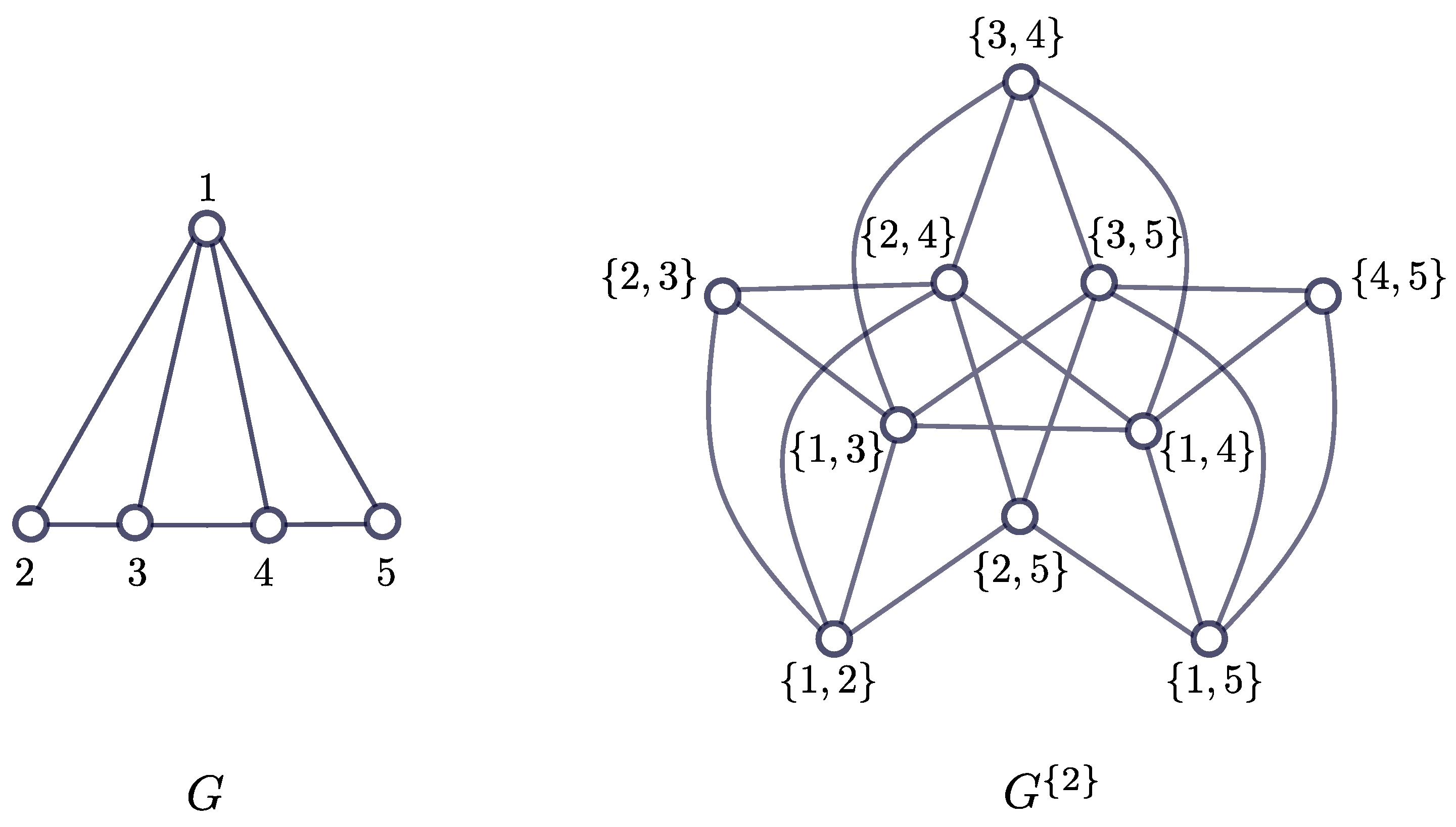
1.2. Basic Definitions and Results
2. Proof of Theorem 1
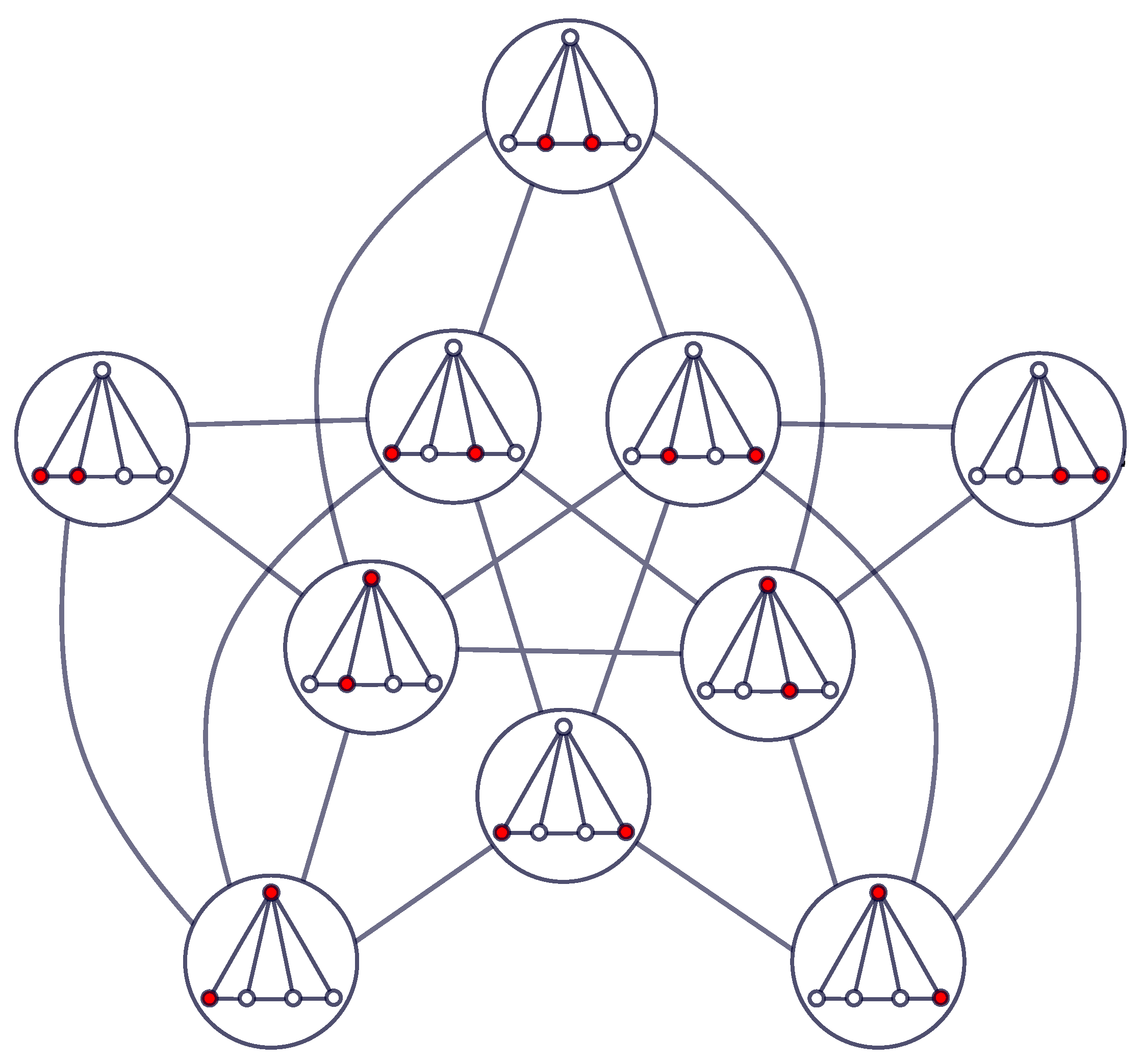
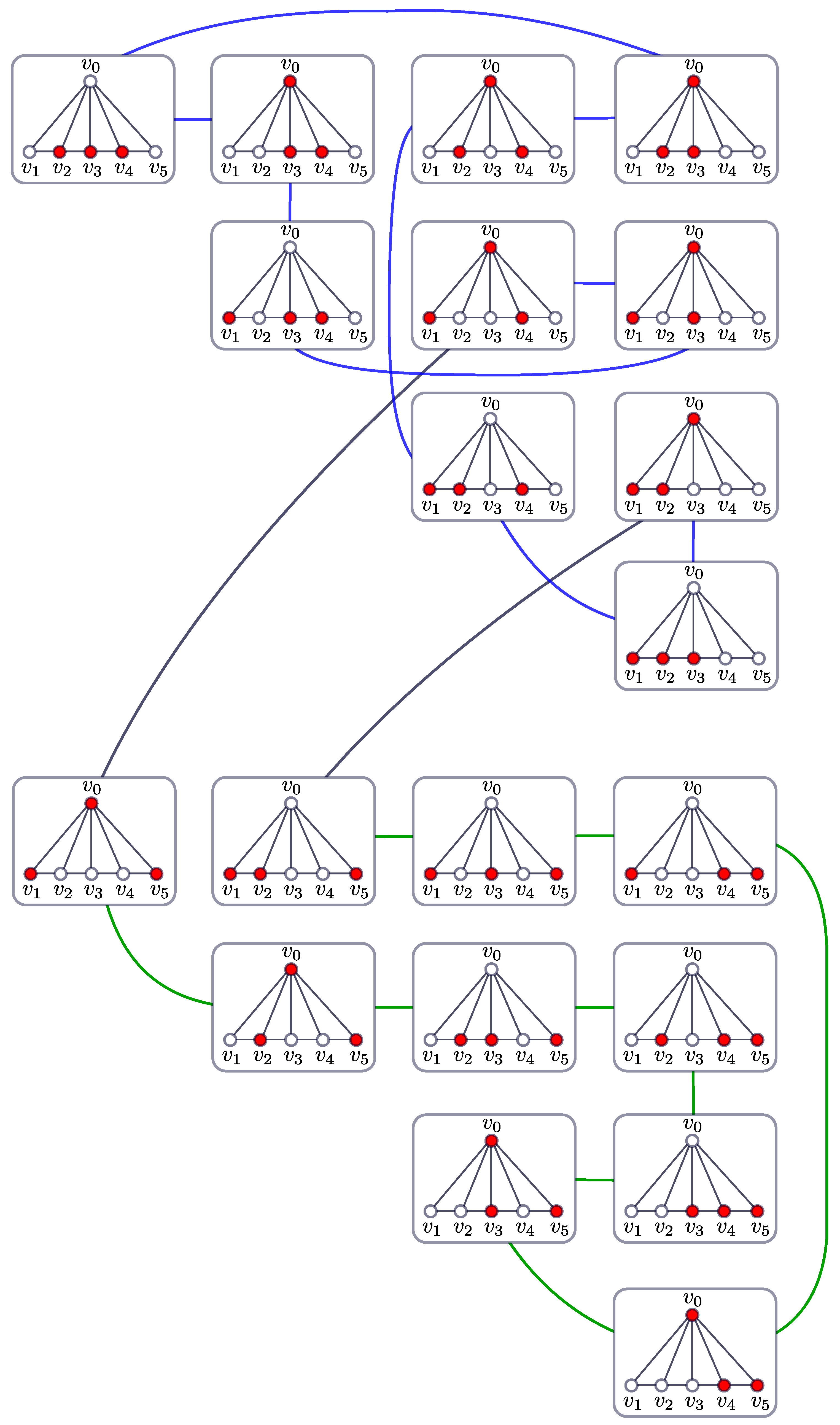
- CaseFor we have , and so is Hamiltonian. Now we work the case . For letand let . It is clear that every is a path in and that is a partition of .LetWe are going to show that C is a Hamiltonian cycle of . Suppose that n is even, soFor i odd, the final vertex of is , while the initial vertex of is , and since these two vertices are adjacent in , the concatenation corresponds to a path in . Similarly, for i even, the final vertex of is while the initial vertex of is , so again, the concatenation corresponds to a path in . We also note that the unique vertex of is , which is adjacent to . As the initial vertex of is , we have that C is a cycle in . As an example, in Figure 3 we show the Hamiltonian cycle C in , which is constructed as above.The proof for n odd is analogous.
- CaseLet C be the cycle defined in the previous case depending on the parity of n. Letbe the path obtained from C by deleting the edge between and . For letWe can observe that after , the vertices in the path follows the pattern , from to 1. For letwhere the sums are taken mod with the convention that . In this case, the vertices in after follow the pattern , from to 1.LetLet us show that is a Hamiltonian cycle of . First we show thatis a partition of .
- -
- belongs to , for any with .
- -
- belongs to , for any and .
- -
- belongs to , for any with .
- -
- Consider now the vertices of type , for ,
- *
- belongs to , for any and .
- *
- belongs to , for any and .
- *
- belongs to , for any and .
Thus, is a partition of . Next we show that is a cycle. We observe that- (1)
- induces a path in , for each ;
- (2)
- the final vertex of is , while the initial vertex of is , and these two vertices are adjacent in ;
- (3)
- for i with , the final vertex of is while the initial vertex of is , and these two vertices are adjacent in ; and
- (4)
- the final vertex of is while the initial vertex of is , and these two vertices are adjacent in .
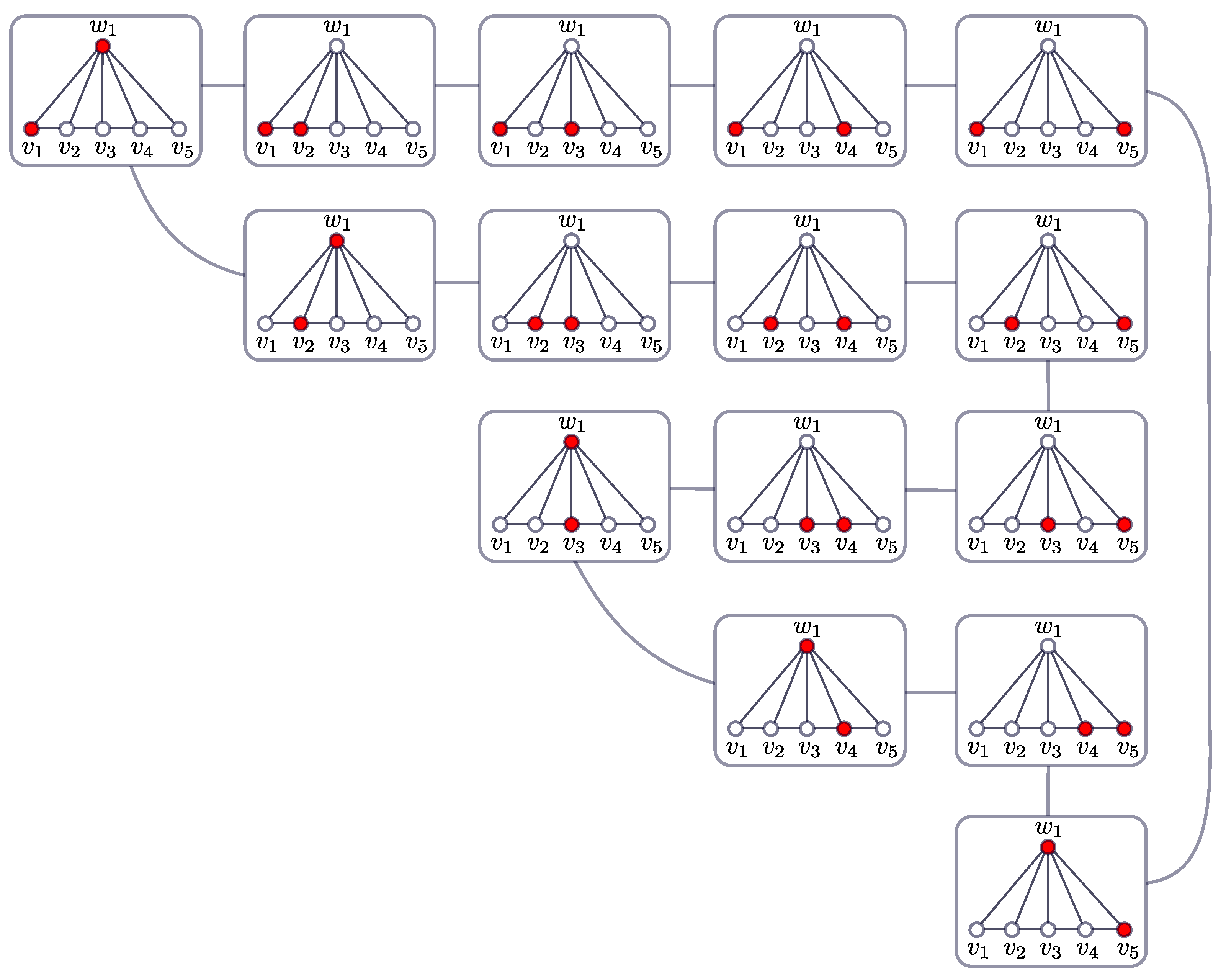
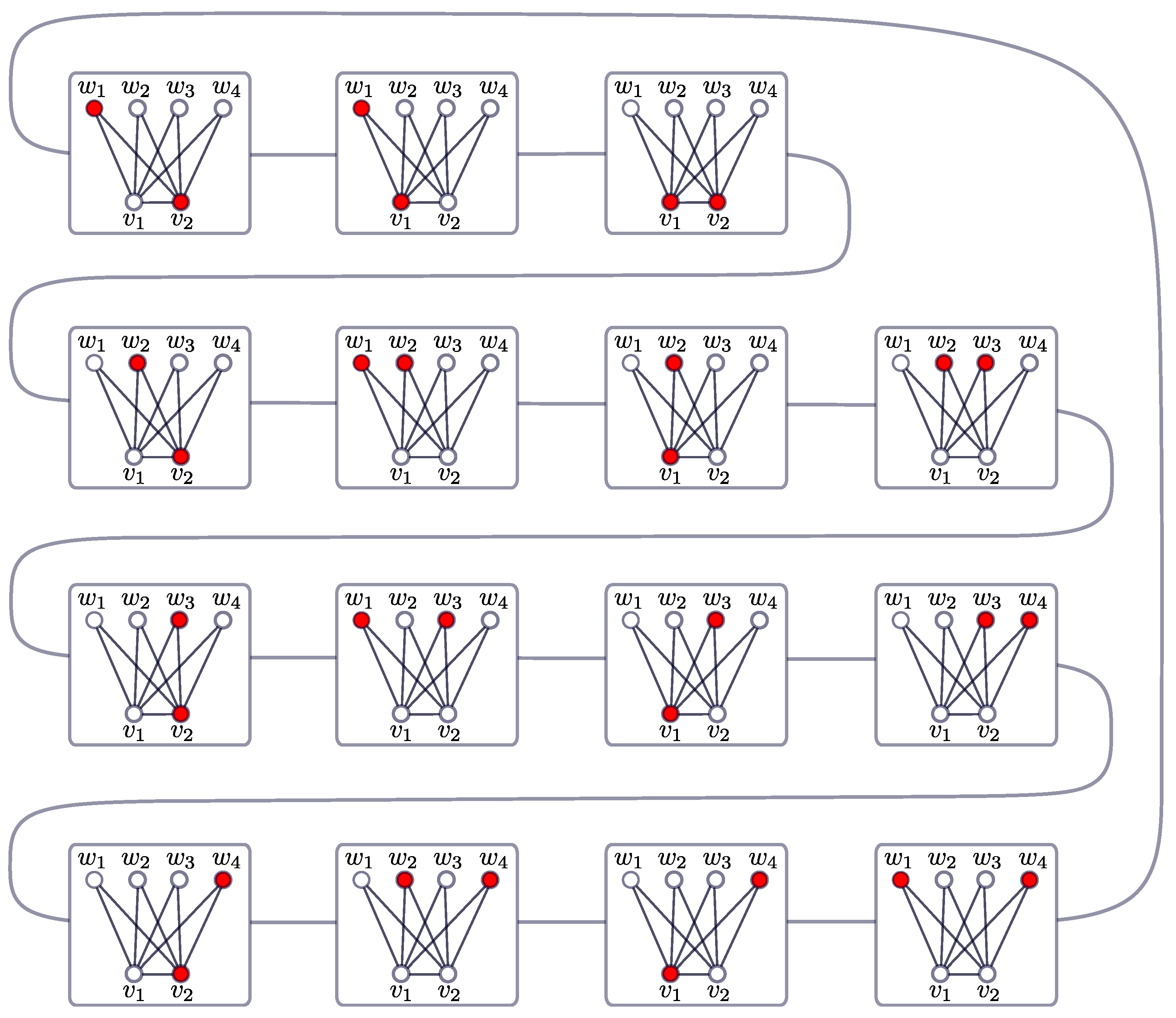
Statements (1)–(4) together imply that is a cycle in . Thus, is a Hamiltonian cycle of . Note that the vertices and are adjacent in , since they are adjacent in .As an example, in Figure 4 we show the Hamiltonian cycle in the graph .
- CaseConsider again the paths defined in the previous case and let us modify them slightly in the following way:
- -
- ;
- -
- for , let be the path obtained from by deleting the vertices of type , for each ;
- -
- let be the path obtained from by first interchanging the vertices and from their current positions in , and then deleting the vertices of type , for every .
Given this construction of we have the following:- (A1)
- induces a path in ;
- (A2)
- for the path has the same initial and final vertices as the path , and has the same initial vertex as , and its final vertex is ;
- (A3)
- since we have deleted only the vertices of type from to obtain , for each and , it follows that is a partition of .
By (A1) and (A2) we can concatenate the paths into a cycle as follows:and then by (A3) it follows that is a Hamiltonian cycle in . Again, the vertices and are adjacent in since they are adjacent in . - CaseHere, our aim is to show that is not Hamiltonian by using the following known result posed in West’s book [29].
3. Proof of Theorem 2
- is odd:
- (1)
- the final vertex of is the vertex , while the initial vertex of is the vertex , and these two vertices are adjacent in ;
- (2)
- for i with , the final vertex of is the vertex , while the initial vertex of is the vertex , and these two vertices are adjacent in ;
- (3)
- for i with , the final vertex of is , while the initial vertex of is , and these two vertices are adjacent in ;
- (4)
- finally, the final vertex of is the vertex while the initial vertex of is the vertex , and these two vertices are adjacent in .
- is even:
- (i)
- is a Hamiltonian cycle of , where the vertices and are adjacent in ;
- (ii)
- is a Hamiltonian cycle of , where the vertices and are adjacent in .
4. A Relationship between Gray Codes for Combinations and the Hamiltonicity of Token Graphs
- (1)
- The transposition condition: two k-subsets are close if they differ in exactly two elements. Example: and are close, while and are not.
- (2)
- The adjacent transposition condition: two k-subsets are close if they differ in exactly two consecutive elements i and . Example: and are close, while and are not.
- (3)
- The one or two apart transposition condition: two k-subsets are close if they differ in exactly two elements i and j, with . Example: and are close, while and are not.
5. Conclusions
- 1.
- To find other families of graphs with Hamiltonian k-token graphs.
- 2.
- Given two graphs G and H, consider the Cartesian product of G and H. To study the Hamiltonicity of in terms of the Hamiltonicity of G and H. Similarly for other products of graphs as the corona of two graphs.
- 3.
- For , to find the smallest Hamiltonian graph G for which is Hamiltonian.
Author Contributions
Funding
Institutional Review Board Statement
Informed Consent Statement
Data Availability Statement
Acknowledgments
Conflicts of Interest
References
- Johnson, S.M. A new upper bound for error-correcting codes. IRE Trans. Inform. Theory 1962, 8, 203–207. [Google Scholar] [CrossRef] [Scilit]
- Alavi, Y.; Behzad, M.; Simpson, J.E. Planarity of double vertex graphs. In Graph Theory, Combinatorics, Algorithms, and Applications; SIAM: Philadelphia, PA, USA, 1991; pp. 472–485. [Google Scholar]
- Alavi, Y.; Behzad, M.; Erdös, P.; Lick, D.R. Double vertex graphs. J. Comb. Inform. Syst. Sci. 1991, 16, 37–50. [Google Scholar]
- Alavi, Y.; Lick, D.R.; Liu, J. Survey of double vertex graphs. Graphs Comb. 2002, 18, 709–715. [Google Scholar] [CrossRef] [Scilit]
- Alavi, Y.; Lick, D.R.; Liu, J. Hamiltonian cycles in double vertex graphs of bipartite graphs. Congr. Numer. 1993, 93, 65–72. [Google Scholar]
- Zhu, B.; Liu, J.; Lick, D.R.; Alavi, Y. n-Tuple vertex graphs. Congr. Numer. 1992, 89, 97–106. [Google Scholar]
- Audenaert, K.; Godsil, C.; Royle, G.; Rudolph, T. Symmetric squares of graphs. J. Comb. Theory B 2007, 97, 74–90. [Google Scholar] [CrossRef] [Scilit]
- Rudolph, T. Constructing physically intuitive graph invariants. arXiv 2002, arXiv:quant-ph/0206068. [Google Scholar]
- Fischbacher, C. A Schrödinger operator approach to higher spin XXZ systems on general graphs. Analytic Trends in Mathematical Physics. Contemp. Math. 2020, 741, 83–103. [Google Scholar]
- Fischbacher, C.; Stolz, G. Droplet states in quantum XXZ spin systems on general graphs. J. Math. Phys. 2018, 59, 051901. [Google Scholar] [CrossRef] [Scilit]
- Ouyang, Y. Computing spectral bounds of the Heisenberg ferromagnet from geometric considerations. J. Math. Phys. 2019, 60, 071901. [Google Scholar] [CrossRef] [Scilit]
- Fabila-Monroy, R.; Flores-Peñaloza, D.; Huemer, C.; Hurtado, F.; Urrutia, J.; Wood, D.R. Token graphs. Graph Comb. 2012, 28, 365–380. [Google Scholar] [CrossRef] [Scilit]
- Carballosa, W.; Fabila-Monroy, R.; Leaños, J.; Rivera, L.M. Regularity and planarity of token graphs. Discuss. Math. Graph Theory 2017, 37, 573–586. [Google Scholar] [CrossRef] [Scilit]
- Dalfó, C.; Duque, F.; Fabila-Monroy, R.; Fiol, M.A.; Huemer, C.; Trujillo-Negrete, A.L.; Zaragoza Martínez, F.J. On the Laplacian spectra of token graphs. Linear Algebra Appl. 2021, 625, 322–348. [Google Scholar] [CrossRef] [Scilit]
- Deepalakshmi, J.; Marimuthu, G. Characterization of token graphs. J. Eng. Technol. 2017, 6, 310–317. [Google Scholar]
- Deepalakshmi, J.; Marimuthu, G.; Somasundaram, A.; Arumugam, S. On the 2-token graph of a graph. AKCE Int. J. Graphs Comb. 2020, 17, 265–268. [Google Scholar] [CrossRef] [Scilit]
- Fabila-Monroy, R.; nos, J.L.; Trujillo-Negrete, A.L. On the Connectivity of Token Graphs of Trees. arXiv 2020, arXiv:2004.14526. [Google Scholar]
- Gómez-Soto, J.M.; Leaños, J.; Ríos-Castro, L.M.; Rivera, L.M. The packing number of the double vertex graph of the path graph. Discret. Appl. Math. 2018, 247, 327–340. [Google Scholar] [CrossRef] [Scilit]
- Leaños, J.; Ndjatchi, M.K. The edge-connectivity of token graphs. Graphs Comb. 2021, 37, 1013–1023. [Google Scholar] [CrossRef] [Scilit]
- Leaños, J.; Trujillo-Negrete, A.L. The connectivity of token graphs. Graphs Comb. 2018, 34, 777–790. [Google Scholar] [CrossRef] [Scilit]
- De Alba, H.; Carballosa, W.; Leaños, J.; Rivera, L.M. Independence and matching number of some token graphs. Australas. J. Comb. 2020, 76, 387–403. [Google Scholar]
- Shang, Y. On the Hamiltonicity of random bipartite graphs. Indian J. Pure Appl. Math. 2015, 46, 163–173. [Google Scholar] [CrossRef] [Scilit]
- Garey, M.R.; Johnson, D.S. Computers and Intractability: A Guide to the Theory of NP-Completeness; W. H. Freeman: San Francisco, CA, USA, 1979. [Google Scholar]
- Alhevaz, A.; Baghipur, M.; Ganie, H.A.; Shang, Y. The Generalized Distance Spectrum of the Join of Graphs. Symmetry 2020, 12, 169. [Google Scholar] [CrossRef] [Scilit]
- Carballosa, W.; Rodríguez, J.M.; Sigarreta, J.M. Hyperbolicity in the corona and join of graphs. Aequ. Math. 2015, 89, 1311–1327. [Google Scholar] [CrossRef] [Scilit]
- Hernández, J.C.; Rodríguez, J.M.; Sigarreta, J.M. Mathematical Properties of the Hyperbolicity of Circulant Networks. Adv. Math. Phys. 2015, 2015, 723451. [Google Scholar] [CrossRef] [Scilit]
- Angeles-Canul, R.J.; Norton, R.M.; Opperman, M.C.; Paribello, C.C.; Russel, M.C.; Tamon, C. Quantum Perfect State Transfer on Weighted Join Graphs. Int. J. Quantum Inf. 2009, 7, 1429–1445. [Google Scholar] [CrossRef] [Scilit]
- Rivera, L.M.; Trujillo-Negrete, A.L. Hamiltonicity of token graphs of fan graphs. Art Discr. Appl. Math. 2018, 1, #P07. [Google Scholar] [CrossRef] [Scilit]
- West, D.B. Introduction to Graph Theory, 2nd ed.; Pearson Education: Singapore, 2001. [Google Scholar]
- Baylis, J. Knotted doughnuts and other mathematical entertainments, by Martin Gardner. Math. Gaz. 1987, 71, 353. [Google Scholar] [CrossRef] [Scilit]
- Ruskey, F. Combinatorial Generation; Preliminary Working Draft; University of Victoria: Victoria, BC, Canada, 2003. [Google Scholar]
- Savage, C. A survey of combinatorial Gray codes. SIAM Rev. 1997, 39, 605–629. [Google Scholar] [CrossRef] [Scilit]
Publisher’s Note: MDPI stays neutral with regard to jurisdictional claims in published maps and institutional affiliations. |
© 2021 by the authors. Licensee MDPI, Basel, Switzerland. This article is an open access article distributed under the terms and conditions of the Creative Commons Attribution (CC BY) license (https://creativecommons.org/licenses/by/4.0/).
Share and Cite
Adame, L.E.; Rivera, L.M.; Trujillo-Negrete, A.L. Hamiltonicity of Token Graphs of Some Join Graphs. Symmetry 2021, 13, 1076. https://doi.org/10.3390/sym13061076
Adame LE, Rivera LM, Trujillo-Negrete AL. Hamiltonicity of Token Graphs of Some Join Graphs. Symmetry. 2021; 13(6):1076. https://doi.org/10.3390/sym13061076
Chicago/Turabian StyleAdame, Luis Enrique, Luis Manuel Rivera, and Ana Laura Trujillo-Negrete. 2021. "Hamiltonicity of Token Graphs of Some Join Graphs" Symmetry 13, no. 6: 1076. https://doi.org/10.3390/sym13061076
APA StyleAdame, L. E., Rivera, L. M., & Trujillo-Negrete, A. L. (2021). Hamiltonicity of Token Graphs of Some Join Graphs. Symmetry, 13(6), 1076. https://doi.org/10.3390/sym13061076

