All articles published by MDPI are made immediately available worldwide under an open access license. No special
permission is required to reuse all or part of the article published by MDPI, including figures and tables. For
articles published under an open access Creative Common CC BY license, any part of the article may be reused without
permission provided that the original article is clearly cited. For more information, please refer to
https://www.mdpi.com/openaccess.
Feature papers represent the most advanced research with significant potential for high impact in the field. A Feature
Paper should be a substantial original Article that involves several techniques or approaches, provides an outlook for
future research directions and describes possible research applications.
Feature papers are submitted upon individual invitation or recommendation by the scientific editors and must receive
positive feedback from the reviewers.
Editor’s Choice articles are based on recommendations by the scientific editors of MDPI journals from around the world.
Editors select a small number of articles recently published in the journal that they believe will be particularly
interesting to readers, or important in the respective research area. The aim is to provide a snapshot of some of the
most exciting work published in the various research areas of the journal.
Fuzzy topological topographic mapping () is a mathematical model which consists of a set of homeomorphic topological spaces designed to solve the neuro magnetic inverse problem. A sequence of FTTM, , is an extension of FTTM that is arranged in a symmetrical form. The special characteristic of , namely the homeomorphisms between its components, allows the generation of new . The generated s can be represented as pseudo graphs. A graph of pseudo degree zero is a special type of graph where each of the components differs from the one adjacent to it. Previous researchers have investigated and conjectured the number of generated pseudo degree zero with respect to n number of components and k number of versions. In this paper, the conjecture is proven analytically for the first time using a newly developed grid-based method. Some definitions and properties of the novel grid-based method are introduced and developed along the way. The developed definitions and properties of the method are then assembled to prove the conjecture. The grid-based technique is simple yet offers some visualization features of the conjecture.
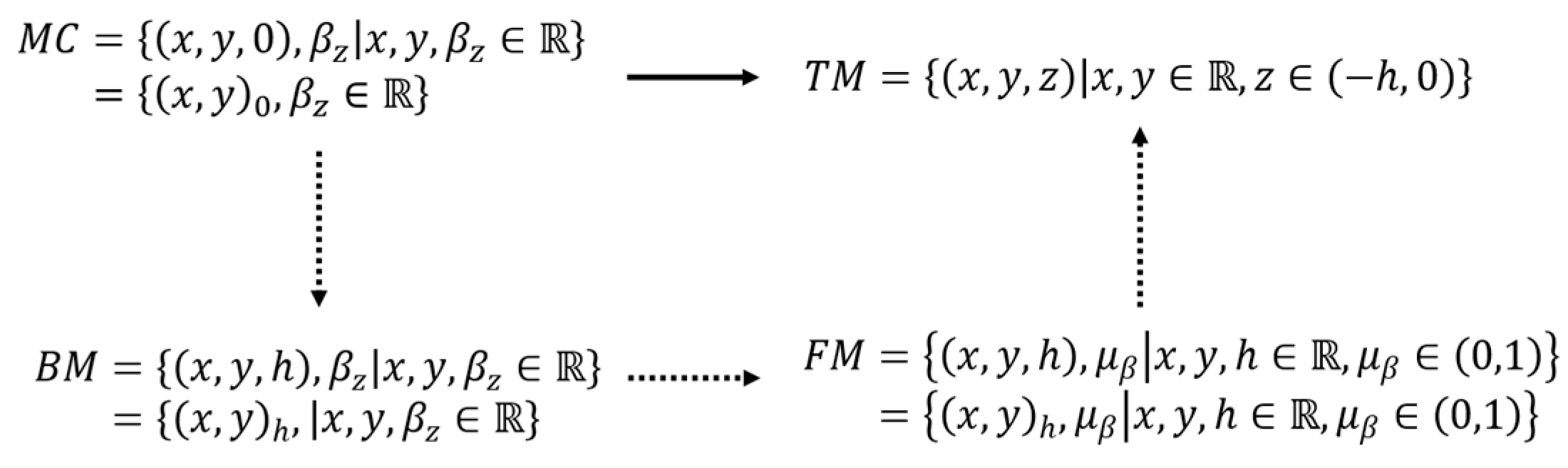
Fuzzy topographic topological mapping (FTTM) [1] was introduced to solve the neuro magnetic inverse problem, particularly with regards to the sources of electroencephalography (EEG) signals recorded from epileptic patients. Originally, the model was a 4-tuple of topological spaces and mappings. The topological spaces are the magnetic plane (MC), base magnetic plane (BM), fuzzy magnetic field (FM) and topographic magnetic field (TM). The third component of FTTM, FM, is a set of three tuples with the membership function of its potential reading obtained from a recorded EEG. FTTM is defined formally as follows (see Figure 1).
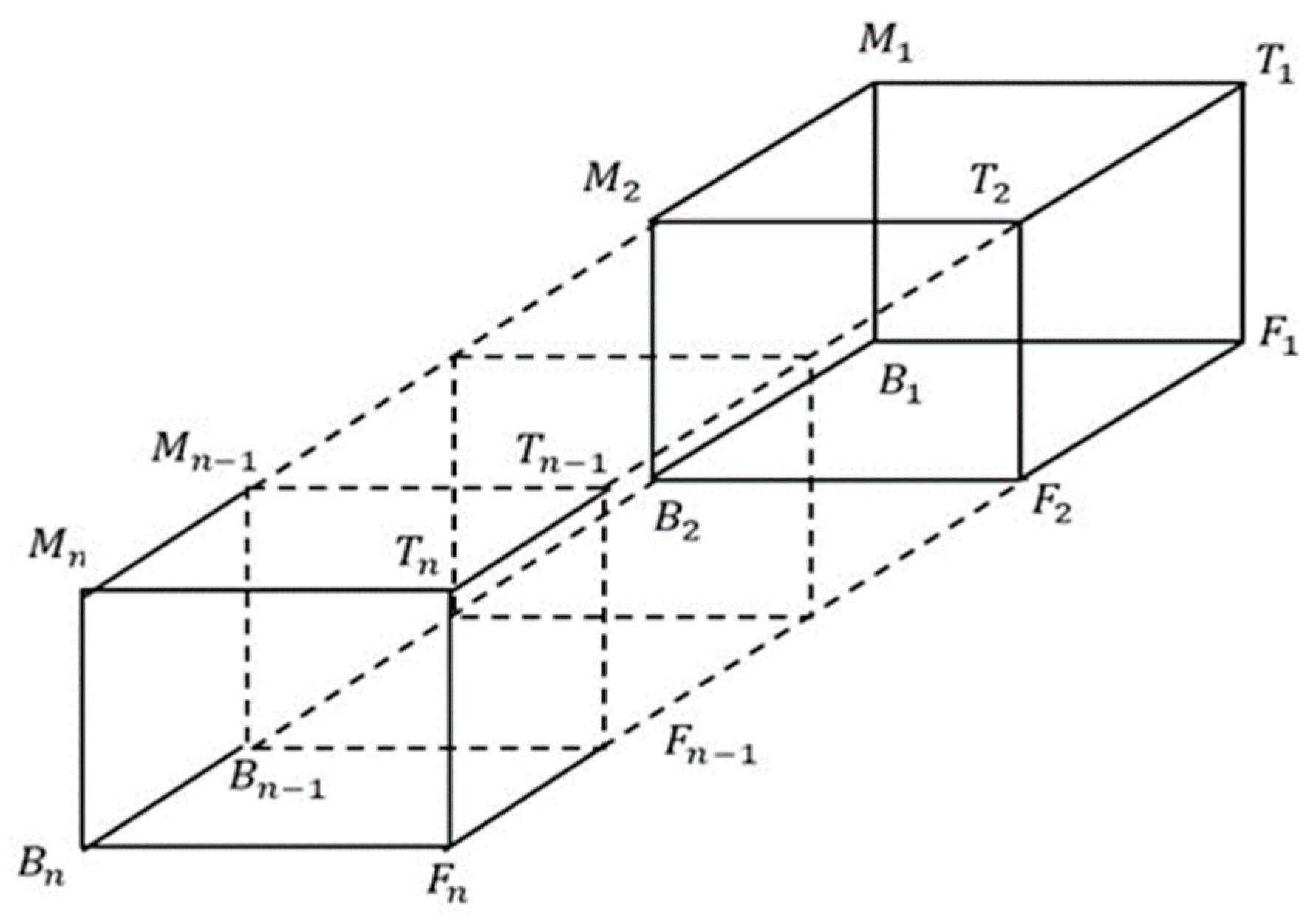
Furthermore, a sequence of FTTM, , is an extension of FTTM and illustrated in Figure 2. It is arranged in a symmetrical form, since the model can accommodate magnetoencephalography (MEG) signals as well as image data due to its homeomorphism.
2. Generalized FTTM
Generally, the FTTM structure can also be expanded for any n number of components.
The same generalization can be applied to any k number of versions as well, denoted as . Without the loss of generality, the collection of the version of is now simply called as a sequence of unless otherwise stated.
Definition3.
Ref. [2] A sequence ofversions ofdenoted bysuch that
where is the first version of , theis the second version ofand so forth.
Obviously, a new can be generated from a combination of components from different versions of due to their homeomorphisms.
A set of elements generated by is denoted by . Mukaram et al. [2] showed that the number of can be determined from using the geometrical features of its graph representation.
Theorem1.
Ref. [2] The number of generatedthat can be created fromis
Theorem 1 is then extended to include number of components.
Theorem2.
Ref. [2] The number of generated FTTM that can be created fromis
The following example is presented to illustrate Theorem 2.
Example1.
Consider, withand, thenthat isas given by Theorem 2.
3. Extended Generalization of FTTM
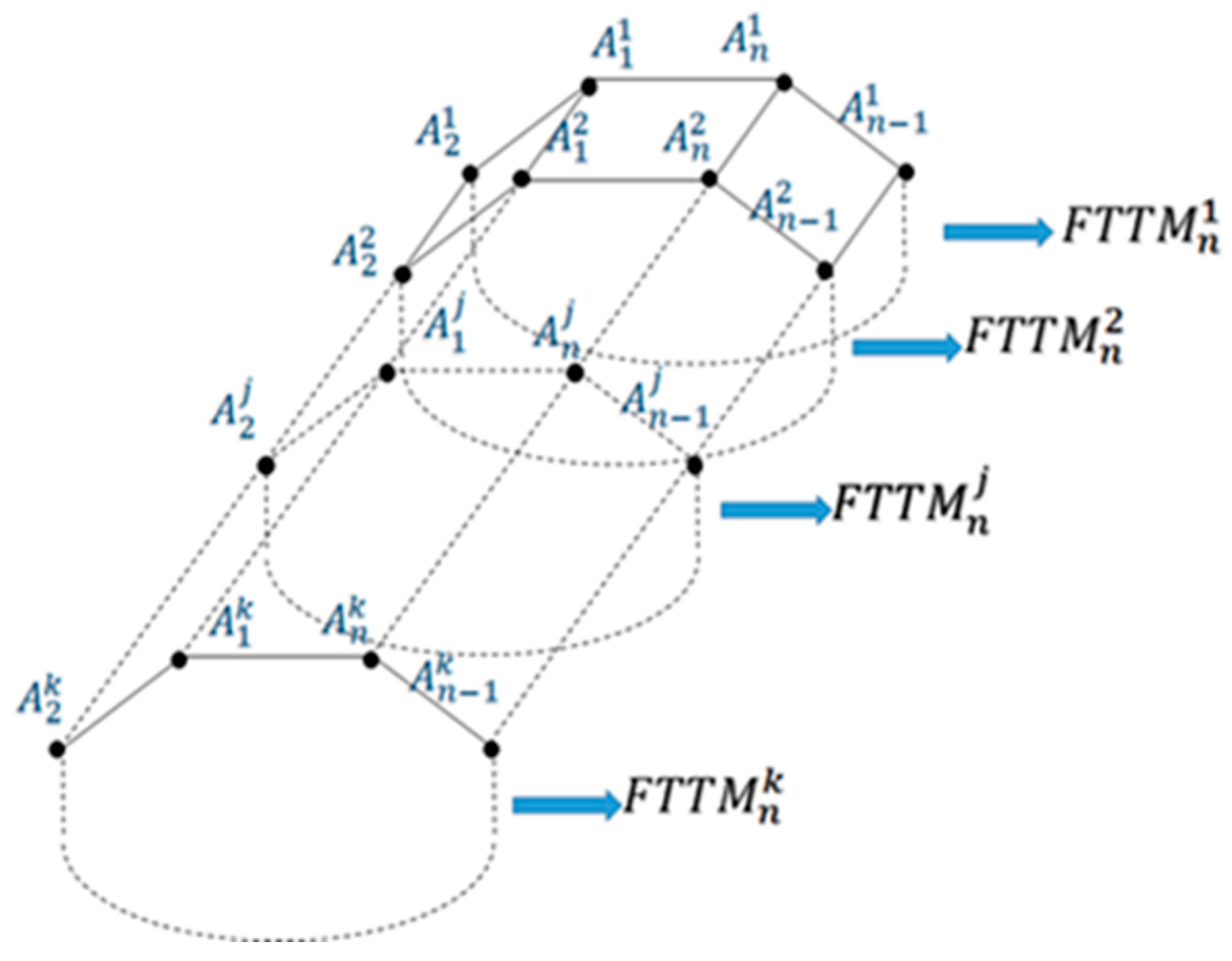
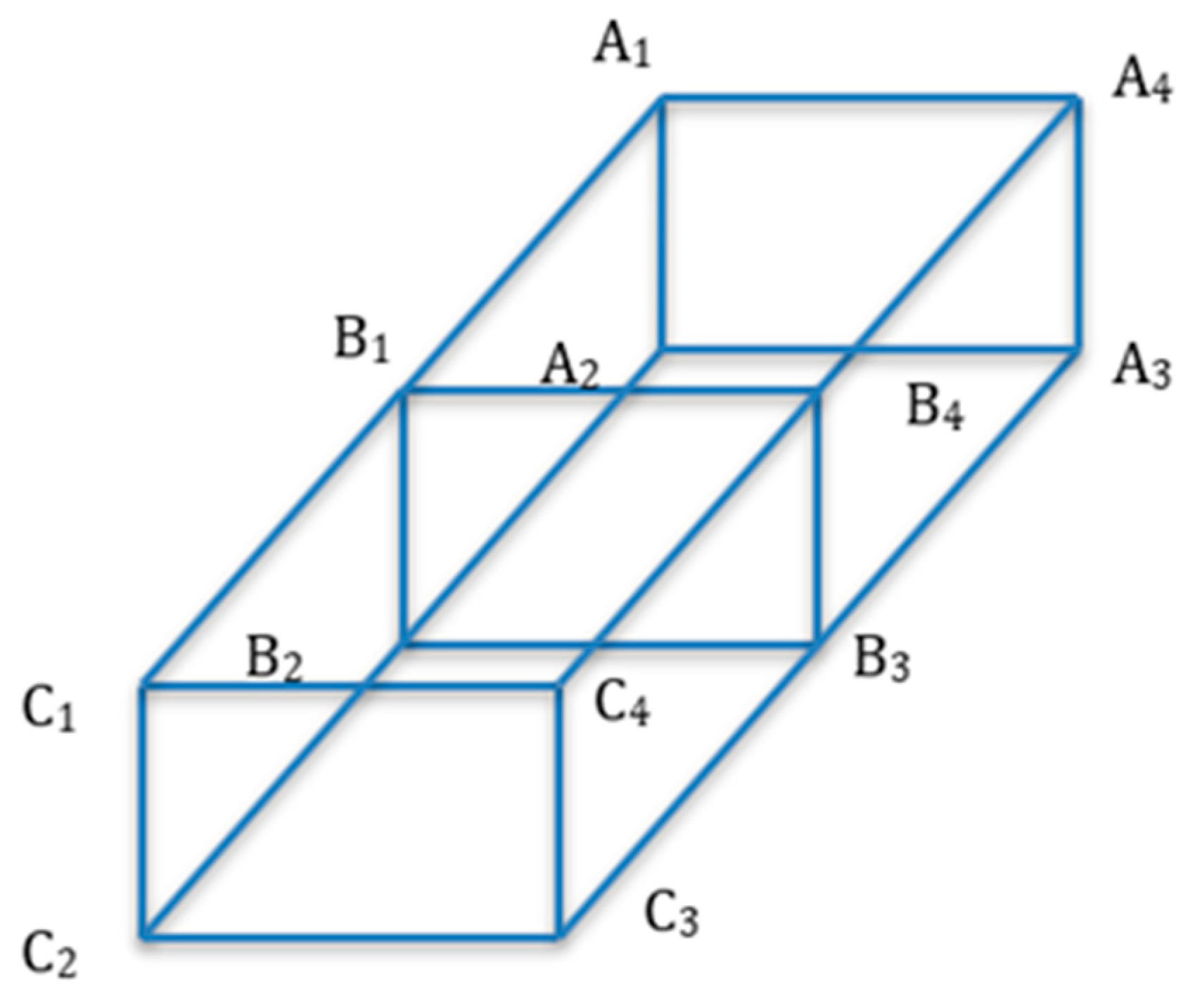
There are many studies on ordinary and fuzzy hypergraphs available in the literature such as [3,4]. However, is an extended generalization of FTTM that is represented by a graph of a sequence of number of polygons with sides or vertices. The polygon is arranged from back to front where the first polygon represents , the second polygon represents and so forth. An edge is added to connect to the component wisely. A similar approach is taken for , and the rest (Figure 3).
When a new
is obtained from
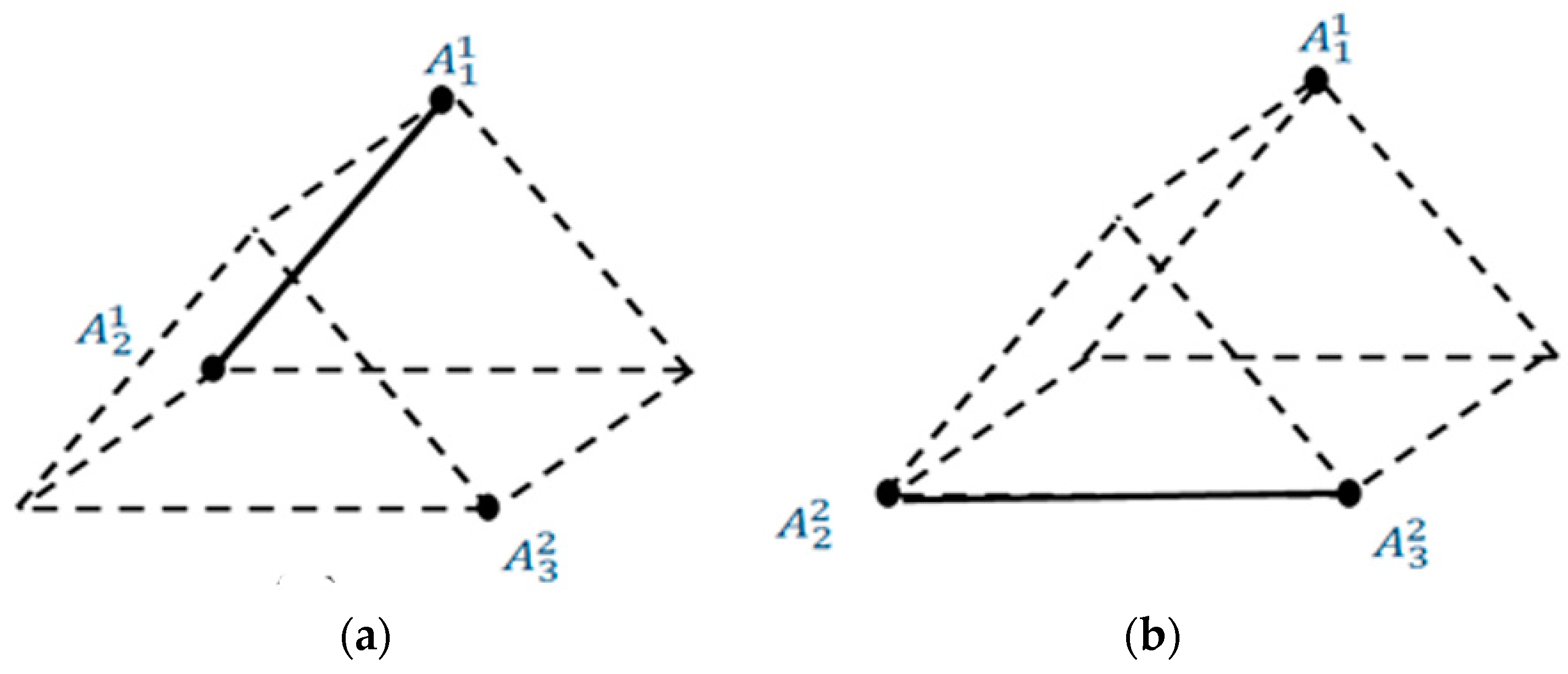
, it is then called a pseudo-graph of the generated and plotted on the skeleton of . A generated element of a pseudo-graph consists of vertices that signify the generated and edges which connect the incidence components. Two samples of pseudo-graphs are illustrated in Figure 4.
Another concept related closely to the pseudo-graph is the pseudo degree. It is defined as the sum of the pseudo degree from each component of the . The pseudo degree of a component is the number of other components that are adjacent to that particular component.
Definition5.
Ref. [2] Thedefines the pseudo degree of thecomponent. It maps a component ofto an integer
for.
Definition6.
Ref. [2] Thedefines the pseudo degree of thegraph. Let
where.
Definition7.
Ref. [2] The set of elements generated bythat have pseudo degree zero is
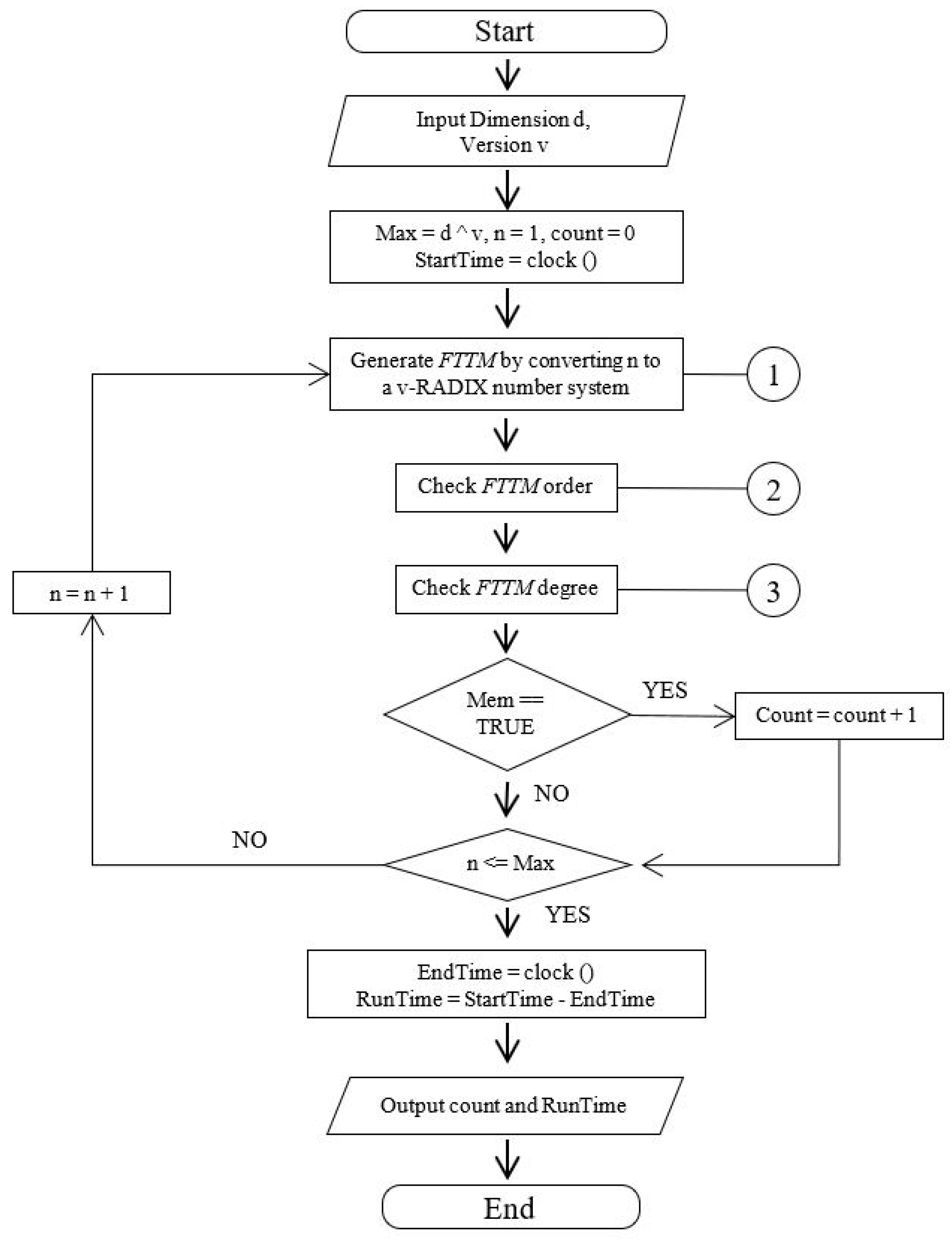
In order to observe some patterns that may appear from the proposed conjecture, Mukaram et al. [2] have developed an algorithm to compute in order to prove the conjecture analytically. A flowchart on is sampled in Figure 6.
The researchers generated all combinations for , and were able to isolate graphs with pseudo degree zero, which are listed below (Table 1).
The researchers then simulated for some values of k as well [2]. The number of graphs of pseudo degree zero for and are listed in Table 2.
4. Grid of FTTM
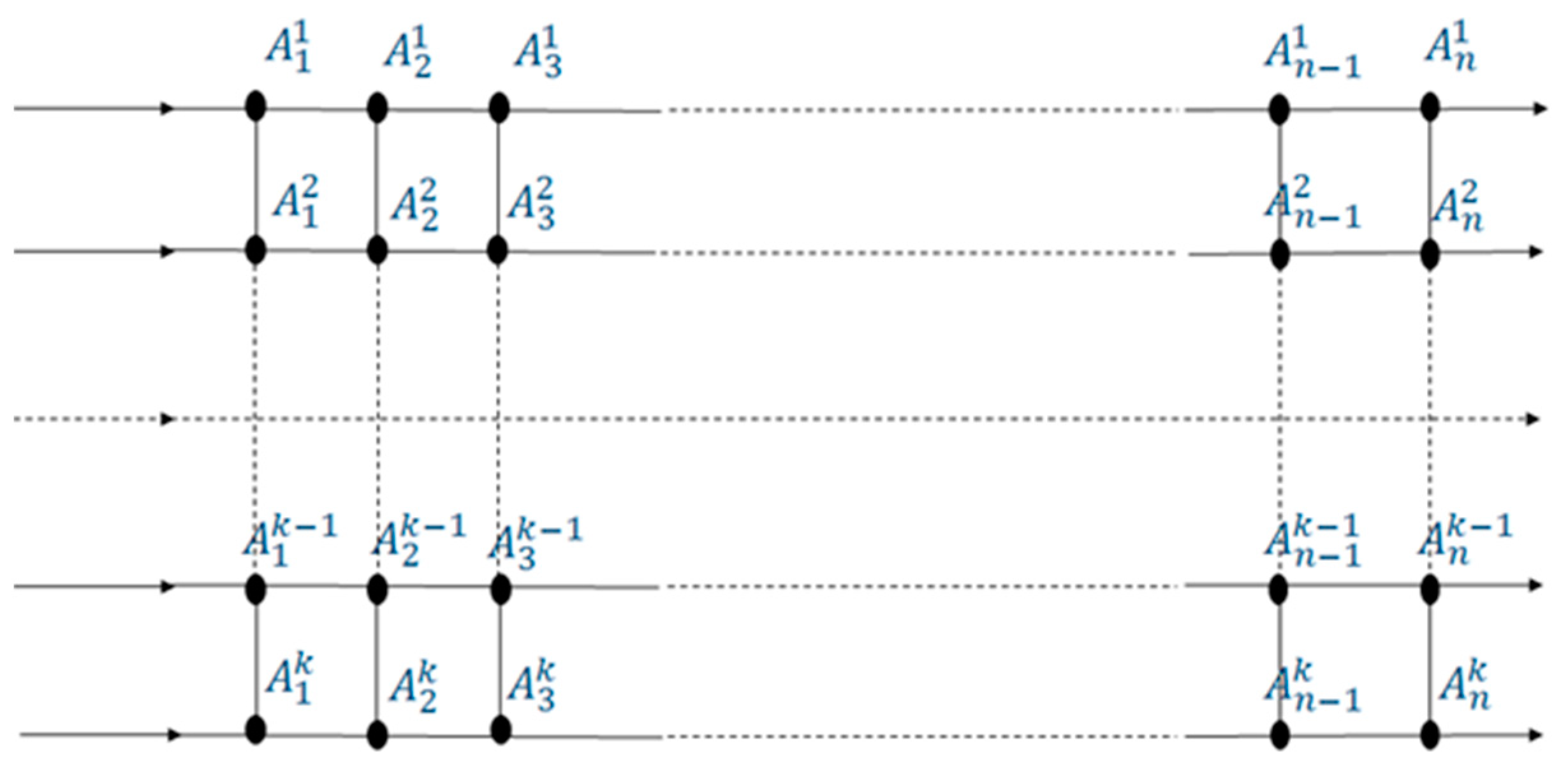
An alternative presentation of a sequence of , called an FTTM grid, is briefly overviewed. It provides a different perspective of the structure of . Instead of a polygon representation for each version of , a straight line is now used. The components of are arranged on a horizontal line of vertices and the lines represent the homeomorphisms between the components of . The only exception is the homeomorphism between the first and last components of and , respectively. Two open segments on the left of and on the right of are used to represent the homeomorphism between them. A vertical line is added to represent a homeomorphism between two components of different versions; hence, a grid is created (see Figure 7).
There are four advantages when FTTM is represented as a grid instead of a sequence of polygon.
It is represented in two dimensions; therefore, it reduces the complexity of the structure.
The process of adding a new component is easier than in a sequence of polygon.
It can take any number of components by adding the number of vertices at the end of the grid.
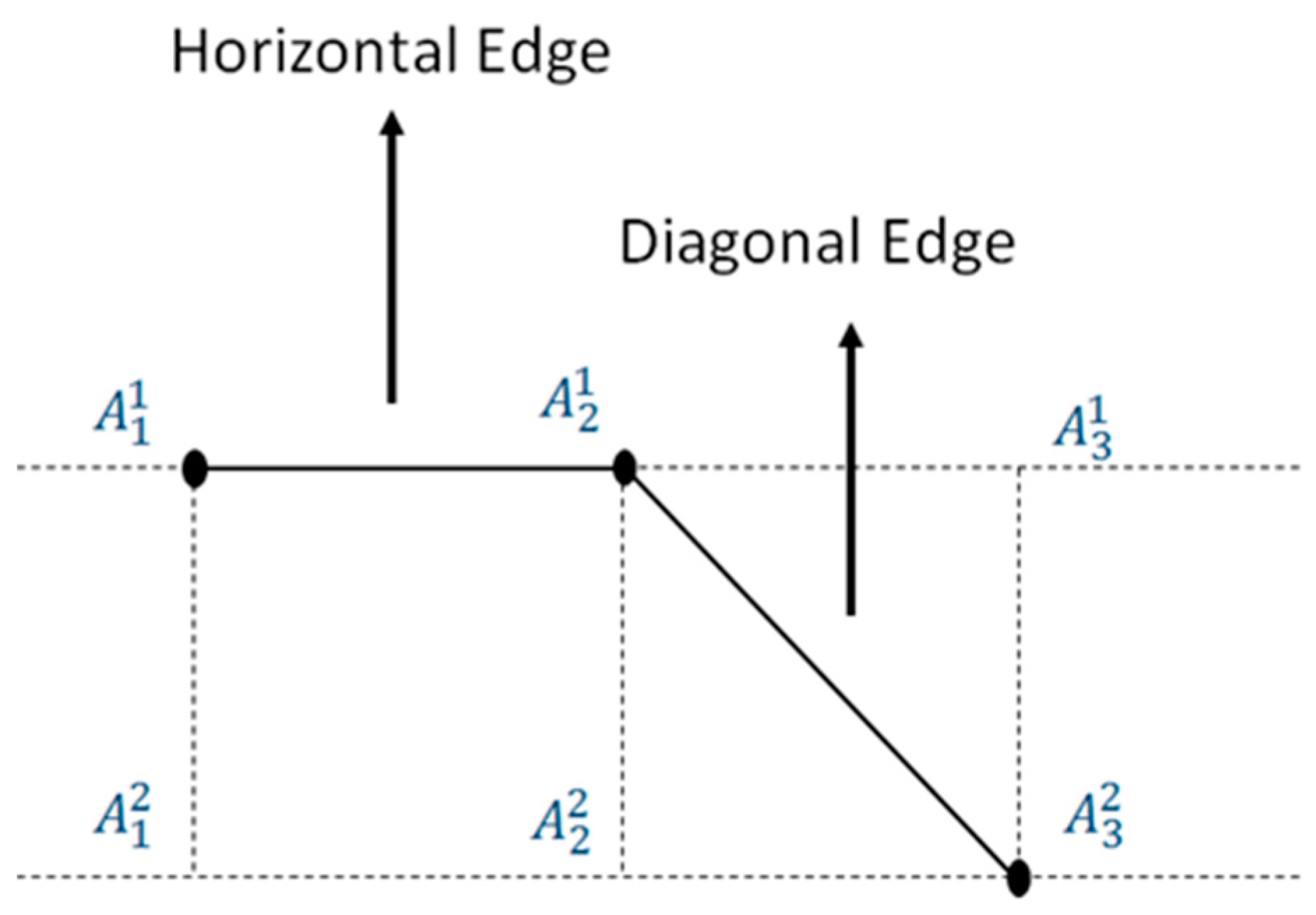
The homeomorphism between two components of the same version is presented as a horizontal edge, whereas the homeomorphism between two components of two different versions is represented by a diagonal edge (see Figure 8). These arrangements are necessary to produce the graph of pseudo degree zero.
Furthermore, Zilullah et al. [2] introduced some operations and properties with respect to the FTTM grid. They are recalled, summarized and listed below for convenience. Then, we will move on to the next main section of the paper wherein Conjecture 1 is finally proven as a theorem.
Definition8.
Letand. A block
, whereis defined as
is the set of FTTM blocks that can be generated from .
Definition9.
The functionis defined asfor,
for, where.
Definition10.
The operationis a mappingsuch that
whenand, then.
Definition11.
An indexedis defined as
A generated is then divided into blocks of three components. A set of blocks is defined as follows.
Definition12.
A set of blocksis defined as
Since this study is concerned with graphs of pseudo degree zero, the sets that need to be taken into consideration are the ones with diagonal paths, namely, .
Lemma1.
Letand. For any, , thenifis connected toandby a diagonal path.
Theorem3.
If, whereis the set of generateds with a diagonal path, then.
Corollary1.
The element ofhas apath with the following properties:
All the edges connecting the path are diagonal.
The starting and the end points of the path belong to different versions of FTTM.
Theorem4.
If, then all the paths forare diagonals.
Proposition1.
If, then.
Lemma2.
If, thensuch thatand.
Lemma3.
If, thenunique tuplesuch thatand.
Theorem5.
Ifand, then.
Lemma4.
Lemma5.
for anyand.
Theorem6.
5. The Theorem
All the materials laid down in previous sections are assembled to produce the analytical proof of Conjecture 1. The first step is to find since is a subset of by Theorem 2.
Theorem7.
ProofofTheorem7.
(By mathematical induction)
Let
For odd numbers,
There are exactly 12 combinations, namely
Now assume is true with
for .
By using Theorem 4, such that
By using Theorem 5,
The set can be constructed from where and . There are four options for , namely . Hence,
The same process can be applied to and . Thus,
Similarly, the same induction process can be used as proof for even parts. □
The set has only two possible subsets, namely and . To find , the relation between , and must be investigated.
Lemma6.
If, then
ProofofLemma6.
Let , then or by Theorem 5. Thus, or , i.e., or . □
Finally, is determined using Lemma 6 and Theorem 5.
Theorem8.
ProofofTheorem8.
By Theorem 5, can be determined by the combination of where . By Theorem 4, all edges must be diagonal; hence, . There are two possibilities for the value of , namely or , where from Theorem 3. Case : if , then which implies or by Corollary 1.
Let , , then for any , then and also for any , then by Corollary 1. Thus, for , there are combinations of tuple .
If , then when and by Corollary 1. Thus, there are combinations of tuple Hence, . Using the same procedure as for , the same result can be obtained for . □
Theorem9.
where,.
ProofofTheorem9.
Using Theorem 6, . From Theorem 8 and Lemma 6,
Hence by Theorem 7,
such that . □
Theorem 9 is another version of the earlier conjecture. A simple algebraic manipulation is needed to show their equivalence. We formally state and prove this as the final theorem.
Theorem10.
where,.
ProofofTheorem10.
By Theorem 9,
and , .
However, when n is odd,
Thus, .
Notice that
When n is even,
Thus, .
Notice that,
It shows that the equation in Theorem 9 is exactly the statement of the conjecture. In other words, the conjecture is proven by construction. □
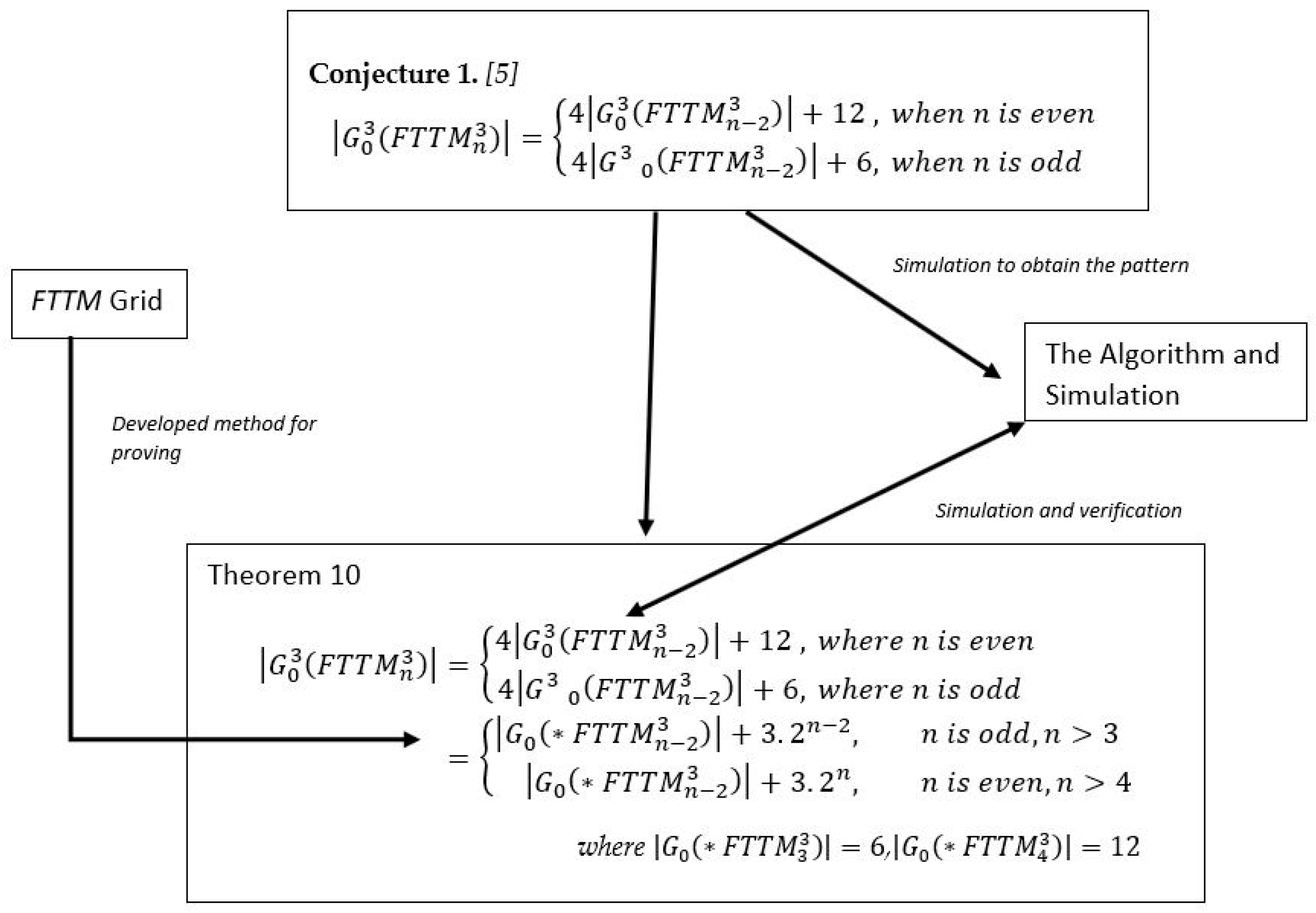
The whole process of proving Conjecture 1 is summarized below in Figure 9.
6. Conclusions
The developed grid-based method of proof is new; some definitions and properties were introduced, whereas others were investigated along the way. The originality and advantages of this method can be summarized in the point forms below.
It provides a different perspective to the structure of . Instead of a polygon representation for each version of , a straight line is now used. The components of are arranged on a horizontal line of vertices and the lines represent the homeomorphisms between the components of .
A vertical line is added to represent a homeomorphism between two components of different versions; hence, a grid is created.
It is represented in two dimensions; therefore, it reduces the complexity of the structure.
The process of adding a new component is easier than in a sequence of polygon.
It can take any number of components by adding the number of vertices at the end of the grid.
The homeomorphism between two components of the same version is presented as a horizontal edge, whereas the homeomorphism between two components of two different versions is represented by a diagonal edge (see Figure 8).
This grid-based technique offers an edge in proving the conjecture; in particular, it enables one to visualize a given problem in a 2-dimensional space.
Finally, the conjecture that spells the number of the generated FTTM graph of pseudo degree zero with respect to n number of components and k number of versions is proven analytically for the first time using this method.
However, the lengthy computing time for simulation needs to be resolved for larger k and n, accordingly. This may be overcome by employing parallel computing, and the grid-based technique can be very handy for such enumerative combinatorics problems in the near future.
Author Contributions
Conceptualization, M.Z.M. and T.A.; methodology, M.Z.M.; software, N.A.; formal analysis, M.Z.M. and N.A.; writing—original draft preparation, M.Z.M. and T.A.; writing—review and editing, N.A.S. and F.M.; Conceptualization, M.Z.M. and T.A.; methodology, M.Z.M.; software, N.A.; formal analysis, M.Z.M. and N.A.; writing—original draft preparation, M.Z.M. and T.A.; writing—review and editing, N.A.S. and F.M.; supervision, T.A. and N.A.; funding acquisition, T.A. and N.A. All authors have read and agreed to the published version of the manuscript.
Funding
This research is supported by the Fundamental Research Grant Scheme (FRGS) FRGS/1/2020/STG06/UTM/01/1 awarded by the Ministry of Higher Education, Malaysia.
Institutional Review Board Statement
Not applicable.
Informed Consent Statement
Not applicable.
Data Availability Statement
No data were used to support this study.
Acknowledgments
Authors acknowledge the support of Universiti Teknologi Malaysia (UTM) and Ministry of Higher Education Malaysia (MOHE) in this work.
Conflicts of Interest
The authors declare no conflict of interest.
Abbreviations
The following abbreviations are used in this manuscript.
BM
Base magnetic plane
EEG
Electroencephalography
FM
Fuzzy magnetic field
FTTM
Fuzzy topological topographic mapping
Sequence of FTTM
MC
Magnetic plane
MEG
Magnetoencephalography
TM
Topographic magnetic field
that have pseudo degree zero
. that have pseudo degree zero
References
Shukor, N.A.; Ahmad, T.; Idris, A.; Awang, S.R.; Fuad, A.A.A. Graph of Fuzzy Topographic Topological Mapping in Relation to k-Fibonacci Sequence. J. Math.2021, 2021, 7519643. [Google Scholar] [CrossRef]
Mukaram, M.Z.; Ahmad, T.; Alias, N. Graph of Pseudo Degree Zero Generated by . In Proceedings of the International Conference on Mathematical Sciences and Technology 2018 (Mathtech2018): Innovative Technologies for Mathematics & Mathematics for Technological Innovation, Penang, Malaysia, 10–12 December 2018; AIP Publishing LLC: Penang, Malaysia, 2019; p. 020007. [Google Scholar] [CrossRef]
Debnath, P. Domination in interval-valued fuzzy graphs. Ann. Fuzzy Math. Inform.2013, 6, 363–370. [Google Scholar]
Konwar, N.; Davvaz, B.; Debnath, P. Results on generalized intuitionistic fuzzy hypergroupoids. J. Intell. Fuzzy Syst.2019, 36, 2571–2580. [Google Scholar]
Elsafi, M.S.A.E. Combinatorial Analysis of N-tuple Polygonal Sequence of Fuzzy Topographic Topological Mapping. Ph.D. Thesis, University Teknologi Malaysia, Skudai, Malaysia, 2014. [Google Scholar]
Figure 1.
The FTTM.
Figure 1.
The FTTM.
Figure 2.
The sequence of .
Figure 2.
The sequence of .
Figure 3.
Graph of .
Figure 3.
Graph of .
Figure 4.
Pseudo graph: (a) ; (b) of .
Figure 4.
Pseudo graph: (a) ; (b) of .
Figure 5.
.
Figure 5.
.
Figure 6.
Flowchart for determining .
Figure 6.
Flowchart for determining .
Figure 7.
A graph representation of as a grid.
Figure 7.
A graph representation of as a grid.
Figure 8.
Generated element on grid.
Figure 8.
Generated element on grid.
Figure 9.
Outline of proving Conjecture 1 by construction.
Figure 9.
Outline of proving Conjecture 1 by construction.
Table 1.
for and .
Table 1.
for and .
n
4
12
24
5
30
120
6
60
480
7
126
1680
8
252
5544
9
510
17,640
10
1020
54,960
11
2046
168,960
12
4092
515,064
13
8190
1,561,560
14
16,380
4,717,440
15
32,766
14,217,840
Table 2.
for and .
Table 2.
for and .
k/n
2
3
4
5
6
7
8
9
10
2
2
0
2
0
2
0
2
0
2
3
0
6
12
30
60
126
252
510
1020
4
0
0
24
120
480
1680
5544
17,640
54,960
5
0
0
0
120
1080
6720
35,280
168,840
763,560
6
0
0
0
0
720
10,080
90,720
665,280
4,339,440
7
0
0
0
0
0
5040
100,800
1,239,840
12,096,000
8
0
0
0
0
0
0
40,320
1,088,640
17,539,200
Publisher’s Note: MDPI stays neutral with regard to jurisdictional claims in published maps and institutional affiliations.
Mukaram, M.Z.; Ahmad, T.; Alias, N.; Shukor, N.A.; Mustapha, F.
Extended Graph of the Fuzzy Topographic Topological Mapping Model. Symmetry2021, 13, 2203.
https://doi.org/10.3390/sym13112203
AMA Style
Mukaram MZ, Ahmad T, Alias N, Shukor NA, Mustapha F.
Extended Graph of the Fuzzy Topographic Topological Mapping Model. Symmetry. 2021; 13(11):2203.
https://doi.org/10.3390/sym13112203
Chicago/Turabian Style
Mukaram, Muhammad Zillullah, Tahir Ahmad, Norma Alias, Noorsufia Abd Shukor, and Faridah Mustapha.
2021. "Extended Graph of the Fuzzy Topographic Topological Mapping Model" Symmetry 13, no. 11: 2203.
https://doi.org/10.3390/sym13112203
APA Style
Mukaram, M. Z., Ahmad, T., Alias, N., Shukor, N. A., & Mustapha, F.
(2021). Extended Graph of the Fuzzy Topographic Topological Mapping Model. Symmetry, 13(11), 2203.
https://doi.org/10.3390/sym13112203
Note that from the first issue of 2016, this journal uses article numbers instead of page numbers. See further details here.
Article Metrics
No
No
Article Access Statistics
For more information on the journal statistics, click here.
Multiple requests from the same IP address are counted as one view.
Mukaram, M.Z.; Ahmad, T.; Alias, N.; Shukor, N.A.; Mustapha, F.
Extended Graph of the Fuzzy Topographic Topological Mapping Model. Symmetry2021, 13, 2203.
https://doi.org/10.3390/sym13112203
AMA Style
Mukaram MZ, Ahmad T, Alias N, Shukor NA, Mustapha F.
Extended Graph of the Fuzzy Topographic Topological Mapping Model. Symmetry. 2021; 13(11):2203.
https://doi.org/10.3390/sym13112203
Chicago/Turabian Style
Mukaram, Muhammad Zillullah, Tahir Ahmad, Norma Alias, Noorsufia Abd Shukor, and Faridah Mustapha.
2021. "Extended Graph of the Fuzzy Topographic Topological Mapping Model" Symmetry 13, no. 11: 2203.
https://doi.org/10.3390/sym13112203
APA Style
Mukaram, M. Z., Ahmad, T., Alias, N., Shukor, N. A., & Mustapha, F.
(2021). Extended Graph of the Fuzzy Topographic Topological Mapping Model. Symmetry, 13(11), 2203.
https://doi.org/10.3390/sym13112203
Note that from the first issue of 2016, this journal uses article numbers instead of page numbers. See further details here.




 ,
,