All articles published by MDPI are made immediately available worldwide under an open access license. No special
permission is required to reuse all or part of the article published by MDPI, including figures and tables. For
articles published under an open access Creative Common CC BY license, any part of the article may be reused without
permission provided that the original article is clearly cited. For more information, please refer to
https://www.mdpi.com/openaccess.
Feature papers represent the most advanced research with significant potential for high impact in the field. A Feature
Paper should be a substantial original Article that involves several techniques or approaches, provides an outlook for
future research directions and describes possible research applications.
Feature papers are submitted upon individual invitation or recommendation by the scientific editors and must receive
positive feedback from the reviewers.
Editor’s Choice articles are based on recommendations by the scientific editors of MDPI journals from around the world.
Editors select a small number of articles recently published in the journal that they believe will be particularly
interesting to readers, or important in the respective research area. The aim is to provide a snapshot of some of the
most exciting work published in the various research areas of the journal.
We get the 3-variable degenerate Hermite Kampé de Fériet polynomials and get symmetric identities for 3-variable degenerate Hermite Kampé de Fériet polynomials. We make differential equations coming from the generating functions of degenerate Hermite Kampé de Fériet polynomials to get some identities for 3-variable degenerate Hermite Kampé de Fériet polynomials,. Finally, we study the structure and symmetry of pattern about the zeros of the 3-variable degenerate Hermite Kampé de Fériet equations.
The classical Hermite numbers and polynomials are usually defined by the generating functions
and
Clearly, .
These numbers and polynomials have been studied because of important roles in many areas of mathematics (see References [1,2]). The special polynomials of 3-variable give partial differential equations of physical phenomenon. Physical problems was expressed by the special functions of mathematical physics. We recall that the 3-variable Hermite polynomials made by the generating function (see Reference [3])
are solutions in the system of equations
In particular, one has
Many researchers studied special numbers and polynomials because of importance (see References [1,2,3,4,5,6,7]). The degenerate Bernoulli, Euler, Genocchi and tangent polynomials were studied in several papers (see References [8,9,10,11,12]). Recently, researchers have studied the differential equations which are related to generating functions of special polynomials (see References [13,14,15,16,17,18]).
We construct the 3-variable degenerate Hermite Kampé de Fériet polynomials and get symmetric identities for 3-variable degenerate Hermite Kampé de Fériet polynomials. Finally, we study the distribution and symmetry of pattern of the roots of the 3-variable degenerate Hermite Kampé de Fériet polynomials Hermite equations.
We define the 3-variable degenerate Hermite Kampé de Fériet polynomials made by the generating function
Since as , it is clear that (4) reduces to (3). If and , Equation (4) is the generating function of the 2-variable Hermite polynomials . Observe that Hermite polynomials with the 2-variable are the solution of the heat equation (see Reference [17])
Theorem1.
For , the 3-variable degenerate Hermite Kampé de Fériet polynomials with the generating function (4) are the solution of the differential equation
Proof.
We see that
satisfies
By substituting the series (4) for , one obtains
We get a recurrence relation for 3-variable degenerate Hermite Kampé de Fériet polynomials and another recurrence relation which comes from
This implies
On the other hand, since
we get
Eliminate and from (5)–(7) to obtain
Differentiate this equation and use (6) again to get
thus we have shown the theorem. □
Theorem2.
The 3-variable degenerate Hermite Kampé de Fériet polynomials with the generating function (4) are the solution of the differential equation
Proof.
We get another recurrence relation which comes from
This implies
Again, we also have
This implies
Thus, from (8)–(10), the degenerate Hermite Kampé de Fériet polynomials of 3-variable with the generating function (4) are the solution of the differential equation
Therefore, we are done. □
We see another application of the differential equation for . The polynomials have this relations
which in view of the initial condition are solved by
The Stirling numbers of the first kind, , were defined by (see References [8,9,10])
is
where . We see the binomial theorem: for a variable x,
By (4), we have
If we compare the coefficients on the both sides of (12), we have representation of .
and denotes taking the integer part.
The following elementary properties of are deduced form (4). We delete the details.
Theorem3.
For any positive n, we have
The paper is written by this process: We make symmetric identities about 3-variable degenerate Hermite Kampé de Fériet polynomials in Section 2. We also get formulas of 3-variable degenerate Hermite Kampé de Fériet polynomials. We induce the differential equations getting from the generating function of 3-variable degenerate Hermite Kampé de Fériet polynomials in Section 3:
In Section 4, we study distribution of computer graphic about the roots of the 3-variable degenerate Hermite Kampé de Fériet equation . Finally, we see the symmetric pattern of the roots of polynomials and indicate some open problems.
2. Symmetric Identities for the 3-Variable Degenerate Hermite Kampé de Fériet Polynomials
In this section, we give symmetric identities for the 3-variable degenerate Hermite Kampé de Fériet polynomials. We also get some formulas and properties of the 3-variable degenerate Hermite Kampé de Fériet polynomials.
Theorem4.
Let and Then
Proof.
Let and We start with
Then the expression for is symmetric in a and b
We can get that
When we compare the coefficients of on the right hand sides of the last two equations, the proof is completed. □
When we let in Theorem 4, we have the corollary
Corollary1.
Let and Then
Again, we now use
For , we define the degenerate Bernoulli polynomials related to the generating function
If we give , are called the degenerate Bernoulli numbers. Let us look at few terms:
Let each integer . is called sum of integers. A generalized falling factorial sum can be defined by the generation function
We look at this
Theorem5.
Let and Then
Proof.
From , we get the following result:
If we follow a similar way, we have
If we compare the coefficients of on the right hand sides of the last two equations, then the proof is completed. □
If we give in Theorem 5, we have the corollary
Corollary2.
Let and Then
where are Bernoulli numbers (see References [8,9,10]).
Theorem6.
Let be nonnegative integers. Then,
Proof.
If we take N-th many derivative with respect to t in (4), we have
If we use the Cauchy product and multiplying the exponential series on both sides of (13), we get
When we use (14) and the Leibniz rule, we have
If we use (14) and (15), and compare the coefficients of , then the proof is completed. □
If we plug in in (15), then we obtain the following theorem
Theorem7.
For we have
3. Differential Equations Related to 3-Variable Degenerate Hermite Kampé de Fériet Polynomials
Many researchers have studied differential equations which are related to the generating functions of special numbers and polynomials in References [13,14,15,16,17,18] in order to make formulas for special numbers and polynomials. Recall that
In this section, we study the differential equations with coefficients coming from the generating functions of the 3-variable degenerate Hermite Kampé de Fériet polynomials:
From (16), it follows
When we continue this process, we can guess that
If we differentiate (19) with respect to t, we have
Now we plug in instead of N in (19) to find
Comparing the coefficients from (20) and (21), we get
and
In addition, by (16), we have
By (24), we get
It is easy to show that
Thus, by (26), we also get
From (22), we note that
For , we have
Continuing this process, we can deduce that, for ,
For , we get
For , we obtain
For , we have
As a matrix, is given by
Therefore, by (28)–(33), we get the following theorem:
Theorem8.
Let The differential equation
has a solution
where
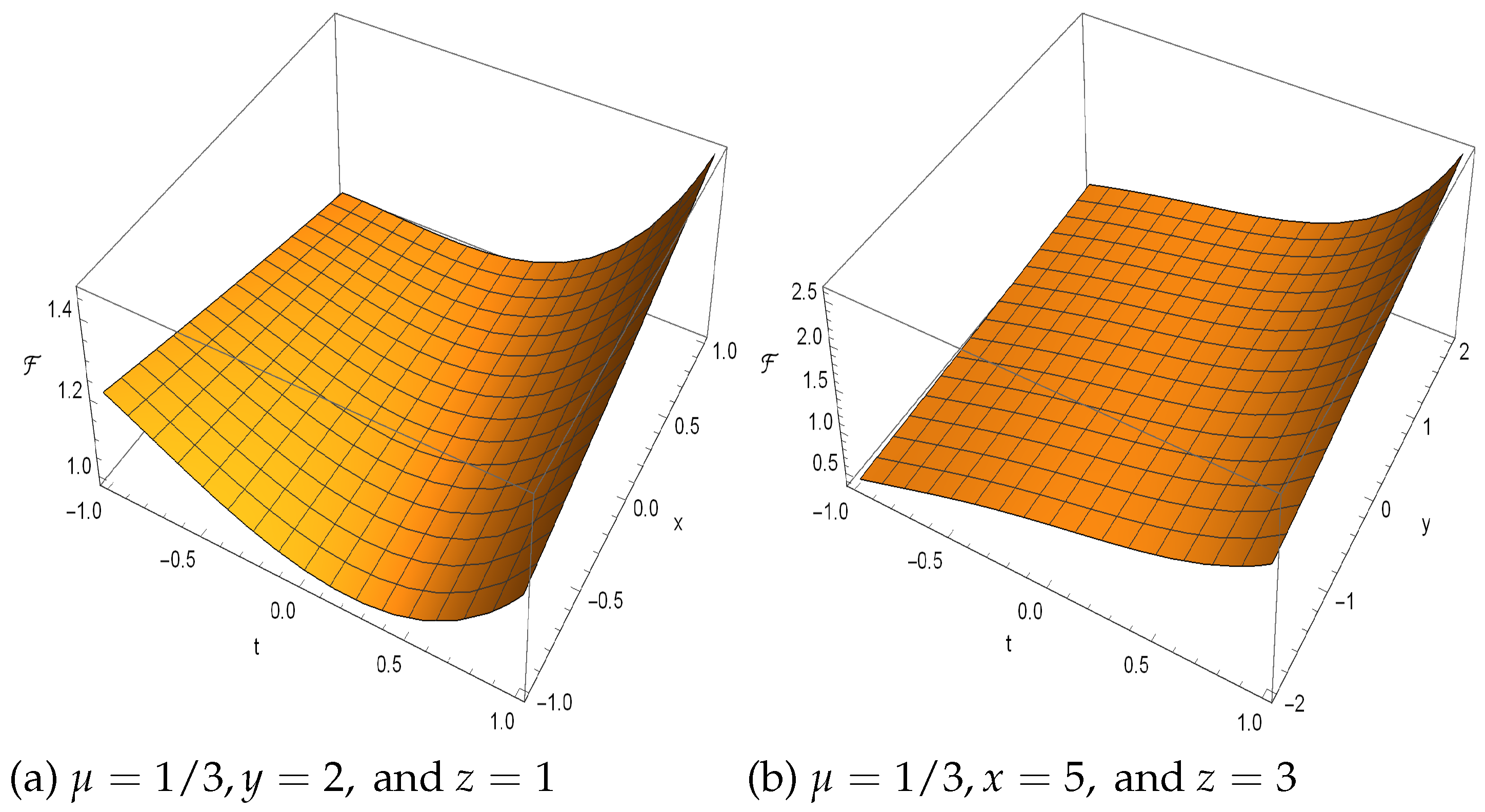
We have a picture of the surface for this solution.
When we take N-th many derivative with respect to t for (4), we have
From (19) and (34), we have the following theorem:
Theorem9.
For , one obtains
From (35) with one obtains the following corollary:
Corollary3.
For , one obtains
where
The first 3-variable degenerate Hermite Kampé de Feŕiet polynomials read
4. Roots of the 3-Variable Degenerate Hermite Kampé de Fériet Equations
In this section we give a theoretical prediction via numerical experiments by finding a regular pattern for the roots of the 3-variable degenerate Hermite Kampé de Fériet equations . To do this, we examine examples of several cases.
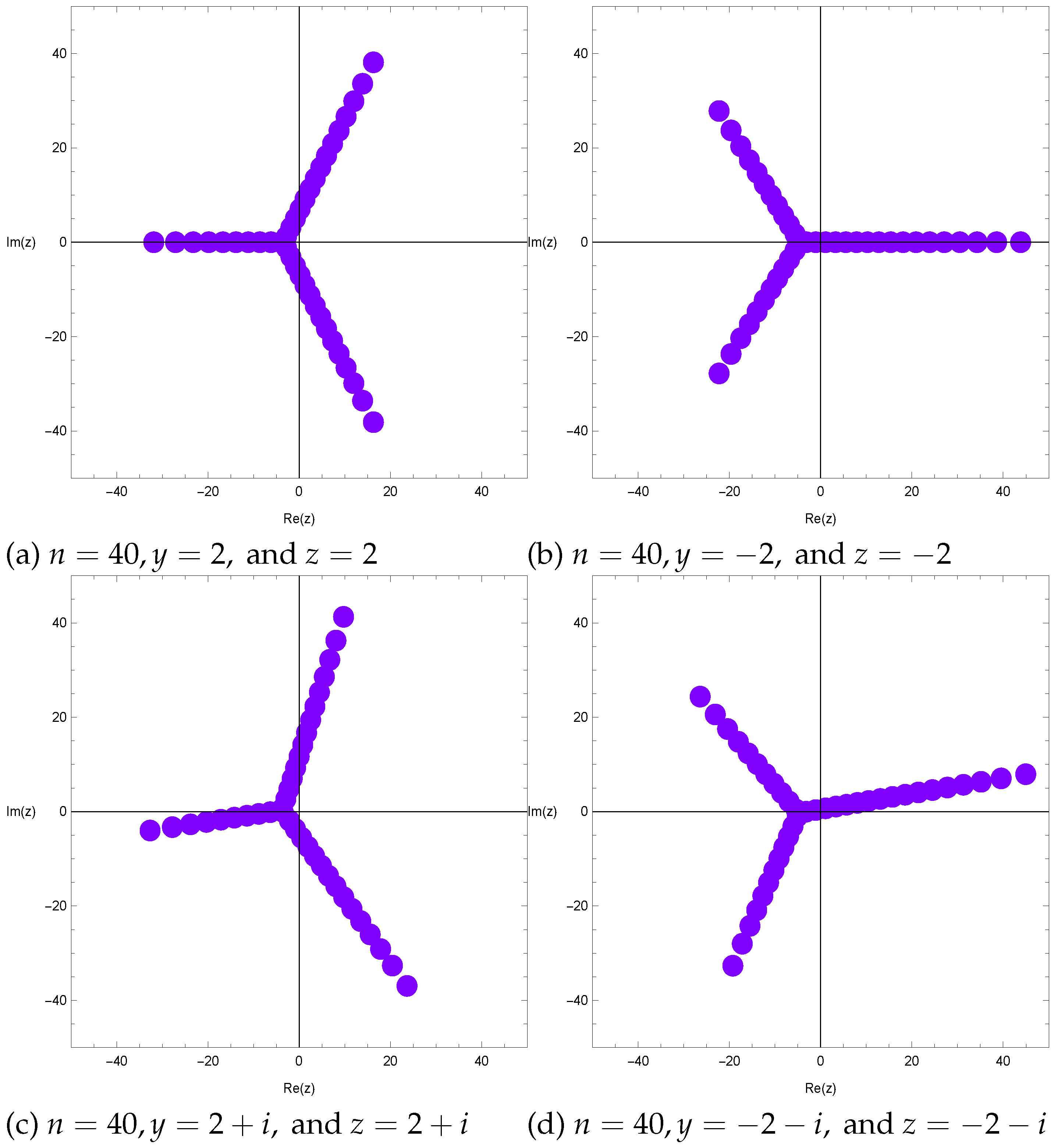
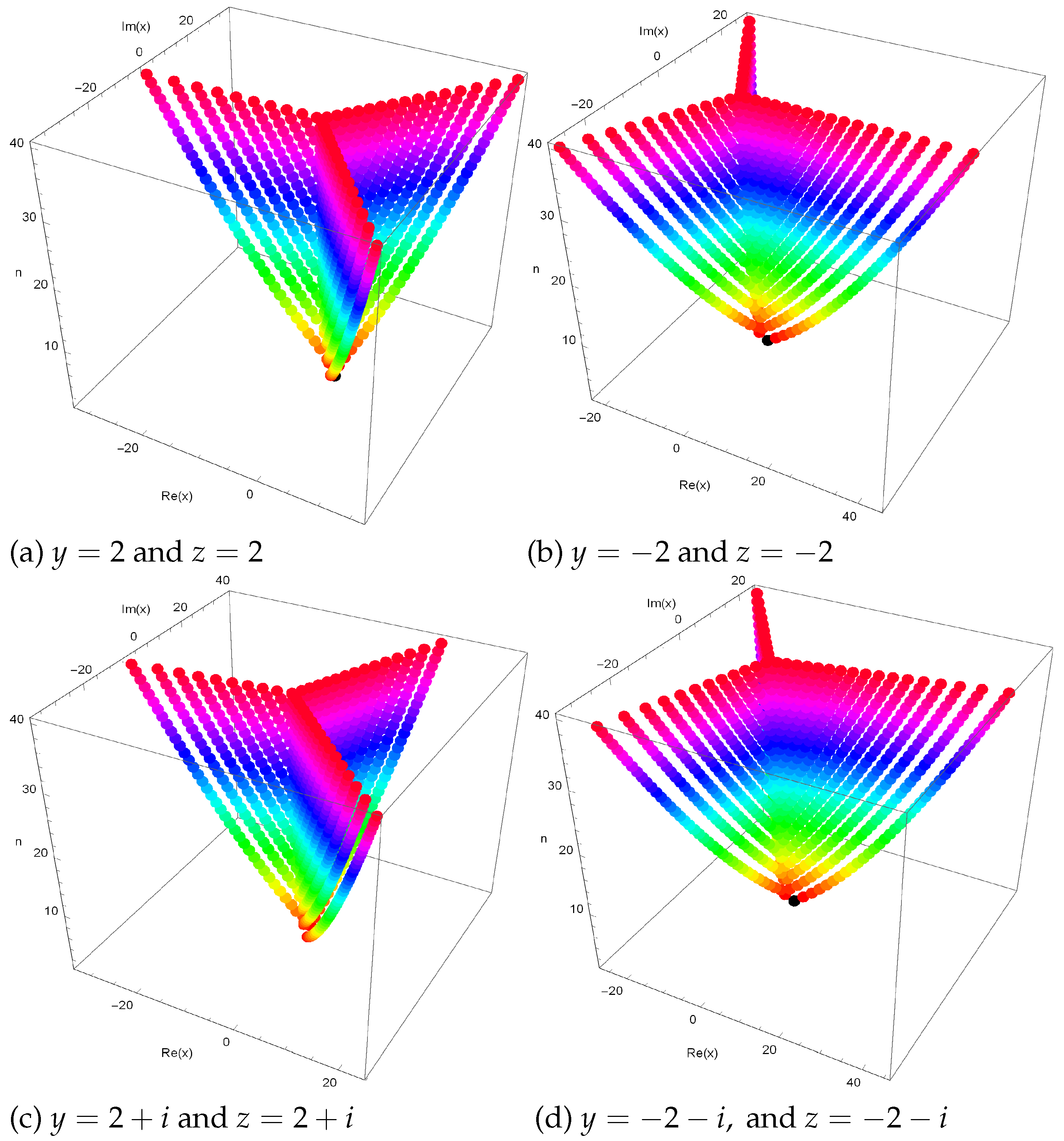
In Figure 2a, we select , , and . In Figure 2b, we select , , and . In Figure 2c, we select , and . In Figure 2d, we select , , and . A picture of the roots of the 3-variable degenerate Hermite Kampé de Fériet equation for from a 3-D structure are shown in Figure 3.
In Figure 3a, we select and . In Figure 3b, we select and . In Figure 3c, we select and . In Figure 3d, we select and . Our distributions for approximated solutions of real roots of equation are shown in Table 1 and Table 2.
We can observe a regular pattern of the complex roots of the 3-variable degenerate Hermite Kampé de Fériet equation . We hope to prove regular pattern of the complex roots of the 3-variable degenerate Hermite Kampé de Fériet equations (Table 1).
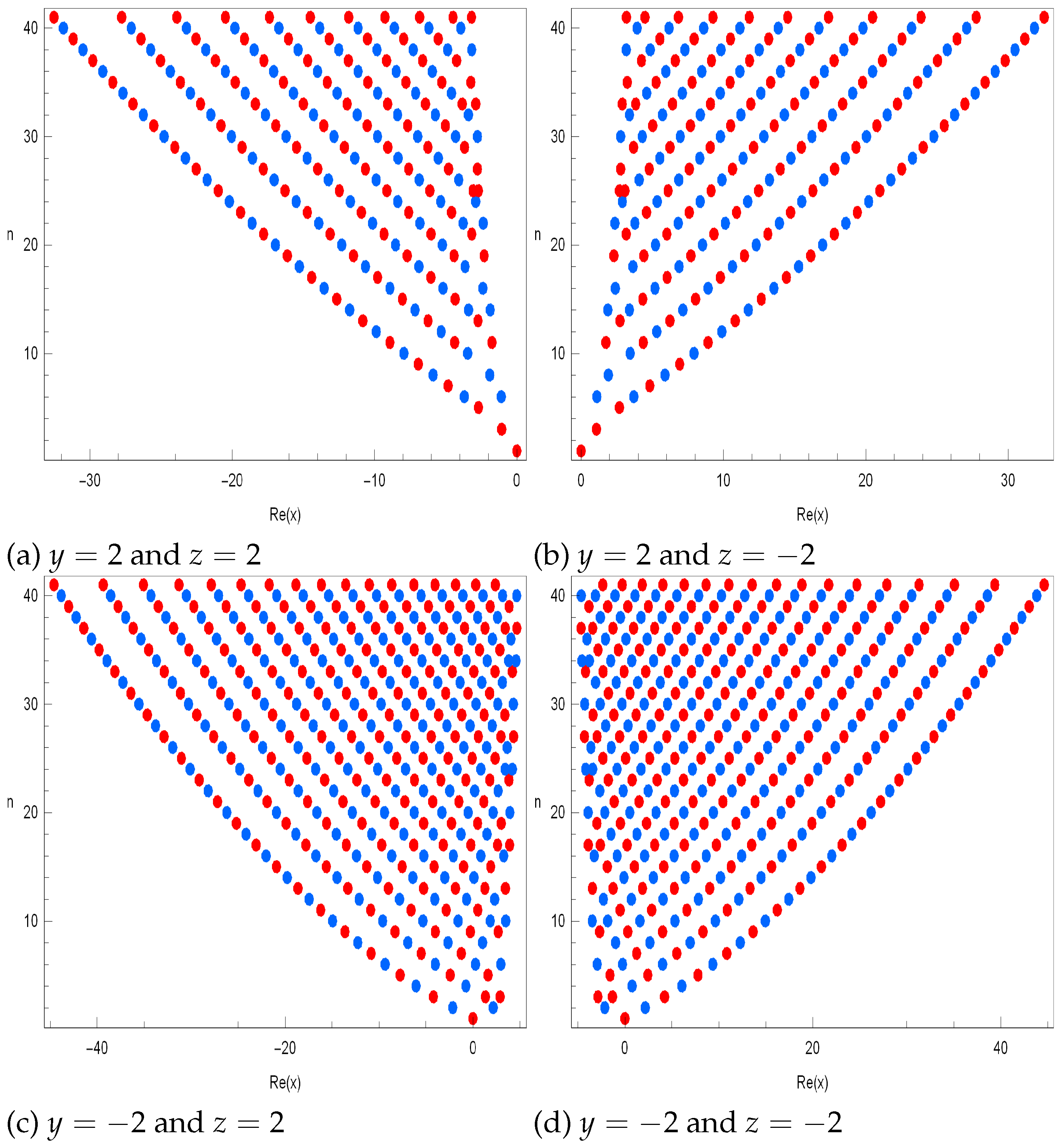
A picture of real roots of equations for are displayed in Figure 4.
Next, we obtain an approximate solution satisfying for given , and in the Table 2.
5. Conclusions and Future Directions
In this article, we constructed the 3-variable degenerate Hermite Kampé de Fériet polynomials and got symmetric identities for 3-variable degenerate Hermite Kampé de Fériet polynomials. We also made the differential equations which are related to the generating function of . We also studied the symmetry of pattern of the roots of the 3-variable degenerate Hermite Kampé de Fériet equations for various variables and z. As a result, we found that the distribution of the roots of 3-variable degenerate Hermite Kampé de Fériet equations has regular pattern. So, we make the following series of conjectures with numerical experiments:
We use some notations. denotes the number of real zeros of on the real plane, that is, , and denotes the number of complex zeros of . Since n is the degree of the polynomial , we obtaine .
We can see a regular pattern of the complex roots of the 3-variable degenerate Hermite Kampé de Fériet equations for , and . Therefore, we can make thebelow conjecture.
Conjecture1.
Let and . Prove or disprove that
where is the set of complex numbers.
Conjecture2.
For and , prove or disprove that
The Conjectures 1 and 2 are unsolved problems for all variables and .
We see that the solutions of the 3-variable degenerate Hermite Kampé de Fériet equations does not show reflection symmetry about for (see Figure 2, Figure 3 and Figure 4).
Conjecture3.
Prove that as an analytic complex function has reflection symmetry .
Finally, we consider the more general problems. How many roots does have? We are not able to decide whether has n distinct solutions. We would like to know the number of complex roots of
Conjecture4.
Prove or disprove that has n distinct solutions.
The conjecture 4 is unsolved problem for all variables n (see Table 1 and Table 2).
If we can theoretically prove the above problems by drawing new ideas from various numerical results, we look forward to contributing to research related to the 3-variable degenerate Hermite Kampé de Fériet equations in applied mathematics, mathematical physics, and engineering.
Author Contributions
C.-S.R. and K.-W.H. did typing together; C.-S.R. and Y.-S.S. draw pictures by using computor. K.-W.H., C.-S.R., and Y.-S.S. made Section 1. Y.-S.S. made Section 2. K.-W.H. made Section 3. C.-S.R. made Section 4. These authors contributed equally to this work. All authors have read and agreed to the published version of the manuscript.
Funding
This work was supported by the Dong-A university research fund.
Acknowledgments
The authors would like to thank the referees for their valuable comments, which improved the original manuscript in its present form.
Conflicts of Interest
The authors declare no conflict of interest.
References
Andrews, L.C. Special Functions for Engineers and Mathematicians; Macmillan. Co.: New York, NY, USA, 1985. [Google Scholar]
Appell, P.; de Fériet, J.H.K. Fonctions Hypergéométriques et Hypersphériques: Polynomes d Hermite; Gauthier-Villars: Paris, France, 1926. [Google Scholar]
Dattoli, G. Generalized Polynomials Operational Identities and Their Applications. J. Comput. Appl. Math.2000, 118, 111–123. [Google Scholar] [CrossRef]
Erdelyi, A.; Magnus, W.; Oberhettinger, F.; Tricomi, F.G. Higher Transcendental Functions; Krieger: New York, NY, USA, 1981; Volume 3. [Google Scholar]
Andrews, G.E.; Askey, R.; Roy, R. Special Functions; Cambridge University Press: Cambridge, UK, 1999. [Google Scholar]
Arfken, G. Mathematical Methods for Physicists, 3rd ed.; Academic Press: Orlando, FL, USA, 1985. [Google Scholar]
Khan, S.; Yasmin, G.; Khan, R.; Hassan, N.A.M. Hermite-based Appell polynomials: Properties and applications. J. Math. Anal. Appl.2009, 351, 756–764. [Google Scholar] [CrossRef]
Carlitz, L. Degenerate Stiling, Bernoulli and Eulerian numbers. Utilitas Math.1979, 15, 51–88. [Google Scholar]
Young, P.T. Degenerate Bernoulli polynomials, generalized factorial sums, and their applications. J. Number Theorey2008, 128, 738–758. [Google Scholar] [CrossRef]
Cenkci, M.; Howard, F.T. Notes on degenerate numbers. Discrete Math.2007, 307, 2375–2395. [Google Scholar] [CrossRef]
Ryoo, C.S. Notes on degenerate tangent polynomials. Glob. J. Pure Appl. Math.2015, 11, 3631–3637. [Google Scholar]
Haroon, H.; Khan, W.A. Degenerate Bernoulli numbers and polynomials associated with degenerate Hermite polynomials. Commun. Korean Math. Soc.2018, 33, 651–669. [Google Scholar]
Hwang, K.W.; Ryoo, C.S. Some identities involving two-variable partially degenerate Hermite polynomials induced from differential equations and structure of their roots. Mathematics2020, 8, 632. [Google Scholar] [CrossRef]
Kim, T.; Kim, D.S.; Kwon, H.I.; Ryoo, C.S. Differential equations associated with Mahler and Sheffer-Mahler polynomials. Nonlinear Funct. Anal. Appl.2019, 24, 453–462. [Google Scholar]
Ryoo, C.S. A numerical investigation on the structure of the zeros of the degenerate Euler-tangent mixed-type polynomials. J. Nonlinear Sci. Appl.2017, 10, 4474–4484. [Google Scholar] [CrossRef]
Ryoo, C.S. Differential equations associated with tangent numbers. J. Appl. Math. Inform.2016, 34, 487–494. [Google Scholar] [CrossRef]
Ryoo, C.S. Some identities involving Hermitt Kampé de Fériet polynomials arising from differential equations and location of their zeros. Mathematics2019, 7, 23. [Google Scholar] [CrossRef]
Ryoo, C.S.; Agarwal, R.P.; Kang, J.Y. Differential equations associated with Bell-Carlitz polynomials and their zeros. Neural Parallel Sci. Comput.2016, 24, 453–462. [Google Scholar]
Figure 1.
The surface for the solution .
Figure 1.
The surface for the solution .
Figure 2.
Zeros of .
Figure 2.
Zeros of .
Figure 3.
Stacks of zeros of .
Figure 3.
Stacks of zeros of .
Figure 4.
Real zeros of .
Figure 4.
Real zeros of .
Table 1.
Numbers of real and complex zeros of .
Table 1.
Numbers of real and complex zeros of .
Degree n
Real Zeros
Complex Zeros
Real Zeros
Complex Zeros
1
1
0
1
0
2
0
2
0
2
3
1
2
0
3
4
0
4
0
4
5
1
4
0
5
6
2
4
0
6
7
1
6
0
7
8
2
6
0
8
9
1
8
0
9
10
2
8
0
10
Table 2.
Approximate roots of .
Table 2.
Approximate roots of .
Degree n
x
1
0
2
−2.1528 i, 2.1528 i
3
−1.0705, 0.5352 + 3.8424 i, 0.5352 − 3.8424 i
4
−1.1238 − 0.9119 i, −1.1238 + 0.9119 i, 1.1238 + 5.4316 i
1.1238 − 5.4316 i
5
−2.6937, −0.3500 − 2.3168 i, −0.3500 + 2.3168 i
1.6969 + 6.9000 i, 1.6969 − 6.9000 i
6
−3.6974, −1.1016, 0.1447 − 3.6924 i
0.1447 + 3.6924 i, 2.2548 + 8.2725 i, 2.2548 − 8.2725 i
7
−4.8260, −1.0340 + 1.3912 i, −1.0340 − 1.3912 i, 0.6498 + 4.9794 i
0.6498 − 4.9794 i, 2.7972 − 9.5687 i, 2.7972 + 9.5687 i
Publisher’s Note: MDPI stays neutral with regard to jurisdictional claims in published maps and institutional affiliations.