


Abstract
In this paper, based on critical point theory, we mainly focus on the multiplicity of nontrivial solutions for a nonlinear discrete Dirichlet boundary value problem involving the mean curvature operator. Without imposing the symmetry or oscillating behavior at infinity on the nonlinear term f, we respectively obtain the sufficient conditions for the existence of at least three non-trivial solutions and the existence of at least two non-trivial solutions under different assumptions on f. In addition, by using the maximum principle, we also deduce the existence of at least three positive solutions from our conclusion. As far as we know, our results are supplements to some well-known ones.
1. Introduction
Let and denote all integers and real numbers, respectively. Let N be a fixed positive integer. Define with for any .
Difference equations are widely used in various research fields, such as computer science, discrete optimization, economics and biological neural networks [1,2,3,4]. On the existence and multiplicity of solutions for the boundary value problems of difference equations, many authors have come to important conclusions by exploiting various methods, including the method of upper and lower solutions, Brouwer degree and invariant sets of descending flow [5,6,7]. Critical point theory was used largely to explore differential equations much earlier on in history. In 2003, Guo and Yu in [8] used critical point theory for the first time to obtain sufficient conditions for the existence of periodic solutions and subharmonic solutions of difference equations. This crucial breakthrough inspired many scholars to use critical point theory to study the dynamics of difference equations and many meaningful and interesting results have been obtained, especially in periodic solutions [9,10,11], homoclinic solutions [12,13,14,15,16] and boundary value problems [17,18,19,20,21,22,23].
In [24], Agarwal, Perera and O’Regan employed the critical point theory to establish the existence of at least two positive solutions of the following second order discrete boundary value problem
where , and is a continuous function. In [18], by using the three critical point theorems proposed by Bonanno [25], Jiang and Zhou obtained sufficient conditions for the existence of at least three solutions of the following Dirichlet boundary value problem with -Laplacian
where is the p-Laplacian defined by with and is a positive parameter. Different from the conclusion of [18], Bonanno in [26] obtained the existence of three positive solutions without the asymptotic condition of the nonlinear function f. In particular, Bonanno obtained the sufficient conditions for the existence of at least four nontrivial solutions when f satisfies the growth condition at zero and infinity [26], which improved the result in [18].
In [27], by using critical point theory, Nastasi and Vetro obtained the existence of at least two positive solutions to the following Dirichlet boundary value problem with -Laplacian
where , and are a continuous function with for all .
It is well known that the differential equation with -Laplacian ( is the mean curvature operator defined by for ) was studied by many scholars in the past decades [28,29,30,31]. It is usually regarded as a variant of the Liouville–Bratu–Gelfand problem, which is used to study the dynamic model of combustible gases. As mentioned above, we find that the research on the difference equation largely focuses on the case with -Laplacian. However, there are only a few results on the boundary value problems involving -Laplacian [32]. Recently, Zhou and Ling in [33] considered the existence of multiple solutions of the following discrete Dirichlet boundary value problem with -Laplacian.
Problem 1
The authors in [33] found that the properties of the nonlinear term plays an important role on the existence of multiple solutions. When has oscillating behavior at infinity, there are infinite solutions to the boundary value (Problem 1) [33]. Naturally, we would like to ask: What will happen if does not oscillate at infinity?
To address this problem, in this paper, we will study the existence of solutions for the boundary value (Problem 1) without oscillating nonlinear terms. In fact, based on the theorems of G. Bonanno (Theorem 4.1 in [22] and Theorem 2.1 in [23]), we will give the conditions of the existence of at least three nontrivial solutions for (Problem 1), when does not have oscillation property at infinity. In addition, when , we obtain the sufficient conditions for the existence of at least three positive solutions of (Problem 1). Moveover, we give two examples to illustrate our main results.
For convenience, we end this section by recalling some classical definitions and two well-known lemmas, which are the main tools of this paper.
Let be a real Banach space. We say that is coercive on X if . If I is a continuously Gâteaux differentiable functional, we say that I satisfies the Palais–Smale condition ((PS)-condition in short), if any sequence such that is bounded and is convergent to 0 in , has a convergent subsequence in X.
Let be a real finite dimensional Banach space and let Φ, be two continuously Gâteaux differentiable functionals with Φ coercive and such that
Lemma 1.
([22]) Assume that (H) holds and there exist and , with , such that:
- ()
- ()
- for each the functional is coercive.
Then, for each , the functional has at least three distinct critical points in X.
Lemma 2.
([23]) Let X be a real Banach space and let Φ, Ψ: be two continuously Gâteaux differentiable functionals such that Assume that there are and , with , such that
for each , and the functional satisfies (PS)-condition and it is unbounded from below. Then, for each , the functional admits at least two non-zero critical points such that
2. Preliminaries
In this section, we recall some definitions, notations and properties. Consider the N-dimensional Banach space
endowed with the norm
We define the functional in the following way
for each , where
It is easy to check that and we have
and
By a standard argument, it can be shown that the critical points of the functional
are the solutions of (Problem 1).
Let
We see that is another norm in S. From Lemma 2.2 of [18], we have
Lemma 3.
([18]) For any , the following relation holds
From (2.1) and (2.3) in [22], we have
Lemma 4.
([22]) For any , one has
where and .
Finally, in order to obtain the positive solutions of (Problem 1), we need the following strong maximum principle, which can be found in Theorem 2.1 of [33].
Lemma 5.
([33]) Assume such that either
for all Then, either in or .
3. Main Results
For convenience, set
Our first result is the following theorem.
Theorem 1.
Assume that there exist two positive constants c and d with
such that
- (i)
- for each and ;
- (ii)
- (iii)
- .
Then, for every , (Problem 1) has at least three nontrivial solutions.
Proof.
We take , and as in (2). Clearly, and are two continuously Gâteaux differentiable functionals. Now, we prove the coercivity of . In fact, one has
This means and verifies the coercivity of . Moreover, by the definition of and , we can obtain
To summarize, condition in Lemma 1 holds.
According to Lemma 1, it is clear that Theorem 1 holds if we can verify and of Lemma 1.
Put
If , let
Then, we have and
Thus, by Lemma 3.
By (i), we see that is increasing in . Thus
Then, it is easy to get
Now, let be defined by
Then, we see from (3) that
Moreover, it holds that
Therefore, we have
Hence, condition of Lemma 1 follows by combining with
Next, we prove the coercivity of the functional . From , there is an such that
Then, there is a positive constant h such that
for each and . By Lemma 3 and , one has
for each . Therefore, it is true that
Thus, we get that is coercive, and condition of Lemma 1 is verified. In summary, all assumptions of Lemma 1 are proved, and so the functional has at least three distinct critical points in X for each . Since is not a solution to the (Problem 1), the proof is completed. □
Remark 1.
It is obvious that the mean curvature operator is odd symmetric (, ). When the nonlinear term f is also odd symmetric (), the variational functional is even symmetric (, ). In this case, it is easy to obtain multiple solutions to (Problem 1) by using the critical point theory with symmetries. However, in this paper, we obtain multiple solutions to (Problem 1) without the symmetry on f.
Now, let
where and define , with defined in (2) and
It is well known that and the critical points of are precisely the solutions of the following problem.
Problem 2
We have the following corollary.
Corollary 1.
Assume that there exist two positive constants c and d with
such that
- (i)
- for each and ;
- (ii)
- (iii)
- .
Then, for every , (Problem 1) has at least three positive solutions.
Proof.
For each , consider (Problem 2) with
One has that condition of Theorem 1 holds. Besides, we have
So, all conditions of Theorem 1 are true. Moreover, since is not a solution of problem , we can get that (Problem 2) has at least three nontrivial solutions. Assume is one of the nontrivial solution, for any , one has either or
Then, we have for all by Lemma 5, i.e., u is a positive solution. In addition, if u is a positive solution of (Problem 2), then u is a positive solution of (Problem 1) obviously and Corollary 1 is proved. □
Next, we will use Lemma 2 to obtain another conclusion of this paper.
Theorem 2.
Assume that there exist two positive constants c and d with
such that
- ()
- for each and ;
- ()
- ()
- there exist a positive constant β such thatfor each
Then, for every , (Problem 1) has at least two non-zero critical points such that
Proof.
Clearly, , are two continuously Gâteaux differentiable functionals and
Let and r be the same as the ones defined in the proof of Theorem 1. Then we have
and
So inequality (1) in Lemma 2 holds. Besides, form and Lemma 4, there is a constant h such that, for any and ,
Therefore, we have
Thus, we see that , which means that the functional is unbounded from below. Moreover, we can get that is coercive. Therefore, satisfies the (PS)-condition and the proof is completed. □
4. Examples
Example 1.
Fix and consider the boundary value (Problem 1) with
for . Then, we have
Let and . Then one has
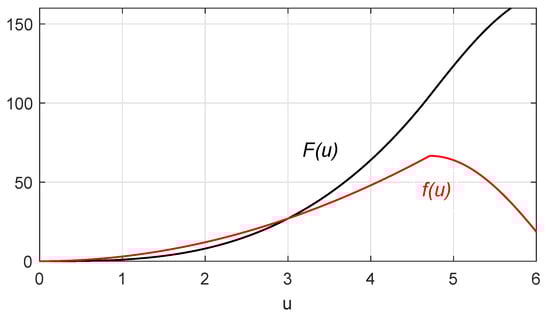
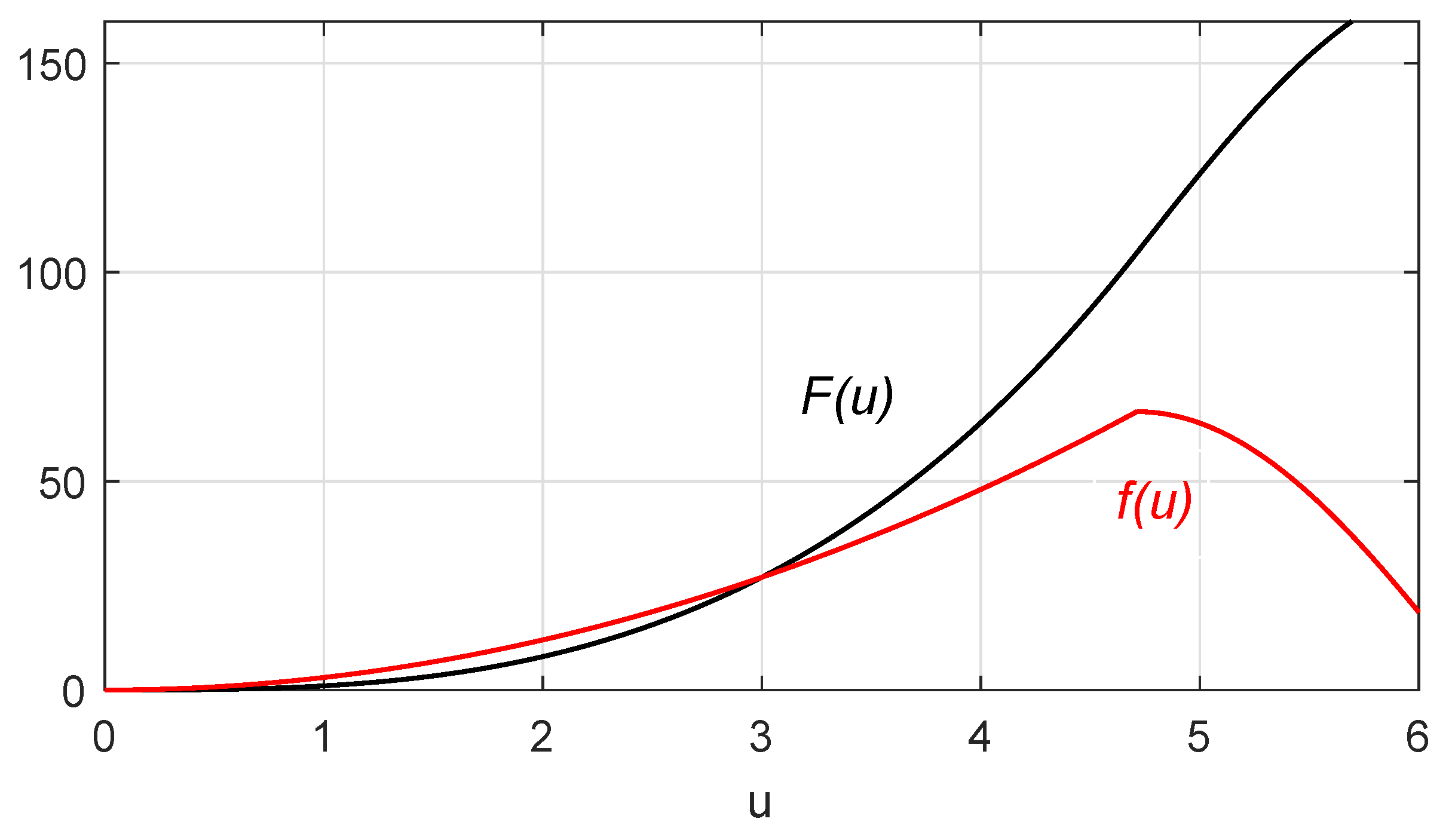
In addition, as shown in Figure 1, for each . Thus condition of Corollary 1 follows. Moreover, we have
and
Figure 1.
The images of and in Example 1.
Since
by combining (9) and (10), condition of Corollary 1 holds.
We can further verify condition of Corollary 1, since
To sum up, all the conditions of Corollary 1 are satisfied. Hence, for
the boundary value problem admits at least three positive solutions.
Example 2.
Let and , consider the boundary value (Problem 1) with
for each Then, we have
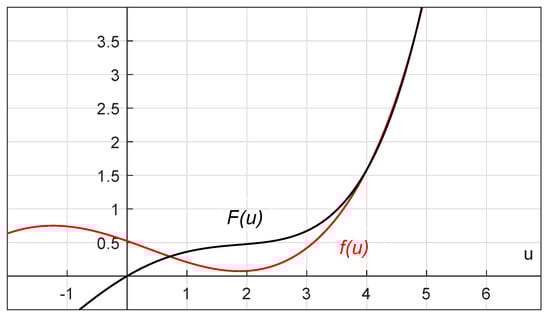
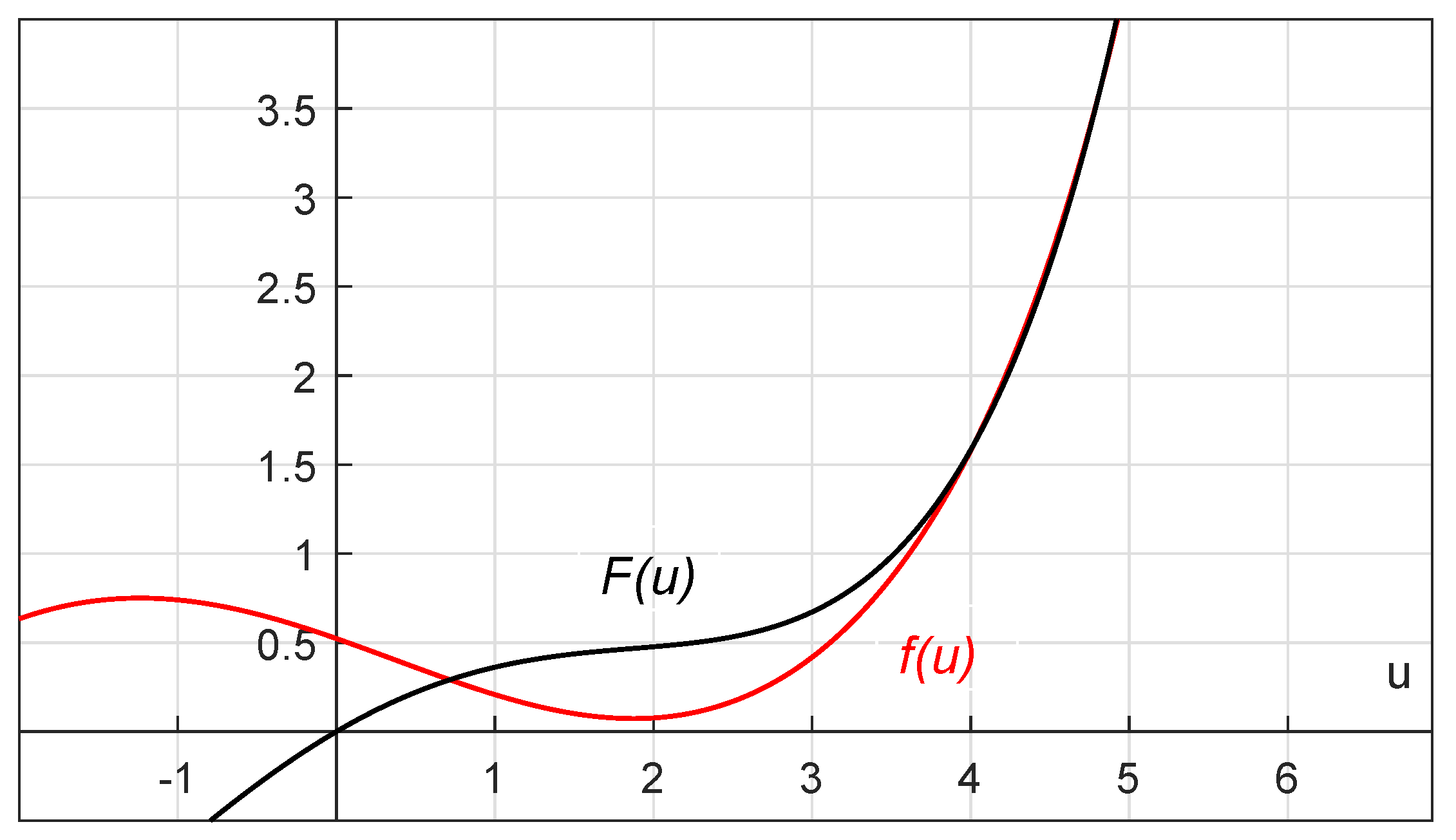
Moreover, the images of and are shown in Figure 2.
Figure 2.
The images of and in Example 2.
Letting and , we have
Now, we prove for each . Let
Then for . Besides, it is obvious that on and on . When , we have
Thus is decreasing on . Since is an increasing function and , we can get on .
In addition, we have
and
It follows that
and
The above together with
confirms condition of Theorem 2.
Besides,
for each . We can see from Theorem 2 that the boundary value problem has at least two non-zero solutions for each .
5. Conclusions
A discrete Dirichlet boundary value problem involving the mean curvature operator is studied in this paper. Unlike the existing result in [33], we obtained different sufficient conditions of the existence of multiple solutions without assuming that the nonlinear term oscillates at infinity, as shown in Theorems 1 and 2. First, according to the research results of Bonanno in [22], we obtain at least three non-trivial solutions in Theorem 1. In addition, as a supplement to Theorem 1, we prove the existence of at least three positive solutions through the maximum principle. Note that inequality (3) plays an important role in the proof of Theorem 1. For the situation that inequality (3) is not satisfied, under another suitable assumption on the nonlinear term, we still can obtain the existence of at least two non-trivial solutions based on Theorem 2.1 in [23]. It seems that the method used in this paper can be adapted to discuss the existence of homoclinic solutions or periodic solutions of difference equations with -Laplacian. This will be left as our future work.
Author Contributions
All authors contributed equally and significantly in writing this paper. All authors have read and agreed to the published version of the manuscript.
Funding
This work is supported by the National Natural Science Foundation of China (Grant No. 11971126) and the Program for Changjiang Scholars and Innovative Research Team in University (Grant No. IRT 16R16).
Conflicts of Interest
The authors declare no conflict of interest.
References
- Elaydi, S. An Introduction to Difference Equations; Springer Science & Business Media: Heidelberg, Germany, 2005. [Google Scholar]
- Yu, J.; Zheng, B. Modeling Wolbachia infection in mosquito population via discrete dynamical models. J. Differ. Equ. Appl. 2019, 25, 1549–1567. [Google Scholar] [CrossRef] [Scilit]
- Long, Y.; Wang, L. Global dynamics of a delayed two-patch discrete SIR disease model. Commun. Nonlinear Sci. Numer. Simul. 2020, 83, 105117. [Google Scholar] [CrossRef] [Scilit]
- Agarwal, R.P. Difference Equations and Inequalities: Theory, Methods, and Applications; Marcel Dekker: New York, NY, USA, 1992. [Google Scholar]
- Jiang, D.; Oregan, D.; Agarwal, R.P. A generalized upper and lower solution method for singular discrete boundary value problems for the one-dimensional p-Laplacian. J. Appl. Anal. 2005, 11, 35–47. [Google Scholar] [CrossRef] [Scilit]
- Bereanu, C.; Mawhin, J. Existence and multiplicity results for nonlinear second order difference equations with Dirichlet boundary conditions. Math. Bohem. 2006, 131, 145–160. [Google Scholar] [CrossRef] [Scilit]
- Long, Y.; Wang, S. Multiple solutions for nonlinear functional difference equations by the invariant sets of descending flow. J. Differ. Equ. Appl. 2019, 25, 1768–1789. [Google Scholar] [CrossRef] [Scilit]
- Guo, Z.; Yu, J. Existence of periodic and subharmonic solutions for second-order superlinear difference equations. Sci. China Ser. A Math. 2003, 46, 506–515. [Google Scholar] [CrossRef] [Scilit]
- Bereanu, C.; Jebelean, P.; Şerban, C. Periodic and Neumann problems for discrete p(·)-Laplacian. J. Math. Anal. Appl. 2013, 399, 75–87. [Google Scholar] [CrossRef] [Scilit]
- Shi, H. Periodic and subharmonic solutions for second-order nonlinear difference equations. J. Appl. Math. Comput. 2015, 48, 157–171. [Google Scholar] [CrossRef] [Scilit]
- Shi, H.; Zhang, H. Existence of gap solitons in periodic discrete nonlinear Schrödinger equations. J. Math. Anal. Appl. 2010, 361, 411–419. [Google Scholar] [CrossRef] [Scilit]
- Shi, H.; Zhang, Y. Existence of breathers for discrete nonlinear Schrödinger equations. Appl. Math. Lett. 2015, 50, 111–118. [Google Scholar] [CrossRef] [Scilit]
- Lin, G.; Zhou, Z. Homoclinic solutions in non-periodic discrete ϕ-Laplacian equations with mixed nonlinearities. Appl. Math. Lett. 2017, 64, 15–20. [Google Scholar] [CrossRef] [Scilit]
- Zhou, Z.; Yu, J. On the existence of homoclinic solutions of a class of discrete nonlinear periodic systems. J. Differ. Equ. 2010, 249, 1199–1212. [Google Scholar] [CrossRef] [Scilit]
- Zhou, Z.; Ma, D. Multiplicity results of breathers for the discrete nonlinear Schrödinger equations with unbounded potentials. Sci. China Math. 2015, 58, 781–790. [Google Scholar] [CrossRef] [Scilit]
- Nastasi, A.; Vetro, C. A note on homoclinic solutions of (p,q)-Laplacian difference equations. J. Differ. Equ. Appl. 2019, 25, 1–11. [Google Scholar] [CrossRef] [Scilit]
- Galewski, M.; Smejda, J. On variational methods for nonlinear difference equations. J. Comput. Appl. Math. 2010, 233, 2985–2993. [Google Scholar] [CrossRef] [Scilit]
- Jiang, L.; Zhou, Z. Three solutions to Dirichlet boundary value problems for p-Laplacian difference equations. Adv. Differ. Equ. 2007, 2008, 1–10. [Google Scholar] [CrossRef] [Scilit]
- Long, Y.; Chen, J. Existence of multiple solutions to second-order discrete Neumann boundary value problems. Appl. Math. Lett. 2018, 83, 7–14. [Google Scholar] [CrossRef] [Scilit]
- Bonanno, G.; Bella, B.D. A fourth-order boundary value problem for a Sturm–Liouville type equation. Appl. Math. Comput. 2010, 217, 3635–3640. [Google Scholar] [CrossRef] [Scilit]
- Bonanno, G.; Jebelean, P.; Şerban, C. Superlinear discrete problems. Appl. Mathe. Lett. 2016, 52, 162–168. [Google Scholar] [CrossRef] [Scilit]
- Bonanno, G.; Candito, P.; D’Aguí, G. Variational methods on finite dimensional Banach spaces and discrete problems. Adv. Nonlinear Stud. 2014, 14, 915–939. [Google Scholar] [CrossRef] [Scilit]
- Bonanno, G.; D’Agui, G. Two non-zero solutions for elliptic Dirichlet problems. Z. Anal. Anwend. 2016, 35, 449–465. [Google Scholar] [CrossRef] [Scilit]
- Agarwal, R.P.; Perera, K.; O’Regan, D. Multiple positive solutions of singular and nonsingular discrete problems via variational methods. Nonlinear Anal. Theory Methods Appl. 2004, 58, 69–73. [Google Scholar] [CrossRef] [Scilit]
- Bonanno, G. A critical points theorem and nonlinear differential problems. J. Glob. Optim. 2004, 28, 249–258. [Google Scholar] [CrossRef] [Scilit]
- Bonanno, G.; Candito, P. Nonlinear difference equations investigated via critical point methods. Nonlinear Anal. 2009, 70, 3180–3186. [Google Scholar] [CrossRef] [Scilit]
- Nastasi, A.; Vetro, C.; Vetro, F. Positive solutions of discrete boundary value problems with the (p,q)-Laplacian operator. Electron. J. Differ. Equ. 2017, 2017, 1–12. [Google Scholar]
- Bonanno, G.; Livrea, R.; Mawhin, J. Existence results for parametric boundary value problems involving the mean curvature operator. Nonlinear Differ. Equ. Appl. NoDEA 2015, 22, 411–426. [Google Scholar] [CrossRef] [Scilit]
- Bonheure, D.; Habets, P.; Obersnel, F.; Omari, P. Classical and non-classical solutions of a prescribed curvature equation. J. Differ. Equ. 2007, 243, 208–237. [Google Scholar] [CrossRef] [Scilit]
- Corsato, C.; Obersnel, F.; Omari, P.; Rivetti, S. Positive solutions of the Dirichlet problem for the prescribed mean curvature equation in Minkowski space. J. Math. Anal. Appl. 2013, 405, 227–239. [Google Scholar] [CrossRef] [Scilit]
- Dai, G. Global bifurcation for problem with mean curvature operator on general domain. Nonlinear Differ. Equ. Appl. NoDEA 2017, 3, 1–10. [Google Scholar] [CrossRef] [Scilit]
- Mawhin, J. Periodic solutions of second order nonlinear difference systems with ϕ-Laplacian: A variational approach. Nonlinear Anal. 2012, 75, 4672–4687. [Google Scholar] [CrossRef] [Scilit]
- Zhou, Z.; Ling, J. Infinitely many positive solutions for a discrete two point nonlinear boundary value problem with ϕc-Laplacian. Appl. Math. Lett. 2019, 91, 28–34. [Google Scholar] [CrossRef] [Scilit]
Publisher’s Note: MDPI stays neutral with regard to jurisdictional claims in published maps and institutional affiliations. |
© 2020 by the authors. Licensee MDPI, Basel, Switzerland. This article is an open access article distributed under the terms and conditions of the Creative Commons Attribution (CC BY) license (http://creativecommons.org/licenses/by/4.0/).