


Abstract
The notion of the orbifold Euler characteristic came from physics at the end of the 1980s. Coincidence (up to sign) of the orbifold Euler characteristics is a necessary condition for crepant resolutions of orbifolds to be mirror symmetric. There were defined higher order versions of the orbifold Euler characteristic and generalized (“motivic”) versions of them. In a previous paper, the authors defined a notion of the Grothendieck ring of varieties with actions of finite groups on which the orbifold Euler characteristic and its higher order versions are homomorphisms to the ring of integers. Here, we define the generalized orbifold Euler characteristic and higher order versions of it as ring homomorphisms from to the Grothendieck ring of complex quasi-projective varieties and give some analogues of the classical Macdonald equations for the generating series of the Euler characteristics of the symmetric products of a space.
Keywords:
actions of finite groups; complex quasi-projective varieties; Grothendieck rings; λ-structure; power structure; Macdonald-type equations MSC:
18F30; 55M35
1. Introduction
The notion of the orbifold Euler characteristic came from physics at the end of the 1980s [1] (see also [2,3]). Coincidence (up to sign) of the orbifold Euler characteristics is a necessary condition for orbifolds (or rather, for their crepant resolutions) to be mirror symmetric. Higher order Euler characteristics of spaces with finite group actions were defined in [2,4]. The class of a variety in the Grothendieck ring of complex quasi-projective varieties (being an additive invariant) can be considered as a generalized (“motivic”) Euler characteristic. Generalized versions of the orbifold Euler characteristic and of higher order Euler characteristics were defined in [5] (as a refinement of the so-called orbifold Hodge–Deligne polynomial; see, e.g., [6]) and in [7]. (They take values in the extension of the Grothendieck ring of complex quasi-projective varieties by rational powers of the class of the affine line.) One has the classical Macdonald equation for the generating series of the Euler characteristics of the symmetric products of a topological space. Its versions for the orbifold Euler characteristic and for the higher order Euler characteristics were obtained in [8]. Some versions for the generalized orbifold Euler characteristic and for the generalized higher order Euler characteristics were given in [5,7].
The orbifold Euler characteristic and the higher order Euler characteristics are usually considered as functions on the Grothendieck ring of G-varieties. These functions define group homomorphisms from to , but not ring homomorphism. A Grothendieck ring on which these Euler characteristics are ring homomorphisms was defined in [9]. It was called the Grothendieck ring of complex quasi-projective varieties with actions of finite groups. In [10], there was defined a notion of the universal Euler characteristic on . It takes values in a ring generated, as a free Abelian group, by elements corresponding to isomorphism classes of finite groups.
Here, we define generalized orbifold Euler characteristic and generalized higher order Euler characteristics as homomorphisms from to . We formulate Macdonald-type equations for them in terms of -ring homomorphisms. There is a map such that , where p is the natural map sending the class of a G-variety to the class of its quotient. We prove a substitute of a Macdonald-type equation for the homomorphism .
2. Power Structures and the Grothendieck Ring of Varieties with Actions of Finite Groups
A power structure over a ring R (commutative, with unit) is a method to give sense to an expression of the form , where and ([11]). It is defined by a map
which satisfies the following properties:
- (1)
- ;
- (2)
- ;
- (3)
- ;
- (4)
- ;
- (5)
- ;
- (6)
- ;
- (7)
- for .
Power structures over a ring are related with -structures on it. A -structure on a ring R (sometimes called a pre-lambda structure; see, e.g., [12]) is an additive-to-multiplicative homomorphism (that is , ) such that A -structure on R defines a power structure over it in the following way. A series can be, in a unique way, represented as the product . Then one defines as . A power structure over R permits one to define a number of -structures on it: for any series , one can put .
The standard power structure over the ring of integers is defined by the standard exponent of a series. A natural power structure over the Grothendieck ring of complex quasi-projective varieties was introduced in [11]. It is defined by the formula
where , , and M are complex quasi-projective varieties, is the big diagonal in , the group acts by the simultaneous permutations on the components of and on the components of .
For a topological space X (say, a complex quasi-projective variety) with an action of a finite group G, one has the notions of the orbifold Euler characteristic and of the (orbifold) Euler characteristics of higher orders (see, e.g., [2,3,4]). They can be defined, in particular, in the following way. Let , where is the (additive) Euler characteristic defined through cohomologies with compact support. For , let
where is the set of conjugacy classes of elements of G, g is a representative of the class , is the fixed point set of g, is the centralizer of the element g in G. The orbifold Euler characteristic is the Euler characteristic of order 1: .
The orbifold Euler characteristic and the Euler characteristics of higher orders can be considered as functions on the Grothendieck ring of quasi-projective G-varieties. These functions are group homomorphisms, but not ring ones. A ring on which they are defined as ring homomorphisms to was introduced in [9].
Let us consider G-varieties, i.e., pairs consisting of a complex quasi-projective variety X and a finite group G acting on X. We shall call two pairs and isomorphic if there exists an isomorphism of quasi-projective varieties and a group isomorphism such that for , . If G is a subgroup of a finite group H, one has the induction operation , which converts G-varieties to H-varieties. For a G-variety X, is the quotient of by the right action of the group G defined by . (The action of H on is defined in the natural way: .)
Definition 1.
(see [9]) The Grothendieck ring of complex quasi-projective varieties with actions of finite groups is the abelian groupgenerated by the classesof G-varieties (for different finite groups G) modulo the relations:
- (1)
- ifandare isomorphic, then;
- (2)
- if Y is a Zariski closed G-subvariety of a G-variety X, then;
- (3)
- ifis a G-variety and G is a subgroup of a finite group H, then.
The multiplication inis defined by the Cartesian product:
The unit element in is , the class of the one-point variety with the action of the group with one element.
Remark 1.
This ring (under the name “the Grothendieck ring of equivariant varieties”) was used in [13].
One has a natural ring homomorphism sending to .
There are two (“geometric”) -structures on the ring . Let X be a G-variety. The Cartesian power carries natural actions of the group (acting component-wise) and of the group (acting by permuting the factors in ), and therefore an action of their semi-direct product (the wreath-product) .
Definition 2.
The Kapranov zeta function ofis
In [9], it is shown that the Kapranov zeta function is well-defined for elements of the ring and defines a -ring structure on it.
Another -structure on the ring is defined by the generating series of classes of equivariant configuration spaces of points in X. Let be the big G-diagonal in the Cartesian power of a G-variety X, i.e., the set of n-tuples with at least two of from the same G-orbit. The wreath product acts on . Let
be the generating series of classes of equivariant configuration spaces of points in X. In [9], it is shown that the series defines a -structure on the ring , and there was given a geometric description of the power structure over corresponding to this -structure. (A geometric description of the power structure over the ring corresponding to the -structure defined by the Kapranov zeta function is not known.) We shall call these -structures (and the corresponding power structures) the symmetric product and the configuration space ones.
In [9], it was shown that the orbifold Euler characteristic and the higher order Euler characteristics of an element of are well-defined (that is, ), and they are ring homomorphisms from to .
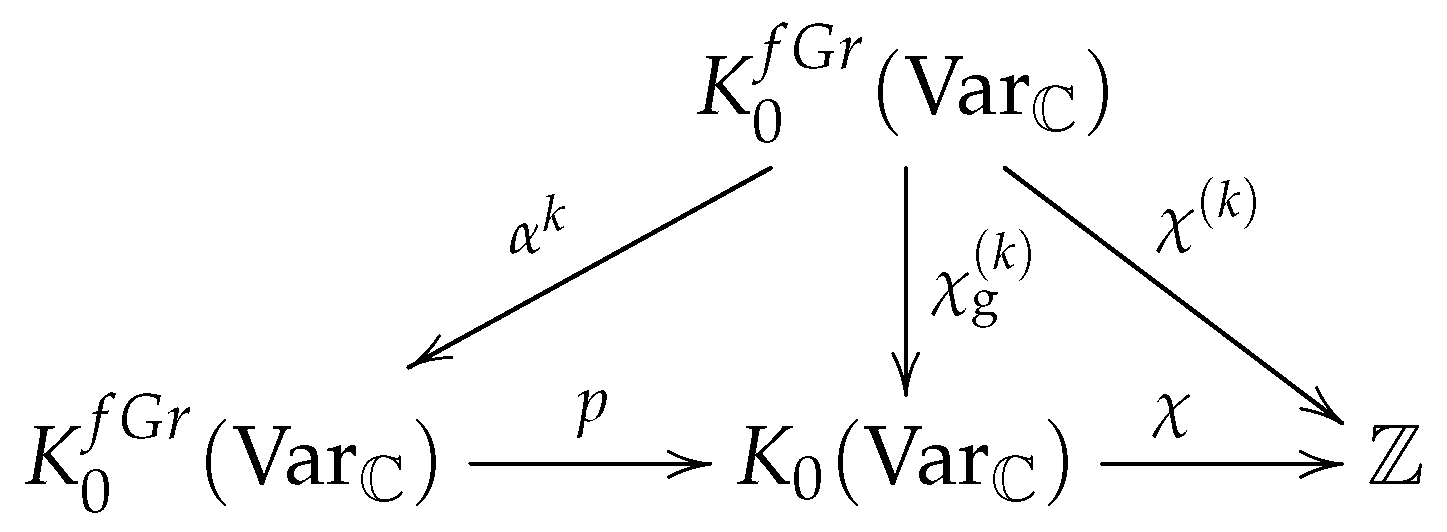
One has a ring homomorphism defined by (see the notations above). One can see that , where is the usual Euler characteristic. Therefore, can be considered as a sort of a generalized version of the Euler characteristic of order k with values in . (In [13], the homomorphism is called the inertia homomorphism.)
3. The Universal Euler Characteristic
In [10], there was defined the so-called universal Euler characteristic on the ring . Let be the subring of generated by the zero-dimensional (i.e., finite) G-varieties. It can be described in the following way. Let be the set of isomorphism classes of finite groups. Then is the Abelian group freely generated by the elements corresponding to the isomorphism classes of finite groups. The generator is represented by the one-point set with the (unique) action of a representative G of the class . The Krull–Schmidt theorem implies that is the ring of polynomials in the variables corresponding to the isomorphism classes of finite indecomposable groups. If is a G-variety, its universal Euler characteristic is defined by
where is the set of points with the isotropy subgroup belonging to the class .
Remark 2.
This characteristic can be regarded as a universal one in the topological category.
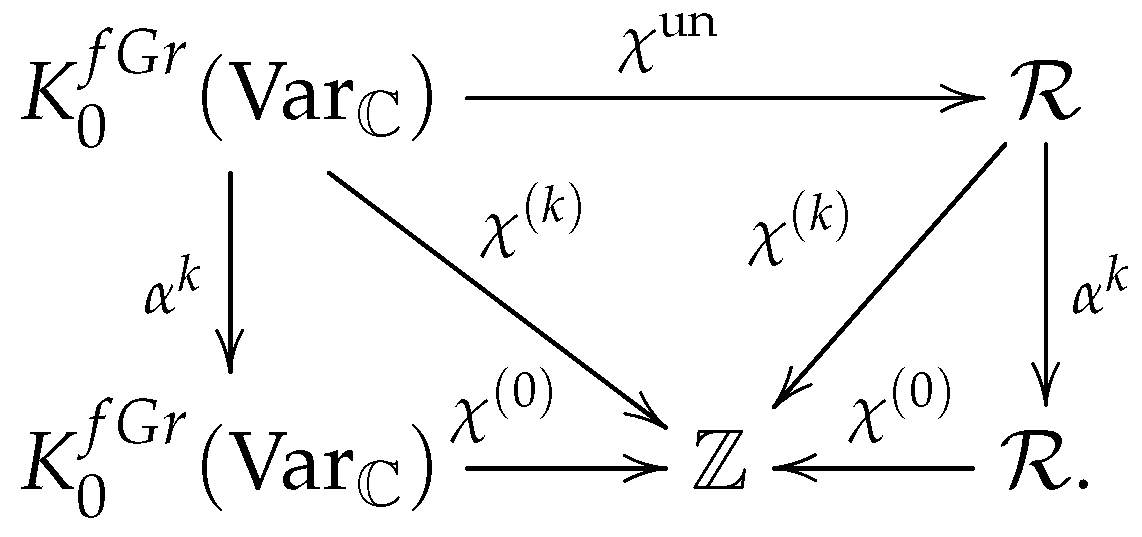
The orbifold Euler characteristic and the higher order Euler characteristics define ring homomorphisms from to .
One has a natural -ring structure on defined by an analogue of the Kapranov zeta function (see [10]), and the maps are -ring homomorphisms with respect to this -structure.
One has the commutative diagram of ring homomorphisms
4. Macdonald-Type Equations and -Structure Homomorphisms
The classical Macdonald equation describes the generating series of the Euler characteristics of the symmetric products of a space:
where X is a topological space and is its nth symmetric product. One also has a Macdonald-type equation for the generating series of the Euler characteristics of the configuration spaces of subsets of points in X. Let be the configuration space of unordered n-tuples of points in X, where is the big diagonal in . Then one has
There exist equations for the generating series of the Hodge–Deligne polynomials of the symmetric products of a complex quasi-projective variety and of the configuration spaces of subsets of points in it (see, e.g., [5]).
These equations are related with -ring homomorphisms (and therefore with power structure homomorphisms) from the Grothendieck ring of complex quasi-projective varieties to and to , respectively. For a ring homomorphism , one has a natural map (a group homomorphism) obtained by applying to the coefficients of a series. If and are -rings, a ring homomorphism is said to be a -ring homomorphism if for . If and are rings with power structures, is a power structure homomorphism if . A -ring homomorphism induces a power structure homomorphism for the corresponding power structures and vise-versa.
Equations (2) and (3) are related with the following -ring structures on the Grothendieck ring and on . The Kapranov zeta function of a variety X (or of its class ) is
One can see that defines a -ring structure on . Another -ring structure on is defined by the series
The corresponding -structures on are and , respectively. Equations (2) and (3) mean that the Euler characteristic is a -ring homomorphism for the corresponding -structures. Both -structures on (as well as both -structures on ) induce the same power structure over (over , respectively). The corresponding power structure over is given by Equation (1).
The Macdonald-type equations for the orbifold Euler characteristic and for the higher order Euler characteristics look like the following.
Theorem 1.
([8]) The mapis a λ-ring homomorphism for the λ-structures on the sourceand on the targetdefined by the Kapranov zeta functionand by the series
respectively, i.e.,
Remark 3.
The mapis not a λ-ring homomorphism with respect to the configuration space λ-structure on.
5. Generalized Euler Characteristics of Higher Orders as Homomorphisms from
In [9], it was shown that the orbifold Euler characteristic and the Euler characteristics of higher orders are ring homomorphism (moreover, -ring homomorphisms) from the Grothendieck ring to . The notions of the generalized (“motivic”) orbifold Euler characteristic and of generalized (“motivic”) Euler characteristics of higher orders were introduced by the authors in [5] (as a refinement of the orbifold Hodge–Deligne polynomial from [6]) and in [7]. They were defined as invariants of a complex quasi-projective manifold with the action of a finite group and took values in the extension of the Grothendieck ring of complex quasi-projective varieties by the rational powers of the class of the affine line and not defined on a ring. The generalized orbifold Euler characteristics took into account the so-called ages (or fermion shifts), which are defined by the actions of the elements of the group on the tangent spaces to their fixed points. These ages are not defined for varieties with finite group actions (or rather, for elements of the corresponding Grothendieck ring(s)). To avoid this problem, in [9], The generalized orbifold Euler characteristics were considered as functions on the Grothendieck ring of varieties with equivariant vector bundles. Here, we define versions of them (with the corresponding weight in terms of [7,9], that is, without taking into account the ages) as ring homomorphisms from to .
The homomorphism sending the class to the class ] is an additive function on and, therefore, can be considered as a generalized version of the Euler characteristic. Let us call it a generalized Euler characteristic of order 0 and denote it by . Let X be a G-variety.
Definition 3.
The generalized Euler characteristicof order k is defined by
where the sum is over the conjugacy classesof elements of G, g is a representative of the class, is the fixed point set of g, andis the centralizer of g in G.
Proposition 1.
The generalized Euler characteristicof order k is a well-defined ring homomorphism fromto.
Proof.
One has to show that respects relations (1)–(3) of Definition 1. This obviously holds for (1) and (2). The fact that respects condition (3) (the induction relation) can be proved by induction on k: it is obvious for , and the statement for an arbitrary k follows from the statement for due to ([9], Lemma 1). □
The following statement gives a Macdonald-type equation for the generalized Euler characteristics of higher orders and is a specification of ([9], Theorem 4) or of ([7], Theorem 1).
Theorem 2.
The mapis a λ-ring homomorphism for the λ-structures on the sourceand on the targetdefined by the Kapranov zeta functionand by the series
i.e.,
Remark 4.
The mapis not a λ-ring homomorphism with respect to the configuration space λ-structure on.
One has the commutative diagram of ring homomorphisms
6. A Substitute of a Macdonald-Type Equation for the Homomorphism
As it follows from Definition 3, the composition of the homomorphism with the natural map coincides with the generalized (“motivic”) Euler characteristic of order k (with the generalized orbifold Euler characteristic for ) computed without the fermion shift (i.e., with in terms of [7]). Its composition with the usual Euler characteristic homomorphism gives the usual (orbifold) Euler characteristic of order k. One has Macdonald-type equations for the (orbifold) Euler characteristic of order k ([8]) and for the generalized Euler characteristic of order k ([7]). Here, we shall give a version of these equations for the homomorphism (which reduces to the Macdonald type equations for the generalized orbifold Euler characteristic and for the orbifold Euler characteristic after applying the homomorphisms p and , respectively). Let be defined in the following way. Let be a G-variety. For a representative g of a conjugacy class , the centralizer acts on the fixed point set of the element g. Let be the group generated by and by an additional element commuting with all the elements of and such that . For , the group coincides with . One has an action of the group on assuming to act trivially. Let be defined by
In particular, .
Theorem 3.
Proof.
The proof essentially follows from the description of the conjugacy classes of elements of the wreath products and of their centralizers from, e.g., [8] and to a big extent repeats the computations in [7]. An element of can be written as a pair , where , . One has
where the sum is over the conjugacy classes of elements of . The conjugacy classes of elements of are characterized by their types. For a cycle (of length r) in the permutation s, its cicle product is well-defined up to conjugacy. For and for , let be the number of r-cycles in s with the cicle product from . One has
The collection is called the type of the element . Two elements of are conjugate if and only if they are of the same type. Therefore, the summation over the conjugacy classes of elements of can be substituted by the summation over all possible types.
The fixed point set can be identified with
The centralizer of is isomorphic to
where the definition of the group and the description of its action on the fixed point set are given above.
Therefore, one has
□
The restrictions of the homomorphisms and to the subring define the homomorphisms and from to The homomorphism acts by the formula .
Corollary 1.
For, one has
7. Conclusions
We study generalized versions of the orbifold Euler characteristic and of higher order Euler characteristics as ring homomorphisms from the Grothendieck ring of complex quasi-projective varieties with actions of finite groups introduced in [9]. We define the generalized orbifold Euler characteristic and generalized higher order Euler characteristics as homomorphisms from to the Grothendieck ring of complex quasiprojective varieties. This permits the formulation of Macdonald-type equations for them in terms of -ring homomorphisms. We consider a map (the inertia homomorphism) from the Grothendieck ring to itself such that the composition of its kth power with the natural map sending the class of a G-variety to the class of its quotient coincides with the generalized (orbifold) Euler characteristic of order k. We formulate and prove a substitute of a Macdonald-type equation for the homomorphism .
Author Contributions
Funding
The work of S.M.G.-Z. was supported by the grant 16-11-10018 of the Russian Science Foundation. I.L. and A.M.-H. were partially supported by a competitive Spanish national grant MTM2016-76868-C2-1-P.
Conflicts of Interest
The authors declare no conflict of interest.
References
- Dixon, L.; Harvey, J.; Vafa, C.; Witten, E. Strings on orbifolds. J. Nucl. Phys. B 1985, 261, 678–686. [Google Scholar] [CrossRef] [Scilit]
- Atiyah, M.; Segal, G. On equivariant Euler characteristics. J. Geom. Phys. 1989, 6, 671–677. [Google Scholar] [CrossRef] [Scilit]
- Hirzebruch, F.; Höfer, T. On the Euler number of an orbifold. Math. Ann. 1990, 286, 255–260. [Google Scholar] [CrossRef] [Scilit]
- Bryan, J.; Fulman, J. Orbifold Euler characteristics and the number of commuting m-tuples in the symmetric groups. Ann. Comb. 1998, 2, 1–6. [Google Scholar] [CrossRef] [Scilit]
- Gusein-Zade, S.M.; Luengo, I.; Melle-Hernández, A. On the power structure over the Grothendieck ring of varieties and its applications. Proc. Steklov Inst. Math. 2007, 258, 53–64. [Google Scholar] [CrossRef] [Scilit]
- Wang, W.; Zhou, J. Orbifold Hodge numbers of wreath product orbifolds. J. Geom. Phys. 2001, 38, 152–169. [Google Scholar] [CrossRef] [Scilit]
- Gusein-Zade, S.M.; Luengo, I.; Melle-Hernández, A. Higher order generalized Euler characteristics and generating series. J. Geom. Phys. 2015, 95, 137–143. [Google Scholar] [CrossRef] [Scilit]
- Tamanoi, H. Generalized orbifold Euler characteristic of symmetric products and equivariant Morava K-theory. Algebr. Geom. Topol. 2001, 1, 115–141. [Google Scholar] [CrossRef] [Scilit]
- Gusein-Zade, S.M.; Luengo, I.; Melle-Hernández, A. Grothendieck ring of varieties with actions of finite groups. Proc. Edinb. Math. Soc. 2019. [Google Scholar] [CrossRef] [Scilit]
- Gusein-Zade, S.M.; Luengo, I.; Melle-Hernández, A. The Universal Euler Characteristic of V-Manifolds. Funct. Anal. Appl. 2018, 52, 297–307. [Google Scholar] [CrossRef] [Scilit]
- Gusein-Zade, S.M.; Luengo, I.; Melle-Hernández, A. A power structure over the Grothendieck ring of varieties. Math. Res. Lett. 2004, 11, 49–57. [Google Scholar] [CrossRef] [Scilit]
- Knutson, D. λ-Rings and the Representation Theory of the Symmetric Group; Lecture Notes in Mathematics; Springer: Berlin, Germany; New York, NY, USA, 1973; Volume 308. [Google Scholar]
- Bergh, D.; Gorchinskiy, S.; Larsen, M.; Lunts, V. Categorical measures for finite group actions. arXiv, 2017; arXiv:1709.00620.
© 2019 by the authors. Licensee MDPI, Basel, Switzerland. This article is an open access article distributed under the terms and conditions of the Creative Commons Attribution (CC BY) license (http://creativecommons.org/licenses/by/4.0/).