Article

Spatial Correlation-Based Motion-Vector Prediction for Video-Coding Efficiency Improvement


1
Department of Information Engineering, Shanghai Maritime University, NO.1550, Haigang Ave., Shanghai 201306, China
2
Department of Electrical and Electronics Engineering, Tokushima University, 2-24, Shinkura-cho, Tokushima, Japan
3
Department of Electronic and Computer Engineering, National Taiwan University of Science and Technology, No. 43, Keelung Rd., Taipei 106, Taiwan
*
Author to whom correspondence should be addressed.
Symmetry 2019, 11(2), 129; https://doi.org/10.3390/sym11020129
Submission received: 28 December 2018 / Revised: 19 January 2019 / Accepted: 20 January 2019 / Published: 23 January 2019
(This article belongs to the Special Issue Information Technology and Its Applications 2021)

Abstract

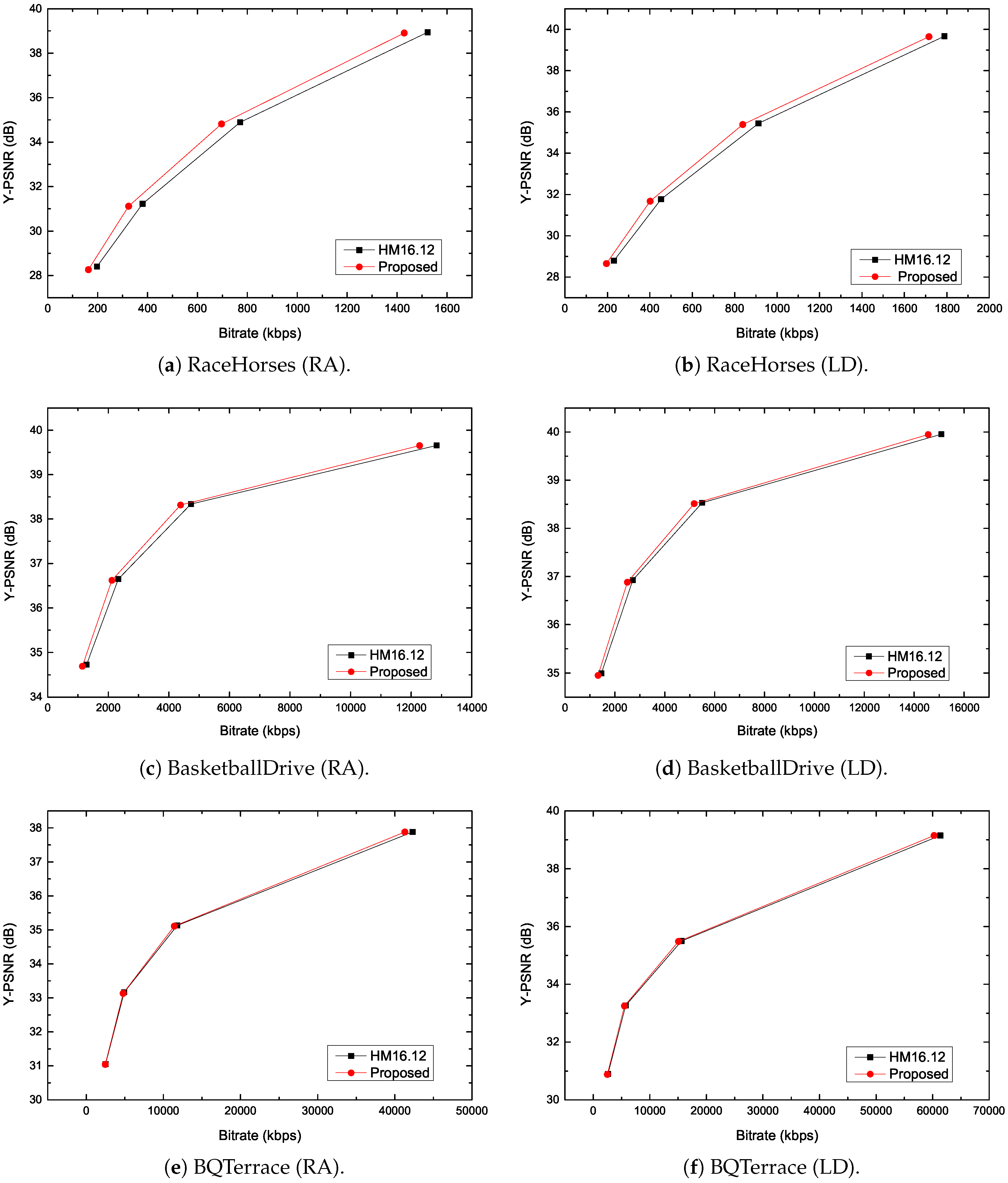
H.265/HEVC achieves an average bitrate reduction of 50% for fixed video quality compared with the H.264/AVC standard, while computation complexity is significantly increased. The purpose of this work is to improve coding efficiency for the next-generation video-coding standards. Therefore, by developing a novel spatial neighborhood subset, efficient spatial correlation-based motion vector prediction (MVP) with the coding-unit (CU) depth-prediction algorithm is proposed to improve coding efficiency. Firstly, by exploiting the reliability of neighboring candidate motion vectors (MVs), the spatial-candidate MVs are used to determine the optimized MVP for motion-data coding. Secondly, the spatial correlation-based coding-unit depth-prediction is presented to achieve a better trade-off between coding efficiency and computation complexity for interprediction. This approach can satisfy an extreme requirement of high coding efficiency with not-high requirements for real-time processing. The simulation results demonstrate that overall bitrates can be reduced, on average, by 5.35%, up to 9.89% compared with H.265/HEVC reference software in terms of the Bjontegaard Metric.
Keywords: H.265/HEVC; motion-vector prediction; video-coding efficiency; CU depth H.265/HEVC; motion-vector prediction; video-coding efficiency; CU depth