Abstract
The Newell–Whitehead–Segel equation is one of the most nonlinear amplitude equations that plays a significant role in the modeling of various physical phenomena arising in fluid mechanics, solid-state physics, optics, plasma physics, dispersion, and convection system. In this analysis, a recent numeric-analytic technique, called the fractional residual power series (FRPS) approach, was successfully employed in obtaining effective approximate solutions to the Newell–Whitehead–Segel equation of the fractional sense. The proposed algorithm relies on a generalized classical power series under the Caputo sense and the concept of an error function that systematically produces an analytical solution in a convergent fractional power series form with accurately computable structures, without the need for any unphysical restrictive assumptions. Meanwhile, two illustrative applications are included to show the efficiency, reliability, and performance of the proposed technique. Plotted and numerical results indicated the compatibility between the exact and approximate solution obtained by the proposed technique. Furthermore, the solution behavior indicates that increasing the fractional parameter changes the nature of the solution with a smooth sense symmetrical to the integer-order state.
1. Introduction
The subject of fractional calculus (FC) is not new, it dates back to the late seventeenth century. It is a generalization of classic calculus that deals with the ordinary differentiation and integration of arbitrary order. Recently, FC has been applied by many researchers to formulate many nonlinear problems that occur in physics and applied mathematics, and it already provides an excellent tool to describe the hereditary and memory properties of these physical phenomena. However, mathematical modeling of real-world problems often leads to nonlinear partial differential equations (NPDEs), including nonlinear oscillations of earthquakes, nonlinear optics, viscoelasticity, fluid flow, chemical reactions, fluid-dynamics traffic, and control theory [1,2,3,4,5,6].
The current work aims to provide a convenient way to ascertain the convergence of approximation series solutions. To achieve our aim, consider the fractional Newell–Whitehead–Segel equation (FNWSE) in the following form:
subject to the initial condition
where , are real constants such that , and . The term represents the variation of with respect to temporal variable at a set position, while expresses the variation of with respect to spatial variable at a specific time , and expresses a nonlinear source term for . Here, the unknown function can be assumed to be the nonlinear distribution of temperature in a thin and infinitely long rod. It may also be considered as the velocity of fluid flow in a tube of unlimited length with a small diameter.
The classic Newell–Whitehead–Segel model (NWS) is one of the most popular amplitude equations describing the occurrence of stationary spatial stripe patterns in a two-dimensional system as well as the dynamic behavior near the bifurcation point of the Rayleigh–Benard convection of binary fluid mixtures [7]. Indeed, two types of patterns can be observed: the roll pattern, in which the cylinders are formed using fluid stream lines that may be bent and form spirals like patterns, and the hexagonal pattern, in which the honey comb and stripes cells are formed by dividing the flow of liquid. For instance, the patterns of stripes can be found in the visual cortex, on zebra skin, and in human fingerprints. It is worth mentioning that the hexagonal patterns can be achieved in a chemical reaction and diffusion model by utilizing laser beam propagation through nonlinear optical media [8].
Numerous mathematical formations contain nonlinear fractional partial differential equations FPDEs. However, solving these equations is usually difficult. Therefore, effective and developed algorithms are needed to obtain analytical or approximate solutions to these equations. Recently, many common numeric-analytic techniques have been proposed for solving the FNWSE such as the homotopy analysis sumudu transform method [9], variational iteration method [10], Adomian decomposition method [11], and fractional complex transform method [12]. For further research papers regarding numerical techniques for fractional ordinary and partial differential equations arising in different branches of science, we refer to [13,14,15,16,17,18].
The objective of this work is to apply an advanced algorithm, called the fractional residual power series (FRPS) algorithm, for solving the time-FNWSE. The FRPS is a novel numeric-analytic technique for dealing with both linear and nonlinear issues, which enables us to obtain analytical and approximate solutions in convergent fractional power series (FPS) by combining Taylor’s fractional series formula and residual error functions without requiring any constrained assumptions [19,20,21,22,23]. The outline of this work is organized as follows. In Section 2, fundamental definitions and theorems about fractional calculus and FPS are shown. The solution methodology of the FRPS algorithm is introduced in Section 3. In Section 4, some numerical applications are included to clarify the accuracy, simplicity, and reliability of the proposed algorithm. Finally, Section 5 is devoted to conclusions.
2. Preliminaries and Notations
In the present section, we recalled some basic definitions and properties of the Caputo and Riemann–Liouville fractional operators. Then, we survey the most important definitions and results related to the fractional Taylor series representation.
Definition 1.
[1] A real function is said to be in the space if there exists a real number , such that , where and it is said to be in the space if .
Definition 2.
[1] The Riemann–Liouville fractional integral operator of order , for a function , is given by:
Definition 3.
[1] The Caputo fractional derivative operator of order for a function , is given by:
, we have the following properties:
- , .
- , .
- , that is, is a linear, .
Definition 4.
[5] A fractional power series (FPS), where , and ,
is called multiple fractional power series (MFPS) about .
Theorem 1.
[5] Suppose that has the following MFPS representation at
where is continuous on and are continuous on , , and is well defined on for and , then the coefficients will be in the form such that .
Proof.
Assuming that then directly . By applying to and evaluating the result at , it yields that and hence . Proceeding inductively and applying to times and evaluating the result at , one can note that and hence the proof is completed.
Theorem 2.
[5] Let and suppose that , , and is well defined on for and . Then,
It is worth mentioning here that the MFPS representation about can be rewritten by
where represents the th approximate series of and is the reminder term of MFPS, which are given, respectively, by
and with . Thus, the MFPS is convergent whenever .
3. Solution Methodology of the FRPS Algorithm
The main objective of this section is to describe the methodology of the proposed algorithm for obtaining the MFPS solution for the FNWSEs (1) and (2) through substituting the expansion of their MFPS among their truncated residual functions.
According to the FRPS approach, let the solution of FNWSEs (1) and (2) about , have the following MFPS:
and let be the th truncated series of such that
Using the initial condition (2) in expansion (3), we find that . Thus, the MFPS solution (4) can be written as:
where the coefficients , can be determined by solving the following fractional differential equation:
in which is called the th residual function and defined as:
whereas the residual function is defined as:
Evidently, and for each and , where is called the convergence radius for the MFPS (3). In [24,25,26,27,28], it has been proved that . Also, for each .
Anyhow, the next algorithm assists us in determining the required coefficients , in expansion (3), as well predict and obtain the MFPS solution of FNWSEs (1) and (2):
Algorithm 1.
To find out the coefficients , in expansion (3), do the following steps:
- Step 1: Assume that the solution of FNWSEs (1) and (2) has the MFPS about :where , , , and such that is continuous on , for .
- Step 2: Define the th truncated series of such that
- Step 3: Consider the initial condition , then the zeroth MFPS approximate solution of is .
- Step 4: Define the th residual function such that
- Step 5: Substitute the th truncated series into the th residual function such that
- Step 6: Set in Step 5, then by using , the first unknown coefficient is obtained. Therefore, the first approximate PS solution is also obtained.
- Step 7: For , do the following subroutine:
- (A)
- Apply the operator , () times, on both sides of the th residual function in Step 4 such that .
- (B)
- Compute the resulting equation at with equality to zero such that , with the help of for at .
- (C)
- Find the th unknown coefficient and do Step 7 for until the arbitrary .
- Step 8: Collect the obtained coefficients for each in terms of expanded MFPS and try to find a general pattern with the term of infinite series so that the exact solution of FNWSEs (1) and (2) is obtained; otherwise, the pattern obtained in the sense of the series coefficients will be the th approximate MFPS solution of FNWSEs (1) and (2).
- Step 9: Stop.
Theorem 3.
Let be the exact solutions of FNWSEs (1) and (2). If there exists a fixed constant such that for all for all , , and , then the sequence of approximate solution converges to as .
Proof.
For all and , let , then from , we have . So, . Similarly, , that is, . Therefore, and hence .
Consequently, we have
which converges to zero as .
4. Numerical Results and Discussion
This section aims to present the implementation of the proposed approach in finding approximate solutions for two FNWSEs in order to show the performance and simplicity of the FRPS method.
Example 1.
Consider the following linear fractional Newell–Whitehead–Segel equations [9,10,11]
with the initial condition
Using the last description of the FRPS algorithm, starting with , then the th residual function for (9) will be as follows
where . So, the first residual function can be given as
Based on the fact that , the first unknown coefficient of the MFPS expansion (3) is . Thus, the first MFPS approximate solution for (9) and (10) is .
Similarly, put into Equation (11), then the second residual function will be as
and the th time fractional derivative of is , then by solving , it yields . Hence, the second MFPS approximate solution for (9) and (10) can be written as .
To find , write the third truncated series in Equation (11), taking into account the values of and in previous steps such that , and through applying on the resulting equation, we get . Then, by utilizing the fact that , the coefficient will be given such that . Therefore, .
Using the same manner for , and based on the fact that , it yields . Depending on this, the fourth MFPS approximate solution can be written as . Moreover, depending on the results of , for , the eighth MFPS approximate solution for (9) and (10) is given by
Correspondingly, for a particular case, , the general form of the MFPS approximate solution of (9) and (10) can be written as
which coincides with the exact solution of the classical NWSE (9) and (10). Also, it is clear that the obtained results are consistent with those of [9,10,11].
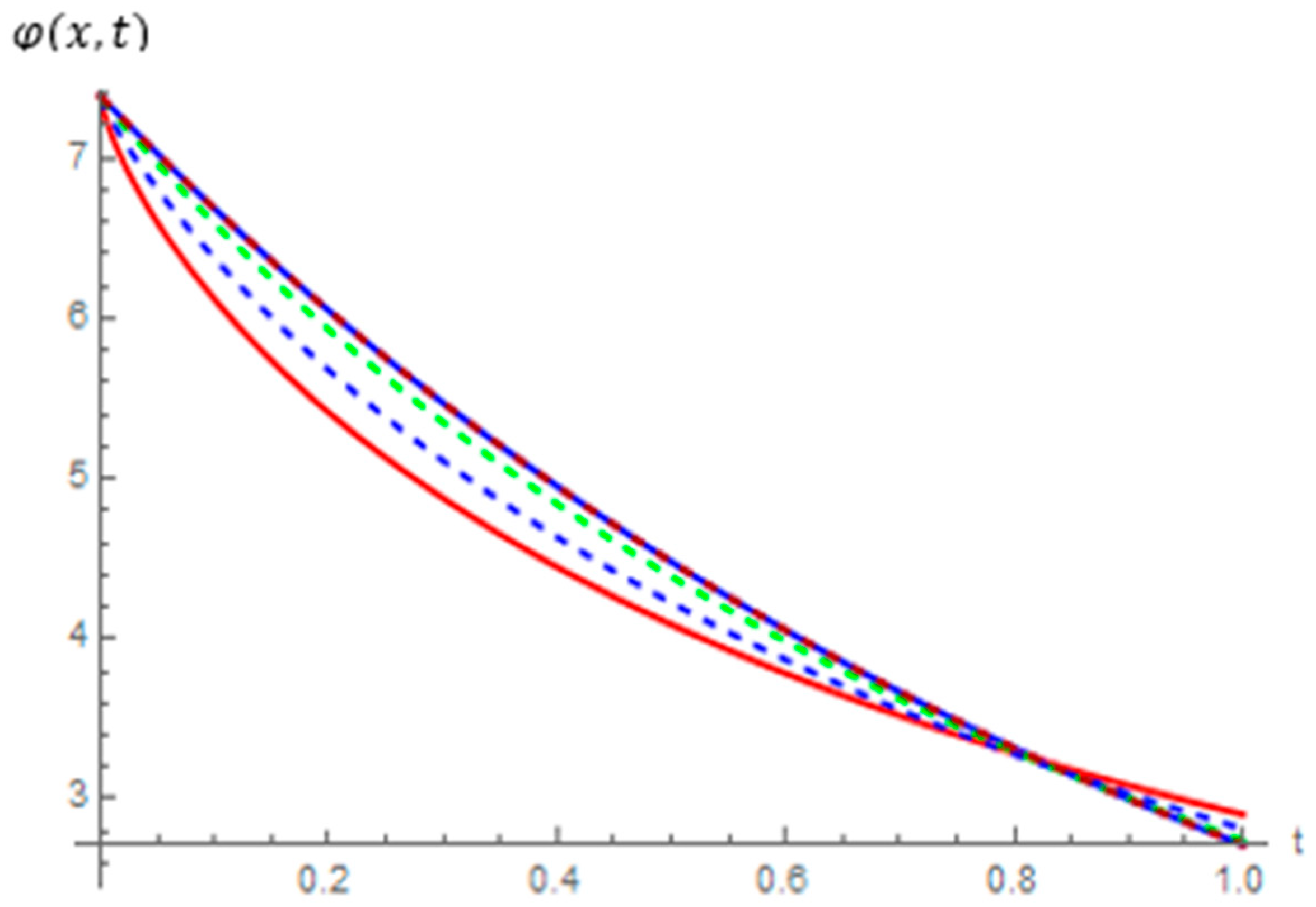
Figure 1 shows the exact solution and the pattern solution of the approximate solution for different values of where . The analysis of absolute errors by the FRPS algorithm is obtained and summarized in Table 1 for fixed values of at and at some selected grid points of with step size . Furthermore, the absolute and relative errors associated with the th approximate solutions when , and for different values of in with step size at are listed in Table 2. It is obvious from this table that the errors are continuously improved by increasing the number of iterations used, especially at some points near the initial values, where the error is equal to zero after . Thus, it can be concluded that increasing the number of FRPS iterations gives higher accuracy of the FRPS method.
Figure 1.
The solution behavior of the approximate solutions for compared with the exact solution. Red, ; dashed blue, ; dashed green, ; dashed darker red, ; and blue, exact solution.
Table 1.
Absolute errors of at and for Example 1.
Table 2.
Error analysis of , at for Example 1.
Typically, computer programs have limited precision when viewing data in floating-point format with a fixed number of decimal places. In this sense, if the simulated data is almost identical to the actual data, then the maximum error is around zero. Therefore, in Table 2, we find some absolute errors equal to zero, which indicates that the exact values are very close to approximations at those nodes after a certain number of iterations.
Example 2.
Consider the following nonlinear fractional Newell–Whitehead–Segel equation [9,10,11]
with the initial condition
To apply the FRPS technique, starting with the initial condition of (17) and based upon (5), the th MFPS approximate solution of (16) is
where the values of , , can be obtained through construction of for (16) as follows
Now, to determine , consider in Equations (18) and (19) so that
Then, by using the fact that , it yields . So, the first MFPS approximate solution of (16) and (17) can be expressed as .
Again, for finding the second coefficient , put in Equations (18) and (19), let , and apply on both sides of the resulting equation as follows
Then, by solving , the second coefficient will be given such that Hence, .
For , apply on the third residual function of (19), then by solving the resulting fractional equation at , one can get . Therefore, the third MFPS will be written as .
Using the same argument and based upon the result of for , the fourth MFPS for nonlinear FNWSEs (16) and (17) can be expressed as:
In case , the approximate solution can be written as
which coincides with the Taylor series expansion of the exact solution , as well as being in good agreement with the results obtained in [9,10,11].
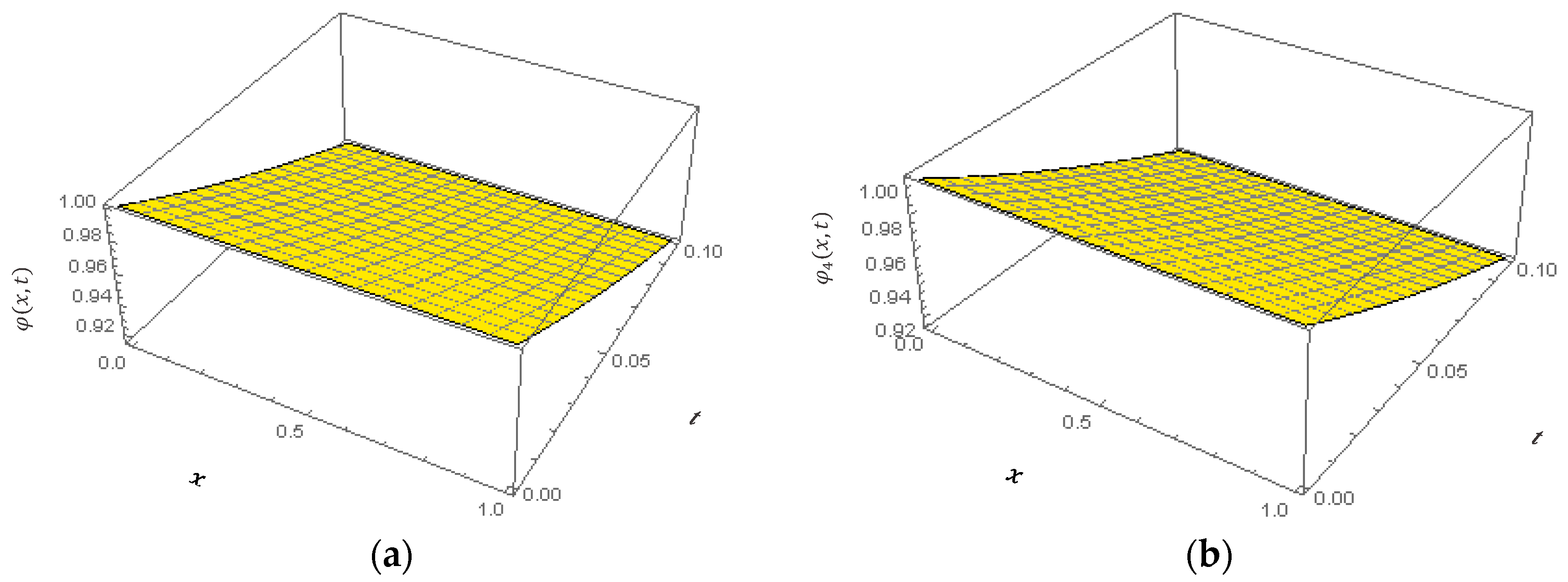
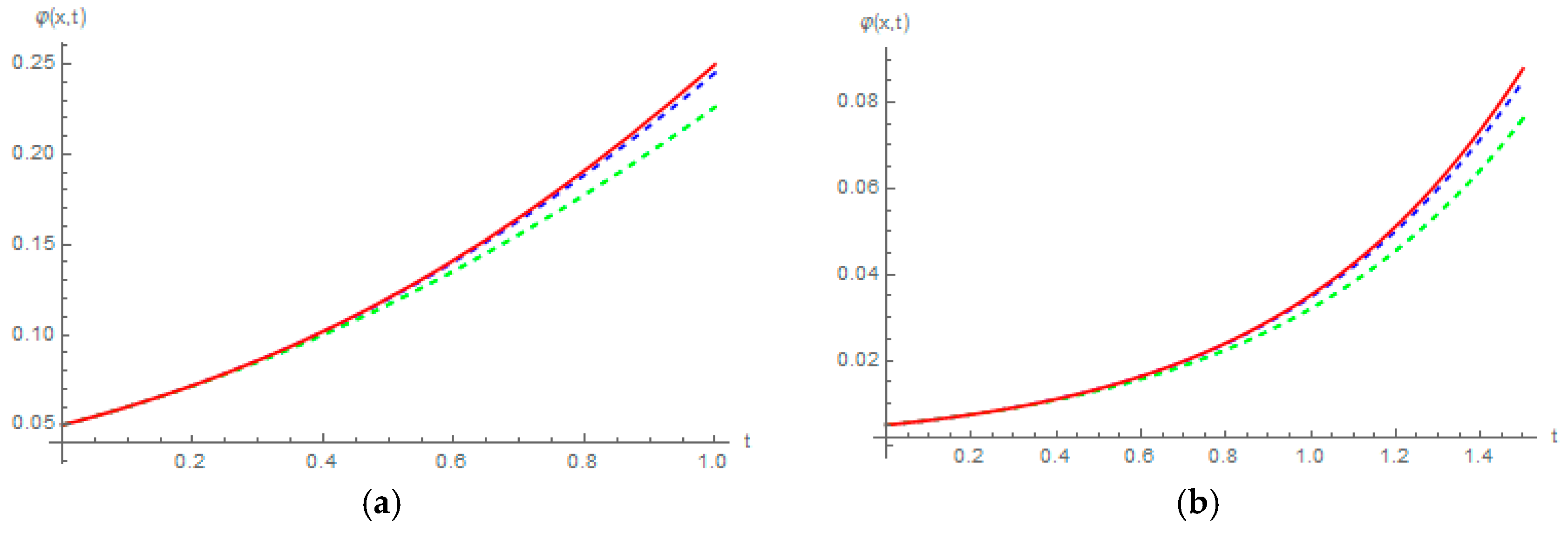
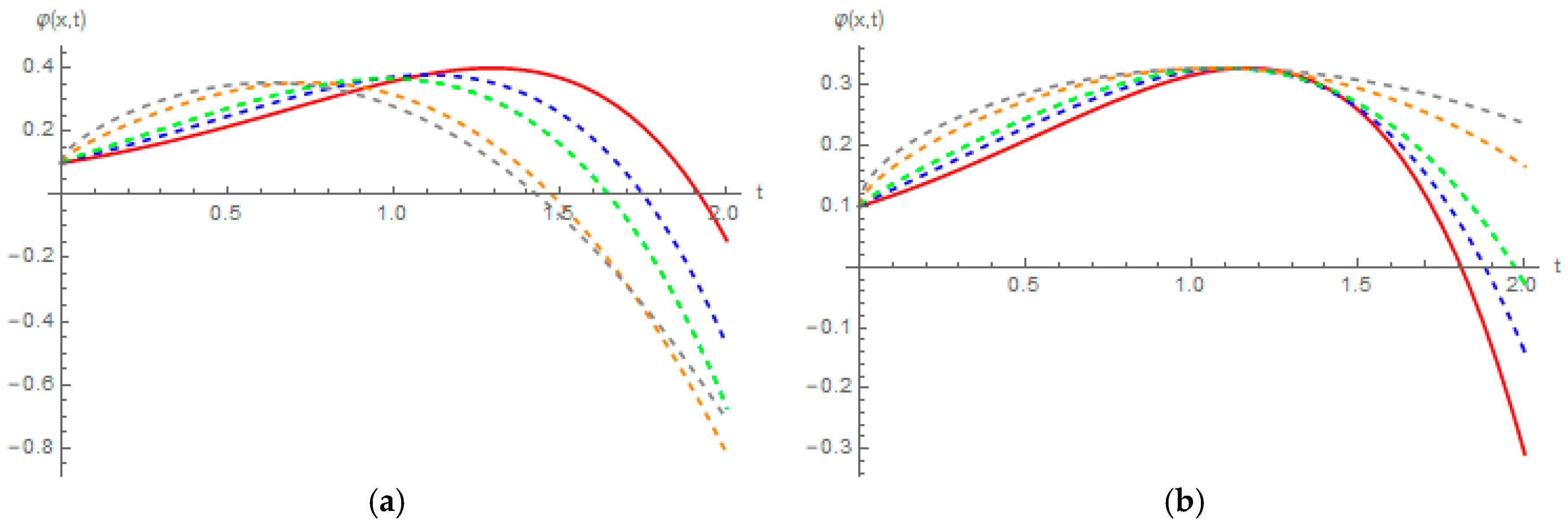
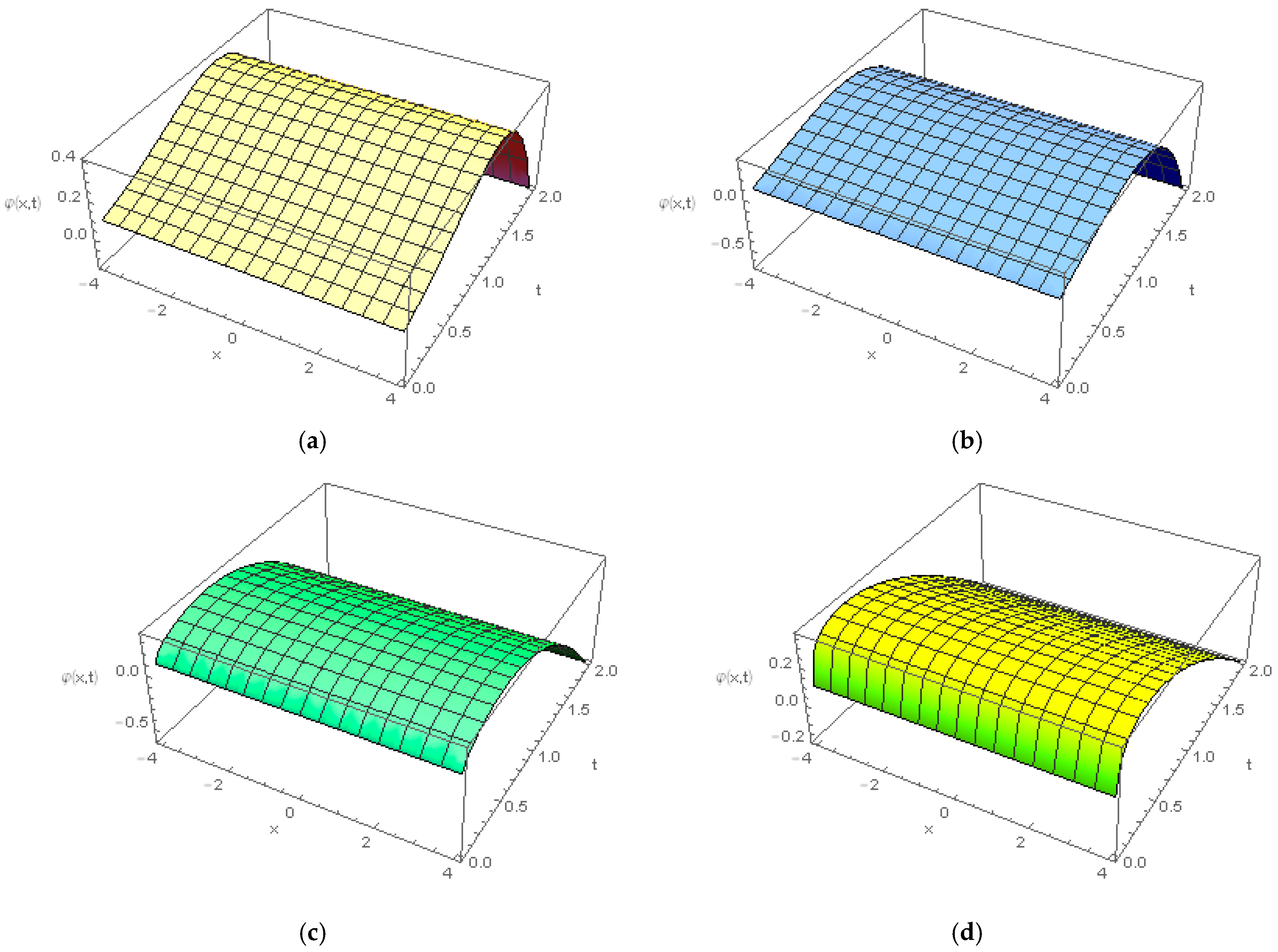
The results obtained by the FRPS method have been drawn in Figure 2 for and at and . From these figures, it can be noted that the three-dimensional graph of the FRPS approximate solution almost coincides with the behavior of the exact solution considering integer derivatives. The accuracy and efficiency of the FRPS algorithm are shown in Table 3 by computing the fourth FRPS approximate solutions for different cases of at fixed values of , and , with step size . For numerical comparison, the proposed method has been compared with the fractional complex transform coupled with He’s polynomials (FCT-HP) method [12] in order to verify the superiority of the FRPS method, where the obtained results of Example 2 are listed in Table 4 for , , , and with step size 0.16. Figure 3 shows the behavior of the exact solution, fifth FRPS solution and fifth FCT-HP solution [12] at , , and each , which can illustrate the efficiency of the proposed method. Here, it can be seen that the curve of the FRPS approximate solution is stable and tends to align slightly more to the curve of the exact solution than the fifth FCT-HP solution described in [12] in solving nonlinear FNWSEs (16) and (17). Figure 4 shows the FRPS solution’s behavior compared with the behavior of the FCT-HP solution for , , and at different values of fractional order such that . While the surface plots of the fifth-order FRPS solutions for Example 2 at and for different values of fractional order such that , are given in Figure 5.
Figure 2.
Solution behavior of the exact and approximate solution at , for nonlinear fractional Newell–Whitehead–Segel equations (FNWSEs) (16) and (17): (a) Exact solution; (b) FRPS solution.
Table 3.
Approximated solutions of at , and for Example 2.
Table 4.
Numerical comparison of at and for Example 2. FPS, fractional power series; FCT-HP, fractional complex transform coupled with He’s polynomials.
Figure 3.
Plots of the solutions for Example 2 at and . Red for the exact solution; blue for the fractional residual power series (FRPS) solution; green for the FCT-HP solution [12]: (a) Solutions at ; (b) Solution at .
Figure 4.
Plots of the FRPS and FCT-HP solutions for Example 2 at and for different values of fractional order . Red, ; blue, ; green, ; orange, ; gray, : (a) FRPS solutions; (b) FCT-HP solutions.
Figure 5.
Surface plots of the fifth-order FRPS solutions for Example 2 at and for different values of fractional order such that : (a) ; (b) ; (c) ; (d) .
5. Conclusions
In this paper, the application of the FRPS algorithm is expanded to explore the approximate solutions of time-fractional Newell–Whitehead–Segel equations in terms of the fractional Caputo derivative. The proposed technique was implemented directly to obtain the approximation solutions in multiple FPS form by deriving the residual error functions. The numerical and graphical results showed coinciding behavior between the analytical solution and the approximate solution of FRPS method at different values of fractional order with a rapid convergence rate even after computing a few iterations. At the same time, these results indicated a good agreement with those obtained by the homotopy analysis sumudu transform method. Moreover, the proposed method does not require any transformation, perturbation, or discretion. From the results, it can be concluded that the FRPS method is a valuable, effective, and straightforward tool in predicting and constructing numeric-analytical solutions for various issues involving fractional partial differential equations. Mathematica 10 software package was used in all computational processes.
Author Contributions
Conceptualization, M.A.; Funding acquisition, R.R.A. and U.K.S.D.; Investigation, R.S.; Methodology, M.A.; Software, M.A.-S.; Supervision, M.A.-S. and R.R.A.; Validation, U.K.S.D.; Visualization, R.S.; Writing—original draft, M.A.; Writing—review and editing, M.A.-S.
Funding
This research was funded by Universiti Kebangsaan Malaysia grant number GP-K007788 and GP-K006926.
Conflicts of Interest
The authors declare no conflict of interest.
References
- Miller, K.S.; Ross, B. An Introduction to the Fractional Calculus and Fractional Differential Equations; Wiley: New York, NY, USA, 1993. [Google Scholar]
- Baleanu, D.; Machado, J.A.T.; Luo, A.C. Fractional Dynamics and Control; Springer: Berlin/Heidelberg, Germany, 2012. [Google Scholar]
- Kilbas, A.A.; Srivastava, H.M.; Trujillo, J.J. Theory and Applications of Fractional Differential Equations, 1st ed.; Elsevier: Amsterdam, The Netherlands, 2010; p. 523. ISBN 0444518320. [Google Scholar]
- Oldham, K.B.; Spanier, J. The Fractional Calculus; Academic Press: New York, NY, USA, 1974. [Google Scholar]
- El-Ajou, A.; Abu Arqub, O.; Momani, S. Approximate analytical solution of the nonlinear fractional KdV-Burgers equation: A new iterative algorithm. J. Comput. Phys. 2015, 293, 81–95. [Google Scholar] [CrossRef]
- Al-Smadi, M. Simplified iterative reproducing kernel method for handling time-fractional BVPs with error estimation. Ain Shams Eng. J. 2018, 9, 2517–2525. [Google Scholar] [CrossRef]
- Rosu, H.C.; Cornejo-Perez, O. Super symmetric pairing of kinks for polynomial nonlinearities. Phys. Rev. E 2005, 4, 1–13. [Google Scholar]
- He, J.M. Homotopy perturbation technique. Comput. Methods Appl. Mech. Eng. 1999, 178, 257–262. [Google Scholar] [CrossRef]
- Kumar, D.; Prakash, R. Numerical approximation of Newell Whitehead-Segel equation of fractional order. Nonlin Eng. 2016, 5, 81–86. [Google Scholar] [CrossRef]
- Prakash, A.; Goyal, M.; Gupta, S. Fractional variational iteration method for solving time-fractional Newell-Whitehead- Segel equation. Nonlin Eng. 2019, 8, 164–171. [Google Scholar] [CrossRef]
- Prakash, A.; Verma, V. Numerical Method for Fractional Model of Newell-Whitehead-Segel Equation. Frontiers in Physics 2019, 7, 15. [Google Scholar] [CrossRef]
- Edeki, S.O.; Ogundile, O.P.; Osoba, B.; Adeyemi, G.A.; Egara, F.O.; Ejoh, A.S. Coupled FCT-HP for Analytical Solutions of the Generalized Time-fractional Newell-Whitehead-Segel Equation. WSEAS Trans. Syst. Control 2018, 13, 266–274. [Google Scholar]
- Al-Smadi, M.; Freihat, A.; Khalil, H.; Momani, S.; Khan, R.A. Numerical multistep approach for solving fractional partial differential equations. Int. J. Comput. Methods 2017, 14, 1750029. [Google Scholar] [CrossRef]
- Altawallbeh, Z.; Al-Smadi, M.; Komashynska, I.; Ateiwi, A. Numerical solutions of fractional systems of two-point BVPs by using the iterative reproducing kernel algorithm. Ukrainian Math. J. 2018, 70, 687–701. [Google Scholar] [CrossRef]
- Al-Smadi, M.; Abu Arqub, O. Computational algorithm for solving fredholm time-fractional partial integrodifferential equations of dirichlet functions type with error estimates. Appl. Math. Comput. 2019, 342, 280–294. [Google Scholar] [CrossRef]
- Al-Smadi, M. Solving fractional system of partial differential equations with parameters derivative by combining the GDTM and RDTM. Nonlinear Stud. 2019, 26, 587–601. [Google Scholar]
- Momani, S.; Abu Arqub, O.; Freihat, A.; Al-Smadi, M. Analytical approximations for Fokker-Planck equations of fractional order in multistep schemes. Appl. Comput. Math. 2016, 15, 319–330. [Google Scholar]
- Alshammari, S.; Al-Smadi, M.; Hashim, I.; Alias, M.A. Applications of fractional power series approach in solving fractional Volterra integro-differential equations. In AIP Conference Proceedings; AIP Publishing: Melville, NY, USA, 2019; Volume 2111, p. 020003. [Google Scholar]
- Kumar, A.; Kumar, S.; Yan, S.P. Residual power series method for fractional diffusion equations. Fundam. Inform. 2017, 151, 213–230. [Google Scholar] [CrossRef]
- Zhang, Y.; Kumar, A.; Kumar, S.; Baleanu, D.; Yang, X.J. Residual power series method for time fractional Schrödinger equations. J. Nonlinear Sci. 2016, 9, 5821–5829. [Google Scholar] [CrossRef]
- Alaroud, M.; Al-Smadi, M.; Ahmad, R.R.; Din, S.K.U. Numerical computation of fractional Fredholm integro-differential equation of order 2b arising in natural sciences. J. Phys. Conf. Ser. 1212, 2019, 012022. [Google Scholar]
- Freihet, A.; Hasan, S.; Al-Smadi, M.; Gaith, M.; Momani, S. Construction of fractional power series solutions to fractional stiff system using residual functions algorithm. Adv. Differ. Equ. 2019, 2019, 95. [Google Scholar] [CrossRef]
- Al Shammari, M.; Al-Smadi, M.; Abu Arqub, O.; Hashim, I.; Alias, M.A. Adaptation of residual power series method to solve Fredholm fuzzy integro-differential equations. In AIP Conference Proceedings; AIP Publishing: Melville, NY, USA, 2019; Volume 2111, p. 020002. [Google Scholar]
- Alaroud, M.; Al-Smadi, M.; Ahmad, R.R.; Din, S.K.U. Computational optimization of residual power series algorithm for certain classes of fuzzy fractional differential equations. Int. J. Differ. Equ. 2018, 2018, 8686502. [Google Scholar] [CrossRef]
- Alshammari, S.; Al-Smadi, M.; Al Shammari, M.; Hashim, I.; Alias, M.A. Advanced analytical treatment of fractional logistic equations based on residual error functions. Int. J. Differ. Equ. 2019, 2019, 7609879. [Google Scholar] [CrossRef]
- Alaroud, M.; Al-Smadi, M.; Ahmad, R.R.; Din, S.K.U. An Analytical Numerical Method for Solving Fuzzy Fractional Volterra Integro-Differential Equations. Symmetry 2019, 11, 205. [Google Scholar] [CrossRef]
- Freihet, A.; Hasan, S.; Alaroud, M.; Al-Smadi, M.; Ahmad, R.R.; Din, S.K.U. Toward computational algorithm for time-fractional Fokker-Planck models. Adv. Mech. Eng. 2019, 11, 1–11. [Google Scholar] [CrossRef]
- Hasan, S.; Al-Smadi, M.; Freihet, A.; Momani, S. Two computational approaches for solving a fractional obstacle system in Hilbert space. Adv. Differ. Equ. 2019, 2019, 55. [Google Scholar] [CrossRef]
© 2019 by the authors. Licensee MDPI, Basel, Switzerland. This article is an open access article distributed under the terms and conditions of the Creative Commons Attribution (CC BY) license (http://creativecommons.org/licenses/by/4.0/).