1. Introduction
Many
-extensions of some special functions such as the hypergeometric functions, the gamma and beta functions, special polynomials, the zeta and related functions,
q-series, and series representations have been studied (see [
1,
2,
3,
4,
5,
6]). In our paper, we always make use of the following notations:
is the set of nonnegative integers, and the notation
The
-number is defined as
Much research has been conducted in the area of special functions by using
-number (see [
1,
2,
3,
4,
5,
6]). The classical Stirling numbers of the first kind
and the second kind
are related to each other like this (see [
7,
8,
9,
10])
respectively, where
. The generalized
-falling factorial
with increment
is defined by
for positive integer
n, with the convention
; we also write
Clearly,
. We also have the binomial theorem: for a variable
x,
We introduced Carlitz-type degenerate Euler numbers
and Euler polynomials
using
-number (see [
4]). For
,
and polynomials
are defined by the generating functions
and
respectively (see [
4]).
Hwang and Ryoo [
11] discussed some properties for Carlitz-type higher-order
-Euler numbers and polynomials. For
and
, the Carlitz-type higher-order
-Euler polynomials
are defined by the generating function:
When
are called the Carlitz-type higher-order
-Euler numbers
(see [
11]). Furthermore, we obtain
For
,
, and
, Carlitz-type higher-order
-Euler polynomials
are defined using generating function
When are called the Carlitz-type higher-order -Euler numbers .
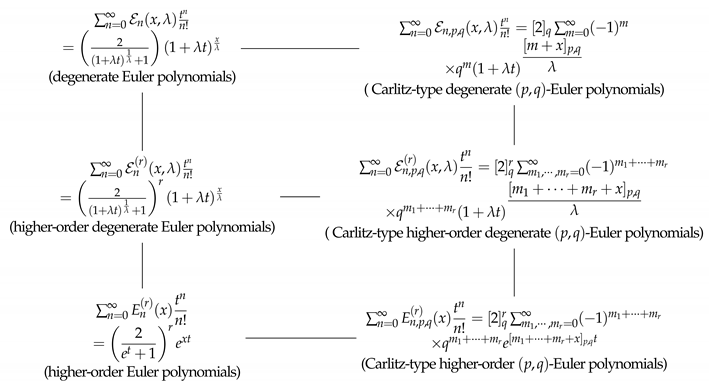
The following diagram shows the variations of the different types of degenerate Euler polynomials and Euler polynomials. Those polynomials in the first row and the third row of the diagram are studied by Hwang and Ryoo [
4,
11], Carlitz [
7], Cenkci and Howard [
9], Wu and Pan [
12], Luo [
13], and Srivastava [
14], respectively. The study of these has produced beneficial results in combinatorics and number theory (see [
4,
7,
9,
12,
13,
14,
15,
16,
17,
18]). The motivation of this paper is to investigate some explicit identities and symmetric identities for Carlitz-type higher-order degenerate
-Euler polynomials in the second row of the diagram.
The goal of this paper is that new generalizations of the Carlitz-type degenerate
-Euler numbers and polynomials is introduced and studied. Each section has the following contents. In
Section 2, Carlitz-type higher-order degenerate
-Euler numbers and polynomials are defined. We induce some of their properties involved distribution relation, explicit formula, and so on. In
Section 3, we make several symmetric identities about Carlitz-type higher-order degenerate
-Euler numbers and polynomials.
2. Carlitz-Type Higher-Order Degenerate -Euler Numbers and Polynomials
At first, the Carlitz-type higher-order degenerate -Euler numbers and polynomials are defined like this:
Definition 1. For positive integer n and , the classical higher-order Euler numbers and Euler polynomials are defined by using generating functions
and
respectively (see [
9,
12]).
Now, new generalizations of the Carlitz-type degenerate -Euler numbers and polynomials are introduced. As we have done so far, the Carlitz-type higher-order -Euler polynomials can be defined as:
Definition 2. For , the Carlitz-type higher-order degenerate -Euler numbers and polynomials are defined by using generating functions, where .
Observe that, if , then and . Note that, if , then and . If , we have the Carlitz-type higher-order -Euler polynomials .
By binomial theorem, we note that
where generalized
-falling factorial
. By Definition 2, we have the theorem below.
Proof. The first part of the theorem follows when we compare the coefficients of in the above equation. We prove Theorem 1. □
Note that
where
is the Stirling numbers of the first kind.
The relation between Carlitz-type high order degenerate -Euler polynomials and Carlitz-type high order -Euler polynomials is given by the below theorem.
Theorem 2. For and , we have Proof. By Theorem 1, (2), and (4), we get
One can obtain the desired result immediately. □
The Carlitz-type higher-order degenerate
-Euler number
can be determined explicitly. A few of them are
By using computer, Carlitz-type higher-order degenerate
-Euler number
can be determined explicitly. The first few
and
are listed in
Table 1.
Note that the limit of
is
as
approaches 0 (see
Table 1).
Again, we give a relation between Carlitz-type higher-order -Euler polynomials and Carlitz-type higher-order degenerate -Euler polynomials in the theorem below.
Proof. We use
t instead of
in Definition 2, we have
Use
t instead of
in (1), we have
and
Thus, we have the theorem below from and . □
By Definition 2 and (7), we get
When we compare the coefficients of in the above equation, we have the theorem below.
Theorem 5. For , , and , From (4) and Theorem 2, we get this:
When we compare the coefficients in the above equation, we get the theorem.
The Carlitz-type high order degenerate
-Euler polynomials
can be determined explicitly. Here are a few of them:
3. Some Symmetric Identities for Carlitz-Type Higher-Order Degenerate -Euler Numbers and Polynomials
Let , for . For and , we obtain certain symmetry identities for Carlitz-type higher-order degenerate -Euler numbers and polynomials.
Theorem 7. Let , for . Then, we obtain Proof. Note that
for any
. In Definition 2, we induce the next result by substituting
instead of
x and replace
q,
p, and
by
,
, and
, respectively:
Since there exists the unique non-negative integer
n such that
with
for any non-negative integer
m and odd positive integer
w, this can be written
We obtain the following formula using the formula above:
From a similar approach, we also have that
Therefore, by (9) and (10), we can obtain the desired result. □
Taking in Theorem 7, we obtain the following multiplication theorem for Carlitz-type higher-order degenerate -Euler polynomials.
Theorem 8. Let for . For and , we obtain Taking
in (11), we get the multiplication theorem for Carlitz-type high order
-Euler polynomials (see [
11]).
Corollary 1. Let for . For and , we get For
in (10), we have the multiplication theorem for Carlitz-type degenerate
-Euler polynomials (see [
4]).
Corollary 2. Let for . For , If in Corollary 2, then we get the corollary.
Corollary 3. Let for . For , If
approaches to 0 in (12), this leads to the distribution relation for Euler polynomials
By Theorem 2 and Theorem 7, it follows the theorem below.
Theorem 9. Let and be odd positive integers. Then, it has We get another symmetry identity by using the addition theorem about the Carlitz-type higher-order degenerate
-Euler polynomials
. Let
for each integer
. The
is called as the alternating
-sums of powers.
Theorem 10. Let with , . For and , we obtain Proof. Now, we use the addition theorem about the Carlitz-type higher-order degenerate
-Euler polynomials (see [
10]). We derive
By Theorem 12, then we have
By (13) and (14), we make the desired symmetric identity. □
By Theorem 10, we have the symmetric identity for the Carlitz-type high order -Euler numbers in complex field.
Corollary 4. Let , , where . For and , we obtain 4. Conclusions
In our previous paper [
4], we studied some identities of symmetry on the Carlitz-type degenerate
-Euler polynomials. The motivation of this paper is to investigate some explicit identities for the Carlitz-type higher-order degenerate
-Euler polynomials in the second row of the diagram at page 3. Thus, we defined the Carlitz-type higher-order degenerate
-Euler polynomials in Definition 2 and obtained the formulas (explicit formula (Theorem 6), multiplication theorem (Theorem 8), and distribution relation (Corollary 2, Corollary 3)). In Theorem 7, we gave some symmetry identities for the Carlitz-type higher-order degenerate
-Euler polynomials. We also obtained the explicit identities related to the Carlitz-type higher-order
-Euler polynomials, the alternating
-sums of powers, and Stirling numbers (see Theorem 10 and Corollary 4). In particular, these results generalized some well-known properties relating degenerate Euler numbers and polynomials, degenerate Stirling numbers, alternating sums of powers, multiplication theorem, distribution relation, falling factorial, symmetry properties of the degenerate Euler numbers and polynomials (see [
7,
8,
9,
10,
11,
12,
13,
14,
15,
16,
17,
18]). In addition, in this paper, if we take
, then [
4] is the special case of this paper.