Article

Dynamics of Laterality in Lake Tanganyika Scale-Eaters Driven by Cross-Predation

1
Animal Ecology, Department of Zoology, Graduate School of Science, Kyoto University, Kitashirakawa-Oiwakecho, Sakyo 606-8502, Japan
2
Animal Sociology, Department of Biology and Geosciences, Graduate School of Science, Osaka City University, 3-3-138 Sugimoto, Sumiyoshi, Osaka 558-8585, Japan
3
Graduate School of Humanities and Sciences, Nara Women’s University, Nara 630-8506, Japan
*
Author to whom correspondence should be addressed.
Symmetry 2019, 11(1), 119; https://doi.org/10.3390/sym11010119
Submission received: 24 November 2018 / Revised: 13 January 2019 / Accepted: 14 January 2019 / Published: 20 January 2019
(This article belongs to the Special Issue Left Versus Right Asymmetries of Brain and Behaviour)

Abstract

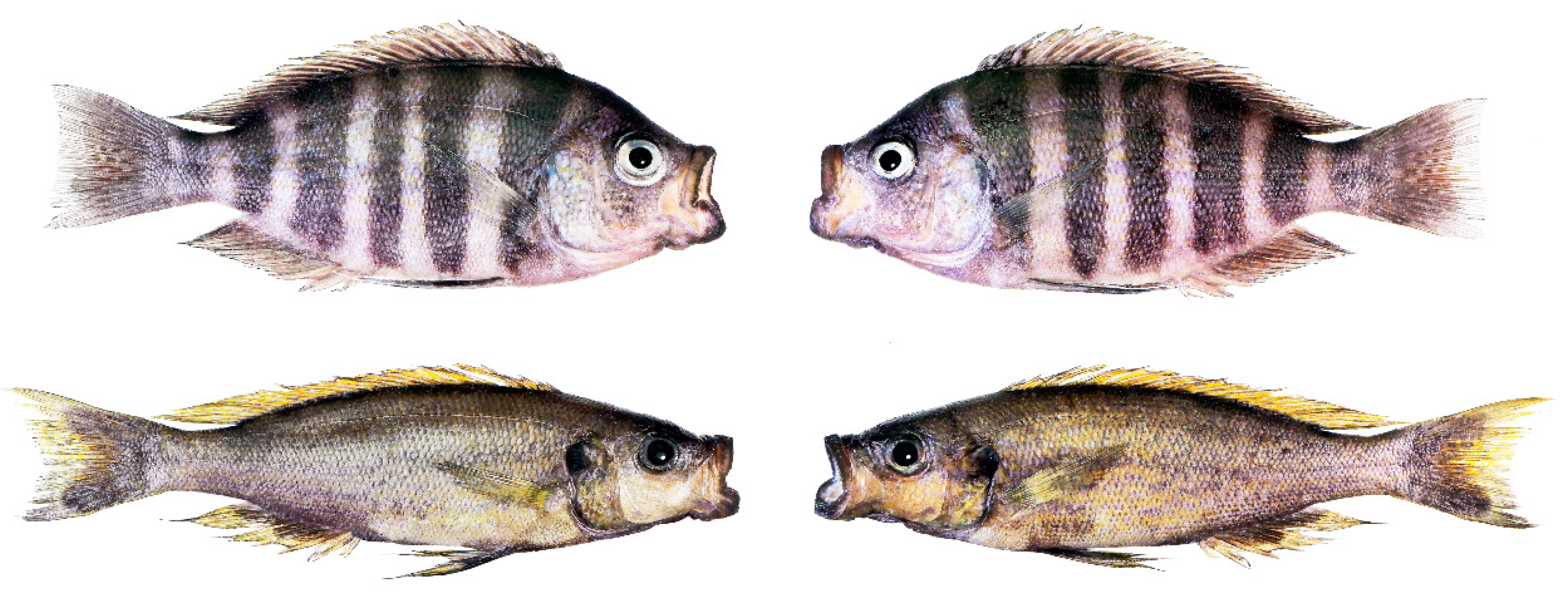
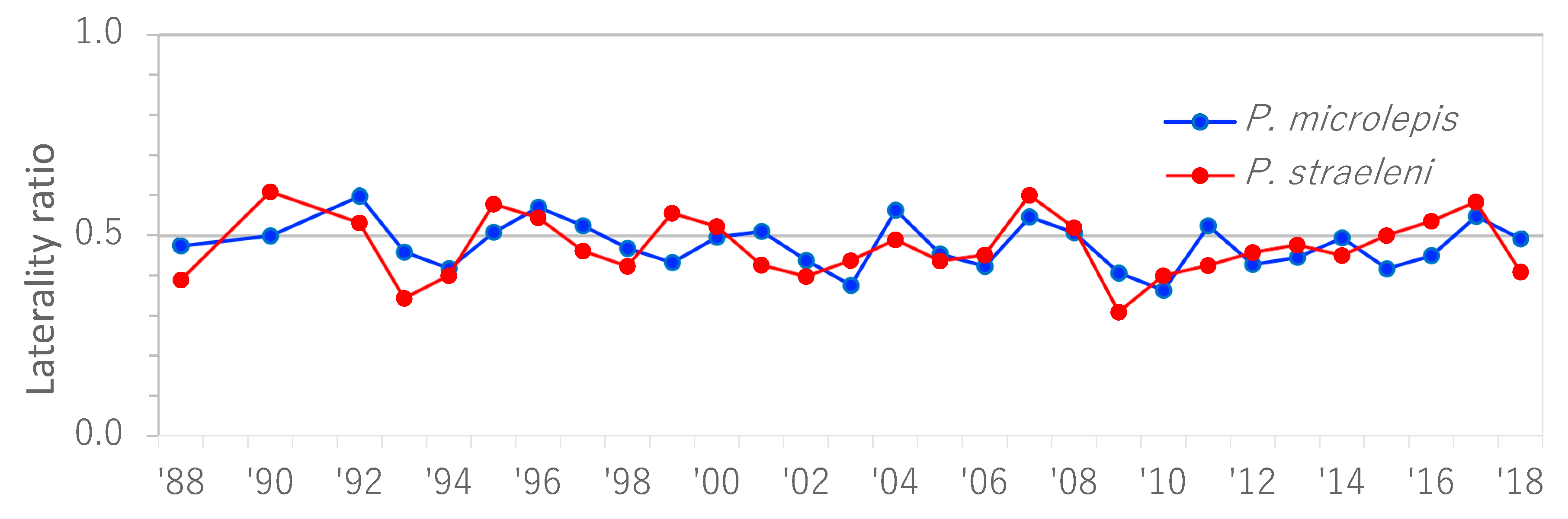
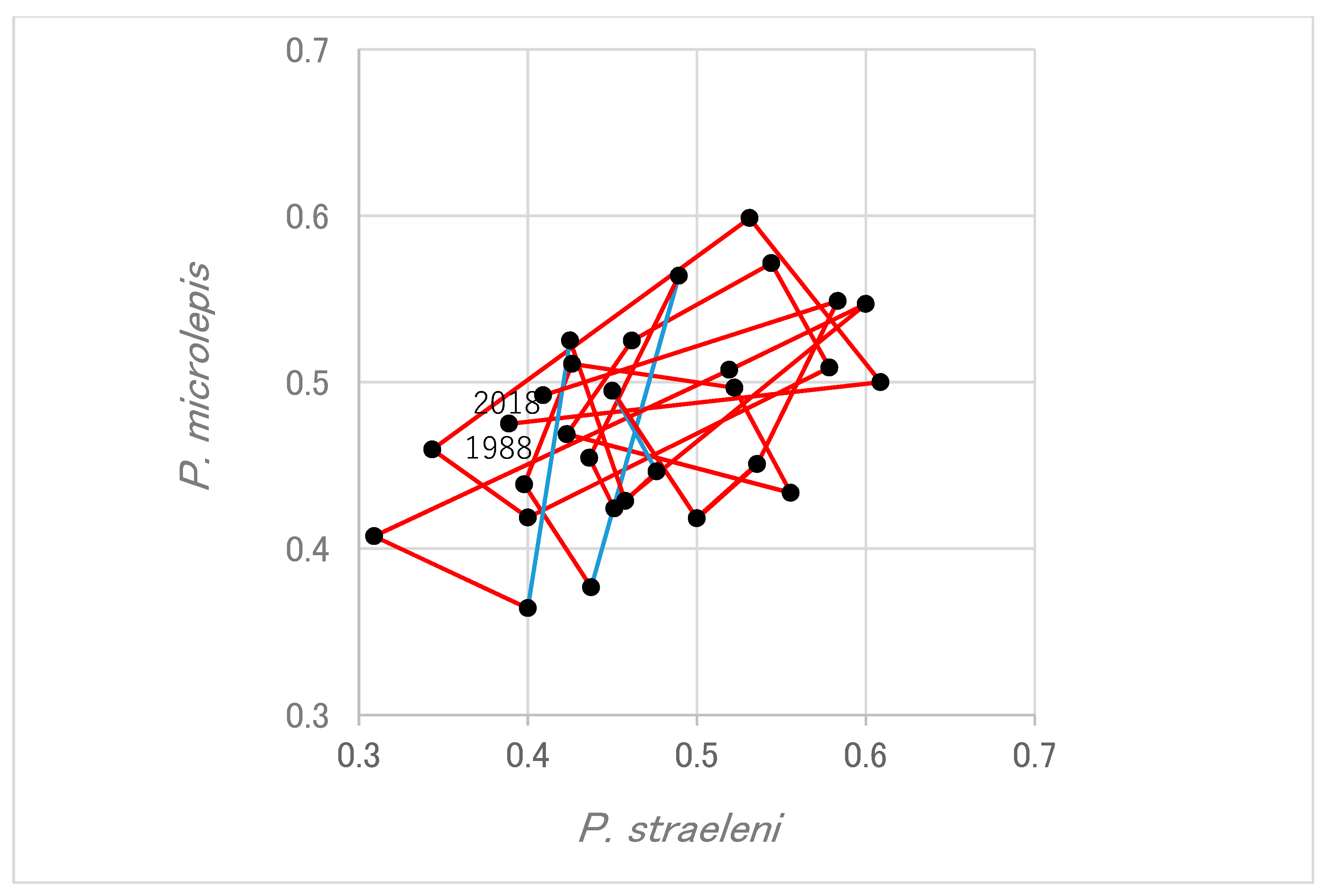
Scale-eating cichlid fishes, Perissodus spp., in Lake Tanganyika have laterally asymmetrical bodies, and each population is composed of righty and lefty morphs. Righty morphs attack the right side of prey and lefty morphs do the opposite. This anti-symmetric dimorphism has a genetic basis. Temporal changes in the frequencies of morphs in two cohabiting scale-eating species (Perissodus microlepis and P. straeleni) were investigated over a 31-year period on a rocky shore at the southern end of the lake. Dimorphism was maintained dynamically during the period in both species, and the frequencies oscillated with a period of about four years in a semi-synchronized manner. Recent studies have indicated that this type of anti-symmetric dimorphism is shared widely among fishes, and is maintained by frequency-dependent selection between predator and prey species. The combinations of laterality in each scale-eater and its victim were surveyed. The results showed that “cross-predation”, in which righty predators catch lefty prey and lefty predators catch righty prey, occurred more frequently than the reverse combination (“parallel-predation”). The cause of the predominance of cross-predation is discussed from the viewpoint of the physical and sensory abilities of fishes.
Keywords: scale-eater; Perissodus; lateral dimorphism; frequency-dependent selection; cross-predation scale-eater; Perissodus; lateral dimorphism; frequency-dependent selection; cross-predation