Abstract
Chemical graph theory plays an important role in modeling and designing any chemical structure. The molecular topological descriptors are the numerical invariants of a molecular graph and are very useful for predicting their bioactivity. In this paper, we study the chemical graph of the crystal structure of titanium difluoride and the crystallographic structure of cuprite . Furthermore, we compute degree-based topological indices, mainly , , , and general Randić indices. Furthermore, we also give exact results of these indices for the crystal structure of titanium difluoride and the crystallographic structure of cuprite .
1. Introduction
Graph theory is one of the most special and unique branches of mathematics by which the demonstration of any structure is made conceivable. Recently, it has attained much attention among researchers because of its wide range of applications in computer science, electrical networks, interconnected networks, biological networks, chemistry, etc. The chemical graph theory is a fast growing area among researchers. It helps in understanding the structural properties of a molecular graph. There are many chemical compounds that possess a variety of applications in the fields of commercial, industrial, pharmaceutical chemistry and daily life and in the laboratory.
A relationship exists between chemical compounds and their molecular structures. The manipulation and examination of chemical structural information is made conceivable using molecular descriptors. Chemical graph theory is a branch of mathematical chemistry in which the tools of graph theory are applied to model the chemical phenomenon mathematically. Furthermore, it relates to the nontrivial applications of graph theory for solving molecular problems. This theory contributes to a prominent role in the field of chemical sciences; see for details [1,2,3].
Chem-informatics is a new subject, which is a combination of chemistry, mathematics and information science. It examines the quantitative structure–activity relationship and quantitative structure-property relationship , which are utilized to predict the bioactivity and physicochemical properties of chemical compounds [4]. The field of chemical graph theory has attained much attention and consideration among researchers [5,6].
In solid state physics, the electrons of a single, isolated atom occupy atomic orbitals, each of which has a discrete energy level. When two atoms join together to form a molecule, their atomic orbitals overlap [7]. The Pauli exclusion principle dictates that no two electrons can have the same quantum numbers in a molecule. Therefore, if two identical atoms combine to form a diatomic molecule, each atomic orbital splits into two molecular orbitals of different energy, allowing the electrons in the former atomic orbitals to occupy the new orbital structure without any having the same energy. Similarly if a large number N of identical atoms come together to form a solid, such as a crystal lattice, the atoms’ atomic orbitals overlap [8]. Since the Pauli exclusion principle dictates that no two electrons in the solid have the same quantum numbers, each atomic orbital splits into N discrete molecular orbitals, each with a different energy.
In chemical graph, the vertices represent atoms, and edges refer to the chemical bonds in the underlying chemical structure. A topological index is a numerical value that is computed mathematically from the molecular graph. It is associated with the chemical constitution indicating the correlation of the chemical structure with many physical, chemical properties and biological activities. The exact formulas of topological indices of certain chemical graphs have been computed and plotted in [9,10].
Let be a graph where V is the vertex set and E is the edge set of G. The degree (or ) of v is the number of edges of G incident with t. The length of the shortest path in a graph G is a distance between s and t. A graph can be represented by a polynomial, a numerical value or by matrix form. There are certain types of topological indices, mainly eccentric-based, degree-based, distance-based indices, etc. In this paper, we deal with degree-based topological indices.
The first and oldest degree-based index was introduced by Milan Randić [11] in 1975 and is defined in the following equation.
In 1988, Bollobás et al. [12] and Amic et al. [13] proposed the general Randić index independently. For more details about the Randić index, its properties and important results, see [14,15]. The general Randić index is defined as:
The atom bond connectivity index is of vital importance and was introduced by Estrada et al. [16]. It is defined as:
The geometric arithmetic index of a graph G was introduced by Vukičević et al. [17]. It is defined as:
The first Zagreb index was introduced in 1972 by [18]. Later on, the second Zagreb index was introduced by [19]. The first and second Zagreb indices are formulated as:
The fourth version of the atom bond connectivity index of a graph G was introduced by Ghorbhani et al. [20]. It is defined as:
where and .
Another molecular descriptor was the fifth version of the geometric arithmetic index of a graph G introduced by Graovac et al. [21]. It is defined as:
2. Research Aim
Our aim in this article is to compute the additive topological indices, mainly the atom bond connectivity index, geometric arithmetic index, fourth atom bond connectivity index , fifth geometric arithmetic index and general Randić index , for for and . Moreover, the graphical representation of these exact result is depicted for further explanation of the behavior of these topological indices.
3. Applications of Topological Indices
The atom-bond connectivity index provides a very good correlation for the stability of linear alkanes, as well as the branched alkanes and for computing the strain energy of cyclo alkanes [22]. The Randi/’c index is a topological descriptor that has been correlated with many chemical characteristics of molecules and has been found to the parallel to computing the boiling point and Kovats constants of the molecules. To correlate with certain physicochemical properties, the index has much better predictive power than the predictive power of the Randić connectivity index [23,24]. The first and second Zagreb index were found to occur for the computation of the total -electron energy of the molecules within specific approximate expressions [25]. These are among the graph invariants, which were proposed for the measurement of the skeleton of the branching of the carbon-atom [26].
4. Crystallographic Structure of the Molecule
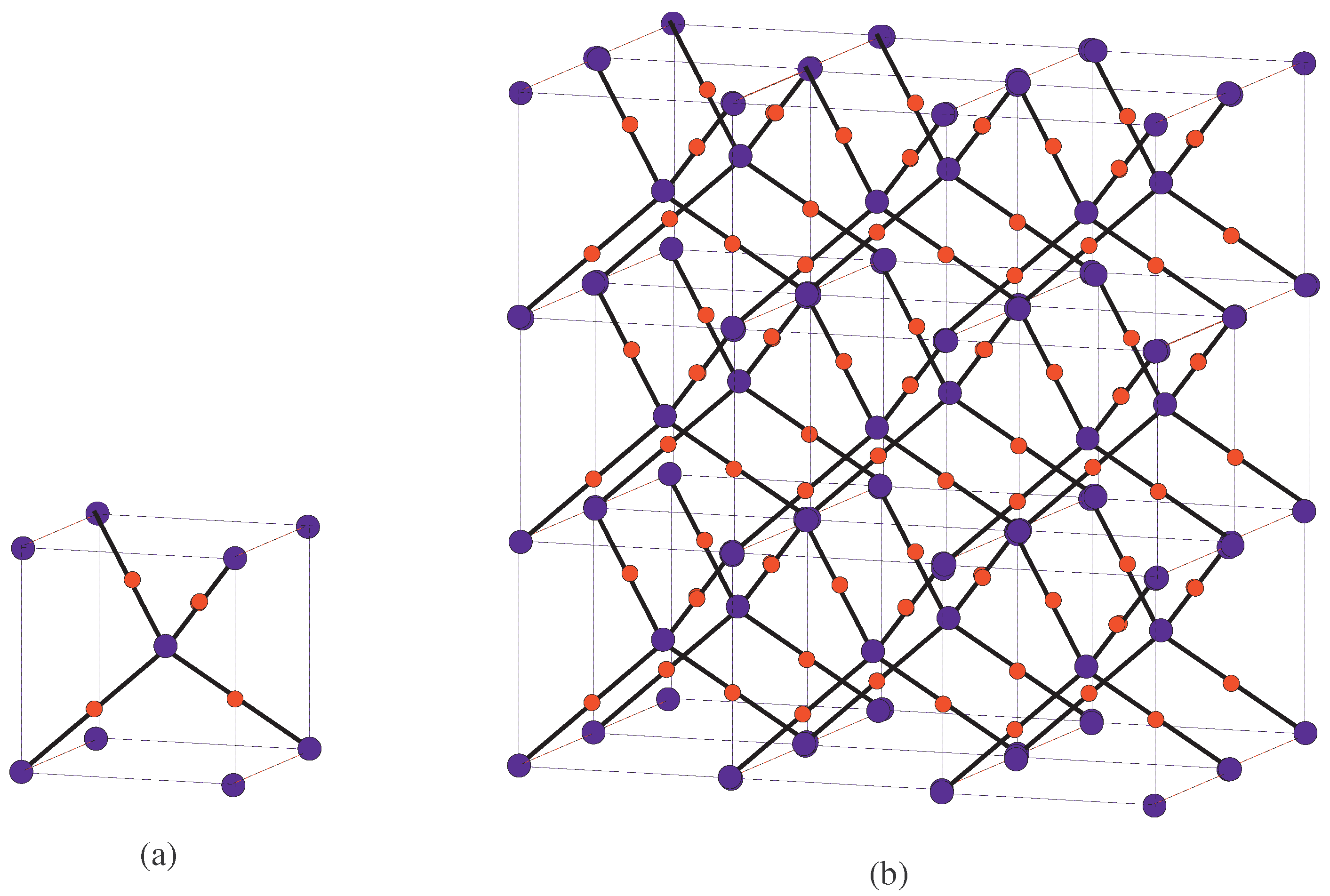
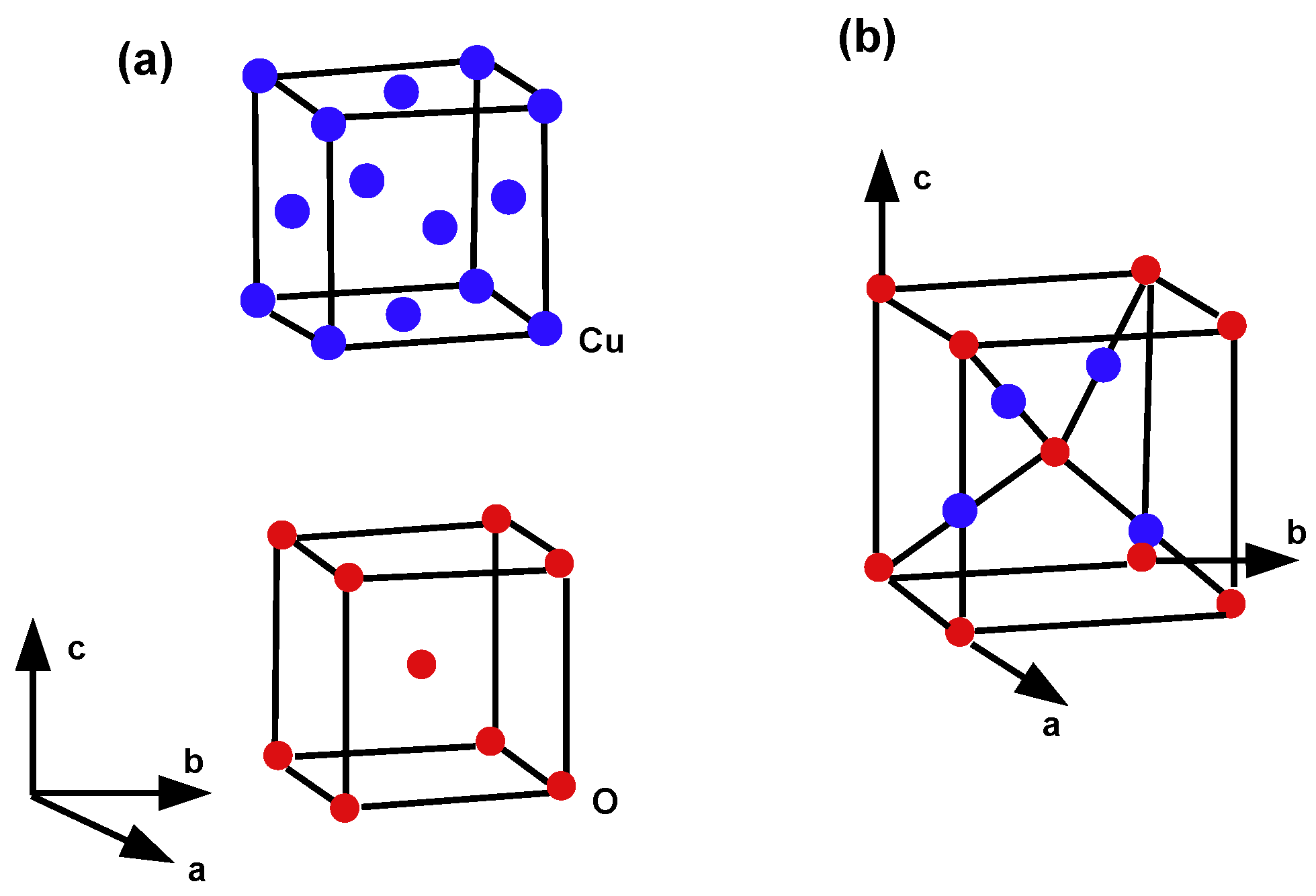
Among various transition metal oxides, has attracted much attention in recent years owing to its distinguished properties and non-toxic nature, low-cost, abundance and simple fabrication process [27]. Nowadays, the promising applications of mainly focus on chemical sensors, solar cells, photocatalysis, lithium-ion batteries and catalysis [28]. The chemical graph of the crystallographic structure of is described in Figure 1 and Figure 2; see details in [29]. Let be the chemical graph of with unit cells in the plane and t layers. We construct this graph first by taking units in the -plane and then storing it up in t layers. The number of vertices and edges of is and , respectively. In , the number of vertices of degree zero is four; the number of vertices of degree one is ; the number of vertices of degree two is ; and the number of vertices of degree four is . Furthermore, the edge partition of based on the degrees of end vertices of each edge is depicted in Table 1.
Figure 1.
Crystallographic structure of the molecule . (a) Structural characteristics of and O atoms in the lattice. The lattice is formed by interpenetrating the and O lattices with each other. (b) Unit cell of . Copper atoms are shown as small blue spheres, and oxygen atoms are shown as large red spheres. In the lattice, each atom is coordinated with two O atoms, and each O atom is coordinated with four atoms.
Figure 2.
(a) Unit cell of (b) Crystallographic structure of
Table 1.
Edge partition of based on the degrees of end vertices of each edge.
Theorem 1.
Consider the graph of with , then its general Randić index is equal to,
Proof.
Let G be the crystallographic structure of . The general Randić index,
For .
For ,
For ,
For ,
☐
Theorem 2.
Consider the graph of with , then its atom bond connectivity index is equal to,
Proof.
Let G be the crystallographic structure of . The result for the atom bond connectivity index is as follows:
☐
Theorem 3.
Consider the graph of with , then its geometric arithmetic index is equal to,
Proof.
Let G be the crystallographic structure of . The geometric arithmetic index is computed as below:
☐
Theorem 4.
Consider the graph of with , then its first and second Zagreb indices are equal to,
Proof.
Let G be the crystallographic structure of . The first Zagreb index is computed as below:
The second Zagreb index is computed as below:
☐
Table 2 shows the edge partition of the chemical graph based on the degree sum of end vertices of each edge.
Table 2.
Edge partition of with based on the degree sum of end vertices of each edge.
Theorem 5.
Consider the graph with , then its fourth atom bond connectivity index is equal to,
Proof.
Let G be the crystallographic structure of . The fourth atom bond connectivity index is computed by using Table 2 in the following equation.
☐
Theorem 6.
Consider the graph with , then its fifth geometric arithmetic index is equal to,
Proof.
Let G be the crystallographic structure of . The fifth geometric arithmetic index is computed as below:
☐
5. Crystal Structure of Titanium Difluoride
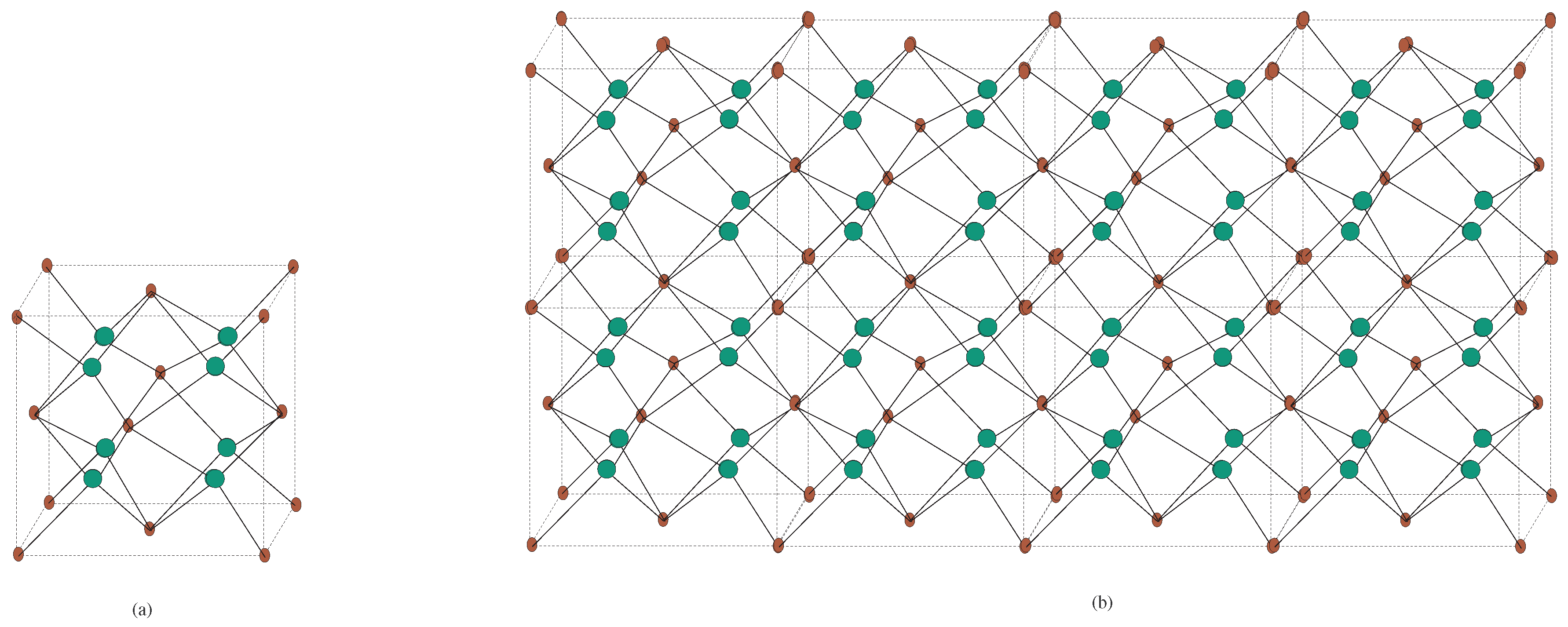
Titanium difluoride is a water-insoluble titanium source for use in oxygen-sensitive applications, such as metal production. Fluoride compounds have diverse applications in current technologies and science, from oil refining and etching to synthetic organic chemistry and the manufacture of pharmaceuticals. The chemical graph of the crystal structure of titanium difluoride is described in Figure 3; for more details, see [30]. Let be the chemical graph of with unit cells in the plane and t layers. We construct this graph first by taking units in the -plane and then storing it up in t layers. The number of vertices and edges of is and , respectively.In , the number of vertices of degree one is eight; the number of vertices of degree two is ; the number of vertices of degree four is ; and the number of vertices of degree eight is . The edge partition of based on the degrees of end vertices of each edge is depicted in Table 3.
Figure 3.
(a)The unit cell of of with atoms in red and F atoms in green; (b) the crystal structure of .
Table 3.
Edge partition of based on the degrees of end vertices of each edge.
Theorem 7.
Consider the graph with , then its general Randić index is equal to,
Proof.
Let be the crystal structure of titanium difluoride. The general Randić index,
For .
For ,
For ,
For ,
☐
Theorem 8.
Consider the graph with , then its atom bond connectivity index is equal to,
Proof.
Let be the crystal structure of titanium difluoride. The atom bond connectivity index can be calculated by using Table 3 in the following equation.
☐
Theorem 9.
Consider the graph with , then its geometric arithmetic index is equal to,
Proof.
Let be the crystal structure of titanium difluoride. The geometric arithmetic index is computed as below:
☐
Theorem 10.
Consider the graph with , then its first and second Zagreb indices are equal to,
Proof.
Let be the crystal structure of titanium difluoride. The first and second Zagreb indices are computed as below:
☐
Table 4 shows the edge partition of the chemical graph based on the degree sum of the end vertices of each edge.
Table 4.
Edge partition of , based on the degree sum of the end vertices of each edge.
Theorem 11.
Consider the graph with , then its fourth atom bond connectivity index is equal to,
Proof.
Let be the crystal structure of titanium difluoride. The fourth atom bond connectivity index is computed as below:
☐
Theorem 12.
Consider the graph with , then its fifth geometric arithmetic index is equal to,
Proof.
Let be the crystal structure of titanium difluoride. The fifth geometric arithmetic index is computed as below:
☐
6. Discussion
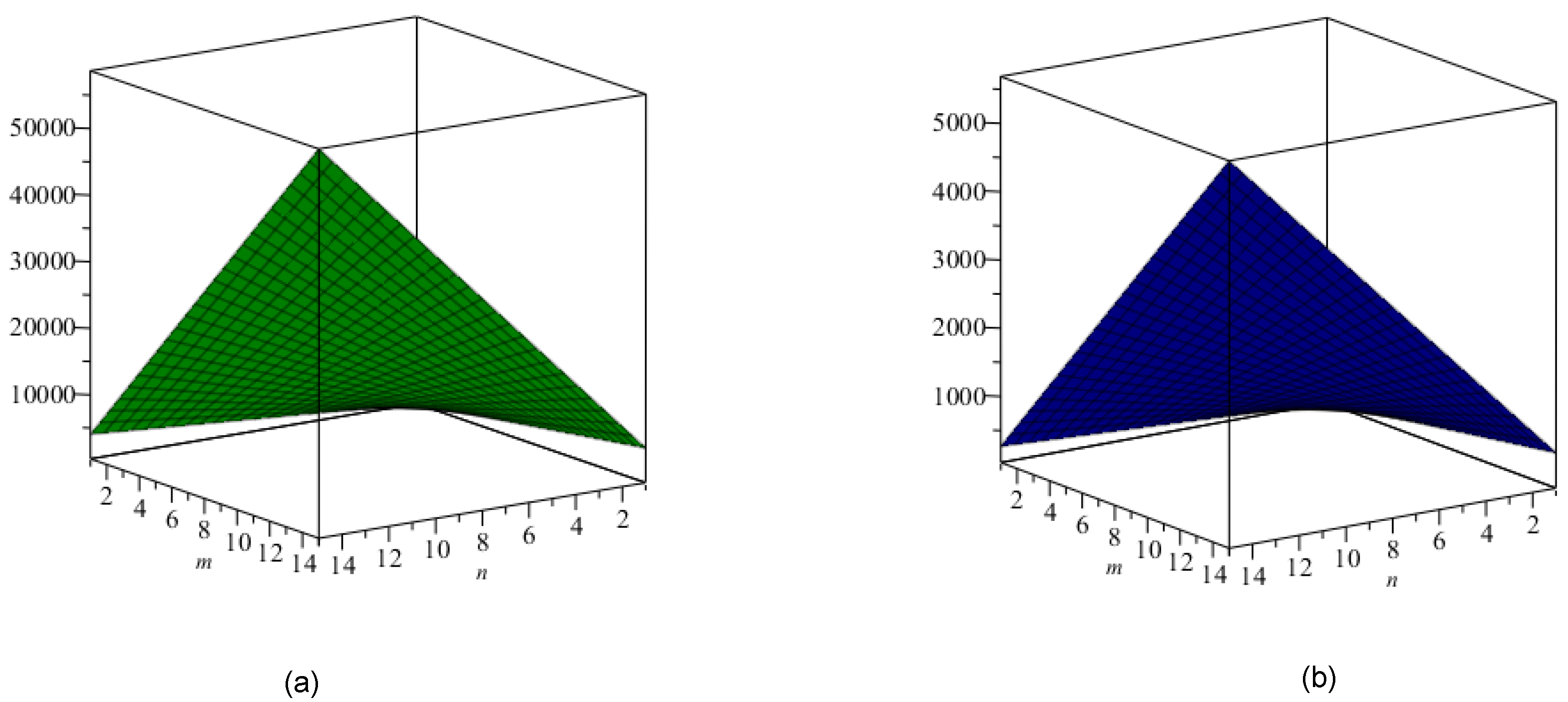
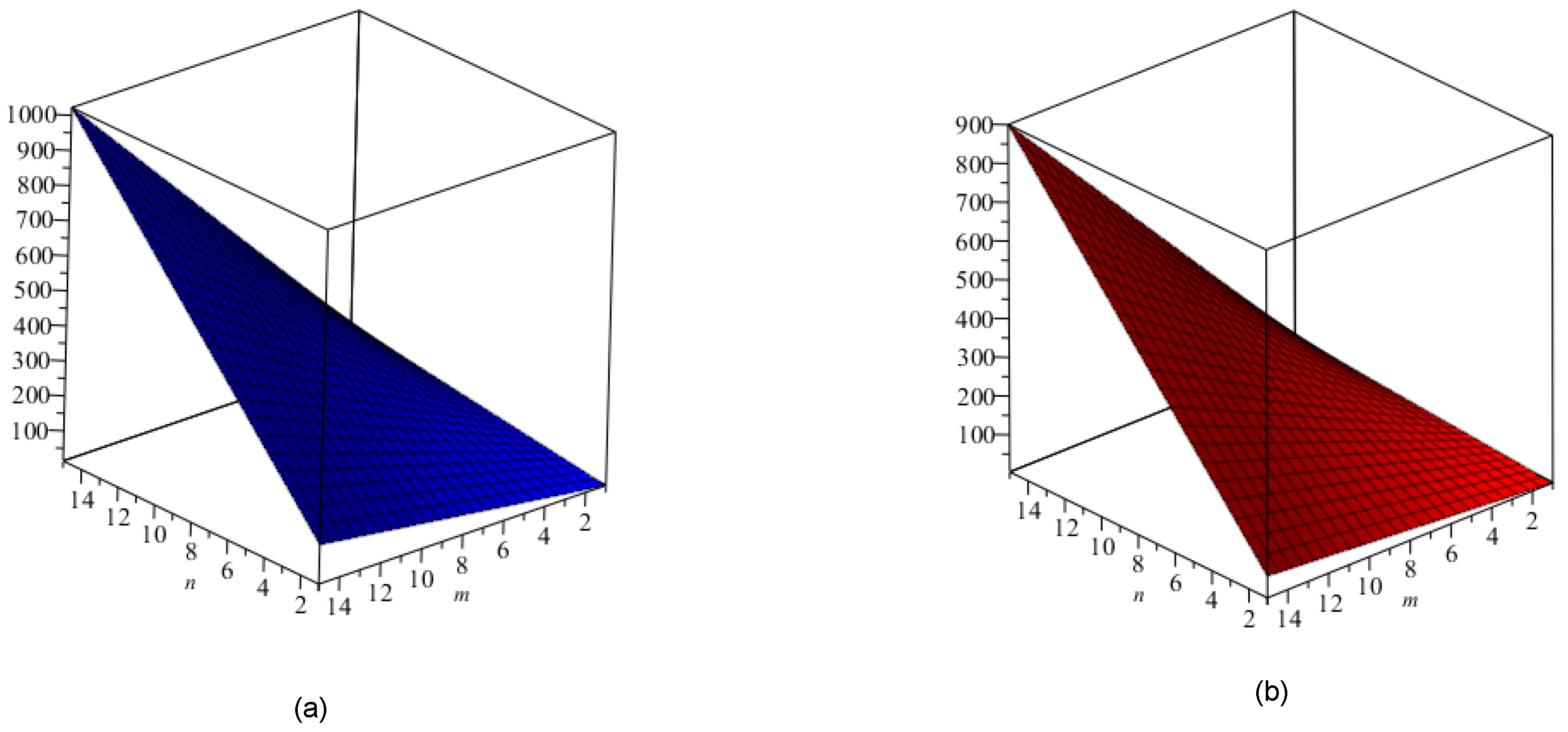
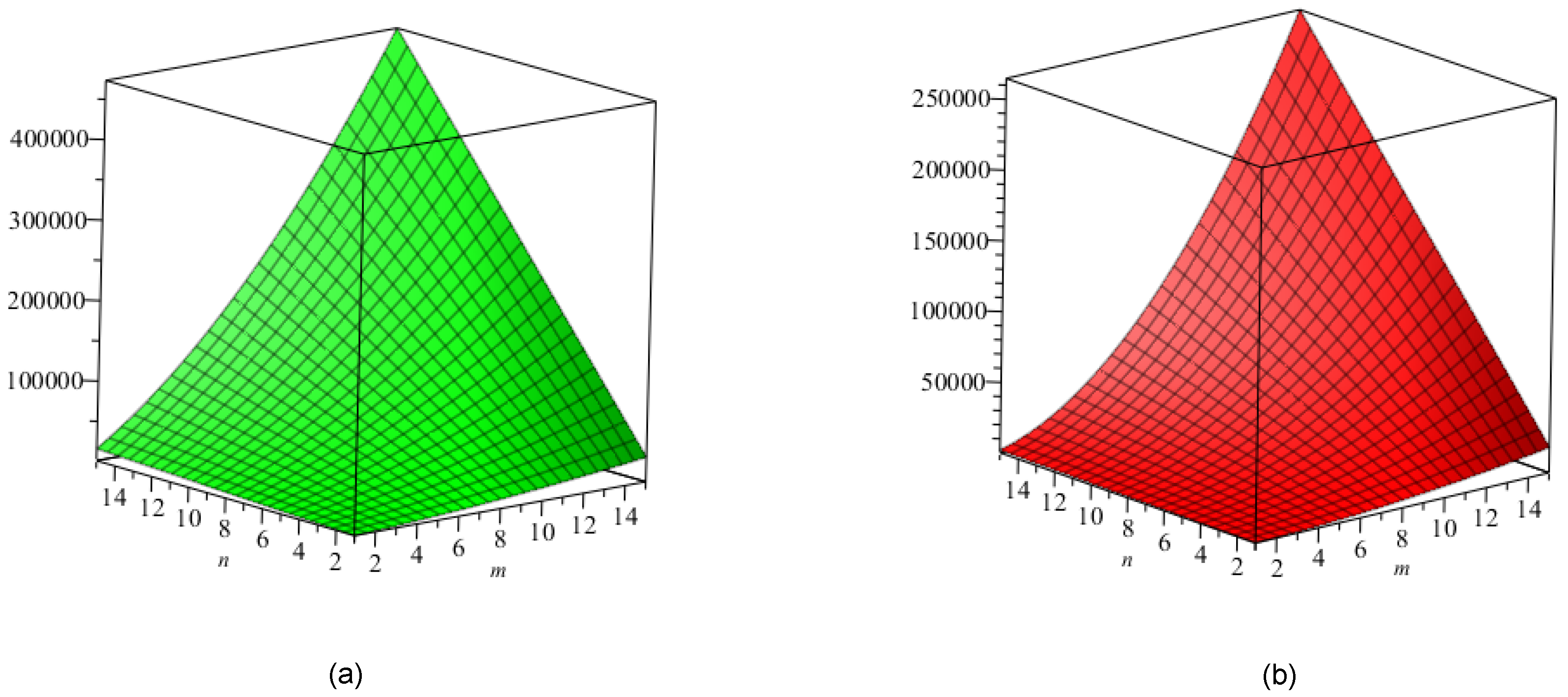
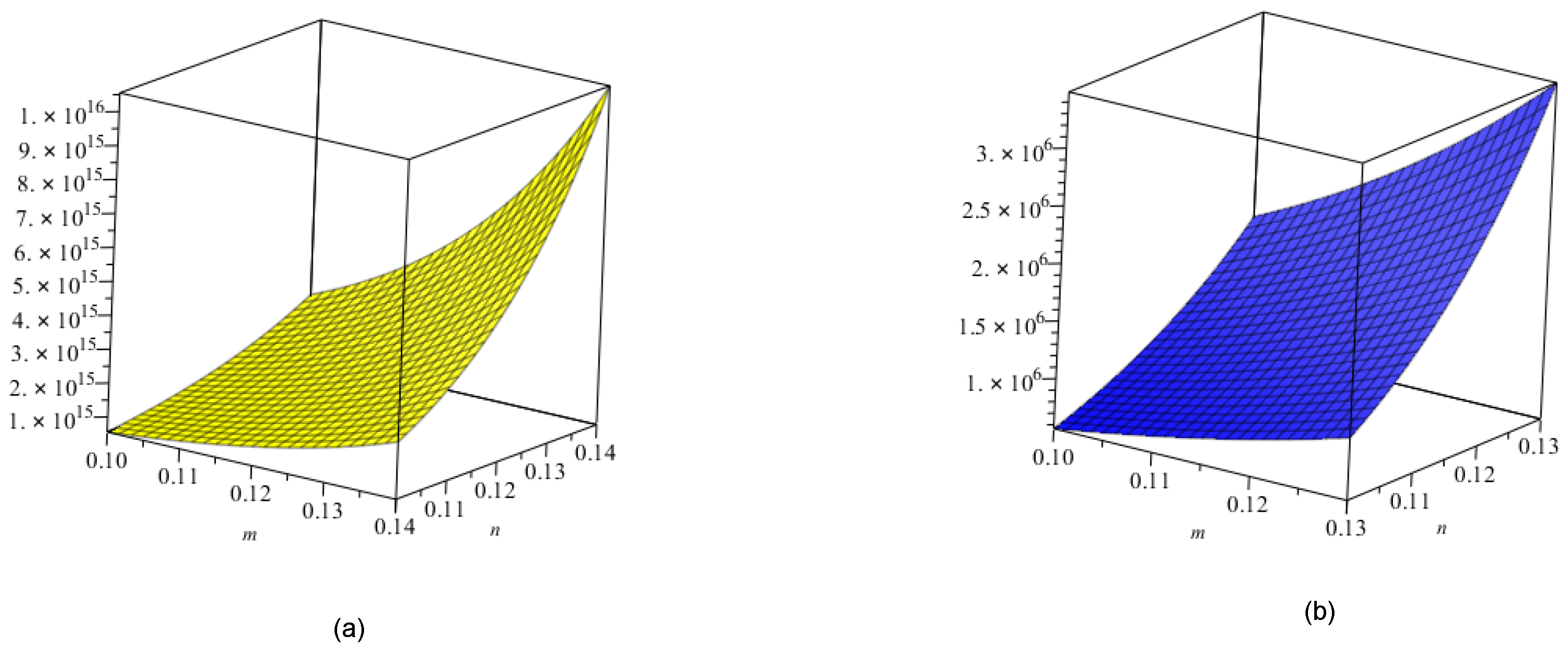
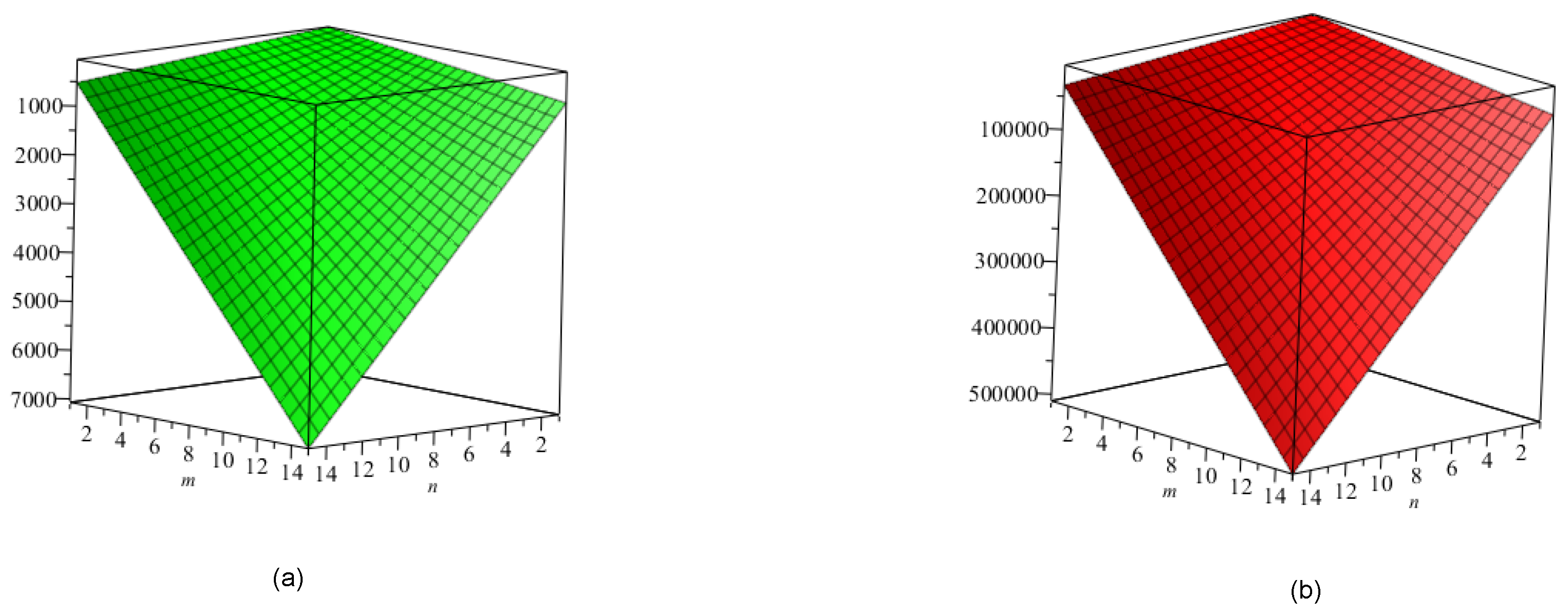
Since the topological indices have many applications in different branches of science, namely pharmaceutical, chemistry and biological drugs, the graphical representation of these calculated results is helpful to scientists. The graphical representations of topological indices for are depicted for Randić indices in Figure 4 and Figure 5. The atomic bond connectivity index and geometric arithmetic index for are depicted in Figure 6. The first and second Zagreb indices for are depicted in Figure 7. The fourth atomic bond connectivity index and the fifth geometric arithmetic index for are depicted in Figure 8.
Figure 4.
The graphical representation of the Randić index for (a) and (b) for .
Figure 5.
The graphical representation of the Randić index for (a) and (b) for .
Figure 6.
The graphical representation of the (a) index and (b) index.
Figure 7.
The graphical representation of the (a) first Zagreb index and (b) second Zagreb index.
Figure 8.
The graphical representation of the (a) index and (b) index.
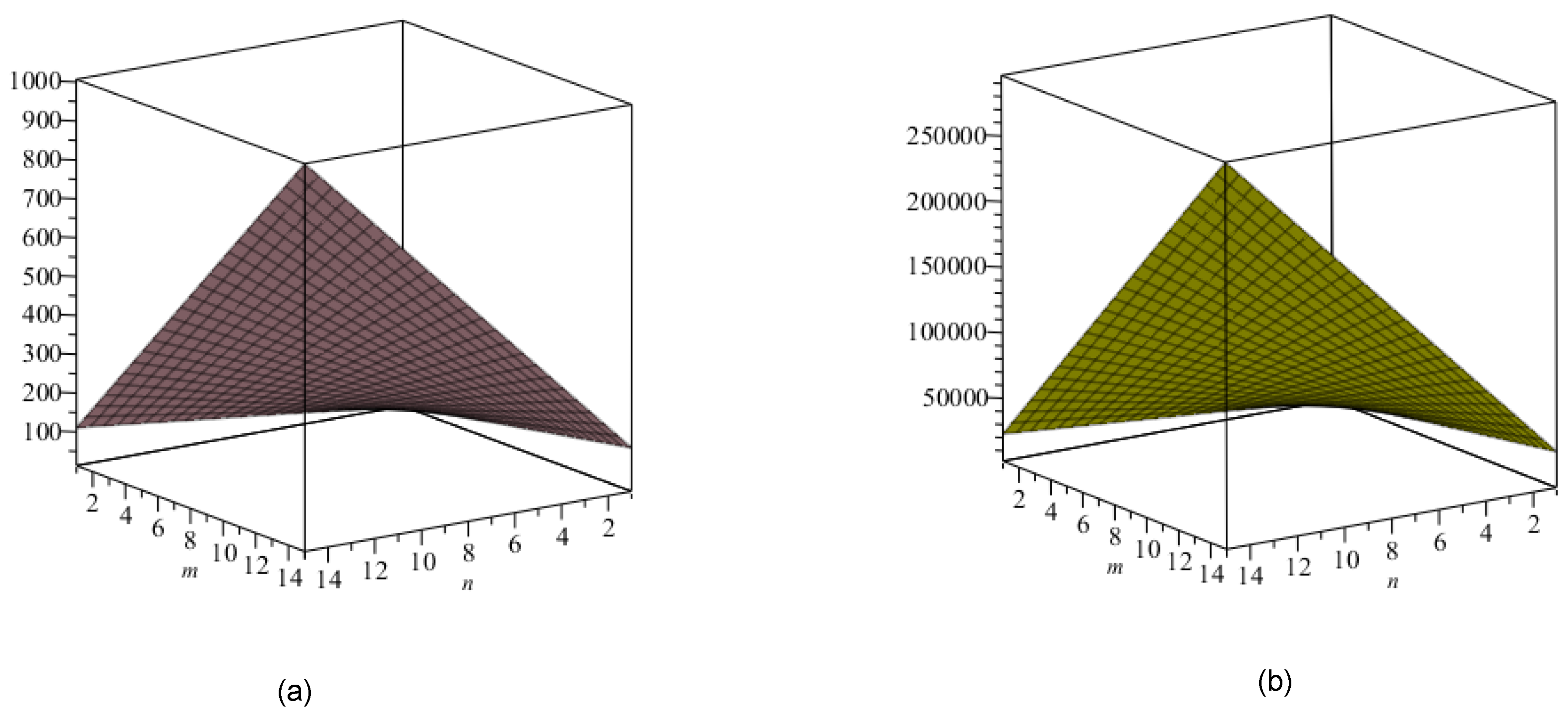
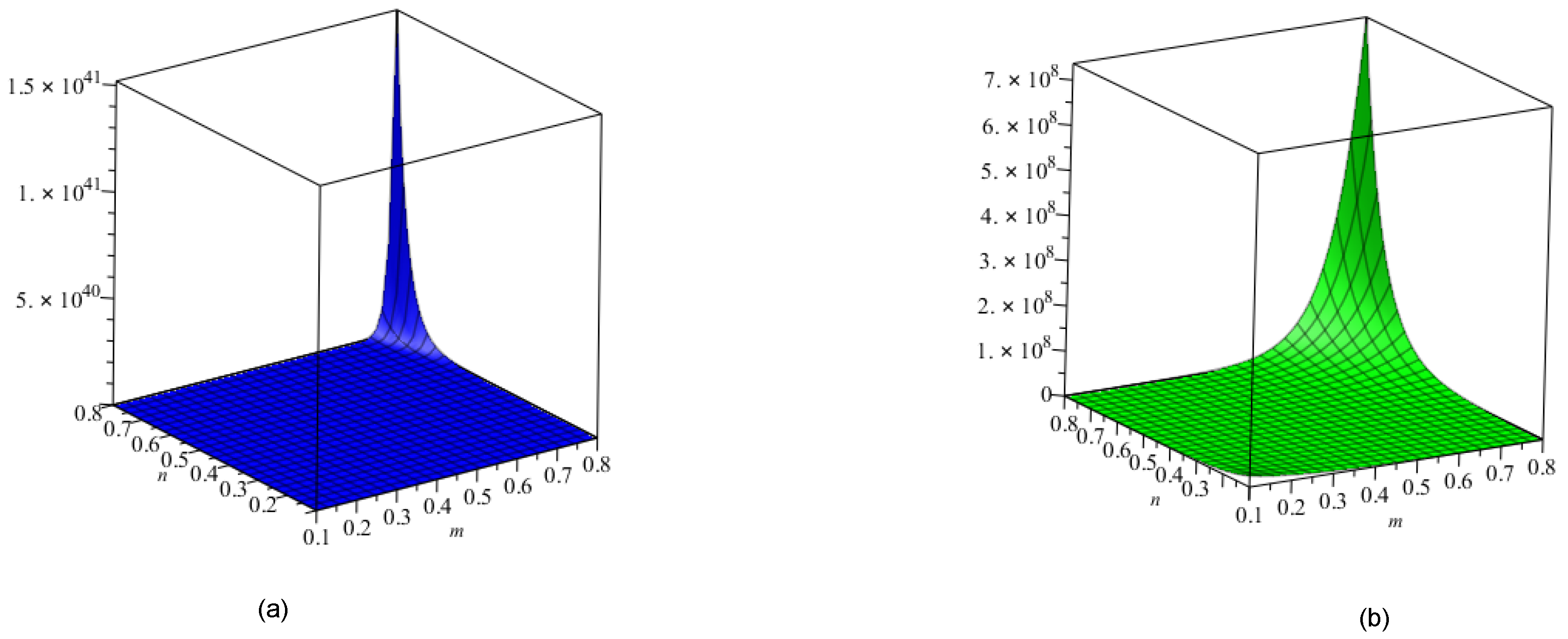
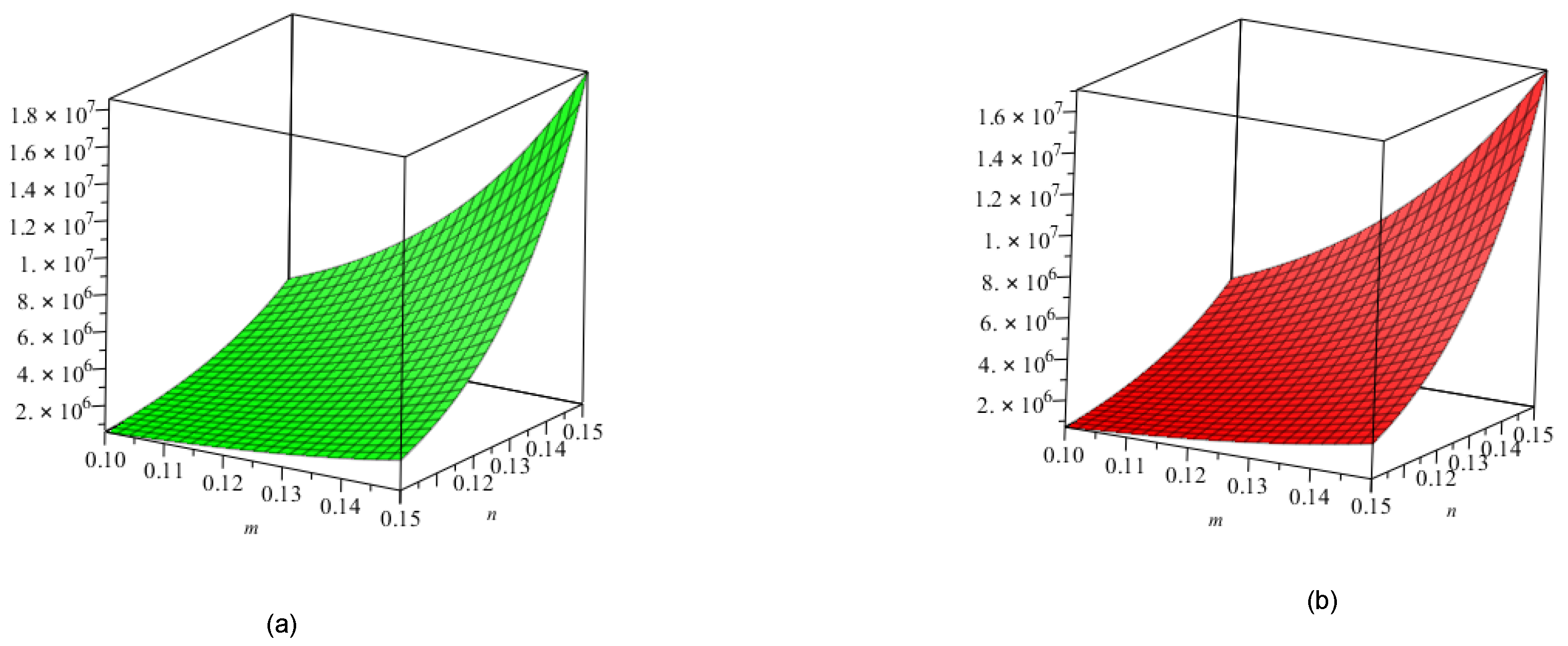
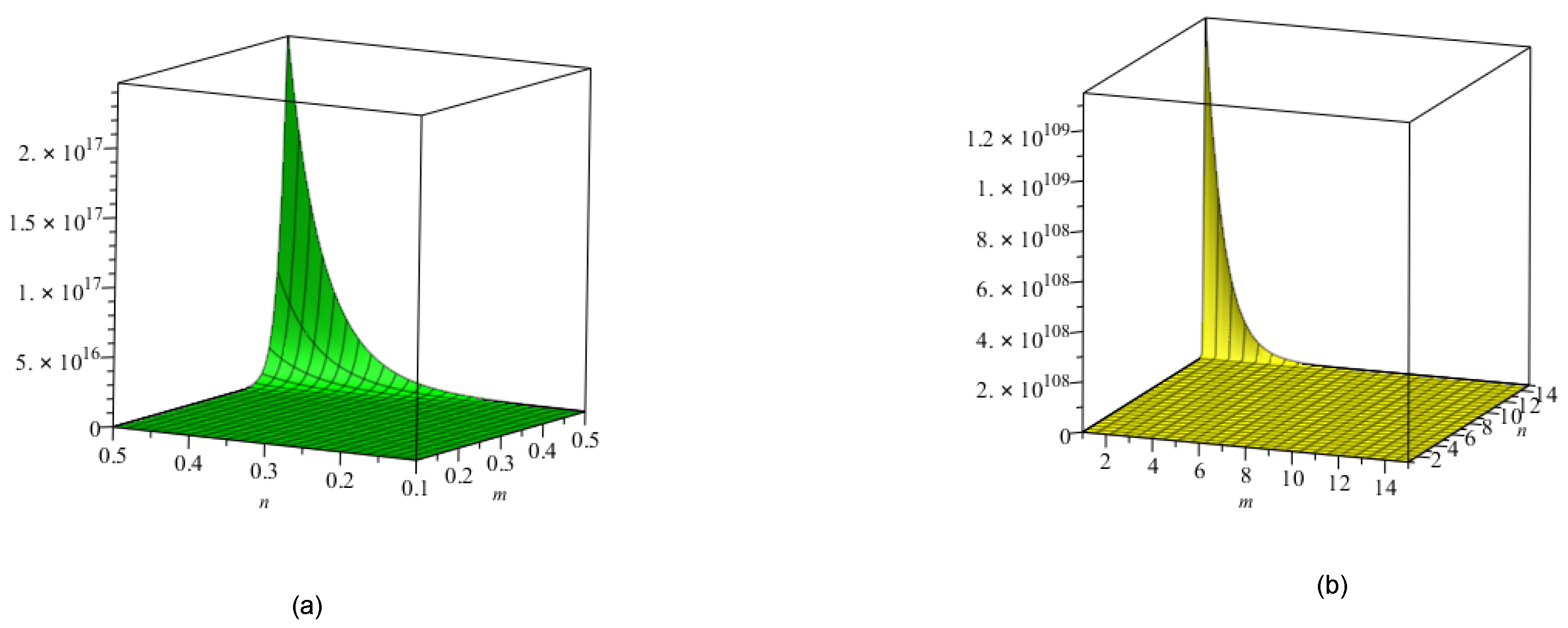
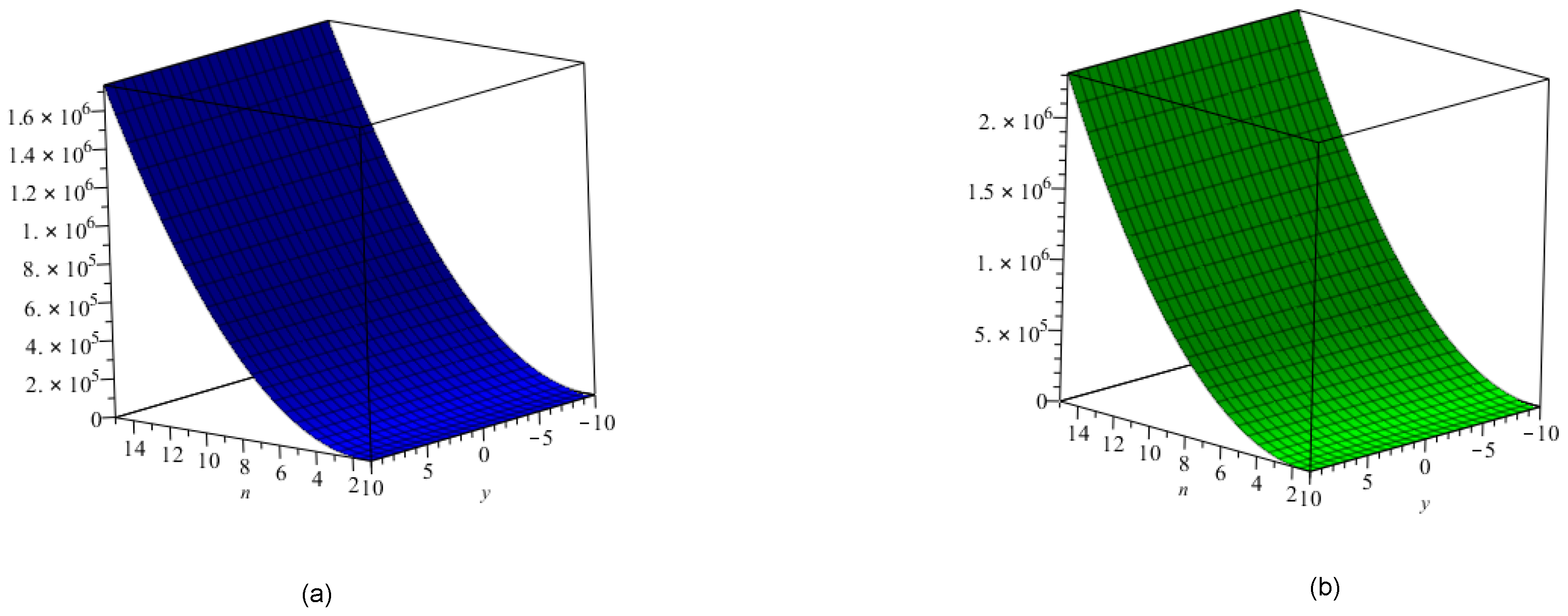
The graphical representations of topological indices for titanium difluoride are depicted for Randić indices in Figure 9 and Figure 10. The atomic bond connectivity index and geometric arithmetic index for titanium difluoride are depicted in Figure 11. The first and second Zagreb indices for titanium difluoride are depicted in Figure 12. The fourth atomic bond connectivity index and the fifth geometric arithmetic index for titanium difluoride are depicted in Figure 13.
Figure 9.
The graphical representation of the Randić index for (a) and (b) for .
Figure 10.
The graphical representation of the Randić index for (a) and (b) for .
Figure 11.
The graphical representation of the (a) index and (b) index.
Figure 12.
The graphical representation of the (a) first Zagreb index and (b) second Zagreb index.
Figure 13.
The graphical representation of the (a) index and (b) index.
7. Conclusions
In this paper, we have computed some degree-based topological indices, namely the atom bond connectivity index , the geometric arithmetic index , the general Randić index, the index, the index and the first and second Zagreb indices for the chemical graph of the crystal structure of titanium difluoride and crystallographic structure of cuprite .
In the future, we are interested in computing the distance-based and counting-related topological indices for these structures.
Author Contributions
J.-B.L. contribute for conceptualization, designing the experiments, funding and analyzed the data curation. M.K.S. and A.Q.B. contribute for supervision, methodology, validation, project administration and formal analysing. M.A.Z. and M.N. contribute for performed experiments, resources, software, some computations and wrote the initial draft of the paper which were investigated and approved by M.K.S. and A.Q.B. and wrote the final draft. All authors read and approved the final version of the paper.
Funding
This research was partially supported by Doctoral Science Foundation of Anhui Jianzhu University under grant No. 2016QD116.
Acknowledgments
The authors are grateful to the anonymous referees for their valuable comments and suggestions that improved this paper.
Conflicts of Interest
The authors declare no conflict of interest.
References
- Farahani, M.R. Computing fourth atom bond connectivity index of V-phenylenic nanotubes and nanotori. Acta Chim. Slov. 2013, 60, 429–432. [Google Scholar] [PubMed]
- Imran, M.; Ali, M.A.; Ahmad, S.; Siddiqui, M.K.; Baig, A.Q. Topological sharacterization of the symmetrical structure of bismuth tri-iodide. Symmetry 2018, 10, 201. [Google Scholar] [CrossRef]
- Gao, W.; Siddiqui, M.K. Molecular descriptors of nanotube, oxide, silicate, and triangulene networks. J. Chem. 2017, 2017, 6540754. [Google Scholar] [CrossRef]
- Wu, W.; Zhang, C.; Lin, W.; Chen, Q.; Guo, X.; Qian, Y. Quantitative Structure-Property Relationship (QSPR) Modeling of Drug-Loaded Polymeric Micelles via Genetic Function Approximation. PLoS ONE 2015, 10, 0119575. [Google Scholar] [CrossRef] [PubMed]
- Hayat, S.; Malik, M.A.; Imran, M. Computing topological indices of honeycomb derived networks. Roman. J. Inf. Sci. Technol. 2015, 18, 144–165. [Google Scholar]
- Bie, R.J.; Siddiqui, M.K.; Razavi, R.; Taherkhani, M.; Najaf, M. Possibility of C38 and Si19Ge19 nanocages in anode of metal ion batteries: computational examination. Acta Chim. Slov. 2018, 65, 303–311. [Google Scholar] [CrossRef]
- Holgate, S.A. Understanding Solid State Physics; CRC Press: Boca Raton, FL, USA, 2009; pp. 177–178. ISBN 1420012320. [Google Scholar]
- Van, Z.B. Section 2.3: Energy Bands. Principles of Semiconductor Devices. Ph.D Thesis, Electrical, Computer, Energy Engineering Department, University of Colorado, Boulder, CO, USA, 13 March 2017. [Google Scholar]
- Siddiqui, M.K.; Imran, M.; Ahmad, A. On Zagreb indices, Zagreb polynomials of some nanostar dendrimers. Appl. Math. Comput. 2016, 280, 132–139. [Google Scholar] [CrossRef]
- Siddiqui, M.K.; Naeem, M.; Rahman, N.A.; Imran, M. Computing topological indicesof certain networks. J. Optoelectron. Adv. Mater. 2016, 18, 884–892. [Google Scholar]
- Randić, M. On characterization of molecular branching. J. Am. Chem. Soc. 1975, 97, 6609–6615. [Google Scholar] [CrossRef]
- Bollobás, B.; Erdös, P. Graphs of extremal weights. Ars Comb. 1998, 50, 225–233. [Google Scholar] [CrossRef]
- Amic, D.; Beslo, D.; Lucic, B.; Nikolic, S.; Trinajstić, N. The vertex-connectivity index revisited. J. Chem. Inf. Comput. Sci. 1998, 38, 819–822. [Google Scholar] [CrossRef]
- Shao, Z.; Siddiqui, M.K.; Muhammad, M.H. Computing zagreb indices and zagreb polynomials for symmetrical nanotubes. Symmetry 2018, 10, 244. [Google Scholar] [CrossRef]
- Li, X.; Gutman, I. Mathematical Aspects of Randić type Molecular Structure Descriptors; Mathematical Chemistry Monographs No. 1: Kragujevac, Serbia, 2006; Volume 330. [Google Scholar]
- Estrada, E.; Torres, L.; Rodríguez, L.; Gutman, I. An atom-bond connectivity inde. Modelling the enthalpy of formation of alkanes. Indian J. Chem. 1998, 37A, 849–855. [Google Scholar]
- Vukičević, D.; Furtula, B. Topological index based on the ratios of geometrical and arithmetical means of end-vertex degrees of edges. J. Math. Chem. 2009, 46, 1369–1376. [Google Scholar]
- Gutman, I.; Trinajstć, N. Graph theory and molecular orbitals, Total π-electron energy of alternant hydrocarbons. Chem. Phys. Lett. 1972, 17, 535–538. [Google Scholar] [CrossRef]
- Gutman, I.; Das, K.C. The first Zagreb index 30 years after. MATCH Commun. Math. Comput. Chem. 2004, 50, 83–92. [Google Scholar]
- Ghorbani, A.; Hosseinzadeh, M.A. Computing ABC4 index of nanostar dendrimers. Optoelectron. Adv. Mater.-Rapid Commun. 2010, 4, 1419–1422. [Google Scholar]
- Graovac, A.; Ghorbani, M.; Hosseinzadeh, M.A. Computing fifth geometric–arithmetic index for nanostar dendrimers. J. Math. Nanosci. 2011, 1, 33–42. [Google Scholar]
- Gao, W.; Siddiqui, M.K.; Naeem, M.; Rehman, N.A. Topological Characterization of Carbon Graphite and Crystal Cubic Carbon Structures. Molecules 2017, 22, 1496. [Google Scholar] [CrossRef] [PubMed]
- Shao, Z.; Wu, P.; Zhang, X.; Dimitrov, D.; Liu, J. On the maximum ABC index of graphs with prescribed size and without pendent vertices. IEEE Access 2018, 6, 27604–27616. [Google Scholar] [CrossRef]
- Shao, Z.; Wu, P.; Gao, Y.; Gutman, I.; Zhang, X. On the maximum ABC index of graphs without pendent vertices. Appl. Math. Comput. 2017, 315, 298–312. [Google Scholar] [CrossRef]
- Imran, M.; Siddiqui, M.K.; Naeem, M.; Iqbal, M.A. On Topological Properties of Symmetric Chemical Structures. Symmetry 2018, 10, 173. [Google Scholar] [CrossRef]
- Gao, W.; Siddiqui, M.K.; Imran, M.; Jamil, M.K.; Farahani, M.R. Forgotten Topological Index of Chemical Structure in Drugs. Saudi Pharm. J. 2016, 24, 258–267. [Google Scholar] [CrossRef] [PubMed]
- Chen, K.; Sun, C.; Song, S.; Xue, D. Polymorphic crystallization of Cu2O compound. CrystEngComm 2014, 16, 52–57. [Google Scholar] [CrossRef]
- Yuhas, B.D.; Yang, P. Nanowire-Based All-Oxide Solar Cells. J. Am. Chem. Soc. 2009, 131, 3756–3761. [Google Scholar] [CrossRef] [PubMed]
- Zhang, J.; Liu, J.; Peng, Q.; Wang, X.; Li, Y. Nearly Monodisperse Cu2O and CuO Nanospheres: Preparation and Applications for Sensitive Gas Sensors. Chem. Mater. 2006, 18, 867–871. [Google Scholar] [CrossRef]
- Cotton, F.A.; Wilkinson, G.; Murillo, C.A.; Bochmann, M. Advanced Inorganic Chemistry; John Wiley and Sons: Hoboken, NJ, USA, 1999. [Google Scholar]
© 2018 by the authors. Licensee MDPI, Basel, Switzerland. This article is an open access article distributed under the terms and conditions of the Creative Commons Attribution (CC BY) license (http://creativecommons.org/licenses/by/4.0/).