1. Introduction
Intensively used forest recreation sites provide accessible spaces for everyday leisure and informal contact with nature [
1,
2,
3,
4,
5]. Accessible forest parks and peri-urban forests function as venues for family outings, informal social gatherings, and everyday contact with nature. Studies of mostly urban forest parks report that most visitors come with family members for half-day leisure trips [
2], and that forest parks are ideal places for urban citizens to experience nature, be physically active, and socialize [
1,
6,
7].
Peri-urban forests close to large cities similarly offer easily accessible locations for hiking and picnicking, providing an “escape” within reasonable travel distance [
8]. With ongoing urbanization, much of the everyday demand for outdoor recreation is concentrated in urban and peri-urban green spaces. Recent work demonstrates that small urban green spaces and peri-urban forests serve as “urban oases,” playing a disproportionately important role in recreation and social life in densely populated cities [
9,
10]. At the same time, they are increasingly recognized as critical elements of urban green infrastructure and sustainable regional development [
8,
11,
12].
In such settings, peaceful nature-oriented visitors, large social groups, and physically active users (for example, walkers, runners, or cyclists) may all use the same forest area at the same time. The physical proximity of these different uses easily leads to tensions. Visitors who seek a peaceful, shaded corner and a sense of nature may be disturbed by noise. Others may find that paths are congested or that heavy vehicular traffic and parking dominate the main arrival zones. A growing body of work shows that intensively used green spaces can experience conflicts where different activities overlap in the same limited area.
Studies in urban parks and urban forests document conflicts between user groups (e.g., runners and mountain bikers) and between recreation and conservation goals [
13,
14,
15]. Design and spatial planning of small green spaces can help manage visitor flows and reduce such conflicts [
16], reinforcing the need for deliberate management rather than leaving incompatible activities to share the same small space.
Zoning is widely recognized as a central tool in recreation planning and management. Frameworks such as the Recreation Opportunity Spectrum (ROS) and Visitor Experience and Resource Protection (VERP) are built around providing a diversity of recreation settings, ranging from highly developed, intensive use areas to peaceful, minimally developed settings, each characterized by specific physical, social, and managerial conditions and associated infrastructure and regulations [
17,
18,
19].
Contemporary visitor use management frameworks build on these zoning concepts by first defining desired resource and social conditions, then selecting measurable indicators (e.g., crowding, number of encounters, or noise levels) and associated standards, and finally adjusting management actions—including the spatial distribution of use to keep conditions within acceptable ranges [
18,
20,
21,
22]. While ROS, Limits of Acceptable Change (LAC), VERP, and related visitor use management frameworks provide powerful tools for structuring recreation opportunities at landscape scales, considerably less attention has been given to how similar principles can be applied within small, intensively used recreation nodes where multiple activities overlap in limited space [
19,
23,
24,
25]. Hence, existing zoning frameworks are highly useful for designing large parks, but do not necessarily provide an adequate solution for small-scale, intensively used recreational sites that experience high volumes of diverse users. In such settings, finer spatial differentiation within a single recreation site may help separate incompatible activities while maintaining accessibility for diverse visitor groups.
In many contexts, recreational sites appear to develop incrementally rather than through a single, integrated design process. Facilities are added over time in response to perceived needs or available budgets. Where planning and management are limited, rules about behavior and noise may remain unclear or only weakly enforced. In the absence of explicit zoning, visitors themselves effectively decide how to distribute different activities across the site. In intensively used green spaces, a common pattern is that very different activities are mixed in the same small areas—for example, loud social activities and peaceful rest, active play and sitting, or vehicle access and pedestrian routes occurring side by side [
13,
14,
15,
16]. Such mixing of uses may be tolerated at low levels of use, but as visitor numbers increase, both social and experiential conflicts tend to intensify [
26,
27,
28].
From the visitors’ perspective, this unmanaged mix of uses in small-scale recreational sites often manifests as crowding, noise, and other disturbances that reduce the perceived quality and enjoyment of the visit [
27,
29,
30,
31,
32]. Visitors may respond by avoiding areas or peak periods. Such displacement responses are widely documented in the literature [
33,
34,
35,
36]. Similar processes of displacement and perceived loss of “fit” between visitors and settings have been described in other recreation contexts [
37].
From a management perspective, lack of deliberate zoning makes it more difficult to concentrate maintenance where it is most needed and to separate high-wear areas from those intended to remain more natural. Without spatial differentiation of uses, it is also challenging to protect more sensitive parts of the forest from trampling and disturbance, a role that zoning has traditionally played in larger protected areas [
38,
39,
40,
41]. Furthermore, clear spatial zoning further provides a simple basis for communicating behavioral expectations, highlighting this framework as a planning tool that is relatively easy for visitors to understand and for managers to communicate [
39], while on-site communication measures are recognized as a central component of visitor management in natural areas [
42].
Against this backdrop, the present study treats intensively used recreational sites as a test case for recreational micro-zoning. It is informed by established approaches to recreation planning and visitor use management, which emphasize the use of zoning and clearly defined social and environmental conditions. However, it focuses on the much less explored question of how such ideas can be operationalized within a single, small recreational site. The study is guided by three core questions. First, why is zoning needed in intensively used forest areas? Second, what kinds of problems arise for visitors and managers when spatial differentiation and on-site management are weak or absent? Third, how can empirical data on visitors’ needs, preferences, and experiences be used to design a micro-zoning scheme that directly addresses these problems?
To address these questions, the study draws on a visitor survey (N = 302) conducted in a network of forest picnic areas and originally commissioned to inform their regional planning and management. The analysis uses the survey as a basis for understanding who uses these sites, what they value, and what disturbs them, and for deriving visitor typologies that can be translated into a micro-zoning model.
More specifically, the study pursues four objectives: (1) to describe the profile of visitors and their patterns of use in recreational forests; (2) to identify the main needs and preferences that visitors express regarding forest attributes and facilities; (3) to document perceived disturbances and conflicts and relate them to types of visits and needs; and (4) to synthesize these findings into a set of visitor types and a corresponding three-zone recreation model that can guide zoning and management at the scale of individual recreational areas.
By pursuing these objectives, the paper aims to clarify why zoning is needed in small, intensively used picnic areas and how a lack of spatial differentiation can undermine visitor experiences. It also demonstrates how relatively simple visitor survey data can be used to justify and design a micro-zoning model that responds directly to what visitors value and what they experience as disturbing, rather than relying solely on expert judgement or generic guidelines.
2. Materials and Methods
Visitor survey research is widely used in tourism and environmental studies, especially for capturing visitors’ experiences and perceptions in natural settings. Such surveys are essential for understanding user engagement and satisfaction, and they provide key insights for planning inclusive and accessible recreation spaces [
43].
This study employed a quantitative visitor survey to examine visitors’ attitudes, needs, and experiences in forest recreation areas in the Northern district of Israel. These forest recreation sites function as public open-access leisure areas. These sites typically include basic visitor infrastructure such as picnic tables, shaded seating areas, parking spaces, and access to short walking trails. They are designed to support multiple forms of outdoor recreation, including picnicking, family gatherings, walking, cycling, and nature-based leisure activities. As such, these forest recreation sites attract heterogeneous visitor groups whose recreational preferences and activity patterns often overlap within the same spatial setting.
The survey targeted visitors aged 18 and above who had visited at least one forest picnic area in the region within the previous year (N = 302), focusing on visitation patterns; valued forest attributes and facilities; perceived disturbances such as noise, crowding, and litter; and basic socio-demographic characteristics. The aim was to provide an empirical basis for understanding how these picnic areas function as everyday recreation spaces and for designing a micro-zoning model that reflects visitors’ preferences and sensitivities.
2.1. Survey Design
The survey instrument, developed by the research team, comprised 33 items structured to collect data across three main categories:
Visitation characteristics: group size and composition, purpose of the visit, frequency of visits to forest recreation sites, distance from place of residence, and mode of access (private car, organized transport, walking, etc.)
Needs, preferences, and experiences: statements about what visitors value in recreational forest (e.g., peacefulness, shade, cleanliness, natural scenery, facilities) and what they perceive as disturbances (e.g., noise, litter, motorized vehicles), as well as items on overall satisfaction. Responses were mainly on five-point Likert scales regarding importance (1 = “not important at all”; 5 = “very important”) or agreement (1 = “strongly disagree”; 5 = “strongly agree”).
Socio-demographic characteristics: age group, education level, one’s native language, and other basic background variables. Most items were multiple-choice or Likert-scale statements; several allowed multiple selections to capture the range of activities and reasons for visiting forest recreation sites. Gender information was not collected as part of the survey design. The study focused on visitor activity patterns and site use characteristics.
2.2. Sampling and Data Collection
Data were collected over seven months, from April to October 2024, using two complementary data collection approaches to reach visitors engaged in different types of use. First, on-site intercept surveys (N = 116) were administered at several forest recreational areas during weekdays and weekends, capturing insights from visitors present in the forests at the time of the study. Second, to expand the sample and include visitors with varying visitation habits, an online version of the questionnaire was distributed using snowball sampling via social media and mailing lists, yielding a further 186 responses. After excluding incomplete questionnaires, the final dataset comprised 302 visitors (18+) who had visited at least one forest recreation site within the previous year. The two data collection strategies were combined because both targeted the same population of forest recreation visitors and used the same questionnaire, and preliminary examination of response patterns did not indicate substantial differences between the two recruitment streams. Although the sampling was non-probabilistic and based partly on snowball methods, which may introduce selection bias, it provides a substantial exploratory dataset for examining visitor needs and experiences in intensively used forest recreational areas. The online survey was administered using Google Forms (Google LLC, Mountain View, CA, USA; available online:
https://forms.google.com; accessed on 15 March 2026).The full survey instrument is provided in
Appendix A.
2.3. Ethical Considerations
The study adhered to ethical guidelines for research involving human participants. Informed consent was obtained from all participants before their involvement in the study.
2.4. Data Analysis
Data were entered and analyzed using IBM SPSS Statistics (Version 29.0; IBM Corp., Armonk, NY, USA). At the first stage, descriptive statistics (frequencies, percentages, means, and standard deviations) were used to profile visitors and summarize patterns of use, valued forest attributes and facilities, and perceived disturbances. Age was originally recorded in seven categories. For inferential statistical analysis, these categories were aggregated into three broader cohorts (18–40, 41–60, and 61+) to ensure sufficient group sizes for statistical testing. At the second stage, relationships between needs, preferences and background categorical variables were examined using cross-tabulation analysis with Pearson’s chi-square tests; only the most relevant patterns are reported here. Thirdly, on this basis, recurring combinations of purposes, needs, and behaviors were synthesized into three interpretive visitor types, which in turn informed the proposed micro-zoning model. The questionnaire consisted primarily of single-item measures assessing visitors’ characteristics, preferences, and experiences. As the study did not employ multi-item psychometric scales, internal consistency reliability statistics (e.g., Cronbach’s alpha) were not applicable.
In addition to the statistical analyses, an interpretive synthesis was conducted to identify recurring patterns in visitor behavior. This synthesis combined the descriptive distributions of visitor preferences with the statistically significant associations identified through Pearson’s chi-square cross-tabulations. Attention was given to combinations of recreation preferences, infrastructure needs, and perceived disturbances that repeatedly appeared across the dataset. The variables that most consistently structured these patterns included preferences for picnic infrastructure, children’s recreation facilities, walking trails, cycling and running access, the importance attributed to secluded spaces, and the desire for a natural and quiet forest atmosphere. Based on these recurring empirical patterns, three visitor use profiles were identified. In the following section, these visitor typologies are used as an analytical framework for discussing a three-zone micro-zoning model that may help reduce spatial conflicts between incompatible recreation activities within the same forest site.
3. Results
The survey data reveal clear patterns in visitor characteristics, preferences, and reported disturbances. Yet the main contribution lies in how these patterns cohere into a parsimonious interpretive model. The findings support a three-type structure of forest recreation use, reflecting distinct combinations of visit purpose, desired setting, and tolerance for intensity. This typology is used throughout the Results to link user needs to points of friction on site and to motivate corresponding micro-zoning requirements.
3.1. Visitor Profile
Respondents represent a wide age range. The largest groups are aged 41–50 (23.2%, N = 70) and 51–60 (22.8%, N = 69), followed by 26–40 (18.9%, N = 57) and 61–70 (15.2%, N = 46). Younger visitors aged 18–25 account for 12.3% of the sample (N = 37), while 6.6% (N = 20) are aged 71–80 and 1.0% (N = 3) are aged over 80. For inferential statistical analysis, age categories were aggregated into three broader cohorts (18–40, 41–60, and 61+) to ensure sufficient group sizes for statistical testing. The age distribution of the respondents is presented in
Table 1.
Educational levels are relatively high: 75.5% (N = 228) report a bachelor’s degree or above, and 40% (N = 121) hold a master’s degree or higher. Hebrew is the most common mother tongue (73.2%, N = 221), and 15% (N = 45) report Arabic as their first language.
With regard to use patterns, respondents can be divided into two broad frequency groups. Occasional visitors (once–twice a year up to once every few months) account for 68.5% of the sample (N = 207), while frequent visitors (from about once a month to once a week) account for 31.5% (N = 95). On average, respondents report visiting KKL forest recreation sites 2.78 times per year (SD = 0.71).
Approximately 38.4% of respondents (N = 116) completed the questionnaire while physically present in a forest recreational area. Among this on-site group, most live relatively close to the forest: 74.6% (N = 87) reside within up to one hour’s drive, while 25.4% (N = 29) live about two hours away. This underscores the role of these forest sites as local and regional recreation spaces.
Group composition among the on-site respondents is dominated by social visits. Of those present in the forest when answering the questionnaire (N = 116), 51.1% (N = 60) visited with family and children, 30% came with friends (N = 35) and partners (N = 21), and 10% (N = 12) visited alone. Only a minority arrived as part of an organized group (7.8%, N = 9) or with work colleagues (4.3%, N = 5).
Group sizes are typically medium to large. Among the central “friends and family” arrival group (N = 105), 38.1% (N = 40) came in groups of up to five people, 36.2% (N = 38) in groups of 5–10, and 20% (N = 21) in groups of 10–20 people.
Most visitors spend several hours in the forest. Across the on-site sample, 29.5% (N = 31) report staying more than five hours, 26.7% stay about two to three hours, 22.9% stay four to five hours, and 21% stay up to one hour. Overall, forest recreation sites function mainly as half-day or full-day leisure destinations rather than brief stopovers.
3.2. Needs and Preferences
Analysis of visitors’ stated reasons for choosing a forest picnic area reveals two main groups of factors.
The first group represents a dominant cluster of needs related to the forest experience itself. When asked to select up to three key factors that influence their choice of a forest recreational site, 47% of respondents emphasized the forest as a peaceful, natural, and inviting environment, 45% highlighted the importance of a peaceful, uncrowded atmosphere, and 40% pointed to the availability of walking and hiking trails. These responses underscore the importance of a calm, pleasant forest setting that supports both rest and light movement.
The second group focuses on infrastructure and facilities that enable the forest experience. Here, 48% of respondents selected toilets and water points as important, 46% emphasized parking and convenient vehicle access, and 44% mentioned tables and benches as central to their choice of forest recreation site. By contrast, only 13% identified children’s play facilities as a key factor, and 9% mentioned accessibility for visitors with disabilities. This pattern indicates that while specialized facilities are important for some, they are secondary to basic comfort and a peaceful, natural setting for most visitors.
Likert-scale items deepen this picture. Around 80% of respondents (N = 241) agree that they are willing to walk about five minutes to find a peaceful spot, and a similar proportion (N = 239, ~80%) agrees that finding a relatively secluded corner away from other visitors is important. In the summary of item means, short loop trails near the recreational area receive a relatively high importance score (mean ≈ 4.22 on a 1–5 scale), whereas access to bicycle and running trails is rated considerably lower (mean ≈ 2.3). Taken together, these findings suggest that visitors attach great importance to a peaceful, shady, clean forest environment with basic infrastructure and short, easy walking options, rather than to more specialized or intensive recreation facilities.
3.3. Disturbances, Conflicts, and Overall Satisfaction
Visitors were asked to evaluate potential sources of disturbance during their forest visits. Several patterns emerge.
First, amplified music stands out as the most prominent disturbance; 78.5% of respondents (N = 237) agreed that listening to music through loudspeakers or portable sound systems interferes with their forest experience. This is reflected in the high mean agreement score for the item “music through speakers disturbs me” (mean ≈ 4.21 on a 1–5 scale).
Second, litter and inconsiderate behavior are also perceived as serious problems. The item related to “litter and lack of consideration” receives a high mean score of about 4.0, indicating broad agreement that uncollected garbage and neglect of cleanliness diminish the quality of the visit.
Other disturbances are reported at more moderate levels. Around one third of respondents (35.7%, N = 108) agree that there is heavy traffic of off-road vehicles near the recreational areas. The mean scores for the items “crowded and noisy” and “off-road vehicles” are around 3.0, suggesting that these issues are present but do not affect all visitors to the same degree. Perceived disturbance from “other visitors whose needs differ from mine” is lower still (mean ≈ 2.58).
Despite these specific complaints, overall evaluations of the forest experience are high. A majority of respondents (62.3%, N = 188) agree that the forest is their preferred place for outings with family and friends, and 69.5% (N = 209) consider the forest ideal for picnics with family and friends. The overall satisfaction item (“I am satisfied with my visit to the forest today”) receives a high mean score of 4.51 (SD = 0.75), and approximately 89% of the on-site sample report being satisfied or very satisfied with their visit.
In sum, visitors highly value forest recreation sites and report generally satisfying experiences, but loud music, crowding, and litter emerge as recurring stress points that can undermine the quality of visits for part of the public.
3.4. Relationships Between Needs, Uses, and User Characteristics
Cross-tabulation analysis using Pearson’s chi-square tests revealed significant relationships between visitor characteristics and recreation preferences. The main patterns relevant for understanding micro-zoning needs are reported below.
Visitors residing closer to the forest were significantly more likely to prioritize children’s play facilities than those traveling from greater distances (χ2(20) = 69.37, p < 0.001). A similar relationship was found between residential distance and the importance of access to cycling and running trails. Visitors living closer to the forest were more likely to consider access to these trails an important factor in campsite selection (χ2(20) = 53.75, p < 0.001).
Preferences for short walking trails were significantly associated with the importance attributed to picnic infrastructure such as tables, seating, and shaded areas (χ
2(10) = 44.23,
p < 0.001), indicating that visitors who prioritize walking opportunities also tend to value nearby resting and gathering facilities. Finally, visitors who emphasized the importance of finding secluded spaces separated from other visitors were significantly more likely to prioritize a natural and quiet forest atmosphere (χ
2(5) = 23.16,
p < 0.001). The significant associations identified through the chi-square tests are summarized in
Table 2.
First, residential distance is linked to certain types of use and infrastructure preferences. Visitors who live within up to one hour’s drive of the forest are more likely to agree that active recreation facilities for children are necessary: among those who stress the importance of such facilities, about 41% live within an hour of the forest. A similar pattern appears for access to bicycle and running trails: among respondents who consider access to these trails important, roughly 39% live within an hour’s drive. This suggests that nearby residents are more likely to integrate active uses (children’s play, running, cycling) into their forest visits.
Second, there is a clear association between picnic infrastructure and walking opportunities. Among respondents for whom the availability of hiking and walking trails is important, 63% also rate the presence of tables, benches and shade as important or very important. This indicates a substantial group of visitors who explicitly combine picnic and walking during a single visit, and who therefore need both basic infrastructure and pleasant short walking options.
Third, preferences for secluded, peaceful spaces are closely tied to the broader desire for a natural, calm forest atmosphere. Around 80% of respondents are willing to walk several minutes to find a peaceful corner and agree that finding a more isolated place away from other groups is important. In the interpretation of the original report, these patterns support the need to design areas that separate moderate and peaceful, nature-oriented use from noisier, more intensive activities, especially when considering micro-zoning.
These relationships, together with the descriptive findings above, provide the empirical basis for the visitor typologies described in the next subsection.
3.5. Visitor Typologies
The visitor typologies presented in this section were derived through an interpretive synthesis of the empirical findings reported above. The analysis combined descriptive distributions of visitor preferences with the statistically significant associations identified through Pearson’s chi-square cross-tabulations. Attention was given to recurring combinations of recreation preferences, perceived disturbances, and visitor characteristics. The variables that most consistently structured these patterns included preferences for picnic infrastructure, children’s recreation facilities, walking trails, cycling and running access, the importance attributed to secluded spaces, and the desire for a natural and quiet forest atmosphere. Additional contextual variables such as residential distance from the forest, visit purpose, visit duration, and attitudes toward music and crowding were examined to better understand how different recreation patterns emerge within the same site.
Based on these recurring empirical patterns, three dominant visitor use profiles were identified. These typologies represent analytically derived patterns of recreation behavior rather than mutually exclusive respondent categories; therefore, individual visitors may express preferences associated with more than one profile. The typologies are used here as an interpretive framework to organize the empirical findings and to inform the micro-zoning implications discussed in the following section.
3.5.1. “Low-Intensity Recreation” (Moderate-Use, Low-Noise, Nature-Oriented Area)
The first visitor profile represents users who primarily seek a quiet and nature-oriented forest experience. This pattern emerges from strong agreement with statements emphasizing the importance of a natural forest atmosphere and the ability to find secluded spaces separated from other visitors. As shown in
Section 3.4, a significant association was identified between the importance attributed to secluded spaces and the desire for a natural and quiet forest atmosphere (χ
2(5) = 23.16,
p < 0.001). Visitors associated with this profile therefore prioritize environmental qualities such as tranquility, low crowding, and opportunities for calm nature immersion over built infrastructure or active recreation facilities.
This profile reflects a central pattern of forest use observed in the dataset. Visitors associated with this type typically come to the forest for relatively extended visits centered on a peaceful nature experience that combines picnicking or social gathering with relaxation in a natural environment. They seek a calm and uncrowded atmosphere while also valuing access to short walking trails, and many are willing to walk several minutes from the parking area to reach more secluded areas of the forest. Group sizes within this profile vary, and visits may extend up to several hours, often combining time spent around recreational infrastructure with short walks. For this type, basic infrastructure such as parking, tables, shade, toilets, and water is important primarily as support for a quiet social experience within a natural forest setting.
3.5.2. “Drive-In Forest Recreation” (Intensive, Infrastructure-Oriented Use)
The second visitor profile reflects a social and infrastructure-oriented pattern of forest use. This pattern emerges from preferences for built amenities that support shared leisure activities, particularly children’s play facilities and picnic infrastructure. As shown in
Section 3.4, visitors residing closer to the forest were significantly more likely to prioritize children’s play facilities than those traveling from greater distances (χ
2(20) = 69.37,
p < 0.001). In addition, preferences for short walking trails were significantly associated with the importance attributed to picnic infrastructure such as tables, seating, and shaded areas (χ
2(10) = 44.23,
p < 0.001). Together, these patterns indicate a visitor profile that places relatively high importance on convenient access, social gathering infrastructure, and facilities that support family- or group-based recreation.
Visitors associated with this profile typically make extensive use of built amenities within the forest recreation site. This group represents a more intensive, infrastructure-dependent use of the forest recreational area. This type includes visitors who come mainly for social gatherings and celebrations, and who show a strong interest in children’s play facilities and the option to play music through loudspeakers. This profile may also include visitors arriving through motorized trips (by car, jeep, or off-road vehicles) who may stop in the forest for relatively short visits, as well as groups engaged in camping, often in larger groups that are less sensitive to noise and more likely to want proximity to play facilities and music. For this type, high-intensity infrastructure (dense picnic tables, children’s play areas, vehicle access, and services such as toilets, water, and a coffee kiosk) is central.
3.5.3. “Active Recreation Use” (Movement-Focused Use)
The third visitor profile represents users whose forest visits are structured primarily around movement-based recreation. This pattern emerges from the importance attributed to access to walking, running, and cycling opportunities within the forest environment. As shown in
Section 3.4, visitors living closer to the forest were significantly more likely to consider access to cycling and running trails an important factor in site selection (χ
2(20) = 53.75,
p < 0.001). In addition, preferences for short walking trails were significantly associated with the importance attributed to picnic infrastructure such as tables, seating, and shaded areas (χ
2(10) = 44.23,
p < 0.001), indicating that movement-based recreation is often combined with short stops or resting points within the recreation area.
This group includes day visitors who regard the forest recreation site primarily as a gateway for active movement, such as walking, hiking, running, or cycling. For many in this type, this active purpose is their main or exclusive goal, and they have limited need for extended use of the picnic tables or dense facilities. Their age varies, and many typically live within about one hour’s drive of the forest. This group places relatively high importance on convenient access to trails, supporting infrastructure such as toilets and water near the entrance, and sometimes on a coffee stand located near the trailheads rather than within the main picnic zone.
Together, these three visitor types describe a spectrum of needs in an intensively used forest recreation site: from peaceful, nature-oriented social use (“Low-Intensity Recreation”), through dense, infrastructure-intensive social and camping use (“Drive-in Forest Recreation”), to movement-focused use that relies on the recreation area primarily as an access point (“Active Recreation Use”). In sites where zoning and management are weak, these uses are likely to overlap within the same limited spaces, contributing to the disturbances and conflicts documented above. For this reason, these typologies provide an empirical basis for considering spatial differentiation through micro-zoning. The synthesis of these findings into three empirically grounded visitor typologies and their corresponding micro-zones is summarized in
Table 3.
4. Discussion
The current study was set to examine three fundamental questions: why zoning is needed in intensively used forest recreation sites; how the lack of zoning and management affects visitors; and how visitors’ data can guide a micro-zoning model. In addressing these questions, the study links the empirical findings to broader debates on forest recreation planning, visitor use management, and spatial zoning in multifunctional landscapes [
17,
18,
20,
21,
22,
40,
44].
4.1. Why Zoning Is Needed in Intensively Used Forest Recreation Sites
The results indicate that the same forest recreational areas must accommodate several distinct styles of use (
Section 3.5). Most visitors arrive in family or mixed-age groups for half-day or full-day visits (
Section 3.1), using these sites as accessible everyday recreation spaces rather than rare “destination” trips. This pattern is consistent with studies that highlight the role of local and regional forests and green spaces in supporting routine leisure, especially for families and mixed-age groups [
1,
2,
6,
7,
8].
At the same time, needs and preferences diverge clearly. One segment prioritizes a peaceful area, shade, cleanliness, natural scenery, and some degree of seclusion; a second emphasizes convenient car access, dense clusters of tables and grills, and proximity to playgrounds or open spaces; a third focuses on trails and movement (
Section 3.2,
Section 3.3,
Section 3.4 and
Section 3.5). Similar co-existence of nature-oriented, social-gathering, and activity-focused users has been documented in urban and peri-urban forests and recreation areas, along with the importance of basic infrastructure and short, accessible trails [
3,
7,
13,
14,
16]. This diversity of use is not inherently problematic; it reflects the multifunctional role that forest recreation sites can play in regional green infrastructure [
8,
11,
12]. The difficulty arises when incompatible uses are compressed into the same small spaces. The survey shows that visitors seeking peacefulness and naturalness are particularly disturbed by loud music, noisy groups, and crowding, while visitors who emphasize convenience and facilities are more tolerant of noise and density but still perceive litter and congestion as negative (
Section 3.3). This aligns with research showing that noise, crowding, and visible disorder act as “repellents” in otherwise attractive recreation settings [
26,
27,
28,
29,
32].
When there is no clear spatial differentiation, visitors have limited options for avoiding disturbing activities. Peace-seeking users may retreat beyond maintained areas or shift to less crowded times, while others simply accept disturbance as the cost of using popular sites (
Section 3.3 and
Section 3.4). These patterns are consistent with the literature on crowding and displacement in high-use recreation settings, where visitors respond to perceived crowding and conflict through spatial or temporal displacement rather than direct confrontation [
30,
33,
34,
35,
36].
As stressed in the Introduction, recreation planning and visitor use management frameworks treat zoning as a basic tool for separating incompatible uses, providing distinct types of experiences and reducing conflicts. The Recreation Opportunity Spectrum (ROS) and related forest recreation planning approaches show how different “setting classes” can be defined by combinations of access, development, social conditions and management [
17,
19,
40]. Visitor use management approaches, including the Visitor Use Management Framework, Limits of Acceptable Change (LAC) and VERP-type processes, explicitly link desired experiences and resource conditions to indicators such as crowding or noise and to spatial and regulatory measures that maintain them [
18,
20,
21,
22,
40]. Large-scale zoning for multiple functions—recreation, conservation and other land uses—is increasingly used in protected areas and regional planning [
38,
39,
41].
The findings translate these established ideas to a much finer spatial scale. In small, intensively used forest recreation sites, physical proximity magnifies conflicts. The survey, therefore, underlines what these frameworks imply: some form of micro-zoning is needed so that high-intensity social use, peaceful nature-oriented visits, and trail-focused activity can coexist without systematically undermining each other.
4.2. How Lack of Zoning and Management Affects Visitors
The survey also clarifies how the absence of clear zoning and associated management decisions is experienced by visitors. Loud, amplified music emerges as a particularly salient disturbance, especially for those who value a peaceful environment and secluded seating (
Section 3.3). Research on soundscapes in natural environments shows that noise can function both as an environmental stressor and as a constraint on restoration, reducing the perceived restorative quality of otherwise natural settings [
32,
45]. The research data echoes this: respondents repeatedly report that music “takes over” the site and makes it difficult to find peaceful corners on busy days.
Crowding near entrances, parking areas, and clusters of facilities is another recurring issue. When parking, picnic tables and playgrounds are concentrated in a narrow zone, and this area becomes highly congested, while more distant parts of the forest may lack basic seating or clear paths (
Section 3.2 and
Section 3.3). Classic work on crowding at intensively developed recreation sites shows that density, social conditions and expectations jointly shape perceived crowding and satisfaction [
26,
27]. Recent studies in forest and park settings similarly identify crowding as a major determinant of perceived quality and willingness to return [
27,
28,
29]. The survey’s results are consistent with this body of work, and add the observation that crowding is unevenly distributed within sites, concentrating particularly where infrastructure and vehicle access are clustered.
Litter is also identified as a major disturbance. Respondents report that uncollected garbage, leftover food, and disposable utensils undermine the sense of being in a natural environment and signal weak management (
Section 3.3). Similar concerns appear in studies of urban and peri-urban green spaces and green open spaces, where poor cleanliness and maintenance reduce perceived quality and equity of provision [
1,
8,
9].
Across these issues, the underlying problem is not only individual behavior but the absence of a clear spatial and managerial structure. When there is no designated “music area”, no explicit peaceful, nature-oriented zone, and no clear differentiation in where facilities and bins are concentrated, visitor experiences depend heavily on the behavior of other users. Peace-seeking visitors risk repeated disappointment and may come to feel that the site “belongs” to a more intensive style of use, mirroring displacement and coping responses noted in crowded recreation settings [
30,
33,
34,
35]. For managers, the lack of micro-zoning makes it harder to communicate expectations, justify restrictions, and concentrate maintenance and monitoring where they are most needed, issues that visitor use management frameworks highlight as central to effective practice [
21,
22,
40,
42].
4.3. How the Data Inform a Three-Zone Micro-Zoning Model
The visitor typologies derived from the survey—“Drive-in Forest Recreation”, “Low-Intensity Recreation”, and “Active Recreation Use”—provide a direct empirical bridge between the documented disturbances and conflicts and a concrete, site-scale micro-zoning model (
Section 3.5). Rather than treating zoning as an abstract design principle, the analysis shows how visitor survey outputs can be translated into three spatially differentiated micro-zones with associated management rules, each aligned with a distinct combination of use patterns, desired experiences, and sensitivity to disturbance.
For the “Drive-in Forest Recreation” type, the survey reveals a strong emphasis on convenience, dense infrastructure, and tolerance of higher noise levels: heavy reliance on car access, closely spaced tables and grills, and, for some, the use of music as part of social gatherings (
Section 3.1,
Section 3.2,
Section 3.3 and
Section 3.5). These patterns resemble high-intensity use observed in some urban and peri-urban recreation sites, where visitors value facilities and easy access even when density is high [
2,
3,
7]. This suggests a high-intensity social zone near parking, with robust infrastructure, clear rules for waste management and safety, and controlled space for music and other loud activities.
For the “Low-Intensity Recreation” type, a peaceful area, shade, cleanliness, and a sense of nature are central. These visitors report high sensitivity to loud music, noisy groups, and crowding, and value short walking trails and modest exploration rather than large-scale facilities (
Section 3.2,
Section 3.3,
Section 3.4 and
Section 3.5). Their profile parallels visitors in studies of forest welfare services and inclusive park design, where accessible but relatively calm and natural spaces support rest and social contact [
4,
5,
9,
45]. This suggests a moderate-use low-noise zone located further from parking, with more dispersed seating, simple infrastructure, and clear expectations of peaceful behavior, supported by design elements that provide visual and acoustic buffering from the high-intensity zone.
For the “Active Recreation Use” type, the priority is movement: connected, legible trails and safe access to paths, using the recreational area mainly as a gateway or brief resting place (
Section 3.1,
Section 3.2,
Section 3.3,
Section 3.4 and
Section 3.5). Similar movement-focused use has been highlighted in studies of trail use and nature-based tourism in forested areas [
2,
7,
8]. This points to a movement-focused zone where trailheads, loops, and connectors are clearly designed and separated as far as possible from the most congested picnic spaces and motor vehicle routes.
These three zones—Drive-in Forest Recreation (high-intensity social), Low-Intensity Recreation (moderate-use peaceful), and Active Recreation Use (movement-focused)—form a coherent gradient rather than rigid compartments. The conceptual move from visitor types to zones closely parallels how ROS and related approaches use visitor segments and setting preferences to define different recreation opportunity classes [
19,
40]. Studies of functional zoning in larger landscape units likewise show how clusters of user needs and ecosystem services can be translated into spatial differentiation and management prescriptions [
38,
39,
41]. The contribution of this study is to apply this logic at the micro-scale of a single forest recreation area, using survey data to justify and design a three-zone model that directly reflects what visitors value and what disturbs them.
4.4. Theoretical and Practical Contributions
From a theoretical perspective, this study contributes to visitor use management and recreation zoning by advancing and operationalizing micro-zoning: the systematic application of established zoning principles within the fine spatial grain of a single, intensively used forest recreation site. While ROS, VERP, and related approaches typically operate at the level of landscapes or entire protected areas [
22,
40,
44], this analysis shows how their core logic can be translated to high-use recreation nodes by explicitly linking (i) visitor types, (ii) desired experiences, and (iii) perceived sources of disturbance to fine-grained spatial differentiation inside one site. In doing so, the study clarifies zoning not only as a regional planning instrument but also as a site-level mechanism for managing everyday experiential conflicts where incompatible uses are compressed into a limited area.
Additionally, by distinguishing between a high-intensity social micro-zone (“Drive-in Forest Recreation”), a moderate-use peaceful micro-zone (“Low-Intensity Recreation”), and a movement-focused micro-zone (“Active Recreation Use”), the study refines existing zoning theory by demonstrating how differentiated experience settings can be structured within a single recreation node rather than only across large landscapes [
19,
40]. This advances academic knowledge of the planning of intensive recreational areas by showing how fine-grained spatial differentiation, grounded in empirically derived visitor typologies, can operationalize visitor use management principles at the site scale and provide a replicable model for other high-use forest settings [
22,
44].
Methodologically, the study demonstrates how standard visitor survey data—descriptive profiles, stated preferences, and perceived disturbances—can be used to derive interpretive visitor typologies and convert them into a concrete micro-zoning model. The contribution is a transparent, replicable workflow—documenting who uses the site, what they value, what disturbs them, and how these patterns recur and cluster into coherent typologies—and then using this structure to justify and design micro-zones that protect the conditions each type seeks. This procedure provides a practical template for forest agencies that already commission visitor surveys but may lack a clear operational bridge from survey findings to spatial management decisions on the site scale.
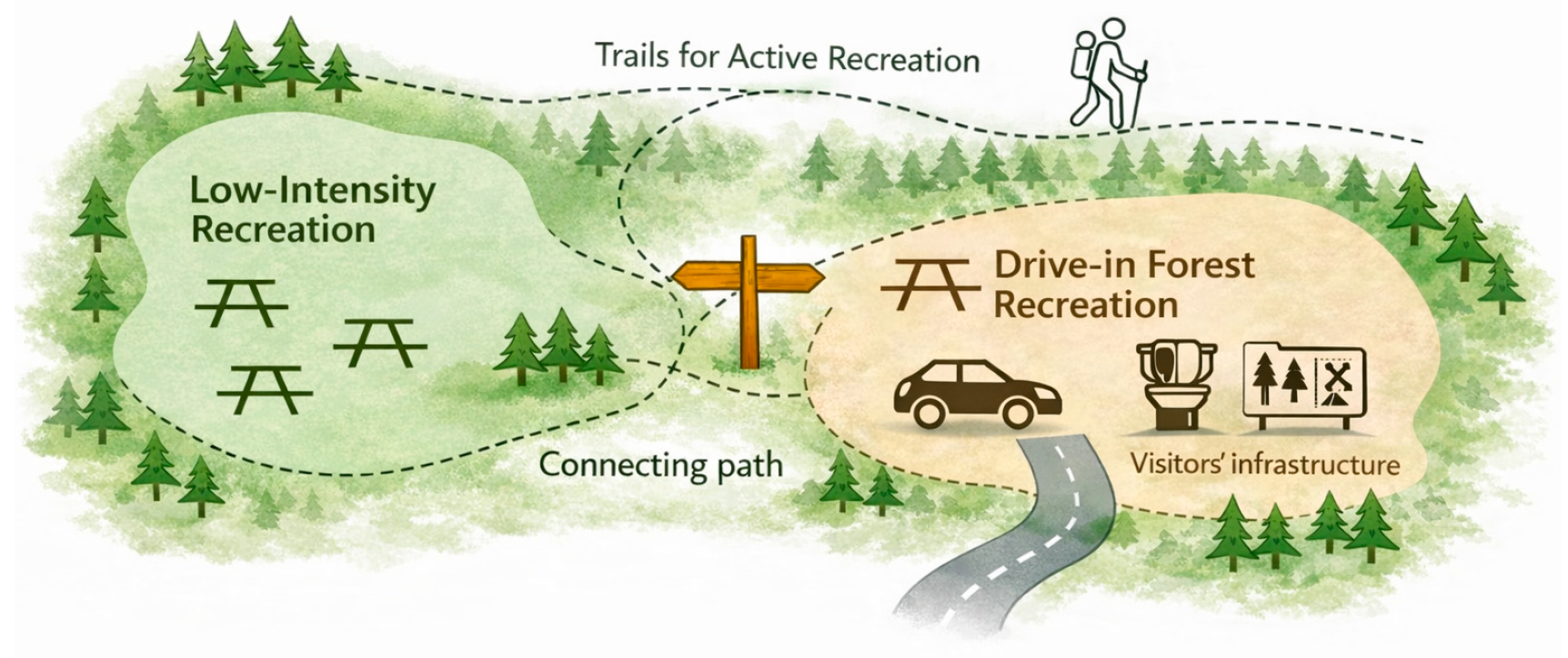
Practically, the proposed three-zone model functions as a compact decision support tool for micro-zoning—a high-intensity social zone, a moderate-use peaceful zone, and a movement-focused zone—which can be adapted to the physical layout and constraints of specific forest recreation sites.
Figure 1 illustrates the conceptual spatial structure of the proposed micro-zoning model.
Because the model is grounded in visitors’ reported needs and tensions (rather than abstract design principles alone), it illustrates how micro-zoning can be used not only to reduce conflict but also to support more equitable access to peaceful, nature-oriented experiences alongside legitimate demand for social gatherings and active use within the same forest site. In operational terms, the proposed model can guide the spatial organization of intensively used forest recreation sites by aligning infrastructure, circulation, and behavioral expectations with the needs of the three identified visitor types. High-intensity social activities, including dense picnic infrastructure, vehicle access, and children’s play facilities, can be concentrated near entrances and parking areas in the Drive-in Forest Recreation zone. More secluded parts of the site may function as Low-Intensity Recreation areas, characterized by dispersed seating, natural vegetation buffers, and expectations of quieter behavior that support peaceful nature-oriented visits. Active Recreation Use can be structured around clearly marked trailheads and loop paths that connect to the broader forest trail system while minimizing interference with stationary recreational activities. In this way, micro-zoning does not necessarily require large physical distances but rather a clear spatial logic that separates incompatible activities while maintaining accessibility within the same recreation site. Implementation of such micro-zoning therefore depends on site-level planning and management decisions, including the placement of infrastructure, circulation routes, and communication measures that help visitors understand and use the differentiated zones.
4.5. Limitations and Future Research
Several limitations should be acknowledged. First, the survey relied on a non-probabilistic sampling strategy combining on-site intercept surveys with online snowball sampling. Because both recruitment strategies used the same questionnaire and targeted the same population of forest recreation visitors, the responses were analyzed as a single dataset; however, this approach may introduce selection bias and therefore limit the statistical representativeness of the results. Online distribution may have favored participation by more digitally connected and highly educated respondents, and some visitor groups may therefore be underrepresented. Although the two recruitment streams were examined for potential differences in response patterns, no substantial differences were identified; however, as the sampling was non-probabilistic, some variation between on-site and online respondents cannot be entirely ruled out. Second, the data were collected during a single multi-month period and therefore do not capture potential seasonal variations in visitation patterns or recreational preferences. Third, the survey focused primarily on recreation needs, preferences, and perceived disturbances, and therefore did not collect some socio-demographic variables such as gender, which may influence recreation behavior. In addition, the study relied on self-reported visitor responses and did not include direct spatial tracking or behavioral observation data, which could have provided a more fine-grained picture of how different activities are distributed within the sites.
Finally, the findings derive from a specific network of intensively used forest recreation areas and therefore should be interpreted as analytically transferable insights rather than universally generalizable results, particularly across different climatic, ecological, or forest-management contexts. Despite these limitations, the dataset provides a substantial empirical basis for understanding visitor needs and use patterns in intensively used forest recreation sites and for exploring the planning implications of micro-zoning at the site scale.
Future research could test and refine the proposed three-zone model in other forest regions and governance contexts, including comparative studies across different climate zones and green infrastructure systems. A useful next step would be to pilot the proposed three-zone model in selected forest recreation sites and evaluate its effects on visitors’ experiences, spatial conflicts, and management outcomes. Longitudinal or mixed-method designs combining repeated surveys with qualitative work and behavioral observations could further examine how zoning implementations affect visitor experiences, conflicts, and environmental conditions over time, and how visitors themselves understand and negotiate the resulting spatial structure.
5. Conclusions
This study examined why zoning matters in intensively used forest recreation sites, how weak or absent zoning is reflected in visitor experiences, and how visitor survey data can be used to design a site-level zoning model. Using responses from 302 visitors to recreational forests, it shows that these sites function as everyday recreation spaces for diverse family and group-based visits, with strong shared preferences for a peaceful area, shade, cleanliness, natural scenery, and basic infrastructure, alongside recurrent disturbances from loud music, crowding, and litter.
By relating these patterns to distinct visitor types, the study provides an empirical justification for zoning within individual recreational areas and proposes a three-zone model that separates high-intensity social use, peaceful nature-oriented use, and movement-focused use while keeping all three within the same site. In doing so, it bridges a gap between macro-level visitor use management frameworks and the micro-level design of small forest recreation nodes. It is key to notice that in structuring space to provide both peaceful nature-oriented areas and legitimate spaces for celebrations and active use, zoning can also support more equitable access to different kinds of forest experiences within the same site.
The challenges identified, limited space, diverse users, and overlapping activities are common in many forest and green-space settings. The approach illustrated here suggests that systematic use of visitor surveys can help forest agencies move from general calls for zoning toward explicit, evidence-based micro-zoning schemes at the scale of individual recreational sites that are intelligible to managers, visitors, and stakeholders alike. While the specific spatial proportions or configurations of zones will necessarily vary between sites, the planning logic illustrated here, deriving zoning structures directly from empirically identified visitor needs, preferences, and disturbances, may be transferable to other intensively used forest recreation areas.