Article

Enhancing Wildlife Park Environmental Management Through an Integrated Evaluation Framework: A Non-Human-Centered Perspective


1
Interdisciplinary Program in Landscape Architecture, Graduate School, Seoul National University, Seoul 08826, Republic of Korea
2
Landscape Architecture, Graduate School, Kyung Hee University, Yongin 17104, Republic of Korea
3
Research Institute of Agriculture and Life Sciences, Seoul National University, Seoul 08826, Republic of Korea
4
Department of Landscape Architecture and Rural Systems Engineering, Seoul National University, Seoul 08826, Republic of Korea
*
Author to whom correspondence should be addressed.
Land 2026, 15(3), 387; https://doi.org/10.3390/land15030387
Submission received: 22 January 2026 / Revised: 16 February 2026 / Accepted: 25 February 2026 / Published: 27 February 2026

Abstract

Wildlife parks play a crucial role in biodiversity conservation and environmental education. However, their management effectiveness remains under-evaluated from an ecological sustainability perspective. Existing evaluation frameworks for wildlife park management are largely human-centered and overlook wildlife as independent subjects. To address this gap, this study emphasizes the intrinsic value of wildlife as independent ecological actors, and proposes an evaluation framework for management effectiveness from a non-human-centered perspective. The framework encompasses five criterion layers subdivided into 24 evaluation indicators established using the analytic hierarchy process (AHP). Post-occupancy evaluation (POE) was subsequently employed as an example application to demonstrate the implementation of the framework at Beijing Wildlife Park (BWP), yielding a comprehensive evaluation index of 76.87%. The results indicate differentiated performance across the five evaluation dimensions without constituting a site-specific judgment. The example application demonstrates the feasibility and operability of the framework, addressing the shortcomings of conventional evaluation approaches in ethical and ecological dimensions. This study provides a decision-support tool to guide the enhancement of environmental management in wildlife parks and may inform evaluation in related animal-oriented spaces.

1. Introduction

1.1. Research Background

According to the United Nations Environment Programme (UNEP) 2021 report Making Peace with Nature, climate change, biodiversity loss, and environmental pollution have become the most pressing environmental challenges of our time [1]. Restoring the relationship between humans and nature and strengthening biodiversity conservation has become an urgent priority in global environmental governance. As key institutions connecting nature and society, wildlife parks play a crucial role by supporting wildlife conservation, scientific research, and public education [2,3,4].
The definition of wildlife park varies across countries and standards. According to the Collins English Dictionary, a wildlife park is “an enclosed area of land where uncaged wild animals roam fairly freely, in conditions designed to mimic their natural habitat as closely as possible” [5]. In Western contexts, wildlife parks are often referred to as Open Plan Zoos or Safari Parks, whereas in some African and Asian regions, they are identified as wildlife conservation areas or National Parks [6]. In China, wildlife parks are categorized as a type of urban park within the urban green space system, with group housing, mixed-species enclosures, and free-ranging displays serving as their primary exhibition modes [7].
In recent years, several wildlife parks have demonstrated strong management practices that attend to animal welfare and ecological conditions. For example, Sabi Sands Game Reserve in South Africa operates as an unfenced landscape contiguous with Kruger National Park, allowing wildlife to move freely across a large natural habitat; Zoofari Parks in the US integrate captive management with conservation programmes; and Tanganyika Wildlife Park in the US combines close-range animal encounters with structured staff supervision and educational interpretation aimed at fostering public awareness of animal care and conservation. However, despite such positive practices, recent cases suggest that significant challenges persist in wildlife park management. In 2022, captive red pandas in several Indian zoos showed stereotypic behaviours caused by insufficient environmental complexity, indicating long-term psychological stress [8]; in 2023, a young giraffe at the Greater Vancouver Zoo died due to poor enclosure design, lack of behavioural enrichment, and inadequate climate adaptation, which further intensified public criticism of captive conditions; in 2024, a commercial wildlife interactive exhibit located in shopping malls in Fort Worth, Texas and Las Vegas, Nevada was criticised for confining animals to limited spaces and exposing them to intensive human disturbance solely for entertainment purposes. These contrasting practices reveal substantial variation in management approaches across wildlife parks and highlight the need for systematic evaluation tools capable of assessing management effectiveness with respect to animal welfare, ecological integrity, and public education and ethical considerations.
As argued by Altvater et al., the underlying cause of the current environmental crisis lies in anthropocentrism [9]. Anthropocentrism means “interpreting or regarding the world in terms of human values and experiences” [10], which creates a dualism that separates the values and experiences of humans from those of nonhuman life forms. This dualistic perspective obscures the interconnectedness between human and nonhuman life [9]. With this shift in environmental philosophy, wildlife parks as hybrid spaces connecting nature and culture have played a growing role in ecological conservation and species breeding [11,12]. However, in practice, wildlife park management still requires further development toward more inclusive and ecologically responsible approaches.

1.2. Animal Welfare Evaluation Frameworks

The evaluation of animal welfare is based on the development of Animal Rights Theories and Animal Liberation [13,14], as well as the practical standards established by global animal protection organizations. Peter Singer proposed the theory of Animal Liberation, while Tom Regan introduced the Animal Rights Theory, both emphasizing that animals should possess independent rights to life and welfare [15,16]. Fraser proposed three perspectives for assessing animal welfare, including the natural living perspective, the biological functioning perspective, and the affective state perspective. The Natural Living Perspective advocates for providing animals with environments that closely resemble their natural habitats, enabling them to express normal behaviour. The Biological Functioning Perspective highlights the importance of keeping animals under conditions that promote health, growth, and reproduction, while the Affective States Perspective focuses on animals’ experiences of pain and other emotional states [17]. In 1979, the Farm Animal Welfare Council (FAWC) introduced the “Five Freedoms” principle, which has become a globally recognized standard for assessing animal welfare [18]. These freedoms include freedom from hunger and thirst, freedom from discomfort, freedom from pain and suffering, freedom to express normal behaviour, and freedom from fear and distress. This framework has been widely applied in wildlife parks, zoos, and other animal management institutions, serving as a fundamental benchmark for evaluating animal welfare; for example, Demartoto et al. applied the Five Freedoms framework to assess animal welfare practices in Indonesian zoos through observational and management-based evaluation [19]. In global zoo management, animal welfare standards centred on the “Five Freedoms” have been widely adopted by international organisations such as the Association of Zoos and Aquariums (AZA) and European Association of Zoos and Aquaria (EAZA), and have been incorporated into accreditation and evaluation systems.

1.3. Analytic Hierarchy Process and Post-Occupancy Evaluation

The Analytic Hierarchy Process (AHP) method was proposed by Saaty in the 1970s as a multi-criteria decision-making technique, integrating both qualitative and quantitative data for solving complex or ambiguous decision-making problems [20,21]. This method decomposes decision-making problems into hierarchical structures and assigns weights to each criterion based on expert judgment, ultimately quantifying the relative importance of different factors to assist decision-making. To mitigate potential subjectivity in the assignment of weights, the composition of the expert panel and the implementation of consistency tests are critical to ensuring methodological rigor and robustness. In the field of environmental planning and spatial management, AHP has been widely applied in landscape quality assessment, ecological restoration evaluation, environmental performance analysis, sustainability assessment, and land-use management, particularly in contexts involving multi-objective trade-offs and complex ecological systems [22,23,24,25]. AHP has demonstrated applicability in constructing and determining the priorities of multiple interrelated criteria. Wildlife parks, as a distinctive type of landscape and ecological space, require the integration of multiple interrelated considerations in the evaluation of environmental management, thereby making AHP a suitable methodological approach.
Post-Occupancy Evaluation (POE) originated in the 1960s from Environmental Psychology [26] and was initially used to evaluate how built environments meet the needs of human users, primarily relying on surveys and interviews to systematically collect user feedback [27]. In built environment research, POE has been widely applied in urban green space evaluation, public housing regeneration, and landscape performance assessment, serving as a post-implementation tool to examine spatial functionality, ecological quality, and stakeholder experience [28,29,30]. In zoo and wildlife park management, POE has been applied to assess the post-occupancy performance of exhibits, including their capacity to support animal welfare and enhance visitor educational experience [31]. In this study, POE is employed to illustrate how the evaluation framework can be applied and its indicators translated into measurable results within a practical management context.

1.4. Non-Anthropocentric Approaches in Wildlife Park Research

Non-anthropocentrism, a theoretical stance within environmental ethics, advocates for a more inclusive and respectful approach toward other living beings [32]. It posits that all living organisms and natural environments possess inherent value, independent of their utility or service to humans [33]. Recent studies in zoo and wildlife park management have begun to reflect ethical orientations increasingly attentive to animal welfare and intrinsic value. Studies on environmental enrichment and enclosure design indicate a growing recognition of animals’ behavioral preferences and thermal comfort as core evaluation criteria [34]. Likewise, the development of automated welfare monitoring systems and disease surveillance demonstrates that animal well-being is being institutionalized as a primary management objective [35,36,37]. Historical analyses of zoo governance further reveal a gradual shift toward recognizing animals as sentient subjects within legal and managerial frameworks [38]. In zoo planning and design, animals are increasingly regarded as stakeholders or even co-participants in the process [39]. These developments suggest that zoo and wildlife park research is progressively moving beyond human-centered managerial logics, embodying an ethical reorientation that foregrounds animals’ intrinsic value, behavioural agency, and welfare as central evaluative concerns.
However, these developments remain conceptually dispersed rather than methodologically consolidated. As noted by Kopnina et al., there is currently no fully developed non-anthropocentric conservation guideline that translates ethical commitments into concrete management tools [40]. Moreover, animal welfare assessments are typically conducted independently from overall park performance evaluation systems and are rarely integrated into mainstream management effectiveness frameworks [41].
Based on the above, this study develops an innovative evaluation framework for wildlife park management effectiveness grounded in a non-anthropocentric perspective, specifically focusing on large-scale suburban parks that preserve natural landscapes, simulate wild animal habitats, and feature open-style exhibits. The framework enhances the capacity to conduct comprehensive assessments of wildlife parks from the standpoint of non-human value. It further demonstrates the operationalisation of this framework through an example application, illustrating how evaluation results can inform management reflection and improvement, thereby facilitating the broader adoption of perspectives beyond humanity in future sustainability research and practice.

2. Materials and Methods

2.1. Research Framework and Process

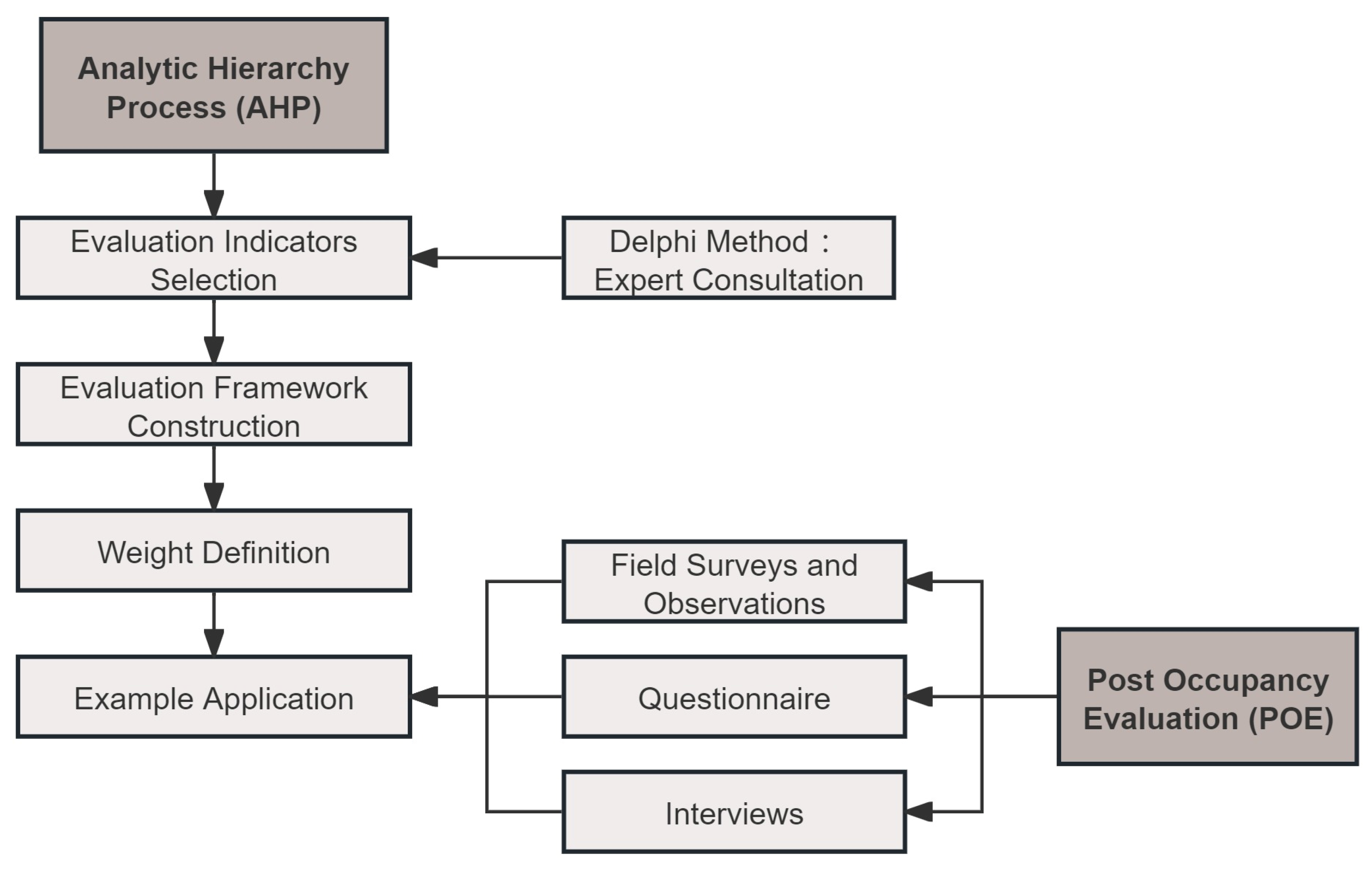
This study first conducted a systematic literature review of animal welfare evaluation frameworks and non-anthropocentric approaches in wildlife park research, establishing the theoretical foundation and identifying a preliminary pool of candidate indicators. Based on this preliminary indicator set, the Delphi method was employed to conduct expert consultation, during which experts evaluated, revised, and refined the indicators. Indicators with low importance or insufficient consensus were removed, resulting in the final hierarchical evaluation framework consisting of a target layer, criterion layer, and indicator layer. The Analytic Hierarchy Process (AHP) was subsequently applied to determine the weights of the retained indicators. A consistency test was conducted to assess the logical coherence of the judgment matrix. Finally, using the Post Occupancy Evaluation (POE), Beijing Wildlife Park (BWP) was selected as an example application to demonstrate the operationalisation of the proposed framework and to conduct a comprehensive assessment of its management effectiveness (Figure 1).

2.2. Selection of Evaluation Indicators

In this study, two key criterion layers were constructed based on Fraser’s theory of animal welfare to evaluate the effectiveness of wildlife park management. First, the habitat environment criterion layer (B1) was developed based on the Natural Living Perspective to evaluate the extent to which wildlife parks support habitat restoration. Second, the animal behaviour and health criterion layer (B2) was designed based on the Biological Functioning Perspective to comprehensively evaluate it in terms of animals’ psychological and physical health, and behavioural expression. The Five Domains Model further conceptualizes animal welfare as comprising four physical–functional domains—nutrition, physical environment, health, and behavioural interactions—and a fifth domain, the mental state. The model emphasizes that environmental conditions and management practices are not equivalent to welfare states per se; rather, they influence welfare indirectly by affecting animals’ physiological stability and behavioural expression [42,43]. Contemporary welfare science recognises that barren or spatially restrictive environments may generate negative affective states such as fear, frustration, or boredom, whereas structurally enriched and ecologically appropriate habitats promote positive engagement and exploratory behaviour [44,45].
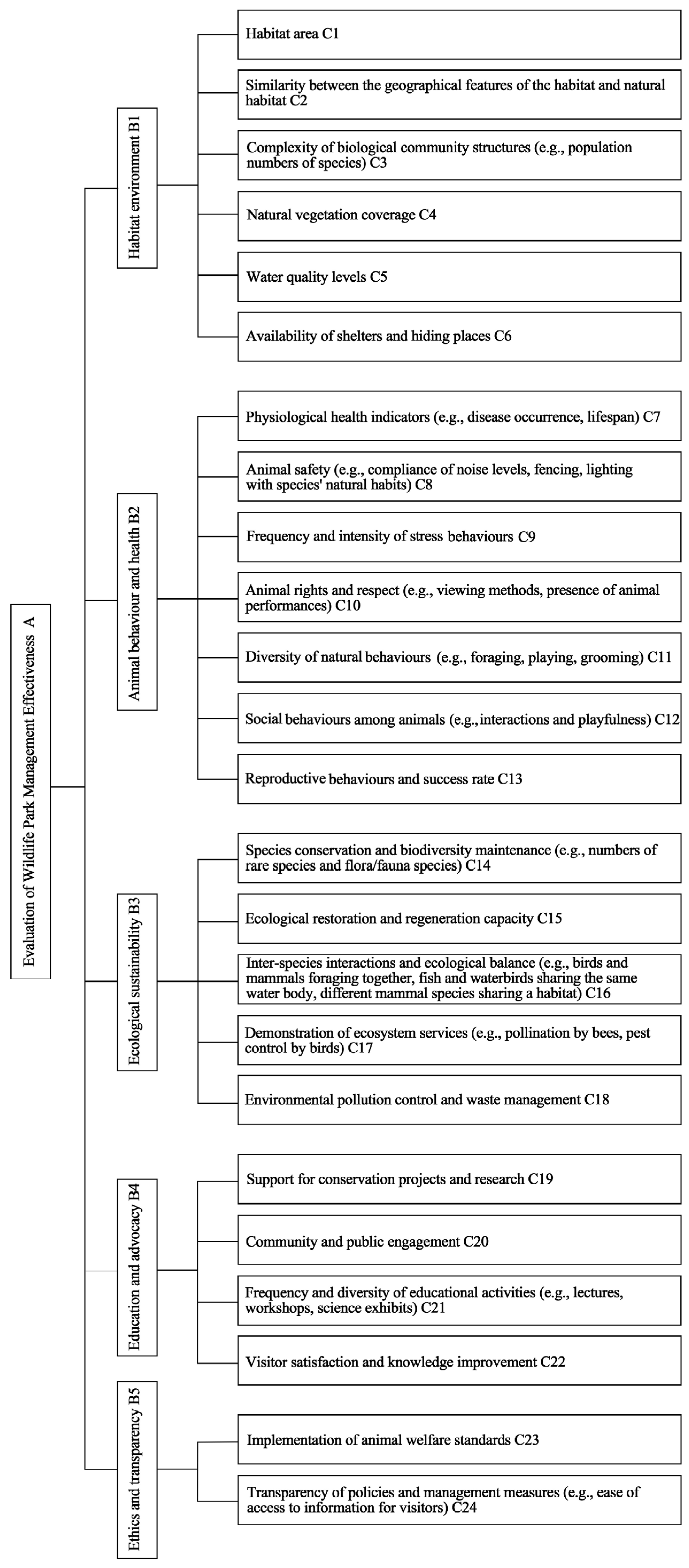
Accordingly, following consultation with experts, six indicators were identified to reflect the structural and ecological characteristics of wildlife park habitats under the Habitat Environment criterion layer (B1). These include habitat area (C1), similarity to natural habitat features (C2), biological community complexity (C3), vegetation coverage (C4), water quality (C5), and the availability of shelters and hiding places (C6), which assess the extent to which the habitat approximates natural environmental conditions. Similarly, under the Animal Behaviour and Health criterion layer (B2), seven indicators were identified to reflect animals’ biological functioning and behavioural expression, including physiological health status (C7), animal safety conditions (C8), stress-related behaviours (C9), respect for animal rights (C10), diversity of natural behaviours (C11), social interactions (C12), and reproductive success (C13).
Secondly, healthy ecosystems provide animals with more stable living environments, enhancing their behavioural expression and adaptive capacity [46]. Thus, this study introduced Ecological Sustainability as the third criterion layer (B3), focusing on the long-term stability of ecosystems and biodiversity conservation within wildlife parks. Ecosystem sustainability is commonly evaluated in terms of biodiversity, resilience, species interactions, and ecosystem functioning. Extensive research has shown that biodiversity supports ecological stability and system resilience [47,48,49,50]. Five indicators were specified to reflect the long-term stability and sustainability of wildlife park ecosystems. These include species conservation and biodiversity maintenance (C14), ecological restoration capacity (C15), inter-species interactions and ecological balance (C16), demonstration of ecosystem services (C17), and environmental pollution control and waste management (C18).
Moreover, non-anthropocentrism advocates for transcending human interests. To promote a shift in public attitudes from anthropocentrism to non-anthropocentrism and to ensure ethical and transparent wildlife park management, this study added two additional criterion layers: Education and Advocacy (B4) and Ethics and Transparency (B5). Environmental education is not merely about knowledge dissemination but also about driving cultural change and reshaping values to foster greater understanding and respect for ecosystems and animals [51,52]. Furthermore, Peter Singer in Animal Liberation underscores humanity’s moral responsibilities in animal management, while ecological ethicist Callicott posits that policy-making and implementation of animal welfare standards should be conducted with openness and transparency [15,53]. These theories collectively affirm that effective environmental education, along with responsible and transparent management practices, can safeguard animal welfare and enhance ecosystem health. Thus, under the Education and Advocacy criterion layer (B4), four indicators were specified to reflect wildlife parks’ role in conservation communication and public engagement. These include support for conservation projects and research (C19), community and public engagement (C20), frequency and diversity of educational activities (C21), and visitor satisfaction and knowledge improvement (C22). Under the Ethics and Transparency criterion layer (B5), two indicators were specified to capture governance responsibility and ethical management. These include the implementation of animal welfare standards (C23) and transparency of policies and management measures (C24), reflecting a commitment to ethical and transparent wildlife park governance grounded in non-anthropocentric values.
Five criterion layers were identified from a non-anthropocentric perspective: habitat environment, animal behaviour and health, ecological sustainability, education and advocacy, and ethics and transparency. Following the Delphi consultation, six preliminary indicators were removed. The exclusions were based on expert panel judgement that these indicators were not fully aligned with the conceptual focus of the evaluation framework or were considered redundant in relation to retained indicators. Detailed reasons for exclusion are provided in Table 1. Ultimately, 24 indicators were retained, constituting the final comprehensive evaluation framework for wildlife park management effectiveness (Figure 2).

2.3. Weight Values and Consistency Tests

The next step focused on determining the weight values for each evaluation criterion. These weight values were derived through systematic expert scoring, creating pairwise comparison matrices to generate eigenvectors and establish the relative importance of each criterion, thereby reflecting their contribution to the overall evaluation objective.
The expert panel consisted of two professors and three doctoral researchers in landscape architecture, all with research experience related to wildlife parks and environmental management, and therefore capable of making informed judgments on the evaluation indicators.
In this study, a matrix-based questionnaire was used to consult experts on the relative importance of the evaluation criteria. Experts were asked to conduct pairwise comparisons between indicators at the same hierarchical level using Saaty’s 1–9 scale (Table 2). For each pair of indicators, experts assessed which indicator was more important and to what extent, forming reciprocal judgment matrices.
To construct the group judgment matrix, the geometric mean aggregation method was adopted to integrate individual expert matrices. The aggregated matrix is expressed as:
A = 1 a 12 a 1 n 1 a 12 1 a 2 n 1 a 1 n 1 a 2 n 1
where a i j   > 0, a i i = 1, and a j i   = 1/ a i j , indicating a reciprocal judgment matrix.
After obtaining the group judgment matrix, the weight vector was calculated using the eigenvalue method. The priority weights were derived from the principal eigenvector of matrix A:
A w = λ m a x w
where w is the normalized weight vector and λ m a x is the maximum eigenvalue of matrix A.
Secondly, to ensure the reliability and logical validity of the weight derivation process, a consistency ratio (CR) test was conducted for each pairwise comparison matrix constructed by the experts. The CR examines the internal logical coherence of each judgment matrix within the Analytic Hierarchy Process (AHP), testing whether the assigned relative importance satisfies the transitivity requirement.
The consistency ratio is calculated as:
C R = C I R I < 0.1
where the Consistency Index (CI) is defined as:
CI = λ m a x n n 1
The Random Consistency Index (RI) values used in this study were adopted from the simulation results originally reported by Saaty, which were obtained through extensive random matrix experiments (Table 3). RI represents the average consistency index of randomly generated reciprocal matrices of the same order. By comparing CI with RI, the CR indicates whether the observed inconsistency level is acceptably small relative to random judgment. According to Saaty’s criterion, a CR value below 0.1 indicates acceptable logical consistency [54]. If the CR exceeded this threshold, the Delphi method was employed to revise the pairwise comparisons until acceptable consistency was achieved.

2.4. Application of the Evaluation Framework

2.4.1. Research Object Selection

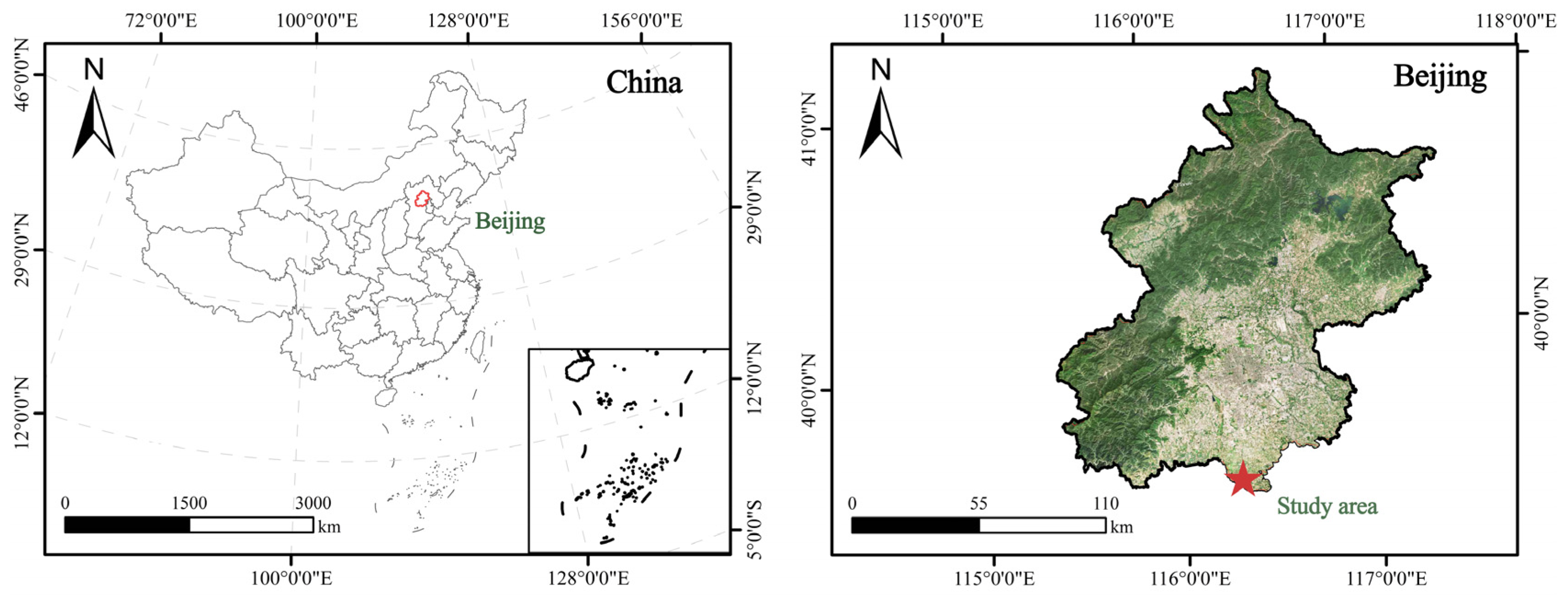
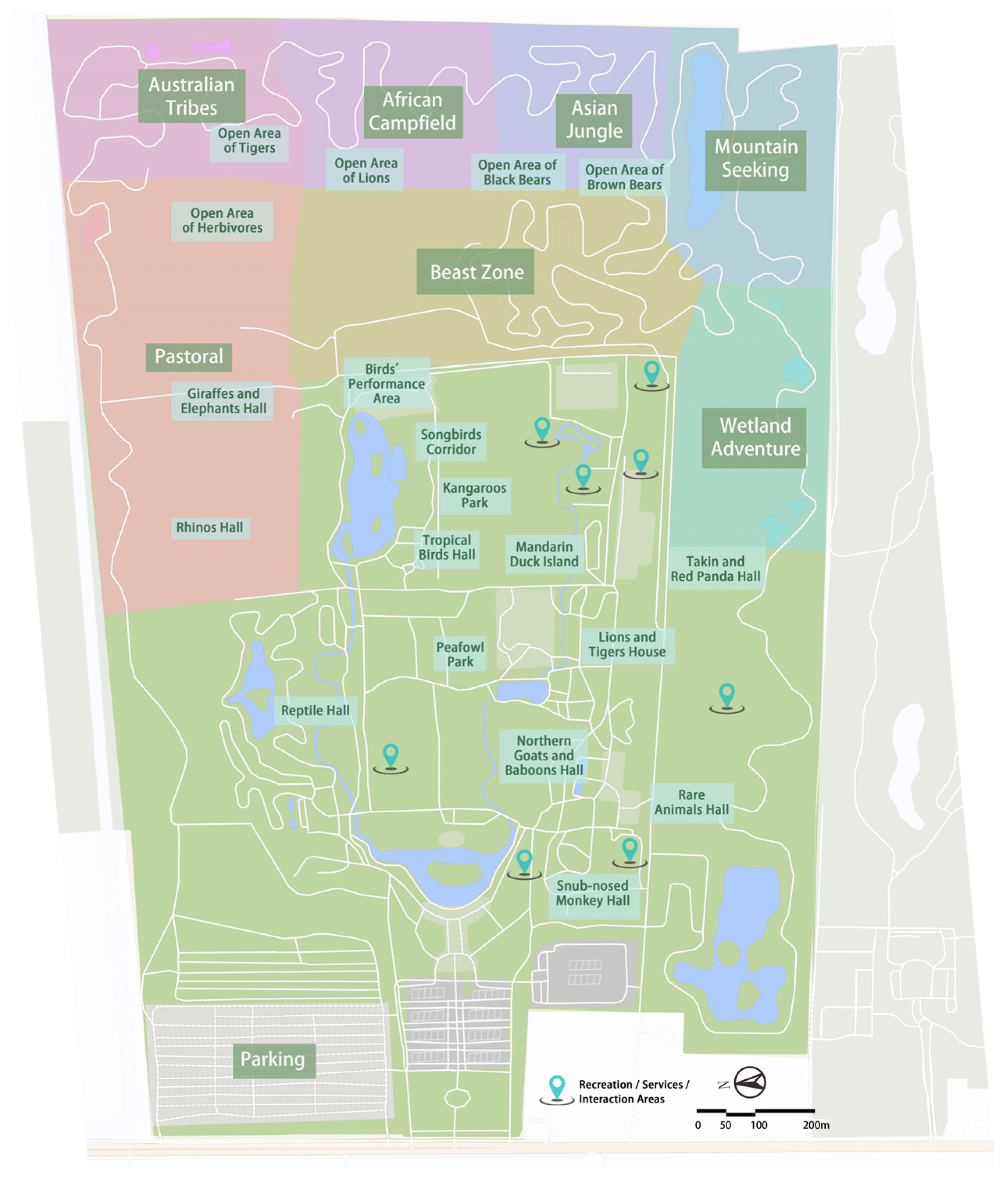
Beijing Wildlife Park (BWP) is a comprehensive wildlife park that employs open-range and mixed-species display methods (Figure 3 and Figure 4). With its rich diversity of animal species and varied exhibit zones, the park provides an ideal setting for evaluating (Table 4). The framework is illustrated through an example implementation in BWP, where environmental management is assessed using the integrated POE–AHP procedure.

2.4.2. Evaluation Procedure

To demonstrate the applicability of the proposed evaluation framework, a structured questionnaire was developed in alignment with the established hierarchical system. Each questionnaire item was formulated to correspond directly to a specific indicator within the criterion and indicator layers, ensuring alignment between the questionnaire design and the evaluation framework. A five-point Likert scale was employed, with responses ranging from ‘very poor’ to ‘very good’ assigned values of 1 to 5 respectively. The survey was conducted online. It was distributed to general visitors who had visited the BWP, researchers in relevant fields, and staff members of the wildlife park, and a total of 270 questionnaires were distributed. After data cleaning, incomplete and invalid questionnaires were excluded, and 214 valid responses were retained for analysis.
For each indicator, the mean score was calculated based on the valid responses. The overall weighted score was computed by multiplying the mean score of each indicator by its corresponding weight and summing across all indicators.
S = F i × X i
where Fi denotes the mean score of indicator i based on valid responses, and Xi denotes the weight assigned to indicator i.
To enhance interpretability and comparability, a Comprehensive Evaluation Index (CEI) was calculated by standardising the overall score against the theoretical maximum score and converting it into a percentage value.
C E I = S S 0 × 100 %
Because each indicator was measured on a five-point Likert scale (1–5), and the sum of all indicator weights equals 1, the theoretical maximum value of S is 5.

3. Results

3.1. Weights of the Evaluation Framework

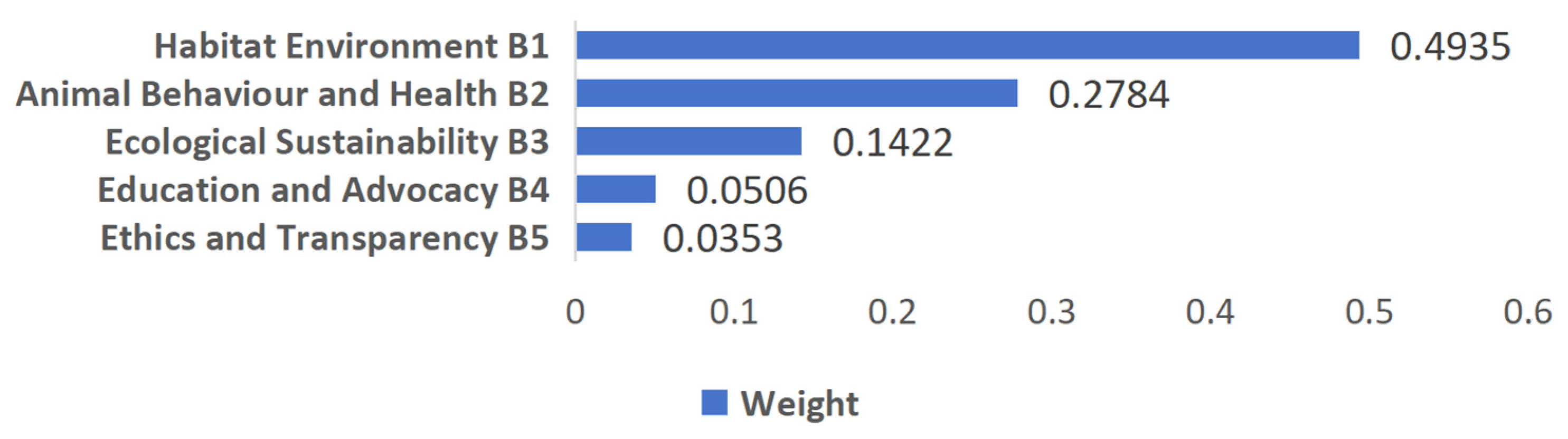
The AHP analysis results presented in Table 5 indicated that all CRs were below 0.1, thus ensuring the reliability of the expert panel responses. At the criterion layer, Habitat Environment ranks first, followed by Animal Behaviour and Health and Ecological Sustainability, whereas Education and Advocacy and Ethics and Transparency receive relatively smaller weights (Figure 5). Under a non-human-centered perspective, this distribution indicates that the framework primarily prioritizes ecological conditions and animal well-being, while social communication and managerial transparency function as complementary dimensions.
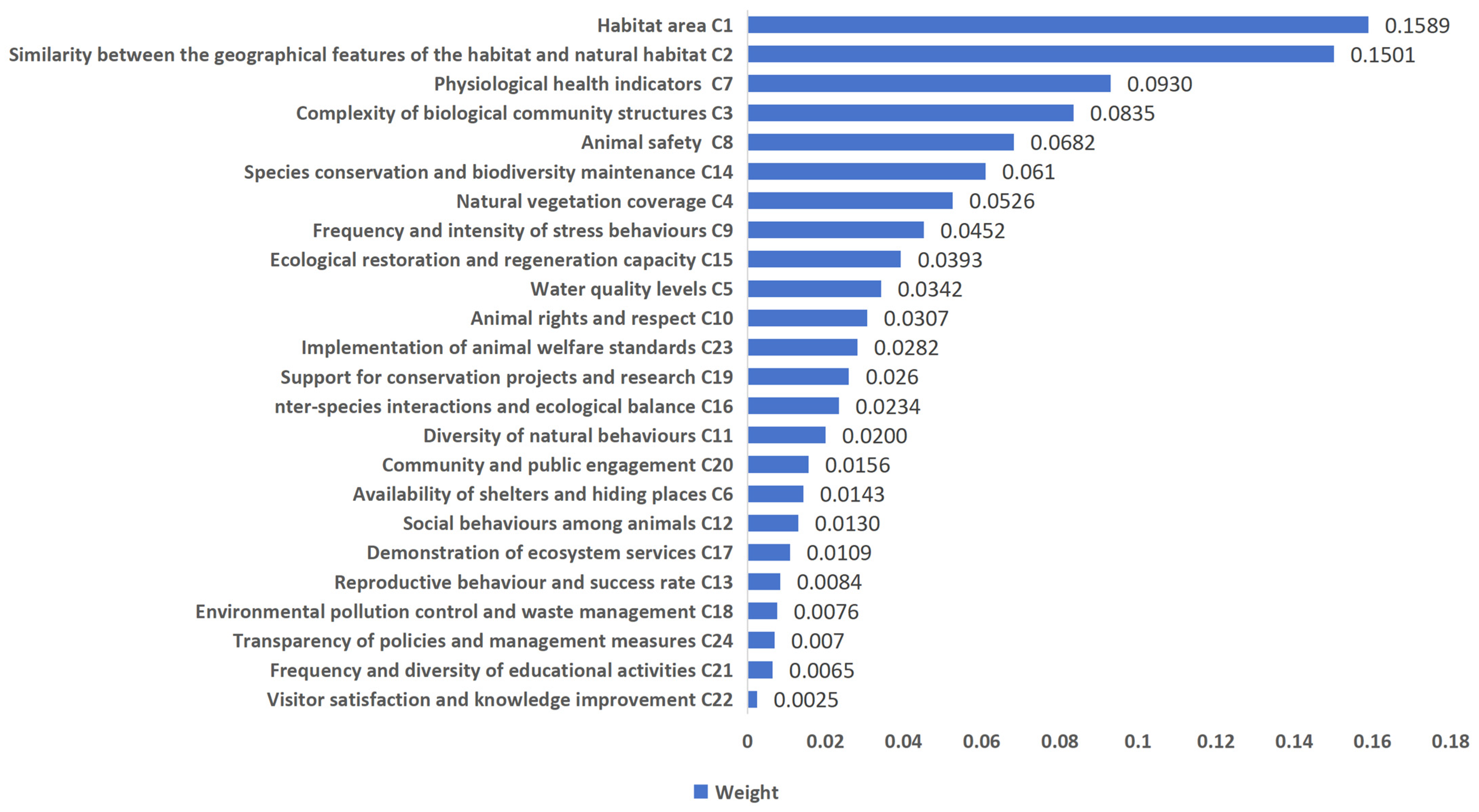
At the indicator layer, among all indicators, habitat area and similarity between the habitat and natural habitat rank first and second, respectively. This indicates that the framework evaluates environments according to their ecological suitability for animals, emphasizing habitat naturalness and adequacy as the primary basis for wildlife park environmental management. The high ranking of physiological health indicators further shows that animal welfare remains a central component in the evaluation framework under a non-human-centered perspective. Following these are indicators related to ecosystem structure and safety, including biological community complexity, animal safety, and biodiversity conservation. These results suggest that environmental management is evaluated not only through individual animal status but also through the stability and functionality of the surrounding ecological system. Mid-level weights are assigned to indicators describing ecological processes and welfare implementation, such as ecological restoration capacity, water quality, animal rights respect, and welfare standard implementation. These indicators function as operational expressions of management practices that maintain long-term environmental stability of the wildlife park. In contrast, indicators associated with human-oriented functions, including public engagement, educational activities, visitor satisfaction, and policy transparency, rank at the lowest positions. This distribution suggests that communication, interpretation, and managerial disclosure are regarded as supportive mechanisms under a non-human-centered perspective (Figure 6).

3.2. Results of the Framework Application

Based on 214 valid responses to BWP, the integrated evaluation framework generated a comprehensive evaluation index of 76.87%. The scores obtained under the evaluation framework are presented in Table 6, and the mean scores of criterion layer are summarised in Table 7.
The habitat environment shows moderate performance, with relatively lower scores in natural similarity, water quality, and shelter availability, indicating limitations in replicating natural living conditions. Animal behaviour and health achieved the highest overall dimension score; however, reproductive behaviour and success rate remain comparatively low. Ecological sustainability shows lower values in ecosystem restoration and ecosystem service display, whereas pollution control and waste management performed relatively better. Education and advocacy is the weakest dimension, mainly due to the very low score in support for conservation projects and research together with limited public engagement. Ethics and transparency shows moderate performance, with relatively lower policy transparency and welfare standard implementation.

4. Discussion

This study incorporates a non-anthropocentric perspective into the structure of management effectiveness evaluation. Through an example application, the framework organises habitat conditions, animal behaviour, ecological functioning, social communication and governance factors into parallel evaluative domains, emphasising that animals are evaluated through welfare and behavioural indicators rather than treated solely as components of an ecosystem or human-use objects. In this way, ethical considerations are translated into measurable criteria within the assessment structure, thereby integrating non-anthropocentric values into the evaluation framework.
Such integration requires a defined methodological structure. The integration of AHP and POE supports this operationalisation. AHP establishes a transparent hierarchical relationship among criteria and allows weighting adjustment under different management priorities, while POE provides a structured mechanism for collecting performance information from stakeholders. Together, the two approaches transform qualitative management conditions into structured quantitative outcomes. This combination supports multi-objective evaluation and accommodates diverse stakeholder perspectives within a unified assessment procedure.
This methodological structure enables practical contexts within wildlife park settings. The example application demonstrates how performance differences across management dimensions can be systematically identified. The framework may also inform evaluation in related animal-oriented places, including urban zoos, ecological parks, and managed conservation facilities involving public access and human–animal interaction.

5. Conclusions

This study constructs an evaluation framework for wildlife park management effectiveness from a non-anthropocentric perspective and demonstrates its implementation through an example application to Beijing Wildlife Park. Building upon traditional animal welfare assessment, the framework expands evaluation to multiple domains, including habitat conditions, ecological functioning, social communication, and governance factors, thereby providing a systematic and operable evaluation structure. Compared with conventional animal welfare assessments, the framework emphasises the intrinsic value and ethical subjectivity of animals and ecosystems within an integrated management context. By integrating POE and AHP, the study establishes a quantifiable and adaptable framework that may also inform evaluation in related animal-oriented facilities such as zoos and ecological parks. The framework links wildlife park management with environmental ethics while supporting conservation-oriented decision-making in practice, enabling management procedures to better align with conservation objectives.

Author Contributions

Conceptualization, F.K.; methodology, F.K. and M.Y.; software, F.K.; data collection, F.K. and M.Y.; data curation, M.Y.; formal analysis, F.K.; writing—original draft preparation, F.K.; writing—review and editing, F.K., M.Y., and J.-H.P.; supervision, J.-H.P.; funding acquisition, J.-H.P. All authors have read and agreed to the published version of the manuscript.

Funding

This research received no external funding. The APC was funded by the Research Institute of Agriculture and Life Sciences, Seoul National University.

Data Availability Statement

The data presented in this study are not publicly available due to ethical and privacy restrictions involving human participants but may be made available from the first author upon reasonable request and with approval from the Seoul National University Institutional Review Board.

Acknowledgments

The authors are grateful to all survey participants.

Conflicts of Interest

The authors declare no conflicts of interest.

References

  1. United Nations Environment Programme. Making Peace with Nature: A Scientific Blueprint to Tackle the Climate, Biodiversity and Pollution Emergencies; UNEP: Nairobi, Kenya, 2021; Available online: https://www.unep.org/resources/making-peace-nature (accessed on 21 January 2025).
  2. Miranda, R.; Escribano, N.; Casas, M.; Pino-del-Carpio, A.; Villarroya, A. The role of zoos and aquariums in a changing world. Annu. Rev. Anim. Biosci. 2023, 11, 287–306. [Google Scholar] [CrossRef]
  3. Fatima, N. The role of zoos in biodiversity conservation. MARKHOR (J. Zool.) 2024, 1, 1–10. [Google Scholar] [CrossRef]
  4. Beer, H.N.; Shrader, T.C.; Schmidt, T.B.; Yates, D.T. The evolution of zoos as conservation institutions: A summary of the transition from menageries to zoological gardens and parallel improvement of mammalian welfare management. J. Zool. Bot. Gard. 2023, 4, 648–664. [Google Scholar] [CrossRef]
  5. Collins English Dictionary. Definition of “Wildlife Park”; HarperCollins Publishers: New York, NY, USA, 2022. [Google Scholar]
  6. Zuo, B. The Evaluation System of Wildlife Park Instruction and Management in China. Ph.D. Thesis, Northeast Forestry University, Harbin, China, 2006. [Google Scholar]
  7. CJJ/T 240–2015; Standard for Terminology of Zoo. Ministry of Housing and Urban-Rural Development of the People’s Republic of China: Beijing, China; China Architecture & Building Press: Beijing, China, 2015.
  8. Sohel Khan, A.; Lea, S.E.; Chand, P.; Rai, U.; Baskaran, N. Predictors of psychological stress and behavioural diversity among captive red panda in Indian zoos and their implications for global captive management. Sci. Rep. 2022, 12, 14034. [Google Scholar] [CrossRef]
  9. Altvater, E.; Crist, E.C.; Haraway, D.J.; Hartley, D.; Parenti, C.; McBrien, J. Anthropocene or Capitalocene?: Nature, History, and the Crisis of Capitalism; PM Press: Oakland, CA, USA, 2016. [Google Scholar]
  10. Anthropocentric. Merriam-Webster.com Dictionary. 2020. Available online: https://www.merriam-webster.com/dictionary/anthropocentric (accessed on 21 January 2025).
  11. Whatmore, S. Hybrid Geographies: Natures, Cultures, Spaces; Sage: London, UK, 2002. [Google Scholar]
  12. Ye, F. Development and Design of Zoological Parks. Ph.D. Thesis, Beijing Forestry University, Beijing, China, 2007. [Google Scholar]
  13. DeGrazia, D. Animal Rights: A Very Short Introduction; Oxford University Press: Oxford, UK, 2002. [Google Scholar]
  14. Garner, R. Animal Ethics; Polity Press: Cambridge, UK, 2005. [Google Scholar]
  15. Singer, P. Animal Liberation; Avon Books: New York, NY, USA, 1975. [Google Scholar]
  16. Regan, T. The Case for Animal Rights; University of California Press: Berkeley, CA, USA, 1983. [Google Scholar]
  17. Fraser, D. Assessing animal welfare at the farm and group level: The interplay of science and values. Anim. Welf. 2003, 12, 433–443. [Google Scholar] [CrossRef]
  18. Farm Animal Welfare Council. Five Freedoms; FAWC: London, UK, 1979. [Google Scholar]
  19. Demartoto, A.; Soemanto, R.B.; Zunariyah, S. Zoo agent’s measure in applying the Five Freedoms principles for animal welfare. Vet. World 2017, 10, 1026–1034. [Google Scholar] [CrossRef]
  20. Min, J. Study on eco-environmental sensitivity evaluation based on GIS with AHP. J. Chongqing Norm. Univ. Nat. Sci. Ed. 2006, 4, 1–10. [Google Scholar]
  21. Karayalcin, I.I. The analytic hierarchy process: Planning, priority setting, resource allocation. Eur. J. Oper. Res. 1982, 9, 97–98. [Google Scholar] [CrossRef]
  22. Chen, J.; Duan, X.; Zhang, W.; Li, X.; Feng, H.; Zhou, R.; Zhu, R. A Study on the Perception Evaluation of Public Spaces in Urban Historic Waterfront Areas Based on AHP–Cloud Modelling: The Case of the Xiaoqinhuai Riverside Area in Yangzhou. Land 2025, 14, 2402. [Google Scholar] [CrossRef]
  23. Luo, P.; Hou, Y.; Niu, Y.; Hu, M.; He, B.; Subehi, L.; Fida, F. A Novel Dual Comprehensive Study of the Economic and Environmental Effectiveness of Urban Stormwater Management Strategies: A Case Study of Xi’an, China. Land 2026, 15, 75. [Google Scholar] [CrossRef]
  24. Kim, R.; Park, Y.; Kang, S.; Lee, J.; Cho, S.-Y.; Lee, S.-W. Decision Support for Peri-Urban Sustainability: An AHP–EWM Based Livability Vulnerability Assessment. Land 2025, 14, 2168. [Google Scholar] [CrossRef]
  25. Ibrahim, H.M.; Alasmary, Z.; Majrashi, M.A.; Harbi, M.A.; Aldubaise, A.; Alghamdi, A.G. Application of Principal Component and Multi-Criteria Analysis to Evaluate Key Physical and Chemical Soil Indicators for Sustainable Land Use Management in Arid Rangeland Ecosystems. Land 2025, 14, 2167. [Google Scholar] [CrossRef]
  26. Carr, N.; Cohen, S. The public face of zoos: Images of entertainment, education and conservation. Anthrozoös 2011, 24, 175–189. [Google Scholar] [CrossRef]
  27. Luo, L.; Lu, W. The research of post-occupancy evaluation in international trend and the realistic thinking of its introduction into China. J. Archit. 2004, 8, 82–83. [Google Scholar]
  28. Zhang, B.; Song, Y.; Liu, D.; Zeng, Z.; Guo, S.; Yang, Q.; Wen, Y.; Wang, W.; Shen, X. Descriptive and Network Post-Occupancy Evaluation of the Urban Public Space through Social Media: A Case Study of Bryant Park, NY. Land 2023, 12, 1403. [Google Scholar] [CrossRef]
  29. Li, M.; Zhang, J.; Wang, Y. Research on Post-Use Evaluation of Community Green Space Rectification Based on a Multi-Dimensional Perception System: A Case Study of Jiayuan Sanli Community in Beijing. Land 2024, 13, 698. [Google Scholar] [CrossRef]
  30. Borriello, L.; Forte, F.; Russo, Y.; Scardapane, S. Suburban Landscape and Public Housing: The Post-Occupancy Evaluation as a Tool for Built Environment Regeneration: A Case Study in the City of Naples, Italy. Land 2025, 14, 211. [Google Scholar] [CrossRef]
  31. Kelling, A.S.; Gaalema, D.E. Post-occupancy evaluations in zoological settings. Zoo Biol. 2011, 30, 597–610. [Google Scholar] [CrossRef]
  32. Vucetich, J.A.; Bruskotter, J.T.; Nelson, M.P. Evaluating whether nature’s intrinsic value is an axiom of or anathema to conservation. Conserv. Biol. 2015, 29, 321–332. [Google Scholar] [CrossRef] [PubMed]
  33. O’Neill, J. The varieties of intrinsic value. Environ. Ethics 1992, 14, 119–137. [Google Scholar] [CrossRef]
  34. Wark, J.D.; Wierzal, N.K.; Cronin, K.A. Mapping Shade Availability and Use in Zoo Environments: A Tool for Evaluating Thermal Comfort. Animals 2020, 10, 1189. [Google Scholar] [CrossRef] [PubMed]
  35. Diana, A.; Salas, M.; Pereboom, Z.; Mendl, M.; Norton, T. A Systematic Review of the Use of Technology to Monitor Welfare in Zoo Animals: Is There Space for Improvement? Animals 2021, 11, 3048. [Google Scholar] [CrossRef]
  36. Hampton, J.O.; MacKenzie, D.I.; Forsyth, D.M. How many to sample? Statistical guidelines for monitoring animal welfare outcomes. PLoS ONE 2019, 14, e0211417. [Google Scholar] [CrossRef]
  37. Bruczyńska, M.; Didkowska, A.; Brzezińska, S.; Nowak, M.; Filip-Hutsch, K.; Kalicki, M.; Augustynowicz-Kopeć, E.; Anusz, K. Mycobacterium avium Subspecies paratuberculosis in Asymptomatic Zoo Herbivores in Poland. Animals 2023, 13, 1022. [Google Scholar] [CrossRef]
  38. Ota, K.; Yamazaki, S. Skepticism in the Early Stage of the Introduction of Environmental Enrichment in Japanese Zoos. Animals 2024, 14, 309. [Google Scholar] [CrossRef]
  39. Luo, Y. A Survey on the Relationship between Wildlife Park Ecological Exhibit and Landscape. Master’s Thesis, Kunming University of Science and Technology, Kunming, China, 2011. [Google Scholar]
  40. Kopnina, H.; Gray, J.; Lynn, W.; Heister, A.; Srivastava, R. Uniting ecocentric and animal ethics: Combining non-anthropocentric approaches in conservation and the care of domestic animals. Ethics Policy Environ. 2023, 26, 265–286. [Google Scholar] [CrossRef]
  41. Tallo-Parra, O.; Salas, M.; Manteca, X. Zoo Animal Welfare Assessment: Where Do We Stand? Animals 2023, 13, 1966. [Google Scholar] [CrossRef]
  42. Mellor, D.J. Updating Animal Welfare Thinking: Moving beyond the “Five Freedoms” towards “A Life Worth Living”. Animals 2016, 6, 21. [Google Scholar] [CrossRef]
  43. Mellor, D.J.; Beausoleil, N.J.; Littlewood, K.E.; McLean, A.N.; McGreevy, P.D.; Jones, B.; Wilkins, C. The 2020 Five Domains Model: Including Human–Animal Interactions in Assessments of Animal Welfare. Animals 2020, 10, 1870. [Google Scholar] [CrossRef] [PubMed]
  44. Mellor, D.; Beausoleil, N. Extending the “Five Domains” Model for Animal Welfare Assessment to Incorporate Positive Welfare States. Anim. Welf. 2015, 24, 241–253. [Google Scholar] [CrossRef]
  45. Lawrence, A.B.; Vigors, B.; Sandøe, P. What Is so Positive about Positive Animal Welfare?—A Critical Review of the Literature. Animals 2019, 9, 783. [Google Scholar] [CrossRef]
  46. Kremen, C.; Merenlender, A.M. Landscapes that work for biodiversity and people. Science 2018, 362, eaau6020. [Google Scholar] [CrossRef]
  47. Hooper, D.U.; Chapin, F.S.; Ewel, J.J.; Hector, A.; Inchausti, P.; Lavorel, S.; Lawton, J.H.; Lodge, D.M.; Loreau, M.; Naeem, S.; et al. Effects of Biodiversity on Ecosystem Functioning: A Consensus of Current Knowledge. Ecol. Monogr. 2005, 75, 3–35. [Google Scholar] [CrossRef]
  48. Tilman, D.; Reich, P.B.; Knops, J.M.H. Biodiversity and Ecosystem Stability in a Decade-Long Grassland Experiment. Nature 2006, 441, 629–632. [Google Scholar] [CrossRef] [PubMed]
  49. Cardinale, B.J.; Duffy, J.E.; Gonzalez, A.; Hooper, D.U.; Perrings, C.; Venail, P.; Narwani, A.; Mace, G.M.; Tilman, D.; Wardle, D.A.; et al. Biodiversity Loss and Its Impact on Humanity. Nature 2012, 486, 59–67. [Google Scholar] [CrossRef]
  50. Loreau, M.; Naeem, S.; Inchausti, P.; Bengtsson, J.; Grime, J.P.; Hector, A.; Hooper, D.U.; Huston, M.A.; Raffaelli, D.; Schmid, B.; et al. Biodiversity and Ecosystem Functioning: Current Knowledge and Future Challenges. Science 2002, 294, 804–808. [Google Scholar] [CrossRef]
  51. Orr, D.W. Ecological Literacy: Education and the Transition to a Postmodern World; State University of New York Press: Albany, NY, USA, 1992. [Google Scholar]
  52. Kellert, S.R.; Black, M.; Rush, C.R.; Bath, A.J. Human culture and large carnivore conservation in North America. Conserv. Biol. 1996, 10, 977–990. [Google Scholar] [CrossRef]
  53. Callicott, J.B. In Defense of the Land Ethic: Essays in Environmental Philosophy; SUNY Press: Albany, NY, USA, 1989. [Google Scholar]
  54. Saaty, T.L. The analytic hierarchy process—What it is and how it is used. Math. Model. 1987, 9, 161–176. [Google Scholar] [CrossRef]
Figure 1. Research framework.
Land 15 00387 g001
Figure 2. Evaluation framework of wildlife park management effectiveness.
Land 15 00387 g002
Figure 3. Location of Beijing Wildlife Park. The red line indicates Beijing in China, and the red star indicates the location of Beijing Wildlife Park.
Land 15 00387 g003
Figure 4. The map of Beijing Wildlife Park. Dark green labels indicate major zones, and light green labels indicate specific animal exhibition areas.
Land 15 00387 g004
Figure 5. Weights of criterion layer.
Land 15 00387 g005
Figure 6. Weights of indicator layer.
Land 15 00387 g006
Table 1. Excluded Indicator.
Excluded IndicatorReason for Exclusion
Adequate exercise spaceOverlaps with C1; its content has been integrated into the retained indicators.
Noise within animal living areasSubstantially overlaps with C8 and C10; its content has been integrated into the retained indicators.
Animal freedomConceptually abstract and difficult to operationalise in a reliable and measurable manner; its underlying aspects are indirectly reflected in C11 and C12.
Use of environmentally friendly materials in habitat facilitiesRepresents a management measure rather than an outcome-based evaluation indicator, and was therefore excluded from the final framework.
Rationality of spatial zoning and layoutPertains to management structure and implementation strategies rather than observable management effectiveness outcomes.
Staff attitudes toward animalsDifficult to assess objectively through questionnaire-based methods and considered insufficiently operational.
Table 2. 1–9 Scale values and their connotations.
Scale ValueDegree of Importance Concrete Meaning
1Equally importantThe evaluation indexes A and B are equally important.
3Slightly importantThe evaluation indexes A and B are slightly important.
5Obviously importantThe evaluation indexes A and B are obviously important.
7Highly importantThe evaluation indexes A and B are highly important.
9Absolutely ImportantThe evaluation indexes A and B are absolutely important.
2, 4, 6, 8MedianThe importance is somewhere in between.
Table 3. Value table of RI.
Random Consistency Index (RI)
n345678910111213141516
RI0.520.891.121.261.361.411.461.491.521.541.561.581.591.5943
Table 4. Basic information of Beijing Wildlife Park.
NameDate of EstablishmentArea (hm2)Number of Thematic Zones
Beijing Wildlife Park200124032
Number of Animal SpeciesNumber of AnimalsNumber of Foreign Species
20010,00042
Table 5. Weights of evaluation indicators.
Target Layer Criterion LayerIndicator Layer
Evaluation of Wildlife Park
Management Effectiveness A
Habitat
Environment
B1—0.4935
Habitat area C1—0.1589
Similarity between the geographical features of the habitat and natural habitat C2—0.1501
Complexity of biological community structures (e.g., population numbers of species) C3—0.0835
Natural vegetation coverage C4—0.0526
Water quality levels C5—0.0342
Availability of shelters and hiding places C6—0.0143
Animal Behaviour and Health
B2—0.2784
Physiological health indicators (e.g., disease occurrence, lifespan) C7 —0.0930
Animal safety (e.g., compliance of noise levels, fencing, lighting with species’ natural habits) C8—0.0682
Frequency and intensity of stress behaviours C9—0.0452
Animal rights and respect (e.g., viewing methods, presence of animal performances) C10—0.0307
Diversity of natural behaviours (e.g., foraging, playing, grooming) C11—0.0200
Social behaviours among animals (e.g., interactions and playfulness) C12—0.0130
Reproductive behaviour and success rate C13—0.0084
Ecological Sustainability
B3—0.1422
Species conservation and biodiversity maintenance (e.g., numbers of rare species and flora/fauna species) C14—0.0610
Ecological restoration and regeneration capacity C15—0.0393
Inter-species interactions and ecological balance (e.g., birds and mammals foraging together, fish and waterbirds sharing the same water body, different mammal species sharing a habitat) C16—0.0234
Demonstration of ecosystem services (e.g., pollination by bees, pest control by birds) C17—0.0109
Environmental pollution control and waste management C18—0.0076
Education and Advocacy
B4—0.0506
Support for conservation projects and research C19—0.0260
Community and public engagement C20—0.0156
Frequency and diversity of educational activities (e.g., lectures, workshops, science exhibits) C21—0.0065
Visitor satisfaction and knowledge improvement C22—0.0025
Ethics and Transparency
B5—0.0353
Implementation of animal welfare standards C23—0.0282
Transparency of policies and management measures (e.g., ease of access to information for visitors) C24—0.0071
Table 6. Mean scores of indicator layer.
Indicator LayerMean Score
Habitat area C14.0311
Similarity between the geographical features of the habitat and natural habitat C23.6266
Complexity of biological community structures C33.8485
Natural vegetation coverage C44.0815
Water quality levels C53.7030
Availability of shelters and hiding places C63.7327
Physiological health indicators C74.2346
Animal safety C83.9305
Frequency and intensity of stress behaviours C93.9461
Animal rights and respect C104.1601
Diversity of natural behaviours C113.8777
Social behaviours among animals C123.9825
Reproductive behaviour and success rate C133.3821
Species conservation and biodiversity maintenance C144.1495
Ecological restoration and regeneration capacity C153.7979
Inter-species interactions and ecological balance C163.8318
Demonstration of ecosystem services C173.3029
Environmental pollution control and waste management C184.0065
Support for conservation projects and research C192.9160
Community and public engagement C203.7059
Frequency and diversity of educational activities C213.8350
Visitor satisfaction and knowledge improvement C223.8935
Implementation of animal welfare standards C233.8864
Transparency of policies and management measures C243.5748
Table 7. Mean scores of criterion layer.
Criterion LayerMean Score
Habitat Environment B13.836
Animal Behaviour and Health B23.930
Ecological Sustainability B33.817
Education and Advocacy B43.588
Ethics and Transparency B53.731
Disclaimer/Publisher’s Note: The statements, opinions and data contained in all publications are solely those of the individual author(s) and contributor(s) and not of MDPI and/or the editor(s). MDPI and/or the editor(s) disclaim responsibility for any injury to people or property resulting from any ideas, methods, instructions or products referred to in the content.