
Assessing Ecological Security Pattern by Integrating Multiple Risks in the Structure–Process–Function Framework: A Case Study from Heilongjiang Province, China

 ,
,
Abstract
1. Introduction
2. Materials and Methods
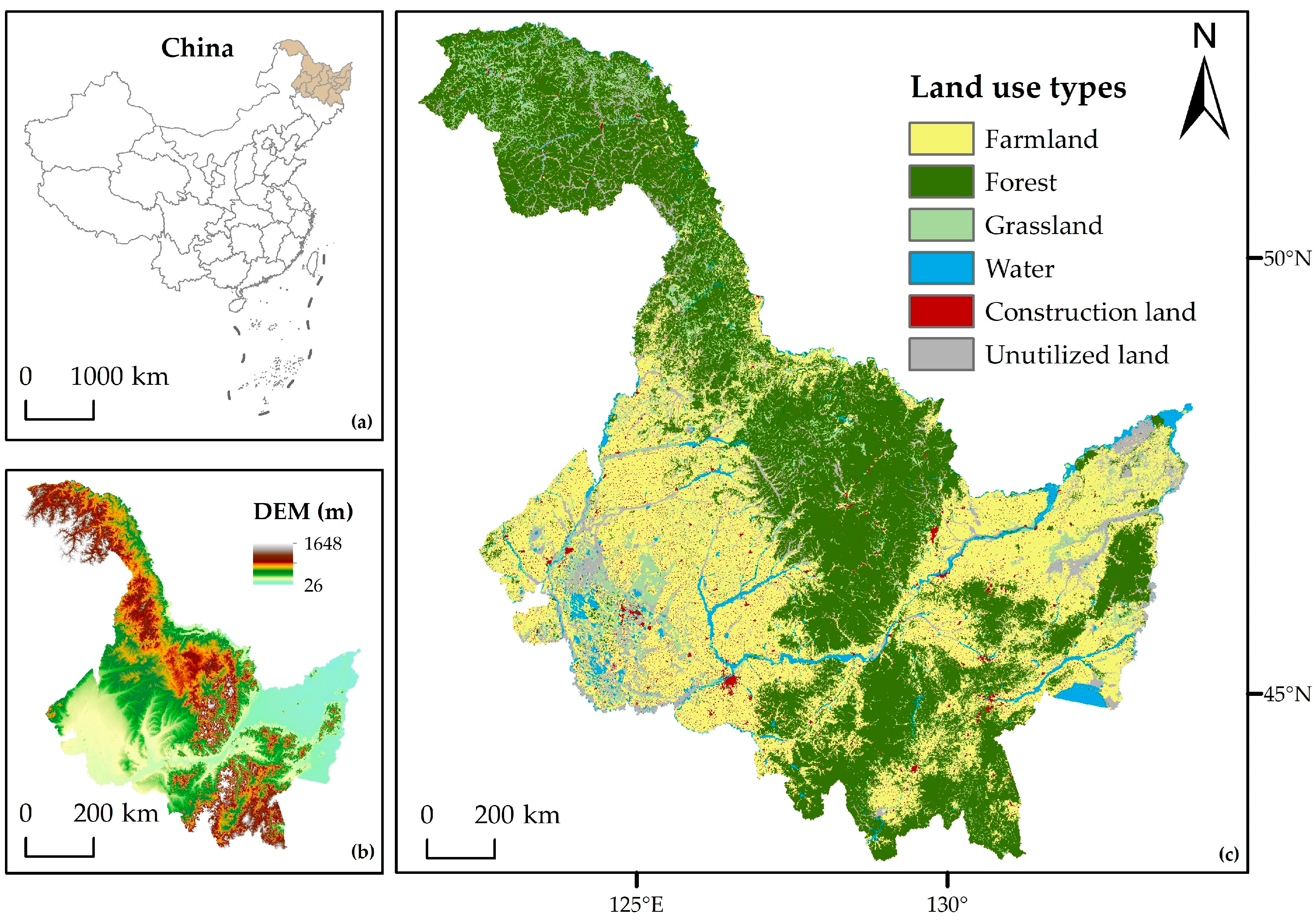
2.1. Research Area and Data Sources
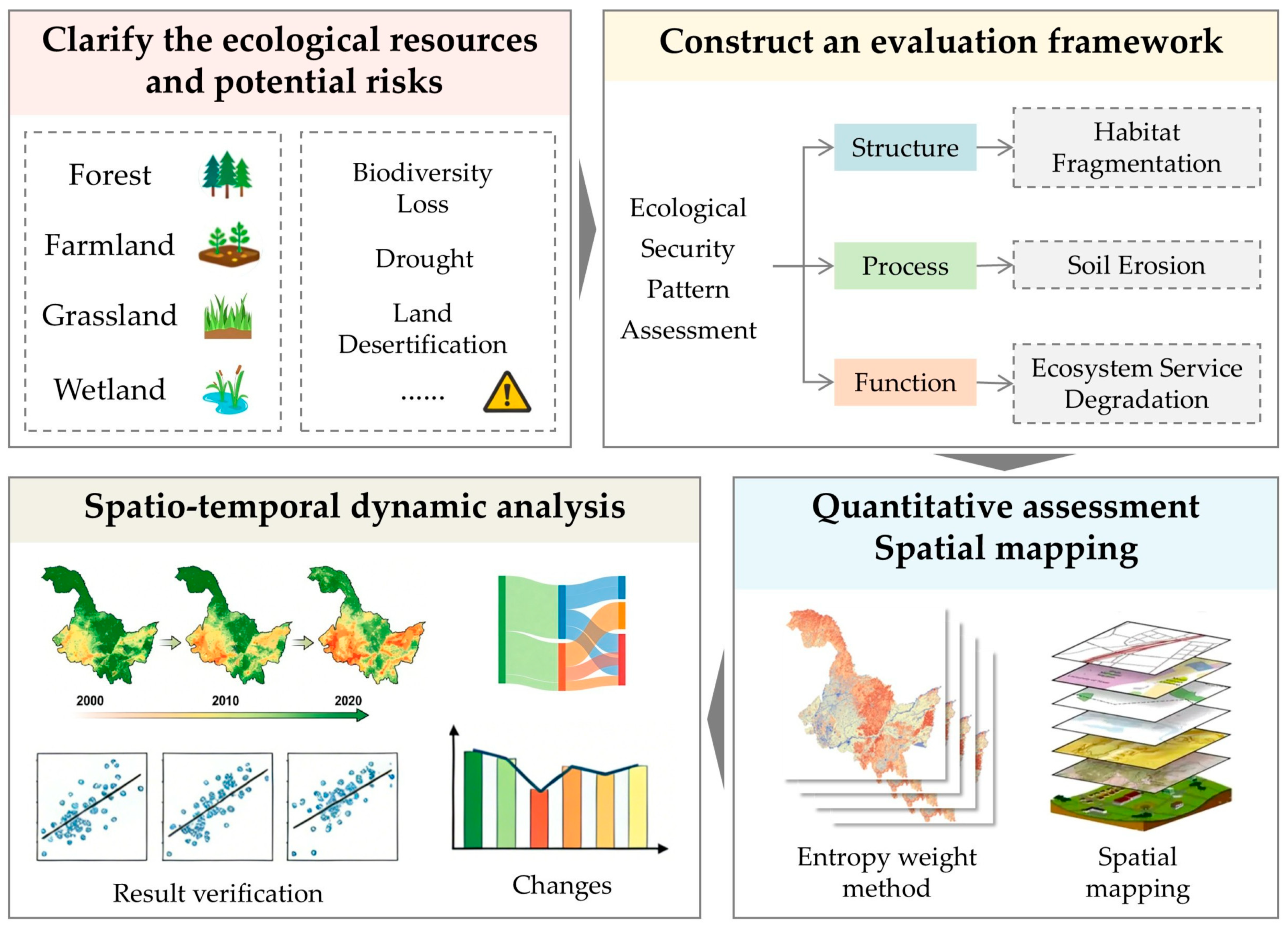
2.2. Establishment of the Evaluation System
2.3. Calculation of the Comprehensive Index for Ecological Security Pattern Assessment
2.3.1. Index Standardization
2.3.2. Calculation of Index Weights
2.3.3. Calculation of the Comprehensive Ecological Security Pattern Index
2.3.4. Classification of Assessment Results
2.4. Validation of Assessment Results
3. Results
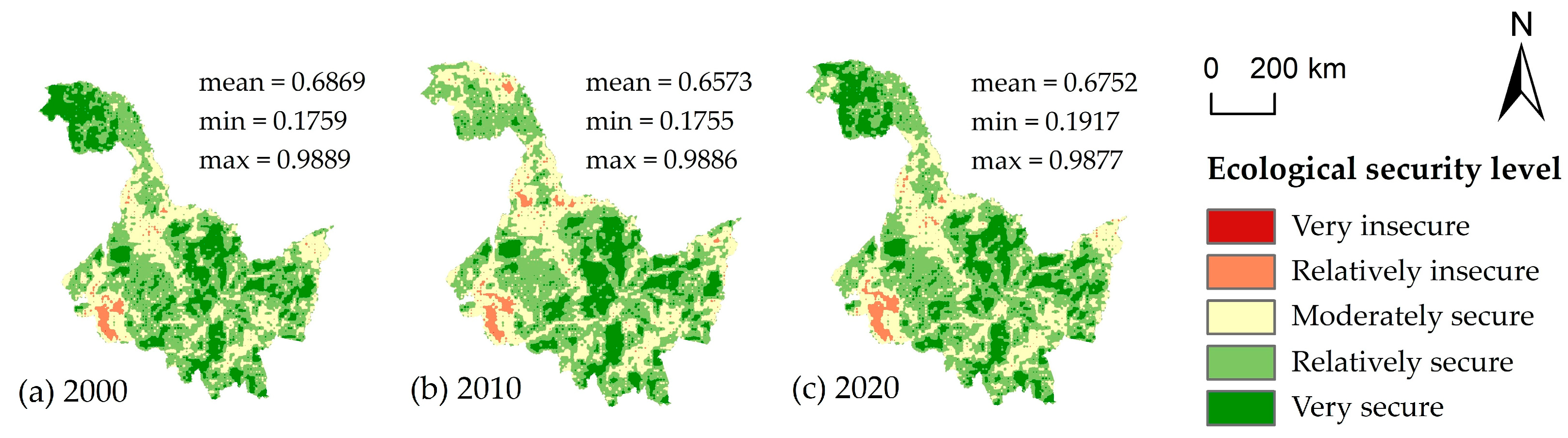
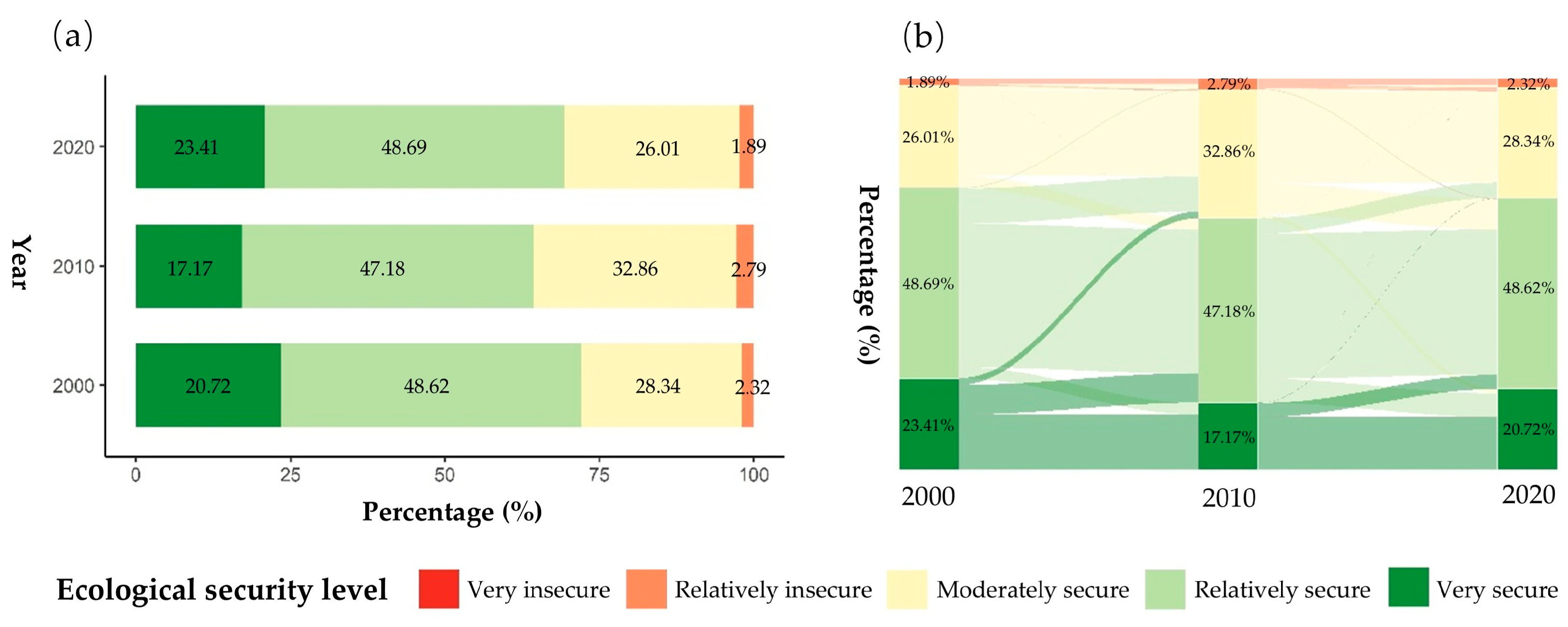
3.1. Spatial Distribution and Changes of Ecological Security Pattern Assessment Results
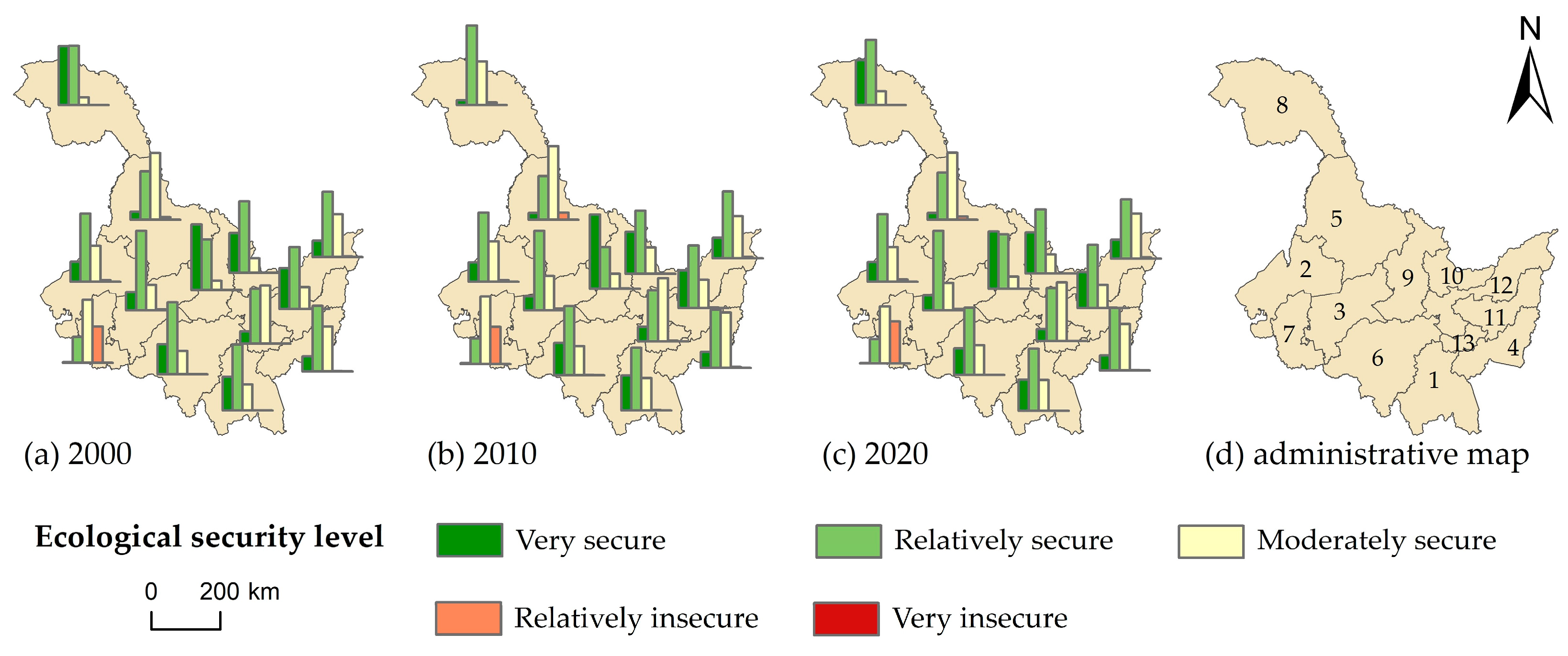
3.2. Assessment Results at the Municipal Scale
3.3. Assessment Results and Changes of Different Dimensions
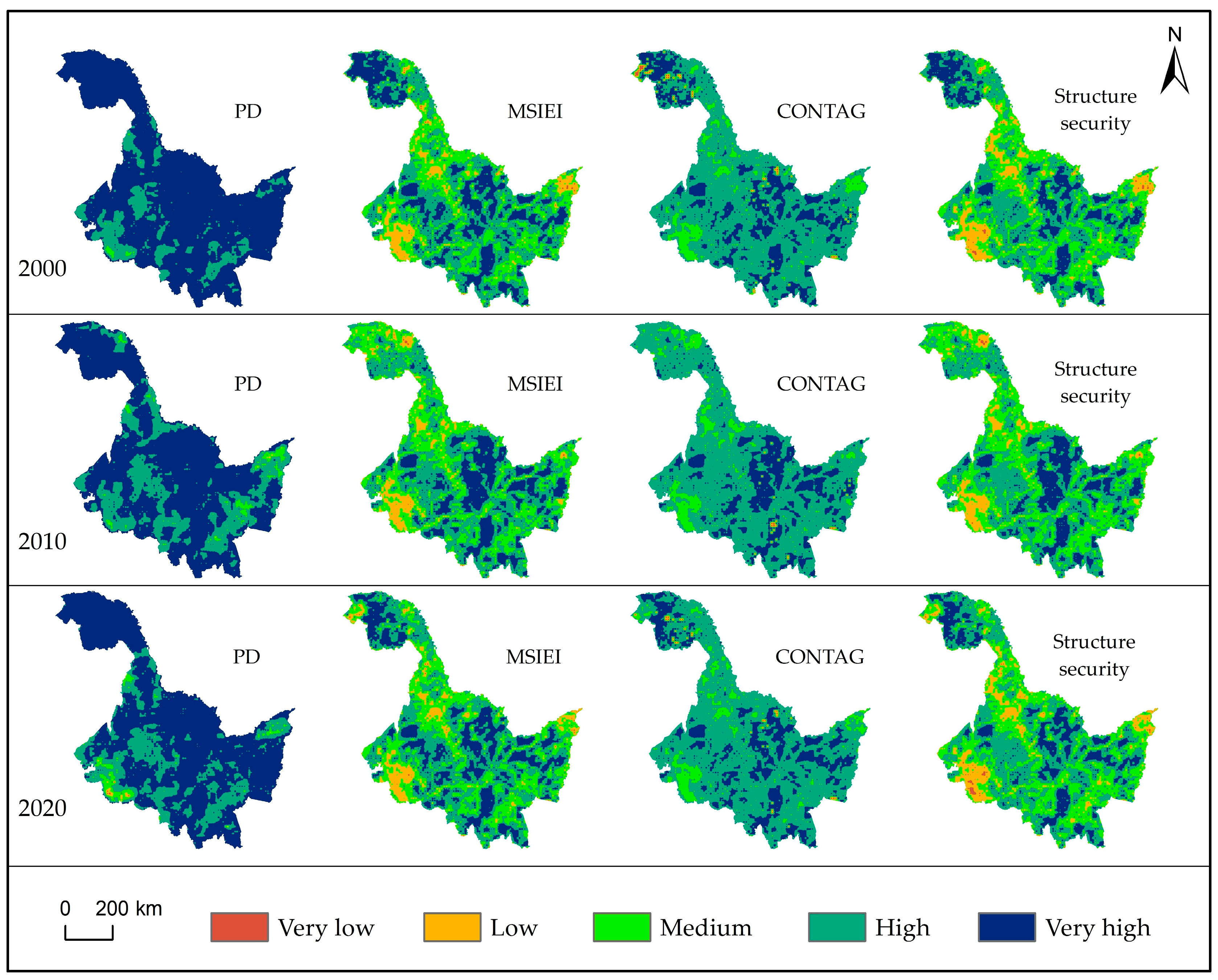
3.3.1. Structure Security and Habitat Fragmentation Risk
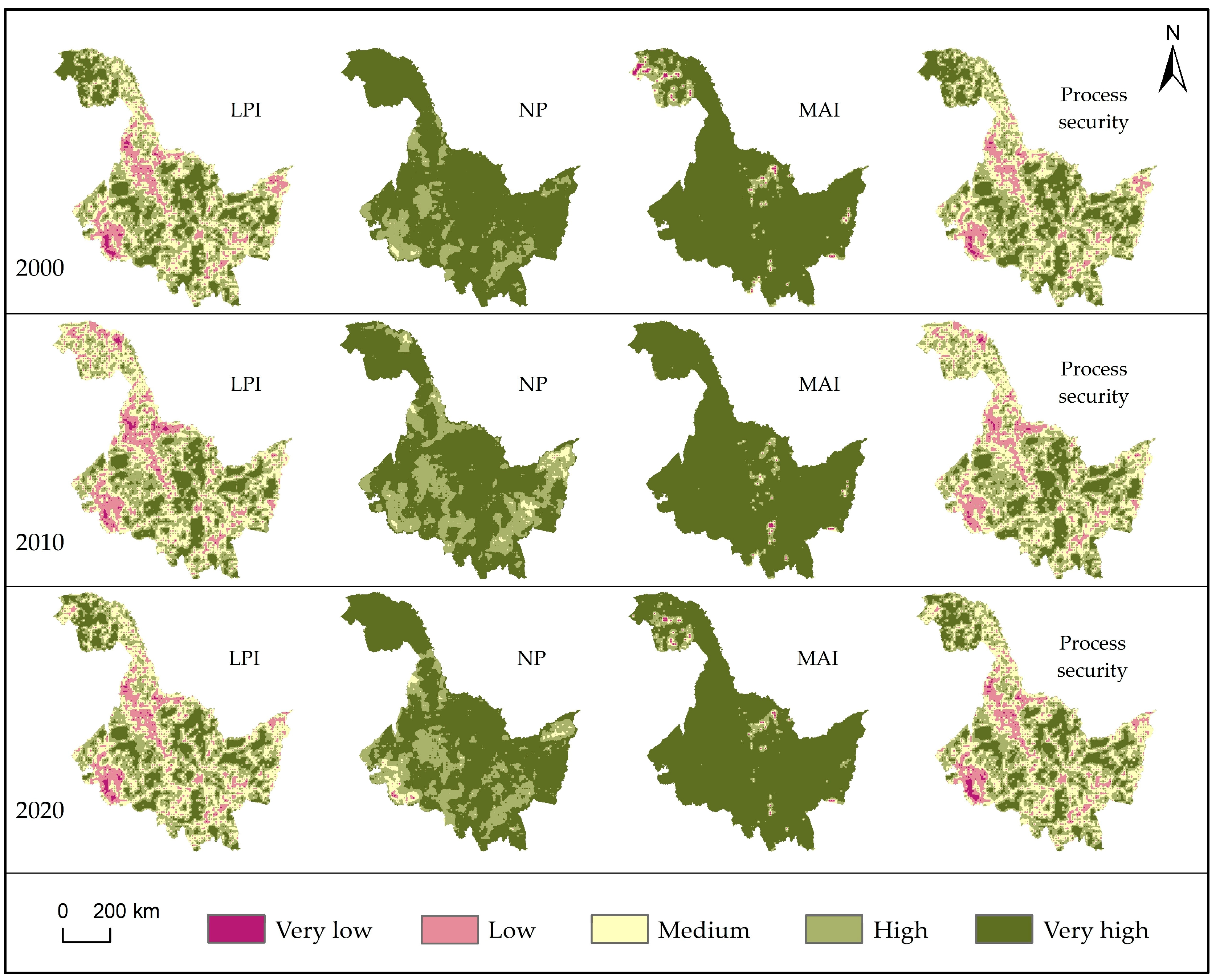
3.3.2. Process Security and Soil Erosion Risk
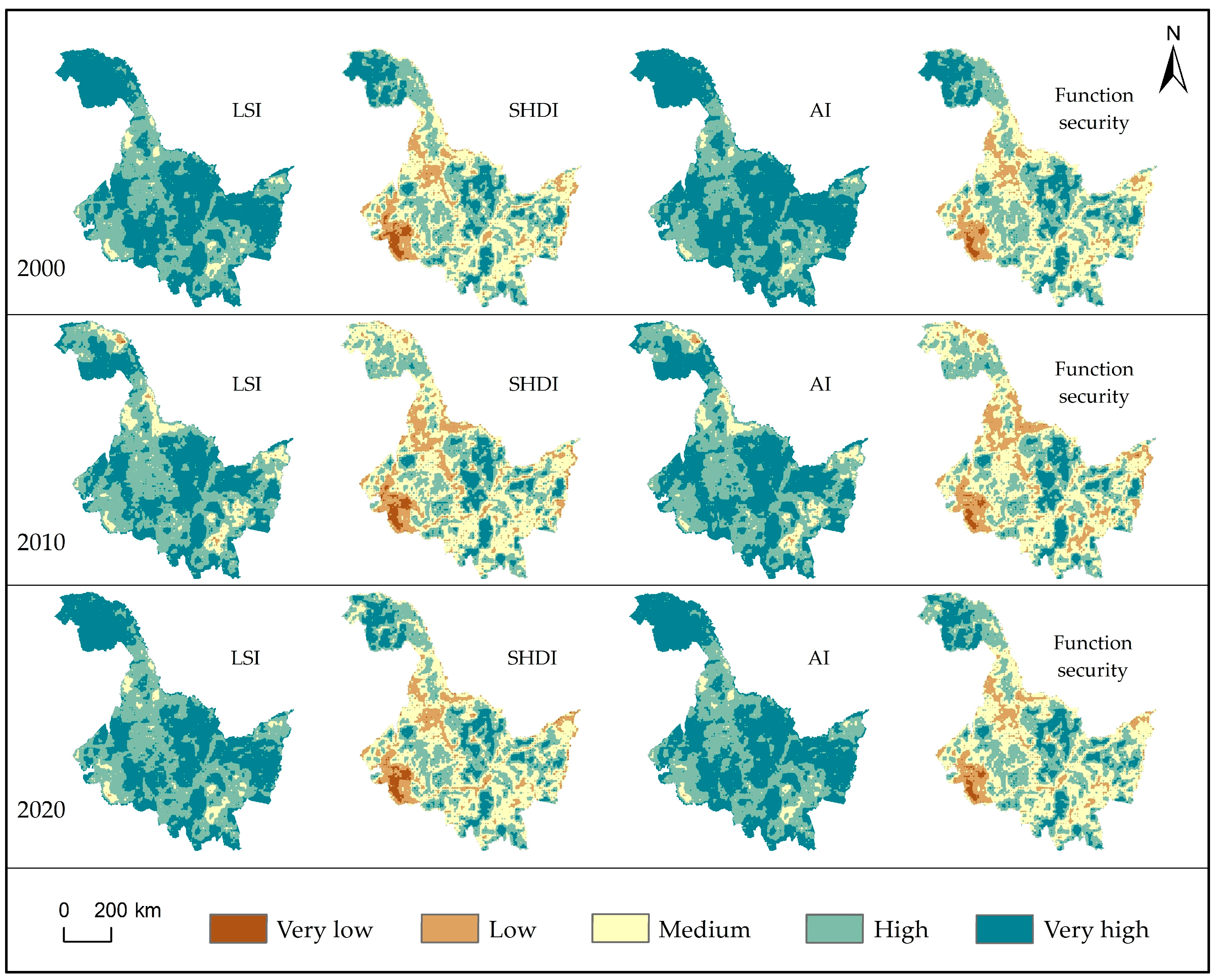
3.3.3. Function Security and Ecosystem Services Degradation Risk
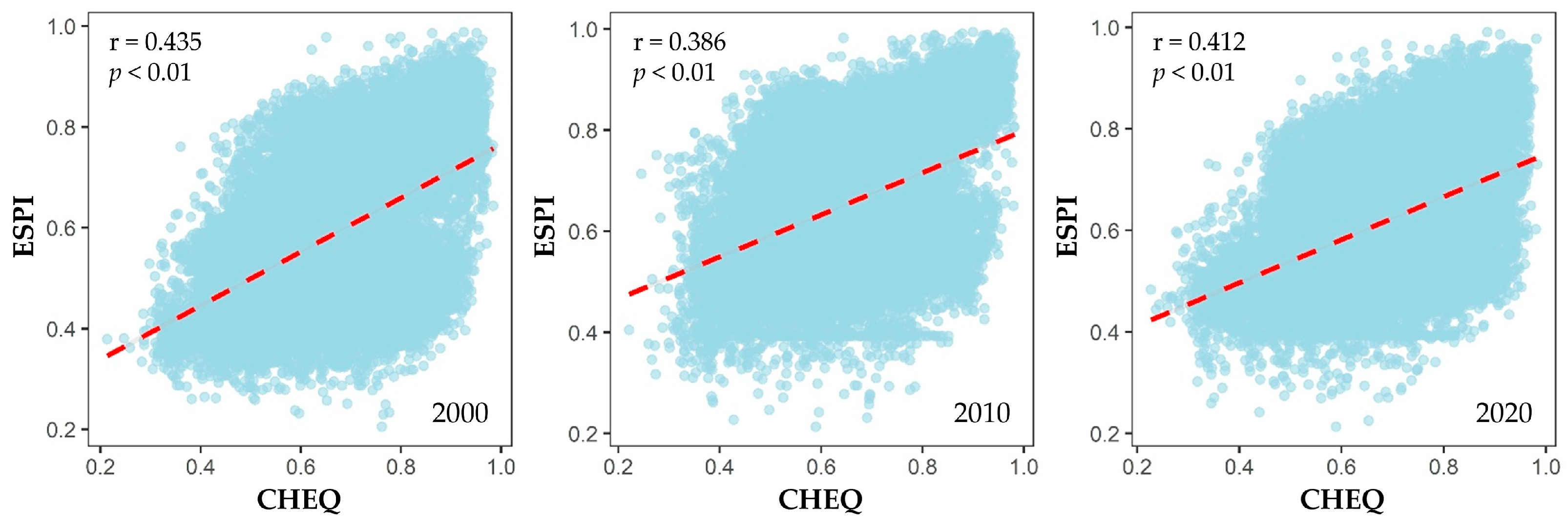
3.4. Reliability Analysis and Model Verification of Ecological Security Pattern Assessment Results
4. Discussion
4.1. Ecological Security Pattern Assessment Result Verification and Comparison
4.2. Assessment Framework for Ecological Security Pattern: Structure–Process–Function Integrating Risksz
5. Conclusions
- (1)
- The study revealed a “V-shaped” evolutionary trajectory of ecological security in Heilongjiang Province from 2000 to 2020, characterized by initial degradation followed by recovery. This trend validates the effectiveness of recent ecological restoration policies, indicating that macro-policy intervention has successfully mitigated the deterioration of the ecological environment.
- (2)
- The assessment highlighted that the mountainous regions in the north and southeast (Greater and Lesser Khingan Mountains) function as robust ecological barriers. In contrast, the plains and resource-dependent cities face security challenges. The distribution pattern indicates that the topographical factors and the transition of resource exploitation are the main factors leading to the regional security pattern.
- (3)
- By transforming ecological risks into diagnosable dimensions, this study demonstrates that ecological security is a dynamic coupling of physical structure, stable processes, and service functions. This study provides a scientific basis for differentiating spatial governance strategies.
Author Contributions
Funding
Data Availability Statement
Conflicts of Interest
References
- Zhong, C.; Guo, H.; Swan, I.; Gao, P.; Yao, Q.; Li, H. Evaluating Trends, Profits, and Risks of Global Cities in Recent Urban Expansion for Advancing Sustainable Development. Habitat Int. 2023, 138, 102869. [Google Scholar] [CrossRef]
- Liu, C.; Li, W.; Xu, J.; Zhou, H.; Wang, W.; Wang, H. Temporal and Spatial Variations of Ecological Security on the Northeastern Tibetan Plateau Integrating Ecosystem Health-Risk-Services Framework. Ecol. Indic. 2024, 158, 111365. [Google Scholar] [CrossRef]
- Wu, X.; Zhang, H. Evaluation of Ecological Environmental Quality and Factor Explanatory Power Analysis in Western Chongqing, China. Ecol. Indic. 2021, 132, 108311. [Google Scholar] [CrossRef]
- Thebo, A.L.; Drechsel, P.; Lambin, E.F. Global Assessment of Urban and Peri-Urban Agriculture: Irrigated and Rainfed Croplands. Environ. Res. Lett. 2014, 9, 114002. [Google Scholar] [CrossRef]
- Ding, M.; Liu, W.; Xiao, L.; Zhong, F.; Lu, N.; Zhang, J.; Zhang, Z.; Xu, X.; Wang, K. Construction and Optimization Strategy of Ecological Security Pattern in a Rapidly Urbanizing Region: A Case Study in Central-South China. Ecol. Indic. 2022, 136, 108604. [Google Scholar] [CrossRef]
- Steffen, W.; Richardson, K.; Rockström, J.; Cornell, S.E.; Fetzer, I.; Bennett, E.M.; Biggs, R.; Carpenter, S.R.; de Vries, W.; de Wit, C.A.; et al. Planetary Boundaries: Guiding Human Development on a Changing Planet. Science 2015, 347, 1259855. [Google Scholar] [CrossRef]
- Estoque, R.C.; Murayama, Y. Quantifying Landscape Pattern and Ecosystem Service Value Changes in Four Rapidly Urbanizing Hill Stations of Southeast Asia. Landsc. Ecol 2016, 31, 1481–1507. [Google Scholar] [CrossRef]
- Li, Y.; Lian, Z.; Zhai, T.; Xie, X.; Wang, Y.; Li, M. Assessment of Land Ecological Security Based on the Boston Model: A Case Study from China. Land 2023, 12, 1348. [Google Scholar] [CrossRef]
- Peng, J.; Pan, Y.; Liu, Y.; Zhao, H.; Wang, Y. Linking Ecological Degradation Risk to Identify Ecological Security Patterns in a Rapidly Urbanizing Landscape. Habitat Int. 2018, 71, 110–124. [Google Scholar] [CrossRef]
- Li, S.; Zhao, Y.; Xiao, W.; Yue, W.; Wu, T. Optimizing Ecological Security Pattern in the Coal Resource-Based City: A Case Study in Shuozhou City, China. Ecol. Indic. 2021, 130, 108026. [Google Scholar] [CrossRef]
- Ye, W.; Kong, Q. Environmental Security: A Fundamental Problem Confronting Mankind in the 21st Century. China Popul. Resour. Environ. 2001, 11, 42–44. [Google Scholar] [CrossRef]
- Tian, J.; Gang, G. Research on Regional Ecological Security Assessment. Energy Procedia 2012, 16, 1180–1186. [Google Scholar] [CrossRef]
- Li, Y.; Zhao, J.; Yuan, J.; Ji, P.; Deng, X.; Yang, Y. Constructing the Ecological Security Pattern of Nujiang Prefecture Based on the Framework of “Importance–Sensitivity–Connectivity”. Int. J. Environ. Res. Public Health 2022, 19, 10869. [Google Scholar] [CrossRef]
- Yu, M.; Zou, F. Ecological Security under the Overall National Security Concept: Risk Perception, Morphological Evolution, and Systematic Governance. Gov. Stud. 2022, 38, 73–82. [Google Scholar] [CrossRef]
- Peng, W.; Li, B.; Liu, C. Xi Jinping’s Important Exposition on Ecological Security and the Construction of Ecological Security System. J. Eco-Civiliz. Stud. 2021, 1, 20–34. [Google Scholar]
- Sui, L.; Yan, Z.; Li, K.; Wang, C.; Shi, Y.; Du, Y. Prediction of Ecological Security Network in Northeast China Based on Landscape Ecological Risk. Ecol. Indic. 2024, 160, 111783. [Google Scholar] [CrossRef]
- Ran, Y.; Lei, D.; Li, J.; Gao, L.; Mo, J.; Liu, X. Identification of Crucial Areas of Territorial Ecological Restoration Based on Ecological Security Pattern: A Case Study of the Central Yunnan Urban Agglomeration, China. Ecol. Indic. 2022, 143, 109318. [Google Scholar] [CrossRef]
- Li, J.-X.; Chen, Y.-N.; Xu, C.-C.; Li, Z. Evaluation and Analysis of Ecological Security in Arid Areas of Central Asia Based on the Emergy Ecological Footprint (EEF) Model. J. Clean. Prod. 2019, 235, 664–677. [Google Scholar] [CrossRef]
- Liu, D.; Chang, Q. Ecological Security Research Progress in China. Acta Ecol. Sin. 2015, 35, 111–121. [Google Scholar] [CrossRef]
- Wang, L.; Pang, Y.S. A Review of Regional Ecological Security Evaluation. Appl. Mech. Mater. 2012, 178–181, 337–344. [Google Scholar] [CrossRef]
- OECD. OECD Core Set of Indicators for Environmental Performance Reviews: A Synthesis Report by the Group on the State of the Environment; Environment monographs; Organisation for Economic Co-Operation and Development: Paris, France, 1993. [Google Scholar]
- Wen, J.; Hou, K. Research on the Progress of Regional Ecological Security Evaluation and Optimization of Its Common Limitations. Ecol. Indic. 2021, 127, 107797. [Google Scholar] [CrossRef]
- Zhang, J.; Hao, X.; Li, X.; Fan, X.; Zhang, S. Evaluation and Regulation Strategy for Ecological Security in the Tarim River Basin Based on the Ecological Footprint. J. Clean. Prod. 2024, 435, 140488. [Google Scholar] [CrossRef]
- Chu, X.; Deng, X.; Jin, G.; Wang, Z.; Li, Z. Ecological Security Assessment Based on Ecological Footprint Approach in Beijing-Tianjin-Hebei Region, China. Phys. Chem. Earth Parts A/B/C 2017, 101, 43–51. [Google Scholar] [CrossRef]
- Liu, T.; Wang, H.-Z.; Wang, H.-Z.; Xu, H. The Spatiotemporal Evolution of Ecological Security in China Based on the Ecological Footprint Model with Localization of Parameters. Ecol. Indic. 2021, 126, 107636. [Google Scholar] [CrossRef]
- Chen, W.; Jiang, C.; Wang, Y.; Liu, X.; Dong, B.; Yang, J.; Huang, W. Landscape Patterns and Their Spatial Associations with Ecosystem Service Balance: Insights from a Rapidly Urbanizing Coastal Region of Southeastern China. Front. Environ. Sci. 2022, 10, 1002902. [Google Scholar] [CrossRef]
- Duarte, G.T.; Santos, P.M.; Cornelissen, T.G.; Ribeiro, M.C.; Paglia, A.P. The Effects of Landscape Patterns on Ecosystem Services: Meta-Analyses of Landscape Services. Landsc. Ecol. 2018, 33, 1247–1257. [Google Scholar] [CrossRef]
- Plexida, S.G.; Sfougaris, A.I.; Ispikoudis, I.P.; Papanastasis, V.P. Selecting Landscape Metrics as Indicators of Spatial Heterogeneity—A Comparison among Greek Landscapes. Int. J. Appl. Earth Obs. Geoinf. 2014, 26, 26–35. [Google Scholar] [CrossRef]
- Jia, Y.; Tang, L.; Xu, M.; Yang, X. Landscape Pattern Indices for Evaluating Urban Spatial Morphology—A Case Study of Chinese Cities. Ecol. Indic. 2019, 99, 27–37. [Google Scholar] [CrossRef]
- Hu, C.; Guo, L.; Li, S.; Liu, P. Research on the Ecological Pattern of Key Ecological Region in Henan Province. Environ. Sci. Manag. 2019, 44, 154–160. [Google Scholar]
- Xu, H. A remote sensing urban ecological index and its application. Acta Ecol. Sin. 2013, 33, 7853–7862. [Google Scholar]
- Liu, Y.; Xu, W.; Hong, Z.; Wang, L.; Ou, G.; Lu, N.; Dai, Q. Integrating Three-Dimensional Greenness into RSEI Improved the Scientificity of Ecological Environment Quality Assessment for Forest. Ecol. Indic. 2023, 156, 111092. [Google Scholar] [CrossRef]
- Li, F.; Zhang, Y.; Zhao, Z.; Cheng, M.; Cheng, M.; Wang, Z. Evaluation of ecological pattern change of Nanhui Dongtan wetland in Shanghai based on remote sensing ecological index. J. Shanghai Ocean Univ. 2020, 29, 746–756. [Google Scholar]
- Soille, P.; Vogt, P. Morphological Segmentation of Binary Patterns. Pattern Recognit. Lett. 2009, 30, 456–459. [Google Scholar] [CrossRef]
- Lin, J.; Huang, C.; Wen, Y.; Liu, X. An Assessment Framework for Improving Protected Areas Based on Morphological Spatial Pattern Analysis and Graph-Based Indicators. Ecol. Indic. 2021, 130, 108138. [Google Scholar] [CrossRef]
- Vogt, P.; Riitters, K. GuidosToolbox: Universal Digital Image Object Analysis. Eur. J. Remote Sens. 2017, 50, 352–361. [Google Scholar] [CrossRef]
- Chen, W.; Liu, H.; Wang, J. Construction and Optimization of Regional Ecological Security Patterns Based on MSPA-MCR-GA Model: A Case Study of Dongting Lake Basin in China. Ecol. Indic. 2024, 165, 112169. [Google Scholar] [CrossRef]
- Qiao, E.; Reheman, R.; Zhou, Z.; Tao, S. Evaluation of Landscape Ecological Security Pattern via the “Pattern-Function-Stability” Framework in the Guanzhong Plain Urban Agglomeration of China. Ecol. Indic. 2024, 166, 112325. [Google Scholar] [CrossRef]
- Yu, K. Landscape Ecological Security Pattern for Biological Conservation. Acta Ecol. Sin. 1999, 1, 10–17. [Google Scholar]
- Peng, J.; Xu, D.; Tang, H.; Jiang, H.; Dong, J.; Wu, J. A Landscape Ecological Approach to Spatial Conservation Planning—Ecological Security Pattern. Trends Ecol. Evol. 2025, 40, 1010–1022. [Google Scholar] [CrossRef]
- Xiang, K.; Chen, L.; Li, W.; He, Z. Construction and Optimization Strategy of Ecological Security Pattern in County-Level Cities under Spatial and Temporal Variation of Ecosystem Services: Case Study of Mianzhu, China. Land 2024, 13, 936. [Google Scholar] [CrossRef]
- Lv, L.; Zhang, S.; Zhu, J.; Wang, Z.; Wang, Z.; Li, G.; Yang, C. Ecological Restoration Strategies for Mountainous Cities Based on Ecological Security Patterns and Circuit Theory: A Case of Central Urban Areas in Chongqing, China. Int. J. Environ. Res. Public Health 2022, 19, 16505. [Google Scholar] [CrossRef]
- Fan, X.; Cheng, Y.; Tan, F.; Zhao, T. Construction and Optimization of the Ecological Security Pattern in Liyang, China. Land 2022, 11, 1641. [Google Scholar] [CrossRef]
- Dong, X.; Wang, F.; Fu, M. Research Progress and Prospects for Constructing Ecological Security Pattern Based on Ecological Network. Ecol. Indic. 2024, 168, 112800. [Google Scholar] [CrossRef]
- Zhong, B.; Wu, S.; Wu, N.; Sun, G.; He, C.; Liu, L.; Chen, H. Constructing Ecological Security Pattern Based on Spatio-Temporal Evaluation of Ecosystem Services and Ecological Health in Chengdu, Southwest China. Front. Environ. Sci. 2024, 12, 1415301. [Google Scholar] [CrossRef]
- Ma, X.; Zhang, J.; Guo, L.; Yang, L.; Wang, J. Traps and improvements of PSR model: An eco-environmental perspective. Acta Ecol. Sin. 2024, 44, 4923–4932. [Google Scholar] [CrossRef]
- Ying, L.; Kong, L.; Xiao, Y.; Ouyang, Z. The research progress and prospect of ecological security and its assessing approaches. Acta Ecol. Sin. 2022, 42, 1679–1692. [Google Scholar] [CrossRef]
- Du, X. Evaluation of Ecosystem Service Bundle and Research on the Optimization of Ecological Security Pattern in Heilongjiang Province. Master’s Thesis, Northeast Agricultural University, Harbin, China, 2025. [Google Scholar]
- Jiang, T.; Wang, Q.; Song, Y.; Jia, G.; Tang, Y.; Liang, C.; Han, L. Identification of Key Areas for Ecological Restoration of Provincial Territorial Space and Restoration Strategies—A Case Study of Heilongjiang Province. Nat. Resour. Econ. China 2025, 38, 52–62, 70. [Google Scholar] [CrossRef]
- Song, J. Research on Synergistic Driving Mechanism and Regulation Strategy of Ecosystem Service Trade-Off in Heilongiiang Province Based on Bayesian Network. Master’s Thesis, Northeast Agricultural University, Harbin, China, 2025. [Google Scholar]
- Uuemaa, E.; Antrop, M.; Roosaare, J.; Marja, R.; Mander, Ü. Landscape Metrics and Indices: An Overview of Their Use in Landscape Research. Living Rev. Landsc. Res. 2009, 3, 1. [Google Scholar] [CrossRef]
- Abolmaali, S.M.; Tarkesh, M.; Mousavi, S.A.; Karimzadeh, H.; Pourmanafi, S.; Fakheran, S. Impacts of Spatio-Temporal Change of Landscape Patterns on Habitat Quality across Zayanderud Dam Watershed in Central Iran. Sci. Rep. 2024, 14, 8780. [Google Scholar] [CrossRef]
- Yang, F.; Yang, L.; Fang, Q.; Yao, X. Impact of Landscape Pattern on Habitat Quality in the Yangtze River Economic Belt from 2000 to 2030. Ecol. Indic. 2024, 166, 112480. [Google Scholar] [CrossRef]
- Ouyang, W.; Skidmore, A.K.; Hao, F.; Wang, T. Soil Erosion Dynamics Response to Landscape Pattern. Sci. Total Environ. 2010, 408, 1358–1366. [Google Scholar] [CrossRef]
- Ahmadi Mirghaed, F.; Souri, B.; Mohammadzadeh, M.; Salmanmahiny, A.; Mirkarimi, S.H. Evaluation of the Relationship between Soil Erosion and Landscape Metrics across Gorgan Watershed in Northern Iran. Env. Monit Assess 2018, 190, 643. [Google Scholar] [CrossRef]
- Dai, E.; Lu, R.; Yin, J. Identifying the Effects of Landscape Pattern on Soil Conservation Services on the Qinghai-Tibet Plateau. Glob. Ecol. Conserv. 2024, 50, e02850. [Google Scholar] [CrossRef]
- Liu, H.M.; Ren, J.Y. The Influence of Landscape Pattern Evolution on the Value of Ecosystem Services. J. Environ. Inform. Lett. 2023, 9, 97–107. [Google Scholar] [CrossRef]
- Hou, L.; Wu, F.; Xie, X. The Spatial Characteristics and Relationships between Landscape Pattern and Ecosystem Service Value along an Urban-Rural Gradient in Xi’an City, China. Ecol. Indic. 2020, 108, 105720. [Google Scholar] [CrossRef]
- Zhu, Y.; Tian, D.; Yan, F. Effectiveness of Entropy Weight Method in Decision-Making. Math. Probl. Eng. 2020, 2020, 3564835. [Google Scholar] [CrossRef]
- Zhang, Z.; Nie, T.; Gao, Y.; Tan, S.; Gao, J. Regional Ecological Security Assessment Based on the Pressure–State–Response Framework. Geogr. Sci. 2022, 42, 1923–1931. [Google Scholar] [CrossRef]
- Ren, E.; Lin, W.; Li, B.; Jiang, Y.; Zhang, Y.; Yu, Y. Regional Ecological Security Assessment Based on the Pressure–State–Response Framework: The Demonstration Zone of Yangtze River Delta as an Example. Land 2024, 13, 96. [Google Scholar] [CrossRef]
- Liu, L.; Ma, C.; Zhang, J.; He, Z.; Huo, S.; Xi, B. Ecological Security Assessment of Typical Watershed in Northeast, China. Res. Environ. Sci. 2019, 32, 1108–1116. [Google Scholar] [CrossRef]
- Li, H.; Li, X.; Yu, J. Research on Ecological Security Assessment in Northeast China. Jilin Univ. J. Humanit. Soc. Sci. 2008, 5, 148–154. [Google Scholar] [CrossRef]
- Tang, C.; Wu, X.; Zheng, Q.; Lyu, N. Ecological Security Evaluations of the Tourism Industry in Ecological Conservation Development Areas: A Case Study of Beijing’s ECDA. J. Clean. Prod. 2018, 197, 999–1010. [Google Scholar] [CrossRef]
- Møller, A.; Jennions, M.D. How Much Variance Can Be Explained by Ecologists and Evolutionary Biologists? Oecologia 2002, 132, 492–500. [Google Scholar] [CrossRef] [PubMed]
- Zhang, H.; He, Z.; Zhang, L.; Cong, R.; Wei, W. Spatial–Temporal Changes and Driving Factor Analysis of Net Ecosystem Productivity in Heilongjiang Province from 2010 to 2020. Land 2024, 13, 1316. [Google Scholar] [CrossRef]
- Wu, B.; Zheng, F.; Fu, Y.; Peng, S.; Yang, X.; Wang, L.; Flanagan, D.C.; Zhang, J.; Li, Z. Decoupling Land Use Intensity and Ecological Risk: Insights from Heilongjiang Province of the Chinese Mollisol Region. Remote Sens. 2025, 17, 2243. [Google Scholar] [CrossRef]
- Li, R.; Yang, X.; Wang, Y.; Li, T.; Zhang, X.; Gao, O.; Zhou, Q. Ecological Transition from Micro-remediation to Ecological Regulation of Petroleum Pollution. Environ. Sci. 2024, 45, 4967–4979. [Google Scholar] [CrossRef]
- Yu, S.; Zhang, X.; Wang, Y.; Shen, Y. Review of research on the impacts of climate change on staple grain crops in the three provinces of Northeast China. Chin. J. Eco-Agric. 2024, 32, 970–985. [Google Scholar]
- Turner, M.G. Landscape Ecology: The Effect of Pattern on Process. Annu. Rev. Ecol. Evol. Syst. 1989, 20, 171–197. [Google Scholar] [CrossRef]
- Wu, J. Landscape Sustainability Science: Ecosystem Services and Human Well-Being in Changing Landscapes. Landsc. Ecol. 2013, 28, 999–1023. [Google Scholar] [CrossRef]
- Cui, X.; Fang, L.; Wang, X.; Kang, J. Urban eco-security assessment in the urban agglomerations based on DPSIR model:acase study of Yangtze River Delta, China. Acta Ecol. Sin. 2021, 41, 302–319. [Google Scholar]



| Data | Year | Spatial Resolution | Sources |
|---|---|---|---|
| DEM | 2020 | 1 km | http://www.resdc.cn/ |
| Land Use | 2000, 2010, 2020 | 30 m | http://www.resdc.cn/ |
| Administrative Boundary | 2024 | - | https://www.tianditu.gov.cn/ |
| NPP | 2000, 2010, 2020 | 30 m | https://www.scidb.cn/ |
| Soil Conservation Capacity | 2000, 2010, 2018 | 300 m | https://www.scidb.cn/ |
| Habitat for Key Protected Wildlife | 2000, 2010, 2020 | 30 m | https://www.scidb.cn/ |
| CHEQ | 2001, 2010, 2020 | 500 m | http://www.geodata.cn/ |
| Indicator Name | Abbreviation | Ecological Significance |
|---|---|---|
| Patch density | PD | Reflects the degree of landscape fragmentation. Higher values indicate a more fragmented landscape and greater human disturbance. |
| Landscape contagion index | CONTAG | Describes the degree of aggregation and extension of patch types. High values indicate dominant patch types with good connectivity. |
| Modified Shannon’s Evenness Index | MSIEI | Quantifies the evenness of the distribution of different patch types. Higher values indicate a more equal distribution of area among patch types. |
| Largest patch index | LPI | Represents the percentage of the landscape comprising the largest patch. |
| Number of patches | NP | Measures the total number of patches in the landscape. |
| Area-weighted mean patch size | MAI | Reflects the degree of fragmentation. Smaller values suggest a more broken landscape structure with higher division tendencies. |
| Landscape shape index | LSI | Characterizes the geometric complexity of patch shapes. Higher deviations from a standardized shape indicate more irregular boundaries. |
| Aggregation index | AI | Measures the degree of clumpiness or non-randomness of patch types. |
| Shannon diversity index | SHDI | Indicates landscape diversity and heterogeneity. Higher values represent a richer variety of land use types and a more complex landscape composition. |
| Dimension | Risk | Indicator | Weight | Attribute | |
|---|---|---|---|---|---|
| Ecological security pattern assessment | Structure | Habitat Fragmentation | PD | 0.04 | negative |
| CONTAG | 0.05 | positive | |||
| MSIEI | 0.18 | negative | |||
| Process | Soil Erosion | LPI | 0.28 | positive | |
| NP | 0.04 | negative | |||
| MAI | 0.04 | negative | |||
| Function | Ecosystem Services Degradation | LSI | 0.06 | negative | |
| AI | 0.05 | positive | |||
| SHDI | 0.26 | negative |
| Ecological Security Level | Number | Standards |
|---|---|---|
| Very insecure | 1 | ≤0.20 |
| Relatively insecure | 2 | 0.20–0.40 |
| Moderately secure | 3 | 0.40–0.60 |
| Relatively secure | 4 | 0.60–0.80 |
| Very secure | 5 | ≥0.80 |
| Dimension | Variable Relationship | Year | Correlation Coefficient | Significance |
|---|---|---|---|---|
| Richness—Habitat Fragmentation | 2000 | 0.300 | p < 0.01 | |
| Structure | 2010 | 0.302 | p < 0.01 | |
| 2020 | 0.283 | p < 0.01 | ||
| Soil Erosion—Soil Conservation | 2000 | 0.192 | p < 0.01 | |
| Process | 2010 | 0.178 | p < 0.01 | |
| 2020 | 0.143 | p < 0.01 | ||
| NPP—Functional Degradation | 2000 | 0.407 | p < 0.01 | |
| Function | 2010 | 0.317 | p < 0.01 | |
| 2020 | 0.298 | p < 0.01 |
Disclaimer/Publisher’s Note: The statements, opinions and data contained in all publications are solely those of the individual author(s) and contributor(s) and not of MDPI and/or the editor(s). MDPI and/or the editor(s) disclaim responsibility for any injury to people or property resulting from any ideas, methods, instructions or products referred to in the content. |
© 2026 by the authors. Licensee MDPI, Basel, Switzerland. This article is an open access article distributed under the terms and conditions of the Creative Commons Attribution (CC BY) license.
Share and Cite
Meng, D.; Wu, Y.; Zhang, M.; Pan, Y.; Li, T.; Zhang, H.; Li, H. Assessing Ecological Security Pattern by Integrating Multiple Risks in the Structure–Process–Function Framework: A Case Study from Heilongjiang Province, China. Land 2026, 15, 259. https://doi.org/10.3390/land15020259
Meng D, Wu Y, Zhang M, Pan Y, Li T, Zhang H, Li H. Assessing Ecological Security Pattern by Integrating Multiple Risks in the Structure–Process–Function Framework: A Case Study from Heilongjiang Province, China. Land. 2026; 15(2):259. https://doi.org/10.3390/land15020259
Chicago/Turabian StyleMeng, Dehui, Yuanxiang Wu, Mingfeng Zhang, Youcheng Pan, Tingting Li, Hao Zhang, and Haochen Li. 2026. "Assessing Ecological Security Pattern by Integrating Multiple Risks in the Structure–Process–Function Framework: A Case Study from Heilongjiang Province, China" Land 15, no. 2: 259. https://doi.org/10.3390/land15020259
APA StyleMeng, D., Wu, Y., Zhang, M., Pan, Y., Li, T., Zhang, H., & Li, H. (2026). Assessing Ecological Security Pattern by Integrating Multiple Risks in the Structure–Process–Function Framework: A Case Study from Heilongjiang Province, China. Land, 15(2), 259. https://doi.org/10.3390/land15020259