Article

A Multi-Indicator Hazard Mechanism Framework for Flood Hazard Assessment and Risk Mitigation: A Case Study of Rizhao, China


1
School of Geography and Tourism, Qufu Normal University, Rizhao 276826, China
2
Sino-Belgian Joint Laboratory of Geo-Information, Rizhao 276826, China
3
Institutes of Science and Development, Chinese Academy of Sciences, Beijing 100190, China
*
Author to whom correspondence should be addressed.
Land 2026, 15(1), 82; https://doi.org/10.3390/land15010082
Submission received: 5 December 2025 / Revised: 26 December 2025 / Accepted: 30 December 2025 / Published: 31 December 2025

Abstract

Urban flooding has become a critical environmental challenge under global climate change and rapid urbanization. This study develops a multi-indicator hazard mechanism framework for flood hazard assessment in Rizhao, a coastal city in China, by integrating three fundamental hydrological processes: runoff generation, flow convergence, and drainage. Based on geospatial data—including DEM, road networks, land cover, and soil characteristics—six key indicators were evaluated using the TOPSIS method: runoff curve number, impervious surface percentage, topographic wetness index, time of concentration, pipeline density, and distance to rivers. The results show that extreme-hazard zones, covering 6.41% of the central urban area, are primarily clustered in northern sectors, where flood susceptibility is driven by the synergistic effects of high imperviousness, short concentration time, and inadequate drainage infrastructure. Independent validation using historical flood records confirmed the model’s reliability, with 83.72% of documented waterlogging points located in predicted high-hazard zones and an AUC value of 0.737 indicating good discriminatory performance. Based on spatial hazard patterns and causal mechanisms, an integrated mitigation strategy system of “source reduction, process regulation, and terminal enhancement” is proposed. This strategy provides practical guidance for pipeline rehabilitation and sponge city implementation in Rizhao’s resilience planning, while the developed hazard mechanism framework of “runoff–convergence–drainage” provides a transferable methodology for flood hazard assessment in large-scale urban environments.

1. Introduction

Urban flooding, driven by climate change and rapid urbanization, has emerged as a major threat to urban security and functionality. This global challenge is escalating, as evidenced by a nearly 25% increase in the population exposed to floods over the past 20 years, based on high-resolution satellite imagery [1]. Among all natural disasters, floods are the most frequent; records from 1990 to 2022 show that 4713 floods across 168 countries and territories impacted over 3.2 billion people, causing substantial human (218,353 fatalities) and economic (over US$1.3 trillion in losses) tolls. Of all the countries where floods occurred, China was the most affected, with the largest cumulative population affected (1.9 billion people) and the most economic damage (US$442 billion) [2]. Despite significant investments in flood defenses following the 1998 floods [3], the problem persists, with more than 157 cities experiencing urban flooding since 2006 [4]. This ongoing vulnerability is largely attributable to decades of dramatic urban expansion, which has encroached upon natural floodplains, intensifying land use conflicts and ultimately elevating disaster risk [5]. Given this confluence of increasing hazard intensity and the growing exposure of urban assets, the scientific and efficient identification of flood-prone areas becomes critically important. Such flood hazard assessment is indispensable for developing targeted strategies and effective mitigation measures to reduce urban flood risk.
Urban flood risk management has become a critical global priority, where accurate flood hazard assessment and mapping serve as foundational components for effective disaster mitigation and resilience planning [6]. Current common techniques for flood hazard assessment include historical disaster statistics, hydro-hydraulic modeling, and indicator-based methods. The historical disaster statistics approach utilizes historical flood records to assess hazard levels by quantifying the magnitude and temporal trend of disasters within each geographical unit [7]. While palaeoflood and historical flood data thus provide a feasible solution for assessing and mapping flood risks, and planning flood-prone zones [8], the method is limited by its reliance on data aggregated at the administrative-unit level. This leads to a coarse spatial resolution that fails to reveal the detailed patterns of urban flood.
In contrast, numerical simulation based on hydro-hydraulic models incorporates high-resolution topographic data, drainage network topology, and other relevant datasets to systematically analyze the mechanisms of surface runoff generation, pipe flow dynamics, and the coupling process of surface flooding. Such models are widely applied in small-scale urban flood studies. Commonly used urban hydro-hydraulic models include: the SWMM model developed by the U.S. Environmental Protection Agency [9], the MIKE series by the Danish Hydraulic Institute [10], the InfoWorks ICM model developed by Wallingford, UK [11], and the LISFLOOD-FP model originally developed by Bates and De Roo [12]. These hydro-hydraulic models have been widely employed to investigate urban inundation [13,14,15,16]. Despite their strong physical basis and high accuracy in simulating hydrodynamic processes, hydro-hydraulic models present two main limitations: high data demands for calibration using flow and water level data, and low computational efficiency that remains a challenge for high-resolution, rapid simulation of large urban areas [17].
The indicator-based assessment method is a systematic approach for evaluating urban flood hazard and risk levels through multidimensional indicator selection, weight calculation, and comprehensive quantification. It is characterized by several distinct advantages, such as low data requirements, high operational flexibility, computational efficiency, and strong interpretability of results. Given these advantages, the method has been widely applied across diverse geographical contexts in recent years. For example, seven key indicators, including elevation, slope, rainfall intensity, runoff, land use/land cover, flow accumulation, and stream power index, were used to detect food-hazard-prone zones in Amman [18]. Al-Hinai et al. mapped flood susceptible areas in Oman’s Muscat Governorate using seven indicators, such as ground elevation; slope degree; hydrologic soil group; land use; and the distances to the coast, wadis, and roads [19]. Shao et al. developed a flood hazard assessment model for the Yangtze-Huaihe River Basin by integrating three-day accumulated precipitation before a flood disaster, predicted daily precipitation, and current soil moisture as disaster-causing factors, along with disaster-prone environmental factors such as river network density, terrain, and land use type [20]. Pham et al. assessed flood hazard in the Talar watershed (Iran) using 14 conditioning variables, with altitude and distance from rivers identified as the most influential factors across multiple predictive models [21]. Vojtek et al. proposed an integrated fluvial-pluvial flood hazard assessment framework for the Gidra River Basin by combining indicator-based analysis with hydraulic modeling, identifying Cífer, Budmerice, and Jablonec as the highest-risk municipalities through a Composite Flood Hazard Index (CFHI) validated against historical flood records [22]. Han et al. established a comprehensive flood risk assessment framework integrating 12 indicators within three criteria layers through the Technique for Order Preference by Similarity to an Ideal Solution (TOPSIS) method. Their structural equation modeling analysis identified road network density, runoff depth, and distance to roads as the dominant factors contributing to urban flood risk in Beijing [23]. Similarly, in a Mediterranean context, Alafostergios et al. applied the Analytical Hierarchy Process (AHP) method within a GIS environment to assess flood susceptibility in the region of Megala Kalyvia, Greece. Their study incorporated key indicators such as distance from rivers, drainage density, land cover, and topography, demonstrating the effectiveness of multi-criteria decision analysis for spatial hazard mapping in data-constrained environments [24]. In an urbanized North American setting, Shrestha et al. integrated GIS with the AHP to assess flood susceptibility in Davidson County, Tennessee, USA. Their study employed ten flood conditioning factors spanning hydrological, hydraulic, topographical, and geomorphological aspects, with results validated against official FEMA flood maps. This demonstrates the robustness of multi-criteria frameworks for systematic risk assessment in data-rich regulatory environments [25]. Despite enabling rapid flood hazard assessment, conventional indicator-based method lacks mechanistic representation of flood processes. This limitation may compromise the scientific validity and rationality of the resulting zonation, thereby constraining its utility in guiding targeted urban flood mitigation strategies.
Therefore, this study proposes a novel flood hazard assessment framework grounded in the physical mechanism of urban flood. We begin by delineating hydrological response units with a digital elevation model. Subsequently, we build a multi-process coupled model that incorporates three core drivers, namely runoff generation, convergence, and drainage, thereby bridging hydrodynamic modeling and indicator-based methods. Key parameters include the runoff curve number for runoff generation, catchment response time for convergence, and pipeline density for drainage capacity. The framework culminates in a TOPSIS-based comprehensive evaluation, delivering a systematic and spatially graded hazard assessment for urban flood-prone areas.

2. Study Area and Data

2.1. Study Area

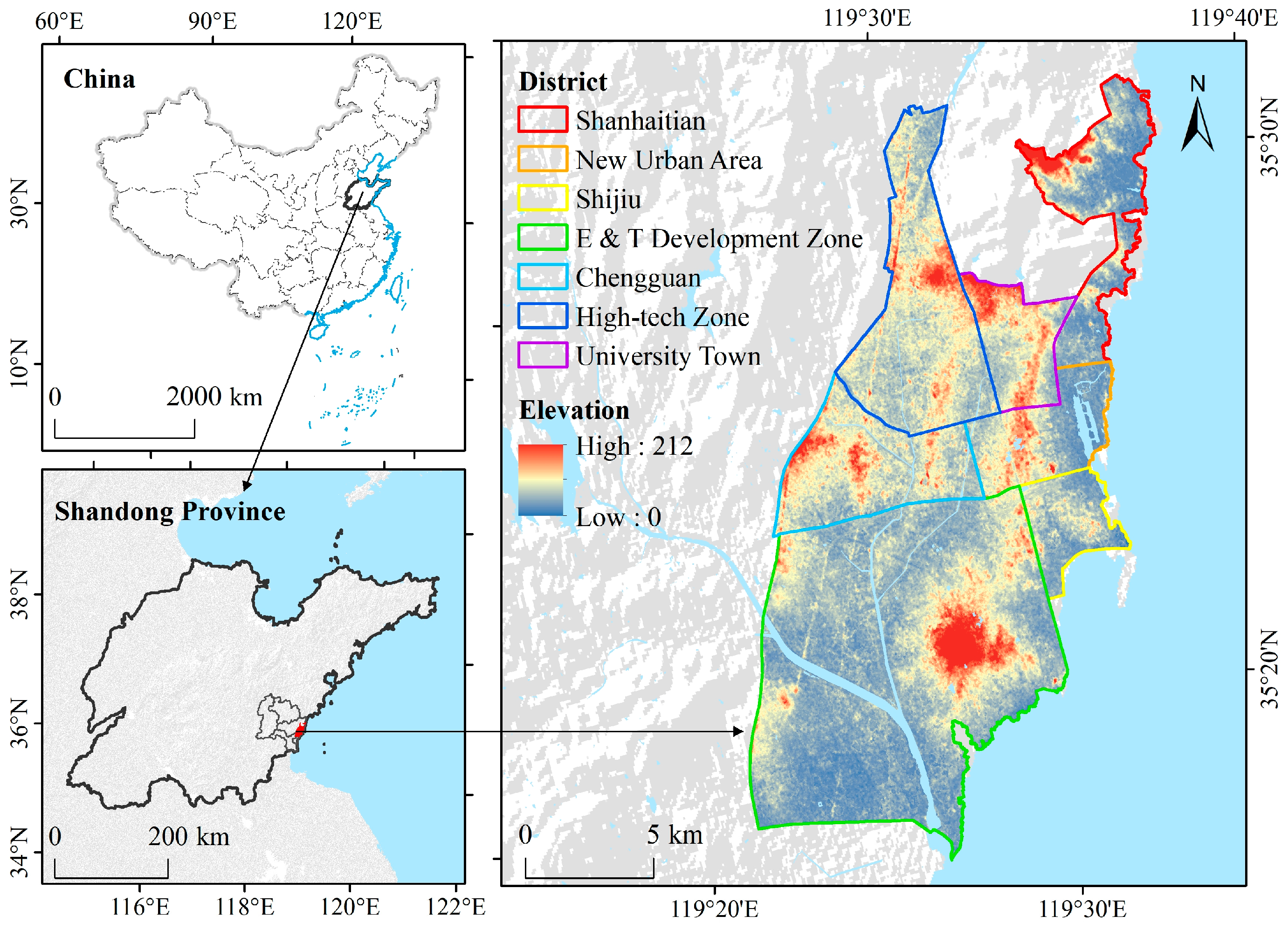
Based on the spatial boundaries defined in the Rizhao City Master Plan (2018–2035), this study focuses on the central urban area of Rizhao City, China. The study area covers approximately 258 km2 and includes seven key districts: Shanhaitian, University Town, High-tech Zone, New Urban Area, Chengguan, Shijiu, and the Economic and Technological (E & T) Development Zone (Figure 1). Located in the southeastern part of Shandong Province along the Yellow Sea coast, Rizhao—whose name originates from the phrase “the first to receive sunlight”—is a renowned port city recognized for its coastal livability. Influenced by its maritime setting, the city experiences a temperate monsoon climate characterized by humid rainy summers and dry, relatively mild winters. The central urban area is situated in the eastern part of the city and features generally flat topography. In recent years, accelerated urbanization has led to a continuous expansion of impervious surfaces. Coupled with the aging of significant portions of the urban drainage infrastructure, these changes have resulted in frequent flooding during rainy seasons, intensifying the challenges of urban flood management.

2.2. Data Sources and Processing

This study developed a flood hazard assessment framework for Rizhao’s central urban area using multi-source geospatial data. The primary datasets include DEM, land cover classification, soil type distribution, road networks, river channels, and historical flood records. Table 1 details the specific evaluation indicators derived from each dataset and their respective sources and descriptions.
The hydrological processing of the 12.5 m resolution DEM data involved: (1) sink filling to ensure hydrologically consistent flow paths, (2) D8 algorithm-based flow direction determination, (3) calculation of flow accumulation, (4) river channel network extraction using a threshold-based approach, and (5) subsequent sub-catchment delineation based on the derived drainage patterns and predetermined outlet locations. The DEM-extracted channel network offers a more refined representation of surface runoff processes than the observed river network in the study area. This approach is particularly advantageous given that the small scale of the delineated sub-catchments requires a level of hydrological detail that conventional river mapping cannot adequately provide.

3. Methodology

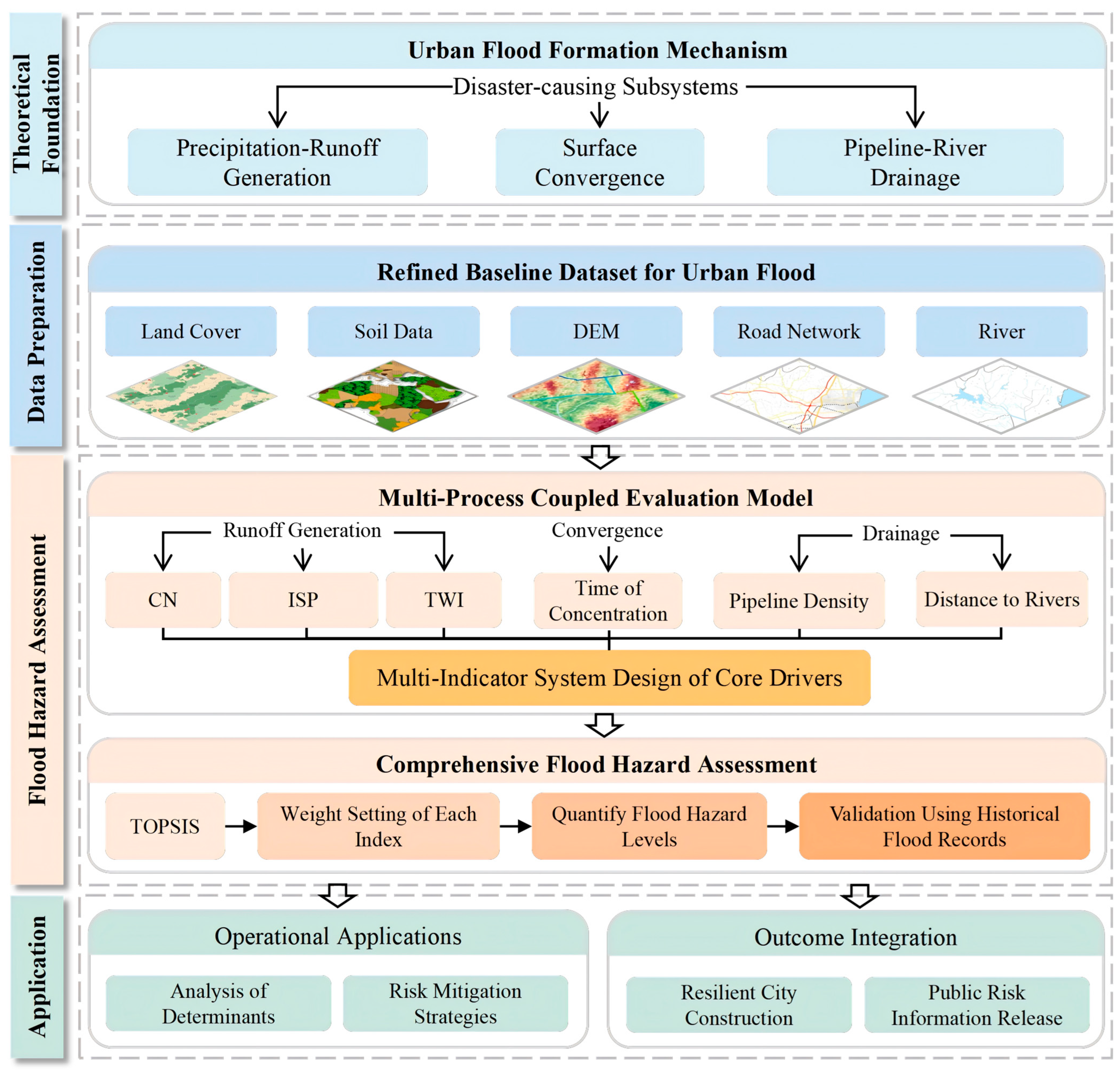
This study establishes a multi-indicator system for flood hazard assessment based on three key hydrological processes: runoff generation, flow convergence, and drainage capacity. The TOPSIS method was employed to develop a comprehensive evaluation model for quantifying flood hazard levels. The multi-indicator hazard mechanism framework for flood hazard assessment developed in this study is presented in Figure 2.

3.1. Multi-Indicator System

3.1.1. Runoff Generation Capacity

To characterize the runoff generation capacity in flood-prone areas, we selected three primary indicators: the Runoff Curve Number (CN), the Impervious Surface Percentage (ISP), and the Topographic Wetness Index (TWI).
The Runoff Curve Number (CN) is a dimensionless parameter that quantifies surface infiltration capacity. A higher CN value indicates reduced infiltration, leading to increased surface runoff generation under given rainfall conditions [26]. This parameter is fundamentally governed by soil type and land cover characteristics. For this study, CN values for various features were determined based on the standard lookup table from the U.S. Department of Agriculture’s TR55 manual [27], with appropriate adjustments for the specific land cover types and hydrological soil groups present in Rizhao City (Table 2).
The Impervious Surface Percentage (ISP) quantifies the proportion of non-permeable surface coverage within a given region. This parameter is estimated using land cover characteristics, with empirical values from established studies assigned to each land cover category (Table 3). For sub-catchment level calculation, the area of each land cover type is multiplied by its corresponding ISP value. The sum of these weighted impervious areas across all land cover types is then divided by the total sub-catchment area to determine the overall ISP.
The Topographic Wetness Index (TWI), derived from Digital Elevation Model (DEM) [28], is a hydrological parameter that quantifies topographic control on soil moisture distribution. By integrating landscape features such as flow path length and upstream catchment area, it effectively simulates the spatial variation in soil moisture saturation under theoretical equilibrium conditions. Higher TWI values indicate greater predicted soil moisture content and consequently enhanced runoff generation potential. The index is commonly computed as:
T W I   =   l n S C A S
where TWI represents the Topographic Wetness Index (dimensionless), SCA denotes the specific catchment area per unit contour length (m2), S refers to the average slope of the catchment area (°).

3.1.2. Flow Concentration Capacity

The Time of Concentration (TC) is a fundamental parameter for evaluating the flow concentration capacity in flood-prone areas. It is defined as the maximum duration required for net rainfall to travel from the hydrologically most remote point of a watershed to its outlet via overland or channelized flow. Here, net rainfall is defined as precipitation that falls on impervious surfaces or is not absorbed by vegetation and soil, thus becoming surface runoff. A widely adopted empirical formula for estimating this parameter is given by:
T C = 0.0078 × L 0.77 S 0.385 × 60  
where TC represents the time of concentration (minutes), L denotes the length of the longest flow path (meters), S indicates the average watershed slope (%).

3.1.3. Drainage Capacity

The residual runoff remaining after runoff generation and convergence processes is the direct cause of urban flood. Consequently, drainage capacity plays a decisive role in determining flood severity in vulnerable areas, where higher drainage efficiency and more unobstructed drainage pathways serve as key mitigating factors. To quantitatively evaluate this capacity, this study employs pipeline density and average distance to rivers as proxy indicators, capturing both the conveyance efficiency of drainage channels and the rapidity of water discharge.
Given that urban drainage networks are typically subterranean and often inaccessible due to data confidentiality or available in ‘paper’ format only [29], pipeline density is approximated using road density. This substitution is supported by documented high spatial correlation between road network patterns and drainage system layouts [30], making road network data an effective proxy in urban flood studies where direct drainage data are unavailable [31,32,33]. Therefore, this study adopts road density to represent pipeline density across the study area.

3.2. TOPSIS-Based Comprehensive Assessment

The Technique for Order Preference by Similarity to an Ideal Solution (TOPSIS) was selected as the core multi-criteria decision-making framework for this study. TOPSIS is particularly suited for urban flood hazard assessment for several reasons: (1) it provides a transparent and interpretable ranking mechanism based on measurable distances to ideal solutions, which aligns with the goal of establishing a physically explainable assessment framework; (2) it effectively handles mixed data types and preserves the original information of indicators, making it ideal for integrating heterogeneous spatial datasets; and (3) unlike complex machine learning “black boxes,” TOPSIS offers clear traceability from input indicators to final hazard scores, a crucial feature for communicating risk to stakeholders and informing mitigation planning.
The application of TOPSIS in this study proceeds in two main phases. First, it quantifies the flood hazard for each evaluation unit (sub-catchment) by calculating its Euclidean distances to both the positive ideal solution and the negative ideal solution, which represent the best and worst possible combinations of indicator values, respectively. Subsequently, the relative closeness coefficient to the ideal solution is computed, generating a continuous hazard score that allows for a systematic and spatially graded classification. The detailed computational procedure is outlined as follows:
Step 1: Construct standardized decision matrix.
Let the matrix rows represent evaluation objects (sub-catchments) and columns represent evaluation indicators. The original data matrix is structured as:
X = x 11 x 12 x 1 m x 21 x 22 x 2 m x n 1 x n 2 x n m
Here, xij denotes the raw value of the j-th indicator for the i-th sub-catchment. This study evaluates 342 sub-catchments (n = 342) based on six indicators (m = 6), with their categories and units detailed in Table 4.
The normalized decision matrix was subsequently constructed through the following standardization procedure:
p i j = x i j i n x i j 2
Based on a structured expert elicitation process, weights (wj) were then assigned to the six indicators to ensure a systematic and consensus-driven outcome. Four experts, comprising two hydrologists and two disaster risk assessment specialists, independently ranked the relative importance of the six indicators regarding their influence on flood hazard in a coastal urban setting. Their individual judgments were synthesized, and any initial discrepancies were resolved through discussion to reach a consensus, yielding the final weight set presented in Table 4. Vector weighting was performed as follows:
z i j = w j × p i j
The weighted normalized matrix Z was thus constructed as follows:
Z = z 11 z 12 z 1 m z 21 z 22 z 2 m z n 1 z n 2 z n m
Step 2: Identify the positive and negative ideal solutions.
The positive ideal solution (Z+) and negative ideal solution (Z) are determined by selecting the maximum and minimum values, respectively, from each column of the weighted normalized matrix Z, as expressed in Equations (7) and (8):
z j + = m a x z 1 j ,   z 2 j ,     z n j , j = 1,2 , , m
z j = m i n z 1 j ,   z 2 j ,     z n j , j = 1,2 , , m
Step 3: Calculate the distances from each evaluation object to the positive-ideal and negative-ideal solutions using Equations (9) and (10):
D i + = j m z j + z i j 2 , i = 1,2 , , n
D i = j m z j z i j 2 , i = 1,2 , , n
where D i + represents the distance between the i-th evaluation object and the positive-ideal solution, and D i denotes the corresponding distance to the negative-ideal solution.
Step 4: Calculate the relative closeness coefficient Ci of each evaluation object to the ideal solution as follows:
C i = D i D i + + D i , i = 1,2 , , n
The relative closeness coefficient Ci ranges from 0 to 1, with values approaching 1 indicating higher flood hazard levels in the evaluation unit.
Step 5: Risk classification and assessment.
Sub-catchments are ranked according to their Ci values to determine flood hazard levels, enabling subsequent spatial distribution analysis and determinant identification through systematic assessment of the hazard patterns.

3.3. Validation Procedure

To quantitatively evaluate the predictive accuracy and reliability of the developed flood hazard assessment framework, an independent validation was conducted using historical flood records. A total of 43 waterlogging point records up to the year 2024 were obtained from the Rizhao City Urban Management Bureau. These records represent documented locations of surface inundation during past storm events, providing ground-truth data for model verification.
The validation procedure comprised two complementary analytical steps:
  • Spatial Overlay and Frequency Analysis: The historical flood points were spatially overlaid with the generated four-level hazard zoning map. The frequency of observed flood points occurring within each predicted hazard zone (Extreme, Significant, Moderate, and Low) was calculated and expressed as a percentage. This analysis directly tests the model’s ability to correctly classify areas of known flooding.
  • Receiver Operating Characteristic (ROC) Curve Analysis: A more rigorous statistical validation was performed using the ROC curve method. The continuous flood hazard index (relative closeness coefficient, Ci) for all sub-catchments was used as the predictor variable, while the presence or absence of a historical flood point within a sub-catchment served as the binary response variable. The Area Under the Curve (AUC) was then computed to measure the overall discriminatory power of the model. An AUC value of 0.5 indicates a performance no better than random chance, while a value of 1.0 represents perfect prediction.
This independent verification is crucial for confirming the practical utility and transferability of the proposed multi-indicator hazard mechanism framework beyond the calibration data.

4. Results

4.1. Analysis of Flood Hazard Indicators

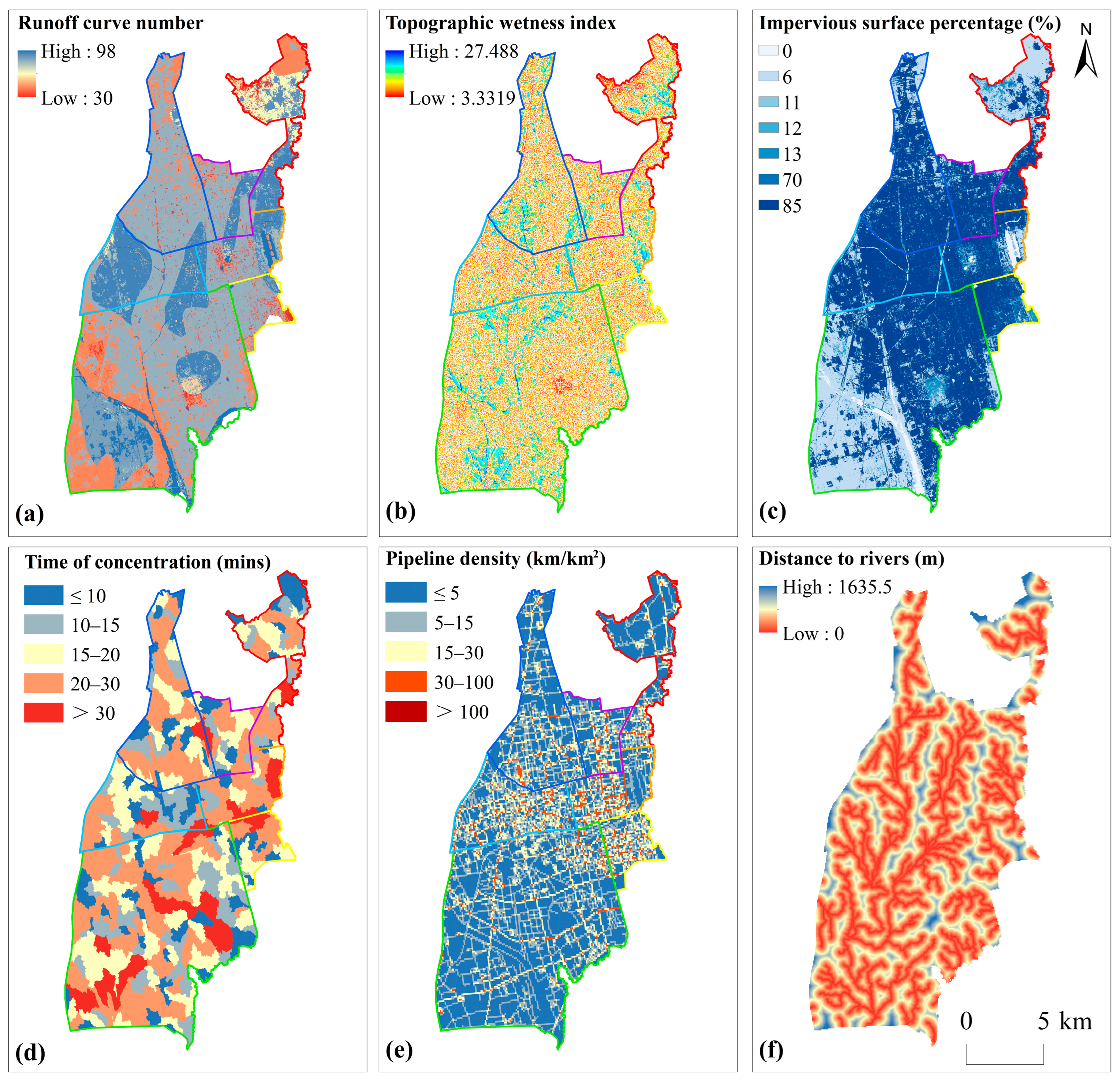
Urban flooding has emerged as a typical urban disaster resulting from the combined impacts of accelerated urbanization and climate change. A systematic indicator framework is crucial for understanding its formation mechanisms and spatial distribution patterns. This research developed an assessment system structured around three fundamental processes: runoff generation, flow convergence, and drainage capacity. The framework integrates six key parameters: Runoff Curve Number (CN), Impervious Surface Percentage (ISP), Topographic Wetness Index (TWI), Time of Concentration (TC), Pipeline Density (PD), and Distance to Rivers (DR). All parameters were quantitatively extracted and calculated through GIS spatial analysis. District-level averages were computed using geostatistical approaches (Table 5), while spatial distribution patterns were visualized through GIS mapping techniques (Figure 3).

4.1.1. Runoff Generation Indicators Analysis

As indicated in Table 5, all seven districts in Rizhao’s central urban area exhibit CN values exceeding 75, reflecting consistently high runoff generation capacity throughout the study area. A notable north–south divergence is observed, with northern districts—Chengguan, New Urban Area, University Town, and High-tech Zone—demonstrating average CN values above 80. Spatial analysis reveals six prominent high-CN zones (Figure 3a):
  • Zone 1 encompasses southern Shanhaitian and eastern New Urban Area, bounded by Haiqu East Road (south), Qingdao Road (west), and Taohua Island (north).
  • Zone 2 forms a narrow north–south corridor extending from central University Town to western New Urban Area, connecting to Zone 1 via Shanhai Road (north) and terminating at Yinhe Park (south).
  • Zone 3 occupies the central study area, spanning from Tianjia Village (north) to Tianjin Road (south), with Linyi South Road (east) and Rizhao Talent Park (west) as boundaries.
  • Zone 4 comprises areas west of Gu River in Chengguan District.
  • Zone 5 covers eastern E & T Development Zone, delineated by Kuishan (west), Yinchuan Road (east), Shanghai Road (north), and Rizhao Shijiu Port Expressway (south).
  • Zone 6 occupies the southwestern E & T Development Zone, demarcated by Futuan River.
Areas with high TWI values are primarily concentrated in the High-tech Zone (10.42), E & T Development Zone (10.39), and New Urban Area (10.26) (Table 5). Spatial analysis of TWI distribution (Figure 3b) reveals that high-TWI zones predominantly align with river networks and water bodies. These three districts contain significant hydrological features including the Futuan River, Gu River, Wanpingkou Lagoon, and Bixia Lake, resulting in elevated soil moisture content, greater saturation potential, and consequently enhanced runoff generation capacity.
ISP varies considerably across districts, with Shanhaitian District recording the lowest average value (41.68%) and Chengguan District the highest (74.99%) (Table 5). As one of Rizhao’s earlier developed urban cores, Chengguan exhibits significantly greater surface impermeability than the more recently developed Shanhaitian and E & T Development Zone. Spatial analysis of ISP distribution indicates predominantly high imperviousness throughout most of the central urban area, with notably lower values confined to northern Shanhaitian and areas west of the Futuan River in the E & T Development Zone (Figure 3c).

4.1.2. Flow Concentration Indicators Analysis

Time of concentration refers to the duration required for stormwater to travel from the catchment’s remotest point to the drainage network. Shorter concentration times accelerate runoff delivery to drainage systems, increasing hydraulic load and elevating flood risk. In Rizhao’s central urban area, the New Urban Area, Shijiu, and E & T Development Zone exhibit relatively long average concentration times, exceeding 20 min (Table 5). Sub-catchments with short concentration times are predominantly distributed in areas with steeper terrain, particularly in northern Shanhaitian District, central University Town, High-tech Zone, and Chengguan District, as shown in Figure 3d.

4.1.3. Drainage Capacity Indicators Analysis

Road density serves as a proxy indicator for the coverage level of subsurface drainage networks. Areas with higher road density are typically equipped with more extensive drainage infrastructure, enabling faster surface runoff concentration and reduced water retention. As shown in Figure 3e, the central sector of the study area demonstrates elevated pipeline density, with prominent concentrations observed in the New Urban Area, Shijiu, University Town, and Chengguan Districts. These zones represent earlier-developed urban cores characterized by well-established road networks and mature municipal drainage systems.
Distance to rivers represents the spatial separation between urban areas and the nearest DEM-derived river channel, directly influencing the natural discharge capacity of surface runoff. Despite the extensive development of urban drainage networks, municipal pipeline systems cannot fully substitute natural water systems. Enhancing river network density helps alleviate pressure on drainage infrastructure by reducing effective catchment area. Within Rizhao’s central urban area, main rivers and tributaries traverse the region from northwest to southeast, with an average distance to rivers of 285.73 m (Table 5). Most sub-catchments show significant hydrological connectivity, with only the northernmost section of Shanhaitian District and the elevated terrain of Kuishan in the E & T Development Zone maintaining sufficient distance from rivers to experience reduced hydrological impact, as detailed in Figure 3f.

4.2. Flood Hazard Assessment Results

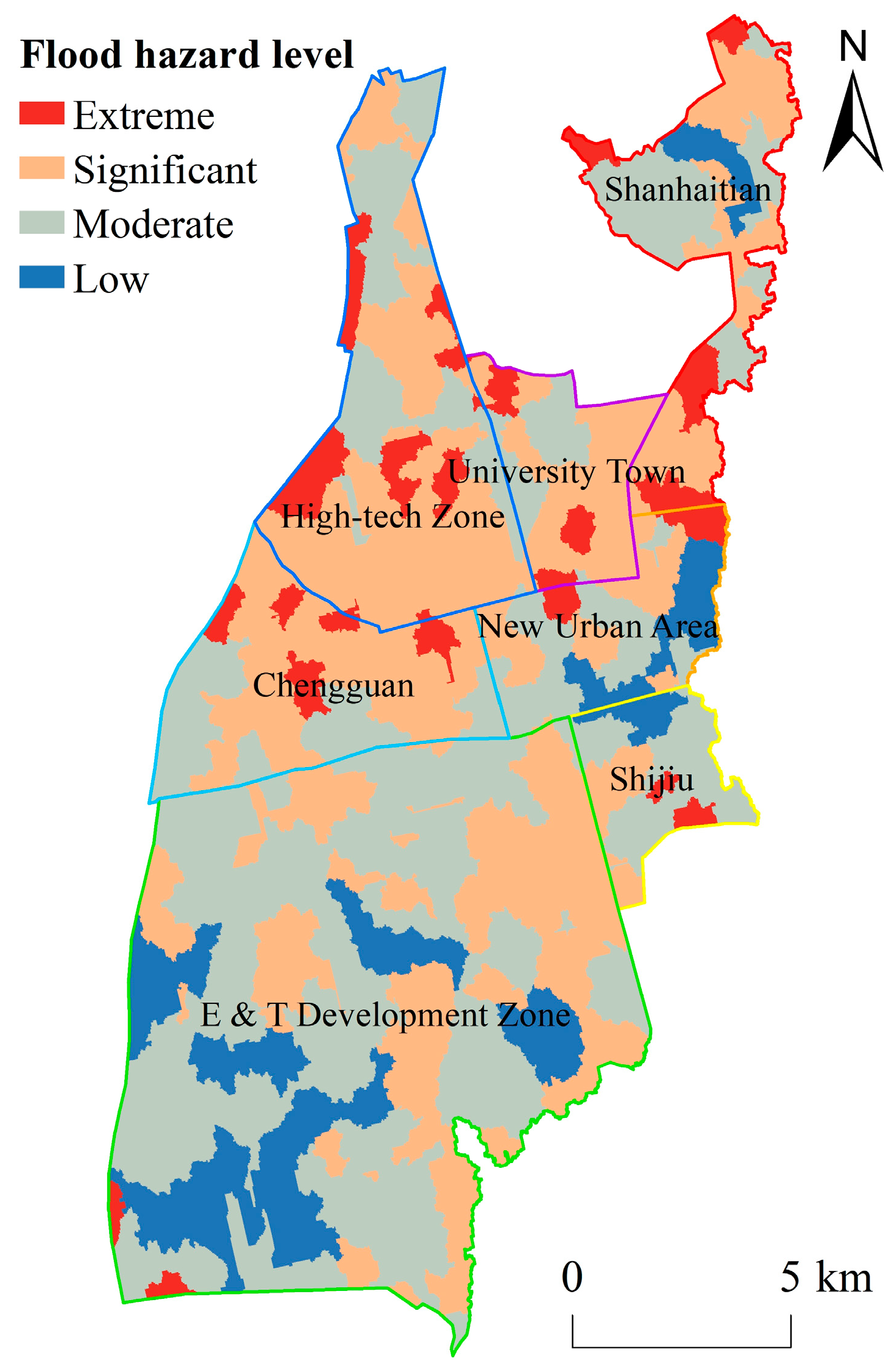
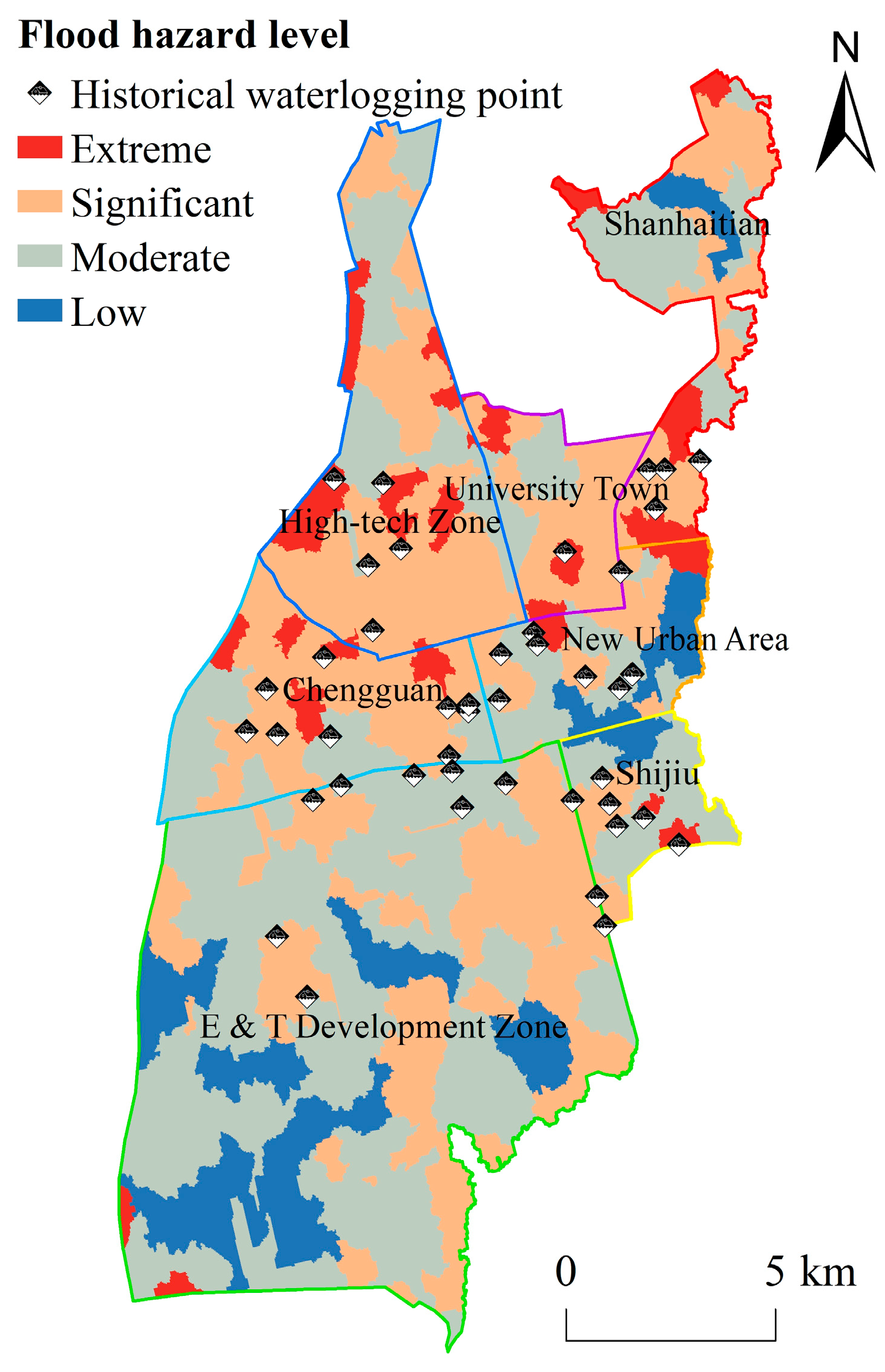
Based on the TOPSIS comprehensive scoring results, this study classified flood hazard in Rizhao’s central urban area into four levels (Extreme, Significant, Moderate, and Low), with their spatial distribution shown in Figure 4. Areas with scores above 0.6 were designated as extreme-hazard zones, accounting for 6.41% of the total area; those between 0.5 and 0.6 as significant-hazard (39.02%); 0.4–0.5 as moderate-hazard (42.98%); and below 0.4 as low-hazard zones (11.59%) (Table 6).
A total of 40 sub-catchments were identified as extreme flood hazard in Rizhao’s central urban area, distributed across all districts but predominantly concentrated in four northern districts: High-tech Zone, Shanhaitian, University Town, and Chengguan District (Figure 4). In these areas, extreme-hazard zones account for over 10% of each district’s total area (Table 6).
Significant-hazard zones show extensive distribution patterns, primarily encircling extreme-hazard zones and extending into southern sections (Figure 4). Moderate-hazard zones are predominantly located in the southern E & T Development Zone and eastern Shijiu District, where moderate-hazard areas constitute more than 50% of the territory (Table 6), with additional scattered distributions throughout central and northern regions (Figure 4).
Low-hazard zones are largely concentrated in southern sub-catchments containing the Futuan River and eastern areas including the Wanpingkou Lagoon, regions characterized by strong drainage capacity. Overall, flood hazard in Rizhao’s central urban area exhibits a clear spatial gradient, decreasing progressively from northern and central regions toward the south and east (Figure 4).

4.3. Analysis of Flood Hazard Determinants

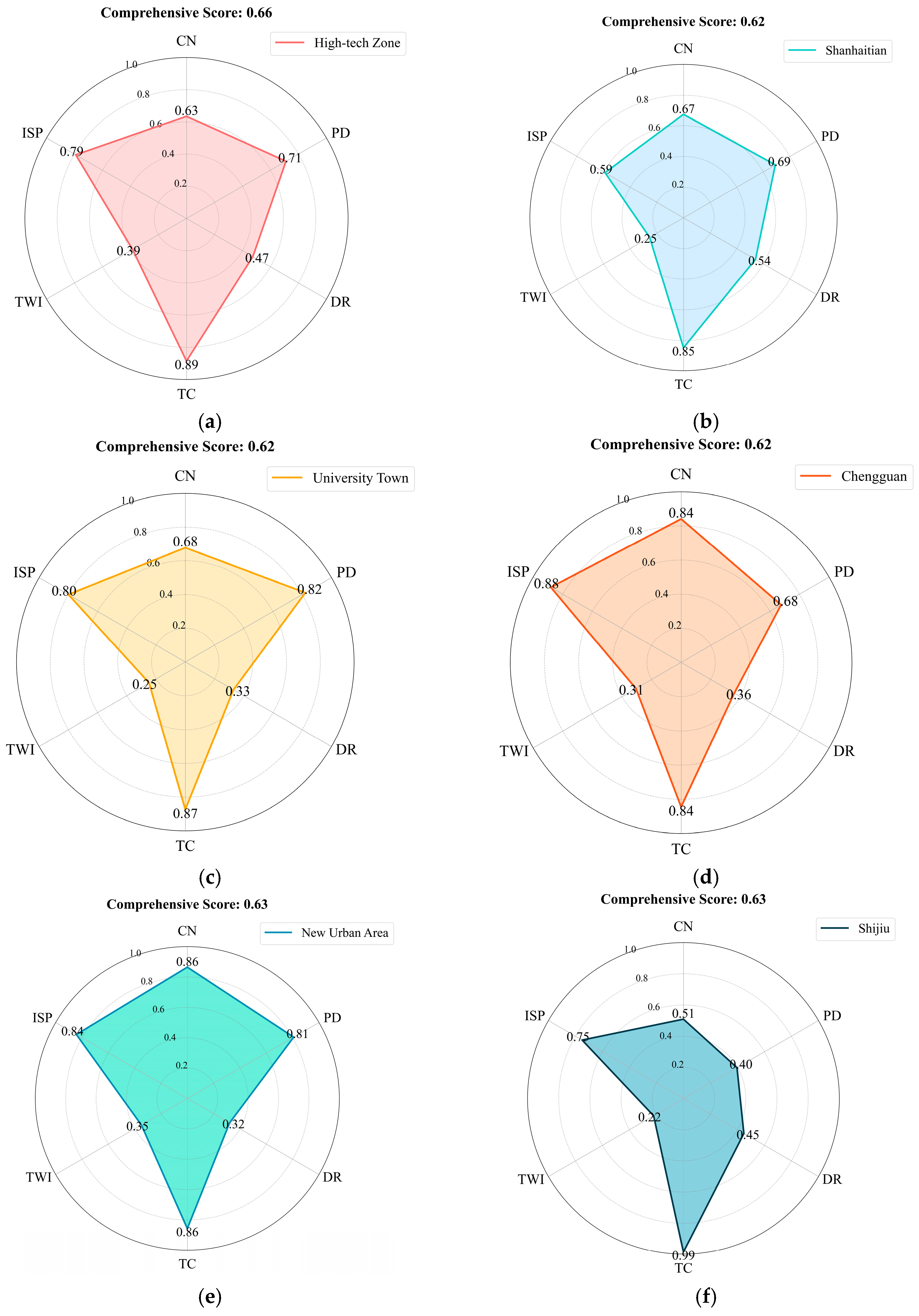
Building on the comprehensive flood hazard assessment, the 40 identified extreme-hazard sub-catchments were aggregated by district to calculate average values of flood indicators and comprehensive scores. These district-level profiles were visualized using radar charts (Figure 5) to compare the characteristic drivers of high flood hazard across different areas, supporting systematic analysis of flood causation mechanisms.
The High-tech Zone demonstrates the most extensive distribution of extreme flood hazard areas, covering nearly one-sixth of its territory (Table 6), with a scattered spatial pattern (Figure 4). The flooding mechanisms here are multifaceted: steep slopes contribute to short concentration times, while extensive impervious surfaces limit infiltration. Additionally, low pipeline density and high CN values further exacerbate stormwater retention issues (Figure 5a).
In Shanhaitian District, extreme-hazard zones account for 13.77% of its area (Table 6), displaying a distinct north–south polarization (Figure 4). Northern extreme-hazard areas result from the combined effect of short concentration times and considerable distance from rivers, while southern sectors are primarily influenced by high CN values and impervious surfaces that restrict infiltration and enhance runoff generation, compounded by short concentration times and inadequate drainage infrastructure (Figure 5b).
University Town, Chengguan, and New Urban Area show extreme-hazard area proportions of 11.84%, 10.67%, and 8.59%, respectively (Table 6). These share common causative factors including high runoff coefficients (elevated ISP and CN values), short concentration times, and low pipeline density (Figure 5c–e).
Shijiu District’s extreme-hazard areas are concentrated in its southern sector (Figure 4) (6.49% of its area, Table 6), where flooding is primarily governed by concentration time and ISP (Figure 5f).
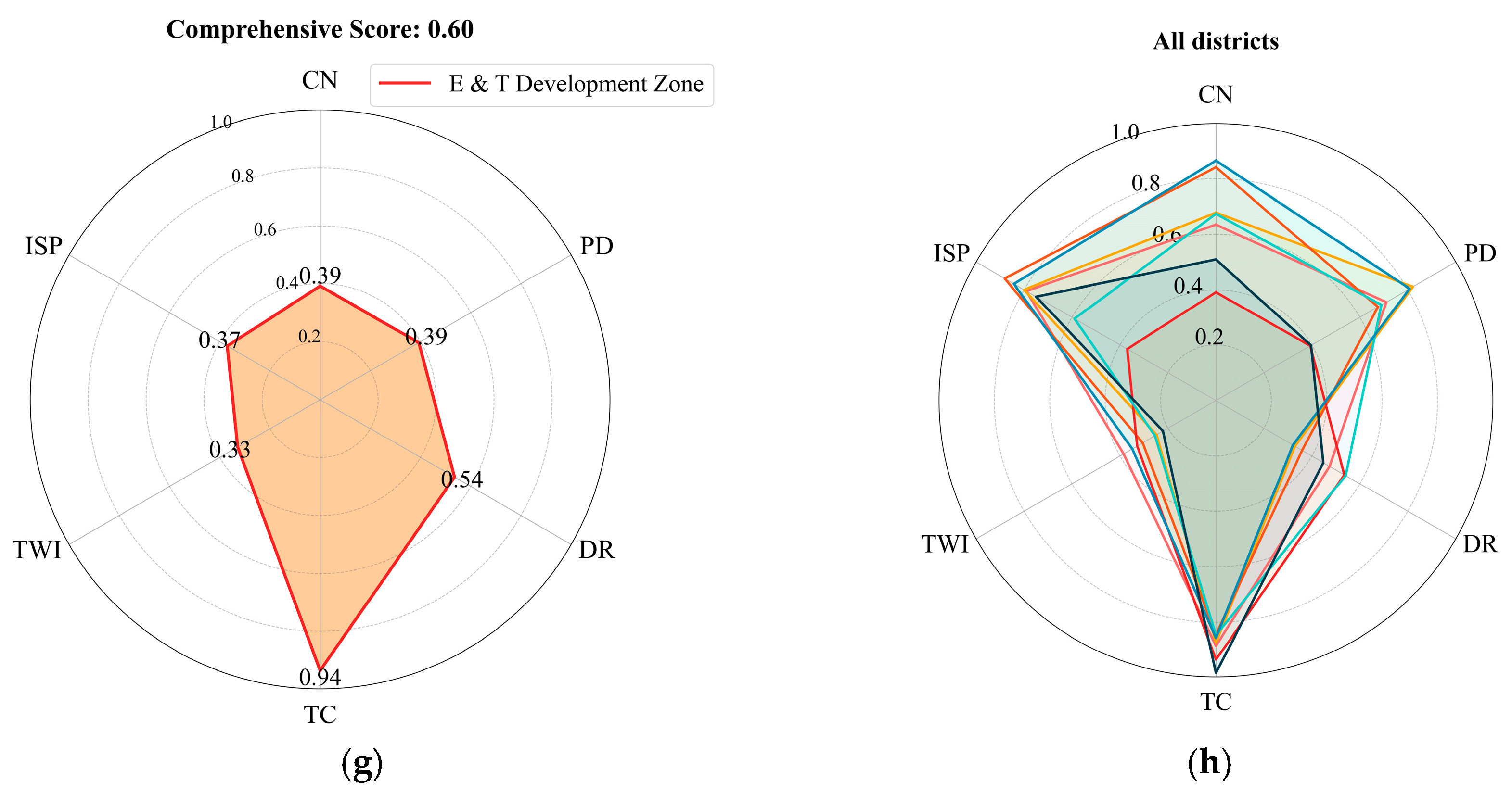
The E & T Development Zone contains minimal extreme-hazard area (0.62% of its area, Table 6), with flood hazard mainly driven by concentration time (Figure 5g).
In summary, although extreme flood hazard areas across Rizhao’s central urban area demonstrate distinct local characteristics, they all share a foundation of intensive urbanization compounded by multiple flood-inducing factors. ISP, concentration time, and pipeline density emerge as the three predominant drivers (Figure 5h), corresponding directly to the core processes of runoff generation, flow convergence, and drainage capacity. Specifically, extensive surface sealing reduces infiltration capacity, while rapid runoff concentration overwhelms drainage systems designed for ordinary rainfall conditions, resulting in frequent flooding during short-duration heavy precipitation events.

4.4. Validation Results and Analysis

4.4.1. Spatial Overlay and Frequency Analysis

The spatial agreement between predicted flood hazard zones and historical waterlogging events was evaluated by overlaying the 43 georeferenced flood points onto the final hazard classification map (Figure 6). Visually, the historical waterlogging points exhibit a pronounced cluster in the northern part of the study area, which corresponds precisely with the extensive ‘Significant’ and ‘Extreme’ hazard zones predicted by our model.
Quantitative analysis further substantiates this spatial correlation. As detailed in Table 7, 83.72% of the historical waterlogging points (36 out of 43) fall within areas classified as ‘Significant’ or ‘Extreme’ hazard. This high concentration within the top two hazard categories strongly validates the model’s ability to delineate regions with a documented propensity for flooding.
An analysis of the 7 misclassified points (located in ‘Moderate’ hazard zones) provides insight into the model’s current limitations. Notably, a majority of these points are associated with railway underpasses and culverts. We hypothesize that this under-prediction stems primarily from the 12.5 m spatial resolution of the DEM data, which is insufficient to capture the subtle yet critical micro-topographic depressions created by such engineered infrastructure. These localized concavities are not resolved in the terrain model, leading to an underestimation of their inherent flood susceptibility. This observation highlights a key dependency of the framework on input data resolution and points to a clear avenue for future improvement through the integration of high-resolution topographic surveys or LiDAR data.

4.4.2. Performance Assessment via ROC Curve Analysis

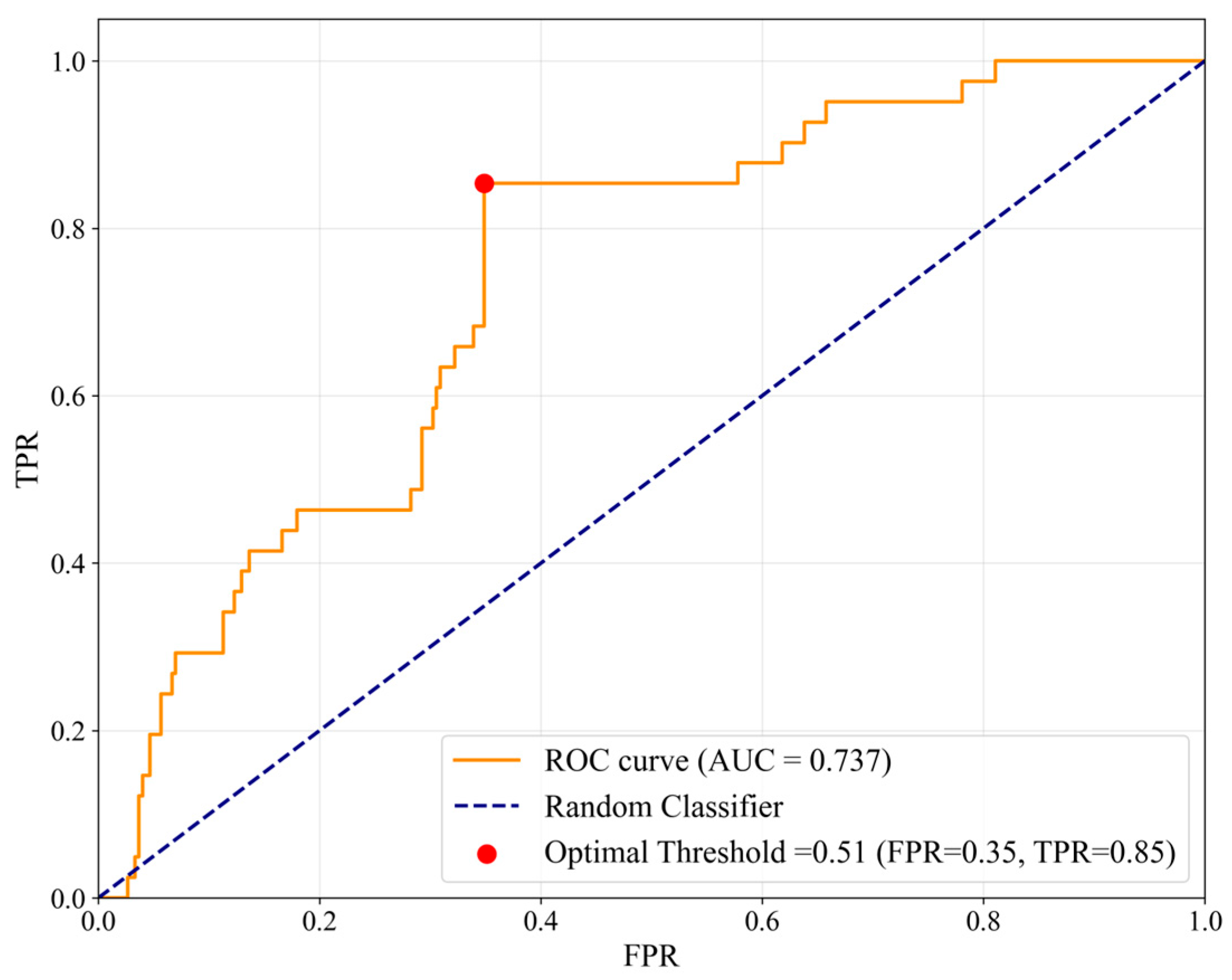
The Receiver Operating Characteristic (ROC) curve analysis provided a statistical measure of the model’s overall discriminatory power (Figure 7). The calculated Area Under the Curve (AUC) value is 0.737. At an optimal classification threshold, the model achieved a True Positive Rate (TPR) of 0.85 and a False Positive Rate (FPR) of 0.35.
The high TPR value indicates that the model successfully identified 85% of the historically recorded flood events, demonstrating a strong capacity for capturing known hazard locations. The 15% false negative rate (i.e., missed events) is consistent with the limitation discussed in Section 4.4.1, primarily attributable to the insufficient spatial resolution of the DEM data in capturing micro-topographic features like underpasses.
The relatively high FPR suggests that the model classifies a portion of non-flooded areas as high hazard. This is likely influenced by the limited size of the historical flood point sample (n = 43). Many areas predicted as ‘Significant’ or ‘Extreme’ hazard may possess high physical susceptibility but have not experienced a documented flood event within the available record period. Consequently, they are counted as “false positives” in this validation, which penalizes the AUC score.
While the AUC value of 0.737 indicates a good but not excellent overall performance from a purely statistical prediction perspective, the model’s design philosophy prioritizes risk-averse safety planning. From a hazard mitigation standpoint, the high TPR ensures that most known problematic areas are flagged. The areas generating false positives, based on our mechanistic indicators (high imperviousness, short concentration time, etc.), still represent a prudent priority for preventive infrastructure investment and monitoring. This “rather over-predict than under-predict” approach aligns with the precautionary principle in urban flood risk management.

5. Mitigation Strategies

Integrated flood management necessitates the co-implementation of structural and non-structural mitigation strategies to achieve sustainable development [34]. Contemporary flood risk mitigation has evolved from single-function solutions toward integrated multi-function approaches [35], as research consistently demonstrates the limitations of isolated measures like green roofs in addressing complex urban flooding [36,37]. Effective multi-function solutions require a systematic framework that holistically coordinates the entire hydrological continuum—from runoff generation through flow convergence to drainage processes—enabling synergistic interactions between natural and engineered systems for enhanced flood resilience. Building on the spatial distribution and causation analysis of flood hazard presented in this study, we identify a systemic imbalance between runoff–convergence characteristics and drainage capacity, underscoring the need to restore natural urban hydrological cycles. To address key challenges—including concentrated runoff, insufficient pipeline capacity, and restricted drainage pathways—we propose structured engineering measures organized around three pillars: source reduction, process regulation, and terminal discharge enhancement. By integrating global best practices and adapting interventions to local flood drivers, these strategies aim to enhance regional resilience, lower the probability of flooding, and reduce potential disaster impacts.

5.1. Source Reduction

Source reduction strategies target the rising runoff coefficient resulting from rapid urbanization. Through the enhancement of source infiltration, these projects retrofit existing surface infrastructure to alleviate runoff pressure. Based on flood hazard assessment outcomes, the following measures are prioritized in key regions: southern Shanhaitian District, University Town, High-tech Zone, New Urban Area, and Chengguan District.
In extreme flood hazard zones characterized by elevated CN values—particularly commercial areas where ISP exceeds 70%—Sponge City technologies, recognized as an innovative approach for urban waterlogging mitigation, are strongly recommended. These measures, including green roofs, rain gardens, permeable pavements, and vegetative swales [38,39], effectively enhance infiltration capacity and reduce surface runoff. Specifically, building on Rizhao’s existing 40.6 km2 of sponge city infrastructure, coverage should be expanded by piloting gray-green synergistic facilities (e.g., permeable asphalt roads, grassed swales) in flood-prone areas to further lower CN values. Land use structure should also be optimized by restricting development in highly impervious zones and conserving natural green spaces and wetlands in future urban plans. In high-TWI areas like low-lying land, development density controls should be enforced alongside supplementary stormwater storage tanks.
District-level interventions are tailored as follows:
Southern Shanhaitian District: Sustain current sponge city accomplishments while integrating gray-green infrastructure into new developments. Incorporate rainwater gardens and permeable pavements as mandatory elements in road upgrades and new construction. Adhere to low floor-area ratio policies by refining zoning regulations to limit development intensity, preventing ecological degradation from over-commercialization and fostering a coastal resort character that harmonizes landscape aesthetics with ecological functionality.
Chengguan District, New Urban Area, and University Town: As mature urban areas, adopt phased retrofitting of rainwater gardens and green roofs. Introduce development density limits in planned zones to protect remaining green spaces and wetlands. For instance, replace impermeable surfaces with permeable materials in older campus and residential sections of University Town. Utilize collaborative industry-academia resources to establish platforms for implementing sponge campus concepts. Develop “micro-wetland networks” around campuses to retain surface runoff while improving visual and ecological quality.
High-tech Zone: Enhance current sponge city projects by extending green roof installations in residential neighborhoods. Align industrial planning (e.g., automotive manufacturing, information technology) with ecological targets by deploying green roofs and sunken green spaces in new industrial parks like Huanghai Digital Intelligence Valley and the New Generation Information Technology Industrial Park. These efforts will establish reproducible eco-industrial benchmarks and help cultivate sustainable green zones.

5.2. Process Regulation

Building on flood hazard assessment and causation analysis, targeted process regulation measures are proposed for key areas including University Town, New Urban Area, High-tech Zone, and Chengguan District. These interventions address two interconnected challenges: deteriorated drainage infrastructure and altered hydrological processes. The legacy of outdated pipeline design standards from earlier urban development has led to systemic aging and structural vulnerability, while extensive land modification has disrupted natural hydrological patterns.
A systematic engineering strategy combines the following measures:
  • Drainage capacity enhancement projects represent a conventional strategy for addressing urban flooding, focusing on improving hydraulic performance through the rehabilitation of aging infrastructure and optimization of network topology [40]. While such projects aim to increase system discharge capacity, their implementation often involves substantial infrastructure investment and may not fully address the complex interplay of hydrological processes in rapidly urbanizing areas.
  • Terrain-Based Hydrological Regulation: Implementing slope adjustments and surface roughness modifications in short concentration-time areas to restore natural hydrological response patterns.
This integrated “pipeline rehabilitation-terrain regulation” framework establishes a synergistic approach to significantly strengthen regional drainage capacity and hydrological resilience.

5.3. Terminal Discharge Enhancement

Terminal discharge solutions focus on restoring natural hydrological connectivity and increasing pipeline density. Key measures include:
  • Constructing ecological detention zones along main drainage corridors in High-tech Zone and E & T Development Zone, restoring natural floodplain spaces through terrain reshaping;
  • Gradually removing unnecessary structures to rehabilitate river–floodplain connectivity;
  • Comprehensively evaluating existing pipeline coverage and strategically planning new drainage networks in low-density areas.
In High-tech Zone, where most extreme-hazard areas coincide with rural residential clusters, drainage infrastructure development should adopt context-specific strategies considering geographical conditions, economic feasibility, and resident lifestyles. Differentiated approaches include:
  • Strict implementation of separated drainage systems in new rural residential areas;
  • Phased transition in older areas through additional intercepting wells to reduce combined sewer discharges;
  • Converting abandoned ponds or low-lying areas into stormwater detention ponds for flood storage and agricultural irrigation during droughts.

6. Discussion

6.1. The Novelty of the Integrated “Runoff–Convergence–Drainage” Framework

This study establishes a multi-indicator hazard mechanism framework that explicitly integrates the three core physical processes of urban flooding: runoff generation, surface flow convergence, and drainage system capacity. The primary scientific contribution of this framework lies in its hybrid design, which bridges a critical methodological gap between fully distributed hydrodynamic models and purely statistical, indicator-based approaches. While high-fidelity hydraulic models (e.g., SWMM, MIKE) offer detailed process simulation, their application at the urban agglomeration scale is often constrained by significant data requirements and computational costs [41,42,43]. Conversely, conventional multi-criteria analyses sometimes aggregate indicators without a strong causal linkage to the underlying physical drivers of flooding [44]. Our framework navigates this divide by structuring the assessment around a mechanistically coherent yet parsimonious set of indicators (CN, ISP, TWI, concentration time, pipeline density, and distance to rivers), each directly mapped to a specific hydrological process. This design ensures that the final hazard score is not merely a statistical composite but a quantitative reflection of known flood-forming mechanisms, enhancing the result’s interpretability for engineers and planners. It provides a transparent, replicable, and efficient tool for city-scale hazard screening and mitigation prioritization, particularly in data-scarce contexts.

6.2. Interpretation of Dominant Hazard Drivers

The factor analysis identified impervious surface percentage (ISP), concentration time, and pipeline density as the three dominant drivers of flood hazard in Rizhao’s central urban area. This finding aligns robustly with urban hydrology theory and empirical studies worldwide. The strong influence of ISP underscores the pivotal role of surface sealing in amplifying runoff volumes, a phenomenon consistently reported in diverse urban settings [45,46,47,48,49]. Similarly, the short concentration times identified in our analysis highlight the critical role of topography—notably elevation and slope—in accelerating surface runoff and overwhelming drainage capacity during heavy rainfall. This is consistent with established hydrological understanding, where elevation is a primary determinant of flow concentration dynamics [50]. The importance of elevation as a key predictor of flood susceptibility has also been widely confirmed in numerous flood risk modeling studies across varied geographical settings [21,45,47,51,52,53,54]. Building upon the above dominant drivers identified, the literature consistently highlights several other critical indicators in urban flood causality. Factors such as pipeline/road density [19,23,54] distance to rivers [21,23,45,52,53,54], and the Topographic Wetness Index (TWI) [47,53] have been widely adopted and validated as significant contributors to flood risk in various urban contexts. This broader set of commonly used indicators further contextualizes our factor selection and aligns our analytical framework with established empirical practices in the field.

6.3. Model Validation

The independent validation using historical flood records provides strong empirical support for the framework’s reliability. The high spatial correspondence between predicted high-hazard zones and documented inundation points—with 83.72% of the historical waterlogging points falling within areas classified as ‘Significant’ or ‘Extreme’ hazard—confirms the model’s effective diagnostic capability. This alignment is further quantified by an AUC value of 0.737, indicating good overall discriminatory performance.
A critical examination of the remaining discrepancies and the non-exceptional AUC value is warranted. The 7 observed flood points located outside predicted high-hazard zones, along with the moderate overall discriminatory performance (AUC = 0.737), can be primarily attributed to two sources of uncertainty: (1) the spatial resolution of the DEM data, where the 12.5 m grid likely smoothes over micro-topographic depressions (e.g., underpasses and culverts) that are critical for localized ponding; and (2) potential inaccuracies in the geolocation or completeness of the historical flood point records, which may affect both the validation sample representativeness and the precise spatial alignment required for flood hazard classifications.
These limitations do not invalidate the model but clearly delineate its current scope of application. They also highlight concrete avenues for future refinement, such as integrating higher-resolution terrain data (e.g., LiDAR-derived DEMs) and expanding the validation dataset with systematically collected, high-precision flood observations. Despite these constraints, the high hit-rate within the top hazard categories demonstrates the framework’s practical utility for prioritizing areas requiring mitigation attention.

6.4. Methodological Choice: TOPSIS as a Tool for Transparent, Mechanism-Based Decision Support

The selection of the TOPSIS was deliberate and fundamental to our research objectives. This study was designed not primarily as a predictive exercise but as a diagnostic and decision-support tool to elucidate the relative contribution of different physical processes to urban flood hazard. TOPSIS is exceptionally suited for this purpose due to its transparent logic: each indicator’s role, its assigned weight based on expert knowledge of coastal urban hydrology, and its contribution to the final score are fully traceable. This transparency is crucial for communicating risk to stakeholders and for formulating targeted, evidence-based mitigation strategies.
This approach stands in contrast to advanced machine learning (ML) models (e.g., Random Forest, Deep Neural Networks), which, while often achieving higher predictive accuracy in pattern recognition [55,56], can operate as “black boxes” with limited mechanistic interpretability [57]. Our goal was to build a causally interpretable framework rather than to maximize predictive performance from a large set of potential features. Therefore, the choice of TOPSIS over ML was a conscious alignment of method with research aim. We posit that future research directions can effectively build upon this foundational work: once a mechanistic understanding of key drivers is established via frameworks like ours, ML and artificial intelligence (AI) techniques can be powerfully applied in contexts with abundant training data (e.g., dense sensor networks, detailed loss records) to develop high-accuracy predictive models that incorporate both the identified physical drivers and complex, non-linear interactions [58,59]. Ultimately, the integration of interpretable, mechanism-based frameworks with data-driven AI techniques represents a promising pathway for creating more robust, adaptive, and high-fidelity flood risk assessment systems in the future [60].

6.5. Limitations, Sensitivity, and Future Integration with Data-Driven Methods

While the TOPSIS-based framework provides a transparent and interpretable tool for diagnostic assessment, we acknowledge certain methodological limitations that point to valuable directions for future research. As noted in Section 6.3, the current model relies on expert-derived weights, which, while grounded in consensus, introduce a degree of subjective judgment. A comprehensive sensitivity analysis on these weights represents a critical next step to rigorously quantify the robustness of the hazard zonation under parameter uncertainty and to further validate the stability of our causal inferences.
Furthermore, we recognize that the translation of our identified, mechanism-based hazard drivers into fully detailed engineering designs remains conceptual. The development of concrete application examples—complete with engineering specifications, cost–benefit analyses [61], and phased implementation plans—is a necessary and logical next step for professional practice. Our study provides the essential spatial prioritization and causal diagnostic (the “where” and “why”) that must inform such subsequent detailed planning and investment decisions.
This progression from diagnostic understanding to detailed engineering naturally aligns with a broader, integrative research trajectory. The structured, mechanism-based indicators developed in this study establish a physically meaningful feature set that is ideally suited to inform more complex models. Future work could therefore powerfully integrate this interpretable framework with advanced data-driven techniques, such as ML.
In such a hybrid approach, our indicators would serve as the foundational input layer for an ML model. This integration offers a dual advantage: it leverages the predictive power and ability to capture non-linear interactions inherent in ML [62], while remaining anchored in the causal, process-based understanding ensured by our feature engineering. Within this hybrid paradigm, sensitivity and feature importance analyses conducted on the ML model would provide a robust, data-driven means to quantify the contribution and relative influence of each physical driver, thereby cross-validating and enriching the expert-based assumptions of the present study.
Ultimately, the convergence of interpretable, mechanism-based frameworks with powerful, data-driven AI techniques represents a promising pathway to develop the next generation of flood risk assessment systems—systems that are not only accurate and adaptive but also remain transparent and actionable for stakeholders. The present study provides the essential mechanistic and diagnostic scaffolding upon which such advanced, integrated, and implementable systems can be built.

7. Conclusions

This study developed a multi-indicator hazard mechanism framework for assessing flood hazard in Rizhao’s central urban area using TOPSIS comprehensive evaluation. The framework integrates six key indicators across three hydrological process dimensions: runoff generation (CN value, ISP, TWI), flow convergence (time of concentration), and drainage capacity (pipeline density, distance to rivers).
Analysis reveals distinct spatial patterns in flood hazard distribution, with significant and moderate hazard zones comprising 82.00% of the study area. Extreme-hazard areas (6.41%) show strong spatial clustering in northern districts including the High-tech Zone, Shanhaitian, University Town, and Chengguan, while low-hazard zones (11.59%) are predominantly located in the southern E & T Development Zone.
Factor analysis identifies ISP, concentration time, and pipeline density as the three dominant hazard drivers, corresponding to the fundamental processes of runoff generation, flow convergence, and drainage capacity, respectively. Independent validation using historical flood records confirmed the model’s practical utility, with 83.72% of documented waterlogging points falling within the predicted ‘Significant’ or ‘Extreme’ hazard zones, and an AUC value of 0.737 indicating good overall discriminatory performance.
Based on these spatial distribution characteristics and causative mechanisms, the study proposes an integrated mitigation strategy system of “source reduction–process regulation–terminal enhancement” designed to enhance regional resilience and reduce urban flood disaster risk. The framework provides a transparent, mechanism-based tool that not only supports city-scale hazard screening and prioritization but also offers a transferable methodology for flood risk assessment in comparable coastal urban environments.

Author Contributions

Conceptualization, Y.Y. and Y.M.; methodology, Y.Y.; software, X.L.; validation, Y.M., Y.Y. and B.L.; formal analysis, Y.M.; investigation, Y.Y.; resources, Y.Y.; data curation, X.L.; writing—original draft preparation, Y.Y.; writing—review and editing, Y.M.; visualization, Y.Y. and Y.M.; supervision, S.H., H.G. and B.L.; funding acquisition, S.H. and H.G. All authors have read and agreed to the published version of the manuscript.

Funding

This research was funded by the Rizhao Natural Science Foundation (Grant No. RZ2024ZR12); the Young Taishan Scholars Program of Shandong Province (Grant No. tsqn202103065); and the Youth Innovation Teams in Colleges and Universities of Shandong Province (Grant No. 2022KJ178).

Data Availability Statement

The datasets used in this study are publicly available from: NASA’s Alaska Satellite Facility Distributed Active Archive Center for DEM data (https://search.asf.alaska.edu/, accessed on 25 December); Wuhan University’s CLCD land cover classification dataset for land cover data (https://zenodo.org/records/8214467, accessed on 25 December); the Institute of Soil Science, Chinese Academy of Sciences for soil data (http://www.issas.cas.cn, accessed on 25 December); and OpenStreetMap for road network data (https://www.openstreetmap.org/, accessed on 25 December).

Acknowledgments

All authors thank the anonymous reviewers and the editor for the constructive comments on the earlier version of the manuscript.

Conflicts of Interest

The authors declare no conflicts of interest. The funders had no role in the design of the study; in the collection, analyses, or interpretation of data; in the writing of the manuscript; or in the decision to publish the results.

References

  1. Tellman, B.; Sullivan, J.A.; Kuhn, C.; Kettner, A.J.; Doyle, C.S.; Brakenridge, G.R.; Erickson, T.A.; Slayback, D.A. Satellite imaging reveals increased proportion of population exposed to floods. Nature 2021, 596, 80–86. [Google Scholar] [CrossRef]
  2. Liu, Q.; Du, M.; Wang, Y.; Deng, J.; Yan, W.; Qin, C.; Liu, M.; Liu, J. Global, regional and national trends and impacts of natural floods, 1990–2022. Bull. World Health Organ. 2024, 102, 410. [Google Scholar] [CrossRef]
  3. Zhou, Y.; Liu, Y.; Wu, W. Strengthen China’s flood control. Nature 2016, 536, 396. [Google Scholar] [CrossRef]
  4. Wang, P.; Li, Y.; Zhang, Y. An urban system perspective on urban flood resilience using SEM: Evidence from Nanjing city, China. Nat. Hazards 2021, 109, 2575–2599. [Google Scholar] [CrossRef]
  5. Andreadis, K.M.; Wing, O.E.; Colven, E.; Gleason, C.J.; Bates, P.D.; Brown, C.M. Urbanizing the floodplain: Global changes of imperviousness in flood-prone areas. Environ. Res. Lett. 2022, 17, 104024. [Google Scholar] [CrossRef]
  6. Ahmad, I.; Ping, W.; Ullah, S.; Faqeih, K.Y.; Alamri, S.M.; Alamery, E.R.; Abalkhail, A.A.A.; Bilal Jan, H.M. Spatiotemporal Mapping of Urban Flood Susceptibility: A Multi-Criteria GIS-Based Assessment in Nangarhar, Afghanistan. Land 2025, 14, 2376. [Google Scholar] [CrossRef]
  7. Che, L.; Yin, S.; Guo, Y. Flood risk assessment combining the historical disaster statistics method with the index system method. Hydrol. Sci. J. 2025, 70, 510–521. [Google Scholar] [CrossRef]
  8. Benito, G.; Lang, M.; Barriendos, M.; Llasat, M.C.; Francés, F.; Ouarda, T.; Thorndycraft, V.; Enzel, Y.; Bardossy, A.; Coeur, D.; et al. Use of Systematic, Palaeoflood and Historical Data for the Improvement of Flood Risk Estimation. Review of Scientific Methods. Nat. Hazards 2004, 31, 623–643. [Google Scholar] [CrossRef]
  9. Ma, B.; Wu, Z.; Hu, C.; Wang, H.; Xu, H.; Yan, D. Process-oriented SWMM real-time correction and urban flood dynamic simulation. J. Hydrol. 2022, 605, 127269. [Google Scholar] [CrossRef]
  10. Li, Y.; Li, H.; Han, Y.; Huang, T.; Wang, Q.; Wang, X. Impact analysis of urban super-standard flood disasters based on MIKE+. Nat. Hazards 2025, 121, 15949–15963. [Google Scholar] [CrossRef]
  11. Cheng, X.; Wang, H.; Chen, B.; Li, Z.; Zhou, J. Comparative analysis of flood prevention and control at LID facilities with runoff and flooding as control objectives based on InfoWorks ICM. Water 2024, 16, 374. [Google Scholar] [CrossRef]
  12. Bates, P.D.; De Roo, A.P.J. A simple raster-based model for flood inundation simulation. J. Hydrol. 2000, 236, 54–77. [Google Scholar] [CrossRef]
  13. Zhang, X.; Kang, A.; Lei, X.; Wang, H. Urban drainage efficiency evaluation and flood simulation using integrated SWMM and terrain structural analysis. Sci. Total Environ. 2024, 957, 177442. [Google Scholar] [CrossRef]
  14. Pandey, D.; Singh, K.K. Identification of Critical Urban Drainage Flooding Points Using MIKE URBAN+: A Case Study of Rohtak, Haryana, India. In Sustainable Management of Land, Water and Pollution of Built-Up Area; Springer: Berlin/Heidelberg, Germany, 2024; pp. 219–230. [Google Scholar] [CrossRef]
  15. Wei, H.; Wu, H.; Zhang, L.; Liu, J. Urban flooding simulation and flood risk assessment based on the InfoWorks ICM model: A case study of the urban inland rivers in Zhengzhou, China. Water Sci. Technol. 2024, 90, 1338–1358. [Google Scholar] [CrossRef]
  16. Li, J.; Yuan, L.; Hu, Y.; Xu, A.; Cheng, Z.; Song, Z.; Zhang, X.; Zhu, W.; Shang, W.; Liu, J.; et al. Flood simulation using LISFLOOD and inundation effects: A case study of Typhoon In-Fa in Shanghai. Sci. Total Environ. 2024, 954, 176372. [Google Scholar] [CrossRef]
  17. Chen, X.; van der Werf, J.A.; Droste, A.; Coenders-Gerrits, M.; Uijlenhoet, R. Barriers to urban hydrometeorological simulation: A review. Hydrol. Earth Syst. Sci. 2025, 29, 3447–3480. [Google Scholar] [CrossRef]
  18. Al-Sababhah, N. Detection of flood-hazard-prone zones using GIS modeling and AHP method in urban areas: The case of Amman Governorate. Bull. Geography. Phys. Geogr. Ser. 2023, 5–24. [Google Scholar] [CrossRef]
  19. Al-Hinai, H.; Abdalla, R. Mapping coastal flood susceptible areas using shannon’s entropy model: The case of muscat governorate, Oman. ISPRS Int. J. Geo-Inf. 2021, 10, 252. [Google Scholar] [CrossRef]
  20. Shao, J.; Shi, M.; Xie, L.; Guo, Y.; Wu, S. Hazard assessment and early warnings of flood disasters in the Yangtze-Huaihe river basin. Geomat. Nat. Hazards Risk 2025, 16, 2525427. [Google Scholar] [CrossRef]
  21. Pham, Q.B.; Pal, S.C.; Chakrabortty, R.; Norouzi, A.; Golshan, M.; Ogunrinde, A.T.; Janizadeh, S.; Khedher, K.M.; Anh, D.T. Evaluation of various boosting ensemble algorithms for predicting flood hazard susceptibility areas. Geomat. Nat. Hazards Risk 2021, 12, 2607–2628. [Google Scholar] [CrossRef]
  22. Vojtek, M.; Moradi, S.; De Luca, D.L.; Petroselli, A.; Vojteková, J. Fluvial and pluvial flood hazard mapping: Combining basin and municipal scale assessment. Geomat. Nat. Hazards Risk 2024, 15, 2432377. [Google Scholar] [CrossRef]
  23. Han, F.; Yu, J.; Zhou, G.; Li, S.; Sun, T. Projected urban flood risk assessment under climate change and urbanization based on an optimized multi-scale geographically weighted regression. Sustain. Cities Soc. 2024, 112, 105642. [Google Scholar] [CrossRef]
  24. Alafostergios, N.; Evelpidou, N.; Spyrou, E. Flood Susceptibility Assessment Based on the Analytical Hierarchy Process (AHP) and Geographic Information Systems (GIS): A Case Study of the Broader Area of Megala Kalyvia, Thessaly, Greece. Information 2025, 16, 671. [Google Scholar] [CrossRef]
  25. Shrestha, S.; Dahal, D.; Poudel, B.; Banjara, M.; Kalra, A. Flood Susceptibility Analysis with Integrated Geographic Information System and Analytical Hierarchy Process: A Multi-Criteria Framework for Risk Assessment and Mitigation. Water 2025, 17, 937. [Google Scholar] [CrossRef]
  26. Huang, S.; Gan, Y.; Chen, N.; Wang, C.; Zhang, X.; Li, C.; Horton, D.E. Urbanization enhances channel and surface runoff: A quantitative analysis using both physical and empirical models over the Yangtze River basin. J. Hydrol. 2024, 635, 131194. [Google Scholar] [CrossRef]
  27. USDA Soil Conservation Service. TR-55: Urban Hydrology for Small Watersheds. Available online: https://www.hydrocad.net/tr-55.htm (accessed on 25 November 2025).
  28. Kopecký, M.; Macek, M.; Wild, J. Topographic Wetness Index calculation guidelines based on measured soil moisture and plant species composition. Sci. Total Environ. 2021, 757, 143785. [Google Scholar] [CrossRef]
  29. Blumensaat, F.; Wolfram, M.; Krebs, P. Sewer model development under minimum data requirements. Environ. Earth Sci. 2012, 65, 1427–1437. [Google Scholar] [CrossRef]
  30. Liu, C.; Duan, D.; Zhang, H. Relationships between fractal road and drainage networks in Wuling mountainous area: Another symmetric understanding of human-environment relations. J. Mt. Sci. 2014, 11, 1060–1069. [Google Scholar] [CrossRef]
  31. Mair, M.; Zischg, J.; Rauch, W.; Sitzenfrei, R. Where to Find Water Pipes and Sewers?—On the Correlation of Infrastructure Networks in the Urban Environment. Water 2017, 9, 146. [Google Scholar] [CrossRef]
  32. Montalvo, C.; Reyes-Silva, J.D.; Sañudo, E.; Cea, L.; Puertas, J. Urban pluvial flood modelling in the absence of sewer drainage network data: A physics-based approach. J. Hydrol. 2024, 634, 131043. [Google Scholar] [CrossRef]
  33. Goldshleger, N.; Karnibad, L.; Shoshany, M.; Asaf, L. Generalising urban runoff and street network density relationship: A hydrological and remote-sensing case study in Israel. Urban Water J. 2012, 9, 189–197. [Google Scholar] [CrossRef]
  34. Abdi-Dehkordi, M.; Bozorg-Haddad, O.; Salavitabar, A.; Mohammad-Azari, S.; Goharian, E. Development of flood mitigation strategies toward sustainable development. Nat. Hazards 2021, 108, 2543–2567. [Google Scholar] [CrossRef]
  35. Chiu, Y.; Raina, N.; Chen, H. Evolution of Flood Defense Strategies: Toward Nature-Based Solutions. Environments 2022, 9, 2. [Google Scholar] [CrossRef]
  36. Mentens, J.; Raes, D.; Hermy, M. Green roofs as a tool for solving the rainwater runoff problem in the urbanized 21st century? Landsc. Urban Plan 2006, 77, 217–226. [Google Scholar] [CrossRef]
  37. Fassman, E.; Simcock, R. Moisture measurements as performance criteria for extensive living roof substrates. J. Environ. Eng. 2012, 138, 841–851. [Google Scholar] [CrossRef]
  38. Rotimi, F.E.; Kalatehjari, R.; Moshood, T.D.; Abu Ali, Z. Assessing Surface Water Flood Mitigation Strategies: A Global Comparative Review. J. Flood Risk Manag. 2025, 18, e70049. [Google Scholar] [CrossRef]
  39. Singh, H.; Nielsen, M.; Greatrex, H. Causes, impacts, and mitigation strategies of urban pluvial floods in India: A systematic review. Int. J. Disaster Risk Reduct. 2023, 93, 103751. [Google Scholar] [CrossRef]
  40. Fan, X.; Matsumoto, T. Comparative Analysis on Urban Flood Countermeasures Based on Life Cycle Thinking: A Comparison between Enhancing of Drainage Capacity Project and Sponge City. Environments 2020, 7, 51. [Google Scholar] [CrossRef]
  41. Chen, T.; Sun, J.; Zhang, Z.; Xiao, Z.; Zheng, L.; Chai, H.; Lin, B. High-performance computing in urban flood modeling: A study on spatial partitioning techniques and parallel performance. J. Hydrol. 2025, 649, 132474. [Google Scholar] [CrossRef]
  42. Guo, K.; Guan, M.; Yu, D. Urban surface water flood modelling—A comprehensive review of current models and future challenges. Hydrol. Earth Syst. Sci. 2021, 25, 2843–2860. [Google Scholar] [CrossRef]
  43. Snikitha, S.; Kumar, G.P.; Dwarakish, G.S. A Comprehensive Review of Cutting-Edge Flood Modelling Approaches for Urban Flood Resilience Enhancement. Water Conserv. Sci. Eng. 2024, 10, 2. [Google Scholar] [CrossRef]
  44. Nasiri Khiavi, A.; Vafakhah, M.; Sadeghi, S.H. Flood-based critical sub-watershed mapping: Comparative application of multi-criteria decision making methods and hydrological modeling approach. Stoch. Environ. Res. Risk Assess. 2023, 37, 2757–2775. [Google Scholar] [CrossRef]
  45. Demissie, Z.; Rimal, P.; Seyoum, W.M.; Dutta, A.; Rimmington, G. Flood susceptibility mapping: Integrating machine learning and GIS for enhanced risk assessment. Appl. Comput. Geosci. 2024, 23, 100183. [Google Scholar] [CrossRef]
  46. Tian, J.; Chen, Y.; Yang, L.; Li, D.; Liu, L.; Li, J.; Tang, X. Enhancing Urban Flood Susceptibility Assessment by Capturing the Features of the Urban Environment. Remote Sens. 2025, 17, 1347. [Google Scholar] [CrossRef]
  47. Wang, Z.; Chen, X.; Qi, Z.; Cui, C. Flood sensitivity assessment of super cities. Sci. Rep. 2023, 13, 5582. [Google Scholar] [CrossRef]
  48. Gupta, L.; Dixit, J. Assessment of urban flood susceptibility and role of urban green space (UGS) on flooding susceptibility using GIS-based probabilistic models. Environ. Monit. Assess. 2023, 195, 1518. [Google Scholar] [CrossRef]
  49. Islam, T.; Zeleke, E.B.; Afroz, M.; Melesse, A.M. A Systematic Review of Urban Flood Susceptibility Mapping: Remote Sensing, Machine Learning, and Other Modeling Approaches. Remote Sens. 2025, 17, 524. [Google Scholar] [CrossRef]
  50. Chen, W.; Li, Y.; Xue, W.; Shahabi, H.; Li, S.; Hong, H.; Wang, X.; Bian, H.; Zhang, S.; Pradhan, B.; et al. Modeling flood susceptibility using data-driven approaches of naïve Bayes tree, alternating decision tree, and random forest methods. Sci. Total Environ. 2020, 701, 134979. [Google Scholar] [CrossRef] [PubMed]
  51. Yariyan, P.; Janizadeh, S.; Van Phong, T.; Nguyen, H.D.; Costache, R.; Van Le, H.; Pham, B.T.; Pradhan, B.; Tiefenbacher, J.P. Improvement of Best First Decision Trees Using Bagging and Dagging Ensembles for Flood Probability Mapping. Water Resour. Manag. 2020, 34, 3037–3053. [Google Scholar] [CrossRef]
  52. Kalantar, B.; Ueda, N.; Saeidi, V.; Janizadeh, S.; Shabani, F.; Ahmadi, K.; Shabani, F. Deep Neural Network Utilizing Remote Sensing Datasets for Flood Hazard Susceptibility Mapping in Brisbane, Australia. Remote Sens. 2021, 13, 2638. [Google Scholar] [CrossRef]
  53. Khosravi, K.; Shahabi, H.; Pham, B.T.; Adamowski, J.; Shirzadi, A.; Pradhan, B.; Dou, J.; Ly, H.; Gróf, G.; Ho, H.L.; et al. A comparative assessment of flood susceptibility modeling using Multi-Criteria Decision-Making Analysis and Machine Learning Methods. J. Hydrol. 2019, 573, 311–323. [Google Scholar] [CrossRef]
  54. Shahiri Tabarestani, E.; Afzalimehr, H. A comparative assessment of multi-criteria decision analysis for flood susceptibility modelling. Geocarto Int. 2022, 37, 5851–5874. [Google Scholar] [CrossRef]
  55. Dodangeh, E.; Choubin, B.; Eigdir, A.N.; Nabipour, N.; Panahi, M.; Shamshirband, S.; Mosavi, A. Integrated machine learning methods with resampling algorithms for flood susceptibility prediction. Sci. Total Environ. 2020, 705, 135983. [Google Scholar] [CrossRef]
  56. Zhu, K.; Lai, C.; Wang, Z.; Zeng, Z.; Mao, Z.; Chen, X. A novel framework for feature simplification and selection in flood susceptibility assessment based on machine learning. J. Hydrol. Reg. Stud. 2024, 52, 101739. [Google Scholar] [CrossRef]
  57. Kumar, V.; Azamathulla, H.M.; Sharma, K.V.; Mehta, D.J.; Maharaj, K.T. The State of the Art in Deep Learning Applications, Challenges, and Future Prospects: A Comprehensive Review of Flood Forecasting and Management. Sustainability 2023, 15, 10543. [Google Scholar] [CrossRef]
  58. Zeng, B.; Huang, G.; Chen, W. Research progress and prospects of urban flooding simulation: From traditional numerical models to deep learning approaches. Environ. Model. Softw. 2025, 183, 106213. [Google Scholar] [CrossRef]
  59. Kumar, V.; Sharma, K.V.; Caloiero, T.; Mehta, D.J.; Singh, K. Comprehensive Overview of Flood Modeling Approaches: A Review of Recent Advances. Hydrology 2023, 10, 141. [Google Scholar] [CrossRef]
  60. Pham, B.T.; Luu, C.; Van Dao, D.; Van Phong, T.; Nguyen, H.D.; Van Le, H.; von Meding, J.; Prakash, I. Flood risk assessment using deep learning integrated with multi-criteria decision analysis. Knowl.-Based Syst. 2021, 219, 106899. [Google Scholar] [CrossRef]
  61. Liu, Y.; Ford, A.; Dawson, R.; Pyatkova, K.; Tang, J.; Wan, Y.; Yang, S. Flood impact on urban transport networks considering the flooding propagation. J. Environ. Manag. 2025, 395, 127972. [Google Scholar] [CrossRef]
  62. Motta, M.; de Castro Neto, M.; Sarmento, P. A mixed approach for urban flood prediction using Machine Learning and GIS. Int. J. Disaster Risk Reduct. 2021, 56, 102154. [Google Scholar] [CrossRef]
Figure 1. Location of the central urban area of Rizhao City, China.
Land 15 00082 g001
Figure 2. Multi-indicator hazard mechanism framework for flood hazard assessment.
Land 15 00082 g002
Figure 3. Spatial distribution of flood hazard assessment indicators in the central urban area of Rizhao City. (a) Runoff curve number; (b) Topographic wetness index; (c) Impervious surface percentage; (d) Time of concentration; (e) Pipeline density; (f) Distance to rivers.
Land 15 00082 g003
Figure 4. Spatial distribution of flood hazard levels in the central urban area of Rizhao City.
Land 15 00082 g004
Figure 5. Radar chart analysis of contributing factors in extreme flood hazard areas. CN: Runoff Curve Number; ISP: Impervious Surface Percentage; TWI: Topographic Wetness Index; TC: Time of Concentration; DR: Distance to Rivers; PD: Pipeline Density. (a) High-tech Zone; (b) Shanhaitian; (c) University Town; (d) Chengguan; (e) New Urban Area; (f) Shijiu; (g) E & T Development Zone; (h) All districts.
Land 15 00082 g005aLand 15 00082 g005b
Figure 6. Spatial overlay of historical waterlogging points on the flood hazard map.
Land 15 00082 g006
Figure 7. ROC curve for model validation.
Land 15 00082 g007
Table 1. Data sources and applications.
DatasetApplicationData Source and Description
DEMDemarcating hydrological response units and extracting sub-catchment characteristics; Calculating runoff generation capacity (Topographic Wetness Index) and flow concentration capacity (Time of Concentration) indicators.Source: ALOS-PALSAR satellite.
Product: ALOS-12.5m, processed and distributed by NASA’s Alaska Satellite Facility Distributed Active Archive Center.
Access: https://search.asf.alaska.edu/, accessed on 25 December 2025.
Land CoverCalculating runoff generation capacity indicator (Runoff Curve Number).Source: Wuhan University’s CLCD (China Land Cover Dataset).
Product: SinoLC-1, 2023 version, with 1 m resolution.
Access: https://zenodo.org/records/8214467, accessed on 25 December 2025.
Soil DataCalculating runoff generation capacity indicator (Runoff Curve Number).Source: Nanjing Institute of Soil Science, Chinese Academy of Sciences.
Product: Digitized 1:100,000 scale soil map (approx. 30 m resolution), edited by Huizhen Zhou, in ARC/INFO COVERAGE format.
Access: http://www.issas.cas.cn, accessed on 25 December 2025.
Road NetworkCalculating drainage capacity indicator (Pipeline Density).Source: Open Street Map.
Access: https://www.openstreetmap.org/, accessed on 25 December 2025.
RiverCalculating drainage capacity indicator (Distance to Rivers).Source: Extracted from DEM data.
Historical Flood DataValidating model predictions spatially with historical flood records.Source: Rizhao City Urban Management Bureau.
Content: 43 recorded historical waterlogging points (updated in 2024).
Access: https://data.sd.gov.cn/portal/catalog/1bf6945a0684410396d818e818bd2f7f, accessed on 25 December 2025.
Table 2. CN values in Rizhao City.
Land Cover TypeHydrologic Soil Group AHydrologic Soil Group BHydrologic Soil Group CHydrologic Soil Group D
Forest30557077
Grassland39617480
Cropland63758387
Barren68798689
Road77858991
Building85909294
Water98989898
Table 3. ISP corresponding to different land cover type.
Land Cover TypeForestGrasslandCroplandBarrenRoadBuildingWater
ISP (%)131261170850
Table 4. Evaluation indicators and weight settings.
CategoryIndicatorUnitswj
Runoff generation capacityCNDimensionless0.25
ISP%0.15
TWIDimensionless0.15
Flow concentration capacityTime of concentrationmins0.25
Drainage capacityPipeline densitykm/km20.1
Distance to riversm0.1
Table 5. Average values of evaluation indicators for each district in the central urban area of Rizhao City.
District NameCNTWIISP (%)TC (Mins)PD (km/km2)DR (m)
Chengguan87.899.6074.9918.1812.20299.74
New Urban Area83.4710.2659.3825.0113.05268.48
University Town82.349.5372.5219.2710.39309.39
High-tech Zone80.4310.4269.4218.737.84279.94
E & T Development Zone79.9510.3950.1521.326.47262.48
Shanhaitian78.779.7441.6817.297.17359.56
Shijiu77.259.6362.7421.4912.92295.36
Average81.0210.1757.0920.378.39285.73
Table 6. Area percentage of sub-catchments by flood hazard level in each district of Rizhao central urban area.
District NameExtremeSignificantModerateLow
High-tech Zone14.25%57.26%28.49%0.00%
Shanhaitian13.77%40.00%37.84%8.38%
University Town11.84%62.28%25.88%0.00%
Chengguan10.67%56.00%33.33%0.00%
New Urban Area8.59%29.29%38.82%23.30%
Shijiu6.49%22.03%59.52%11.96%
E & T Development Zone0.62%29.58%51.72%18.08%
Average6.41%39.02%42.98%11.59%
Table 7. Distribution of observed waterlogging points across predicted flood hazard levels.
Hazard LevelNumber of Observed Waterlogging PointsPercentage (%)
Extreme1330.23
Significant2353.49
Moderate716.28
Low00.00
Total43100.00
Disclaimer/Publisher’s Note: The statements, opinions and data contained in all publications are solely those of the individual author(s) and contributor(s) and not of MDPI and/or the editor(s). MDPI and/or the editor(s) disclaim responsibility for any injury to people or property resulting from any ideas, methods, instructions or products referred to in the content.