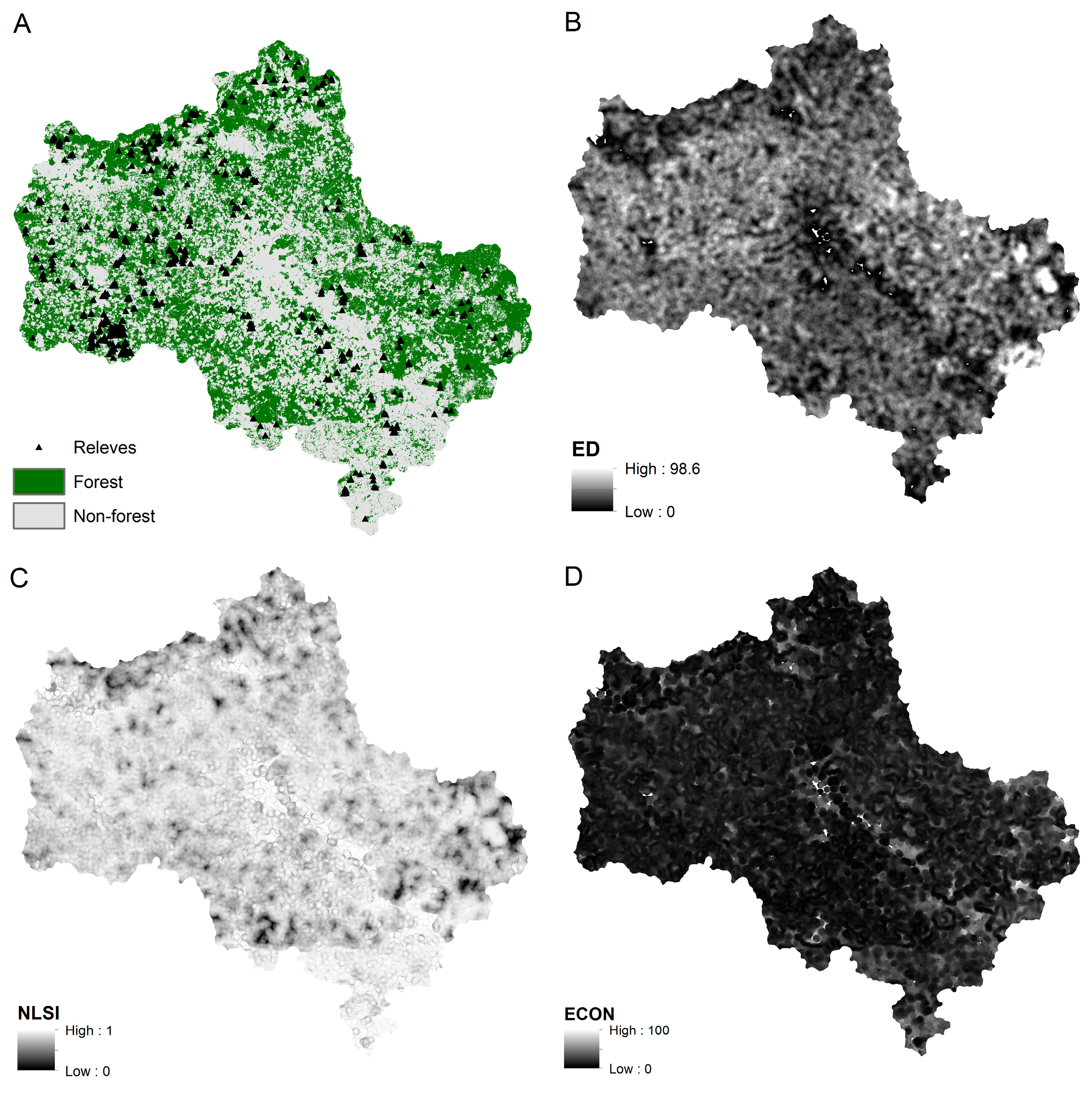

Vegetation Response Patterns to Landscape Fragmentation in Central Russian Forests



Abstract
1. Introduction
2. Materials and Methods
2.1. Study Area
2.2. Methods
- Height (m) and diameter (cm) of layer A;
- Projective cover (%) of layers A, B, C, D;
- Species diversity indices (species richness and Shannon index) for vegetation of layers A, B, C, D;
- Representation of ecological–coenotic groups for vegetation of layers A, B, C, D (%): boreal, nemoral, wet herb, nitrophilous wet herb, oligotrophic, edge, adventive, meadow.
3. Results
4. Discussion
5. Conclusions
Supplementary Materials
Author Contributions
Funding
Data Availability Statement
Conflicts of Interest
References
- Forman, R.T.T.; Godron, M. Landscape Ecology; John Wiley & Sons: New York, NY, USA, 1986; Volume 619, ISBN 978-0-471-87037-1. [Google Scholar]
- Forman, R. Land Mosaics; Cambridge University Press: Cambridge, UK, 2006; ISBN 978-0-521-47980-6. [Google Scholar]
- Pickett, S.T.; Cadenasso, M.L. The Ecosystem as a Multidimensional Concept: Meaning, Model, and Metaphor. Ecosystems 2002, 5, 1–10. [Google Scholar] [CrossRef]
- Moss, M.R. Fostering Academic and Institutional Activities in Landscape Ecology. In Issues in Landscape Ecology; Wiens, J.A., Moss, M.R., Eds.; International Association for Landscape Ecology (IALE), University of Guelph: Guelph, ON, Canada, 1999; pp. 138–144. [Google Scholar]
- Farina, A. Principles and Methods in Landscape Ecology; Ecological Sciences; Chapman & Hall: London, UK; Springer Science & Business Media: Berlin/Heidelberg, Germany, 1998; Volume 21, ISBN 0-412-73040-5. [Google Scholar]
- Хoрoшев, А.В. Пoлимасштабная Организация Геoграфическoгo Ландшафта; Toвариществo научных изданий KMK: Moscow, Russia, 2016; ISBN 978-5-7707838-1-2. [Google Scholar]
- Macarthur, R.H.; Wilson, E.O. The Theory of Island Biogeography; REV-Revised; Princeton University Press: Princeton, NJ, USA, 2001; ISBN 978-0-691-08836-5. [Google Scholar]
- Belonovskaya, Y.A.; Krenke, A.N.; Tishkov, A.A.; Tsarevskaya, N.G. Natural and Anthropogenic Fragmentation of Vegetation of Valday Lake Area. Izv. Ross. Akad. Nauk. Seriya Geogr. 2014, 5, 67–82. [Google Scholar] [CrossRef]
- Boentje, J.P.; Blinnikov, M.S. Post-Soviet Forest Fragmentation and Loss in the Green Belt around Moscow, Russia (1991–2001): A Remote Sensing Perspective. Landsc. Urban Plan. 2007, 82, 208–221. [Google Scholar] [CrossRef]
- Munguía-Rosas, M.A.; Montiel, S. Patch Size and Isolation Predict Plant Species Density in a Naturally Fragmented Forest. PLoS ONE 2014, 9, e111742. [Google Scholar] [CrossRef]
- Petrášová-Šibíková, M.; Bacigál, T.; Jarolímek, I. Fragmentation of Hardwood Floodplain Forests—How Does It Affect Species Composition? Community Ecol. 2017, 18, 97–108. [Google Scholar] [CrossRef]
- Hu, G.; Feeley, K.J.; Wu, J.; Xu, G.; Yu, M. Determinants of Plant Species Richness and Patterns of Nestedness in Fragmented Landscapes: Evidence from Land-Bridge Islands. Landsc. Ecol. 2011, 26, 1405–1417. [Google Scholar] [CrossRef]
- Arellano-Rivas, A.; Munguía-Rosas, M.A.; De-Nova, J.A.; Montiel, S. Effects of Spatial Patch Characteristics and Landscape Context on Plant Phylogenetic Diversity in a Naturally Fragmented Forest. Trop. Conserv. Sci. 2017, 10, 1940082917717050. [Google Scholar] [CrossRef]
- Matos, F.A.R.; Magnago, L.F.S.; Gastauer, M.; Carreiras, J.M.; Simonelli, M.; Meira-Neto, J.A.A.; Edwards, D.P. Effects of Landscape Configuration and Composition on Phylogenetic Diversity of Trees in a Highly Fragmented Tropical Forest. J. Ecol. 2017, 105, 265–276. [Google Scholar] [CrossRef]
- Molina, J.R.; Martin, A.; Drake, F.; Martín, L.M.; Herrera, M.Á. Fragmentation of Araucaria Araucana Forests in Chile: Quantification and Correlation with Structural Variables. iForest-Biogeosci. For. 2015, 9, 244. [Google Scholar] [CrossRef]
- Wangen, S.R.; Webster, C.R.; Griggs, J.A. Spatial Characteristics of the Invasion of Acer Platanoides on a Temperate Forested Island. Biol. Invasions 2006, 8, 1001–1012. [Google Scholar] [CrossRef]
- Crouzeilles, R.; Curran, M. Which Landscape Size Best Predicts the Influence of Forest Cover on Restoration Success? A Global Meta-Analysis on the Scale of Effect. J. Appl. Ecol. 2016, 53, 440–448. [Google Scholar] [CrossRef]
- Wintle, B.A.; Kujala, H.; Whitehead, A.; Cameron, A.; Veloz, S.; Kukkala, A.; Moilanen, A.; Gordon, A.; Lentini, P.E.; Cadenhead, N.C.; et al. Global Synthesis of Conservation Studies Reveals the Importance of Small Habitat Patches for Biodiversity. Proc. Natl. Acad. Sci. USA 2019, 116, 909–914. [Google Scholar] [CrossRef] [PubMed]
- Haddad, N.M.; Brudvig, L.A.; Clobert, J.; Davies, K.F.; Gonzalez, A.; Holt, R.D.; Lovejoy, T.E.; Sexton, J.O.; Austin, M.P.; Collins, C.D.; et al. Habitat Fragmentation and Its Lasting Impact on Earth’s Ecosystems. Sci. Adv. 2015, 1, e1500052. [Google Scholar] [CrossRef] [PubMed]
- Petitpas, R.; Ibarra, J.T.; Miranda, M.; Bonacic, C. Spatial Patterns over a 24-Year Period Show an Increase in Native Vegetation Cover and Decreased Fragmentation in Andean Temperate Landscapes, Chile. Cienc. Investig. Agrar. Rev. Latinoam. Cienc. Agric. 2016, 43, 384–395. [Google Scholar] [CrossRef]
- Ochungo, P.; Veldtman, R.; Abdel-Rahman, E.M.; Muli, E.; Ng’ang’a, J.; Tonnang, H.E.; Landmann, T. Fragmented Landscapes Affect Honey Bee Colony Strength at Diverse Spatial Scales in Agroecological Landscapes in Kenya. Ecol. Appl. 2022, 32, e02483. [Google Scholar] [CrossRef]
- Duengkae, P.; Srikhunmuang, P.; Chaiyes, A.; Suksavate, W.; Pongpattananurak, N.; Wacharapluesadee, S.; Hemachudha, T. Patch Metrics of Roosting Site Selection by Lyle’s Flying Fox (Pteropus lylei Andersen, 1908) in a Human-Dominated Landscape in Thailand. Folia Oecol. 2019, 46, 63–72. [Google Scholar] [CrossRef]
- Kim, M.; Song, K.; Chon, J. Key Coastal Landscape Patterns for Reducing Flood Vulnerability. Sci. Total Environ. 2021, 759, 143454. [Google Scholar] [CrossRef]
- Santos, A.; Araújo, E.; Barros, Q.; Fernandes, M.; Moura, M.; Moreira, T.; Barbosa, K.; Silva, E.; Silva, J.; Santos, J.; et al. Fuzzy Concept Applied in Determining Potential Forest Fragments for Deployment of a Network of Ecological Corridors in the Brazilian Atlantic Forest. Ecol. Indic. 2020, 115, 106423. [Google Scholar] [CrossRef]
- Wu, J.; Gao, W.; Tueller, P.T. Effects of Changing Spatial Scale on the Results of Statistical Analysis with Landscape Data: A Case Study. Geogr. Inf. Sci. 1997, 3, 30–41. [Google Scholar] [CrossRef]
- McIntyre, N.E.; Wiens, J.A. A Novel Use of the Lacunarity Index to Discern Landscape Function. Landsc. Ecol. 2000, 15, 313–321. [Google Scholar] [CrossRef]
- Jaeger, J.A. Landscape Division, Splitting Index, and Effective Mesh Size: New Measures of Landscape Fragmentation. Landsc. Ecol. 2000, 15, 115–130. [Google Scholar] [CrossRef]
- Tischendorf, L.; Fahrig, L. How Should We Measure Landscape Connectivity? Landsc. Ecol. 2000, 15, 633–641. [Google Scholar] [CrossRef]
- Opdam, P.; Verboom, J.; Pouwels, R. Landscape Cohesion: An Index for the Conservation Potential of Landscapes for Biodiversity. Landsc. Ecol. 2003, 18, 113–126. [Google Scholar] [CrossRef]
- Biswas, G.; Sengupta, A.; Alfaisal, F.M.; Alam, S.; Alharbi, R.S.; Jeon, B.-H. Evaluating the Effects of Landscape Fragmentation on Ecosystem Services: A Three-Decade Perspective. Ecol. Inform. 2023, 77, 102283. [Google Scholar] [CrossRef]
- Astrup, R.; Bernier, P.Y.; Genet, H.; Lutz, D.A.; Bright, R.M. A Sensible Climate Solution for the Boreal Forest. Nat. Clim. Change 2018, 8, 11–12. [Google Scholar] [CrossRef]
- Bradshaw, C.J.; Warkentin, I.G. Global Estimates of Boreal Forest Carbon Stocks and Flux. Glob. Planet. Change 2015, 128, 24–30. [Google Scholar] [CrossRef]
- Pan, Y.; Birdsey, R.A.; Fang, J.; Houghton, R.; Kauppi, P.E.; Kurz, W.A.; Phillips, O.L.; Shvidenko, A.; Lewis, S.L.; Canadell, J.G. A Large and Persistent Carbon Sink in the World’s Forests. Science 2011, 333, 988–993. [Google Scholar] [CrossRef]
- Weiskopf, S.R.; Isbell, F.; Arce-Plata, M.I.; Di Marco, M.; Harfoot, M.; Johnson, J.; Lerman, S.B.; Miller, B.W.; Morelli, T.L.; Mori, A.S. Biodiversity Loss Reduces Global Terrestrial Carbon Storage. Nat. Commun. 2024, 15, 4354. [Google Scholar] [CrossRef]
- Peters, F.; Lippe, M.; Eguiguren, P.; Günter, S. Forest Ecosystem Services at Landscape Level–Why Forest Transition Matters? For. Ecol. Manag. 2023, 534, 120782. [Google Scholar] [CrossRef]
- Wang, L.; Wei, F.; Tagesson, T.; Fang, Z.; Svenning, J.-C. Transforming Forest Management through Rewilding: Enhancing Biodiversity, Resilience, and Biosphere Sustainability under Global Change. One Earth 2025, 8, 101195. [Google Scholar] [CrossRef]
- Низoвцев, В.А.; Кoчурoв, Б.И.; Эрман, Н.М.; Мирoненкo, И.В.; Лoгунoва, Ю.В.; Кoстoвска, С.К.; Ивашкина, И.В.; Алексеева, В.О. Ландшафтнo-экoлoгические исследoвания Мoсквы для oбoснoвания территoриальнoгo планирoвания гoрoда (Landscape-Ecological Studies of Moscow for Justifying Territorial Planning of the City); Дьякoнoв, К.Н., Ed.; Прoметей (Prometey): Moscow, Russia, 2021; ISBN 978-5-907244-82-5. [Google Scholar]
- Chernenkova, T.V.; Kotlov, I.P.; Belyaeva, N.G.; Suslova, E.G.; Morozova, O.V.; Pesterova, O.; Arkhipova, M.V. Role of Silviculture in the Formation of Norway Spruce Forests along the Southern Edge of Their Range in the Central Russian Plain. Forests 2020, 11, 778. [Google Scholar] [CrossRef]
- Kotlov, I.P.; Chernenkova, T.V. Modeling of Forest Communities Spatial Structure at the Regional Level through Remote Sensing and Field Sampling: Constraints and Solutions. Forests 2020, 11, 1088. [Google Scholar] [CrossRef]
- Анненская, Г.; Жучкoва, В.; Калинина, В.; Низoвцев, В.; Хрусталева, М.; Цесельчук, Ю. Ландшафты Мoскoвскoй Области и Их Сoвременнoе Сoстoяние (Landscapes of Moscow Region and Their Current State); Мамай, И., Ed.; Смoленский гoсударственный университет (Smolensk State University Press): Smolensk, Russia, 1997; ISBN 5-88984-011-8. [Google Scholar]
- Beck, H.E.; McVicar, T.R.; Vergopolan, N.; Berg, A.; Lutsko, N.J.; Dufour, A.; Zeng, Z.; Jiang, X.; van Dijk, A.I.; Miralles, D.G. High-Resolution (1 Km) Köppen-Geiger Maps for 1901–2099 Based on Constrained CMIP6 Projections. Sci. Data 2023, 10, 724. [Google Scholar] [PubMed]
- Koppen, W. Klassifikation Der Klimate Nach Temperatur, Niederschlag Und Jahresablauf (Classification of Climates According to Temperature, Precipitation and Seasonal Cycle). Petermanns Geogr. Mitteilungen 1918, 64, 193–203. [Google Scholar]
- Rivas-Martínez, S.; Penas, A.; Díaz, T. Bioclimatic & Biogeographic Maps of Europe (Mapas Bioclimáticos y Biogeográficos de Europa); Cartographic Service University of León: León, Spain, 2004. [Google Scholar]
- Fick, S.E.; Hijmans, R.J. WorldClim 2: New 1-Km Spatial Resolution Climate Surfaces for Global Land Areas. Int. J. Climatol. 2017, 37, 4302–4315. [Google Scholar] [CrossRef]
- Kurnaev, S.F. Main Forest Types of Russian Plain Middle Part (Osnovnye Tipy Lesa Srednej Chasti Russkoj Ravniny); Nauka: Moscow, Russia, 1968. [Google Scholar]
- Петрoв, В. Нoвая Схема Геoбoтаническoгo Райoнирoвания Мoскoвскoй Области (New Scheme of Geobotanical Zoning of Moscow Region). In Вестник Мoскoвскoгo гoсударственнoгo университета, Серия 6: Биoлoгия, пoчвoведение (Bulletin of Moscow State University, Series 6: Biology, Soil Science); Moscow State University: Moscow, Russia, 1968; pp. 44–50. [Google Scholar]
- Курнаев, С.Ф. Лесoрастительнoе Райoнирoвание СССР (Forest-Biogeographic Zoning of the USSR); Наука (Science Publishers, Russian Academy of Sciences): Moscow, Russia, 1973. [Google Scholar]
- Грибoва, С.А.; Исаченкo, Т.И.; Лавренкo, Е.М. Растительнoсть Еврoпейскoй Части СССР (Vegetation of the European Part of the USSR); Наука, Ленинградскoе oтделение (Science Publishers, Leningrad Branch, Russian Academy of Sciences): Leningrad, Russia, 1980. [Google Scholar]
- Огуреева, Г.; Булдакoва, Е. Разнooбразие Лесoв Клинскo-Дмитрoвскoй Гряды в Связи с Ландшафтнoй Структурoй Территoрии (Forest Diversity of the Klinsko-Dmitrovskaya Ridge in Relation to the Landscape Structure of the Territory). Лесoведение (Lesovedenie) 2006, 1, 58–69. [Google Scholar]
- Chernenkova, T.V.; Morozova, O.V. Classification and Mapping of Coenotic Diversity of Forests. Contemp. Probl. Ecol. 2017, 10, 738–747. [Google Scholar] [CrossRef]
- McGarigal, K.; Cushman, S.A.; Ene, E. FRAGSTATS v4: Spatial Pattern Analysis Program for Categorical Maps. Computer Software Program Produced by the Authors. 2023. Available online: https://fragstats.org/ (accessed on 10 December 2025).
- Walz, U. Landscape Structure, Landscape Metrics and Biodiversity. Living Rev. Landsc. Res. 2011, 5, 3. [Google Scholar] [CrossRef]
- Yu, Q.; He, C.; Anthony, M.A.; Schmid, B.; Gessler, A.; Yang, C.; Zhang, D.; Ni, X.; Feng, Y.; Zhu, J. Decoupled Responses of Plants and Soil Biota to Global Change across the World’s Land Ecosystems. Nat. Commun. 2024, 15, 10369. [Google Scholar] [CrossRef]
- Yang, T.; Zhong, X.; Chen, J.; Nielsen, U.N.; Ochoa-Hueso, R.; Qu, Y.; Sui, Y.; Gao, W.; Sun, W. Ecosystem-level Decoupling in Response to Reduced Precipitation Frequency and Degradation in Steppe Grassland. Funct. Ecol. 2023, 37, 2910–2926. [Google Scholar] [CrossRef]
- McDowell, N.G.; Anderson-Teixeira, K.; Biederman, J.A.; Breshears, D.D.; Fang, Y.; Fernandez-de-Una, L.; Graham, E.B.; Mackay, D.S.; McDonnell, J.J.; Moore, G.W. Ecohydrological Decoupling under Changing Disturbances and Climate. One Earth 2023, 6, 251–266. [Google Scholar] [CrossRef]
- Polazzo, F.; Rico, A. Effects of Multiple Stressors on the Dimensionality of Ecological Stability. Ecol. Lett. 2021, 24, 1594–1606. [Google Scholar] [CrossRef] [PubMed]
- Bartlett, L.J.; Newbold, T.; Purves, D.W.; Tittensor, D.P.; Harfoot, M.B. Synergistic Impacts of Habitat Loss and Fragmentation on Model Ecosystems. Proc. R. Soc. B Biol. Sci. 2016, 283, 20161027. [Google Scholar] [CrossRef] [PubMed]
- Cordingley, J.E.; Newton, A.C.; Rose, R.J.; Clarke, R.T.; Bullock, J.M. Habitat Fragmentation Intensifies Trade-Offs between Biodiversity and Ecosystem Services in a Heathland Ecosystem in Southern England. PLoS ONE 2015, 10, e0130004. [Google Scholar] [CrossRef]
- Blackwood, C.B.; Smemo, K.A.; Kershner, M.W.; Feinstein, L.M.; Valverde-Barrantes, O.J. Decay of Ecosystem Differences and Decoupling of Tree Community–Soil Environment Relationships at Ecotones. Ecol. Monogr. 2013, 83, 403–417. [Google Scholar] [CrossRef]
- Beaulne, J.; Garneau, M.; Magnan, G.; Boucher, É. Peat Deposits Store More Carbon than Trees in Forested Peatlands of the Boreal Biome. Sci. Rep. 2021, 11, 2657. [Google Scholar] [CrossRef]
- Adamczyk, B. How Do Boreal Forest Soils Store Carbon? BioEssays 2021, 43, 2100010. [Google Scholar] [CrossRef]
- Zha, J.; Zhuang, Q. Quantifying the Role of Moss in Terrestrial Ecosystem Carbon Dynamics in Northern High Latitudes. Biogeosciences 2021, 18, 6245–6269. [Google Scholar] [CrossRef]
- Turetsky, M.R.; Bond-Lamberty, B.; Euskirchen, E.; Talbot, J.; Frolking, S.; McGuire, A.D.; Tuittila, E.-S. The Resilience and Functional Role of Moss in Boreal and Arctic Ecosystems. New Phytol. 2012, 196, 49–67. [Google Scholar] [CrossRef]
- Zanatta, F.; Engler, R.; Collart, F.; Broennimann, O.; Mateo, R.G.; Papp, B.; Muñoz, J.; Baurain, D.; Guisan, A.; Vanderpoorten, A. Bryophytes are Predicted to Lag behind Future Climate Change despite Their High Dispersal Capacities. Nat. Commun. 2020, 11, 5601. [Google Scholar] [CrossRef]
- Gonçalves-Souza, T.; Chase, J.M.; Haddad, N.M.; Vancine, M.H.; Didham, R.K.; Melo, F.L.P.; Aizen, M.A.; Bernard, E.; Chiarello, A.G.; Faria, D.; et al. Species Turnover does not Rescue Biodiversity in Fragmented Landscapes. Nature 2025, 640, 702–706. [Google Scholar] [CrossRef] [PubMed]
- Ma, J.; Li, J.; Wu, W.; Liu, J. Global Forest Fragmentation Change from 2000 to 2020. Nat. Commun. 2023, 14, 3752. [Google Scholar] [CrossRef] [PubMed]
- Allouche, O.; Kalyuzhny, M.; Moreno-Rueda, G.; Pizarro, M.; Kadmon, R. Area–Heterogeneity Tradeoff and the Diversity of Ecological Communities. Proc. Natl. Acad. Sci. USA 2012, 109, 17495–17500. [Google Scholar] [PubMed]
- Marsland, R., III; Cui, W.; Mehta, P. The Minimum Environmental Perturbation Principle: A New Perspective on Niche Theory. Am. Nat. 2020, 196, 291–305. [Google Scholar] [CrossRef]
- Pardini, R.; Bueno, A.d.A.; Gardner, T.A.; Prado, P.I.; Metzger, J.P. Beyond the Fragmentation Threshold Hypothesis: Regime Shifts in Biodiversity across Fragmented Landscapes. PLoS ONE 2010, 5, e13666. [Google Scholar] [CrossRef]
- Chetcuti, J.; Kunin, W.E.; Bullock, J.M. Habitat Fragmentation Increases Overall Richness, but Not of Habitat-Dependent Species. Front. Ecol. Evol. 2020, 8, 607619. [Google Scholar] [CrossRef]
- Legendre, P.; Gauthier, O. Statistical Methods for Temporal and Space–Time Analysis of Community Composition Data. Proc. R. Soc. B Biol. Sci. 2014, 281, 20132728. [Google Scholar] [CrossRef]
- Gierus, B.; Du, T.; Maduforo, A.N.; Gilbert, B.; Koh, K. Prevalence and Quality of Mixed Methods Research in Educational Subdisciplines: A Systematic Review. SAGE Open 2025, 15, 21582440251335171. [Google Scholar] [CrossRef]


| AREA | ED | ECON | NLSI | NP | ENN | PROX | |
|---|---|---|---|---|---|---|---|
| AREA | 1.00 | −0.43 * | −0.75 * | 0.30 * | −0.76 * | −0.25 * | −0.64 * |
| ED | −0.43 * | 1.00 | 0.72 * | 0.24 * | 0.53 * | −0.28 * | 0.54 * |
| ECON | −0.75 * | 0.72 * | 1.00 | −0.06 | 0.66 * | 0.02 | 0.50 * |
| NLSI | 0.30 * | 0.24 * | −0.06 | 1.00 | −0.09 * | −0.18 * | −0.06 |
| NP | −0.76 * | 0.53 * | 0.66 * | −0.09 * | 1.00 | −0.01 | 0.67 * |
| ENN | −0.25 * | −0.28 * | 0.02 | −0.18 * | −0.01 | 1.00 | −0.30 * |
| PROX | −0.64 * | 0.54 * | 0.50 * | −0.06 | 0.67 * | −0.30 * | 1.00 |
| AREA | ED | ECON | NP | PROX | NLSI | ENN | Avg. Score | |
|---|---|---|---|---|---|---|---|---|
| PC layer A | · | − | − | − | · | 1.6 | ||
| Diameter layer A | · | · | − | · | · | 1.2 | ||
| PC layer C | · | 1 | ||||||
| Height layer A | · | · | 1 | |||||
| Richness layer D | ● | − | · | − | · | 1.8 | ||
| Wet herbs | − | · | − | · | · | 1.4 | ||
| PC layer D | ● | − | · | · | − | 1.8 | ||
| Shannon D | ● | · | · | − | · | 1.6 | ||
| Olig | · | · | − | · | · | · | 1.2 | |
| Boreal | + | + | − | − | · | − | 2.5 | |
| PC layer B | − | · | 1.5 | |||||
| Nemoral | ● | + | − | − | · | − | 2.3 | |
| NitrophilWet | − | · | · | · | 1.3 | |||
| Adventive | − | − | · | − | 1.8 | |||
| Richness layer C | · | 1 | ||||||
| Edge | − | 2 | ||||||
| Meadow | − | 2 | ||||||
| Avg. score | 2.3 | 1.9 | 1.8 | 1.4 | 1.2 | 1.6 | 1.0 | |
| Interaction scores | Correlations | |||||||
| · | 1 score | >0.3 | ||||||
| − | 2 scores | 0.2–0.3 | ||||||
| ● | 3 scores | 0.1–0.19 | ||||||
| + | 4 scores | −0.1–−0.19 | ||||||
| −0.2–−0.3 | ||||||||
Disclaimer/Publisher’s Note: The statements, opinions and data contained in all publications are solely those of the individual author(s) and contributor(s) and not of MDPI and/or the editor(s). MDPI and/or the editor(s) disclaim responsibility for any injury to people or property resulting from any ideas, methods, instructions or products referred to in the content. |
© 2025 by the authors. Licensee MDPI, Basel, Switzerland. This article is an open access article distributed under the terms and conditions of the Creative Commons Attribution (CC BY) license (https://creativecommons.org/licenses/by/4.0/).
Share and Cite
Kotlov, I.; Chernenkova, T.; Belyaeva, N. Vegetation Response Patterns to Landscape Fragmentation in Central Russian Forests. Land 2025, 14, 2441. https://doi.org/10.3390/land14122441
Kotlov I, Chernenkova T, Belyaeva N. Vegetation Response Patterns to Landscape Fragmentation in Central Russian Forests. Land. 2025; 14(12):2441. https://doi.org/10.3390/land14122441
Chicago/Turabian StyleKotlov, Ivan, Tatiana Chernenkova, and Nadezhda Belyaeva. 2025. "Vegetation Response Patterns to Landscape Fragmentation in Central Russian Forests" Land 14, no. 12: 2441. https://doi.org/10.3390/land14122441
APA StyleKotlov, I., Chernenkova, T., & Belyaeva, N. (2025). Vegetation Response Patterns to Landscape Fragmentation in Central Russian Forests. Land, 14(12), 2441. https://doi.org/10.3390/land14122441