
From Morphotype to Plan: Advancing a Typo-Morphological Method for Rural Architecture and Landscape Through Territorial-Planning Analysis Within the Pontine Reclamation, Italy

 , ,
, ,
Abstract
1. Premise
2. Introduction
2.1. International Theoretical Foundations of Rural and Agrarian Landscapes
2.2. Rural Architecture as a Structural Component of the Landscape
2.3. The Case of Sabaudia and the Territorial Organization of the ONC
2.4. Research Thesis and Hypotheses
- Morphological Hypothesis–The repetition of building types and farm layouts generates a coherent settlement structure capable of organizing the agrarian landscape according to principles of productive rationality.
- Territorial Hypothesis–The farm units, integrated with the hydraulic and road networks of the reclamation, constitute an infrastructural framework operating at the landscape scale.
- Interpretative Hypothesis–The combined reading of architectural, settlement, and infrastructural components redefines rural architecture as an active device in the construction and structuring of the Pontine agrarian landscape.
3. Background
3.1. The Comparative Framework Underlying Typological Observation
3.2. Definition of the Qualifying and Characterizing Elements of the Topic
3.3. Classification of Evaluation Indicators and Definition of the Investigative Method: Typological Observation Sheets
4. Materials and Methods
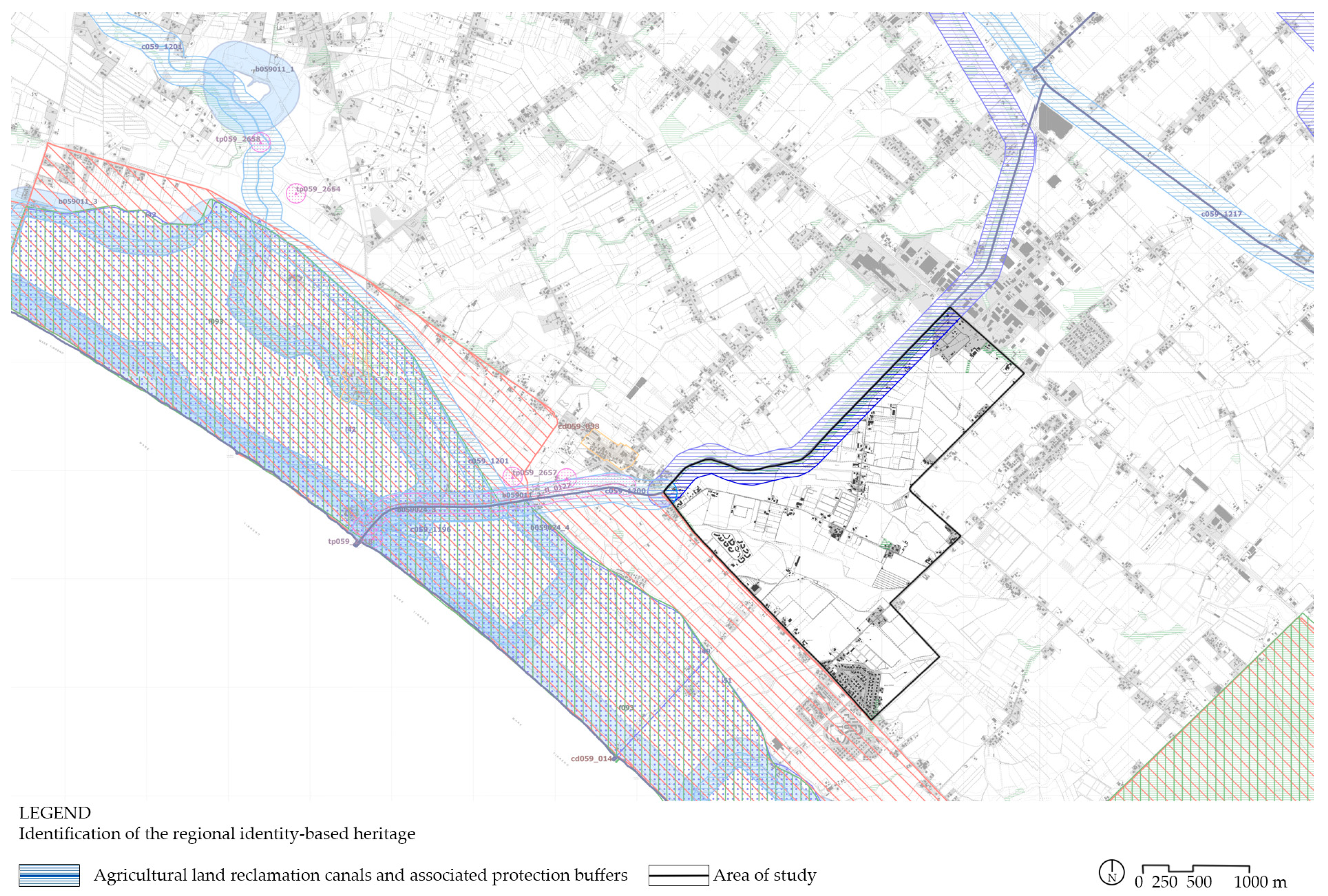
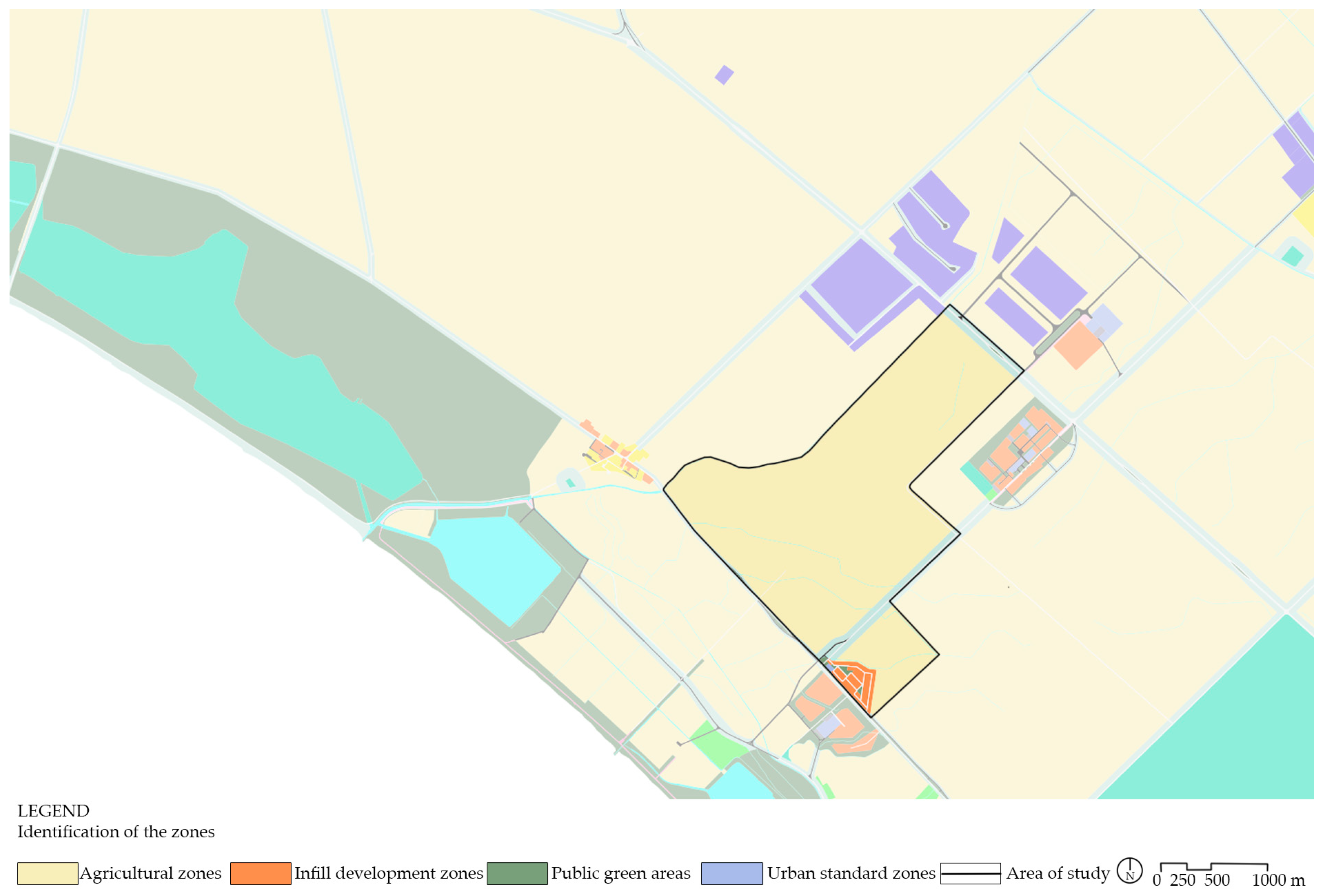
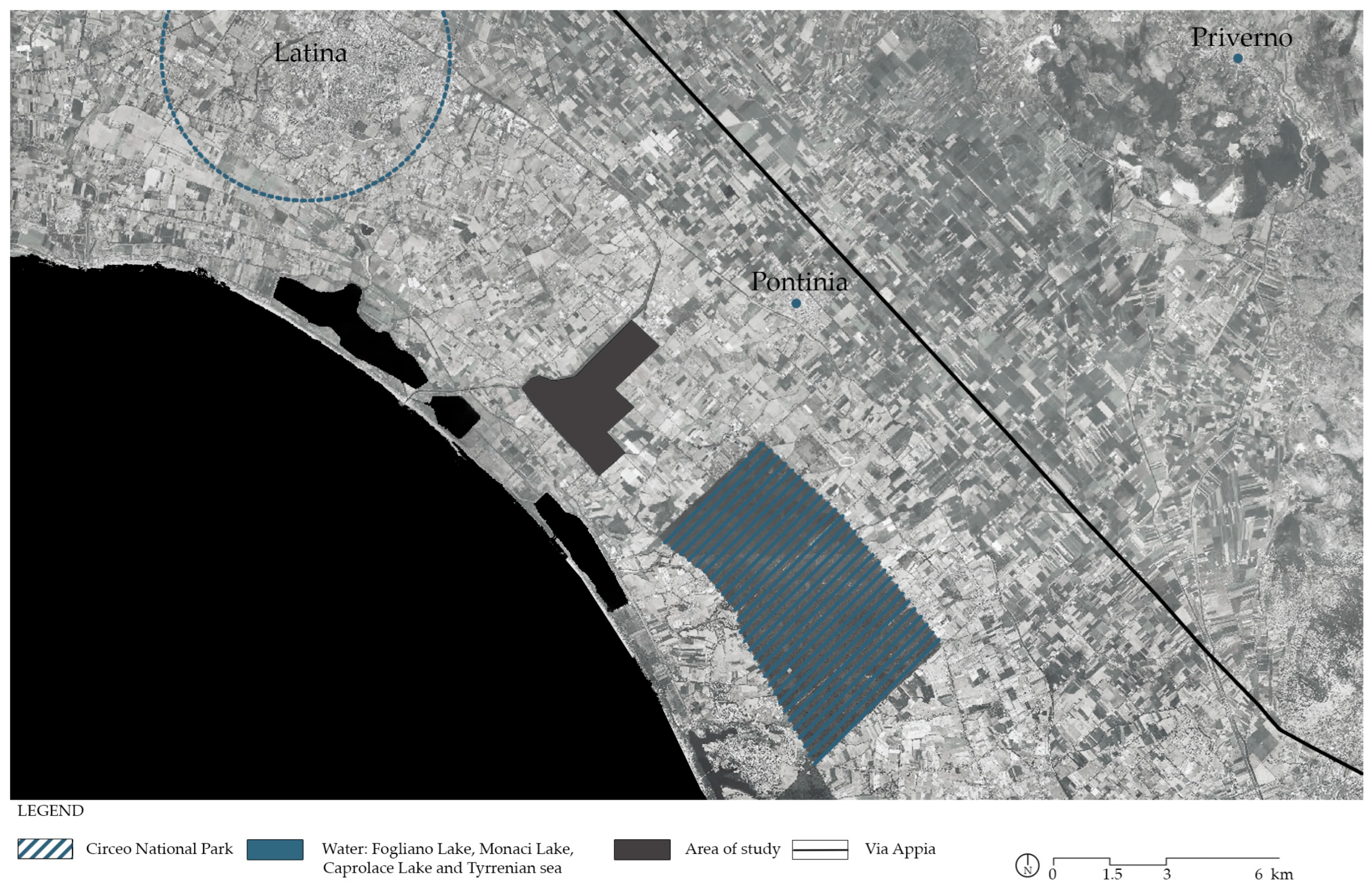
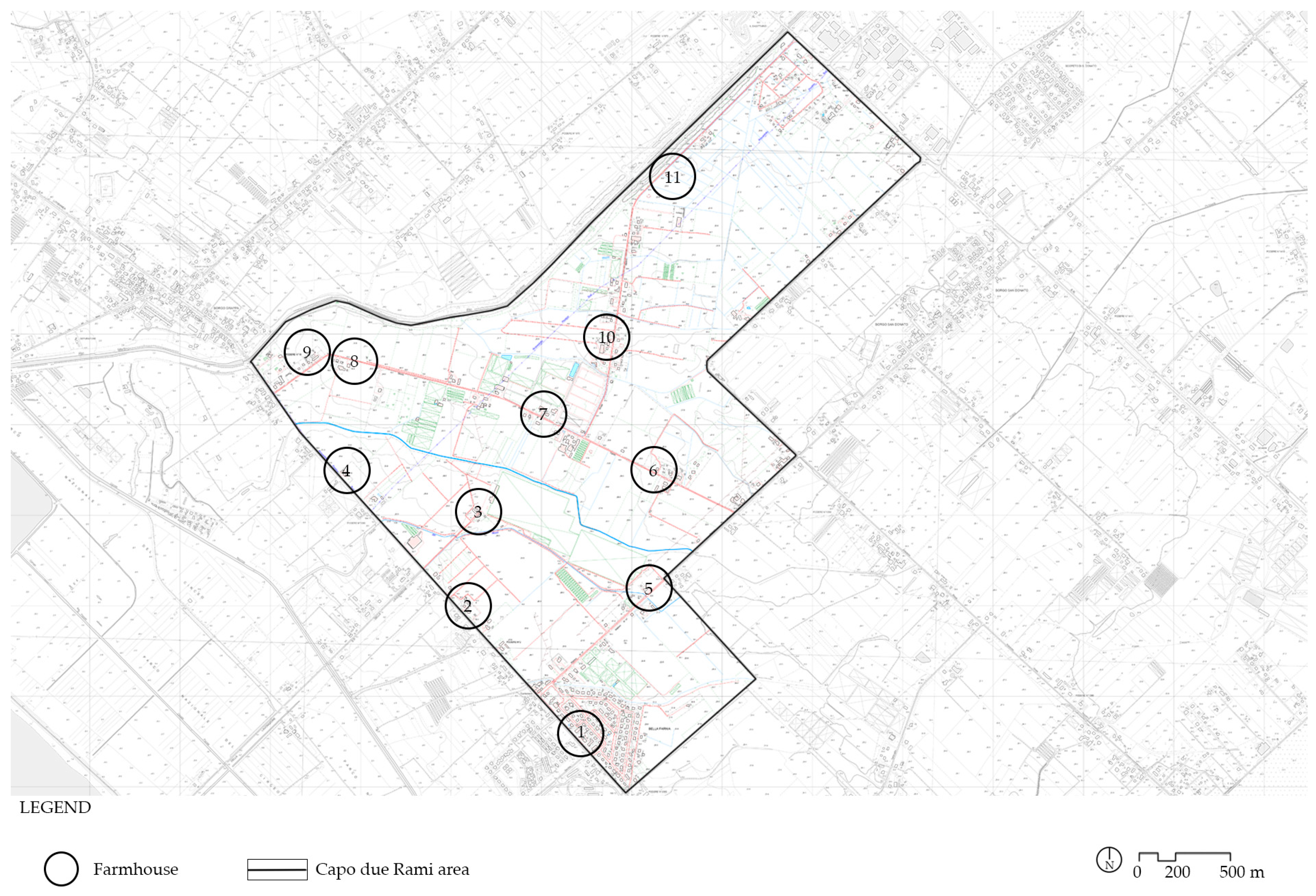
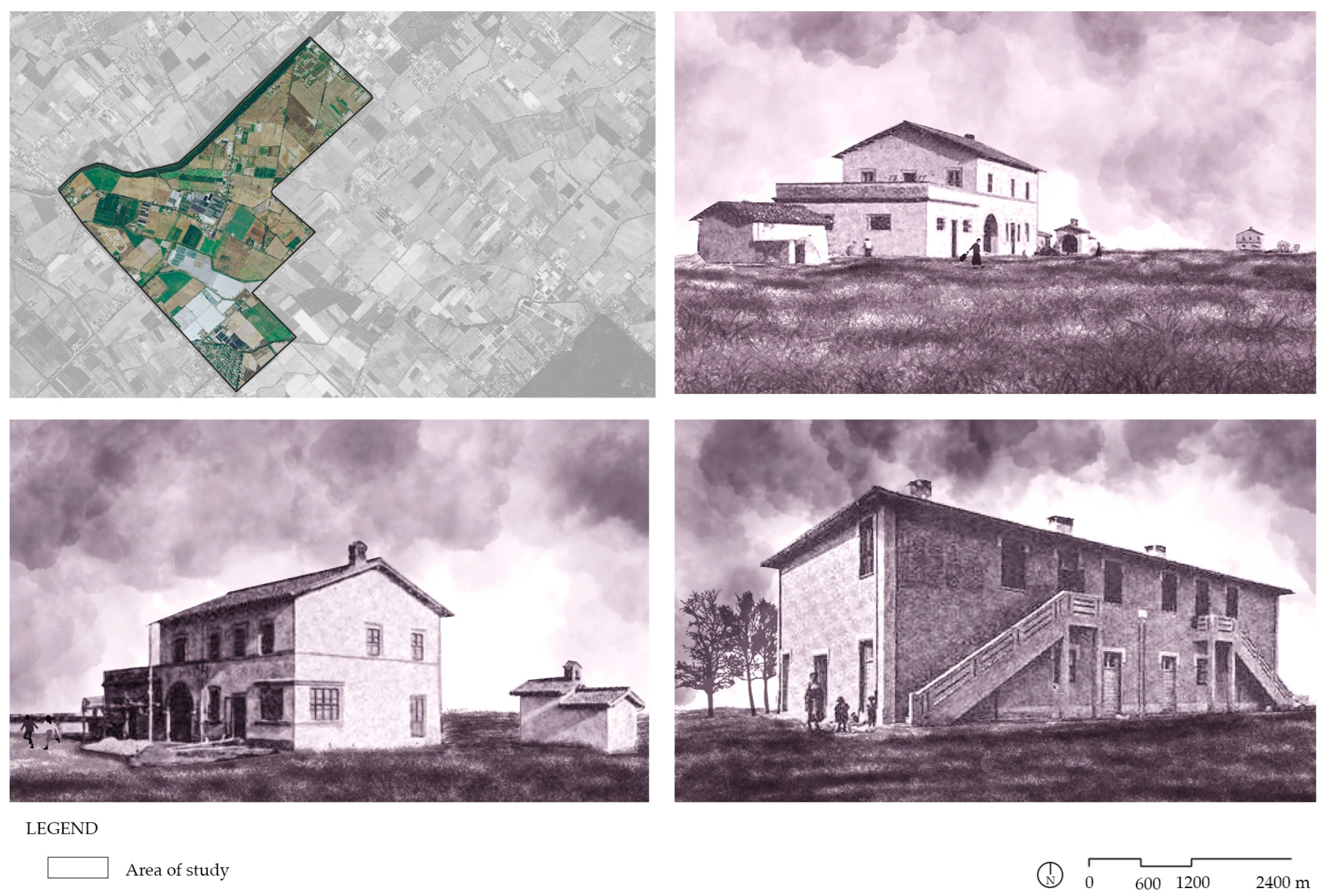
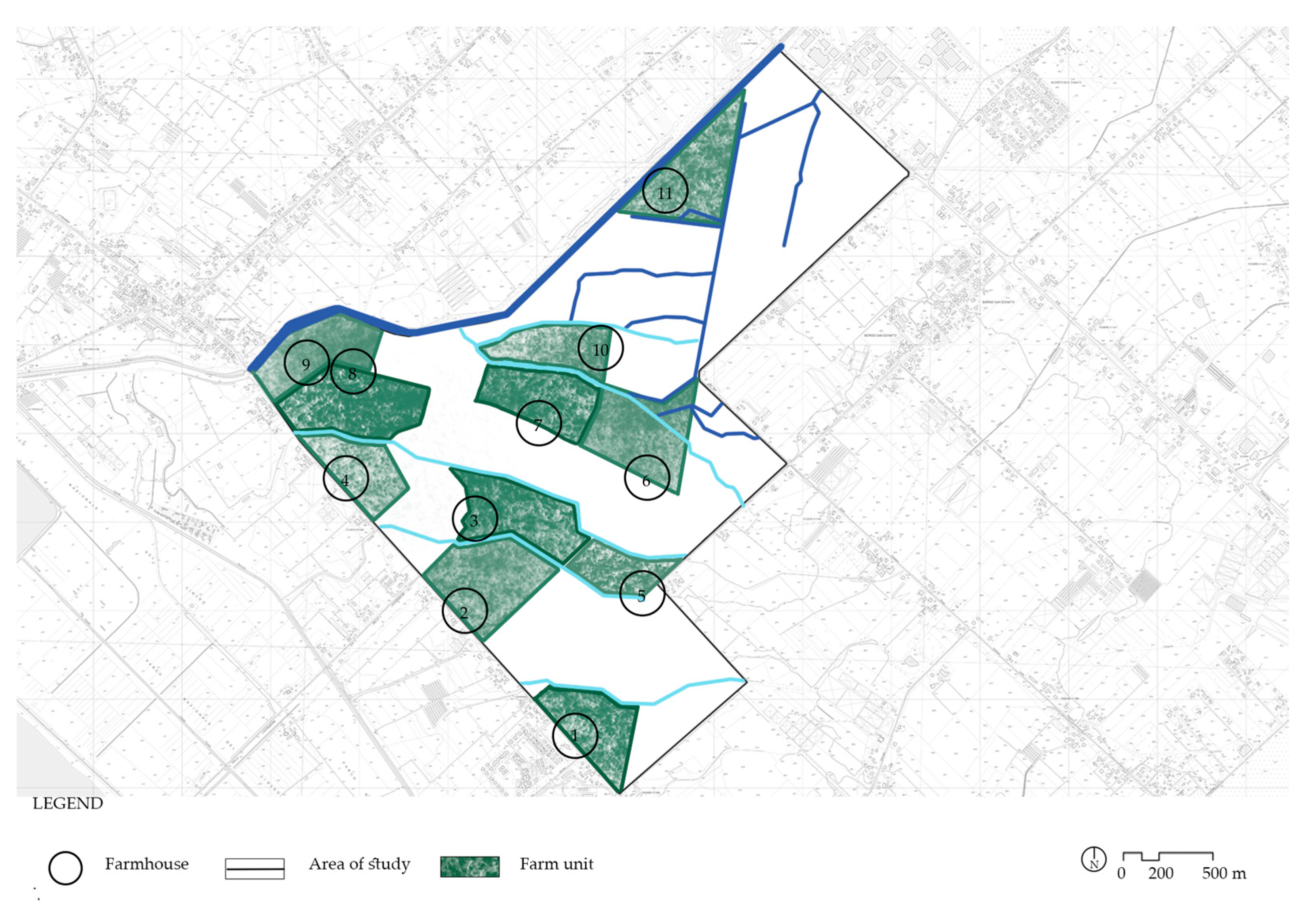
4.1. Presentation of the Case Study
4.2. Historical, Typological, and Landscape Analyses: The Characterizing Elements of the Observation Sheets
4.2.1. Historical and Historical-Documentary Analyses
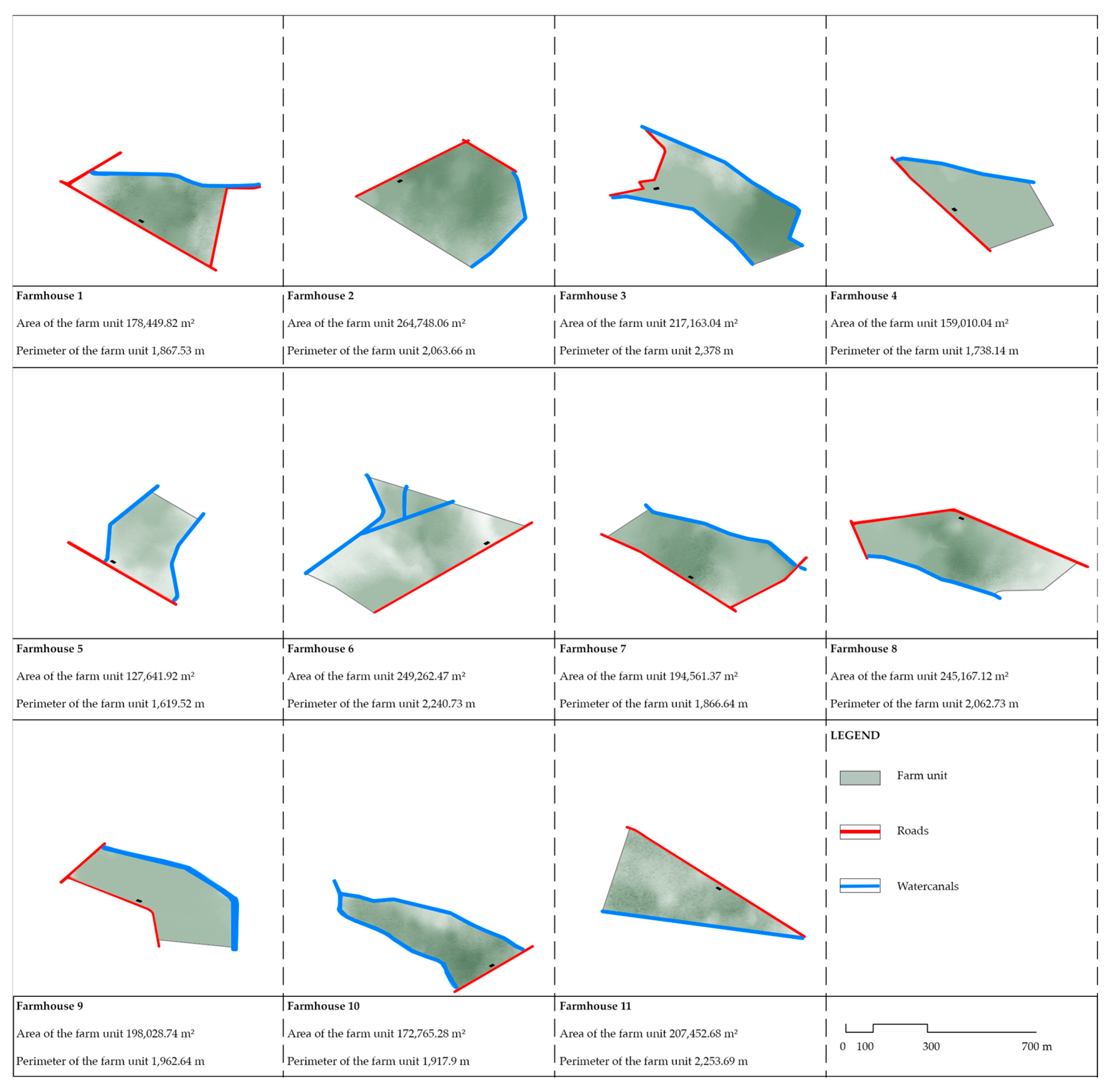
4.2.2. The Farm Unit as Intermediate Landscape Scale
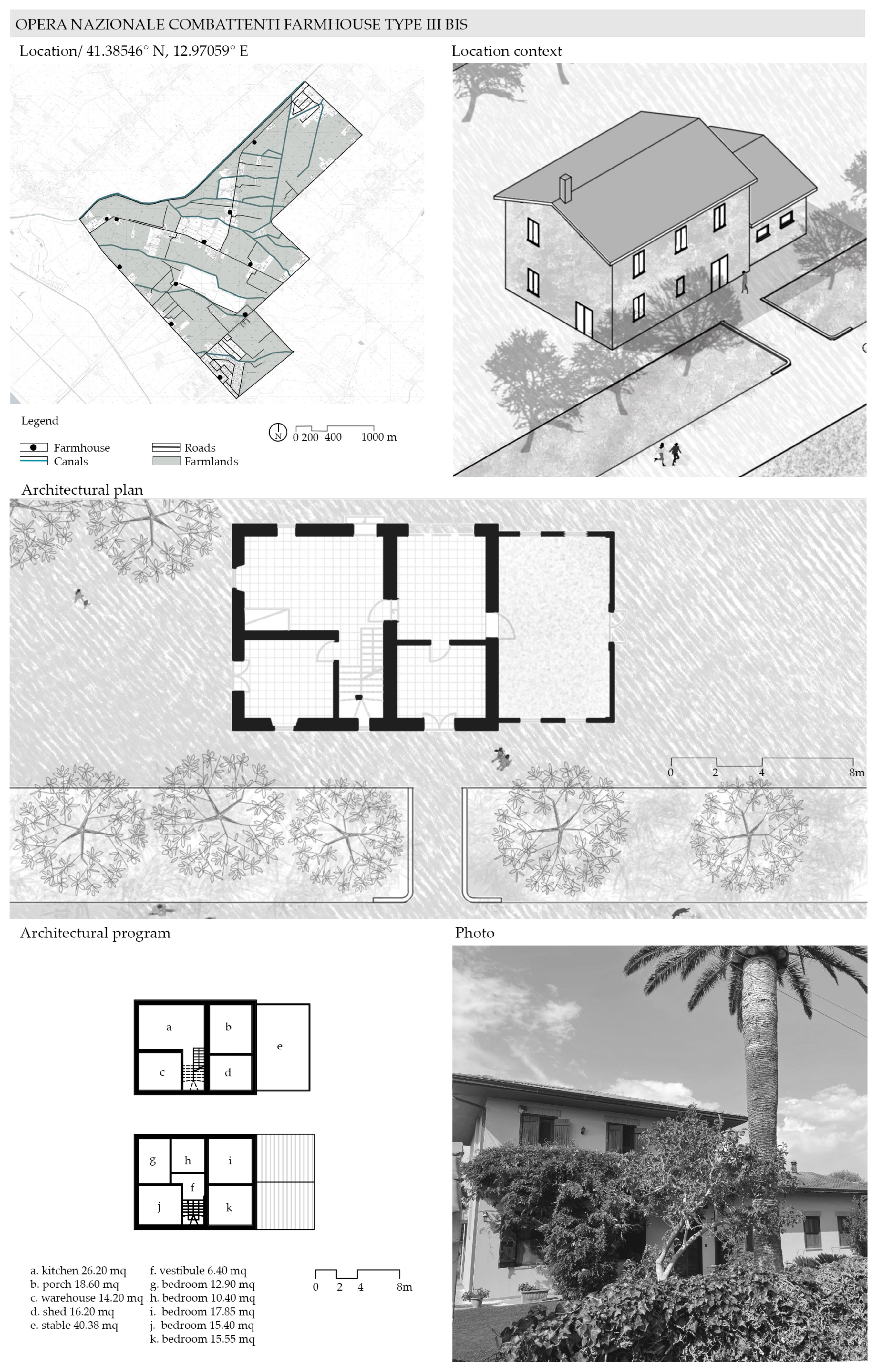
4.2.3. Architectural Typology of the ONC Farmhouse
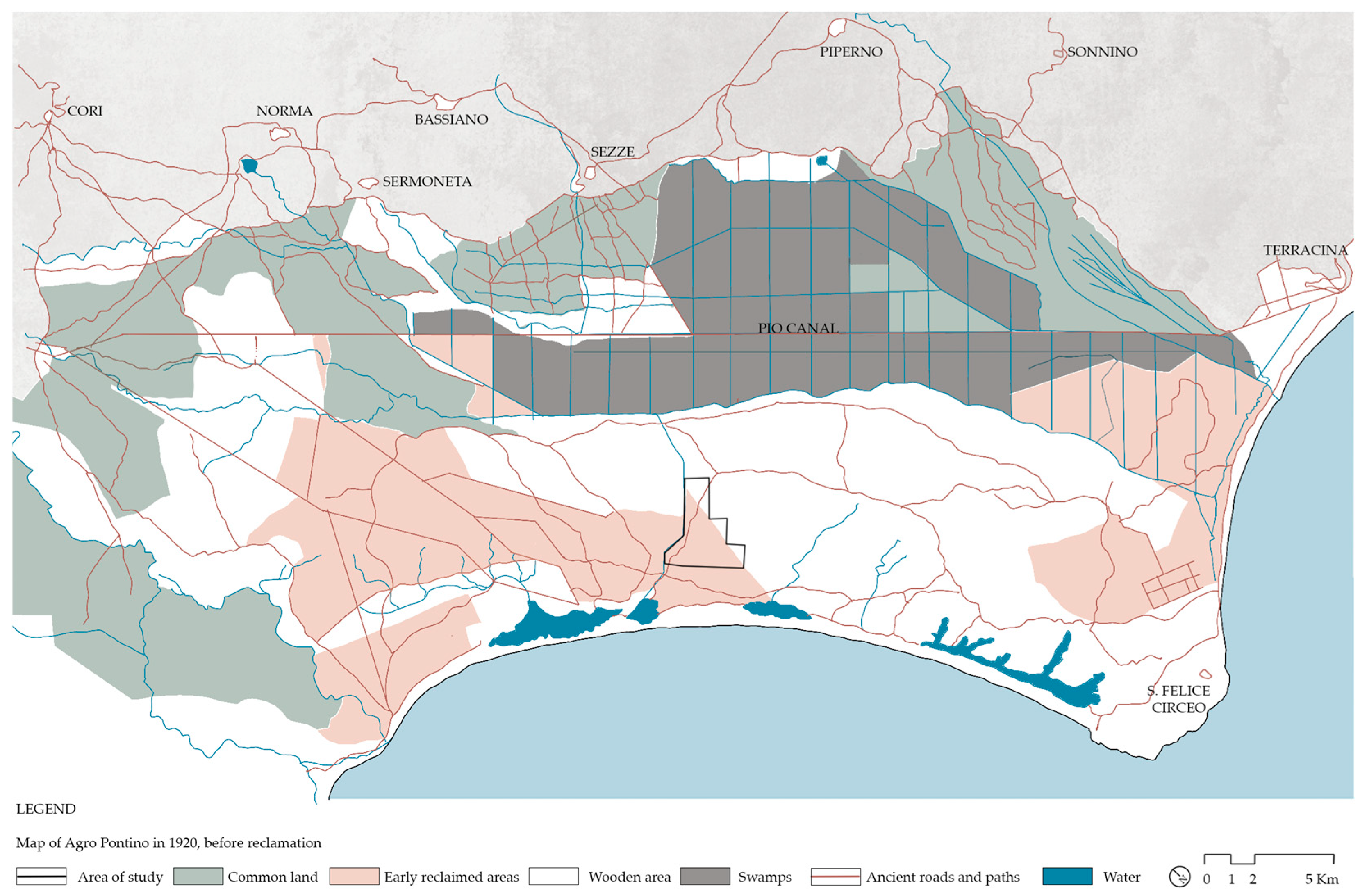
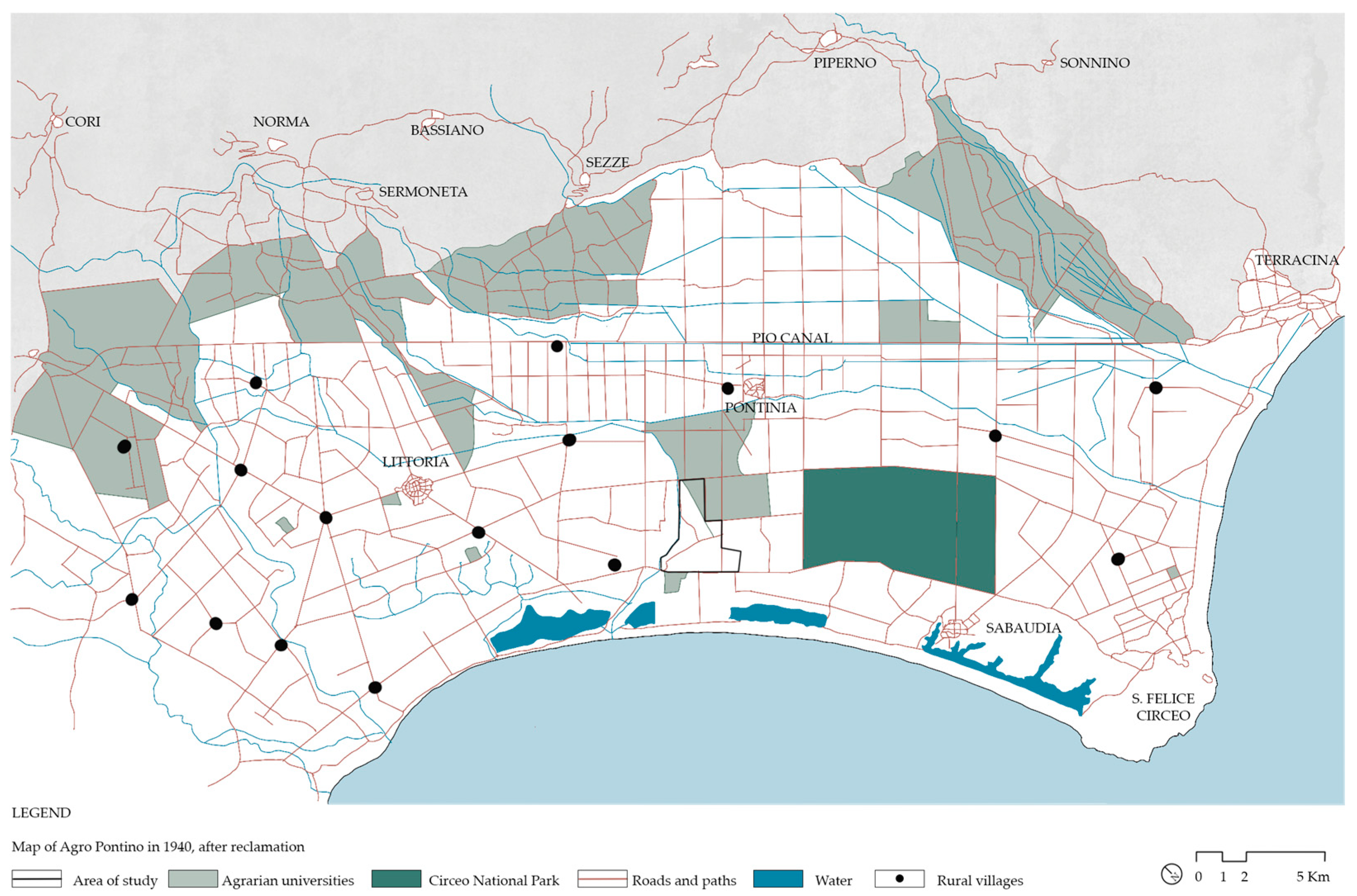
4.2.4. From Reclamation to Planning: Relationships Between Territorial Structure and Building Type
5. Results and Discussion
5.1. Application and Replication of the Experimental Model of Typological Analysis
5.2. Rural Architecture and the Construction of the Agrarian Landscape System
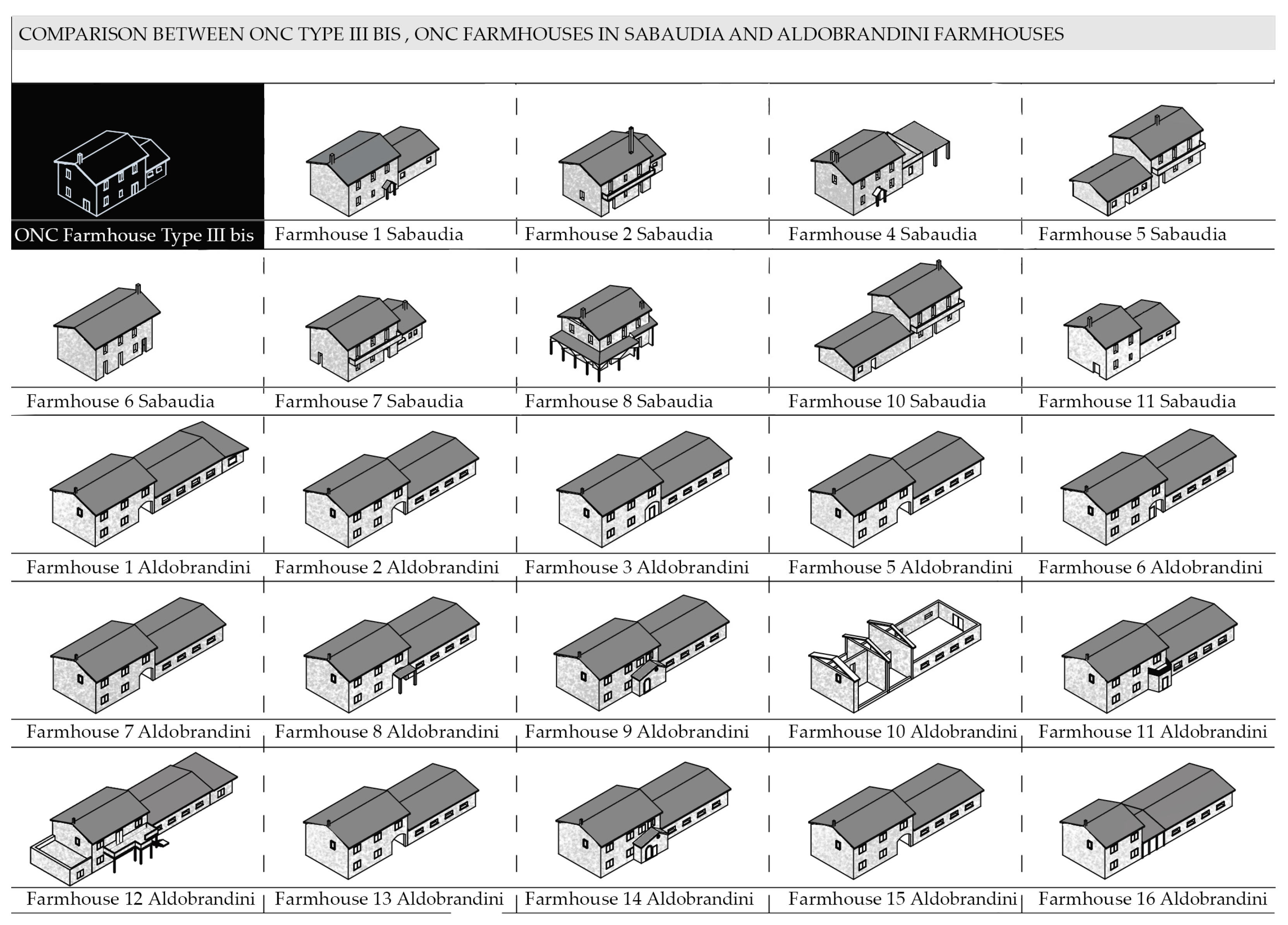
5.3. Typological Variations Across Territorial and Intermediate Scales
5.4. Typology, Planning Logics, and Landscape Policy Framework
6. Conclusions
Author Contributions
Funding
Data Availability Statement
Conflicts of Interest
References
- Bigiotti, S.; Santarsiero, M.L.; Del Monaco, A.I.; Marucci, A. A Typological Analysis Method for Rural Dwellings: Architectural Features, Historical Transformations, and Landscape Integration: The Case of “Capo Due Rami”, Italy. Land 2025, 14, 374. [Google Scholar] [CrossRef]
- Bigiotti, S.; Costantino, C.; Santarsiero, M.L.; Marucci, A. A Methodological Approach for Assessing the Interaction Between Rural Landscapes and Built Structures: A Case Study of Winery Architecture in Tuscany, Italy. Land 2025, 14, 152. [Google Scholar] [CrossRef]
- Selman, P. What Do We Mean by Sustainable Landscape? Sustain. Sci. Pract. Policy 2008, 4, 23–28. [Google Scholar] [CrossRef]
- Pagano, G.; Guarniero, D. Architettura Rurale Italiana; Quaderni della Triennale, Ed.; Ulrico Hoepli Editore: Milano, Italy, 1936. [Google Scholar]
- D’Amia, G. Giuseppe Pagano e l’architettura rurale. Territorio 2013, 66, 109–120. [Google Scholar] [CrossRef]
- Biasutti, R. Per lo studio dell’abitazione rurale in Italia. Riv. Geogr. Ital. 1926, 33, 1–24. [Google Scholar]
- Barbieri, G.; Gambi, L. (Eds.) La Casa Rurale in Italia. In Ricerche sulle Dimore Rurali in Italia; No. 29; Consiglio Nazionale delle Ricerche; Leo S. Olschki Editore: Firenze, Italy, 1970. [Google Scholar]
- Di Giulio, R.; Zaffagnini, T. Case Sparse. Paesaggi Agrari tra Ferrara e Bologna: Strategie per la Valorizzazione e il Riuso del Patrimonio Rurale; FrancoAngeli Editore: Milano, Italy, 2010. [Google Scholar]
- Bilò, F. Valori estetici e paesaggio contemporaneo. In Conferenza Nazionale per il Paesaggio. Lavori Preparatori; Cavezzali, D., Palombi, M.R., Eds.; Gangemi Editore: Roma, Italy; pp. 141–144. ISBN 978-88-492-0132-1.
- Donadieu, P. Scienze del Paesaggio. Tra Teorie e Pratiche; Edizioni ETS: Bologna, Italy, 2014; ISBN 978-88-4673-7106. [Google Scholar]
- Gkartzios, M.; Gallent, N.; Scott, M. (Eds.) Rural Places and Planning: Stories from the Global Countryside; Policy Press: Bristol, UK, 2022. [Google Scholar] [CrossRef]
- Gregotti, V. La nozione di “contesto”. Casabella 1981, 465, 9. [Google Scholar]
- Gregotti, V. Il Territorio dell’Architettura; Feltrinelli: Milano, Italy, 1966; p. 75. [Google Scholar]
- Magnaghi, A. (Ed.) Il Territorio Bene Comune; Firenze University Press: Firenze, Italy, 2012; ISBN 978-88-6655-131-7 (print), 978-88-6655-134-8 (online). [Google Scholar]
- Italian Government. Legislative Decree of January 22, 2004, No. 42, Code of Cultural Heritage and Landscape; pursuant to Article 10 of Law No. 137 of July 6, 2002; Italian Government: Rome, Italy, 2004.
- Cecchi, R. I Beni Culturali. Testimonianza Materiale di Civiltà; Spirali Edizioni: Milano, Italy, 2006; ISBN 978-88-7770-742-0. [Google Scholar]
- Sereni, E. Storia Del Paesaggio Agrario Italiano, 3rd ed.; Edizioni Laterza: Bari, Italy, 2020; ISBN 978-88-581-4074-1. [Google Scholar]
- Italian Government. Legislative Decree of April 3, 2006, No. 152, Environmental Code; Amended by Legislative Decree of January 16, 2008, No. 4; Italian Government: Rome, Italy, 2008.
- Secchi, R. Progetto di paesaggio, progetto evolutivo? In Paesaggio e Ambiente Nelle Trasformazioni Urbane; Aracne editrice Srl: Rome, Italy, 2013. [Google Scholar]
- Orlando, S.; Catania, P.; Greco, C.; Ferro, M.V.; Vallone, M.; Scarascia Mugnozza, G. Rural Landscape Transformation and the Adaptive Reuse of Historical Agricultural Constructions in Bagheria (Sicily): A GIS-Based Approach to Territorial Planning and Representation. Sustainability 2025, 17, 6291. [Google Scholar] [CrossRef]
- Masullo, C. La grande bonifica della Piana Pontina. L’Acqua—Rivista dell’Associazione Idrotecnica Italiana. Sezione “Opere e Sistemi”. 2016. Available online: https://www.idrotecnicaitaliana.it/lacquaonline/wp-content/uploads/2016/08/Masullo-LA-BONIFICA-della-PIANURA-PONTINA.pdf (accessed on 16 October 2025).
- Trapani, F. Verso La Pianificazione Territoriale Integrata. Il Governo Del Territorio A Confronto Delle Politiche Di Sviluppo Locale; Franco Angeli: Milano, Italy, 2009; ISBN 978-88-568-0463-8. [Google Scholar]
- De Montis, A. Measuring the Performance of Planning: The Conformance of Italian Landscape Planning Practices with the European Landscape Convention. Eur. Plan. Stud. 2016, 24, 1727–1745. [Google Scholar] [CrossRef]
- De Montis, A.; Ledda, A.; Serra, V.; Noce, M.; Barra, M.; De Montis, S. A Method for Analysing and Planning Rural Built-up Landscapes: The Case of Sardinia, Italy. Land Use Policy 2017, 62, 113–131. [Google Scholar] [CrossRef]
- Fiore, E.; Iaccarino, S. An Historically-Informed Approach to the Conservation of Vernacular Architecture: The Case of the Phlegrean Farmhouses. The International Archives of the Photogrammetry. Remote Sens. Spat. Inf. Sci. 2020, 44, 153–158. [Google Scholar]
- Rahmi, D.H.; Tamimi, S. Traditional Domestic Architecture in the Rural Cultural Landscape of Borobudur, Indonesia. ISVS E-J. 2023, 10, 182–200. [Google Scholar]
- Khadour, N.; Basha, N.A.; Sárospataki, M.; Fekete, A. Correlation between Land Use and the Transformation of Rural Housing Model in the Coastal Region of Syria. Sustainability 2021, 13, 4357. [Google Scholar] [CrossRef]
- Ji, Z.; Xu, Y.; Sun, M.; Liu, C.; Lu, L.; Huang, A.; Duan, Y.; Liu, L. Spatiotemporal Characteristics and Dynamic Mechanism of Rural Settlements Based on Typical Transects: A Case Study of Zhangjiakou City, China. Habitat Int. 2022, 123, 102545. [Google Scholar] [CrossRef]
- Xie, D.; Wang, Y.; Song, F. Space Optimization of Historical Landscape of The Great Wall Villages Based on Landscape Ecology: A Case Study of Chicheng Area in Zhangjiakou. Environ. Eng. Manag. J. 2023, 22, 1057–1071. [Google Scholar] [CrossRef]
- Peña-Huaman, F.; Sifuentes-Rivera, D.; Yarasca-Aybar, C. Architectural typology of rural housing in Jaen, Peru. Built Herit. 2022, 6, 2. [Google Scholar] [CrossRef]
- Picuno, P. Vernacular farm buildings in landscape planning: A typological analysis in a southern Italian region. J. Agric. Eng. 2012, 43, e20. [Google Scholar] [CrossRef]
- Lešková, A.; Vaishar, A. Analysis of Rural Identity in Terms of Preservation of Traditional Folk Architecture in the Vranov Region. In Proceedings of the Public Recreation and Landscape Protection—With Sense Hand in Hand? Mendel University Press at Mendel University in Brno: Krtiny, Czech Republic, 2020; pp. 31–35. [Google Scholar]
- Wang, Q.; Liu, W.; Mao, L. Spatial Evolution of Traditional Village Dwellings in Heilongjiang Province. Sustainability 2023, 15, 5330. [Google Scholar] [CrossRef]
- Örteş, Ş.A.; Sağlık, C.H.; Saydamer Yaşar, A. On the Trail of Traditional Turkish Neighbourhood and Houses: Analysis of the Rural Settlement of Sadağı in Orhaneli. Int. J. Archit. Herit. 2024, 19, 2067–2085. [Google Scholar] [CrossRef]
- Zhou, M.; Bonenberg, W.; Wei, X.; Qi, L. Revitalizing Traditional Villages Through Adaptive Design Strategies: Selected Case Studies of Chinese and French Traditional Villages. In Proceedings of the Advances in Human Factors in Architecture, Sustainable Urban Planning and Infrastructure; Springer International Publishing: Cham, Switzerland, 2021; pp. 318–326. [Google Scholar]
- Erdem Kaya, M.; Kaya, H.; Terzi, F.; Tolunay, D.; Alkay, E.; Bektas Balçik, F.; Guler Tozluoglu, E.; Serdar Yakut, S. The Landscape Identity of Rural Settlements: Turkey’s Aegean Region. Urban. Chall. 2024, 35, 136–154. [Google Scholar] [CrossRef]
- Williams, R. The Country and the City; Chatto & Windus: London, UK, 1973; ISBN 0-7012-1005-2. [Google Scholar]
- Bigiotti, S.; Santarsiero, M.L.; Del Monaco, A.I.; Marucci, A. Eco-Efficient Retrofitting of Rural Heritage: A Systematic Review of Sustainable Strategies. Energies 2025, 18, 4065. [Google Scholar] [CrossRef]
- Novello, E. La Bonifica in Italia: Legislazione, Credito E Lotta Alla Malaria Dall’unità Al Fascismo; Franco Angeli: Milano, Italy, 2003; ISBN 978-88-464-4890-3. [Google Scholar]
- Parco Nazionale del Circeo. Piano del Parco—Relazione, Tomo 1: Analisi; Ente Parco Nazionale del Circeo: Sabaudia, Italy, 2011; p. 94. [Google Scholar]
- Area Vasta. Agro Pontino e Città di Fondazione: Un Laboratorio di Urbanistica Rurale. Area Vasta Online. 2003. Available online: https://www.areavasta.it/av_2003n6e7/antologia_pag277_294.html (accessed on 10 October 2025).
- D’Erme, F. Storia Della Bonifica Pontina; Vona Sabino: Rome, Italy, 2010; ISBN 978-88-96454-05-3. [Google Scholar]
- Bonfante, F.; Monica, L. Nuove Città E Nuove Campagne in Italia: Dalla Città Corporativa Alla Ricostruzione; FAM (Fondamenti di Architettura e Morfologia): Naples, Italy, 2023; No. 62–63; p. 27. [Google Scholar] [CrossRef]
- Italian Ministry for Cultural Heritage and Activities. Gli Archivi Dell’agricoltura e del Territorio. Fonti per la Storia Agraria e del Paese; Central Office for Archival Heritage: Rome, Italy, 2009; p. 251.
- Muntoni, A. Urbanistica e architettura nelle città dell’Agro Pontino. In Città Pontine, Architettura Città; Agorà edizioni: La Spezia, Italy, 2006; Volume 14, p. 26. [Google Scholar]
- Carfagna, D. Perché Sabaudia. Architettura Città; Rivista di Architettura e Cultura Urbana: Camerino, Italy, 2006; Volume 14, pp. 45–47. [Google Scholar]
- Ciccozzi, E. Archivi Dell’agricoltura del Territorio di Roma e del Lazio. Fonti per la Storia Agraria e del Paese; Ministero per i Beni e le Attività Culturali—Direzione Generale per gli Archivi: Rome, Italy, 2009; p. 399.
- Cazzola, A. I Paesaggi Nelle Campagne di Roma; Firenze University Press: Florence, Italy, 2005; p. 195. [Google Scholar]
- Salvucci, G.; Scarpitta, D.; Maialetti, M.; Rontos, K.; Bigiotti, S.; Sateriano, A.; Muolo, A. Measuring Data Quality from Building Registers: A Case Study in Italy. Geographies 2024, 4, 596–611. [Google Scholar] [CrossRef]
- Ramazzotti, L. (Ed.) Campagna Urbana—Urban Countryside. La Città in Estensione Nella Bassa Sabina; Gangemi Editore: Rome, Italy, 2015; ISBN 978-88-492-2837-3. [Google Scholar]
- La Regina, F. Architettura Rurale. Problemi Di Storia E Conservazione Della Civiltà Edilizia Contadina in Italia; Calderini: Bologna, Italy, 1980; ISBN 978-88-7019-045-8. [Google Scholar]
- Todaro, U. L’edilizia urbana e rurale. L’Agro Pontino 1940, 8, 66. [Google Scholar]
- Carli, E. Il genere architettura rurale e il funzionalismo. Casabella 1936, 107, 6–7. [Google Scholar]
- Tassinari, P.; Torreggiani, D.; Paolinelli, G.; Benni, S. Rural Buildings and their Integration in Landscape Management. Agric. Eng. Int. CIGR J. 2007, 9, 1–20. [Google Scholar]
- Garric, J.-P. Vers une Agritecture. Architecture des Constructions Agricoles (1789–1950); Mardaga: Bruxelles, Belgium, 2014. [Google Scholar]
- Waldheim, C. Landscape as Urbanism; Princeton University Press: Princeton, NJ, USA, 2016. [Google Scholar]
- Caniggia, G.; Maffei, G.L. Composizione Architettonica e Tipologia Edilizia 1: Lettura Dell’edilizia di Base; Marsilio Eds: Venezia, Italy, 1995. [Google Scholar]
- Villani, L. La casa popolarissima: Tipologie edilizie tra ruralismo, razionalismo e autarchia. In Le borgate del Fascismo. Storia Urbana, Politica e Sociale della Periferia Romana; Villani, L., Ed.; Ledizioni: Torino, Italy, 2012. [Google Scholar]
- Costantino, C.; Bigiotti, S.; Marucci, A.; Gulli, R. Long-Term Comparative Life Cycle Assessment, Cost, and Comfort Analysis of Heavyweight vs. Lightweight Construction Systems in a Mediterranean Climate. Sustainability 2024, 16, 8959. [Google Scholar] [CrossRef]
- Isola, D.; Bigiotti, S.; Marucci, A. Livestock Buildings in a Changing World: Building Sustainability Challenges and Landscape Integration Management. Sustainability 2025, 17, 5644. [Google Scholar] [CrossRef]
- Bigiotti, S.; Costantino, C.; Marucci, A. Decision-Making Tools for Sustainable Recovery of Rural Villages: Planning Policies and Implementation Strategies for Valorising Small Communities in Inner Areas Under the Next Generation EU Programme. WIT Transactions on Ecology and the Environment—Sustainable Development and Planning XIII; WIT Press: Devon, UK, 2024; Volume 262, pp. 479–494. [Google Scholar] [CrossRef]
- Bigiotti, S.; Santarsiero, M.L.; Costantino, C.; Marucci, A. Photovoltaic Technology and Rural Landscapes: A Systematic Literature Review on Challenges and Sustainable Integration. Energies 2025, 18, 2095. [Google Scholar] [CrossRef]





| Code | Questions |
|---|---|
| Q-01 | How did the historical, institutional, and technical processes of the Pontine reclamation define a unified settlement model in which the repetition of ONC farm units and rural nuclei acquires the value of rural planning? |
| Q-02 | How does the standardization of ONC building types and rural morphotypes translate the productive, social, and environmental logics of the reclaimed territory into built form? |
| Q-03 | How did the repetition of settlement models and their integration with the infrastructural and agrarian networks shape the Pontine Landscape, generating a spatial and functional balance of planning significance? |
| Code | Area | Key Themes | Refs. |
|---|---|---|---|
| MG-01 | Historical and Documentary Analyses | Analysis of the transformation processes induced in the territory and verification of the historical and historiographic documentation related to the interventions of modification and consolidation of the territorial structure. | [24,25,26,27,28] |
| MG-02 | Typological and Morphological Analyses | Analysis and identification of settlement models and building types; study of the architectural and constructive characteristics and verification of the physical–spatial organization of rural artifacts. | [29,30,31,32,33] |
| MG-03 | Landscape and Cartographic Analyses | Analysis of the relationships between settlement models and rural planning framework; verification of the planning role assumed by the farm systems and reclamation infrastructures in shaping the rural Landscape. | [34,35,36,37,38] |
| MG-04 | Relationships between territorial planning and settlement type | Analysis of the correlations among the settlement model, the agrarian grid, and the infrastructural network derived from the reclamation; interpretation of the settlement system as the outcome of a form of rural planning at the territorial scale, anticipating urban planning logics. | [2,11,13,22,23] |
| Code | Macrogruppi | Indicators |
|---|---|---|
| MG-01 | Historical and Historical Documentary Analyses | Direct analyses and surveys; archival and historiographic verification of the area and the building; review and re-elaboration of historical cartography. |
| MG-02 | Typological and Morphological Analyses | Architectural program; distributive, physical, and spatial organization; construction system and analysis of materials used; direct or remote survey; cadastral verification. |
| MG-03 | Landscape and Cartographic Analyses | Location and environmental framework; climatic and landscape characterization; description of the territorial setting and surrounding systems; on-site photographic surveys. |
| MG-04 | Relationships between territorial planning and settlement type | Analysis of the correlations among the agrarian layout, reclamation infrastructures, and road network; verification of spatial coherence between the settlement model and territorial organization; evaluation of the planning value derived from the repetition of building types and land-division schemes. |
| Code | Synthetical Response |
|---|---|
| R-01 | The historical analysis confirms that the ONC farmhouses derive from a process of integrated planning, in which reclamation works constituted the infrastructural and morphological premise for the settlement organization. |
| R-02 | The building morphotype of the ONC farmhouses reveals a structural and distributive coherence based on the functional separation between residential and productive spaces, confirming repetition as the ordering principle of the landscape. |
| R-03 | The systematic reiteration of building and agrarian models is configured as a tool of implicit planning, capable of constructing a coherent territorial structure on a supra-architectural scale, attributable to a genuine planning logic. |
Disclaimer/Publisher’s Note: The statements, opinions and data contained in all publications are solely those of the individual author(s) and contributor(s) and not of MDPI and/or the editor(s). MDPI and/or the editor(s) disclaim responsibility for any injury to people or property resulting from any ideas, methods, instructions or products referred to in the content. |
© 2025 by the authors. Licensee MDPI, Basel, Switzerland. This article is an open access article distributed under the terms and conditions of the Creative Commons Attribution (CC BY) license (https://creativecommons.org/licenses/by/4.0/).
Share and Cite
Bigiotti, S.; Santarsiero, M.L.; Del Monaco, A.I.; Marucci, A. From Morphotype to Plan: Advancing a Typo-Morphological Method for Rural Architecture and Landscape Through Territorial-Planning Analysis Within the Pontine Reclamation, Italy. Land 2025, 14, 2389. https://doi.org/10.3390/land14122389
Bigiotti S, Santarsiero ML, Del Monaco AI, Marucci A. From Morphotype to Plan: Advancing a Typo-Morphological Method for Rural Architecture and Landscape Through Territorial-Planning Analysis Within the Pontine Reclamation, Italy. Land. 2025; 14(12):2389. https://doi.org/10.3390/land14122389
Chicago/Turabian StyleBigiotti, Stefano, Mariangela Ludovica Santarsiero, Anna Irene Del Monaco, and Alvaro Marucci. 2025. "From Morphotype to Plan: Advancing a Typo-Morphological Method for Rural Architecture and Landscape Through Territorial-Planning Analysis Within the Pontine Reclamation, Italy" Land 14, no. 12: 2389. https://doi.org/10.3390/land14122389
APA StyleBigiotti, S., Santarsiero, M. L., Del Monaco, A. I., & Marucci, A. (2025). From Morphotype to Plan: Advancing a Typo-Morphological Method for Rural Architecture and Landscape Through Territorial-Planning Analysis Within the Pontine Reclamation, Italy. Land, 14(12), 2389. https://doi.org/10.3390/land14122389