Review

Permafrost Degradation: Mechanisms, Effects, and (Im)Possible Remediation

by
Doriane Baillarget
and
Gianvito Scaringi
*
Institute of Hydrogeology, Engineering Geology and Applied Geophysics, Faculty of Science, Charles University, 128 00 Prague, Czech Republic
*
Author to whom correspondence should be addressed.
Current address: Department of Earth, Water and Environmental Sciences, University of Montpellier, 34090 Montpellier, France.
Land 2025, 14(10), 1949; https://doi.org/10.3390/land14101949
Submission received: 12 August 2025 / Revised: 22 September 2025 / Accepted: 25 September 2025 / Published: 26 September 2025
(This article belongs to the Special Issue Feature Papers for "Land, Soil and Water" Section)

Abstract

Permafrost degradation, driven by the thawing of ground ice, results in the progressive thinning and eventual loss of the permafrost layer. This process alters hydrological and ecological systems by increasing surface and subsurface water flow, changing vegetation density, and destabilising the ground. The thermal and hydraulic conductivity of permafrost are strongly temperature-dependent, both increasing as the soil warms, thereby accelerating thaw. In addition, thawing permafrost releases large quantities of greenhouse gases, establishing a feedback loop in which global warming both drives and is intensified by permafrost loss. This paper reviews the mechanisms and consequences of permafrost degradation, including reductions in strength and enhanced deformability, which induce landslides and threaten the structural integrity of foundations and critical infrastructure. Permafrost has been investigated and modelled extensively, and various approaches have been devised to address the consequences of thawing permafrost on communities and the built environment. Some techniques focus on keeping the ground frozen via insulation, while others propose local replacement of permafrost with more stable materials. However, given the scale and pace of current changes, systematic remediation appears unfeasible. This calls for increased efforts towards adaptation, informed by interdisciplinary research.

1. Introduction: Permafrost and Ground Ice

The balance between the hydrosphere, cryosphere, atmosphere, and upper layers of the Earth’s soil is being increasingly disrupted by the accelerating pace of global warming [1,2,3,4]. Climate change represents one of the most pressing challenges of the 21st century owing to its far-reaching and multifaceted impacts on Earth’s systems. During the Last Glacial Maximum, permafrost extended in Europe as far south as the Sea of Azov and southern Hungary, covering 34.5 million km2 in the Northern Hemisphere alone [5,6]. Over a third of this extent has been lost to date [7], and the rate of loss has been increasing significantly in recent years.
Permafrost refers to permanently frozen ground found in regions where temperatures remain at or below 0 °C for at least two consecutive years [8] and where soil moisture is sufficient to form ground ice. It is predominantly located in high-latitude and high-altitude regions, such as the Arctic, Antarctica, the Himalayas, the Andes, and the Alps [9,10,11,12]. Permafrost can also exist beneath the seabed as offshore permafrost, particularly in the Arctic Ocean [13]. This type of permafrost, which formed during the Ice Age, can extend up to 700 m below the sea floor [14,15].
Permafrost is categorised in several ways, such as according to its extent, temperature, and formation mechanism. With respect to the former, permafrost can be classified into four types, ranging from the most widespread to the most localised: continuous permafrost (covering over 90% of the area), discontinuous permafrost (50–90%), sporadic permafrost (10–50%), and isolated patches (less than 10%) [16,17]. However, the patterns of spatial occurrence can differ between lowlands and mountain regions. For instance, in lowlands, sporadic permafrost can occur as a zone with patchy permafrost and permafrost-free areas. In mountains, topography and other terrain features, which are also responsible for a high variability in thermal conditions, create a mosaic of frozen and non-frozen ground [18].
Ice present in permafrost is termed ground ice. Several types of ground ice exist, each providing insights into the environment in which the ice formed. Specifically: (i) pore ice forms during cold seasons in soils not exposed to significant precipitation; (ii) tabular ice also forms in cooler seasons, and is among the most studied types, as it can occupy up to 75% of the ground’s volume; (iii) ice wedges develop in thermal contraction cracks and typically form large ice masses [19]; (iv) pingo ice results from the solidification of groundwater in horizontal layers beneath the surface [20]; (v) buried ice originates from various surface water sources—such as rivers, lakes, snow, glaciers, and even seawater—and contributes significantly to permafrost volume.
The ground just beneath the surface can undergo seasonal thawing and refreezing; this is termed the active layer. Its thickness varies depending on climate, vegetation, soil composition, and local hydrology, and it plays a crucial role in regulating the thermal balance of the underlying permafrost. Normally, the colder the climate, the thinner the active layer overlying the permanently frozen ground. Notably, in the warmer months, the active layer becomes more chemically reactive and prone to releasing greenhouse gases and organic materials [21,22]. In contrast, the deeper internal layers of permafrost—being insulated from direct external influences—remain relatively stable and can even regain strength during the cold season [23]. This cyclical resilience is one reason why permafrost formed during the last Ice Age has persisted until today [24].
Permafrost degradation refers to the thawing, gradual or abrupt [25,26,27], of perennially frozen ground, driven by rising ground temperatures linked to climate change [28]. At its core, the process is caused by the transfer of heat from the atmosphere and surface into the soil, which destabilises the active layer. Notably, recent research has shown a comparable contribution of changes in precipitation and air temperature to this transfer of heat [29].
As the ground thaws, its physical and mechanical properties change, leading to increased unfrozen water content, higher hydraulic conductivity, and reduced mechanical strength [30]. These changes weaken the soil structure, causing ground settlement, thaw consolidation, and in some cases the formation of taliks—unfrozen layers within permafrost [31]. Over time, these processes manifest in visible consequences such as surface subsidence, thermokarst features, accelerated runoff, and slope instability [32,33,34].
Permafrost plays a vital role in preserving ecosystems [35,36] and supporting civil infrastructure [37,38] in high-latitude and high-altitude regions. Its degradation has significant consequences not only for the atmosphere and biosphere but also for surface topography [39] and human health [40]. As such, studying and monitoring permafrost are essential for anticipating and mitigating the impacts of its thaw.
In this review, we examine the degradation of onshore permafrost by first outlining the driving factors, then discussing the consequences and broader impacts of this phenomenon. Finally, we present an overview of remediation measures, arguing that, with the present climate trends, efforts should transition towards non-structural mitigation measures, focusing on adaptation rather than preservation.

2. Degradation Processes and Modelling

2.1. Processes

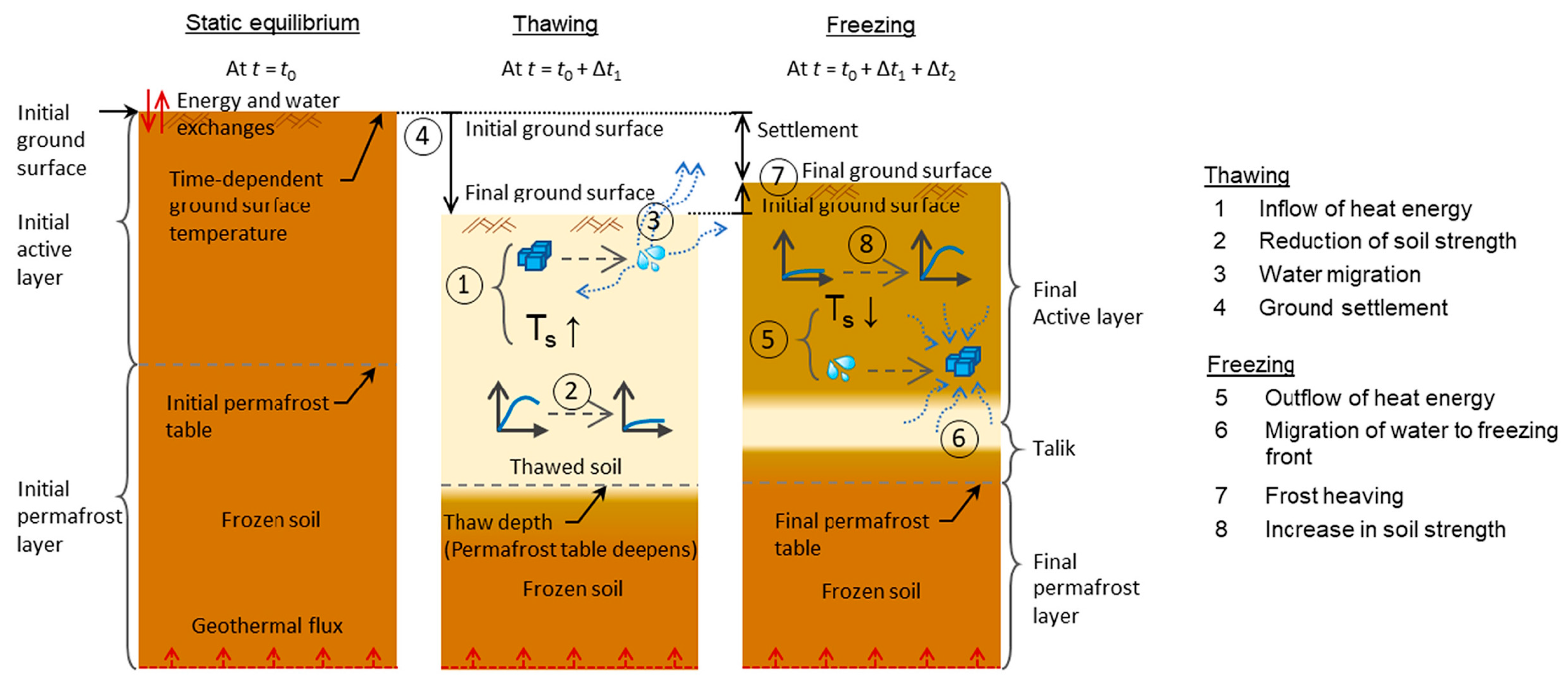
The progressive deepening of the active layer is a key process contributing to permafrost degradation [41]. It is promoted by an energy imbalance year-on-year, as the active layer exchanges heat with both the atmosphere and the underlying ground [42,43] (Figure 1). During the summer, solar radiation intensifies, increasing atmospheric and surface temperatures. Some of this energy is absorbed by the ground, which then releases it back into the atmosphere over time. This process is strongly influenced by albedo [44], which is affected by vegetation, snow, and ice cover [45]. Surfaces with higher albedo reflect more solar radiation, reducing the amount of energy absorbed at the surface and slowing permafrost warming. Conversely, a reduction in snow or vegetation cover leads to lower albedo, increasing heat absorption and enhancing permafrost thaw [46,47].
As the active layer thaws, its mechanical strength decreases [48,49]. The phase change from ice to liquid water reduces the structural integrity of the soil by weakening the adhesion between ice particles and increasing shear stress within the soil matrix. As liquid water accumulates [50], pore water pressure increases, promoting water migration through the soil and further destabilising the permafrost [51,52,53]. The rising pressure gradient causes the overburden load to be redistributed within the soil profile, which results in increased effective stress. Together with the loss of structural support from ice [54,55,56], this increased stress prompts ground deformation and thaw consolidation, which ultimately results in a net loss of ground water and a decrease in soil volume.
Following the summer thaw and the deepening of the active layer, a new seasonal active layer begins to refreeze during winter. In some cases, not all portions of this layer return to a frozen state. If an unfrozen zone remains between the permafrost and the seasonally frozen soil, this is called a talik [31,57,58]. Taliks are becoming increasingly common and thicker under current climatic trends, significantly contributing to permafrost degradation [23].
At a given location, this mechanism of downward degradation unfolds through different stages over the years. An initial degradation stage is identified when the average annual soil temperatures remain below zero at all depths and decrease downwards in the active layer, down to below the permafrost table, where equilibrium is attained with the geothermal gradient [59]. With air and surface temperatures increasing, intensive degradation—entailing the deepening of the active layer—is apparent when the average annual soil temperature becomes positive at some depth within the active layer and decrease downwards into the permanently frozen ground. This indicates that temperature fluctuations around 0 °C have begun to affect a portion of the permanently frozen ground, which therefore begins thawing. With temperatures increasing further, the depth with positive average annual soil temperatures above the permafrost table can become larger than the depth of seasonal frost penetration. If this occurs, seasonal frost and permafrost become disconnected, and a thawed layer (the talik) is formed, as already mentioned. If degradation proceeds further downwards, deeply buried permafrost may remain [59]. If average temperatures become greater than 0 °C at all depths, permafrost thaws completely and only a seasonally frozen ground remains down to a certain depth of seasonal frost penetration.
Geothermal heat from the Earth’s interior also contributes to warming. Thus, degradation of permafrost can also proceed upwards, from beneath the frozen layer toward the surface [60,61,62]. Heat is transferred upward into the active layer, primarily through thermal conduction [63], and to a lesser extent, through convection driven by groundwater percolation [64]. Although local conditions like groundwater activity, thermal conductivity, and ice content play a role, the rate and intensity of upward degradation are chiefly controlled by the ratio of the geothermal gradient in the deeper unfrozen soil to that in permafrost [59], whereby a greater ratio implies faster degradation. As warm groundwater rises or heat is conducted from deeper layers, the base of the permafrost begins to melt, reducing its thickness from below. This process weakens the mechanical stability of the frozen ground, as the thawed layer becomes saturated with liquid water and loses strength. Over time, upward thawing can disconnect permafrost from the overlying active layer, creating instability in the soil structure, enhancing subsurface water flow, and accelerating surface deformations. In regions with infrastructure, this form of degradation, also termed permafrost base degradation [65], is particularly dangerous, as it can undermine foundations from below without obvious early surface signs.
Lateral permafrost degradation is common at the margin of permafrost bodies, where the frozen ground is in lateral contact with a warmer, unfrozen zone [66,67]. This process is often initiated at permafrost boundaries exposed to external heat sources, such as lakes, rivers, thaw slumps, or areas where vegetation cover has been disturbed. Water plays a central role, as heat transfer from surface water bodies or infiltrating runoff accelerates the thaw along permafrost edges. Once ice-rich soils at the margins thaw, ground stability decreases, causing erosion, mass wasting, and lateral retreat of permafrost. Lateral thawing can also expand taliks, creating continuous unfrozen zones that fragment permafrost landscapes. The consequences include accelerated shoreline retreat in Arctic lakes, enlargement of thermokarst depressions, and destabilisation of slopes where permafrost once acted as a binding layer [68,69,70]. For infrastructure, lateral thawing is particularly problematic, since it undermines embankments, roads, and pipelines from the sides, reducing their bearing capacity and increasing susceptibility to collapse.
Finally, when thawing occurs simultaneously in multiple directions—downward, upward, and laterally—composite degradation occurs, which is most the rapid and complex form of permafrost loss. Composite degradation often produces highly irregular thaw patterns, enhancing thermokarst development, subsidence, and ground collapse. Because the frozen ground loses strength on several fronts simultaneously, composite thawing greatly accelerates landscape change.

2.2. Modelling of Permafrost

Various approaches are used to understand, predict, and mitigate complex thermo-hydro-mechanical (THM) processes in frozen and thawing soils. These models range from conceptual and empirical to detailed process-based and coupled multiphysics frameworks, often utilising numerical methods [71,72,73].
Process-based permafrost models assess the ground’s thermal state using fundamental principles of heat transfer. They can be classified by temporal, thermal, and spatial criteria [71]. In particular: (i) temporal models can determine equilibrium permafrost conditions for a given annual regime or track the transient evolution of permafrost from an initial to a current or future state; (ii) basic thermal models can identify the presence or absence of permafrost, active-layer depth, or mean annual ground temperature, while more sophisticated ones incorporate detailed heat transfer; (iii) spatial models can define conditions at a single point (one-dimensional vertical temperature profile), along a two-dimensional section, or over an entire region [74]. Most spatial models treat points as one-dimensional, ignoring lateral heat flow.
A significant challenge for exact analytical models is their restriction to idealised conditions, as real-world complexities such as seasonal variations, snow cover, and temperature-dependent thermal properties are hard to represent. This has resulted in the development of approximate analytical models or numerical methods.
Equilibrium models define permafrost conditions for a given annual regime. Some examples include [71]: (i) frost index models, which identify permafrost presence by comparing predicted winter freezing to predicted summer thawing thaw; (ii) the Kudryavtsev model [75], which estimates the maximum annual depth of thaw propagation and the mean annual temperature at the base of the active layer. It has been widely utilised in GIS to estimate active-layer thickness and average annual ground temperatures across the circumpolar Arctic scales; (iii) the TTOP (temperature at the top of permafrost) model [12], which estimates the mean annual temperature at the top of perennial frozen/unfrozen soil. It integrates the thermal offset effect—where the mean annual temperature varies due to disparities in frozen and thawed thermal conductivities—with freezing and thawing indices. This methodology has also been modified for application in mountainous regions by accounting for elevation and potential solar radiation. Its effectiveness in estimating equilibrium conditions renders it valuable for determining the bottom depth of grids within transient models.
Statistical models link permafrost occurrences to easily measurable or computable topographic and climatic factors such as elevation, slope, aspect, mean air temperature, or solar radiation [76,77,78]. They are widely utilised in mountain permafrost research and assume equilibrium conditions. Additionally, multi-criteria approaches have been developed within GIS environments, assigning scores to various factors (elevation, topographic wetness, potential solar radiation, vegetation) to produce maps of permafrost favourability. Limitations of this approach include the indirect nature of the driving information and the necessity for recalibration in different environments.
Physically based numerical models are essential for solving complex permafrost problems due to the non-linearity of governing equations and complex boundary conditions [73,79]. Finite difference and finite element methods are routinely utilised [80,81]. Examples encompass one-dimensional finite-difference models addressing heat conduction with phase change and snow routines, as well as finite-element models evaluating transient climate change effects on permafrost. In these models, the upper boundary conditions (ground surface) may be specified directly or derived through the calculation of the surface energy balance. The lower boundary and initial conditions are of paramount importance, as deep profiles influence the near-surface thermal regime; hence, appropriate “spin-up” procedures are necessary to achieve equilibrium. In high-altitude environments, significant lateral variability in microclimate and subsurface conditions necessitates the use of specialised numerical models. Physics-based modelling approaches for steep bedrock temperatures and distributed hydrological models adapted for permafrost are employed.
Numerical models frequently rely on multiphysical coupling, which has emerged as a key research field. This has resulted in notable progress in coupling models and simulation solvers for frozen soils. [73]. Specifically:
  • Thermo-hydraulic models focus on combined thermal flow and mass transfer within soils during freezing and thawing. They consider the variations and movement of unfrozen water content with temperature and are often validated against field observations of temperature and water content [82,83]. Phase change is generally managed using concepts such as apparent heat capacity or relative permeability [73].
  • Thermo-mechanical models traditionally focus on phenomena such as frost heave and thaw settlement, which are closely related to changes in soil strength during the processes of freezing and thawing [84,85,86,87]. These models are founded on the principles of energy conservation and linear momentum equations, frequently simplifying the coupling to emphasise the impact of heat transfer on mechanical properties, such as those dependent on temperature. Additionally, certain thermo-mechanical models integrate water migration through the application of the segregation potential model.
  • Thermo-hydro-mechanical (THM) models are capable of simulating the complex interactions among thermal, hydraulic, and mechanical fields within soil [88]. Early iterations of THM models commonly employed simplifying assumptions. However, more sophisticated models (e.g., capturing temperature and porosity dependence of shear strength) have been developed to investigate complex phenomena, such as soil-pipeline interactions and frost heaving processes, incorporating water migration [79,89,90,91,92]. In models concerning frozen soil, the thermal component addresses heat conduction and convection resulting from water movement. The hydraulic component models water transport driven by temperature, hydraulic gradients, and pressure variations, with permeability being dependent on temperature and pore pressure [93]. The mechanical component considers stresses induced by thermal expansion and volumetric changes attributable to ice formation, with elastic parameters related to temperature, saturation, and porosity [73]. These models often rely on stress fields governed by Navier’s equation, effective stress theory, poromechanics, and elastic or elastoplasticity theories [94,95,96,97,98]. A considerable number of models incorporate elastic-plastic constitutive relationships, such as the Modified Cam-Clay model or the Clay And Sand Model [99,100], to simulate soil hardening during freezing and softening or volume compression during thawing [91]. Additionally, some models introduce a pore ice content ratio to regulate hardening and softening behaviours [101,102]. Of particular interest are novel THM models that account for the formation and evolution of ice lenses [103], with criteria for their formation influenced by temperature, overburden pressure, separation strength, void ratio, and porosity.
  • Thermo-hydro-chemical (THC) models incorporate the chemical component, particularly focusing on freezing point depression caused by solutes, which is especially relevant in fine-grained soils. They examine the effects of salt on freezing and thawing processes and the interactions between salination and freeze–thaw cycles [104,105,106].
  • Thermo-hydro-mechanical-chemical (THMC) models are comprehensive frameworks that examine the combined influences of thermal, hydraulic, mechanical, and chemical processes. Research in this field frequently explores the effect of salt on THM processes in frozen soils or during the dissociation and formation of natural gas hydrates [73,107,108].
In recent years, some specialised computational frameworks have been developed to tackle specific challenges in permafrost modelling. They are briefly described below.
  • Phase-field modelling elucidates the macroscopic phase-change process and is augmented by the continuum theory of porous media. This modelling approach is efficacious in capturing microstructural evolution, discontinuities due to damage, granular rearrangement, and phase transitions in frozen soils [109]. Certain models employ two-phase field variables to simulate freezing-induced fractures resulting from ice lens formation. A recent study introduced a THM framework integrated with a phase-field methodology and adapted Cam-Clay plasticity to model thaw consolidation, thereby addressing issues of nonlocal softening and particle reorganisation [100].
  • Peridynamics, unlike classical local theories, utilises integral-differential equations and has shown success in modelling heat conduction, phase change, and water flow in porous media [110,111]. It can be extended to THM and THMC models [73].
  • The Material Point Method (MPM) has recently been employed to model time-dependent phase transitions and large deformations in porous media, especially useful for thawing-triggered landslides and significant settlements, where the finite-element method might face mesh distortion [112]. This framework treats ice as a solid constituent and uses an ice saturation-dependent Mohr-Coulomb model for strength.
  • Mixed finite element schemes are being explored [113], such as P0-P0 models (lowest order mixed finite elements) schemes, because they are conservative and robust for heterogeneous permafrost, demonstrating advantages in enthalpy-based formulations over temperature-based ones [114].
  • Recent research also concentrates on scaling up thermal models from the pore level to the Darcy scale using numerical methods, deriving effective properties through homogenisation, and extending pore-scale physics to align with empirical Darcy-scale models. This includes integrating phenomena such as freezing temperature depression in small pores (Gibbs-Thomson relation) [113].

2.3. Permafrost Evolution from Climate Modelling

Thanks to climate records dating back to the 20th century, it is now clear that permafrost degradation is accelerating [36,115,116,117]. Scientists have dedicated significant effort to modelling and forecasting the evolution of permafrost coverage in all regions where permafrost exists [118,119,120,121].
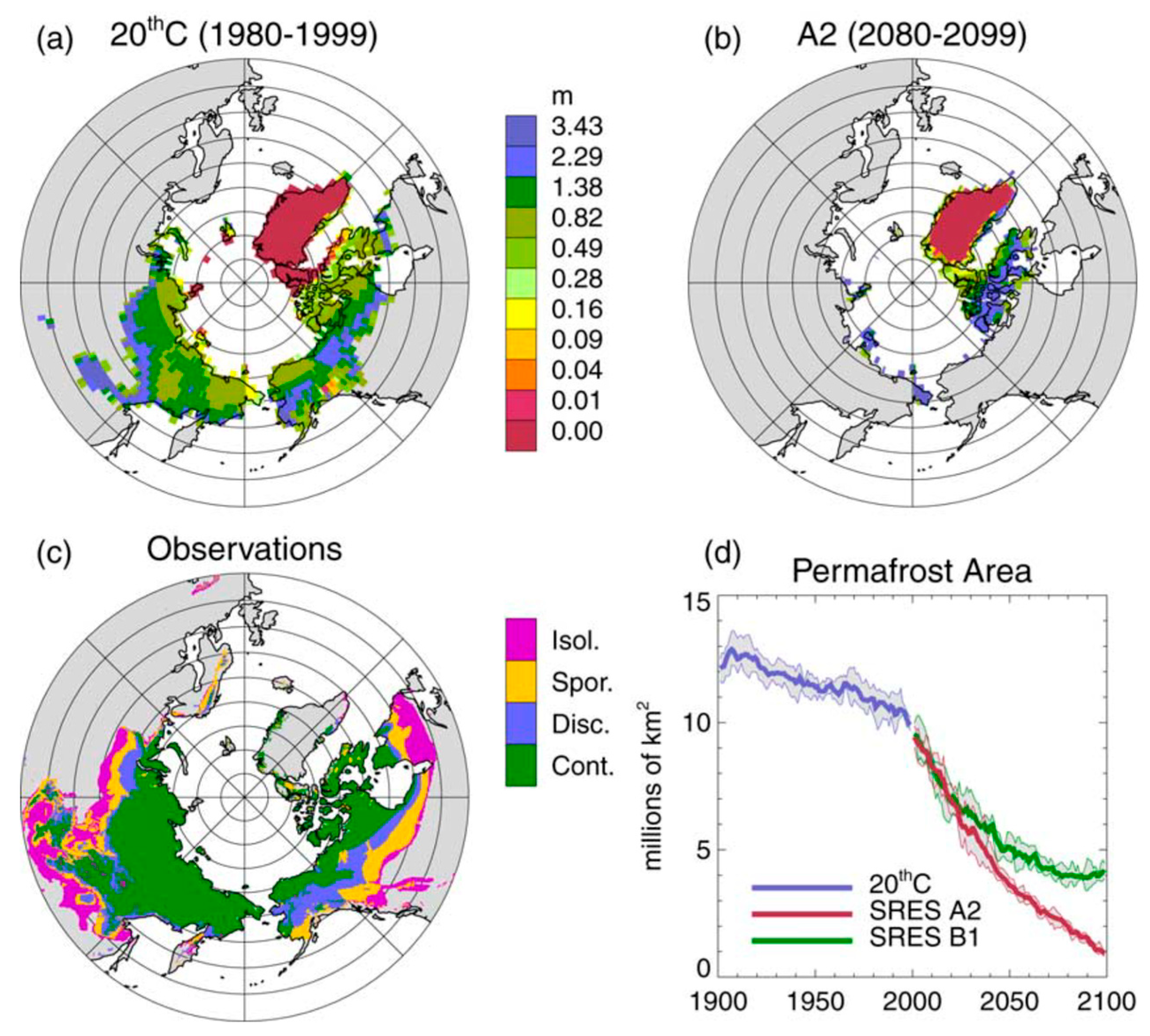
In a 2005 study, Lawrence and Slater [122] used the Community Climate System Model 3 (CCSM3) to simulate the evolution of permafrost surface area between 1920 and 2100 (Figure 2). Based on historical data until 1999, they developed two climate scenarios (high and low greenhouse gas emissions). Under the worst scenario, they predicted a decline in near-surface permafrost area from 10 million km2 in 1999 to 4 million km2 by 2050 and only 1 million km2 by 2100. Interestingly, the authors predicted considerable spatial variations in the trend of permafrost loss, with almost complete loss in Alaska, significant reductions in Siberia and Canada, but only a minor change in Greenland. To understand the dynamics behind their projections, the authors considered several environmental parameters, including atmospheric and soil temperatures, precipitation (rain and snow), soil water phase composition (ice and liquid), and runoff, identifying atmospheric warming as the culprit for permafrost loss. This was confirmed by subsequent modelling studies [29,123,124].
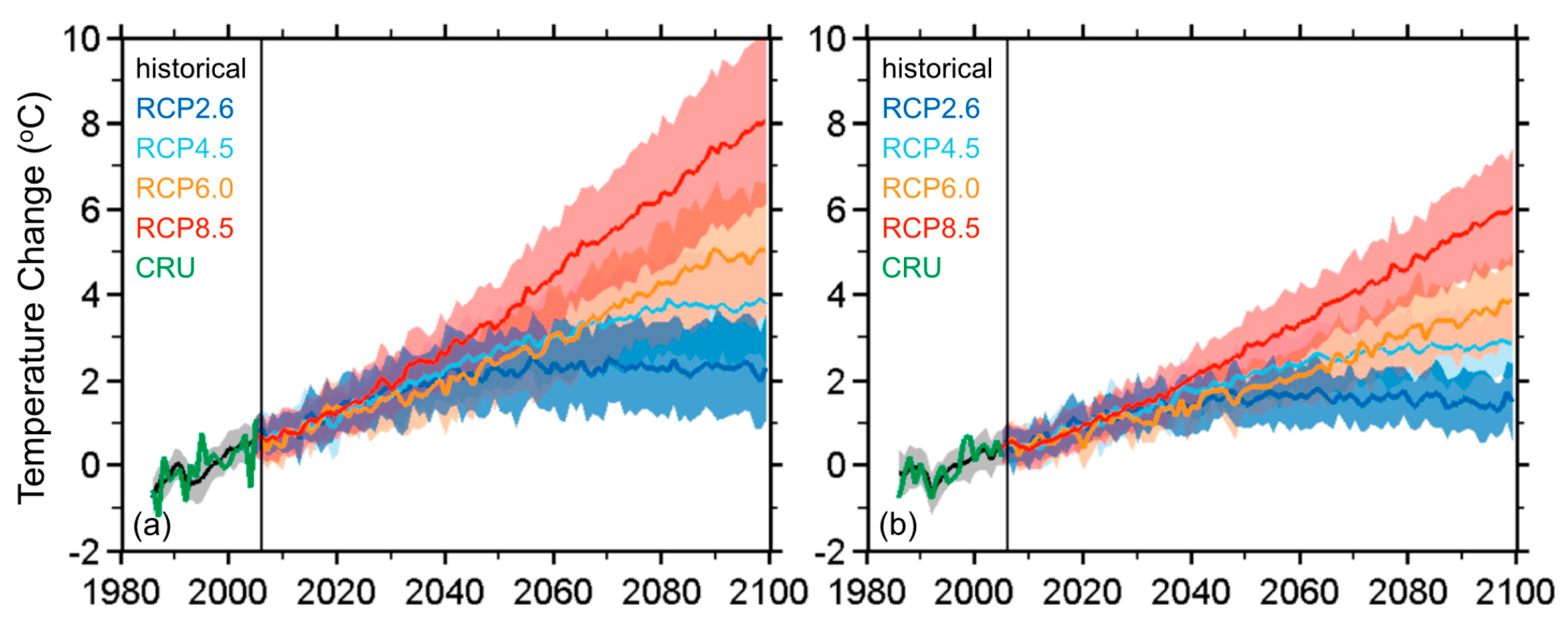
Since the early 2000s, climate models used to represent permafrost degradation have significantly improved. The Coupled Model Intercomparison Project Phase 5 (CMIP5), and then the CMIP6 were adopted to simulate future permafrost changes more accurately. Among various climate variables, temperature was identified as having the most substantial influence on permafrost degradation and was therefore prioritised in the projections [125,126,127]. As an example, Guo and Wang study [125] applied four Representative Concentration Pathways (RCPs) to model future scenarios of greenhouse gas emissions and their impact on surface warming. Each RCP corresponds to a different trajectory of radiative forcing by 2100:
  • RCP 8.5: High-emissions scenario, with a projected temperature increase in +8 °C;
  • RCP 6.0: Medium–high-emissions scenario, with +4 °C;
  • RCP 4.5: Medium–low-emissions scenario, with +3 °C;
  • RCP 2.6: Low-emissions scenario, with +1.5 °C by 2100.
An interesting feature observed in these projections is a crossover between the RCP 4.5 and RCP 6.0 temperature curves (Figure 3). Up until approximately 2060, RCP 4.5 shows higher temperatures than RCP 6.0. However, after 2060, the trend reverses. This inversion implies that even scenarios with slower initial warming can lead to accelerated temperature increases later in the century, which may affect the accuracy of mid-century permafrost degradation predictions.
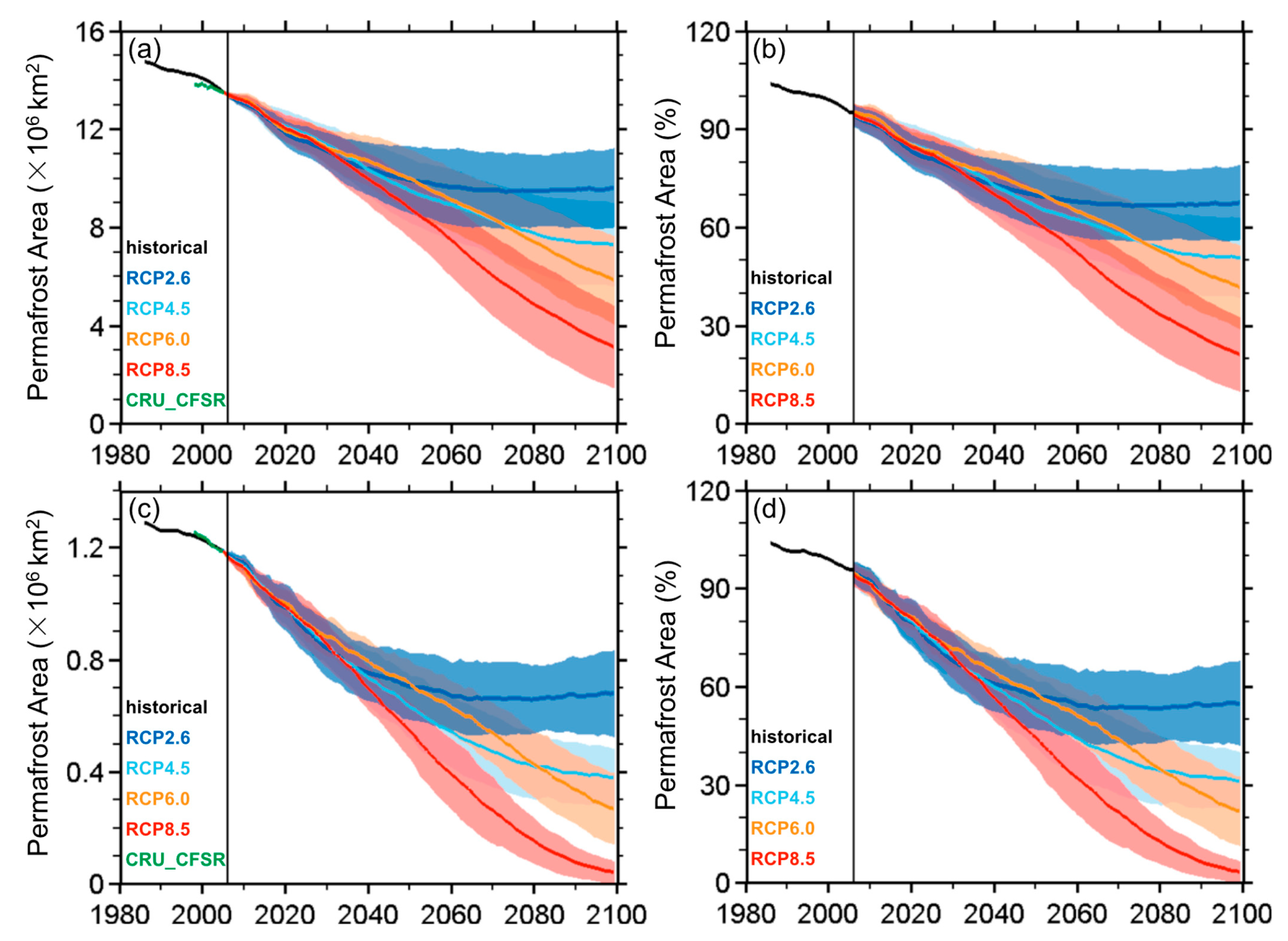
This crossover is also evident in the graphs showing permafrost area evolution under the four RCP scenarios (Figure 4). As expected, RCP 2.6 shows the smallest reduction in permafrost extent by 2100 and at the other extreme, RCP 8.5 exhibits the largest loss. Notably, the crossover between RCP 4.5 and RCP 6.0 in permafrost area projections occurs in 2070 for high-latitude and in 2080 for high-altitude zones, suggesting that the geographic position of permafrost influences its rate of degradation, likely owing to differing climate sensitivities and energy balances in these regions.

3. Consequences

3.1. Landslides

The degradation of permafrost significantly affects soil stability, especially in high-latitude regions [39,128,129,130,131,132]. As the ice within permafrost melts, the ground’s structural integrity weakens, increasing the risk of landslides and ground failure. A further increase in temperature above freezing brings additional thermo-hydro-mechanical effects in soil, including temperature-dependent changes in hydraulic conductivity, water retention capacity, compressibility, and shear strength [88,133,134,135].
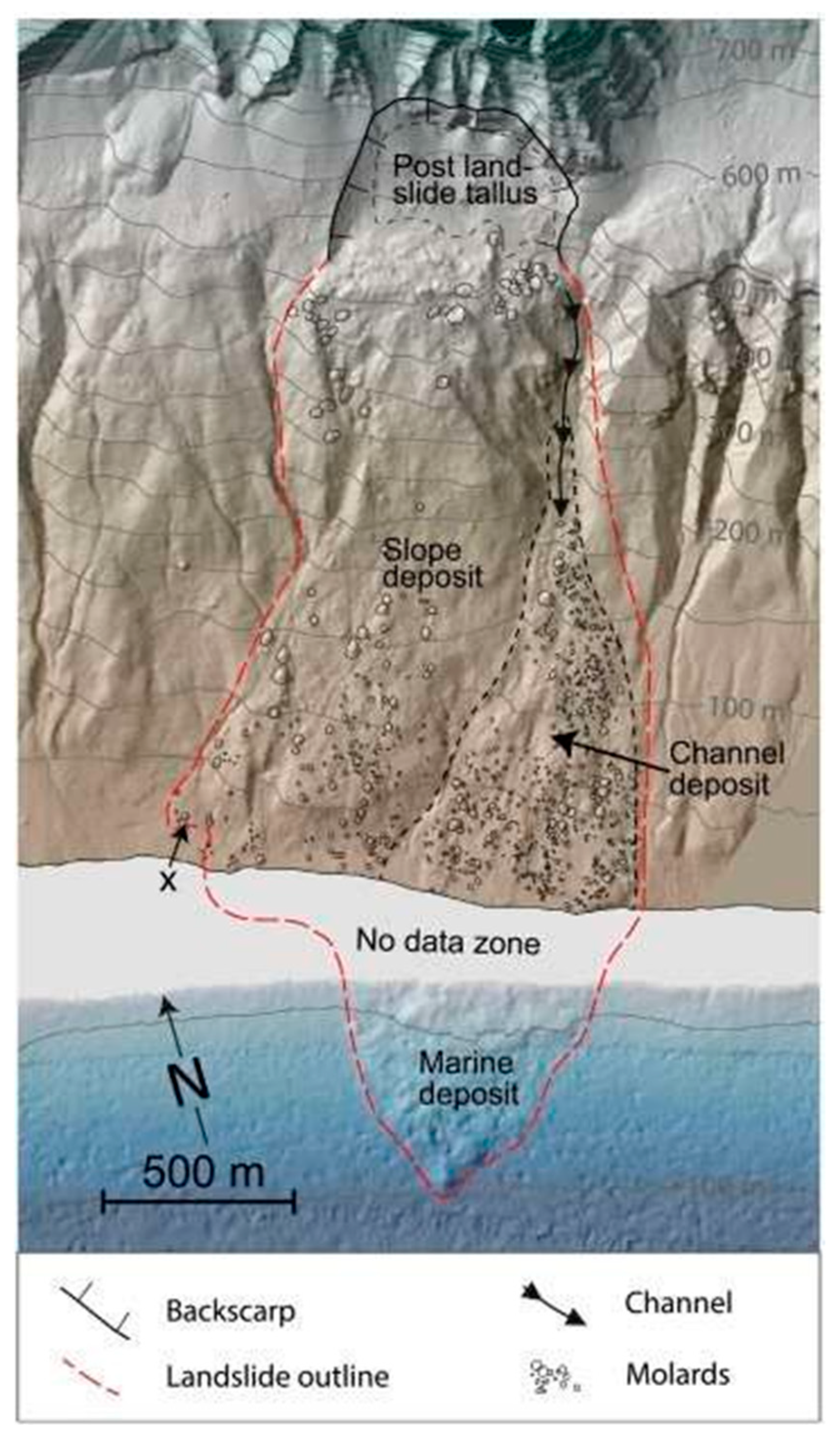
A striking historical example of ground failure occurred on the western coast of Greenland, in the Nuussuaq Peninsula, where thawing permafrost triggered one of the region’s most dramatic landslides, which resulted in the death of one fisherman [136]. In 1949, a light-coloured lineament 9–22 m in height appeared at the top of a talus slope along the coast. As the ice component melted, only the soil matrix remained, leading to mechanical disequilibrium. The presence of molards—soil blocks previously held together by ice—indicated advanced thawing. Progressive mass movement and shearing began to develop, creating visible cracks in the surface. These cracks were further exacerbated by weathering, surface runoff, and even lichen colonisation, which often occurs when bare soil becomes exposed. Without the stabilising influence of ground ice, vegetation took hold, further weakening the slope structure. Finally, in 1952, the slope failed catastrophically. A landslide involving 5.9 million m3 of material collapsed from an elevation of 700 m to 450 m. The eastern portion of the slide formed a channel deposit (Figure 5). Approximately 1.6 million m3 of debris was deposited on land, while between 1.8 and 4.5× million m3 flowed into the sea. This sudden and massive displacement of material triggered a tsunami with a wave height ranging from 4.5 to 7.7 m.
In high-altitude regions, landslides can exhibit unique characteristics due to the interaction between glaciers and permafrost [137]. Initially, glacier ice melts and often collapses in the form of ice avalanches, which can trigger mudflows, cause flooding in mountain lakes, and even lead to the failure of dams and bridges. Subsequently, as in high-latitude landslides, the exposed soil undergoes weathering, surface runoff, and crack formation. Water infiltrates the soil, promoting vegetation growth and deeper subsurface water flow, all of which alter the surface geometry of the permafrost.
Permafrost degradation also weakens infrastructure in its area of influence through various mechanisms [138,139,140]. With regard to slope instability issues, disequilibrium in the soil, combined with glacier activity, promotes continuous transport of surface debris, leading to frequent rockfalls and landslides. Consequently, vegetation, rocks, and human structures are particularly vulnerable to being transported downslope. The lower mountain valleys, which also have gentle slopes, become accumulation zones for these debris flows.
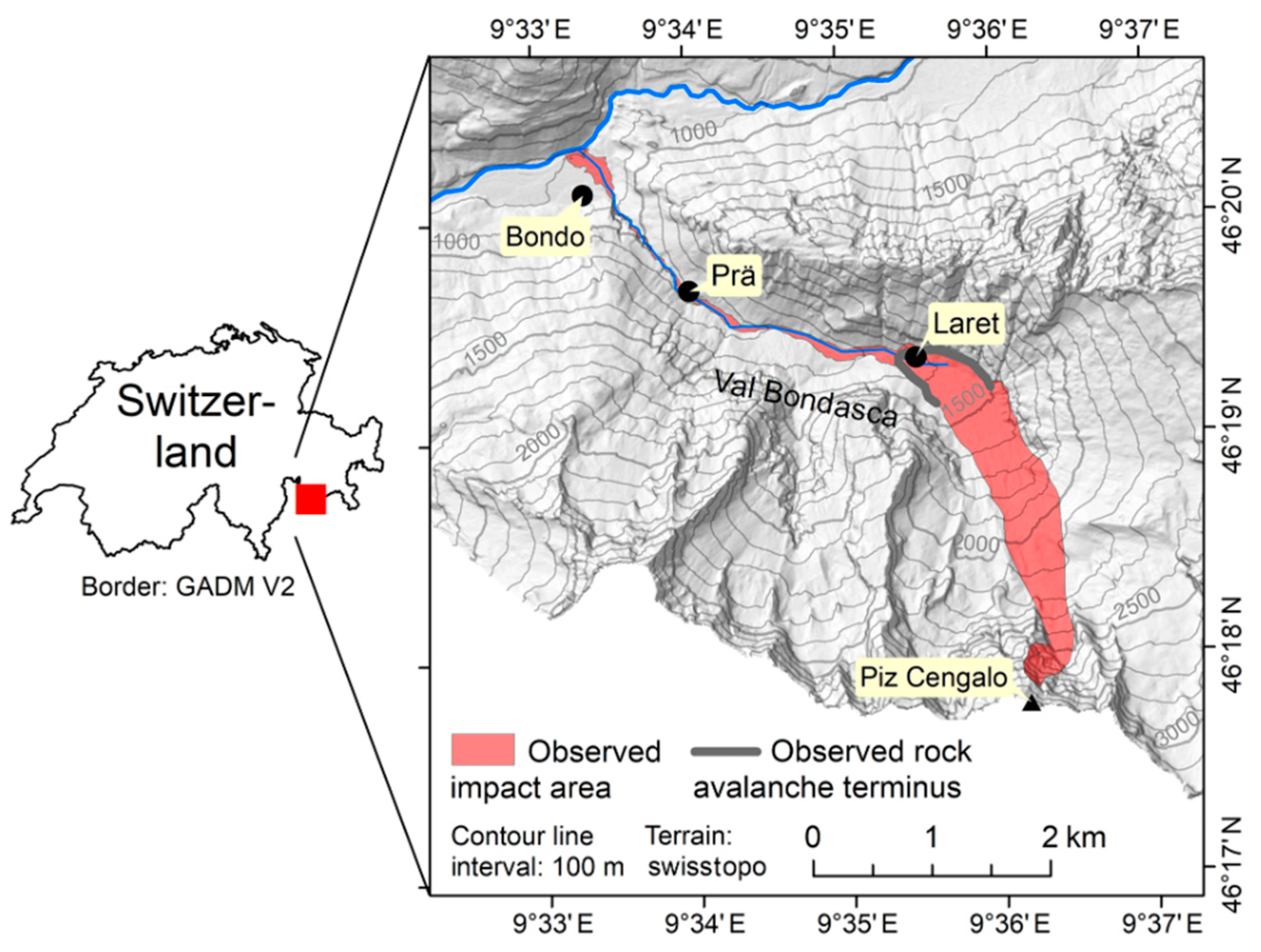
A notable example occurred in 2017 in Canton Graubünden, Switzerland, where a massive landslide devastated the village of Bondo (Figure 6). The initial rockslide, originating from an elevation of over 3000 m, mobilised over half a million m3 of ice, which descended through the valley. As the ice slid downhill, it rapidly melted into water, transforming the mass into a mudflow. Approximately 50,000 m3 of debris reached Bondo almost immediately. Over the next 24 h, between 450,000 and 750,000 m3 of material inundated the area. Tragically, four people disappeared, and ten houses were destroyed.
Landslides follow a rupture surface that allows the mass to move downslope. This rupture may be a discrete break or a zone of distributed strain. The post-failure velocity of a landslide is determined by crack formation, gravitational pull, shearing strength, and the magnitude of strength loss during the event. Depending on whether the initial failure involves a fall or a flow, the resulting landslide may evolve into a debris avalanche (as in Nuussuaq, where it formed a drainage channel) or a debris flow (as in Bondo, due to the involvement of saturated material) [142].
Given the hazardous consequences of these events for both the environment and human life, it is crucial to study their frequency and triggers. Overall, landslides, and particularly fatal landslides, are increasing worldwide for a number of reasons [143]. Focusing specifically on Non-Seismic Non-Rainfall (NSNR) triggered landslides, Froude and Petley [143] provide some insight into the role of permafrost and glacier degradation. NSNR events show a consistent upward trend over time. The amplitude of the NSNR curve increased from 0 to 1.21 events per pentad (25 days) in 2004 to 0–2.72 events per pentad by 2016. As the permafrost area continues to shrink annually, a link between its degradation and the rising frequency of high-altitude landslides appears plausible. However, only 2.3% of NSNR landslides are currently attributed to freeze–thaw processes (including glaciers and permafrost), which are not necessarily a symptom of permafrost degradation [143]. This suggests that while cryospheric factors are important, they represent just one part of a more complex system of landslide triggers.

3.2. Foundations Design and Soil Properties

The assessment and design of foundation systems in permafrost regions has become essential to ensure the stability and longevity of structures. Due to the heterogeneity of physical characteristics and constituents of permafrost, it is important to select a foundation design capable of withstanding permafrost degradation. To determine the most suitable foundation type, several key geotechnical and thermal properties should be evaluated, ideally through temperature-controlled laboratory experiments [88]. These include the bulk modulus, shear modulus, Young’s modulus, maximum deviatoric stress, friction angle, cohesion, unfrozen water content, thermal conductivity, and thaw strain. Engineering soil parameters are affected by temperature; for instance, an increase in temperature leads to a reduction in elastic moduli and soil strength, thereby decreasing the bearing capacity of the soil and increasing its compressibility [23,144,145].
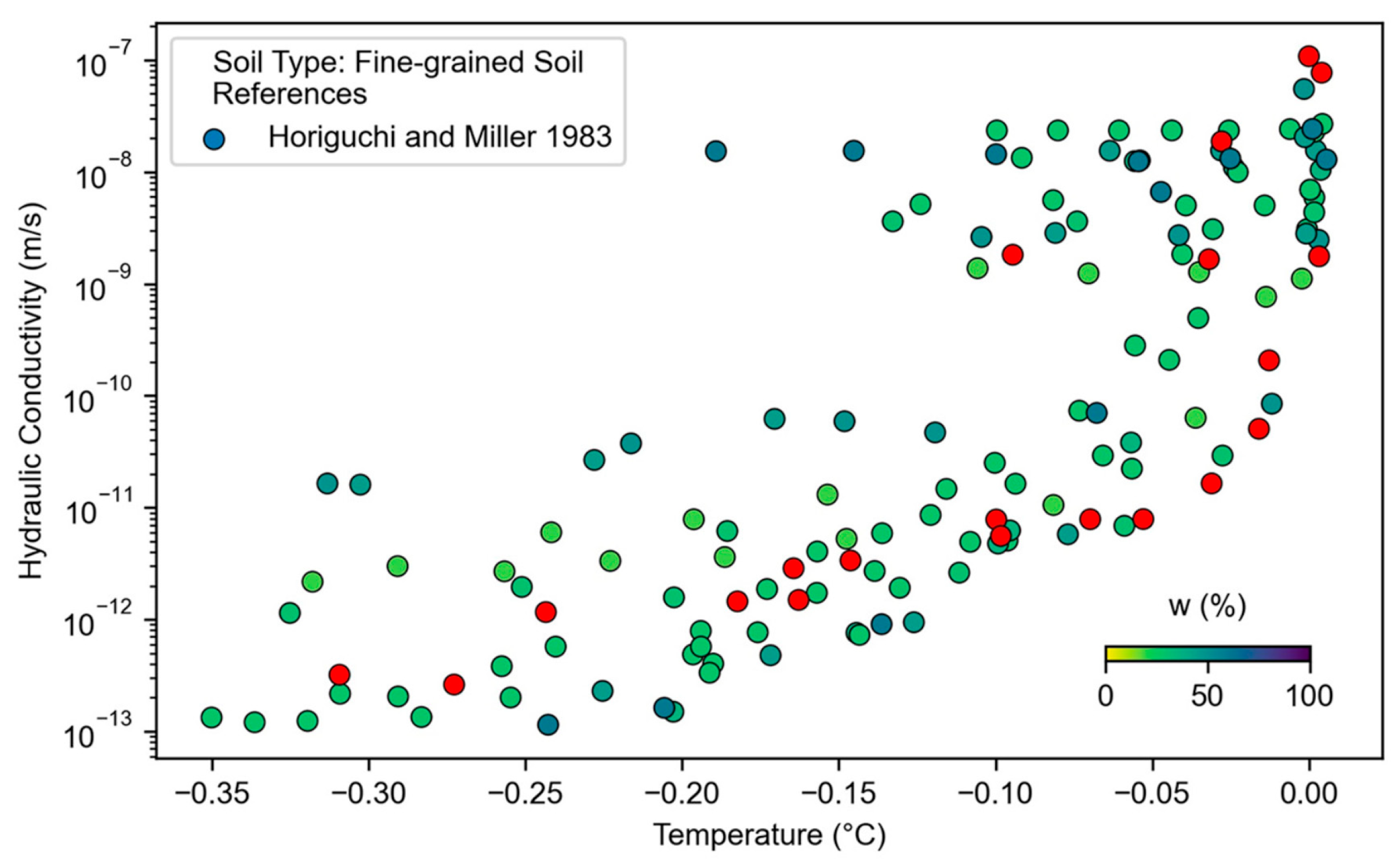
Additionally, rising temperatures cause an increase in unfrozen water content within the permafrost, which in turn enhances the hydraulic conductivity and accelerates water flow. This relationship is illustrated in Figure 7, where a distinct trend can be observed: hydraulic conductivity increases non-linearly as soil temperature approaches 0 °C [23]. Specifically, at around −0.20 °C, individual measurements show very high water content (approaching 100%), corresponding to a hydraulic conductivity of ~10−8 m/s. As the temperature continues to rise toward 0 °C, the number of data points with high unfrozen water content increases. These points tend to cluster around 0 °C, with corresponding hydraulic conductivities ranging between 10−9 and 10−7 m/s. A second group of measurements, concentrated between −0.35 °C and −0.10 °C, displays lower hydraulic conductivities, typically ranging from 10−13 to 10−10 m/s. This explains why more subsurface runoff can be seen in permafrost areas with an increase in temperature.
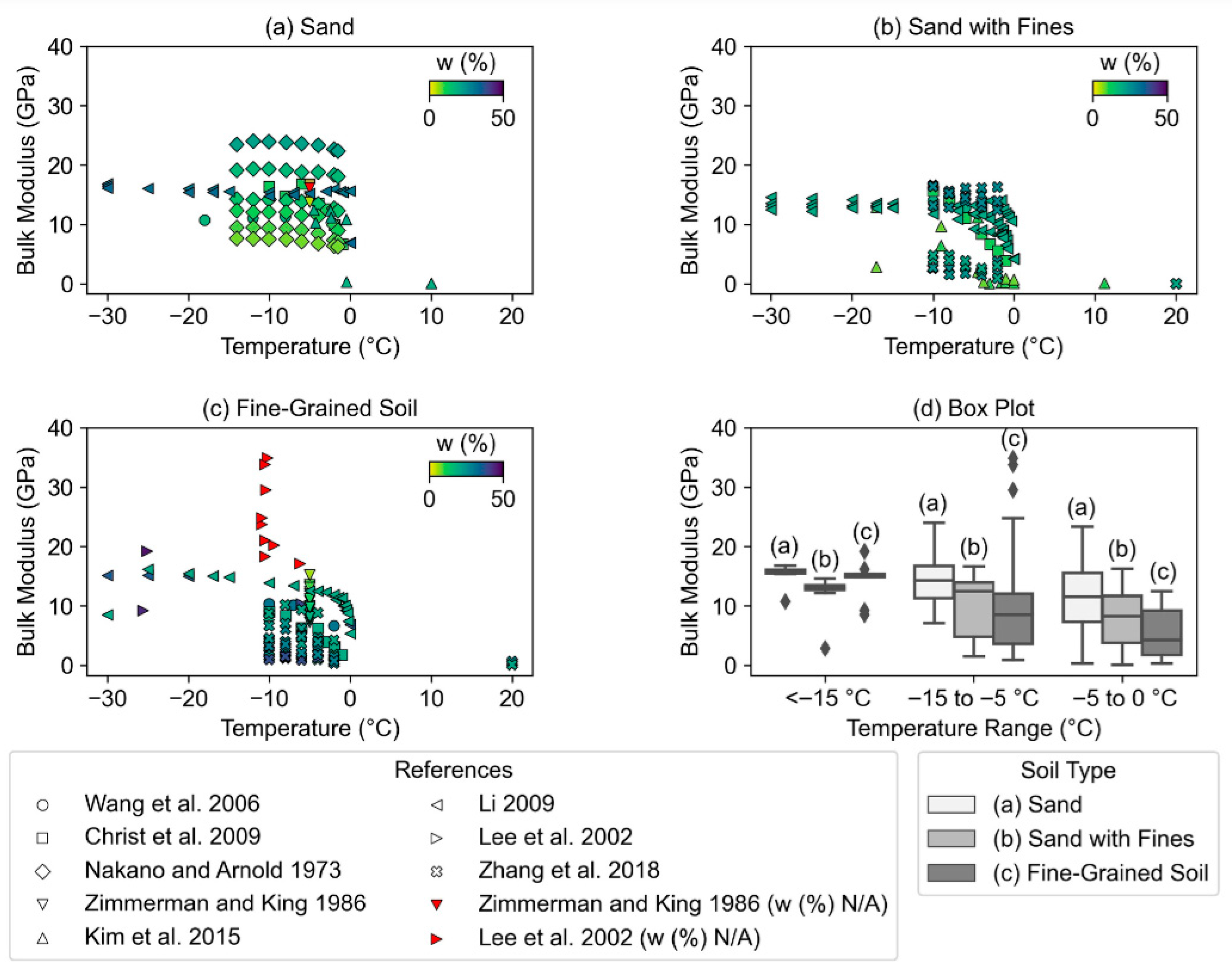
In addition, the geomechanical and thermal properties of permafrost show a clear correlation with temperature variations. Regarding the bulk modulus, for sand with fines and fine-grained soils, experimental data points from the literature are primarily concentrated between −10 °C and 0 °C [23]. Within this temperature range, the values of bulk modulus generally lie between 0 and 19 GPa (Figure 8b,c), except for sand (Figure 8a), where values range from 8 to 25 GPa. A threshold appears around 15 GPa, which seems to represent a limit associated with high water content; thus, this value can serve as a benchmark for interpreting permafrost behaviour. The boxplots illustrate a consistent decrease in quartiles (Q1, Q2, Q3) as the temperature approaches 0 °C for all soil types (Figure 8d).
A similar pattern is observed for the shear modulus. Data available from the literature for sand with fines and fine-grained soils also cluster around the −10 °C to 0 °C range [23]. In the case of sand, a distinct trend in water content is visible in the data, with low shear modulus values (7.5 GPa) associated with low water content and higher values (14 GPa) corresponding to medium water content, as reported by Wang et al. [155]. The data by Li [152] and Meng et al. [147] show a comparable trend for fine-grained soils: higher water content aligns with shear moduli around 12 GPa, while lower water content corresponds to values near 2.5 GPa. This trend is less evident for sand with fines. As with the bulk modulus, the data compiled in [23] confirm a general decrease in shear modulus toward 0 °C for all soil types. In terms of foundation design, the increased compressibility and deformability of the ground, combined with the uncertainties related to the determination of the soil parameters and the high sensitivity to changes in temperature, call for more conservative designs (e.g., larger footprints to better distribute the loads and limit overall and differential settlements) and a systematic use of remediation measures.
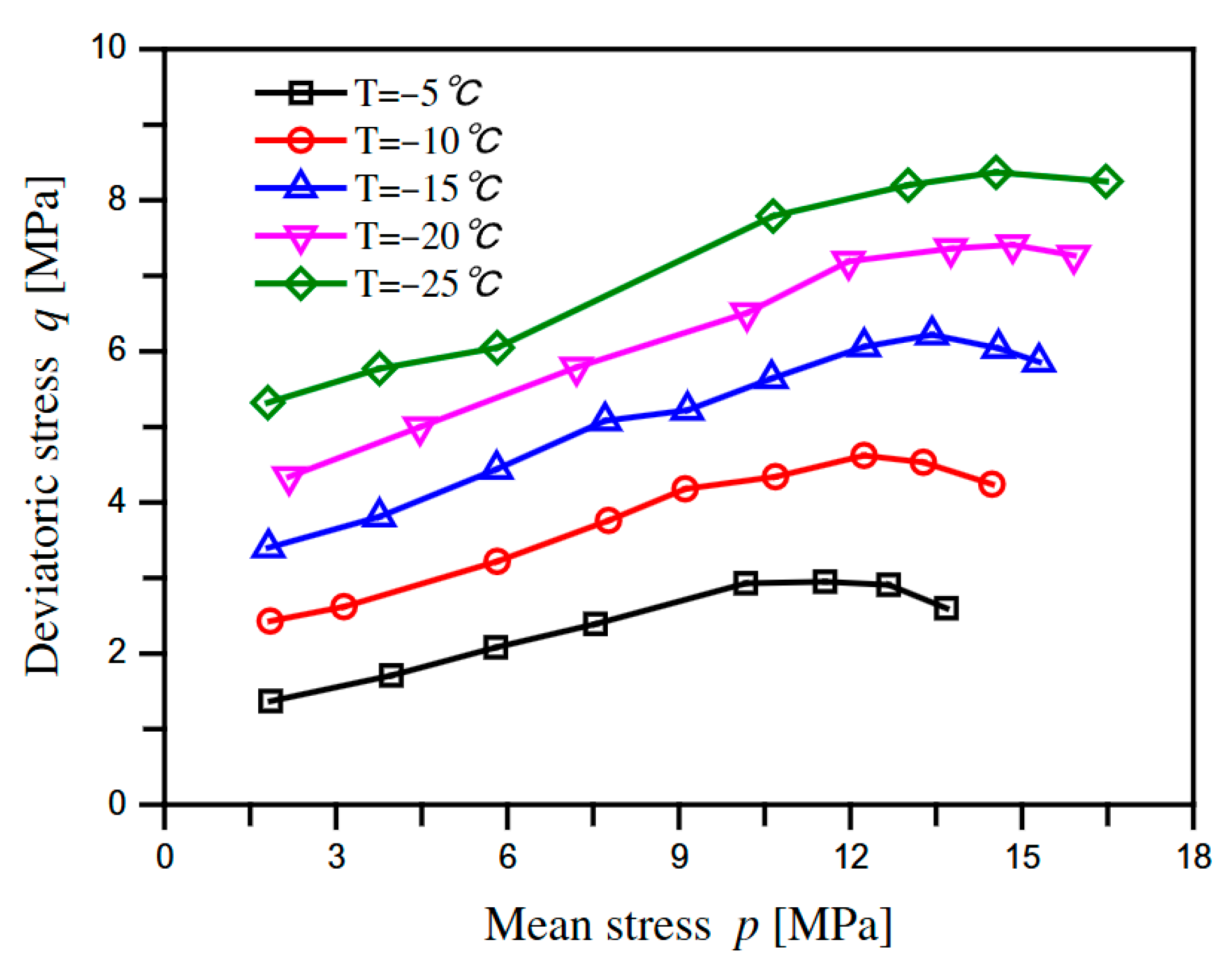
A third parameter that can be analysed is the maximum deviatoric stress (Figure 9), which relates to the maximum shear stress that a soil can withstand under a given confining stress. It is especially important for evaluating a soil’s ultimate strength and bearing capacity, especially when considering failure due to yielding or plastic deformation. In comparison to the bulk and shear moduli, less information is available from the literature for interpretation. For instance, the analysis by Liew et al. [23] focuses primarily on sand and fine-grained soils. According to available insights from the literature [23,156,157,158], the deviatoric stress in sand decreases logarithmically as the temperature approaches 0 °C. For fine-grained soils, the same phenomenon is observed, albeit with a less steep gradient. Again, this calls for more conservative foundation designs to ensure a sufficient margin of safety against failure, which can include the option of deep foundations in place of shallow foundations, which can directly anchor the structure in deeper, healthier permafrost or in unfrozen, but stronger layers.
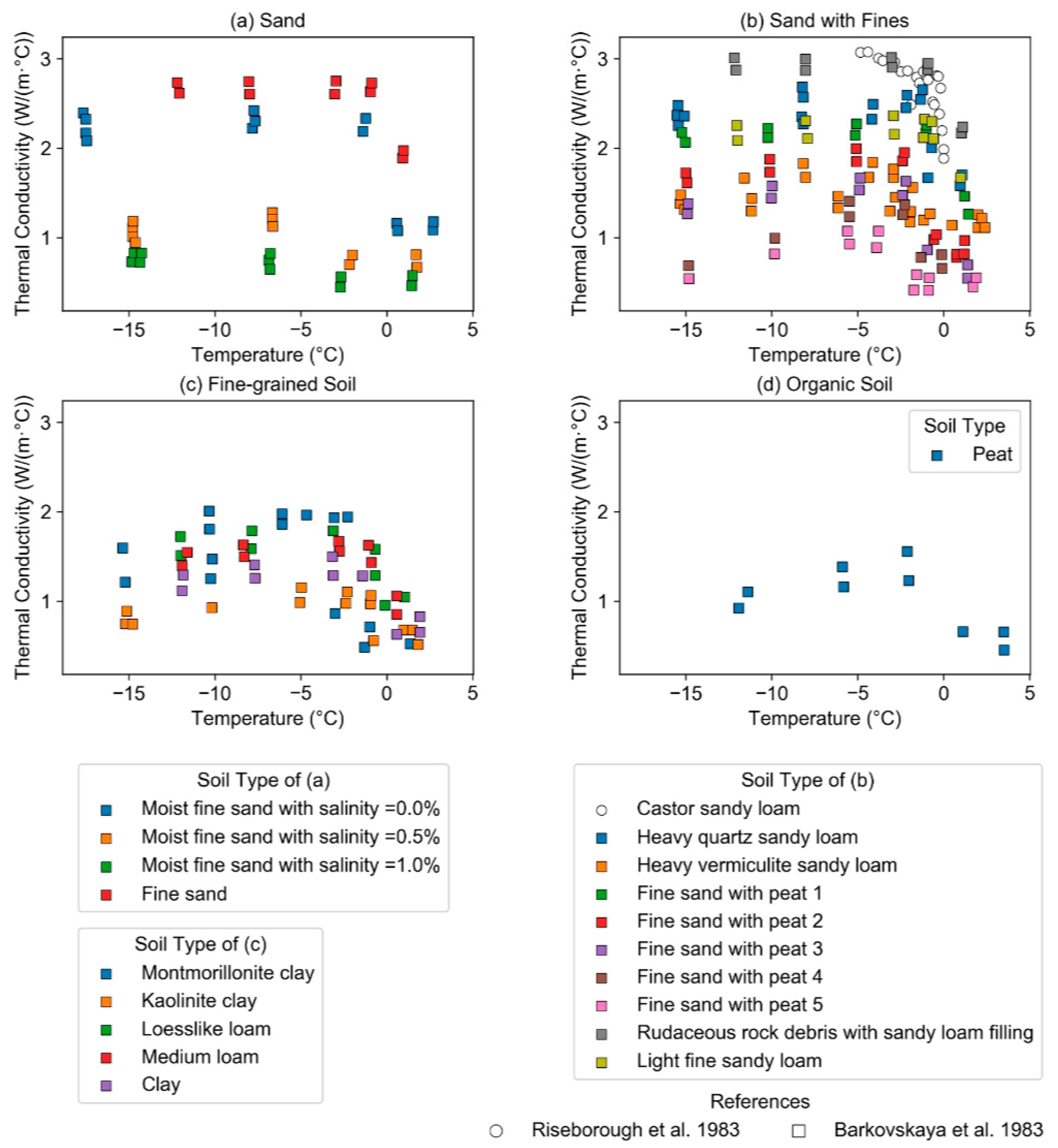
Thermal conductivity is another crucial property, especially considering its influence on heat transfer within permafrost and its role in thermokarst development [159,160,161,162]. Among all soil types, sand shows a particularly distinct trend with respect to layer type (Figure 10a). Here, higher salinity levels correspond to higher thermal conductivity values. Overall, thermal conductivity values remain relatively stable from −20 °C to −4 °C, then begin to converge toward 0.5 W/(m·°C) between −3 °C and +3 °C. A similar pattern is visible in the other three soil types (Figure 10b–d).
In fine-grained soils, mineral composition has a notable influence on thermal conductivity. The lowest values are primarily associated with kaolinite clay (Al2Si2O5(OH)4) and general clay, while higher values are found in montmorillonite clay ((Na,Ca)0.3(Al,Mg)2Si4O10(OH)2·nH2O) and loess-like loam (Figure 10c). In sand with fines, lower thermal conductivity values are associated with a smaller size of the fines: for Peat 5 (high fine content), thermal conductivity ranges from 0.2 to 1.1 W/(m·°C), whereas for Peat 1 (low fine content), it ranges from 2.0 to 2.2 W/(m·°C) within the temperature range of −15 °C to −5 °C (Figure 10b).
Overall, the thermal and geomechanical properties of permafrost soil appear to be very sensitive to even small increases in temperature, especially near the melting point [23]. However, the friction angle seems to be an exception, since various studies [156,165,166] highlighted weak or no correlations with temperature as the latter approaches 0 °C. By analysing a large number of data points, Liew et al. [23], for instance, did not identify a significant correlation between friction angle and temperature in the range of −15 °C to 0 °C for both coarse-grained and fine-grained soil. Furthermore, in the realm of positive temperatures, soil friction actually seems to increase, especially in slow-sheared clays, owing to the progressive reduction in water retention capacity, which results in loss of lubrication between clay platelets [133,135]. Consequently, slope instability phenomena in degrading permafrost should be related more to the loss of cohesion and stiffness caused by the weakening and loss of ice than to a decrease in intergranular frictional resistance. Similarly, with regard to the runout mechanisms, a transition should occur from solid-like (rock-like) landsliding, in which frozen blocks detach and fragment as they move downwards—a mechanism common in ice and rock avalanches—to a mechanism controlled by the abundance of liquid water and completely destructured soil—such as in mudflows.

4. Remediation

Engineers and scientists have been aware for a long time that building and maintaining infrastructure on permafrost is a difficult task [167,168,169], which has become even more challenging under climate change. In response to this challenge, various engineering solutions have been developed to mitigate permafrost degradation, including the use of passive and active cooling systems (such as thermosyphons and heat drains), the construction of pile foundations that reach well below the active layer, air convection embankments, and enhancing soil insulation with geosynthetics. Additional techniques involve optimising site drainage to minimise heat entry and water accumulation, using light-coloured or reflective surfaces to reduce solar heat absorption, snow management, and advanced monitoring and early-warning systems to track permafrost stability.
For years, installing thermosyphons was enough to address many challenges of building in or on permafrost at a moderate cost. A thermosyphon is a passive, two-phase heat exchanger consisting of a sealed tube containing a pressurised fluid that evaporates, rising as a vapour to a condenser at the top. There, the vapour condenses, releasing heat to the atmosphere, and the resulting liquid returns by gravity to the bottom of the tube, completing the cycle. This process cools the permafrost, preventing thaw and the associated structural damage to foundations and infrastructure [170].
In recent decades, however, the costs of reliable stabilisation methods have increased significantly, along with the need for continuous inspection of both the structures and the ground beneath them. This challenge is especially critical for long linear infrastructure—highways [171], railways [172], oil and gas pipelines [170], and power transmission lines [173]—that traverse remote regions. In the most vulnerable locations, additional cooling equipment, together with auxiliary facilities such as fuel storage, power generation units, and operating staff, must be mobilised to reduce the risk of failure.
As shorter, warmer winters and longer, hotter summers accelerate permafrost thaw, thermosyphons often function outside their intended operational conditions and are unable to maintain frozen conditions. Field records show their effective performance can drop to roughly half of what is assumed in design calculations. Moreover, practical experience suggests that nearly one-third of thermosyphons are damaged during installation, and as many as half of the remaining units fail within about ten years of service [174].
Most permafrost-related research in geotechnical engineering currently emphasises detailed thermal modelling of frozen ground, whereas comparatively little effort is devoted to inventing or refining thermal stabilisation techniques [175,176]. Originally, thermosyphons were intended to protect foundation piles embedded deep beneath the active layer—typically at depths of 6 m, compared with only ~1 m of seasonal thaw. They worked well in this vertical configuration. However, their application has since been expanded to less suitable settings, such as road embankments, where soil in shallow layers moves laterally and the benefit of deep freezing is limited. To address this, some recent designs combine inclined or looped thermosyphons with surface insulation [177] to better control shallow thaw. While effective, this dual system is expensive, difficult to install, and logistically demanding in remote areas, nearly doubling the cost compared with standard vertical thermosyphons.
Strategies to reduce the energy input to permafrost include reflective or shading barriers [178], insulation layers [172], waterproofing layers [171], and even unconventional methods such as livestock grazing, which reduces snow depth and thereby promotes winter soil cooling [179]. Yet none of these passive techniques can completely block environmental heat fluxes. Active cooling technologies are technically mature but require large and costly energy supplies. One potential remedy is to harness renewable energy: solar arrays installed along transport corridors could, in principle, provide sufficient power for active cooling [180]. Several recent studies have explored solar-driven devices for stabilising railway embankments in permafrost regions [181]. However, these systems still concentrate mainly on cooling deeper layers, with limited attention to reducing solar radiation at the surface or integrating with energy grids to redistribute cooling power and make use of otherwise wasted heat.
With the acceleration of climate change, the stabilisation of permafrost is becoming increasingly unfeasible. Rising air temperatures reduce the effectiveness of traditional engineering solutions. Even newly developed approaches face high costs, limited performance, and significant maintenance challenges. As a result, the long-term preservation of frozen ground under current climatic trends cannot be guaranteed. This situation calls for a strategic shift from attempting to fully prevent permafrost degradation toward adapting to its inevitable impacts. Adaptation may involve redesigning construction practices, strengthening monitoring networks, and, where risks are greatest, relocating critical infrastructure and even entire communities to more stable ground. Such proactive planning is essential to safeguard both human safety and economic stability in permafrost regions.

5. Discussion and Conclusions

Permafrost degradation is driven by a wide range of interacting factors, including mechanical (e.g., bulk modulus, shear modulus, effective tangent angle, maximum deviatoric stress), chemical (e.g., weathering, dilution, dissolution), thermal (e.g., thermal conductivity, thermokarsts, seasonal and climatic variations), and hydrological/hydrogeological (e.g., percolation, precipitation, runoff, and erosion) influences. These categories are interconnected: for example, acid precipitation not only causes mechanical erosion, but also promotes chemical dissolution and induces thermal shocks between ice and infiltrating liquid water. Therefore, a comprehensive understanding of permafrost degradation requires analysing all these parameters—not just climate change.
The type of soil, along with latitude and altitude, plays a critical role in permafrost behaviour. On the coastline, where salinity is higher, thermal conductivity tends to be lower, and this can slow down permafrost degradation to some extent. On the other hand, saltwater intrusion can increase permafrost degradation [182]. Coastal permafrost in areas like Nuussuaq, Greenland, should therefore be more sensitive to thermal variations than high-altitude permafrost, such as that found on the Tibetan Plateau. However, while thermal conductivity has more influence at lower altitudes, slope instability and gravity at higher altitudes may accelerate degradation processes differently than in coastal zones.
As permafrost degradation accelerates over time, solid water (ice) content decreases, while liquid water content increases. This leads to denser runoff and more abundant meltwater. Consequently, terrain stability is compromised. Overflowing rivers and lakes, particularly in mountainous areas, pose a threat to both human and animal populations, increasing the risk of flooding, dam breaks, and landslides [129,131,183].
Additionally, exposed soil becomes more visible as permafrost thaws, facilitating the appearance and densification of vegetation. While vegetation may stabilise soil through root systems, it can also destabilise it depending on the species, soil conditions, and climate [184,185,186]. This factor must be accounted for in slope instability assessments.
To better understand and prevent these cascading effects, scientists must conduct extensive geophysical surveys to monitor changes in both ice volume and soil behaviour within permafrost zones. Alongside this, geotechnical engineers and researchers must deepen their study of soil processes and behaviour under permafrost conditions. This includes sample collection, laboratory testing, and mathematical modelling [187,188]. Hydrologists and hydrogeologists should collaborate with engineers to map out environmental risks and assess the impact on infrastructure. Meanwhile, engineers must rethink foundation design, adapting construction methods to ensure long-term durability in degrading permafrost environments [189,190].
However, these physical and environmental issues are only part of the problem. Most of the permafrost present today originated during the last Ice Age and has served as a substantial natural reservoir for soil carbon over thousands of years [191,192,193]. As permafrost thaws, this stored carbon gets released into the atmosphere as methane and carbon dioxide, which are potent greenhouse gases, potentially accelerating global warming and establishing a feedback loop that further intensifies permafrost degradation. Additionally, the thawing of ancient organic matter may reintroduce long-dormant pathogens. Some are known, like Bacillus anthracis (anthrax) and variola virus (smallpox), and others are newly identified, such as the ancient caribou faeces-associated virus (aCFV), Cripavirus, and Cordyceps fungi [40,194,195].
To mitigate methane emissions, scientists are exploring the use of methanotrophs [196], microbes that consume methane, and developing methods to increase their consumption rate [197,198,199]. For CO2 capture, strategies include enhanced rock weathering in soils [200] and the CarbFix method, which stores CO2 in geological formations [201,202].
It should be kept in mind that permafrost degradation is not solely an engineering or geotechnical concern but a phenomenon with far broader ecological and societal implications. The thawing of frozen ground alters entire ecosystems by transforming hydrological regimes, reshaping landscapes, and changing the distribution of vegetation and wildlife. It also contributes, as aforementioned, to the release of powerful greenhouse gases, reinforcing global warming. Furthermore, permafrost thaw poses risks to traditional ways of life for Indigenous and local communities, whose subsistence practices, cultural heritage, and spiritual ties are closely linked to frozen landscapes.
Given the diverse and severe consequences of permafrost degradation, the most effective strategy would be to confront the underlying cause directly, namely, by curbing and eventually reversing the progression of climate change [203,204]. Unfortunately, such a global shift appears highly unlikely in the near future. As a more practical approach, the advancement and implementation of engineering countermeasures hold promise for slowing or limiting the effects of permafrost degradation. One promising solution is the use of urea foam, an insulating material that modifies thermal conductivity and performs well across a range of moisture contents (10–700%). Composed of air, water, and a solid polymer matrix, urea foam reduces the amplitude of temperature fluctuations, even at depth [205,206]. In addition to urea foam, other strategies and materials for insulation have been proposed and tested, albeit without gaining widespread use [207,208,209,210].
Still, the pace of degradation continues to accelerate because of the rapid climate change [211], indicating that larger-scale, systemic solutions are necessary. Although permafrost degradation is a natural phenomenon, like global warming, human activities are amplifying its effects and causing irreversible damage. To slow this process, efforts must focus on: (i) advancing scientific knowledge; (ii) improving monitoring and modelling, and (iii) developing innovative, integrated solutions. Only through multidisciplinary collaboration and proactive policy measures can we hope to decelerate permafrost degradation and mitigate its vast implications for our planet.

Author Contributions

Conceptualization, D.B. and G.S.; methodology, D.B. and G.S.; investigation, D.B. and G.S.; resources, G.S.; writing—original draft preparation, D.B.; writing—review and editing, G.S.; visualization, D.B. and G.S.; supervision, G.S.; project administration, G.S.; funding acquisition, G.S. All authors have read and agreed to the published version of the manuscript.

Funding

G. Scaringi acknowledges support from the Ministry of Education, Culture and Sport of the Czech Republic (MSMT) through the ERC CZ grant No. LL2316.

Data Availability Statement

This work used freely available data.

Conflicts of Interest

The authors declare no conflicts of interest.

References

  1. Spiridonov, V.; Ćurić, M.; Novkovski, N. Hydrosphere and Cryosphere: Key Challenges. In Atmospheric Perspectives: Unveiling Earth’s Environmental Challenges; Spiridonov, V., Ćurić, M., Novkovski, N., Eds.; Springer Nature: Cham, Switzerland, 2025; pp. 83–105. ISBN 978-3-031-86757-6. [Google Scholar]
  2. Trautmann, S.; Knoflach, B.; Stötter, J.; Elsner, B.; Illmer, P.; Geitner, C. Potential Impacts of a Changing Cryosphere on Soils of the European Alps: A Review. CATENA 2023, 232, 107439. [Google Scholar] [CrossRef]
  3. Kundu, S.N. Earth’s Energy Balance and Climate. In Sustainable Energy and Environment; Apple Academic Press: Palm Bay, FL, USA, 2019; ISBN 978-0-429-43010-7. [Google Scholar]
  4. Bibi, S.; Wang, L.; Li, X.; Zhou, J.; Chen, D.; Yao, T. Climatic and Associated Cryospheric, Biospheric, and Hydrological Changes on the Tibetan Plateau: A Review. Int. J. Climatol. 2018, 38, e1–e17. [Google Scholar] [CrossRef]
  5. Fábián, S.Á.; Kovács, J.; Varga, G.; Sipos, G.; Horváth, Z.; Thamó-Bozsó, E.; Tóth, G. Distribution of Relict Permafrost Features in the Pannonian Basin, Hungary. Boreas 2014, 43, 722–732. [Google Scholar] [CrossRef]
  6. Lindgren, A.; Hugelius, G.; Kuhry, P.; Christensen, T.R.; Vandenberghe, J. GIS-Based Maps and Area Estimates of Northern Hemisphere Permafrost Extent during the Last Glacial Maximum. Permafr. Periglac. Process. 2016, 27, 6–16. [Google Scholar] [CrossRef]
  7. Li, G.; Zhang, M.; Pei, W.; Melnikov, A.; Khristoforov, I.; Li, R.; Yu, F. Changes in Permafrost Extent and Active Layer Thickness in the Northern Hemisphere from 1969 to 2018. Sci. Total Environ. 2022, 804, 150182. [Google Scholar] [CrossRef]
  8. Dobinski, W. Permafrost. Earth-Sci. Rev. 2011, 108, 158–169. [Google Scholar] [CrossRef]
  9. Gisnås, K.; Etzelmüller, B.; Lussana, C.; Hjort, J.; Sannel, A.B.K.; Isaksen, K.; Westermann, S.; Kuhry, P.; Christiansen, H.H.; Frampton, A.; et al. Permafrost Map for Norway, Sweden and Finland. Permafr. Periglac. Process. 2017, 28, 359–378. [Google Scholar] [CrossRef]
  10. Zou, D.; Zhao, L.; Sheng, Y.; Chen, J.; Hu, G.; Wu, T.; Wu, J.; Xie, C.; Wu, X.; Pang, Q.; et al. A New Map of Permafrost Distribution on the Tibetan Plateau. Cryosphere 2017, 11, 2527–2542. [Google Scholar] [CrossRef]
  11. Drewes, J.; Moreiras, S.; Korup, O. Permafrost Activity and Atmospheric Warming in the Argentinian Andes. Geomorphology 2018, 323, 13–24. [Google Scholar] [CrossRef]
  12. Obu, J.; Westermann, S.; Bartsch, A.; Berdnikov, N.; Christiansen, H.H.; Dashtseren, A.; Delaloye, R.; Elberling, B.; Etzelmüller, B.; Kholodov, A.; et al. Northern Hemisphere Permafrost Map Based on TTOP Modelling for 2000–2016 at 1 km2 Scale. Earth-Sci. Rev. 2019, 193, 299–316. [Google Scholar] [CrossRef]
  13. Overduin, P.P.; Schneider von Deimling, T.; Miesner, F.; Grigoriev, M.N.; Ruppel, C.; Vasiliev, A.; Lantuit, H.; Juhls, B.; Westermann, S. Submarine Permafrost Map in the Arctic Modeled Using 1-D Transient Heat Flux (SuPerMAP). J. Geophys. Res. Ocean. 2019, 124, 3490–3507. [Google Scholar] [CrossRef]
  14. Portnov, A.; Smith, A.J.; Mienert, J.; Cherkashov, G.; Rekant, P.; Semenov, P.; Serov, P.; Vanshtein, B. Offshore Permafrost Decay and Massive Seabed Methane Escape in Water Depths >20 m at the South Kara Sea Shelf. Geophys. Res. Lett. 2013, 40, 3962–3967. [Google Scholar] [CrossRef]
  15. Overduin, P.P.; Haberland, C.; Ryberg, T.; Kneier, F.; Jacobi, T.; Grigoriev, M.N.; Ohrnberger, M. Submarine Permafrost Depth from Ambient Seismic Noise. Geophys. Res. Lett. 2015, 42, 7581–7588. [Google Scholar] [CrossRef]
  16. Throop, J.; Lewkowicz, A.G.; Smith, S.L. Climate and Ground Temperature Relations at Sites across the Continuous and Discontinuous Permafrost Zones, Northern Canada. Can. J. Earth Sci. 2012, 49, 865–876. [Google Scholar] [CrossRef]
  17. Kellerer-Pirklbauer, A. Long-Term Monitoring of Sporadic Permafrost at the Eastern Margin of the European Alps (Hochreichart, Seckauer Tauern Range, Austria). Permafr. Periglac. Process. 2019, 30, 260–277. [Google Scholar] [CrossRef]
  18. Gruber, S.; Fleiner, R.; Guegan, E.; Panday, P.; Schmid, M.-O.; Stumm, D.; Wester, P.; Zhang, Y.; Zhao, L. Review Article: Inferring Permafrost and Permafrost Thaw in the Mountains of the Hindu Kush Himalaya Region. Cryosphere 2017, 11, 81–99. [Google Scholar] [CrossRef]
  19. Liljedahl, A.K.; Boike, J.; Daanen, R.P.; Fedorov, A.N.; Frost, G.V.; Grosse, G.; Hinzman, L.D.; Iijma, Y.; Jorgenson, J.C.; Matveyeva, N.; et al. Pan-Arctic Ice-Wedge Degradation in Warming Permafrost and Its Influence on Tundra Hydrology. Nat. Geosci. 2016, 9, 312–318. [Google Scholar] [CrossRef]
  20. Demidov, N.; Wetterich, S.; Verkulich, S.; Ekaykin, A.; Meyer, H.; Anisimov, M.; Schirrmeister, L.; Demidov, V.; Hodson, A.J. Geochemical Signatures of Pingo Ice and Its Origin in Grøndalen, West Spitsbergen. Cryosphere 2019, 13, 3155–3169. [Google Scholar] [CrossRef]
  21. Schuur, E.A.G.; McGuire, A.D.; Schädel, C.; Grosse, G.; Harden, J.W.; Hayes, D.J.; Hugelius, G.; Koven, C.D.; Kuhry, P.; Lawrence, D.M.; et al. Climate Change and the Permafrost Carbon Feedback. Nature 2015, 520, 171–179. [Google Scholar] [CrossRef]
  22. Knoblauch, C.; Beer, C.; Liebner, S.; Grigoriev, M.N.; Pfeiffer, E.-M. Methane Production as Key to the Greenhouse Gas Budget of Thawing Permafrost. Nat. Clim. Change 2018, 8, 309–312. [Google Scholar] [CrossRef]
  23. Liew, M.; Ji, X.; Xiao, M.; Farquharson, L.; Nicolsky, D.; Romanovsky, V.; Bray, M.; Zhang, X.; McComb, C. Synthesis of Physical Processes of Permafrost Degradation and Geophysical and Geomechanical Properties of Permafrost. Cold Reg. Sci. Technol. 2022, 198, 103522. [Google Scholar] [CrossRef]
  24. Coulombe, S.; Fortier, D.; Lacelle, D.; Kanevskiy, M.; Shur, Y. Origin, Burial and Preservation of Late Pleistocene-Age Glacier Ice in Arctic Permafrost (Bylot Island, NU, Canada). Cryosphere 2019, 13, 97–111. [Google Scholar] [CrossRef]
  25. Turetsky, M.R.; Abbott, B.W.; Jones, M.C.; Anthony, K.W.; Olefeldt, D.; Schuur, E.A.G.; Grosse, G.; Kuhry, P.; Hugelius, G.; Koven, C.; et al. Carbon Release through Abrupt Permafrost Thaw. Nat. Geosci. 2020, 13, 138–143. [Google Scholar] [CrossRef]
  26. Webb, H.; Fuchs, M.; Abbott, B.W.; Douglas, T.A.; Elder, C.D.; Ernakovich, J.G.; Euskirchen, E.S.; Göckede, M.; Grosse, G.; Hugelius, G.; et al. A Review of Abrupt Permafrost Thaw: Definitions, Usage, and a Proposed Conceptual Framework. Curr. Clim. Change Rep. 2025, 11, 7. [Google Scholar] [CrossRef] [PubMed]
  27. Minsley, B.J.; Pastick, N.J.; James, S.R.; Brown, D.R.N.; Wylie, B.K.; Kass, M.A.; Romanovsky, V.E. Rapid and Gradual Permafrost Thaw: A Tale of Two Sites. Geophys. Res. Lett. 2022, 49, e2022GL100285. [Google Scholar] [CrossRef]
  28. Streletskiy, D.; Anisimov, O.; Vasiliev, A. Chapter 10—Permafrost Degradation. In Snow and Ice-Related Hazards, Risks, and Disasters; Shroder, J.F., Haeberli, W., Whiteman, C., Eds.; Hazards and Disasters Series; Academic Press: Boston, MA, USA, 2015; pp. 303–344. ISBN 978-0-12-394849-6. [Google Scholar]
  29. Mekonnen, Z.A.; Riley, W.J.; Grant, R.F.; Romanovsky, V.E. Changes in Precipitation and Air Temperature Contribute Comparably to Permafrost Degradation in a Warmer Climate. Environ. Res. Lett. 2021, 16, 024008. [Google Scholar] [CrossRef]
  30. Nicolsky, D.J.; Romanovsky, V.E. Modeling Long-Term Permafrost Degradation. J. Geophys. Res. Earth Surf. 2018, 123, 1756–1771. [Google Scholar] [CrossRef]
  31. O’Neill, H.B.; Roy-Leveillee, P.; Lebedeva, L.; Ling, F. Recent Advances (2010–2019) in the Study of Taliks. Permafr. Periglac. Process. 2020, 31, 346–357. [Google Scholar] [CrossRef]
  32. Streletskiy, D.A.; Maslakov, A.; Grosse, G.; Shiklomanov, N.I.; Farquharson, L.; Zwieback, S.; Iwahana, G.; Bartsch, A.; Liu, L.; Strozzi, T.; et al. Thawing Permafrost Is Subsiding in the Northern Hemisphere—Review and Perspectives. Environ. Res. Lett. 2025, 20, 013006. [Google Scholar] [CrossRef]
  33. Lewkowicz, A.G.; Way, R.G. Extremes of Summer Climate Trigger Thousands of Thermokarst Landslides in a High Arctic Environment. Nat. Commun. 2019, 10, 1329. [Google Scholar] [CrossRef]
  34. Nelson, F.E.; Anisimov, O.A.; Shiklomanov, N.I. Subsidence Risk from Thawing Permafrost. Nature 2001, 410, 889–890. [Google Scholar] [CrossRef]
  35. Shur, Y.L.; Jorgenson, M.T. Patterns of Permafrost Formation and Degradation in Relation to Climate and Ecosystems. Permafr. Periglac. Process. 2007, 18, 7–19. [Google Scholar] [CrossRef]
  36. Yang, Z.; Ou, Y.H.; Xu, X.; Zhao, L.; Song, M.; Zhou, C. Effects of Permafrost Degradation on Ecosystems. Acta Ecol. Sin. 2010, 30, 33–39. [Google Scholar] [CrossRef]
  37. Shur, Y.; Goering, D.J. Climate Change and Foundations of Buildings in Permafrost Regions. In Permafrost Soils; Margesin, R., Ed.; Springer: Berlin/Heidelberg, Germany, 2009; pp. 251–260. ISBN 978-3-540-69371-0. [Google Scholar]
  38. Dourado, J.B.d.O.L.; Deng, L.; Chen, Y.; Chui, Y.-H. Foundations in Permafrost of Northern Canada: Review of Geotechnical Considerations in Current Practice and Design Examples. Geotechnics 2024, 4, 285–308. [Google Scholar] [CrossRef]
  39. Luo, J.; Niu, F.; Lin, Z.; Liu, M.; Yin, G. Recent Acceleration of Thaw Slumping in Permafrost Terrain of Qinghai-Tibet Plateau: An Example from the Beiluhe Region. Geomorphology 2019, 341, 79–85. [Google Scholar] [CrossRef]
  40. Wu, R.; Trubl, G.; Taş, N.; Jansson, J.K. Permafrost as a Potential Pathogen Reservoir. One Earth 2022, 5, 351–360. [Google Scholar] [CrossRef]
  41. Jin, X.-Y.; Jin, H.-J.; Iwahana, G.; Marchenko, S.S.; Luo, D.-L.; Li, X.-Y.; Liang, S.-H. Impacts of Climate-Induced Permafrost Degradation on Vegetation: A Review. Adv. Clim. Change Res. 2021, 12, 29–47. [Google Scholar] [CrossRef]
  42. Jiang, Y.; Zhuang, Q.; O’Donnell, J.A. Modeling Thermal Dynamics of Active Layer Soils and Near-Surface Permafrost Using a Fully Coupled Water and Heat Transport Model. J. Geophys. Res. Atmos. 2012, 117, D11110. [Google Scholar] [CrossRef]
  43. Li, Z.; Zhao, R.; Hu, J.; Wen, L.; Feng, G.; Zhang, Z.; Wang, Q. InSAR Analysis of Surface Deformation over Permafrost to Estimate Active Layer Thickness Based on One-Dimensional Heat Transfer Model of Soils. Sci. Rep. 2015, 5, 15542. [Google Scholar] [CrossRef]
  44. Stephens, G.L.; O’Brien, D.; Webster, P.J.; Pilewski, P.; Kato, S.; Li, J. The Albedo of Earth. Rev. Geophys. 2015, 53, 141–163. [Google Scholar] [CrossRef]
  45. Luo, D.; Jin, H.; Marchenko, S.S.; Romanovsky, V.E. Difference between Near-Surface Air, Land Surface and Ground Surface Temperatures and Their Influences on the Frozen Ground on the Qinghai-Tibet Plateau. Geoderma 2018, 312, 74–85. [Google Scholar] [CrossRef]
  46. Sturm, M.; Douglas, T.; Racine, C.; Liston, G.E. Changing Snow and Shrub Conditions Affect Albedo with Global Implications. J. Geophys. Res. Biogeosci. 2005, 110, G01004. [Google Scholar] [CrossRef]
  47. Li, Q.; Ma, M.; Wu, X.; Yang, H. Snow Cover and Vegetation-Induced Decrease in Global Albedo From 2002 to 2016. J. Geophys. Res. Atmos. 2018, 123, 124–138. [Google Scholar] [CrossRef]
  48. Wang, B.; Gao, J.H.; Wang, Y.Q.; Quan, X.J.; Gong, Y.W.; Zhou, S.W. Experimental Study on the Effect of Freezing and Thawing on the Shear Strength of the Frozen Soil in Qinghai-Tibet Railway Embankment. Adv. Civ. Eng. 2022, 2022, 9239460. [Google Scholar] [CrossRef]
  49. Ajmera, B.; Emami Ahari, H. Review of the Impact of Permafrost Thawing on the Strength of Soils. J. Cold Reg. Eng. 2024, 38, 03124001. [Google Scholar] [CrossRef]
  50. Li, H.; Yang, Z.; Wang, J. Unfrozen Water Content of Permafrost during Thawing by the Capacitance Technique. Cold Reg. Sci. Technol. 2018, 152, 15–22. [Google Scholar] [CrossRef]
  51. Eigenbrod, K.D.; Knutsson, S.; Sheng, D. Pore-Water Pressures in Freezing and Thawing Fine-Grained Soils. J. Cold Reg. Eng. 1996, 10, 77–92. [Google Scholar] [CrossRef]
  52. Walvoord, M.A.; Kurylyk, B.L. Hydrologic Impacts of Thawing Permafrost—A Review. Vadose Zone J. 2016, 15, 1–20. [Google Scholar] [CrossRef]
  53. Zhang, L.; Ma, W.; Yang, C. Investigation on the Effects of Freeze-Thaw Action on the Pore Water Pressure Variations of Soils. J. Offshore Mech. Arct. Eng. 2018, 140, 062001. [Google Scholar] [CrossRef]
  54. Qi, J.; Yao, X.; Yu, F.; Liu, Y. Study on Thaw Consolidation of Permafrost under Roadway Embankment. Cold Reg. Sci. Technol. 2012, 81, 48–54. [Google Scholar] [CrossRef]
  55. Qi, J.; Yao, X.; Yu, F. Consolidation of Thawing Permafrost Considering Phase Change. KSCE J. Civ. Eng. 2013, 17, 1293–1301. [Google Scholar] [CrossRef]
  56. Zhang, H.; Zhang, J.; Zhang, Z.; Chen, J.; You, Y. A Consolidation Model for Estimating the Settlement of Warm Permafrost. Comput. Geotech. 2016, 76, 43–50. [Google Scholar] [CrossRef]
  57. Devoie, É.; Connon, R.F.; Beddoe, R.; Goordial, J.; Quinton, W.L.; Craig, J.R. Disconnected Active Layers and Unfrozen Permafrost: A Discussion of Permafrost-Related Terms and Definitions. Sci. Total Environ. 2024, 912, 169017. [Google Scholar] [CrossRef]
  58. Connon, R.; Devoie, É.; Hayashi, M.; Veness, T.; Quinton, W. The Influence of Shallow Taliks on Permafrost Thaw and Active Layer Dynamics in Subarctic Canada. J. Geophys. Res. Earth Surf. 2018, 123, 281–297. [Google Scholar] [CrossRef]
  59. Jin, H.; Zhao, L.; Wang, S.; Jin, R. Thermal Regimes and Degradation Modes of Permafrost along the Qinghai-Tibet Highway. Sci. China Ser. D 2006, 49, 1170–1183. [Google Scholar] [CrossRef]
  60. Mei, Q.-H.; Chen, J.; Liu, Y.-Q.; Zhang, S.-H.; Zhao, J.-Y.; Dong, T.-C.; Wang, J.-C.; Zhao, Y.-J. Degradation of Warm Permafrost and Talik Formation on the Qinghai–Tibet Plateau in 2006–2021. Adv. Clim. Change Res. 2024, 15, 275–284. [Google Scholar] [CrossRef]
  61. Cao, W.; Cao, Y.; Sheng, Y.; Chou, Y.; Wu, J.; Peng, E. The Evolution Process and Degradation Model of Permafrost in the Source Area of the Yellow River on the Qinghai-Tibet Plateau since the Little Ice Age. CATENA 2024, 236, 107671. [Google Scholar] [CrossRef]
  62. Sun, W.; Zhang, T.; Clow, G.D.; Sun, Y.-H.; Zhao, W.-Y.; Liang, B.-B.; Fan, C.-Y.; Peng, X.-Q.; Cao, B. Observed Permafrost Thawing and Disappearance near the Altitudinal Limit of Permafrost in the Qilian Mountains. Adv. Clim. Change Res. 2022, 13, 642–650. [Google Scholar] [CrossRef]
  63. Clauser, C. Heat Transport Processes in the Earth’s Crust. Surv. Geophys. 2009, 30, 163–191. [Google Scholar] [CrossRef]
  64. Banks, D. A Review of the Importance of Regional Groundwater Advection for Ground Heat Exchange. Environ. Earth Sci. 2015, 73, 2555–2565. [Google Scholar] [CrossRef]
  65. Dobiński, W.; Kasprzak, M. Permafrost Base Degradation: Characteristics and Unknown Thread with Specific Example from Hornsund, Svalbard. Front. Earth Sci. 2022, 10, 802157. [Google Scholar] [CrossRef]
  66. Jones, B.M.; Baughman, C.A.; Romanovsky, V.E.; Parsekian, A.D.; Babcock, E.L.; Stephani, E.; Jones, M.C.; Grosse, G.; Berg, E.E. Presence of Rapidly Degrading Permafrost Plateaus in South-Central Alaska. Cryosphere 2016, 10, 2673–2692. [Google Scholar] [CrossRef]
  67. Jorgenson, M.T.; Douglas, T.A.; Liljedahl, A.K.; Roth, J.E.; Cater, T.C.; Davis, W.A.; Frost, G.V.; Miller, P.F.; Racine, C.H. The Roles of Climate Extremes, Ecological Succession, and Hydrology in Repeated Permafrost Aggradation and Degradation in Fens on the Tanana Flats, Alaska. J. Geophys. Res. Biogeosci. 2020, 125, e2020JG005824. [Google Scholar] [CrossRef]
  68. Martin, L.C.P.; Nitzbon, J.; Scheer, J.; Aas, K.S.; Eiken, T.; Langer, M.; Filhol, S.; Etzelmüller, B.; Westermann, S. Lateral Thermokarst Patterns in Permafrost Peat Plateaus in Northern Norway. Cryosphere 2021, 15, 3423–3442. [Google Scholar] [CrossRef]
  69. de la Barreda-Bautista, B.; Boyd, D.S.; Ledger, M.; Siewert, M.B.; Chandler, C.; Bradley, A.V.; Gee, D.; Large, D.J.; Olofsson, J.; Sowter, A.; et al. Towards a Monitoring Approach for Understanding Permafrost Degradation and Linked Subsidence in Arctic Peatlands. Remote Sens. 2022, 14, 444. [Google Scholar] [CrossRef]
  70. Creel, R.; Guimond, J.; Jones, B.M.; Nielsen, D.M.; Bristol, E.; Tweedie, C.E.; Overduin, P.P. Permafrost Thaw Subsidence, Sea-Level Rise, and Erosion Are Transforming Alaska’s Arctic Coastal Zone. Proc. Natl. Acad. Sci. USA 2024, 121, e2409411121. [Google Scholar] [CrossRef] [PubMed]
  71. Riseborough, D.; Shiklomanov, N.; Etzelmüller, B.; Gruber, S.; Marchenko, S. Recent advances in permafrost modelling. Permafr. Periglac. Process. 2008, 19, 137–156. [Google Scholar] [CrossRef]
  72. Smith, S.L.; O’Neill, H.B.; Isaksen, K.; Noetzli, J.; Romanovsky, V.E. The Changing Thermal State of Permafrost. Nat. Rev. Earth Environ. 2022, 3, 10–23. [Google Scholar] [CrossRef]
  73. Li, K.-Q.; Yin, Z.-Y. State of the Art of Coupled Thermo–Hydro-Mechanical–Chemical Modelling for Frozen Soils. Arch. Comput. Methods Eng. 2025, 32, 1039–1096. [Google Scholar] [CrossRef]
  74. Jiang, H.; Yi, Y.; Yang, K.; Zhao, L.; Chen, D.; Kimball, J.S.; Lu, F. Soil Freeze/Thaw Dynamics Strongly Influences Runoff Regime in a Tibetan Permafrost Watershed: Insights from a Process-Based Model. CATENA 2024, 243, 108182. [Google Scholar] [CrossRef]
  75. Kudryavtsev, S.A. Numerical Modeling of the Freezing, Frost Heaving, and Thawing of Soils. Soil Mech. Found. Eng. 2004, 41, 177–184. [Google Scholar] [CrossRef]
  76. Gruber, S.; Hoelzle, M. Statistical modelling of mountain permafrost distribution: Local calibration and incorporation of remotely sensed data. Permafr. Periglac. Process. 2001, 12, 69–77. [Google Scholar] [CrossRef]
  77. Boeckli, L.; Brenning, A.; Gruber, S.; Noetzli, J. A Statistical Approach to Modelling Permafrost Distribution in the European Alps or Similar Mountain Ranges. Cryosphere 2012, 6, 125–140. [Google Scholar] [CrossRef]
  78. Wang, T.; Wu, T.; Wang, P.; Li, R.; Xie, C.; Zou, D. Spatial Distribution and Changes of Permafrost on the Qinghai-Tibet Plateau Revealed by Statistical Models during the Period of 1980 to 2010. Sci. Total Environ. 2019, 650, 661–670. [Google Scholar] [CrossRef]
  79. Nishimura, S.; Gens, A.; Olivella, S.; Jardine, R.J. THM-Coupled Finite Element Analysis of Frozen Soil: Formulation and Application. Geotechnique 2009, 59, 159–171. [Google Scholar] [CrossRef]
  80. Jafarov, E.; Marchenko, S.; Romanovsky, V. Numerical Modeling of Permafrost Dynamics in Alaska Using a High Spatial Resolution Dataset. Cryosphere 2012, 6, 613–624. [Google Scholar] [CrossRef]
  81. He, W.; Sheng, Y.; Cao, W.; Ning, Z.; Tian, M.; Wang, Y. Thermal Stability Prediction of Frozen Rocks under Fluctuant Airflow Temperature in a Vertical Shaft Based on Finite Difference and Finite Element Methods. Case Stud. Therm. Eng. 2023, 52, 103700. [Google Scholar] [CrossRef]
  82. Liu, Z.; Yu, X. Coupled Thermo-Hydro-Mechanical Model for Porous Materials under Frost Action: Theory and Implementation. Acta Geotech. 2011, 6, 51–65. [Google Scholar] [CrossRef]
  83. Liu, Z.; Yu, X. Coupled Thermo-Hydraulic Modelling of Pavement under Frost. Int. J. Pavement Eng. 2014, 15, 427–437. [Google Scholar] [CrossRef]
  84. Mamot, P.; Weber, S.; Eppinger, S.; Krautblatter, M. A Temperature-Dependent Mechanical Model to Assess the Stability of Degrading Permafrost Rock Slopes. Earth Surf. Dyn. 2021, 9, 1125–1151. [Google Scholar] [CrossRef]
  85. Wu, X.; Dong, J.; He, P.; Lian, B.; Wang, L. Thermo-Mechanical Evaluation of a Thermal Anchor Pipe Frame System for Permafrost Slope Stabilization. Geotech. Geol. Eng. 2025, 43, 330. [Google Scholar] [CrossRef]
  86. Pei, W.; Zhang, M.; Li, S.; Lai, Y.; Jin, L. Thermo-Mechanical Stability Analysis of Cooling Embankment with Crushed-Rock Interlayer on a Sloping Ground in Permafrost Regions. Appl. Therm. Eng. 2017, 125, 1200–1208. [Google Scholar] [CrossRef]
  87. Zhang, M.; Pei, W.; Li, S.; Lu, J.; Jin, L. Experimental and Numerical Analyses of the Thermo-Mechanical Stability of an Embankment with Shady and Sunny Slopes in a Permafrost Region. Appl. Therm. Eng. 2017, 127, 1478–1487. [Google Scholar] [CrossRef]
  88. Scaringi, G.; Loche, M. A Thermo-Hydro-Mechanical Approach to Soil Slope Stability under Climate Change. Geomorphology 2022, 401, 108108. [Google Scholar] [CrossRef]
  89. Yu, F.; Guo, P.; Lai, Y.; Stolle, D. Frost Heave and Thaw Consolidation Modelling. Part 2: One-Dimensional Thermohydromechanical (THM) Framework. Can. Geotech. J. 2020, 57, 1595–1610. [Google Scholar] [CrossRef]
  90. Tang, L.; Yang, L.; Wang, X.; Yang, G.; Ren, X.; Li, Z.; Li, G. Numerical Analysis of Frost Heave and Thawing Settlement of the Pile–Soil System in Degraded Permafrost Region. Environ. Earth Sci. 2021, 80, 693. [Google Scholar] [CrossRef]
  91. Liu, Q.; Cai, G.; Zhou, C.; Yang, R.; Li, J. Thermo-Hydro-Mechanical Coupled Model of Unsaturated Frozen Soil Considering Frost Heave and Thaw Settlement. Cold Reg. Sci. Technol. 2024, 217, 104026. [Google Scholar] [CrossRef]
  92. Jia, H.; Xiao, K.; Hao, Y.; Jin, L.; Wei, Y.; Tan, X. Moisture Migration within the Melting Laps during Construction Controls Frost Heaving Damage of Lining in Permafrost Tunnels. Tunn. Undergr. Space Technol. 2026, 167, 107107. [Google Scholar] [CrossRef]
  93. Watanabe, K.; Osada, Y. Simultaneous Measurement of Unfrozen Water Content and Hydraulic Conductivity of Partially Frozen Soil near 0 °C. Cold Reg. Sci. Technol. 2017, 142, 79–84. [Google Scholar] [CrossRef]
  94. Liu, E.; Lai, Y. Thermo-Poromechanics-Based Viscoplastic Damage Constitutive Model for Saturated Frozen Soil. Int. J. Plast. 2020, 128, 102683. [Google Scholar] [CrossRef]
  95. Sun, K.; Zhou, A. A Multisurface Elastoplastic Model for Frozen Soil. Acta Geotech. 2021, 16, 3401–3424. [Google Scholar] [CrossRef]
  96. Wang, D.; Liu, E.; Zhang, D.; Yue, P.; Wang, P.; Kang, J.; Yu, Q. An Elasto-Plastic Constitutive Model for Frozen Soil Subjected to Cyclic Loading. Cold Reg. Sci. Technol. 2021, 189, 103341. [Google Scholar] [CrossRef]
  97. Ma, F.; Liu, E.; Song, B.; Wang, P.; Wang, D.; Kang, J. A Poromechanics-Based Constitutive Model for Warm Frozen Soil. Cold Reg. Sci. Technol. 2022, 199, 103555. [Google Scholar] [CrossRef]
  98. Li, B.; Norouzi, E.; Zhu, H.-H.; Wu, B. A Thermo-Poromechanical Model for Simulating Freeze–Thaw Actions in Unsaturated Soils. Adv. Water Resour. 2024, 184, 104624. [Google Scholar] [CrossRef]
  99. Yu, F.; Guo, P.; Na, S. A Framework for Constructing Elasto-Plastic Constitutive Models for Frozen and Unfrozen Soils. Int. J. Numer. Anal. Methods Geomech. 2022, 46, 436–466. [Google Scholar] [CrossRef]
  100. Kebria, M.M.; Na, S.; Tighe, S. Thermo-Hydro-Mechanics of Thawing Permafrost: A Phase-Field Framework with Enriched Modified Cam-Clay Plasticity. Acta Geotech. 2025, 20, 4329–4354. [Google Scholar] [CrossRef]
  101. Ma, B.; Teng, J.; Li, H.; Zhang, S.; Cai, G.; Sheng, D. A New Strength Criterion for Frozen Soil Considering Pore Ice Content. Int. J. Geomech. 2022, 22, 04022107. [Google Scholar] [CrossRef]
  102. Jiang, N.; Li, H.; Liu, Y.; Li, H.; Wen, D. Pore Microstructure and Mechanical Behaviour of Frozen Soils Subjected to Variable Temperature. Cold Reg. Sci. Technol. 2023, 206, 103740. [Google Scholar] [CrossRef]
  103. Gao, H.; Ghoreishian Amiri, S.A.; Kjelstrup, S.; Grimstad, G.; Loranger, B.; Scibilia, E. Formation and Growth of Multiple, Distinct Ice Lenses in Frost Heave. Int. J. Numer. Anal. Methods Geomech. 2023, 47, 82–105. [Google Scholar] [CrossRef]
  104. Wu, M.; Wu, J.; Tan, X.; Huang, J.; Jansson, P.-E.; Zhang, W. Simulation of Dynamical Interactions between Soil Freezing/Thawing and Salinization for Improving Water Management in Cold/Arid Agricultural Region. Geoderma 2019, 338, 325–342. [Google Scholar] [CrossRef]
  105. Wan, H.; Bian, J.; Zhang, H.; Li, Y. Assessment of Future Climate Change Impacts on Water-Heat-Salt Migration in Unsaturated Frozen Soil Using CoupModel. Front. Environ. Sci. Eng. 2020, 15, 10. [Google Scholar] [CrossRef]
  106. Liu, S.; Huang, Q.; Zhang, W.; Ren, D.; Huang, G. Improving Soil Hydrological Simulation under Freeze–Thaw Conditions by Considering Soil Deformation and Its Impact on Soil Hydrothermal Properties. J. Hydrol. 2023, 619, 129336. [Google Scholar] [CrossRef]
  107. Kimoto, S.; Oka, F.; Fushita, T. A Chemo–Thermo–Mechanically Coupled Analysis of Ground Deformation Induced by Gas Hydrate Dissociation. Int. J. Mech. Sci. 2010, 52, 365–376. [Google Scholar] [CrossRef]
  108. Zhang, X.; Wang, Q.; Yu, T.; Wang, G.; Wang, W. Numerical Study on the Multifield Mathematical Coupled Model of Hydraulic-Thermal-Salt-Mechanical in Saturated Freezing Saline Soil. Int. J. Geomech. 2018, 18, 04018064. [Google Scholar] [CrossRef]
  109. Sweidan, A.H.; Heider, Y.; Markert, B. A Unified Water/Ice Kinematics Approach for Phase-Field Thermo-Hydro-Mechanical Modeling of Frost Action in Porous Media. Comput. Methods Appl. Mech. Eng. 2020, 372, 113358. [Google Scholar] [CrossRef]
  110. Jabakhanji, R.; Mohtar, R.H. A Peridynamic Model of Flow in Porous Media. Adv. Water Resour. 2015, 78, 22–35. [Google Scholar] [CrossRef]
  111. Nikolaev, P.; Sedighi, M.; Jivkov, A.P.; Margetts, L. Analysis of Heat Transfer and Water Flow with Phase Change in Saturated Porous Media by Bond-Based Peridynamics. Int. J. Heat Mass Transf. 2022, 185, 122327. [Google Scholar] [CrossRef]
  112. Yu, J.; Zhao, J.; Zhao, S.; Liang, W. Thermo-Hydro-Mechanical Coupled Material Point Method for Modeling Freezing and Thawing of Porous Media. Int. J. Numer. Anal. Methods Geomech. 2024, 48, 3308–3349. [Google Scholar] [CrossRef]
  113. Vohra, N. Mathematical Models and Computational Schemes for Thermo-Hydro-Mechanical Phenomena in Permafrost: Multiple Scales and Robust Solvers. Ph.D. Thesis, Oregon State University, Corvallis, OR, USA, 2023. [Google Scholar]
  114. Bigler, L.; Peszynska, M.; Vohra, N. Heterogeneous Stefan Problem and Permafrost Models with P0-P0 Finite Elements and Fully Implicit Monolithic Solver. Electron. Res. Arch. 2022, 30, 1477–1531. [Google Scholar] [CrossRef]
  115. Vasiliev, A.A.; Drozdov, D.S.; Gravis, A.G.; Malkova, G.V.; Nyland, K.E.; Streletskiy, D.A. Permafrost Degradation in the Western Russian Arctic. Environ. Res. Lett. 2020, 15, 045001. [Google Scholar] [CrossRef]
  116. Zhang, Y.; Xie, C.; Wu, T.; Zhao, L.; Pang, Q.; Wu, J.; Yang, G.; Wang, W.; Zhu, X.; Wu, X.; et al. Permafrost Degradation Is Accelerating beneath the Bottom of Yanhu Lake in the Hoh Xil, Qinghai-Tibet Plateau. Sci. Total Environ. 2022, 838, 156045. [Google Scholar] [CrossRef]
  117. Deng, H.; Zhang, Z.; Wu, Y. Accelerated Permafrost Degradation in Thermokarst Landforms in Qilian Mountains from 2007 to 2020 Observed by SBAS-InSAR. Ecol. Indic. 2024, 159, 111724. [Google Scholar] [CrossRef]
  118. Rasmussen, L.H.; Zhang, W.; Hollesen, J.; Cable, S.; Christiansen, H.H.; Jansson, P.-E.; Elberling, B. Modelling Present and Future Permafrost Thermal Regimes in Northeast Greenland. Cold Reg. Sci. Technol. 2018, 146, 199–213. [Google Scholar] [CrossRef]
  119. Debolskiy, M.V.; Nicolsky, D.J.; Hock, R.; Romanovsky, V.E. Modeling Present and Future Permafrost Distribution at the Seward Peninsula, Alaska. J. Geophys. Res. Earth Surf. 2020, 125, e2019JF005355. [Google Scholar] [CrossRef]
  120. Nitzbon, J.; Westermann, S.; Langer, M.; Martin, L.C.P.; Strauss, J.; Laboor, S.; Boike, J. Fast Response of Cold Ice-Rich Permafrost in Northeast Siberia to a Warming Climate. Nat. Commun. 2020, 11, 2201. [Google Scholar] [CrossRef]
  121. Langer, M.; Nitzbon, J.; Groenke, B.; Assmann, L.-M.; Schneider von Deimling, T.; Stuenzi, S.M.; Westermann, S. The Evolution of Arctic Permafrost over the Last 3 Centuries from Ensemble Simulations with the CryoGridLite Permafrost Model. Cryosphere 2024, 18, 363–385. [Google Scholar] [CrossRef]
  122. Lawrence, D.M.; Slater, A.G. A Projection of Severe Near-Surface Permafrost Degradation during the 21st Century. Geophys. Res. Lett. 2005, 32, L24401. [Google Scholar] [CrossRef]
  123. Demchenko, P.F.; Eliseev, A.V.; Arzhanov, M.M.; Mokhov, I.I. Impact of Global Warming Rate on Permafrost Degradation. Izv. Atmos. Ocean. Phys. 2006, 42, 32–39. [Google Scholar] [CrossRef]
  124. Guo, D.; Sun, J.; Li, H.; Zhang, T.; Romanovsky, V.E. Attribution of Historical Near-Surface Permafrost Degradation to Anthropogenic Greenhouse Gas Warming. Environ. Res. Lett. 2020, 15, 084040. [Google Scholar] [CrossRef]
  125. Guo, D.; Wang, H. CMIP5 Permafrost Degradation Projection: A Comparison among Different Regions. J. Geophys. Res. Atmos. 2016, 121, 4499–4517. [Google Scholar] [CrossRef]
  126. Burke, E.J.; Zhang, Y.; Krinner, G. Evaluating Permafrost Physics in the Coupled Model Intercomparison Project 6 (CMIP6) Models and Their Sensitivity to Climate Change. Cryosphere 2020, 14, 3155–3174. [Google Scholar] [CrossRef]
  127. Alexandrov, G.A.; Ginzburg, V.A.; Insarov, G.E.; Romanovskaya, A.A. CMIP6 Model Projections Leave No Room for Permafrost to Persist in Western Siberia under the SSP5-8.5 Scenario. Clim. Change 2021, 169, 42. [Google Scholar] [CrossRef]
  128. Wang, Y.; Sun, Z.; Sun, Y. Effects of a Thaw Slump on Active Layer in Permafrost Regions with the Comparison of Effects of Thermokarst Lakes on the Qinghai–Tibet Plateau, China. Geoderma 2018, 314, 47–57. [Google Scholar] [CrossRef]
  129. Nicu, I.C.; Lombardo, L.; Rubensdotter, L. Preliminary Assessment of Thaw Slump Hazard to Arctic Cultural Heritage in Nordenskiöld Land, Svalbard. Landslides 2021, 18, 2935–2947. [Google Scholar] [CrossRef]
  130. Makopoulou, E.; Karjalainen, O.; Elia, L.; Blais-Stevens, A.; Lantz, T.; Lipovsky, P.; Lombardo, L.; Nicu, I.C.; Rubensdotter, L.; Rudy, A.C.A.; et al. Retrogressive Thaw Slump Susceptibility in the Northern Hemisphere Permafrost Region. Earth Surf. Process. Landf. 2024, 49, 3319–3331. [Google Scholar] [CrossRef]
  131. Haeberli, W.; Schaub, Y.; Huggel, C. Increasing Risks Related to Landslides from Degrading Permafrost into New Lakes in De-Glaciating Mountain Ranges. Geomorphology 2017, 293, 405–417. [Google Scholar] [CrossRef]
  132. Patton, A.I.; Rathburn, S.L.; Capps, D.M. Landslide Response to Climate Change in Permafrost Regions. Geomorphology 2019, 340, 116–128. [Google Scholar] [CrossRef]
  133. Loche, M.; Scaringi, G. Temperature and Shear-Rate Effects in Two Pure Clays: Possible Implications for Clay Landslides. Results Eng. 2023, 20, 101647. [Google Scholar] [CrossRef]
  134. Loche, M.; Scaringi, G. Assessing the Influence of Temperature on Slope Stability in a Temperate Climate: A Nationwide Spatial Probability Analysis in Italy. Environ. Model. Softw. 2025, 183, 106217. [Google Scholar] [CrossRef]
  135. Dhakal, O.P.; Loche, M.; Dahal, R.K.; Scaringi, G. Influence of Temperature on the Residual Shear Strength of Landslide Soil: Role of the Clay Fraction. Bull. Eng. Geol. Environ. 2025, 84, 394. [Google Scholar] [CrossRef]
  136. Svennevig, K.; Keiding, M.; Korsgaard, N.J.; Lucas, A.; Owen, M.; Poulsen, M.D.; Priebe, J.; Sørensen, E.V.; Morino, C. Uncovering a 70-Year-Old Permafrost Degradation Induced Disaster in the Arctic, the 1952 Niiortuut Landslide-Tsunami in Central West Greenland. Sci. Total Environ. 2023, 859, 160110. [Google Scholar] [CrossRef] [PubMed]
  137. Kääb, A.; Huggel, C.; Fischer, L.; Guex, S.; Paul, F.; Roer, I.; Salzmann, N.; Schlaefli, S.; Schmutz, K.; Schneider, D.; et al. Remote Sensing of Glacier- and Permafrost-Related Hazards in High Mountains: An Overview. Nat. Hazards Earth Syst. Sci. 2005, 5, 527–554. [Google Scholar] [CrossRef]
  138. Hjort, J.; Karjalainen, O.; Aalto, J.; Westermann, S.; Romanovsky, V.E.; Nelson, F.E.; Etzelmüller, B.; Luoto, M. Degrading Permafrost Puts Arctic Infrastructure at Risk by Mid-Century. Nat. Commun. 2018, 9, 5147. [Google Scholar] [CrossRef]
  139. Hjort, J.; Streletskiy, D.; Doré, G.; Wu, Q.; Bjella, K.; Luoto, M. Impacts of Permafrost Degradation on Infrastructure. Nat. Rev. Earth Environ. 2022, 3, 24–38. [Google Scholar] [CrossRef]
  140. Ran, Y.; Cheng, G.; Dong, Y.; Hjort, J.; Lovecraft, A.L.; Kang, S.; Tan, M.; Li, X. Permafrost Degradation Increases Risk and Large Future Costs of Infrastructure on the Third Pole. Commun. Earth Environ. 2022, 3, 238. [Google Scholar] [CrossRef]
  141. Mergili, M.; Jaboyedoff, M.; Pullarello, J.; Pudasaini, S.P. Back Calculation of the 2017 Piz Cengalo–Bondo Landslide Cascade with r.Avaflow: What We Can Do and What We Can Learn. Nat. Hazards Earth Syst. Sci. 2020, 20, 505–520. [Google Scholar] [CrossRef]
  142. Hungr, O.; Leroueil, S.; Picarelli, L. The Varnes Classification of Landslide Types, an Update. Landslides 2014, 11, 167–194. [Google Scholar] [CrossRef]
  143. Froude, M.J.; Petley, D.N. Global Fatal Landslide Occurrence 2004 to 2016. Nat. Hazards Earth Syst. Sci. 2018, 18, 2161–2181. [Google Scholar] [CrossRef]
  144. Cheng, Q.; Zhou, C.; Ng, C.W.W.; Tang, C.S. Effects of Soil Structure on Thermal Softening of Yield Stress. Eng. Geol. 2020, 269, 105544. [Google Scholar] [CrossRef]
  145. Rotta Loria, A.F.; Coulibaly, J.B. Thermally Induced Deformation of Soils: A Critical Overview of Phenomena, Challenges and Opportunities. Geomech. Energy Environ. 2021, 25, 100193. [Google Scholar] [CrossRef]
  146. Horiguchi, K.; Miller, R.D. Hydraulic conductivity functions of frozen materials. In Permafrost: Fourth International Conference; National Academy Press: Washington, DC, USA, 1983. [Google Scholar]
  147. Meng, Q.; Li, D.; Chen, J.; Xu, A.; Huang, S. Experimental Research on Physical-Mechanical Characteristics of Frozen Soil Based on Ultrasonic Technique. In Proceedings of the Ninth International Conference on Permafrost, Fairbanks, AK, USA, 29 June–3 July 2008; Volume 2, pp. 1179–1183. [Google Scholar]
  148. Christ, M.; Kim, Y.C.; Park, J.B. The influence of temperature and cycles on acoustic and mechanical properties of frozen soils. KSCE J. Civ. Eng. 2009, 13, 153–159. [Google Scholar] [CrossRef]
  149. Nakano, Y.; Arnold, R. Acoustic properties of frozen Ottawa sand. Water Resour. Res. 1973, 9, 178–184. [Google Scholar] [CrossRef]
  150. Zimmerman, R.W.; King, M.S. The effect of the extent of freezing on seismic velocities in unconsolidated permafrost. Geophysics 1986, 51, 1285–1290. [Google Scholar] [CrossRef]
  151. Kim, Y.; Chae, D.; Kim, K.; Cho, W. Physical and mechanical characteristics of frozen ground at various sub-zero temperatures. KSCE J. Civ. Eng. 2015, 20, 2365–2374. [Google Scholar] [CrossRef]
  152. Li, H. Experimental and Numerical Study of Sonic Wave Propagation in Freezing Sand and Silt; University of Alaska Fairbanks: Fairbanks, AK, USA, 2009; ISBN 1-109-33815-5. [Google Scholar]
  153. Lee, M.Y.; Fossum, A.; Costin, L.S.; Bronowski, D. Frozen Soil Material Testing and Constitutive Modeling; Sandia Report; SAND: Albuquerque, New Mexico, 2002; Volume 524, pp. 8–65. [Google Scholar] [CrossRef]
  154. Zhang, F.; Yang, Z.; Still, B.; Wang, J.; Yu, H.; Zubeck, H.; Petersen, T.; Aleshire, L. Elastic properties of saline permafrost during thawing by bender elements and bending disks. Cold Reg. Sci. Technol. 2018, 146, 60–71. [Google Scholar] [CrossRef]
  155. Wang, D.; Zhu, Y.; Ma, W.; Niu, Y. Application of Ultrasonic Technology for Physical–Mechanical Properties of Frozen Soils. Cold Reg. Sci. Technol. 2006, 44, 12–19. [Google Scholar] [CrossRef]
  156. Ma, W.; Wu, Z.; Zhang, C. Strength and Yield Criteria of Frozen Soil. Prog. Nat. Sci. 1995, 5, 405–409. [Google Scholar]
  157. Yang, Z.; Still, B.; Ge, X. Mechanical Properties of Seasonally Frozen and Permafrost Soils at High Strain Rate. Cold Reg. Sci. Technol. 2015, 113, 12–19. [Google Scholar] [CrossRef]
  158. Zhang, D.; Liu, E.; Liu, X.; Zhang, G.; Song, B. A New Strength Criterion for Frozen Soils Considering the Influence of Temperature and Coarse-Grained Contents. Cold Reg. Sci. Technol. 2017, 143, 1–12. [Google Scholar] [CrossRef]
  159. Li, R.; Zhao, L.; Wu, T.; Wang, Q.; Ding, Y.; Yao, J.; Wu, X.; Hu, G.; Xiao, Y.; Du, Y.; et al. Soil Thermal Conductivity and Its Influencing Factors at the Tanggula Permafrost Region on the Qinghai–Tibet Plateau. Agric. For. Meteorol. 2019, 264, 235–246. [Google Scholar] [CrossRef]
  160. Cui, F.-Q.; Liu, Z.-Y.; Chen, J.-B.; Dong, Y.-H.; Jin, L.; Peng, H. Experimental Test and Prediction Model of Soil Thermal Conductivity in Permafrost Regions. Appl. Sci. 2020, 10, 2476. [Google Scholar] [CrossRef]
  161. Li, W.; Weng, B.; Yan, D.; Lai, Y.; Li, M.; Wang, H. Underestimated Permafrost Degradation: Improving the TTOP Model Based on Soil Thermal Conductivity. Sci. Total Environ. 2023, 854, 158564. [Google Scholar] [CrossRef] [PubMed]
  162. Ke, X.; Wang, W.; Niu, F.; Gao, Z. Investigating Soil Properties and Their Effects on Freeze-Thaw Processes in a Thermokarst Lake Region of Qinghai-Tibet Plateau, China. Eng. Geol. 2024, 342, 107734. [Google Scholar] [CrossRef]
  163. Riseborough, D.W.; Smith, M.W.; Halliwell, D.H. Determination of the thermal properties of frozen soils. In Proceedings of the Fourth International Conference on Permafrost, Fairbanks, AK, USA, 17–22 July 1983; National Academy Press: Washington, DC, USA, 1983; pp. 1072–1077. [Google Scholar]
  164. Barkovskaya, Y.N.; Yershov, E.D.; Kamarove, I.A.; Cheveriov, V.G. Mechansism and regularities of changes in heat conductivity of soils during the freezing-thawing process. In Proceedings of the Fourth International Conference on Permafrost, Fairbanks, AK, USA, 17–22 July 1983; National Academy Press: Washington, DC, USA, 1983; pp. 46–50. [Google Scholar]
  165. Alkire, B.D.; Andersland, O.B. The Effect of Confining Pressure on the Mechanical Properties of Sand–Ice Materials. J. Glaciol. 1973, 12, 469–481. [Google Scholar] [CrossRef]
  166. Abdulrahman, A.A.H. Load Transfer and Creep Behavior of Pile Foundations in Frozen Soils. Ph.D. Thesis, Carleton University, Ottawa, ON, Canada, 2019. [Google Scholar]
  167. Crawford, C.B.; Johnston, G.H. Construction on Permafrost. Can. Geotech. J. 1971, 8, 236–251. [Google Scholar] [CrossRef]
  168. Wei, M.; Guodong, C.; Qingbai, W. Construction on Permafrost Foundations: Lessons Learned from the Qinghai–Tibet Railroad. Cold Reg. Sci. Technol. 2009, 59, 3–11. [Google Scholar] [CrossRef]
  169. Ulitsky, V.M.; Gorodnova, E.V. The Construction of Transport Infrastructure on Permafrost Soils. Procedia Eng. 2017, 189, 421–428. [Google Scholar] [CrossRef]
  170. Li, G.; Wang, F.; Ma, W.; Fortier, R.; Mu, Y.; Zhou, Z.; Mao, Y.; Cai, Y. Field Observations of Cooling Performance of Thermosyphons on Permafrost under the China-Russia Crude Oil Pipeline. Appl. Therm. Eng. 2018, 141, 688–696. [Google Scholar] [CrossRef]
  171. Yinfei, D.; Shengyue, W.; Shuangjie, W.; Jianbing, C. Cooling Permafrost Embankment by Enhancing Oriented Heat Conduction in Asphalt Pavement. Appl. Therm. Eng. 2016, 103, 305–313. [Google Scholar] [CrossRef]
  172. Luo, J.; Niu, F.; Liu, M.; Lin, Z.; Yin, G. Field Experimental Study on Long-Term Cooling and Deformation Characteristics of Crushed-Rock Revetment Embankment at the Qinghai–Tibet Railway. Appl. Therm. Eng. 2018, 139, 256–263. [Google Scholar] [CrossRef]
  173. Wang, T.; Zhou, G.; Chao, D.; Yin, L. Influence of Hydration Heat on Stochastic Thermal Regime of Frozen Soil Foundation Considering Spatial Variability of Thermal Parameters. Appl. Therm. Eng. 2018, 142, 1–9. [Google Scholar] [CrossRef]
  174. Loktionov, E.Y.; Sharaborova, E.S.; Shepitko, T.V. A Sustainable Concept for Permafrost Thermal Stabilization. Sustain. Energy Technol. Assess. 2022, 52, 102003. [Google Scholar] [CrossRef]
  175. Kong, X.; Doré, G.; Calmels, F. Thermal Modeling of Heat Balance through Embankments in Permafrost Regions. Cold Reg. Sci. Technol. 2019, 158, 117–127. [Google Scholar] [CrossRef]
  176. Kong, X. Development of Design Tools for Convection Mitigation Techniques to Preserve Permafrost under Northern Transportation Infrastructure. Ph.D. Thesis, Laval University, Québec, QC, Canada, 2019. [Google Scholar]
  177. Mu, Y.; Wang, G.; Yu, Q.; Li, G.; Ma, W.; Zhao, S. Thermal Performance of a Combined Cooling Method of Thermosyphons and Insulation Boards for Tower Foundation Soils along the Qinghai–Tibet Power Transmission Line. Cold Reg. Sci. Technol. 2016, 121, 226–236. [Google Scholar] [CrossRef]
  178. Qin, Y.; Li, Y.; Bao, T. An Experimental Study of Reflective Shading Devices for Cooling Roadbeds in Permafrost Regions. Sol. Energy 2020, 205, 135–141. [Google Scholar] [CrossRef]
  179. Beer, C.; Zimov, N.; Olofsson, J.; Porada, P.; Zimov, S. Protection of Permafrost Soils from Thawing by Increasing Herbivore Density. Sci. Rep. 2020, 10, 4170. [Google Scholar] [CrossRef] [PubMed]
  180. Asanov, I.M.; Loktionov, E.Y. Possible Benefits from PV Modules Integration in Railroad Linear Structures. Renew. Energy Focus 2018, 25, 1–3. [Google Scholar] [CrossRef]
  181. Hu, T.; Liu, J.; Hao, Z.; Chang, J. Design and Experimental Study of a Solar Compression Refrigeration Apparatus (SCRA) for Embankment Engineering in Permafrost Regions. Transp. Geotech. 2020, 22, 100311. [Google Scholar] [CrossRef]
  182. Guimond, J.A.; Mohammed, A.A.; Walvoord, M.A.; Bense, V.F.; Kurylyk, B.L. Saltwater Intrusion Intensifies Coastal Permafrost Thaw. Geophys. Res. Lett. 2021, 48, e2021GL094776. [Google Scholar] [CrossRef]
  183. Jones, B.M.; Grosse, G.; Farquharson, L.M.; Roy-Léveillée, P.; Veremeeva, A.; Kanevskiy, M.Z.; Gaglioti, B.V.; Breen, A.L.; Parsekian, A.D.; Ulrich, M.; et al. Lake and Drained Lake Basin Systems in Lowland Permafrost Regions. Nat. Rev. Earth Environ. 2022, 3, 85–98. [Google Scholar] [CrossRef]
  184. Hales, T.C. Modelling Biome-Scale Root Reinforcement and Slope Stability. Earth Surf. Process. Landf. 2018, 43, 2157–2166. [Google Scholar] [CrossRef]
  185. Domènech, G.; Fan, X.; Scaringi, G.; van Asch, T.W.; Xu, Q.; Huang, R.; Hales, T.C. Modelling the Role of Material Depletion, Grain Coarsening and Revegetation in Debris Flow Occurrences after the 2008 Wenchuan Earthquake. Eng. Geol. 2019, 250, 34–44. [Google Scholar] [CrossRef]
  186. Pedone, G.; Tsiampousi, A.; Cotecchia, F.; Zdravkovic, L. Coupled Hydro-Mechanical Modelling of Soil–Vegetation–Atmosphere Interaction in Natural Clay Slopes. Can. Geotech. J. 2022, 59, 272–290. [Google Scholar] [CrossRef]
  187. Siva Subramanian, S.; Ishikawa, T.; Tokoro, T. Stability Assessment Approach for Soil Slopes in Seasonal Cold Regions. Eng. Geol. 2017, 221, 154–169. [Google Scholar] [CrossRef]
  188. Subramanian, S.S.; Fan, X.; Yunus, A.P.; van Asch, T.; Scaringi, G.; Xu, Q.; Dai, L.; Ishikawa, T.; Huang, R. A Sequentially Coupled Catchment-Scale Numerical Model for Snowmelt-Induced Soil Slope Instabilities. J. Geophys. Res. Earth Surf. 2020, 125, e2019JF005468. [Google Scholar] [CrossRef]
  189. Bommer, C.; Phillips, M.; Arenson, L.U. Practical Recommendations for Planning, Constructing and Maintaining Infrastructure in Mountain Permafrost. Permafr. Periglac. Process. 2010, 21, 97–104. [Google Scholar] [CrossRef]
  190. Doré, G.; Niu, F.; Brooks, H. Adaptation Methods for Transportation Infrastructure Built on Degrading Permafrost. Permafr. Periglac. Process. 2016, 27, 352–364. [Google Scholar] [CrossRef]
  191. Schädel, C.; Bader, M.K.-F.; Schuur, E.A.G.; Biasi, C.; Bracho, R.; Čapek, P.; De Baets, S.; Diáková, K.; Ernakovich, J.; Estop-Aragones, C.; et al. Potential Carbon Emissions Dominated by Carbon Dioxide from Thawed Permafrost Soils. Nat. Clim. Change 2016, 6, 950–953. [Google Scholar] [CrossRef]
  192. Masyagina, O.V.; Evgrafova, S.; Bugaenko, T.N.; Kholodilova, V.V.; Krivobokov, L.V.; Korets, M.A.; Wagner, D. Permafrost Landslides Promote Soil CO2 Emission and Hinder C Accumulation. Sci. Total Environ. 2019, 657, 351–364. [Google Scholar] [CrossRef] [PubMed]
  193. Miner, K.R.; Turetsky, M.R.; Malina, E.; Bartsch, A.; Tamminen, J.; McGuire, A.D.; Fix, A.; Sweeney, C.; Elder, C.D.; Miller, C.E. Permafrost Carbon Emissions in a Changing Arctic. Nat. Rev. Earth Environ. 2022, 3, 55–67. [Google Scholar] [CrossRef]
  194. Miner, K.R.; D’Andrilli, J.; Mackelprang, R.; Edwards, A.; Malaska, M.J.; Waldrop, M.P.; Miller, C.E. Emergent Biogeochemical Risks from Arctic Permafrost Degradation. Nat. Clim. Change 2021, 11, 809–819. [Google Scholar] [CrossRef]
  195. Zhang, B.; Zhang, B.; Xu, Y.; Yan, X.; Wang, S.; Yang, X.; Yang, H.; Zhang, G.; Zhang, W.; Chen, T.; et al. Shift in Potential Pathogenic Bacteria during Permafrost Degradation on the Qinghai-Tibet Plateau. Sci. Total Environ. 2024, 954, 176778. [Google Scholar] [CrossRef]
  196. Singleton, C.M.; McCalley, C.K.; Woodcroft, B.J.; Boyd, J.A.; Evans, P.N.; Hodgkins, S.B.; Chanton, J.P.; Frolking, S.; Crill, P.M.; Saleska, S.R.; et al. Methanotrophy across a Natural Permafrost Thaw Environment. ISME J. 2018, 12, 2544–2558. [Google Scholar] [CrossRef]
  197. Strong, P.J.; Xie, S.; Clarke, W.P. Methane as a Resource: Can the Methanotrophs Add Value? Environ. Sci. Technol. 2015, 49, 4001–4018. [Google Scholar] [CrossRef]
  198. Park, S.; Kim, C. Application and Development of Methanotrophs in Environmental Engineering. J. Mater. Cycles Waste Manag. 2019, 21, 415–422. [Google Scholar] [CrossRef]
  199. Keuschnig, C.; Larose, C.; Rudner, M.; Pesqueda, A.; Doleac, S.; Elberling, B.; Björk, R.G.; Klemedtsson, L.; Björkman, M.P. Reduced Methane Emissions in Former Permafrost Soils Driven by Vegetation and Microbial Changes Following Drainage. Glob. Change Biol. 2022, 28, 3411–3425. [Google Scholar] [CrossRef]
  200. Lehmann, J.; Possinger, A. Removal of Atmospheric CO2 by Rock Weathering Holds Promise for Mitigating Climate Change. Nature 2020, 583, 204–205. [Google Scholar] [CrossRef]
  201. Gíslason, S.R.; Sigurdardóttir, H.; Aradóttir, E.S.; Oelkers, E.H. A Brief History of CarbFix: Challenges and Victories of the Project’s Pilot Phase. Energy Procedia 2018, 146, 103–114. [Google Scholar] [CrossRef]
  202. Ratouis, T.M.P.; Snæbjörnsdóttir, S.Ó.; Voigt, M.J.; Sigfússon, B.; Gunnarsson, G.; Aradóttir, E.S.; Hjörleifsdóttir, V. Carbfix 2: A Transport Model of Long-Term CO2 and H2S Injection into Basaltic Rocks at Hellisheidi, SW-Iceland. Int. J. Greenh. Gas Control 2022, 114, 103586. [Google Scholar] [CrossRef]
  203. Shu, F.H. Stopping and Reversing Climate Change. Resonance 2019, 24, 51–72. [Google Scholar] [CrossRef]
  204. Scafetta, N. Impacts and Risks of “Realistic” Global Warming Projections for the 21st Century. Geosci. Front. 2024, 15, 101774. [Google Scholar] [CrossRef]
  205. Feklistov, V.N.; Rusakov, N.L. Application of Foam Insulation for Remediation of Degraded Permafrost. Cold Reg. Sci. Technol. 1996, 24, 205–212. [Google Scholar] [CrossRef]
  206. Zhai, X.; Wang, H.; Hou, X.; He, L. Direct Shooting Method-Based Optimized Design of Novel Bridge-like Pavement Structures. J. Phys. Conf. Ser. 2024, 2913, 012025. [Google Scholar] [CrossRef]
  207. Liu, J.; Tian, Y. Numerical Studies for the Thermal Regime of a Roadbed with Insulation on Permafrost. Cold Reg. Sci. Technol. 2002, 35, 1–13. [Google Scholar] [CrossRef]
  208. Duan, X.; Naterer, G.F. Thermal Protection of a Ground Layer with Phase Change Materials. J. Heat Transf. 2009, 132, 011301. [Google Scholar] [CrossRef]
  209. Wei, H.; Zhang, Y. Application of a New Thermal Insulation Layer to Subgrade. Proc. Inst. Civ. Eng.-Transp. 2018, 175, 50–60. [Google Scholar] [CrossRef]
  210. Gagnon, S.; Fortier, D.; Sliger, M.; Rioux, K. Air-Convection-Reflective Sheds: A Mitigation Technique That Stopped Degradation and Promoted Permafrost Recovery under the Alaska Highway, South-Western Yukon, Canada. Cold Reg. Sci. Technol. 2022, 197, 103524. [Google Scholar] [CrossRef]
  211. Liu, M.; Song, Y.; Xu, T.; Xu, Z.; Wang, T.; Yin, L.; Jia, X.; Tang, J. Trends of Precipitation Acidification and Determining Factors in China During 2006–2015. J. Geophys. Res. Atmos. 2020, 125, e2019JD031301. [Google Scholar] [CrossRef]
Figure 1. Schematic of permafrost degradation model for simulating cumulative soil temperature increase, strength reduction, and settlement (Ts = soil temperature). Red arrows indicate the direction of heat flow. Horizontal dashed arrows indicate the temporal sequence of processes. Reprinted with permission from [23]. Copyright 2022 by Elsevier B.V.
Land 14 01949 g001
Figure 2. Mean permafrost area and active layer thickness from CCSM3 between 1980 and 1999 (a) and between 2080 and 2099 (b). Observations estimates of the permafrost (continuous, discontinuous, sporadic, and isolated) (c). Time series of the simulated global permafrost area (excluding glacial Greenland and Antarctica) (d). The grey shaded area represents the ensemble spread. Reprinted with permission from [122]. Copyright 2005 by the American Geophysical Union.
Land 14 01949 g002
Figure 3. Area-averaged changes in surface air temperature as averaged over the simulated present-day (a) high-latitude and (b) high-altitude permafrost areas during the period from 1986 to 2099 relative to the period 1986–2005. Shaded areas represent one standard deviation across models. Reprinted with permission from [125]. Copyright 2016 by the American Geophysical Union.
Land 14 01949 g003
Figure 4. Projected changes in (a,b) high-latitude and (c,d) high-altitude permafrost areas during the period from 1986 to 2100. Note that (a,c) refer to absolute permafrost area, while (b,d) refer to the percentage of permafrost area relative to the 1986–2005 period. Shaded areas represent one standard deviation across models. The green line represents change in the permafrost area diagnosed by the SFI model driven by the CRU_CFSR data. Reprinted with permission from [125]. Copyright 2016 by the American Geophysical Union.
Land 14 01949 g004
Figure 5. Morphological map of the Niiortuut landslide area. Based on field observations and a DEM produced from 2019 oblique aerials. Molards, deposit zones and other significant morphological features are shown. X marks a subordinate lobe where the landslide did not reach the sea. Reprinted with permission from [136]. Copyright 2022 by the Authors.
Land 14 01949 g005
Figure 6. Impact area of the 2017 Piz Cengalo–Bondo landslide cascade. Reprinted with permission from [141]. Copyright 2020 by the Authors.
Land 14 01949 g006
Figure 7. Variations in hydraulic conductivity with temperature and water content. Data are from Horiguchi and Miller [146]. Reprinted with permission from [23]. Copyright 2022 by Elsevier B.V.
Land 14 01949 g007
Figure 8. Variations in bulk modulus with temperature for (a) sand, (b) sand with fines, and (c) fine-grained soils with (d) boxplots comparing bulk moduli for different soil types across different ranges of temperature. Data are from Wang et al. [147], Christ et al. [148], Nakano and Arnold [149], Zimmerman and King [150], Kim et al. [151], Li [152], Lee et al. [153], Zhang et al. [154]. Reprinted with permission from [23]. Copyright 2022 by Elsevier B.V.
Land 14 01949 g008
Figure 9. Strength of a frozen soil, depicted as the maximum deviatoric stress vs. the mean stress for different temperatures. Reprinted with permission from [158]. Copyright 2017 by Elsevier B.V.
Land 14 01949 g009
Figure 10. Variations in thermal conductivity with temperature for (a) sand, (b) sand with fines, (c) fine-grained soils, and (d) organic soils. Data from Riseborough et al. [163] and Barkovskaya et al. [164]. Reprinted with permission from [23]. Copyright 2022 by Elsevier B.V.
Land 14 01949 g010
Disclaimer/Publisher’s Note: The statements, opinions and data contained in all publications are solely those of the individual author(s) and contributor(s) and not of MDPI and/or the editor(s). MDPI and/or the editor(s) disclaim responsibility for any injury to people or property resulting from any ideas, methods, instructions or products referred to in the content.