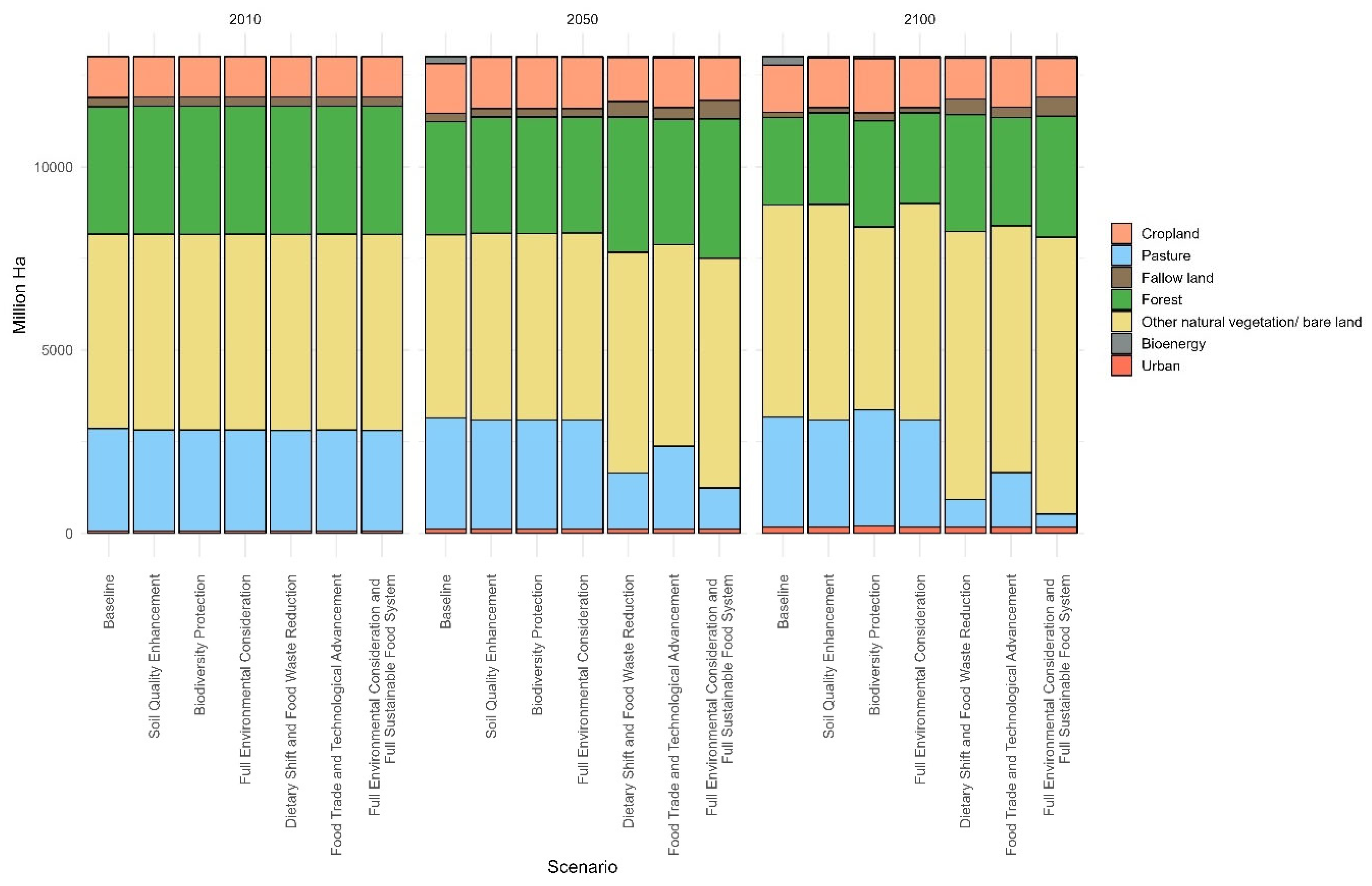
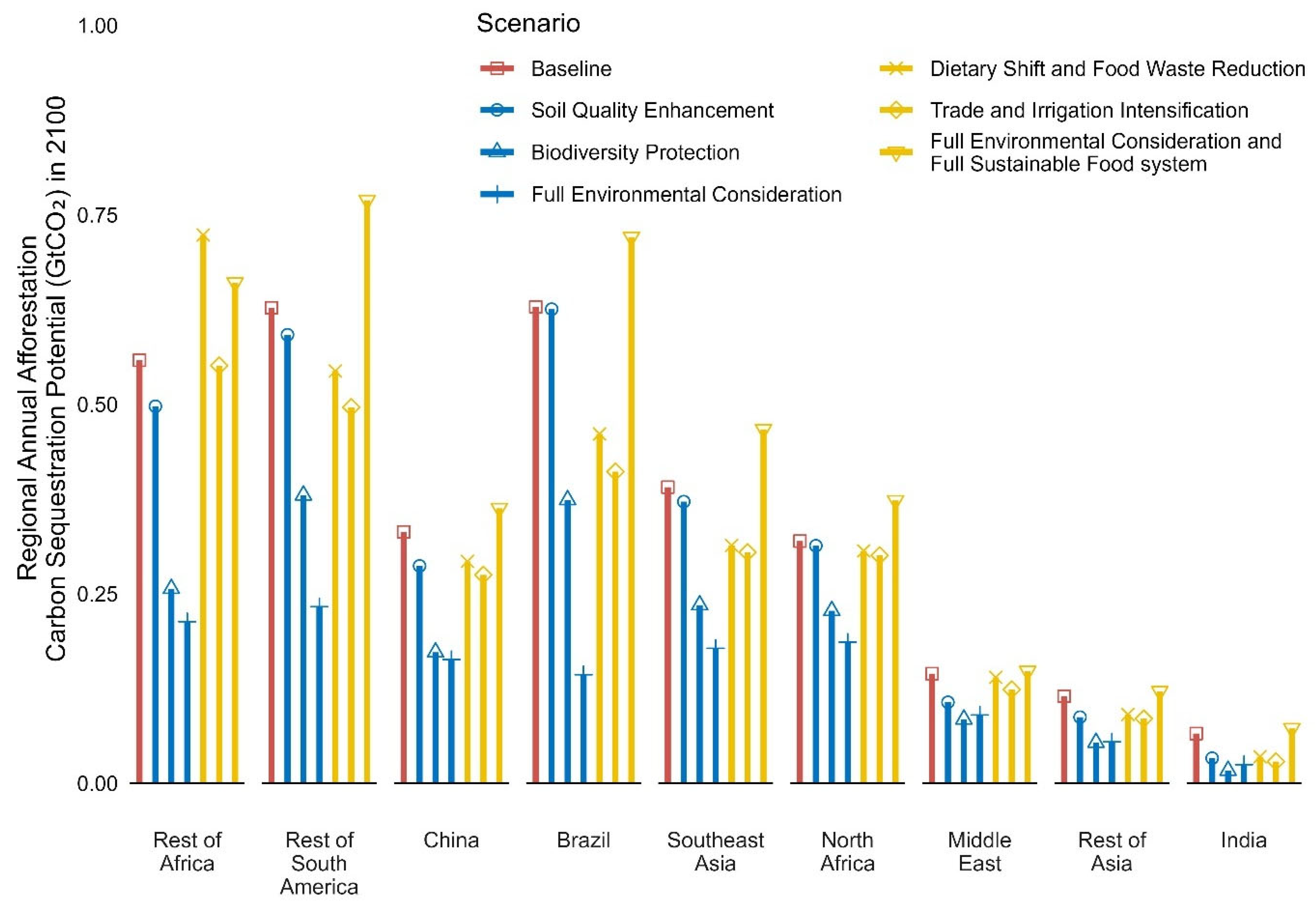
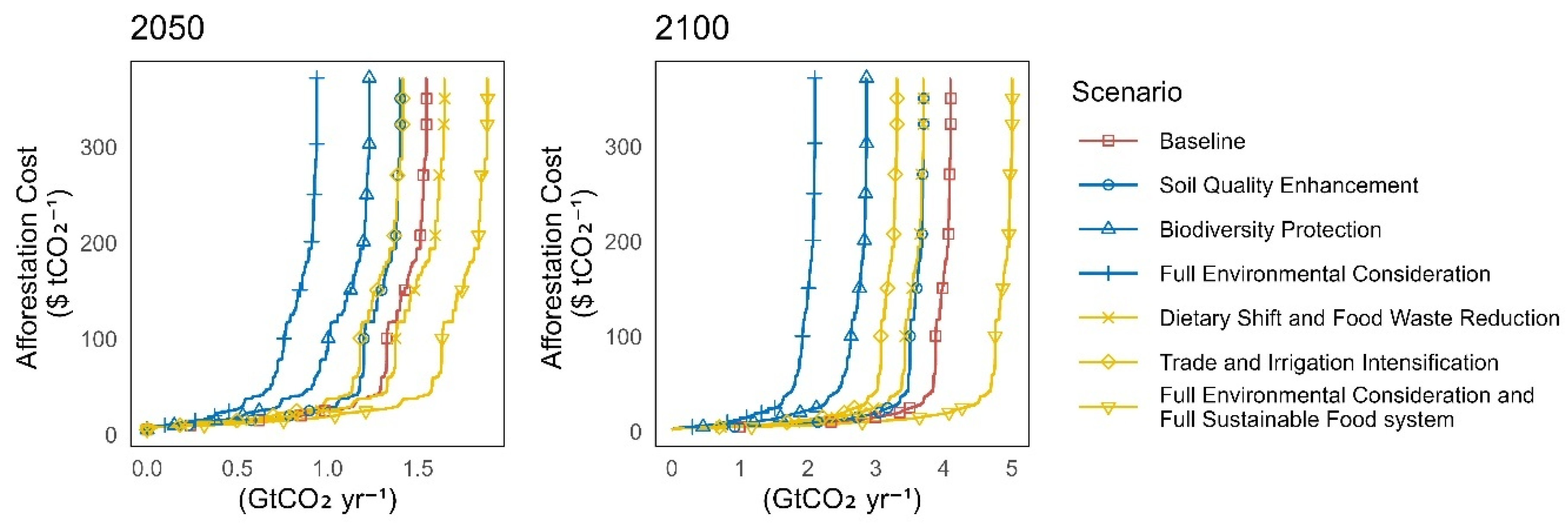
Global Afforestation Carbon Sequestration Potential Within an Integrated Environmental Protection and Sustainable Food System Framework

 , , and
Abstract
1. Introduction
2. Materials and Methods
- a.
- Land demand estimation and spatial allocation
- b.
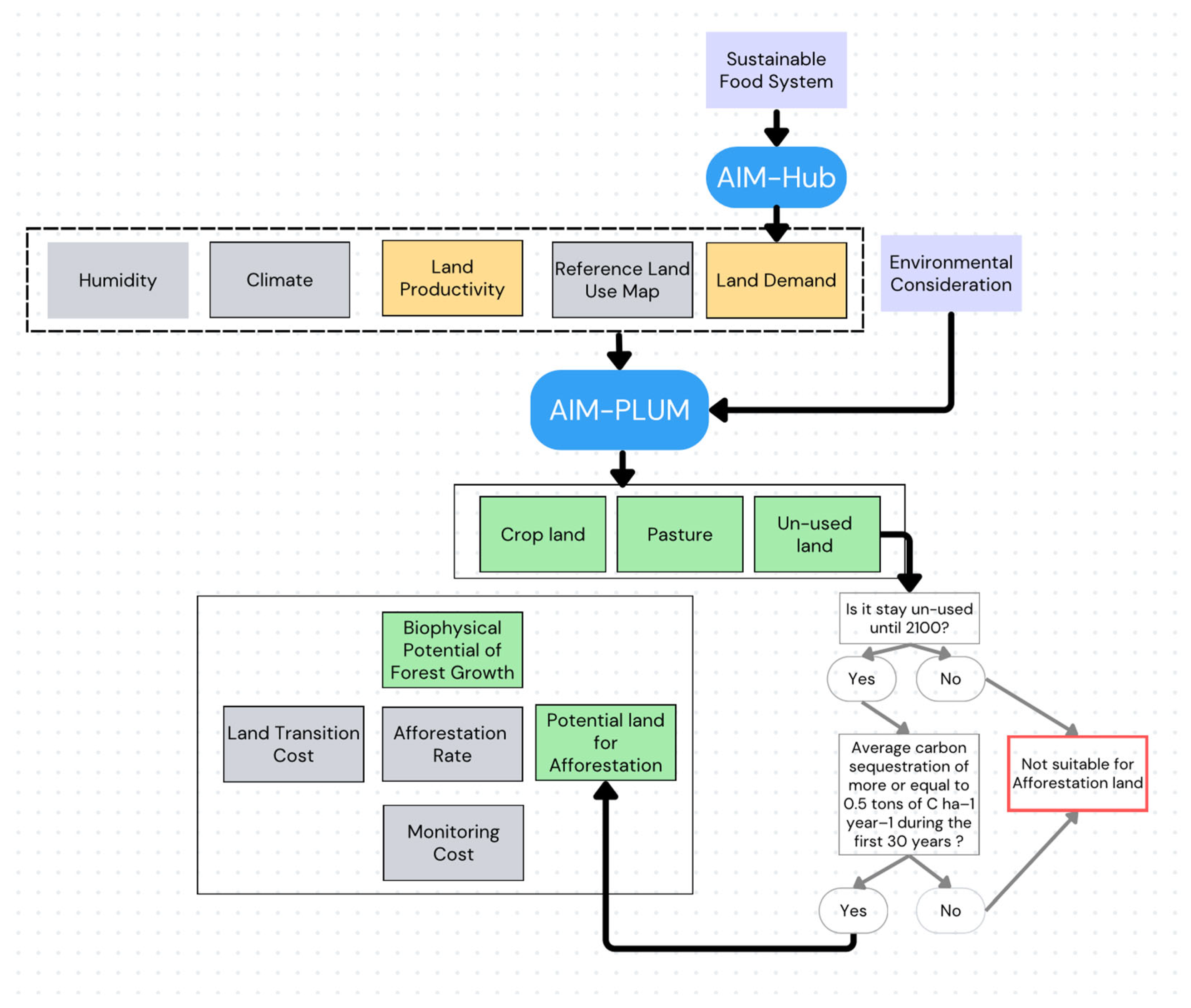
- Identification of suitable land for afforestation carbon sequestration potential
- c.
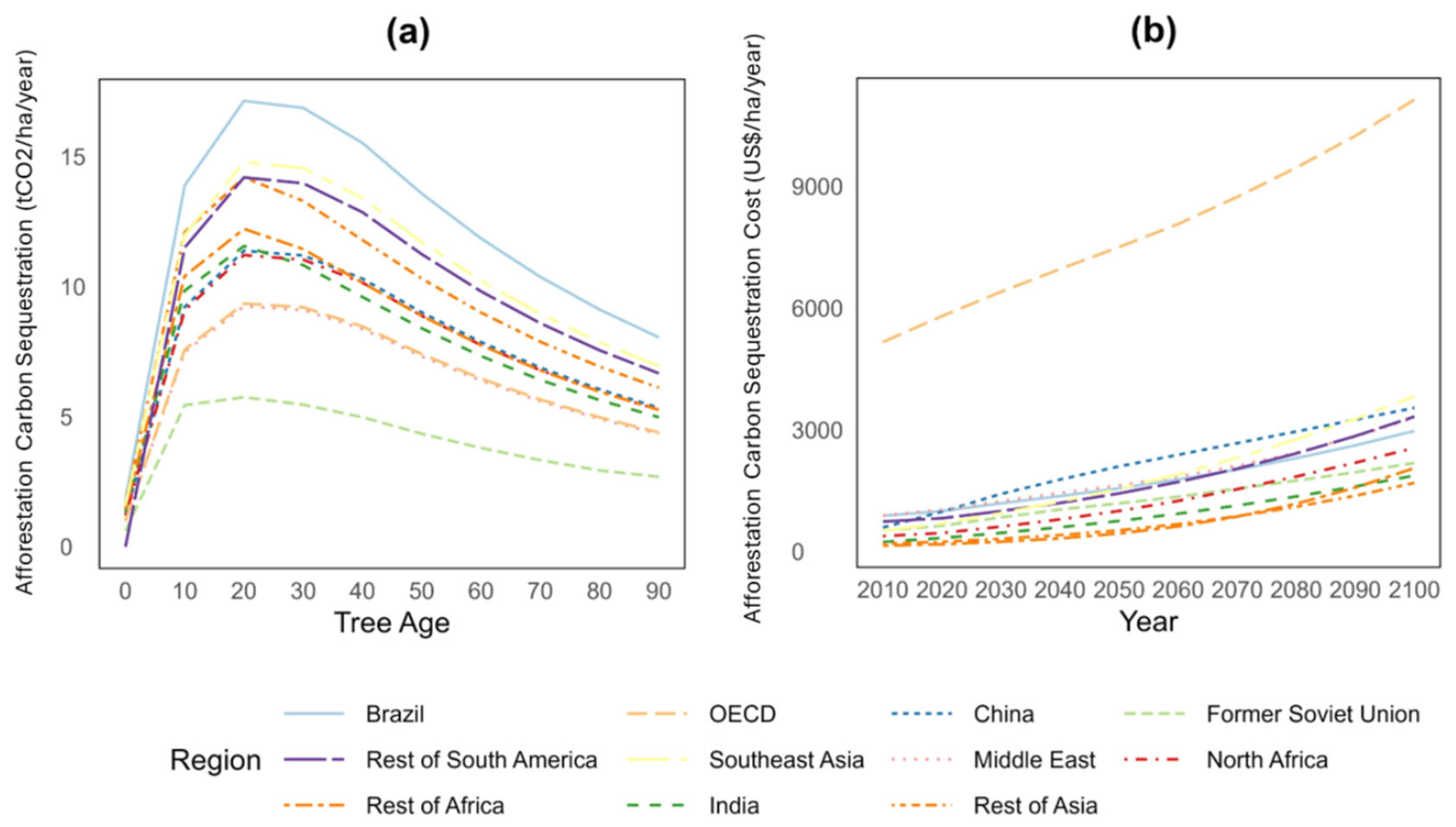
- Cost estimation and supply curve construction
3. Scenario Settings
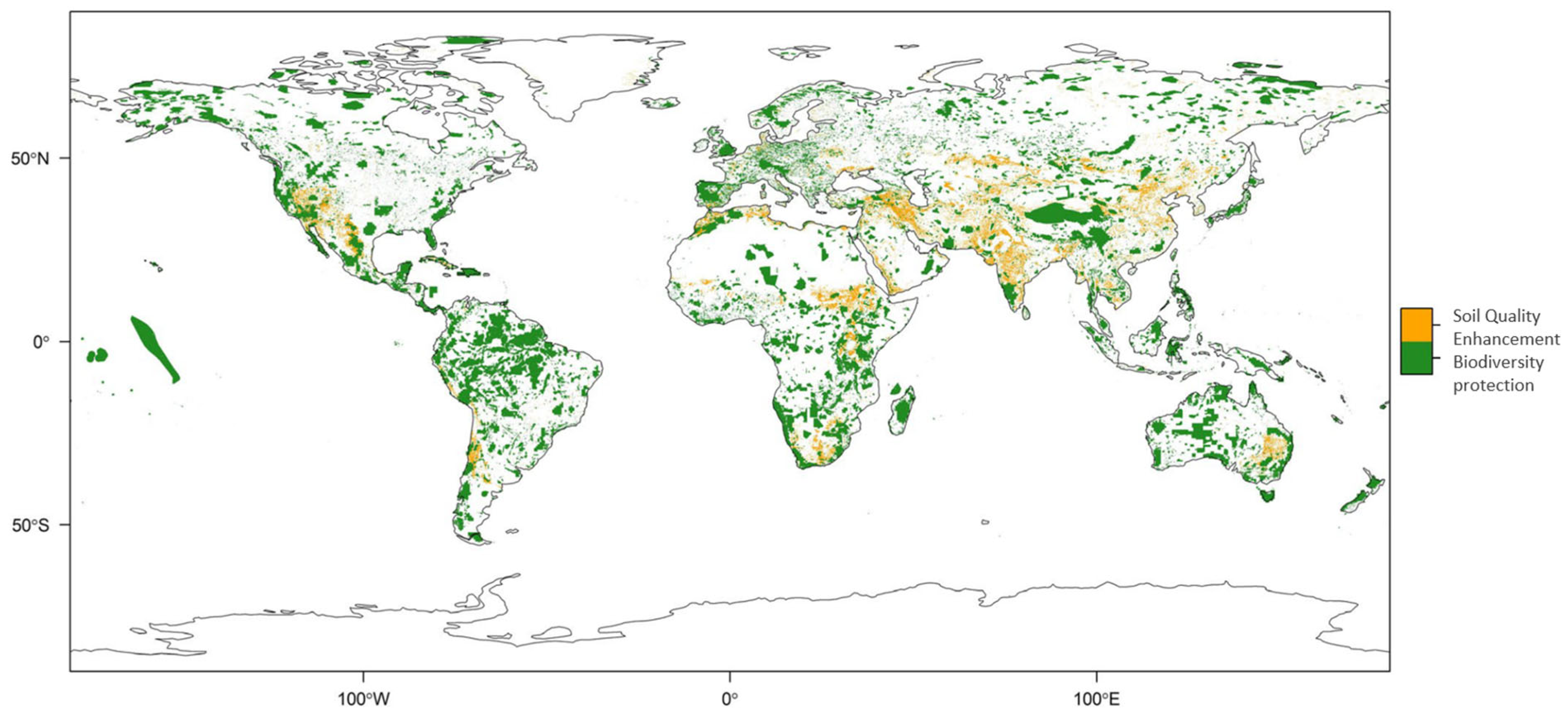
3.1. Biodiversity Protections
3.2. Soil Quality Enhancements
3.3. Dietary Shifts and Food Waste Reductions
3.4. Trade and Irrigation Intensifications
4. Results
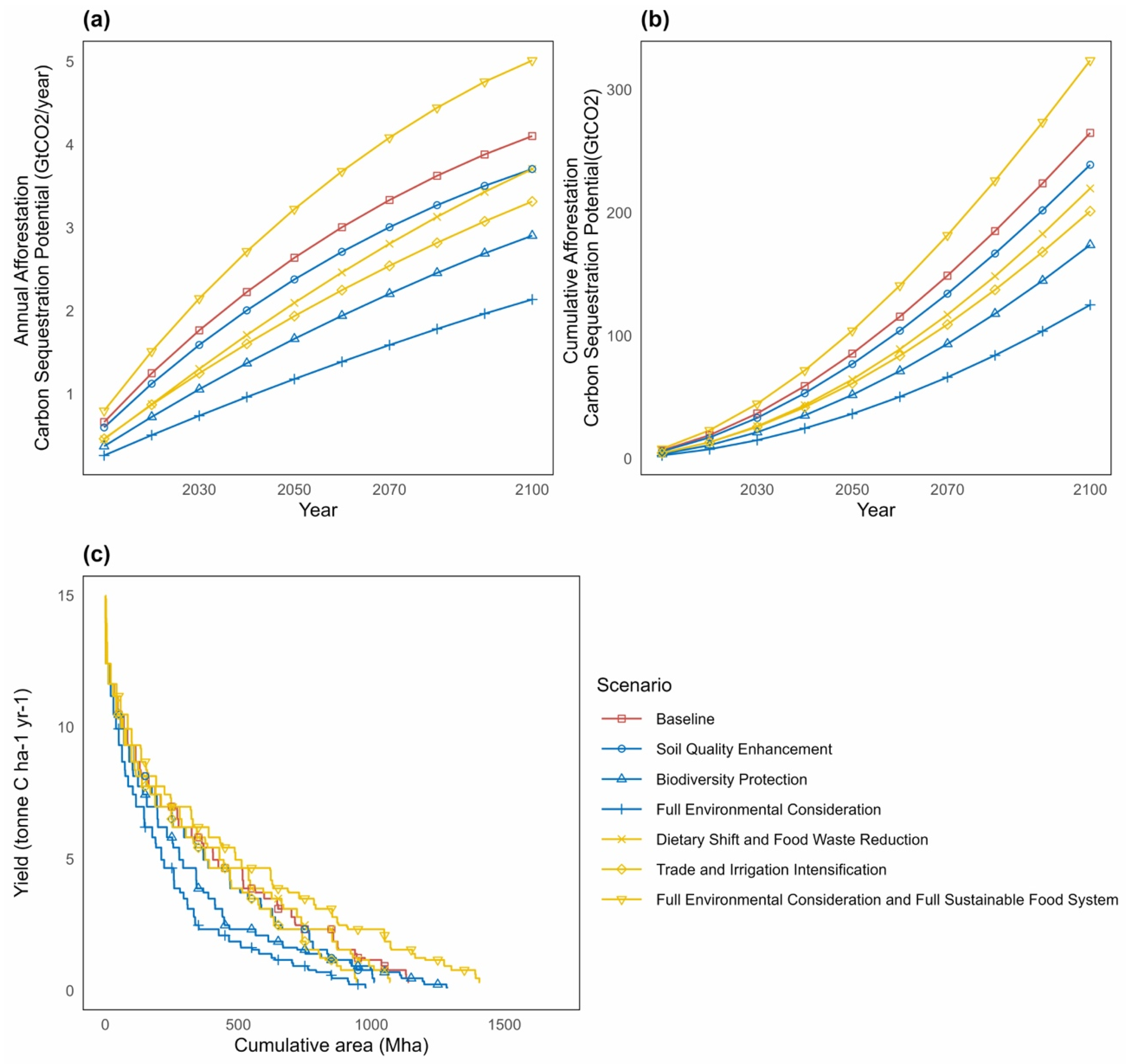
4.1. Global Afforestation Carbon Sequestration Potential
4.2. Regional Potential
4.3. Cost of Carbon Sequestration
5. Discussion
5.1. Afforestation Carbon Sequestration Potential Is Restricted Under Environmental Considerations
5.2. Sustainable Food Systems Can Help Compensate for These Land Constraints
6. Limitations and Uncertainties
7. Conclusions
Supplementary Materials
Author Contributions
Funding
Data Availability Statement
Acknowledgments
Conflicts of Interest
References
- Intergovernmental Panel on Climate Change. Climate Change 2022: Impacts, Adaptation, and Vulnerability; IPCC: Geneva, Switzerland, 2022; Available online: https://www.ipcc.ch/report/ar6/wg2/ (accessed on 29 July 2025).
- Gidden, M.J.; Roe, S.; Ganti, G.; Gasser, T.; Hasegawa, T.; Lamb, W.F.; Ochi, Y.; Strefler, J.; Vaughan, N.E. Chapter 8: Paris-consistent CDR scenarios. In The State of Carbon Dioxide Removal 2024, 2nd ed.; Smith, S.M., Geden, O., Gidden, M.J., Lamb, W.F., Nemet, G.F., Minx, J.C., Buck, H., Burke, J., Cox, E., Edwards, M.R., et al., Eds.; 2024; Available online: https://osf.io/8xk7h/files/mkgqv (accessed on 11 September 2026).
- Hasegawa, T.; Fujimori, S.; Ito, A.; Takahashi, K. Careful selection of forest types in afforestation can increase carbon sequestration by 25% without compromising sustainability. Commun. Earth Environ. 2024, 5, 171. [Google Scholar] [CrossRef] [Scilit]
- Lewis, S.L.; Wheeler, C.E.; Mitchard, E.T.A.; Koch, A. Restoring natural forests is the best way to remove atmospheric carbon. Nature 2019, 568, 25–28. [Google Scholar] [CrossRef] [Scilit] [PubMed]
- Rogelj, J.; Popp, A.; Calvin, K.V.; Luderer, G.; Emmerling, J.; Gernaat, D.; Fujimori, S.; Strefler, J.; Hasegawa, T.; Krey, V.; et al. Scenarios towards limiting global mean temperature increase below 1.5 °C. Nat. Clim. Change 2018, 8, 325–332. [Google Scholar] [CrossRef] [Scilit]
- Griscom, B.W.; Adams, J.; Ellis, P.W.; Houghton, R.A.; Lomax, G.; Miteva, D.A.; Schlesinger, W.H.; Shoch, D.; Siikamäki, J.V.; Smith, P.; et al. Natural climate solutions. Proc. Natl. Acad. Sci. USA 2017, 114, 11645–11650. [Google Scholar] [CrossRef] [Scilit] [PubMed]
- Roe, S.; Streck, C.; Obersteiner, M.; Frank, S.; Griscom, B.; Drouet, L.; Fricko, O.; Gusti, M.; Harris, N.; Hasegawa, T.; et al. Contribution of the land sector to a 1.5 °C world. Nat. Clim. Change 2019, 9, 817–828. [Google Scholar] [CrossRef] [Scilit]
- Intergovernmental Panel on Climate Change. Summary for policymakers. In Global Warming of 1.5 °C.; Masson-Delmotte, V., Zhai, P., Pörtner, H.-O., Roberts, D., Skea, J., Shukla, P.R., Pirani, A., Moufouma-Okia, W., Péan, C., Pidcock, R., et al., Eds.; IPCC: Geneva, Switzerland, 2018. [Google Scholar]
- Smith, P. Chapter 11: Agriculture, forestry and other land use (AFOLU). In Climate Change 2014: Mitigation of Climate Change: Contribution of Working Group III to the Fifth Assessment Report of the Intergovernmental Panel on Climate Change; Cambridge University Press: Cambridge, UK, 2014. [Google Scholar]
- Calvin, K.; Wise, M.; Clarke, L.; Edmonds, J.; Kyle, P.; Luckow, P. Implications of simultaneously mitigating and adapting to climate change: Initial experiments using GCAM. Clim. Change 2014, 123, 125–137. [Google Scholar] [CrossRef] [Scilit]
- Humpenöder, F.; Popp, A.; Dietrich, J.P.; Klein, D.; Lotze-Campen, H.; Bonsch, M.; Bodirsky, B.L.; Weindl, I.; Stevanović, M.; Müller, C.; et al. Investigating afforestation and bioenergy CCS as climate change mitigation strategies. Environ. Res. Lett. 2014, 9, 064029. [Google Scholar] [CrossRef] [Scilit]
- Sathaye, J.; Makundi, W.; Andrasko, K. Forestry Mitigation Potential and Costs in Developing Countries Preface. Mitig. Adapt. Strateg. Glob. Change 2001, 6, 183–184. [Google Scholar] [CrossRef] [Scilit]
- Busch, J.; Engelmann, J.; Cook-Patton, S.C.; Griscom, B.W.; Kroeger, T.; Possingham, H.; Shyamsundar, P. Potential for low-cost carbon dioxide removal through tropical reforestation. Nat. Clim. Change 2019, 9, 463–466. [Google Scholar] [CrossRef] [Scilit]
- Bastin, J.-F.; Finegold, Y.; Garcia, C.; Mollicone, D.; Rezende, M.; Routh, D.; Zohner, C.M.; Crowther, T.W. The global tree restoration potential. Science 2019, 365, 76–79. [Google Scholar] [CrossRef] [Scilit] [PubMed]
- Krause, A.; Pugh, T.A.M.; Bayer, A.D.; Doelman, J.C.; Humpenöder, F.; Anthoni, P.; Khabarov, N.; Stehfest, E. Global consequences of afforestation and bioenergy cultivation on ecosystem service indicators. Biogeosciences 2017, 14, 4829–4850. [Google Scholar] [CrossRef] [Scilit]
- Hasegawa, T.; Fujimori, S.; Shin, Y.; Takahashi, K.; Masui, T.; Tanaka, A. Consequence of climate mitigation on the risk of hunger. Environ. Sci. Technol. 2015, 49, 7245–7253. [Google Scholar] [CrossRef] [Scilit] [PubMed]
- Hasegawa, T.; Fujimori, S.; Havlík, P.; Valin, H.; Bodirsky, B.L.; Doelman, J.C.; Fellmann, T.; Kyle, P.; Koopman, J.F.L.; Lotze-Campen, H.; et al. Risk of increased food insecurity under stringent global climate change mitigation policy. Nat. Clim. Change 2018, 8, 699–703. [Google Scholar] [CrossRef] [Scilit]
- Doelman, J.C.; Stehfest, E.; van Vuuren, D.P.; Hof, A.F.; Braakhekke, M.C.; Gernaat, D.E.H.J.; van den Berg, M.; van Zeist, W.-J.; Daioglou, V.; van Meijl, H.; et al. Afforestation for climate change mitigation: Potentials, risks and trade-offs. Glob. Change Biol. 2020, 26, 1576–1591. [Google Scholar] [CrossRef] [Scilit] [PubMed]
- Fujimori, S.; Wu, W.; Doelman, J.; Frank, S.; Hristov, J.; Kyle, P.; Sands, R.; van Zeist, W.-J.; Havlik, P.; Domínguez, I.P.; et al. Publisher correction: Land-based climate change mitigation measures can affect agricultural markets and food security. Nat. Food 2022, 3, 294. [Google Scholar] [CrossRef] [Scilit] [PubMed]
- Kreidenweis, U.; Humpenöder, F.; Stevanović, M.; Bodirsky, B.L.; Kriegler, E.; Lotze-Campen, H.; Popp, A. Afforestation to mitigate climate change: Impacts on food prices under consideration of albedo effects. Environ. Res. Lett. 2016, 11, 085001. [Google Scholar] [CrossRef] [Scilit]
- Frank, S.; Havlík, P.; Stehfest, E.; van Meijl, H.; Witzke, H.P.; Pérez-Domínguez, I.; van Dijk, M.; Doelman, J.C.; Fellmann, T.; Koopman, J.F.L.; et al. Agricultural non-CO2 emission reduction potential in the context of the 1.5 °C target. Nat. Clim. Change 2017, 7, 870–874. [Google Scholar] [CrossRef] [Scilit]
- Lawrence, D.; Coe, M.; Walker, W.; Verchot, L.; Vandecar, K. The unseen effects of deforestation: Biophysical effects on climate. Front. For. Glob. Change 2018, 1, 6. [Google Scholar] [CrossRef] [Scilit]
- Ohashi, H.; Yonekura, Y.; Hirata, A.; Takano, K.; Nishijima, S.; Matsui, T. The effect of climate change on the extinction risk of living organisms on the global scale: Evaluation of the effect and side effects of mitigation measures. In Proceedings of the 64th Annual Meeting of the Ecological Society of Japan, Organized Session T05: Mitigation/Adaptation Measures of Climate Change: Relationship from Ecosystem Impact Prediction to Human Activities, Tokyo, Japan, 14–18 March 2017. [Google Scholar]
- Ohashi, H.; Hasegawa, T.; Hirata, A.; Fujimori, S.; Takahashi, K.; Tsuyama, I.; Nakao, K.; Kominami, Y.; Tanaka, N.; Hijioka, Y.; et al. Biodiversity can benefit from climate stabilization despite adverse side effects of land-based mitigation. Nat. Commun. 2019, 10, 5240. [Google Scholar] [CrossRef] [Scilit] [PubMed]
- Houghton, R.A.; Byers, B.; Nassikas, A.A. A role for tropical forests in stabilizing atmospheric CO2. Nat. Clim. Change 2015, 5, 1022–1023. [Google Scholar] [CrossRef] [Scilit]
- Seddon, N.; Smith, A.; Smith, P.; Key, I.; Chausson, A.; Girardin, C.; House, J.; Srivastava, S.; Turner, B. Getting the message right on nature-based solutions to climate change. Glob. Change Biol. 2021, 27, 1518–1546. [Google Scholar] [CrossRef] [Scilit] [PubMed]
- Pörtner, H.-O.; Scholes, R.J.; Agard, J.; Archer, E.; Arneth, A.; Bai, X.; Barnes, D.; Burrows, M.; Chan, L.; Cheung, W.L.; et al. Scientific Outcome of the IPBES-IPCC Co-Sponsored Workshop on Biodiversity and Climate Change; IPBES Secretariat: Bonn, Germany, 2021. [Google Scholar] [CrossRef] [Scilit]
- Hirata, A.; Ohashi, H.; Hasegawa, T.; Fujimori, S.; Takahashi, K.; Tsuchiya, K.; Matsui, T. The choice of land-based climate change mitigation measures influences future global biodiversity loss. Commun. Earth Environ. 2024, 5, 259. [Google Scholar] [CrossRef] [Scilit]
- Benítez, P.C.; McCallum, I.; Obersteiner, M.; Yamagata, Y. Global potential for carbon sequestration: Geographical distribution, country risk and policy implications. Ecol. Econ. 2007, 60, 572–583. [Google Scholar] [CrossRef] [Scilit]
- Wang, Y.; Zhu, Y.; Cook-Patton, S.C.; Sun, W.; Zhang, W.; Ciais, P.; Li, T.; Smith, P.; Yuan, W.; Zhu, X.; et al. Land availability and policy commitments limit global climate mitigation from forestation. Science 2025, 389, 931–934. [Google Scholar] [CrossRef] [Scilit] [PubMed]
- Wu, W.; Hasegawa, T.; Ohashi, H.; Hanasaki, N.; Liu, J.; Matsui, T.; Fujimori, S.; Masui, T.; Takahashi, K. Global advanced bioenergy potential under environmental protection policies and societal transformation measures. GCB Bioenergy 2019, 11, 1275–1292. [Google Scholar] [CrossRef] [Scilit]
- Sun, Z.; Scherer, L.; Tukker, A.; Spawn-Lee, S.A.; Bruckner, M.; Gibbs, H.K.; Behrens, P. Dietary change in high-income nations alone can lead to substantial double climate dividend. Nat. Food 2022, 3, 29–37. [Google Scholar] [CrossRef] [Scilit] [PubMed]
- Fujimori, S.; Masui, T.; Matsuoka, Y. AIM-HUB [Basic] Manual; Discussion Paper Series, Center for Social and Environmental Systems Research; National Institute for Environmental Studies: Tsukuba, Japan, 2012.
- Hasegawa, T.; Fujimori, S.; Ito, A.; Takahashi, K.; Masui, T. Global land-use allocation model linked to an integrated assessment model. Sci. Total Environ. 2017, 580, 787–796. [Google Scholar] [CrossRef] [Scilit] [PubMed]
- Fujimori, S.; Hasegawa, T.; Masui, T.; Takahashi, K. Land use representation in a global CGE model for long-term simulation: CET vs. logit functions. Food Secur. 2014, 6, 685–699. [Google Scholar] [CrossRef] [Scilit]
- Fujimori, S.; Abe, M.; Kinoshita, T.; Hasegawa, T.; Kawase, H.; Kushida, K.; Yoshikawa, M. Downscaling global emissions and its implications derived from climate model experiments. PLoS ONE 2017, 12, e0169733. [Google Scholar] [CrossRef] [Scilit] [PubMed]
- Fujimori, S.; Hasegawa, T.; Rogelj, J.; Su, X.; Havlík, P.; Krey, V.; Takahashi, K.; Riahi, K. Inclusive climate change mitigation and food security policy under 1.5 °C climate goal. Environ. Res. Lett. 2018, 13, 074033. [Google Scholar] [CrossRef] [Scilit]
- Kamasela, D.F.; Fujimori, S.; Hasegawa, T.; Vishwanathan, S.S. Global soil organic carbon sequestration potential under sustainable food systems and climate mitigation. Environ. Res. Lett. 2025, 20, 124062. [Google Scholar] [CrossRef] [Scilit]
- Hasegawa, T.; Fujimori, S.; Tsuchiya, K.; Ito, A.; Takahashi, K. National land-based climate mitigation scenarios dataset. Sci. Data 2025, 12, 1077. [Google Scholar] [CrossRef] [Scilit] [PubMed]
- Intergovernmental Panel on Climate Change. 2006 IPCC Guidelines for National Greenhouse Gas Inventories; Eggleston, H.S., Buendia, L., Miwa, K., Ngara, T., Tanabe, K., Eds.; Institute for Global Environmental Strategies: Kanagawa, Japan, 2006. [Google Scholar]
- Dutschke, M. Permanence of CDM Forests or Non-permanence of Land Use Related Carbon Credits? HWWA Discussion Paper No. 132; Hamburg Institute of International Economics: Hamburg, Germany, 2001. [Google Scholar]
- United Nations. United Nations Strategic Plan for Forests 2017–2030: Resolution Adopted by the General Assembly on 27 April 2017, A/RES/71/285; United Nations: New York, NY, USA, 2017. [Google Scholar]
- Sohngen, B.; Golub, A.A.; Hertel, T.W. The role of forestry in carbon sequestration in general equilibrium models. In Economic Analysis of Land Use in Global Climate Change Policy; Hertel, T.W., Rose, S.K., Tol, R.S.J., Eds.; Routledge: Abingdon, UK, 2009; pp. 279–302. [Google Scholar]
- Winsten, J.; Walker, S.; Brown, S.; Grimland, S. Estimating carbon supply curves from afforestation of agricultural land in the Northeastern U.S. Mitig. Adapt. Strateg. Glob. Change 2011, 16, 925–942. [Google Scholar] [CrossRef] [Scilit]
- Hoogwijk, M.; Faaij, A.; de Vries, B.; Turkenburg, W. Exploration of regional and global cost-supply curves of biomass energy from short-rotation crops at abandoned cropland and rest land under four IPCC SRES land-use scenarios. Biomass Bioenergy 2009, 33, 26–43. [Google Scholar] [CrossRef] [Scilit]
- O’Neill, B.C.; Kriegler, E.; Ebi, K.L.; Kemp-Benedict, E.; Riahi, K.; Rothman, D.S.; van Ruijven, B.J.; van Vuuren, D.P.; Birkmann, J.; Kok, K.; et al. The roads ahead: Narratives for shared socioeconomic pathways describing world futures in the 21st century. Glob. Environ. Change 2017, 42, 169–180. [Google Scholar] [CrossRef] [Scilit]
- IUCN; UNEP-WCMC. The World Database on Protected Areas (WDPA) [January 2018 Version]. UNEP-WCMC. 2018. Available online: https://www.protectedplanet.net/ (accessed on 29 June 2024).
- BirdLife International. World Database of Key Biodiversity Areas. KBA Partnership. 2017. Available online: https://www.keybiodiversityareas.org/ (accessed on 21 September 2024).
- Phillips, S.J.; Anderson, R.P.; Schapire, R.E. Maximum entropy modeling of species geographic distributions. Ecol. Model. 2006, 190, 231–259. [Google Scholar] [CrossRef] [Scilit]
- Crowe, O.; Beresford, A.E.; Buchanan, G.M.; Grantham, H.S.; Simkins, A.T.; Watson, J.E.M.; Butchart, S.H.M. A global assessment of forest integrity within Key Biodiversity Areas. Biol. Conserv. 2023, 286, 110293. [Google Scholar] [CrossRef] [Scilit]
- Oraon, P.R.; Sagar, V.; Beauty, K. Ecological restoration of degraded land through afforestation activities. In Land and Environmental Management Through Forestry; Raj, A., Jhariya, M.K., Banerjee, A., Nema, S., Bargali, K., Eds.; Wiley: Hoboken, NJ, USA, 2023; pp. 201–216. [Google Scholar] [CrossRef] [Scilit]
- Chazdon, R.L.; Peres, C.A.; Dent, D.H.; Sheil, D.; Lugo, A.E.; Lamb, D.; Stork, N.E.; Miller, S.E. The potential for species conservation in tropical secondary forests. Conserv. Biol. 2009, 23, 1406–1417. [Google Scholar] [CrossRef] [Scilit] [PubMed]
- Freddy, N.; Monica, P. Mapping Land Use Systems at Global and Regional Scales for Land Degradation Assessment Analysis; Technical Report of the LADA FAO/UNEP Project; FAO: Rome, Italy, 2011. [Google Scholar]
- Oldeman, R.; Hakkeling, R.; Sombroek, W. World Map of the Status of Human-Induced Soil Degradation: An Explanatory Note, 2nd ed.; International Soil Reference and Information Centre (ISRIC): Wageningen, The Netherlands, 1991; Available online: https://edepot.wur.nl/287507 (accessed on 11 September 2026).
- Lefebvre, D.; Williams, A.G.; Kirk, G.J.D.; Burgess, P.J.; Meersmans, J.; Silman, M.R.; Román-Dañobeytia, F.; Farfan, J.; Smith, P. Assessing the carbon capture potential of a reforestation project. Sci. Rep. 2021, 11, 19907. [Google Scholar] [CrossRef] [Scilit] [PubMed]
- Willett, W.; Rockström, J.; Loken, B.; Springmann, M.; Lang, T.; Vermeulen, S.; Garnett, T.; Tilman, D.; DeClerck, F.; Wood, A.; et al. Food in the Anthropocene: The EAT–Lancet Commission on healthy diets from sustainable food systems. Lancet 2019, 393, 447–492. [Google Scholar] [CrossRef] [Scilit] [PubMed]
- Ardra, S.; Barua, M.K. Halving food waste generation by 2030: The challenges and strategies of monitoring UN Sustainable Development Goal target 12.3. J. Clean. Prod. 2022, 380, 135042. [Google Scholar] [CrossRef] [Scilit]
- von Lampe, M.; Willenbockel, D.; Ahammad, H.; Blanc, E.; Cai, Y.; Calvin, K.; Fujimori, S.; Hasegawa, T.; Havlik, P.; Heyhoe, E.; et al. Why do global long-term scenarios for agriculture differ? An overview of the AgMIP global economic model intercomparison. Agric. Econ. 2014, 45, 3–20. [Google Scholar] [CrossRef] [Scilit]
- Hanasaki, N.; Kanae, S.; Oki, T.; Masuda, K.; Motoya, K.; Shirakawa, N.; Shen, Y.; Tanaka, K. An integrated model for the assessment of global water resources—Part 2: Applications and assessments. Hydrol. Earth Syst. Sci. 2013, 17, 1069–1080. [Google Scholar] [CrossRef] [Scilit]
- Jansakoo, T.; Sekizawa, S.; Fujimori, S.; Hasegawa, T.; Oshiro, K. Benefits of air quality for human health resulting from climate change mitigation through dietary change and food loss prevention policy. Sustain. Sci. 2024, 19, 1391–1407. [Google Scholar] [CrossRef] [Scilit]
- Intergovernmental Panel on Climate Change. Special Report on Emissions Scenarios; Nakicenovic, N., Alcamo, J., Davis, G., de Vries, B., Fenhann, J., Gaffin, S., Gregory, K., Grübler, A., Jung, T.Y., Kram, T., et al., Eds.; Cambridge University Press: Cambridge, UK, 2000. [Google Scholar]
- Dudley, N. (Ed.) Guidelines for Applying Protected Area Management Categories; IUCN: Gland, Switzerland, 2008. [Google Scholar]
- Wijenayake, P.R.; Rangani, P.; Hasegawa, T.; Ohashi, H.; Hirata, A.; Takahashi, K. Afforestation and reforestation have varying biodiversity impacts across and within biomes. Environ. Res. Lett. 2026, 21, 024031. [Google Scholar] [CrossRef] [Scilit]
- Intergovernmental Science-Policy Platform on Biodiversity and Ecosystem Services. The IPBES Assessment Report on Land Degradation and Restoration; IPBES: Bonn, Germany, 2018. [Google Scholar]
- Gvein, M.H.; Hu, X.; Næss, J.S.; Watanabe, M.D.B.; Cavalett, O.; Malbranque, M.; Kindermann, G.; Cherubini, F. Potential of land-based climate change mitigation strategies on abandoned cropland. Commun. Earth Environ. 2023, 4, 39. [Google Scholar] [CrossRef] [Scilit]
- Strassburg, B.B.N.; Iribarrem, A.; Beyer, H.L.; Cordeiro, C.L.; Crouzeilles, R.; Jakovac, C.C.; Junqueira, A.B.; Lacerda, E.; Latawiec, A.E.; Balmford, A.; et al. Global priority areas for ecosystem restoration. Nature 2020, 586, 724–729. [Google Scholar] [CrossRef] [Scilit] [PubMed]
- Ritchie, H.; Roser, M. Half of the World’s Habitable Land is Used for Agriculture. Our World in Data. 2019. Available online: https://ourworldindata.org/global-land-for-agriculture (accessed on 29 September 2025).
- FABLE. Food, Agriculture, Biodiversity, Land-use, and Energy Pathways to 2050; Food, Agriculture, Biodiversity, Land-Use, and Energy Consortium: Laxenburg, Austria, 2021. [Google Scholar]
- Pendrill, F.; Persson, U.M.; Godar, J.; Kastner, T.; Moran, D.; Schmidt, S.; Wood, R. Agricultural and forestry trade drives large share of tropical deforestation emissions. Glob. Environ. Change 2019, 56, 1–10. [Google Scholar] [CrossRef] [Scilit]
- Rasmussen, L.V.; Bierbaum, R.; Oldekop, J.A.; Agrawal, A. Bridging the gap between sustainable development and land system science. Nat. Sustain. 2021, 4, 392–399. [Google Scholar]
- Weindl, I.; Lotze-Campen, H.; Popp, A.; Müller, C.; Havlík, P.; Herrero, M.; Schmitz, C.; Rolinski, S. Livestock in a changing climate: Production system transitions as an adaptation strategy for agriculture. Environ. Res. Lett. 2017, 12, 094003. [Google Scholar] [CrossRef] [Scilit]
- Adolph, B.; Griffiths, G.; Hou-Jones, X. Analysis of the Implications of Africa’s Food Systems Development on Environmental Sustainability: Discussion Document; International Center for Tropical Agriculture (CIAT): Palmira, Colombia, 2023; Available online: https://hdl.handle.net/10568/135521 (accessed on 31 December 2023).
- Yu, Q.; Xiang, M.; Sun, Z.; Wu, W. The complexity of measuring cropland use intensity: An empirical study. Agric. Syst. 2021, 192, 103180. [Google Scholar] [CrossRef] [Scilit]
- Wang, H.; Sui, W.; Zhang, W.; Guo, Y.; Wang, S.; Jiang, L. Dietary shift can enhance the environmental benefits of crop redistribution. Environ. Impact Assess. Rev. 2024, 106, 107494. [Google Scholar] [CrossRef] [Scilit]
- Long, W.; Zhu, X.; Weikard, H.P.; Oenema, O.; Hou, Y. Exploring sustainable food system transformation options in China: An integrated environmental-economic modelling approach based on the applied general equilibrium framework. Sustain. Prod. Consum. 2024, 51, 42–54. [Google Scholar] [CrossRef] [Scilit]
- Nilsson, S.; Schopfhauser, W. The carbon-sequestration potential of a global afforestation program. Clim. Change 1995, 30, 267–293. [Google Scholar] [CrossRef] [Scilit]
- Byers, E.; Krey, V.; Kriegler, E.; Riahi, K.; Schaeffer, R.; Kikstra, J.; Lamboll, R.; Nicholls, Z.; Sandstad, M.; Smith, C.; et al. AR6 Scenarios Database; International Institute for Applied Systems Analysis (IIASA): Laxenburg, Austria, 2022. [Google Scholar] [CrossRef]



| Scenario Name | Environmental Consideration | Sustainable Food System |
|---|---|---|
| Baseline | X | X |
| Biodiversity Protection | Biodiversity Protection | X |
| Soil Quality Enhancement | Soil Quality Enhancement | X |
| Full Environmental Consideration | Biodiversity Protection, Soil Quality Enhancement | X |
| Dietary Shift and Food Waste Reduction (Env + Diet) | Full Environmental Consideration | Dietary Shift and Food Waste Reduction |
| Trade and Irrigation Intensification (Env + Trade) | Full Environmental Consideration | Food Trade and Technological Advancement |
| Full Environmental Consideration and Full Sustainable Food System (Env + Diet + Trade) | Full Environmental Consideration | Dietary Shift, Food Waste Reduction, Food Trade and Technological Advancement |
Disclaimer/Publisher’s Note: The statements, opinions and data contained in all publications are solely those of the individual author(s) and contributor(s) and not of MDPI and/or the editor(s). MDPI and/or the editor(s) disclaim responsibility for any injury to people or property resulting from any ideas, methods, instructions or products referred to in the content. |
© 2026 by the authors. Licensee MDPI, Basel, Switzerland. This article is an open access article distributed under the terms and conditions of the Creative Commons Attribution (CC BY) license.
Share and Cite
Kamasela, D.F.; Fujimori, S.; Hasegawa, T.; Vishwanathan, S.S. Global Afforestation Carbon Sequestration Potential Within an Integrated Environmental Protection and Sustainable Food System Framework. Land 2026, 15, 1733. https://doi.org/10.3390/land15091733
Kamasela DF, Fujimori S, Hasegawa T, Vishwanathan SS. Global Afforestation Carbon Sequestration Potential Within an Integrated Environmental Protection and Sustainable Food System Framework. Land. 2026; 15(9):1733. https://doi.org/10.3390/land15091733
Chicago/Turabian StyleKamasela, Dianti Farhana, Shinichiro Fujimori, Tomoko Hasegawa, and Saritha Sudharmma Vishwanathan. 2026. "Global Afforestation Carbon Sequestration Potential Within an Integrated Environmental Protection and Sustainable Food System Framework" Land 15, no. 9: 1733. https://doi.org/10.3390/land15091733
APA StyleKamasela, D. F., Fujimori, S., Hasegawa, T., & Vishwanathan, S. S. (2026). Global Afforestation Carbon Sequestration Potential Within an Integrated Environmental Protection and Sustainable Food System Framework. Land, 15(9), 1733. https://doi.org/10.3390/land15091733