From Preservation to Transformation: Long-Term Locational Vitality Evolution and Multi-Scale Influencing Factors of Heritage Spaces in the Yangtze River Delta, China

Abstract
1. Introduction
2. Materials and Methods
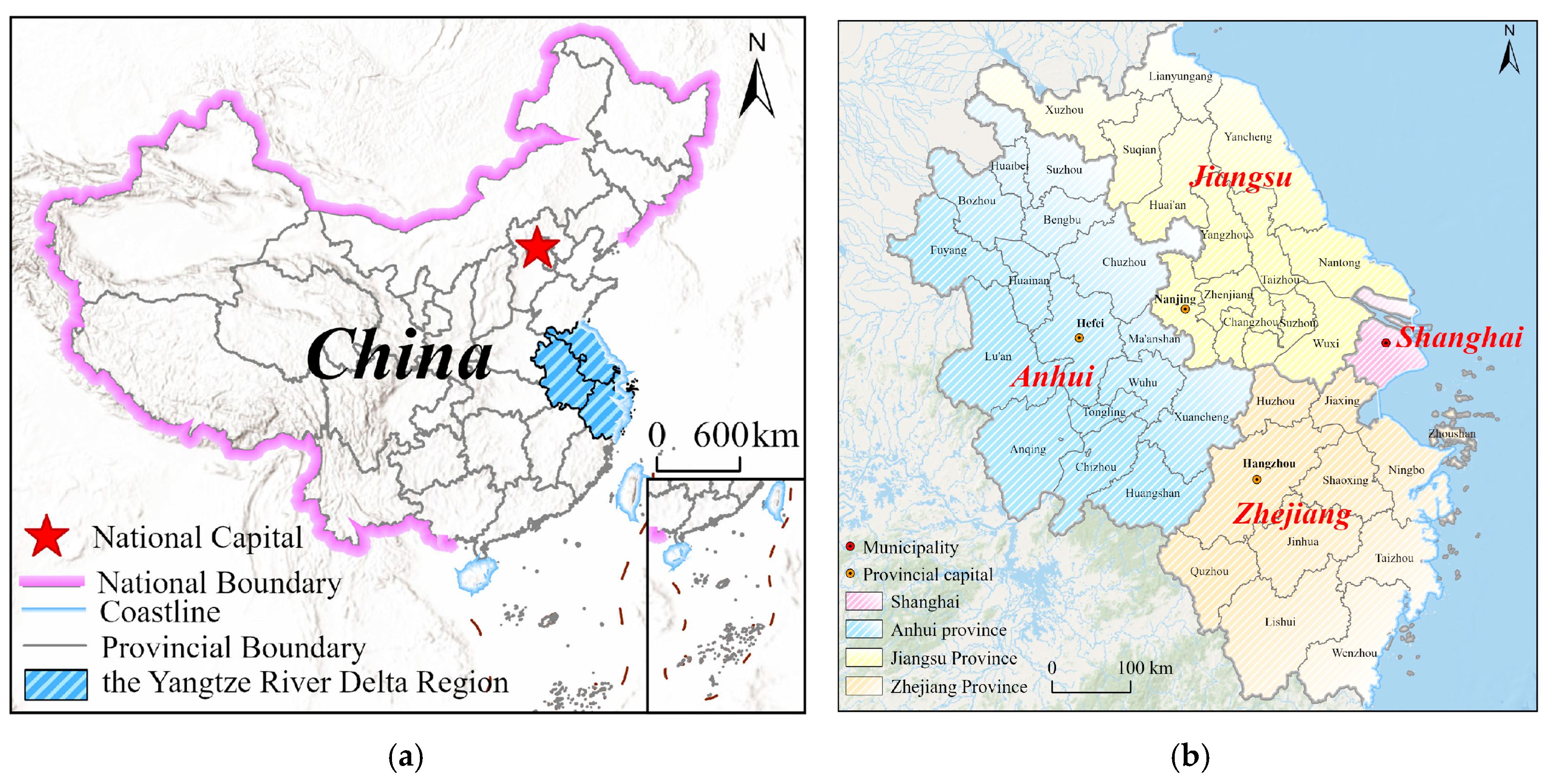
2.1. Study Area
2.2. Data Sources and Preprocessing
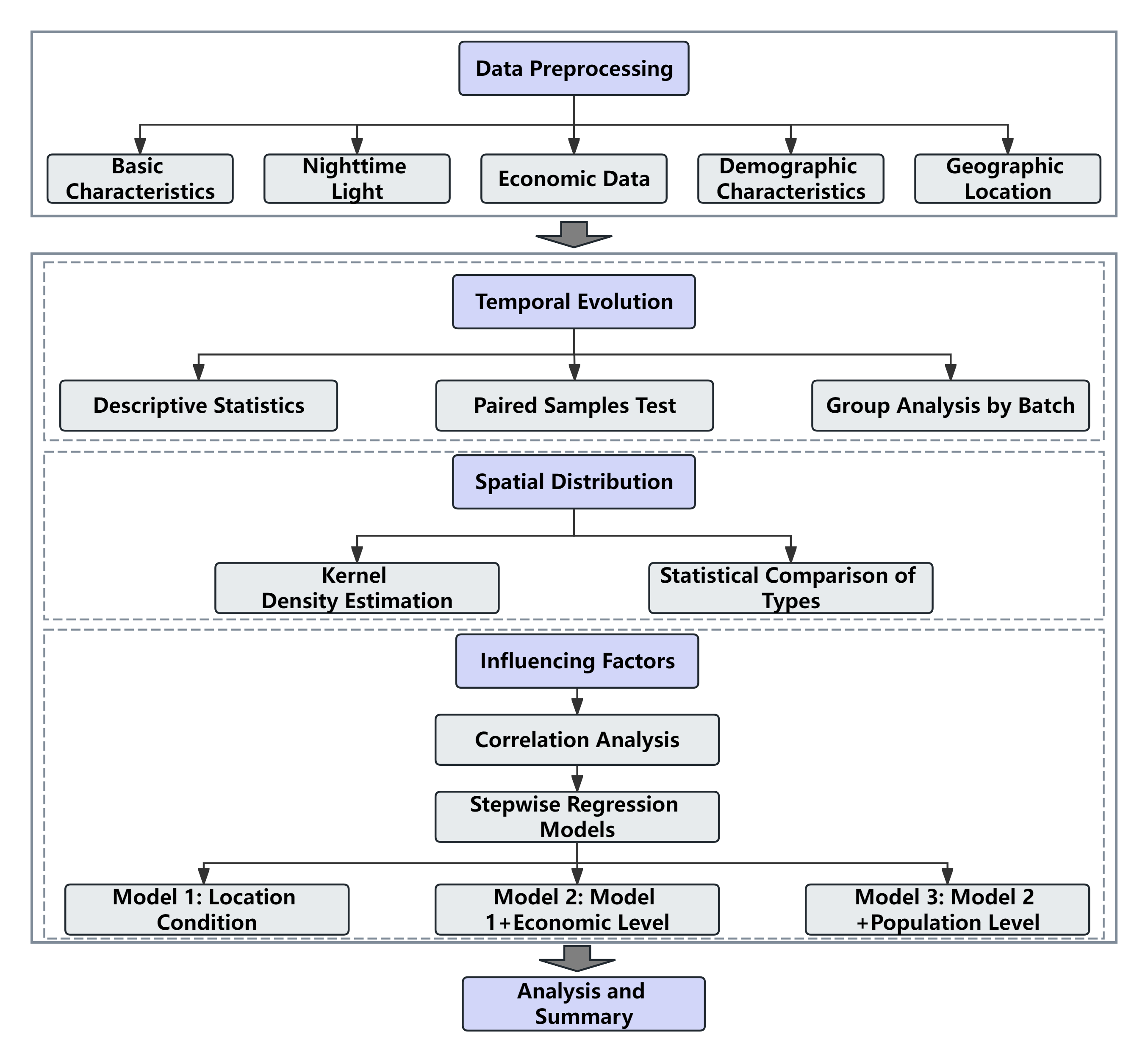
2.3. Analytical Methods
2.3.1. Temporal Evolution Analysis
2.3.2. Spatial Distribution Analysis
2.3.3. Influencing Factor Analysis
3. Results
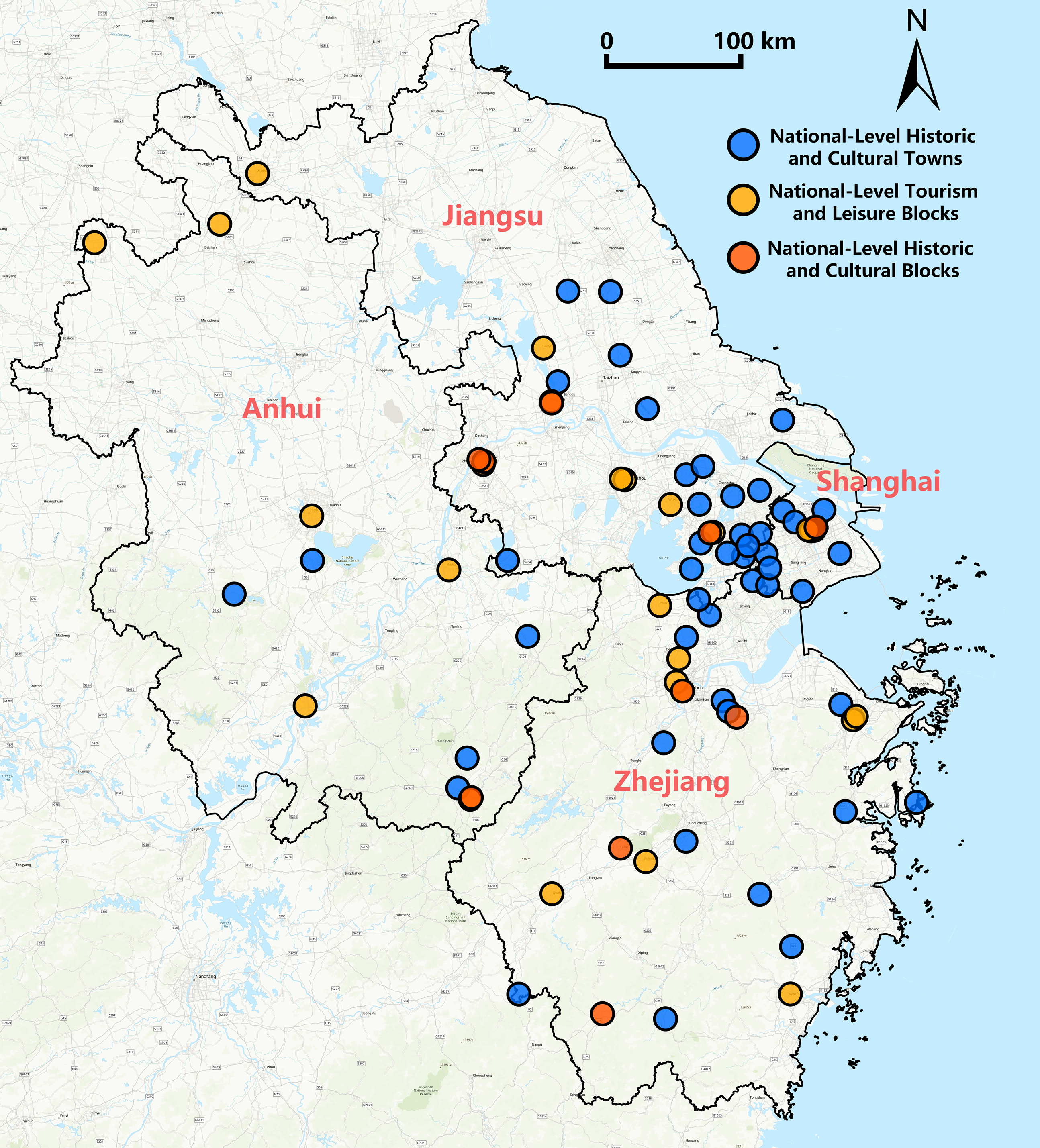
3.1. Data Overview
3.2. Temporal Evolution
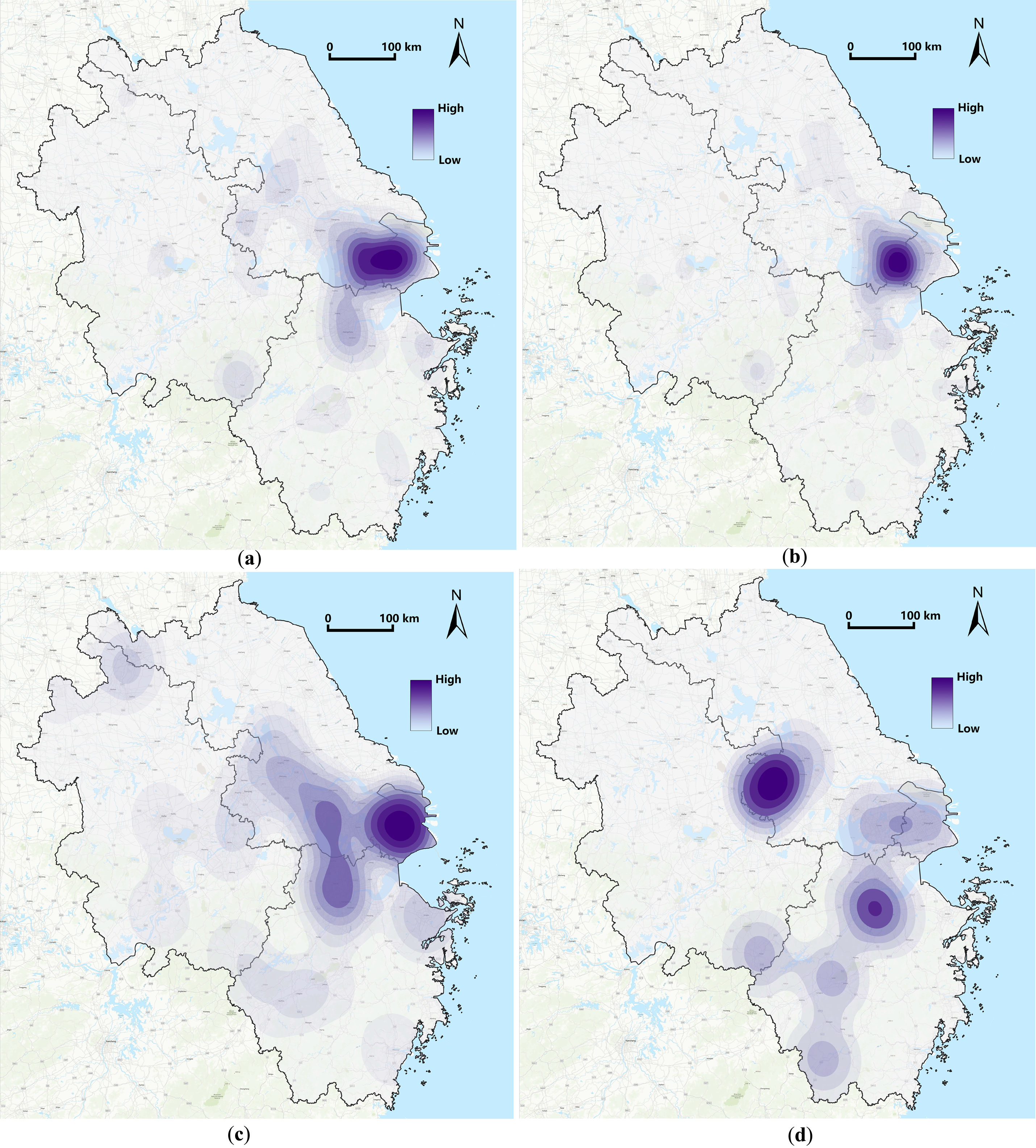
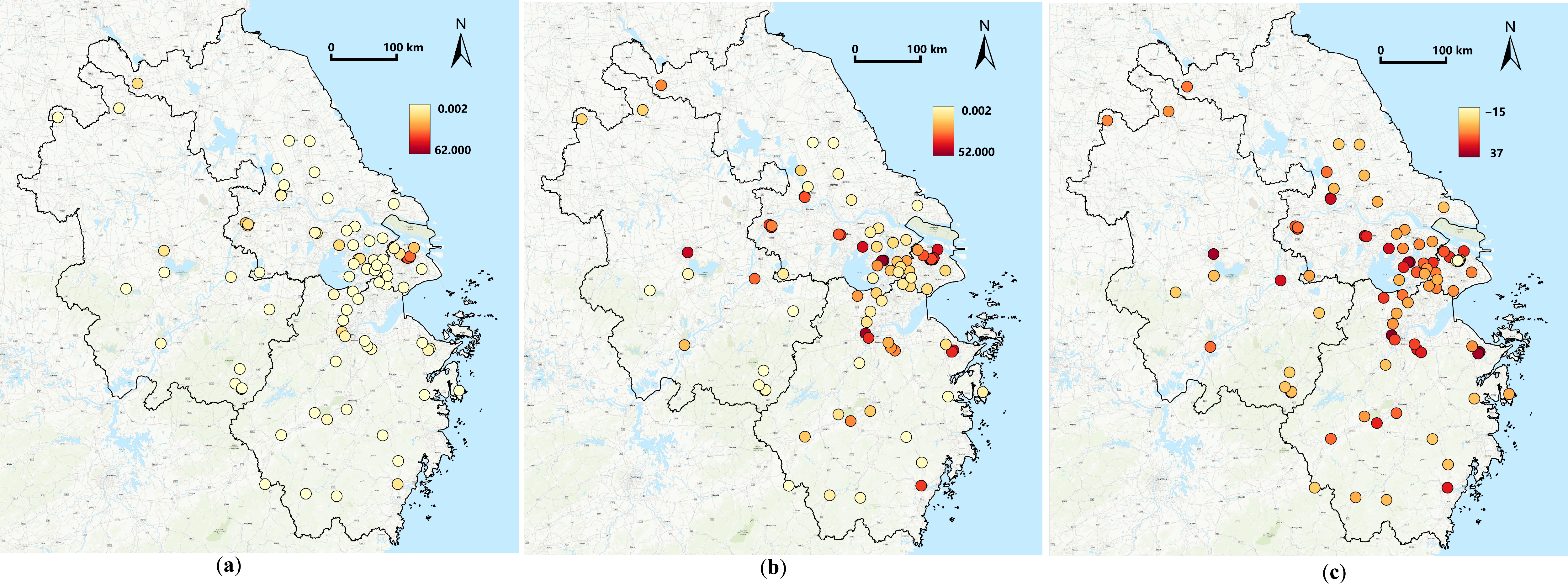
3.3. Spatial Distribution
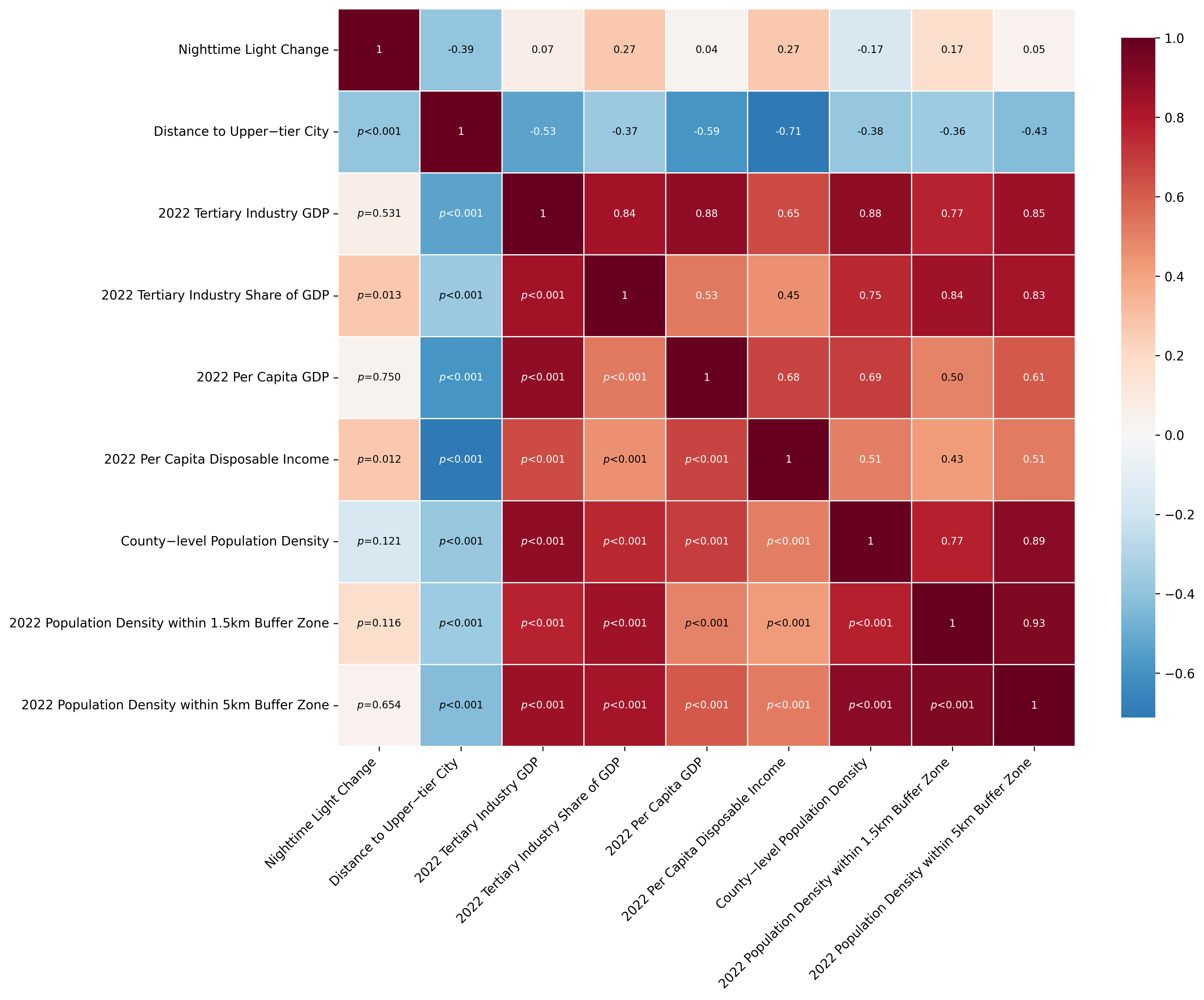
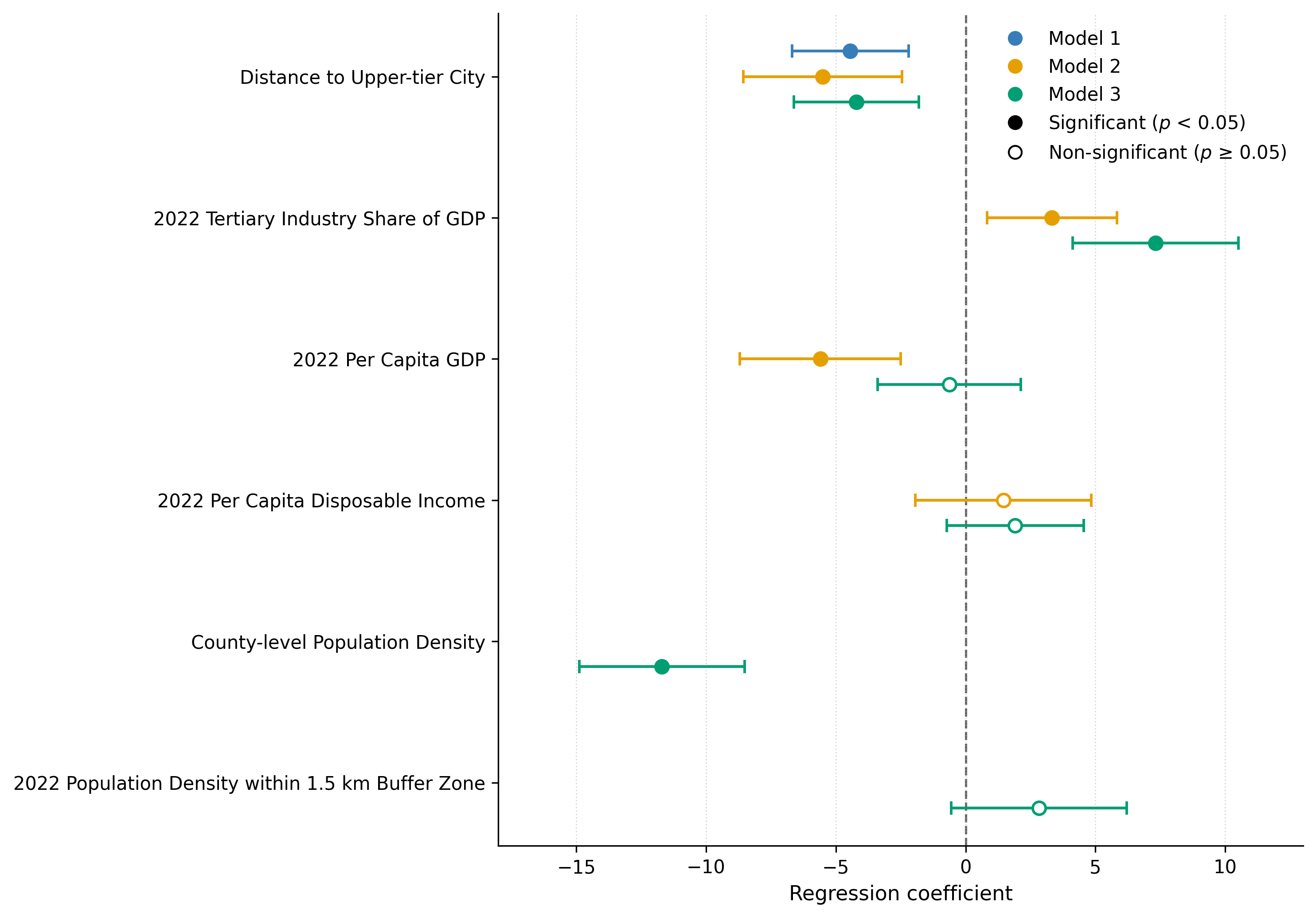
3.4. Influencing Factors
4. Discussion
4.1. Heritage Spaces as Dynamic Socioeconomic Systems
4.2. Development Pathways Among Different Heritage Spaces
4.3. Effects of Multi-Scale Factors on Heritage Locational Vitality Evolution
4.4. Policy Implications for Heritage Transformation
5. Conclusions
- (1)
- Heritage spaces should be understood as dynamic socioeconomic systems rather than static conservation objects.
- (2)
- Heritage spaces exhibit differentiated development trajectories according to their functional positioning and spatial contexts.
- (3)
- The locational vitality evolution of heritage spaces, as captured by nighttime light changes, is shaped by the interaction between regional development conditions and multi-scale socioeconomic environments.
Author Contributions
Funding
Data Availability Statement
Acknowledgments
Conflicts of Interest
References
- Elsayyad, N.A.; Hasan, A.S.; Akl, M.H. Reframing Heritage-Based Urban Branding in Lived Historic Contexts: A Domain-Based Analytical Framework from Cairo’s City of the Dead. Architecture 2026, 6, 108. [Google Scholar] [CrossRef] [Scilit]
- Ugong, N.A. Sustainable cultural heritage management: A case study in Sarawak, Malaysia. J. Cult. Herit. Manag. Sustain. Dev. 2026, 16, 988–1007. [Google Scholar] [CrossRef] [Scilit]
- De Gregorio, S.; De Vita, M.; De Berardinis, P.; Palmero, L.; Risdonne, A. Designing the sustainable adaptive reuse of industrial heritage to enhance the local context. Sustainability 2020, 12, 9059. [Google Scholar] [CrossRef] [Scilit]
- Song, J.; Chen, J.; Yang, X.; Zhu, Y. Research on Adaptive Reuse Strategy of Industrial Heritage Based on the Method of Social Network. Land 2024, 13, 383. [Google Scholar] [CrossRef] [Scilit]
- Nyseth, T.; Sognnæs, J. Preservation of old towns in Norway: Heritage discourses, community processes and the new cultural economy. Cities 2013, 31, 69–75. [Google Scholar] [CrossRef] [Scilit]
- UNESCO, W. Recommendation on the historic urban landscape. In Proceedings of the Records of the General Conference 36th Session, Paris, France, 10 November 2011. [Google Scholar]
- Wang, S.; Gu, K. Pingyao: The historic urban landscape and planning for heritage-led urban changes. Cities 2020, 97, 102489. [Google Scholar] [CrossRef] [Scilit]
- Ranjbar, E.; Ebrahimighorbani, F.; Motalaei, N. New evidence of contribution of culture to urban regeneration in the Global South, a comprehensive research on 170 projects in 34 cities of Iran. Cities 2026, 175, 107181. [Google Scholar] [CrossRef] [Scilit]
- López-Jiménez, J.; Martínez-Puche, A. Promoting Cultural Heritage in the South of the Valencia Region (Spain): Protection, Conservation and Integrated Management to Maximise Its Socio-Economic Benefits. Sustainability 2026, 18, 5047. [Google Scholar] [CrossRef] [Scilit]
- Falanga, R.; Nunes, M.C. Tackling urban disparities through participatory culture-led urban regeneration. Insights from Lisbon. Land Use Policy 2021, 108, 105478. [Google Scholar] [CrossRef] [Scilit]
- Zhang, D.; Xu, S. Humanistic needs and satisfaction study of multi-users in historic districts based on cognitive psychology. Psychiatr. Danub. 2021, 33, 681–693. [Google Scholar]
- Zhao, L.; Kim, E. Urban Revitalization of World Heritage Cities Through Cultural and Creative Industries: A Case Study of Pingyao Under the Cities, Culture, and Creativity Framework. Sustainability 2025, 17, 4292. [Google Scholar] [CrossRef] [Scilit]
- Liu, R.; Yan, H.; Zhang, Z. Does historic preservation affect firms’ output? Evidence from the awarding of the Historic City title in China. China Econ. Rev. 2024, 85, 102156. [Google Scholar] [CrossRef] [Scilit]
- Sun, J.; Shao, L. Interpretation of Historic Urban Landscape Genes: A Case Study of Harbin, China. Land 2024, 13, 1988. [Google Scholar] [CrossRef] [Scilit]
- Wang, G.; Liu, S. Adaptability evaluation of historic buildings as an approach to propose adaptive reuse strategies based on complex adaptive system theory. J. Cult. Herit. 2021, 52, 134–145. [Google Scholar] [CrossRef] [Scilit]
- Kim, H.; Kim, H.; Woosnam, K.M. Collaborative governance and conflict management in cultural heritage-led regeneration projects: The case of urban Korea. Habitat Int. 2023, 134, 102767. [Google Scholar] [CrossRef] [Scilit]
- Gravagnuolo, A.; Angrisano, M.; Bosone, M.; Buglione, F.; De Toro, P.; Fusco Girard, L. Participatory evaluation of cultural heritage adaptive reuse interventions in the circular economy perspective: A case study of historic buildings in Salerno (Italy). J. Urban Manag. 2024, 13, 107–139. [Google Scholar] [CrossRef] [Scilit]
- Zhang, X.; Leng, T.; Liu, Y.; Zhao, X. What makes historic districts thrive? Spatial configurations and differentiated strategies for heritage regeneration. Front. Archit. Res. 2026. [Google Scholar] [CrossRef] [Scilit]
- Gao, F.; Deng, X.; Liao, S.; Liu, Y.; Li, H.; Li, G.; Chen, W. Portraying business district vibrancy with mobile phone data and optimal parameters-based geographical detector model. Sustain. Cities Soc. 2023, 96, 104635. [Google Scholar] [CrossRef] [Scilit]
- Hu, Q.; Li, S. Spatial Reconstruction and Economic Vitality Assessment of Historical Towns Using SDGSAT-1 Nighttime Light Imagery and Historical GIS: A Case Study of Suburban Shanghai. Remote Sens. 2025, 17, 2123. [Google Scholar] [CrossRef] [Scilit]
- Reggiani, M. Urban regeneration strategies and place development in contemporary Tokyo: The case of Shibuya Station area. J. Place Manag. Dev. 2021, 15, 40–54. [Google Scholar] [CrossRef] [Scilit]
- Xiang, L.; Feng, C.; Liu, Y.; Wang, Y. Space and culture acculturation: Exploring urban regeneration in historic conservation areas, Yangmeizhu Street in Beijing, China. Front. Archit. Res. 2025, 14, 1274–1290. [Google Scholar] [CrossRef] [Scilit]
- Han, Y.; Dong, Y.; You, F.; Ji, T.; Qiu, Z. A methodological framework for adaptive reuse integrating structural and spatial coordination: Evidence from the Xiaoxihu Historic Block, Nanjing, China. Front. Archit. Res. 2026. [Google Scholar] [CrossRef] [Scilit]
- Patrick, C. The value of historic district status. Reg. Sci. Urban Econ. 2025, 115, 104157. [Google Scholar] [CrossRef] [Scilit]
- Huang, J.; Wang, R.; Shen, B. Assessing the paradox between development and preservation: A study on the coupling and coordination degree of morphology, function, and behavior in historic districts. J. Urban Manag. 2026, 15, 1254–1272. [Google Scholar] [CrossRef] [Scilit]
- Wang, Y.; Jin, C.; Wang, T.; Xu, D. The Interpretation of Historical Layer Evolution Laws in Historic Districts from the Perspective of the Historic Urban Landscape: A Case Study in Shenyang, China. Land 2025, 14, 1029. [Google Scholar] [CrossRef] [Scilit]
- He, D.; Zhang, Y.; Wu, L. Towards Character-Based Zoning: Managing Historic Urban Landscapes and Integrating a Dynamic Integrity Framework in Jingdezhen, China. Land 2026, 15, 615. [Google Scholar] [CrossRef] [Scilit]
- Du, J.; Yu, Z.; Cheng, S.; Li, L.; Miao, C. Exploring the role of government-driven culture-led micro-regeneration in shaping the sense of place within urban historic districts in China. Cities 2026, 169, 106575. [Google Scholar] [CrossRef] [Scilit]
- Li, F.; Sun, T.; Yang, K.; Shao, Y.; Huo, Y.; Liu, Y. Walkable Access to Cultural Tourism Opportunities in Historic Urban Cores: Spatial Mismatch and Interpretable Evidence from Suzhou, China. Sustainability 2026, 18, 5462. [Google Scholar] [CrossRef] [Scilit]
- Fung, I.W.H.; Tsang, Y.T.; Tam, V.W.Y.; Xu, Y.T.; Mok, E.C.K. A review on historic building conservation: A comparison between Hong Kong and Macau systems. Renew. Sustain. Energy Rev. 2017, 71, 927–942. [Google Scholar] [CrossRef] [Scilit]
- Zhang, K.; Boarin, P.; Aitken-Rose, E. Whoever uses it, pays for it. A land value approach to sustainable historic district conservation in China. J. Urban Manag. 2026, 15, 1336–1347. [Google Scholar] [CrossRef] [Scilit]
- Yang, Q.; Wang, L.; Qin, X.; Fan, Y.; Wang, Y.; Ding, L. Urban land use efficiency and contributing factors in the Yangtze River Delta under increasing environmental restrictions in China. Chin. Geogr. Sci. 2022, 32, 883–895. [Google Scholar] [CrossRef] [Scilit]
- National Bureau of Statistics of China. Economic and Social Development Statistical Chart: Major Economic Indicators of the Beijing-Tianjin-Hebei Region, the Yangtze Economic Belt, and the Yangtze River Delta in 2022. Available online: http://qstheory.cn/dukan/qs/2023-06/16/c_1129695713.htm (accessed on 25 August 2026).
- Zhang, K.; Li, X.; Chen, J.; Geng, Y. Spatiotemporal Evolution and Influencing Factors of Multifunctional Territorial Spatial Utilization Efficiency: Evidence from the Yangtze River Delta, China. Land 2026, 15, 2. [Google Scholar] [CrossRef] [Scilit]
- Wang, Z. Economic, Demographic, Nighttime Light and Location Data of National-Level Historic (Tourism) Settlements in the Yangtze River Delta Region. Mendeley Data 2026. [Google Scholar] [CrossRef]
- Elvidge, C.D.; Baugh, K.E.; Kihn, E.A.; Kroehl, H.W.; Davis, E.R.; Davis, C.W. Relation between satellite observed visible-near infrared emissions, population, economic activity and electric power consumption. Int. J. Remote Sens. 1997, 18, 1373–1379. [Google Scholar] [CrossRef] [Scilit]
- Li, X.; Li, D.; Xu, H.; Wu, C. Intercalibration between DMSP/OLS and VIIRS night-time light images to evaluate city light dynamics of Syria’s major human settlement during Syrian Civil War. Int. J. Remote Sens. 2017, 38, 5934–5951. [Google Scholar] [CrossRef] [Scilit]
- Cai, S.; Gou, Z. Are Green Spaces More Available and Accessible to Green Building Users? A Comparative Study in Texas. Land 2023, 12, 226. [Google Scholar] [CrossRef] [Scilit]
- Kabisch, N.; Strohbach, M.; Haase, D.; Kronenberg, J. Urban green space availability in European cities. Ecol. Indic. 2016, 70, 586–596. [Google Scholar] [CrossRef] [Scilit]
- Hidalgo-Sánchez, F.M.; Carrascal-Pérez, M.F.; Rey-Pérez, J.; Plaza, C.; Mascort-Albea, E.J. Cultural heritage, sustainability, conservation, and social welfare. A management plan for the historic municipal buildings of Seville (Andalusia, Spain). Hist. Environ. Policy Pract. 2022, 13, 426–458. [Google Scholar] [CrossRef] [Scilit]
- Chiu, Y.-H.; Lee, M.-S.; Wang, J.-W. Culture-led urban regeneration strategy: An evaluation of the management strategies and performance of urban regeneration stations in Taipei City. Habitat Int. 2019, 86, 1–9. [Google Scholar] [CrossRef] [Scilit]
- Gan, X.; Huang, L.; Wang, H.; Mou, Y.; Wang, D.; Hu, A. Optimal block size for improving urban vitality: An exploratory analysis with multiple vitality indicators. J. Urban Plan. Dev. 2021, 147, 04021027. [Google Scholar] [CrossRef] [Scilit]
- Gao, F.; Liu, Y.; Liao, S.; Zhang, J.; Jiao, Z.; Hu, X.; Wu, J.; Chen, W.; Li, G. Lively Guangzhou: Deciphering the divergent intra-urban vibrancy across historic districts and CBD using interpretable machine learning. Cities 2025, 167, 106345. [Google Scholar] [CrossRef] [Scilit]
- Li, D.; Han, H.; Wang, J.; Xiao, X. Explaining Urban Vitality Through Interpretable Machine Learning: A Big Data Approach Using Street View Images and Environmental Factors. Sustainability 2025, 17, 4926. [Google Scholar] [CrossRef] [Scilit]
- Labadi, S.; Logan, W. Urban Heritage, Development and Sustainability: International Frameworks, National and Local Governance; Routledge: London, UK, 2015. [Google Scholar]
- Avrami, E.; Macdonald, S.; Mason, R.; Myers, D. Values in Heritage Management: Emerging Approaches and Research Directions; Getty Publications: Los Angeles, CA, USA, 2019. [Google Scholar]
- Wang, X.; Ren, H.; Wang, P.; Yang, R.; Luo, L.; Cheng, F. A preliminary study on Target 11.4 for UN sustainable development goals. Int. J. Geoherit. Parks 2018, 6, 18–24. [Google Scholar] [CrossRef] [Scilit]





| Variables | Mean | Std. Dev. | Min | P25 | Median | P75 | Max |
|---|---|---|---|---|---|---|---|
| 2000 Average Nighttime Light | 6.58 | 13.12 | 0.00 | 0.03 | 0.38 | 6.56 | 61.64 |
| 2022 Average Nighttime Light | 18.90 | 15.77 | 0.00 | 5.24 | 13.84 | 32.34 | 51.78 |
| Nighttime Light Change | 12.32 | 11.42 | –14.92 | 4.53 | 10.81 | 21.30 | 37.16 |
| Distance to Upper-tier City (km) | 51.64 | 63.61 | 0.00 | 0.00 | 22.00 | 80.00 | 219.00 |
| 2022 Tertiary Industry GDP (100 million RMB) | 9.75 | 6.53 | 1.40 | 5.45 | 7.62 | 11.64 | 28.13 |
| 2022 Tertiary Industry Share of GDP | 62.61% | 18.49% | 36.30% | 48.20% | 54.40% | 78.40% | 98.70% |
| 2022 Per Capita GDP (10,000 RMB/person) | 14.64 | 6.09 | 2.94 | 10.86 | 13.80 | 17.50 | 28.50 |
| 2022 Per Capita Disposable Income (10,000 RMB/person) | 6.25 | 1.60 | 3.15 | 4.95 | 6.58 | 7.67 | 8.46 |
| County-level Population Density (Persons/ha) | 42.13 | 71.45 | 0.57 | 5.83 | 15.01 | 39.21 | 315.25 |
| 2022 Population Density within 1.5 km Buffer Zone (Persons/ha) | 96.82 | 95.79 | 2.07 | 20.85 | 60.50 | 145.00 | 378.98 |
| 2022 Population Density within 5 km Buffer Zone (Persons/ha) | 56.57 | 71.86 | 0.41 | 8.46 | 19.60 | 74.83 | 296.61 |
| Types | Total Samples | Distribution by Recognition Batch | Median of Nighttime Light Change | Q1 | Q3 | IQR |
|---|---|---|---|---|---|---|
| National-Level Historic and Cultural Towns | 47 | Batch 1: 5; Batch 2: 9; Batch 3: 10; Batch 4: 13; Batch 5: 10 | 6.55 | 2.26 | 12.59 | 10.33 |
| National-Level Tourism and Leisure Blocks | 28 | Batch 1: 10; Batch 2: 8; Batch 3: 10 | 21.58 | 10.05 | 29.00 | 18.95 |
| National-Level Historic and Cultural Blocks | 10 | Batch 1: 10 | 15.25 | 6.27 | 22.66 | 16.39 |
| Types | Recognition Batches | Normality Test (Shapiro–Wilk p) | Variance Homogeneity (Levene p) | Test Statistic | p-Value |
|---|---|---|---|---|---|
| National-Level Historic and Cultural Towns | Batch 1–5 | Batch 1–3 and 5 p > 0.05; Batch 4 p = 0.015 | 0.548 | H(4) = 6.179 | 0.186 |
| National-Level Tourism and Leisure Blocks | Batch 1–3 | All groups p > 0.05 | 0.860 | F(2,25) = 1.123 | 0.341 |
| Variables | Model 1 | Model 2 | Model 3 |
|---|---|---|---|
| Constant | 12.325 *** (1.146) | 12.325 *** (1.072) | 12.325 *** (0.834) |
| Distance to Upper-tier City | −4.446 *** (1.146) | −5.503 *** (1.561) | −4.209 *** (1.229) |
| 2022 Tertiary Industry Share of GDP | — | 3.326 ** (1.279) | 7.311 *** (1.630) |
| 2022 Per Capita GDP | — | −5.600 *** (1.583) | −0.628 (1.406) |
| 2022 Per Capita Disposable Income | — | 1.452 (1.730) | 1.910 (1.348) |
| County-level Population Density | — | — | −11.701 *** (1.623) |
| 2022 Population Density within 1.5 km Buffer Zone | — | — | 2.825 (1.723) |
| R2 | 0.154 | 0.286 | 0.579 |
| Adjusted R2 | 0.143 | 0.250 | 0.546 |
| VIF | - | 1.422~2.603 | 2.172~4.266 |
Disclaimer/Publisher’s Note: The statements, opinions and data contained in all publications are solely those of the individual author(s) and contributor(s) and not of MDPI and/or the editor(s). MDPI and/or the editor(s) disclaim responsibility for any injury to people or property resulting from any ideas, methods, instructions or products referred to in the content. |
© 2026 by the authors. Licensee MDPI, Basel, Switzerland. This article is an open access article distributed under the terms and conditions of the Creative Commons Attribution (CC BY) license.
Share and Cite
Shen, Z.; Chen, K. From Preservation to Transformation: Long-Term Locational Vitality Evolution and Multi-Scale Influencing Factors of Heritage Spaces in the Yangtze River Delta, China. Land 2026, 15, 1722. https://doi.org/10.3390/land15091722
Shen Z, Chen K. From Preservation to Transformation: Long-Term Locational Vitality Evolution and Multi-Scale Influencing Factors of Heritage Spaces in the Yangtze River Delta, China. Land. 2026; 15(9):1722. https://doi.org/10.3390/land15091722
Chicago/Turabian StyleShen, Zhihui, and Kaida Chen. 2026. "From Preservation to Transformation: Long-Term Locational Vitality Evolution and Multi-Scale Influencing Factors of Heritage Spaces in the Yangtze River Delta, China" Land 15, no. 9: 1722. https://doi.org/10.3390/land15091722
APA StyleShen, Z., & Chen, K. (2026). From Preservation to Transformation: Long-Term Locational Vitality Evolution and Multi-Scale Influencing Factors of Heritage Spaces in the Yangtze River Delta, China. Land, 15(9), 1722. https://doi.org/10.3390/land15091722