Article

Agricultural Resilience Under Synergistic Compensation Policies: A System Dynamics Study of Nenjiang, Heilongjiang Province, China

1
School of Geography, Harbin Normal University, Harbin 150025, China
2
Research Center for Cold Region Urban-Rural Development and Planning, Harbin Normal University, Harbin 150025, China
*
Author to whom correspondence should be addressed.
Land 2026, 15(9), 1564; https://doi.org/10.3390/land15091564
Submission received: 27 June 2026 / Revised: 5 August 2026 / Accepted: 20 August 2026 / Published: 26 August 2026

Abstract

Policies designed to enhance agricultural resilience may produce unintended trade-offs among ecological, industrial, and social subsystems due to resource competition, structural constraints, and cross-subsystem feedback. This study conceptualizes these unintended effects as a “resilience compensation trap.” Taking Nenjiang City, Heilongjiang Province, China, as a case study, we integrate social–ecological systems theory with system dynamics modeling to examine the evolution of agricultural resilience from 2015 to 2035 under five scenarios: baseline development, ecological priority, industrial upgrading, talent revitalization, and comprehensive optimization. The results show that overall agricultural resilience increases slowly under the baseline scenario. Industrial upgrading raises overall resilience to 16.43 in 2035, representing an increase of 60.92% relative to the baseline, but reduces ecological resilience by 26.94%, thereby producing a clear cross-subsystem compensation effect. By contrast, the comprehensive optimization scenario increases overall resilience to 18.07, 76.98% above the baseline, while reducing conflicts among the three subsystems. These results indicate that single-objective interventions may activate negative feedback that offset their intended benefits. By operationalizing absorptive, adaptive, and transformative capacities as interacting variables and feedback loops, this study provides a process-based explanation of agricultural resilience trade-offs. The findings further highlight the importance of coordinated ecological, industrial, and social policies.

1. Introduction

Growing food-security demands [1,2], the decline and aging of the agricultural labor force [3], and the continued degradation of land resources [4,5] are jointly narrowing the safe operating space of agricultural systems, placing intensive agriculture at risk of a systemic sustainability crisis [6,7,8,9]. Therefore, the core challenge of agricultural development is not merely to increase output and economic value. It is also necessary to stabilize agricultural income, maintain production stability, and safeguard ecological functions under resource constraints and external disturbances to achieve long-term sustainability [10,11,12]. Against this backdrop, agricultural systems must maintain functionality and achieve adaptive adjustment under disturbances [13]. It should be noted that the formulation and implementation of agricultural policies are embedded within specific institutional contexts, and differences in political–economic systems may shape policy objectives, instruments, and effectiveness. However, this study focuses on the internal feedback mechanisms of agricultural social–ecological systems under a given institutional setting, rather than conducting a cross-system comparative analysis. Agricultural resilience is not equivalent to agricultural sustainability; rather, it represents the dynamic capacity that supports the long-term maintenance of productive, ecological, and social functions. Accordingly, resilience assessment provides a process-oriented indication of whether agricultural systems can sustain these core functions under changing conditions and has therefore become a focal issue in both academic research and policy practice.
Specifically, agricultural resilience refers to the capacity of an agricultural social–ecological system to maintain, adjust, and reorganize its core productive, ecological, and social functions in response to environmental degradation, market fluctuations, demographic change, and resource constraints. It encompasses the capacities to absorb disturbances while maintaining essential functions [14,15], to adapt through resource reallocation and structural adjustment, and to transform development pathways through technological, institutional, and organizational change under long-term constraints [16,17,18]. In previous studies, efforts to enhance agricultural resilience have often relied on compensatory policy instruments such as ecological compensation and industrial support; however, because these instruments are typically oriented toward single objectives, they frequently generate latent conflicts within agricultural systems [19,20,21,22], whereby ecological compensation may reduce agricultural income by constraining inputs and production practices, while industrial subsidies may increase resource consumption and ecological risks, and the resulting income instability further exacerbates agricultural labor outmigration [23,24]. Multiple policies intended to enhance agricultural resilience have failed to form synergistic effects and instead have offset one another within the system [21,25].
It follows that the key obstacle to agricultural resilience governance may lie not in insufficient policy intensity but in how policy interventions are amplified, attenuated, or even reversely transformed through internal structures and feedback mechanisms once they enter the agricultural system. However, existing studies still lack an integrated framework capable of explaining how multiple policy interventions interact with internal feedback mechanisms and generate cross-subsystem trade-offs over time. First, agricultural resilience research has extended beyond conceptual clarification and static measurement to include disturbance responses, adaptive processes, and dynamic evolution within agricultural and food systems [13]. However, existing studies have generally focused on specific disturbances, capacities, or individual system components, with limited attention to the long-term cross-subsystem feedback generated by multiple policy interventions [15,26]. Second, existing studies on compensation policies are typically organized around sectoral objectives, making it difficult to reveal interactions among different policies and their long-term systemic effects [27]. Consequently, there is still a lack of an integrated theoretical and analytical framework capable of explaining how multiple policy interventions generate cross-subsystem trade-offs and why individually beneficial compensation measures may fail to produce sustained improvements in overall resilience.
This study introduces a system evolution perspective to examine the cross-subsystem linkage effects of policy interventions within complex rural systems. In complex rural systems, interventions or policies aimed at enhancing the resilience of a specific subsystem may, due to resource reallocation and related mechanisms, weaken or sacrifice the resilience of other subsystems, thereby generating unintended outcomes in which overall resilience improvement is constrained or even reversed [28,29,30,31]. This phenomenon is defined in this study as the resilience compensation trap. Compensation policies do not inherently generate positive effects on agricultural resilience, as their outcomes remain subject to long-term lock-in effects shaped by internal system feedback and institutional structures [32]. On this basis, this study further argues that policy coordination across ecological, industrial, and social dimensions, simultaneously targeting the absorptive, adaptive, and transformative capacities of agricultural resilience, can effectively break low-resilience lock-ins and achieve phased resilience enhancement.
The evolutionary dynamics of agricultural resilience involve multi-subsystem coupling, long-term feedback, and nonlinear processes [33], which are difficult to capture using traditional static analytical methods. Accordingly, this study adopts social–ecological systems (SES) theory to conceptualize agriculture as a complex adaptive system composed of ecological foundations, industrial structures, and social elements and employs system dynamics (SD) modeling to simulate the dynamic evolution of agricultural resilience under policy interventions [34,35,36].
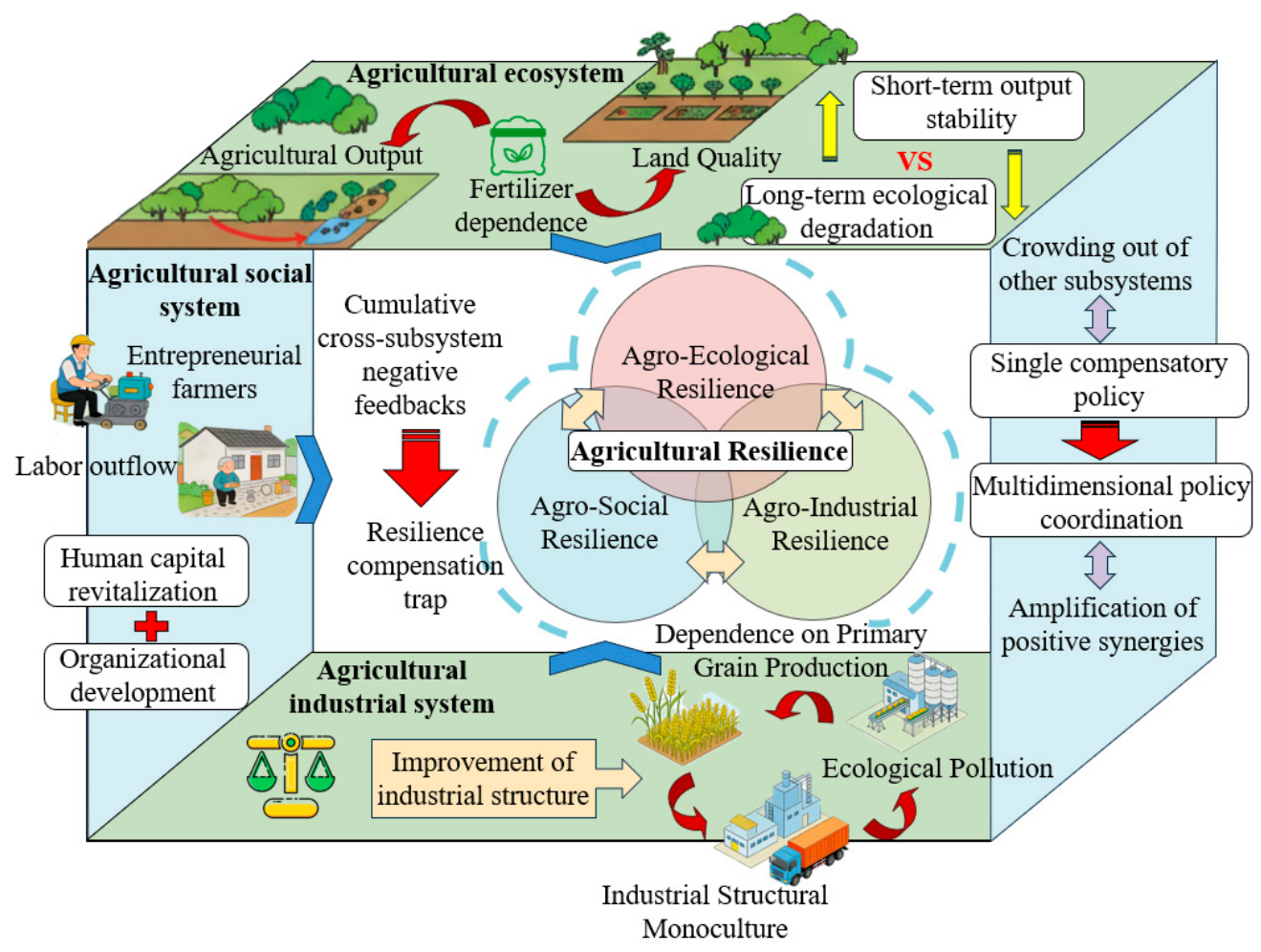
Nenjiang, located in the core black soil region of the Songnen Plain, is a typical high-intensity grain production area that, while long contributing to national food security, faces multiple constraints including black soil degradation, a single industrial structure, and population outmigration. This real-world context provides an ideal setting for clarifying the relationships among compensation policies, system feedback, and resilience evolution (Figure 1). Therefore, this study selects Nenjiang City in Heilongjiang Province, China, as a case study and constructs an SES-based system dynamics model to design policy combination scenarios across ecological, industrial, and social dimensions, systematically examining the long-term impacts of single compensation measures and coordinated interventions on agricultural resilience, and offering mechanistic explanations and policy implications for agricultural resilience governance.

2. Theoretical Foundations

This study integrates resilience theory and social–ecological systems (SES) theory to establish the theoretical foundation for analyzing agricultural resilience evolution. Resilience theory provides the conceptual basis for understanding system capacities, whereas SES theory emphasizes interactions, feedback, and cross-scale linkages among ecological, industrial, and social components.
When compensatory policies enter the system as external interventions, changes in resilience often do not follow a linear relationship in which greater input necessarily leads to stronger resilience; under certain conditions, policies may trigger positive feedback that enable phased improvements, but they may also be offset by compounded constraints and negative feedback or even generate new vulnerabilities [37,38]. This implies that resilience constitutes a process-oriented evaluative dimension of agricultural sustainability rather than a substitute for sustainability as a whole; however, resilience alone is insufficient to explain why path dependence emerges. Addressing the underlying mechanisms therefore requires linking the coupling structures and feedback chains within agricultural systems.
A social–ecological system (SES) is a composite system composed of social subsystems, ecological subsystems, and their interactions [39,40], whose structure, functions, and complexity differ fundamentally from those of purely social or ecological systems [41,42,43], making it a typical complex adaptive system [44]. Developed by Ostrom, this theory aims to provide researchers with a foundational analytical platform that is effective for addressing specific social–ecological problems while integrating multi-level and multidisciplinary knowledge systems [45,46]. Against the backdrop of intensifying global environmental change, traditional paradigms that separate social and ecological analysis have revealed their limitations [47], and the SES framework, which emphasizes human–environment coupling, has gradually become an important pathway for understanding sustainable development issues [48,49,50,51].
The core contribution of the SES framework lies in the fact that it is not a specific predictive model but a diagnostic “meta-theoretical framework” [52] that provides a shared analytical structure and terminology across disciplines to organize knowledge, compare cases, and accumulate general theories of sustainability [46,52]. Existing studies demonstrate that this framework effectively supports commons governance and policy evaluation and has been widely applied in research on system attributes and integrated governance analysis [53,54,55], and public policy assessment [56,57,58], with empirical validation in fields such as fisheries management, community forest governance, and urban water resource management [59,60,61,62]. At the same time, SES theory emphasizes the existence of multi-level, nested hierarchical structures within systems, whereby local-scale dynamics are profoundly shaped by cross-scale interactions with higher-level forces such as national policies and global markets, providing an analytical window for explaining the nonlinear effects of compensation policies.
Accordingly, this study conceptualizes Nenjiang City as a typical agricultural social–ecological system and argues that the vulnerability of its resilience originates from dynamic imbalances and negative feedback among three core subsystems: agricultural ecology and environmental carrying capacity, agricultural production and technological efficiency, and agricultural social and economic momentum. SES theory provides a structured mechanistic framework for identifying contradictions and explaining nonlinearities in this study, shifting the analytical focus from single-factor analysis toward a deeper understanding of holistic system dynamics and coupled relationships.

3. Study Area and Research Methods

3.1. Overview of the Study Area

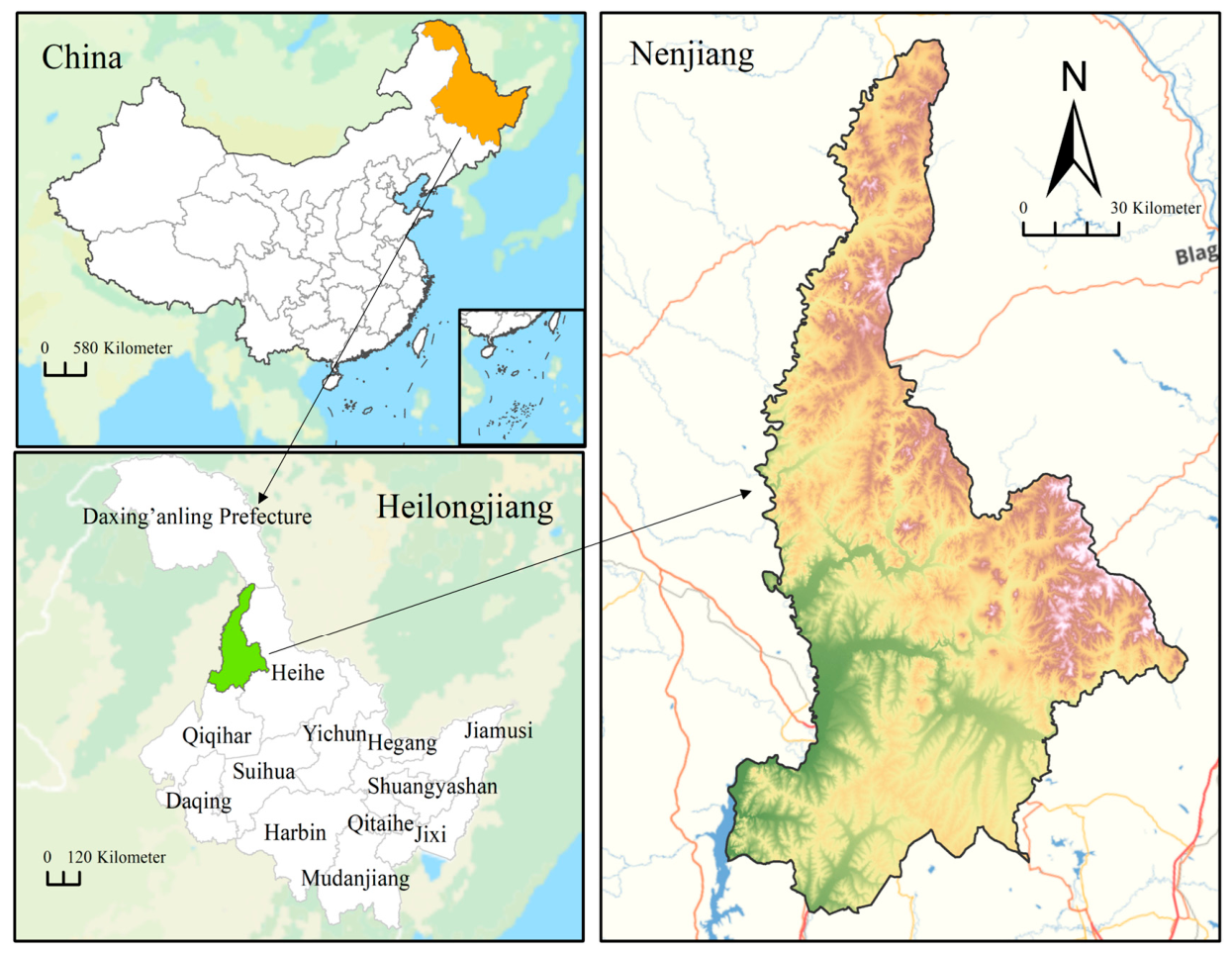
Nenjiang City is located in the northwestern part of Heilongjiang Province, China, and lies on the Songnen Plain, one of the world’s three major black soil regions (Figure 2). As a well-known major production area for wheat and soybeans, a nationally important commodity grain base, an agricultural industrialization base, and a leading grain-producing county in China, Nenjiang City has maintained a total grain output of approximately 20 billion kilograms as of 2024. As a key commodity grain production base in Northeast China and a core area of black soil resources, Nenjiang City exhibits typical regional characteristics of ecosystem sensitivity, a highly homogeneous industrial structure, and high levels of social and population outmigration. While making substantial contributions to national food security, it simultaneously faces multiple severe challenges, including ecological degradation, industrial structural rigidity, and the loss of population. The conflict between production targets and sustainable development makes Nenjiang City a representative case for observing and simulating the evolutionary mechanisms of agricultural resilience in black soil regions, and enhancing the resilience of its agricultural system has become a core issue for achieving comprehensive revitalization and ecological security.

3.2. Construction of the Agricultural Resilience Evaluation Framework for Nenjiang City

Within the integrated framework of social–ecological systems (SES) theory and resilience theory, this study first identifies the analytical dimensions and indicator requirements of agricultural resilience and decomposes the dynamic evolutionary mechanisms of the agricultural resilience system in Nenjiang City into three core subsystems: the agricultural ecology and environmental carrying capacity subsystem, the agricultural production and industrial structure subsystem, and the agricultural social and economic adaptation subsystem (Table 1).
The agricultural ecology and environmental carrying capacity subsystem primarily characterizes the natural capital foundation on which regional agriculture depends, with a particular focus on the health of land ecosystems under the pressures of intensive production. This subsystem assesses the ecosystem’s capacity to absorb resource consumption and production pressures from the absorptive dimension [63], examines the regulatory and recovery capacities of agroecosystems under technological improvement and adjustments in production practices from the adaptive dimension [33,64], and evaluates the supporting role of ecological conservation investments and governance optimization in agricultural sustainability from the transformative dimension [65], thereby providing an integrated reflection of environmental resilience in regional agricultural ecosystems.
The agricultural production and technological efficiency subsystem focuses on the economic structural characteristics and technological development level of regional agriculture, emphasizing the capacity of agricultural systems to respond to market fluctuations and achieve structural adjustment. From the absorptive dimension, this subsystem characterizes the effects of farmers’ capital buffering capacity and risks associated with industrial structure homogeneity on system stability [66]; from the adaptive dimension, it evaluates the roles of government guidance, the level of industrialization, and governance efficiency in enhancing agricultural adjustment capacity [17]; and from the transformative dimension, it examines the impacts of urban–rural factor mobility and changes in non-agricultural employment opportunities on agricultural structural optimization [67], thereby comprehensively reflecting the economic resilience of the agricultural system.
The agricultural social and economic dynamism subsystem mainly reflects the social foundations and human capital conditions that support long-term agricultural development, with particular attention to issues such as population aging, labor outmigration, and insufficient endogenous momentum. From the absorptive dimension, this subsystem analyzes the impacts of demographic structural changes on agricultural labor supply [68]; from the adaptive dimension, it evaluates the mitigating effects of productivity improvements and mechanization substitution on labor constraints [69,70]; and from the transformative dimension, it examines the promoting effects of educational development and rural infrastructure improvement on the upgrading of agricultural social systems [71], thereby providing a comprehensive representation of social resilience within the agricultural system.
Table 1. Evaluation indicator system of agricultural resilience in Nenjiang City.
Primary IndicatorSecondary IndicatorTertiary IndicatorIndicator Attribute
Agro-ecological and environmental carrying subsystemAbsorptive capacityDegree of fertilizer dependencyNegative
Simplification of cropping structureNegative
Adaptive capacityFertilizer utilization efficiencyPositive
Coverage rate of facility agriculturePositive
Transformative capacityAgricultural social learning potentialPositive
Intensity of ecological conservation investmentPositive
Agricultural production and technological efficiency subsystemAbsorptive capacityRisk of industrial structure simplificationNegative
Farmers’ capital buffering capacityPositive
Adaptive capacityIntensity of government investment guidancePositive
Comparative benefits of agriculturePositive
Transformative capacityRural–urban integration ratePositive
Pressure from urban–rural income disparityNegative
Agricultural social and economic driving subsystemAbsorptive capacityNon-agricultural employment opportunitiesPositive
Rural population agingNegative
Adaptive capacityAgricultural labor productivityPositive
Level of agricultural mechanization substitutionPositive
Transformative capacityLevel of educational developmentPositive
Level of rural infrastructure modernizationPositive

3.3. Data Sources and Data Processing

Based on the evaluation framework and indicator requirements described above, this study takes Nenjiang City in Heihe, Heilongjiang Province, China, as the research sample, with the quantitative data mainly drawn from the China Statistical Yearbook, Heilongjiang Statistical Yearbook, and Heihe Statistical Yearbook for the period 2015–2022. To supplement and validate these data—particularly for defining the causal loop structure of the model and understanding the internal mechanisms underlying the core conflicts—necessary qualitative information was collected through field investigations and structured interviews conducted in Nenjiang City.
To address data gaps in certain years, linear interpolation was applied to ensure the continuity of the time series. To eliminate the influence of differing units and scales across indicators and ensure comparability within the analytical framework, all indicator data were subjected to index-based preprocessing. The composite resilience indices were constructed through weighted aggregation, with indicator weights determined using the entropy method to reflect the relative information contribution of each indicator. The same weighting structure was used to calculate overall agricultural resilience and the three subsystem resilience indices in the subsequent system dynamics simulations. This procedure provided a standardized and reliable data foundation for the historical resilience assessment and dynamic simulation (Table 2).

4. Development of the System Dynamics (SD) Model of Agricultural Resilience in Nenjiang City

4.1. Model Boundaries and Core Assumptions

The system boundaries of the system dynamics (SD) model developed in this study include both spatial and temporal dimensions. The spatial boundary is defined as the administrative territory of Nenjiang City in Heilongjiang Province, China. The temporal boundary is set from 2015 to 2035, with 2015 designated as the baseline year for model simulation and a simulation time step of one year. The period from 2015 to 2022 serves as the historical validation phase of the model, during which historical statistical data from Nenjiang City are used to calibrate key parameters and verify the accuracy and validity of the model. The period from 2023 to 2035 is designated as the scenario simulation and projection phase, which is used to simulate the future evolution trends and potential pathways of the agricultural resilience system in Nenjiang City under different policy interventions.
To ensure the logical consistency and scientific validity of the system dynamics model, a set of core assumptions is established as follows.
First, regarding the exclusion of external shocks, the model focuses primarily on endogenous feedback mechanisms within the system and therefore assumes that the study area will not experience major, unpredictable external macro-level shocks during the simulation period and that such external factors remain relatively stable without significantly altering overall system behavior.
Second, concerning structural consistency, it is assumed that the core internal structures and key feedback loops driving the evolution of the agricultural system in Nenjiang remain fundamentally stable throughout the simulation period. System evolution is assumed to follow existing development trends, without considering structural disruptions or collapses caused by technological breakthroughs or social revolutions, while allowing for localized fluctuations in internal system states.
Third, with respect to the representation of core dimensions, the complexity of the agricultural resilience system in Nenjiang City is captured through the dynamic interactions among three core subsystems: agricultural ecology and environmental carrying capacity, agricultural production and industrial structure, and agricultural social and economic adaptation. These three subsystems jointly capture the primary behavioral patterns and internal conflict mechanisms of the system.
Fourth, regarding the simplification of secondary variables, variables with relatively minor influence or limited data availability are reasonably simplified or aggregated. For example, complex individual farmer decision-making processes are simplified into functions based on key economic signals in order to avoid reliance on empirical proxies or qualitative assessments that could undermine model validity.
Fifth, with respect to policy implementation stability, scenario simulations assume that key policy interventions can be implemented continuously and consistently within each respective scenario. Policy effects are modeled with explicit time delays to reflect institutional lag effects observed in real-world contexts.
Sixth, concerning the dominance of endogenous drivers, it is assumed that the core forces driving the evolution of the agricultural system in Nenjiang originate from endogenous factors within the system. The emergence of systemic trap behaviors is therefore primarily determined by endogenous feedback loops associated with the three core conflicts, rather than by unforeseeable external random events.

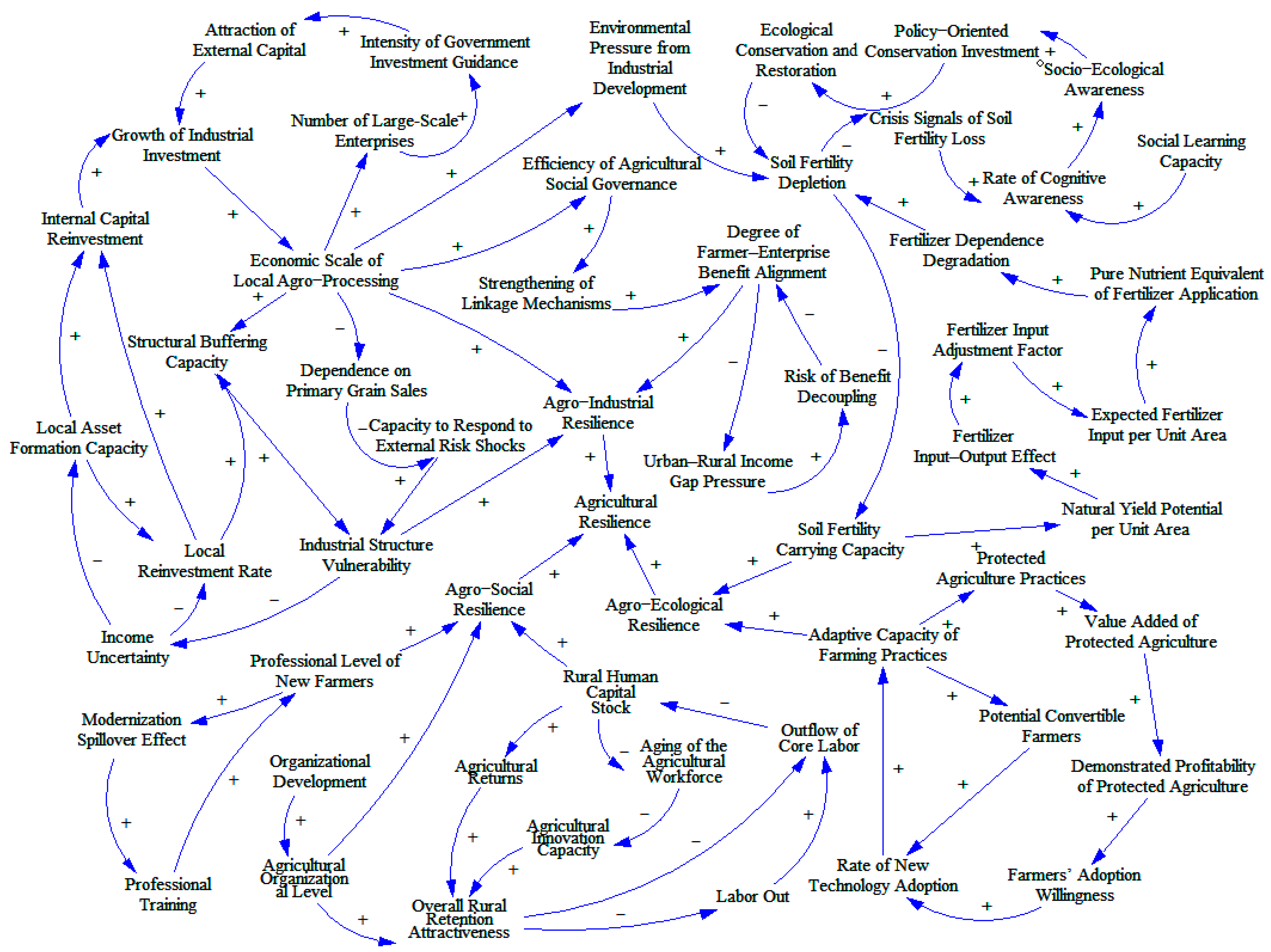
4.2. Design of Causal Loop Diagrams: Dynamic Feedback Mechanisms of the Three Subsystems

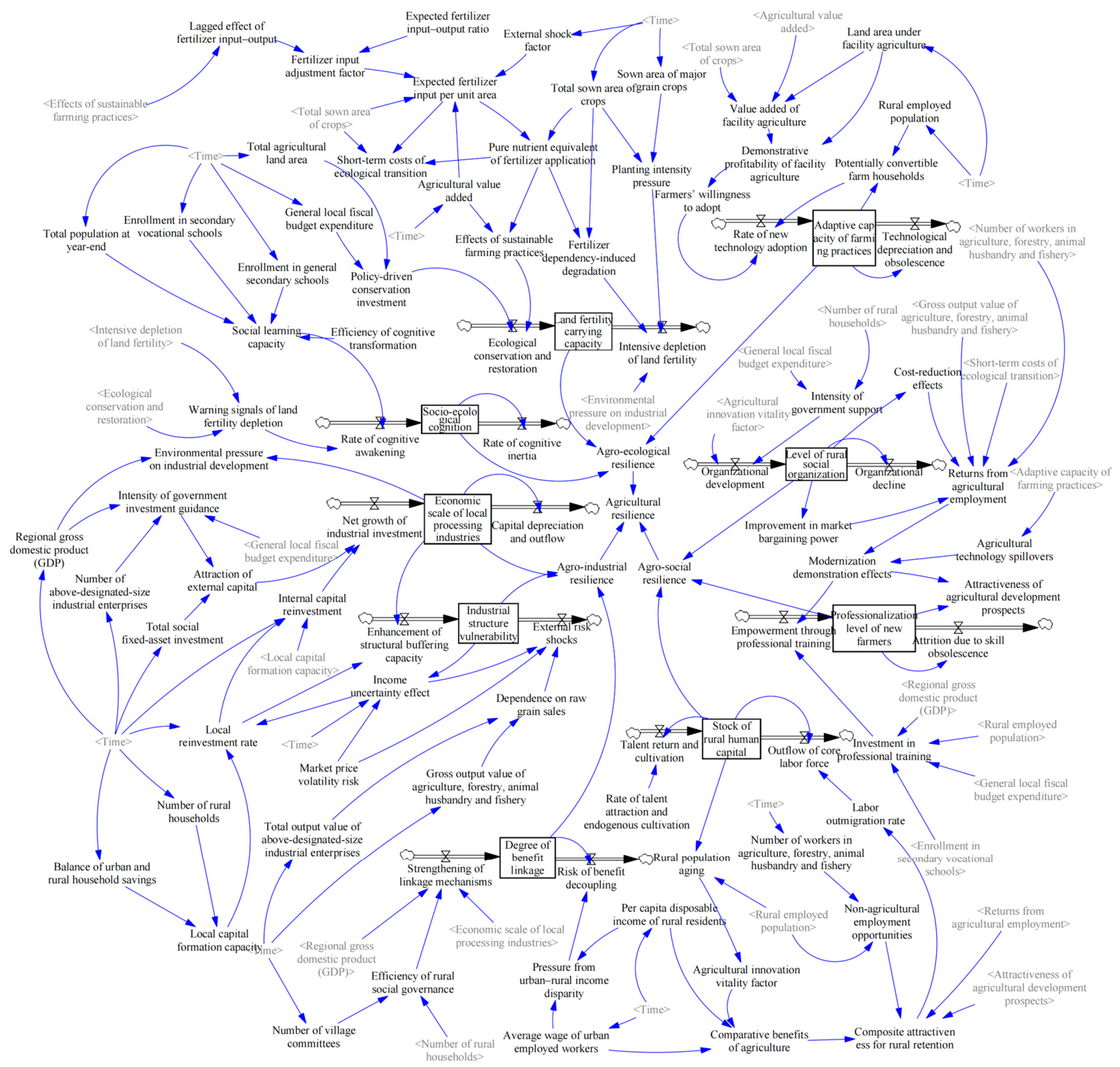
The agricultural resilience system dynamics (SD) model developed in this study for Nenjiang City comprises nine state variables [59], eighteen rate variables, and more than sixty auxiliary variables, whose interactions and feedback jointly form the causal loop network underlying agricultural resilience in Nenjiang City (Figure 3).
Within the ecological subsystem, land fertility stock is treated as the key form of natural capital supporting long-term agricultural productivity and ecosystem functioning [72,73,74]. Short-term yield targets and yield-oriented intensification may encourage farmers to increase fertilizer inputs to maintain or enhance crop production, particularly where fertilizer application is regarded as the most direct means of compensating for declining soil productivity [75,76,77]. However, excessive and inefficient fertilizer application can reduce nutrient-use efficiency, accelerate soil acidification and nutrient imbalance, and impair soil biological and physicochemical properties, thereby increasing fertilizer dependence and generating a self-reinforcing negative loop of “fertility decline–fertilizer increase–further fertility degradation” [78,79,80]. At the same time, observable signals of land fertility degradation can increase farmers’ socio-ecological awareness and stimulate investment in soil conservation and sustainable farming practices. Through farmer networks, experiential learning, knowledge exchange, and collective learning, such awareness can facilitate the adoption and continued implementation of conservation agriculture, no-tillage, cover cropping, organic amendments, and integrated soil–crop management practices, thereby improving soil restoration and strengthening long-term agro-ecological resilience [81,82].
The core vulnerability of the industrial subsystem stems from its high dependence on external markets for primary agricultural products, where price volatility disrupts income stability and capital accumulation, suppresses reinvestment and value-chain extension, and locks the system into a negative cycle of “raw-grain dependence–income volatility–capital shortage–structural fragility” [82,83]. Although external capital and policy support may promote scale expansion, resilience upgrading depends on structural transformation, value-chain integration, and benefit-sharing mechanisms that reduce the risk of interest decoupling between farmers and enterprises, allowing value-added returns to flow back stably and forming sustained positive feedback loops [84,85].
The social subsystem centers on rural human capital, where low comparative returns from agriculture drive labor outmigration, weaken learning capacity and technology adoption, and further depress agricultural productivity and household income, forming a decline loop of “low returns–outmigration–capacity loss–lower returns” [86,87,88]. While organizational development can provide a buffering effect by improving collective action, market access, and knowledge exchange, professionalization and specialized training are critical for enhancing innovation capacity, accelerating technology diffusion, and enabling systemic transformation of rural agricultural systems [1,81,89]. Through interlinked pathways of “income–capital–technology–land fertility–cognition,” the three subsystems interact dynamically, with ecological constraints regulating industrial expansion, industrial returns shaping talent retention and technology diffusion, and social learning modifying farming practices and resource management behaviors, thereby generating path-dependent evolutionary trajectories within agricultural systems.

4.3. Design of Stock–Flow Diagrams and Key Equations

Based on the selected variables and causal loop diagram, historical data were collected for variables with sufficient observations. Model parameters were then determined using a combination of trend extrapolation, expert-informed judgment, and table functions, a common practice in system dynamics modeling for integrating empirical data with qualitative knowledge. Specifically, trend extrapolation was applied to parameters supported by continuous historical data, whereas expert-informed judgment and table functions were used for parameters that lacked direct observations or represented nonlinear behavioral relationships. During model development, the parameters and equations were iteratively adjusted in accordance with empirical evidence to ensure that the variable values and model structure were consistent with observed trends and the identified causal relationships. The resulting stock–flow diagram is shown in Figure 4, and representative equations, including the weighted aggregation equations used to calculate overall and subsystem resilience, are presented in Table 3. Key latent variables are further explained below. The composite resilience index was constructed using a weighted aggregation approach based on subsystem contributions, with weights derived from the entropy method to reflect the relative importance of each component.
To improve interpretability, several key latent variables used in the model are briefly defined as follows. Socio-ecological awareness represents the aggregated cognition of farmers and local stakeholders regarding ecological constraints and sustainable practices, which evolves through the balance between cognitive awakening and cognitive inertia. Adaptive capacity of farming practices denotes the accumulated ability of agricultural producers to adopt and maintain improved technologies under changing environmental and economic conditions. Composite rural retention attractiveness reflects the overall attractiveness of remaining in or returning to rural areas, combining agricultural returns, non-agricultural opportunities, and development prospects. Agricultural development prospects attractiveness captures expectations regarding future agricultural income and structural upgrading. These variables are treated as proxy constructs to represent complex social processes that are not directly observable.

5. Model Validation and Scenario Design

5.1. Model Validation

To ensure that the agricultural resilience system dynamics (SD) model constructed in this study can reliably reproduce the key behavioral patterns of the real system and support subsequent scenario simulations, model validity was assessed through structural consistency checks, historical behavior reproduction, and sensitivity analysis. Specifically, structural validity testing was used to examine whether the model structure and causal relationships were consistent with theoretical expectations and empirical evidence, while historical fit assessment and sensitivity analysis were conducted to evaluate the model’s ability to reproduce observed trends and the robustness of its conclusions under parameter perturbations. The corresponding quantitative results are presented below (Table 4).
After confirming the rationality of the model structure, this section aims to comprehensively evaluate model validity through rigorous quantitative methods from two core dimensions: the accuracy of historical behavior reproduction and robustness under parameter perturbations. The central objective of this validation is to quantitatively assess the model’s ability to replicate historical system dynamics, which constitutes a critical step in determining whether the model is suitable for predictive analysis. This study selects ten key variables from the model, compares their simulated values with observed values over the validation period, and employs the mean relative error as the accuracy evaluation metric. It is widely accepted in the literature that when the relative error of variables is controlled within 10%, the model can be considered highly reliable [90]. As shown in Table 5, the results indicate that the mean relative errors of all key variables are well below the 10% threshold, demonstrating extremely high historical fitting accuracy and confirming that the model meets precision requirements by accurately reproducing and capturing the core dynamic behaviors and developmental trajectories of the study area, thereby providing a solid foundation for subsequent simulation analyses. In addition, ten important model parameters were selected and increased by 10% to observe the corresponding changes in core output variables, and sensitivity analysis was conducted to test the robustness of the model’s conclusions. The results show that the model structure exhibits a high degree of robustness, with the mean sensitivity values of all tested parameters in Table 3 being below 2.5%, the vast majority below 1.0%, and an average variable sensitivity of 0.69%, indicating strong overall model stability.

5.2. Scenario Design and Policy Settings

To explore the dynamic responses of the agricultural resilience system under different policy interventions, multiple scenarios were designed based on a parameter-adjustment approach commonly used in system dynamics modeling. Specifically, key policy-related variables were modified to represent different intervention intensities and combinations. The scenario settings were informed by historical development trends of Nenjiang City, relevant policy documents, and findings from previous studies, ensuring their consistency with realistic development pathways (Table 6). Scenario 1 assumes that the model operates under the original scale of factors, retaining the original indicator values of all variables. Scenario 2 focuses on identifying improvements in the agricultural ecological subsystem by proportionally increasing the values of ecological subsystem factors on the original basis. Scenario 3 focuses on identifying improvements in the agricultural industrial subsystem by proportionally increasing the values of industrial subsystem factors on the original basis. Scenario 4 focuses on identifying improvements in the agricultural social subsystem by proportionally increasing the values of social subsystem factors on the original basis. Scenario 5 combines the policy interventions specified in Scenarios 2–4 to comprehensively enhance the level of agricultural resilience in Nenjiang City and promote the development of agricultural resilience in the Nenjiang region.

5.3. Baseline Dynamics and Resilience Lock-In

Under the baseline scenario, the overall resilience of the agricultural system in Nenjiang City exhibits a steady upward trend over the simulation period from 2015 to 2035, increasing from its 2015 baseline value to 10.21 in 2035, thereby revealing the system’s baseline evolutionary trajectory under the continuation of current development trends. Within this process, the resilience of the ecological subsystem reaches 14.92 in the terminal year, while that of the industrial subsystem rises to 13.95, with both displaying sustained and accelerating growth patterns that together constitute the core support for the improvement of overall system resilience. In contrast, the agricultural social subsystem undergoes a pronounced U-shaped trajectory of “decline followed by recovery” during the simulation period, with its resilience bottoming out around 2026 and only beginning a slow rebound thereafter, recovering to merely 0.44 by 2035. This process vividly reflects the long-term decline pressures and extremely limited endogenous recovery capacity faced by rural society under the existing development pathway, driven by factors such as the outmigration of core labor forces and population aging.

5.4. Resilience Compensation Effects Under Alternative Policy Scenarios

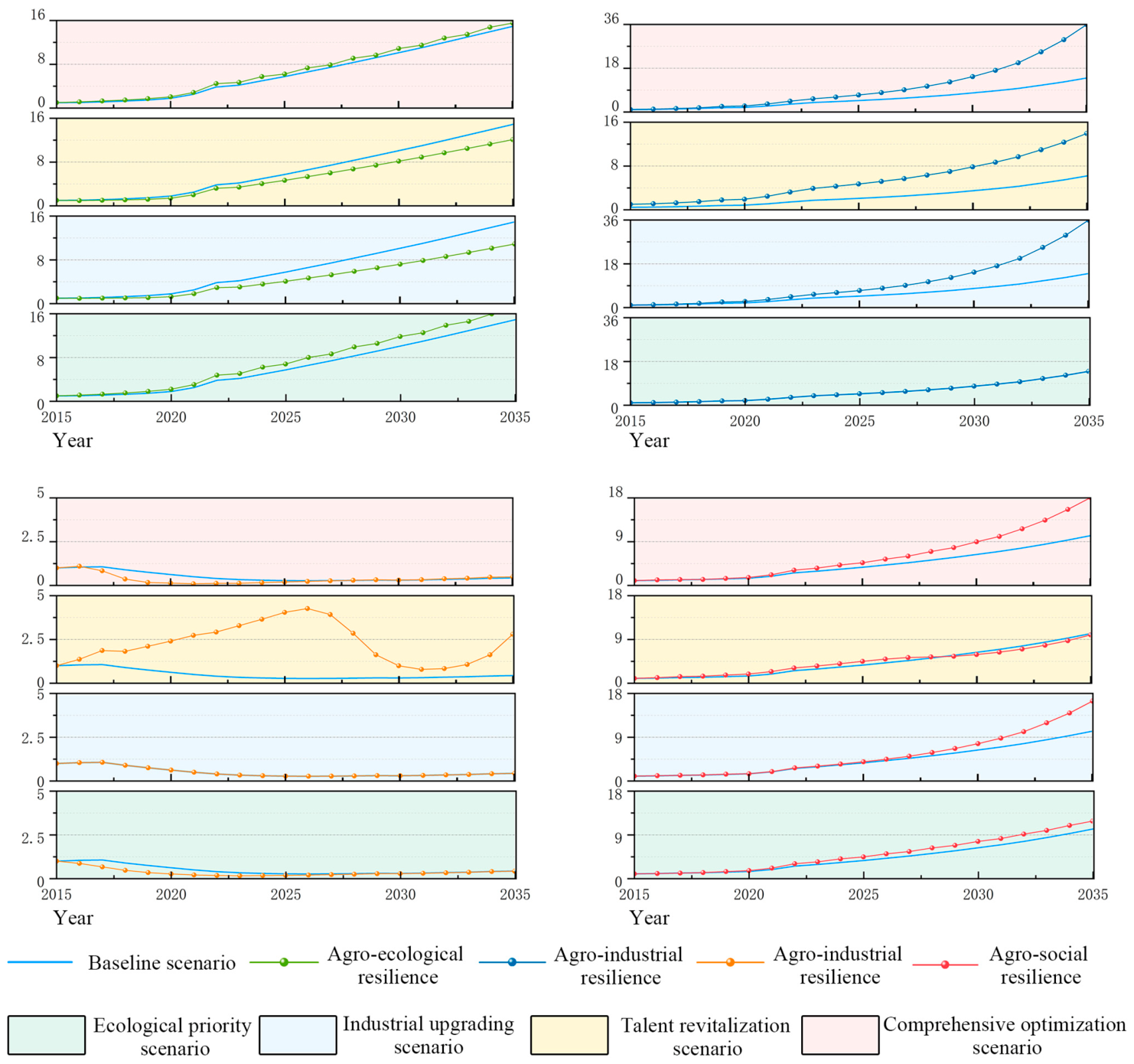
Table 7 summarizes the resilience levels in 2035 and their percentage changes relative to the baseline scenario across the five policy scenarios. Figure 5 further illustrates the dynamic trajectories of overall resilience and the three subsystem-specific resilience dimensions throughout the simulation period.
At the overall system level, the comprehensive optimization scenario produces the strongest improvement in agricultural resilience, followed by the industrial upgrading and ecological priority scenarios. The comprehensive optimization scenario reaches an overall resilience level of 18.07 in 2035, representing an increase of 76.98% relative to the baseline, while the industrial upgrading scenario reaches 16.43, an increase of 60.92%. These results indicate that industrial development is an important driver of overall resilience; however, the additional improvement achieved under the comprehensive optimization scenario demonstrates that industrial upgrading alone cannot fully address the multidimensional vulnerabilities of the agricultural system. The ecological priority scenario also improves overall resilience, whereas the talent revitalization scenario remains slightly below the baseline in the terminal year. The scenario ranking therefore suggests that coordinated interventions across ecological, industrial, and social dimensions are more effective than policies focused on a single subsystem.
The subsystem results reveal a clear trade-off between ecological conservation and industrial development. The ecological priority scenario generates the highest ecological resilience, reaching 16.73 in 2035, while the comprehensive optimization scenario maintains ecological resilience slightly above the baseline level. By contrast, the industrial upgrading scenario substantially increases industrial resilience but reduces ecological resilience to 10.90, which is 26.94% below the baseline. The talent revitalization scenario also produces a decline in ecological resilience, although its negative effect is less pronounced than that of industrial upgrading. In the industrial subsystem, both the industrial upgrading and comprehensive optimization scenarios increase resilience to 35.96, approximately 157.8% above the baseline, whereas the ecological priority and talent revitalization scenarios produce almost no change relative to the baseline. These contrasting outcomes show that the improvement of industrial resilience does not automatically generate corresponding ecological benefits. Instead, industrial expansion may intensify environmental pressure and resource competition, thereby transferring part of the resilience gain from the industrial subsystem to the ecological subsystem.
The social subsystem exhibits the strongest nonlinear response among the three dimensions. As shown in Figure 5, social resilience under the talent revitalization scenario initially declines but subsequently rises rapidly, reaching a peak of approximately 4.26 around 2026 before gradually decreasing to 2.80 in 2035. Despite the later decline, its terminal value remains 536.36% above the baseline, indicating that organizational development, talent attraction, and the professionalization of farmers can substantially strengthen rural human capital and social adaptive capacity. In comparison, the industrial upgrading scenario produces almost no improvement in social resilience, while the ecological priority scenario slightly suppresses it. Under the comprehensive optimization scenario, social resilience initially experiences downward pressure but later recovers and exceeds the baseline, reaching 0.49 in 2035. These trajectories suggest that social-policy effects are characterized by pronounced time delays and adjustment processes, rather than immediate and continuously increasing responses.
Taken together, the scenario results provide evidence of a resilience compensation trap within the agricultural social–ecological system. Policies targeted at a single subsystem may substantially improve their intended dimension while simultaneously weakening another dimension. Industrial upgrading, for example, generates a large increase in industrial and overall resilience but is accompanied by a considerable reduction in ecological resilience. Similarly, ecological priority improves ecological conditions but produces limited overall gains and a slight decline in social resilience. The comprehensive optimization scenario does not maximize every subsystem independently; instead, it achieves the highest overall resilience by combining industrial improvement with the mitigation of ecological and social losses. Therefore, the resilience compensation trap should be identified primarily through the joint comparison of subsystem-specific trajectories rather than through the aggregate resilience index alone. Figure 6 highlights the temporal evolution, divergence, and turning points of these trajectories.

6. Discussion

6.1. Endogenous Mechanisms of the Agricultural Resilience Network in Nenjiang City

From a social–ecological systems (SES) perspective, the low resilience of the agricultural system in Nenjiang City is not caused by insufficient resource endowments or a lack of policy intensity, but rather by a path-dependent state shaped by the coupled feedback among the ecological, industrial, and social subsystems.
In the ecological dimension, yield-oriented high-input production exchanges the fertility of black soil for short-term stability, weakening the system’s long-term absorptive and adaptive capacities and forming a lock-in in the continuous input—fertility depletion loop. In the industrial dimension, the high dependence on external markets for primary agricultural products amplifies the impact of price fluctuations suppresses local capital accumulation and industrial diversification, thus limiting economic resilience and making it highly sensitive to external disturbances. While human capital can provide key drivers for rural transformation [91,92], in the social dimension, the dual constraints of population aging and labor outmigration continuously weaken the agricultural system’s ability to undergo transformation. The interactions among these three subsystems reinforce each other and form a complex lock-in structure, causing the system to exhibit a resilience profile of short-term stability and long-term vulnerability under the combined effects of external shocks and internal constraints, thereby providing a mechanistic explanatory framework for the differentiation of subsequent policy effects.

6.2. Subsystem Policy Conflicts and Resilience Compensation Traps

The pronounced divergence in subsystem resilience evolution trajectories under different policy scenarios reveals a long-overlooked resilience compensation trap in agricultural resilience governance, whereby policy interventions intended to enhance the resilience of one subsystem may weaken the resilience of others through resource reallocation, constraint transmission, or structural trade-offs. For example, in this study, the industrial upgrading scenario substantially enhances industrial resilience while exerting persistent negative impacts on the ecological system, whereas the ecological priority scenario improves ecological carrying capacity but generates implicit crowding-out effects on social resilience. This finding challenges the conventional policy design assumption that stronger compensatory policies necessarily yield proportionally greater positive effects, and is consistent with Wilson’s concept of a “zero-sum game,” in which gains for one actor imply losses for another, a conclusion also echoed in previous studies [93,94,95].
From a social–ecological systems (SES) perspective, such compensation effects do not indicate policy failure but rather represent endogenous outcomes of cross-scale and cross-subsystem feedback inherent in complex systems. Single-objective-oriented policies are prone to amplification or distortion within existing system structures, thereby inducing unintended consequences. Through dynamic simulation, this study quantitatively reveals the mechanisms of systemic policy conflicts under conditions of multiple concurrent policy interventions, offering a novel analytical perspective for agricultural resilience governance.

6.3. Policy-Synergistic Governance Triggering Positive Linkages and Resilience Transitions

Under the constraints of the aforementioned mechanisms, a single policy can usually only elevate the curve locally, while failing to simultaneously resolve the negative feedback constraints imposed by other subsystems; consequently, its long-term aggregate effects are significantly weaker than those of an integrated policy mix. This classic conclusion has been confirmed by numerous studies [96,97]. Scenario simulations indicate that integrated optimization, by acting simultaneously on key links such as ecological conservation, industrial upgrading, and talent revitalization, can weaken the self-reinforcement of negative feedback at the system level and activate positive cross-subsystem linkages, thereby driving a leap in overall resilience. In the terminal year, the overall resilience under the integrated scenario is significantly higher than that under the baseline scenario, and the gap relative to the single-policy scenario shows a widening trend. This suggests that enhancing system resilience relies more on collaborative governance to reconstruct the system’s causal logic and interest linkages, rather than merely intensifying a single policy instrument [98]. Without neglecting ecological constraints, industrial value addition, and social capacity building, only through multidimensional policy coordination can the system shift from a locked-in state of developmental stagnation toward a high-resilience model of sustainable development [99].

6.4. Paradigm Shift in Resilience Research from Static to Dynamic Perspectives

This study advances agricultural resilience research by shifting from static capacity assessment toward dynamic mechanism simulation. Existing studies have largely relied on indicator systems to measure agricultural resilience in cross-sectional or quasi-static terms, which, while useful for identifying vulnerability patterns, are insufficient for explaining why policy interventions produce divergent or even opposing long-term effects [92,100,101].
By introducing social–ecological systems (SES) theory and constructing a system dynamics model, this study operationalizes the absorptive, adaptive, and transformative capacities embedded in agricultural resilience as traceable state variables, rate variables, and feedback loops within the system, enabling simulation of how policy interventions reshape evolutionary trajectories by altering system structures and feedback intensities. This process-oriented research paradigm not only strengthens explanatory power with respect to historical evolutionary pathways but also provides a forward-looking tool for evaluating future policy combinations. The approach offers a unified platform for comparing the long-term systemic effects of different policy mixes, allowing key questions—such as why single compensation measures fail and how coordinated policies generate leapfrog effects—to be systematically addressed within the same theoretical and modeling framework [46,102].

7. Conclusions

This study examined how policy interventions reshape agricultural resilience through cross-subsystem feedback in the agricultural social–ecological system of Nenjiang City, a major black-soil grain-producing region in Northeast China. By integrating social–ecological systems theory, an entropy-weighted resilience assessment framework, and system dynamics modeling, the study simulated the evolution of ecological, industrial, social, and overall agricultural resilience from 2015 to 2035 under baseline, ecological-priority, industrial-upgrading, talent-revitalization, and comprehensive-optimization scenarios.
The results yield three main conclusions. First, under the continuation of existing development trends, overall agricultural resilience increases gradually, but the social subsystem remains a persistent constraint because of population aging, labor outmigration, and insufficient endogenous human-capital accumulation. Second, single-dimensional interventions generate clear cross-subsystem trade-offs. In particular, the industrial-upgrading scenario raises overall resilience to 16.43 in 2035, 60.92% above the baseline, but reduces ecological resilience by 26.94%. This demonstrates that an improvement in one subsystem does not necessarily translate into a sustained improvement in system-wide resilience. Third, the comprehensive-optimization scenario produces the strongest overall effect, increasing agricultural resilience to 18.07 in 2035, 76.98% above the baseline, while mitigating ecological and social losses. Coordinated interventions, therefore, outperform policies targeting individual subsystems.
These findings support the concept of a resilience compensation trap, in which policies designed to strengthen one dimension of agricultural resilience may weaken another through resource reallocation, structural constraints, and delayed feedback. For major grain-producing regions, agricultural resilience governance should therefore move beyond single-objective compensation. Ecological carrying capacity should be treated as a binding constraint, industrial upgrading should be accompanied by environmental safeguards and benefit-sharing mechanisms, and talent development and rural organizational capacity should be strengthened to prevent the social subsystem from becoming a long-term bottleneck.
The transferable contribution of this study lies primarily in its analytical framework rather than in the direct replication of specific parameter values. The proposed framework may be applicable to other intensive agricultural regions characterized by ecological pressure, dependence on primary-product production, population outmigration, and strong policy intervention. However, the magnitude and direction of policy effects are likely to vary with institutional arrangements, industrial structures, demographic conditions, resource endowments, and policy implementation capacity. Therefore, applying the model to other regions requires reconstruction of the causal relationships, recalibration of parameters and indicator weights using local data, and redefinition of scenario settings according to regional policy priorities.
This study has several limitations. The model simplifies unpredictable external shocks and assumes relative continuity in policy implementation, and some actor behaviors are represented through aggregate functional relationships because of data constraints. Moreover, the conclusions are derived from a single regional case and should not be interpreted as universal numerical thresholds. Future research should incorporate stochastic disturbances such as extreme climate events, agricultural price fluctuations, and policy discontinuities, explicitly represent the heterogeneous decisions of farmers, enterprises, and governments, and test the robustness and transferability of the framework through cross-regional comparison and model migration.


Author Contributions

Conceptualization, X.C.; methodology, H.W. and W.D.; software, X.C. and W.D.; validation, X.C., W.D. and J.M.; formal analysis, H.W.; investigation, X.W.; resources, X.C.; data curation, X.C., Y.C. and D.X.; writing—original draft preparation, H.W.; writing—review and editing, X.C., W.D., J.M., X.W., Y.C., D.X. and Y.Z.; visualization, J.M.; supervision, H.W.; project administration, X.C.; funding acquisition, X.C. All authors have read and agreed to the published version of the manuscript.

Funding

This research was funded by the Natural Science Foundation of Heilongjiang, grant number LH2023D019; the National Social Science Fund of China, grant number 24FJLB034; and the National Natural Science Foundation of China, grant number 42471318.

Data Availability Statement

The data supporting the findings of this study are derived from the China Statistical Yearbook, Heilongjiang Statistical Yearbook, Heihe Statistical Yearbook, field investigations, and structured interviews conducted in Nenjiang City. The processed data used for model construction and simulation are available from the corresponding author upon reasonable request.

Acknowledgments

The authors gratefully acknowledge the valuable support and assistance provided by mentors, colleagues, and institutions throughout the completion of this study.

Conflicts of Interest

The authors declare no conflicts of interest. The funders had no role in the design of the study; in the collection, analyses, or interpretation of data; in the writing of the manuscript; or in the decision to publish the results.

Abbreviations

The following abbreviations are used in this manuscript:
AbbreviationFull form
SESSocial–ecological systems
SDSystem dynamics
GDPGross domestic product

References

  1. Hanjra, M.A.; Qureshi, M.E. Global water crisis and future food security in an era of climate change. Food Policy 2010, 35, 365–377. [Google Scholar] [CrossRef] [Scilit]
  2. Guo, Y.; Xiang, Y. Economic and welfare effects of food security policies from a global perspective: Evidence from China’s soybean production capacity enhancement project. Audit Econ. Res. 2025, 40, 116–127. [Google Scholar]
  3. Jarzebski, M.P.; Elmqvist, T.; Gasparatos, A.; Fukushi, K.; Eckersten, S.; Haase, D.; Goodness, J.; Khoshkar, S.; Saito, O.; Takeuchi, K.; et al. Ageing and population shrinking: Implications for sustainability in the urban century. npj Urban Sustain. 2021, 1, 17. [Google Scholar] [CrossRef] [Scilit]
  4. Li, R.; Hu, W.; Jia, Z.; Liu, H.; Zhang, C.; Huang, B.; Yang, S.; Zhao, Y.; Zhao, Y.; Shukla, M.K.; et al. Soil degradation: A global threat to sustainable use of black soils. Pedosphere 2025, 35, 264–279. [Google Scholar] [CrossRef] [Scilit]
  5. Zhou, W.; Qiao, G.; Xu, S.; Cao, Y.; Cao, M.; Tang, H.; Huang, Y. Land degradation neutrality assessment in China’s black soil region: Integrating multi-source LULC data and innovative quantitative indicators. Ecol. Indic. 2025, 181, 114448. [Google Scholar] [CrossRef] [Scilit]
  6. Gaffney, J.; Bing, J.; Byrne, P.F.; Cassman, K.G.; Ciampitti, I.; Delmer, D.; Habben, J.; Lafitte, H.R.; Lidstrom, U.E.; Porter, D.O.; et al. Science-based intensive agriculture: Sustainability, food security, and the role of technology. Glob. Food Secur. 2019, 23, 236–244. [Google Scholar] [CrossRef] [Scilit]
  7. Gong, H.; Meng, D.; Li, X.; Zhu, F. Soil degradation and food security coupled with global climate change in northeastern China. Chin. Geogr. Sci. 2013, 23, 562–573. [Google Scholar] [CrossRef] [Scilit]
  8. Meuwissen, M.P.M.; Feindt, P.H.; Slijper, T.; Spiegel, A.; Finger, R.; De Mey, Y.; Paas, W.; Termeer, K.J.A.M.; Poortvliet, P.M.; Peneva, M.; et al. Impact of COVID-19 on farming systems in Europe through the lens of resilience thinking. Agric. Syst. 2021, 191, 103152. [Google Scholar] [CrossRef] [Scilit]
  9. Smith, P.; Calvin, K.; Nkem, J.; Campbell, D.; Cherubini, F.; Grassi, G.; Korotkov, V.; Le Hoang, A.; Lwasa, S.; McElwee, P.; et al. Which practices co-deliver food security, climate change mitigation and adaptation, and combat land degradation and desertification? Glob. Change Biol. 2020, 26, 1532–1575. [Google Scholar] [CrossRef] [Scilit]
  10. Chen, Y.; Lu, X.; Zhang, K.; Chen, B. Resilience of agricultural production social–ecological systems: Dimensions and measurement. Acta Ecol. Sin. 2025, 45, 4548–4560. [Google Scholar] [CrossRef]
  11. Kanter, D.R.; Musumba, M.; Wood, S.L.R.; Palm, C.; Antle, J.; Balvanera, P.; Dale, V.H.; Havlik, P.; Kline, K.L.; Scholes, R.J.; et al. Evaluating agricultural trade-offs in the age of sustainable development. Agric. Syst. 2018, 163, 73–88. [Google Scholar] [CrossRef] [Scilit]
  12. Miao, X.; Li, Z.; Wang, M.; Mei, J.; Chen, J. Measurement of cultivated land ecosystem resilience in black soil region of Northeast China under the background of cultivated land protection policy in China: Case study of Qiqihar city. J. Clean. Prod. 2024, 434, 140141. [Google Scholar] [CrossRef] [Scilit]
  13. Darnhofer, I. Resilience or how do we enable agricultural systems to ride the waves of unexpected change? Agric. Syst. 2021, 187, 102997. [Google Scholar] [CrossRef] [Scilit]
  14. He, Y.; Yang, J. Resilience enhancement of agricultural industrial chains under the dual-circulation framework. Issues Agric. Econ. 2021, 10, 78–89. [Google Scholar] [CrossRef]
  15. Hao, A.; Tan, Y. Mechanisms and effect measurement of rural industrial integration in enhancing agricultural resilience. J. Agrotech. Econ. 2023, 7, 88–107. [Google Scholar] [CrossRef]
  16. Gil, J.D.B.; Cohn, A.S.; Duncan, J.; Newton, P.; Vermeulen, S. The resilience of integrated agricultural systems to climate change. WIREs Clim. Change 2017, 8, e461. [Google Scholar] [CrossRef] [Scilit]
  17. Meuwissen, M.P.M.; Feindt, P.H.; Spiegel, A.; Termeer, C.J.A.M.; Mathijs, E.; Mey, Y.D.; Finger, R.; Balmann, A.; Wauters, E.; Urquhart, J.; et al. A framework to assess the resilience of farming systems. Agric. Syst. 2019, 176, 102656. [Google Scholar] [CrossRef] [Scilit]
  18. Rathi, A. Is agrarian resilience limited to agriculture? Investigating the “farm” and “non-farm” processes of agriculture resilience in the rural. J. Rural Stud. 2022, 93, 155–164. [Google Scholar] [CrossRef] [Scilit]
  19. Chan, K.M.A.; Anderson, E.; Chapman, M.; Jespersen, K.; Olmsted, P. Payments for ecosystem services: Rife with problems and potential—For transformation towards sustainability. Ecol. Econ. 2017, 140, 110–122. [Google Scholar] [CrossRef] [Scilit]
  20. Frascarelli, A.; Ciliberti, S.; Bartolucci, P.E.; Mastandrea, G. The CAP coherence between redistributive and environmental goals: Do the allocation criteria for direct payments play a role? Agric. Food Econ. 2025, 13, 15. [Google Scholar] [CrossRef] [Scilit]
  21. Moffette, F.; Alix-Garcia, J. Agricultural subsidies: Cutting into forest conservation? Environ. Dev. Econ. 2024, 29, 179–205. [Google Scholar] [CrossRef] [Scilit]
  22. Potter, C.A.; Wolf, S.A. Payments for ecosystem services in relation to US and UK agri-environmental policy: Disruptive neoliberal innovation or hybrid policy adaptation? Agric. Hum. Values 2014, 31, 397–408. [Google Scholar] [CrossRef] [Scilit]
  23. Wang, Y.; Zhang, Q.; Bilsborrow, R.; Tao, S.; Chen, X.; Sullivan-Wiley, K.; Huang, Q.; Li, J.; Song, C. Effects of payments for ecosystem services programs in China on rural household labor allocation and land use: Identifying complex pathways. Land Use Policy 2020, 99, 105024. [Google Scholar] [CrossRef] [Scilit]
  24. Wu, X.; Wang, S.; Fu, B.; Zhao, Y.; Wei, Y. Pathways from payments for ecosystem services program to socioeconomic outcomes. Ecosyst. Serv. 2019, 39, 101005. [Google Scholar] [CrossRef] [Scilit]
  25. Jaime, M.M.; Coria, J.; Liu, X. Interactions between CAP agricultural and agri-environmental subsidies and their effects on the uptake of organic farming. Am. J. Agric. Econ. 2016, 98, 1114–1145. [Google Scholar] [CrossRef] [Scilit]
  26. Chen, B.; Liu, X.; Liu, J. Construction and optimization of ecological security patterns in Chinese black soil areas considering ecological importance and vulnerability. Sci. Rep. 2025, 15, 12142. [Google Scholar] [CrossRef] [Scilit]
  27. Rogge, K.S.; Reichardt, K. Policy mixes for sustainability transitions: An extended concept and framework for analysis. Res. Policy 2016, 45, 1620–1635. [Google Scholar] [CrossRef] [Scilit]
  28. Huang, X.; Li, H.; Zhang, X.; Zhang, X. Land use policy as an instrument of rural resilience—The case of land withdrawal mechanism for rural homesteads in China. Ecol. Indic. 2018, 87, 47–55. [Google Scholar] [CrossRef] [Scilit]
  29. Jagustović, R.; Papachristos, G.; Zougmoré, R.B.; Kotir, J.H.; Kessler, A.; Ouédraogo, M.; Ritsema, C.J.; Dittmer, K.M. Better before worse trajectories in food systems? An investigation of synergies and trade-offs through climate-smart agriculture and system dynamics. Agric. Syst. 2021, 190, 103131. [Google Scholar] [CrossRef] [Scilit]
  30. Roberts, E.; Anderson, B.A.; Skerratt, S.; Farrington, J. A review of the rural-digital policy agenda from a community resilience perspective. J. Rural Stud. 2017, 54, 372–385. [Google Scholar] [CrossRef] [Scilit]
  31. Yates, J.S. Uneven interventions and the scalar politics of governing livelihood adaptation in rural Nepal. Glob. Environ. Change 2012, 22, 537–546. [Google Scholar] [CrossRef] [Scilit]
  32. Wilson, G.A. Community resilience: Path dependency, lock-in effects and transitional ruptures. J. Environ. Plan. Manag. 2014, 57, 1–26. [Google Scholar] [CrossRef] [Scilit]
  33. Tittonell, P. Assessing resilience and adaptability in agroecological transitions. Agric. Syst. 2020, 184, 102862. [Google Scholar] [CrossRef] [Scilit]
  34. Jagustović, R.; Zougmoré, R.B.; Kessler, A.; Ritsema, C.J.; Keesstra, S.; Reynolds, M. Contribution of systems thinking and complex adaptive system attributes to sustainable food production: Example from a climate-smart village. Agric. Syst. 2019, 171, 65–75. [Google Scholar] [CrossRef] [Scilit]
  35. Muflikh, Y.N.; Smith, C.; Aziz, A.A. A systematic review of the contribution of system dynamics to value chain analysis in agricultural development. Agric. Syst. 2021, 189, 103044. [Google Scholar] [CrossRef] [Scilit]
  36. Rich, K.M.; Rich, M.; Dizyee, K. Participatory systems approaches for urban and peri-urban agriculture planning: The role of system dynamics and spatial group model building. Agric. Syst. 2018, 160, 110–123. [Google Scholar] [CrossRef] [Scilit]
  37. Cumming, G.S.; Olsson, P.; Chapin, F.S.; Holling, C.S. Resilience, experimentation, and scale mismatches in social-ecological landscapes. Landsc. Ecol. 2013, 28, 1139–1150. [Google Scholar] [CrossRef] [Scilit]
  38. Scheffer, M.; Bascompte, J.; Brock, W.A.; Brovkin, V.; Carpenter, S.R.; Dakos, V.; Held, H.; Van Nes, E.H.; Rietkerk, M.; Sugihara, G. Early-warning signals for critical transitions. Nature 2009, 461, 53–59. [Google Scholar] [CrossRef] [Scilit] [PubMed]
  39. Shi, P.; Wang, J.; Hu, X.; Ye, T. An integrated resilience framework for social–ecological systems against compound risks. Acta Geogr. Sin. 2014, 69, 863–876. [Google Scholar]
  40. Gao, Y.; Shen, Z.; Zhang, H.; Bao, J. Advances in coupled social–ecological system simulation research from an ecosystem services perspective. Acta Geogr. Sin. 2024, 79, 134–146. [Google Scholar]
  41. Lubchenco, J. Entering the century of the environment: A new social contract for science. Science 1998, 279, 491–497. [Google Scholar] [CrossRef] [Scilit]
  42. Ostrom, E. A general framework for analyzing sustainability of social-ecological systems. Science 2009, 325, 419–422. [Google Scholar] [CrossRef] [Scilit] [PubMed]
  43. Preiser, R.; Biggs, R.; De Vos, A.; Folke, C. Social-ecological systems as complex adaptive systems: Organizing principles for advancing research methods and approaches. Ecol. Soc. 2018, 23, art46. [Google Scholar] [CrossRef] [Scilit]
  44. Levin, S.; Xepapadeas, T.; Crépin, A.-S.; Norberg, J.; De Zeeuw, A.; Folke, C.; Hughes, T.; Arrow, K.; Barrett, S.; Daily, G.; et al. Social-ecological systems as complex adaptive systems: Modeling and policy implications. Environ. Dev. Econ. 2013, 18, 111–132. [Google Scholar] [CrossRef] [Scilit]
  45. Ostrom, E. A diagnostic approach for going beyond panaceas. Proc. Natl. Acad. Sci. USA 2007, 104, 15181–15187. [Google Scholar] [CrossRef] [Scilit] [PubMed]
  46. McGinnis, M.D.; Ostrom, E. Social-ecological system framework: Initial changes and continuing challenges. Ecol. Soc. 2014, 19, art30. [Google Scholar] [CrossRef] [Scilit]
  47. Cai, X.; Wu, B.; Zou, D. Mechanisms of resilience network formation in urban social–ecological systems under uncertain production environments: Evidence from Guangzhou. Econ. Geogr. 2024, 44, 1524–1533. [Google Scholar] [CrossRef]
  48. Bodin, Ö. Collaborative environmental governance: Achieving collective action in social-ecological systems. Science 2017, 357, eaan1114. [Google Scholar] [CrossRef] [Scilit]
  49. Boyd, J.; Banzhaf, S. What are ecosystem services? The need for standardized environmental accounting units. Ecol. Econ. 2007, 63, 616–626. [Google Scholar] [CrossRef] [Scilit]
  50. Glaser, M.; Krause, G.; Ratter, B.; Welp, M. Human/nature interaction in the Anthropocene potential of social-ecological systems analysis. GAIA 2008, 17, 77–80. [Google Scholar] [CrossRef] [Scilit]
  51. Leslie, H.M.; Basurto, X.; Nenadovic, M.; Sievanen, L.; Cavanaugh, K.C.; Cota-Nieto, J.J.; Erisman, B.E.; Finkbeiner, E.; Hinojosa-Arango, G.; Moreno-Báez, M.; et al. Operationalizing the social-ecological systems framework to assess sustainability. Proc. Natl. Acad. Sci. USA 2015, 112, 5979–5984. [Google Scholar] [CrossRef] [Scilit]
  52. Rivero, A.L.; Hakizimana, E.E. Ostrom’s SES framework to understand the factors of successful and unsuccessful situation in the SES: A meta-analysis of community forests in Mexico. Front. J. Soc. Technol. Environ. Sci. 2016, 5, 103. [Google Scholar] [CrossRef] [Scilit]
  53. Jamila Haider, L.; Neusel, B.; Peterson, G.D.; Schlüter, M. Past management affects success of current joint forestry management institutions in Tajikistan. Environ. Dev. Sustain. 2019, 21, 2183–2224. [Google Scholar] [CrossRef] [Scilit]
  54. Mohammed, A.J.; Inoue, M. Identifying salient forest SES attributes for sustainability: A multi-country study. Land Use Policy 2017, 60, 197–205. [Google Scholar] [CrossRef] [Scilit]
  55. Yang, Y.; Wang, Z.; Shi, X.; Ren, J.; Wang, H. Driving mechanisms of industrial spatial differentiation in China: Evidence from a social–ecological system perspective. China Environ. Manag. 2019, 11, 38–46. [Google Scholar] [CrossRef]
  56. Jiao, W.; Yu, Z.; He, S. Analyzing the policy-driven adaptation of important agriculture heritage systems to modernization from the resilience perspective: A case study of Qingtian rice-fish culture system, China. Front. Sustain. Food Syst. 2024, 8, 1364075. [Google Scholar] [CrossRef] [Scilit]
  57. Ling, G.H.T.; Leng, P.C.; Ho, C.S. Effects of diverse property rights on rural neighbourhood public open space (POS) governance: Evidence from Sabah, Malaysia. Economies 2019, 7, 61. [Google Scholar] [CrossRef] [Scilit]
  58. Rodríguez-Robayo, K.J.; Merino-Perez, L. Contextualizing context in the analysis of payment for ecosystem services. Ecosyst. Serv. 2017, 23, 259–267. [Google Scholar] [CrossRef] [Scilit]
  59. Partelow, S. A review of the social-ecological systems framework: Applications, methods, modifications, and challenges. Ecol. Soc. 2018, 23, art36. [Google Scholar] [CrossRef] [Scilit]
  60. Zhou, X.; Meng, D.; Huang, X.; Zhang, J.; Yang, X.; Jiao, Y. Regional planning of ecosystem service supply–demand coordination and human well-being integration. Acta Ecol. Sin. 2022, 42, 5748–5760. [Google Scholar]
  61. You, Y.; Li, S.; Guo, J. Spatiotemporal coupling and simulation of social–ecological systems under the life community concept: A case study of forest–farmland–lake systems. Acta Ecol. Sin. 2024, 44, 2745–2760. [Google Scholar] [CrossRef]
  62. Jiao, Y.; Li, N. Progress in social–ecological system framework research: Development dynamics, methodologies, and application domains. Acta Ecol. Sin. 2024, 44, 8968–8983. [Google Scholar] [CrossRef]
  63. Kabato, W.; Hailegnaw, N.; Mutum, L.; Molnar, Z. Managing soil health for climate resilience and crop productivity in a changing environment. Sci. Total Environ. 2025, 1000, 180460. [Google Scholar] [CrossRef] [Scilit]
  64. Hassan, W.; Li, Y.; Saba, T.; Jabbi, F.; Wang, B.; Cai, A.; Wu, J. Improved and sustainable agroecosystem, food security and environmental resilience through zero tillage with emphasis on soils of temperate and subtropical climate regions: A review. Int. Soil Water Conserv. Res. 2022, 10, 530–545. [Google Scholar] [CrossRef] [Scilit]
  65. Ceddia, M.G.; Bardsley, N.O.; Gomez-y-Paloma, S.; Sedlacek, S. Governance, agricultural intensification, and land sparing in tropical South America. Proc. Natl. Acad. Sci. USA 2014, 111, 7242–7247. [Google Scholar] [CrossRef] [Scilit]
  66. Barrett, C.B. Smallholder market participation: Concepts and evidence from eastern and southern Africa. Food Policy 2008, 33, 299–317. [Google Scholar] [CrossRef] [Scilit]
  67. Musungu, A.L.; Kubik, Z.; Qaim, M. Drought shocks and labour reallocation in rural Africa: Evidence from Ethiopia. Eur. Rev. Agric. Econ. 2024, 51, 1045–1068. [Google Scholar] [CrossRef] [Scilit]
  68. Liu, J.; Fang, Y.; Wang, G.; Liu, B.; Wang, R. The aging of farmers and its challenges for labor-intensive agriculture in China: A perspective on farmland transfer plans for farmers’ retirement. J. Rural Stud. 2023, 100, 103013. [Google Scholar] [CrossRef] [Scilit]
  69. Belton, B.; Win, M.T.; Zhang, X.; Filipski, M. The rapid rise of agricultural mechanization in Myanmar. Food Policy 2021, 101, 102095. [Google Scholar] [CrossRef] [Scilit]
  70. Hamilton, S.F.; Richards, T.J.; Shafran, A.P.; Vasilaky, K.N. Farm labor productivity and the impact of mechanization. Am. J. Agric. Econ. 2022, 104, 1435–1459. [Google Scholar] [CrossRef] [Scilit]
  71. Reimers, M.; Klasen, S. Revisiting the role of education for agricultural productivity. Am. J. Agric. Econ. 2013, 95, 131–152. [Google Scholar] [CrossRef] [Scilit]
  72. Foley, J.A.; Ramankutty, N.; Brauman, K.A.; Cassidy, E.S.; Gerber, J.S.; Johnston, M.; Mueller, N.D.; O’Connell, C.; Ray, D.K.; West, P.C.; et al. Solutions for a cultivated planet. Nature 2011, 478, 337–342. [Google Scholar] [CrossRef] [Scilit]
  73. Smith, P.; Poch, R.M.; Lobb, D.A.; Bhattacharyya, R.; Alloush, G.; Eudoxie, G.D.; Anjos, L.H.C.; Castellano, M.; Ndzana, G.M.; Chenu, C.; et al. Status of the world’s soils. Annu. Rev. Environ. Resour. 2024, 49, 73–104. [Google Scholar] [CrossRef] [Scilit]
  74. Tilman, D.; Cassman, K.G.; Matson, P.A.; Naylor, R.; Polasky, S. Agricultural sustainability and intensive production practices. Nature 2002, 418, 671–677. [Google Scholar] [CrossRef] [Scilit] [PubMed]
  75. Chen, X.; Cui, Z.; Fan, M.; Vitousek, P.; Zhao, M.; Ma, W.; Wang, Z.; Zhang, W.; Yan, X.; Yang, J.; et al. Producing more grain with lower environmental costs. Nature 2014, 514, 486–489. [Google Scholar] [CrossRef] [Scilit]
  76. Ju, X.-T.; Xing, G.-X.; Chen, X.-P.; Zhang, S.-L.; Zhang, L.-J.; Liu, X.-J.; Cui, Z.-L.; Yin, B.; Christie, P.; Zhu, Z.-L.; et al. Reducing environmental risk by improving N management in intensive Chinese agricultural systems. Proc. Natl. Acad. Sci. USA 2009, 106, 3041–3046. [Google Scholar] [CrossRef] [Scilit]
  77. Zhang, X.; Davidson, E.A.; Mauzerall, D.L.; Searchinger, T.D.; Dumas, P.; Shen, Y. Managing nitrogen for sustainable development. Nature 2015, 528, 51–59. [Google Scholar] [CrossRef] [Scilit]
  78. Devi, P.I.; Manjula, M.; Bhavani, R.V. Agrochemicals, environment, and human health. Annu. Rev. Environ. Resour. 2022, 47, 399–421. [Google Scholar] [CrossRef] [Scilit]
  79. Guo, J.H.; Liu, X.J.; Zhang, Y.; Shen, J.L.; Han, W.X.; Zhang, W.F.; Christie, P.; Goulding, K.W.T.; Vitousek, P.M.; Zhang, F.S. Significant acidification in major Chinese croplands. Science 2010, 327, 1008–1010. [Google Scholar] [CrossRef] [Scilit] [PubMed]
  80. Zhu, Q.; De Vries, W.; Liu, X.; Hao, T.; Zeng, M.; Shen, J.; Zhang, F. Enhanced acidification in Chinese croplands as derived from element budgets in the period 1980–2010. Sci. Total Environ. 2018, 618, 1497–1505. [Google Scholar] [CrossRef] [Scilit]
  81. Pretty, J.; Benton, T.G.; Bharucha, Z.P.; Dicks, L.V.; Flora, C.B.; Godfray, H.C.J.; Goulson, D.; Hartley, S.; Lampkin, N.; Morris, C.; et al. Global assessment of agricultural system redesign for sustainable intensification. Nat. Sustain. 2018, 1, 441–446. [Google Scholar] [CrossRef] [Scilit]
  82. Skaalsveen, K.; Ingram, J.; Urquhart, J. The role of farmers’ social networks in the implementation of no-till farming practices. Agric. Syst. 2020, 181, 102824. [Google Scholar] [CrossRef] [Scilit]
  83. Rausser, G.; Zilberman, D. Preface to the fifteenth volume of the annual review of resource economics. Annu. Rev. Resour. Econ. 2023, 15, v–xii. [Google Scholar] [CrossRef] [Scilit]
  84. Markelova, H.; Meinzen-Dick, R.; Hellin, J.; Dohrn, S. Collective action for smallholder market access. Food Policy 2009, 34, 1–7. [Google Scholar] [CrossRef] [Scilit]
  85. Schipanski, M.E.; MacDonald, G.K.; Rosenzweig, S.; Chappell, M.J.; Bennett, E.M.; Kerr, R.B.; Blesh, J.; Crews, T.; Drinkwater, L.; Lundgren, J.G.; et al. Realizing resilient food systems. BioScience 2016, 66, 600–610. [Google Scholar] [CrossRef] [Scilit]
  86. Li, Y.; Westlund, H.; Liu, Y. Why some rural areas decline while some others not: An overview of rural evolution in the world. J. Rural Stud. 2019, 68, 135–143. [Google Scholar] [CrossRef] [Scilit]
  87. Rigg, J.; Salamanca, A.; Parnwell, M. Joining the dots of agrarian change in Asia: A 25 year view from Thailand. World Dev. 2012, 40, 1469–1481. [Google Scholar] [CrossRef] [Scilit]
  88. Taylor, J.E.; Yunez-Naude, A.; Hampton, S. Agricultural policy reforms and village economies: A computable general-equilibrium analysis from Mexico. J. Policy Model. 1999, 21, 453–480. [Google Scholar] [CrossRef] [Scilit]
  89. Spielman, D.J.; Davis, K.; Negash, M.; Ayele, G. Rural innovation systems and networks: Findings from a study of Ethiopian smallholders. Agric. Hum. Values 2011, 28, 195–212. [Google Scholar] [CrossRef] [Scilit]
  90. Gu, C.; Guan, W.; Liu, H. Chinese urbanization 2050: SD modeling and process simulation. Sci. China Earth Sci. 2017, 60, 1067–1082. [Google Scholar] [CrossRef] [Scilit]
  91. Liu, L.; Ross, H.; Ariyawardana, A. Building rural resilience through agri-food value chains and community interactions: A vegetable case study in Wuhan, China. J. Rural Stud. 2023, 101, 103047. [Google Scholar] [CrossRef] [Scilit]
  92. Zheng, Z.-Q.; Chou, R.-J. Rebuilding the resilience of mountainous rural communities by enhancing community capital through industrial transformation: A case study from rural Fujian, China. Habitat Int. 2024, 149, 103086. [Google Scholar] [CrossRef] [Scilit]
  93. Burian, A.; Kremen, C.; Wu, J.S.-T.; Beckmann, M.; Bulling, M.; Garibaldi, L.A.; Krisztin, T.; Mehrabi, Z.; Ramankutty, N.; Seppelt, R. Biodiversity–production feedback effects lead to intensification traps in agricultural landscapes. Nat. Ecol. Evol. 2024, 8, 752–760. [Google Scholar] [CrossRef] [Scilit]
  94. Wilson, G.A.; Hu, Z.; Rahman, S. Community resilience in rural China: The case of Hu village, Sichuan Province. J. Rural Stud. 2018, 60, 130–140. [Google Scholar] [CrossRef] [Scilit]
  95. Zhou, Y.; Gu, H. Enhancing rural resilience through the rural revitalisation strategy in rural China: Evidence from Wushi village, Hunan Province. J. Rural Stud. 2025, 113, 103493. [Google Scholar] [CrossRef] [Scilit]
  96. Kern, F.; Rogge, K.S.; Howlett, M. Policy mixes for sustainability transitions: New approaches and insights through bridging innovation and policy studies. Res. Policy 2019, 48, 103832. [Google Scholar] [CrossRef] [Scilit]
  97. Stechemesser, A.; Koch, N.; Mark, E.; Dilger, E.; Klösel, P.; Menicacci, L.; Nachtigall, D.; Pretis, F.; Ritter, N.; Schwarz, M.; et al. Climate policies that achieved major emission reductions: Global evidence from two decades. Science 2024, 385, 884–892. [Google Scholar] [CrossRef] [Scilit]
  98. McAreavey, R. Finding rural community resilience: Understanding the role of anchor institutions. J. Rural Stud. 2022, 96, 227–236. [Google Scholar] [CrossRef] [Scilit]
  99. Alam, G.M.M.; Alam, K.; Mushtaq, S. Climate change perceptions and local adaptation strategies of hazard-prone rural households in Bangladesh. Clim. Risk Manag. 2017, 17, 52–63. [Google Scholar] [CrossRef] [Scilit]
  100. Tambo, J.A. Adaptation and resilience to climate change and variability in north-east Ghana. Int. J. Disaster Risk Reduct. 2016, 17, 85–94. [Google Scholar] [CrossRef] [Scilit]
  101. Van Der Lee, J.; Kangogo, D.; Gülzari, Ş.Ö.; Dentoni, D.; Oosting, S.; Bijman, J.; Klerkx, L. Theoretical positions and approaches to resilience assessment in farming systems. A review. Agron. Sustain. Dev. 2022, 42, 27. [Google Scholar] [CrossRef] [Scilit]
  102. Werdiningtyas, R.; Wei, Y.; Western, A.W. Understanding policy instruments as rules of interaction in social-ecological system frameworks. Geogr. Sustain. 2020, 1, 295–303. [Google Scholar] [CrossRef] [Scilit]
Figure 1. Mechanism diagram of the agricultural system in Nenjiang City.
Land 15 01564 g001
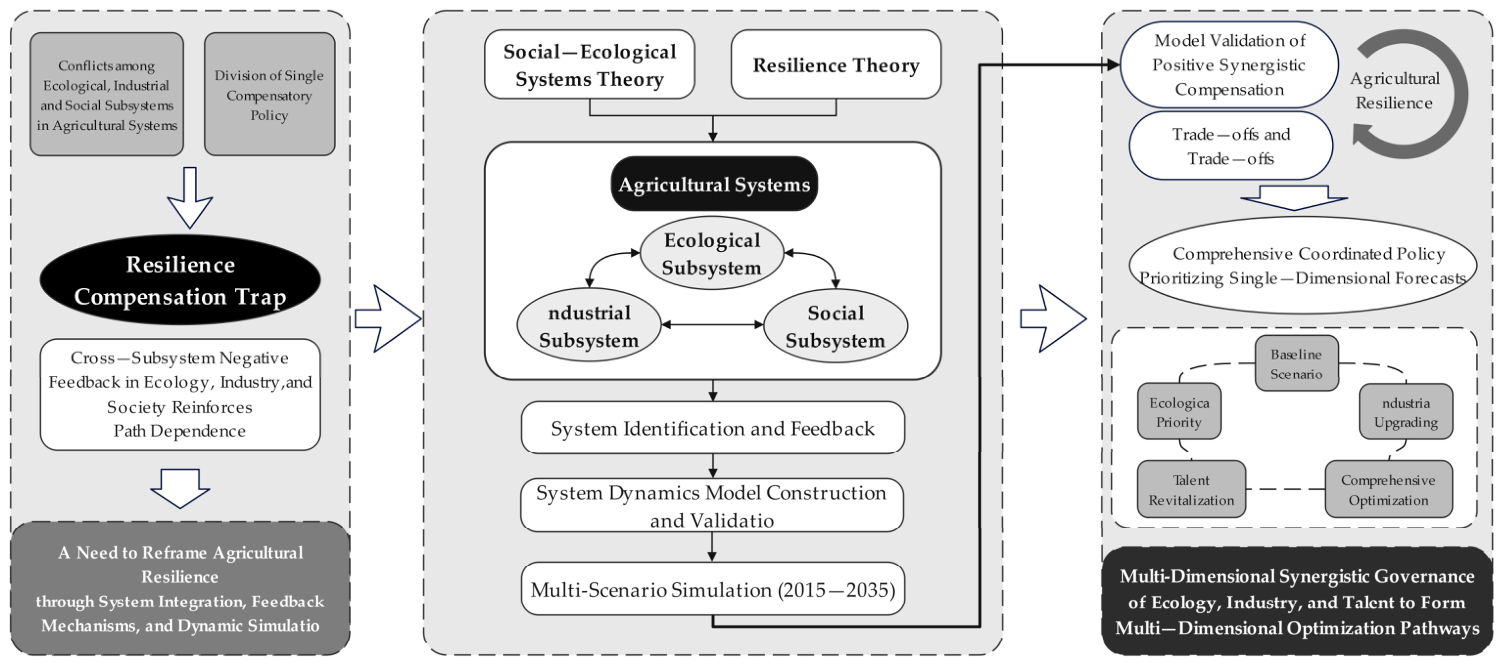
Figure 2. Research scheme.
Land 15 01564 g002
Figure 3. Location map of Nenjiang City.
Land 15 01564 g003
Figure 4. Causal loop diagram of agricultural resilience in Nenjiang City.
Land 15 01564 g004
Figure 5. Stock–flow diagram of the agricultural resilience SD model in Nenjiang City.
Land 15 01564 g005
Figure 6. Simulation results of agricultural resilience and its subsystems.
Land 15 01564 g006
Table 2. Composition of interview participants and qualitative coding examples.
Participant TypeProportion (%)Selection CriteriaExample StatementInitial Code
Farmers47.8A combination of random sampling and typical case selection was adopted to ensure coverage of different farm sizes and production experiences“In recent years, to maintain grain yield, fertilizer input has increased compared with the past, but soil fertility does not seem to have improved significantly.”Increased fertilizer input; soil fertility decline; production pressure
Cooperative managers22.5Cooperatives registered in Nenjiang City with stable operation and a certain capacity to organize and serve farmers were selected“The cooperative can unify procurement and sales, but local processing capacity is limited, and agricultural products are still mainly sold as raw grain.”Unified operation; insufficient processing capacity; dependence on raw grain sales
Village cadres12.3Village officials familiar with local agricultural production, demographic changes, and policy implementation were selected“Most young people have migrated out for work, and the remaining labor force is aging, so agricultural production increasingly relies on machinery.”Labor outmigration; population aging; mechanization substitution
Agricultural enterprise representatives17.4Representatives engaged in agricultural product purchasing, processing, marketing, or agricultural services were selected“Enterprises are willing to expand processing scale, but raw material price fluctuations and unstable benefit linkages with farmers remain major constraints.”Market price volatility; agro-processing development; weak benefit linkage
Table 3. Key equations.
Implicit VariableEquations
Agricultural Resiliencey = 0.351546 ∗ Agricultural ecological resilience + 0.346577 ∗ Agricultural industrial resilience + 0.301877 ∗ Agricultural social resilience
Agro-Ecological Resiliencey = 0.324559 ∗ Soil land productivity + 0.465514 ∗ Farming mode adaptability + 0.209927 ∗ Social ecological cognition
Agro-Industrial Resiliencey = 0.406006 ∗ Industrial structure resilience + 0.346555 ∗ Local agricultural economic scale + 0.247439 ∗ Agricultural processing intensity
Agro-Social Resiliencey = 0.429745 ∗ Rural labor input rate + 0.32132 ∗ Village-level organizationalization level + 0.248936 ∗ New-type professional farmers
Intensity of Government Investment Guidancey = (Local fiscal general budget expenditure/Regional GDP) + (Number of industrial enterprises above designated size/100) ∗ 2
Socio-Ecological Awarenessy = INTEG (Cognitive awakening rate − Cognitive solidification rate)
Adaptive Capacity of Farming Practicesy = INTEG (New technology adoption rate − Technology elimination and obsolescence rate)
Social Learning Capacityy = (Number of students in general secondary schools + Number of students in secondary vocational education + Number of students in higher education)
Composite Rural Retention Attractivenessy = ABS (Agricultural comparative benefit ∗ 0.3 + Non-agricultural employment opportunities ∗ 0.2 + Agricultural development prospects attractiveness ∗ 0.4 + Agricultural income)
Table 4. Summary of variables in the system dynamics model.
VariableNumberVariables
Ecological dimension18Land fertility carrying capacity, ecological conservation and restoration, intensive depletion of land fertility, fertilizer dependency-induced degradation, warning signals of land fertility depletion, total agricultural land area, total sown area of crops, planting intensity pressure, sown area of major grain crops, pure nutrient equivalent of fertilizer application, expected fertilizer input per unit area, lagged effect of fertilizer input–output, fertilizer input adjustment factor, expected fertilizer input–output ratio, external shock factor, external risk shocks, short-term costs of ecological transition, agro-ecological resilience
Industrial dimension22Industrial structure vulnerability, economic scale of local processing industries, net growth of industrial investment, capital depreciation and outflow, gross output value of above-designated-size industries, gross output value of agriculture, forestry, animal husbandry and fishery, agricultural value added, value added of facility agriculture, demonstrative profitability of facility agriculture, potentially convertible farm households, land area under facility agriculture, dependence on raw grain sales, market price volatility risk, income uncertainty effect, comparative benefits of agriculture, returns from agricultural employment, non-agricultural employment opportunities, average wage of urban employed workers, number of workers in agriculture, forestry, animal husbandry and fishery, agricultural innovation vitality factor, environmental pressure on industrial development, agro-industrial resilience
Social dimension26Socio-ecological cognition, rate of cognitive awakening, rate of cognitive inertia, social learning capacity, stock of rural human capital, level of rural social organization, professionalization level of new farmers, organizational development, organizational decline, empowerment through professional training, attrition due to skill obsolescence, talent return and cultivation, rate of talent attraction and endogenous cultivation, outflow of core labor force, labor outmigration rate, rural employed population, enrollment in general secondary schools, enrollment in secondary vocational schools, total population at year-end, number of rural households, rural population aging, efficiency of rural social governance, pressure from urban–rural income disparity, number of village committees, farmers’ willingness to adopt, agro-social resilience
Other25Agricultural resilience, effects of sustainable farming practices, policy-driven conservation investment, general local fiscal budget expenditure, local reinvestment rate, local capital formation capacity, balance of urban and rural household savings, internal capital reinvestment, attraction of external capital, intensity of government investment guidance, total social fixed-asset investment, regional gross domestic product, number of above-designated-size industrial enterprises, degree of benefit linkage, strengthening of linkage mechanisms, risk of benefit decoupling, enhancement of structural buffering capacity, composite attractiveness for rural retention, attractiveness of agricultural development prospects, improvement in market bargaining power, cost-reduction effects, modernization demonstration effects, agricultural technology spillovers, investment in professional training, adaptive capacity of farming practices, agro-industrial resilience, agro-social resilience
Table 5. Results of the system stock-flow test of key variables and sensitivity analysis.
Error TestSensitivity Test
VariableMean Relative Error (%)VariableMean Sensitivity (%)
Pure nutrient equivalent of fertilizer application3.69Land fertility carrying capacity0.49
Agro-ecological resilience0.50Social learning capacity0.05
Agro-industrial resilience2.16Adaptive capacity of farming practices0.07
Agro-social resilience0.23Economic scale of local processing industries1.93
Socio-ecological cognition0.39Industrial structure vulnerability0.14
Economic scale of local processing industries7.25Degree of benefit linkage0.56
Industrial structure vulnerability0.68Stock of rural human capital0.99
Stock of rural human capital0.15Professionalization level of new farmers0.13
Degree of benefit linkage2.63Level of rural social organization0.23
Agricultural resilience2.47Intensity of government investment guidance2.34
Table 6. Simulation scenarios and policy settings for agricultural resilience.
Scenario No.Scenario TypeScenario SettingsSimulation Objective
Scenario 1Baseline scenarioContinuation of current policies and investment levels, with no additional intervention measuresTo provide a reference baseline and reveal potential resilience risks faced by the system in the absence of intervention
Scenario 2Ecological priority scenarioReduction in pure fertilizer application by 50%, increase in socio-ecological cognition by 150%, and increase in new technology adoption rate by 150%To verify the mitigating effects of ecological restoration on land fertility decline and assess the potential improvement in agro-ecological resilience
Scenario 3Industrial upgrading scenarioIncrease in the intensity of government investment guidance by 200%, expansion of local processing industry scale by 200%, and enhancement of benefit linkage tightness by 150%To test the impacts of industrial structure diversification on economic resilience and evaluate the risk of excessive dependence on a single industrial structure
Scenario 4Talent revitalization scenarioIncrease in rural social organization level by 200%, enhancement of comprehensive talent attraction by 150%, and improvement in the professionalization level of new farmers by 200%To examine the role of human capital reconstruction in enhancing social resilience and assess whether it can reverse the negative feedback of talent loss
Scenario 5Comprehensive optimization scenarioCombination of Scenario 2, Scenario 3, and Scenario 4To explore pathways for overall resilience enhancement of the system and verify whether synergistic effects exceed the additive effects of single-policy interventions
Table 7. Resilience levels in 2035 and percentage changes relative to the baseline scenario under the five policy scenarios.
ScenarioOverall ResilienceEcological ResilienceIndustrial ResilienceSocial Resilience
Baseline10.21 (0%)14.92 (0%)13.95 (0%)0.44 (0%)
Ecological priority11.84 (+15.96%)16.73 (+12.13%)13.95 (0%)0.43 (−2.27%)
Industrial upgrading16.43 (+60.92%)10.90 (−26.94%)35.96 (+157.8%)0.44 (0%)
Talent revitalization9.94 (−2.64%)12.11 (−18.83%)13.95 (0%)2.80 (+536.36%)
Comprehensive optimization18.07 (+76.98%)15.52 (+4.02%)35.96 (+157.8%)0.49 (+11.36%)
Disclaimer/Publisher’s Note: The statements, opinions and data contained in all publications are solely those of the individual author(s) and contributor(s) and not of MDPI and/or the editor(s). MDPI and/or the editor(s) disclaim responsibility for any injury to people or property resulting from any ideas, methods, instructions or products referred to in the content.