Article

Modeling Sustainability Trade-Offs in a High-Andean Rural Community: Pine Plantations, Livestock, and Food Systems in Patapallpa Alta (Cusco, Peru)

by
Juan José Cadillo-Benalcazar
1,2,*,
Pablito Marcelo López Serrano
3,
Amilcar Quispe
4,
María E. Holgado-Rojas
4,
Janet Mamani
4,
Hugo B. Ccopa Huayta
4,
María A. Paucarmayta-Holgado
4,
Richard R. Vargas-Tito
4 and
Richard Tito
5
1
Facultad de Ciencias Ambientales, Universidad Científica del Sur, Lima 15067, Peru
2
Centro de Investigaciones Tecnológicas, Biomédicas y Medioambientales, Calle José Santos Chocano 199 Bellavista, Callao 07006, Peru
3
Institute of Silviculture and Wood Industry, Juárez University of the State of Durango, Ciudad Universitaria, Boulevard 501, Durango 34120, Durango, Mexico
4
Facultad de Ciencias Biológicas, Escuela Profesional de Biología, Universidad Nacional de San Antonio Abad del Cusco, Av. de la Cultura, Nro. 733, Cusco 08003, Peru
5
Facultad de Ciencias Biológicas, Universidad Nacional Mayor de San Marcos, Lima 15081, Peru
*
Author to whom correspondence should be addressed.
Land 2026, 15(7), 1318; https://doi.org/10.3390/land15071318
Submission received: 13 May 2026 / Revised: 10 July 2026 / Accepted: 10 July 2026 / Published: 22 July 2026

Abstract

Rural development strategies in the Andes face persistent tensions between income generation, food provision, and the conservation of ecological functions. In Patapallpa Alta (Cusco, Peru), the expansion of pine plantations associated with mushroom production has created new economic opportunities but also tensions involving water availability, land-use, and labor organization. This study applies the Multi-Scale Integrated Analysis of Societal and Ecosystem Metabolism (MuSIASEM) approach to develop a model for evaluating these trade-offs in terms of viability, feasibility, and desirability. The analysis includes territorial, productive, nutritional, and biophysical dimensions to represent interdependencies among dietary needs, food provision, labor, land-use, and biophysical pressures. The results show that the community functions as an open metabolic system where social reproduction depends on both local production and external flows. Although the pine–mushroom subsystem generates income and is socially valued, it also reshapes relationships among land, water, and labor in ecosystems where grasslands perform essential hydrological functions. This model brings the underlying structural tensions that shape sustainability to the surface and provides a useful framework for supporting decision-making in complex rural territories.

1. Introduction

Rural communities in the high Andes face persistent tensions between income generation, food provision, and the conservation of ecological functions [1,2]. These areas operate under severe agroecological constraints that limit production options and require households to combine agriculture, livestock raising, forestry activities, and trade with external markets to maintain their livelihoods. Consequently, land-use decisions reshape the relationships among social organization, resource use, provisioning systems, and ecosystem functions [2].
Among such transformations, the expansion of plantations with exotic tree species—particularly Pinus spp. and Eucalyptus globulus—has been promoted as a strategy to restore degraded areas and diversify rural incomes [3,4,5]. However, this strategy remains controversial given that its economic benefits may coexist with changes in water availability, ecological processes, biodiversity, and traditional land-uses associated with grazing and subsistence agriculture [6,7,8]. Also, pine plantations rarely function as independent production systems—instead, they are part of broader territorial configurations integrating forestry activities, livestock production, household consumption, and external markets.
The above interactions pose a significant challenge for sustainability assessment. A land-use strategy may strengthen one dimension of the system but lead to pressure or dependency in others—including changes in labor allocation, land availability, water use, or reliance on external inputs. Thus, the central question is not merely whether a specific activity provides benefits, but whether the resulting configuration can support the socio-ecological system as a whole.
Various analytical traditions have advanced the understanding of sustainability, yet each addresses only part of the problem posed by territories where productive, ecological, and social functions are tightly coupled. Sustainable livelihood frameworks broadened the analysis beyond monetary income by including household assets, vulnerability, and adaptation strategies [9,10,11]. However, they remain limited in their capacity to track how biophysical requirements circulate and constrain the system across organizational levels, from the household to the territory. Ecosystem services approaches exposed the underlying dependence of human well-being on ecological functions [12,13,14], but they are less suited to quantifying the trade-offs that arise when competing land-uses draw on the same biophysical base. Social–ecological system frameworks integrate stakeholders, institutions, and resources within a single structure [15,16]. Yet, they tend to under-operationalize the material and energy flows linking social organization to ecological limits. Finally, biophysical accounting methods—material and energy flow analysis, and ecological or water footprints—quantify resource use and associated environmental pressures [17,18,19,20,21,22,23]. However, by emphasizing aggregate system totals, they may underrepresent the internal functional relationships via which specific activities, labor, and land-uses generate said pressures. The resulting gap is therefore not a shortage of dimensions but the absence of a single framework able to represent both simultaneously and across scales, how household consumption, productive organization, labor, territorial funds, and external dependencies mutually constrain one another. Addressing rural transitions such as the one under study precisely requires this integrated, multi-level representation.
The Multi-Scale Integrated Analysis of Societal and Ecosystem Metabolism (MuSIASEM) provides such a framework by representing socio-ecological systems as hierarchical organizations of interdependent funds and flows across multiple levels [24,25]. Funds represent the structural elements that maintain the system—such as land, human activity, and productive capacity. For their part, flows stand for the energy, materials, biomass, water, and products mobilized for the system’s reproduction [26]. This structure allows sustainability to be assessed through the dimensions of viability, feasibility, and desirability [24].
This study applies a MuSIASEM-based model to Patapallpa Alta, a rural high-Andean community located in Cusco (Peru). A feature of this community is the coexistence of pine plantations linked to Suillus luteus mushroom production, livestock systems, guinea pig farming, subsistence agriculture, and external food supply chains [27]. This configuration provides a suitable case for studying how a local productive diversification strategy interacts with economic, social, and ecological processes at the territorial level [28,29]. Addressing the methodological gap identified above, the purpose of this study is to develop an integrated metabolic model to characterize the organization of the Patapallpa Alta socio-ecological system. The study further aims to evaluate the trade-offs associated with the pine–mushroom strategy in relation to income generation, food provision, labor allocation, land requirements, and biophysical pressures. In doing so, the study contributes to research on territorial sustainability by showing how MuSIASEM can integrate social, ecological, and biophysical dimensions to evaluate trade-offs shaping complex rural territories.

2. Conceptual Framework

2.1. Rural Socio-Ecological Systems and Land-Use Transformations in the Andes

Research on land-use systems emphasizes that rural territories should be studied as socio-ecological configurations where land simultaneously fulfills productive, social, and ecological functions [30,31]. From this perspective, land-use change not only alters land-cover or productive activities but also reshapes the relationships among stakeholders, resources, benefits, and environmental pressures. Given the complexity of these systems, such transformations often involve trade-offs among production, livelihood, and environmental objectives [32].
This perspective is particularly relevant in the Andes, where rural communities have historically developed diversified production systems combining agriculture, livestock, forestry activities, and resource management across heterogeneous ecological conditions [33,34]. These arrangements respond to environmental variability as well as economic and institutional constraints in a flexible manner [35]. Recent land-use transformations should be understood within this broader territorial logic. For this reason, new productive activities should not be assessed solely based on their yield or profitability but also according to their effects on labor organization, land management, resource use, and household reproduction strategies. Moreover, by reshaping local production and consumption patterns, territorial transformations can also change the spatial distribution of biophysical pressures. When communities partially depend on external resources, demand for water, land, or biomass may be transferred to other territories through flows embedded in exchanged products and inputs [23,36]. This dimension is essential when assessing rural systems combining local production, household consumption, and market interactions.

2.2. MuSIASEM as an Integrated Framework for Multi-Scale Sustainability Assessment

The assessment of complex socio-ecological systems requires approaches capable of integrating social organization, ecological processes, and resource-use patterns across multiple scales. Conventional sustainability assessments based on isolated indicators provide useful information on specific components but have limitations in representing system-level interactions. MuSIASEM was developed to address this challenge via an integrated representation of societal and ecosystem metabolism across hierarchical levels [24,37].
MuSIASEM organizes information in a hierarchical structure based on the relationship between funds and flows. Funds represent the elements maintaining system identity and functionality, whereas flows represent the resources mobilized for system operation and reproduction. This structure enables the integration of social, economic, productive, and biophysical information while preserving relationships across levels of analysis [38].
A central contribution of MuSIASEM is that it avoids limiting sustainability assessment to a single dimension or aggregate indicator. Instead, it enables the simultaneous assessment of internal organization, external constraints, and social objectives through a number of notions. These are viability (compatibility with internal technical and demographic constraints), feasibility (compatibility with environmental limits), and desirability (alignment with stakeholder aspirations) [25]. Such analytical potential has been demonstrated in previous applications to rural and territorial systems [39,40]. Its implications for interpreting the findings of the present study are discussed in Section 5.

2.3. Multi-Scale Metabolic Representation of the Patapallpa Alta Socio-Ecological System

Based on the MuSIASEM framework, this study represents Patapallpa Alta as an open metabolic system where household consumption, provisioning systems, productive activities, territorial resources, and external supply chains are functionally interconnected. This representation examines the community as a metabolic configuration sustained by interactions between funds and flows.
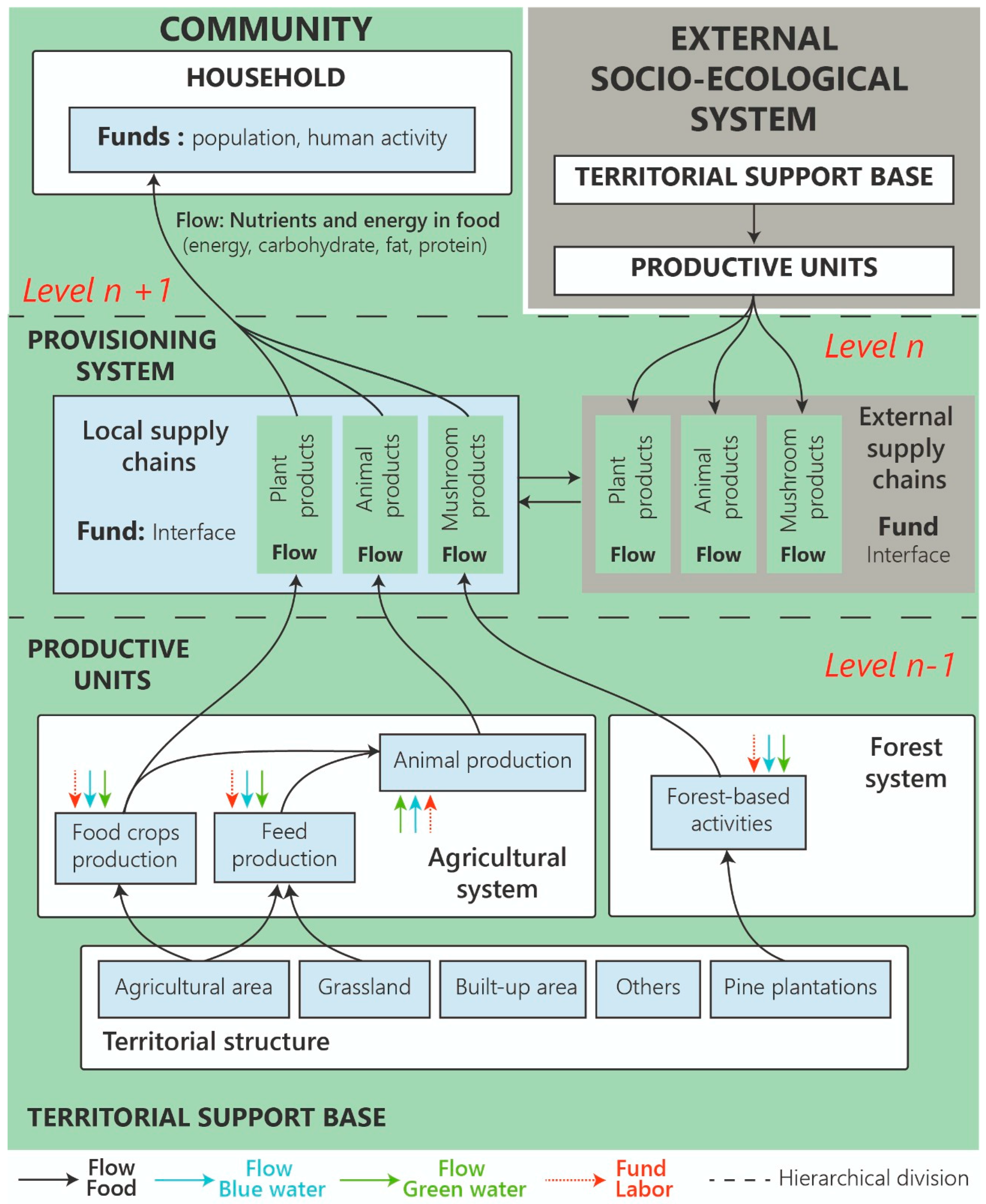
Within this framework, the pine–Suillus luteus production subsystem is considered a productive diversification strategy modifying the organization of these metabolic components—thereby influencing the allocation of local resources, household strategies, and the community’s dependence on external inputs. A central principle of this representation is the distinction between scale and level. While scale refers to the analytical dimension used to observe a phenomenon, level represents a specific position within such scale [41]. Following MuSIASEM principles, the community is represented as a constitutive hierarchy organized into three functional levels—namely, territorial productive base (n − 1), provisioning system (n), and household consumption (n + 1)—together with a connected external socio-ecological system (Figure 1).
(a)
Level n − 1 represents the system’s ecological and productive base. It includes the territorial structure and local production units associated with agriculture, livestock, and forestry activities. It further defines local funds—including agricultural land, cropland, grassland, pine land, livestock populations, and sector-specific labor. Finally, it generates internal flows such as crop biomass, feed biomass, animal products, mushroom biomass, and water consumption. In this case study, the latter was classified into green and blue water following the water footprint approach. Green water refers to rainwater that is stored in the soil and absorbed by plants through evapotranspiration during biomass production (e.g., crops, grasslands, and forests). Blue water refers to the consumption of surface and groundwater resources (e.g., rivers, reservoirs, and aquifers) during production processes [42,43].
(b)
Level n represents the interface between internal production and external exchanges. It assesses the system’s provisioning capacity via flows of plant food, animal products, and plantation-derived mushroom biomass, and includes imported biomass flows linked to external resources. This level links production to household requirements and enables local self-sufficiency and external dependence to be assessed.
(c)
Level n + 1 represents household consumption and social reproduction. Households are characterized by population and human activity funds, which generate metabolic demands expressed as biomass consumption, macronutrient requirements, and caloric intake. Such requirements determine the biophysical load supported by the lower levels of the system.
(d)
The external socio-ecological system is included as a connected domain rather than an additional hierarchical level. It represents the resources and production processes outside Patapallpa Alta that contribute to meeting local demands via imported goods. This enables the identification of external dependencies and displaced biophysical pressures.
This organization provides the analytical basis for the empirical assessment developed in this study. In the case of the pine–grassland water trade-off, the added value of MuSIASEM lies in its capacity to standardize two movements that other frameworks can only capture separately—while doing so within a single multilevel accounting framework. These two movements are the internal transformation of a territorial fund (grassland converted into pine plantation to generate a monetary flow) and the simultaneous externalization of environmental pressure via imported flows.
In order to translate this conceptual representation into the MuSIASEM accounting framework, the main components of each hierarchical level were associated with their relevant fund elements, flow elements, and system boundaries (Table 1).

3. Methodology

3.1. Area Under Study

The area under study is the Patapallpa Alta rural community, which is located in the Ocongate district in Cusco, Peru. The community was selected as a relevant case study of rural transformation in high-Andean contexts because it combines traditional livelihood activities with recent productive diversification processes associated with pine afforestation, Suillus luteus mushroom production, guinea pig farming, local organization, and value-added initiatives [27].
The empirical analysis was based on a census survey of 45 households conducted in Patapallpa Alta. As a baseline profile of the surveyed households, the socio-economic structure corresponds to a predominantly subsistence-oriented context: 89% of households report incomes equal to or below the minimum living wage—approximately USD 303, at an average exchange rate of 3.38 PEN (soles)/USD—and all households engage in agricultural activities. This profile is reported here as a contextual reference for the survey data used in the model, consistent with the close link between household consumption and local production.
Given the absence of an official georeferenced boundary for the community, its spatial limits were defined using biophysical criteria based on hydrological units. This boundary established the extent of the land fund considered in the MuSIASEM representation. A Digital Elevation Model (DEM) was processed using the WGS 1984 UTM Zone 19S coordinate system in ArcGIS Desktop 10.5 (Esri, Redlands, CA, USA) with the Spatial Analyst module. The DEM was hydrologically corrected using the Fill tool. Subsequently, Flow Direction and Flow Accumulation layers were generated. The drainage network was then delineated using a contribution threshold adjusted to the DEM spatial resolution and the extent of the area. Finally, micro-watersheds were delineated using the Watershed tool from outlet points derived from the drainage network.
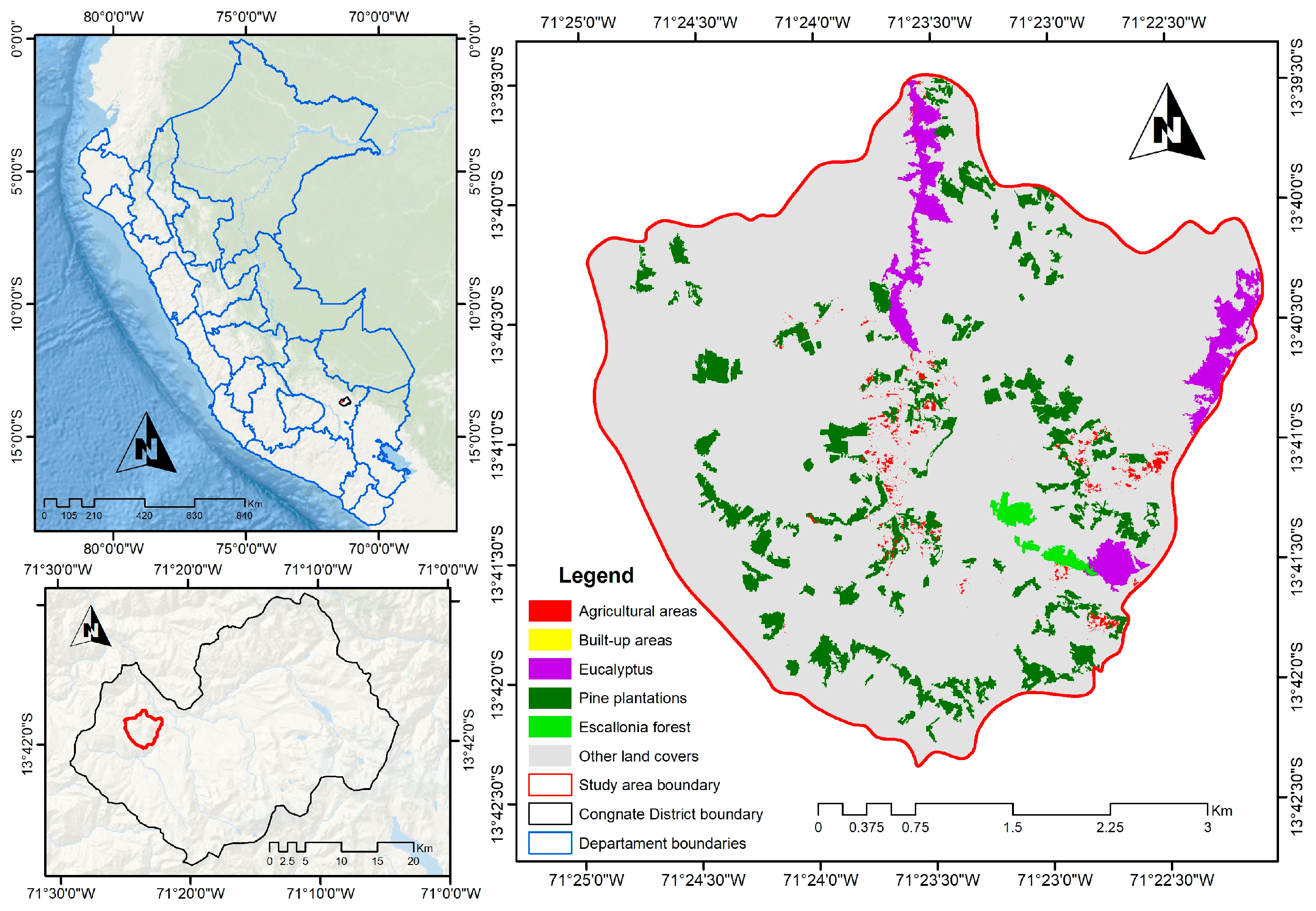
Land-cover characterization was performed using a high-resolution RGB image from Google Earth Pro 7.3.7.1155 (Google LLC, Mountain View, CA, USA), with a spatial resolution of 2 m per pixel, which was acquired in June 2025. This image was used as reference information for visual interpretation and for the selection of training samples. A supervised classification was then performed using the Maximum Likelihood Classifier in ArcGIS [44,45]. Six land-cover classes were defined; namely, agricultural areas, eucalyptus plantations, pine plantations, Escallonia forest, built-up areas, and other land-covers (see Figure 2). This classification provided the spatial basis for estimating the territorial structure of the community and identifying the land-use categories used in the MuSIASEM model as the representation of the land fund and its associated productive functions. In addition, historical Google Earth Pro 7.3.7.1155 (Google LLC, Mountain View, CA, USA) images were used to classify pine plantations by age into old plantations (≥10 years), intermediate plantations (5–10 years), and recent plantations (<5 years).

3.2. Sources and Assumptions

Primary data were collected from household-level surveys (N = 45). In light of the fact that three households failed to report the number of household members, missing values were estimated using a distribution-based deterministic imputation procedure derived from the observed household-size structure. This imputation yielded an estimated resident population of 171 inhabitants (household size = 3.8; SD = 1.7), which was subsequently used to calculate aggregate food demand and the metabolic requirements associated with household consumption.
Secondary information on food consumption patterns and technical coefficients related to production systems, including yields and labor requirements, was compiled from secondary sources and validated through consultations with key local informants. The relevant data sources and methodological assumptions are summarized in Table 2 (for further details, see the Supplementary Materials).
To describe the influence of pine plantations on soil water dynamics, volumetric soil water content (SWC) was monitored using two SoilVue10 sensors (Campbell Scientific, Logan, UT, USA). One probe was installed within a 15-year-old pine plantation, while the other was deployed in nearby native grassland. The sensors were 180 m apart, with each located 90 m from the pine plantation edge. The two monitoring sites shared similar topographic and geohydrological characteristics, including elevation, slope, hillslope position, and sandy loam soil texture. In addition, both sites were located near the mountain summit, where no evidence of streams or groundwater emergence was observed, suggesting limited influence of lateral subsurface flow on the sensors. Each sensor recorded SWC at six soil depths (−5, −10, −20, −30, −40, and −50 cm) at 10 min intervals over a 1-year period (August 2024 to July 2025), and all data were stored in a CR1000X datalogger (Campbell Scientific, Logan, UT, USA).

3.3. Sensitivity Analysis of Labor Availability Assumptions

Because community-level demographic structure and household-level labor allocation were not directly measured, a deterministic scenario-based sensitivity study was conducted to test whether the labor viability interpretation is robust to assumptions about labor supply, following the uncertainty assessment logic of Morgan et al. [68]. The study is framed as an upper-bound screening test: a negative annual labor balance identifies a labor constraint, whereas a positive balance is necessary but not sufficient to demonstrate realized labor availability.
Three supply-side parameters were varied independently: the working-age share (ω); the participation equivalence factor (π), which represents the effective full-time-equivalent contribution of the working-age population; and the annual labor supply schedule (hSUP). Rather than co-varying ω and π along a single gradient, the two were combined in a full factorial design (ω ∈ {0.55, 0.65, 0.75}; π ∈ {0.45, 0.60, 0.75, 0.90}) so that the independent effect of each parameter—including asymmetric combinations such as a low working-age share with high participation—could be assessed. Two annual labor supply schedules were evaluated: the Peruvian statutory full-time schedule (hSUP = 2304 h·person−1·year−1; 48 h-week−1 × 48 weeks [69]) and a severe lower schedule (hSUP = 1800 h·person−1·year−1) adopted as a stress scenario following the Eurostat Annual Work Unit convention [70]. The 1800 h schedule is not treated as a measured local agricultural labor standard but as a deliberate downward stress on assumed annual labor supply. Because peasant labor is seasonally concentrated, the annual balance was complemented by a conditional peak-load threshold (κmax), reporting the maximum peak-to-average concentration each scenario could absorb. Seeing as empirical peak concentration was not measured, these thresholds are interpreted as conditional rather than as evidence that seasonal bottlenecks are absent.
Potential annual labor supply (LSUP), the annual labor balance, and the supply-to-demand ratio were computed as
L S U P = P × ω × π × h S U P
where P is the resident population, ω is the working-age share, π is the participation equivalence factor, and h s u p is the annual labor supply schedule of a fully participating working-age person. The annual labor balance was then calculated as:
B L = L S U P L D E M
and the labor supply-to-demand ratio as:
R L = L S U P L D E M
where LSUP = Potential annual labor supply (h·year−1), LDEM = Annual labor demand (h·year−1), BL = Annual labor balance (h·year−1), RL = Labor supply-to-demand ratio (dimensionless).
Results are also expressed in full-time-equivalent (FTE) workers for interpretability. The full parameter grid, governing equations, factorial results, breakpoint estimates, and seasonal thresholds are reported in the Supplementary Materials (Tables S1–S4).
F T E D E M = L D E M h S U P
F T E S U P = L S U P h S U P = P × ω × π

4. Results

4.1. Level n + 1: Household Metabolic Demand

At level n + 1, the household system represents the final consumption component of the Patapallpa Alta metabolic system. From a MuSIASEM perspective, resident population is the main fund element, whereas food consumption, expressed in terms of energy and macronutrient requirements, represents the flows required for social reproduction. This level defines the population-scaled metabolic demand that must be supported by the food provisioning system (level n) and, indirectly, by the productive and territorial funds represented at level n − 1.
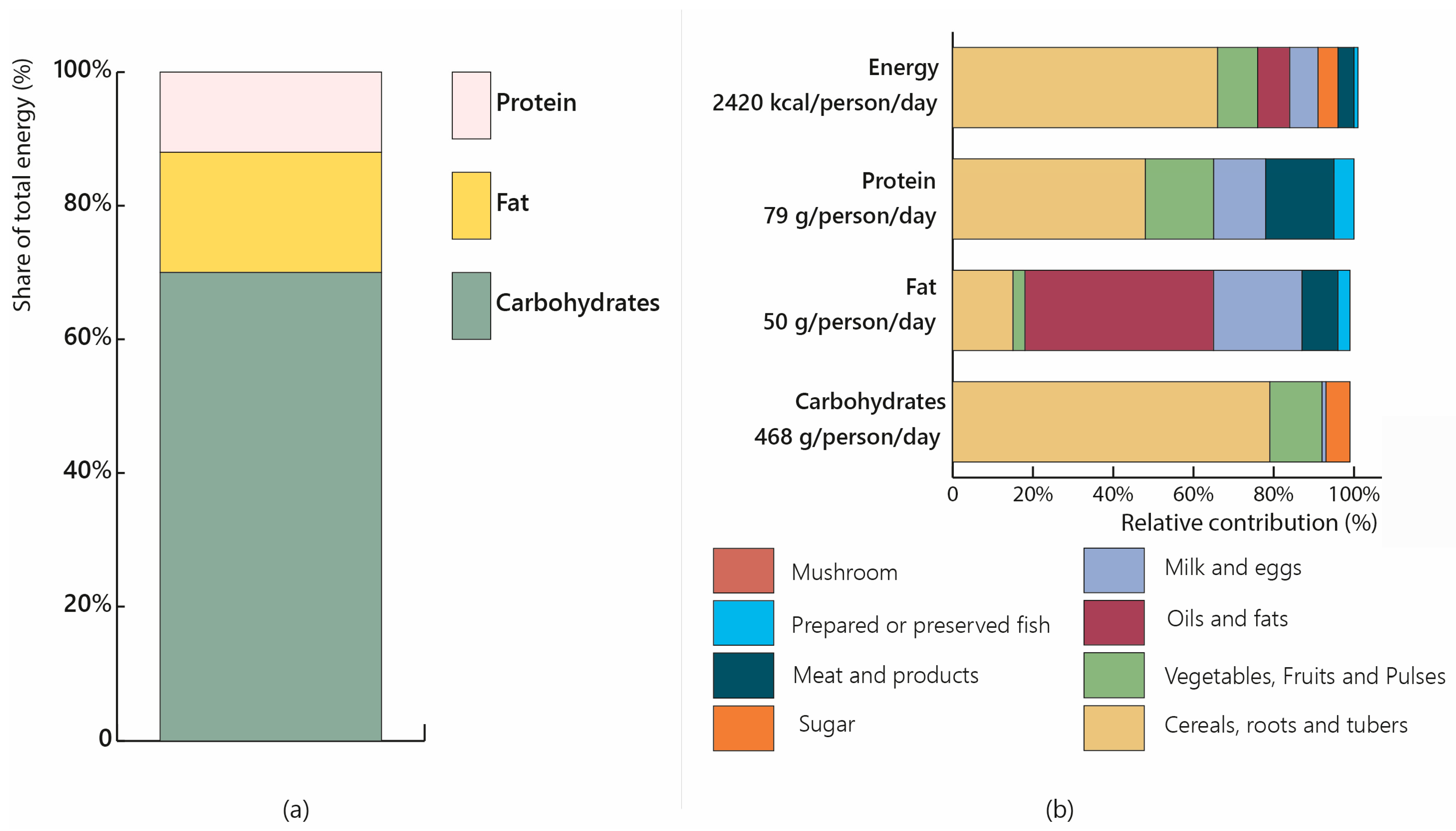
Food requirements were scaled to an estimated resident population of 171 inhabitants. Estimated dietary demand is 2420 kcal/person/day. In terms of macronutrient composition, this energy intake is distributed as 70% carbohydrates, 18% fats, and 12% proteins (Figure 3a). This pattern indicates that household food metabolism is mainly structured around carbohydrate-rich foods, which represent the dominant energy source within the local diet. The estimated energy intake is lower than the reference value reported for a rural adult male in Peru performing moderate physical activity—2836 kcal/person/day [71]. However, this comparison should be interpreted only as a contextual benchmark rather than as a direct assessment of nutritional adequacy, because the calculated demand represents a population-level average that includes individuals of different ages, sexes, and levels of physical activity.
The composition of this demand reveals a strong dependence on staple foods. Cereals, roots, and tubers are the main dietary group, providing most carbohydrate intake and an important contribution to total protein availability. Vegetables, fruits, and legumes provide a smaller but relevant contribution to carbohydrate and protein intake, whereas meat and other animal-derived products represent the main source of animal protein within the diet. Fat intake is mainly associated with oils and fats, which account for a large proportion of total fat consumption despite contributing only a limited fraction of total dietary energy.
In operational terms, level n + 1 determines the extent and composition of household food requirements: 2420 kcal/person/day in terms of energy intake, 468 g/person/day of carbohydrates, 50 g/person/day of fats, and 79 g/person/day of proteins (Figure 3b). Therefore, this level represents the metabolic starting point for analyzing food provisioning, dependence on internal and external resources, and the associated land, water, and labor requirements examined at lower hierarchical levels.

4.2. Level n: Food Provisioning System

Level n represents the metabolic interface between household food demand (level n + 1) and the provisioning systems required to satisfy it. This level distinguishes between internal flows generated through the local productive base and external flows supplied through connected socio-ecological systems beyond the community boundary. This distinction makes it possible to assess not only the amount of food supplied but also the functional organization through which the community meets its metabolic requirements.
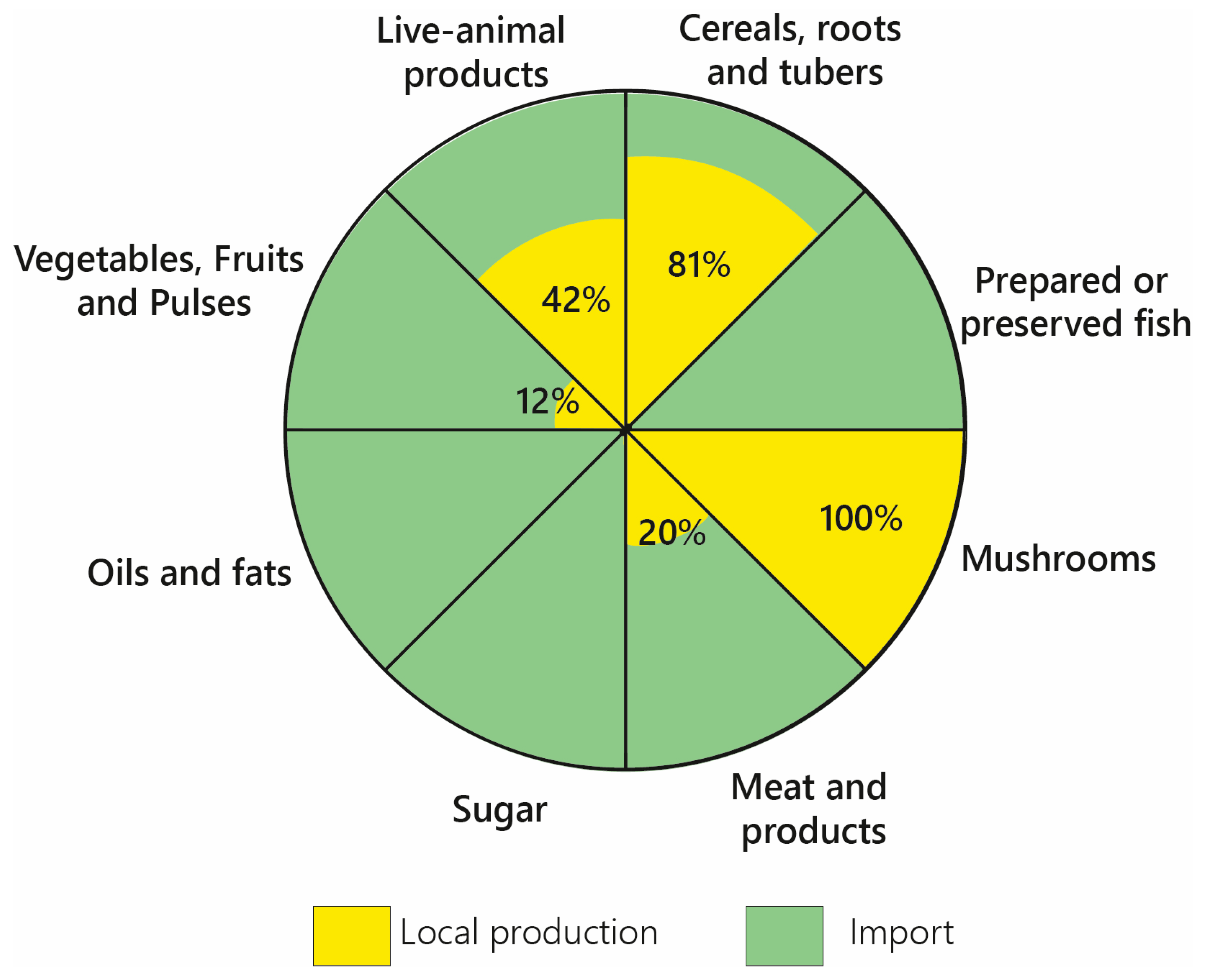
To maintain consistency between household consumption and food provisioning, food demand was expressed in primary food equivalents following the criteria described in the methodology. Under this representation, total food demand reached approximately 155 t/year, of which 77 t/year were supplied by local production and 78 t/year by imported flows (Figure 4), which represents an overall self-sufficiency level close to 50%. This aggregate value should be interpreted as a volumetric indicator based on primary food equivalents rather than as a measure of caloric, protein, or nutritional self-sufficiency. It also does not imply homogeneous independence across the food system. Instead, it reflects a functionally differentiated structure in which some dietary components are sustained mainly by local resources, whereas others depend on external supply chains.
Household food demand is mainly concentrated in the cereals, roots, and tubers group, which approximately accounts for 79 t/year (51% of total food demand). In this group, demand is dominated by potato equivalents—including fresh potatoes and chuño (freeze-dried potato)—which together exceed 55 t/year, followed by wheat, maize, and rice-derived products. Of the total demand in this group, approximately 64 t/year are supplied locally, representing an 81% self-sufficiency level. This component represents the main internal food supply pathway as it is directly related to the dietary pattern identified at level n + 1, where carbohydrate-rich foods dominate household energy intake.
In contrast, food groups associated with dietary diversification show greater dependence on external flows. Vegetables, fruits, and legumes approximately represent 27 t/year (18% of total demand). However, only 3 t/year are produced locally, resulting in a self-sufficiency level close to 12%. This indicates that these components are not primarily sustained by the local territorial base but rely largely on supply chains connected to external territories.
Animal-derived products follow an intermediate pattern. Live animal products account for approximately 21 t/year, with a self-sufficiency level of 42%. That said, internal differences exist because processed dairy products such as cheese and yogurt are supplied externally. Meat products show a lower self-sufficiency level—close to 20%—and are mainly associated with local mutton and guinea pig production. Although livestock activities are part of the local productive structure, this pattern reflects that they only partially cover household animal-product demand.
Some food groups depend entirely on external flows, including fish, oils and fats, and sugar. This reflects both the agroecological limitations of the high-Andean territory and the integration of the community into broader food supply networks. Conversely, mushrooms derived from the pine–Suillus luteus subsystem are locally supplied. That said, their household consumption volume is marginal and does therefore not substantially affect the overall provisioning structure [50].
Level n reveals that Patapallpa Alta is an open metabolic system. The community maintains significant local capacity to sustain staple food requirements while relying on external flows to complement other household demand components. This provisioning configuration determines how the metabolic burden associated with food consumption is redistributed across local and external systems, defining the land, water, and labor requirements assessed at level n − 1.

4.3. Level n − 1: Social–Environmental Pressure

Level n − 1 assesses how the food provisioning structure identified at level n translates into biophysical and social requirements. This level links provisioning flows to the land, water, and human activity required to sustain them, and differentiates pressures within Patapallpa Alta from those embodied in external provisioning chains.
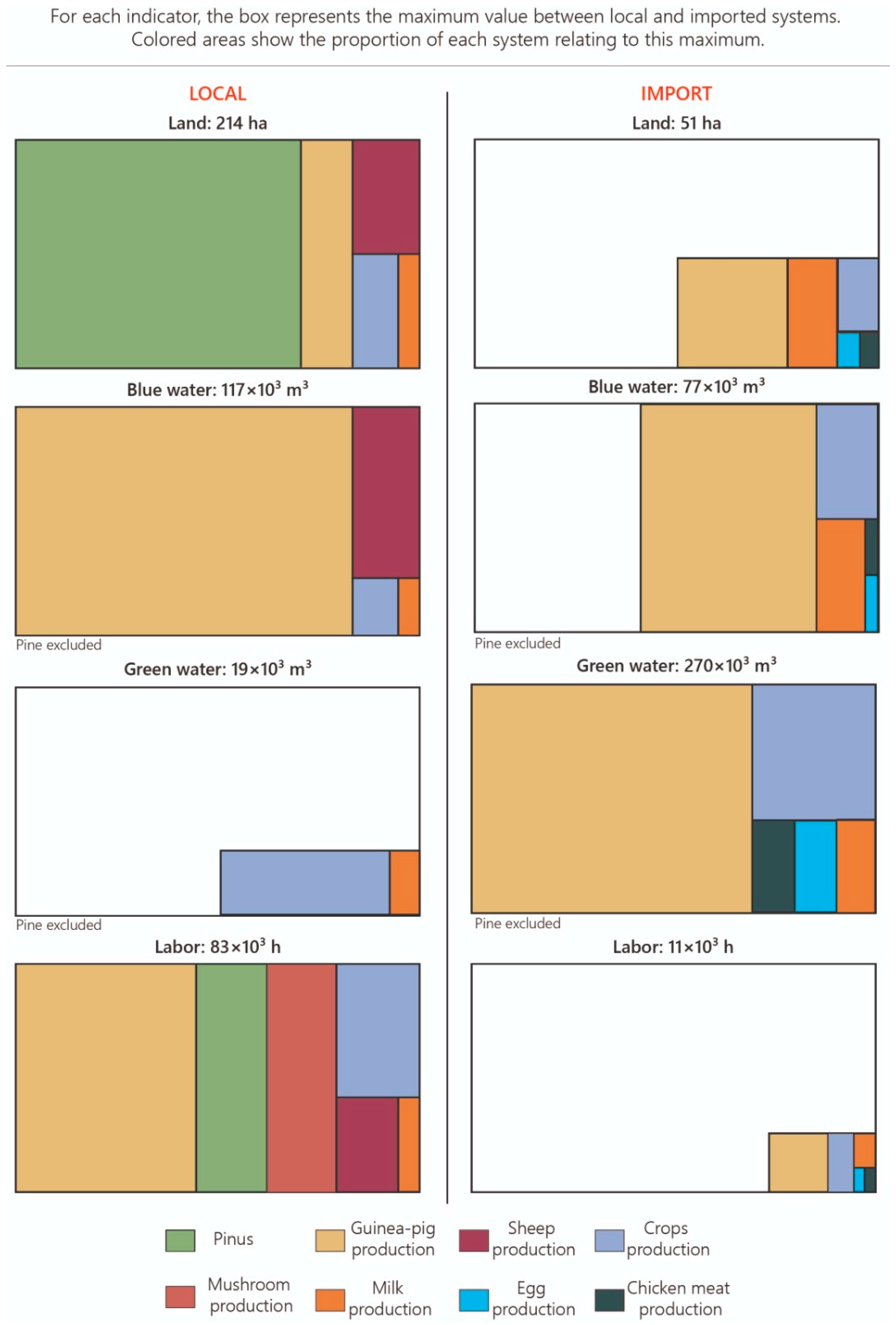
Overall, the food provisioning system was associated with approximately 265 ha/year of land, 194,000 m3/year of blue water, 289,000 m3/year of green water, and 94,000 h/year of labor. Each total combines local and imported sources, whose relative shares vary across these requirements (Figure 5). Land and labor are predominantly concentrated within the community, blue water is shared between local and imported provisioning pathways, and green water is largely embodied in external flows. This pattern reveals a differentiated metabolic structure. Local production sustains a substantial part of the territorial and labor food system basis, particularly via pine plantations, mushroom production, livestock-related activities, and staple crops. By contrast, imported flows embody a large share of the ecological processes required to sustain consumption, particularly via green water associated with external biomass production.
Animal production plays a central role in this redistribution of pressures. Guinea pig production, in particular, links local forage and labor requirements to imported feed concentrates, thereby connecting the community’s internal productive system with external land and water demands. Similarly, imported milk-related flows contribute to the externalization of part of the biophysical burden associated with household food provisioning.
The contrast between blue and green water is especially relevant. Blue water requirements remain partly anchored in local production, reflecting the role of forage, crops, and livestock systems in the community. However, green water is largely displaced to external territories, indicating that a significant portion of the rainfall-dependent ecological processes supporting the food system occurs outside the local boundary.
Level n − 1 shows that the sustainability trade-offs of Patapallpa Alta cannot be only understood through the proportion of food produced locally or imported. Each provisioning pathway redistributes pressures differently across land, water, and labor. This configuration highlights that sustainability depends on the compatibility between food provisioning, territorial funds, water requirements, and labor organization across interconnected local and external production systems.
Of the total land requirement (265 ha/year), approximately 214 ha/year (81%) are mobilized within the community, whereas 51 ha/year (19%) are embodied in imported products and are therefore externalized as virtual land. Nearly one-fifth of the land base required to reproduce the local provisioning system thus lies beyond the territorial boundary of Patapallpa Alta. The displacement is even greater for rainfall-dependent water: a substantial share of green water requirements is embodied in external flows, whereas blue water requirements are shared between local and imported sources. These figures provide the empirical basis for the interpretation developed in Section 5.3.

4.4. The Pine–Mushroom Subsystem: Territorial Trade-Offs Between Income Generation and Ecological Functions

The pine–mushroom subsystem represents a distinctive component of the territorial organization of Patapallpa Alta because of its relevance for land-use, labor requirements, and complementary economic flows for households. Pine plantations operate as a land fund that supports Suillus luteus production, thus transforming an introduced forest cover into a strategy for economic diversification. This subsystem is associated with policy strategies aimed at improving livelihood opportunities in high-Andean communities via reforestation, edible mushroom production linked to pine plantations, and the potential long-term use of timber resources.
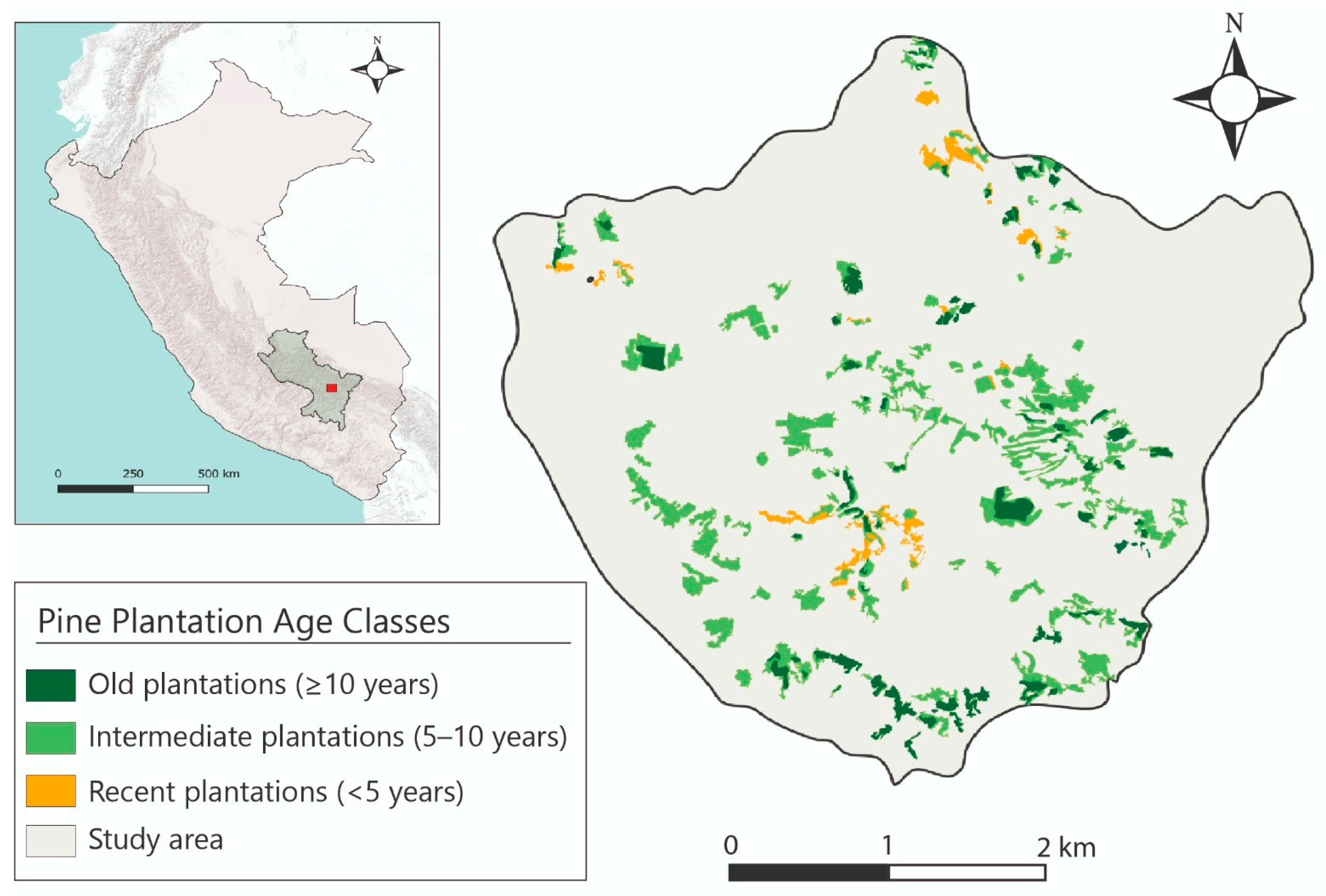
The total forested area reaches 166.42 ha, distributed across mature plantations (≥10 years; 37.44 ha), intermediate plantations (5–10 years; 113.01 ha), and recent plantations (<5 years; 15.97 ha) (Figure 6). This age structure is relevant because Suillus luteus productivity depends on the establishment of ectomycorrhizal associations with species of the genus Pinus and varies according to the plantation development stage.
With an average yield of 821 kg fresh weight/ha/year, intermediate plantations provide the largest contribution to mushroom production and approximately generate 92,781 kg fresh weight/year. Mature plantations reach an average yield of 736 kg fresh weight/ha/year, which is 27,571 kg fresh weight/year. For their part, recent plantations show lower productivity, with 262 kg fresh weight/ha/year and approximately 4189 kg fresh weight/year. Overall, the subsystem produces an estimated 124,541 kg fresh mushrooms/year.
Using a fresh-to-dry conversion ratio of 10:1, this production roughly represents 12,454 kg dry mushrooms/year. Considering an average price of 10 PEN/kg dry weight, which is equivalent to around USD 2.96/kg dry weight, the potential economic flow associated with mushroom production reaches approximately 124,541 PEN/year, or around USD 36,849/year. This value should be interpreted as a potential gross monetary flow generated by the subsystem rather than as net income or evidence of an equal distribution of economic benefits among households.
Beyond its monetary contribution, this subsystem is also an important component of local labor organization. Pine plantation management requires approximately 17,363 h/year, while mushroom production activities account for approximately 17,141 h/year. Together, these figures indicate that the pine–mushroom subsystem is not only a land-based economic diversification strategy but also a labor-intensive component of the local socio-ecological metabolism.
However, the same territorial fund that enables these economic and labor flows may also involve potential biophysical trade-offs. To explore whether this transformation is associated with changes in soil hydrology, volumetric soil water content (SWC) was monitored at one pine plantation point and one adjacent native grassland point under comparable topographic and soil conditions (Section 3.2). The results suggest lower soil water content at depth in the monitored pine site compared with the monitored grassland site. Because monitoring was based on a single point per cover type, this comparison is strictly indicative rather than conclusive. In other words, it is not used to support any quantitative hydrological claim, and the observed difference could also reflect unobserved micro-topographic, soil texture, or subsurface flow heterogeneity rather than a systematic plantation effect. The full depth–time profiles are therefore reported only in the Supplementary Materials (Figure S1), and the methodological limitations of this comparison are discussed in Section 5.4.

4.5. Labor Availability Sensitivity Analysis

The MuSIASEM accounting quantified a local labor requirement of 82,852 h·year−1, equivalent to 36 FTE under the statutory schedule (2304 h·person−1·year−1) and 46 FTE under the severe schedule (1800 h·person−1·year−1). Across the full factorial of working age share and participation equivalence, the aggregate annual labor balance is positive throughout the upper-bound participation range (π = 0.60–0.90) under both supply schedules. The only labor-constrained case arises in the joint worst-case corner (ω = 0.55, π = 0.45) combined with the severe supply schedule, where supply falls about 8% below demand (RL = 0.92); under the statutory schedule this same corner remains positive (RL = 1.18). This corner defines the breakpoint region rather than demonstrating general labor availability (Table S2).
Demand-side margins are correspondingly wide in the central and favorable scenarios (from about +132% to +221% under the statutory schedule and +81% to +151% under the severe schedule) but narrow in the depressed corner (+18% under the statutory schedule, −8% under the severe schedule). The critical labor availability share is Scritical ≈ 21% under the statutory schedule and ≈27% under the severe schedule (Table S3). Given that peasant labor is seasonally concentrated and empirical peak concentration was not measured, the seasonal thresholds (κmax) reported in Table S4 are conditional and do not establish that peak-period bottlenecks are absent.
The screening test indicates that labor is unlikely to be the binding constraint at the aggregate community scale across most plausible supply conditions. That said, it explicitly identifies the joint depressed-participation, low-supply corner as the region where this conclusion no longer holds. This remains an aggregate annual capacity check and does not establish realized labor availability at the household level or during peak agricultural periods. Framed this way, the screening test retains diagnostic value precisely because a positive aggregate balance does not assert a labor surplus but rather redirects the diagnosis. Indeed, it rules out total labor volume as the binding constraint at the community scale and thereby locates the relevant planning questions in the temporal and distributional dimensions—seasonal peak concentration, captured conditionally by κmax, and intra-community allocation—rather than in the aggregate size of the labor fund.

5. Discussion

5.1. Metabolic Organization and Redistribution of Pressures

The application of MuSIASEM allows Patapallpa Alta to be interpreted as an integrated metabolic configuration in which household food demand, provisioning flows, and biophysical and social funds are functionally interconnected. This approach avoids examining agriculture, livestock activities, the pine–mushroom subsystem, and external flows as independent components, and enables the assessment of how they interact within the same socio-ecological organization. From this perspective, Patapallpa Alta can be understood as a hybrid metabolic configuration. Local production supports a substantial share of basic food demand—particularly cereals, roots, and tubers—whereas other food and productive requirements are complemented through external flows. This combination indicates that the system does not rely exclusively on local production but on the interaction between internal resources and external connections. This functional integration is consistent with previous MuSIASEM applications to rural and territorial systems, including analyses of Andean society–agriculture–forest configurations [39,40,72]. In the present case, it evidences how productive diversification redistributes sustainability pressures across local land, labor, and water requirements and external embodied flows—an interdependence that sector-by-sector accounts leave implicit.

5.2. Viability, Feasibility, and Desirability of the Socio-Ecological Configuration

Interpreting these results through the MuSIASEM diagnostic triad—viability, feasibility, and desirability [24,25]—allows the socio-ecological configuration to be assessed through complementary dimensions.
(a)
From a feasibility standpoint, what is most relevant here is not the degree of external dependence itself, but its asymmetric nature and the function of each flow within the food basket. In Patapallpa Alta, dependence on external flows should not necessarily be interpreted as a weakness, but may also be understood as a form of metabolic complementarity in response to high-Andean agroecological constraints [34]. Meeting household food demand depends not only on the community’s internal biophysical funds but also on flows mobilized in other territories—particularly green water—embodied in imported products, suggesting a form of metabolic interdependence across territories [36]. The results show a markedly uneven pattern: whereas land—214 ha local versus 51 ha embodied in imports—and blue water remain largely within the communal boundary, approximately 93% of green water—270 × 103 of 289 × 103 m3, excluding the pine plantation—is embodied in imported products. This suggests that part of the rainfall-dependent ecological support underpinning local consumption is tied to conditions located beyond the communal boundary. The relevance of this dependence, moreover, does not rest on the imported volume alone, but also on the metabolic function of each flow. In contrast to the strong local anchoring of cereals, roots, and tubers—81% in volumetric terms—and mushrooms—100%—only 12% of vegetables, fruits, and legumes is locally sourced. This group is relevant to dietary diversity and micronutrient supply, while also showing limited local substitutability under current high-Andean conditions. Thus, potential vulnerability appears to stem less from external dependence in general than from the combination of external dependence, dietary importance, and limited local substitutability. MuSIASEM helps to make this distinction analytically visible: feasibility can be interpreted not as territorial self-sufficiency, but as a property of a hybrid configuration whose degree of criticality depends on what is imported, what function it serves, and how locally substitutable it is.
(b)
From a viability standpoint, the key issue is not the aggregate size of the human activity fund, but the precise scope of what the analysis can support. In aggregate terms, labor requirements—82,852 h·year−1, equivalent to 36–46 FTE depending on the schedule considered—remain within the available fund across almost the entire evaluated range. The only constrained case appears under the most unfavorable combination of low effective participation and the most severe schedule (RL = 0.92). This suggests that, at the aggregate community scale, the total volume of labor does not emerge as the main constraint. This result, however, is necessary but not sufficient. Rural productive labor is not homogeneous across the year: an hour required during harvest cannot be fully offset by an hour available in a slack period [73]. Since the community combines multiple productive activities requiring time allocation within specific windows, a positive annual balance does not guarantee effective labor availability during seasonal peaks. The estimated peak-concentration thresholds (κmax) are conditional because empirical seasonal labor concentration was not directly measured, and therefore they do not rule out temporal bottlenecks. Nor does the aggregate balance show how labor is distributed among households with different demographic compositions. Thus, the contribution of MuSIASEM is not to assert labor viability, but to delimit the diagnosis. By showing that aggregate labor volume does not appear to be the main constraint, the analysis shifts the viability question from how much labor is available to when it is needed and how it is distributed. Viability therefore emerges not as a simple condition of sufficiency, but as a property of the temporal and social structure of the human activity fund.
(c)
From a desirability standpoint, the key issue is not the positive valuation of the pine–mushroom subsystem alone, but the coexistence of economic appreciation and environmental concern. At the community level, 84% of households rated its overall benefits as high or very high and 89% identified income generation as a benefit. However, only 18% associated plantations with soil and water conservation, while 49% perceived competition for water and 38% reported biodiversity reduction. Since these indicators refer to different valuation dimensions, they should not be read as contradictions within individual households, but they do show that economic desirability coexists with environmental concerns at the community scale. This pattern is consistent with multi-stakeholder evidence from the Peruvian Andes, where pine and other exotic plantations are perceived as competing for water [5]. MuSIASEM helps to situate this coexistence within the fund–flow framework: concerns over water and biodiversity are tied to ecological functions of grassland that may be altered by its conversion into plantation. Desirability is therefore not interpreted as a simple aggregate preference, but as a multidimensional judgment in which the economic appeal of a strategy may coexist with perceived pressures on ecological functions recognized as relevant by the community.

5.3. The Pine–Mushroom Subsystem as a Transformation of the Territorial Fund

Pine plantations do not merely represent forest cover or an isolated productive activity but rather a transformation of the land fund. While the activity contributes to economic diversification in a high-Andean context where income alternatives are limited, the conversion of grasslands into forest plantations may modify functions associated with the original territorial fund, particularly those related to hydrological regulation and ecosystem functioning [4,6,7,74].
The soil moisture evidence should be interpreted as an indication of potential interactions between land-cover change and ecological functioning, rather than as a definitive assessment of the environmental impacts of forest plantations. From this perspective, the contribution of the analysis is not to classify pine plantations as inherently positive or negative but to show how an intervention aimed at increasing a specific flow—such as monetary income—may be associated with simultaneous changes in the ecological and social conditions sustaining the system. Such types of relationships are particularly relevant to decision-making processes. In this regard, MuSIASEM can be applied either as a diagnostic tool assessing the current state of a system, or as a simulation framework exploring potential outcomes under alternative scenarios (‘what if’ analyses).
Read together, the metabolic magnitudes do not merely describe separate accounting results but rather identify a structural mismatch between the territorial boundary of Patapallpa Alta and the broader metabolic boundary of the system reproducing it. The contrast between the internal land requirement (214 ha/year, 81%) and the virtual land embodied in imported products (51 ha/year, 19%), along with a volumetric self-sufficiency near 50% and a substantial share of green (rainfall-dependent) water embodied in external flows, shows that part of the ecological work sustaining local consumption is performed outside the community. This follows directly from the accounting boundary adopted here: when imported products embody land and water mobilized elsewhere, the metabolic boundary of the system that reproduces the community necessarily extends beyond its territorial boundary.
Interpreted through this mismatch, land-use intensification, environmental pressure externalization, and commodification of marginal grassland are not three labels attached to the results but rather three linked moments of a single metabolic reorganization. Intensification and externalization are two sides of the same movement where additional livelihood and income flows are obtained from limited high-Andean land—through the pine–mushroom subsystem and imported input livestock strategies—within a provisioning configuration in which externally supplied components of the food basket draw 51 ha of embodied land and a substantial share of green water from other territories. Externalization becomes visible within the same accounting boundary: a substantial part of the displaced component involves green water—the rainfall-dependent flow that grasslands help regulate—so that the community’s reproduction depends partly on ecological work relocated to other territories through imported products, rather than being performed entirely within its own boundary [42,75]. Commodification completes this structural reading: converting communal grassland, which is a fund valued for its hydrological and ecological functions [7,76], into a plantation fund that is primarily valued for the monetary flow it generates, reallocates an internal buffering function. In this scenario, external dependence becomes structurally more relevant [36].
The implication is that local resilience is partly externally constituted. The community’s apparent viability rests not only on its internal funds but also on externalized land and rainfall-dependent water flows. Here, the internal grassland fund that contributes to hydrological regulation is being partially transformed. The relevant trade-off is therefore not confined to income versus conservation within a fixed territory. It concerns the relocation of resilience-supporting functions across scales—from internal ecological buffering toward a more externally subsidized mode of reproduction. This is the specific contribution of the MuSIASEM reading to the peasant livelihoods literature: asset- and capital-based livelihood approaches identify diversification as a strengthening of household portfolios [9,10,11], but they do not follow the biophysical work displaced across levels to make that diversification viable. By tracking funds and flows simultaneously, this study shows that livelihood diversification may coexist with reduced internal buffering capacity and greater dependence on external ecological support, so that apparent improvements in local livelihood resilience rely partly on ecological work performed elsewhere and may compromise the future buffering role of the internal hydrological fund if grassland conversion continues.

5.4. Methodological Scope and Limitations

The main contribution of this study is methodological and integrative. The analysis demonstrates how MuSIASEM can organize heterogeneous information—including household surveys, land-cover classification, production coefficients, nutritional information, water requirements, labor estimates, and environmental monitoring—within a coherent framework to represent rural metabolism. This integrative capacity is particularly relevant in high-Andean contexts, where available information is often fragmented and incomplete.
Accordingly, the analysis combines primary data, secondary sources, methodological assumptions, and proxy coefficients. However, the results should be understood as a systemic representation aimed at identifying patterns, functional relationships, and socio-ecological trade-offs, rather than as an exhaustive or precise quantification of all processes within the system. Also, the approach represents the system in static terms, without capturing temporal dynamics such as changes in productivity, prices, or environmental conditions.
Four additional considerations should be noted. Firstly, the analysis was conducted at an aggregated community scale and does therefore not fully capture household-level differences in land access, labor availability, or distribution of benefits derived from the pine–mushroom subsystem. Secondly, the requirements associated with external flows represent embodied pressures rather than direct measurements of environmental impacts occurring in other territories. Thirdly, environmental pressures were estimated without partitioning the biophysical burden between primary products and by-products. Because crop and feed production are represented as mutually exclusive compartments, this avoids double-counting, but it attributes any residue-based ecological subsidy to the primary crop product and therefore provides a conservative upper bound on the pressure assigned to human food. Fourthly, soil moisture monitoring requires greater spatial and temporal replication before robust hydrological conclusions can be established at the landscape scale.
Despite such limitations, the case of Patapallpa Alta shows that rural development strategies should not only be evaluated according to the new benefits they generate but also according to how they interact with the ecological and social resources required to sustain them over time. However, its potential could be significantly expanded through integration with qualitative tools aimed at incorporating cultural dimensions.

6. Conclusions

Representing Patapallpa Alta through the funds–flows logic of MuSIASEM transforms a set of sectoral observations into an integrated diagnosis of how the community sustains itself. The analysis shows that the community operates as a hybrid metabolic system where local production secures the bulk of staple food requirements, whereas the components that diversify the diet depend largely on external supply chains. Self-sufficiency is therefore not a uniform property of the system but a function-specific outcome that the integrated accounting evidences.
The same accounting reveals that the funds and flows sustaining consumption are not spatially aligned. Land and labor remain predominantly internal, while a large share of the ecological processes embodied in food—particularly rainfall-dependent water—is displaced to other territories through imported flows. Sustainability at the local scale is thus achieved partly by externalizing environmental pressure rather than by resolving it, with animal production acting as the main bridge between internal and external demands. The pine–mushroom subsystem illustrates how a strategy aimed at increasing a single flow—i.e., monetary income—reorganizes the funds on which the system depends. By converting grassland into forest plantation, it redefines a territorial fund valued for its ecological and hydrological regulation into one valued for the income it generates. Here, single-point soil water monitoring provides only indicative evidence of possible changes in deep soil moisture, which motivates—rather than demonstrates—concern for the hydrological function of the converted fund. The subsystem should therefore be judged not by its economic contribution alone, but also by its potential effect on the territorial and hydrological functions it reorganizes.
Finally, except under a joint worst-case corner of demographic and labor supply assumptions, the labor fund does not appear to be the binding constraint at the community scale, and aggregate viability does not rule out tensions in the distribution of work among households. As this case illustrates, rural development strategies should be evaluated not only by the flows they generate but by their compatibility with the funds—land, water, labor, and ecological regulation—required to sustain them over time. By highlighting these interdependencies across levels, MuSIASEM offers a transferable diagnostic approach, which is illustrated here through a single high-Andean community, for more integrated, less sectorally fragmented sustainability assessments, rather than a generalizable prescription for high-Andean territories as a whole.

Supplementary Materials

The following supporting information can be downloaded at: https://www.mdpi.com/article/10.3390/land15071318/s1. This article is accompanied by an Excel and Word file containing the model structure and the data used herein.

Author Contributions

Conceptualization: J.J.C.-B.; Methodology: J.J.C.-B.; Research: P.M.L.S., A.Q., J.M., H.B.C.H., R.R.V.-T. and M.A.P.-H.; Drafting—Original draft preparation: J.J.C.-B.; Drafting—Review and editing: R.T. and M.E.H.-R.; Funding acquisition: R.T. All authors have read and agreed to the published version of the manuscript.

Funding

This work was funded by CONCYTEC through the PROCIENCIA Program under the “Proyectos de Investigación Aplicada 2023-02” framework, according to contract PE501082995-2023—PROCIENCIA.

Institutional Review Board Statement

The study was approved by the Ethics Committee of the Universidad Científica del Sur (Certificate of Approval No. 583-CIEI-CIENTÍFICA-2024).

Informed Consent Statement

Informed consent was obtained from all subjects involved in the study.

Data Availability Statement

The data used to develop the model and support the findings of this study are provided in the Supplementary Materials. Additional data or methodological information can be requested from the corresponding author.

Acknowledgments

For the preparation of this manuscript, the authors used ChatGPT (OpenAI, GPT-5.5) to assist with grammatical revision and stylistic refinement of the text. The authors have reviewed and edited the output, and take full responsibility for the content of this publication.

Conflicts of Interest

The authors declare no conflicts of interest.

References

  1. de Valença, A.W.; Vanek, S.J.; Meza, K.; Ccanto, R.; Olivera, E.; Scurrah, M.; Lantinga, E.A.; Fonte, S.J. Land Use as a Driver of Soil Fertility and Biodiversity across an Agricultural Landscape in the Central Peruvian Andes. Ecol. Appl. 2017, 27, 1138–1154. [Google Scholar] [CrossRef] [Scilit] [PubMed]
  2. Pouliot, M.; Rasmussen, M.B. Re-Imagining Land: Conceptualizing the Changing Form and Content of the Andean Peasant Community in Peru. Geoforum 2023, 146, 103859. [Google Scholar] [CrossRef] [Scilit]
  3. Braun, A.C. Encroached by Pine and Eucalyptus? A Grounded Theory on an Environmental Conflict between Forest Industry and Smallholder Livelihoods in Chile. J. Rural Stud. 2021, 82, 107–120. [Google Scholar] [CrossRef] [Scilit]
  4. Milkovic, M.; Paruelo, J.M.; Nosetto, M.D. Hydrological Impacts of Afforestation in the Semiarid Patagonia: A Modelling Approach. Ecohydrology 2019, 12, e2113. [Google Scholar] [CrossRef] [Scilit]
  5. Christmann, T.; Cjuno-Turpo, I.; López-Aranda, M.; Wilson, S.J.; Cuni-Sanchez, A.; Malhi, Y.; Ramirez, A.; Rondán, V.; Medina Castro, F.; Mamani, M.; et al. Sowing and Harvesting Water: Revisiting Forest Restoration in the Peruvian Andes Through a Multi-Stakeholder Analysis. People Nat. 2025, 7, 631–652. [Google Scholar] [CrossRef] [Scilit]
  6. Farley, K.A.; Kelly, E.F.; Hofstede, R.G.M. Soil Organic Carbon and Water Retention after Conversion of Grasslands to Pine Plantations in the Ecuadorian Andes. Ecosystems 2004, 7, 729–739. [Google Scholar] [CrossRef] [Scilit]
  7. Buytaert, W.; Iñiguez, V.; Bièvre, B. De The Effects of Afforestation and Cultivation on Water Yield in the Andean Páramo. For. Ecol. Manag. 2007, 251, 22–30. [Google Scholar] [CrossRef] [Scilit]
  8. Tito, R.; Salinas, N.; Cosio, E.G.; Boza Espinoza, T.E.; Muñiz, J.G.; Aragón, S.; Nina, A.; Roman-Cuesta, R.M. Secondary Forests in Peru: Differential Provision of Ecosystem Services Compared to Other Post-Deforestation Forest Transitions. Ecol. Soc. 2022, 27, 12. [Google Scholar] [CrossRef] [Scilit]
  9. Chambers, R.; Conway, G.R. Sustainable Rural Livelihoods: Practical Concepts for the 21st Century; IDEAS Working Paper Series from RePEc; Institute of Development Studies (IDS): Brighton, UK, 1991. [Google Scholar]
  10. Zhao, X.; Su, H. Paradigm Shifts and Frontier Issues in Contemporary Sustainable Livelihoods Research: A Geographical Perspective. Appl. Geogr. 2026, 191, 104007. [Google Scholar] [CrossRef] [Scilit]
  11. Ying, B.; Xiang, C.; Ke, L. A Review of Livelihood Resilience and Its Insights for the Livelihood Research of Rural Residents in Karst Mountainous Areas. Ecol. Front. 2025, 46, 1009–1018. [Google Scholar] [CrossRef] [Scilit]
  12. Millennium Ecosystem Assessment. Ecosystems and Human Well-Being: Synthesis; Millennium Ecosystem Assessment: Washington, DC, USA, 2005. [Google Scholar]
  13. Haines-Young, R.; Potschin, M. The Links between Biodiversity, Ecosystem Service and Human Well-Being. In Ecosystem Ecology: A New Synthesis; Raffaelli, D.G., Frid, C.L.J., Eds.; Cambridge University Press: Cambridge, UK, 2010; pp. 110–139. [Google Scholar]
  14. Gómez-Baggethun, E.; de Groot, R.; Lomas, P.L.; Montes, C. The History of Ecosystem Services in Economic Theory and Practice: From Early Notions to Markets and Payment Schemes. Ecol. Econ. 2010, 69, 1209–1218. [Google Scholar] [CrossRef] [Scilit]
  15. Ostrom, E. A General Framework for Analyzing Sustainability of Social-Ecological Systems. Science 2009, 325, 419–422. [Google Scholar] [CrossRef] [Scilit] [PubMed]
  16. Binder, C.R.; Hinkel, J.; Bots, P.W.G.; Pahl-Wostl, C. Comparison of Frameworks for Analyzing Social-Ecological Systems. Ecol. Soc. 2013, 18, 26–49. [Google Scholar] [CrossRef] [Scilit]
  17. Haberl, H.; Fischer-Kowalski, M.; Krausmann, F.; Winiwarter, V. Social Ecology: Society-Nature Relations Across Time and Space; Human-Environment Interactions; Springer Nature: Cham, Switzerland, 2016; Volume 5, ISBN 3319333267. [Google Scholar]
  18. Fischer-Kowalski, M.; Haberl, H. (Eds.) Socioecological Transitions and Global Change: Trajectories of Social Metabolism and Land Use; Advances in Ecological Economics; Edward Elgar: Cheltenham, UK, 2007; ISBN 184720340X. [Google Scholar]
  19. Gerber, J.-F.; Scheidel, A. In Search of Substantive Economics: Comparing Today’s Two Major Socio-Metabolic Approaches to the Economy—MEFA and MuSIASEM. Ecol. Econ. 2018, 144, 186–194. [Google Scholar] [CrossRef] [Scilit]
  20. Wackernagel, M.; Schulz, N.B.; Deumling, D.; Linares, A.C.; Jenkins, M.; Kapos, V.; Monfreda, C.; Loh, J.; Myers, N.; Norgaard, R.; et al. Tracking the Ecological Overshoot of the Human Economy. Proc. Natl. Acad. Sci. USA 2002, 99, 9266–9271. [Google Scholar] [CrossRef] [Scilit] [PubMed]
  21. Wackernagel, M. Our Ecological Footprint: Reducing Human Impact on the Earth; Rees, W.E., Ed.; New Catalyst Bioregional Series, No. 9; New Society Publishers: Gabriola Island, BC, Canada, 1996; ISBN 0865713111. [Google Scholar]
  22. Hoekstra, A.Y. The Water Footprint Assessment Manual: Setting the Global Standard, 1st ed.; Hoekstra, A.Y., Ed.; Earthscan: London, UK, 2011; ISBN 1-136-53851-8. [Google Scholar]
  23. Hoekstra, A.Y.; Chapagain, A.K. Water Footprints of Nations: Water Use by People as a Function of Their Consumption Pattern. Water Resour. Manag. 2007, 21, 35–48. [Google Scholar] [CrossRef] [Scilit]
  24. Giampietro, M.; Mayumi, K.; Sorman, A.H. The Metabolic Pattern of Societies: Where Economists Fall Short; Routledge Studies in Ecological Economics; Routledge: London, UK, 2012; ISBN 9780415589536. [Google Scholar]
  25. Giampietro, M. Resource Accounting for Sustainability Assessment: The Nexus between Energy, Food, Water and Land Use; Giampietro, M., Ed.; Routledge Explorations in Sustainability and Governance; Routledge, Taylor & Group: London, UK, 2015; ISBN 9781138646957. [Google Scholar]
  26. Georgescu-Roegen, N. The Entropy Law and the Economic Process; Harvard University Press: Cambridge, MA, USA, 1971; ISBN 0674257812. [Google Scholar]
  27. Arango, M.; de Gana, O. Una Felicidad Que Se Contagia. Breve Reporte de Seguimiento a Los Proyectos Financiados Por Leren van Elkaar Entre 2007 y 2018. 2019. Available online: https://pachamamaraymi.org/docs/a-happiness-that-is-contagious.pdf (accessed on 9 July 2026).
  28. Pachamama Raymi. Informe Anual 2012; Pachamama Raymi: Cusco, Peru, 2012; Available online: https://pachamamaraymi.org/docs/pmr-informe-anual-2012-1.pdf (accessed on 9 July 2026).
  29. AgroPeru Informa Cusco: Impulsan La Recuperación de Ecosistemas y La Mejora En La Crianza de Alpacas En Ocongate. Available online: https://www.agroperu.pe/cusco-impulsan-la-recuperacion-de-ecosistemas-y-la-mejora-en-la-crianza-de-alpacas-en-ocongate/#:~:text=Cumpliendo%20con%20los%20objetivos%20de%20repoblar%20los,otros%2C%20para%20reverdecer%20las%20cumbres%20de%20Ocongate (accessed on 18 April 2026).
  30. Folke, C. Resilience: The Emergence of a Perspective for Social–Ecological Systems Analyses. Glob. Environ. Change 2006, 16, 253–267. [Google Scholar] [CrossRef] [Scilit]
  31. Verburg, P.H.; Crossman, N.; Ellis, E.C.; Heinimann, A.; Hostert, P.; Mertz, O.; Nagendra, H.; Sikor, T.; Erb, K.H.; Golubiewski, N.; et al. Land System Science and Sustainable Development of the Earth System: A Global Land Project Perspective. Anthropocene 2015, 12, 29–41. [Google Scholar] [CrossRef] [Scilit]
  32. Meyfroidt, P.; Roy Chowdhury, R.; de Bremond, A.; Ellis, E.C.; Erb, K.H.; Filatova, T.; Garrett, R.D.; Grove, J.M.; Heinimann, A.; Kuemmerle, T.; et al. Middle-Range Theories of Land System Change. Glob. Environ. Change 2018, 53, 52–67. [Google Scholar] [CrossRef] [Scilit]
  33. Carilla, J.; Grau, R.; Acosta, O.O.; Malizia, A.; Ceballos, S.; Llambı, L.D.; Piquer-Rodrıguez, M.; Zarba, L.; Flores, S.; Cuesta, F.; et al. ROSA: An Andean Network of Social–Ecological Observatories. Mt. Res. Dev. 2024, 44, A1–A10. [Google Scholar] [CrossRef] [Scilit]
  34. Caulfield, M.E.; Hammond, J.; Fonte, S.J.; Florido, M.A.; Fuentes, W.; Meza, K.; Navarette, I.; Vanek, S.J.; van Wijk, M. Unpicking the Inter-Relationships Between Off-Farm Livelihood Diversification, Household Characteristics, and Farm Management in the Rural Andes. Front. Sustain. Food Syst. 2021, 5, 724492. [Google Scholar] [CrossRef] [Scilit]
  35. Sarapura-Escobar, S.; Hoddy, E.T. Safeguarding the Land to Secure Food in the Highlands of Peru: The Case of Andean Peasant Producers. Front. Sustain. Food Syst. 2022, 6, 787600. [Google Scholar] [CrossRef] [Scilit]
  36. Liu, J.; Hull, V.; Batistella, M.; deFries, R.; Dietz, T.; Fu, F.; Hertel, T.W.; Cesar Izaurralde, R.; Lambin, E.F.; Li, S.; et al. Framing Sustainability in a Telecoupled World. Ecol. Soc. 2013, 18, 26–44. [Google Scholar] [CrossRef] [Scilit]
  37. Giampietro, M.; Mayumi, K.; Bukkens, S.G.F. Multiple-Scale Integrated Assessment of Societal Metabolism: An Analytical Tool to Study Development and Sustainability. Environ. Dev. Sustain. 2001, 3, 275–307. [Google Scholar] [CrossRef] [Scilit]
  38. Giampietro, M.; Bukkens, S.G.F. Analogy between Sudoku and the Multi-Scale Integrated Analysis of Societal Metabolism. Ecol. Inform. 2015, 26, 18–28. [Google Scholar] [CrossRef] [Scilit]
  39. Serrano-Tovar, T.; Giampietro, M. Multi-Scale Integrated Analysis of Rural Laos: Studying Metabolic Patterns of Land Uses across Different Levels and Scales. Land Use Policy 2014, 36, 155–170. [Google Scholar] [CrossRef] [Scilit]
  40. Lomas, P.L.; Giampietro, M. Environmental Accounting for Ecosystem Conservation: Linking Societal and Ecosystem Metabolisms. Ecol. Model. 2017, 346, 10–19. [Google Scholar] [CrossRef] [Scilit]
  41. Gibson, C.C.; Ostrom, E.; Ahn, T.K. The Concept of Scale and the Human Dimensions of Global Change: A Survey. Ecol. Econ. 2000, 32, 217–239. [Google Scholar] [CrossRef] [Scilit]
  42. Mekonnen, M.M.; Hoekstra, A.Y. The Green, Blue and Grey Water Footprint of Crops and Derived Crop Products. Volume 1: Main Report; Value of Water Research Report Series No. 47; UNESCO-IHE Institute for Water Education: Delft, The Netherlands, 2010. [Google Scholar]
  43. Mekonnen, M.M.; Hoekstra, A.Y. The Green, Blue and Grey Water Footprint of Farm Animals and Animal Products. Volume 1: Main Report; Value of Water Research Report Series No. 48; UNESCO-IHE Institute for Water Education: Delft, The Netherlands, 2010. [Google Scholar]
  44. Richards, J.A. Remote Sensing Digital Image Analysis: An Introduction, 4th ed.; Jia, X., Ed.; Springer: Berlin/Heidelberg, Germany, 2006; ISBN 3-540-29711-1. [Google Scholar]
  45. Jensen, J.R. Introductory Digital Image Processing: A Remote Sensing Perspective, 4th ed.; Pearson Education: Glenview, IL, USA, 2016; ISBN 9780134058160. [Google Scholar]
  46. INEI Encuesta Nacional de Hogares ENAHO. Available online: https://proyectos.inei.gob.pe/microdatos/ (accessed on 2 April 2026).
  47. Reyes García, M.; Gómez-Sánchez Prieto, I.; Espinoza Barrientos, C. Tablas Peruanas de Composición de Alimentos; Instituto Nacional de Salud: Lima, Peru, 2017. [Google Scholar]
  48. Dehyfoods. Product Specification & Technical Data: Dehydrated Slippery Jack Mushroom/Suillus Luteus; Dehyfoods: Meiningen, Germany, 2023; Available online: https://dehyfoods.com/images/PDF/TechSpec_Suillus_luteus_all_2_3.pdf (accessed on 9 July 2026).
  49. MacLean, W.C.; Warwick, P. Food Energy: Methods of Analysis and Conversion Factors: Report of a Technical Workshop, Rome, 3–6 December 2002; FAO Food and Nutrition Paper, 77; Food and Agriculture Organization of the United Nations: Rome, Italy, 2003; ISBN 9251050147. [Google Scholar]
  50. Escalante Valencia, N. Producción Del Hongo Silvestre Comestible y Su Aporte Socioeconómico En Las Familias Del Distrito de Ccatcca, Provincia de Quispicanchi—Cusco. Master’s Thesis, Universidad Nacional de San Antonio Abad del Cusco, Cusco, Peru, 2024. [Google Scholar]
  51. FAO. Technical Conversion Factors for Agricultural Commodities; FAO: Rome, Italy, 2023. [Google Scholar]
  52. MIDAGRI Perfil Productivo Regional. Available online: https://app.powerbi.com/view?r=eyJrIjoiN2U3NTdkYTktOTk5Ny00NjQ5LTg0ZjEtMmIzYzlmZWIwMDhlIiwidCI6IjdmMDg0NjI3LTdmNDAtNDg3OS04OTE3LTk0Yjg2ZmQzNWYzZiJ9 (accessed on 4 April 2026).
  53. FAO FAOSTAT Datos Sobre Alimentación y Agricultura. Available online: https://www.fao.org/faostat/es/#home (accessed on 4 April 2026).
  54. Pimentel, D. Food, Energy, and Society, 3rd ed.; Pimentel, M., Ed.; CRC Press: Boca Raton, FL, USA, 2008; ISBN 9781420046670. [Google Scholar]
  55. Florez Sihua, E., Ed.; Personal communication, 2020.
  56. Mekonnen, M.M.; Hoekstra, A.Y. The Green, Blue and Grey Water Footprint of Farm Animals and Animal Products. Volume 2: Appendices; Value of Water Research Report Series No. 48; UNESCO-IHE Institute for Water Education: Delft, The Netherlands, 2010. [Google Scholar]
  57. Mekonnen, M.M.; Hoekstra, A.Y. The Green, Blue and Grey Water Footprint of Crops and Derived Crop Products. Volume 2: Appendices; Value of Water Research Report Series No. 47; UNESCO-IHE Institute for Water Education: Delft, the Netherlands, 2010. [Google Scholar]
  58. Celis, P.W.; Mathios, F.M.; Cáceres, C.J.; Aguilar, V.J. Rendimiento Productivo de Pollos Parrilleros Alimentados Con Harina de Yuca (Manihot esculenta) Como Reemplazo Del Maíz. Rev. Investig. Vet. Perú 2019, 30, 676–681. [Google Scholar] [CrossRef] [Scilit]
  59. Alvarado Rodríguez, R.; Chavez Alva, L. Manejo de Maíz Amarillo Duro (Híbridos); Folleto No. 10-09; Ministerio de Agricultura y Riego (MINAGRI): Lima, Peru, 2009. [Google Scholar]
  60. MEF Resolución Ministerial No. 541-2006-EF-15. Establecen Disposiciones Para la Comercialización de Torta de Soya en el Marco del Convenio Para la Venta de Productos Agrícolas Derivado de la Operación de Endeudamiento Externo Aprobada Mediante D.S. No. 146-2006-EF; Ministerio de Economía y Finanzas: Lima, Peru, 2006. [Google Scholar]
  61. Zambrano Rodríguez, R.V. Rendimiento Productivo de Gallinas Ponedoras Alimentadas Con Harina de Yuca (Manihot Esculenta) y Manano Oligosacárido. Master’s Thesis, Universidad Nacional Agraria La Molina, Lima, Perú, 2018. [Google Scholar]
  62. Bartl, K.; Gómez, C.A.; Nemecek, T. Life Cycle Assessment of Milk Produced in Two Smallholder Dairy Systems in the Highlands and the Coast of Peru. J. Clean. Prod. 2011, 19, 1494–1505. [Google Scholar] [CrossRef] [Scilit]
  63. Agrorural; MIDAGRI. Crianza de Ovinos; MIDAGRI: Lima, Peru, 2013. [Google Scholar]
  64. Mamani, R.; Condori, N.; Huacani, F.; Checalla, V. Parámetros Productivos Del Ovino Criollo. Manglar 2022, 19, 77–84. [Google Scholar] [CrossRef] [Scilit]
  65. Rojas Ccorimanya, E.A. Sistemas de Alimentación y la Respuesta Productiva en Cuyes Machos Mejorados Tipo 1 En El Distrito de Ocongate—Cusco. Bachelor’s Thesis, Universidad Nacional de San Antonio Abad del Cusco, Cusco, Peru, 2019. [Google Scholar]
  66. Herrera, H.; Niño, J.A.; Torrel, T.; Vargas-Rocha, L.A. Effect of Alfalfa, Concentrate and Ryegrass Diets on Guinea Pig Production Variables. RIA. Rev. Investig. Agropecu. 2024, 50, 155–160. [Google Scholar] [CrossRef] [Scilit]
  67. Alagón, G.; Tupayachi, G.; Villacorta, W.; Taco, C.; Jancco, M.; Zuniga, E.; López-Luján, M.d.C.; Ródenas, L.; Moya, V.J.; Martínez-Paredes, E.; et al. Nutritive Value of Some Concentrate Feedstuffs for Guinea Pigs (Cavia porcellus). Animals 2024, 14, 3142. [Google Scholar] [CrossRef] [Scilit] [PubMed]
  68. Morgan, M.G.; Henrion, M.; Small, M.J. Uncertainty: A Guide to Dealing with Uncertainty in Quantitative Risk and Policy Analysis; Cambridge University Press: Cambridge, UK, 1990; ISBN 0521365422. [Google Scholar]
  69. Congreso de la República del Perú. Constitución Política Del Perú. Artículo 25; Congreso de la República del Perú: Lima, Peru, 1993. [Google Scholar]
  70. EUROSTAT Glossary:Annual Work Unit (AWU). Available online: https://ec.europa.eu/eurostat/statistics-explained/index.php?title=Glossary:Annual_work_unit_(AWU) (accessed on 29 June 2026).
  71. MINSA; INS Requerimientos Nutricionales. Available online: https://alimentacionsaludable.ins.gob.pe/adultos/requerimientos-nutricionales (accessed on 2 April 2026).
  72. Cadillo-Benalcazar, J.J.; Silva-Macher, J.C.; Salinas, N. Applying the Multi-Scale Integrated Analysis of Societal and Ecosystem Metabolism (MuSIASEM) to Characterize the Society–Agriculture–Forest System: The Case of Huayopata, Cuzco (Peru). Environ. Dev. Sustain. 2024, 26, 29839–29862. [Google Scholar] [CrossRef] [Scilit] [PubMed]
  73. Sen, A.K. Peasants and Dualism with or without Surplus Labor. J. Political Econ. 1966, 74, 425–450. [Google Scholar] [CrossRef] [Scilit]
  74. Carrión-Paladines, V.; Benítez, Á.; García-Ruíz, R. Conversion of Andean Montane Forest to Exotic Forest Plantation Modifies Soil Physicochemical Properties in the Buffer Zone of Ecuador’s Podocarpus National Park. For. Ecosyst. 2022, 9, 100076. [Google Scholar] [CrossRef] [Scilit]
  75. Rhouma, A.; Seitfudem, G.; El Jeitany, J.; Pacetti, T.; Brouwer, F.; Gil, J.M. Connecting the Water Footprint with the Water-Energy-Food-Ecosystems Nexus Concept and Its Added Value in the Mediterranean. Environ. Sustain. Indic. 2025, 26, 100640. [Google Scholar] [CrossRef] [Scilit]
  76. Farley, K.A.; Jobbágy, E.G.; Jackson, R.B. Effects of Afforestation on Water Yield: A Global Synthesis with Implications for Policy. Glob. Change Biol. 2005, 11, 1565–1576. [Google Scholar] [CrossRef] [Scilit]
Figure 1. Multi-scale metabolic representation of the socio-ecological system of Patapallpa Alta (Cusco, Peru).
Land 15 01318 g001
Figure 2. Location, spatial delimitation, and land-cover classification of the Patapallpa Alta socio-ecological system, Cusco, Peru. The upper-left panel shows the location of the Ocongate District within Peru; the lower-left panel indicates the location of Patapallpa Alta within the district, highlighted by the red outline; and the right panel presents the study area boundary and its land-cover classification.
Land 15 01318 g002
Figure 3. Household metabolic demand in Patapallpa Alta (Cusco, Peru), expressed on a per capita daily basis. (a) Contribution of macronutrients—carbohydrates, fats, and proteins—to total dietary energy intake (% of 2420 kcal/person/day). (b) Relative contribution of food groups (% of each total) to dietary energy and to each macronutrient flow: energy (2420 kcal/person/day), protein (79 g/person/day), fat (50 g/person/day), and carbohydrates (468 g/person/day). Bars sum to 100%. Energy contributions were computed from food-specific Atwater factors [49]; Consequently, gram totals do not reconcile with energy using generic 4-4-9 factors.
Land 15 01318 g003
Figure 4. Self-sufficiency level by food group.
Land 15 01318 g004
Figure 5. Environmental pressure generated by local and imported production systems in the community of Patapallpa Alta (Cusco, Peru).
Land 15 01318 g005
Figure 6. Spatial distribution of pine plantations by age class in Patapallpa Alta, Cusco, Peru. Dark green denotes old plantations (≥10 years), light green denotes intermediate-age plantations (5–10 years), orange denotes recent plantations (<5 years), and light gray denotes the study area. In the inset map, the red square indicates the geographic location of Patapallpa Alta within the Cusco Region.
Land 15 01318 g006
Table 1. Multi-level MuSIASEM representation of funds, flows, and system boundaries in Patapallpa Alta (Cusco, Peru).
LevelComponentFundFlowBoundary
n + 1HouseholdPopulation, human activityPopulation-scaled metabolic demandInternal
Household memberskcal, protein, fat, carbohydratesInternal
nProvisioning systemInterfacePlant food flowsInternal
Meat, milk, eggsInternal
Mushroom biomassInternal
Imported biomass flowsExternal SES
n − 1Agricultural systemFood crops:
Agricultural land, agricultural labor
Crop biomass, green water, blue waterInternal
Feed production:
Cropland, grassland, feed-related labor
Feed biomass, green water, blue waterInternal
Animal productionAnimal population, laborAnimal productsInternal
Pine plantation systemPine landMushroom biomassInternal
Territorial support baseLand-use:
Agricultural area, grassland, forest, built-up area
Internal
External SESExternal productive systemsEmbodied agricultural land and associated fundsVirtual land, green water, blue waterExternal
Table 2. Data integration and main assumptions for MuSIASEM fund–flow accounting.
MuSIASEM ComponentFunds and Flows RepresentedMain OutputsMain Methodological AssumptionsSources
Household system (level n + 1)Fund: population.Population estimate.
  • Missing household-size data from three households were estimated using deterministic distribution-based imputation before scaling population demand.
  • Survey.
Household consumption system (level n + 1)Funds: population, households.
Flows: food and nutrients.
Food demand; calories; nutritional flows.
  • The 45 surveyed households represented the whole community. Missing household-size data were estimated.
  • The 2023–2024 rural Cusco diet was used as reference after local validation.
  • To estimate S. luteus consumption, values reported for a mushroom-producing community located in the same study province were used as a reference.
  • Survey.
  • Diet: [46]
  • Food composition: [47,48]
  • Food energy: Energy contributions from macronutrients were calculated using food-specific Atwater conversion factors rather than generalized 4-4-9 factors, following the food composition database used in this study. See [49]
  • Consumption of S. luteus: [50]
  • Validation: feedback from residents.
Food provisioning system (level n)Flows: local and imported food.Local supply; imports; primary food demand.
  • Local food was defined as production within community boundaries and imports as external production.
  • Processed foods were converted into primary equivalents.
  • Validation: feedback from residents.
  • Transformation coefficients: [51]
Territorial support systemFunds: agricultural areas, forests, plantations.Land-cover classes; plantation age.See Section 3.1.
Flows: land occupation and soil-water dynamics.Soil moisture profilesSoil-water monitoring (described below).
Agricultural production system (level n − 1)Funds: land and human activity.
Flows: crop biomass and water.
Agricultural land; labor; green and blue water demand
  • Food demand was converted into land, labor and water requirements.
  • Local yields were validated with local farmers.
  • For imported products of national origin, average Peruvian yields were used. For products sourced from abroad, yields from the main supplying country were applied. For example, for imported wheat, Canada’s yield was used because Canada is the main source of the wheat consumed in Peru.
  • One workday was assumed to equal 8 h.
  • No allocation procedure was applied among main products and by-products when estimating environmental pressures. Land, blue water, green water, and labor requirements were assigned to the complete production system associated with each provisioning flow, rather than being partitioned among individual outputs. This approach was adopted because the analysis aimed to represent the total biophysical requirements needed to sustain the metabolic functions of the socio-ecological system. This choice does not double-count residues across compartments: guinea-pig feed is accounted for solely as cultivated ryegrass–clover forage and imported concentrate (barley, alfalfa, maize), so the crop and livestock feed accounts are mutually exclusive and no crop by-product footprint is assigned twice.
  • Local yield: feedback from residents.
  • External yield: [52,53,54]
  • Labor: Agricultural production costs obtained from the Regional Directorate of Agriculture and Irrigation of Cusco [55] and adjusted based on feedback from local farmers.
  • Green and blue water: Because crop-specific water data were not available for Patapallpa Alta, water requirements for Cusco were used as a proxy [42,43,56,57].
Livestock production system (level n − 1)Funds: animal stocks, grazing land, infrastructure and labor.
Flows: animal products and feed biomass.
Animal stocks; feed demand; land; labor; water demand.
  • For further details on the models used, see the Supplementary Materials.
  • Animal demand was linked with herd structure, productivity, feed conversion and management coefficients.
  • High-Andean extensive systems were assumed for sheep and milk production.
  • Cheese and other processed dairy products were considered imported flows and expressed as milk-equivalent demand. To estimate their associated biophysical requirements, the same technical coefficients used for local milk production were applied as a proxy for calculating land, blue water, green water, and labor requirements.
  • Model to produce eggs and chicken meat: [42,43,51,52,53,56,57,58,59,60,61]
  • Model to produce milk: [42,43,51,56,57,62]
  • Model to produce mutton: [42,43,51,53,56,57,63,64]
  • Model to produce guinea pig: [42,43,56,57,65,66,67]
  • The following sources were also used for all models: Agricultural production costs obtained from the Regional Directorate of Agriculture and Irrigation of Cusco [55] and adjusted based on feedback from local farmers.
Disclaimer/Publisher’s Note: The statements, opinions and data contained in all publications are solely those of the individual author(s) and contributor(s) and not of MDPI and/or the editor(s). MDPI and/or the editor(s) disclaim responsibility for any injury to people or property resulting from any ideas, methods, instructions or products referred to in the content.