Co-Inoculation of Rhizobia and a Multifunctional Microbial Consortium Is Associated with Improved Soybean Performance and Bacterial Community Reassembly in Soybean Fields
Abstract
1. Introduction
2. Materials and Methods
2.1. Experimental Site and Materials
2.2. Experimental Design
2.2.1. Pot Experiment
2.2.2. Field Plot Experiment
2.3. Determination Methods
2.3.1. Soybean Agronomic Traits and Yield
2.3.2. Soil Physicochemical Properties
2.3.3. Soil Extracellular Enzyme Activities
2.3.4. Bacterial Community Analysis
2.4. Statistical Analysis
3. Results
3.1. Co-Inoculation Was Associated with Higher Soybean Performance
3.2. Short-Term Treatment-Associated Differences in Soil Physicochemical Properties
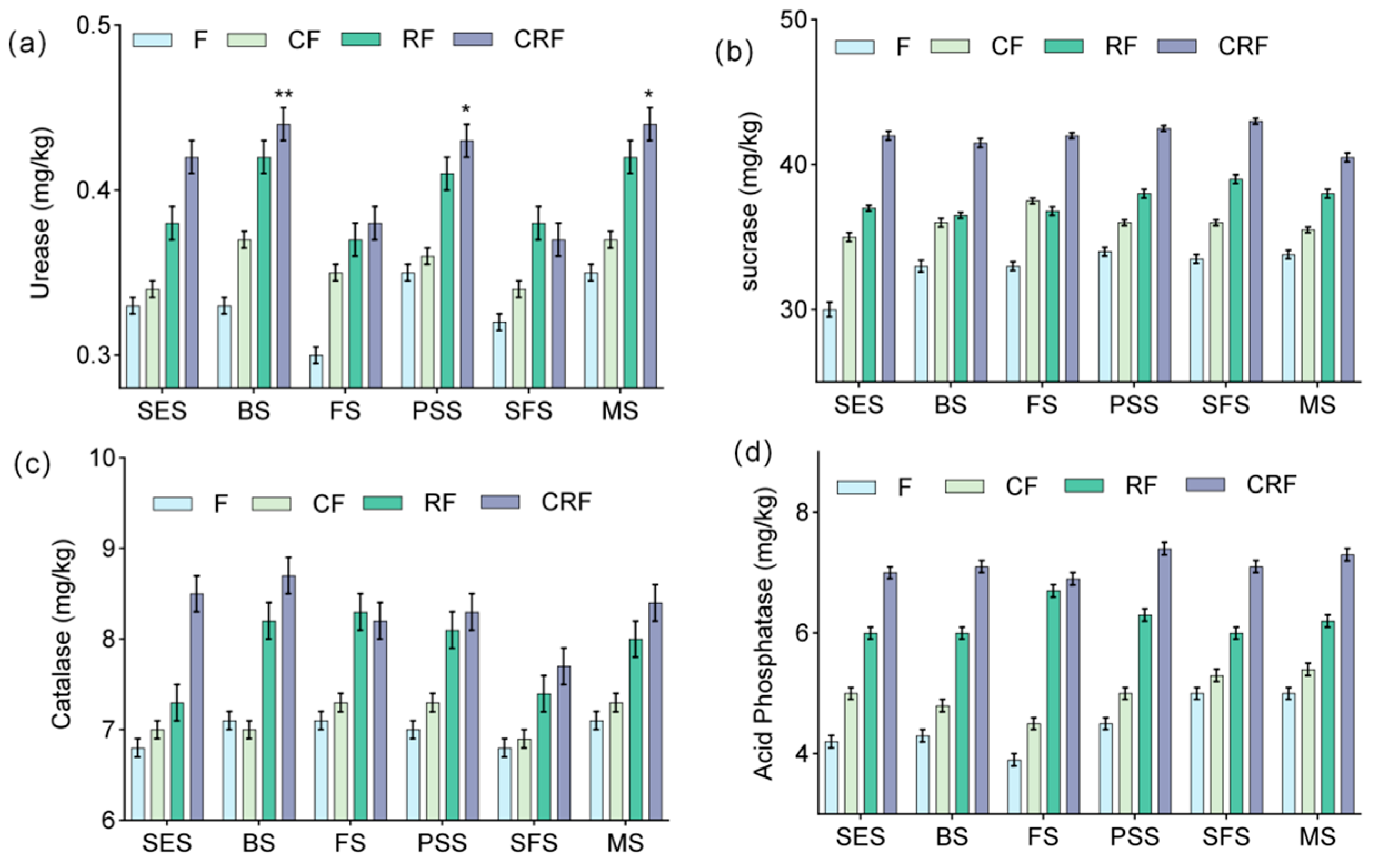
3.3. Effects on Soil Extracellular Enzyme Activities
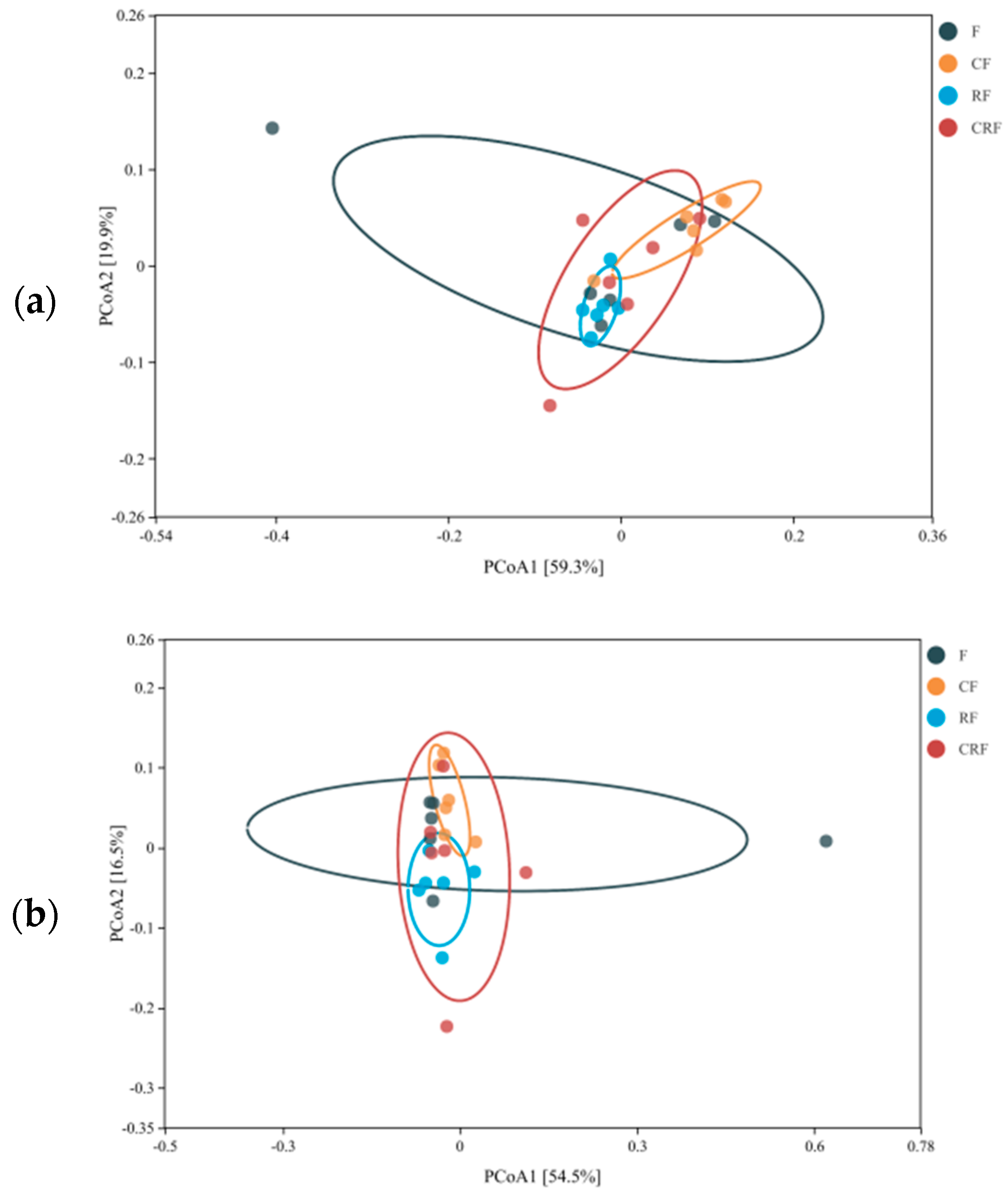
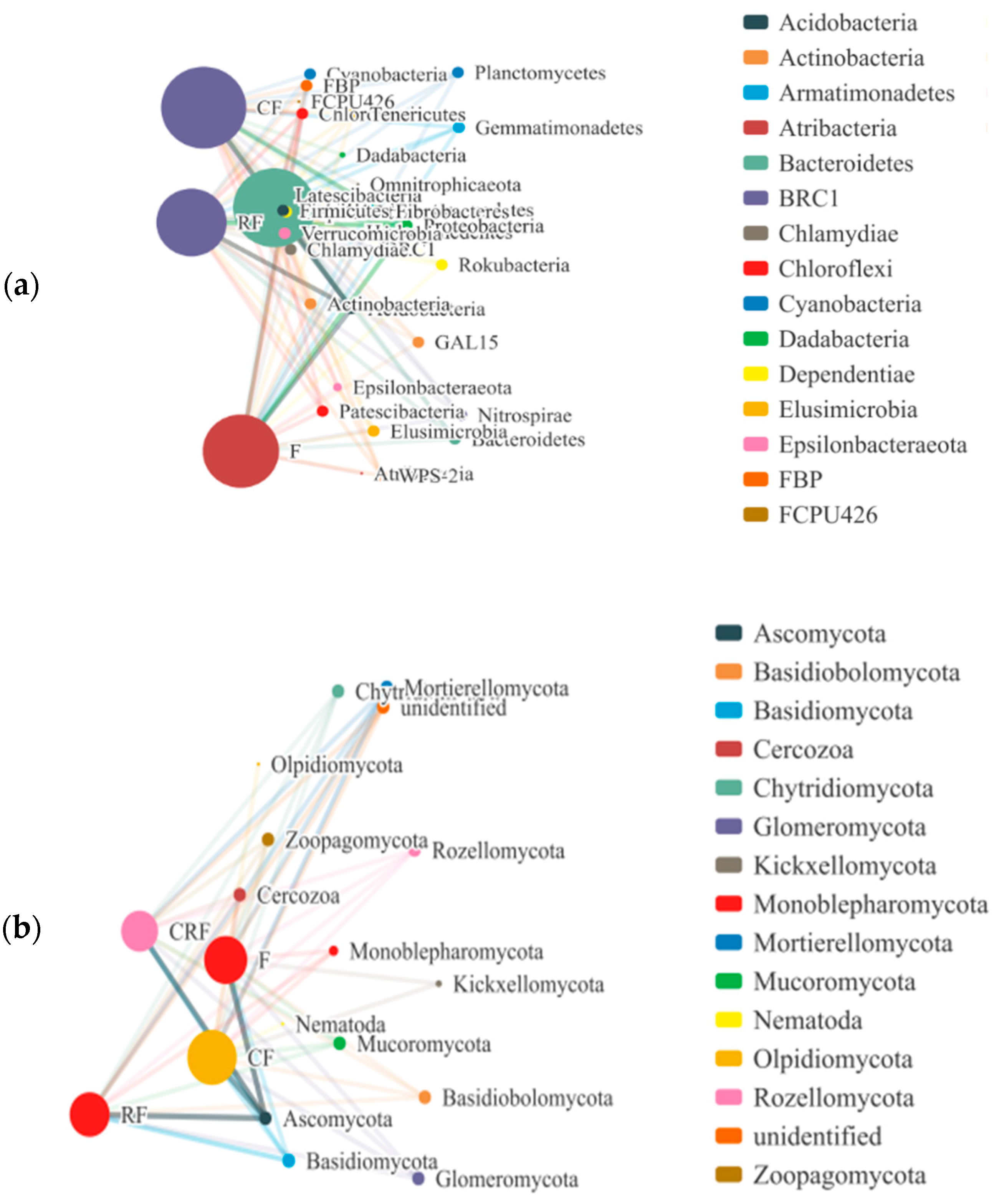
3.4. Effects on Soil Bacterial Community Structure
3.5. Relationships Between Soil Factors, Bacterial Community, and Soybean Yield
4. Discussion
4.1. Co-Inoculation Was Associated with Higher Soybean Performance
4.2. Short-Term Soil Property and Enzyme Activity Responses to Co-Inoculation
4.3. Responses of Bacterial Community Structure
4.4. Key Factors Driving Community Changes and Yield
5. Conclusions
Supplementary Materials
Author Contributions
Funding
Data Availability Statement
Conflicts of Interest
References
- Alvarez, A.L.; Weyers, S.L.; Gardner, R.D. Insights into the effect of cyanobacterial inoculations on the microbial dynamics of an arable soil under simulated rain. Biol. Fertil. Soils 2023, 59, 103–116. [Google Scholar] [CrossRef] [Scilit]
- Li, R.; Hu, W.; Jia, Z.; Liu, H.; Zhang, C.; Huang, B.; Yang, S.; Zhao, Y.; Zhao, Y.; Shukla, M.K.; et al. Soil degradation: A global threat to sustainable use of black soils. Pedosphere 2025, 35, 264–279. [Google Scholar] [CrossRef] [Scilit]
- Ulzen, J.; Abaidoo, R.C.; Mensah, N.E.; Masso, C.; AbdelGadir, A.H. Bradyrhizobium Inoculants Enhance Grain Yields of Soybean and Cowpea in Northern Ghana. Front. Plant Sci. 2016, 7, 1770. [Google Scholar] [CrossRef] [Scilit] [PubMed]
- Akley, E.K.; Rice, C.W.; Adotey, N.; Ampim, P.A.Y.; Vara Prasad, P.V.; Owusu Danquah, E.; Denwar, N.N. Residual Bradyrhizobium inoculation effects on soybean performance and selected soil health parameters. Agron. J. 2022, 114, 1627–1641. [Google Scholar] [CrossRef] [Scilit]
- Cardoso, J.D.; Gomes, D.F.; Goes, K.C.G.P.; Fonseca, N.d.S.; Dorigo, O.F.; Hungria, M.; Andrade, D.S. Relationship between total nodulation and nodulation at the root crown of peanut, soybean and common bean plants. Soil Biol. Biochem. 2009, 41, 1760–1763. [Google Scholar] [CrossRef] [Scilit]
- Rodiño, A.P.; De La Fuente, M.; De Ron, A.M.; Lema, M.J.; Drevon, J.J.; Santalla, M. Variation for nodulation and plant yield of common bean genotypes and environmental effects on the genotype expression. Plant Soil 2011, 346, 349–361. [Google Scholar] [CrossRef] [Scilit]
- Wang, L.; Jiao, Y.; Bi, Y.; Hu, Y.; Jiang, Y.; Wang, S.; Wang, S. Nodulation number tempers the relative importance of stochastic processes in the assembly of soybean root-associated communities. ISME Commun. 2023, 3, 89. [Google Scholar] [CrossRef] [Scilit] [PubMed]
- Hardoim, P.R.; Overbeek, L.S.V.; Berg, G.; Pirttilä, A.M.; Compant, S.; Campisano, A.; Döring, M.; Sessitsch, A. The Hidden World within Plants: Ecological and Evolutionary Considerations for Defining Functioning of Microbial Endophytes. Microbiol. Mol. Biol. Rev. 2015, 79, 293–320. [Google Scholar] [CrossRef] [Scilit] [PubMed]
- Labaz, B.; Hartemink, A.E.; Zhang, Y.; Stevenson, A.; Kabała, C. Organic carbon in Mollisols of the world—A review. Geoderma 2024, 447, 116937. [Google Scholar] [CrossRef] [Scilit]
- Wang, H.; Yang, S.; Wang, Y.; Gu, Z.; Xiong, S.; Huang, X.; Sun, M.; Zhang, S.; Guo, L.; Cui, J.; et al. Rates and causes of black soil erosion in Northeast China. CATENA 2022, 214, 106250. [Google Scholar] [CrossRef] [Scilit]
- Li, C.; Chen, X.; Jia, Z.; Zhai, L.; Zhang, B.; Grüters, U.; Ma, S.; Qian, J.; Liu, X.; Zhang, J.; et al. Meta-analysis reveals the effects of microbial inoculants on the biomass and diversity of soil microbial communities. Nat. Ecol. Evol. 2024, 8, 1270–1284. [Google Scholar] [CrossRef] [Scilit] [PubMed]
- Jack, C.N.; Petipas, R.H.; Cheeke, T.E.; Rowland, J.L.; Friesen, M.L. Microbial Inoculants: Silver Bullet or Microbial Jurassic Park? Trends Microbiol. 2021, 29, 299–308. [Google Scholar] [CrossRef] [Scilit] [PubMed]
- Prando, A.M.; Barbosa, J.Z.; Oliveira, A.B.d.; Nogueira, M.A.; Possamai, E.J.; Hungria, M. Benefits of soybean co-inoculation with Bradyrhizobium spp. and Azospirillum brasilense: Large-scale validation with farmers in Brazil. Eur. J. Agron. 2024, 155, 127112. [Google Scholar] [CrossRef] [Scilit]
- Wang, Q.; Sheng, J.; Pan, L.; Cao, H.; Li, C.; Lambers, H.; Wang, X. Soil property determines the ability of rhizobial inoculation to enhance nitrogen fixation and phosphorus acquisition in soybean. Appl. Soil Ecol. 2022, 171, 104346. [Google Scholar] [CrossRef] [Scilit]
- Rahman, A.; Manci, M.; Nadon, C.; Perez, I.A.; Farsamin, W.F.; Lampe, M.T.; Le, T.H.; Torres Martínez, L.; Weisberg, A.J.; Chang, J.H.; et al. Competitive interference among rhizobia reduces benefits to hosts. Curr. Biol. 2023, 33, 2988–3001.e4. [Google Scholar] [CrossRef] [Scilit] [PubMed]
- Martins, J.T.; Peixoto, L.; Giannini-Kurina, F.; Han, E.; Rasmussen, J. Effect of additional inoculation on in situ biomass, nodule formation and N2 fixation in soybean under Northern European conditions. Plant Soil 2026, 518, 197–210. [Google Scholar] [CrossRef] [Scilit]
- Wang, M.; Ge, A.-H.; Ma, X.; Wang, X.; Xie, Q.; Wang, L.; Song, X.; Jiang, M.; Yang, W.; Murray, J.D.; et al. Dynamic root microbiome sustains soybean productivity under unbalanced fertilization. Nat. Commun. 2024, 15, 1668. [Google Scholar] [CrossRef] [Scilit] [PubMed]
- Hungria, M.; Rondina, A.B.L.; Nunes, A.L.P.; Araujo, R.S.; Nogueira, M.A. Seed and leaf-spray inoculation of PGPR in brachiarias (Urochloa spp.) as an economic and environmental opportunity to improve plant growth, forage yield and nutrient status. Plant Soil 2021, 463, 171–186. [Google Scholar] [CrossRef] [Scilit]
- Kaschuk, G.; Auler, A.C.; Vieira, C.E.; Dakora, F.D.; Jaiswal, S.K.; da Cruz, S.P. Coinoculation impact on plant growth promotion: A review and meta-analysis on coinoculation of rhizobia and plant growth-promoting bacilli in grain legumes. Braz. J. Microbiol. 2022, 53, 2027–2037. [Google Scholar] [CrossRef] [Scilit] [PubMed]
- Barbosa, J.Z.; Hungria, M.; Sena, J.V.d.S.; Poggere, G.; dos Reis, A.R.; Corrêa, R.S. Meta-analysis reveals benefits of co-inoculation of soybean with Azospirillum brasilense and Bradyrhizobium spp. in Brazil. Appl. Soil Ecol. 2021, 163, 103913. [Google Scholar] [CrossRef] [Scilit]
- Canellas, L.P.; Silva, R.M.; Barbosa, L.J.d.S.; Sales, F.S.; Ribeiro, R.C.; Mota, G.P.; Olivares, F.L. Co-Inoculation with Bradyrhizobium and Humic Substances Combined with Herbaspirillum seropedicae Promotes Soybean Vegetative Growth and Nodulation. Agronomy 2023, 13, 2660. [Google Scholar] [CrossRef] [Scilit]
- Peoples, M.B.; Giller, K.E.; Jensen, E.S.; Herridge, D.F. Quantifying country-to-global scale nitrogen fixation for grain legumes: I. Reliance on nitrogen fixation of soybean, groundnut and pulses. Plant Soil 2021, 469, 1–14. [Google Scholar] [CrossRef] [Scilit]
- Del Buono, D. Can biostimulants be used to mitigate the effect of anthropogenic climate change on agriculture? It is time to respond. Sci. Total Environ. 2021, 751, 141763. [Google Scholar] [CrossRef] [Scilit] [PubMed]
- Nardi, S.; Muscolo, A.; Vaccaro, S.; Baiano, S.; Spaccini, R.; Piccolo, A. Relationship between molecular characteristics of soil humic fractions and glycolytic pathway and krebs cycle in maize seedlings. Soil Biol. Biochem. 2007, 39, 3138–3146. [Google Scholar] [CrossRef] [Scilit]
- Nardi, S.; Pizzeghello, D.; Ertani, A. Hormone-like activity of the soil organic matter. Appl. Soil Ecol. 2018, 123, 517–520. [Google Scholar] [CrossRef] [Scilit]
- Janati, W.; Benmrid, B.; Elhaissoufi, W.; Zeroual, Y.; Nasielski, J.; Bargaz, A. Will Phosphate Bio-Solubilization Stimulate Biological Nitrogen Fixation in Grain Legumes? Front. Agron. 2021, 3, 637196. [Google Scholar] [CrossRef] [Scilit]
- Akimbekov, N.; Qiao, X.; Digel, I.; Abdieva, G.; Ualieva, P.; Zhubanova, A. The effect of leonardite-derived amendments on soil microbiome structure and potato yield. Agriculture 2020, 10, 147. [Google Scholar] [CrossRef] [Scilit]
- Asaf, S.; Numan, M.; Khan, A.L.; Al-Harrasi, A. Sphingomonas: From diversity and genomics to functional role in environmental remediation and plant growth. Crit. Rev. Biotechnol. 2020, 40, 138–152. [Google Scholar] [CrossRef] [Scilit] [PubMed]
- Muñoz, N.; Qi, X.; Li, M.W.; Xie, M.; Gao, Y.; Cheung, M.Y.; Wong, F.L.; Lam, H.M. Improvement in nitrogen fixation capacity could be part of the domestication process in soybean. Heredity 2016, 117, 84–93. [Google Scholar] [CrossRef] [Scilit] [PubMed]
- Beruk, H.; Yoseph, T.; Ayalew, T. Unlocking the Potential of Inoculation with Bradyrhizobium for Enhanced Growth and Symbiotic Responses in Soybean Varieties under Controlled Conditions. Agronomy 2024, 14, 1280. [Google Scholar] [CrossRef] [Scilit]
- Omari, R.A.; Yuan, K.; Anh, K.T.; Reckling, M.; Halwani, M.; Egamberdieva, D.; Ohkama-Ohtsu, N.; Bellingrath-Kimura, S.D. Enhanced Soybean Productivity by Inoculation With Indigenous Bradyrhizobium Strains in Agroecological Conditions of Northeast Germany. Front. Plant Sci. 2022, 12, 707080. [Google Scholar] [CrossRef] [Scilit] [PubMed]
- He, C.; Gao, T.; Wang, X.; Chen, R.; Gao, H.; Liu, H. Co-inoculation of Bacillus subtilis and Bradyrhizobium liaoningense increased soybean yield and improved soil bacterial community composition in coastal saline-alkali land. Front. Plant Sci. 2025, 16, 1677763. [Google Scholar] [CrossRef] [Scilit] [PubMed]
- Fonseca de Souza, L.; Oliveira, H.G.; Pellegrinetti, T.A.; Mendes, L.W.; Bonatelli, M.L.; Dumaresq, A.S.R.; Sinatti, V.V.C.; Pinheiro, J.B.; Azevedo, J.L.; Quecine, M.C. Co-inoculation with Bacillus thuringiensis RZ2MS9 and rhizobia improves the soybean development and modulates soil functional diversity. FEMS Microbiol. Ecol. 2025, 101, fiaf013. [Google Scholar] [CrossRef] [Scilit] [PubMed]
- Marchão, R.L.; Silva, G.C.d.; Andrade, S.R.M.d.; Junior, F.B.d.R.; Júnior, M.P.d.B.; Haphonsso, R.H.; Carvalho, A.M.d. Improving Soybean Development and Grain Yield by Complementary Inoculation with Growth-Promoting Bacteria Azospirillum, Pseudomonas, Priestia, and Bacillus. Plants 2025, 14, 402. [Google Scholar] [CrossRef] [Scilit] [PubMed]
- Marinković, J.; Miljaković, D.; Đorđević, V.; Vasiljević, M.; Tamindžić, G.; Miladinović, J.; Vasiljević, S. Perspectives of Bradyrhizobium and Bacillus Inoculation for Improvement of Soybean Tolerance to Water Deficit. Agronomy 2024, 14, 2692. [Google Scholar] [CrossRef] [Scilit]
- Yamamoto, S.; Okazaki, S.; Monica, N.D.; Ohkama-Ohtsu, N.; Tanaka, H.; Sugihara, S. Rhizobium Inoculation Improved the Rhizosphere P Dynamics and P Uptake Capacity of Pigeon Pea Plants Grown in Strongly Weathered Soil Only under P Fertilized Conditions. Agronomy 2022, 12, 3149. [Google Scholar] [CrossRef] [Scilit]
- Chen, Y.; Xia, A.; Zhang, Z.; Wang, F.; Chen, J.; Hao, Y.; Cui, X. Extracellular enzyme activities response to nitrogen addition in the rhizosphere and bulk soil: A global meta-analysis. Agric. Ecosyst. Environ. 2023, 356, 108630. [Google Scholar] [CrossRef] [Scilit]
- Xu, F.; Liao, H.; Yang, J.; Zhang, Y.; Yu, P.; Cao, Y.; Fang, J.; Chen, S.; Li, L.; Sun, L.; et al. Auxin-producing bacteria promote barley rhizosheath formation. Nat. Commun. 2023, 14, 5800. [Google Scholar] [CrossRef] [Scilit] [PubMed]
- Joshi, S.; Gangola, S.; Jaggi, V.; Sahgal, M. Functional characterization and molecular fingerprinting of potential phosphate solubilizing bacterial candidates from Shisham rhizosphere. Sci. Rep. 2023, 13, 7003. [Google Scholar] [CrossRef] [Scilit] [PubMed]
- Letunic, I.; Bork, P. Interactive Tree Of Life (iTOL) v5: An online tool for phylogenetic tree display and annotation. Nucleic Acids Res. 2021, 49, W293–W296. [Google Scholar] [CrossRef] [Scilit] [PubMed]



| Trait | F | CF | RF | CRF |
|---|---|---|---|---|
| Plant height (cm) | 77.67 ± 2.18 | 79.67 ± 2.36 | 77.00 ± 2.10 | 79.67 ± 2.25 |
| Plant density (plants m−2) | 28.00 ± 0.58 | 28.67 ± 0.76 | 29.33 ± 0.58 | 28.50 ± 0.71 |
| Seeds per plant | 50.93 ± 1.74 | 53.50 ± 1.92 | 52.27 ± 1.63 | 52.77 ± 1.85 |
| Root length (cm) | 27.33 ± 1.16 | 30.53 ± 1.34 | 35.67 ± 1.52 | 31.33 ± 1.28 |
| Root diameter (cm) | 0.71 ± 0.04 | 0.64 ± 0.03 | 0.73 ± 0.04 | 0.81 ± 0.05 |
| Root fresh weight (g) | 7.63 ± 0.38 | 6.72 ± 0.34 | 6.08 ± 0.31 | 7.40 ± 0.42 |
| Nodule number per plant | 26.47 ± 1.86 | 37.53 ± 2.31 | 27.90 ± 1.94 | 20.60 ± 1.42 |
| Plant fresh weight (g) | 39.32 ± 1.97 | 34.77 ± 1.74 | 30.40 ± 1.61 | 35.55 ± 1.82 |
| Leaf area (cm2) | 30.89 ± 1.46 | 34.72 ± 1.62 | 26.66 ± 1.31 | 20.16 ± 1.08 |
| 100-seed weight (g) | 16.30 ± 0.31 | 15.93 ± 0.28 | 15.93 ± 0.30 | 16.50 ± 0.33 |
| Yield (kg ha−1) | 2093.25 ± 58.64 | 2200.35 ± 67.25 | 2199.60 ± 62.48 | 2234.40 ± 70.16 |
| Yield increase (%) | — | 5.00 | 5.00 | 7.00 |
| Index | Treatment | SES | BS | FS | PSS | SFS | MS |
|---|---|---|---|---|---|---|---|
| pH | F | 6.13 ± 0.05 cC | 6.03 ± 0.04 dC | 6.09 ± 0.05 cC | 6.13 ± 0.04 cB | 6.05 ± 0.05 cB | 6.21 ± 0.06 cB |
| CF | 6.22 ± 0.04 bB | 6.09 ± 0.05 cC | 6.33 ± 0.06 bB | 6.25 ± 0.05 bB | 6.14 ± 0.04 bA | 6.28 ± 0.05 bA | |
| RF | 6.23 ± 0.05 bB | 6.19 ± 0.04 bB | 6.43 ± 0.05 aA | 6.30 ± 0.06 bA | 6.21 ± 0.05 aA | 6.30 ± 0.04 bA | |
| CRF | 6.26 ± 0.04 aA | 6.28 ± 0.05 aA | 6.18 ± 0.04 bC | 6.37 ± 0.05 aA | 6.20 ± 0.04 aA | 6.35 ± 0.05 aA | |
| SOM (g kg−1) | F | 32.8 ± 0.9 cC | 33.4 ± 1.0 cB | 29.0 ± 0.8 dC | 31.5 ± 0.9 cC | 32.0 ± 0.8 cC | 33.5 ± 1.0 cC |
| CF | 33.6 ± 0.9 cB | 34.7 ± 1.1 bB | 37.2 ± 1.0 bB | 36.5 ± 1.1 bB | 39.3 ± 1.2 bB | 41.0 ± 1.3 bB | |
| RF | 36.2 ± 1.0 aA | 37.1 ± 1.2 aA | 35.9 ± 1.0 cB | 41.3 ± 1.2 aA | 40.0 ± 1.1 bB | 42.4 ± 1.3 aA | |
| CRF | 35.0 ± 1.0 bA | 37.3 ± 1.1 aA | 39.2 ± 1.2 aA | 41.0 ± 1.1 aA | 44.0 ± 1.3 aA | 43.6 ± 1.2 aA | |
| SWC (%) | F | 15.9 ± 0.5 dC | 16.3 ± 0.6 cB | 15.3 ± 0.5 dD | 16.4 ± 0.6 cC | 17.1 ± 0.5 dC | 16.5 ± 0.6 dC |
| CF | 17.1 ± 0.6 cB | 18.2 ± 0.7 bB | 17.6 ± 0.6 cB | 19.1 ± 0.7 bB | 18.0 ± 0.6 cC | 18.8 ± 0.7 cB | |
| RF | 21.2 ± 0.7 bA | 20.9 ± 0.8 aA | 19.7 ± 0.7 bC | 21.1 ± 0.8 aA | 20.2 ± 0.7 bB | 22.4 ± 0.8 bA | |
| CRF | 22.3 ± 0.8 aA | 22.1 ± 0.7 aA | 23.2 ± 0.8 aA | 20.7 ± 0.7 aA | 23.6 ± 0.9 aA | 23.0 ± 0.8 aA | |
| AP (mg kg−1) | F | 14.7 ± 0.6 dC | 15.6 ± 0.7 dC | 17.1 ± 0.7 cB | 16.4 ± 0.6 cC | 15.7 ± 0.6 cC | 18.2 ± 0.8 cC |
| CF | 16.4 ± 0.7 bB | 18.7 ± 0.8 bB | 19.1 ± 0.8 bA | 20.0 ± 0.9 bB | 18.7 ± 0.7 bB | 20.4 ± 0.9 bB | |
| RF | 15.4 ± 0.6 cB | 16.8 ± 0.7 cC | 17.2 ± 0.7 cB | 19.6 ± 0.8 bB | 18.8 ± 0.8 bB | 21.0 ± 0.9 bA | |
| CRF | 17.8 ± 0.7 aA | 21.9 ± 1.0 aA | 20.4 ± 0.9 aA | 21.3 ± 0.9 aA | 22.4 ± 1.0 aA | 21.9 ± 0.9 aA | |
| AK (mg kg−1) | F | 143.2 ± 4.3 cC | 144.3 ± 4.5 cC | 151.3 ± 4.8 cB | 150.4 ± 4.6 cC | 152.4 ± 4.9 bB | 156.0 ± 5.1 cC |
| CF | 166.0 ± 5.2 aA | 159.4 ± 4.9 bB | 162.5 ± 5.0 aA | 169.3 ± 5.4 aA | 171.6 ± 5.7 aA | 170.9 ± 5.5 bB | |
| RF | 158.4 ± 4.8 bB | 161.4 ± 5.0 bA | 163.5 ± 5.1 aA | 171.7 ± 5.6 aA | 169.9 ± 5.4 bA | 173.5 ± 5.8 aA | |
| CRF | 161.7 ± 5.0 bA | 165.4 ± 5.2 aA | 159.4 ± 4.8 bA | 162.4 ± 5.1 bB | 168.7 ± 5.3 bA | 171.8 ± 5.6 bA | |
| AN (mg kg−1) | F | 13.98 ± 0.5 bB | 14.55 ± 0.51 cC | 16.17 ± 0.58 dD | 15.98 ± 0.55 cC | 16.78 ± 0.61 cC | 16.90 ± 0.63 dD |
| CF | 12.66 ± 0.44 cC | 14.05 ± 0.49 cC | 16.78 ± 0.60 cC | 15.57 ± 0.54 cC | 18.98 ± 0.69 bB | 17.87 ± 0.65 cC | |
| RF | 14.09 ± 0.50 bB | 15.09 ± 0.53 bB | 17.36 ± 0.62 bB | 18.36 ± 0.67 bB | 21.98 ± 0.82 aA | 19.32 ± 0.71 bA | |
| CRF | 15.43 ± 0.54 aA | 17.36 ± 0.63 aA | 18.92 ± 0.70 aA | 19.37 ± 0.72 aA | 18.89 ± 0.68 bB | 20.81 ± 0.78 aA |
| Treatments | pH | SWC (%) | SOM (g/kg) | AP (mg/kg) | AK (mg/kg) | AN (mg/kg) |
|---|---|---|---|---|---|---|
| F | 0.071 * | 0.012 | 0.342 | 0.128 ** | 0.390 | 0.125 |
| CF | −0.136 ** | 0.526 * | 0.142 | 0.091 | 0.638 * | 0.520 |
| RF | 0.031 | 0.681 * | −0.798 ** | −0.217 * | 0.382 | 0.461 |
| CRF | 0.146 ** | 0.385 | 0.655 * | 0.071 | −0.708 ** | 0.702 * |
Disclaimer/Publisher’s Note: The statements, opinions and data contained in all publications are solely those of the individual author(s) and contributor(s) and not of MDPI and/or the editor(s). MDPI and/or the editor(s) disclaim responsibility for any injury to people or property resulting from any ideas, methods, instructions or products referred to in the content. |
© 2026 by the authors. Licensee MDPI, Basel, Switzerland. This article is an open access article distributed under the terms and conditions of the Creative Commons Attribution (CC BY) license.
Share and Cite
Hou, T.; Jiang, C.; Wang, X.; Fan, E.; Zhang, T.; Zhang, J.; Meng, L. Co-Inoculation of Rhizobia and a Multifunctional Microbial Consortium Is Associated with Improved Soybean Performance and Bacterial Community Reassembly in Soybean Fields. Land 2026, 15, 1270. https://doi.org/10.3390/land15071270
Hou T, Jiang C, Wang X, Fan E, Zhang T, Zhang J, Meng L. Co-Inoculation of Rhizobia and a Multifunctional Microbial Consortium Is Associated with Improved Soybean Performance and Bacterial Community Reassembly in Soybean Fields. Land. 2026; 15(7):1270. https://doi.org/10.3390/land15071270
Chicago/Turabian StyleHou, Tingting, Chao Jiang, Xiangxiang Wang, Enyue Fan, Tingyu Zhang, Jiabao Zhang, and Liqiang Meng. 2026. "Co-Inoculation of Rhizobia and a Multifunctional Microbial Consortium Is Associated with Improved Soybean Performance and Bacterial Community Reassembly in Soybean Fields" Land 15, no. 7: 1270. https://doi.org/10.3390/land15071270
APA StyleHou, T., Jiang, C., Wang, X., Fan, E., Zhang, T., Zhang, J., & Meng, L. (2026). Co-Inoculation of Rhizobia and a Multifunctional Microbial Consortium Is Associated with Improved Soybean Performance and Bacterial Community Reassembly in Soybean Fields. Land, 15(7), 1270. https://doi.org/10.3390/land15071270