


Geopolitics of the Land–Food–Climate Nexus: Curriculum Strategies for Addressing Global North Agricultural Power and Global South Vulnerability


Abstract
1. Introduction
1.1. Novelty of the Study
1.2. Theoretical Framework
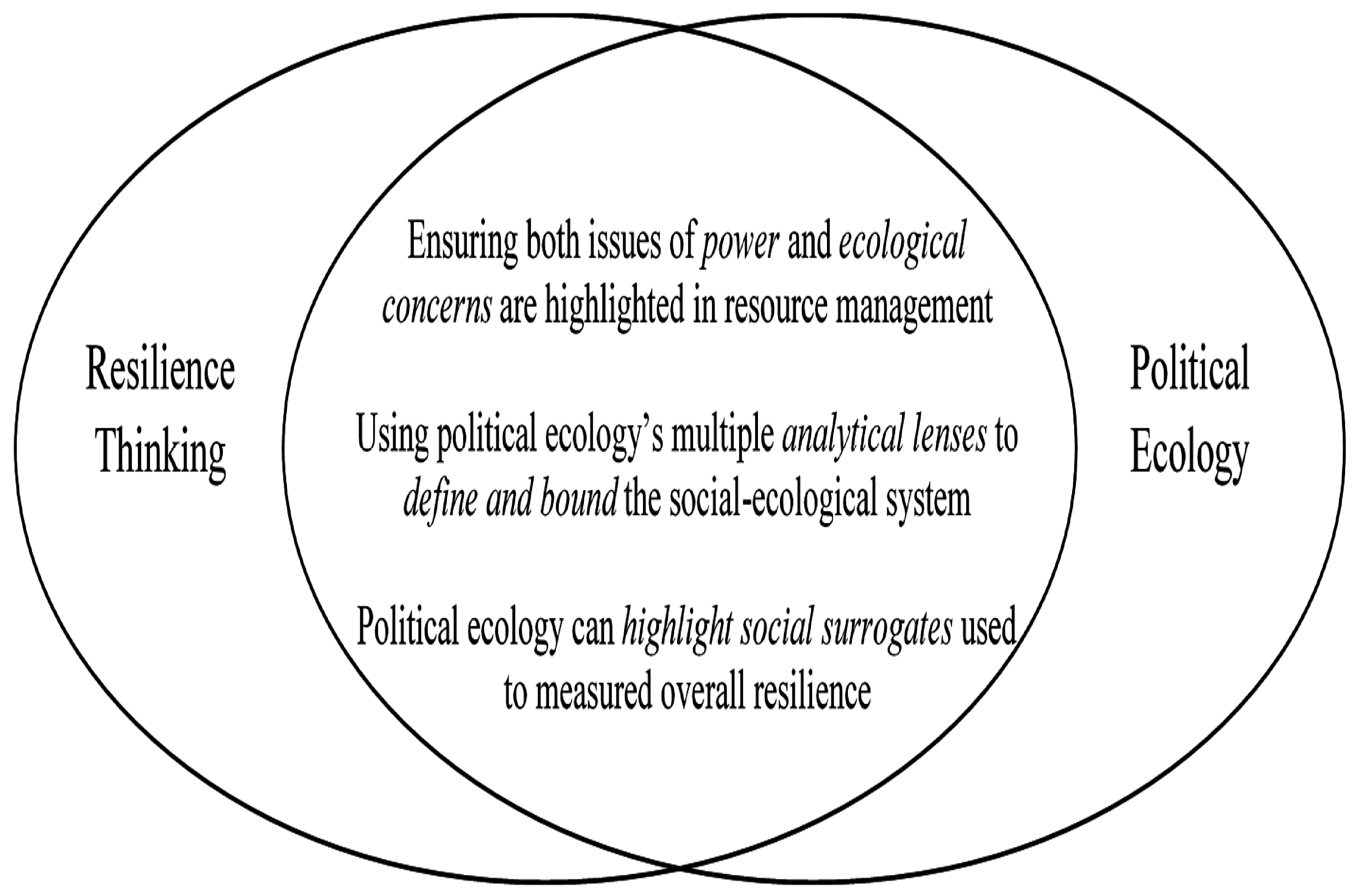
Political Ecology Theory
2. Materials and Methods
2.1. Search Strategy and Database Coverage
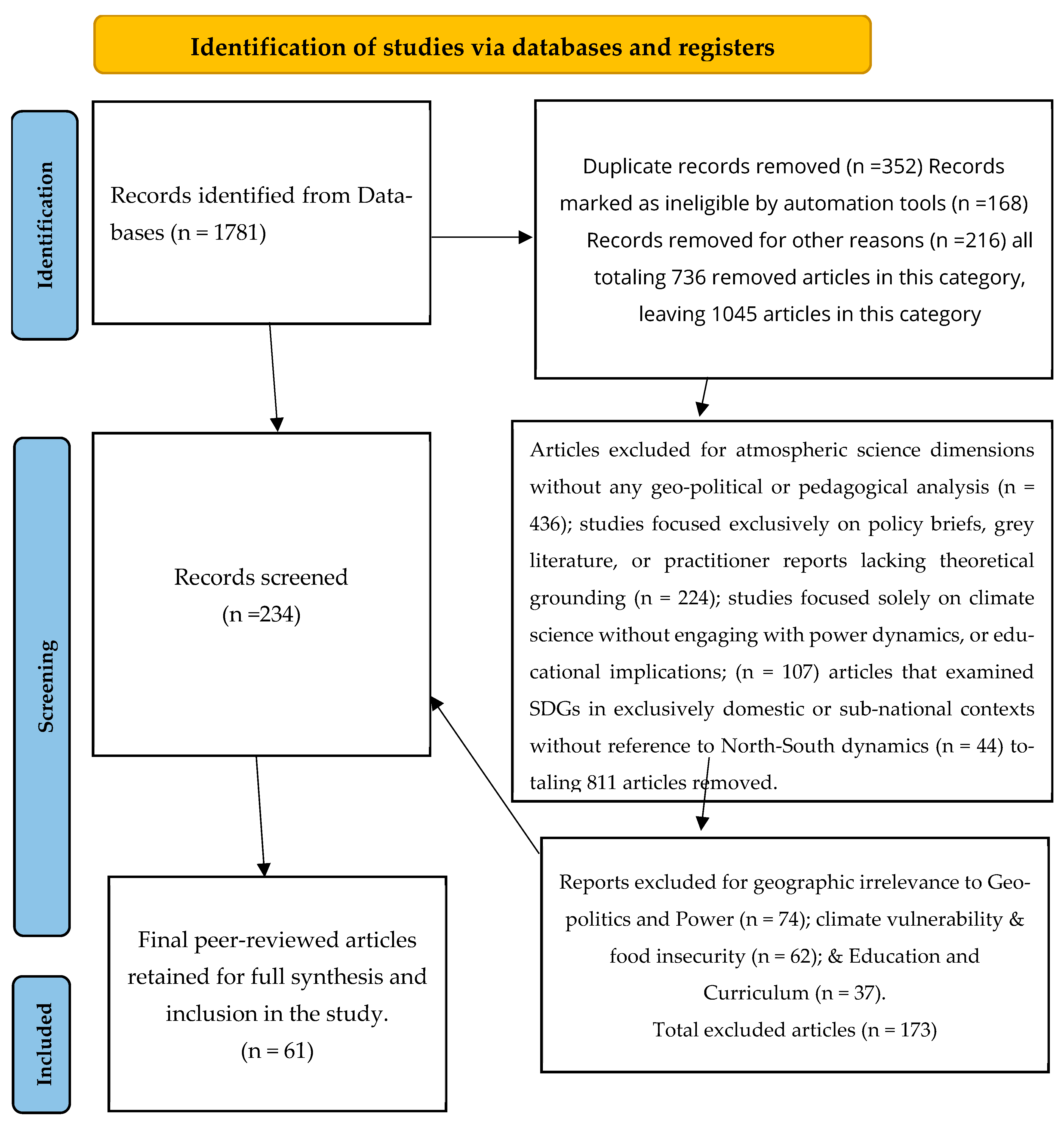
2.2. PRISMA Screening and Selection Process
2.3. Inclusion and Exclusion Criteria
2.4. Data Extraction and Coding Strategy
3. Results
3.1. Frequency of Themes and Identified Patterns
3.2. Finding 1: The Structural Architecture of Agricultural Power and Manufactured Vulnerability
3.3. The Pedagogical Gap: Depoliticization and the SDG Effect
3.4. Finding 3: Emergent Pedagogical Strategies for Critical Geopolitical Literacy
3.5. Emergent Pathways: Toward a Critical and Geopolitically Literate Pedagogy
4. Discussion
4.1. Complementary Critical Lenses: Geopolitics, Ecological Economics, and Postcolonial Studies on Land Grabs and Climate Adaptation
4.2. From Critical Diagnosis to Curricular Transformation
4.3. The Depoliticized Classroom and Its Consequences
4.4. Bridging the Gap: The Imperative of Critical Geopolitical Literacy
4.5. Practical Pathways for Integration and Implementation
5. Conclusions
6. Recommendations
Supplementary Materials
Author Contributions
Funding
Data Availability Statement
Conflicts of Interest
References
- Dalby, S. Anthropocene Geopolitics: Globalization, Security, Sustainability; University of Ottawa Press: Ottawa, ON, Canada, 2020. [Google Scholar] [CrossRef]
- Barakat, S.; Cochrane, L.; Vasekha, I. The humanitarian-development-peace nexus for global food security: Responding to the climate crisis, conflict, and supply chain disruptions. Int. J. Disaster Risk Reduct. 2023, 98, 104106. [Google Scholar] [CrossRef]
- Myers, S.S.; Smith, M.R.; Guth, S.; Golden, C.D.; Vaitla, B.; Mueller, N.D.; Huybers, P. Climate change and global food systems: Potential impacts on food security and undernutrition. Annu. Rev. Public Health 2017, 38, 259–277. [Google Scholar] [CrossRef]
- Clapp, J.; Newell, P.; Brent, Z.W. The global political economy of climate change, agriculture and food systems. J. Peasant. Stud. 2018, 45, 80–88. [Google Scholar] [CrossRef]
- Chandra, A.; McNamara, K.E.; Dargusch, P. The relevance of political ecology perspectives for smallholder Climate-Smart Agriculture: A review. J. Political Ecol. 2017, 24, 821–842. [Google Scholar] [CrossRef]
- Zondi, N.T.B.; Ngidi, M.S.C.; Ojo, T.O.; Hlatshwayo, S.I. Impact of market participation of indigenous crops on household food security of smallholder farmers of South Africa. Sustainability 2022, 14, 15194. [Google Scholar] [CrossRef]
- Merino, R. The geopolitics of food security and food sovereignty in Latin America: Harmonizing competing visions or reinforcing extractive agriculture? Geopolitics 2022, 27, 898–920. [Google Scholar] [CrossRef]
- Scheffran, J. Limits to the Anthropocene: Geopolitical conflict or cooperative governance? Front. Political Sci. 2023, 5, 1190610. [Google Scholar] [CrossRef]
- Atukunda, P.; Eide, W.B.; Kardel, K.R.; Iversen, P.O.; Westerberg, A.C. Unlocking the potential for achievement of the UN Sustainable Development Goal 2–‘Zero Hunger’–in Africa: Targets, strategies, synergies and challenges. Food Nutr. Res. 2021, 65, 10–29219. [Google Scholar] [CrossRef]
- Tilzey, M. Political Ecology, Food Regimes, and Food Sovereignty: Crisis, Resistance, and Resilience; Springer: Cham, Switzerland, 2017. [Google Scholar]
- Warnock, J.W. The Politics of Hunger: The Global Food System; Routledge: London, UK, 2019. [Google Scholar] [CrossRef]
- Leimgruber, W. Between Global and Local: Marginality and Marginal Regions in the Context of Globalization and Deregulation; Routledge: London, UK, 2018. [Google Scholar] [CrossRef]
- Norton, G.W.; Alwang, J.; Masters, W.A. Economics of Agricultural Development: World Food Systems and Resource Use; Routledge: London, UK, 2021. [Google Scholar] [CrossRef]
- Bankoff, G. Remaking the world in our own image: Vulnerability, resilience and adaptation as historical discourses. Disasters 2019, 43, 221–239. [Google Scholar] [CrossRef]
- Mabhaudhi, T.; Chibarabada, T.P.; Chimonyo, V.G.P.; Murugani, V.G.; Pereira, L.M.; Sobratee, N.; Modi, A.T. Mainstreaming underutilized indigenous and traditional crops into food systems: A South African perspective. Sustainability 2018, 11, 172. [Google Scholar] [CrossRef]
- Amelework, A.B.; Bairu, M.W.; Maema, O.; Venter, S.L.; Laing, M. Adoption and promotion of resilient crops for climate risk mitigation and import substitution: A case analysis of cassava for South African agriculture. Front. Sustain. Food Syst. 2021, 5, 617783. [Google Scholar] [CrossRef]
- Lyster, R. Climate justice, adaptation and the Paris Agreement: A recipe for disasters? Environ. Politics 2017, 26, 438–458. [Google Scholar] [CrossRef]
- Kissinger, G.; Gupta, A.; Mulder, I.; Unterstell, N. Climate financing needs in the land sector under the Paris Agreement: An assessment of developing country perspectives. Land Use Policy 2019, 83, 256–269. [Google Scholar] [CrossRef]
- Pill, M. Towards a funding mechanism for loss and damage from climate change impacts. Clim. Risk Manag. 2022, 35, 100391. [Google Scholar] [CrossRef]
- Franco, I.; Saito, O.; Vaughter, P.; Whereat, J.; Kanie, N.; Takemoto, K. Higher education for sustainable development: Actioning the global goals in policy, curriculum and practice. Sustain. Sci. 2019, 14, 1621–1642. [Google Scholar] [CrossRef]
- Kerr, R.B.; Young, S.L.; Young, C.; Santoso, M.V.; Magalasi, M.; Entz, M.; Snapp, S.S. Farming for change: Developing a participatory curriculum on agroecology, nutrition, climate change and social equity in Malawi and Tanzania. In Critical Adult Education in Food Movements; Springer Nature: Cham, Switzerland, 2022; pp. 29–46. [Google Scholar] [CrossRef]
- O’Lear, S. Environmental Geopolitics; Bloomsbury Publishing PLC: London, UK, 2018. [Google Scholar]
- Leichenko, R.; O’Brien, K. Climate and Society: Transforming the Future; John Wiley & Sons: New York, NY, USA, 2024. [Google Scholar]
- Gilson, E.; Kenehan, S. (Eds.) Food, Environment, and Climate Change: Justice at the Intersections; Bloomsbury Publishing PLC: London, UK, 2018. [Google Scholar] [CrossRef]
- Adelman, S. The sustainable development goals, anthropocentrism and neoliberalism. In Sustainable Development Goals; Edward Elgar Publishing: Cheltenham, UK, 2018; pp. 15–40. [Google Scholar] [CrossRef]
- Nguyen, T.T.; Grote, U.; Neubacher, F.; Do, M.H.; Paudel, G.P. Security risks from climate change and environmental degradation: Implications for sustainable land use transformation in the Global South. Curr. Opin. Environ. Sustain. 2023, 63, 101322. [Google Scholar] [CrossRef]
- Giraldo, O.F. Political Ecology of Agriculture; Page Political Ecology of Agriculture; Springer: Cham, Switzerland, 2019. [Google Scholar] [CrossRef]
- Dunlap, A.; Verweijen, J.; Tornel, C. The political ecologies of “green” extractivism(s): An introduction. J. Political Ecol. 2024, 31, 436–463. [Google Scholar] [CrossRef]
- Moragues-Faus, A.; Marsden, T. The political ecology of food: Carving ‘spaces of possibility’in a new research agenda. J. Rural. Stud. 2017, 55, 275–288. [Google Scholar] [CrossRef]
- Goldman, M.J.; Turner, M.D.; Daly, M. A critical political ecology of human dimensions of climate change: Epistemology, ontology, and ethics. Wiley Interdiscip. Rev. Clim. Change 2018, 9, e526. [Google Scholar] [CrossRef]
- Quandt, A. Towards Integrating Political Ecology into Resilience-Based Management. Resources 2016, 5, 31. [Google Scholar] [CrossRef]
- Ahlborg, H.; Nightingale, A.J. Theorizing power in political ecology: The ‘where’ of power in resource governance projects. J. Political Ecol. 2018, 25, 381–401. [Google Scholar] [CrossRef]
- Tornaghi, C.; Dehaene, M. The prefigurative power of urban political agroecology: Rethinking the urbanisms of agroecological transitions for food system transformation. Agroecol. Sustain. Food Syst. 2020, 44, 594–610. [Google Scholar] [CrossRef]
- Rotz, S.; Duncan, E.; Small, M.; Botschner, J.; Dara, R.; Mosby, I.; Fraser, E.D. The politics of digital agricultural technologies: A preliminary review. Sociol. Rural. 2019, 59, 203–229. [Google Scholar] [CrossRef]
- Whyte, K. Settler colonialism, ecology, and environmental injustice. Environ. Soc. 2018, 9, 125–144. [Google Scholar] [CrossRef]
- Domínguez, L.; Luoma, C. Decolonising conservation policy: How colonial land and conservation ideologies persist and perpetuate indigenous injustices at the expense of the environment. Land 2020, 9, 65. [Google Scholar] [CrossRef]
- Aguayo, B.C.; Latta, A. Agro-ecology and food sovereignty movements in Chile: Socio-spatial practices for alternative peasant futures. In Futures: Imagining Socioecological Transformation; Routledge: London, UK, 2018; pp. 173–182. [Google Scholar] [CrossRef]
- Torres-Carrión, P.V.; González-González, C.S.; Aciar, S.; Rodríguez-Morales, G. Methodology for systematic literature review applied to engineering and education. In 2018 IEEE Global Engineering Education Conference (EDUCON); IEEE: New York, NY, USA, 2018; pp. 1364–1373. [Google Scholar] [CrossRef]
- Mohamed-Shaffril, H.A.; Samsuddin, S.F.; Abu Samah, A. The ABC of systematic literature review: The basic methodological guidance for beginners. Qual. Quant. 2021, 55, 1319–1346. [Google Scholar] [CrossRef]
- Page, M.J.; Moher, D. Evaluations of the uptake and impact of the Preferred Reporting Items for Systematic reviews and Meta-Analyses (PRISMA) Statement and extensions: A scoping review. Syst. Rev. 2017, 6, 263. [Google Scholar] [CrossRef]
- McInnes, M.D.; Moher, D.; Thombs, B.D.; McGrath, T.A.; Bossuyt, P.M.; Clifford, T.; Willis, B.H. Preferred reporting items for a systematic review and meta-analysis of diagnostic test accuracy studies: The PRISMA-DTA statement. JAMA 2018, 319, 388–396. [Google Scholar] [CrossRef]
- Estoque, R.C. Complexity and diversity of nexuses: A review of the nexus approach in the sustainability context. Sci. Total Environ. 2023, 854, 158612. [Google Scholar] [CrossRef]
- Carney, M.A. The climate-food-migration nexus: Critical perspectives. Glob. Food Secur. 2024, 42, 100786. [Google Scholar] [CrossRef]
- Ciaian, P.; Baldoni, E.; Kancs, D.A.; Drabik, D. The capitalization of agricultural subsidies into land prices. Annu. Rev. Resour. Econ. 2021, 13, 17–38. [Google Scholar] [CrossRef]
- McMichael, P. Political economy of the global food and agriculture system. In Rethinking Food and Agriculture; Woodhead Publishing: Sawston, UK, 2021; pp. 53–75. [Google Scholar] [CrossRef]
- O’Brien, K.; Leichenko, R. Toward an integrative discourse on climate change. Dialogues Hum. Geogr. 2019, 9, 33–37. [Google Scholar] [CrossRef]
- Ribot, J. Cause and response: Vulnerability and climate in the Anthropocene. In New Directions in Agrarian Political Economy; Routledge: London, UK, 2017; pp. 27–66. [Google Scholar] [CrossRef]
- Reed, D. Structural Adjustment and the Environment; Routledge: London, UK, 2019. [Google Scholar] [CrossRef]
- Daoudy, M. The Origins of the Syrian Conflict: Climate Change and Human Security; Cambridge University Press: Cambridge, UK, 2020. [Google Scholar]
- Kopnina, H. Education for the future? Critical evaluation of education for sustainable development goals. J. Environ. Educ. 2020, 51, 280–291. [Google Scholar] [CrossRef]
- Ravenhill, J. (Ed.) Global Political Economy; Oxford University Press: Oxford, UK, 2017. [Google Scholar] [CrossRef]
- Stein, S.; Ahenakew, C.; Jimmy, E.; Andreotti, V.; Valley, W.; Amsler, S.; Gesturing Towards Decolonial Futures Collective. Developing stamina for decolonizing higher education: A workbook for non-indigenous people. Gesturing Towards Decolonial Futures Collect. 2021, 13–127. [Google Scholar] [CrossRef]
- Martínez-Hernández, C.; Mínguez, C. The Anthropocene and the sustainable development goals: Key elements in geography higher education? Int. J. Sustain. High. Educ. 2023, 24, 1648–1667. [Google Scholar] [CrossRef]
- Griffiths, T.G. Education to transform the world: Limits and possibilities in and against the SDGs and ESD. Int. Stud. Sociol. Educ. 2021, 30, 73–92. [Google Scholar] [CrossRef]
- Swyngedouw, E. Promises of the Political: Insurgent Cities in a Post-Political Environment; MIT Press: Cambridge, MA, USA, 2018; pp. 113–127. [Google Scholar] [CrossRef]
- Cohn, T.H.; Hira, A. Global Political Economy: Theory and Practice; Routledge: London, UK, 2020. [Google Scholar] [CrossRef]
- Gills, B.; Morgan, J. Global climate emergency: After COP24, climate science, urgency, and the threat to humanity. In Economics and Climate Emergency; Routledge: London, UK, 2022; pp. 253–270. [Google Scholar] [CrossRef]
- Kasperson, J.X.; Kasperson, R.E.; Turner, B.L.; Hsieh, W.; Schiller, A. Vulnerability to global environmental change. In Social Contours of Risk; Routledge: London, UK, 2022; pp. 245–285. [Google Scholar] [CrossRef]
- Rother, M.B.; Sosa, M.S.; Debbich, M.; Castrovillari, C.; Prifti, E. Global Food Crisis Update: Recent Developments, Outlook, and Imf Engagement; International Monetary Fund: Bretton Woods, NH, USA, 2023. [Google Scholar] [CrossRef]
- Andreotti, V.; Stein, S.; Sutherland, A.; Pashby, K.L.; Susa, R.; Amsler, S. Mobilizing different conversations about global justice in education: Toward alternative futures in uncertain times. Policy Pract. A Dev. Educ. Rev. 2018, 26, 9–41. [Google Scholar]
- Malik, S.A. Linking climate-smart agriculture to farming as a service: Mapping an emergent paradigm of datafied dispossession in India. J. Peasant. Stud. 2023, 50, 2187–2209. [Google Scholar] [CrossRef]
- Chandra, A.; McNamara, K.E.; Dargusch, P. Climate-smart agriculture: Perspectives and framings. Clim. Policy 2018, 18, 526–541. [Google Scholar] [CrossRef]

| Author & Year | Region/Context | Method | Main Findings | SDG Relevance |
|---|---|---|---|---|
| [1] | Global | Theoretical/Conceptual | Examines the interplay between globalization, security, and sustainability in the Anthropocene era, arguing that geopolitical frameworks must be reconceived to address ecological crisis and resource competition. | SDG 13, SDG 15 |
| [2] | Global | Conceptual Review | Analyzes the humanitarian-development-peace nexus in relation to global food security, identifying climate crisis, conflict, and supply chain disruptions as compounding stressors that undermine food system resilience. | SDG 2, SDG 13 |
| [3] | Global | Systematic Review | Demonstrates that climate change poses significant threats to food systems globally, with disproportionate impacts on undernutrition and food security in low-income, climate-vulnerable nations. | SDG 2, SDG 13 |
| [4] | Global | Political Economy Analysis | Critically examines the global political economy of climate change as it intersects with agriculture and food systems, identifying structural inequities in trade, finance, and governance that disadvantage the Global South. | SDG 2, SDG 13, SDG 15 |
| [5] | Global South/Asia-Pacific | Literature Review | Reviews the relevance of political ecology for climate-smart agriculture in smallholder contexts, highlighting how power asymmetries shape which technologies and practices are promoted and who benefits. | SDG 2, SDG 13, SDG 15 |
| [6] | South Africa | Quantitative Survey | Investigates how participation in indigenous crop markets improves household food security among smallholder farmers, demonstrating the livelihood and resilience value of traditional agro-food systems. | SDG 2, SDG 15 |
| [7] | Latin America | Geopolitical Analysis | Examines tensions between food security and food sovereignty in Latin America, critiquing how extractive agricultural paradigms reinforced by Global North interests compete with indigenous and peasant-led alternatives. | SDG 2, SDG 15 |
| [8] | Global | Conceptual/Theoretical | Explores the limits of the Anthropocene concept in geopolitical terms, arguing that confronting climate change requires either escalating conflict over resources or transformative cooperative multilateral governance. | SDG 13, SDG 15 |
| [9] | Africa | Policy Review | Identifies strategic targets, synergies, and structural challenges in achieving SDG 2 (Zero Hunger) across Africa, underscoring the role of political will, governance, and investment in food system transformation. | SDG 2 |
| [10] | Global | Theoretical/Political Ecology | Develops a political ecology framework for analyzing food regimes and food sovereignty, arguing that crisis, resistance, and resilience are central to understanding contemporary agrarian struggles. | SDG 2, SDG 15 |
| [11] | Global | Critical Analysis | Provides a comprehensive critical account of the global food system, tracing how political decisions, corporate power, and trade regimes manufacture hunger while generating profit for a minority of actors. | SDG 2 |
| [12] | Global | Theoretical/Conceptual | Examines how marginality and marginal regions are produced through globalization and deregulation, offering a framework for understanding spatial inequity between the Global North and Global South. | SDG 2, SDG 13 |
| [14] | Global | Historical/Discursive Analysis | Critically deconstructs vulnerability, resilience, and adaptation as historical discourses, revealing how these concepts have been instrumentalized to manage rather than transform conditions of risk and inequality. | SDG 13, SDG 15 |
| [15] | South Africa | Mixed Methods Review | Makes a case for mainstreaming underutilized indigenous and traditional crops into formal food systems, demonstrating their nutritional, ecological, and cultural contributions to food security and sustainability. | SDG 2, SDG 15 |
| [16] | South Africa | Case Study | Evaluates cassava as a climate-resilient and import-substituting crop for South African agriculture, providing empirical evidence of how underutilized crops can buffer climate-related food insecurity. | SDG 2, SDG 13 |
| [17] | Global | Legal/Policy Analysis | Critically evaluates the Paris Agreement’s approach to climate justice and adaptation, highlighting its inadequacy in addressing loss and damage, particularly for the most vulnerable nations. | SDG 13 |
| [18] | Global South | Policy Review | Assesses land sector climate financing needs under the Paris Agreement from the perspective of developing countries, revealing significant gaps between stated commitments and actual disbursements. | SDG 13, SDG 15 |
| [20] | Global | Systematic Review | Reviews how higher education institutions are translating ESD commitments into policy, curriculum, and practice, identifying wide variation in depth of engagement and critical integration of the global goals. | SDG 2, SDG 13, SDG 15 |
| [21] | East Africa (Malawi, Tanzania) | Participatory Action Research | Documents the co-development of a participatory curriculum integrating agroecology, nutrition, climate change, and social equity, demonstrating how critical pedagogy can be embedded in food movement contexts. | SDG 2, SDG 13 |
| [27] | Global/Latin America | Theoretical/Political Ecology | Develops a political ecology of agriculture framework that reframes agrarian questions around power, ecology, and sovereignty, providing a foundational theoretical basis for critically analyzing food systems. | SDG 2, SDG 15 |
| [28] | Global | Conceptual Review | Introduces and critically maps the political ecologies of green extractivism, arguing that ostensibly sustainable transitions often replicate colonial resource logics that dispossess communities in the Global South. | SDG 13, SDG 15 |
| [29] | Global | Political Ecology Review | Articulates a new political ecology research agenda for food systems that carves spaces of possibility, centering power, justice, and alternative food networks as sites of transformative potential. | SDG 2, SDG 15 |
| [30] | Global | Theoretical Review | Provides a critical political ecology of climate change’s human dimensions, addressing epistemological, ontological, and ethical challenges in how vulnerability, adaptation, and resilience are framed in scholarship. | SDG 13, SDG 15 |
| [32] | Global | Theoretical/Political Ecology | Theorizes power within political ecology, arguing that the spatial and relational dimensions of power in resource governance projects remain underexplored and must be foregrounded in both research and curriculum. | SDG 13, SDG 15 |
| [33] | Europe/Global | Conceptual Analysis | Examines the prefigurative power of urban political agroecology in rethinking food system transitions, arguing for place-based, justice-oriented approaches that challenge dominant technocratic urbanisms. | SDG 2, SDG 15 |
| [34] | Canada/Global North | Literature Review | Offers a preliminary review of the politics of digital agricultural technologies, revealing how digitalization reproduces existing power asymmetries and raises new concerns for data sovereignty and smallholder exclusion. | SDG 2, SDG 15 |
| [35] | North America (Indigenous contexts) | Critical/Decolonial Theory | Examines settler colonialism, ecology, and environmental injustice, arguing that Indigenous peoples experience climate change as an amplification of ongoing colonial dispossession, with direct implications for environmental education. | SDG 13, SDG 15 |
| [36] | Global | Policy/Discursive Analysis | Critiques the persistence of colonial land and conservation ideologies in contemporary policy, demonstrating how dominant conservation frameworks continue to perpetuate Indigenous injustices under the guise of sustainability. | SDG 15 |
| [37] | Chile/Latin America | Case Study | Documents agro-ecology and food sovereignty movements in Chile, illustrating how peasant communities construct alternative socio-spatial futures that resist both industrial agriculture and neoliberal food governance. | SDG 2, SDG 15 |
| [42] | Global | Systematic Review | Reviews the nexus approach in sustainability science, mapping its conceptual diversity and complexity, and identifying how intersectoral linkages—including land, food, water, and energy—are under-integrated in education. | SDG 2, SDG 13, SDG 15 |
| [43] | Global | Critical Review | Offers critical perspectives on the climate-food-migration nexus, demonstrating how these interconnected crises are poorly addressed in governance and education frameworks that lack geopolitical and justice orientations. | SDG 2, SDG 13 |
| [44] | Europe/OECD | Quantitative/Econometric | Analyzes the capitalization of agricultural subsidies into land prices, providing empirical evidence of how farm subsidy regimes distort land markets and entrench inequality in access to productive agricultural land. | SDG 2, SDG 15 |
| [45] | Global | Political Economy Analysis | Examines the political economy of global food and agriculture systems through a food regime lens, critiquing corporate consolidation, trade liberalization, and the subordination of food sovereignty to market imperatives. | SDG 2, SDG 13, SDG 15 |
| [46] | Global | Theoretical/Conceptual | Proposes an integrative discourse on climate change that bridges human security, political economy, and environmental science, arguing for transformative frameworks that center justice in climate education and policy. | SDG 13 |
| [47] | Global South/Africa | Political Ecology/Theoretical | Reconceptualizes vulnerability and climate response in the Anthropocene, arguing that vulnerability is a politically produced condition shaped by historical and ongoing governance failures, not a natural or geographic given. | SDG 13, SDG 15 |
| [48] | Global South | Policy Analysis | Documents how Structural Adjustment Programs systematically dismantled public agricultural support and environmental protections in the Global South, manufacturing long-term ecological and food system vulnerability. | SDG 2, SDG 13, SDG 15 |
| [49] | Middle East (Syria) | Case Study/Historical Analysis | Traces the origins of the Syrian conflict to the intersection of climate change, drought, governance failure, and human security collapse, illustrating how climate vulnerability cascades into political crisis. | SDG 13 |
| [50] | Global | Critical Review | Critically evaluates dominant approaches to ESD in relation to the SDGs, arguing that techno-optimistic and anthropocentric framings depoliticize sustainability education and limit its transformative potential. | SDG 2, SDG 13, SDG 15 |
| [51] | Global | Theoretical/Critical Education | Examines the limits and possibilities of education in transforming the world within the SDG and ESD framework, critiquing the contradictions between emancipatory educational goals and neoliberal institutional constraints. | SDG 2, SDG 13, SDG 15 |
| [52] | Global/Higher Education | Decolonial/Critical Pedagogy | Provides a practical workbook for developing decolonial stamina in higher education, centering non-Indigenous positionality and arguing for epistemic humility, relational accountability, and curricular co-creation with marginalized communities. | SDG 13, SDG 15 |
| [53] | Global/Urban | Critical Political Theory | Examines the post-political condition in urban and environmental governance, arguing that consensus-based sustainability politics evacuates genuine democratic contestation and suppresses justice-oriented alternatives. | SDG 13, SDG 15 |
| [26] | Global South | Policy and Risk Review | Evaluates security risks arising from climate change and environmental degradation in the Global South, recommending sustainable land use transformation as a key intervention for reducing intersecting vulnerabilities. | SDG 13, SDG 15 |
| Second-Order Theme | No. of Studies (n = 61) | % of Corpus | Primary SDG Domain | Predominant Method |
|---|---|---|---|---|
| OECD subsidy-driven market distortion | 34 | 50% | SDG 2 | Political Economy; Policy Analysis |
| Intellectual property enclosure and seed sovereignty erosion | 21 | 31% | SDG 2, SDG 15 | Legal Analysis; Political Ecology |
| SAP-induced adaptive capacity erosion | 17 | 25% | SDG 2, SDG 13 | Historical Institutionalism; Policy Review |
| Depoliticization of SDG 2 in curricula | 12 | 18% | SDG 2 | Systematic Review; Critical Pedagogy |
| Depoliticization of SDG 13 in curricula | 9 | 13% | SDG 13 | Policy Analysis; Critical Review |
| Depoliticization of SDG 15 in curricula | 8 | 12% | SDG 15 | Decolonial Theory; Policy Analysis |
| Colonial conservation ideology in land governance | 11 | 16% | SDG 15 | Decolonial Analysis; Case Study |
| Green extractivism and new land dispossession | 9 | 13% | SDG 13, SDG 15 | Political Ecology; Conceptual Review |
| Decolonial and place-based case study pedagogy | 11 | 16% | SDG 2, SDG 15 | Participatory Research; Case Study |
| Scenario-based simulation methodologies | 8 | 12% | SDG 2, SDG 13 | Pedagogical Research; Action Research |
| Transdisciplinary geospatial approaches | 7 | 10% | SDG 13, SDG 15 | Mixed Methods; Systematic Review |
| Scalar mismatch in ESD framing | 22 | 32% | SDG 2, SDG 13, SDG 15 | Critical Review; Theoretical Analysis |
| Epistemological exclusion of Southern knowledge | 18 | 26% | SDG 2, SDG 13, SDG 15 | Decolonial Theory; Critical Pedagogy |
| Temporal foreshortening in climate-food curricula | 14 | 21% | SDG 2, SDG 13, SDG 15 | Historical Analysis; Critical Review |
Disclaimer/Publisher’s Note: The statements, opinions and data contained in all publications are solely those of the individual author(s) and contributor(s) and not of MDPI and/or the editor(s). MDPI and/or the editor(s) disclaim responsibility for any injury to people or property resulting from any ideas, methods, instructions or products referred to in the content. |
© 2026 by the authors. Licensee MDPI, Basel, Switzerland. This article is an open access article distributed under the terms and conditions of the Creative Commons Attribution (CC BY) license.
Share and Cite
Olatoye, T.A.; Fru, R.N.; Magadlela, A. Geopolitics of the Land–Food–Climate Nexus: Curriculum Strategies for Addressing Global North Agricultural Power and Global South Vulnerability. Land 2026, 15, 1162. https://doi.org/10.3390/land15071162
Olatoye TA, Fru RN, Magadlela A. Geopolitics of the Land–Food–Climate Nexus: Curriculum Strategies for Addressing Global North Agricultural Power and Global South Vulnerability. Land. 2026; 15(7):1162. https://doi.org/10.3390/land15071162
Chicago/Turabian StyleOlatoye, Tolulope Ayodeji, Raymond Nkwenti Fru, and Anathi Magadlela. 2026. "Geopolitics of the Land–Food–Climate Nexus: Curriculum Strategies for Addressing Global North Agricultural Power and Global South Vulnerability" Land 15, no. 7: 1162. https://doi.org/10.3390/land15071162
APA StyleOlatoye, T. A., Fru, R. N., & Magadlela, A. (2026). Geopolitics of the Land–Food–Climate Nexus: Curriculum Strategies for Addressing Global North Agricultural Power and Global South Vulnerability. Land, 15(7), 1162. https://doi.org/10.3390/land15071162

