Article

Quantifying Spatiotemporal Dynamics and Zoning Management of Plastic Greenhouse Land Use Intensity: A Case Study in Weifang, China


1
State Key Laboratory of Remote Sensing and Digital Earth, Aerospace Information Research Institute, Chinese Academy of Sciences, Beijing 100094, China
2
University of Chinese Academy of Sciences, Beijing 100049, China
*
Author to whom correspondence should be addressed.
Land 2026, 15(7), 1109; https://doi.org/10.3390/land15071109 (registering DOI)
Submission received: 27 April 2026 / Revised: 10 June 2026 / Accepted: 15 June 2026 / Published: 23 June 2026
(This article belongs to the Section Land – Observation and Monitoring)

Abstract

Plastic-covered greenhouses (PCGs) are an important form of intensive agricultural land use, but their long-term spatial dynamics are difficult to summarize from annual maps alone. This study mapped PCGs in Weifang, China, from 2016 to 2025 using Sentinel-2 imagery processed in Google Earth Engine. A Random Forest model trained with pooled multi-year samples was used to generate annual probability maps, which were converted to binary maps using a fixed threshold (T = 0.45) to improve cross-year comparability. Pixel-wise annual sequences were then summarized into four process classes: stable, gain, loss, and flip. These process classes, together with annual greenhouse coverage, were aggregated to a 16 km2 hexagon grid. Current coverage, long-term change, and process composition were further combined to produce an exploratory rule-based zoning interpretation. Independent year-specific validation showed overall accuracies of 0.969–0.983 and Kappa values of 0.740–0.841. Greenhouse precision remained high, while recall was lower, indicating a conservative detection tendency. From 2016 to 2025, mapped greenhouse area increased by 21.3%, reaching 752 km2. Shouguang, Qingzhou, and Changle accounted for 77.7% of the 2025 total. The results show a persistent high-intensity core and more dynamic marginal areas, providing spatial evidence for differentiated monitoring and targeted verification.

1. Introduction

In response to the growing scarcity of high-quality land resources worldwide, protected cultivation has become a prominent form of agricultural intensification, reshaping land systems in many producing regions [1]. Plastic-covered greenhouses (PCGs) concentrate production, infrastructure, and inputs within compact footprints, which makes them economically attractive. At the same time, they are governance-relevant because they can reshape local land-use configurations, alter interactions at the urban–rural fringe, and amplify environmental trade-offs associated with intensive vegetable production and plastic use [2]. For land management, the key issue is not only the total area of greenhouses, but also where they cluster, how stable those clusters are over time, and whether expansion or volatility aligns with planning objectives and regulatory constraints [3,4].
Remote sensing has become the main approach for monitoring greenhouse distribution and change because plastic-covered structures show distinctive spectral behavior and seasonal contrast when multi-temporal observations are available [5,6]. Recent methodological advances include index-based and object-oriented approaches, machine learning using medium-resolution time series, and deep learning based on high-resolution imagery, while Google Earth Engine (GEE) has enabled long-term and large-area processing [7,8,9]. Sentinel-1/2 fusion and improved network designs have further reduced confusion in complex backgrounds, and global or national-scale products indicate growing demand for consistent greenhouse inventories beyond single-case studies [10,11,12]. These developments have made annual greenhouse mapping at 10 m resolution increasingly feasible. However, for land-oriented applications, the key issue is no longer whether annual maps can be produced, but whether they can support temporally comparable and management-relevant interpretation [13].
A first challenge is temporal comparability. Year-specific tuning can improve within-year performance, but it complicates cross-year interpretation when the objective is to identify genuine land-use change rather than classifier drift [7,14]. A second challenge is governance-scale interpretability. Pixel-wise maps are informative, but they do not directly provide actionable spatial units for zoning, monitoring, or targeted intervention, especially in highly clustered and spatially heterogeneous greenhouse landscapes [15,16]. This limitation becomes more evident when results are summarized within administrative boundaries, because the choice of spatial unit can alter statistical patterns and blur cross-boundary gradients, a phenomenon known as the modifiable areal unit problem (MAUP) [17,18]. Grid-based aggregation can improve comparability, yet only a limited number of greenhouse studies have treated the spatial unit itself as an explicit component of the analytical design rather than a post hoc reporting choice [19,20]. These gaps provide the direct motivation for the present study [19,20].
Most multi-year greenhouse studies report long-term trends, but fewer have moved beyond trend description to explicit process-based and management-oriented analysis at a consistent spatial support [3,7,8]. Few studies have robustly integrated several key components, including temporally consistent annual mapping, explicit pixel-wise change process typology, and standardized management units that account for MAUP [21,22]. As a result, decision-makers may lack a transparent basis for distinguishing persistent production cores from expansion margins, decline areas, and volatile landscapes, and for translating these patterns into auditable zoning priorities [23].
To address this gap, this study investigates annual plastic-covered greenhouse dynamics in Weifang from 2016 to 2025 and develops a framework that links annual mapping with process typology and management zoning [24,25]. We identify four long-term trajectories—Stable, Gain, Loss, and Flip—and integrate current intensity, long-term change, and process composition within a 16 km2 hexagon framework to derive management zones. The study aims to provide temporally consistent evidence for decade-scale comparison and to support differentiated, spatially explicit land management. More broadly, it demonstrates how annual Earth observation products can be translated into policy-relevant information for land governance.

2. Materials and Methods

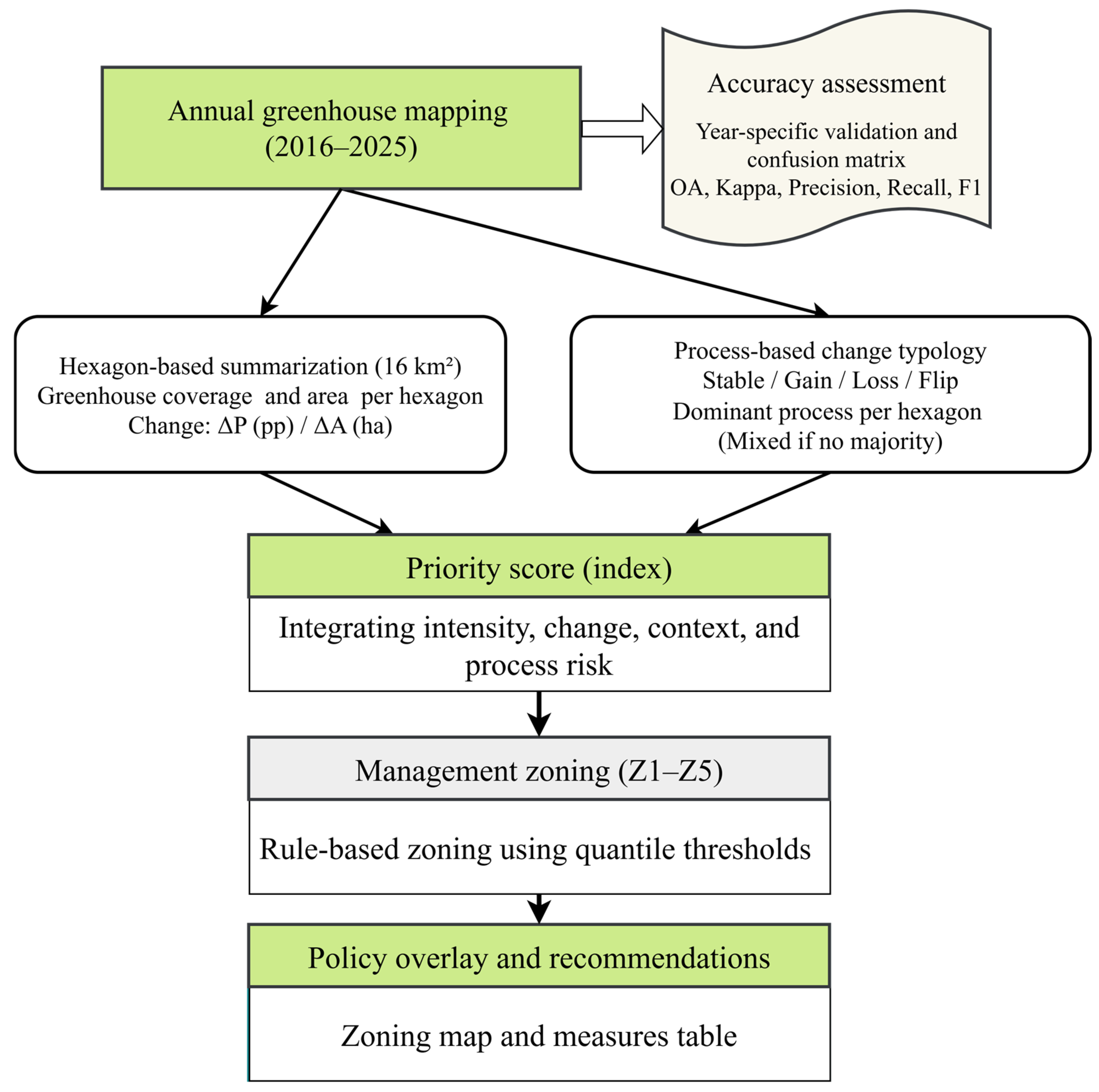
We generated annual plastic-covered greenhouse maps (2016–2025) from Sentinel-2 imagery in GEE using a RF classifier to produce per-pixel greenhouse probabilities. We converted probabilities to binary maps using a cross-year fixed threshold and removed isolated detections with a connected-pixel filter (Figure 1) [26]. Annual outputs were evaluated using year-specific independent validation samples, and accuracy was summarized using standard confusion-matrix metrics [27]. The annual binary maps were then aggregated to a fixed-area 16 km2 hexagon grid to derive greenhouse intensity (coverage and area) and long-term change indicators [28,29]. Based on the stabilized pixel-wise presence sequence, a strict four-class process typology (Stable/Gain/Loss/Flip) was constructed and summarized to hexagon-level compositions [30,31]. Finally, a rule-based management zoning (Z1–Z5) was derived by integrating current intensity, long-term change, and process composition to support transparent prioritization and policy-relevant interpretation [32].

2.1. Study Area

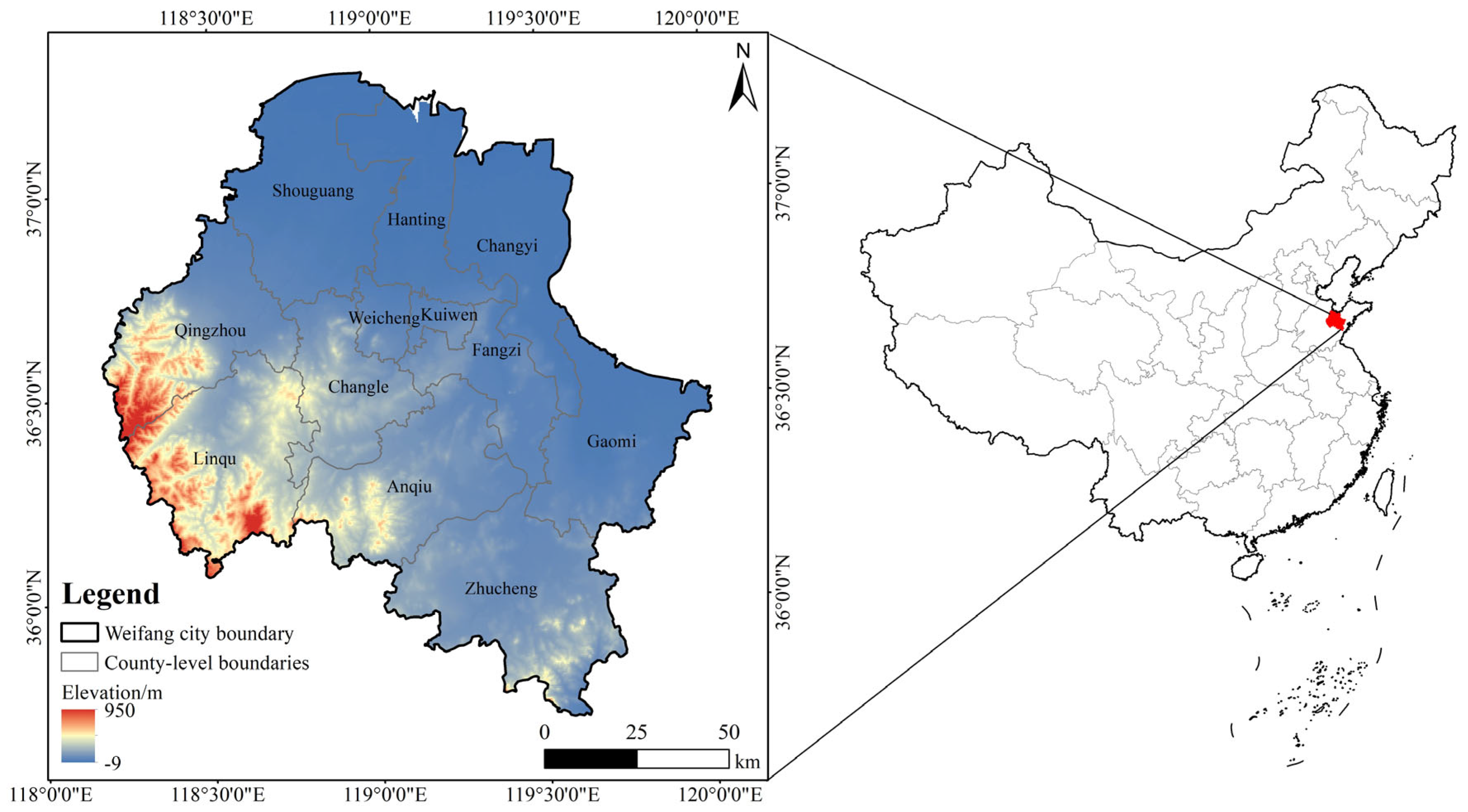
Weifang City is a prefecture-level city in central Shandong Province, eastern China (Figure 2). The region lies on the Shandong Peninsula and extends from the inland agricultural plain to the Laizhou Bay coastal zone, representing a typical warm-temperate monsoon agro-ecosystem with clear seasonality [33]. Intensive cropland dominates the low-relief landscape, providing favorable conditions for protected horticulture [34]. Weifang—especially Shouguang and surrounding counties—hosts one of China’s most concentrated belts of plastic-covered greenhouses, making it an ideal testbed for long-term greenhouse mapping and process-oriented spatial analysis [35]. All spatial processing, aggregation, and cartographic outputs were conducted in WGS 84/UTM Zone 50N to ensure consistent distance/area computation and cross-year comparability.

2.2. Data Sources and Preprocessing

All remote-sensing processing was performed in Google Earth Engine (GEE) for 2016–2025 [36]. The primary input was the Sentinel-2 MSI harmonized image collection (COPERNICUS/S2_HARMONIZED) [37]. Scenes were first filtered by metadata-based cloudiness (CLOUDY_PIXEL_PERCENTAGE ≤ 20). We then masked pixel-level cloud and cirrus contamination using the QA60 band (opaque cloud: bit 10; cirrus: bit 11). Reflectance values were divided by 10,000 to convert integer-stored values to unitless reflectance.
For each year t, the annual image collection was defined using a fixed interval [01-01-t, 01-01-(t + 1)), ensuring consistent temporal coverage across years. Annual and seasonal composites were generated with identical time windows for 2016–2024. Seasonal windows were defined as summer (1 June–1 September in year t) and winter (1 December in year t to 1 March in year t + 1). For 2025, the winter window end date was truncated to 10 January 2026 due to data availability.
To reduce false positives over impervious surfaces, an auxiliary built-up reference layer from Dynamic World (reference year: 2019) was used for hard-negative sampling (Table 1), providing additional non-greenhouse samples concentrated in built-up areas [38,39]. All spatial processing and outputs were projected to WGS 84/UTM Zone 50N to maintain consistent area calculations and cross-year comparability.

2.3. Feature Engineering from Sentinel-2

We constructed an optical predictor set from Sentinel-2 bands and indices to capture the spectral response and seasonal contrast of plastic-covered greenhouses [40,41]. Base predictors included reflectance bands B2 (blue), B3 (green), B4 (red), B8 (NIR), and the SWIR bands B11 (SWIR1) and B12 (SWIR2). We further derived commonly used spectral indices (e.g., NDVI, EVI, NDWI, and NDBI) and additional band-math features using standard definitions. The final Top-30 predictors (and their definitions) are listed in Supplementary Table S1. For each predictor X, we computed annual summary statistics (maximum, minimum, mean, and standard deviation). To enhance separability from seasonally varying background land cover, we also calculated a winter-summer contrast for selected predictors [42]:
Δ X = μ winter , t X μ summer , t X
μ winter , t X and μ summer , t X denote per-pixel means of predictor X computed within the winter and summer compositing windows of year t . Where the summer and winter means were computed from the seasonal composites defined in Section 2.2.

2.4. Model Training and Feature Selection

We formulated a binary classification scheme (greenhouse vs. non-greenhouse). For each year (2016–2025), interpretation samples were labelled using high-resolution imagery. The training set contained 5000 samples per year with a balanced class ratio (GH:non-GH = 1:1). To support an independent evaluation, an independent year-specific validation set was collected for each year (2000 samples; GH:non-GH = 1:3) and kept strictly disjoint from the training samples (Table 2) [43].
To reduce confusion with impervious surfaces, we performed hard-negative mining by augmenting the non-greenhouse class with additional samples drawn from a Dynamic World built-up mask (reference year: 2019) [38]. This augmentation was applied to the training pool only and was not used for validation.
Annual greenhouse probability maps were produced using a Random Forest (RF) classifier implemented in GEE. A single RF model was trained on the pooled multi-year training set and then applied consistently across years to improve cross-year comparability [44,45]. Feature selection was based on RF variable importance computed from the pooled training data [46,47]; the final model retained the top 30 predictors (Top-30; Supplementary Table S1).

2.5. Annual Greenhouse Mapping and Post-Classification Refinement

The Random Forest (RF) classifier produced a per-pixel greenhouse probability p t 0 , 1 for each year t . A single probability threshold T was used to binarize annual probability maps into greenhouse presence/absence:
G t = I p t T
where G t 0 ,   1 denotes the annual binary greenhouse map and I · is the indicator function (equal to 1 if the condition holds and 0 otherwise). Threshold candidates were examined by sweeping T over 0 ,   1 with a step of 0.01 and were screened during model development to balance precision and recall using a held-out development subset drawn from the training pool, supported by qualitative inspection of representative outputs [48,49,50]. The independent year-specific validation sets were kept strictly for final evaluation and were not used for threshold selection. To avoid unrealistic year-to-year fluctuations, we further enforced temporal consistency as an additional constraint when selecting the final threshold [51,52]. The final threshold was fixed as T = 0.45 and applied uniformly to all years. The fixed threshold was used as an empirical compromise threshold rather than a universally optimal threshold. It was selected to balance greenhouse omission and commission errors while maintaining cross-year comparability. Therefore, the mapped area, process typology, and zoning outcomes should be interpreted as conditional on this fixed-threshold setting.
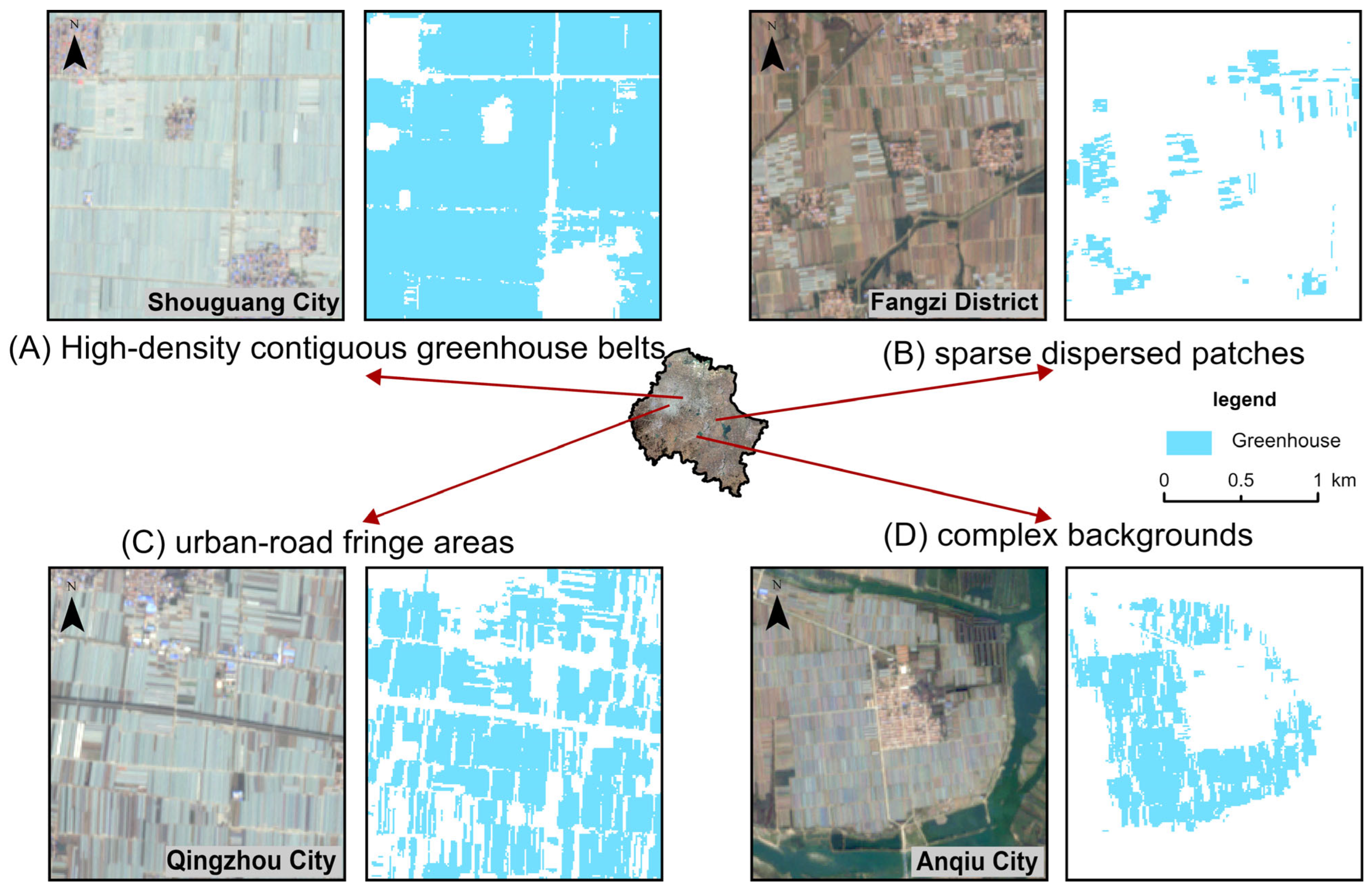
To suppress speckle-like noise and remove small isolated detections, we applied a connected-component (connected-pixel) filter to G t at 10 m resolution [53]. Connected patches smaller than MIN_PIX = 5 pixels were removed (equivalent to 500 m2). We set CONNECT_MAX = 256 as the maximum patch size used during connected-pixel counting for computational efficiency. Representative mapping outputs and typical commission/omission patterns across contrasting scene contexts are illustrated in Figure 3.

2.6. Accuracy Assessment

Annual mapping accuracy was evaluated using year-specific independent validation samples (Table 2). For each year, a confusion matrix was constructed by treating greenhouse (GH) pixels as the positive class and non-greenhouse pixels as the negative class [54]. Overall accuracy (OA), Cohen’s Kappa, and GH-specific precision, recall, and F1-score were used to summarize classification performance [55]. Let T P , T N , F P , and F N denote true positives, true negatives, false positives, and false negatives, respectively. The metrics were calculated as follows:
O A = T P + T N T P + T N + F P + F N
P r e c i s i o n G H = T P T P + F P
R e c a l l G H = T P T P + F N
F 1 G H = 2 × P r e c i s i o n G H × R e c a l l G H P r e c i s i o n G H + R e c a l l G H
K a p p a = p o p e 1 p e

2.7. Hexagon-Based Aggregation of Greenhouse Intensity

To reduce sensitivity to administrative boundaries and enable comparable spatial reporting, annual binary greenhouse presence maps G t were aggregated to a fixed-area hexagon grid (16 km2 per cell) in WGS 84/UTM Zone 50N (EPSG:32650) [17]. SWIR bands (B11/B12) and derived predictors were aligned to the 10 m grid using nearest-neighbor resampling during export in GEE. For each year t and hexagon h , greenhouse area was computed from 10 m pixel counts within the hexagon:
A h , t = N h , t · a pix
where N h , t denotes the number of pixels classified as greenhouse in G t , and a pix is the area of a single pixel (100 m2 at 10 m resolution). Hexagons intersecting the city boundary were clipped, and the effective area of each clipped hexagon was denoted as A h . Greenhouse intensity was then expressed as coverage percentage:
P h , t = 100 · A h , t A h
This normalization ensures that coverage estimates remain comparable for boundary cells with reduced effective area after clipping. The hexagon framework provides a uniform spatial unit for subsequent analysis of spatiotemporal dynamics and management-oriented typologies.

2.8. Pixel-Wise Process Typology and Hexagon Composition

We characterized long-term greenhouse dynamics using a strict four-class, pixel-wise process typology: Stable, Gain, Loss, and Flip. For each pixel, we constructed an annual binary presence sequence G t for t = 2016, …, 2025, where G t = 1 indicates greenhouse presence in year t and G t = 0 otherwise. To reduce spurious year-to-year flips caused by single-year noise, the sequence was stabilized using a 3-year temporal majority filter, with additional rules to fill isolated 1-0-1 gaps and remove isolated 0-1-0 spikes [56].
Based on the stabilized sequence, we computed the total number of greenhouse years S and the number of inter-annual transitions C :
S = t = 2016 2025 G t , C = t = 2016 2024 I G t + 1 G t
C counts the number of state changes between consecutive years in the binary sequence. Pixels with S > 0 were assigned to one of the four process classes as follows: Stable if S = 10 ; Gain if G 2016 = 0 , G 2025 = 1 , and C = 1 ; Loss if G 2016 = 1 , G 2025 = 0 , and C = 1 ; and Flip if C 2 [57].
Process rasters were further aggregated to the hexagon grid to quantify process areas (e.g., proc_stable, proc_gain, proc_loss, proc_flip) and their composition within each hexagon. For each hexagon h , the share of process k was computed as:
share h , k = proc h , k proc h , total , dom_share h = max k ( share h , k )
Here, proc h , k denotes the area of process k within hexagon h , and proc h , total = k proc h , k with k Stable , Gain , Loss , Flip . A hexagon was labelled Mixed when dom_share h < 0.5 , indicating that no single process type accounted for the majority of greenhouse dynamics within the cell.

2.9. Management Zoning (Z1–Z5)

Hexagon-level management zones (Z1–Z5) were defined by jointly considering (i) current greenhouse intensity, (ii) long-term intensity change, and (iii) process composition derived from the pixel-wise typology [58,59]. Current intensity was quantified as hexagon greenhouse coverage in 2025, P h , 2025 (%), and long-term change was expressed in percentage points as:
Δ P h = P h , 2025 P h , 2016 .
Δ P h is measured in percentage points (pp). Process composition was summarized by the shares of Stable/Gain/Loss/Flip area within each hexagon and by dominance (i.e., the largest process share), with hexagons labelled as Mixed when the dominance share was below 0.5.
Quantile thresholds of P h , 2025 and Δ P h were derived empirically from the subset of ever-GH hexagons (i.e., hexagons with non-zero greenhouse presence during 2016–2025) to ensure that zoning rules were calibrated on relevant cells [58]. Here, ever-GH hexagons refer to hexagons with non-zero greenhouse presence during 2016–2025. Zoning rules were then applied in a fixed order to avoid overlaps, first assigning candidate zones based on the joint position of P h , 2025 and Δ P h , and subsequently refining zone labels using process dominance and the Mixed criterion. The full set of quantile-based thresholds and decision rules is reported in Table 3.

2.10. Software and Reproducibility

Remote-sensing processing, including scene filtering, cloud/cirrus masking, temporal compositing, feature engineering, model training, and annual classification, was implemented in Google Earth Engine. Hexagon grid construction, spatial aggregation, and cartographic outputs were prepared in ArcGIS Pro 3.1.0 under WGS 84/UTM Zone 50N (EPSG:32650). Pixel-wise process typology computation and statistical table generation were implemented in Python 3.11 using geopandas, rasterio, numpy, and pandas.
To support methodological transparency, key settings are explicitly reported in the Methods section and associated tables, including temporal windows, the binarization threshold (T = 0.45; step = 0.01 for threshold screening), post-classification refinement parameters (MIN_PIX = 5; CONNECT_MAX = 256), and quantile-based zoning rules. The processing scripts and parameter files are retained by the authors for internal verification and are not publicly released because the workflow depends on project-specific interpretation samples and intermediate geospatial products. The main statistical outputs required to support the conclusions are reported in the manuscript and Supplementary Materials.

3. Results

3.1. Annual Mapping Accuracy

Year-specific accuracy metrics show stable overall agreement across 2016–2025, with overall accuracy (OA) ranging from 0.969 to 0.983 and Kappa from 0.740 to 0.841 (Table 4). Greenhouse (GH) detection achieves consistently high precision (0.855–0.976), whereas recall is lower (0.738–0.806), resulting in F1-scores of 0.806–0.850. Temporal variation is modest in OA (range: 0.014) but more pronounced for GH precision (range: 0.121) and recall (range: 0.068), indicating that year-to-year differences are mainly expressed as changes in GH commission/omission patterns rather than overall agreement.
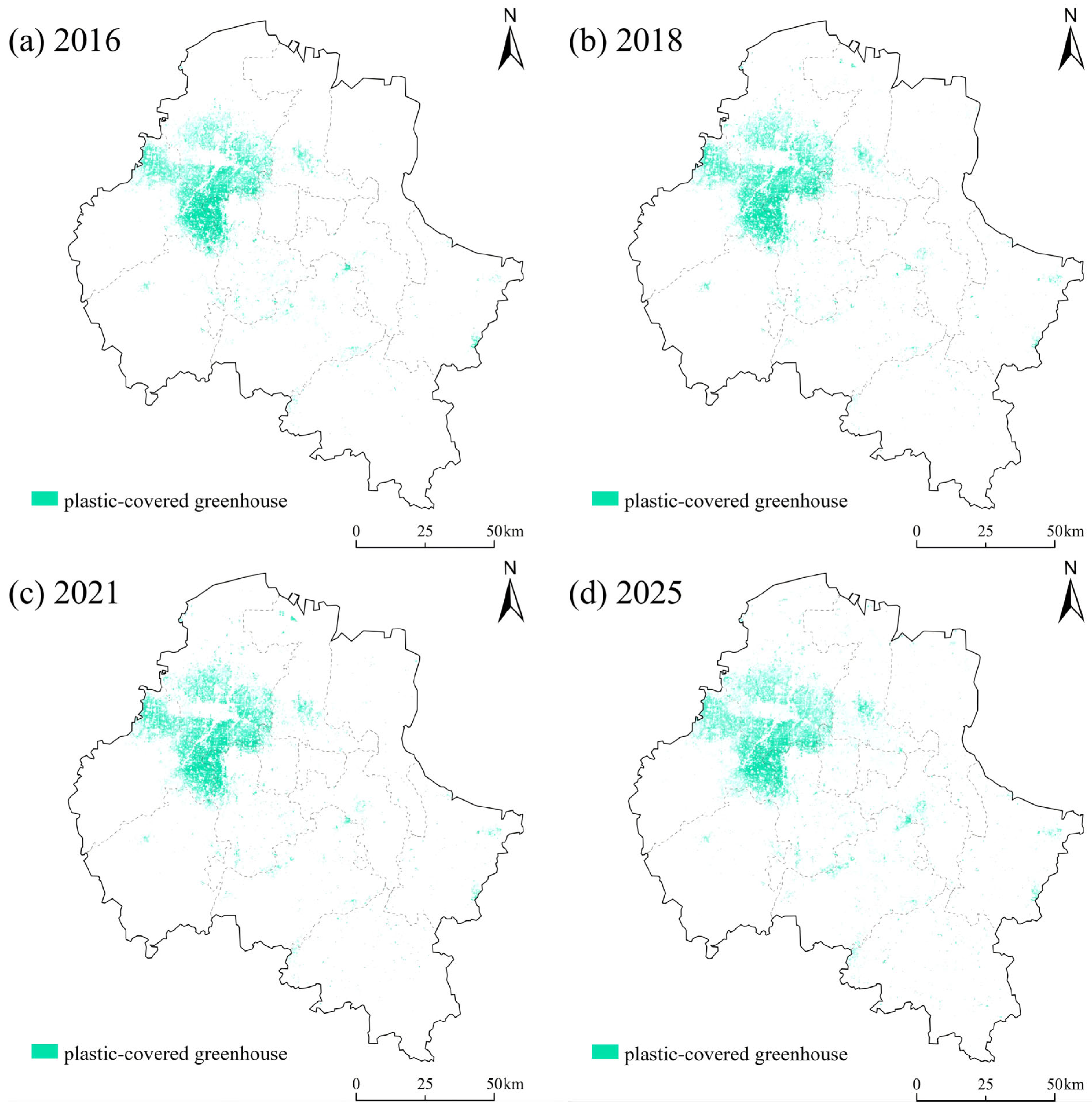
The spatialized annual mapping results further show that the classification outputs capture the main greenhouse distribution pattern across different years (Figure 4). In 2016, greenhouse areas were already concentrated in the northern core of Weifang, particularly around Shouguang, Qingzhou, and Changle. The 2018 and 2021 maps indicate that the core distribution remained spatially persistent, while changes were mainly observed along the margins of the main greenhouse belt. By 2025, the mapped greenhouse pattern still showed strong spatial concentration, with additional expansion signals appearing in peripheral and lower-density areas. These spatial outputs are consistent with the accuracy assessment results and provide the basis for subsequent area statistics, process typology, and management zoning analysis.

3.2. City-Wide Temporal Trajectory (2016–2025)

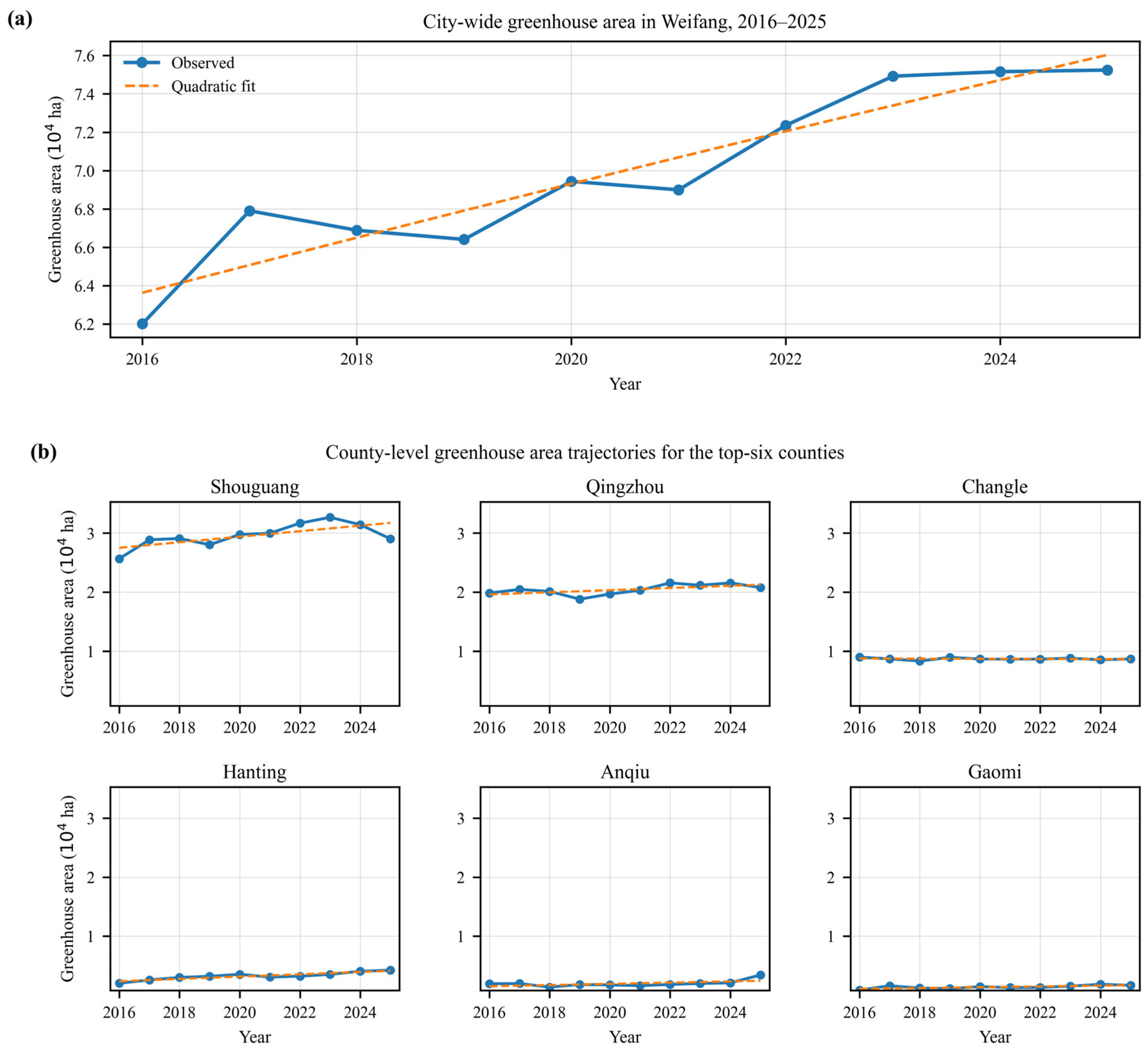
At the city scale, greenhouse area increased from 62,010.25 ha in 2016 to 75,241.87 ha in 2025, corresponding to a net gain of 13,231.62 ha (+21.3%) and an average annual growth rate of approximately 2.17% (Figure 5a). The trajectory shows a pronounced rise in 2017, a mild contraction during 2018–2019, renewed growth after 2020 with a brief dip around 2021, and a near-plateau during 2024–2025. County-level trajectories further indicate strong spatial heterogeneity: Shouguang and Qingzhou consistently exhibit the largest greenhouse areas among the top six counties, whereas Changle remains comparatively stable and Hanting and Anqiu show clearer upward trends toward the later years (Figure 5b).

3.3. Hexagon-Scale Spatial Pattern of Greenhouse Coverage

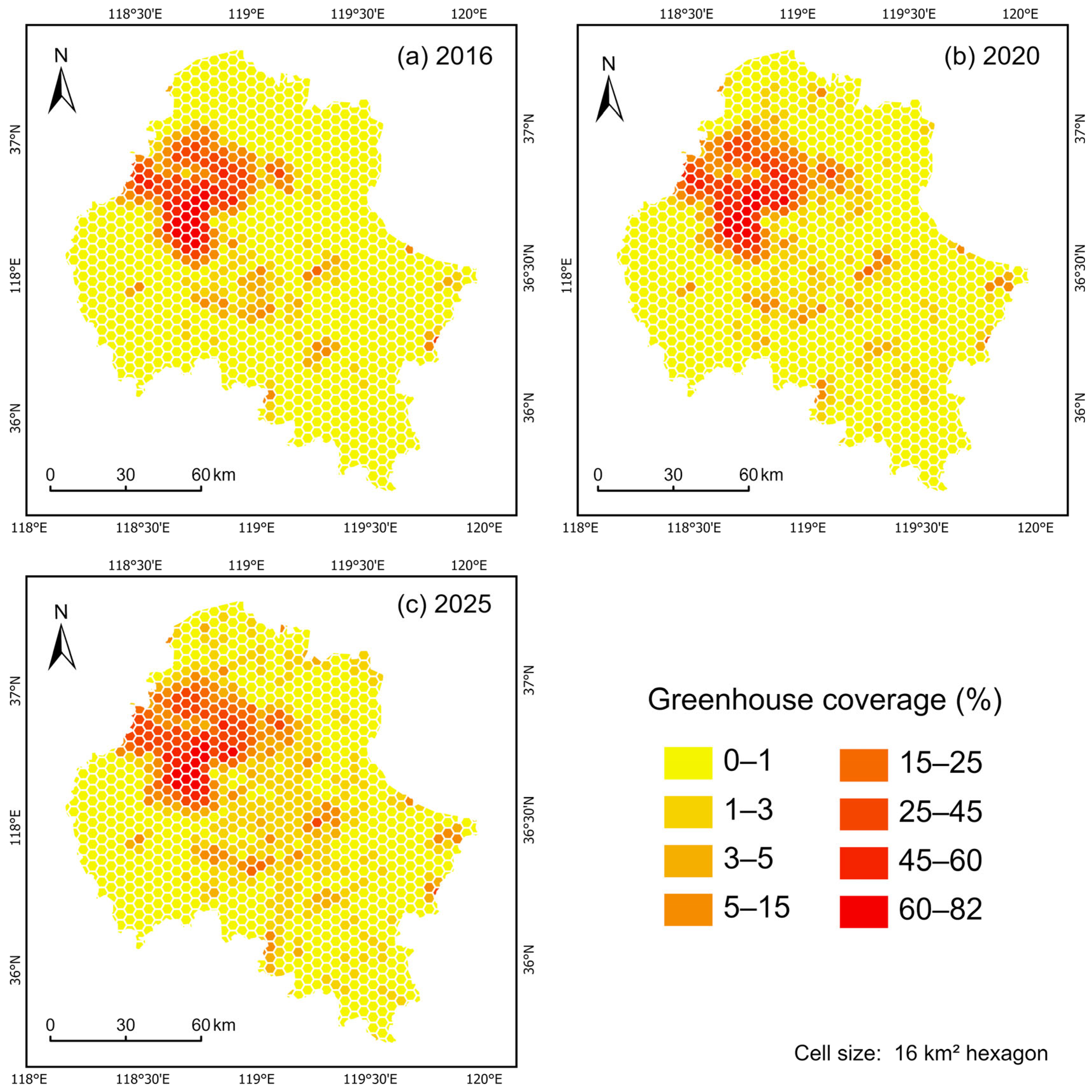
Hexagon-based aggregation (16 km2) reveals a strongly clustered and uneven distribution of greenhouse (GH) coverage across Weifang. Across the three benchmark years (2016, 2020, and 2025), high-coverage hexagons remain concentrated within a persistent core cluster, whereas most other areas are dominated by low-coverage cells (Figure 6). Using consistent class breaks, the overall footprint of the core cluster appears stable over time, while visible changes are mainly expressed along the outer margins of the cluster rather than across the entire city.
County-level totals for 2025 further indicate a high concentration of GH area: Shouguang, Qingzhou, and Changle together account for 77.7% of the city-wide GH area (38.6%, 27.6%, and 11.5%, respectively), suggesting that city-wide totals are largely dominated by these core counties (Table 5).

3.4. City-Wide Process Typology (2016–2025)

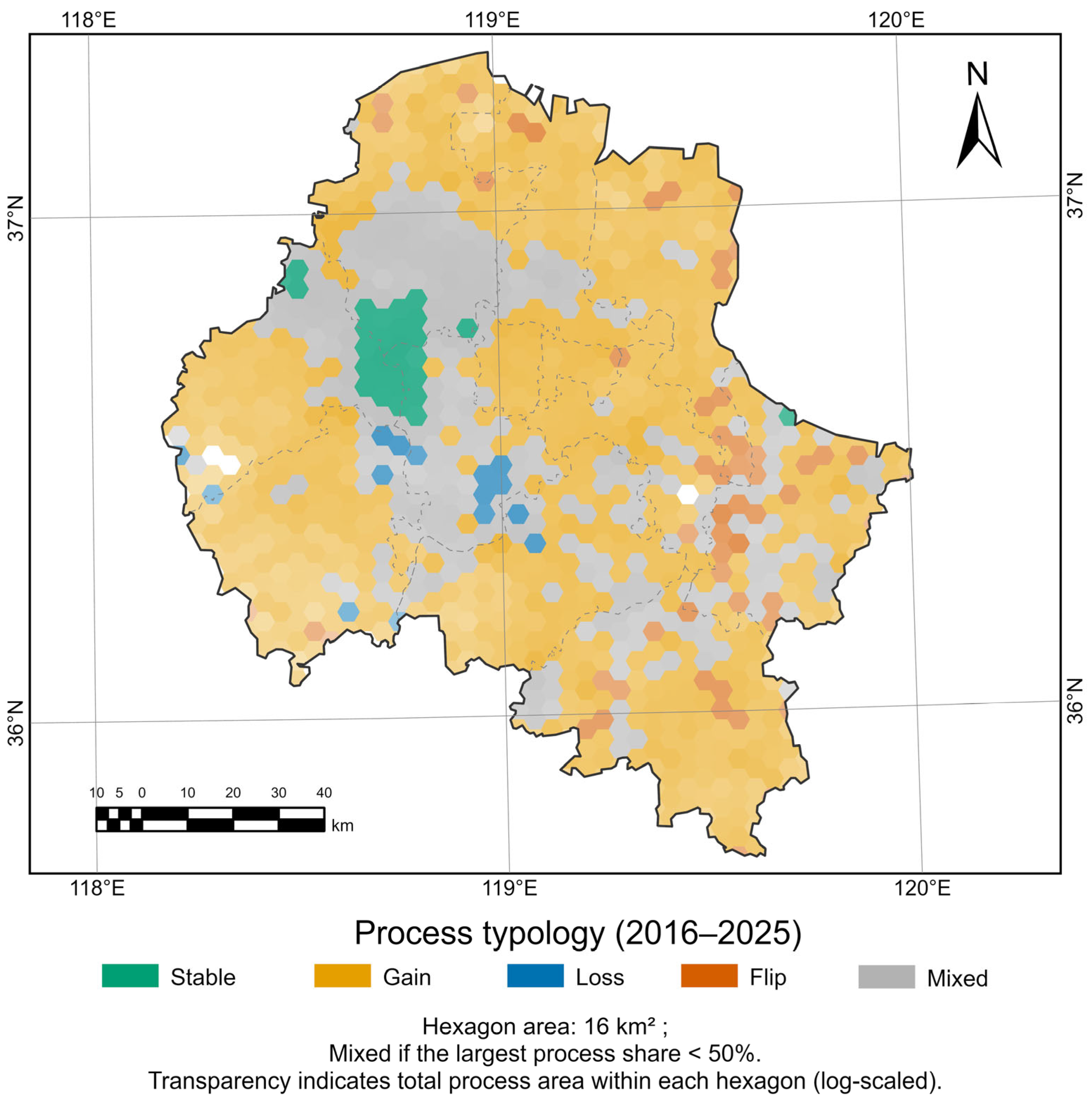
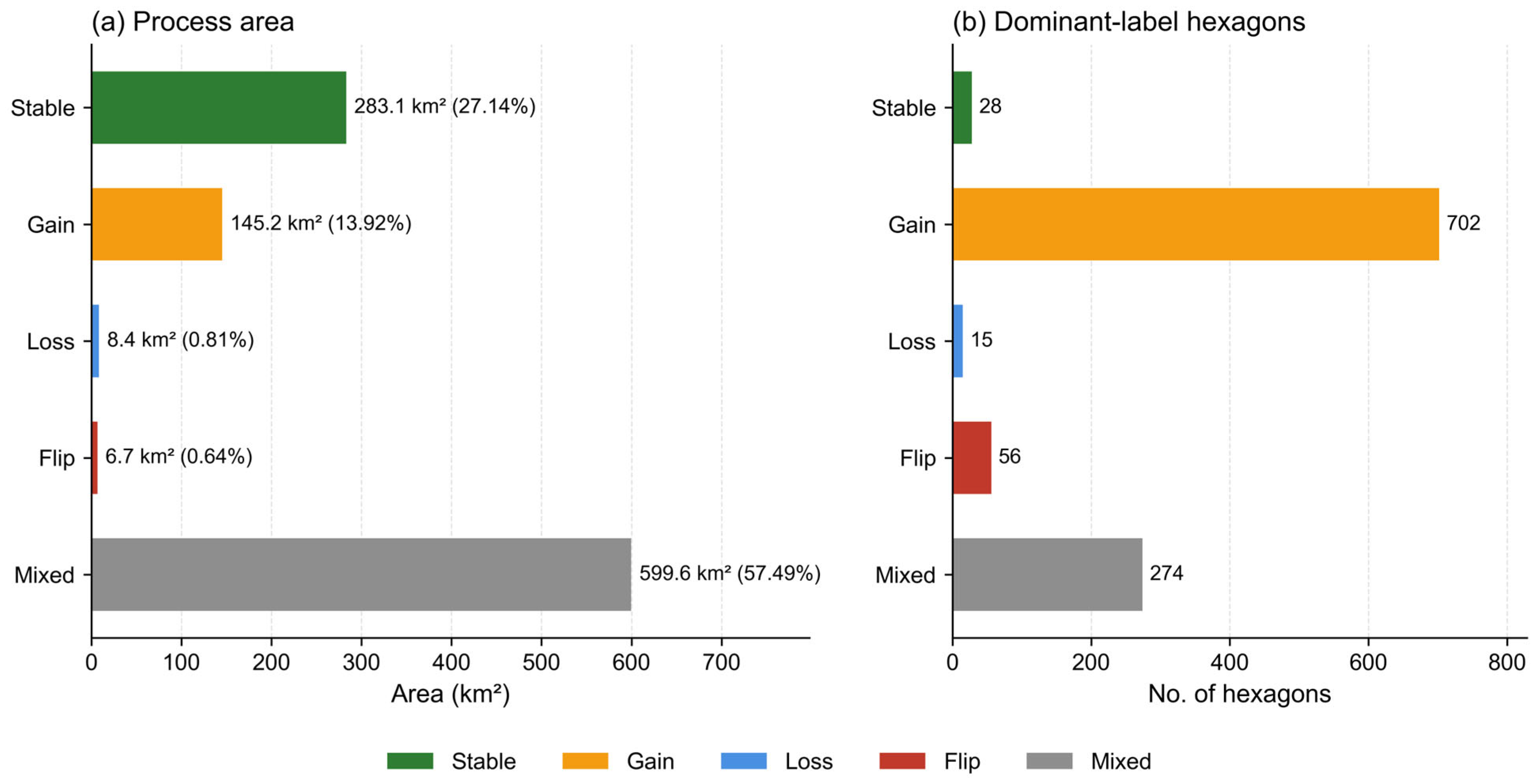
Hexagon-level process typology reveals substantial spatial heterogeneity in decadal greenhouse (GH) dynamics across Weifang (Figure 7). At the city scale, mixed-dominant hexagons, defined as units with dom_share < 0.50, accounted for the largest share of the ever-GH footprint, reaching 57.49% (599.6 km2), followed by stable-dominant hexagons at 27.14% (283.1 km2) (Figure 8). Gain-dominant hexagons contributed 13.92% (145.2 km2), whereas loss- and flip-dominant hexagons occupied only small proportions of the ever-GH footprint, accounting for 0.81% (8.4 km2) and 0.64% (6.7 km2), respectively. In terms of dominant-label counts, gain-dominant hexagons were the most numerous (702), followed by mixed-dominant hexagons (274), while stable-, flip-, and loss-dominant hexagons were much fewer (28, 56, and 15, respectively) (Figure 8). Spatially, the dominant process types formed an uneven mosaic, with stable-dominant hexagons concentrated in a localized cluster, whereas mixed-dominant hexagons were widely distributed across the rest of the study area.
Process dominance was also closely associated with current GH coverage intensity in 2025. Stable-dominant hexagons exhibited markedly higher 2025 coverage than gain-dominant and flip-dominant hexagons. Mixed-dominant hexagons showed an intermediate pattern, with a relatively low median coverage (3.01%) but a wide spread, indicating substantial within-city variability in process composition. Loss-dominant hexagons had a median coverage of 0.86%, but they were rare in both area (8.4 km2) and count (15 hexagons). Overall, these results suggest that the high-coverage core was primarily characterized by persistent GH presence, whereas gains and flips were more common in low-coverage settings and around the margins of the core area.

3.5. County-Level Contrasts in Four Dominant Process Types

Marked inter-county differences emerged in the composition of greenhouse processes over 2016–2025 (Table 6). Process shares were calculated as area-weighted proportions of the ever-GH footprint within each county. Therefore, they reflect long-term process composition rather than single-year stock conditions. Unlike the city-wide dominant-label summary in Figure 8, this county-level table reports the full Stable/Gain/Loss/Flip composition within each county and does not assign a Mixed category.
The northern core counties exhibited a relatively high share of Stable processes. Shouguang and Qingzhou, which had the largest ever-GH footprints, 415.7 km2 and 269.5 km2 respectively, showed Stable shares of 43.85% and 50.45%. Changle County displayed a comparable structure, with a Stable share of 47.17%, indicating a consolidated and mature greenhouse landscape with substantial persistence over the decade. In these counties, Gain shares remained moderate, ranging from 18.14% to 22.91%, suggesting incremental expansion superimposed on an established base.
In contrast, several peripheral counties were dominated by Gain processes. Hanting District, Anqiu City, Zhucheng City, Gaomi City, Linqu County, Fangzi District, Weicheng District, Changyi City, and Kuiwen District all showed Gain as the dominant process type. In Changyi and Kuiwen in particular, Gain shares reached 68.42%, indicating recent and concentrated expansion relative to their smaller historical base.
Loss and Flip processes accounted for smaller but non-negligible proportions within several counties. Loss shares ranged from 3.25% to 27.47%, while Flip shares ranged from 14.64% to 36.33%. Notably, Gaomi and Hanting exhibited relatively elevated Flip shares, at 36.33% and 28.71%, respectively, suggesting stronger temporal instability in these counties. Overall, the county-level composition reveals a clear spatial differentiation between a stabilized northern core with a high proportion of persistent greenhouse areas and a set of expanding peripheral counties characterized by Gain dominance. This structural contrast provides a meso-scale explanation for the city-wide process pattern and underpins the subsequent zoning-oriented interpretation.

3.6. Management Zoning Outcomes (Z1–Z5)

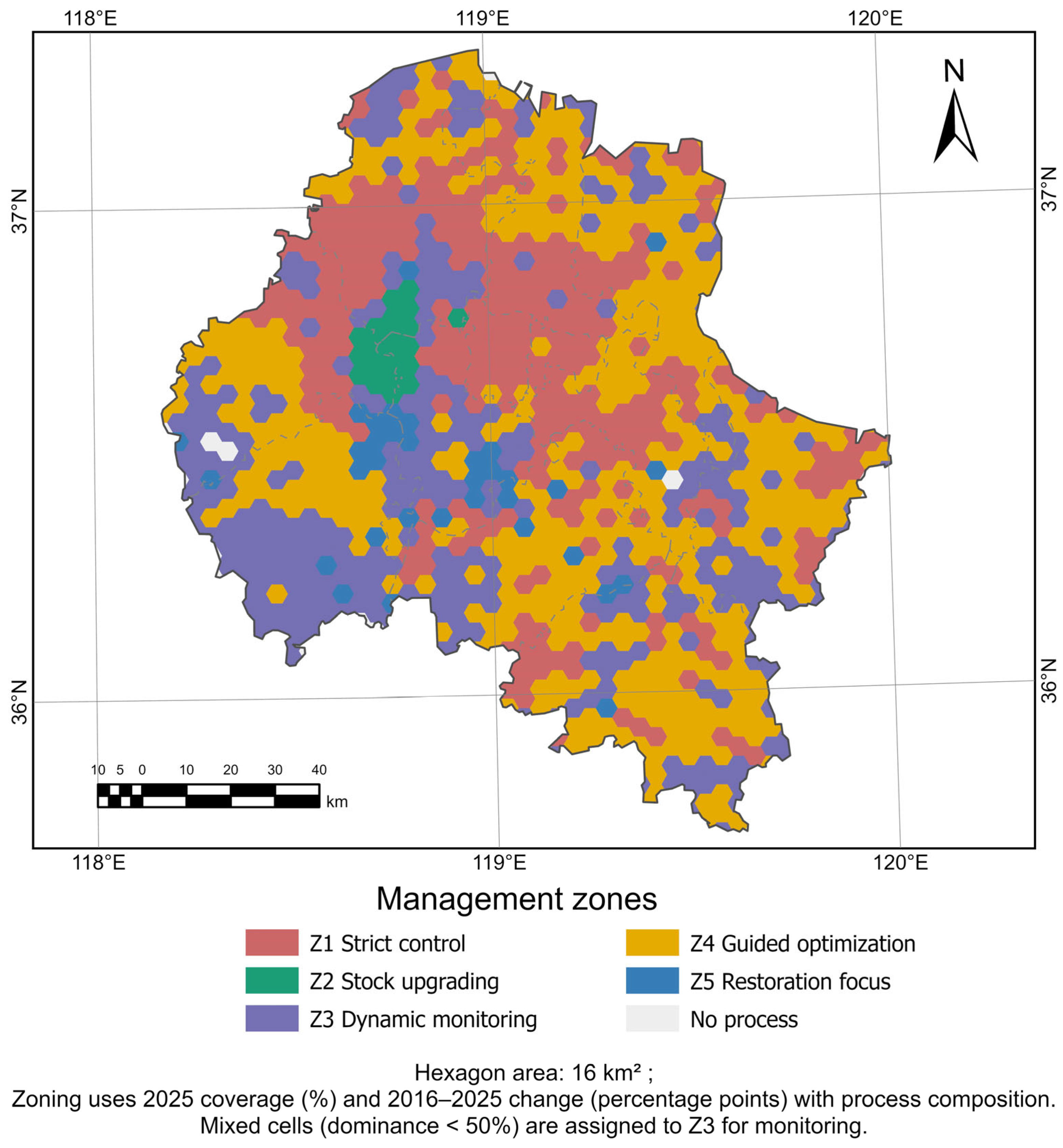
The management zoning framework integrates 2025 greenhouse intensity (P2025), long-term change in coverage (ΔP, 2016–2025), and process composition to delineate five actionable zone types across the ever-greenhouse hexagon set (n = 1075). The total zoned area is 15,839.58 km2. Z4 (Guided optimization) occupies the largest share (39.54%), followed by Z1 (Strict control; 28.88%) and Z3 (Dynamic monitoring; 26.21%). In contrast, Z2 (Stock upgrading) and Z5 (Restoration focus) represent small proportions of the zoned area (2.02% and 3.35%, respectively) (Figure 9; Table 7).
Zone-level statistics further distinguish the five types in terms of intensity, net change, and dominance structure. Z2 comprises a small set of very high-intensity hexagons, with a median P2025 of 62.002% (IQR 16.295), whereas Z1 is characterized by moderate-to-high intensity (median P2025 = 2.635%, IQR 7.454) and a positive net increase (median ΔP = 1.993 pp, IQR 2.579). Z3 shows low intensity and minimal net change (median P2025 = 0.103%, IQR 0.796; median ΔP = 0.052 pp, IQR 0.092), consistent with a monitoring-oriented class. Z4, the most extensive zone, exhibits low-to-moderate intensity (median P2025 = 0.510%, IQR 0.462) with a modest net increase (median ΔP = 0.436 pp, IQR 0.380). By contrast, Z5 is associated with net decline (median ΔP = −0.906 pp, IQR 1.935) despite a median intensity of P2025 = 1.011% (IQR 2.317).
Differences in dominance also emerge across zones. Median dom_share is highest in Z4 (0.704) and Z2 (0.700). Z3 shows the greatest dispersion in dominance (IQR dom_share = 0.466), indicating stronger within-zone heterogeneity in process composition. Spatially, the zoning map highlights a structured pattern in which strict-control and guided-optimization zones constitute the main spatial framework, while the high-intensity stock-upgrading cells appear as sparse hotspots embedded within the broader production landscape.

4. Discussion

4.1. Decadal Dynamics and Spatial Concentration

Across Weifang, the mapped greenhouse (GH) area increased from 62,010 ha in 2016 to 75,242 ha in 2025 (+21.3%). The trajectory shows an early rise, a downturn around 2018–2019, renewed growth after 2020, and a clear deceleration toward 2024–2025. Spatially, the city-wide total remains highly concentrated: in 2025, Shouguang, Qingzhou, and Changle together account for 77.7% of Weifang’s GH area. This concentration is consistent with earlier remote-sensing studies that identify the Shouguang–northwestern Weifang plain as a dominant greenhouse belt [9,35,59]. At the 16 km2 hexagon scale, high-coverage cells consistently cluster within a persistent core, whereas discernible changes are expressed mainly along the core margins rather than being evenly distributed across the municipality. From a governance perspective, this core–margin structure matters because a stable production core can dominate aggregate totals, while small, spatially localized adjustments at the margins can account for a disproportionate share of net change and may warrant more targeted monitoring and zoning responses.

4.2. Interpreting “Mixed” Dominance: Heterogeneity Versus Instability

The decade-long process typology highlights strong within-city heterogeneity. Mixed-dominance hexagons (defined as dom_share < 0.50) constitute the largest share of the ever-GH footprint (57.5%, 59,963 ha), whereas stable-dominance hexagons account for 27.1% (28,305 ha). Gain-dominant hexagons contribute 13.9%, while loss- and flip-dominant hexagons remain rare. Dominance is also systematically related to intensity: stable-dominant hexagons exhibit much higher 2025 coverage (median 54.5%) than gain- and flip-dominant hexagons, with mixed-dominance hexagons sitting between them, typically low in median coverage but spanning a wide range. Substantively, the pattern suggests a core–margin structure. Persistence dominates within a high-coverage core, while gains and flips are more often observed in low-coverage settings that coincide with fragmented land-use mosaics and edge environments [60].
At the same time, mixed dominance should not be interpreted as instability by default. In 10 m binary maps, boundary locations and narrow or interspersed features are more susceptible to mixed-pixel effects and label ambiguity, and small year-to-year differences near edges can inflate apparent transitions even after temporal stabilization [61,62]. For governance-oriented interpretation, mixed-dominance cells should be read as diagnostic zones rather than definitive change signals. They capture both marginal dynamics and elevated uncertainty, so targeted review is more informative than strong causal inference.

4.3. Positioning Relative to Existing Greenhouse Mapping and MAUP-Aware Aggregation

Methodologically, this study sits within a mature stream of Sentinel-2 greenhouse mapping that combines multi-spectral predictors (including seasonal contrasts) with supervised classification, alongside recent deep-learning variants that target complex backgrounds and large-area deployment [40]. Rather than proposing a new mapping paradigm, our contribution is what consistent annual maps enable: a pixel-wise decadal process typology, hexagon-level process composition, and a transparent rule-based management zoning that translates long-term dynamics into interpretable priorities.
A second thread concerns spatial support and the modifiable areal unit problem (MAUP). Aggregating 10 m outputs to a fixed 16 km2 hexagon grid improves cross-space comparability, reduces dependence on administrative boundaries, and provides a consistent unit for linking intensity, change, and process composition. However, MAUP implies that indicator magnitudes and apparent spatial coherence can vary with both unit size and zoning design, so results should be interpreted as conditional on the chosen support and summarization rules [63,64]. In this light, a “dominant process” label is a within-cell summary and should not be read as spatial uniformity inside a hexagon.
These considerations also apply to zoning based on percentile (quantile) thresholds. Percentile cutoffs are distribution-dependent and therefore conditional on the selected support and the reference sample (here, ever-GH hexagons) [65]. Transferring the same cutoffs to other regions or alternative supports would require recalibration. Where space allows, a concise scale-sensitivity check using one or two alternative supports can further demonstrate whether the main zoning patterns are robust to reasonable changes in aggregation [64].

4.4. Uncertainty and Limitations Implied by the Design

The accuracy profile is stable across years, with OA (~0.97–0.98) and Kappa (~0.74–0.84) remaining consistently high. GH precision remains high, whereas recall is consistently lower. This systematic asymmetry suggests an omission-dominated error pattern, so annual GH area is more likely to be underestimated—especially where greenhouses are small or fragmented, affected by shadow, or spectrally confounded with other bright surfaces [66]. Two design choices explicitly trade sensitivity for temporal comparability: a fixed probability threshold (T = 0.45) applied to all years, and a minimum connected-pixel filter (MIN_PIX = 5) that removes small isolated patches from annual outputs. From an operational perspective, this conservative bias is compatible with compliance-oriented screening (where false alarms are costly), but users should interpret area totals cautiously in edge environments with fine-grained greenhouse mosaics.
Temporal stabilization of the binary sequence (3-year majority voting, filling 1–0–1 gaps, and removing 0–1–0 spikes) further reduces spurious interannual fluctuations and facilitates interpretation of decadal process categories [51]. At the same time, this procedure constrains what the “Flip” class can capture: in practice, it reflects recurring switching in mapped presence at the 10 m support after smoothing, rather than a complete record of short-lived, one-year conversions. These choices are defensible for long-term consistency, but they require explicit reporting of steps and parameters so that downstream users can evaluate the resulting indicators appropriately [67]. Accordingly, flip- and decline-related signals are best interpreted as screening flags for targeted verification—particularly in fragmented edge environments—rather than as definitive evidence of rapid on–off greenhouse management.
Several limitations remain in the present analysis. First, although the training and validation samples were kept separate, plastic-covered greenhouses are spatially clustered, and residual spatial autocorrelation between samples cannot be fully excluded. The reported accuracy values should therefore be interpreted as sample-based estimates rather than as results from a fully spatial-blocked validation design. Second, recall was consistently lower than precision, indicating that omission errors were a more important source of uncertainty than commission errors. This conservative mapping tendency may underestimate persistent and newly expanded greenhouse areas and may also affect the derived loss, flip, and mixed classes. Third, the temporal stabilization rules were useful for reducing isolated one-year noise, but they may also suppress real short-term construction, abandonment, or replacement events. For this reason, the Flip and Mixed categories should be treated as screening indicators of unstable or uncertain dynamics rather than as direct evidence of frequent land-use conversion. Finally, the 16 km2 hexagon grid and the quantile-based zoning thresholds provide a consistent exploratory spatial support, but they do not represent an optimized zoning scale or a final management boundary. Future work should test threshold sensitivity, alternative grid sizes, and spatially blocked validation designs when more time and data are available.

4.5. Governance Implications and Boundaries of Inference

The zoning framework provides a transparent bridge from remote-sensing indicators to management-oriented prioritization by combining current intensity (P2025), long-term change (ΔP, 2016→2025), and process composition. Over the ever-GH hexagon set, Z4 (Guided optimization) accounts for the largest area share (39.5%), followed by Z1 (Strict control; 28.9%) and Z3 (Dynamic monitoring; 26.2%). Z2 (Stock upgrading) and Z5 (Restoration focus) each account for less than 5% of the ever-GH area.
Importantly, the zoning map should be interpreted as an evidence-informed screening and prioritization layer rather than a compliance or adjudication instrument [68]. Z4 (Guided optimization) represents growth-dominant landscapes at low-to-moderate intensity. In practical terms, these areas are suitable for guided expansion and layout optimization, where planning support and standardized infrastructure can steer dispersed growth toward more orderly development. Recent work on Earth observation for policy implementation and enforcement consistently emphasizes that EO-derived signals are most defensible when used to prioritize monitoring resources and trigger follow-up checks, supported by transparent uncertainty communication and clear protocols [69].
Within this interpretation, Z2 isolates very high-intensity and predominantly stable greenhouse landscapes (median P2025 = 62.0%), which supports interventions centered on retrofitting, environmental performance, and infrastructure upgrading rather than additional expansion. Z1 highlights areas with moderate-to-high intensity coupled with rapid net increase or volatility (median ΔP ≈ 2.0 percentage points), where closer review of new conversions and stricter permitting scrutiny are most justifiable under cropland protection and land-use governance agendas [70]. Z3, together with mixed-dominance areas, warrants sustained monitoring because heterogeneity, edge effects, and mapping uncertainty tend to concentrate there; these are also settings where dispersed small additions can accumulate into meaningful net change. Z5 captures net decline (median ΔP ≈ −0.9 percentage points), but apparent decline may arise from genuine removal, land-use substitution, or persistent omission in complex backgrounds. Accordingly, Z5 is best treated as a screening layer that prioritizes targeted verification and contextual interpretation, rather than as a standalone indication of restoration outcomes.

4.6. Transferability and Next Steps

Core elements of the workflow—Sentinel-2 feature engineering, RF-based probability mapping, a fixed decision threshold, and cloud-scale implementation—are broadly transferable, and related designs have been adopted in regional to global greenhouse mapping efforts. The main constraint on transferability is therefore less computational than interpretive: low-coverage, mixed, and edge settings constitute a large fraction of the ever-GH footprint, and these are precisely the contexts where background-dependent confusions (e.g., roads, bright roofs, bare soil, and seasonal surface changes) are widely reported to challenge greenhouse detection. Two extensions would strengthen the scientific contribution while remaining directly relevant to Land’s governance-oriented audience. First, a concise scale-sensitivity appendix could quantify how MAUP affects zoning shares and process composition when alternative spatial supports are used. Second, an uncertainty-facing companion product could report per-hexagon probability summaries and/or stability diagnostics alongside the categorical zone, enabling end users to distinguish “high-priority and certain” areas from “high-priority but ambiguous” ones and to prioritize targeted verification accordingly.

5. Conclusions

This study developed a decade-consistent workflow to map plastic-covered greenhouses in Weifang from 2016 to 2025 using Sentinel-2 imagery processed in Google Earth Engine. The workflow used a Random Forest classifier trained on pooled multi-year samples, a fixed probability threshold (T = 0.45), and post-classification connected-pixel filtering. Year-specific independent validation indicates stable overall agreement, with OA ranging from 0.969 to 0.983 and Kappa ranging from 0.740 to 0.841. Greenhouse-specific precision remained consistently high (0.855–0.976), whereas recall was lower (0.738–0.806), suggesting a conservative detection tendency in which omissions remain the dominant risk.
At the city scale, greenhouse area increased from 620.10 km2 in 2016 to 752.42 km2 in 2025, corresponding to a net increase of 132.32 km2 and a relative growth of 21.3%. The 2025 greenhouse stock was strongly concentrated in the northern core of Weifang, where the top three counties accounted for 77.7% of the city-wide total. Aggregation to a fixed 16 km2 hexagon grid enabled process-oriented interpretation at a governance-relevant spatial support. Mixed-dominance cells represented 57.49% of the ever-GH footprint, whereas stable-dominant cores accounted for 27.14% and sustained substantially higher 2025 coverage, with a median coverage of 54.47%.
Overall, the proposed workflow links annual mapping, process typology, and hexagon-based zoning in a consistent spatial framework. Its main value lies in summarizing where greenhouse land use remained persistent, where expansion occurred, and where mapped dynamics were more uncertain. The zoning results should be understood as an exploratory screening layer for differentiated monitoring and targeted verification, rather than as a final management plan. Practical land-use decisions would require further field checks and the integration of socioeconomic conditions, policy constraints, and multi-scale uncertainty analysis.

Supplementary Materials

The following supporting information can be downloaded at: https://www.mdpi.com/article/10.3390/land15071109/s1, Table S1: Top-30 predictors retained in the final Random Forest model.

Author Contributions

Conceptualization, S.G. and L.W.; methodology, S.G. and L.W.; software, S.G.; validation, S.G.; formal analysis, S.G.; investigation, S.G.; resources, L.W.; data curation, S.G.; writing—original draft preparation, S.G.; writing—review and editing, S.G. and L.W.; visualization, S.G.; supervision, L.W.; project administration, L.W.; funding acquisition, L.W. All authors have read and agreed to the published version of the manuscript.

Funding

This research was funded by the National Natural Science Foundation of China (grant number U2244230); the Ministry-Province Cooperative Project under the Ministry of Natural Resources (grant number 2024ZRBSHZ098); and the National Key Research and Development Program of China (grant number 2021YFB3901305).

Data Availability Statement

The Sentinel-2 imagery and Dynamic World data used in this study are publicly available through Google Earth Engine. The derived annual greenhouse maps, interpretation samples, intermediate geospatial products, and processing scripts are not publicly archived because they are part of an ongoing institutional research project and include project-specific interpretation data. The main statistical results supporting the findings are included in the article and Supplementary Materials. Additional information may be made available from the corresponding author upon reasonable request, subject to institutional and data-use restrictions.

Acknowledgments

The authors thank the providers of the Google Earth Engine platform and the Sentinel-2 and Dynamic World datasets used in this study.

Conflicts of Interest

The authors declare no conflicts of interest. The funders had no role in the design of the study; in the collection, analyses, or interpretation of data; in the writing of the manuscript; or in the decision to publish the results.

References

  1. Veettil, B.K.; Van, D.D.; Quang, N.X.; Hoai, P.N. Remote Sensing of Plastic-covered Greenhouses and Plastic-mulched Farmlands: Current Trends and Future Perspectives. Land Degrad. Dev. 2023, 34, 591–609. [Google Scholar] [CrossRef]
  2. Wang, K.; Chen, W.; Tian, J.; Niu, F.; Xing, Y.; Wu, Y.; Zhang, R.; Zheng, J.; Xu, L. Accumulation of Microplastics in Greenhouse Soil after Long-Term Plastic Film Mulching in Beijing, China. Sci. Total Environ. 2022, 828, 154544. [Google Scholar] [CrossRef] [PubMed]
  3. Jiménez-Lao, R.; Aguilar, F.J.; Nemmaoui, A.; Aguilar, M.A. Remote Sensing of Agricultural Greenhouses and Plastic-Mulched Farmland: An Analysis of Worldwide Research. Remote Sens. 2020, 12, 2649. [Google Scholar] [CrossRef]
  4. Chen, Y.; Wang, Z.; You, K.; Zhu, C.; Wang, K.; Gan, M.; Zhang, J. Trends, Drivers, and Land Use Strategies for Facility Agricultural Land during the Agricultural Modernization Process: Evidence from Huzhou City, China. Land 2024, 13, 543. [Google Scholar] [CrossRef]
  5. Yang, D.; Chen, J.; Zhou, Y.; Chen, X.; Chen, X.; Cao, X. Mapping Plastic Greenhouse with Medium Spatial Resolution Satellite Data: Development of a New Spectral Index. ISPRS J. Photogramm. Remote Sens. 2017, 128, 47–60. [Google Scholar] [CrossRef]
  6. Sun, H.; Wang, L.; Lin, R.; Zhang, Z.; Zhang, B. Mapping Plastic Greenhouses with Two-Temporal Sentinel-2 Images and 1D-CNN Deep Learning. Remote Sens. 2021, 13, 2820. [Google Scholar] [CrossRef]
  7. Zhang, M.; Dong, J.; Ge, Q.; Hasituya; Hao, P. A Review of Agricultural Film Mapping: Current Status, Challenges, and Future Directions. J. Remote Sens. 2025, 5, 0395. [Google Scholar] [CrossRef]
  8. Acharki, S.; Veettil, B.K.; Vizzari, M. Plastic-Covered Greenhouses Mapping in Morocco with Google Earth Engine: Comparing Sentinel-2 and Landsat-8 Data Using Pixel- and Object-Based Methods. Remote Sens. Appl. Soc. Environ. 2024, 34, 101158. [Google Scholar] [CrossRef]
  9. Ou, C.; Yang, J.; Du, Z.; Liu, Y.; Feng, Q.; Zhu, D. Long-Term Mapping of a Greenhouse in a Typical Protected Agricultural Region Using Landsat Imagery and the Google Earth Engine. Remote Sens. 2019, 12, 55. [Google Scholar] [CrossRef]
  10. Chen, D.; Ma, A.; Zheng, Z.; Zhong, Y. Large-Scale Agricultural Greenhouse Extraction for Remote Sensing Imagery Based on Layout Attention Network: A Case Study of China. ISPRS J. Photogramm. Remote Sens. 2023, 200, 73–88. [Google Scholar] [CrossRef]
  11. Zhou, C.; Huang, J.; Xiao, Y.; Du, M.; Li, S. A Novel Approach: Coupling Prior Knowledge and Deep Learning Methods for Large-Scale Plastic Greenhouse Extraction Using Sentinel-1/2 Data. Int. J. Appl. Earth Obs. Geoinf. 2024, 132, 104073. [Google Scholar] [CrossRef]
  12. Niu, B.; Feng, Q.; Qiu, B.; Su, S.; Zhang, X.; Cui, R.; Zhang, X.; Sun, F.; Yan, W.; Zhao, S.; et al. Global-PCG-10: A 10 m Global Map of Plastic-Covered Greenhouses Derived from Sentinel-2 in 2020. Earth Syst. Sci. Data 2025, 17, 5065–5088. [Google Scholar] [CrossRef]
  13. Zhu, L.; Sun, W.; Fan, D.; Xing, H.; Ban, H. Exploring the Level of Agricultural Development Using Greenhouse Mapping: A Case Study of Shandong Province, China. IEEE J. Sel. Top. Appl. Earth Obs. Remote Sens. 2025, 18, 5793–5809. [Google Scholar] [CrossRef]
  14. Hong, R.; Xiao, B.; Yan, H.; Liu, J.; Liu, P.; Song, Z. Multitemporal Greenhouse Mapping for High-Resolution Remote Sensing Imagery Based on an Improved YOLOX. Comput. Electron. Agric. 2023, 206, 107689. [Google Scholar] [CrossRef]
  15. Eilola, S.; Käyhkö, N.; Fagerholm, N. Lessons Learned from Participatory Land Use Planning with High-Resolution Remote Sensing Images in Tanzania: Practitioners’ and Participants’ Perspectives. Land Use Policy 2021, 109, 105649. [Google Scholar] [CrossRef]
  16. Carrido, A.J.D.C.; Felix, P.A.G.; Soriano, F.A.; Esmeralda, A.K.B.; Petacio, A.F.; Aminulla, M.H.K.; Roxas, R.R.; Magayanes, L.M.; Padao, I.C.; Rivera, M.A. A Geospatial Analytical Framework for Assessing Land Use and Zoning Compliance: The Case of Zamboanga City. ISPRS Ann. Photogramm. Remote Sens. Spat. Inf. Sci. 2026, X-5/W4-2025, 135–142. [Google Scholar] [CrossRef]
  17. Jelinski, D.E.; Wu, J. The Modifiable Areal Unit Problem and Implications for Landscape Ecology. Landsc. Ecol. 1996, 11, 129–140. [Google Scholar] [CrossRef]
  18. Openshaw, S. The Modifiable Areal Unit Problem; Concepts and Techniques in Modern Geography; Geo Books: Norwich, UK, 1983. [Google Scholar]
  19. Bousquin, J. Discrete Global Grid Systems as Scalable Geospatial Frameworks for Characterizing Coastal Environments. Environ. Model. Softw. 2021, 146, 105210. [Google Scholar] [CrossRef] [PubMed]
  20. Nalej, M. Scale and Aggregation Effects of MAUP on Built-Up Area Concentration: Evidence from the Łódź Metropolitan Area. ISPRS Int. J. Geo-Inf. 2026, 15, 72. [Google Scholar] [CrossRef]
  21. Graesser, J.; Stanimirova, R.; Tarrio, K.; Copati, E.J.; Volante, J.N.; Verón, S.R.; Banchero, S.; Elena, H.; de Abelleyra, D.; Friedl, M.A. Temporally-Consistent Annual Land Cover from Landsat Time Series in the Southern Cone of South America. Remote Sens. 2022, 14, 4005. [Google Scholar] [CrossRef]
  22. Pontius, R.G., Jr.; Krithivasan, R.; Sauls, L.; Yan, Y.; Zhang, Y. Methods to Summarize Change among Land Categories across Time Intervals. J. Land Use Sci. 2017, 12, 218–230. [Google Scholar] [CrossRef]
  23. Guilherme, F.; Gonçalves, J.A.; Carretero, M.A.; Farinha-Marques, P. Assessment of Land Cover Trajectories as an Indicator of Urban Habitat Temporal Continuity. Landsc. Urban Plan. 2024, 242, 104932. [Google Scholar] [CrossRef]
  24. Drusch, M.; Del Bello, U.; Carlier, S.; Colin, O.; Fernandez, V.; Gascon, F.; Hoersch, B.; Isola, C.; Laberinti, P.; Martimort, P.; et al. Sentinel-2: ESA’s Optical High-Resolution Mission for GMES Operational Services. Remote Sens. Environ. 2012, 120, 25–36. [Google Scholar] [CrossRef]
  25. Breiman, L. Random Forests. Mach. Learn. 2001, 45, 5–32. [Google Scholar] [CrossRef]
  26. Belgiu, M.; Drăguţ, L. Random Forest in Remote Sensing: A Review of Applications and Future Directions. ISPRS J. Photogramm. Remote Sens. 2016, 114, 24–31. [Google Scholar] [CrossRef]
  27. Stehman, S.V. Selecting and Interpreting Measures of Thematic Classification Accuracy. Remote Sens. Environ. 1997, 62, 77–89. [Google Scholar] [CrossRef]
  28. Stough, T.; Cressie, N.; Kang, E.L.; Michalak, A.M.; Sahr, K. Spatial Analysis and Visualization of Global Data on Multi-Resolution Hexagonal Grids. Jpn. J. Stat. Data Sci. 2020, 3, 107–128. [Google Scholar] [CrossRef] [PubMed]
  29. Liang, Q.; Zhou, J.; Ben, J.; Chen, Y.; Huang, X.; Ding, J.; Dai, J. Precise Hexagonal Pixel Modeling and an Easy-Sharing Storage Scheme for Remote Sensing Images Based on Discrete Global Grid System. Int. J. Digit. Earth 2024, 17, 2328824. [Google Scholar] [CrossRef]
  30. Robert Gilmore Pontius, J.; Gao, Y.; Giner, N.M.; Kohyama, T.; Osaki, M.; Hirose, K. Design and Interpretation of Intensity Analysis Illustrated by Land Change in Central Kalimantan, Indonesia. Land 2013, 2, 351–369. [Google Scholar] [CrossRef]
  31. Aldwaik, S.Z.; Pontius, R.G. Intensity Analysis to Unify Measurements of Size and Stationarity of Land Changes by Interval, Category, and Transition. Landsc. Urban Plan. 2012, 106, 103–114. [Google Scholar] [CrossRef]
  32. Zheng, Y.; Dian, Y.; Guo, Z.; Yao, C.; Wu, X. A Functional Zoning Method in Rural Landscape Based on High-Resolution Satellite Imagery. Remote Sens. 2023, 15, 4920. [Google Scholar] [CrossRef]
  33. Beck, H.E.; Zimmermann, N.E.; McVicar, T.R.; Vergopolan, N.; Berg, A.; Wood, E.F. Present and Future Köppen-Geiger Climate Classification Maps at 1-Km Resolution. Sci. Data 2018, 5, 180214. [Google Scholar] [CrossRef] [PubMed]
  34. Chen, J.; Chen, J.; Liao, A.; Cao, X.; Chen, L.; Chen, X.; He, C.; Han, G.; Peng, S.; Lu, M.; et al. Global Land Cover Mapping at 30 m Resolution: A POK-Based Operational Approach. ISPRS J. Photogramm. Remote Sens. 2015, 103, 7–27. [Google Scholar] [CrossRef]
  35. Liu, X.; Xiao, B.; Jiao, J.; Hong, R.; Li, Y.; Liu, P. Remote Sensing Detection and Mapping of Plastic Greenhouses Based on YOLOX+: A Case Study in Weifang, China. Comput. Electron. Agric. 2024, 218, 108702. [Google Scholar] [CrossRef]
  36. Gorelick, N.; Hancher, M.; Dixon, M.; Ilyushchenko, S.; Thau, D.; Moore, R. Google Earth Engine: Planetary-Scale Geospatial Analysis for Everyone. Remote Sens. Environ. 2017, 202, 18–27. [Google Scholar] [CrossRef]
  37. Harmonized Sentinel-2 MSI: MultiSpectral Instrument, Level-1C (TOA)|Earth Engine Data Catalog. Available online: https://developers.google.com/earth-engine/datasets/catalog/COPERNICUS_S2_HARMONIZED?hl=zh-cn (accessed on 28 February 2026).
  38. Brown, C.F.; Brumby, S.P.; Guzder-Williams, B.; Birch, T.; Hyde, S.B.; Mazzariello, J.; Czerwinski, W.; Pasquarella, V.J.; Haertel, R.; Ilyushchenko, S.; et al. Dynamic World, Near Real-Time Global 10 m Land Use Land Cover Mapping. Sci. Data 2022, 9, 251. [Google Scholar] [CrossRef]
  39. Dynamic World V1|Earth Engine Data Catalog. Available online: https://developers.google.com/earth-engine/datasets/catalog/GOOGLE_DYNAMICWORLD_V1?hl=zh-cn (accessed on 28 February 2026).
  40. Zhang, P.; Du, P.; Guo, S.; Zhang, W.; Tang, P.; Chen, J.; Zheng, H. A Novel Index for Robust and Large-Scale Mapping of Plastic Greenhouse from Sentinel-2 Images. Remote Sens. Environ. 2022, 276, 113042. [Google Scholar] [CrossRef]
  41. Jiménez-Lao, R.; Aguilar, M.A.; Aguilar, F.J. PLASTIC COVER GREENHOUSES REFLECTANCE SPECTRA FROM DIFFERENT OPTICAL SATELLITE IMAGERY. Int. Arch. Photogramm. Remote Sens. Spat. Inf. Sci. 2022, XLIII-B2-2022, 585–592. [Google Scholar] [CrossRef]
  42. Liu, J.; Heiskanen, J.; Aynekulu, E.; Maeda, E.; Pellikka, P. Land Cover Characterization in West Sudanian Savannas Using Seasonal Features from Annual Landsat Time Series. Remote Sens. 2016, 8, 365. [Google Scholar] [CrossRef]
  43. Olofsson, P.; Foody, G.M.; Herold, M.; Stehman, S.V.; Woodcock, C.E.; Wulder, M.A. Good Practices for Estimating Area and Assessing Accuracy of Land Change. Remote Sens. Environ. 2014, 148, 42–57. [Google Scholar] [CrossRef]
  44. Verhulst, M.; Heremans, S.; Blaschko, M.B.; Somers, B. Temporal Transferability of Tree Species Classification in Temperate Forests with Sentinel-2 Time Series. Remote Sens. 2024, 16, 2653. [Google Scholar] [CrossRef]
  45. Filippelli, S.K.; Schleeweis, K.; Nelson, M.D.; Fekety, P.A.; Vogeler, J.C. Testing Temporal Transferability of Remote Sensing Models for Large Area Monitoring. Sci. Remote Sens. 2024, 9, 100119. [Google Scholar] [CrossRef]
  46. Genuer, R.; Poggi, J.-M.; Tuleau-Malot, C. Variable Selection Using Random Forests. Pattern Recognit. Lett. 2010, 31, 2225–2236. [Google Scholar] [CrossRef]
  47. Strobl, C.; Boulesteix, A.-L.; Zeileis, A.; Hothorn, T. Bias in Random Forest Variable Importance Measures: Illustrations, Sources and a Solution. BMC Bioinform. 2007, 8, 25. [Google Scholar] [CrossRef] [PubMed]
  48. Davis, J.; Goadrich, M. The Relationship between Precision-Recall and ROC Curves. In Proceedings of the 23rd International Conference on Machine Learning; Association for Computing Machinery: New York, NY, USA, 2006; pp. 233–240. [Google Scholar]
  49. Saito, T.; Rehmsmeier, M. The Precision-Recall Plot Is More Informative than the ROC Plot When Evaluating Binary Classifiers on Imbalanced Datasets. PLoS ONE 2015, 10, e0118432. [Google Scholar] [CrossRef] [PubMed]
  50. Fawcett, T. An Introduction to ROC Analysis. Pattern Recognit. Lett. 2006, 27, 861–874. [Google Scholar] [CrossRef]
  51. Khanal, N.; Matin, M.A.; Uddin, K.; Poortinga, A.; Chishtie, F.; Tenneson, K.; Saah, D. A Comparison of Three Temporal Smoothing Algorithms to Improve Land Cover Classification: A Case Study from NEPAL. Remote Sens. 2020, 12, 2888. [Google Scholar] [CrossRef]
  52. Hermosilla, T.; Wulder, M.A.; White, J.C.; Coops, N.C. Land Cover Classification in an Era of Big and Open Data: Optimizing Localized Implementation and Training Data Selection to Improve Mapping Outcomes. Remote Sens. Environ. 2022, 268, 112780. [Google Scholar] [CrossRef]
  53. Lv, Z.; Zhang, X.; Benediktsson, J.A. Developing a General Post-Classification Framework for Land-Cover Mapping Improvement Using High-Spatial-Resolution Remote Sensing Imagery. Remote Sens. Lett. 2017, 8, 607–616. [Google Scholar] [CrossRef]
  54. Congalton, R.G. A Review of Assessing the Accuracy of Classifications of Remotely Sensed Data. Remote Sens. Environ. 1991, 37, 35–46. [Google Scholar] [CrossRef]
  55. Foody, G.M. Status of Land Cover Classification Accuracy Assessment. Remote Sens. Environ. 2002, 80, 185–201. [Google Scholar] [CrossRef]
  56. Shih, H.; Stow, D.A.; Weeks, J.R.; Coulter, L.L. Determining the Type and Starting Time of Land Cover and Land Use Change in Southern Ghana Based on Discrete Analysis of Dense Landsat Image Time Series. IEEE J. Sel. Top. Appl. Earth Obs. Remote Sens. 2016, 9, 2064–2073. [Google Scholar] [CrossRef]
  57. Stow, D.A.; Shih, H.-C.; Coulter, L.L. Discrete Classification Approach to Land Cover and Land Use Change Identification Based on Landsat Image Time Sequences. Remote Sens. Lett. 2014, 5, 922–931. [Google Scholar] [CrossRef]
  58. Mu, W.; Tong, D. A General Model for Creating Robust Choropleth Maps. Comput. Environ. Urban Syst. 2022, 96, 101850. [Google Scholar] [CrossRef]
  59. Tong, X.; Zhang, X.; Fensholt, R.; Jensen, P.R.D.; Li, S.; Larsen, M.N.; Reiner, F.; Tian, F.; Brandt, M. Global Area Boom for Greenhouse Cultivation Revealed by Satellite Mapping. Nat. Food 2024, 5, 513–523. [Google Scholar] [CrossRef] [PubMed]
  60. Fletcher, R.J.; Smith, T.A.H.; Troy, S.; Kortessis, N.; Turner, E.C.; Bruna, E.M.; Holt, R.D. The Prominent Role of the Matrix in Ecology, Evolution, and Conservation. Annu. Rev. Ecol. Evol. Syst. 2024, 55, 423–447. [Google Scholar] [CrossRef]
  61. Ma, L.; Schmitt, M.; Zhu, X. Uncertainty Analysis of Object-Based Land-Cover Classification Using Sentinel-2 Time-Series Data. Remote Sens. 2020, 12, 3798. [Google Scholar] [CrossRef]
  62. Zhang, Q.; Zhang, P. An Uncertainty Descriptor for Quantitative Measurement of the Uncertainty of Remote Sensing Images. Remote Sens. 2019, 11, 1560. [Google Scholar] [CrossRef]
  63. Zhou, X.; Yeh, A.G.O. Understanding the Modifiable Areal Unit Problem and Identifying Appropriate Spatial Unit in Jobs–Housing Balance and Employment Self-Containment Using Big Data. Transportation 2021, 48, 1267–1283. [Google Scholar] [CrossRef]
  64. Chen, X.; Ye, X.; Widener, M.J.; Delmelle, E.; Kwan, M.-P.; Shannon, J.; Racine, E.F.; Adams, A.; Liang, L.; Jia, P. A Systematic Review of the Modifiable Areal Unit Problem (MAUP) in Community Food Environmental Research. Urban Inform. 2022, 1, 22. [Google Scholar] [CrossRef]
  65. Schiewe, J. Task-Oriented and Change-Preserving Data Classification for Multi-Temporal Choropleth Maps. KN-J. Cartogr. Geogr. Inf. 2024, 74, 17–27. [Google Scholar] [CrossRef]
  66. Stehman, S.V.; Foody, G.M. Key Issues in Rigorous Accuracy Assessment of Land Cover Products. Remote Sens. Environ. 2019, 231, 111199. [Google Scholar] [CrossRef]
  67. Prantl, T.; Barthel, T.; Kaiser, D.; Schwinger, M.; Bauer, A.; Kounev, S. Challenges in the Evaluation of Earth Observation Products: Accuracy Assessment Case Study Using Convolutional Neural Networks. Remote Sens. Appl. Soc. Environ. 2025, 37, 101420. [Google Scholar] [CrossRef]
  68. Berger, K.; Foerster, S.; Szantoi, Z.; Hostert, P.; Foerster, M.; Van De Kerchove, R.; Vancutsem, C.; Schweitzer, C.; Masolele, R.; Reiche, J.; et al. Evolving Earth Observation Capabilities for Recent Land-Related EU Policies. Land Use Policy 2025, 158, 107749. [Google Scholar] [CrossRef]
  69. Chugg, B.; Anderson, B.; Eicher, S.; Lee, S.; Ho, D.E. Enhancing Environmental Enforcement with near Real-Time Monitoring: Likelihood-Based Detection of Structural Expansion of Intensive Livestock Farms. Int. J. Appl. Earth Obs. Geoinf. 2021, 103, 102463. [Google Scholar] [CrossRef]
  70. Ministry of Agriculture and Rural Affairs of the People’s Republic of China; Ministry of Natural Resources of the People’s Republic of China. Notice on Issuing the Action Plan for the Special Rectification Campaign on “Greenhouse Houses” Issues to Resolutely Curb the Non-Agricultural Use of Farmland. Available online: https://www.moa.gov.cn/govpublic/ZZYGLS/201809/t20180915_6157403.htm (accessed on 28 February 2026).
Figure 1. Workflow of annual greenhouse mapping (2016–2025).
Land 15 01109 g001
Figure 2. Location of the study area (Weifang, Shandong Province, China).
Land 15 01109 g002
Figure 3. Examples of annual greenhouse mapping outputs and typical error patterns (commission/omission) in four representative contexts (Weifang, 2019). (A) High-density contiguous greenhouse belts (Shouguang); (B) sparse dispersed patches (Fangzi); (C) urban-road fringe areas (Qingzhou); and (D) complex backgrounds (Anqiu). For each context, the left panel shows Sentinel-2 imagery and the right panel shows the corresponding binary greenhouse map.
Land 15 01109 g003
Figure 4. Spatialized annual greenhouse mapping results for representative years in Weifang.
Land 15 01109 g004
Figure 5. Greenhouse area trajectories at city and county scales in Weifang from 2016 to 2025. (a) City-wide total greenhouse area with a fitted trend line; (b) county-level trajectories for the top-six counties ranked by mean greenhouse area over 2016–2025. County panels use separate y-axis ranges to highlight within-county temporal changes.
Land 15 01109 g005
Figure 6. Hexagon greenhouse coverage maps for 2016, 2020, and 2025 (consistent class breaks).
Land 15 01109 g006
Figure 7. Hexagon process typology map in Weifang, 2016–2025. Dashed lines indicate county boundaries.
Land 15 01109 g007
Figure 8. City-wide summary of process typology aggregated to 16 km2 hexagons (2016–2025).
Land 15 01109 g008
Figure 9. Hexagon management zoning map (Z1–Z5). Dashed lines indicate county boundaries.
Land 15 01109 g009
Table 1. Data inventory and their roles in the workflow.
DatasetProvider/PlatformTemporal CoverageSpatial Resolution
(m)
Key PreprocessingRole in Workflow
Sentinel-2 MSI harmonized imagery (S2_HARMONIZED)Google Earth Engine2016–2025Native 10/20/60; resampled to a common 10 m gridScene filter (≤20% cloudy); QA60 cloud/cirrus masking; reflectance scaling (÷10,000); annual/seasonal compositing; alignment to a common 10 m gridFeature construction and annual greenhouse classification
Dynamic World built-up reference V1 (built-up probability; year 2019) [38]Google Earth Engine201910Median built-up probability; threshold built ≥ 0.70; random sampling from built-up pixels (duplicates allowed)Hard-negative mining to reduce commission errors over impervious surfaces
Table 2. Sample and validation design for annual binary classification.
ComponentSource/RuleYearsSize
(per Year)
Class Ratio
(GH:Non-GH)
Used forNotes
Training samples (base)Manual interpretation from high-resolution imagery2016–20255000 (GH 2500; non-GH 2500)1:1 Model training (pooled across years)Training pool merges all years; kept disjoint from validation.
Validation samples (independent)Manual interpretation from high-resolution imagery2016–20252000 (GH 500; non-GH 1500)1:3Year-specific evaluation onlyCollected independently each year; not used for training, feature selection, or threshold tuning.
Hard negatives (built-up)Dynamic World built-up probability (median), built ≥ 0.70 (ref. year 2019) [38]2019500 (non-GH only)Training augmentation onlyDuplicates allowed; appended to training pool to reduce false positives over impervious surfaces.
Disjointness principleNo overlap between training and validation point setsQuality controlEnforced by unique point IDs/coordinates; validation set remains untouched during model fitting.
Table 3. Quantile-based zoning rules using current intensity and long-term change (hexagon level).
ZoneQuantitative RuleInterpretationManagement Focus
Z1 Strict control[(ΔP ≥ 1.324 pp) OR (flip_share ≥ 0.30)] AND P ≥ 0.669%Rapid expansion and/or high volatility under moderate-to-high intensity; tighten land-use control and risk screening.Control expansion; manage volatility
Z2 Stock upgradingP ≥ 2.723% AND stable_share ≥ 0.60 AND not Mixed (dom_share ≥ 0.50)High-intensity, stable core areas; prioritize facility upgrading and efficiency gains.Upgrade/modernize existing stock
Z4 Guided optimizationgain_share ≥ 0.40 AND 0.160% ≤ P < 2.723%Growth-dominant areas at low-to-moderate intensity; guide orderly expansion and improve layout.Guided expansion & layout optimization
Z5 Restoration focusloss_share ≥ 0.40 AND ΔP ≤ 0.046 ppAreas with pronounced loss signal and net decline; support restoration or transition strategies.Restoration/transition support
Z3 Dynamic monitoringAll remaining hexagons (including Mixed)Heterogeneous or non-dominant process composition; maintain monitoring and targeted checks.Monitoring and targeted inspection
Note: P denotes greenhouse coverage in 2025 (%), and ΔP denotes the 2016–2025 change in coverage (pp). Mixed indicates dom_share < 0.50. Operationally, rules were applied in a fixed order to avoid overlaps.
Table 4. Year-specific accuracy metrics for greenhouse mapping (greenhouse as the positive class).
YearOAKappaPrecision (GH)Recall (GH)F1-Score (GH)
20160.980.8110.9760.7450.845
20170.9790.8380.9190.7900.850
20180.9830.8410.9170.7920.850
20190.9760.8150.8890.7740.828
20200.9720.8050.8850.7720.825
20210.9760.8220.8710.8010.835
20220.9780.8360.8930.8060.847
20230.9730.7920.8880.7380.806
20240.9690.7930.8820.7830.830
20250.9770.7400.8550.7980.826
Table 5. County-level concentration of greenhouse area in 2025 (Weifang).
CountyGreenhouse Area (km2)Share of City Total (%)
Shouguang29038.6
Qingzhou20827.6
Changle8711.5
Top-3 total58577.7
Weifang total752100.0
Table 6. County-level composition of greenhouse processes (2016–2025).
CountyEver-GH Area (2016–2025)
(km2)
Stable Share
(%)
Gain Share
(%)
Loss Share
(%)
Flip Share
(%)
Dominant ProcessDominant Share
(%)
Shouguang City415.743.8522.9114.8818.36Stable43.85
Qingzhou City269.550.4518.8215.2715.46Stable50.45
Changle County105.847.1718.1420.0514.64Stable47.17
Hanting District70.714.8843.7412.6728.71Gain43.74
Anqiu City49.48.3147.2919.325.1Gain47.29
Zhucheng City27.0753.810.0829.13Gain53.8
Gaomi City24.513.3540.539.7836.33Gain40.53
Linqu County21.911.2837.5127.4723.73Gain37.51
Fangzi District21.24.8759.397.8927.86Gain59.39
Weicheng District17.222.7246.418.3722.49Gain46.41
Changyi City14.60.7968.423.2527.55Gain68.42
Kuiwen District5.60.6968.424.3926.51Gain68.42
Note: Shares are computed as proportions of proc_total (2016–2025 ever-GH footprint) within each county and sum to 100% across Stable/Gain/Loss/Flip.
Table 7. Summary of management zones (Z1–Z5) over ever-greenhouse hexagons (2016–2025).
Zone CodeZone NameNo. of HexagonsArea
(km2)
Area Share
(%)
Median P2025
(%)
IQR P2025
(%)
Median ΔP
(pp)
IQR ΔP
(pp)
Median dom_shareIQR dom_share
1Z1 Strict control3034575.0228.882.6357.4541.9932.5790.5470.239
2Z2 Stock upgrading20320.002.0262.00216.295−3.9055.4960.7000.127
3Z3 Dynamic monitoring2964151.0326.210.1030.7960.0520.0920.6330.466
4Z4 Guided optimization4226262.9039.540.5100.4620.4360.3800.7040.223
5Z5 Restoration focus34530.633.351.0112.317−0.9061.9350.4900.151
Disclaimer/Publisher’s Note: The statements, opinions and data contained in all publications are solely those of the individual author(s) and contributor(s) and not of MDPI and/or the editor(s). MDPI and/or the editor(s) disclaim responsibility for any injury to people or property resulting from any ideas, methods, instructions or products referred to in the content.