Article

Dynamics of the Symbiotic Relationship Between Urban and Rural Construction Land (URCL) and the Factors Influencing Its Transformation

College of Public Administration, Nanjing Agricultural University, Nanjing 210018, China
*
Author to whom correspondence should be addressed.
Land 2026, 15(6), 922; https://doi.org/10.3390/land15060922
Submission received: 1 May 2026 / Revised: 22 May 2026 / Accepted: 25 May 2026 / Published: 27 May 2026
(This article belongs to the Special Issue Land Use Transition Pathways: Governance, Resources, and Policies)

Abstract

At the present stage, driven by China’s “Three Types of Land” reform policies, the inter-action between urban and rural construction land (URCL) has evolved from an administratively dominated allocation structure toward a market-oriented one. Under the impetus of urban–rural transition, China’s urban and rural construction land has developed a symbiotic relationship characterized by internal factor mobility and external environmental constraints. This study develops a symbiosis indicator system and applies a logistic model to quantitatively evaluate the symbiotic relationship between urban construction land and rural construction land from 2009 to 2024 and to trace its evolutionary patterns. The results reveal the following: The symbiotic relationship gradually transitions from competitive symbiosis to mutualistic symbiosis, yet it exhibits frequent fluctuations and occasional transient reversions to competition, indicating that mutualism remains unstable. Urban construction land dominates during competitive symbiosis, whereas rural construction land dominates during mutualistic symbiosis; urban dominance within mutualistic phases occurs only sporadically. The marketization of rural construction land (measured by the leased and sold area and associated income) accelerates efficient urban—rural cooperation; land expropriation and the urbanization rate are key drivers shifting the relationship from competition to mutualism. However, excessive reliance on urbanization may impede the market structure of rural construction land and disrupt the established mutualistic pattern.

1. Introduction

As a spatial medium for the flow of urban–rural factors in China, urban and rural construction land (URCL)—comprising urban construction land (UCL) and rural construction land (RCL)—serves as a crucial link for achieving urban–rural integration and acts as a core driving force of socio-economic development [1,2]. In the context of rapid urbanization, URCL is characterized by the coexistence of over-exploitation and inefficient use, compounded by policy biases that favor urban over rural land use, which together impede the advancement of urban–rural integration [3]. An in-depth investigation into the interactive relationship between UCL and RCL and its influencing factors is there-fore essential.
Existing research indicates that this interaction arises from the interplay of urban and rural land use and is closely tied to urban–rural economic growth [4]. Differences in land transfer methods, dominated by distinct urban and rural actors, stem from disparities in population, capital, technology, and other factors inherent to urban and rural areas. Urban and rural resource endowments thus play an important role in shaping urban–rural spatial interactions [5,6,7]. Moreover, the evolution of the URCL relationship in China exhibits a path dependence rooted in land rights awareness; the effective integration of cross-scale interactions among the state, market, and society is the central pathway for fostering reciprocal development of URCL [8]. Other studies have shown that, although the interaction between UCL and RCL displays growing interconnectedness and enhanced mobility of urban–rural spatial factors, it also entails the drawback of declining ecosystem service functions [9].
This organizational phenomenon—whereby symbiotic benefits are generated through close cooperation and differences are reconciled through healthy competition—echoes the dynamic relationships among symbiotic units in symbiosis theory. Further-more, the construction of spatial and relational value between urban and rural areas follows a developmental trajectory consistent with symbiosis theory, evolving from mutual independence toward mutual benefit and reciprocity [10,11]. The widespread neglect of resource constraints in URCL allocation—manifested as a natural-resource-driven drag effect—renders the compensatory mechanism of “subsidizing urban uses at rural expense” a key impediment to their integration [12,13]. The transfer of construction land between urban and rural areas remains tightly controlled by government-led policy implementation, and the persistent urban–rural dual system further obstructs the integration of URCL [14]. Consequently, although the existing literature generally acknowledges an interdependent and interactive dynamic between UCL and RCL, interpretations of the precise nature of this relationship and its contributing factors remain notably inconsistent.
In summary, grounded in the empirical reality of the coexistence and mutual influence of URCL, this study employs symbiosis theory as an analytical framework to examine the formation of the URCL relationship and to clarify its symbiotic core. It further reveals the evolutionary dynamics of the symbiotic state of URCL and identifies its influencing factors, thereby providing a reference basis for promoting the unified and coordinated allocation of URCL.

2. Analytical Framework, Methods and Data Sources

2.1. Analytical Logic

Symbiosis theory posits that all biological communities, including those in nature and human society, exhibit the capacity for close association, complementarity of needs, mutual development, and co-evolution. In other words, the symbiotic relationships be-tween two symbiotic units engaged in material exchange are both intimate and diverse [15,16,17]. Existing studies adopt symbiosis theory to frame the emerging symmetric and reciprocal urban–rural relationship, and interpret the symbiotic interaction of URCL as a dynamic coexistence embedded within a set of intimate relationships [18,19,20].
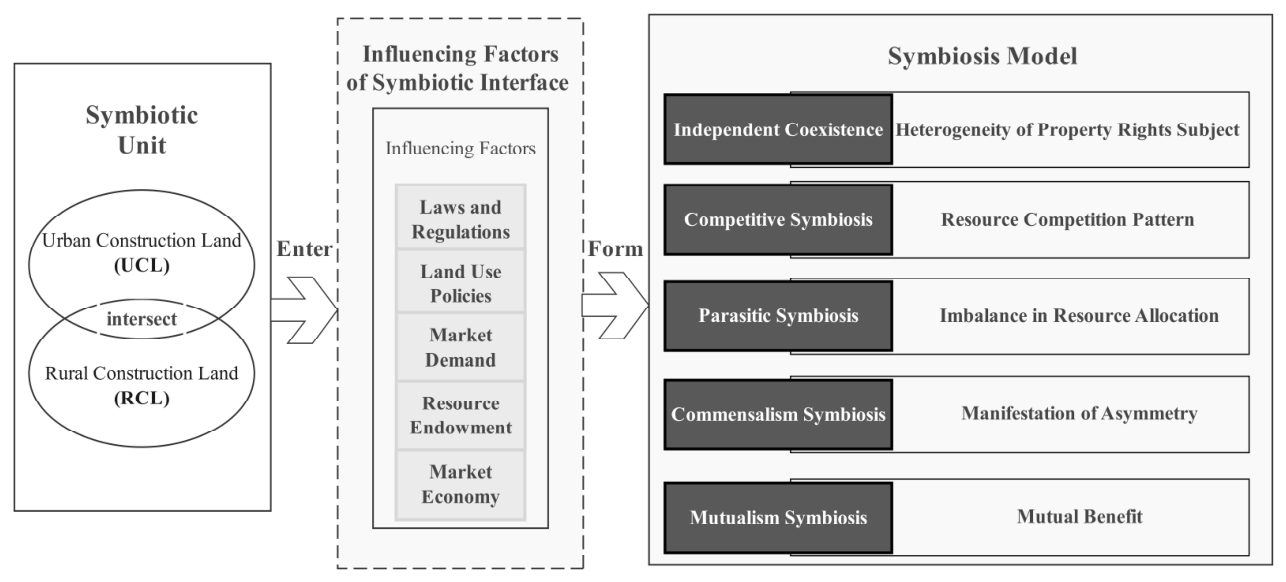
Based on the fundamental premise of symbiosis theory—that a symbiotic system comprises three essential elements (symbiotic units, symbiotic interfaces, and symbiotic modes)—the formation of an URCL symbiotic system involves the following three com-ponents: (1) The urban–rural interest relationship, characterized by prolonged co-construction and mutual adjustment, embodies two distinct spatially dominant entities and serves as a crucial carrier of economic activities [21]. (2) Urban and rural spaces each possess distinctive material, institutional, and capital elements, which constitute the foundation of their existence and differentiation [22]. (3) With urbanization, production factors flow continuously between urban and rural areas, and the allocation of URCL follows a pattern in which UCL—dominated by state ownership—is supplemented by rural construction land under collective ownership. In summary, URCL is defined by a division of symbiotic units along the basic spatial entities of cities and villages, with clear administrative boundaries between them; its external environment is shaped by differences in urban–rural land policies, market demand for land, and urban–rural resource endowments, giving rise to diverse spatial interaction relationships such as independence, leadership, complementarity, and equality. In this way, the symbiotic unit, symbiotic interface, and symbiotic mode of the URCL system are constituted. The logic underlying the formation of the symbiotic relationship of URCL can be elaborated along the following dimensions.
First, driven by urban–rural differentiation and the mobility of factors, interactions arise among the spatial units of URCL, giving rise to the symbiotic unit of URCL. Urban–rural differentiation is fundamentally rooted in the duality of property rights subjects, which demarcates cities and villages into two administratively and spatially distinct units based on ownership—state ownership and collective ownership. Nevertheless, UCL and RCL are not fully independent; the most direct manifestation of their interaction is the exchange of land factors, wherein RCL enters the urban–rural symbiotic dynamic as an incremental land resource supplementing urban land space. UCL is supplied through two principal channels. The first consists of state-owned land within existing urban areas, which is categorized into specific land-use types in accordance with land demand and urban planning; the use rights of such state-owned construction land are transferred to the market through tender, auction, listing, or lease. The second channel involves land on the urban fringe that is expropriated in response to urban land scarcity driven by industrial expansion and urban–rural agglomeration. This land, originally under rural collective ownership, is converted into state-owned land through expropriation and subsequently provides land resources for urban expansion. This process constitutes a direct ex-pression of URCL interaction, with the urbanization rate serving as the primary factor determining the frequency of such symbiotic engagement.
Second, under different external constraints, the interactions between the spatial units of URCL become differentiated, and the content of the symbiotic interface is gradually enriched. (1) One is policy constraints on urban–rural land-use. UCL policies are designed to meet the demands of urban industrial development, residential housing, and infrastructure upgrading, whereas RCL policies aim to safeguard farmers’ basic rights and interests while raising their incomes. When the restrictive effects of these policies materialize within the same spatiotemporal context, they give rise to symbiotic relationships marked by a resource tug-of-war, which may be competitive, parasitic, or mutualistic in nature. Land expropriation policies that enable UCL expansion and market-entry policies that promote the market-oriented operation of RCL jointly constitute the policy frame-work for positive URCL interaction. Under the influence of shifting urban–rural land policies and the constraints they impose, the symbiotic interaction between UCL and RCL exhibits distinctly dynamic characteristics. (2) Another is land demand as the primary driver of the spatial structural evolution of URCL. As UCL pursues efficient, green, and ecologically sustainable urban environments, urban land demand continuously extends urban space and its functional boundaries outward, creating urban–-rural fringe areas along the peripheries of rural territory. Constrained by the household registration system and resource–environmental carrying capacity, rural-to-urban population flows tend to stall at the urban edge, settling in the urban–rural boundary interaction zone. Urban–rural land demand thus induces interaction between URCL spatial units and the formation of interaction zones, making the interplay between UCL and RCL distinctly visible. (3) Another is constraints stemming from disparities in urban–rural resource endowments. Urban spaces display varying degrees of urbanization shaped by population density, economic level, capital flows, and other factors. Meanwhile, the strong and weak push–-pull forces generated by urbanization exert intermittent and periodic “strength transitions” on rural areas. Differences in urban–rural resource endowments cause the structure of UCL to trigger supply and demand changes in RCL. Constrained by these endowment disparities, RCL occupies a passive position within the symbiotic relationship.
Third, through the spatial interactions between URCL, diverse symbiotic behavioral modes take shape, characterized predominantly by competition and mutualism. The gradual progression of urbanization across urban–rural space, combined with the integration of urban and rural elements, generates distinct behavioral patterns, which mani-fest in URCL as interactive structural changes in land-use scale, land-use form, and functional positioning. (1) When UCL, driven by market forces, expands indefinitely into rural areas through land expropriation and alters the rural land-use structure, URCL exhibits competitive or confrontational symbiotic behavior. Under competitive symbiosis, RCL develops in a passive state. To broaden the market scope of its ownership and use rights, RCL acquiesces to the expansion of the UCL market, such that competition and confrontation coexist. (2) When urban land policies regulate expropriation behavior and rural development targets urbanization or pursues an urbanized growth path, URCL enters a par-asitic symbiotic state. Parasitic symbiosis is manifested primarily in the market lag of RCL: an institutional vacuum surrounds RCL marketization, and even after initial marketization, RCL remains in a passive symbiotic state due to induced development from urban areas, leading to frequent human–land separation. Prolonged parasitism may trigger an urban–rural resource imbalance. (3) Commensalism represents the turning point at which the URCL dynamic begins to transition toward mutualism. Unlike parasitism and competition, commensalism serves primarily as a behavioral mode for examining whether parasitic units can be incorporated into an integrated system to achieve sustain-able development. In essence, it breaks the parasitic condition of urban–rural resource imbalance and brings both URCL onto a common analytical plane. The rural collectively- owned commercial construction land (RCOCCL) marketization constitutes a classic juncture at which the URCL relationship enters the commensal mode. (4) When URCL progresses through the commensal stage, enabling the synchronous realization of both urban and rural land values and their mutual coordination, the two entities enter the mutualism mode. Mutualistic symbiosis is embodied in practice by the simultaneous marketization of both UCL and RCL. It reveals land value through market allocation and exposes the advantages and disadvantages inherent in the URCL relationship, such as the dynamics between stock and incremental construction land, the compatibility and conflicts between urban and rural land-use policies, and the effectiveness of integrated urban–rural market development. Mutualistic symbiosis thus provides a basis for measuring UCL and RCL along a common dimension.
In summary, the interaction between UCL and RCL—shaped by the promoting or inhibiting effects of internal factors such as property rights arrangements and resource allocation, as well as external environmental factors including policies, laws, regulations, and the market economy—generates symbiotic behavior patterns that are competitive, complementary, or egalitarian (Figure 1). These patterns constitute the basic logic of URCL symbiosis.

2.2. Methods

2.2.1. Method for Measuring the Symbiotic Relationship Between URCL in China

Based on spatial boundaries, UCL and RCL in China constitute two symbiotic units in symbiosis theory, influenced by external symbiotic links (phenomenal parameters reflecting the external characteristics of symbiotic units) and endogenous symbiotic matrices (qualitative parameters that capture the internal relationships of symbiosis). These two units exhibit both heterogeneity and mutual correlation [23]. Under a fixed total amount of URCL and constrained by the maximum output constraint of land space saturation (de-noted as “K”), any land exceeding the carrying capacity of the symbiotic environment leads to resource depletion and waste, such as inefficient construction land use, approved but unbuilt land, and declining agglomeration benefits. The extended logistic model effectively illustrates the compatibility principle of qualitative parameters within the symbiotic matrix and characterizes the interactive relationships among various variables in the same environment [24]. This paper applies this model to analyze the symbiotic relationship between URCL. Based on the single-species logistic model developed by Belgian scholar Verhulst [25,26,27], UCL and RCL are treated as two symbiotic units. Substituting the descriptive characteristics of the URCL market, the symbiotic measurement model for URCL is given as follows:
d O 1 ( t ) d t = r 1 O 1 ( t ) ( 1 O 1 ( t ) K 1 )
d O 2 ( t ) d t = r 2 O 2 ( t ) ( 1 O 2 ( t ) K 2 )
In Equations (1) and (2), r can be understood as the potential average annual growth rate of URCL that is driven exclusively by its endogenous forces, under the premise that urban–rural interactions (symbiotic effects) and environmental carrying capacity constraints (K) are excluded, and r1 and r2 denote the natural growth rates of UCL and RCL, respectively, driven by internal dynamics such as population agglomeration and industrial investment. These rates were obtained by fitting the logistic equation using nonlinear least squares (NLS). O1 and O2 represent the output levels of UCL and RCL derived from the input of qualitative parameters. K1 and K2 denote the maximum output constraints—that is, the ultimate spatial saturation levels—for UCL and RCL, respectively. This study does not impose an externally given carrying capacity K. Instead, K is jointly estimated from time-series data of URCL spanning 2009–2024 using nonlinear least squares. The initial values for the iterative estimation are determined by a combination of the three-point method and linearization approximation, which together ensure global convergence. To verify reliability, we conduct both initial-value perturbation tests and year-by-year rolling regressions; the signs and magnitudes of the estimated parameters remain robust throughout. The resulting data-driven K can be interpreted as the potential upper limit of URCL under the continuation of existing socioeconomic and policy trends. O 1 ( t ) K 1 and O 2 ( t ) K 2 denote, respectively, the ratios of the maximum spatial output levels of URCL, namely the growth saturation of URCL; and 1 O 1 ( t ) K 1 and 1 O 2 ( t ) K 2 denote the proportions of the un-realized portions of the spatial output levels of URCL, i.e., the logistic coefficients, which are used to reflect the retarding effect of growth saturation on output growth under the constraints of urban–rural spatial market values. Here, O i 0 = O i 0 .
Given the continuously evolving interactions among symbiotic units, the symbiotic relationship of URCL—that is, the degree of symbiosis between the units—is typically quantified by the rate of change in the quality parameter of one unit induced by the rate of change in the quality parameter of the other [28], denoted by “δ”. The symbiosis degree δ represents the intensity of reciprocal influence between UCL and RCL. The value of “δ” indicates the specific symbiosis mode exhibited by URCL. Based on this, introducing “δ” into Equations (1) and (2), respectively, yields the following model:
d O 1 ( t ) d t = r 1 O 1 ( t ) ( 1 O 1 ( t ) K 1 + δ 21 O 2 ( t ) K 2 )
d O 2 ( t ) d t = r 2 O 2 ( t ) ( 1 O 2 ( t ) K 2 + δ 12 O 1 ( t ) K 1 )
In Equations (3) and (4), δ12 denotes the symbiotic effect of UCL on RCL, and δ21 denotes the symbiotic effect of RCL on UCL. Depending on the value ranges of δ12 and δ21, and following the separate calculation of the symbiosis degrees for UCL and RCL, the specific symbiotic mode is identified according to the predefined symbiosis-degree value ranges [29] (Figure 1). Overall, the mode transitions induced by changes in δ12 and δ21 represent an evolution from low-level to high-level symbiosis. The paired values of δ12 and δ21 also progressively shift from negative values, through equality, to positive values. Therefore, in practice, the actual value range and specific fixed values of δ can be regarded as inflection-point thresholds for attaining the next-stage symbiosis mode, representing a synergistic value shaped by the combined effects of current economic, social, political, and other factors. The mapping between the value ranges and the symbiotic modes is presented in Table 1.

2.2.2. Measurement of the Dominant Forces and Influencing Factors of the Symbiotic Relationship Between URCL in China

In symbiosis theory, the symbiotic coefficient (θ) quantifies the degree of mutual in-fluence between symbiotic units, specifically the effect of one unit on another. It is calculated as the ratio of the interaction magnitude between two symbiotic units to the sum of their total interactions, yielding a value between 0 and 1. In a two-dimensional symbiotic system comprising UCL and RCL, the combined reciprocal influences of the two units sum to 1. The symbiotic coefficient thus reflects both the intensity of interaction between units and directly determines which unit occupies a dominant position, as guided by qualitative parameters—such as land-use efficiency, economic development vitality, and eco-logical environment quality—key indicators of the symbiotic development quality of URCL [30]. Based on the clarification of the symbiotic effects represented by the symbiotic degrees δ12 and δ21, the term δ 21 O 2 ( t ) K 2 (the symbiosis coefficient θ12), represents the degree of symbiotic influence of UCL on RCL, while δ 12 O 1 ( t ) K 1 (the symbiosis coefficient θ21), represents the degree of symbiotic influence of RCL on UCL. Taking θ12 as an example, the determination of the influence level of the symbiosis coefficient is presented in Table 2 [31], and the same determination applies to θ21 as well.
The symbiotic relationship between UCL and RCL is shaped by the interplay of qualitative parameters, which govern intrinsic characteristics, and phenomenal parameters, which capture the external environment. Together, these parameters constitute the influencing factors—referred to as symbiotic indicators—driving changes in the URCL symbiotic relationship. Pairwise analysis of the quality and phenomenal parameters reveals their specific roles in these changes. Integrating the classification of symbiotic degrees in Table 1, it is observed that the cumulative symbiotic degree fluctuates around 0 over time, with its sign distinguishing the type of relationship: a symbiotic degree greater than 0 corresponds to commensalistic and mutualistic relationships, and a sudden positive in-crease indicates commensalism; conversely, a symbiotic degree less than 0 corresponds to amensalistic and competitive relationships, and a sudden negative increase indicates amensalism.
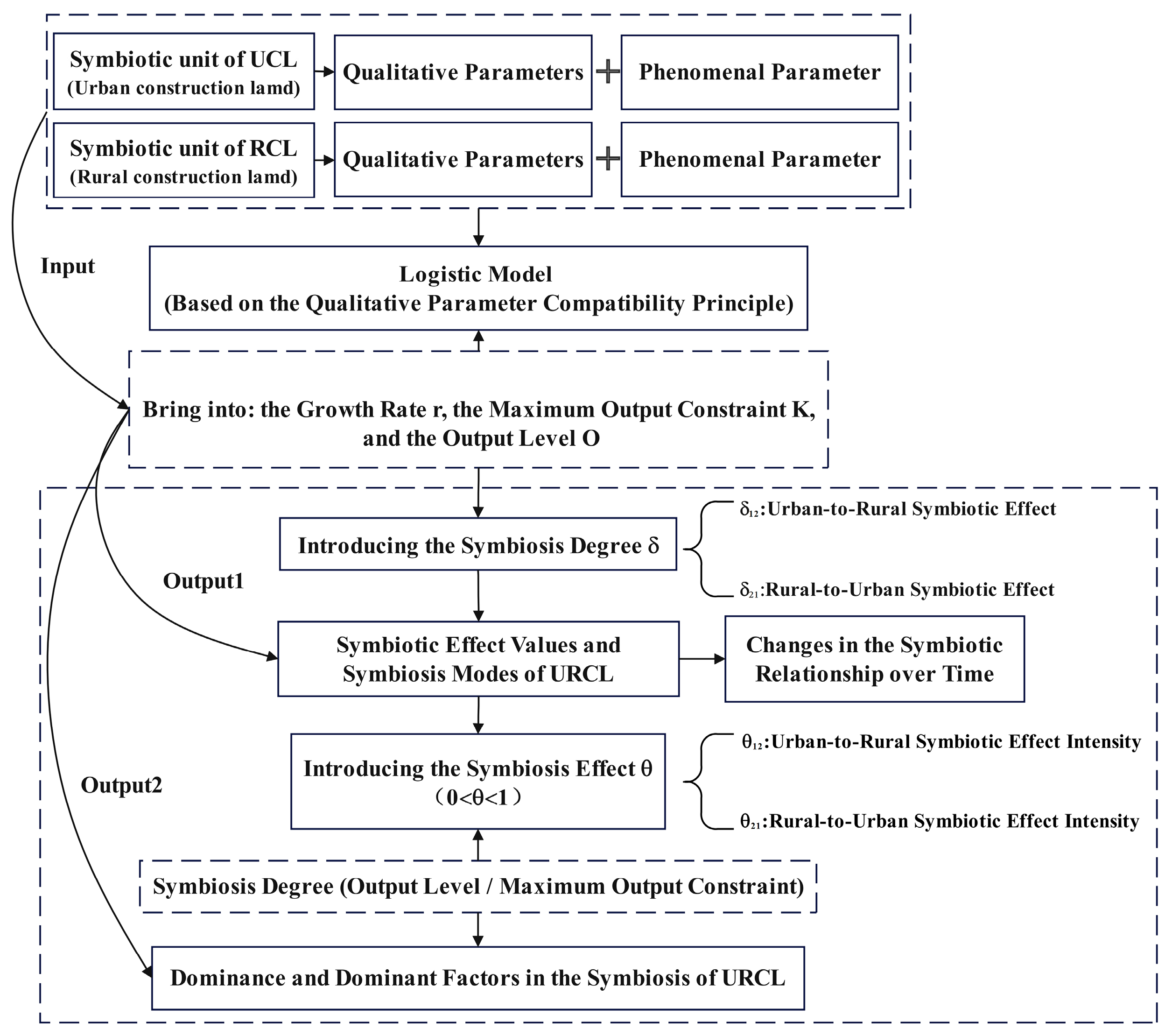
The computation process for changes in the symbiosis relationship between URCL is illustrated in Figure 2 below.

2.2.3. Construction of Symbiosis Indicators for URCL in China

Urban construction land (UCL) and rural construction land (RCL) in China, as two relatively independent symbiotic units, ground their symbiotic interaction in the quantities of construction land delimited by state-owned and collective-owned property rights [32]. The symbiosis indicators for UCL and RCL constitute the objective factors that define the interactive relationship between the two units and comprise quality parameter indicators (variables reflecting the internal dynamics of symbiosis) and image parameter indicators (variables reflecting the external characteristics of the symbiotic units).
Based on the formation logic of URCL symbiosis, the quality parameter indicators for this symbiosis are selected as the “national urban construction land area” and “national rural settlement construction land area”, which represent the maximum output constraint (K) of construction land in urban and rural spaces. Considering urban expropriation of RCL as a passive, compensated interaction, and the rural collectively-owned commercial construction land (RCOCCL) marketization as an active interaction participating in market transactions, and in light of conflicts such as institutional competition and land parcel overlap between expropriation and market entry, “land expropriation area” and “leased and sold area of rural collective construction land” are used as the interactive proxies for the resource tug-of-war between URCL (i.e., “O”) [33,34]. Based on the external influences of the symbiotic environment and symbiotic interface in the interaction of URCL (i.e., the influence of phenomenal parameters), such as the positive or negative comprehensive benefits generated by rapid urbanization on urban and rural land-use [35,36]; urbanization is inextricably linked to the consumption levels of urban and rural residents. In the context of urban–rural integration, the consumption levels of urban and rural residents can not only reflect the urban–rural consumption gap but also help characterize urbanization patterns based on the income–expenditure distribution structure, thereby enabling the formulation of context-specific urban–rural interaction models [37]. In light of research findings such as land factor flow driving changes in the urban–rural economic structure [38], the “urban residents’ consumption level”, “urbanization rate”, and “rural residents’ consumption level” are selected as peripheral factor indicators affecting the symbiotic changes of URCL. The “income from leasing and sold of rural construction land” is set corresponding to the “leased and sold area of rural construction land” to capture rural income changes. Table 3 below presents the construction of symbiosis indicators for URCL.
Given that the calculation of the symbiotic degree of URCL requires the extraction of principal features from the qualitative parameters of UCL and RCL, principal component analysis (PCA) is employed to perform the calculation.
Taking the symbiosis indicators of UCL as an example, the specific processing steps are as follows:
(1)
Data standardization: Since principal component analysis (PCA) is sensitive to dimension, each indicator is first standardized using the Z-score method:
z i j = x i j x ¯ j s j
where x ¯ j is the mean of the j-th indicator and sj is the standard deviation.
(2)
Calculate the correlation coefficient matrix: For the standardized data, compute the correlation coefficient matrix R.
(3)
Extract principal components: Calculate the eigenvalues λ and the corresponding eigenvectors of R. Select the number of principal components based on the cumulative variance contribution rate, typically requiring a cumulative contribution rate of ≥ 80%. The principal component analysis results for the two qualitative parameters of the UCL symbiosis indicators are shown in Table 4. Since the contribution rate of the first principal component is sufficiently high (90.59%), the score of the first principal component is used as the initial comprehensive value.
(4)
Calculate the comprehensive score (normalized):
F = P C 1 = j = 1 2 α j z i j
where αj is the loading (eigenvector element) of the first principal component.
To map the comprehensive indicator to the interval [0, 1] (normalization), min–max normalization is applied.
U = F m i n F m a x F m i n F
where U is the comprehensive symbiosis indicator of UCL after principal component analysis and normalization.
Similarly, the comprehensive symbiosis indicator of RCL is obtained. The principal component analysis results are shown in Table 5, and the score of the first principal com-ponent is also used as the initial comprehensive value.

2.3. Data Sources

According to Table 3 and considering data availability, the evolution of the symbiotic degree, symbiosis coefficient, and their influencing factors for URCL are measured using data from 2009 to 2024. Among the indicators, the “national urban construction land area” and “national rural settlement construction land area” are sourced from the China Urban-Rural Construction Statistical Yearbook; the “land expropriation area” is sourced from the China Natural Resources Statistical Yearbook; and the “leased and sold area of rural construction land” and the “income from leasing and sold of rural construction land” are sourced from the China Policy and Reform Statistical Annual Report. These two sets of data are subject to certain limitations. As the official data for 2024 have not yet been released, the area and income of RCL leased and sold in 2024 were imputed. Linear extrapolation based on historical series (e.g., linear regression prediction) was not adopted because it implicitly assumes a strong “trend-stationary” condition and can introduce substantial bias in years marked by policy shifts or economic fluctuations. In contrast, K-nearest neighbors (KNN) imputation can fully exploit the statistical associations among variables and is more logically grounded than simple autoregressive or mean imputation. Accordingly, we employed KNN imputation to fill in the missing data. The imputed values, while informative, may nevertheless deviate to some extent from the actual situation in that year. Data on the “urban residents’ consumption level”, “rural residents’ consumption level” and “urbanization rate” are sourced from the China Statistical Yearbook. All calculated data are normalized.
The data and models have passed a series of tests, including the baseline regression, substitution of core variables, endogeneity treatment, and robustness checks. The core conclusions of this paper remain substantively unchanged, and the results prove robust.

3. Results

3.1. Dynamics of the Symbiotic Relationship of Between URCL

The symbiotic degree between UCL and RCL determines the symbiotic state of the two principal market entities at different stages, that is, the evolution of their symbiotic relationship. Based on the symbiotic degree calculated from Equations (3) and (4) and the classification criteria in Table 1, the evolutionary trajectory of the URCL symbiotic relationship from 2009 to 2024 is derived and presented in Table 6.
Table 6 shows that the symbiotic relationship between URCL over the study period has the following characteristics:
(1)
The overall trend reveals a gradual shift from competitive symbiosis to mutualistic symbiosis. From 2009 to 2014, URCL predominantly exhibited features of competitive and parasitic symbiosis. During this period, the rising urbanization rate stimulated simultaneous increases in land demand in both urban and rural areas. Given the non-renewable and inherently scarce nature of land within a shared spatial context, urban and rural land scales were inevitably drawn into a competitive trade-off, in which urban spaces held stronger policy and economic advantages. Between 2015 and 2024, the URCL symbiotic relationship alternated between competition and mutualism, displaying an overall wave-like pattern. From 2015 to 2020, mutualistic symbiosis prevailed. With the advancement of the “Three Types of Land” reform and the implementation of policies permitting rural collectively-owned commercial construction land (RCOCCL) marketization following the revision of China’ s Land Ad-ministration Law, the symbiotic degree gap between UCL and RCL narrowed, giving rise to a mutually reinforcing interaction mechanism. From 2021 to 2024, competitive symbiosis became dominant. Within the limited market capacity of urban–rural land, competition between the two land supply entities—state-owned and collectively owned—is inevitable and represents a necessary phase in the market allocation process that helps balance the land-use structures of the symbiotic units.
(2)
The symbiotic relationship between URCL exhibits pronounced fluctuations, with two distinct fluctuation nodes identified during the study period. The first node, between 2014 and 2016, is characterized by frequent shifts in the symbiotic relationship, indicating that both the structure of urban–rural land-use and broader socio-economic development significantly shape these changes; the integration of URCL cannot be disentangled from the social, economic, and political systems underpinned by urban–rural land. The second node emerges after a sustained period of mutualistic symbiosis from 2017 to 2020: the mutualistic pattern was disrupted during 2021–2023 and gave way to competitive symbiosis. Notably, the gap between δ12 and δ21 widened during this period compared with that before 2017, suggesting that transient and unstable mutualistic symbiosis may intensify resource competition between urban and rural areas. The re-emergence of the competitive symbiosis mode between URCL during 2021–2023 can be attributed primarily to two factors: external environ-mental shocks and conflicts in urban–rural cooperation. On the one hand, under the constraint of a fixed maximum capacity of urban–rural supply and demand, persistent policy input has fostered reform inertia in URCL, weakening the symbiotic dependence between urban and rural areas. Exploiting policy provisions to capture market gains is the immediate driver of the return to competitive symbiosis. On the other hand, the market is inherently competitive: the cooperative structure embedded in the integrated URCL market implicitly contains competition. When input costs in both URCL markets rise, the short-term strategy of shifting from mutualism to competition can help increase land-based fiscal revenue, serving as one mechanism through which the integrated market achieves positive performance in its early stages. Furthermore, asymmetry among symbiotic units can disrupt the existing mutualistic relationship between urban and rural areas, prompting actors to leverage market competitiveness to extract benefits. The mutualistic state from 2017 to 2020 represents a nascent stage in which new market forces surfaced under the impetus of new policies, confirming the positive role of policies that simultaneously curtailed administrative allocation and strengthened market transactions in both urban and rural land systems. The return to mutualistic symbiosis in 2024 reflects that, after undergoing internal optimization through competitive restructuring, urban and rural areas have attained an integrated, high-quality mutualistic symbiosis.
Therefore, achieving a healthy, orderly, and stable symbiotic relationship depends fundamentally on promoting the internal development of UCL and RCL respectively—that is, facilitating their internal optimization, upgrading, and rational allocation. Only through such endogenous consolidation can sustainable mutualistic symbiosis between UCL and RCL be fostered and a more harmonious, efficient land-use pattern be established.

3.2. The Dominant Forces in URCL Symbiosis

The symbiosis coefficients between UCL and RCL capture the fluctuating dominance within the urban–rural symbiotic relationship, reflecting the relative symbiotic strength of each unit. These coefficients were calculated for the study period and are presented in Table 7.
As shown in Table 7, the symbiosis coefficients between UCL and RCL reveal an alternating pattern of urban–rural dominance throughout the study period. UCL exerted a guiding influence on the evolution of the symbiotic relationship; however, after 2023, RCL progressively emerged as a stable land supply entity within the integrated URCL market. Specifically, from 2009 to 2014, under competitive symbiosis, UCL held an absolutely dominant position, with θ 12 substantially larger than θ 21. From 2015 to 2020, RCL played a facilitative role in mutualistic symbiosis, with θ 21 slightly exceeding θ 12, and the symbiotic structure approached parity—exhibiting a mutually beneficial, temporarily equalized pattern driven by market-entry policies. Between 2021 and 2024, dominance oscillated between UCL and RCL, and by 2024, the symbiosis coefficient of RCL reached a new peak of 0.709, positioning RCL as the dominant party in the mutualistic symbiosis of URCL. Since the introduction of rural collectively- owned commercial construction land (RCOCCL) marketization, RCL has steadily consolidated its role as the land supply entity in the integrated URCL market.

3.3. Influencing Factors on URCL Symbiosis

3.3.1. The Induced Effect of RCL Marketization on Changes in the URCL Relationship

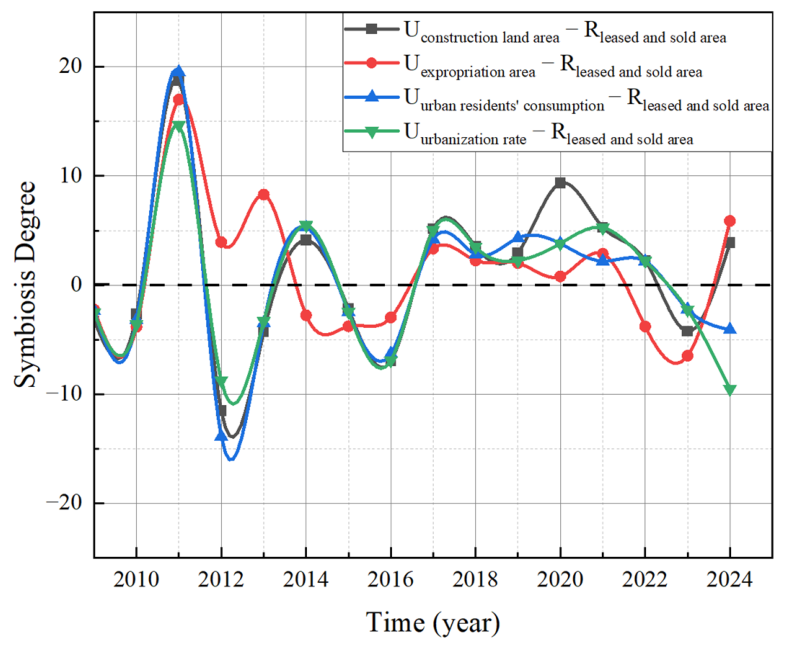
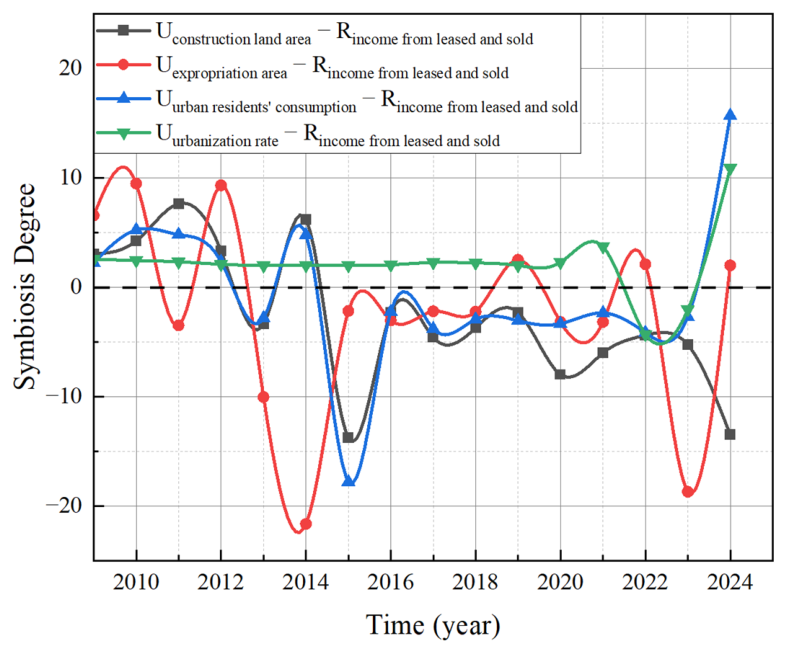
Building on the alternating dominance pattern of URCL symbiotic forces between urban and rural areas observed during the study period, this section further investigates the factors driving changes in symbiotic interactions as the relationship gradually shifts from competitive to mutualistic symbiosis. As shown in Table 3, URCL symbiosis is characterized by four qualitative parameters and four phenomenal parameters, yielding 16 (24) possible combinations. Taking the symbiosis indicators of UCL as the anchor, these 16 combinations are analyzed to identify the respective roles that various urban factors play in shaping the symbiotic relationship with the rural unit. The accumulated symbiotic degree fluctuates around zero, as detailed in Figure 3 and Figure 4.
Under the premise of urban dominance, the relationship between various urban in-dicators—the “urban construction land area”, “expropriation area”, “urban residents’ consumption level” and “urbanization rate”—and the “leased and sold area of rural con-struction land” gradually transitions from a competitive symbiotic relationship (below zero) to a mutualistic symbiotic relationship (above zero), exhibiting a “competition-first, mutualism-later” symbiotic change (Figure 3). This shift from competition to mutualism occurs because, as RCL increasingly relies on market mechanisms (e.g., leasing and sold) to allocate resources, the symbiotic relationship initially exhibits temporary confrontational characteristics in terms of URCL supply-and-demand quantity and land-use structure due to the influence of the urban construction structure demand, urbanization rate, and expropriation factors—i.e., competitive symbiosis. As market-based allocation gradually becomes involved in the structure of RCL, it not only optimizes the value of rural resources internally but also reduces the urban–rural resource endowment disparity externally. Consequently, the urban symbiotic factors and the “leased and sold area of rural construction land” become mutualistically symbiotic. The sudden positive and negative increases in the symbiotic degree around zero during 2013–2015 correspond to the overall cyclical changes in the symbiotic relationship of URCL, indicating that the “leased and sold area of rural construction land” fluctuates in the same frequency as the urban–rural symbiotic relationship. That is, the dynamic “competition-first, mutualism-later” change between the four urban indicators and the “leased and sold area of rural construction land” is consistent with the overall transition of the URCL symbiotic relationship from competitive symbiosis to mutualistic symbiosis.
Conversely, the set of UCL symbiosis measurement indicators exhibits a “mutual-ism-first, competition-later” symbiotic change with respect to the “income from leased and sold of rural construction land”, fluctuating from above zero to below zero (Figure 4). During 2009–2014, the symbiotic degree of various urban factors on the “income from leased and sold of rural construction land” was above zero, indicating a mutualistic symbiotic relationship. After 2016, the symbiotic degree fluctuated below zero, forming a phased competitive symbiotic relationship of urban areas with respect to the “income from leased and sold of rural construction land”. In the early period, urban symbiotic indicators played a facilitating and guiding role in increasing the leasing/sold prices of RCL and manifesting its market value. In the later period, as the market-based allocation mode of RCL directly changed, urban and rural land spaces became competing land sup-ply entities in terms of land prices. The shift in the symbiotic relationship of the four UCL indicators with respect to the “income from leased and sold of rural construction land”—from mutualism to competition—reveals the issue of instability in URCL mutualistic symbiosis, i.e., the supply–demand conflict between urban and rural entities under market allocation.
The marketization reform of RCL has become the trigger and starting point for the transition of URCL from competitive symbiosis to mutualistic symbiosis. Since the rural collectively-owned commercial construction land (RCOCCL) marketization was implemented, the quota share of RCL in the integrated URCL market has gradually increased. The increase in the area of RCL eligible for market entry helps alleviate urban land pressure and provides land resources for a diversified urban–rural land-use structure. The rise in “income from the leasing and sold of rural construction land” leads to a temporary competitive state in URCL, after which it returns to mutualistic symbiosis, indicating that the RCL market has formed a benign competitive structure of “equal rights, equal prices for equal land” with the UCL market within the integrated urban–rural arena. At the same time, it drives the internal integration of urban land space, achieving an efficient urban–rural cooperative relationship. Among the symbiotic factors of RCL, “national rural settlement construction land area”, as a spatial capacity value, fluctuates in the same frequency as the “leased and sold area of rural construction land”; the “rural residents’ consumption level” serves as a mutualistic symbiotic factor supporting the marketization of RCL.

3.3.2. The Key Role of the Urbanization Rate and Land Expropriation in the Symbiosis of URCL

While the symbiotic degree conveys the closeness of the symbiotic relationship be-tween UCL and RCL, the symbiosis coefficient captures the relative weight of their symbiotic factors within the symbiotic framework. Based on the symbiotic degree values de-rived from the 16 factor combinations in Section 3.3.1, the key influencing factors of UCL symbiosis are identified using the symbiosis coefficient. The detailed results are presented in Table 8.
Based on the mean symbiosis coefficients of mutual influences among the URCL symbiotic factors in Table 8, the UCL symbiotic factors are summarized into three aspects: the dominant role of land expropriation and the urbanization rate, the facilitating role of urban residents’ consumption level, and the absence of pronounced dominance among certain factors. The details are as follows.
(1)
The Dominant Role of Land Expropriation and the Urbanization Rate.
“Land expropriation” and the “urbanization rate” play a dominant role in the tran-sition of URCL from competitive symbiosis to mutualistic symbiosis. As a configuration tool that not only connects urban and rural land spaces but also influences the allocation and competition of urban–rural resources, expropriation affects both the internal land- use structure of rural areas and the transaction volume and transaction prices in the RCL market, thereby exerting a dominant role in the changing symbiotic relationship of URCL. In 2015, the “Three Types of Land” reform, while narrowing the scope of expropriation to create market space for the integration of URCL, also explored a direct market entry path-way for rural collectively-owned commercial construction land (RCOCCL), thus facilitat-ing the transition of the URCL relationship from competitive symbiosis to mutualistic symbiosis. This transition reflects the inherent advantage of market entry in balancing the urban–rural land structure and also signifies an easing of the urban–rural land relation-ship. However, because rural collectively-owned commercial construction land (RCOCCL) marketization remains in a consolidation window, competitive symbiosis re-emerges after a brief period of mutualistic symbiosis.
The relationship between the “urbanization rate” and the “leased and sold area of rural construction land” is complex, undergoing a transition from competitive symbiosis to mutualistic symbiosis. However, the dependency brought by rapid urbanization affects the stability of the urban–rural mutualistic symbiotic structure. During the urbanization process, the relationship between the “urbanization rate” and the “leased and sold area of rural construction land” exhibits varying degrees of competitive and mutualistic symbio-sis. Before 2016, urbanization primarily involved encroachment on rural resources. After 2016, as RCL gradually became marketized, the resulting value appreciation not only en-riched collective economies but also externally alleviated the tight market structure of URCL, leading to mutualistic symbiosis between the two. However, the excessive depend-ence of RCL on the spillover effects of urbanization, while neglecting its own structural market transformation, is detrimental to the efficient integration of the market entry of collectively operated profit-oriented construction land and the revitalization of new-type rural collective economies, leaving the urban–rural mutualistic symbiotic structure still unstable.
(2)
The Facilitating Role of Urban Residents’ Consumption Level in Changes of Urban–rural Land Structure
“Urban residents’ consumption level” plays a facilitating role in the changing sym-biotic relationship of URCL. First, due to the mobility of urban and rural populations and the symmetry of market information obtained by urban and rural residents in the Internet era, the disparity in consumption structures between urban and rural residents has grad-ually narrowed, exhibiting a mutually beneficial symbiotic relationship. Second, as the symbiotic relationship of URCL transforms, the spillover and driving effects of urban res-idents’ consumption level on rural residents’ consumption level have gradually weakened. In the process of RCL transitioning from administrative allocation to market allocation, rural residents’ consumption level has also shifted from relying on the urban consumption structure to forming a market economic structure with rural characteristics. Thus, “urban residents’ consumption level’ not only demonstrates a radiating effect that drives changes in both the consumption levels and structures of urban and rural residents but also pro-vides a basis for assessing labor participation in the measurement of total factor efficiency of the URCL market.
(3)
The Policy Implications of The Convergence of Symbiosis Coefficient Values for URCL
The two symbiotic combinations, “urban construction land area–rural residents’ consumption level” and “urban residents’ consumption level–rural residents’ consumption level”, yield calculated symbiosis coefficients that are close to each other. Based on the analysis of the cross-changing dominance of URCL between 2021 and 2024, in the context of increasingly equalized flows of urban–rural factors, the “spillover effect” of urbanization on farmers’ consumption has gradually converged. Farmers’ consumption behavior is now more comprehensively influenced by multiple factors, such as their own income structure, the development of digital inclusive finance, and the improvement of the rural consumption environment. This evolution carries clear policy implications: in promoting integrated urban–rural development, policymakers should avoid simply re-lying on the traditional path where urbanization unidirectionally drives rural consumption. Instead, greater emphasis should be placed on cultivating rural endogenous dynamics and strengthening the synergistic construction of urban and rural consumption markets.

4. Discussion

First, this study analyzes the causes of fluctuations in the URCL symbiotic relation-ship in China. The findings show that the symbiotic relationship exhibits multi-pattern fluctuations, primarily because the transition from binary opposition to a unified urban–-rural land market inevitably entails repeated games among institutional change, market forces, and diverse stakeholders. The transfer of URCL depends not only on administrative policies and allocation instruments but also on the broader economic context and so-cial structure within which land reform unfolds. The symbiotic relationship has under-gone two major fluctuation nodes. The first, from 2014 to 2016, marked the early stage of reform and displayed typical characteristics such as the coexistence of old and new institutions, unsettled market expectations, and tentative strategic interactions among stake-holders. The second, from 2021 to 2023, was characterized by intensified competition, indicating that the market entry of collective land has shifted from a supplementary role to that of a substantive competitor. Such “high-quality competition” is precisely the prelude to the formation of a unified and efficient market.
Second, this study identifies the divergent roles of influencing factors in the URCL symbiotic relationship. Among the influencing factors associated with UCL, the same fac-tor (e.g., land expropriation and, the urbanization rate) can induce both mutualistic and competitive symbiosis. The fundamental reason is that such factors play distinct roles un-der different modes of URCL symbiosis; this apparent duality is not a contradiction but rather reflects a core mechanism of mutual transformation catalyzed by policy reforms. Drawing on the analysis of fluctuation nodes in the symbiotic relationship, two sources of these differences can be identified. The first is dimensional divergence: the same factor manifests as resource competition in the early stage of symbiotic change and as value mutualism in the later stage. The second is mechanism reversal: a shift from an early urban–rural “substitution relationship” to a “market-creation relationship”. Therefore, the op-posing patterns of dominance do not arise from the influencing factors themselves, but rather from the sequential dominance of these factors over time. This finding further reveals the dynamic complexity and institutional evolution logic as the urban–rural relationship transitions from binary segmentation toward an integrated market.
Third, this study regard the policy instruments policy instruments for regulating the symbiotic relationship between URCL. First, to stabilize or improve the existing mutualistic structure, it is essential to further consolidate cooperative content between URCL. This can be achieved by establishing a unified URCL market platform, thereby forming an equitable and transparent land market. For instance, in pilot areas where the marketization reform of RCL has matured, unified online benchmark land prices and transaction rules should be developed for both urban and rural land, making the market value of RCL explicit and scientifically quantifiable while providing a pricing reference for leasing and mortgaging such land. Second, the market entry forms of rural collectively-owned commercial construction land (RCOCCL) marketization should accommodate diversified market demand. In terms of land-use modalities, approaches such as transfer, leasing, and capital contribution (equity participation) should be employed to achieve a tripartite win–win out-come for enterprises, village collectives, and individuals, with a clearly defined revenue distribution mechanism characterized by “one-time pricing and long-term profit-sharing,” thereby avoiding the risks of one-off farmer sell-outs and “loss of control upon equity participation.” Regarding land-use scope, the “urban–rural fringe” should be effectively utilized as an intermediate zone. By focusing on the large amount of inefficient and idle RCL for commercial use around cities, rural collective economic organizations may be permitted to develop commercial facilities ancillary to subsidized rental housing or com-munity elderly care facilities, thereby diversifying the realization of market appreciation gains and reducing urban–rural asymmetry. Third, land expropriation, as the most direct form of economic linkage from cities to villages in urban–rural symbiotic interaction, can be gradually linked to market mechanisms. Allowing land-using enterprises and collectives to directly negotiate land purchases through market-based consultation can help re-duce the frequency of conflicts between existing and new policies. Finally, it is crucial to guard against risks in the URCL symbiosis—such as speculative behavior in the RCL market and collective financial crises among farmers—by formulating preemptive policy institutions to address them.
The research data are calculated primarily at the national level, given the limitations of provincial and municipal data on RCL. Accordingly, the findings are most applicable to pilot areas with mature rural collectively-owned commercial construction land (RCOCCL) marketization for commercial use, as well as to developed regions in China characterized by a high degree of urban–rural land marketization. This not only affirms the positive role of existing policy reforms in advancing the marketization of RCL, but also reveals—through changes in the symbiotic relationship—a structural asymmetry be-tween URCL, an insight that can help further enhance mutualistic stability. The discussion reveals that regional land-use changes are not only driven by economic, social, and political factors but also exert feedback effects on policy and economic structures. Accordingly, future research should further clarify that applying this method to regions such as South-east Asia, Africa, Europe, or North America necessitates contextual adaptations tailored to local economic levels, social structures, and policy contents, with particular attention to critical junctures of local policy change.
In addition, the data limitations acknowledged in this study will be incorporated into our future research agenda. As more fine-grained data become available, we will prioritize conducting quantitative validation at the regional level, employing methods such as field surveys, questionnaire surveys, and interview-based analyses to complement and refine the dataset.

5. Conclusions

From a symbiosis perspective, this paper develops the logic of URCL symbiosis and applies a logistic population growth model to construct an indicator system for the two symbiotic units—UCL and RCL. It then examines the symbiotic evolution of URCL from independent coexistence to mutualistic symbiosis and identifies the key factors driving this transition. This study is subject to certain data limitations: the 2024 data were obtained through interpolation based on historical trends rather than actual observations, which may affect the precision of the analytical results to some extent. When data become avail-able, future research is encouraged to re-examine and validate the relevant findings using actual statistics for that year, so as to further enhance the robustness of the conclusions. The conclusions are as follows:
(1)
URCL symbiosis arises from the interaction between UCL and RCL spatial units un-der the combined effects of property rights arrangements, spatial distribution, and policies. Once these units enter the symbiotic interface shaped by urban–rural land policies, land market demand, and urban–rural resource endowments, distinct symbiotic patterns emerge according to differences in their respective symbiotic indicator inputs. Changes in the symbiotic relationship are reflected in the value of the symbiotic degree.
(2)
The URCL symbiotic relationship exhibits a progressive transition from competitive to mutualistic symbiosis, while the urban–rural dominance within the symbiosis fluctuates in synchrony with these changes. A brief reversal from mutualistic back to competitive symbiosis occurred during 2021–2023. This phase essentially represents a dynamic adjustment process through which URCL, driven by urban–rural integration, optimizes the market structure and advances toward high-quality symbiosis.
(3)
The marketization of RCL, land expropriation, and urbanization constitute the principal factors influencing the URCL symbiotic relationship. Analyses of the symbiotic degree and mean symbiosis coefficient indicate that RCL marketization facilitates mutualistic symbiosis between UCL and RCL. The urbanization rate and land expropriation not only serve as key drivers of changes in URCL symbiosis but also exhibit a strong correlation with the transaction prices and traded area of the RCL market.

Author Contributions

Conceptualization, Q.Z. and K.L.; software, Q.Z.; software, Q.Z.; validation, Q.Z.; formal analysis, Q.Z.; data curation, Q.Z.; writing—original draft, Q.Z.; writing—review and editing, Q.Z. and K.L.; visualization, Q.Z.; supervision, K.L.; project administration, K.L. All authors have read and agreed to the published version of the manuscript.

Funding

This work was supported by the National Social Science Found of China (Project No. 22BJY203), entitled “Theory and Practice of Rural Collectively-owned Commercial Construction Land (RCOCCL) Supporting Rural Industrial Development”.

Data Availability Statement

The processed dataset and code for replication supporting the conclusions of this article will be made available by the authors upon reasonable request.

Conflicts of Interest

The authors declare no conflicts of interest.

References

  1. Chen, K.Q.; Long, H.L.; Liao, L.W.; Tu, S.S.; Li, T.T. Land use transitions and urban-rural integrated development: Theoretical framework and China’s evidence. Land Use Policy 2020, 92, 104465. [Google Scholar] [CrossRef]
  2. Cattaneo, A.; Adukia, A.; Brown, D.L.; Christiaensen, L.; Evans, D.K.; Haakenstad, A.; McMenom, T.; Partridge, M.; Vaz, S.; Weiss, D.J. Economic and social development along the urban-rural continuum: New opportunities to inform policy. World Dev. 2022, 157, 105941. [Google Scholar] [CrossRef]
  3. Wang, X.F.; Zhang, X.D. A regional comparative study on the mismatch between population urbanization and land urbanization in China. PLoS ONE 2023, 18, e0287366. [Google Scholar] [CrossRef]
  4. Li, X.; Kuang, X.F.; Ma, X.D.; Li, C.C. Are there interactions between the urban and rural construction land use transition? Evidence from Jiangsu province in China. Habitat Int. 2024, 148, 103092. [Google Scholar] [CrossRef]
  5. Wu, Y.Z. Spatial Governance in Urban-Rural Integrated Development. Frontiers 2025, 93–100. [Google Scholar]
  6. Feng, X.; Wang, H.; Chi, G.Q. Does market-oriented land conveyance affect regional economic resilience? A spatial and mediation analysis based on 287 Chinese cities. Land Use Policy 2025, 150, 107457. [Google Scholar]
  7. Huang, Y.J.; Gan, J.W.; Liu, B.L.; Zhao, K.Q. Environmental policy and green development in urban and rural construction: Beggar-thy-neighbor or win-win situation? J. Clean. Prod. 2024, 446, 141201. [Google Scholar] [CrossRef]
  8. Jia, K.Y.; Huang, X.J.; Qiao, W.F.; Zhong, S.J. Unpacking divergent rural-urban land use dynamics in county urbanization: A comparative socio-spatial analytics approach. Cities 2024, 154, 105343. [Google Scholar] [CrossRef]
  9. Long, H. Analysis of Rural Transformation Development and Restructuring in China. In Land Use Transitions and Rural Restructuring in China; Springer: Singapore, 2020; pp. 315–377. [Google Scholar]
  10. Tang, S.; Wang, F.; Ye, H.; Lu, X.C. Rural Clustering Development Strategies Based on Symbiosis Theory, Guangzhou. Planners 2024, 40, 55–63. [Google Scholar]
  11. Zhang, B.Z.; Duan, M.; Tan, T. Spatial Structure, Production Order, and Construction Path of Urban-rural Communities: A Symbiotic Perspective. J. Nanjing Agric. Univ. (Soc. Sci. Ed.) 2023, 23, 97–104. [Google Scholar]
  12. Su, K.Q.; He, D.W.; Wang, R.X.; Han, Z.; Deng, X.Z. Assessment of natural resource endowment and urban-rural integration for sustainable development in Xinjiang, China. J. Clean. Prod. 2024, 450, 142046. [Google Scholar] [CrossRef]
  13. Guo, J.P.; Zhao, Y.H.; Li, F.Y.H.; Mao, K.B.; He, J.F.; He, Q. Developing a land development compensation model for returned land in tract expropriation: Towards a unified urban-rural land market in China. Land Use Policy 2024, 139, 107088. [Google Scholar] [CrossRef]
  14. Tan, R.; Wang, R.Y.; Heerink, N. Liberalizing rural-to-urban construction land transfers in China: Distribution effects. China Econ. Rev. 2020, 60, 101147. [Google Scholar] [CrossRef]
  15. Oulhen, N.; Schulz, B.J.; Carrier, T.J. English translation of Heinrich Anton de Bary’s 1878 speech, ‘Die Erscheinung der Symbiose’ (‘De la symbiose’). Symbiosis 2016, 69, 131–139. [Google Scholar] [CrossRef]
  16. Liu, R.J.; Wang, L. Symbiology; Science Press: Beijing, China, 2018; pp. 4–15. [Google Scholar]
  17. Douglas, A.E. The Symbiotic Habit; Princeton University Press: Princeton, NJ, USA, 2021; pp. 1–24. [Google Scholar]
  18. Wu, X.L. Symmetry Mutualism of Urban and Rural Areas: A New Theoretical Framework of Urban-Rural Relationship. Issues Agric. Econ. 2018, 14–22. [Google Scholar]
  19. Peacock, K.A. Symbiosis in Ecology and Evolution. North-Holl. Philos. Ecol. 2011, 11, 219–250. [Google Scholar]
  20. Roossinck, M.J.; Bazán, E.R. Symbiosis: Viruses as Intimate Partners. Annu Rev. Virol. 2017, 4, 123–139. [Google Scholar] [CrossRef]
  21. Xu, X.; Wang, Y.Y. Research on the Logical Mechanism, Multidimensional Measurement and Regional Coordinated Development of Urban-rural Integration: From the Perspective of Coordinated Promotion of New Urbanization and Rural Vitalization. Issues Agric. Econ. 2023, 49–62. [Google Scholar]
  22. Cao, H.; Chen, C.; Chen, J.L.; Song, W.X.; He, J.; Liu, C.H. Differentiation of urban-rural interface and its driving mechanism: A case study of Nanjing, China. Land Use Policy 2024, 140, 107090. [Google Scholar] [CrossRef]
  23. Hu, S.J. Theory of Social Symbiosis, 2nd ed.; Fudan University Press: Shanghai, China, 2012; pp. 1–66. [Google Scholar]
  24. Hermann, R. Ecology; Springer: Berlin/Heidelberg, Germany, 1980. [Google Scholar]
  25. Lotka, A.J. Elements of Physical Biology. Nature 1925, 116, 461. [Google Scholar] [CrossRef]
  26. Volterra, V. Fluctuations in the Abundance of a Species considered Mathematically1. Nature 1926, 118, 558–560. [Google Scholar] [CrossRef]
  27. Krebs, C.J. Ecology: The Experimental Analysis of Distribution and Abudance, 3rd ed.; Harper & Row: New York, NY, USA, 1985; pp. 207–234. [Google Scholar]
  28. Fan, C.L.; Zhang, Q.C.; Peng, M.S. The Symbiosis and Mutual Prosperity of Economy and Finance: Theory, Measurement and Implementation Path. Mod. Financ. Econ.-J. Tianjin Univ. Financ. Econ. 2021, 41, 3–17. [Google Scholar]
  29. Zhou, Y.Q.; Zhu, P.L.; Xia, T.X. The mutualistic symbiosis of public and scientific attention in science communication. Sci. Rep. 2025, 15, 41151. [Google Scholar] [CrossRef]
  30. Yuan, C.Q. Symbiosis and Harmony; Social Sciences Academic Press: Beijing, China, 2008; pp. 8–30. [Google Scholar]
  31. Yuan, C.Q. Symbiosis Theory—On Small Economy; Economic Science Press: Beijing, China, 1998; pp. 1–82. [Google Scholar]
  32. Zhong, S.J.; Huang, X.J.; Chen, Z.G. Urban-rural Construction Land Market Integration Models and Differentiation Mechanisms at the County Level: A Comparative Case Study of Deqing County, Zhejiang Province and Nanhai District, Guangdong Province. Chin. Rural Econ. 2024, 23–41. [Google Scholar]
  33. Hua, Z.; He, Y. Rural Collective Land Expropriation in China: Historical Evolution, Institutional Attributes, and Reform Pathways. Land 2026, 15, 663. [Google Scholar] [CrossRef]
  34. Luo, R.F. The Legal Mechanism for the Coordination Between the Marketization of Collective Land Designated for Business-related Construction And the Expropriation and Development of Tracts of Land. Wuhan Univ. J. (Philos. Soc. Sci.) 2025, 78, 5–15. [Google Scholar]
  35. Yi, C.J.; Xu, B.Y.; Shi, X.Y.; Li, R.F.; Chen, J. Exploring the spatial effects of rapid urbanization on land use efficiency in China under Low-Carbon constraint. Ecol. Indic. 2025, 174, 113442. [Google Scholar] [CrossRef]
  36. Chen, J.; Zhang, Y. The Impact of Market-Oriented Reform of Rural Collective Operational Construction Land in China on the Urban-Rural Income Gap. Land 2026, 15, 364. [Google Scholar] [CrossRef]
  37. Shen, J.N. The Extensive and Intensive Urbanization Affecting the Consumption of Urban and Rural Residents in China. J. Commer. Econ. 2023, 46–50. [Google Scholar]
  38. Peng, C.X. A multi-source data study on the imbalance of economic production factors between urban and rural areas in the pearl river delta. GeoJourna 2026, 91, 48. [Google Scholar] [CrossRef]
Figure 1. Logic diagram of the symbiotic relationship formation between URCL.
Land 15 00922 g001
Figure 2. Calculation flowchart of the symbiotic relationship and dominant driving forces between URCL.
Land 15 00922 g002
Figure 3. The impact of urban factors on fluctuations in “Leased and Sold Area of Rural Construction Land”.
Land 15 00922 g003
Figure 4. The impact of urban factors on fluctuations in the “Income from Leased and Sold of Rural Construction Land”.
Land 15 00922 g004
Table 1. The ranges of values of δ21 and δ12 and the corresponding symbiotic patterns.
The Values of δ 21 and δ 12 Symbiosis ModelCharacteristic
δ 21 = δ 12 = 0 Independent coexistenceThere is no competitive or cooperative relationship between URCL. UCL, existing in a dualistic structure, gradually transitions toward state ownership, while RCL gradually moves toward collective ownership. Both have weak external radiation.
δ 21 < 0 , δ 12 < 0Competitive symbiosisThe symbiotic radiation between URCL is less than 0. UCL and RCL are externally competitive, and the competition is segmented. That is, driven by the scarcity of construction land itself, two types of resource-occupying competitive behaviors emerge, represented by urban and rural areas.
δ 21 < 0 , δ 12 >0Parasitic symbiosisAt this stage, the analysis is split into two symbiotic features: “parasitism” and “symbiosis.” “Parasitism” is reflected in RCL acting as a supplementary land supplier for urban–rural development, engaging in urban spatial construction in a competitive manner, i.e., δ 21 < 0 . “Symbiosis” is reflected in the spatial configuration and policy advantages of UCL gradually radiating to rural areas in a mutually beneficial and co-existing state, i.e., δ 12 > 0.
δ 21 = 0 , δ 12 > 0Commensalism symbiosis δ 21 = 0 signifies that RCL has gradually transitioned to an independent participant in the structural allocation of URCL, breaking away from its parasitic status and accessing the integrated URCL market as a market player. The commensalistic pattern of urban–rural land marketization both highlights the value of rural resources and exposes the asymmetric nature of urban–rural relationships.
δ 21 > 0 , δ 12 > 0Mutualism symbiosisBoth δ 21 and δ 12 are greater than 0, indicating that urban and rural areas have essentially achieved a fundamental pattern of harmonious symbiosis of URCL. This can be further divided into two cases, as shown in the right column. δ 21 δ 12 > 0: Asymmetric mutualistic symbiosis, manifested as equal rights for equal land, entails hidden issues in urban–rural complementarity.
δ 21 = δ 12 > 0: Symmetric mutualistic symbiosis manifests as the efficient integration of URCL, which is theoretically a “utopia.”
Table 2. Determination of the dominance degree of the symbiotic relationship between URCL.
Symbiosis CoefficientInfluence
θ 12 = 0 A certain urban symbiosis indicator has no effect on the rural symbiosis indicator.
θ 12 = 1 A certain urban symbiosis indicator has no effect on the rural symbiosis indicator.
0 < θ 12 < 0.5 The effect of a certain urban symbiotic indicator on the rural symbiotic indicator is smaller than the effect of a certain rural symbiotic indicator on the urban symbiotic indicator.
0.5 < θ 12 < 1 The effect of a certain urban symbiotic indicator on the rural symbiotic indicator is greater than the effect of a certain rural symbiotic indicator on the urban symbiotic indicator.
θ 12 = 0.5 The effect of a certain urban symbiotic indicator on the rural symbiotic indicator is equal to the effect of a certain rural symbiotic indicator on the urban symbiotic indicator.
Table 3. Construction of symbiosis indicators for URCL.
Symbiosis UnitsSymbiotic DimensionSymbiosis IndicatorsExplanation of IndicatorsReference Basis
UCL Symbiosis IndicatorsQualitative ParametersNational Urban Construction Land Area (square kilometer)Refers to the land area occupied for the implementation of urban planning within the scope defined by the overall land-use plan, including land for urban housing, public buildings, etc., excluding land requisitioned for public use. It reflects the urban capacity and its constraints.[32]
Land Expropriation Area (square kilometer/year)Refers to the act whereby the state, based on the need of public interest, expropriates land collectively owned by farmers and converts it into state ownership, while providing reasonable compensation to the expropriated parties. It is also a land-use pattern through which urban spaces directly utilize rural land.[33,34]
Phenomenal ParametersUrban Residents’ Consumption Level (yuan)This indicator measures the degree to which urban residents’ consumption of material goods and services satisfies their needs for survival, development, and enjoyment, and represents the consumption level of individuals or society.[35,36,37,38]
Urbanization Rate (%)It directly reflects the speed and scale of urban–rural development and serves as an important indicator of the degree of urbanization in a region. It generally refers to the proportion of the urban population to the total population, comprehensively representing multiple dimensions such as population, land, and culture.[35,36,37]
RCL Symbiosis IndicatorsQualitative ParametersNational Rural Settlement Construction Land Area (square kilometer)It equals the current village land area minus the collectively owned agricultural land area, reflecting the rural capacity and its constraints.[32]
Leased and Sold Area of Rural Collective Construction Land (square kilometer/year)Refers to the land area of rural collective construction land-use rights leased or transferred by rural collective economic organizations during the current year. The leased or transferred area herein includes above-ground structures and facilities such as factories and shops owned by farmers’ collectives, which are leased or transferred together with the rural collective construction land-use rights.[33,34]
Phenomenal ParametersIncome from Leasing and Sold of Rural Construction Land (10,000 yuan)Refers to the total transaction price of rural collective construction land-use rights leased or transferred by rural collective economic organizations during the current year, serving as an indicator of returning to the market for achieving urban–rural integration.[32]
Rural Residents’ Consumption Level (10,000 yuan)This composite indicator incorporates the per capita consumption expenditure, Engel coefficient, consumption growth rate, and category-specific consumption proportions, serving to measure the level of rural economic and social development.[35,36,37,38]
Table 4. Principal component analysis results of UCL’s key parameters.
Principal ComponentEigenvalue (λ)Variance (%)Cumulative (%)
PC11.811790.59%90.59%
PC20.18839.41%100%
Table 5. Principal component analysis results of RCL’s key parameters.
Principal ComponentEigenvalue (λ)Variance (%)Cumulative (%)
PC11.675383.76%83.76%
PC20.324716.24%100%
Table 6. Changes in the symbiosis relationship between URCL from 2009 to 2024.
TimeSymbiosis DegreeSymbiosis Relationship
δ 12 δ 21
2009−1.980−0.705Competition Symbiosis
2010−1.937−0.454Competition Symbiosis
20115.503−1.052Parasitic Symbiosis
20125.252−0.815Parasitic Symbiosis
20134.941−0.752Parasitic Symbiosis
20142.2780.044Commensalism Symbiosis
20151.6411.072Mutualistic Symbiosis
2016−0.925−1.167Competition Symbiosis
20173.4824.030Mutualistic Symbiosis
20182.7403.442Mutualistic Symbiosis
20192.4073.337Mutualistic Symbiosis
20201.3122.825Mutualistic Symbiosis
2021−4.101−2.390Competition Symbiosis
2022−2.497−0.401Competition Symbiosis
2023−0.831−1.200Competition Symbiosis
20240.9622.344Mutualistic Symbiosis
Refer to Table 1 for the value ranges of δ 21 and δ 12 .
Table 7. Calculation of the symbiosis coefficient and change in the dominant force of URCL.
Time θ 12 θ 21Dominant Force
20090.7370.263Absolute Dominance of UCL
20100.8100.190Absolute Dominance of UCL
20110.8400.160Absolute Dominance of UCL
20120.8660.134Absolute Dominance of UCL
20130.8680.132Absolute Dominance of UCL
20140.9810.019Absolute Dominance of UCL
20150.6050.395Significant Dominance of UCL
20160.4420.558Marginal Dominance of RCL
20170.4630.537Marginal Dominance of RCL
20180.4430.557Marginal Dominance of RCL
20190.4190.581Marginal Dominance of RCL
20200.3170.683Significant Dominance of RCL
20210.6320.368Significant Dominance of UCL
20220.8620.138Significant Dominance of UCL
20230.4090.591Marginal Dominance of RCL
20240.2910.709Significant Dominance of RCL
Refer to Table 2 for the determination of the dominant degree for θ 12 and θ 12 .
Table 8. Calculation of coefficients for URCL symbiosis indicators and identification of urban influencing factors.
UCL IndicatorsRCL
Indicators
Average Symbiosis CoefficientVariation of Dominant Forces
θ 12 θ 21
UCL AreaRCL Area0.5410.459Urban construction weakly dominates the direction of rural construction.
Leased and Sold Area of RCL0.6080.392Urban construction demand drives rural land flow.
Income from Leasing and Sold of RCL0.4630.537The dominant role of rural rental income is gradually emerging.
Rural Residents’ Consumption Level0.4890.511The symbiosis coefficients of the two are close to each other, meaning that both urban planning and rural consumption depend more on the dynamics of urban–rural change and do not exhibit clear dominance.
Land Expropriation AreaRCL Area0.7860.214Expropriation has a strong impact on rural planning.
Leased and Sold Area of RCL0.6120.388Expropriation strongly affects the volume of rural market transactions.
Income from Leasing and Sold of RCL0.6220.378Expropriation further affects rural land prices.
Rural Residents’ Consumption Level0.5920.408Expropriation affects changes in rural residents’ consumption level.
Urban Residents’ ConsumptionRCL Area0.5420.458Urban residents’ consumption weakly influences the rural land–use structure.
Leased and Sold Area of RCL0.5620.438Urban residents’ consumption structure affects the supply and demand of the rural land market.
Income from Leasing and Sold of RCL0.4370.563The absorptive capacity of the RCL market is gradually emerging.
Rural Residents’ Consumption Level0.5050.495The consumption level coefficient between urban and rural residents is approximately 0.5, implying that neither urban nor rural residents’ consumption level significantly drives the other.
Urbanization RateRCL Area0.5440.456The process of urbanization influences the variation in the amount of RCL, both incremental and existing.
Leased and Sold Area of RCL0.597 0.403 The urbanization rate guides the rural land structure.
Income from Leasing and Sold of RCL0.574 0.426The urbanization rate weakly influences rural land transaction prices.
Rural Residents’ Consumption Level0.514 0.486Urbanization weakly influences rural residents’ consumption.
Disclaimer/Publisher’s Note: The statements, opinions and data contained in all publications are solely those of the individual author(s) and contributor(s) and not of MDPI and/or the editor(s). MDPI and/or the editor(s) disclaim responsibility for any injury to people or property resulting from any ideas, methods, instructions or products referred to in the content.