Dynamics of the Symbiotic Relationship Between Urban and Rural Construction Land (URCL) and the Factors Influencing Its Transformation
Abstract
1. Introduction
2. Analytical Framework, Methods and Data Sources
2.1. Analytical Logic
2.2. Methods
2.2.1. Method for Measuring the Symbiotic Relationship Between URCL in China
2.2.2. Measurement of the Dominant Forces and Influencing Factors of the Symbiotic Relationship Between URCL in China
2.2.3. Construction of Symbiosis Indicators for URCL in China
- (1)
- Data standardization: Since principal component analysis (PCA) is sensitive to dimension, each indicator is first standardized using the Z-score method:
- (2)
- Calculate the correlation coefficient matrix: For the standardized data, compute the correlation coefficient matrix R.
- (3)
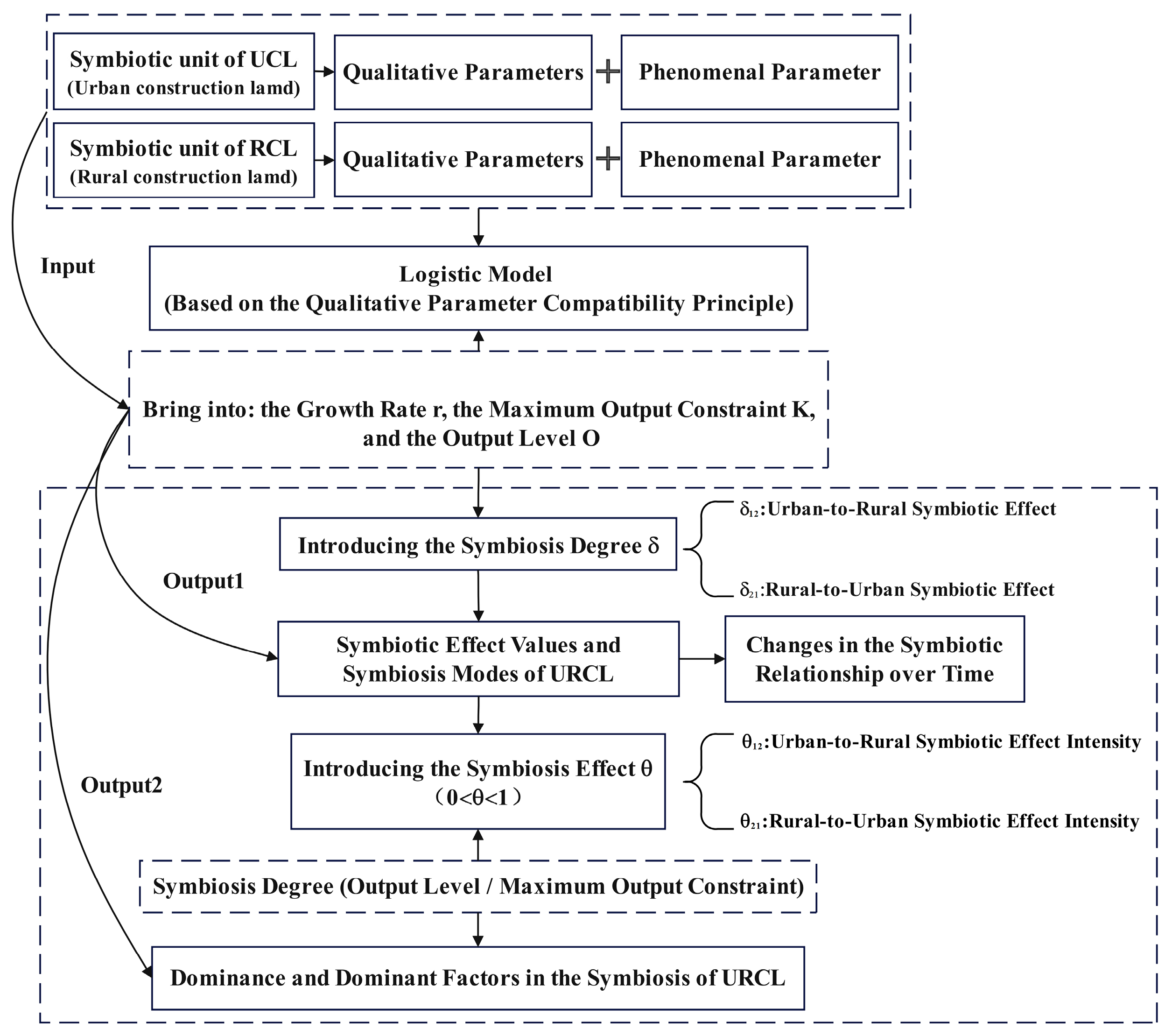
- Extract principal components: Calculate the eigenvalues λ and the corresponding eigenvectors of R. Select the number of principal components based on the cumulative variance contribution rate, typically requiring a cumulative contribution rate of ≥ 80%. The principal component analysis results for the two qualitative parameters of the UCL symbiosis indicators are shown in Table 4. Since the contribution rate of the first principal component is sufficiently high (90.59%), the score of the first principal component is used as the initial comprehensive value.
- (4)
- Calculate the comprehensive score (normalized):
2.3. Data Sources
3. Results
3.1. Dynamics of the Symbiotic Relationship of Between URCL
- (1)
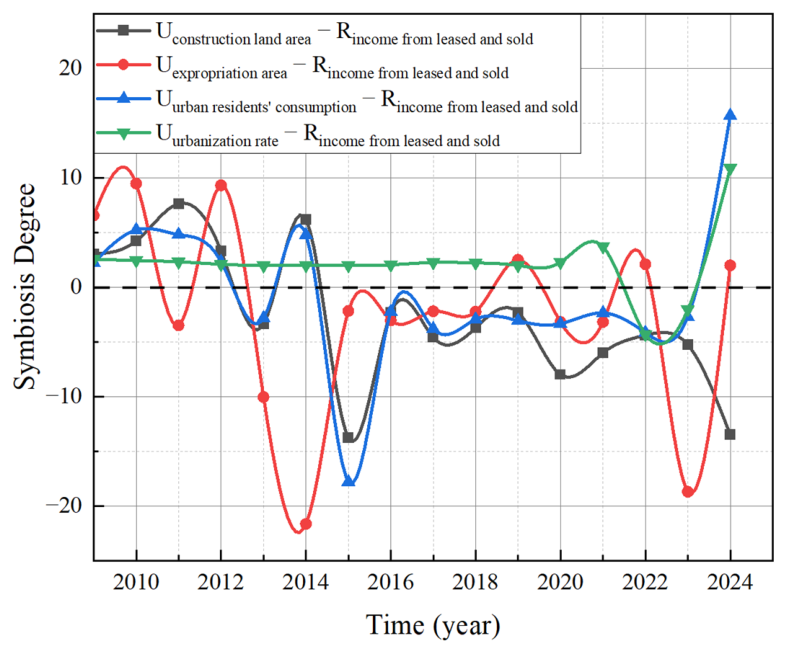
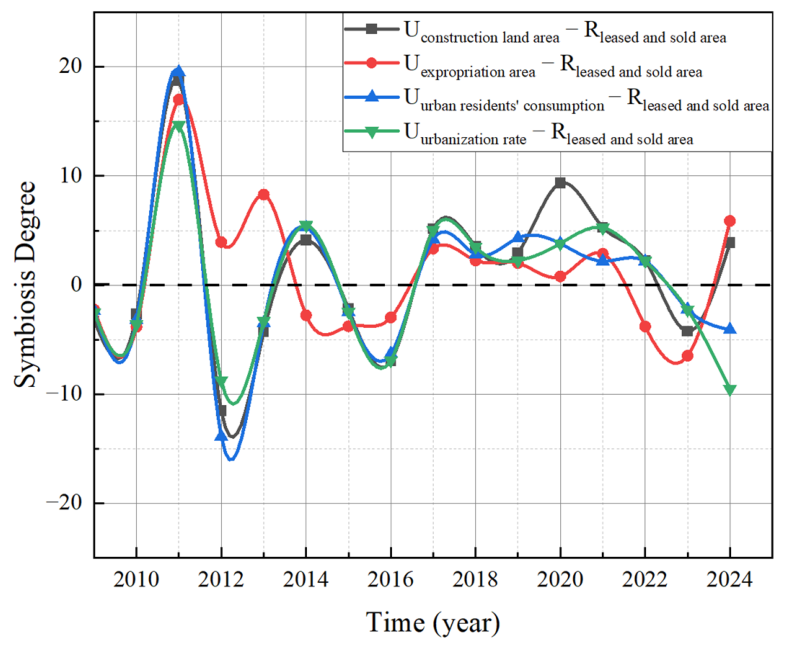
- The overall trend reveals a gradual shift from competitive symbiosis to mutualistic symbiosis. From 2009 to 2014, URCL predominantly exhibited features of competitive and parasitic symbiosis. During this period, the rising urbanization rate stimulated simultaneous increases in land demand in both urban and rural areas. Given the non-renewable and inherently scarce nature of land within a shared spatial context, urban and rural land scales were inevitably drawn into a competitive trade-off, in which urban spaces held stronger policy and economic advantages. Between 2015 and 2024, the URCL symbiotic relationship alternated between competition and mutualism, displaying an overall wave-like pattern. From 2015 to 2020, mutualistic symbiosis prevailed. With the advancement of the “Three Types of Land” reform and the implementation of policies permitting rural collectively-owned commercial construction land (RCOCCL) marketization following the revision of China’ s Land Ad-ministration Law, the symbiotic degree gap between UCL and RCL narrowed, giving rise to a mutually reinforcing interaction mechanism. From 2021 to 2024, competitive symbiosis became dominant. Within the limited market capacity of urban–rural land, competition between the two land supply entities—state-owned and collectively owned—is inevitable and represents a necessary phase in the market allocation process that helps balance the land-use structures of the symbiotic units.
- (2)
- The symbiotic relationship between URCL exhibits pronounced fluctuations, with two distinct fluctuation nodes identified during the study period. The first node, between 2014 and 2016, is characterized by frequent shifts in the symbiotic relationship, indicating that both the structure of urban–rural land-use and broader socio-economic development significantly shape these changes; the integration of URCL cannot be disentangled from the social, economic, and political systems underpinned by urban–rural land. The second node emerges after a sustained period of mutualistic symbiosis from 2017 to 2020: the mutualistic pattern was disrupted during 2021–2023 and gave way to competitive symbiosis. Notably, the gap between δ12 and δ21 widened during this period compared with that before 2017, suggesting that transient and unstable mutualistic symbiosis may intensify resource competition between urban and rural areas. The re-emergence of the competitive symbiosis mode between URCL during 2021–2023 can be attributed primarily to two factors: external environ-mental shocks and conflicts in urban–rural cooperation. On the one hand, under the constraint of a fixed maximum capacity of urban–rural supply and demand, persistent policy input has fostered reform inertia in URCL, weakening the symbiotic dependence between urban and rural areas. Exploiting policy provisions to capture market gains is the immediate driver of the return to competitive symbiosis. On the other hand, the market is inherently competitive: the cooperative structure embedded in the integrated URCL market implicitly contains competition. When input costs in both URCL markets rise, the short-term strategy of shifting from mutualism to competition can help increase land-based fiscal revenue, serving as one mechanism through which the integrated market achieves positive performance in its early stages. Furthermore, asymmetry among symbiotic units can disrupt the existing mutualistic relationship between urban and rural areas, prompting actors to leverage market competitiveness to extract benefits. The mutualistic state from 2017 to 2020 represents a nascent stage in which new market forces surfaced under the impetus of new policies, confirming the positive role of policies that simultaneously curtailed administrative allocation and strengthened market transactions in both urban and rural land systems. The return to mutualistic symbiosis in 2024 reflects that, after undergoing internal optimization through competitive restructuring, urban and rural areas have attained an integrated, high-quality mutualistic symbiosis.
3.2. The Dominant Forces in URCL Symbiosis
3.3. Influencing Factors on URCL Symbiosis
3.3.1. The Induced Effect of RCL Marketization on Changes in the URCL Relationship
3.3.2. The Key Role of the Urbanization Rate and Land Expropriation in the Symbiosis of URCL
- (1)
- The Dominant Role of Land Expropriation and the Urbanization Rate.
- (2)
- The Facilitating Role of Urban Residents’ Consumption Level in Changes of Urban–rural Land Structure
- (3)
- The Policy Implications of The Convergence of Symbiosis Coefficient Values for URCL
4. Discussion
5. Conclusions
- (1)
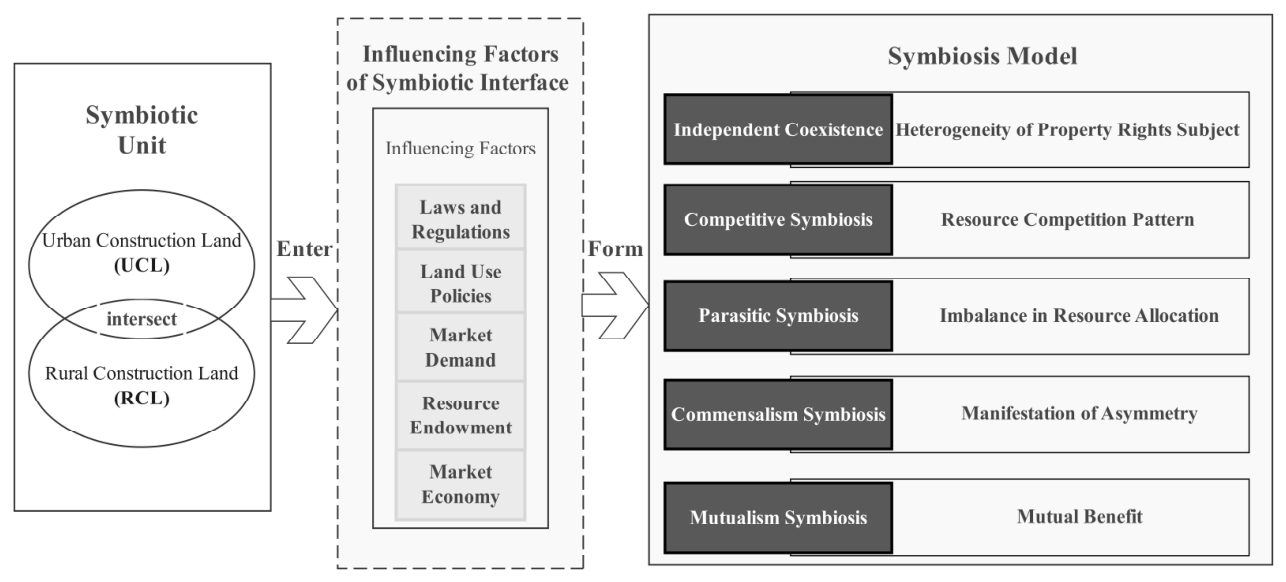
- URCL symbiosis arises from the interaction between UCL and RCL spatial units un-der the combined effects of property rights arrangements, spatial distribution, and policies. Once these units enter the symbiotic interface shaped by urban–rural land policies, land market demand, and urban–rural resource endowments, distinct symbiotic patterns emerge according to differences in their respective symbiotic indicator inputs. Changes in the symbiotic relationship are reflected in the value of the symbiotic degree.
- (2)
- The URCL symbiotic relationship exhibits a progressive transition from competitive to mutualistic symbiosis, while the urban–rural dominance within the symbiosis fluctuates in synchrony with these changes. A brief reversal from mutualistic back to competitive symbiosis occurred during 2021–2023. This phase essentially represents a dynamic adjustment process through which URCL, driven by urban–rural integration, optimizes the market structure and advances toward high-quality symbiosis.
- (3)
- The marketization of RCL, land expropriation, and urbanization constitute the principal factors influencing the URCL symbiotic relationship. Analyses of the symbiotic degree and mean symbiosis coefficient indicate that RCL marketization facilitates mutualistic symbiosis between UCL and RCL. The urbanization rate and land expropriation not only serve as key drivers of changes in URCL symbiosis but also exhibit a strong correlation with the transaction prices and traded area of the RCL market.
Author Contributions
Funding
Data Availability Statement
Conflicts of Interest
References
- Chen, K.Q.; Long, H.L.; Liao, L.W.; Tu, S.S.; Li, T.T. Land use transitions and urban-rural integrated development: Theoretical framework and China’s evidence. Land Use Policy 2020, 92, 104465. [Google Scholar] [CrossRef]
- Cattaneo, A.; Adukia, A.; Brown, D.L.; Christiaensen, L.; Evans, D.K.; Haakenstad, A.; McMenom, T.; Partridge, M.; Vaz, S.; Weiss, D.J. Economic and social development along the urban-rural continuum: New opportunities to inform policy. World Dev. 2022, 157, 105941. [Google Scholar] [CrossRef]
- Wang, X.F.; Zhang, X.D. A regional comparative study on the mismatch between population urbanization and land urbanization in China. PLoS ONE 2023, 18, e0287366. [Google Scholar] [CrossRef]
- Li, X.; Kuang, X.F.; Ma, X.D.; Li, C.C. Are there interactions between the urban and rural construction land use transition? Evidence from Jiangsu province in China. Habitat Int. 2024, 148, 103092. [Google Scholar] [CrossRef]
- Wu, Y.Z. Spatial Governance in Urban-Rural Integrated Development. Frontiers 2025, 93–100. [Google Scholar]
- Feng, X.; Wang, H.; Chi, G.Q. Does market-oriented land conveyance affect regional economic resilience? A spatial and mediation analysis based on 287 Chinese cities. Land Use Policy 2025, 150, 107457. [Google Scholar]
- Huang, Y.J.; Gan, J.W.; Liu, B.L.; Zhao, K.Q. Environmental policy and green development in urban and rural construction: Beggar-thy-neighbor or win-win situation? J. Clean. Prod. 2024, 446, 141201. [Google Scholar] [CrossRef]
- Jia, K.Y.; Huang, X.J.; Qiao, W.F.; Zhong, S.J. Unpacking divergent rural-urban land use dynamics in county urbanization: A comparative socio-spatial analytics approach. Cities 2024, 154, 105343. [Google Scholar] [CrossRef]
- Long, H. Analysis of Rural Transformation Development and Restructuring in China. In Land Use Transitions and Rural Restructuring in China; Springer: Singapore, 2020; pp. 315–377. [Google Scholar]
- Tang, S.; Wang, F.; Ye, H.; Lu, X.C. Rural Clustering Development Strategies Based on Symbiosis Theory, Guangzhou. Planners 2024, 40, 55–63. [Google Scholar]
- Zhang, B.Z.; Duan, M.; Tan, T. Spatial Structure, Production Order, and Construction Path of Urban-rural Communities: A Symbiotic Perspective. J. Nanjing Agric. Univ. (Soc. Sci. Ed.) 2023, 23, 97–104. [Google Scholar]
- Su, K.Q.; He, D.W.; Wang, R.X.; Han, Z.; Deng, X.Z. Assessment of natural resource endowment and urban-rural integration for sustainable development in Xinjiang, China. J. Clean. Prod. 2024, 450, 142046. [Google Scholar] [CrossRef]
- Guo, J.P.; Zhao, Y.H.; Li, F.Y.H.; Mao, K.B.; He, J.F.; He, Q. Developing a land development compensation model for returned land in tract expropriation: Towards a unified urban-rural land market in China. Land Use Policy 2024, 139, 107088. [Google Scholar] [CrossRef]
- Tan, R.; Wang, R.Y.; Heerink, N. Liberalizing rural-to-urban construction land transfers in China: Distribution effects. China Econ. Rev. 2020, 60, 101147. [Google Scholar] [CrossRef]
- Oulhen, N.; Schulz, B.J.; Carrier, T.J. English translation of Heinrich Anton de Bary’s 1878 speech, ‘Die Erscheinung der Symbiose’ (‘De la symbiose’). Symbiosis 2016, 69, 131–139. [Google Scholar] [CrossRef]
- Liu, R.J.; Wang, L. Symbiology; Science Press: Beijing, China, 2018; pp. 4–15. [Google Scholar]
- Douglas, A.E. The Symbiotic Habit; Princeton University Press: Princeton, NJ, USA, 2021; pp. 1–24. [Google Scholar]
- Wu, X.L. Symmetry Mutualism of Urban and Rural Areas: A New Theoretical Framework of Urban-Rural Relationship. Issues Agric. Econ. 2018, 14–22. [Google Scholar]
- Peacock, K.A. Symbiosis in Ecology and Evolution. North-Holl. Philos. Ecol. 2011, 11, 219–250. [Google Scholar]
- Roossinck, M.J.; Bazán, E.R. Symbiosis: Viruses as Intimate Partners. Annu Rev. Virol. 2017, 4, 123–139. [Google Scholar] [CrossRef]
- Xu, X.; Wang, Y.Y. Research on the Logical Mechanism, Multidimensional Measurement and Regional Coordinated Development of Urban-rural Integration: From the Perspective of Coordinated Promotion of New Urbanization and Rural Vitalization. Issues Agric. Econ. 2023, 49–62. [Google Scholar]
- Cao, H.; Chen, C.; Chen, J.L.; Song, W.X.; He, J.; Liu, C.H. Differentiation of urban-rural interface and its driving mechanism: A case study of Nanjing, China. Land Use Policy 2024, 140, 107090. [Google Scholar] [CrossRef]
- Hu, S.J. Theory of Social Symbiosis, 2nd ed.; Fudan University Press: Shanghai, China, 2012; pp. 1–66. [Google Scholar]
- Hermann, R. Ecology; Springer: Berlin/Heidelberg, Germany, 1980. [Google Scholar]
- Lotka, A.J. Elements of Physical Biology. Nature 1925, 116, 461. [Google Scholar] [CrossRef]
- Volterra, V. Fluctuations in the Abundance of a Species considered Mathematically1. Nature 1926, 118, 558–560. [Google Scholar] [CrossRef]
- Krebs, C.J. Ecology: The Experimental Analysis of Distribution and Abudance, 3rd ed.; Harper & Row: New York, NY, USA, 1985; pp. 207–234. [Google Scholar]
- Fan, C.L.; Zhang, Q.C.; Peng, M.S. The Symbiosis and Mutual Prosperity of Economy and Finance: Theory, Measurement and Implementation Path. Mod. Financ. Econ.-J. Tianjin Univ. Financ. Econ. 2021, 41, 3–17. [Google Scholar]
- Zhou, Y.Q.; Zhu, P.L.; Xia, T.X. The mutualistic symbiosis of public and scientific attention in science communication. Sci. Rep. 2025, 15, 41151. [Google Scholar] [CrossRef]
- Yuan, C.Q. Symbiosis and Harmony; Social Sciences Academic Press: Beijing, China, 2008; pp. 8–30. [Google Scholar]
- Yuan, C.Q. Symbiosis Theory—On Small Economy; Economic Science Press: Beijing, China, 1998; pp. 1–82. [Google Scholar]
- Zhong, S.J.; Huang, X.J.; Chen, Z.G. Urban-rural Construction Land Market Integration Models and Differentiation Mechanisms at the County Level: A Comparative Case Study of Deqing County, Zhejiang Province and Nanhai District, Guangdong Province. Chin. Rural Econ. 2024, 23–41. [Google Scholar]
- Hua, Z.; He, Y. Rural Collective Land Expropriation in China: Historical Evolution, Institutional Attributes, and Reform Pathways. Land 2026, 15, 663. [Google Scholar] [CrossRef]
- Luo, R.F. The Legal Mechanism for the Coordination Between the Marketization of Collective Land Designated for Business-related Construction And the Expropriation and Development of Tracts of Land. Wuhan Univ. J. (Philos. Soc. Sci.) 2025, 78, 5–15. [Google Scholar]
- Yi, C.J.; Xu, B.Y.; Shi, X.Y.; Li, R.F.; Chen, J. Exploring the spatial effects of rapid urbanization on land use efficiency in China under Low-Carbon constraint. Ecol. Indic. 2025, 174, 113442. [Google Scholar] [CrossRef]
- Chen, J.; Zhang, Y. The Impact of Market-Oriented Reform of Rural Collective Operational Construction Land in China on the Urban-Rural Income Gap. Land 2026, 15, 364. [Google Scholar] [CrossRef]
- Shen, J.N. The Extensive and Intensive Urbanization Affecting the Consumption of Urban and Rural Residents in China. J. Commer. Econ. 2023, 46–50. [Google Scholar]
- Peng, C.X. A multi-source data study on the imbalance of economic production factors between urban and rural areas in the pearl river delta. GeoJourna 2026, 91, 48. [Google Scholar] [CrossRef]




| The Values of and | Symbiosis Model | Characteristic | |
|---|---|---|---|
| Independent coexistence | There is no competitive or cooperative relationship between URCL. UCL, existing in a dualistic structure, gradually transitions toward state ownership, while RCL gradually moves toward collective ownership. Both have weak external radiation. | ||
| 0 | Competitive symbiosis | The symbiotic radiation between URCL is less than 0. UCL and RCL are externally competitive, and the competition is segmented. That is, driven by the scarcity of construction land itself, two types of resource-occupying competitive behaviors emerge, represented by urban and rural areas. | |
| >0 | Parasitic symbiosis | At this stage, the analysis is split into two symbiotic features: “parasitism” and “symbiosis.” “Parasitism” is reflected in RCL acting as a supplementary land supplier for urban–rural development, engaging in urban spatial construction in a competitive manner, i.e., . “Symbiosis” is reflected in the spatial configuration and policy advantages of UCL gradually radiating to rural areas in a mutually beneficial and co-existing state, i.e., > 0. | |
| 0 | Commensalism symbiosis | signifies that RCL has gradually transitioned to an independent participant in the structural allocation of URCL, breaking away from its parasitic status and accessing the integrated URCL market as a market player. The commensalistic pattern of urban–rural land marketization both highlights the value of rural resources and exposes the asymmetric nature of urban–rural relationships. | |
| 0 | Mutualism symbiosis | Both and are greater than 0, indicating that urban and rural areas have essentially achieved a fundamental pattern of harmonious symbiosis of URCL. This can be further divided into two cases, as shown in the right column. | 0: Asymmetric mutualistic symbiosis, manifested as equal rights for equal land, entails hidden issues in urban–rural complementarity. |
| 0: Symmetric mutualistic symbiosis manifests as the efficient integration of URCL, which is theoretically a “utopia.” | |||
| Symbiosis Coefficient | Influence |
|---|---|
| A certain urban symbiosis indicator has no effect on the rural symbiosis indicator. | |
| A certain urban symbiosis indicator has no effect on the rural symbiosis indicator. | |
| The effect of a certain urban symbiotic indicator on the rural symbiotic indicator is smaller than the effect of a certain rural symbiotic indicator on the urban symbiotic indicator. | |
| The effect of a certain urban symbiotic indicator on the rural symbiotic indicator is greater than the effect of a certain rural symbiotic indicator on the urban symbiotic indicator. | |
| The effect of a certain urban symbiotic indicator on the rural symbiotic indicator is equal to the effect of a certain rural symbiotic indicator on the urban symbiotic indicator. |
| Symbiosis Units | Symbiotic Dimension | Symbiosis Indicators | Explanation of Indicators | Reference Basis |
|---|---|---|---|---|
| UCL Symbiosis Indicators | Qualitative Parameters | National Urban Construction Land Area (square kilometer) | Refers to the land area occupied for the implementation of urban planning within the scope defined by the overall land-use plan, including land for urban housing, public buildings, etc., excluding land requisitioned for public use. It reflects the urban capacity and its constraints. | [32] |
| Land Expropriation Area (square kilometer/year) | Refers to the act whereby the state, based on the need of public interest, expropriates land collectively owned by farmers and converts it into state ownership, while providing reasonable compensation to the expropriated parties. It is also a land-use pattern through which urban spaces directly utilize rural land. | [33,34] | ||
| Phenomenal Parameters | Urban Residents’ Consumption Level (yuan) | This indicator measures the degree to which urban residents’ consumption of material goods and services satisfies their needs for survival, development, and enjoyment, and represents the consumption level of individuals or society. | [35,36,37,38] | |
| Urbanization Rate (%) | It directly reflects the speed and scale of urban–rural development and serves as an important indicator of the degree of urbanization in a region. It generally refers to the proportion of the urban population to the total population, comprehensively representing multiple dimensions such as population, land, and culture. | [35,36,37] | ||
| RCL Symbiosis Indicators | Qualitative Parameters | National Rural Settlement Construction Land Area (square kilometer) | It equals the current village land area minus the collectively owned agricultural land area, reflecting the rural capacity and its constraints. | [32] |
| Leased and Sold Area of Rural Collective Construction Land (square kilometer/year) | Refers to the land area of rural collective construction land-use rights leased or transferred by rural collective economic organizations during the current year. The leased or transferred area herein includes above-ground structures and facilities such as factories and shops owned by farmers’ collectives, which are leased or transferred together with the rural collective construction land-use rights. | [33,34] | ||
| Phenomenal Parameters | Income from Leasing and Sold of Rural Construction Land (10,000 yuan) | Refers to the total transaction price of rural collective construction land-use rights leased or transferred by rural collective economic organizations during the current year, serving as an indicator of returning to the market for achieving urban–rural integration. | [32] | |
| Rural Residents’ Consumption Level (10,000 yuan) | This composite indicator incorporates the per capita consumption expenditure, Engel coefficient, consumption growth rate, and category-specific consumption proportions, serving to measure the level of rural economic and social development. | [35,36,37,38] |
| Principal Component | Eigenvalue (λ) | Variance (%) | Cumulative (%) |
|---|---|---|---|
| PC1 | 1.8117 | 90.59% | 90.59% |
| PC2 | 0.1883 | 9.41% | 100% |
| Principal Component | Eigenvalue (λ) | Variance (%) | Cumulative (%) |
|---|---|---|---|
| PC1 | 1.6753 | 83.76% | 83.76% |
| PC2 | 0.3247 | 16.24% | 100% |
| Time | Symbiosis Degree | Symbiosis Relationship | |
|---|---|---|---|
| 2009 | −1.980 | −0.705 | Competition Symbiosis |
| 2010 | −1.937 | −0.454 | Competition Symbiosis |
| 2011 | 5.503 | −1.052 | Parasitic Symbiosis |
| 2012 | 5.252 | −0.815 | Parasitic Symbiosis |
| 2013 | 4.941 | −0.752 | Parasitic Symbiosis |
| 2014 | 2.278 | 0.044 | Commensalism Symbiosis |
| 2015 | 1.641 | 1.072 | Mutualistic Symbiosis |
| 2016 | −0.925 | −1.167 | Competition Symbiosis |
| 2017 | 3.482 | 4.030 | Mutualistic Symbiosis |
| 2018 | 2.740 | 3.442 | Mutualistic Symbiosis |
| 2019 | 2.407 | 3.337 | Mutualistic Symbiosis |
| 2020 | 1.312 | 2.825 | Mutualistic Symbiosis |
| 2021 | −4.101 | −2.390 | Competition Symbiosis |
| 2022 | −2.497 | −0.401 | Competition Symbiosis |
| 2023 | −0.831 | −1.200 | Competition Symbiosis |
| 2024 | 0.962 | 2.344 | Mutualistic Symbiosis |
| Time | 12 | 21 | Dominant Force |
|---|---|---|---|
| 2009 | 0.737 | 0.263 | Absolute Dominance of UCL |
| 2010 | 0.810 | 0.190 | Absolute Dominance of UCL |
| 2011 | 0.840 | 0.160 | Absolute Dominance of UCL |
| 2012 | 0.866 | 0.134 | Absolute Dominance of UCL |
| 2013 | 0.868 | 0.132 | Absolute Dominance of UCL |
| 2014 | 0.981 | 0.019 | Absolute Dominance of UCL |
| 2015 | 0.605 | 0.395 | Significant Dominance of UCL |
| 2016 | 0.442 | 0.558 | Marginal Dominance of RCL |
| 2017 | 0.463 | 0.537 | Marginal Dominance of RCL |
| 2018 | 0.443 | 0.557 | Marginal Dominance of RCL |
| 2019 | 0.419 | 0.581 | Marginal Dominance of RCL |
| 2020 | 0.317 | 0.683 | Significant Dominance of RCL |
| 2021 | 0.632 | 0.368 | Significant Dominance of UCL |
| 2022 | 0.862 | 0.138 | Significant Dominance of UCL |
| 2023 | 0.409 | 0.591 | Marginal Dominance of RCL |
| 2024 | 0.291 | 0.709 | Significant Dominance of RCL |
| UCL Indicators | RCL Indicators | Average Symbiosis Coefficient | Variation of Dominant Forces | |
|---|---|---|---|---|
| 12 | 21 | |||
| UCL Area | RCL Area | 0.541 | 0.459 | Urban construction weakly dominates the direction of rural construction. |
| Leased and Sold Area of RCL | 0.608 | 0.392 | Urban construction demand drives rural land flow. | |
| Income from Leasing and Sold of RCL | 0.463 | 0.537 | The dominant role of rural rental income is gradually emerging. | |
| Rural Residents’ Consumption Level | 0.489 | 0.511 | The symbiosis coefficients of the two are close to each other, meaning that both urban planning and rural consumption depend more on the dynamics of urban–rural change and do not exhibit clear dominance. | |
| Land Expropriation Area | RCL Area | 0.786 | 0.214 | Expropriation has a strong impact on rural planning. |
| Leased and Sold Area of RCL | 0.612 | 0.388 | Expropriation strongly affects the volume of rural market transactions. | |
| Income from Leasing and Sold of RCL | 0.622 | 0.378 | Expropriation further affects rural land prices. | |
| Rural Residents’ Consumption Level | 0.592 | 0.408 | Expropriation affects changes in rural residents’ consumption level. | |
| Urban Residents’ Consumption | RCL Area | 0.542 | 0.458 | Urban residents’ consumption weakly influences the rural land–use structure. |
| Leased and Sold Area of RCL | 0.562 | 0.438 | Urban residents’ consumption structure affects the supply and demand of the rural land market. | |
| Income from Leasing and Sold of RCL | 0.437 | 0.563 | The absorptive capacity of the RCL market is gradually emerging. | |
| Rural Residents’ Consumption Level | 0.505 | 0.495 | The consumption level coefficient between urban and rural residents is approximately 0.5, implying that neither urban nor rural residents’ consumption level significantly drives the other. | |
| Urbanization Rate | RCL Area | 0.544 | 0.456 | The process of urbanization influences the variation in the amount of RCL, both incremental and existing. |
| Leased and Sold Area of RCL | 0.597 | 0.403 | The urbanization rate guides the rural land structure. | |
| Income from Leasing and Sold of RCL | 0.574 | 0.426 | The urbanization rate weakly influences rural land transaction prices. | |
| Rural Residents’ Consumption Level | 0.514 | 0.486 | Urbanization weakly influences rural residents’ consumption. | |
Disclaimer/Publisher’s Note: The statements, opinions and data contained in all publications are solely those of the individual author(s) and contributor(s) and not of MDPI and/or the editor(s). MDPI and/or the editor(s) disclaim responsibility for any injury to people or property resulting from any ideas, methods, instructions or products referred to in the content. |
© 2026 by the authors. Licensee MDPI, Basel, Switzerland. This article is an open access article distributed under the terms and conditions of the Creative Commons Attribution (CC BY) license.
Share and Cite
Zhang, Q.; Long, K. Dynamics of the Symbiotic Relationship Between Urban and Rural Construction Land (URCL) and the Factors Influencing Its Transformation. Land 2026, 15, 922. https://doi.org/10.3390/land15060922
Zhang Q, Long K. Dynamics of the Symbiotic Relationship Between Urban and Rural Construction Land (URCL) and the Factors Influencing Its Transformation. Land. 2026; 15(6):922. https://doi.org/10.3390/land15060922
Chicago/Turabian StyleZhang, Qi, and Kaisheng Long. 2026. "Dynamics of the Symbiotic Relationship Between Urban and Rural Construction Land (URCL) and the Factors Influencing Its Transformation" Land 15, no. 6: 922. https://doi.org/10.3390/land15060922
APA StyleZhang, Q., & Long, K. (2026). Dynamics of the Symbiotic Relationship Between Urban and Rural Construction Land (URCL) and the Factors Influencing Its Transformation. Land, 15(6), 922. https://doi.org/10.3390/land15060922