Integrated Urban Climate Resilience and Sustainability Assessment System for Urban Regeneration and Building Renovation


Abstract
1. Introduction
2. Literature Review
2.1. Multi-Hazard Vulnerability Analysis
- Exposure mapping: High-resolution spatial layers that represent hazard footprints (land surface temperature, flood depth, wind/storm corridors, landslide susceptibility), derived from remote sensing, hydrodynamic modeling (SWMM/2D models) and microclimate simulations (ENVI-met version 5.8.0).
- Sensitivity and adaptive capacity: Socio-demographic indicators (age, income, housing quality), critical infrastructure dependence (substation locations, pumping stations, major arterials) and building-stock characteristics (typology, envelope, thermal mass) that determine damage and loss.
- Urgent: Retrofit and emergency measures in high-risk clusters (e.g., cooling centers, emergency drainage improvements)
- Targeted: Prioritized building renovations and green infrastructure corridors in neighborhood hotspots
- Routine: Long-term zoning and land-use changes to reduce exposure (setbacks, permeable surfaces, urban greening)
2.2. Urban Climate Resilience
2.3. Sustainable Urban Regeneration (SUR)
2.4. Building Renovation
2.5. Urban Microclimate and Urban Heat Island (UHI) Effect
2.6. Life Cycle Assessment (LCA)
2.7. Remote Sensing and Vegetation Mapping
2.8. Positioning Against Existing Integrated Urban Climate Resilience Frameworks
3. Materials and Methods
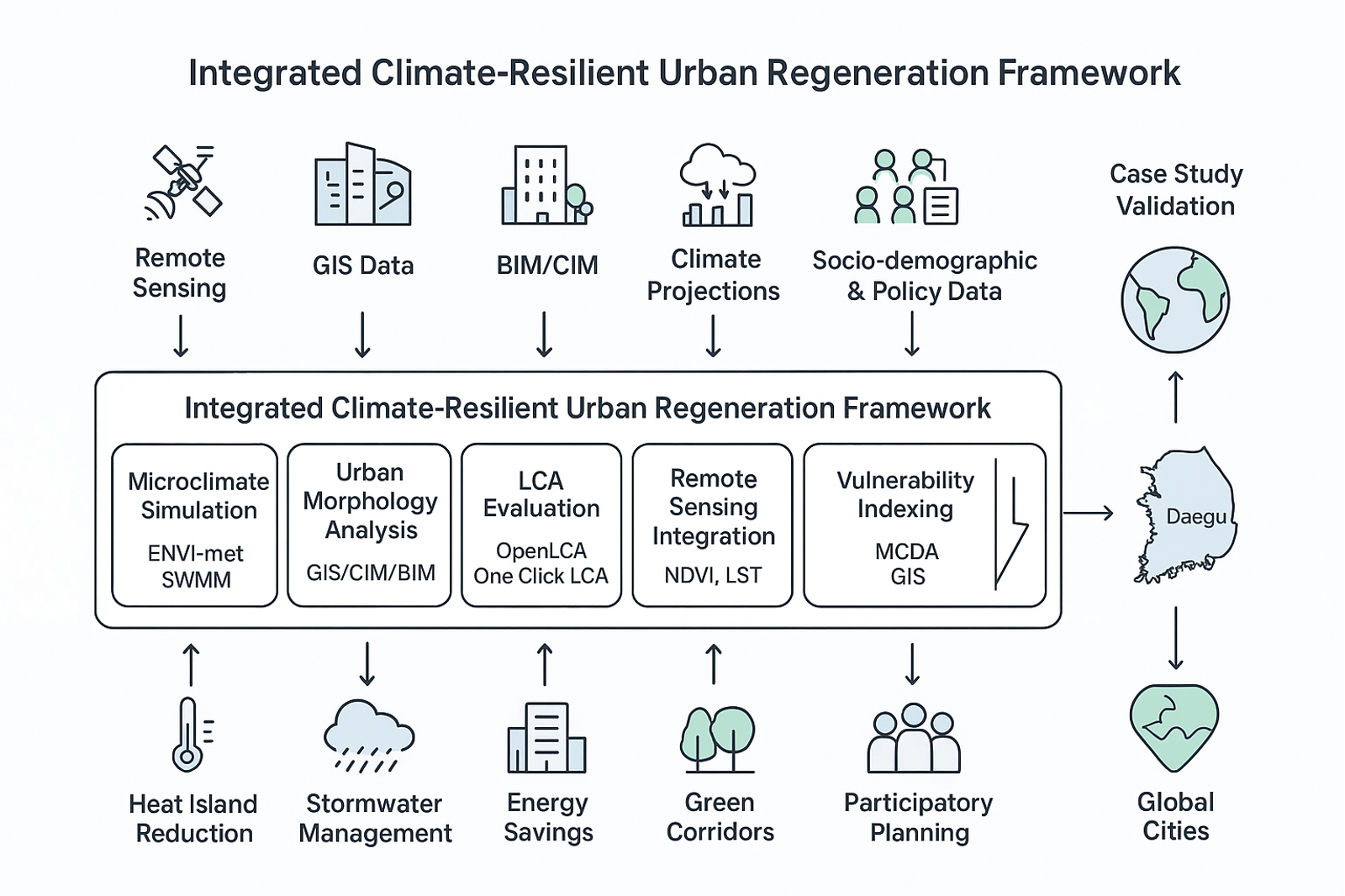
3.1. Conceptual Framework Overview
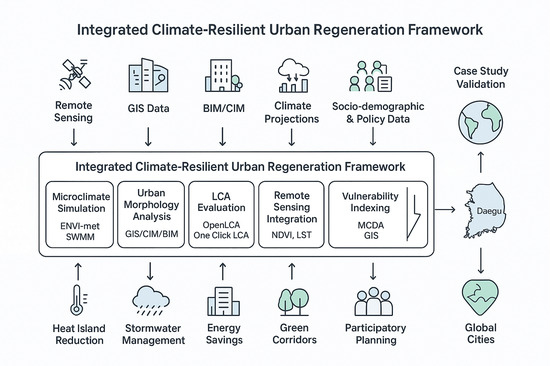
- Spatial analytics through GIS and remote sensing to capture morphology, vegetation, land surface temperature (LST), and hydrological dynamics.
- Simulation models (microclimate and hydrological) to quantify exposure and test adaptation measures.
- LCA-based evaluation of building and material interventions to ensure long-term sustainability.
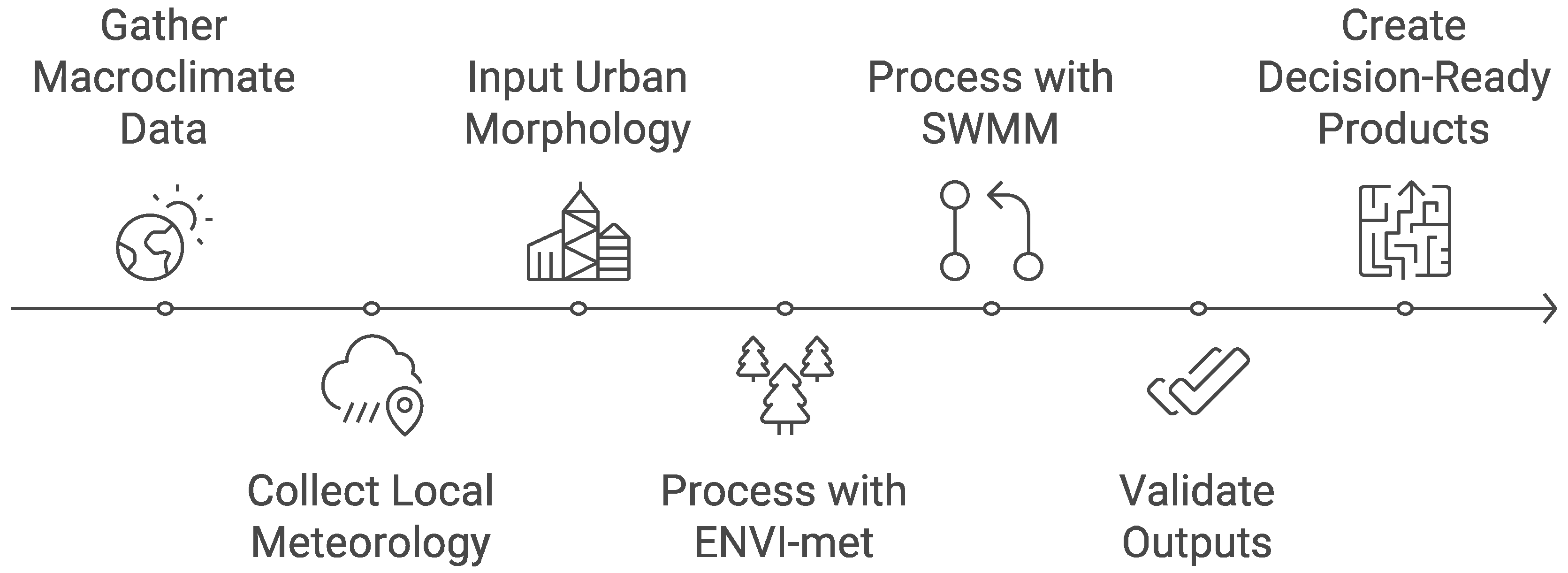
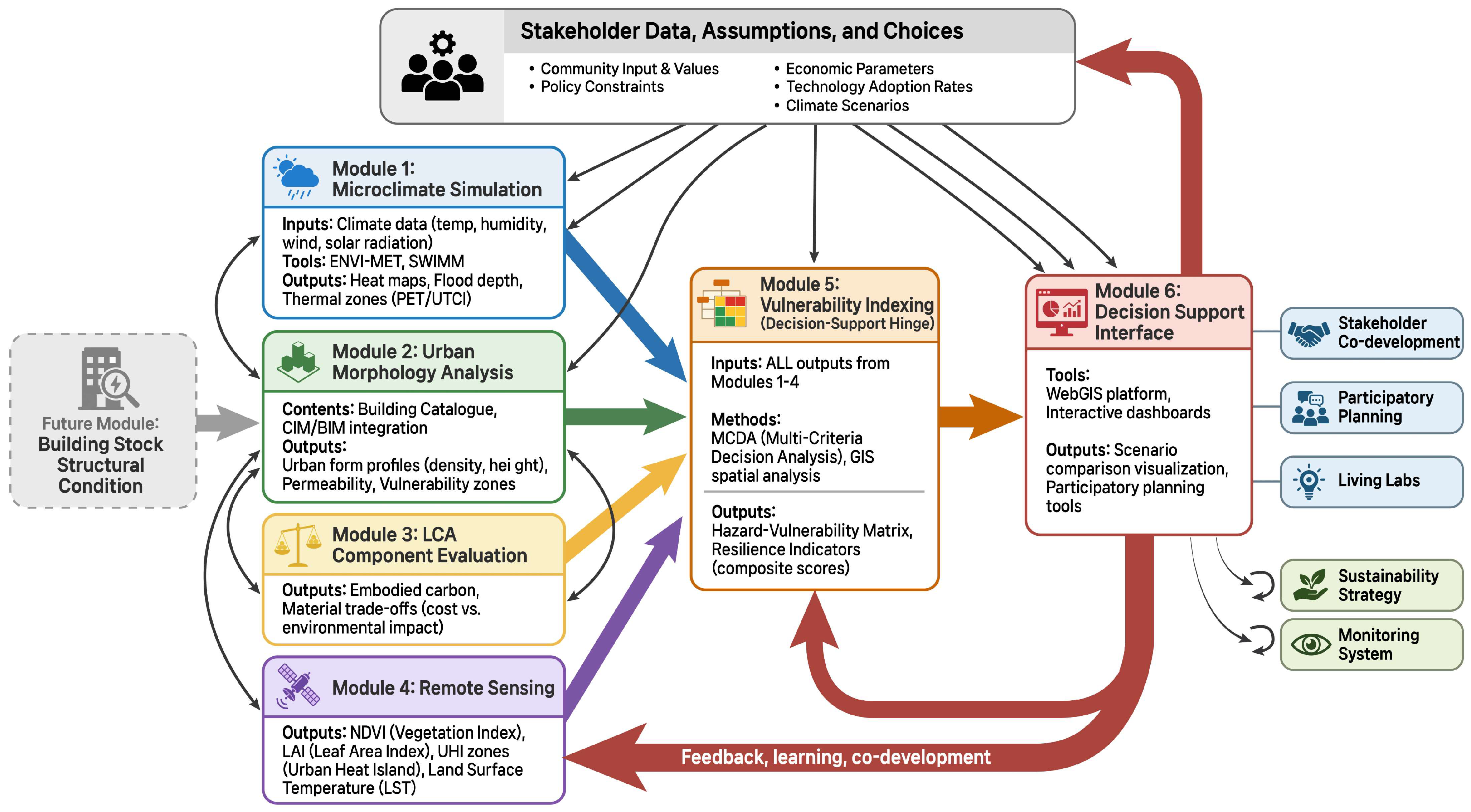
3.2. Urban Microclimate Simulation (Module 1)
- High-resolution meteorological data (e.g., KMA, IPCC climate scenarios) and given urban parameters (e.g., vegetation cover, surface albedo, building geometry) with strong correlations to observed damage from past climate events.
- Enhancing model fidelity through iterative validation using empirical datasets and remote sensing sources.
3.3. Urban Morphology GIS and CIM/BIM Integration (Module 2)
- Mapping and prioritizing potential urban regeneration zones.
- Integrating geospatial data layers with 3D building models to identify high-impact renovation opportunities. Building-level intervention mapping using LOD3 BIM data.
- Supporting a comprehensive catalogue of urban and building typologies, materials, envelope systems, and green infrastructure components, that links climate vulnerability to specific building materials, typologies, and system components
3.4. LCA-Based Component Evaluation (Module 3)
- Material choices, embodied energy and carbon of building materials across production, transport, installation, use, and end-of-life phases.
- Performance improvements and operational energy reduction through passive (e.g., insulation, shading) and active (e.g., HVAC upgrades, renewable integration) retrofitting strategies.
- Mitigation and adaptation co-benefits, such as reduced surface runoff (via permeable or vegetated surfaces), enhanced thermal stress resilience, and lowered risk from floods and heatwaves.
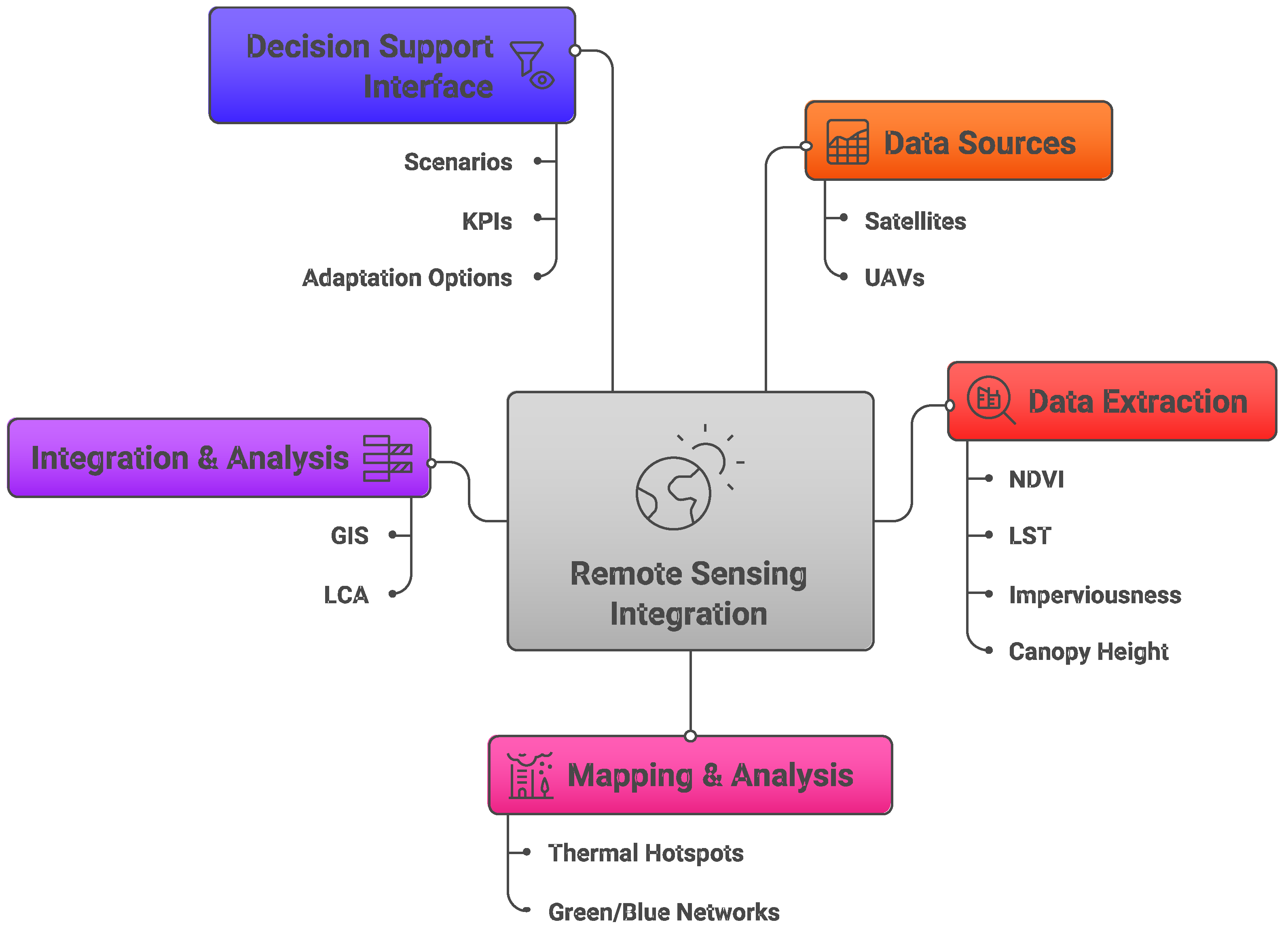
3.5. Remote Sensing and Green Infrastructure Analysis (Module 4)
- Urban vegetation and green space quantification: Using indices like NDVI (Normalized Difference Vegetation Index), LAI (Leaf Area Index), and SAVI (Soil Adjusted Vegetation Index), remote sensing allows detailed mapping of tree cover, lawn surfaces, and vegetative health [107].
- Surface temperature estimation: Thermal remote sensing from satellites (e.g., Landsat 8 TIRS, Sentinel-3 SLSTR) is used to identify urban heat island hotspots, validating outputs from ENVI-met and other microclimate models.
- Permeability and land-use mapping: High-resolution imagery is utilized to detect impervious surfaces and provide hydrological modeling inputs.
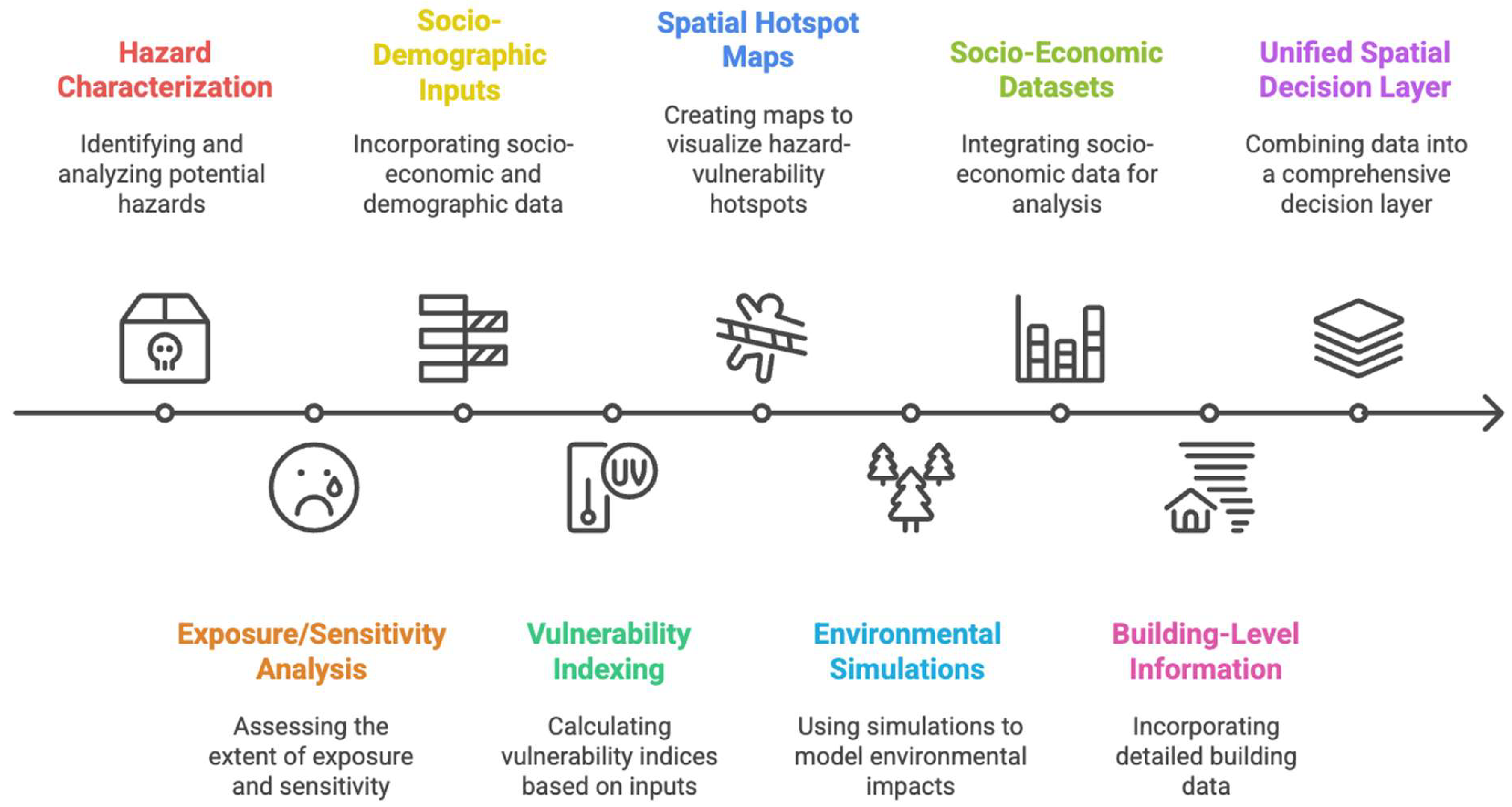
3.6. Hazard and Vulnerability Indexing (Module 5)
- ENVI-met simulations generate high-resolution maps of heat stress (°C above baseline) and outdoor thermal comfort indices.
- SWMM models provide pluvial flood depth and stormwater network performance metrics under varying rainfall intensities.
- Additional hazard layers incorporate drought severity indices and wind vulnerability in exposed urban corridors.
- Urban surface characteristics (e.g., reflectivity, permeability, vegetation) are mapped using GIS and remote sensing.
- Building and infrastructure data (envelope, material, insulation) are integrated from BIM/CIM catalogues.
- Infrastructure networks, including subsurface drainage and stormwater networks are evaluated for redundancy and robustness.
- Socio-demographic datasets (population density, age distribution, income, health vulnerability) are overlaid with hazard layers to identify socially vulnerable hotspots.
- Indicators are weighted using MCDA approaches to reflect local policy priorities (e.g., prioritizing elderly populations for heatwave adaptation).
- Outputs include a hazard–vulnerability matrix, which spatially aligns multi-hazard risk intensity with socio-technical vulnerability.
3.7. Decision Support Interface (DSI) (Module 6)
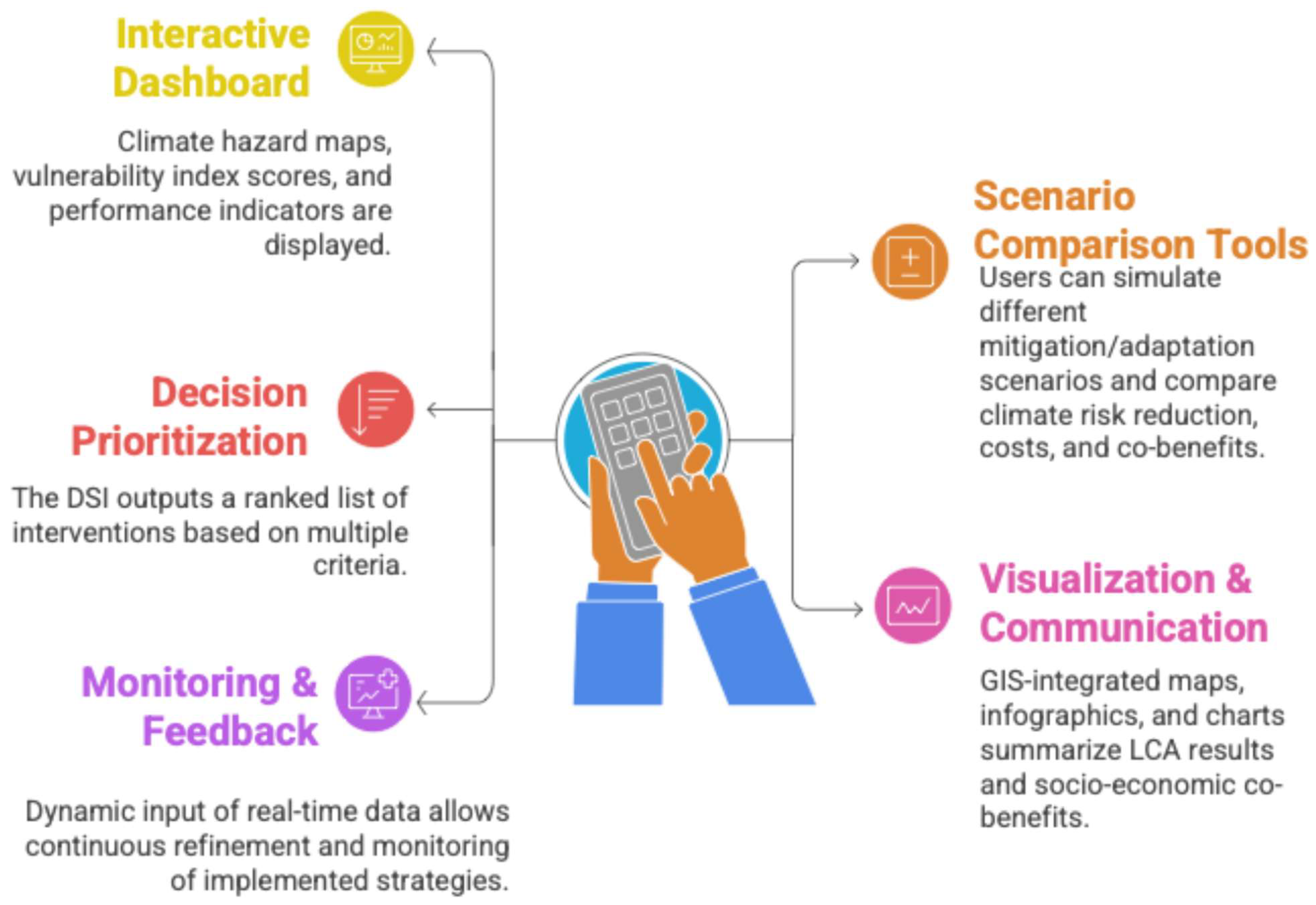
- Climate Risk Visualization: Interactive maps display future heat, flood, and drought scenarios under multiple climate projections and renovation pathways, enabling exploration of uncertainty and stress testing of strategies.
- Adaptation Strategy Comparison: Users can compare alternative regeneration and renovation interventions using predefined performance indicators (e.g., reduction in heat stress hotspots, embodied carbon savings, or improved runoff retention).
- Stakeholder Engagement: Intuitive dashboards and map-based interfaces allow non-experts, including residents and community groups, to interact with climate risk data, fostering participatory, and inclusive planning.
- Participatory Planning Support: The interface integrates scenario exploration tools, allowing policymakers, planners, and citizens to collaboratively test design options and evaluate co-benefits across environmental, economic, and social dimensions.
3.8. Data Sources and Tools
3.9. Multi-Scale Modeling Approach
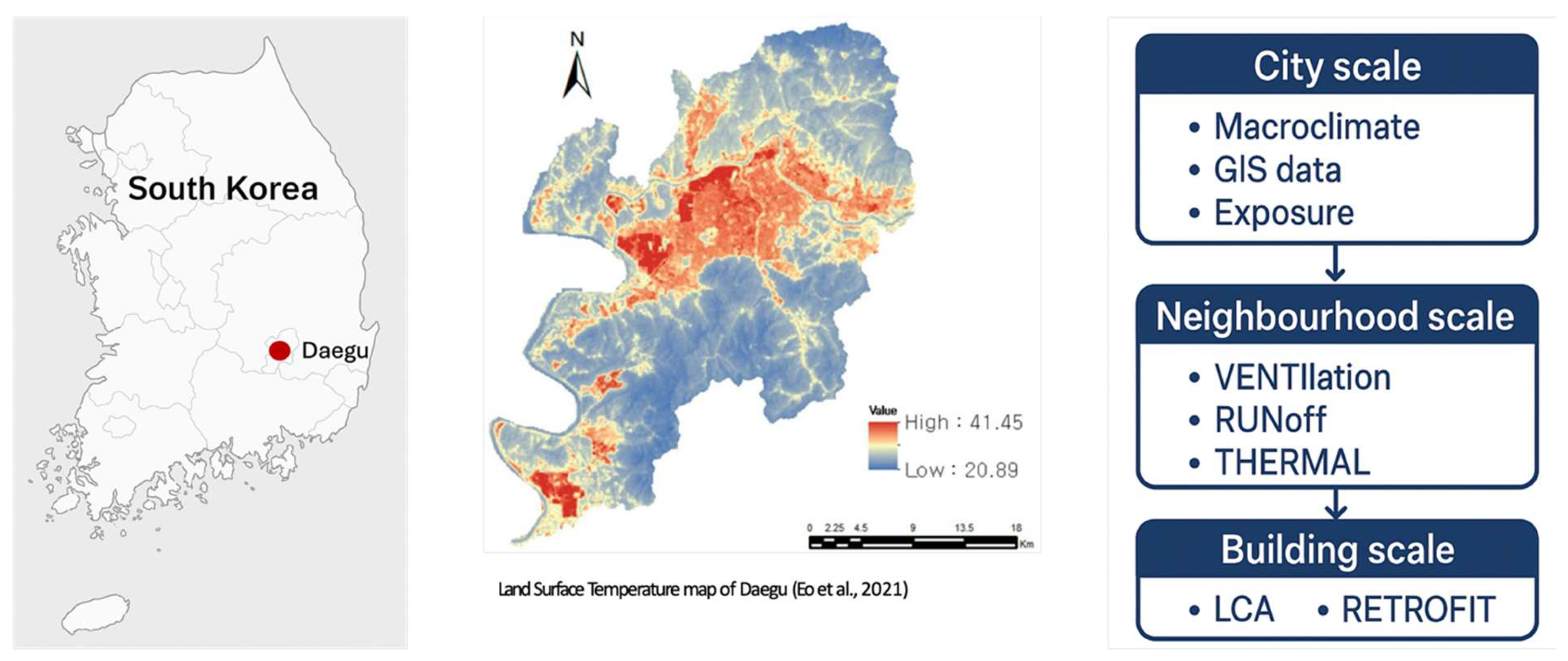
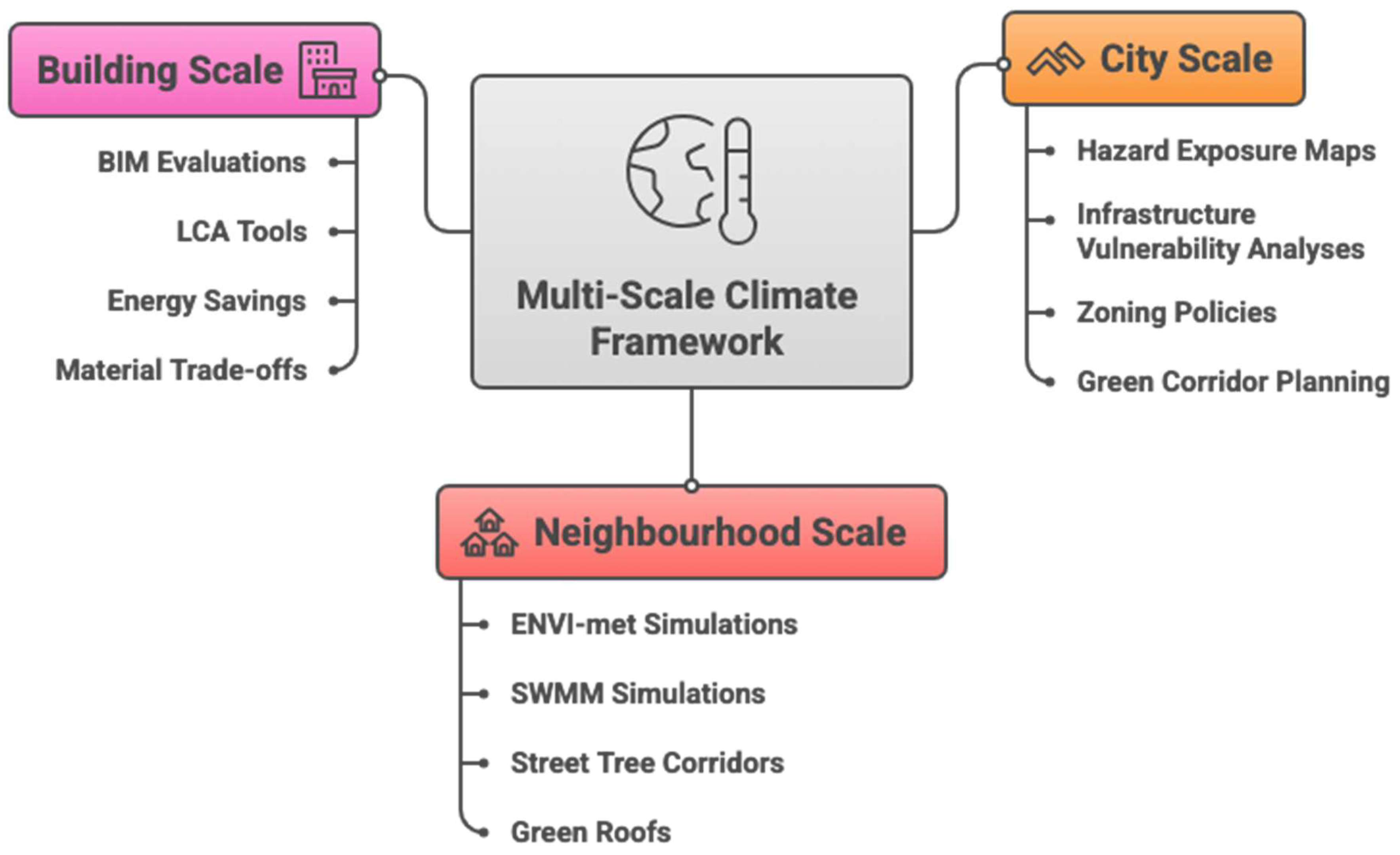
- City scale (macro) hazard exposure maps (e.g., land surface temperature, flood corridors) and infrastructure vulnerability analyses are generated using remote sensing and GIS. Outputs inform city-wide zoning policies, green corridor planning, and investment priorities. Typical outputs include heat exposure maps, critical infrastructure vulnerability indices, and service recovery time estimates.
- Neighborhood scale (meso): Simulations of urban morphology effects on ventilation, shading, and runoff, using 10–100 s domains with ENVI-met and SWMM coupled inputs. Outputs support block-level regeneration packages (green roofs, permeable paving, street trees) and neighborhood prioritization.
- Building scale (micro): Building energy and envelope modeling, LCA of retrofit options (functional unit: per m2 renovated gross floor area over a 50-year horizon), and façade/roof catalogue implementation. Building-scale outputs feed back into neighborhood scenarios (aggregate energy demand, local heat mitigation potential).
3.10. Uncertainty Sources and Sensitivity Framework
3.11. Current Scope of Sustainability Coverage and SDG Alignment
4. Results
4.1. Baseline Characterization of the Daegu Study Area
4.2. Scenario-Based Assessment
4.3. Urban Dataset
4.4. Application of Framework in Daegu
- City scale: Macroclimate projections (IPCC SSP2/SSP5) and municipal GIS data inform exposure mapping for heat and flood risks.
- Neighborhood scale: ENVI-met and SWMM simulations assess ventilation corridors, runoff management, and thermal hotspots, guiding block-level regeneration packages.
- Building scale: LCA and retrofit catalogues are applied to test renovation strategies, integrating thermal performance with long-term sustainability metrics.
4.5. Framework Validation Status and Roadmap
5. Discussion
5.1. Framework Contributions and Comparison with Related Approaches
5.2. Addressing Limitations
5.3. Future Research Directions
- Completion and full empirical validation of the Daegu pilot, including completion of the ENVI-met calibration, SWMM flood validation, and DSI stakeholder co-design activities described in Section 4.5. This is the primary near-term deliverable and constitutes the prerequisite for evidence-based claims of framework performance and transferability to other urban contexts.
- System implementation across multiple Korean cities such as Gwangju, Deajeon, Seoul, and Busan.
- AI-driven climate analytics (machine learning and digital twins) integration for predictive modeling, early-warning systems, and automated scenario testing.
- Development of open-source planning toolkits for municipal governments, NGOs, and researchers to adopt the framework without high technical barriers.
- Strengthening community engagement components, including participatory dashboards co-design workshops, and urban living labs, to enhance inclusivity and ensure that technical outputs translate into socially accepted interventions.
- Cross-sectoral applications, expanding beyond heat and flood resilience to address air pollution, resource circularity, and ecosystem services in urban regeneration strategies.
Author Contributions
Funding
Data Availability Statement
Conflicts of Interest
Abbreviations
| GIS | Geographic Information Systems |
| BIM | Building Information Modeling |
| CIM | City Information Modeling |
| LCA | Life Circle Assessment |
| DSI | Decision Support Interface |
| SDGs | Sustainable Development Goals |
| UHI | Urban Heat Island |
| SWMM | Storm Water Management Model |
| SoVI | Social Vulnerability Index |
| FVI | Flood Vulnerability Index |
| SUR | Sustainable Urban Regeneration |
| MCDA | Multi-Criteria Decision Analysis |
| USF | Urban Sustainability Framework |
| SUMP | Sustainable Mobility Plan |
| UWG | Urban Weather Generator |
| LCC | Life Cycle Costing |
| UGS | Urban Green Spaces |
| LES | Large Eddy Simulation |
| AHP | Analytic Hierarchy Process |
| PCA | Principal Component Analysis |
References
- Intergovermental Panel of Climate Change II (IPCC). Climate Change 2022: Impacts, Adaptation, and Vulnerability. Contribution of Working Group II to the Sixth Assessment Report of the Intergovernmental Panel on Climate Change. Pörtner, D.C.R.H.-O., Tignor, M., Poloczanska, E.S., Mintenbeck, K., Alegría, A., Craig, M., Langsdorf, S., Löschke, S., Möller, V., Okem, A., et al., Eds.; Cambridge University Press: Cambridge, UK; New York, NY, USA, 2022. [Google Scholar]
- Intergovermental Panel of Climate Change (IPCC). Climate Change 2023: Synthesis Report. Contribution of Working Groups I, II and III to the Sixth Assessment Report of the Intergovernmental Panel on Climate Change. Core Writing Team, Lee, H., Romero, J., Eds.; IPCC: Geneva, Switzerland, 2023; pp. 1–34. [Google Scholar]
- United Nations (UN) (Ed.) Transforming Our World: The 2030 Agenda for Sustainable Development; United Nations: New York, NY, USA, 2015. [Google Scholar]
- Department for Energy Security and Net Zero. 2024 Government Greenhouse Gas Conversion Factors for Company Reporting: Methodology Paper for Conversion Factors Final Report. Department for Energy Security and Net Zero: London, UK, 2024. [Google Scholar]
- EEA (European Enviroment Agency) (Ed.) Annual Report 2010 and Environmental Statement 2011; Publications Office of the EU: Luxembourg, 2011. [Google Scholar]
- UN DESA. The Sustainable Development Goals Report 2025—July 2025. UN DESA: New York, NY, USA, 2025. [Google Scholar]
- Senjana, S.; Handayani, W.; Suprapt, A. A Review of Resilience in Urban Form for Natural Disater Prone Areas. Spatium 2024, 51, 63–72. [Google Scholar] [CrossRef]
- Williams-Eynon, A. Retrofitting for Resilience: How to Protect Existing Buildings from Floods, Fires, and More While Preserving Embodied Carbon. Urban Land, 28 April 2022.
- IPCC. Climate Change 2022—Mitigation of Climate Change: Working Group III Contribution to the Sixth Assessment Report of the Intergovernmental Panel on Climate Change. Cambridge University Press: Cambridge, UK, 2023. [Google Scholar]
- Schmidt, M. Rainwater Harvesting for Evaporative Cooling—Towards a New Water Paradigm; Schuetze, T., Kang, J.-E., Eds.; Sungkyunkwan University: Seoul, Republic of Korea, 2013; pp. 75–100. [Google Scholar]
- Schmidt, M. Gebäudebegrünung und energieeffiziente Gebäudekühlung. In Klimaresiliente Stadt und Architektur—Block 3 Anpassungsmaßnahmen an den Klimawandel; Berlin, A., Ed.; Architektenkammer Berlin: Berlin, Germany, 2021; pp. 1–135. [Google Scholar]
- Li, X.-X.; Liu, X. Effect of tree evapotranspiration and hydrological processes on urban microclimate in a tropical city: A WRF/SLUCM study. Urban Clim. 2021, 40, 101009. [Google Scholar] [CrossRef]
- Qiu, G.Y.; Yan, C.; Liu, Y. Urban evapotranspiration and its effects on water budget and energy balance: Review and perspectives. Earth-Sci. Rev. 2023, 246, 104577. [Google Scholar] [CrossRef]
- Bloemendaal, N.; de Moel, H.; Martinez, A.B.; Muis, S.; Haigh, I.D.; van der Wiel, K.; Haarsma, R.J.; Ward, P.J.; Roberts, M.J.; Dullaart, J.C.M.; et al. A globally consistent local-scale assessment of future tropical cyclone risk. Sci. Adv. 2022, 8, eabm8438. [Google Scholar] [CrossRef]
- Lourenço, B.A. Enhancing the Sustainability Assessment: A Multi-Criteria Decision Making Framework for Assessing Building Elements. In Institute of Energy Efficient and Sustainable Design and Building; TUM School of Engineering and Design of the Technical University of Munich: Munich, Germany, 2023. [Google Scholar]
- Shamsuddin, S. Resilience resistance: The challenges and implications of urban resilience implementation. Cities 2020, 103, 102763. [Google Scholar] [CrossRef]
- Xu, H.; Li, Y.; Tan, Y.; Deng, N. A Scientometric Review of Urban Disaster Resilience Research. Int. J. Environ. Res. Public Health 2021, 18, 3677. [Google Scholar] [CrossRef]
- Chen, Y.; Liao, Z.; Shi, Y.; Tian, Y.; Zhai, P. Detectable Increases in Sequential Flood-Heatwave Events Across China During 1961–2018. Geophys. Res. Lett. 2021, 48, e2021GL092549. [Google Scholar] [CrossRef]
- Amoruso, F.M.; Dietrich, U.; Schuetze, T. Development of a Building Information Modeling-Parametric Workflow Based Renovation Strategy for an Exemplary Apartment Building in Seoul, Korea. Sustainability 2018, 10, 4494. [Google Scholar] [CrossRef]
- Amoruso, F.M.; Schuetze, T. Life cycle assessment and costing of carbon neutral hybrid-timber building renovation systems: Three applications in the Republic of Korea. Build. Environ. 2022, 222, 109395. [Google Scholar] [CrossRef]
- Schuetze, T.; Gohaud, E. Potential for sustainable urban regeneration policies and practices in Daegu, Republic of Korea. IOP Conf. Ser. Earth Environ. Sci. 2020, 588, 052039. [Google Scholar] [CrossRef]
- Dodman, D.; Hayward, B.; Pelling, M.; Broto, V.C.; Chow, W.; Chu, E.; Dawson, R.; Khirfan, L.; McPhearson, T.; Prakash, A.; et al. Chapter 6: Cities, Settlements and Key Infrastructure. In Climate Change 2022: Impacts, Adaptation and Vulnerability. Contribution of Working Group II to the Sixth Assessment Report of the Intergovernmental Panel on Climate Change; Pörtner, H.-O., Roberts, D.C., Tignor, M., Poloczanska, E.S., Mintenbeck, K., Alegría, A., Craig, M., Langsdorf, S., Löschke, S., Möller, V., et al., Eds.; Cambridge University Press: Cambridge, UK; New York, NY, USA, 2020; pp. 907–1040. [Google Scholar]
- Zscheischler, J.; Westra, S.; Hurk, B.; Seneviratne, S.; Ward, P.; Pitman, A.; AghaKouchak, A.; Bresch, D.; Leonard, M.; Wahl, T.; et al. Future climate risk from compound events. Nat. Clim. Change 2018, 8, 469–477. [Google Scholar] [CrossRef]
- Penny, D.; Zachreson, C.; Fletcher, R.; Lau, D.; Lizier, J.T.; Fischer, N.; Evans, D.; Pottier, C.; Prokopenko, M. The demise of Angkor: Systemic vulnerability of urban infrastructure to climatic variations. Sci. Adv. 2018, 4, eaau4029. [Google Scholar] [CrossRef]
- Kappes, M.S.; Papathoma-Koehle, M.; Keiler, M. Assessing physical vulnerability for multi-hazards using an indicator-based methodology. Appl. Geogr. 2012, 32, 577–590. [Google Scholar] [CrossRef]
- Yiannakou, A.; Salata, K.-D. Adaptation to Climate Change through Spatial Planning in Compact Urban Areas: A Case Study in the City of Thessaloniki. Sustainability 2017, 9, 271. [Google Scholar] [CrossRef]
- Holling, C. Resilience of ecosystems: Local surprise and global change. In Global Change; Roederer, J.G., Malone, T.F., Eds.; Cambridge University Press: Cambridge, UK, 1986; pp. 228–269. [Google Scholar]
- Meerow, S.; Stults, M. Comparing Conceptualizations of Urban Climate Resilience in Theory and Practice. Sustainability 2016, 8, 701. [Google Scholar] [CrossRef]
- Meerow, S.; Newell, J.P.; Stults, M. Defining urban resilience: A review. Landsc. Urban Plan. 2016, 147, 38–49. [Google Scholar] [CrossRef]
- Ahern, J. From fail-safe to safe-to-fail: Sustainability and resilience in the new urban world. Landsc. Urban Plan. 2011, 100, 341–343. [Google Scholar] [CrossRef]
- Leichenko, R. Climate change and urban resilience. Curr. Opin. Environ. Sustain. 2011, 3, 164–168. [Google Scholar] [CrossRef]
- Li, D.; Bou-Zeid, E. Synergistic Interactions between Urban Heat Islands and Heat Waves: The Impact in Cities Is Larger than the Sum of Its Parts. J. Appl. Meteorol. Climatol. 2013, 52, 2051–2064. [Google Scholar] [CrossRef]
- Cheval, S.; Amihăesei, V.-A.; Chitu, Z.; Dumitrescu, A.; Falcescu, V.; Irașoc, A.; Micu, D.M.; Mihulet, E.; Ontel, I.; Paraschiv, M.-G.; et al. A systematic review of urban heat island and heat waves research (1991–2022). Clim. Risk Manag. 2024, 44, 100603. [Google Scholar] [CrossRef]
- Rossman, L.; Huber, W. Storm Water Management Model Reference Manual Volume III—Water Quality; The U.S. Environmental Protection Agency (EPA): Washington, DC, USA, 2016. [Google Scholar]
- Zhou, Q. A Review of Sustainable Urban Drainage Systems Considering the Climate Change and Urbanization Impacts. Water 2014, 6, 976–992. [Google Scholar] [CrossRef]
- Cutter, S.L.; Boruff, B.J.; Shirley, W.L. Social Vulnerability to Environmental Hazards. Soc. Sci. Q. 2003, 84, 242–261. [Google Scholar] [CrossRef]
- UN-Habitat. World Cities Report 2020: The Value of Sustainable Urbanization. UN-Habitat: Nairobi, Kenya, 2020. [Google Scholar]
- Batty, M. Digital twins. Environ. Plan. B Urban Anal. City Sci. 2018, 45, 817–820. [Google Scholar] [CrossRef]
- Hwang, K.; Schuetze, T.; Amoruso, F.M. Flood Resilient and Sustainable Urban Regeneration Using the Example of an Industrial Compound Conversion in Seoul, South Korea. Sustainability 2020, 12, 918. [Google Scholar] [CrossRef]
- Aerts, J.C.J.H.; Botzen, W.J.W.; Emanuel, K.; Lin, N.; de Moel, H.; Michel-Kerjan, E.O. Evaluating Flood Resilience Strategies for Coastal Megacities. Science 2014, 344, 473–475. [Google Scholar] [CrossRef] [PubMed]
- Shi, L.; Eric, C.; Debats, J. Explaining Progress in Climate Adaptation Planning Across 156 U.S. Municipalities. J. Am. Plan. Assoc. 2015, 81, 191–202. [Google Scholar] [CrossRef]
- Tiboni, M.; Botticini, F.; Sousa, S.; Silva, N. A Systematic Review for Urban Regeneration Effects Analysis in Urban Cores. Sustainability 2020, 12, 9296. [Google Scholar] [CrossRef]
- Moufid, O.; Praharaj, S.; Jarar Oulidi, H. Digital technologies in urban regeneration: A systematic review of literature. J. Urban Manag. 2025, 14, 264–278. [Google Scholar] [CrossRef]
- Pineda Pinto, M.; Steele, W. Regenerative Urban Development Paradigms in a Time of Climate Change and Ecological Crisis. In Future Cities Making: Mission-Oriented Research for Urban Sustainability Transitions in Australia; Frantzeskaki, N., Moglia, M., Newton, P., Prasad, D., Pineda Pinto, M., Eds.; Springer Nature Singapore: Singapore, 2025; pp. 197–212. [Google Scholar]
- European Commission. The European Green Deal, COM(2019) 640 Final. Available online: https://commission.europa.eu/strategy-and-policy/priorities-2019-2024/european-green-deal (accessed on 11 October 2025).
- Couch, C.; Sykes, O.; Börstinghaus, W. Thirty years of urban regeneration in Britain, Germany and France: The importance of context and path dependency. Prog. Plan. 2011, 75, 1–52. [Google Scholar] [CrossRef]
- Roberts, P.; Sykes, H.; Granger, R.; Roberts, P. Urban Regeneration, 2nd ed.; nSAGE Publications Ltd.: London, UK, 2017. [Google Scholar]
- Said, Z.M.; Dindar, S. Key Challenges and Strategies in the Evaluation of Sustainable Urban Regeneration Projects: Insights from a Systematic Literature Review. Sustainability 2024, 16, 9903. [Google Scholar] [CrossRef]
- World Bank; Global Platform for Sustainable Cities. Urban Sustainability Framework, 1st ed.; World Bank Group: Washington, DC, USA, 2018. (In English) [Google Scholar]
- Olianas, D.; Leotta, M.; Ricca, F.; Biagiola, M.; Tonella, P. STILE: A tool for optimizing E2E web test scripts parallelization. J. Syst. Softw. 2025, 222, 112304. [Google Scholar] [CrossRef]
- SUMP-Central Compentence Center (EU). Zubehör. Available online: https://sump-central.eu/de/tools-resources/tools-2/sump-self-assessment-tool/ (accessed on 11 October 2025).
- Acevedo-De-los-Ríos, A.; Jones-Pérez, J.; Rondinel-Oviedo, D.R. Methodology for Prioritizing Sustainable Urban Regeneration Interventions in Informal Settlements: Case Study in Lima. Cities 2025, 157, 105550. [Google Scholar] [CrossRef]
- Omrany, H.; Ghaffarianhoseini, A.; Ghaffarianhoseini, A.; Clements-Croome, D.J. The uptake of City Information Modelling (CIM): A comprehensive review of current implementations, challenges and future outlook. Smart Sustain. Built Environ. 2023, 12, 1090–1116. [Google Scholar] [CrossRef]
- Pereira, A.P.; Prokopiuk, M. Informational Modeling of Cities: Method and Challenges for Institutional Implementation. J. Urban Technol. 2024, 31, 97–115. [Google Scholar] [CrossRef]
- Grieves, M. Origins of the Digital Twin Concept. 2016. Available online: https://www.researchgate.net/publication/307509727_Origins_of_the_Digital_Twin_Concept (accessed on 11 October 2025).
- VanDerHorn, E.; Mahadevan, S. Digital Twin: Generalization, characterization and implementation. Decis. Support Syst. 2021, 145, 113524. [Google Scholar] [CrossRef]
- Puerari, E.; De Koning, J.I.J.C.; Von Wirth, T.; Karré, P.M.; Mulder, I.J.; Loorbach, D.A. Co-Creation Dynamics in Urban Living Labs. Sustainability 2018, 10, 1893. [Google Scholar] [CrossRef]
- Iyer-Raniga, U. Using the ReSOLVE framework for circularity in the building and construction industry in emerging markets. IOP Conf. Ser. Earth Environ. Sci. 2019, 294, 012002. [Google Scholar] [CrossRef]
- Vanhuyse, F. The Urban Circularity Assessment Framework (UCAF): A Framework for Planning, Monitoring, Evaluation, and Learning from CE Transitions in Cities. Circ. Econ. Sustain. 2024, 4, 1069–1092. [Google Scholar] [CrossRef]
- Pegorin, M.C.; Caldeira-Pires, A.; Faria, E. Interactions between a circular city and other sustainable urban typologies: A review. Discov. Sustain. 2024, 5, 14. [Google Scholar] [CrossRef]
- Rahmati, Y. Artificial Intelligence for Sustainable Urban Biodiversity: A Framework for Monitoring and Conservation. arXiv 2024, arXiv:2501.14766. [Google Scholar] [CrossRef]
- Córdoba Hernández, R.; Camerin, F. Assessment of ecological capacity for urban planning and improving resilience in the European framework: An approach based on the Spanish case. Cuad. De Investig. Geográfica 2023, 49, 119–142. [Google Scholar] [CrossRef]
- European Commission. Renovation Wave for Europe—Greening Our Buildings, Creating Jobs, Improving Lives. COM (2020) 662 Final; European Commission: Brussels, Belgium, 2020. [Google Scholar]
- Jensen, P.A.; Liane, T.; Paula, F.; Visscher, H. Sustainable building renovation—Strategies and processes. Constr. Manag. Econ. 2022, 40, 157–160. [Google Scholar] [CrossRef]
- Khadra, A.; Akander, J.; Myhren, J.A. Sustainable Renovation Practices in Decision-Making for Multi-Family Buildings. Smart Cities 2025, 8, 63. [Google Scholar] [CrossRef]
- Yadav, V.; Yadav, N. Beyond Sustainability, Toward Resilience, and Regeneration: An Integrative Framework for Archetypes of Regenerative Innovation. Glob. J. Flex. Syst. Manag. 2024, 25, 849–879. [Google Scholar] [CrossRef]
- He, C.; Hou, Y.; Ding, L.; Li, P. Visualized literature review on sustainable building renovation. J. Build. Eng. 2021, 44, 102622. [Google Scholar] [CrossRef]
- Ürge-Vorsatz, D.; Petrichenko, K.; Staniec, M.; Antal, M. Best Practice Policies for Low Carbon & Energy Buildings Based on Scenario Analysis; Global Best Practice Network for Buildings: Paris, France, 2012. [Google Scholar]
- Sibileau, H.; Broer, R.; Dravecký, L.; Fabbri, M.; Álvarez, X.F.; Kockat, J.; Jankovic, I. DEEP Renovation: Shifting from Exception to s Tandrad Practice in EU Policy; Buildings Performance Institute Europe (BPIE): Brussels, Belgium, 2021. [Google Scholar]
- KICT; Korea Institute of Civil Engineering and Building Technology. 2022 KICT Annual Report; Korea Institute of Civil Engineering and Building Technology: Ilsan, Republic of Korea, 2023. [Google Scholar]
- Hausfather, Z.; Drake, H.F.; Abbott, T.; Schmidt, G.A. Evaluating the Performance of Past Climate Model Projections. Geophys. Res. Lett. 2020, 47, e2019GL085378. [Google Scholar] [CrossRef]
- Ferreiro-Lera, G.-B.; Penas, Á.; del Río, S. Unveiling Deviations from IPCC Temperature Projections through Bayesian Downscaling and Assessment of CMIP6 General Circulation Models in a Climate-Vulnerable Region. Remote Sens. 2024, 16, 1831. [Google Scholar] [CrossRef]
- Grimm, N.B.; Faeth, S.H.; Golubiewski, N.E.; Redman, C.L.; Wu, J.; Bai, X.; Briggs, J.M. Global Change and the Ecology of Cities. Science 2008, 319, 756–760. [Google Scholar] [CrossRef]
- Oke, T.R. The energetic basis of the urban heat island. Q. J. R. Meteorol. Soc. 1982, 108, 1–24. [Google Scholar] [CrossRef]
- Oke, T.R.; Mills, G.; Christen, A.; Voogt, J.A. Urban Climates; Cambridge University Press: Cambridge, UK, 2017. [Google Scholar]
- Santamouris, M.; Paolini, R.; Haddad, S.; Synnefa, A.; Garshasbi, S.; Hatvani-Kovacs, G.; Gobakis, K.; Yenneti, K.; Vasilakopoulou, K.; Feng, J.; et al. Heat mitigation technologies can improve sustainability in cities. An holistic experimental and numerical impact assessment of urban overheating and related heat mitigation strategies on energy consumption, indoor comfort, vulnerability and heat-related mortality and morbidity in cities. Energy Build. 2020, 217, 110002. [Google Scholar] [CrossRef]
- Mandjoupa, L.K.; Roman, K.K.; Azam, H.; Denis, M. Analyzing Urban Microclimate (UMC) Parameters and Comprehensive Review of UHI and Air Quality Interconnections. Environments 2025, 12, 104. [Google Scholar] [CrossRef]
- Virk, G. Designing for the urban climate: An integrated methodology to assess the impact of the urban climate on building performance in the United Kingdom. In The Bartlett School of Environment, Energy and Resources; UCL (University College London): London, UK, 2020. [Google Scholar]
- Bruse, M. ENVI-met 3.0: Updated Model Overview. 2004. Available online: https://www.envi-met.net/documents/papers/overview30.pdf (accessed on 11 October 2025).
- Schneider, M.; Tötzer, T.; Bügelmayer-Blaschek, M.; Berg, R. Pitfalls and Potentials of Microclimate Simulations in Urban Planning. J. Urban Plan. Dev. 2023, 149, 04023048. [Google Scholar] [CrossRef]
- Mosteiro-Romero, M.; Maiullari, D.; Pijpers-van Esch, M.; Schlueter, A. An Integrated Microclimate-Energy Demand Simulation Method for the Assessment of Urban Districts. Front. Built Environ. 2020, 6, 553946. [Google Scholar] [CrossRef]
- Mao, J.; Norford, L. Urban Weather Generator: Physics-Based Microclimate Simulation for Performance-Oriented Urban Planning. In Urban Microclimate Modelling for Comfort and Energy Studies; Springer: Cham, Switzerland, 2021; pp. 241–263. [Google Scholar]
- Morganti, M.; Ricci, D. Climate Adaptation in Urban Regeneration: A Cross-Scale Digital Design Workflow. In Technological Imagination in the Green and Digital Transition; Springer International Publishing: Cham, Switzerland, 2023. [Google Scholar]
- EPFL. CitySim Software. Available online: https://www.epfl.ch/labs/leso/transfer/software/citysim/ (accessed on 11 October 2025).
- QGIS. Available online: https://qgis.org/en/site/ (accessed on 11 October 2025).
- Du, S.; Zhang, X.; Jin, X.; Zhou, X.; Shi, X. A review of multi-scale modelling, assessment, and improvement methods of the urban thermal and wind environment. Build. Environ. 2022, 213, 108860. [Google Scholar] [CrossRef]
- Leone, M.F.; Visconti, C.; Tersigni, E.; Nocerino, G.; Addabbo, N.; Verde, S.; Mills, G.; Pellegrino, M.; Ruggiero, A.; Koutra, S.; et al. Climate-Resilient Urban Planning, Design and Governance Toolkit; UCCRN: New York, NY, USA, 2024. [Google Scholar]
- Lim, H.; Jo, S.; Park, S. Analysis of Thermal Environment Modification Effects of Street Trees Depending on Planting Types and Street Directions in Summertime Using ENVI-Met Simulation. J. Korean Inst. Landsc. Archit. 2022, 50, 1–22. [Google Scholar] [CrossRef]
- European Commission. Stakeholder Conslutation on the Renovation Wave Initative. Directorate-General for Energy. Directorate C—Renewables, Research and Innovation, Energy Efficiency: European Commisson, 2020. Available online: https://circabc.europa.eu/ui/group/8f5f9424-a7ef-4dbf-b914-1af1d12ff5d2/library/cfe4009f-fa1d-4487-91f0-9b245da50faf/details?open=true (accessed on 11 October 2025).
- Santamouris, M. Regulating the damaged thermostat of the cities—Status, impacts and mitigation challenges. Energy Build. 2015, 91, 43–56. [Google Scholar] [CrossRef]
- Emmanuel, R.; Krüger, E. Urban heat island and its impact on climate change resilience in a shrinking city: The case of Glasgow, UK. Build. Environ. 2012, 53, 137–149. [Google Scholar] [CrossRef]
- Li, Z.; Zhao, Y.; Xia, H.; Xie, S. A multi-objective optimization framework for building performance under climate change. J. Build. Eng. 2023, 80, 107978. [Google Scholar] [CrossRef]
- Susca, T.; Pomponi, F. Heat island effects in urban life cycle assessment: Novel insights to include the effects of the urban heat island and UHI-mitigation measures in LCA for effective policy making. J. Ind. Ecol. 2020, 24, 410–423. [Google Scholar] [CrossRef]
- Merdymshaeva, E.; Mora, S.; Machida, Y.; Zhang, F.; Duarte, F.; Paul, S.; Ratti, C.; Mörtberg, U. Assessing the impact of greenery on urban heat using opportunistic drive-by sensing. Environ. Plan. B Urban Anal. City Sci. 2025, 52, 1974–1993. [Google Scholar] [CrossRef]
- ISO 14040:2006; Environmental Management—Life Cycle Assessment—Principles and Framework. International Organization for Standardization: Geneva, Switzerland, 2006.
- EN 15978:2026; Sustainability of Construction Works—Assessment of Environmental Performance of Buildings—Calculation Method. European Committee for Standardization: Brussels, Belgium, 2026.
- Vilches, A.; Garcia-Martinez, A.; Sanchez-Montañes, B. Life cycle assessment (LCA) of building refurbishment: A literature review. Energy Build. 2017, 135, 286–301. [Google Scholar] [CrossRef]
- Asdrubali, F.; Baldassarri, C.; Fthenakis, V. Life cycle analysis in the construction sector: Guiding the optimization of conventional Italian buildings. Energy Build. 2013, 64, 73–89. [Google Scholar] [CrossRef]
- Stephan, A.; Crawford, R.H.; de Myttenaere, K. A comprehensive assessment of the life cycle energy demand of passive houses. Appl. Energy 2013, 112, 23–34. [Google Scholar] [CrossRef]
- Komeh, Z.; Hamzeh, S.; Memarian, H.; Attarchi, S.; Alavipanah, S.K. A Remote Sensing Approach to Spatiotemporal Analysis of Land Surface Temperature in Response to Land Use/Land Cover Change via Cloud Base and Machine Learning Methods, Case Study: Sari Metropolis, Iran. Int. J. Environ. Res. 2025, 19, 98. [Google Scholar] [CrossRef]
- Ansah, M.K.; Chen, X.; Yang, H.; Lu, L.; Lam, P.T.I. An integrated life cycle assessment of different façade systems for a typical residential building in Ghana. Sustain. Cities Soc. 2020, 53, 101974. [Google Scholar] [CrossRef]
- Weng, Q. Remote sensing of impervious surfaces in the urban areas: Requirements, methods, and trends. Remote Sens. Environ. 2012, 117, 34–49. [Google Scholar] [CrossRef]
- Voogt, J.A.; Oke, T.R. Thermal remote sensing of urban climates. Remote Sens. Environ. 2003, 86, 370–384. [Google Scholar] [CrossRef]
- Lu, Y.; Wu, J.; Liu, M. Decoding the cooling potential of urban green spaces: A cross-city investigation of driving factors in 311 Chinese cities under varying climate zones. Sustain. Cities Soc. 2025, 126, 106410. [Google Scholar] [CrossRef]
- Na, N.; Dan, L.; Dandan, X.; Xuhui, N.; Yanqing, L.; Wang, H. Measuring the cooling effects of green cover on urban heat island effects using Landsat satellite imagery. Int. J. Digit. Earth 2024, 17, 2358867. [Google Scholar] [CrossRef]
- Han, T.; Du, C.; Xie, Y.; Xian, X.; Zhang, X.; Yang, B.; Chen, Y. A 3D perspective for understanding the mechanisms of urban heat island and urban morphology using multi-modal geospatial data and interpretable machine learning. Build. Environ. 2025, 282, 113184. [Google Scholar] [CrossRef]
- Weng, Q. Thermal infrared remote sensing for urban climate and environmental studies: Methods, applications, and trends. ISPRS J. Photogramm. Remote Sens. 2009, 64, 335–344. [Google Scholar] [CrossRef]
- Jayasooriya, V.M.; Adams, M.D. From urban heat islands to intra-urban heat islands: Role of urban fabric in redefining microclimates of tomorrow’s compact cities. Energy Build. 2024, 324, 114900. [Google Scholar] [CrossRef]
- Ferré-Bigorra, J.; Casals, M.; Gangolells, M. The adoption of urban digital twins. Cities 2022, 131, 103905. [Google Scholar] [CrossRef]
- Grimmond, C.S.B.; Oke, T.R. Turbulent Heat Fluxes in Urban Areas: Observations and a Local-Scale Urban Meteorological Parameterization Scheme (LUMPS). J. Appl. Meteorol. 2002, 41, 792–810. [Google Scholar] [CrossRef]
- Sibileau, H. Delivering the EPBD: A Guide Towards Better, Affordable and More Resilient Buildings for All in Europe. Buildings Performance Institute Europe: Brussels, Belgium, 2025. [Google Scholar]
- Cascone, S.; Parisi, G.; Caponetto, R. BIM-Based Strategies for the Revitalization and Automated Management of Buildings: A Case Study. Sustainability 2024, 16, 6720. [Google Scholar] [CrossRef]
- Komarzyńska-Świeściak, E.; Kirschke, K.; Kirschke, P. Timing Circular Regeneration with Adaptive Reuse Potential: A Century of Transformations at the Renoma Department Store, Wroclaw. Sustainability 2025, 17, 11276. [Google Scholar] [CrossRef]
- Fayed, L.; Elshater, A.; Rashed, R. Copenhagen: A Model for Regenerative Cities. In Proceedings of the “Architecture and Urbanism: A Smart Outlook” AR_UP 2019, Cairo, Egypt, 14–16 October 2019. [Google Scholar]
- Grimmond, S. Urbanization and global environmental change: Local effects of urban warming. Geogr. J. 2007, 173, 83–88. [Google Scholar] [CrossRef]
- Palme, M.; Inostroza, L.; Villacreses, G.; Lobato, A.; Carrasco, C. Urban weather data and building models for the inclusion of the urban heat island effect in building performance simulation. Data Brief 2017, 14, 671–675. [Google Scholar] [CrossRef]
- Palme, M.; Inostroza, L.; Villacreses, G.; Lobato-Cordero, A.; Carrasco, C. From urban climate to energy consumption. Enhancing building performance simulation by including the urban heat island effect. Energy Build. 2017, 145, 107–120. [Google Scholar] [CrossRef]
- Beall, J. Urbanising futures and sustainability: ODS sponsored plenary panel discussion, DSA 2022. Oxf. Dev. Stud. 2023, 51, 1–5. [Google Scholar] [CrossRef]
- Oliveira, V.; Silva, M.; Samuels, I. Urban morphological research and planning practice: A Portuguese assessment. Urban Morphol. 2013, 18, 23–39. [Google Scholar] [CrossRef]
- Gyucha, A.; Derby Lewis, A.; Solinis Casparius, R.; Piland, N.C.; Alberti, M. Editorial: Shaping the future: Urban resilience and socio-ecological systems through time. Front. Ecol. Evol. 2024, 12, 1392723. [Google Scholar] [CrossRef]
- Murshed, S.M.; Duval, A.; Koch, A.; Rode, P. Impact of urban morphology on energy consumption of vertical mobility in Asian cities: A comparative analysis with 3D city models. Urban Sci. 2018, 3, 4. [Google Scholar] [CrossRef]
- Li, X.; Zhou, W.; Ouyang, Z. Forty years of urban expansion in Beijing: What is the relative importance of physical, socioeconomic, and neighborhood factors? Appl. Geogr. 2013, 38, 1–10. [Google Scholar] [CrossRef]
- Croce, S.; Vettorato, D. Urban surface uses for climate resilient and sustainable cities: A catalogue of solutions. Sustain. Cities Soc. 2021, 75, 103313. [Google Scholar] [CrossRef]
- ISO 14040:2006 + Amd 1:2020; Umweltmanagement—Ökobilanz—Grundsätze und Rahmenbedingungen. ISO: Geneva, Switzerland, 2020.
- Turner, B.L.; Kasperson, R.E.; Matson, P.A.; McCarthy, J.J.; Corell, R.W.; Christensen, L.; Eckley, N.; Kasperson, J.X.; Luers, A.; Martello, M.L.; et al. A framework for vulnerability analysis in sustainability science. Proc. Natl. Acad. Sci. USA 2003, 100, 8074–8079. [Google Scholar] [CrossRef]
- Birkmann, J. Measuring Vulnerability to Natural Hazards: Towards Disaster Resilient Societies, 2nd ed.; United Nations University Press: New York, NY, USA, 2013. [Google Scholar]
- Saaty, T.L. The Analytic Hierarchy Process; McGraw-Hill: New York, NY, USA, 1980. [Google Scholar]
- Gohaud, E.; Arora, A.S.; Schuetze, T. Urban Form and Sustainable Neighborhood Regeneration—A Multiscale Study of Daegu, South Korea. Sustainability 2025, 17, 4888. [Google Scholar] [CrossRef]
- Eum, J.-H.; Kim, K.; Jung, E.-H.; Rho, P. Evaluation and Utilization of Thermal Environment Associated with Policy: A Case Study of Daegu Metropolitan City in South Korea. Sustainability 2018, 10, 1179. [Google Scholar] [CrossRef]
- Seo, H.; Jun, B.-W. Analyzing the Driving Forces for the Change of Urban Green Spaces in Daegu with Logistic Regression and Geographical Detector [로지스틱 회귀분석과 지리 탐색기를 이용한 대구시 녹지 변화의 동인 분석]. J. Korean Assoc. Reg. Geogr. 2017, 23, 403–419. [Google Scholar] [CrossRef]
- Seong, J.H.; Lee, K.R.; Kwon, Y.S.; Han, Y.K.; Lee, W.H. A Study on Identification of the Heat Vulnerability Area Considering Spatial Autocorrelation—Case Study in Daegu [공간적 자기상관성을 고려한 폭염취약지역 도출에 관한 연구–대구광역시를 중심으로]. J. Korean Soc. Surv. Geod. Photogramm. Cartogr. 2020, 38, 295–304. [Google Scholar]
- Daegu Metropolitan Government. Eco-Friendly and Safe Housing Remodelling Projects [친환경·안심 주택 리모델링 사업 백서]; Daegu Metropolitan Government: Daegu, Republic of Korea, 2023. [Google Scholar]
- Eum, J.-H.; Scherer, D.; Fehrenbach, U.; Woo, J.-H. Development of an urban landcover classification scheme suitable for representing climatic conditions in a densely built-up Asian megacity. Landsc. Urban Plan. 2011, 103, 362–371. [Google Scholar] [CrossRef]
- Kim, J.; Yeom, S.; Hong, T. Analyzing the cooling effect, thermal comfort, and energy consumption of integrated arrangement of high-rise buildings and green spaces on urban heat island. Sustain. Cities Soc. 2025, 119, 106105. [Google Scholar] [CrossRef]
- Korea Meteorological Administration. Open MET Data Portal; Korea Meteorological Administration: Seoul, Republic of Korea, 2025. [Google Scholar]
- Daegu Metropolitan Government (Ed.) Building Stock Registry and Urban Renovation Database; Daegu Metropolitan Government: Daegu, Republic of Korea, 2023. [Google Scholar]
- Eo, S.; Choi, H.-S.; Kim, G.; Lee, G. The Relationship between Surface Temperature and Vegetation Cover Obtained Using Landsat 8 Satellite Imagery—A Case Study of Daegu Metropolitan City. J. Clim. Change Res. 2021, 12, 713–720. [Google Scholar] [CrossRef]
- KMA (Ed.) Climatological Normals of Korea and Long-Term Climate Records for Daegu Station. KMA: Seoul, Republic of Korea, 2025. [Google Scholar]
- Santamouris, M.; Haddad, S.; Saliari, M.; Vasilakopoulou, K.; Synnefa, A.; Paolini, R.; Ulpiani, G.; Garshasbi, S.; Fiorito, F. On the energy impact of urban heat island in Sydney: Climate and energy potential of mitigation technologies. Energy Build. 2018, 166, 154–164. [Google Scholar] [CrossRef]
- Maronga, B.; Winkler, M.; Li, D. Can Areawide Building Retrofitting Affect the Urban Microclimate? An LES Study for Berlin, Germany. J. Appl. Meteorol. Climatol. 2022, 61, 800–817. [Google Scholar] [CrossRef]
- Córdoba Hernández, R.; Camerin, F. The application of ecosystem assessments in land use planning: A case study for supporting decisions toward ecosystem protection. Futures 2024, 161, 103399. [Google Scholar] [CrossRef]
- KICT (Ed.) Korean Life Cycle Inventory (LCI) Database; KICT: Goyang, Republic of Korea, 2025. [Google Scholar]





| Module | Description | Key Tools | Outputs |
|---|---|---|---|
| 1. Microclimate Simulation | Simulates urban heat, ventilation, and rainfall | ENVI-met, SWMM | Heat maps, flood depth, thermal zones |
| 2. Urban Morphology Analysis | Analyzes spatial structure and permeability | QGIS, CIM/BIM | Vulnerability zones, urban form profiles |
| 3. LCA Component Evaluation | Assesses environmental impacts of retrofits | One Click LCA, OpenLCA | Embodied carbon, material trade-offs |
| 4. Remote Sensing | Maps vegetation, LST, land cover | Sentinel-2, Landsat 8, LiDAR | NDVI, LAI, UHI zones |
| 5. Vulnerability Indexing | Combines hazard + social + material data | MCDA, GIS | Hazard–vulnerability matrix, resilience indicators |
| 6. Decision Support Interface | Visualizes scenarios and KPIs | WebGIS, custom dashboard | Scenario comparisons, participatory planning tools |
| Criterion | Heat Hazard | Flood Hazard | Social Vulnerability | Building Sensitivity | Adaptive Capacity | Norm. Weight |
|---|---|---|---|---|---|---|
| Heat Hazard | 1 | 1/2 | 2 | 3 | 4 | 0.271 |
| Flood Hazard | 2 | 1 | 3 | 4 | 5 | 0.383 |
| Social Vulnerability | 1/2 | 1/3 | 1 | 2 | 3 | 0.175 |
| Building Sensitivity | 1/3 | 1/4 | 1/2 | 1 | 2 | 0.108 |
| Adaptive Capacity | 1/4 | 1/5 | 1/3 | 1/2 | 1 | 0.063 |
| Dimension | Indicator Type | Example Indicators/Metrics | Data Sources/Tools |
|---|---|---|---|
| Hazard | Heat stress | Maximum daily temperature, UHI intensity, heatwave frequency | ENVI-met, Landsat TIRS, KMA, IPCC scenarios |
| Flooding | Rainfall intensity, flood depth, runoff volume | SWMM, LiDAR, rainfall gauges, DEMs | |
| Drought | Soil moisture deficit, groundwater level, precipitation anomaly | Remote sensing (SMAP, Sentinel-1), KMA | |
| Exposure | Population and assets | Population density, critical infrastructure, housing units | Census, GIS layers, urban cadastral maps |
| Land use | Residential vs. commercial share, green space availability | QGIS, land cover datasets, local planning maps | |
| Sensitivity | Building typology | Age of structures, material type, insulation level | BIM/CIM databases, building registries |
| Infrastructure condition | Drainage system age/capacity, road permeability | Municipal engineering datasets | |
| Adaptive Capacity | Governance and services | Emergency response capacity, planning regulations, governance integration capability | City policy documents, UN-Habitat frameworks |
| Socio-economic factors | Household income, education, health access | Household surveys, census data | |
| Green/blue infrastructure | Vegetation cover %, water retention areas | NDVI, LAI, GIS-based land cover maps |
| Input Data Sources | Processing/Integration | Outputs/Visualizations | User Functions |
|---|---|---|---|
| Microclimate simulations (ENVI-met, SWMM) | Scenario-based modeling of heat stress, runoff, and comfort zones | Interactive heat and flood maps | Explore spatial risk zones under different climate scenarios |
| Urban morphology (GIS, CIM/BIM) | Cross-scale integration of building typologies and land use | Vulnerability zoning and 3D urban profiles | Identify priority regeneration districts and renovation clusters |
| LCA evaluations (One Click LCA, OpenLCA) | Benchmarking material and retrofit strategies against ISO standards | Comparative embodied carbon and energy-use indicators | Compare retrofit measures by cost, carbon footprint, and resilience benefits |
| Remote sensing (Sentinel-2, Landsat, LiDAR) | Vegetation and land surface temperature mapping | NDVI/LAI overlays with UHI hotspots | Assess urban greening and track vegetation health over time |
| Hazard and vulnerability indexing (MCDA, GIS) | Integration of hazard, infrastructure, and socio-demographic data | Composite hazard–vulnerability matrices | Prioritize interventions by combining physical risk with social vulnerability |
| Stakeholder inputs (surveys, participatory workshops) | Participatory scenario exploration | Multi-criteria strategy evaluation | Enable collaborative decision-making and community-informed planning |
| Domain | Data Sources/Tools | Application |
|---|---|---|
| Macroclimate | Meteonorm, KMA (Korea Meteorological Administration), IPCC SSP2/SSP5 scenarios | Macroclimate simulation, heatwave and rainfall analysis |
| Urban Morphology | AW3D30 (30 m DSM), Natural Earth, Copernicus Urban Atlas | Urban structure analysis, permeability mapping |
| Remote Sensing | Sentinel-2 (NDVI, SAVI), Landsat 8 TIRS (LST), MODIS, LiDAR (vegetation height models) | Vegetation, LST, surface materials |
| Infrastructure | Municipal GIS (e.g., Daegu Urban Platform), QGIS, open street data | Drainage, road, green space networks |
| Buildings | Revit BIM models, CIM platforms, building energy audits, material inventories | Retrofit scenarios, façade/roof catalogue, LCA inputs |
| Simulation Tools | ENVI-met, SWMM, OpenLCA, Rhino/Grasshopper (Ladybug Tools), InVEST Toolkit | Modeling heat and flood, runoff, environmental impacts |
| Module | Key Uncertain Parameters | Primary Uncertainty Sources | Magnitude Range | Mitigation/Sensitivity Approach |
|---|---|---|---|---|
| M1- ENVI-met (Microclimate) | Leaf Area Index (LAI) Surface albedo Building geometry Meteorological forcing | Vegetation parameterization; sensor measurement error; boundary condition assumptions | LAI: ±0.5 m2/m2 Albedo: ±0.05–0.10 Wind speed: ±10–20% | UAV-derived canopy data for LAI; satellite albedo retrieval; ensemble runs with 3 met. scenarios (historical, SSP2–4.5, SSP5–8.5) |
| M1- SWMM (Hydrology) | Manning roughness coefficient Infiltration rates Pipe capacity Rainfall input | Soil variability; aging infrastructure; sub-daily rainfall uncertainty | Manning n: ±15–25% Infiltration: ±30% Design rainfall: ±20% | OAT sensitivity on Manning n and infiltration; comparison against 3 historical flood events; Monte Carlo sampling for design storms |
| M3- LCA | Ecoinvent background data Allocation method Transport distances Service life assumption | Database vintage; allocation choices; local vs. global supply chain | GHG: ±15–30% for key materials Primary energy: ±10–25% | Sensitivity run comparing cut-off vs. 100% burden allocation; ±20% service life variation (40/50/60 yr); regional Korean ecoinvent adaptation |
| M4- Remote Sensing | Atmospheric correction Sensor calibration Seasonal variability Spatial resolution mismatch | Cloud cover; sensor degradation; temporal compositing | LST: ±1–2 °C NDVI: ±0.05–0.08 | Multi-temporal composites (5-image median); cross-validation with KMA ground stations and UAV thermal survey; inter-sensor harmonization (Landsat 8 and 9) |
| M5- Vulnerability Indexing (MCDA/AHP) | Indicator weights Socio-demographic data vintage Indicator normalization method | Subjectivity in expert elicitation; data currency; sensitivity to normalization choice | AHP consistency ratio: CR < 0.10 Weight variation: ±20% for top 2 criteria | PCA-based weight validation; CR threshold check; ±20% OAT weight sensitivity on heat and flood hazard dimensions; comparison of min–max vs. z-score normalization |
| System-level (Propagated) | Upstream module outputs feed downstream calculations (e.g., ENVI-met temperatures → LCA thermal load; SWMM drainage → vulnerability index) | Compounding uncertainties across module interfaces; assumptions in data translation | Cascade amplification estimated at ±20–35% for compound outputs | Bounding scenario analysis (optimistic/central/pessimistic) across all modules simultaneously; flagged as priority for full probabilistic validation in future work |
| Indicator | Baseline Value | Source | Data Origin |
|---|---|---|---|
| UHI intensity (summer peak) | Up to +5.8 °C above rural surroundings (Daegu city center vs. Mt. Palgong reference) | [131,137] | LST map (Landsat 8 TIRS)/KMA station records |
| Mean summer land surface temp. | 34–42 °C (urban core); 28–33 °C (suburban fringe)—July average | [137] | Landsat 8 TIRS Band 10 composites |
| Share of pre-1990 residential buildings | ~50% of total residential building stock (est. 180,000+ units) | [136] | City building registry [129] |
| Share with inadequate thermal insulation | ~60–70% of pre-1990 stock lacks current KS F 2278 insulation standards | [136] | City renovation database |
| Green coverage ratio (NDVI > 0.3) | ~18% of urban core area (Daegu-gu, Jung-gu combined) | [137] | Sentinel-2 NDVI composite (2022) |
| Annual rainfall | ~1600 mm/yr (70% concentrated June–August monsoon) | [138] | KMA Daegu station (long-term average) |
| Stormwater drainage design standard | 10-year return period design capacity (most central districts) | [132,136] | Municipal engineering records |
| Projected rainfall intensification (SSP5–8.5, 2050) | +15–25% increase in 1 h design rainfall intensity | [9,138] | Downscaled CMIP6 ensemble |
| Historic heat record | 40.0 °C (August 2018)—national record high | [138] | KMA station records |
| Projected mean summer temp. increase (SSP2–4.5, 2050) | +1.5–2.2 °C above 1990 baseline | [9,72] | CMIP6 downscaling for Daegu region |
| KPI | Unit | Baseline (No Intervention) | Scenario A UHI Mitigation (Green + Reflective) | Scenario B Flood Management (Permeable + SUDS) | Scenario C Deep Renovation (Integrated) | Reference Sources |
|---|---|---|---|---|---|---|
| UHI Surface Temp. Reduction | °C above baseline | 0 | 1.5–3.0 | 0.5–1.5 | 2.5–4.0 | [76]; ENVI-met benchmarks |
| Pedestrian Thermal Comfort (PET reduction) | °C PET | 0 | 2.0–4.0 | 0.5–1.5 | 3.0–5.0 | ENVI-met literature |
| Stormwater Runoff Reduction | % of rainfall | 0 | 10–20 | 40–60 | 30–50 | SWMM modeling benchmarks [35] |
| Peak Flow Attenuation | % reduction | 0 | 5–15 | 30–50 | 20–35 | [35,108] |
| Heating Energy Savings | kWh/m2/yr | 0 | 0–5 | 0–5 | 25–45 | [68,69] |
| Cooling Energy Savings | kWh/m2/yr | 0 | 10–20 | 2–8 | 20–35 | [139] |
| Embodied Carbon (materials) | kg CO2-eq/m2 | 0 | 20–45 | 40–120 | 60–150 | [99,101] |
| Life cycle CO2 Savings (50 yr) | kg CO2-eq/m2/yr | 0 | 3–8 | 1–4 | 20–40 | [69,99] |
| Estimated Implementation Cost | USD/m2 | — | 80–200 | 40–120 | 150–350 | [64,101] |
| Primary Modules Applied | — | — | M1, M3, M4 | M1, M3, M5 | M1–M6 (all) | This framework |
Disclaimer/Publisher’s Note: The statements, opinions and data contained in all publications are solely those of the individual author(s) and contributor(s) and not of MDPI and/or the editor(s). MDPI and/or the editor(s) disclaim responsibility for any injury to people or property resulting from any ideas, methods, instructions or products referred to in the content. |
© 2026 by the authors. Licensee MDPI, Basel, Switzerland. This article is an open access article distributed under the terms and conditions of the Creative Commons Attribution (CC BY) license.
Share and Cite
Kim, J.; Meller, B.; Woo, J.; Arora, A.S.; Schuetze, T. Integrated Urban Climate Resilience and Sustainability Assessment System for Urban Regeneration and Building Renovation. Land 2026, 15, 920. https://doi.org/10.3390/land15060920
Kim J, Meller B, Woo J, Arora AS, Schuetze T. Integrated Urban Climate Resilience and Sustainability Assessment System for Urban Regeneration and Building Renovation. Land. 2026; 15(6):920. https://doi.org/10.3390/land15060920
Chicago/Turabian StyleKim, Jeongmin, Birte Meller, Junhee Woo, Amarpreet Singh Arora, and Thorsten Schuetze. 2026. "Integrated Urban Climate Resilience and Sustainability Assessment System for Urban Regeneration and Building Renovation" Land 15, no. 6: 920. https://doi.org/10.3390/land15060920
APA StyleKim, J., Meller, B., Woo, J., Arora, A. S., & Schuetze, T. (2026). Integrated Urban Climate Resilience and Sustainability Assessment System for Urban Regeneration and Building Renovation. Land, 15(6), 920. https://doi.org/10.3390/land15060920