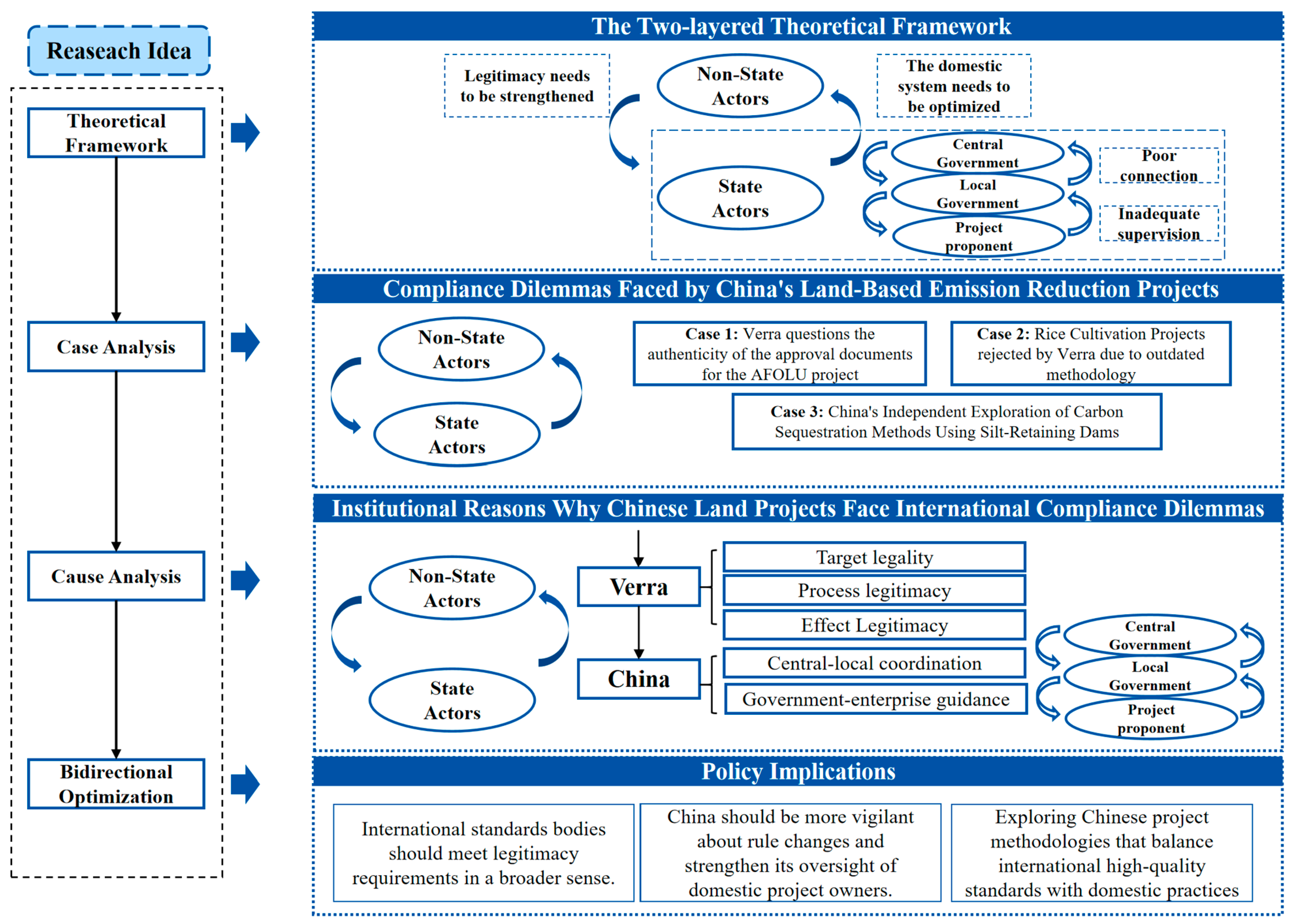
Dilemmas and Exits: Compliance Risks and Future Paths for Land-Based Emission Reduction Projects in China


Abstract
1. Introduction
2. Theoretical Framework and Research Methods
2.1. Theoretical Framework
2.2. Research Methods
2.2.1. Theoretical Research Methodology
2.2.2. Normative Analysis
2.2.3. Case-Study Analysis
3. Compliance Dilemmas Faced by China’s Land-Based Emission-Reduction Projects Amid Conflicts Between Rules by Non-State Actors and State Actors
3.1. At the Non-State Actor Level: Verra Imposed Sanctions on China’s Emissions Reduction Projects Based on Its Internal Requirements
3.1.1. Case 1: The Verra “Nested Doll” Compliance Dilemma Faced by Chinese Land-Related Projects
3.1.2. Case Study 2: The Verra “Iterative” Compliance Dilemma Faced by Chinese Land Projects
3.2. State Actor Level: Domestic Measures Taken by China to Avoid Sanctions from International Standards Bodies
4. An Analysis of the Underlying Reasons for the Compliance Dilemma of Land-Based Emission-Reduction Projects in China Based on a Nested Two-Level Theoretical Framework
4.1. Theoretical Level 1: Comprehensive Legitimacy Assessment of Non-State Actors
4.1.1. Assessment of Verra’s Target Legitimacy
4.1.2. Assessment of Verra’s Process Legitimacy
4.1.3. Assessment of Verra’s Effect Legitimacy
4.2. Theoretical Level Two: Evaluation of the Effectiveness of the Connection Between Small Two-Tier Rules Within State Actors
4.2.1. There Is Still Room for Improvement and Refinement in China’s Emission Reduction Project Standards
4.2.2. China Still Needs to Strengthen Supervision of Project Owners’ Compliance with and Implementation of International Standards
5. Policy Implications
5.1. International Standards Bodies Should Meet Legitimacy Requirements in a Broader Sense
5.2. China Should Enhance Its Vigilance Against Rule Changes and Strengthen Its Supervision of Domestic Project Proponents
5.3. Exploring a Chinese Project Methodology That Balances International High-Quality Standards with Domestic Practices
6. Conclusions
Author Contributions
Funding
Data Availability Statement
Conflicts of Interest
Appendix A

| Num. | Project Name | Num. | Project Name |
|---|---|---|---|
| 1847 | Qianxinan Afforestation Project in Guizhou Province | 1895 | Jilin Linjiang Afforestation Project |
| 1864 | Puzhen Afforestation Project in Guizhou Province | 1896 | Hunan Northern and Northwestern Area Afforestation Project |
| 1865 | Xiguan Afforestation Project in Guizhou Province | 1935 | Hubei Hongshan IFM Project |
| 2070 | Guinan Afforestation Project | 2249 | Henan Fangcheng and Tanghe Afforestation Project |
| 1332 | Reforestation Project in Yingjing County, Sichuan Province | 2326 | Guangxi Jinxiu IFM Project |
| 1361 | Reforestation Project in Qinghai Province 2012 | 2327 | Guangxi Huanjiang IFM Project |
| 1529 | Inner Mongolia Chao’er Improved Forest Management Project | 2343 | Zhanjiang Mangrove Afforestation Project |
| 1542 | Yunnan Kunming Liangqu Improved Forest Management Project | 2370 | Zhangye City Afforestation Project in Gansu Province |
| 1577 | Fujian Yong’an Improved Forest Management Project | 2375 | Jilin Sanchazi Afforestation Project |
| 1664 | Yunnan Xishuangbanna Improved Forest Management Project | 2391 | Gansu Tianshui Afforestation Project |
| 1715 | Inner Mongolia Wu’erqihan IFM Project | 2405 | Gansu Dingxi Afforestation Project |
| 1718 | Inner Mongolia Keyihe IFMProject | 2413 | Zhangjiakou Zhangbei County 2017 Afforestation Project |
| 1825 | Afforestation Project in Xining City | 2418 | Gansu Lanzhou Afforestation Project |
| 1826 | Qinghai Afforestation Project | 2451 | Shanxi Loufan Afforestation Project |
| 1832 | Haidong Afforestation Project | 1855 | Hechu Afforestation Project in Anhui Province |
| 1855 | Hechu Afforestation Project in Anhui Province | 1930 | Henan Nanzhao Afforestation Project |
| 1930 | Henan Nanzhao Afforestation Project | 2082 | Qianbei Afforestation Project |
| 2082 | Qianbei Afforestation Project | 2083 | Liangdu Afforestation Project |
| 2083 | Liangdu Afforestation Project | 2087 | Chudu Afforestation Project |
| 2087 | Chudu Afforestation Project | 2310 | Anhuang Afforestation Project |
| 2310 | Anhuang Afforestation Project | 2378 | Miaoling Afforestation Project |
| 2378 | Miaoling Afforestation Project | 2379 | Huadu Afforestation Project |
| 2379 | Huadu Afforestation Project | 2387 | Liugui Afforestation Project |
| 2387 | Liugui Afforestation Project | 2652 | Hehan Yiyang Afforestation Project |
| 1866 | Xinjiang Makit County Afforestation Carbon Sequestration Project |
| 1 | Emission reduction projects in the category of Agriculture, Forestry, and Other Land Use (AFOLU), also known as Natural Climate Solutions or Nature Restoration projects, include two categories: carbon emission reduction and carbon removal projects. Specific examples include Afforestation, Reforestation, and Revegetation (ARR) projects; Improved Forest Management (IFM) projects; and Reducing Emissions from Deforestation and Forest Degradation in Developing Countries (REDD) projects. |
References
- Seddon, N.; Chausson, A.; Berry, P.; Girardin, C.A.J.; Smith, A.; Turner, B. Understanding the value and limits of nature-based solutions to climate change and other global challenges. Philos. Trans. R. Soc. B Biol. Sci. 2020, 375, 20190120. [Google Scholar] [CrossRef] [PubMed]
- West, T.A.P.; Wunder, S.; Sills, E.O.; Börner, J.; Rifai, S.W.; Neidermeier, A.N.; Frey, G.P.; Kontoleon, A. Action needed to make carbon offsets from forest conservation work for climate change mitigation. Science 2023, 381, 873–877. [Google Scholar] [CrossRef] [PubMed]
- Macintosh, A.; Butler, D.; Larraondo, P.; Evans, M.C.; Ansell, D.; Waschka, M.; Fensham, R.; Eldridge, D.; Lindenmayer, D.; Gibbons, P.; et al. Australian human-induced native forest regeneration carbon offset projects have limited impact on changes in woody vegetation cover and carbon removals. Commun. Earth Environ. 2024, 5, 149. [Google Scholar] [CrossRef]
- Verra. Serious Allegations Prompt Verra to Reject China Projects and Launch Broader Reviews. Verra Official Report. 2025. Available online: https://verra.org/serious-allegations-prompt-verra-to-reject-china-projects-and-launch-broader-reviews/ (accessed on 27 April 2026).
- Battocletti, V.; Enriques, L.; Romano, A. The voluntary carbon market: Market failures and policy implications. Univ. Colo. Law Rev. 2024, 95, 519. [Google Scholar] [CrossRef]
- Gbabo, E.Y.; Okenwa, O.K.; Chima, P.E. Integrating CDM regulations into role-based compliance models for energy infra-structure projects. Int. J. Adv. Multidiscip. Res. Stud. 2024, 4, 2430–2438. [Google Scholar] [CrossRef]
- Wetterberg, K.; Ellis, J.; Schneider, L. The interplay between voluntary and compliance carbon markets. In OECD Environment Working Papers; OECD: Paris, France, 2024. [Google Scholar]
- Lou, J.; Hultman, N.; Patwardhan, A.; Mintzer, I. Corporate motivations and co-benefit valuation in private climate finance in-vestments through voluntary carbon markets. npj Clim. Action 2023, 2, 32. [Google Scholar] [CrossRef]
- Cherepanova, V. Balancing Act: Integrity and Innovation in Voluntary Carbon Markets. World Bank Ethics & Com-pliance Report. 2025. Available online: https://www.worldbank.org/content/dam/documents/sanctions/other-documents/2025/apr/Cherepanova.V.CarbonMarkets.pdf (accessed on 16 May 2026).
- Lövbrand, E.; Rindefjäll, T.; Nordqvist, J. Closing the legitimacy gap in global environmental governance? Lessons from the emerging CDM market. Glob. Environ. Politics 2009, 9, 74–100. [Google Scholar] [CrossRef]
- Andonova, L.B.; Sun, Y. Private governance in developing countries: Drivers of voluntary carbon offset programs. Glob. Environ. Politics 2019, 19, 99–122. [Google Scholar] [CrossRef]
- Cashore, B. Legitimacy and the Privatization of Environmental Governance: How Non-State Market-Driven (NSMD) Governance Systems Gain Rule-Making Authority. In International Environmental Governance; Routledge: Oxford, UK, 2017; Volume 15, pp. 503–539. [Google Scholar]
- Bernstein, S.; Cashore, B. Can non-state global governance be legitimate? An analytical framework. Regul. Gov. 2007, 1, 347–371. [Google Scholar] [CrossRef]
- Bernstein, S. When is non-state global governance really governance. Utah Law Rev. 2010, 2010, 91. [Google Scholar] [CrossRef]
- Kuyper, J.W.; Linnér, B.O.; Schroeder, H. Non-state actors in hybrid global climate governance: Justice, legitimacy, and effectiveness in a post-Paris era. Wiley Interdiscip. Rev. Clim. Change 2018, 9, e497. [Google Scholar] [CrossRef]
- CCER-14-005-V01; Methodology for Voluntary Greenhouse Gas Emission Reduction Projects: Sedimentation by Yudiba Dams. General Office of the Ministry of Ecology and Environment, General Office of the Ministry of Water Resources: Beijing, China, 2025. Available online: https://www.mee.gov.cn/xxgk2018/xxgk/xxgk06/202512/W020251202539685833521.pdf (accessed on 27 April 2026).
- Schmidt, V.A. Democracy and legitimacy in the European Union revisited: Input, output and ‘throughput’. Political Stud. 2013, 61, 2–22. [Google Scholar] [CrossRef]
- Verra. Verra Rejects China Rice Cultivation Projects, Sanctions Auditing Firms and Project Proponents. Available online: https://verra.org/verra-rejects-china-rice-cultivation-projects-sanctions-auditing-firms-and-project-proponents/ (accessed on 27 April 2026).
- Verra. Verra Releases New Rice Methodology. Available online: https://verra.org/verra-releases-new-rice-methodology/ (accessed on 27 April 2026).
- Gold Standard. Joined up Sustainable Transition (JUST): Coal Decommissioning. Available online: https://www.goldstandard.org/consultations/joined-up-sustainable-transition-just-coal-decommissionning-consultation?utm_source=chatgpt.com/ (accessed on 16 May 2026).
- UNFCCC. FAQs on Transitioning CDM Activities to the Article 6.4 Mechanism. Available online: https://unfccc.int/process-and-meetings/the-paris-agreement/article-6/article-64-pacm/CDM_transition/faqs?utm_source=chatgpt.com#The-process-for-transitioning-CDM-activities-to-A64/ (accessed on 16 May 2026).
- Notice on Issuing the “Methodology for Voluntary Greenhouse Gas Emission Reduction Projects: Silt Dam Carbon Sequestration (CCER-14-005-V01)”. Environmental Protection Office Climate Change Letter [2025] No. 438. Available online: https://www.mee.gov.cn/xxgk2018/xxgk/xxgk06/202512/t20251202_1136958.html (accessed on 27 April 2026).
- Hidden CDRs in China’s Ecological Engineering: Silt-Retention Dam Methodology. Available online: https://mp.weixin.qq.com/s/eTABV6mPSO0ce8zW20kp9w (accessed on 27 April 2026).
- Verra. Qianxinan Afforestation Project in Guizhou Province. Available online: https://registry.verra.org/app/projectDetail/VCS/1847 (accessed on 27 April 2026).
- Verra. VCS Methodology Change and Requantification Procedure. Available online: https://verra.org/wp-content/uploads/2024/10/VCS-Methodology-Change-and-Requantification-Procedure-v4.0-1.pdf (accessed on 27 April 2026).
- Verra. VCS Standard Version 5.0. Available online: https://verra.org/wp-content/uploads/2025/12/VCS-Standard-v5.0.pdf (accessed on 27 April 2026).
- Li, F.; Gao, F.; Zhou, Y. Interpretation of the Soil and Water Conservation Law of the People’s Republic of China; Law Press: Beijing, China, 2024. [Google Scholar]
- Verra. Verra Inactivates UNFCCC CDM Rice Cultivation Methodology. Available online: https://verra.org/verra-inactivates-unfccc-cdm-rice-cultivation-methodology/ (accessed on 27 April 2026).
- Guizhou Provincial Public Resources Trading Network. Tender Announcement for the Xingren City Project Area of the Comprehensive Management of Rocky Desertification and Biodiversity Conservation Project in the Eastern Wumeng Mountains, Qianxinan Prefecture, Guizhou Province. 2023. Available online: https://ggzy.guizhou.gov.cn/tradeInfo/detailHtml?metaId=902452977090252800 (accessed on 27 April 2026).
- Yanhe, Dejiang, Yinjiang Rural Methane Digesters Project in Guizhou Province, China. Available online: https://cdm.unfccc.int/Projects/Validation/DB/HO2ZN2K27C4R7Z02SWSY7MBIPGVWW3/view.html (accessed on 27 April 2026).
- Kumar, M.; Khan, U.U. Public International Law; Academic University Press: New York, NY, USA, 2023; pp. 17–18. [Google Scholar]
- UNFCCC. Key Rules Agreed for Credible Climate Project Crediting Under UN Carbon Market. Available online: https://unfccc.int/news/key-rules-agreed-for-credible-climate-project-crediting-under-un-carbon-market (accessed on 27 April 2026).
- Jan, L. New Global Carbon Credit Standards Promise More Credibility. Will They Work? Available online: https://earth.org/new-global-credible-credit-standards-promise-more-credibility-will-they-work/ (accessed on 27 April 2026).
- Lou, J.; Hultman, N.; Patwardhan, A.; Qiu, Y.L. Integrating sustainability into climate finance by quantifying the co-benefits and market impact of carbon projects. Commun. Earth Environ. 2022, 3, 137. [Google Scholar] [CrossRef]
- Xu, J.; Zhang, Y. Has the international climate regime promoted climate justice? Evidence from Clean Development Mechanism projects in China. Clim. Policy 2022, 22, 222–235. [Google Scholar] [CrossRef]
- Climate Science. Opinion: In the Post-COP30 Era, CCER is Leading the Construction of a High-Quality Market System. Available online: https://mp.weixin.qq.com/s/tte6lgWSY9bT8fly_-NwNA (accessed on 27 April 2026).
- Pillai, A.V. Influence of International Environmental Norms in Domestic Laws: Indian Experience. In Law and Emerging Issues; Routledge: Oxford, UK, 2024; pp. 71–78. [Google Scholar]

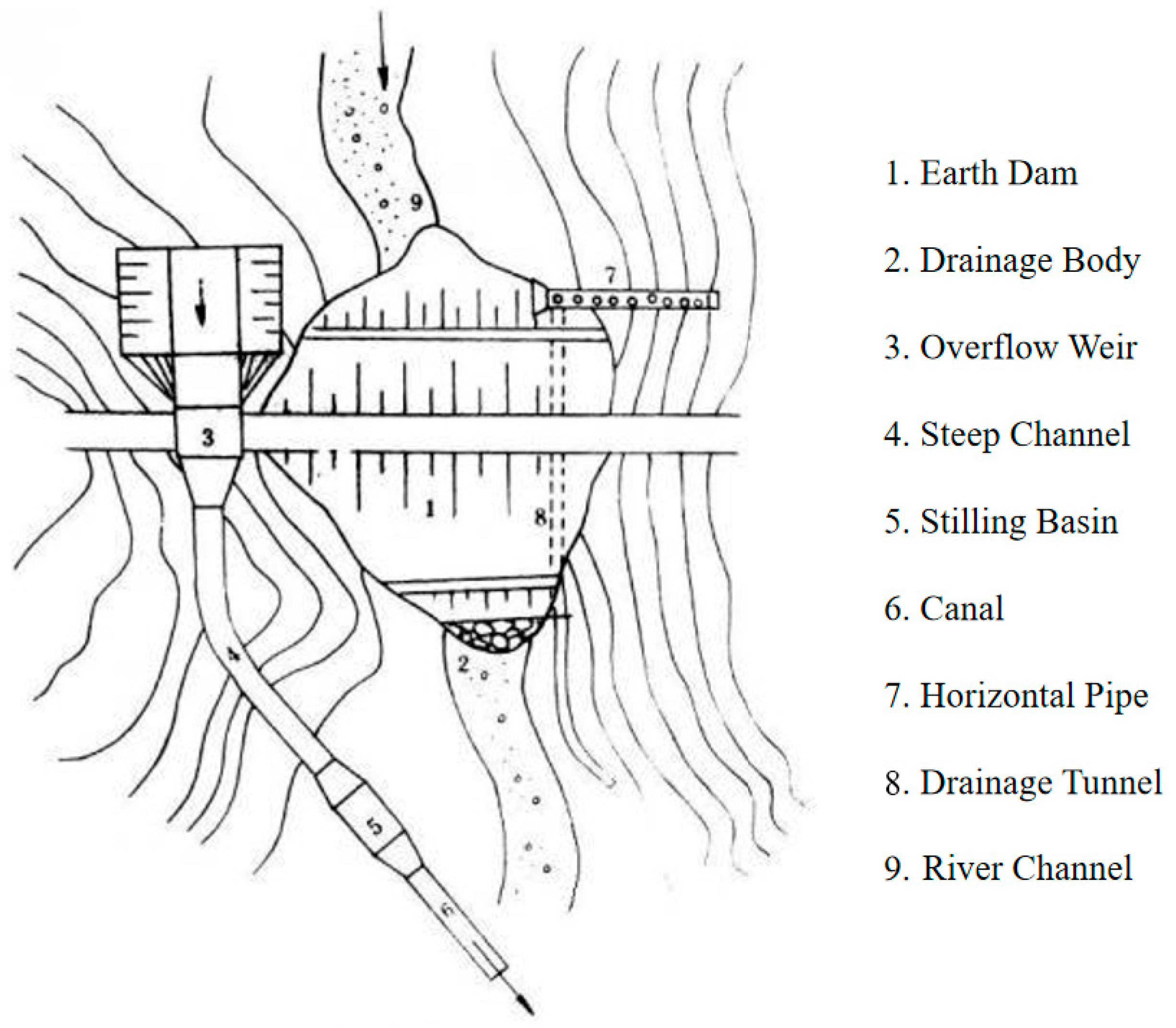
| Num. | Project Name | Num. | Project Name |
|---|---|---|---|
| 2362 | Adjusted Water Management in Rice Cultivation in Tongcheng City | 2771 | Futong Adjusted Water Management in Rice Cultivation |
| 2396 | Adjusted Water Management in Rice Cultivation in Nanling County | 2845 | QiDa Adjusted Water Management in Rice Cultivation |
| 2397 | Adjusted Water Management in Rice Cultivation in Chizhou City | 2850 | Chishui Adjusted Water Management in Rice Cultivation |
| 2398 | Qiantai Adjusted Water Management in Rice Cultivation | 2851 | Xihuai Adjusted Water Management in Rice Cultivation |
| 2399 | Adjusted Water Management in Rice Cultivation in Wangjiang County and Susong County | 2853 | Yufeng Adjusted Water Management in Rice Cultivation |
| 2476 | Huaining Adjusted Water Management in Rice Cultivation | 2854 | Hongmei Adjusted Water Management in Rice Cultivation |
| 2477 | Wanfan Adjusted Water Management in Rice Cultivation | 2855 | Zhengtongsui Adjusted Water Management in Rice Cultivation |
| 2504 | Adjusted Water Management in Rice Cultivation in Xuanzhou District | 2856 | Wudao Adjusted Water Management in Rice Cultivation |
| 2506 | Adjusted Water Management in Rice Cultivation In Northern Lujiang County | 2891 | Adjusted Water Management in Rice Cultivation In Jiangxia District |
| 2507 | Adjusted Water Management in Rice Cultivation In Southern Lujiang County | 2892 | Adjusted Water Management in Rice Cultivation In Wuxue City |
| 2629 | Adjusted Water Management in Rice Cultivation in South Jiangjin District | 2894 | Adjusted Water Management in Rice Cultivation In Xinzhou District |
| 2630 | Adjusted Water Management in Rice Cultivation in Yongchuan District | 2899 | Adjusted Water Management in Rice Cultivation In Dawu County |
| 2631 | Adjusted Water Management in Rice Cultivation in Dazu District | 2902 | Adjusted Water Management in Rice Cultivation In Huangmei County |
| 2632 | Adjusted Water Management in Rice Cultivation in Eastern Hechuan District | 2903 | Adjusted Water Management in Rice Cultivation In Xiaochang County |
| 2633 | Adjusted Water Management in Rice Cultivation in Nanchuan District | 2909 | Adjusted Water Management in Rice Cultivation In Yingcheng City |
| 2634 | Adjusted Water Management in Rice Cultivation in Tongnan District | 2910 | Wude Adjusted Water Management in Rice Cultivation |
| 2769 | Adjusted Water Management in Rice Cultivation in Pinghu City | 2911 | Adjusted Water Management in Rice Cultivation in Haiyan County |
| 2770 | Yulin Adjusted Water Management in Rice Cultivation | 2912 | Adjusted Water Management in Rice Cultivation in Tongxiang City |
| Legislation | Relevant Articles | Key Contents |
|---|---|---|
| Land Administration Law | Article 3. Article 4, Paragraph 3. Article 44, Paragraph 1. | The use of land must be strictly in accordance with the purposes set out in the overall land use plan. When agricultural land is converted to construction land, the conversion approval procedures must be completed. |
| Forest Law | Article 15, Paragraph 1, Paragraph 3. Article 37, Paragraph 1. Article 45. | Owners and users of forests, trees, and forest land shall protect and rationally utilize forests, trees, and forest land in accordance with the law, and shall not illegally change the use of forest land. When organizing afforestation and greening projects, governments at all levels should plan scientifically, adapt to local conditions, optimize the structure of forest types and tree species, and encourage the use of native tree species and improved varieties of trees. |
| Environmental Impact Assessment Law | Article 7, Paragraph 1, Paragraph 3. Article 8. Article 16, Paragraph 1. | The relevant departments of the State Council, the local people’s governments at or above the prefecture-level city level, and their relevant departments shall, during the planning process of the land use plans, regional, river basin, and sea area construction, development, and utilization plans they organize to compile, organize environmental impact assessments, and compile chapters or explanations on the environmental impact of the plans. |
| Category | Sedimentation Dam Carbon Sequestration (CCER-14-005-V01) | VCS Methodology Afforestation, Reforestation, and Revegetation (ARR) (VM0047) | |
|---|---|---|---|
| Baseline setting | Relevant Articles | Article 6.1 and 6.4 | Article 6.2 Census-based Approach |
| Content differences | Adopts a relatively direct discrimination approach, the core of which lies in identifying the original damaged state of the land before construction: Baseline scenario identification (6.1) explicitly requires that the land within the project boundary must be an erosion gully before construction of the Yudiba dam. Calculation simplification principle (6.4): Under the baseline scenario, the impacts of the carbon pool and emission sources are considered negligible. | Employs a “Census-based Approach,” determining whether the baseline is zero by setting specific physical thresholds: Quantification Method (6.2): Using the “Project Method” to set the credit baseline. Dual admission criteria: Vegetation threshold: The original woody biomass cover of the project area must be less than 10%. Land history: The land must be continuously cultivated or fall under the land use category “settlement” or “other land.” Result determination: Only when both of the above criteria are met can it be assumed that no forest and grassland restoration will occur without project intervention, thus setting the baseline to 0. | |
| Additionality argument | Relevant Articles | Article 6.2 | Article 7.2 Census-based Approach: Article 7.3.4 Common Practice |
| Content differences | Exempt from argumentation | Project proponents must conduct rigorous triple justification: regulatory surplus, investment analysis, and Common Practice analysis. | |
| Project leak calculation | Relevant Articles | Article 6.6 | Article 8.4 Leakage Emissions Article 4.2 In the area-based quantification approach |
| Content differences | It is assumed that the project implementation will not result in any transfer of agricultural or pastoral activities in the region; therefore, the leakage amount is set directly to 0. | Census method: If the project can maintain the existing level of agricultural production and avoid land-use conversion, the leakage effect can be assumed to be minimal (de minimis). Area method: This must not be ignored; monitoring and quantification must be performed using tools such as VMD0054. | |
| Non-persistent risk deduction | Relevant Articles | Article 7.1 | Article 8.5.1 Area-based Quantification of Uncertainty Article 8.5.2 Census-based Quantification of Uncertainty |
| Content differences | Given the risks of flooding, earthquakes, and erosion gully damage on the Loess Plateau, a “non-persistent risk deduction rate” is established. This deduction rate is determined by accounting for historical dam failure rates, with a default value of 1%. | Area method: Assumes zero uncertainty in geographic boundaries and performance baselines, but standard methods must be used to estimate the uncertainty of carbon pool changes. Census method: Assumes zero uncertainty in population size and baselines; uncertainty is primarily calculated through error propagation when estimating carbon pool changes. | |
| Legislation and Regulations | Relevant Articles | Key Contents |
|---|---|---|
| Civil Code | Article 10 | Civil disputes shall be handled in accordance with the law; where the law does not provide, custom may be applied, but it shall not violate public order and good morals. |
| Law on the Application of Laws to Foreign-related Civil Relations | Article 4 Article 5 | Where the laws of the People’s Republic of China contain mandatory provisions regarding foreign-related civil relations, those mandatory provisions shall apply directly. |
| Civil Procedure Law | Article 271 | Where an international treaty concluded or acceded to by the People’s Republic of China contains provisions different from those of this Law, the provisions of that international treaty shall apply, except for those provisions to which the People’s Republic of China has made reservations. |
| Interpretation of the Supreme People’s Court on Several Issues Concerning the Application of International Treaties and International Customs in the Trial of Foreign-Related Civil and Commercial Cases | Article 1 | Where international treaties contain provisions that differ from those of the laws of the People’s Republic of China, the provisions of the international treaties shall apply, except for those provisions on which the People’s Republic of China has made reservations. |
| Standardization Law | Article 2 Article 18 | Mandatory standards must be implemented. The state encourages the adoption of recommended standards. The state encourages academic societies, associations, chambers of commerce, federations, industry technology alliances, and other social organizations to coordinate with relevant market entities to formulate group standards that meet market and innovation needs jointly. The development of group standards should adhere to the principles of openness, transparency, and fairness. |
Disclaimer/Publisher’s Note: The statements, opinions and data contained in all publications are solely those of the individual author(s) and contributor(s) and not of MDPI and/or the editor(s). MDPI and/or the editor(s) disclaim responsibility for any injury to people or property resulting from any ideas, methods, instructions or products referred to in the content. |
© 2026 by the authors. Licensee MDPI, Basel, Switzerland. This article is an open access article distributed under the terms and conditions of the Creative Commons Attribution (CC BY) license.
Share and Cite
Wang, S.; He, W. Dilemmas and Exits: Compliance Risks and Future Paths for Land-Based Emission Reduction Projects in China. Land 2026, 15, 895. https://doi.org/10.3390/land15060895
Wang S, He W. Dilemmas and Exits: Compliance Risks and Future Paths for Land-Based Emission Reduction Projects in China. Land. 2026; 15(6):895. https://doi.org/10.3390/land15060895
Chicago/Turabian StyleWang, Siwei, and Wei He. 2026. "Dilemmas and Exits: Compliance Risks and Future Paths for Land-Based Emission Reduction Projects in China" Land 15, no. 6: 895. https://doi.org/10.3390/land15060895
APA StyleWang, S., & He, W. (2026). Dilemmas and Exits: Compliance Risks and Future Paths for Land-Based Emission Reduction Projects in China. Land, 15(6), 895. https://doi.org/10.3390/land15060895