




Does Government Embedment Enhance Villagers’ Willingness to Mutually Supervise Rural Residential Land Utilization?
Abstract
1. Introduction
2. Theoretical Analysis and Research Hypotheses
2.1. Impact of Government Embedment on Villagers’ Willingness to Supervise Each Other in Rural Residential Land Use
2.2. Moderating Role of Local Elders’ Intervention
3. Materials and Methods
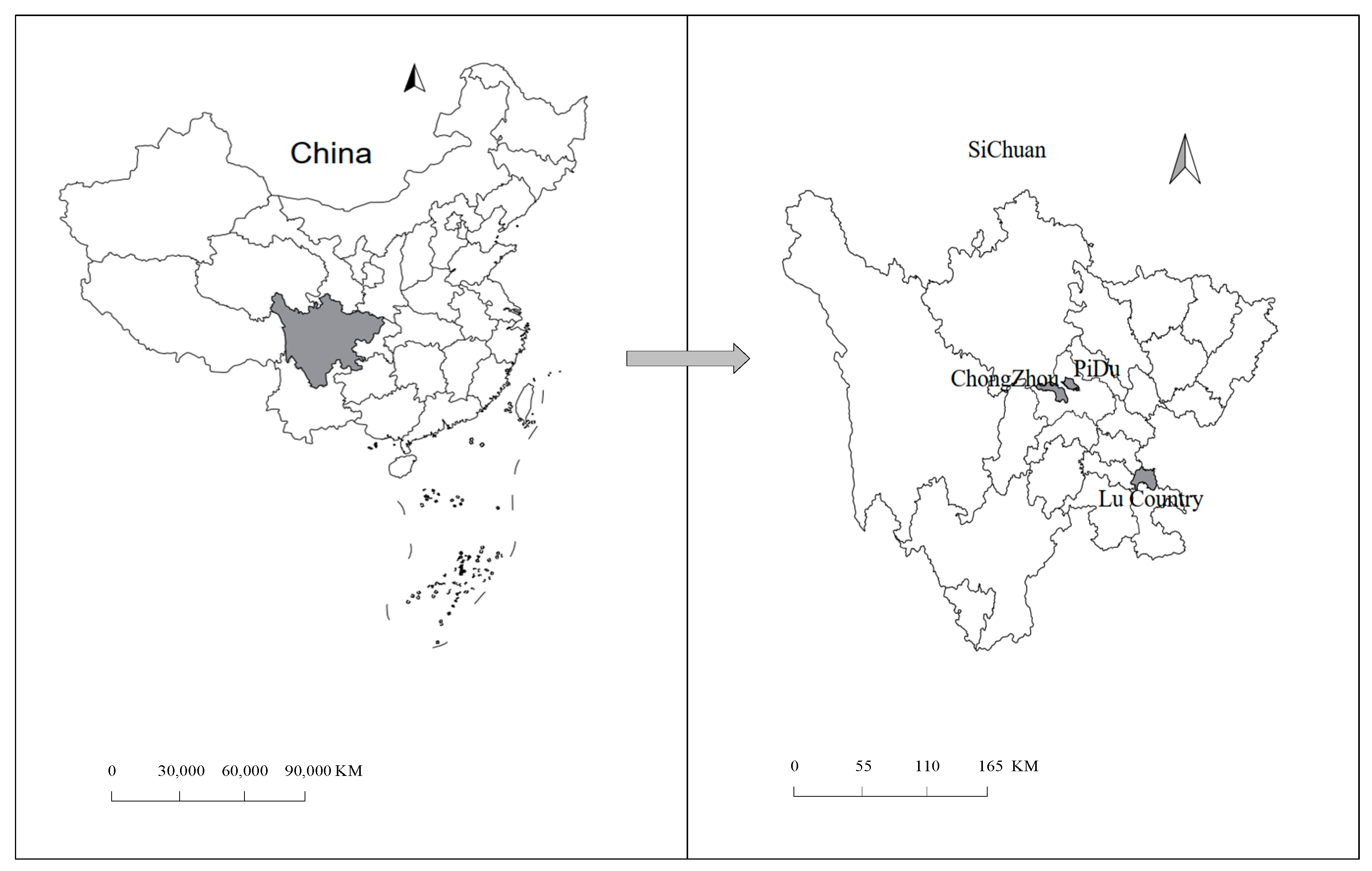
3.1. Data Sources
3.2. Model Specification
3.3. Variable Selection
- (1)
- Dependent Variable: Villagers’ willingness to mutually supervise rural residential land utilization. This willingness to engage in mutual supervision is captured by the following question in the questionnaire: “Are you willing to supervise the Rural Residential Land use behavior of other villagers?” A response of “Yes” indicates a willingness to supervise others, while “No” indicates unwillingness.
- (2)
- Core Explanatory Variables: Government Embedment comprising Organizational Embedment and Conceptual Embedment. In this study, Government Embedment refers to the incorporation of governmental administrative power, resources, and structures into the governance of rural residential land. According to Xu et al., Government Embedment comprises five dimensions: Conceptual Embedment, Organizational Embedment, Rights Embedment, Cultural Embedment, and Resource Embedment [32]. Among these, Organizational Embedment primarily concerns the collaborative arrangements between township governments and village collectives in the supervision of homestead use, including coordination in organizational structures and personnel. Conceptual Embedment, on the other hand, relates mainly to government-led publicity and training on rural residential land, governance institutions, land use regulations, and management practices. Organizational Embedment is reflected in the question: “How do you think the government’s Rural Residential Land use regulation work in your village in recent years?” The responses are categorized as “Very Poor”, “Poor”, “Average”, “Good”, and “Very Good”. Conceptual Embedment is reflected by the interview question, “How many Rural Residential Land use promotional training sessions were conducted by the government in the village last year?” The actual number of training sessions reflects the degree of Conceptual Embedment.
- (3)
- Moderating Variable: Local elders’ involvement. This study aims to investigate how the involvement of local elites influences rural residential land supervision under Government Embedment. Therefore, the degree of involvement of local elites is reflected by the interview question, “How many local elites in the village are involved in Rural Residential Land governance?” The number of local elites involved in governance directly reflects the degree of involvement.
- (4)
- Control Variables. Drawing on research on mutual supervision in public pool resource governance [33], this study includes gender, age, education level, the number of rural residential land plots, whether the rural residential land is idle, whether land rights have been confirmed, labor mobility, anonymous reporting, and collective scale as control variables. The definition of each variable can be found in Table 1.
4. Empirical Findings and Analysis
4.1. Impact of Government Embedment on Mutual Supervision Intentions in Rural Residential Land Governance
4.2. Robustness Tests
4.3. Endogeneity Test
4.4. Heterogeneity Analysis
4.5. Test of Moderating Effects
5. Discussion
6. Conclusions and Policy Implications
Author Contributions
Funding
Informed Consent Statement
Data Availability Statement
Acknowledgments
Conflicts of Interest
References
- Yan, J.M.; Di, L.X.T.; Xia, F.Z. Implementation of the Rural Revitalization Strategy and Deepening of the “Three Rights Separation” Reform for Rural Residential Land Sites. Reform 2019, 1, 5–18. [Google Scholar]
- Li, Q. Qualification Rights to Rural Residential Land Sites: Reinterpreting Essence, Elaborating Functions, and Defining Content. Chin. J. Land Sci. 2021, 35, 7. [Google Scholar]
- Lang, X.Y. Diverse Pathways for Realizing Farmers’ Property Rights in Rural Residential Land Under the “Three Rights Separation” System. Acad. Circ. 2022, 2, 146–155. [Google Scholar]
- Qiao, L.Y.; Liu, Y.S. Rural Revitalization Strategy and Reform of Rural Residential Land System in the New Era. Geogr. Res. 2019, 3, 655–666. [Google Scholar]
- Zheng, F.T. Reform of the “Three Rights Separation” System for Rural Residential Land Sites Emerges as a New Lever for Rural Revitalization. People’s Forum 2018, 10, 75–77. [Google Scholar]
- Zhang, Q.Y.; Du, H.; Zhong, J.X. Rural Residential Land System: Transformation, Performance, and Reform—A Perspective Based on Open and Closed Rights. Agric. Econ. Issues 2021, 4, 46–58. [Google Scholar]
- Li, Q. Administrative Embedding and Its Practical Logic in Rural Collective Income Distribution: An Examination of Compensation Management for Cadres in Rural Collective Economic Organizations. China Rural. Rev. 2021, 4, 107–122. [Google Scholar]
- Yuan, F.C.; Jin, Y.G. Administrative Embedding, Village-Centeredness, and Governance Diversity: An Observation of Rural Residential Land Reform in County Y. J. Nanjing Agric. Univ. (Soc. Sci. Ed.) 2019, 19, 96–107+157–158. [Google Scholar]
- Liu, R.; He, X.F. From Embedded Governance to Categorical Management: A Retrospective and Prospect of the Evolution of the Rural Residential Land System. J. Sichuan Univ. (Philos. Soc. Sci. Ed.) 2018, 47–56. [Google Scholar]
- Yang, H.; Yang, Z. Differentiation in Villages: Familiar-Based Society, Wealthy Residents, and Class Resentment—Insights into Rural Class Differentiation in Eastern China. China Rural. Rev. 2017, 4, 116–129. [Google Scholar]
- Polanyi, K. The Great Transformation: The Political and Economic Origins of Our Time; Gang, F.; Yang, L., Translators; Zhejiang People’s Publishing House: Hangzhou, China, 2007. [Google Scholar]
- Granovetter, M. Embeddedness: Social Networks and Economic Action; Luo, J.D., Translator; Social Sciences Academic Press: Beijing, China, 2015. [Google Scholar]
- Rosenau, J.N. Governance Without Government; Jiangxi People’s Publishing House: Nanchang, China, 2001. [Google Scholar]
- Salamon, L.M. The New Governance: A Guide to Government Tools; Na, X., Translator; Peking University Press: Beijing, China, 2016. [Google Scholar]
- Chen, F. On ‘Embedded Governance’ of Grassroots Regimes: Field Study in Dong Village, LUZhong. Youth Res. 2011, 1, 23–32. [Google Scholar]
- Li, H.Y. Administrative Boosting of Autonomy: Government Intervention and Autonomy Development in Unit-Level Decentralization Reform—Based on Investigation and Analysis of Shizhai Village, Hezhen Town. J. Nanjing Agric. Univ. (Soc. Sci. Ed.) 2022, 1, 98–108. [Google Scholar]
- Zhou, M.; Xu, K. The Role of Township Governments in Revitalizing Rural Self-Governance Organizations: A Case Study of Town C, Shaanxi Province. Seek. Truth 2023, 2, 94–108, 112. [Google Scholar]
- Liu, F.; Kong, X.C. Village Governance by Local Elders: Generative Logic, Practical Patterns, and Improvement Pathways. Jianghai Acad. J. 2020, 5, 116–123. [Google Scholar]
- Ni, X.L.; Wang, J.Y. School of Public Administration, Nanjing University of Finance and Economics. “New Village Elders Governance”: Path Selection and Optimization Strategies for Rural Community Governance Innovation. Nanjing Soc. Sci. 2021, 5, 82–90. [Google Scholar]
- Elinor, O. Governing the Commons: The Evolution of Institutions for Collective Action; Yu, X.D.; Chen, X.D., Translators; Shanghai Sanlian Bookstore: Shanghai, China, 2000. [Google Scholar]
- Deng, J.W. Government Embedding and Social Empowerment: Dual Pathways to Achieving Inclusive Governance. J. Zhengzhou Univ. (Philos. Soc. Sci. Ed.) 2020, 53, 6–11. [Google Scholar]
- Wang, S.B.; Ruan, Z.Y. The Development of Social Work in China Against the Background of Building a Harmonious Society. Soc. Sci. China 2009, 5, 128–140. [Google Scholar]
- Zhang, J.L. Mutual Oversight Mechanisms in Tradable Water Rights Systems. Chin. Rural. Econ. 2007, 9, 53–59. [Google Scholar]
- Helian, Z.W.; Zhao, C.X. A Signal Transmission Game Analysis of Government Training and Farmer Participation. Theor. Explor. 2008, 2, 89–92. [Google Scholar]
- Niu, X.; Zhou, H.M.; Wu, G.C. Farm Household Differentiation, Perceived Property Value, and Rural Residential Land Withdrawal Behavior. J. Northwest AF Univ. (Soc. Sci. Ed.) 2023, 23, 135–145. [Google Scholar]
- Yu, T.; Yu, F.W. Analysis of the Impact of Perceptions Regarding Resource Utilization of Livestock and Poultry Waste on Farmers’ Participation Intentions under Environmental Regulatory Policy Contexts. Chin. Rural. Econ. 2019, 8, 91–108. [Google Scholar]
- Jiang, F.B. The ‘Return of Rural Elders’: Urban-Rural Circular Restoration and Elite Structure Reconstruction—Analyzing the Evolution of Urban-Rural Relations Over 40 Years of Reform and Opening up. In Zhejiang Social Sciences; No. 10; Zhejiang Academy of Social Sciences: Hangzhou, China, 2018. [Google Scholar]
- He, X.F. Keywords of Rural Society; Shandong People’s Publishing House: Jinan, China, 2010; p. 134. [Google Scholar]
- Zhu, Y. Village Governance by Local Elders: Core Roles, Institutional Alignment, and Practical Mechanisms—An Examination of Practices in Southern Jiangxi Rural Areas. J. Yunnan Minzu Univ. (Philos. Soc. Sci. Ed.) 2022, 39, 65–73. [Google Scholar]
- Ding, B. Embedding and Reconstruction: The Governance Logic of New Rural Elders Returning to Village Governance in the Context of Rural Revitalization. Seek. Truth 2022, 3, 100–108, 112. [Google Scholar]
- Wang, Q. Historical, Practical, and Theoretical Logics of New Rural Elders’ Integration into Village Governance Systems. J. Southeast Univ. (Philos. Soc. Sci. Ed.) 2021, 23, 59–63. [Google Scholar]
- Xu, B.J.; Chen, W.D. Autonomous Governance and Government Embedment Integration: The Way of Public Affairs Governance. Henan Soc. Sci. 2017, 25, 104–111. [Google Scholar]
- Ostrom, E. A general framework for analyzing the sustainability of social-ecological systems. Science 2009, 325, 419–422. [Google Scholar] [CrossRef] [PubMed]
- He, M.; Qiu, X.Y. The Dual-Track Coupling Mechanism of Government Embedment and Rural Autonomy under Governance Transformation: An Analysis Based on ‘Value–Institution–Role’ Framework. J. Agric. Econ. Manag. 2022, 21, 644–651. [Google Scholar]
- Luo, X.Z. Mobilization without Organization: Collective Action in Acquaintance Societies—An Analysis of a Rural Mass Incident. J. Jiangsu Adm. Inst. 2013, 5, 66–72. [Google Scholar]

| Variable Name | Definition and Assignment | Mean | Standard Deviation | Minimum | Maximum |
|---|---|---|---|---|---|
| Willingness to Engage in Mutual Supervision | 0 = Unwilling to supervise, 1 = Willing to supervise | 0.724 | 0.447 | 0 | 1 |
| Organizational Embedment | 1 = Very Poor, 2 = Poor, 3 = Average, 4 = Good, 5 = Very Good | 3.396 | 1.027 | 1 | 5 |
| Concept Embedment | Number of training sessions conducted by the government in villages last year on Rural Residential Land utilization | 5.707 | 7.328 | 0 | 30 |
| Gender | 0 = Female, 1 = Male | 0.776 | 0.418 | 0 | 1 |
| Age | Age of Head of Household/Years | 57.687 | 11.060 | 26 | 90 |
| Educational attainment | 1 = Elementary school or below; 2 = Junior high school; 3 = High school or vocational school; 4 = College or above | 1.802 | 0.830 | 1 | 4 |
| Total Income | Total Household Income/Ten Thousand Yuan | 10.844 | 0.953 | 7.6 | 15.38 |
| Number of Rural Residential Land Plots | How many Rural Residential Land Plots does your household have? 0 = 1 Rural Residential Land; 1 = 2 or more Rural Residential Land | 0.073 | 0.261 | 0 | 1 |
| Is It Idle? | Is your Rural Residential Land idle? 0 = No; 1 = Yes | 0.06 | 0.238 | 0 | 1 |
| Whether rights are confirmed | Has your Rural Residential Land been legally confirmed? 0 = No; 1 = Yes | 0.804 | 0.397 | 0 | 1 |
| Labor Mobility | What is the labor mobility situation in the village? 0 = inflow; 1 = outflow? | 0.884 | 0.320 | 0 | 1 |
| Whistleblowing | Does the village have an anonymous reporting channel for illegal residential land use? 0 = No; 1 = Yes | 0.642 | 0.480 | 0 | 1 |
| Collective Scale | How many households are there in the village? 1 = 500 households or fewer; 2 = [500, 1000) households; 3 = [1000, 1500) households; 4 = 1500 households or more | 1.904 | 1.008 | 1 | 4 |
| Variable Name | Willingness to Engage in Mutual Supervision in Rural Residential Land Governance | |||
|---|---|---|---|---|
| (1) | (2) | (3) | (4) | |
| Organizational Embedment | 0.638 *** (0.108) | 0.631 *** (0.112) | ||
| Concept Embedment | 0.053 (0.079) | 0.023 (0.084) | ||
| Gender | −0.341 (0.286) | −0.315 (0.275) | ||
| Age | 0.002 (0.012) | 0.004 (0.012) | ||
| Educational Attainment | 0.395 ** (0.176) | 0.409 ** (0.168) | ||
| Total Income | 0.022 (0.120) | 0.034 (0.116) | ||
| Number of Rural Residential Land Plots | −0.617 (0.411) | −0.594 (0.385) | ||
| Is It Idle? | 0.045 (0.472) | −0.015 (0.456) | ||
| Whether Rights are Confirmed | −0.340 (0.301) | −0.294 (0.288) | ||
| Labor Mobility | 0.093 (0.390) | 0.289 * (0.371) | ||
| Whistleblowing | 0.435 * (0.266) | 0.425 (0.255) | ||
| Collective Scale | −0.031 (0.115) | −0.051 (0.112) | ||
| Log Likelihood | −246.102 | −237.741 | −264.688 | −255.021 |
| R2 | 0.071 | 0.103 | 0.001 | 0.037 |
| LR Chi-squared | 37.63 | 54.35 | 0.46 | 19.79 |
| Sample size | 450 | 450 | 450 | 450 |
| Variable Name | Willingness to Engage in Mutual Supervision in Rural Residential Land Governance | |||
|---|---|---|---|---|
| (1) | (2) | (3) | (4) | |
| Organizational Embedment | 0.373 *** (0.063) | 0.369 *** (0.065) | ||
| Concept Embedment | 0.013 (0.008) | 0.005 (0.011) | ||
| Constant | −0.635 *** (0.216) | −1.103 * (1.019) | −0.019 (1.008) | |
| Control Variables | Uncontrolled | Controlled | Uncontrolled | Controlled |
| Log Likelihood | −246.554 | −237.741 | −263.689 | −254.931 |
| R2 | 0.069 | 0.103 | 0.005 | 0.038 |
| LR Chi-squared | 36.73 | 54.35 | 2.46 | 19.97 |
| N | 450 | 450 | 450 | 450 |
| Variable Name | Willingness to Engage in Mutual Supervision | |
|---|---|---|
| IV-Probit | 2SLS | |
| Organizational Embedment | 0.679 *** | 0.109 *** (0.027) |
| Constant | 0.884 * (0.494) | |
| Wald Test p-value | 0.472 | |
| Durbin (Score) Test p-value | 0.499 | |
| Wu–Hausman Test p-value | 0.503 | |
| Control Variables | Controlled | Controlled |
| N | 450 | 450 |
| Variable Name | Urban Villages | Suburban Villages | Remote Suburban Villages | |||
|---|---|---|---|---|---|---|
| (1) | (2) | (3) | (4) | (5) | (6) | |
| Organizational Embedment | 0.605 ** (0.248) | 0.630 *** (0.157) | 0.903 *** (0.278) | |||
| Conceptual Embedment | −0.144 (0.171) | 1.114 * (0.711) | 0.407 (0.629) | |||
| Constant | −1.092 (4.452) | 1.200 (4.413) | −3.191 (2.797) | −1.275 (2.611) | −0.583 (3.251) | 2.004 (2.977) |
| Control Variables | Controlled | Controlled | Controlled | Controlled | Controlled | Controlled |
| Log Likelihood | −59.066 | −61.941 | −111.788 | −119.222 | −56.448 | −62.248 |
| LR chi2 | 17.77 | 12.03 | 32.26 | 17.39 | 20.89 | 8.52 |
| N | 118 | 118 | 222 | 222 | 110 | 110 |
| Variable Name | Willingness to Mutual Supervision | |||||
|---|---|---|---|---|---|---|
| (1) | (2) | (3) | (4) | (5) | (6) | |
| Organizational Embedment | 0.203 (0.212) | 0.280 (0.218) | 0.619 *** (0.137) | 0.645 *** (0.142) | ||
| Conceptual Embedment | −0.085 (0.039) | −0.075 (0.043) | −0.021 (0.043) | 0.001 (0.047) | ||
| Number of Local Elders | −0.259 (0.126) | 0.173 (0.128) | −0.047 (0.054) | 0.023 (0.055) | ||
| Organizational Embedment × Number of Local Elders | 0.085 ** (0.039) | 0.067 * (0.039) | ||||
| Concept Embedment × Number of Local Elders | 0.010 (0.006) | 0.010 (0.007) | ||||
| Organizational Embedment × Conceptual Embedment | 0.002 (0.013) | −0.002 (0.014) | ||||
| Constant | 0.241 (0.699) | −0.855 (1.890) | 1.374 *** (0.303) | 0.334 (1.760) | −0.964 ** (0.454) | −0.172 (1.769) |
| Control Variables | Uncontrolled | Controlled | Uncontrolled | Controlled | Uncontrolled | Controlled |
| Log Likelihood | −237.682 | −229.744 | −255.168 | −245.968 | −245.506 | −237.681 |
| LR Chi2 | 40.91 | 56.79 | 5.94 | 24.34 | 38.52 | 54.47 |
| N | 450 | 450 | 450 | 450 | 450 | 450 |
Disclaimer/Publisher’s Note: The statements, opinions and data contained in all publications are solely those of the individual author(s) and contributor(s) and not of MDPI and/or the editor(s). MDPI and/or the editor(s) disclaim responsibility for any injury to people or property resulting from any ideas, methods, instructions or products referred to in the content. |
© 2025 by the authors. Licensee MDPI, Basel, Switzerland. This article is an open access article distributed under the terms and conditions of the Creative Commons Attribution (CC BY) license (https://creativecommons.org/licenses/by/4.0/).
Share and Cite
Chen, S.; Tang, H.; Yang, Z. Does Government Embedment Enhance Villagers’ Willingness to Mutually Supervise Rural Residential Land Utilization? Land 2025, 14, 2387. https://doi.org/10.3390/land14122387
Chen S, Tang H, Yang Z. Does Government Embedment Enhance Villagers’ Willingness to Mutually Supervise Rural Residential Land Utilization? Land. 2025; 14(12):2387. https://doi.org/10.3390/land14122387
Chicago/Turabian StyleChen, Sirui, Hong Tang, and Zhongjian Yang. 2025. "Does Government Embedment Enhance Villagers’ Willingness to Mutually Supervise Rural Residential Land Utilization?" Land 14, no. 12: 2387. https://doi.org/10.3390/land14122387
APA StyleChen, S., Tang, H., & Yang, Z. (2025). Does Government Embedment Enhance Villagers’ Willingness to Mutually Supervise Rural Residential Land Utilization? Land, 14(12), 2387. https://doi.org/10.3390/land14122387

