Article

A Multidimensional Spatial Framework for Assessing Territorial Resilience Across 86 Municipalities in Northern Portugal


by
Fernando Fonseca
* and
Paulo J. G. Ribeiro
Centre for Territory, Environment and Construction (CTAC), University of Minho, 4800-058 Guimarães, Portugal
*
Author to whom correspondence should be addressed.
Land 2026, 15(6), 1082; https://doi.org/10.3390/land15061082
Submission received: 11 May 2026 / Revised: 12 June 2026 / Accepted: 16 June 2026 / Published: 18 June 2026

Abstract

Urban and regional resilience has gained increasing relevance as cities and territories concentrate larger shares of population, economic activity, and exposure to various shocks. This study proposes an integrated framework to evaluate and compare territorial resilience across Northern Portugal, combining quantitative data from 42 indicators spanning five resilience dimensions. Municipal values for each indicator were classified into quintiles, converted into a standardized ranking scale from 1 to 5, and aggregated through GIS spatial operations to produce composite regional resilience maps. The results indicate that Northern Portugal displays moderate resilience, with pronounced spatial disparities. More urbanized and coastal municipalities tend to exhibit higher resilience levels than inland territories. Infrastructural resilience emerges as the weakest, while social resilience achieves the highest performance. By highlighting spatial inequalities and the dimensions requiring targeted intervention, this study offers actionable insights to support evidence-based policies aimed at strengthening territorial resilience in Northern Portugal.

1. Introduction

The Introduction of this study is divided into three subsections. Section 1.1 clarifies the concept of territorial resilience and situates it within its broader theoretical background. Section 1.2 examines the key territorial resilience dimensions, highlighting the multifaceted nature of the concept. Finally, Section 1.3 identifies the main research gaps in the existing literature that motivate the present study, and outlines the main objectives and contributions of this study.

1.1. Understanding Territorial Resilience: Concept and Context

Territorial resilience refers to the capacities of a territory (region, municipality, or city) and its social and physical components to anticipate, respond to, recover from, and adapt to disruptive events [1]. Interest in regional and urban resilience has grown due to the increasing frequency and complexity of shocks, such as the 2008/2009 global financial crisis and the COVID-19 pandemic [2], and to respond to extreme events and disasters, namely, those caused by climate change [3]. Cities, as dense hubs of population, economic activity, and innovation, have received particular attention in resilience research [4], largely due to the fact that more than half of the global population currently lives in urban areas, a share projected to reach 68% by 2050 [5]. In addition, despite occupying less than 1% of the Earth’s land surface [6], urban areas generate approximately 80% of global GDP [7], highlighting their critical role in global development. However, this concentration of people, infrastructure, and economic assets also increases exposure and vulnerability to a range of disruptions, including floods, heatwaves, and storms, particularly in the context of climate change and environmental degradation [8].
Resilience is widely recognized as a “no-regrets” strategy for reducing vulnerability to disasters and emerging threats [8]. As such, resilience has emerged as a forward-looking approach to address the challenges posed by rapid urbanization and environmental change [9]. It has become central in international urban policies, including UN Sustainable Development Goal 11, the World Bank City Resilience Program, the EU Strategy on Adaptation to Climate Change and the European Green Deal, the OECD Resilient Cities Program, and the Resilient Cities Network, which provide frameworks, financing, and guidance for strengthening urban adaptive capacities.
Despite this, there is still no harmonized definition or consensus on a set of descriptors for resilience as applied to territories [10]. Originally developed in ecological contexts [11], resilience has since been adopted across multiple disciplines and territorial dimensions [4,10]. To clarify the concept, Meerow et al. [12] define territorial resilience as the ability of a system to maintain or quickly return to desired functions, adapt to change, and transform systems that constrain adaptive capacity. Subsequent studies emphasize the capacity of interconnected social, economic, natural, and infrastructural systems to absorb hazards, such as earthquakes and floods, and human-induced risks, while maintaining functional continuity [13]. Resilience encompasses actions before (preparedness and risk reduction), during (response), and after crises (recovery, transformation, and learning) across multiple scales [9].

1.2. Territorial Resilience Dimensions

Territories, as complex systems of interacting people, resources, and institutions, require adaptive, flexible, and learning-oriented strategies that enable them to be proactive rather than reactive to unpredictable events [14], thereby determining their capacity to withstand and adapt to disruptions [10,13]. Therefore, territorial resilience is commonly analyzed through five interrelated dimensions: infrastructural, environmental, social, economic, and institutional.
Infrastructural resilience is fundamental to the continuous functioning of cities and territories and to ensuring residents’ quality of life. It refers to the capacity of critical systems, such as water, electricity, transportation, communications, drainage networks, and essential facilities (e.g., hospitals and fire stations), to withstand, adapt to, and recover from external shocks, including natural hazards and economic disruptions [15,16,17]. These systems provide essential services, often span large areas, and can be difficult to restore, making them particularly vulnerable to both natural and technological hazards. Their resilience underpins a territory’s ability to maintain basic and emergency services, accommodate displaced populations, and support evacuation processes. Research on infrastructure resilience has grown in recent years and includes literature reviews [15,18], studies on the vulnerability and resilience of various facilities [19], on the use of green infrastructure to enhance resilience [20], and on methods to assess resilience [21].
Social resilience refers to the ability of individuals and communities to anticipate, mitigate, adapt to, and recover from hazards while maintaining essential functions and promoting social well-being [22]. It reflects the adaptive capacity of people at risk or during a crisis [23], which depends on both collective and individual abilities to respond effectively to hazards. Collective factors include aspects like community networks, trust, leadership, and inclusive governance [24], while individual features include aspects like age, gender, education, income, ethnicity, and social inclusiveness, among others [24,25].
Environmental resilience reflects the ability of ecosystems to maintain functionality, recover rapidly, and adapt in response to hazards [26]. It has been conceptualized in diverse ways, including ensuring resource availability and species connectivity, implementing natural flood management strategies, adopting nature-based solutions [27], and managing greenhouse gas (GHG) emissions and air pollutants [16], among others.
Economic resilience captures the capacity of regions and local economies to withstand shocks (market disruptions, competitive pressures, natural events) and recover [28]. It can be conceptualized through four main components: (i) resistance reflects the sensitivity of the regional economy to external shocks; (ii) recovery captures the speed and extent of rebound; (iii) re-orientation refers to the economic ability to adjust to shocks; and (iv) renewal indicates the capacity to establish new and stable pathways for economic growth following a shock [28]. Economic resilience has a key role in navigating economic crises [29], which in turn translates into effects on unemployment rates [25], household incomes, the risk of poverty [30], and broader socioeconomic outcomes.
Finally, institutional resilience reflects the capacity of organizations and governance systems to prepare for, respond to, and recover from disruptions while maintaining essential functions [9]. Institutional resilience ensures that governance and decision-making systems remain effective during and after disruptions. The type and quality of governance shape key aspects, including the level of transparency [24], institutional effectiveness, and municipal fiscal health [31], that determine the capacity to fund long-term resilience strategies.
Together, these five dimensions form a complex, interdependent system where their effectiveness depends on the extent to which they interact and reinforce one another. Strengthening resilience requires integrated strategies promoting robustness, adaptability, inclusiveness, and sustainability.

1.3. Research Gaps, Objectives and Contributions of the Study

Despite growing academic interest, the practical implementation of territorial resilience remains limited. Few studies focus explicitly on resilience practice, such as identifying best practices, supporting community preparedness, or strengthening governance and adaptive management [32]. Conceptual models continue to dominate the literature, and the lack of a shared operational definition of resilience constrains policy translation [33,34]. This gap represents a major barrier to advancing territorial resilience planning and practice. Existing research has also largely examined individual resilience dimensions without fully accounting for their interdependencies [35]. Dimensions such as institutional [36], social [3,37] and environmental [27] resilience have received comparatively less attention than infrastructure or economic dimensions, limiting understanding of governance networks and collaborative mechanisms [38]. This highlights the need for more holistic and multidisciplinary frameworks that strengthen the operationalization of resilience strategies [33,35,39], including the development of more comprehensive indicator systems for resilience assessment [30]. Furthermore, most studies have focused on single cities or territories, with limited cross-scale comparative research [35,40]. Broader regional assessments are therefore required to capture the influence of socioeconomic, geographic, and institutional contexts, and to generate insights that are scalable and transferable across territories [33,39,40]. In addition, research has often targeted specific types of disasters, limiting understanding of the complex and interrelated hazards affecting urban and regional systems [34,35]. This restricts the development of integrated resilience strategies capable of addressing the multidimensional nature of territorial risks, particularly in urban contexts. Finally, in Portugal, existing research has mainly focused on hazard vulnerability, with few comprehensive territorial resilience assessments, particularly regarding social resilience [41], underscoring the need for multidimensional and spatially explicit approaches.
Against this backdrop, this study addresses these gaps by proposing a multidimensional, indicator-based spatial framework for territorial resilience assessment and comparison. Specifically, the study evaluates and compares resilience performance across the 86 municipalities of Northern Portugal, a region characterized by strong territorial imbalances and exposure to multiple natural and technological hazards of moderate-to-high susceptibility. The main novelty of this research lies in the integration of a large set of 42 indicators across five resilience dimensions (infrastructural, social, environmental, economic, and institutional) into a single spatially explicit comparative framework, enabling both multidimensional assessment and territorial benchmarking at the municipal scale. Indicators were standardized using a quintile classification method (scores from 1 to 5), enabling comparability across municipalities and dimensions. Composite and dimension-specific resilience maps were then generated using GIS (Geographic Information Systems) through ArcGIS 10.5, ensuring a consistent and visually interpretable representation of territorial disparities. To enhance the methodological robustness of the framework, sensitivity analyses were also performed to evaluate the influence of alternative normalization procedures and weighting schemes on the resulting resilience patterns.
Unlike previous studies that often focus on single dimensions, case studies, or non-spatial analyses, this approach combines indicator-based resilience measurement with GIS-based spatial analysis, allowing for the identification of spatial patterns of resilience across an entire region. To the best of our knowledge, no previous study in Portugal has applied a spatially explicit territorial resilience framework combining five dimensions and 42 indicators at the municipal scale for an entire NUTS II region. This framework contributes to the literature by providing a replicable and scalable methodology for integrated territorial resilience assessment, bridging the gap between conceptual resilience models and operational spatial planning tools. In addition, by identifying municipalities with lower resilience performance, the study supports the formulation of targeted mitigation and adaptation strategies, offering actionable insights for regional development policies and spatial planning aimed at reducing territorial inequalities and enhancing resilience capacity.

2. Methods and Data

The methodology of this study is organized into three subsections. Section 2.1 presents the case study, Section 2.2 introduces and justifies the resilience indicators used, and Section 2.3 describes the data collection process, the assessment and scoring of the resilience indicators and respective dimensions.

2.1. Case Study

Portugal exhibits pronounced territorial imbalances, with approximately 75% of the population concentrated along the coast and 44% residing in the metropolitan areas of Lisbon and Porto [42]. Nationally, about 68% of the population lives in urban areas [43]. The country is highly vulnerable to climate change and related hazards, including rising sea levels, coastal erosion, floods, extreme precipitation, heatwaves, and fire risks, which can lead to disasters causing loss of life and severe economic and social damage [44]. A recent example is the series of storms that affected Portugal in January and February 2026, triggering urban flooding, coastal erosion, and landslides. Among these, Storm Kristin, which struck on 27 January 2026, was the most destructive, with wind gusts reaching up to 200 km/h. The storm caused widespread damage across the central region of the country, resulting in 10 fatalities, electricity outages affecting more than 800,000 residents, and losses estimated at up to 6 billion EUR.
The Northern region (NUTS II) covers 21,284 km2, is divided into eight sub-regions (NUTS III), and comprises 86 municipalities (Figure 1). The region has 3.58 million inhabitants, representing 35% of Portugal’s total population [42]. Around 65% of this population is concentrated in the Porto Metropolitan Area (PMA) and in the municipalities of Braga, Guimarães, Vila Nova de Famalicão, and Barcelos [42], which are located along the coast and adjacent areas. The inland areas are more sparsely populated and exhibit higher levels of population ageing. The region has 54 urban areas classified as “cities”, 27 of which lie within the PMA. These cities vary widely in size, from those with over 100,000 inhabitants (Porto, Vila Nova de Gaia, and Braga) to smaller cities with fewer than 10,000 residents, like Vila Nova de Foz Côa and Miranda do Douro. Economically, the region contributes approximately 39% of national exports and accounts for around 30% of Portugal’s GDP [45].
Regional vulnerabilities stem from the presence of natural and technological hazards with moderate-to-high susceptibility, as well as from their tangible impacts on territories and populations. Extreme risks include rural wildfires and heatwaves, while coastal erosion and overtopping, floods and flash floods, and landslides are considered moderate risks [45]. In inland areas, heatwaves are the predominant hazard, further exacerbating wildfire and drought hazards [45]. The high concentration of population in coastal and adjacent areas intensifies exposure to a growing range of risks that are expected to worsen under climate change, including coastal erosion and sea-level rise. Climate change also drives extreme storms and rainfall events, increasing the likelihood of urban flooding [41]. Approximately 20 areas adjacent to river systems in the region have been identified as having high flood risk [45].

2.2. Selection of Territorial Resilience Indicators

The resilience assessment was conducted using a set of indicators representing the five key dimensions of territorial resilience introduced in Section 1.2. Indicators are variables or quantitative metrics that capture the operational characteristics of a system or track progress toward specific targets [46]. In resilience research, indicators serve multiple purposes: as assessment tools to identify risks and vulnerabilities, as information tools to support land-use planning and emergency preparedness, and as monitoring tools to evaluate how effectively a territory responds to and recovers from disasters and shocks [47]. By providing insights into potential weaknesses and resilience gaps, these indicators help decision-makers anticipate challenges and implement policies to strengthen resilience [30]. Further, resilience indicators allow for standardized comparisons across regions and municipalities, offering a comprehensive and context-sensitive basis for evaluating territorial performance [16,48]. This makes them particularly valuable for assessing and benchmarking resilience across the 86 municipalities of Northern Portugal.
Selecting appropriate indicators and optimizing their selection is inherently challenging, particularly due to data availability constraints and inconsistencies in indicator definitions across sources and contexts [16]. In this study, indicators were selected based on their theoretical relevance and their recurrent application in previous territorial resilience assessments and composite index frameworks. Examples include the studies by Liu et al. [16], Yu et al. [17], Jaafari et al. [25], Figueiredo et al. [47], Feofilovs and Romagnoli [48], and Nafeh et al. [49]. In addition, the final set of indicators was selected according to three practical criteria: (i) the availability of data at the Portuguese municipal level; (ii) the use of official and open access data sources; and (iii) the availability of recent data with sufficient update frequency to reflect current conditions and trends. In total, 42 indicators were selected for the resilience assessment. The complete list of indicators, together with their rationale and classification by resilience dimension, is presented in Table 1, Table 2, Table 3, Table 4 and Table 5.

2.2.1. Infrastructural Resilience Indicators

Building on the conceptualization of infrastructural resilience outlined in Section 1.2, this study operationalizes this dimension through 11 indicators capturing the availability, accessibility, and robustness of critical systems and services. As shown in Table 1, this includes access to essential utilities, such as piped water and electricity, as well as characteristics of the built environment and connectivity, including road network density and building conditions. It also reflects the provision of key public services, notably health and civil protection facilities [30,49].
Table 1. Selected indicators for assessing infrastructural resilience.
IndicatorRationale
Number of hospitals and health centersReflects the capacity to provide healthcare and respond to emergencies [25,50].
Number of fire stationsReflects preparedness and ability to respond to fires and other emergencies [10].
Households connected to water network (%)Indicates access to clean water, a basic utility service [47,48,50].
Households connected to sewer network (%)Indicates access to sanitation and capacity to manage wastewater [47,48,50].
Average building age (years)Indicates the condition and resilience of the building stock [16,30].
Households unable to keep their homes warm (%)Reflects energy vulnerability and housing quality [48].
Road density (km/km2)Shows the availability and connectivity of road transport infrastructure [16,25].
Rail density (km/km2)Shows the availability and connectivity of rail transport infrastructure [16,51].
Broadband subscribers per 100 inhabitantsIndicates digital connectivity and access to ICT [16,17,50].
Travel time to the nearest hospital (minutes)Describes the accessibility of healthcare infrastructure for residents [31].
Average commute time (minutes)Reflects the efficiency of transport infrastructure and its impact on mobility [16].

2.2.2. Social Resilience Indicators

Social resilience indicators capture socio-demographic characteristics that influence communities’ vulnerability and resilience to different types of threats, as well as their capacity to cope with, recover from, and adapt to adverse events [17,30,49]. In this study, social resilience is assessed using eight indicators (Table 2), including socio-demographic variables related to age structure, demographic dependency, the presence of vulnerable populations such as older adults, children, individuals with disabilities, educational attainment, and population growth. These socio-demographic variables can significantly affect overall social resilience [49].
Table 2. Selected indicators for assessing social resilience.
IndicatorRationale
Elderly (>65 years) dependency (%)Reflects the proportion of seniors who may require social support and care, indicating potential social vulnerability [25,48].
Youth (<15 years) dependency (%)Reflects the proportion of young dependents, indicating demands on education and childcare [48].
Gender ratio (%)Reflects balanced representation and access for all genders, social equity and inclusiveness [25].
Proportion of graduated population (%)Indicates human capital and the community’s capacity to adapt and innovate [25].
Population change 2011–2021 (%)Indicates societal vitality and long-term development potential [25].
Proportion of disabled people (%)Reflects physical and mental vulnerabilities of the population and the need for inclusive social and healthcare services [25].
Number of homeless people per 100,000 inhabitantsIndicates social vulnerability and potential strain on community support systems [47].
Number of doctors per 10,000 inhabitantsReflects the accessibility and capacity of healthcare services to meet the needs of the population [17,50].

2.2.3. Environmental Resilience Indicators

Environmental resilience indicators reflect a territory’s capacity to maintain essential environmental functions, quality, structures, and feedback mechanisms in the face of disturbances, as well as its ability to recover or adapt to new stable conditions [17]. In this study, environmental resilience is assessed using ten indicators (Table 3), encompassing factors related to human activities, such as carbon emissions, air pollutant emissions, and fossil fuel energy consumption, as well as territorial features including public green spaces, environmental protection expenditures, and other relevant environmental attributes.
Table 3. Selected indicators for assessing environmental resilience.
IndicatorRationale
GHG emissions (ton CO2eq/inhab.)Indicates the contribution of local activities to GHG emissions [16,52].
NOx emissions (ton/year)Represents the intensity of air-polluting activities, affecting environmental quality and public health [16].
Mean annual concentration of PM2.5 and PM10 (µg/m3)Represents the intensity of air-polluting activities, affecting environmental quality and public health [16,47,50].
Fossil fuel energy consumption (ton/inhab.)Indicates dependence on carbon-intensive energy sources, contributing to GHG emissions and air pollution [52].
Per capita electricity consumption (kWh/inhab.)Represents energy demand and efficiency patterns, influencing environmental pressure [17].
Public green space coverage (ha)Captures the availability of accessible green areas that support recreation, social well-being, and climate change [17,50].
Built-up area per capita (m2/inhab.)Indicates urban land-use intensity, reflecting pressure on natural land and resource efficiency [53].
Environmental expenditure (%)Indicates the level of public investment in environmental protection and sustainability policies [54].
Selective municipal waste (kg/inhab.)Indicates efficiency in waste recycling [17,48].
Number of environmental non-governmental organizationsCaptures civic engagement, environmental awareness, and community capacity to support environmental protection [55].

2.2.4. Economic Resilience Indicators

Economic resilience indicators assess resilience from the economic perspective of individuals, households, and communities [30]. Economically resilient territories are better able to absorb shocks and accelerate recovery through mechanisms such as insurance coverage, social safety nets, welfare systems, and public financial support [17,49]. In this study, economic resilience is assessed using seven indicators (Table 4), including variables related to unemployment, household income, purchasing power, population at risk of poverty, income inequality (Gini index), and related measures.
Table 4. Selected indicators for assessing economic resilience.
IndicatorRationale
Unemployment rate (%)Indicates economic stability and labor market strength [17,25].
Population at risk of poverty (%)Indicates economic and social vulnerability and inequality [25,30].
Gini index per household (%)Assesses income inequality, a critical factor influencing social cohesion and equitable access to resources [16,47].
Monthly household income (€)Reflects household economic capacity, directly linked to adaptive potential and ability to recover from disruptions [30,49].
Purchasing power (% of the national total)Shows economic strength and access to goods and services [56].
Number of businesses per 1000 inhabitantsReflects economic diversity and local economic activity [47].
Median value of owner-occupied housing (€/m2)Represents housing market stability and wealth distribution [16].

2.2.5. Institutional Resilience Indicators

Institutional resilience indicators capture the capacity of communities and local governments to organize, implement mitigation measures, and enhance preparedness for various risks [16,49]. They also reflect governance quality, crisis management effectiveness, and the ability of a territory to maintain social stability and equity, support adaptation, and promote sustained development in the face of socioeconomic shocks and natural hazards [3,17,30]. In this study, institutional resilience is assessed using six indicators (Table 5): municipal transparency index, abstention rate in local elections, municipal fiscal expenditure, investment in science and R&D, municipal debt per capita, and crime rate.
Table 5. Selected indicators for assessing institutional resilience.
IndicatorRationale
Fiscal expenditure per capita (€/inhab.)Indicates the financial capacity of municipal governments to deliver public services and respond to shocks [31,50,54].
Science and R&D expenditure (€/inhab.)Indicates the prioritization of educational and scientific policy, essential for fostering innovation [17].
Municipal debt per capita (€/inhab.)Indicates municipal fiscal health and capacity to fund long-term resilience strategies [31].
Municipal transparency index (%)Measures governance quality, accountability, public trust, and improved decision-making [47].
Abstention rate from local elections (%)Reflects the community involvement, civic engagement and trust in local governance [49].
Crime incidence rate (‰)Reflects institutional effectiveness in maintaining public order and social stability [49].

2.2.6. Correlation Analysis of Resilience Indicators

As composite indicator frameworks may be affected by redundancy among variables, a Pearson correlation analysis was conducted to examine the relationships between indicators within each resilience dimension. The objective was to assess whether the selected indicators captured complementary aspects of territorial resilience or whether strong associations suggested potential duplication of information. Correlation matrices for all dimensions are presented in the Supplementary Materials.
The results revealed predominantly low-to-moderate correlations among indicators, indicating that the selected variables generally capture distinct aspects of territorial resilience across the five dimensions. No correlation coefficient exceeded 0.95, suggesting the absence of severe multicollinearity. Although some higher correlations were observed particularly among environmental (NOx and PM10 emissions) and infrastructural (road and rail density) dimensions, these indicators capture conceptually distinct aspects of territorial resilience and are widely employed in previous resilience assessment frameworks [16,51]. For example, NOx and PM10 represent different air pollutants with distinct environmental and public health implications. Similarly, road and rail density capture different components of transport infrastructure and connectivity, with road density reflecting local and regional accessibility, and emergency response capacity, whereas rail density represents mobility alternatives, and transport system diversification. Although these indicators tend to co-occur in more urbanized municipalities, they provide complementary information regarding infrastructural resilience and were therefore retained. Given their conceptual relevance, complementary contribution to the assessment of territorial resilience, and widespread use in previous resilience assessment frameworks, all 42 indicators presented in Table 1, Table 2, Table 3, Table 4 and Table 5 were retained and incorporated into the subsequent regional resilience evaluation.

2.3. Data Collection, Assessment and Scoring

Evaluating resilience at regional and municipal scales is often constrained by data availability and consistency, as relevant information can be incomplete, heterogeneous, or not systematically collected [57]. To overcome these challenges, this study relies exclusively on publicly available, officially validated data sources, ensuring transparency, replicability, and comparability across municipalities. Indicator selection was guided by both the territorial resilience literature and the availability of municipal-level data, prioritizing variables that reflect positive or negative contributions to resilience across the five defined dimensions. Data were primarily sourced from open access national databases, including Statistics Portugal (e.g., the 2021 population and housing census), the Portuguese Environment Agency, and the SDG Local platform available at https://odslocal.pt (accessed on 9 January 2026).
After collecting data for the 42 indicators, the quintile classification method was applied to assess the relative performance of each municipality for the selected resilience indicators and dimensions in comparison with the other remaining municipalities of the Northern region. The quintile method is widely used in urban planning and resilience research, including assessments of spatial vulnerability and resilience to specific hazards [31]. To enable comparability across indicators with different units and scales, all indicators were normalized using a quintile-based scoring system, corresponding to the 20th, 40th, 60th, and 80th percentiles of the indicator distribution. The quintile classification ensures a balanced distribution of municipalities across performance classes and allows for relative comparison independent of indicator units. To evaluate and compare resilience across municipalities, each indicator i was first classified into quintiles based on its distribution among the 86 municipalities. Each municipality m received a score Si (m) from 1 to 5 according to Equation (1):
S i   ( m )   =   1   i f   m   i n   1 s t   q u i n t i l e 2   i f   m   i n   2 n d   q u i n t i l e 3   i f   m   i n   3 r d   q u i n t i l e 4   i f   m   i n   4 t h   q u i n t i l e 5   i f   m   i n   5 t h   q u i n t i l e  
Thus, municipalities were ranked for each indicator and classified into quintiles, with scores ranging from 1 (lowest performance) to 5 (highest performance). For indicators with an inverse relationship to resilience, the scoring scale was reversed to obtain an adjusted score (S′), ensuring that higher scores consistently represent higher resilience (Equation (2)).
S i ( m ) = 6 S i ( m )
where Si(m) is the original quintile-based score (ranging from 1 to 5) assigned to municipality m for indicator i, and S i (m) is the reversed score.
The indicators for which the scoring was reversed included: average building age, households unable to keep their homes warm, travel time to the nearest hospital, and average commute time (infrastructural dimension); elderly dependency ratio, number of disabled individuals, and homeless population (social dimension); GHG emissions, NOx emissions, mean annual concentration of PM2.5 and PM10, fossil fuel consumption, electricity consumption, and built-up area per capita (environmental dimension); unemployment rate, population at risk of poverty, Gini index, and the median value of owner-occupied housing (economic dimension); municipal debt, abstention rate from local elections, and crime incidence (institutional dimension).
Within each resilience dimension D, the dimension-specific score for municipality m was calculated as the average of all normalized indicator scores (Equation (3)).
R D = 1 n D   i = 1 n D S i
where RD is the composite resilience score for dimension D, nD is the total number of indicators included in dimension D, and Si is the quintile-based score assigned to indicator i.
Finally, dimension-specific resilience scores were calculated as the arithmetic mean of the normalized indicator scores within each dimension (Equation (4)).
R total   m = 1 5 D R D m
where Rtotal (m) represents the overall resilience score of municipality m; and RD (m) is the average resilience score of municipality m for resilience dimension D.
The adopted process ensures transparency and consistency in the assessment of resilience across municipalities, avoiding subjective prioritization and providing a clear and consistent measure. However, it inherently assumes equal weighting of indicators and dimensions. Equal weighting has been widely adopted in resilience studies [58,59,60] as a pragmatic and transparent approach. Its use is further justified by the absence of a universally validated framework capable of objectively determining the relative contribution of each resilience indicator [58,59]. Accordingly, in this study, it was assumed that all indicators contribute equally to the performance of their respective dimension, and all dimensions contribute equally to the overall regional resilience score. All indicator values and composite scores were georeferenced at the municipal level and processed in ArcGIS. GIS operations included data integration and the production of thematic maps for individual indicators, resilience dimensions, and the overall resilience index. These spatial outputs enable a clear comparative analysis of resilience patterns throughout the region.
The described framework provides a relative assessment of municipal resilience capacity within the territorial context of Northern Portugal. The quintile-based normalization approach is intended to identify spatial disparities and compare municipalities within a common regional framework, rather than to classify territories as objectively resilient or non-resilient in absolute terms.
To assess the robustness of the framework, two complementary sensitivity analyses were conducted. Sensitivity analysis is a methodological approach used to examine how the outputs of a model respond to variations in input parameters, thereby indicating the extent to which results change when underlying assumptions or factors are modified [61]. In urban planning and spatial analysis, sensitivity analyses are commonly applied through scenario-based approaches to simulate the effects of changes in statistical or spatial parameters on model outputs. In this study, the influence of the normalization procedure was first examined by comparing the original quintile-based scoring approach with an alternative min–max normalization method. The min–max technique was selected as a widely used linear normalization procedure that preserves the full range of variation in the data and is commonly applied in multi-criteria decision-making and composite index construction [61]. This comparison enables evaluation of the stability of municipal rankings under different normalization assumptions. Second, the sensitivity of the composite resilience index to the weighting scheme was assessed by comparing the baseline equal-weighted model with a set of alternative weighting scenarios, in which each resilience dimension was alternatively assigned a higher weight (40%), while the remaining dimensions were equally weighted (15% each). This procedure allows assessment of the influence of different normative assumptions regarding the relative importance of resilience dimensions.

3. Results

This section presents the findings obtained using the described methodology. It begins with an analysis of regional resilience across the five dimensions, followed by an overview of overall regional resilience, and concludes with the sensitivity analysis.

3.1. Regional Resilience Across the Five Dimensions

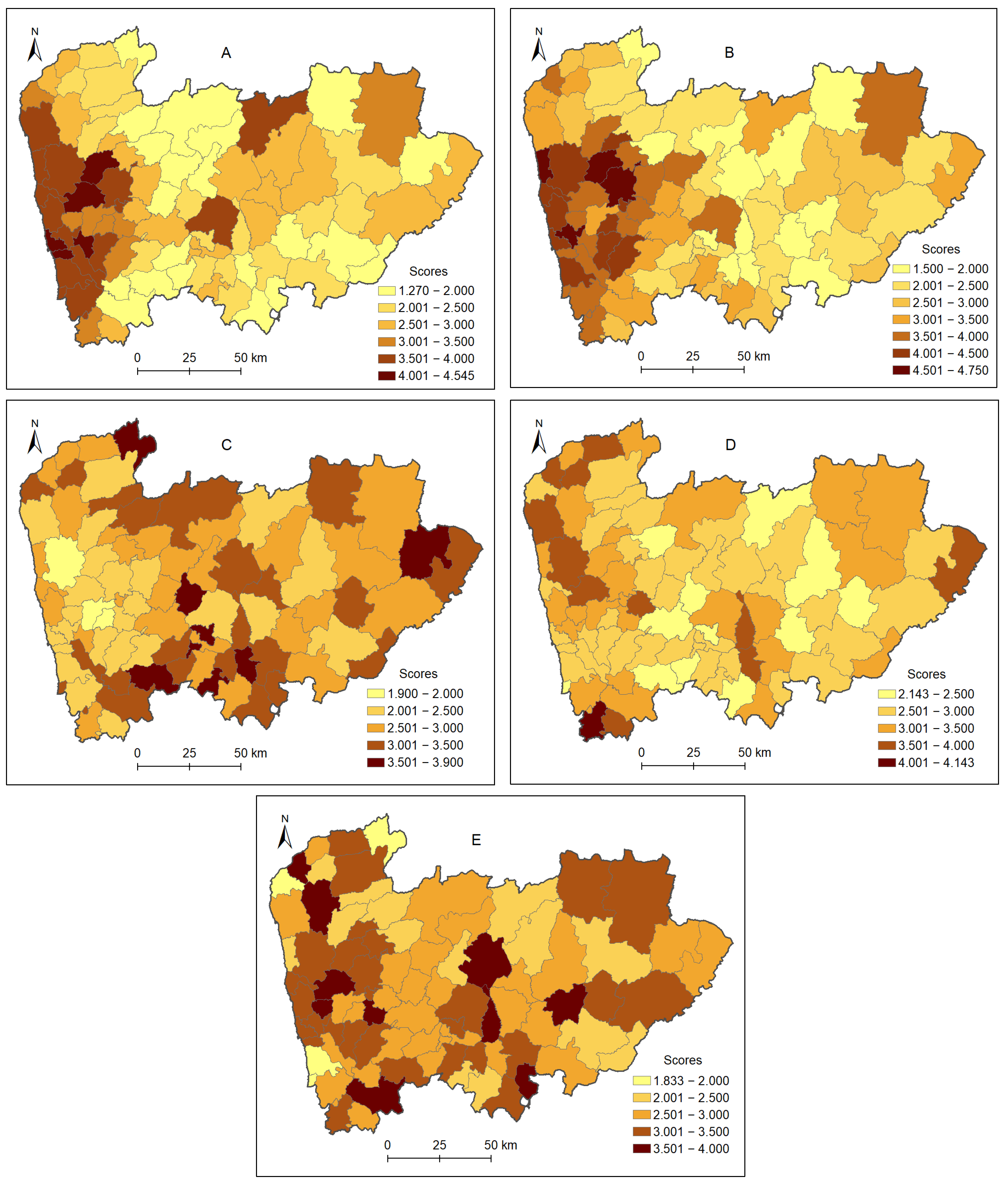
Infrastructural resilience exhibits pronounced regional contrasts, with scores ranging from 1.27 to 4.55 (Figure 2A). Higher scores are concentrated in municipalities within or near PMA and other major urban centers, such as Braga, Guimarães, and Vila Nova de Famalicão. These areas benefit from denser transport networks, better healthcare access, stronger digital connectivity, and newer building stock. Lower scores are predominantly inland, where road and rail density is low, access to services is limited and may involve longer travel times. These patterns highlight persistent spatial inequalities in infrastructure and service provision, reflected in the high standard deviation (0.80) and in the relatively low mean (2.79) and median (2.64) values. Over 44% of municipalities fall into the “Very Low” or “Low” categories, indicating persistent regional infrastructural gaps.
Social resilience follows a broadly similar spatial pattern (Figure 2B). Urban municipalities, including Braga, Guimarães, and Maia, exhibit higher scores (>4.5) due to favorable demographics, higher education levels, and better healthcare access. Inland municipalities, such as Tabuaço, Vila Nova de Foz Côa, and Valpaços, have the lowest scores (<2.0), reflecting high elderly dependency, population decline, low education, and greater social vulnerability. Social resilience shows the highest variability among the five dimensions (SD = 0.90), with the largest proportion of both “Very Low” and “Very High” scores (Table 6), underscoring the uneven distribution of social capital across the region.
Environmental resilience differs from other dimensions and exhibits lower score dispersion (Figure 2C). Higher scores are predominantly observed in less urbanized and industrialized municipalities, such as Vimioso and Mesão Frio, due to lower emissions, reduced energy use, and abundant green areas. Conversely, more urbanized or industrialized municipalities, including Barcelos, Paços de Ferreira, and Santo Tirso, score lower, highlighting potential trade-offs between environmental performance and socio-economic development. The highest score in this dimension (3.90) indicates room for environmental improvement across the entire region.
Economic resilience is concentrated in economically dynamic municipalities, such as Oliveira de Azeméis and Santa Maria da Feira, where labor markets, business networks, incomes, and purchasing power are stronger (Figure 2D). Lower economic resilience is observed in inland, low-density municipalities such as Resende and Carrazeda de Ansiães, where economic activity is less diversified, household incomes are lower, and the risk of poverty is higher. As shown in Table 6, economic resilience shows the lowest variability among the five dimensions (SD = 0.44), with most municipalities (72.09%) scoring in the “Medium” range, reflecting relatively consistent economic performance (Table 7).
Finally, institutional resilience exhibits moderate spatial variability (Figure 2E). Most municipalities display relatively strong institutional capacity, with 62% scoring above 3.0, indicating a comparatively robust institutional capacity relative to the other dimensions. Low scores (<2.0) appear in some coastal municipalities, like Espinho and Caminha, while the highest score (4.00) occurs inland in Vila Pouca de Aguiar. These patterns suggest institutional resilience is influenced more by governance quality than by population size or location.

3.2. Overall Regional Resilience

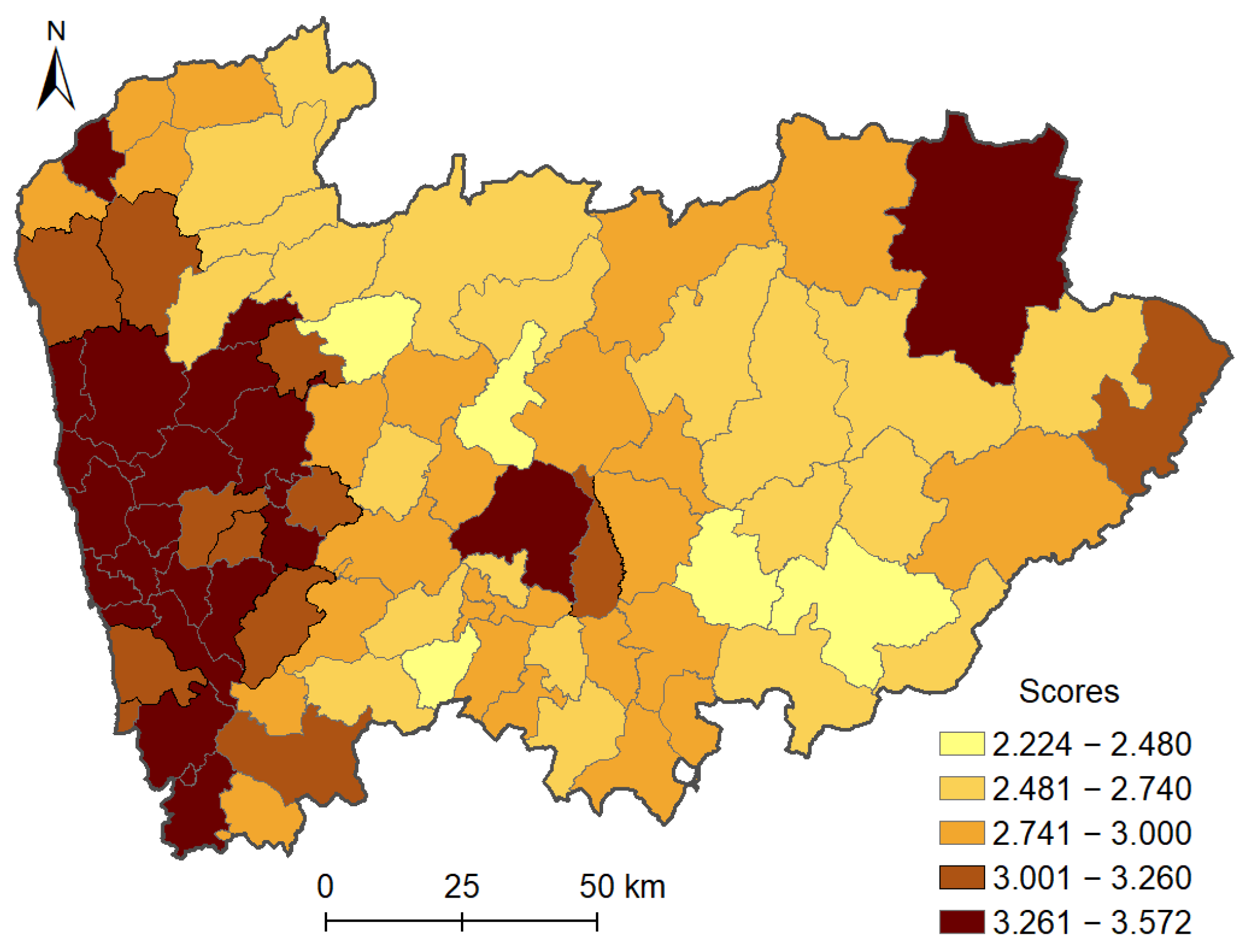
Overall resilience across the 86 municipalities is moderate but spatially heterogeneous (Figure 3 and Table 7). The most resilient municipalities are located in the Ave and Cávado subregions, including Vila Nova de Famalicão (3.57), Braga, Guimarães, and Vizela. Coastal municipalities, including the PMA, and inland main cities such as Bragança and Vila Real, score 3.0–3.5. The lowest resilience scores occur in dispersed inland municipalities, including Vieira do Minho (2.22), Carrazeda de Ansiães, Resende, Ribeira de Pena, and Torre de Moncorvo. The majority of municipalities (89.5%) fall into the Medium-Low (53.49%) or Medium-High (36.05%) categories, emphasizing the predominance of intermediate resilience levels. High and low scores are not consistently associated with specific spatial or demographic characteristics, reflecting the combined influence of infrastructural, social, environmental, economic, and institutional factors. These results confirm the coexistence of structurally vulnerable and comparatively resilient municipalities within the same regional context. As shown in Table 7, the distribution of scores is centered around moderate values (mean = 2.95; median = 2.91), with relatively low dispersion (standard deviation = 0.33), suggesting a generally balanced, though not homogeneous, level of resilience across the region. These patterns reinforce the multidimensional and place-specific nature of resilience in the Northern area of Portugal and underscore the need for territorially differentiated policy responses rather than uniform regional strategies. Analysis of mean scores reveals that infrastructural, environmental, and institutional resilience fall below the threshold of 3.0, indicating low capacity in these dimensions. Only social resilience exceeds this benchmark, suggesting comparatively stronger social networks. Overall, these results highlight structural weaknesses, particularly in infrastructure and environmental capacity, which may compromise long-term stability and adaptability.

3.3. Sensitivity Analysis

Finally, to assess the robustness of the proposed methodological approach, a sensitivity analysis was conducted comparing the original quintile-based normalization with an alternative min–max normalization procedure. As illustrated in Table 8, the results show a high level of consistency in municipal rankings, with Pearson correlations ranging from 0.731 (Environmental dimension) to 0.954 (Infrastructure dimension). Importantly, the overall composite resilience index exhibits a very high correlation between the two approaches (ρ = 0.930), indicating that the main territorial patterns and conclusions of the study are not significantly affected by the choice of normalization method. The observed lower stability in the Environmental dimension reflects the greater heterogeneity and skewness of environmental indicators.
A second sensitivity analysis was also conducted to evaluate the influence of the weighting scheme on the composite resilience index. This analysis compared the baseline equal-weighted index with a set of alternative scenarios in which each resilience dimension was alternatively assigned a higher weight (40%), while the remaining dimensions were equally weighted (15% each). The results, also reported in Table 8, indicate a high level of consistency across all specifications. Pearson correlation coefficients between the baseline and alternative weighting scenarios range from 0.876 to 0.964, confirming the stability of municipal rankings under different weighting assumptions. The highest robustness is observed for the infrastructural, social, economic, and institutional dimensions, while the environmental dimension shows comparatively lower, but still strong, stability. Overall, these findings reinforce the robustness of the composite resilience index and confirm that the main spatial patterns are not substantially affected by methodological choices related to either normalization or weighting.

4. Discussion

The territorial resilience literature remains characterized by ongoing debates regarding its conceptual definition, dimensional structure, and operationalization. In particular, differences persist regarding how resilience should be measured, how indicators should be selected, and the extent to which composite indices capture structural versus functional dimensions of resilience. In this context, this study evaluates and compares the performance of 42 resilience indicators across five dimensions for 86 municipalities in Northern Portugal, providing a regional-scale mapping of territorial resilience in the region. Our results reveal two main patterns: (i) pronounced spatial variability in resilience levels across municipalities; and (ii) substantial heterogeneity among the five resilience dimensions. These findings confirm that territorial resilience is unevenly distributed and shaped by multiple interacting factors, underscoring the importance of analyzing not only composite resilience scores but also the underlying indicators and dimensions that drive them. The sensitivity analyses further show that these spatial and dimensional patterns are largely preserved under alternative normalization procedures and weighting schemes.
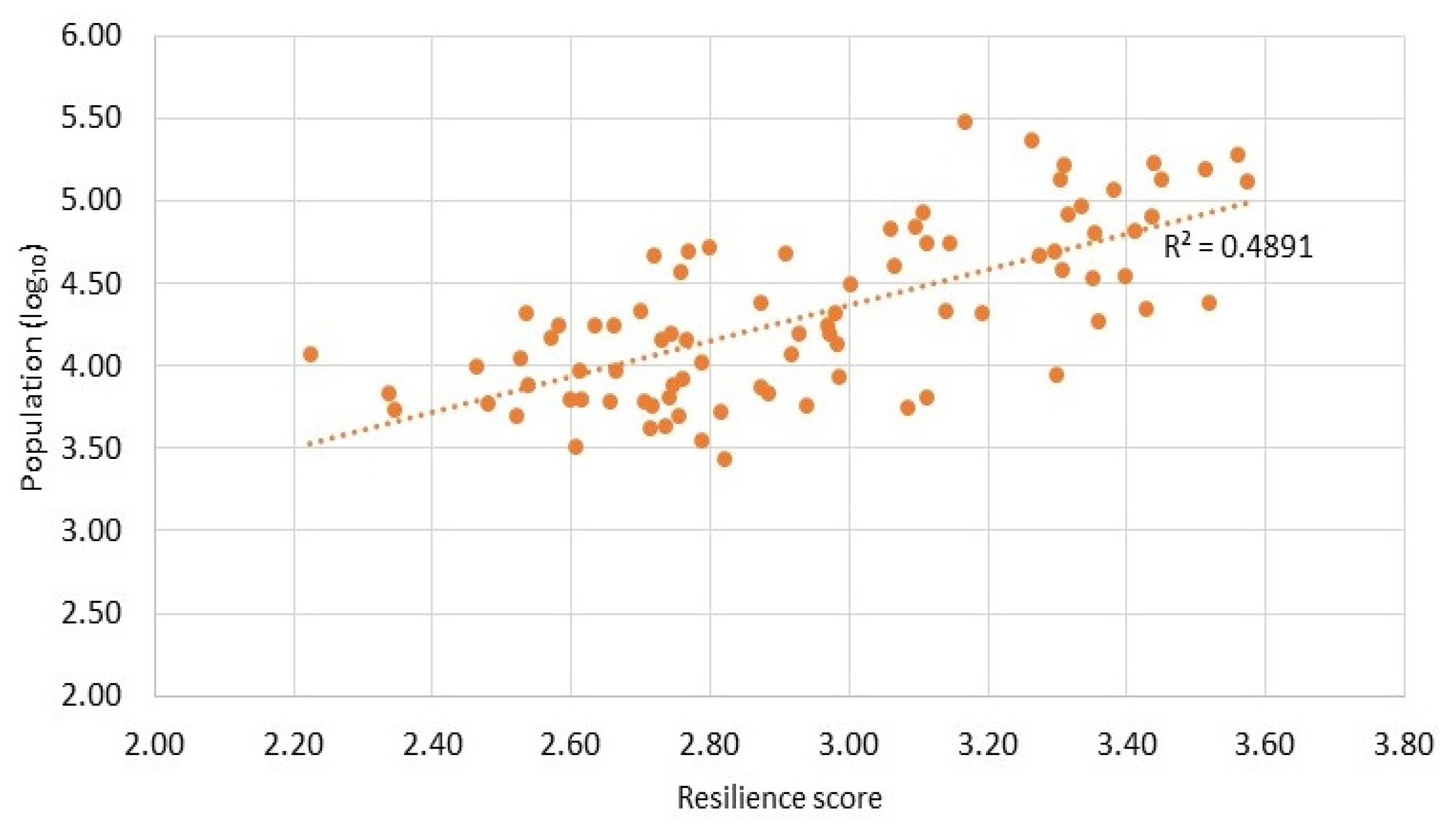
The spatial variability of resilience scores reveals a clear regional pattern. In our study, the highest-performing territories include medium-sized cities in the Ave and Cávado sub-regions, namely the municipalities of Vila Nova de Famalicão, Braga, Guimarães, and Vizela, followed by most coastal municipalities and major cities, while lower resilience levels are concentrated in inland, mountainous, and more peripheral areas. The higher resilience scores observed in coastal and urban municipalities should be interpreted within the broader context of regional development patterns in Northern Portugal. Urban areas, which are predominantly concentrated along the Atlantic corridor, typically benefit from greater population concentration, more diversified economic structures, better transport and public service provision, stronger institutional capacity, and improved access to healthcare and educational facilities. These characteristics provide territories with greater capacity to anticipate, absorb, adapt to, and recover from disturbances, contributing to higher overall resilience levels. In this sense, the results are consistent with the long-standing spatial disparities that characterize the region, where investments in infrastructure, public services, and economic opportunities have historically been concentrated in coastal areas. In addition, our findings suggest a positive relationship between municipal population size and resilience. As shown in Figure 4, which plots log-transformed municipal populations against resilience scores, more populous municipalities generally exhibit higher resilience levels than their less populated counterparts.
Nonetheless, resilience is not determined solely by population size (Porto and Vila Nova de Gaia, the largest cities in the region, do not rank highest), but rather by balanced performance across multiple dimensions. More specifically, the lower ranking of Porto and Vila Nova de Gaia is largely associated with weaker environmental performance, reflected in higher CO2, NOx, and particulate matter emissions, greater energy consumption, and higher environmental expenditure requirements. It also reflects a lower performance in some socioeconomic and institutional indicators, including unemployment, housing affordability, population at risk of poverty (particularly in Porto), and criminal case incidence. Medium-sized cities in the Ave and Cávado sub-regions appear better positioned, combining diversified and innovation-driven economies, industrial clusters, higher education institutions, and technology-oriented firms with strong social cohesion and manageable urban density [62]. These findings support Zhao et al. [50], who argue that cities with more balanced functional structures tend to exhibit higher resilience.
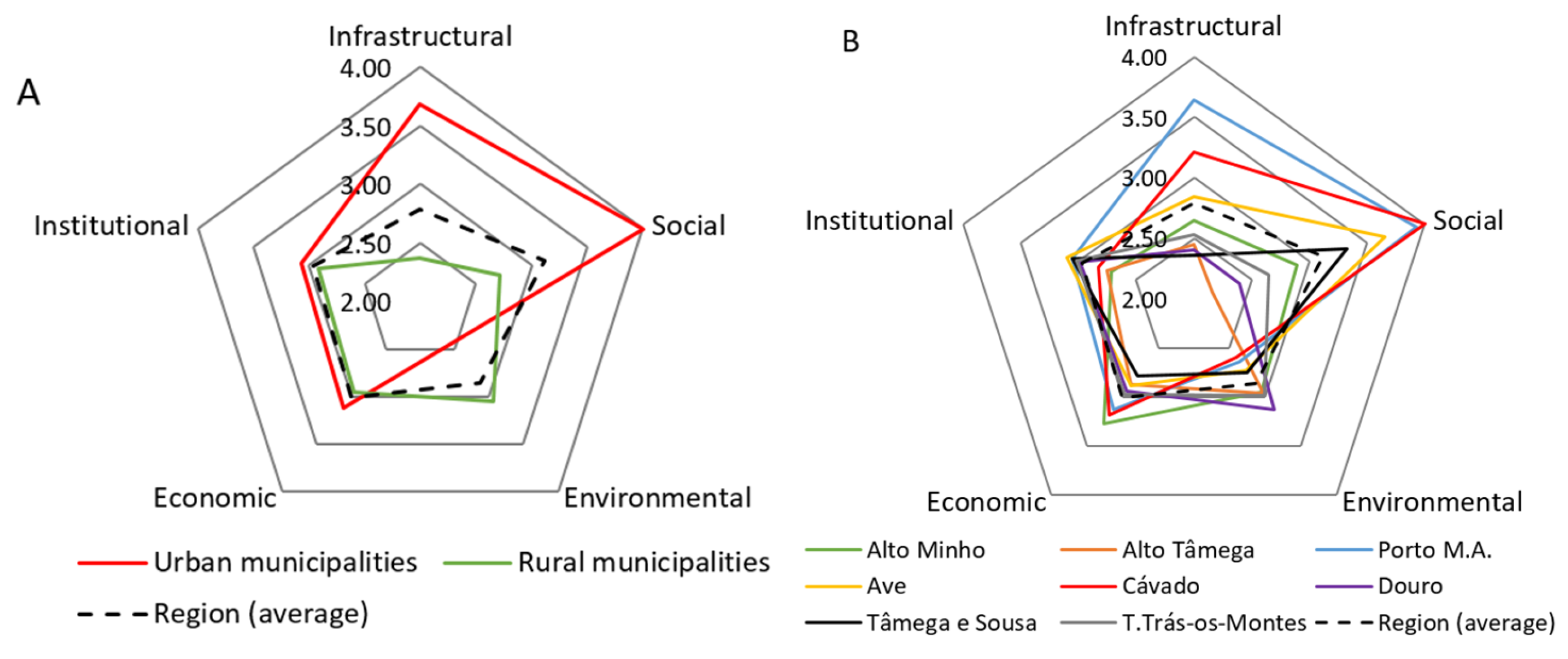
In contrast, lower resilience levels are mostly found in inland, mountainous, and more peripheral areas, where reduced availability and accessibility of essential services and transport infrastructure remain important constraints. As shown in Figure 5B, these territories clearly have a poor performance in infrastructural indicators like fewer hospitals, health centers and fire stations, lower road and rail network densities, and longer travel times to the nearest hospital. Overall, these findings indicate that significant structural disparities persist across the region, particularly in infrastructure provision within inland territories. Nonetheless, the multidimensional nature of resilience suggests that these patterns should not be interpreted as a simple urban–rural hierarchy. The proposed resilience score is not intended to measure socio-economic development per se, but rather territorial resilience, understood as an ex ante structural capacity of territories to anticipate, absorb, adapt to, and recover from disturbances. While several indicators are associated with broader development conditions, they are included to the extent that they contribute to the availability of resources, infrastructure, and institutional capacities that underpin resilience processes. From this perspective, and as shown in Figure 5A, while urban municipalities tend to perform better in the infrastructural, social, and economic dimensions, rural territories, such as those located in Douro, Alto Tâmega, Terras de Trás-os-Montes, and Alto Minho, often exhibit relatively stronger environmental performance and, in some cases, better institutional capacity. Moreover, resilience outcomes may vary depending on the type of shock considered, as different territorial contexts may exhibit distinct strengths and vulnerabilities.
The results also reveal important trade-offs between resilience dimensions. Several municipalities combine strong performance in some domains with weaker results in others, illustrating that composite scores may conceal significant internal heterogeneity. For example, municipalities with strong economic resilience, such as Oliveira de Azeméis (4.14) and Barcelos (3.71), display comparatively weaker environmental performance (2.60 and 1.90, respectively), reflecting the environmental pressures often associated with industrial activity and urban development. Conversely, several inland municipalities, including Cinfães, Tabuaço, and Melgaço, achieve environmental resilience scores above 3.50 despite recording low performance in other dimensions, particularly infrastructural resilience in Cinfães and social resilience in Tabuaço and Melgaço, where scores fall below 2.00. Similarly, Esposende and Vila Nova de Gaia combine relatively high overall resilience with weaker performance in institutional or environmental dimensions, demonstrating that favorable composite scores may mask important territorial vulnerabilities. These findings reinforce the multidimensional nature of territorial resilience and highlight the importance of analyzing both the composite index and its individual dimensions. From a policy perspective, these findings suggest that resilience strategies should be tailored to the specific strengths and weaknesses of each territory rather than relying solely on overall resilience rankings.
These findings should be interpreted in light of broader conceptual and empirical debates in the resilience literature. For example, in Greece, Colantoni et al. [63] also observed higher resilience levels in medium-sized and coastal municipalities, while inland rural areas tended to be more vulnerable. Similarly, Östh et al. [64] found that areas located near major urban centers in Sweden exhibited greater resilience than peripheral regions. Conversely, rural territories often perform better in environmental indicators due to lower land artificialization, reduced emissions, and lower resource consumption. A comparable pattern has been identified in Spain, where rural municipalities showed strong environmental performance but weaker socioeconomic conditions and limited access to services [65]. The literature also highlights that this relationship is not uniform across all contexts or dimensions of resilience. For example, Giannakis and Bruggeman [66] show that rural regions in Greece may exhibit greater resistance to recessionary economic shocks, suggesting that policy-makers should pay greater attention to innovation, human capital, and infrastructure in rural areas. Overall, these studies suggest that territorial resilience is highly context-dependent and multidimensional, and that different territorial systems may display contrasting resilience profiles depending on their socio-economic structure, governance capacity, and exposure to shocks.
Regarding the heterogeneity among the five resilience dimensions, our findings indicate that social resilience records the highest average score (3.12), while infrastructural resilience displays the lowest (2.79). The relatively high social score appears to be associated with a generally balanced performance across several demographic and social indicators, including low levels of homelessness, a lower proportion of people with disabilities, and the balance between elderly and youth dependency ratios. Although these indicators vary among municipalities, their spatial distribution is less polarized than that observed for infrastructural and economic variables, contributing to a more homogeneous pattern of social resilience across the region.
The multidimensional approach adopted in this study provides a comprehensive perspective on territorial resilience and offers valuable insights for policy design. By identifying the dimensions that contribute most strongly to resilience deficits, the proposed framework can support more targeted and evidence-based interventions. Strengthening inter-municipal cooperation, which remains limited in Portugal [62], together with adequate national support mechanisms, is particularly important for inland municipalities, where lower infrastructural, social, and economic resilience is associated with persistent challenges related to infrastructure provision, service accessibility, demographic decline, and population ageing. Many of these constraints exceed the capacity of individual municipalities to address in isolation and require coordinated strategies, resource sharing, and integrated territorial planning. In contrast, coastal municipalities tend to display lower environmental resilience, suggesting the need for policies aimed at reducing greenhouse gas emissions and air pollutants, limiting the consumption of non-renewable resources, and expanding urban green spaces where appropriate. Addressing the specific resilience deficits of different territorial contexts can contribute to strengthening overall regional resilience and supporting long-term sustainability.

5. Conclusions

To the best of our knowledge, this study provides the first comprehensive assessment of territorial resilience across the 86 municipalities of Northern Portugal, integrating five key dimensions within a spatially explicit analytical framework that can support targeted policy design. The main findings can be summarized as follows. First, Northern Portugal displays a moderate level of territorial resilience (average score 2.95), indicating structural vulnerabilities that may limit the region’s capacity to anticipate and recover from shocks. Second, resilience levels vary significantly across the region, with inland municipalities consistently showing lower performance than coastal areas, making them more vulnerable to external pressures. Third, urban municipalities generally exhibit higher resilience than predominantly rural areas across most dimensions, except for environmental resilience, where rural territories tend to perform better. Fourth, among urban areas, medium-sized cities in the Ave and Cávado sub-regions (Vila nova de Famalicão, Braga, and Guimarães) demonstrate higher resilience than municipalities in the Porto Metropolitan Area, suggesting that balanced urban structures may be more important than population size alone. Finally, infrastructural resilience emerges as the weakest dimension, while social resilience shows the strongest performance, highlighting priority areas for policy intervention. These findings emphasize that resilience is highly context-dependent and must be addressed through place-based strategies that reflect local conditions. Given the absence of a formal regional administrative tier in Portugal, strengthening inter-municipal cooperation and multi-level governance is essential, particularly to address shared vulnerabilities in inland territories.
Despite its contributions, the study presents limitations that open avenues for future research. First, as the analysis is region-bounded and relative in nature, the results should be interpreted in terms of intra-regional disparities rather than absolute resilience levels, limiting direct comparability with other territorial scales. Future research could extend the analysis to the national level to provide broader comparative insights. Second, the selection of indicators was constrained by the availability of municipal-level data. Although the 42 indicators capture multiple dimensions of resilience, additional variables could improve the comprehensiveness of the assessment where richer datasets are available. Third, the methodology assumes equal weighting among resilience dimensions and indicators in order to ensure simplicity, transparency, and reproducibility, making the framework and its results more interpretable and actionable for stakeholders and policymakers. Although a sensitivity analysis based on alternative weighting scenarios demonstrated the robustness of the results under different weighting scenarios, equal weighting may still overlook differences in the actual relative importance of specific resilience dimensions and indicators. Future research could address this limitation by incorporating expert and stakeholder consultation to develop weighting schemes that better reflect the relative importance of resilience dimensions and indicators in the Portuguese territorial context. Fourth, future research could strengthen the validation of the proposed framework by incorporating observed recovery trajectories following specific shocks in the region, benchmarking against independently developed resilience indices, and cross-validating results with alternative composite measures where available. Fifth, the results should be interpreted as a resilience capacity snapshot, reflecting the structural conditions that shape territorial resilience at the time of observation rather than its temporal dynamics. And finally, the current framework aggregates resilience dimensions without explicitly modelling their interactions. More advanced analytical techniques could help capture the complex relationships among them, while cross-country comparisons using a consistent set of indicators would further test the robustness and broader applicability of the proposed framework.

Supplementary Materials

The following supporting information can be downloaded at: https://www.mdpi.com/article/10.3390/land15061082/s1, Table S1: Correlation matrix of infrastructural resilience indicators; Table S2: Correlation matrix of social resilience indicators; Table S3: Correlation matrix of environmental resilience indicators; Table S4: Correlation matrix of economic resilience indicators; Table S5: Correlation matrix of institutional resilience indicators.

Author Contributions

Conceptualization, F.F. and P.J.G.R.; methodology, F.F. and P.J.G.R.; validation, F.F. and P.J.G.R.; formal analysis, F.F.; investigation, F.F. and P.J.G.R.; resources, F.F.; data curation, F.F. and P.J.G.R.; writing—original draft preparation, F.F.; writing—review and editing, P.J.G.R.; visualization, F.F. and P.J.G.R.; supervision, P.J.G.R. All authors have read and agreed to the published version of the manuscript.

Funding

This work was supported by the Foundation for Science and Technology under the Grant number UIDP/04047/2020.

Data Availability Statement

Data are contained within the article.

Conflicts of Interest

The authors declare no conflicts of interest.

References

  1. Fekete, A.; Hetkämper, C.; Bauer, C. Resilience in the context of civil protection and municipalities. In International Perspectives of Crime Prevention 13; Marks, E., Heinzelmann, C., Wollinger, G., Eds.; Forum Verlag Godesberg GmbH: Mönchengladbach, Germany, 2025; Volume 1, pp. 95–113. [Google Scholar] [CrossRef]
  2. Gomes, L.; Santos, S.; Coelho, L.; Rebelo, E. Using MCDA to assist an Intermunicipal community develop a resilience strategy in face of the pandemic caused by the SARS-CoV-2. Socio-Econ. Plan. Sci. 2023, 87, 101588. [Google Scholar] [CrossRef] [PubMed]
  3. Amegavi, G.; Nursey, M.; Suh, J. Advancing social equity in urban resilience planning: Challenges and opportunities. J. Environ. Plan. Manag. 2025, 69, 1843–1863. [Google Scholar] [CrossRef]
  4. Bautista, N.; Benayas, J.; Manana, J.; Suárez, M.; Sanz, E. The role of urban resilience in research and its contribution to sustainability. Cities 2022, 126, 103715. [Google Scholar] [CrossRef]
  5. United Nations. Revision of World Urbanization Prospects; Population Division of the United Nations Department of Economic and Social Affairs: New York, NY, USA, 2018. [Google Scholar]
  6. Potere, D.; Schneider, A.; Angel, S.; Civco, D. Mapping urban areas on a global scale: Which of the eight maps now available is more accurate? Int. J. Remote Sens. 2009, 30, 6531–6558. [Google Scholar] [CrossRef]
  7. World Bank. City Resilience Program Annual Report 2020; World Bank: Washington, DC, USA, 2020; p. 27. [Google Scholar]
  8. Solecki, W.; Leichenko, R.; O’Brien, K. Climate change adaptation strategies and disaster risk reduction in cities: Connections, contentions, and synergies. Curr. Opin. Environ. Sustain. 2011, 3, 135–141. [Google Scholar] [CrossRef]
  9. Kapucu, N.; Ge, Y.; Rott, E.; Isgandar, H. Urban resilience: Multidimensional perspectives, challenges and prospects for future research. Urban Gov. 2024, 4, 162–179. [Google Scholar] [CrossRef]
  10. Rezvani, S.; Almeida, N.; Falcão, M.; Duarte, M. Enhancing urban resilience evaluation systems through automated rational and consistent decision-making simulations. Sustain. Cities Soc. 2022, 78, 103612. [Google Scholar] [CrossRef]
  11. Holling, C. Resilience and stability of ecological systems. Annu. Rev. Ecol. Syst. 1973, 4, 1–23. [Google Scholar] [CrossRef]
  12. Meerow, S.; Newell, J.; Stults, M. Defining urban resilience: A review. Landsc. Urban Plan. 2016, 147, 38–49. [Google Scholar] [CrossRef]
  13. Ribeiro, P.; Gonçalves, L. Urban resilience: A conceptual framework. Sustain. Cities Soc. 2019, 50, 101625. [Google Scholar] [CrossRef]
  14. Lak, A.; Hasankhan, F.; Garakani, S. Principles in practice: Toward a conceptual framework for resilient urban design. J. Environ. Plan. Manag. 2020, 63, 2194–2226. [Google Scholar] [CrossRef]
  15. Liu, W.; Song, Z. Review of studies on the resilience of urban critical infrastructure networks. Reliab. Eng. Syst. Saf. 2020, 193, 106617. [Google Scholar] [CrossRef]
  16. Liu, H.; Chen, N.; Wang, X. Exploring spatial patterns of sustainability and resilience of metropolitan areas in the US using self-organizing maps. Cities 2024, 155, 105414. [Google Scholar] [CrossRef]
  17. Yu, J.; Hu, W.; Hou, L. Towards more resilient cities-analyzing the impact of new-type urbanization on urban resilience: Considering spatial spillover boundaries. Sustain. Cities Soc. 2024, 114, 105735. [Google Scholar] [CrossRef]
  18. Curt, C.; Tacnet, J. Resilience of critical infrastructures: Review and analysis of current approaches. Risk Anal. 2018, 38, 2441–2458. [Google Scholar] [CrossRef] [PubMed]
  19. Fang, Y.; Zio, E. An adaptive robust framework for the optimization of the resilience of interdependent infrastructures under natural hazards. Eur. J. Oper. Res. 2019, 276, 1119–1136. [Google Scholar] [CrossRef]
  20. Suárez, M.; Rieiro, A.; Alba, D.; Langemeyer, J.; Gómez, E.; Ametzaga, I. Urban resilience through green infrastructure: A framework for policy analysis applied to Madrid, Spain. Landsc. Urban Plan. 2024, 241, 104923. [Google Scholar] [CrossRef]
  21. Vamvakeridou, L.; Chen, A.; Khoury, M.; Gibson, M.; Kostaridis, A.; Stewart, D.; Wood, M.; Djordjevic, S.; Savic, D. Assessing and visualising hazard impacts to enhance the resilience of Critical Infrastructures to urban flooding. Sci. Total Environ. 2020, 707, 136078. [Google Scholar] [CrossRef] [PubMed]
  22. Urbina, O.; Fekete, A.; Matos, J.; Teixeira, E. Social resilience assessment for urban fires in Guimarães historical center. Int. J. Disaster Risk Reduct. 2025, 117, 105131. [Google Scholar] [CrossRef]
  23. Champlin, C.; Sirenko, M.; Comes, T. Measuring social resilience in cities: An exploratory spatio-temporal analysis of activity routines in urban spaces during COVID-19. Cities 2023, 135, 104220. [Google Scholar] [CrossRef] [PubMed]
  24. Alizadeh, H.; Sharifi, A. Analysis of the state of social resilience among different socio-demographic groups during the COVID-19 pandemic. Int. J. Disaster Risk Reduct. 2021, 64, 102514. [Google Scholar] [CrossRef] [PubMed]
  25. Jaafari, A.; Mafi, D.; Yousefi, S. A spatiotemporal analysis using expert-weighted indicators for assessing social resilience to natural hazards. Sustain. Cities Soc. 2024, 100, 105051. [Google Scholar] [CrossRef]
  26. Lan, C.; Li, X.; Peng, B.; Li, X. Unlocking urban ecological resilience: The dual role of environmental regulation and green technology innovation. Sustain. Cities Soc. 2025, 128, 106466. [Google Scholar] [CrossRef]
  27. Wu, X.; Zhang, J.; Geng, X.; Wang, T.; Wang, K.; Liu, S. Increasing green infrastructure-based ecological resilience in urban systems: A perspective from locating ecological and disturbance sources in a resource-based city. Sustain. Cities Soc. 2020, 61, 102354. [Google Scholar] [CrossRef]
  28. Hui, J.; Tan, Q. Dynamic evaluation of regional economic resilience under major public emergencies: Based on an improved dynamic evaluation model of grey incidence projection-fuzzy matter element. Wirel. Netw. 2023, 29, 3223–3238. [Google Scholar] [CrossRef]
  29. Sutton, J.; Arcidiacono, A.; Torrisi, G.; Arku, R. Regional economic resilience: A scoping review. Prog. Hum. Geogr. 2023, 47, 500–532. [Google Scholar] [CrossRef]
  30. Osei, R.; Tam, V.; Komac, U.; Ampratwum, G. Critical review of urban community resilience indicators. Smart Sustain. Built Environ. 2024, 13, 1511–1537. [Google Scholar] [CrossRef]
  31. Aroca, E.; Bodoque, J.; García, J. How to construct and validate an Integrated Socio-Economic Vulnerability Index: Implementation at regional scale in urban areas prone to flash flooding. Sci. Total Environ. 2020, 746, 140905. [Google Scholar] [CrossRef] [PubMed]
  32. Assumma, V.; Bottero, M.; De Angelis, E.; Lourenço, J.; Monaco, R.; Soares, A. A decision support system for territorial resilience assessment and planning: An application to the Douro Valley (Portugal). Sci. Total Environ. 2021, 756, 143806. [Google Scholar] [CrossRef] [PubMed]
  33. Rezvani, S.; Falcão, M.; Komljenovic, D.; Almeida, N. A systematic literature review on urban resilience enabled with asset and disaster risk management approaches and GIS-based decision support tools. Appl. Sci. 2023, 13, 2223. [Google Scholar] [CrossRef]
  34. Büyüközkan, G.; Ilıcak, Ö.; Feyzioğlu, O. A review of urban resilience literature. Sustain. Cities Soc. 2022, 77, 103579. [Google Scholar] [CrossRef]
  35. Zhang, Y.; Li, X.; Liu, Q. Advancing urban resilience: A multi-hazard risk perspective on frontier evolution, research hotspots, and practical exploration. Urban Clim. 2025, 60, 102342. [Google Scholar] [CrossRef]
  36. Kaltenbrunner, K.; Stoetzer, S. Institutional resilience of club sport in an extreme context: Collective dealing with the COVID-19 pandemic from an institutional work lens. Int. J. Sport Policy Politics 2025, 17, 267–286. [Google Scholar] [CrossRef]
  37. Larimian, T.; Sadeghi, A.; Palaiologou, G.; Schmidt, R. Neighbourhood social resilience (NSR): Definition, conceptualisation, and measurement scale development. Sustainability 2020, 12, 6363. [Google Scholar] [CrossRef]
  38. Hannibal, B.; Meerow, S.; Woodruff, S.; Roy, M.; Gilbertson, P.; Matos, M. Who collaborates on urban resilience? An analysis of flood resilience planning networks in four coastal cities. J. Urban Aff. 2024, 46, 1775–1792. [Google Scholar] [CrossRef]
  39. Lv, Y.; Sarker, M. Integrative approaches to urban resilience: Evaluating the efficacy of resilience strategies in mitigating climate change vulnerabilities. Heliyon 2024, 10, e28191. [Google Scholar] [CrossRef] [PubMed]
  40. Rezvani, S.; Silva, M.; Almeida, N. NETOBRA: Boosting urban resilience through a digital platform for the construction ecosystem. Procedia Struct. Integr. 2024, 55, 72–79. [Google Scholar] [CrossRef]
  41. Jacinto, R.; Sebastião, F.; Reis, E.; Ferrão, J. SoResilere—A social resilience index applied to Portuguese flood disaster-affected municipalities. Sustainability 2023, 15, 3309. [Google Scholar] [CrossRef]
  42. Statistics Portugal. Census 2021; Statistics Portugal: Lisbon, Portugal, 2021.
  43. World Bank. World Development Indicators: Urban Population (% of Total Population); World Bank: Washington, DC, USA, 2024. [Google Scholar]
  44. Silva, J.; Macassa, G.; Barros, H.; Ribeiro, A. Local Climate Change Adaptation under the Lenses of Public Health: A Case Study from Porto, Portugal. Port. J. Public Health 2024, 42, 169–183. [Google Scholar] [CrossRef] [PubMed]
  45. CCDRN. Northern Regional Spatial Planning Programme; Norte Portugal Regional Coordination and Development Commission: Porto, Portugal, 2024.
  46. Ribeiro, P.; Fonseca, F.; Santos, P. Sustainability assessment of a bus system in a mid-sized municipality. J. Environ. Plan. Manag. 2020, 63, 236–256. [Google Scholar] [CrossRef]
  47. Figueiredo, L.; Honiden, T.; Schumann, A. Indicators for resilient cities. OECD Reg. Dev. Work. Pap. 2018, 1, 1–66. [Google Scholar] [CrossRef]
  48. Feofilovs, M.; Romagnoli, F. Dynamic assessment of urban resilience to natural hazards. Int. J. Disaster Risk Reduct. 2021, 62, 102328. [Google Scholar] [CrossRef]
  49. Nafeh, A.M.; Beldjoudi, H.; Yelles, K.; Monteiro, R. Development of a seismic social vulnerability model for northern Algeria. Int. J. Disaster Risk Reduct. 2020, 50, 101821. [Google Scholar] [CrossRef]
  50. Zhao, R.; Fang, C.; Liu, J.; Zhang, L. The evaluation and obstacle analysis of urban resilience from the multidimensional perspective in Chinese cities. Sustain. Cities Soc. 2022, 86, 104160. [Google Scholar] [CrossRef]
  51. Chen, M.; Zhang, Q.; Jiang, Y.; Wang, J.; Zhu, S. Evaluating the coupling coordination levels and critical obstacle indicators of urban infrastructure resilience: A case study in China. Buildings 2025, 15, 495. [Google Scholar] [CrossRef]
  52. Zhao, T.; Sun, Z.; Wang, J.; Tang, Y.; Varga, L.; Skibniewski, M. Resilience-based transportation system planning optimization through dedicated autonomous vehicle lanes configuration. Transp. Res. Part E 2025, 194, 103939. [Google Scholar] [CrossRef]
  53. Wang, H.; Ge, Q. Ecological resilience of three major urban agglomerations in China from the “environment–society” coupling perspective. Ecol. Indic. 2024, 169, 112944. [Google Scholar] [CrossRef]
  54. Zheng, Y.; Xin, X.; Chen, L.; Mou, W.; Xiao, H. Development as adaptation: Framing and measuring urban resilience in Beijing. Adv. Clim. Change Res. 2018, 9, 234–242. [Google Scholar] [CrossRef]
  55. Özerol, G.; Bressers, H. Enhancing the resilience of midsize cities to climate extremes: A tool for practitioners to assess their governance context. Total Environ. Res. Themes 2023, 8, 100080. [Google Scholar] [CrossRef]
  56. Priolo, L.; Ribeiro, P.; Pinto, N. Urban resilience centered on transport systems. Transp. Res. Procedia 2023, 72, 4374–4381. [Google Scholar] [CrossRef]
  57. Cardoni, A.; Noori, A.; Greco, R.; Cimellaro, G. Resilience assessment at the regional level using census data. Int. J. Disaster Risk Reduct. 2021, 55, 102059. [Google Scholar] [CrossRef]
  58. Suárez, M.; Gómez-Baggethun, E.; Benayas, J.; Tilbury, D. Towards an urban resilience index: A case study in 50 Spanish cities. Sustainability 2016, 8, 774. [Google Scholar] [CrossRef]
  59. Kaya, A.; Sajjad, M.; Dedekorkut-Howes, A. Downscaling Urban Disaster Resilience: Toward Building-Scale Geo-Information Modeling and Machine Learning-Assisted Resilience Knowledge Systems. Trans. GIS 2025, 29, e70153. [Google Scholar] [CrossRef]
  60. Moreira, L.; Vanelli, F.; Schwamback, D.; Kobiyama, M.; Brito, M. Sensitivity analysis of indicator weights for the construction of flood vulnerability indexes: A participatory approach. Front. Water 2023, 5, 970469. [Google Scholar] [CrossRef]
  61. Soares, M.; Fonseca, F.; Ramos, R. A quantitative spatial methodology for delimiting historical centers: An application in Guarda, Portugal. J. Spat. Inf. Sci. 2022, 25, 1–28. [Google Scholar] [CrossRef]
  62. Fonseca, F.; Ramos, R.; Silva, A. An agent-based model as a tool of planning at a sub-regional scale. In Computational Science and Its Applications; Murgante, B., Misra, S., Rocha, A., Torre, C., Rocha, J., Falcão, M., Taniar, D., Apduhan, B., Gervasi, O., Eds.; Springer: Cham, Switzerland, 2014; Volume 8580, pp. 611–628. [Google Scholar] [CrossRef]
  63. Colantoni, A.; Halbac, R.; Halbac, C.; Cudlin, P.; Salvati, L.; Gimenez, A. Demographic resilience in local systems: An empirical approach with census data. Systems 2020, 8, 34. [Google Scholar] [CrossRef]
  64. Östh, J.; Reggiani, A.; Nijkamp, P. Resilience and accessibility of Swedish and Dutch municipalities. Transportation 2018, 45, 1051–1073. [Google Scholar] [CrossRef]
  65. Nogués, S.; Gonzalez, E.; Cordera, R. Planning regional sustainability: An index-based framework to assess spatial plans. Application to the region of Cantabria (Spain). J. Clean. Prod. 2019, 225, 510–523. [Google Scholar] [CrossRef]
  66. Giannakis, E.; Bruggeman, A. Economic crisis and regional resilience: Evidence from Greece. Pap. Reg. Sci. 2017, 96, 451–477. [Google Scholar] [CrossRef]
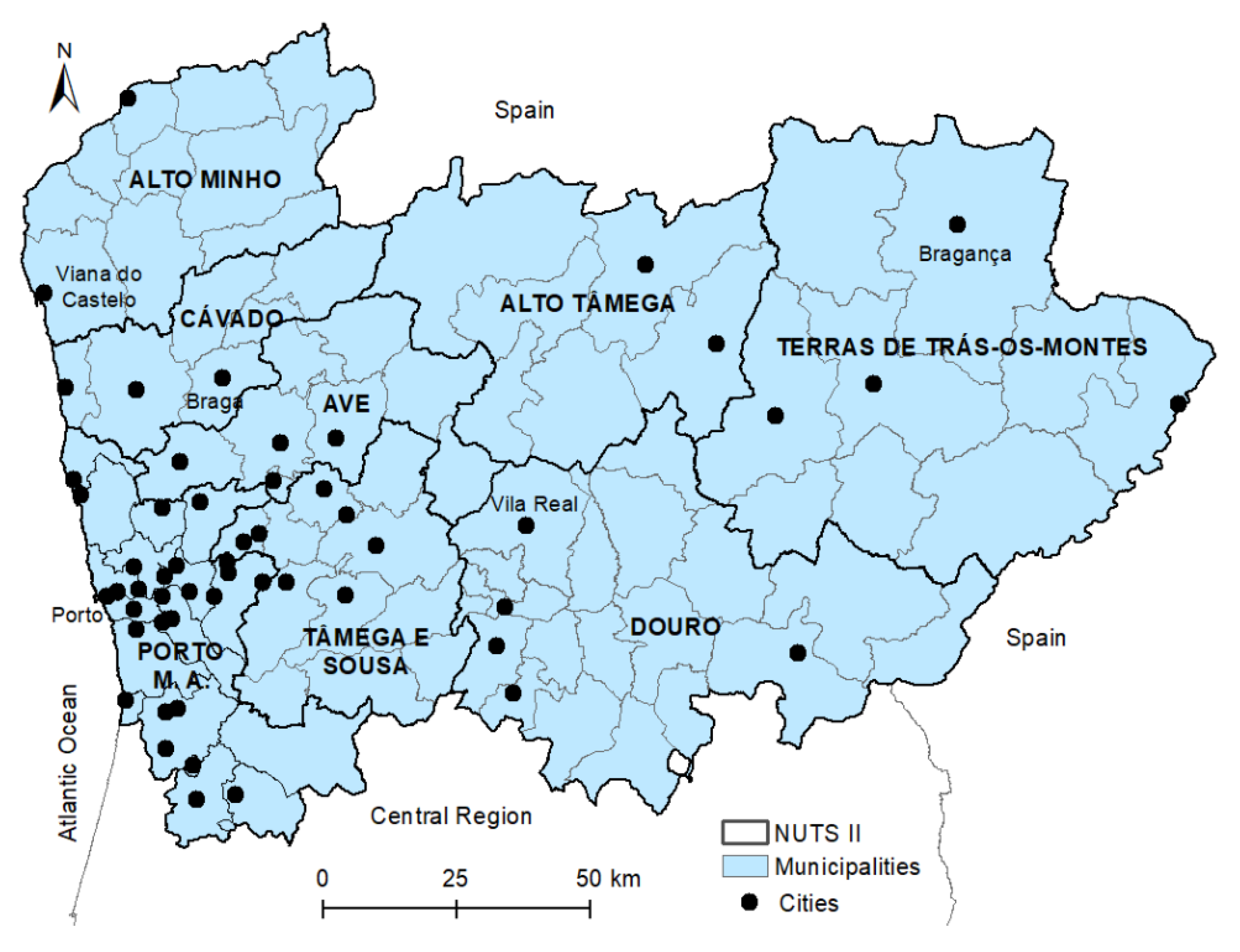
Figure 1. Northern region of Portugal.
Land 15 01082 g001
Figure 2. Average resilience scores of infrastructural (A), social (B), environmental (C), economic (D) and institutional (E) indicators in the northern region of Portugal.
Land 15 01082 g002
Figure 3. Global resilience scores across the region.
Land 15 01082 g003
Figure 4. Relationship between municipal population (log-transformed) and resilience scores across the 86 municipalities.
Land 15 01082 g004
Figure 5. Urban–rural (A) and sub-regional (B) differences in resilience dimensions.
Land 15 01082 g005
Table 6. Resilience score classes by dimension.
Score ClassInfrastructuralSocialEnvironmentalEconomicInstitutionalGlobal
Very low
(<2.00)
13
(15.12%)
10
(11.63%)
1
(1.16%)
0
(0.00%)
3
(3.49%)
0
(0.00%)
Low
(≥2.00–≤2.49)
25
(29.07%)
17
(19.77%)
18
(20.93%)
12
(13.95%)
11
(12.79%)
5
(5.81%)
Medium-low
(≥2.5–≤2.99)
16
(18.60%)
9
(10.47%)
28
(32.56%)
28
(32.56%)
18
(20.93%)
46
(53.49%)
Medium-high
(≥3.0–≤3.49)
11
(12.79%)
14
(16.28%)
29
(33.72%)
34
(39.53%)
40
(46.51%)
31
(36.05%)
High
(≥3.5–≤3.99)
14
(16.28%)
19
(22.08%)
10
(11.63%)
11
(12.79%)
13
(15.12%)
4
(4.65%)
Very high
(≥4.00)
7
(8.14%)
17
(19.77%)
0
(0.00%)
1
(1.17%)
1
(1.16%)
0
(0.00%)
Table 7. Descriptive statistics of resilience scores by dimension.
Resilience
Dimension
MeanMedianMin.Max.Std.
Dev.
Municipality < ScoreMunicipality
> Score
Infrastructural2.792.641.274.550.80CinfãesBraga
Social3.123.191.504.750.90TabuaçoBraga
Environmental2.862.801.903.900.48BarcelosVimioso
Economic3.013.002.144.140.44ResendeO. Azeméis
Institutional2.973.001.834.000.49EspinhoV.P. Aguiar
Global2.952.912.223.570.33V. MinhoV.N. Famalicão
Table 8. Robustness of the composite resilience index under alternative normalization and weighting scenarios.
Resilience DimensionQuintile vs. Min–Max (r)Weighting Robustness (r)
Infrastructural0.9540.964
Social0.9100.959
Economic0.8610.876
Institutional0.8010.952
Environmental0.7310.935
Overall resilience0.9300.937
Disclaimer/Publisher’s Note: The statements, opinions and data contained in all publications are solely those of the individual author(s) and contributor(s) and not of MDPI and/or the editor(s). MDPI and/or the editor(s) disclaim responsibility for any injury to people or property resulting from any ideas, methods, instructions or products referred to in the content.