1. Introduction
Weekday commuting and weekend recreation represent two major domains of intra-urban mobility through which urban spatial structure shapes residents’ well-being and the functioning of cities. The former captures the most regular and unavoidable work-related travel, while the latter reflects one of the main ways in which residents access leisure, recovery, and social participation outside work routines.
Examining how jobs–housing–recreation spatial structure relates to these two mobility-performance dimensions is important for two reasons. First, both commuting and recreation are core components of urban spatial-structure performance. Commuting has long been central to urban mobility and jobs–housing research [
1,
2], whereas recreational mobility has received comparatively less attention. Yet weekend recreational mobility matters in its own right, as recreational activities support leisure participation, social interaction, recovery, quality of life, and the attractiveness of large cities [
3,
4,
5]. In large Chinese cities, where congestion increasingly extends from weekday commuting peaks into weekend leisure periods, weekend recreational mobility has also become part of the broader challenge of urban mobility and quality of life. This makes it increasingly necessary to evaluate urban spatial-structure performance beyond a commuting-centred perspective.
Second, these two dimensions are interrelated rather than independent. Recreational opportunities may also matter for commuting performance indirectly through residential choice: if households value access to recreational facilities, open spaces, environmental quality, and other non-work amenities, the spatial distribution of these resources may shape where they live and, in turn, the commuting costs they bear [
6,
7]. In this sense, recreational conditions are not external to commuting-centred spatial performance; they may condition the effectiveness of jobs–housing balance itself. More broadly, weekday commuting and weekend recreation are jointly shaped by the spatial configuration of jobs, housing, and recreational resources. The key issue is therefore not only how jobs and housing are related, but how jobs, housing, and recreation are jointly configured to affect the combined performance of work-related and non-work mobility.
However, the value of an integrated jobs–housing–recreation perspective depends on whether the relationship between weekday commuting costs and weekend recreational mobility conditions leaves scope for coordinated improvement, which can only be assessed by clarifying its functional form empirically rather than assuming it in advance. In Alonso’s residential location framework [
8], households trade off commuting costs against other locational advantages, and subsequent empirical research suggests that such trade-offs may also extend to recreational accessibility [
2,
3]. At the same time, unequal bidding power may sort some residents into locations with favourable conditions in both domains, while leaving others in locations with unfavourable conditions in both. In real cities, these mechanisms may coexist and interact, producing relationships more complex than either straightforward trade-off or straightforward alignment. What therefore remains unclear is whether this relationship is broadly positive, broadly negative, nonlinear, range-dependent, or shaped by more complex combinations of these tendencies. Clarifying this issue is therefore essential for assessing whether there is scope for jointly improving commuting and recreational mobility performance within a jobs–housing–recreation framework.
Despite its importance, the relationship between weekday commuting costs and weekend recreational mobility conditions has rarely been treated as an explicit empirical question [
9], and direct research linking commuting to other activity or travel domains remains limited [
10,
11,
12,
13,
14]. Relevant insights are instead dispersed across several related strands, each of which illuminates part of the problem without identifying the relationship itself.
A first relevant strand is commuting-centered spatial structure research. This literature is primarily organized around how urban spatial structure shapes commuting performance, with outcomes commonly measured in terms of commuting time, commuting distance, excess commuting, jobs–housing balance, and related indicators of spatial mismatch and accessibility [
1,
15,
16,
17,
18,
19,
20]. Its evaluative scope therefore remains centered on spatial-structure performance from a commuting perspective, rather than on how commuting and recreational mobility performance are jointly configured.
A second relevant strand concerns recreation-related access and use, particularly in relation to parks and greenspaces. This literature focuses mainly on the distribution, accessibility, equity, and use of parks and greenspaces, examining how access and visitation vary with transport conditions, perceived quality, population demand, supply–demand balance, and spatial equity, increasingly with human mobility data [
21,
22,
23,
24,
25,
26,
27]. Recent work on non-work travel further examines activity types and nonlinear built-environment associations, but remains centered on non-work activity demand rather than weekend recreational mobility conditions [
28]. The analytical focus of this strand therefore remains on recreational opportunities, park access, greenspace use, and non-work activity patterns themselves, rather than on their relationship with weekday commuting costs.
A related strand concerns residential location and accessibility trade-off studies. By modelling how households choose among alternative residential locations, this literature inherently addresses trade-offs among housing attributes, commuting costs, neighbourhood conditions, and access to employment, services, open space, and other amenities [
6,
7]. The most closely related evidence shows that commuting burdens may be weighed against non-work dimensions of residential utility, such as open-space access, leisure-related facilities, or proximity to social contacts, and that residential location may shape both commuting and non-work travel outcomes [
7,
14,
29,
30,
31]. These studies are closely related, but their analytical focus remains on residential choice and its travel implications, rather than on the relationship between weekday commuting costs and weekend recreational mobility conditions.
A fourth strand concerns built environment–travel behaviour studies and mixed-use planning. This literature examines how urban form and land-use characteristics—such as density, diversity, design, destination accessibility, and transit access—are associated with travel behaviour, and how mixed-use or compact development is expected to enhance proximity, accessibility, functional diversity, and transport sustainability [
32,
33,
34]. Recent reviews further emphasize that mixed-use development is multidimensional and context-dependent, involving transport, social, economic, environmental, and regulatory dimensions [
33,
34]. Here, lower commuting burdens and better access to recreational or other non-work opportunities are often treated as parallel benefits of more integrated land-use arrangements, rather than as outcomes whose empirical relationship is itself examined directly.
Taken together, these strands provide important but partial foundations for understanding weekday commuting costs and weekend recreational mobility conditions. They show that commuting performance, recreational access and use, residential choice trade-offs, and built-environment effects on travel behaviour are conceptually connected. However, existing studies tend to examine these issues as separate or only loosely connected concerns, rather than treating the commuting–recreation relationship itself as the object of empirical analysis. As a result, limited evidence exists on how weekday commuting costs and weekend recreational mobility conditions are jointly structured within residential space. Whether the two dimensions are positively aligned, subject to trade-offs, or related through nonlinear and range-dependent forms therefore remains an open empirical question.
Against this background, this study examines the individual-level relationship between weekday commuting costs and weekend recreational mobility conditions using large-scale location-based services (LBS) data from the central urban area of Chongqing, China. The analysis is guided by two research questions: (1) What empirical relationship exists between weekday commuting costs and weekend recreational mobility conditions at the individual level, and what functional form does this relationship take across commuting-cost ranges? (2) How can the identified pattern be interpreted in relation to the jobs–housing–recreation structure of urban space, and what implications does it have for integrated spatial diagnosis and future spatial-performance research?
By addressing these questions, this study positions the commuting–recreation relationship as an empirical entry point for integrated spatial-performance research. The underlying idea is that weekday commuting and weekend recreation should be understood not as separate mobility outcomes, but as two related performance expressions of the same jobs–housing–recreation spatial structure. This relationship matters because residential locations simultaneously anchor residents’ work-related mobility costs and their access to weekend recreational opportunities, while recreational resources and other non-work amenities may also shape residential choice and, indirectly, commuting costs. Examining the commuting–recreation relationship therefore provides a way to assess how work-related and recreational mobility costs are jointly configured through the spatial relationships among jobs, housing, and recreation.
The study makes two specific advances. First, it examines whether there is empirical support for considering commuting and recreational mobility conditions jointly within a jobs–housing–recreation framework. It does so by analysing whether weekday commuting costs and weekend recreational mobility conditions are systematically related at the individual level, what functional form this relationship takes, and whether the spatial logic behind the relationship suggests scope for integrated spatial diagnosis and future evaluation of coordinated improvement possibilities. Second, it uses this empirical examination to outline how spatial-performance evaluation can move toward a jobs–housing–recreation perspective. In this perspective, residential locations are examined through the joint configuration of weekday commuting costs and weekend recreational mobility costs. Rather than claiming to identify causal mechanisms or optimization effects, the study points to the need for future research on how alternative jobs–housing–recreation configurations may support more favourable combined mobility conditions.
4. Discussion
4.1. A Nonlinear and Range-Dependent Commuting–Recreation Relationship
4.1.1. Empirical Findings Across Specifications
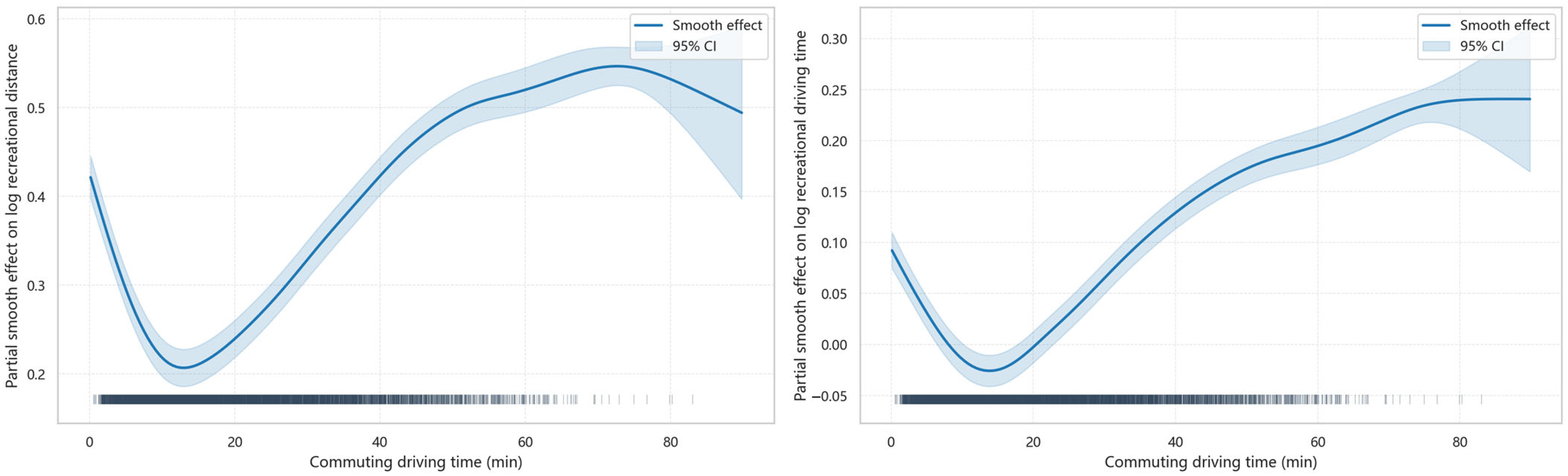
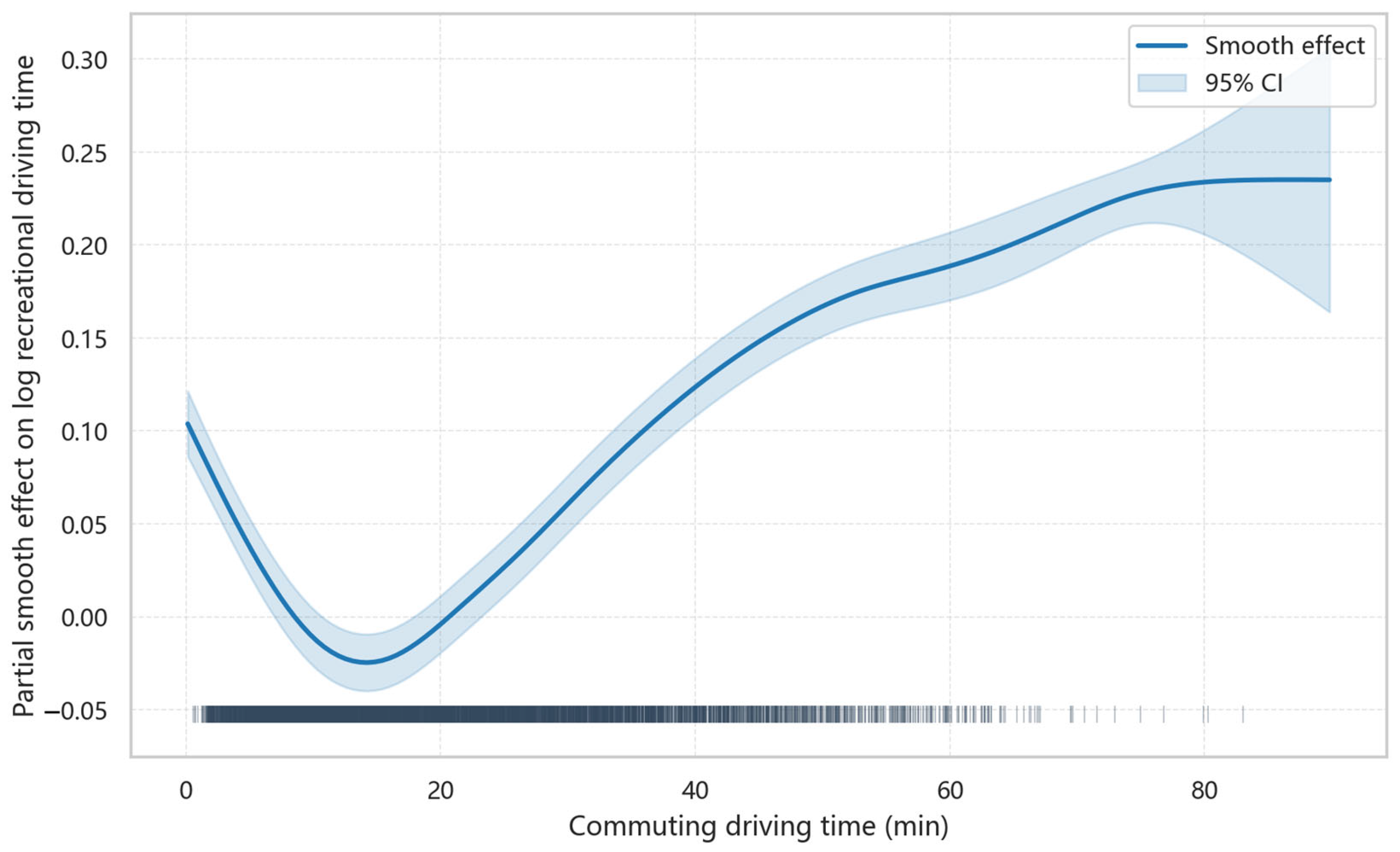
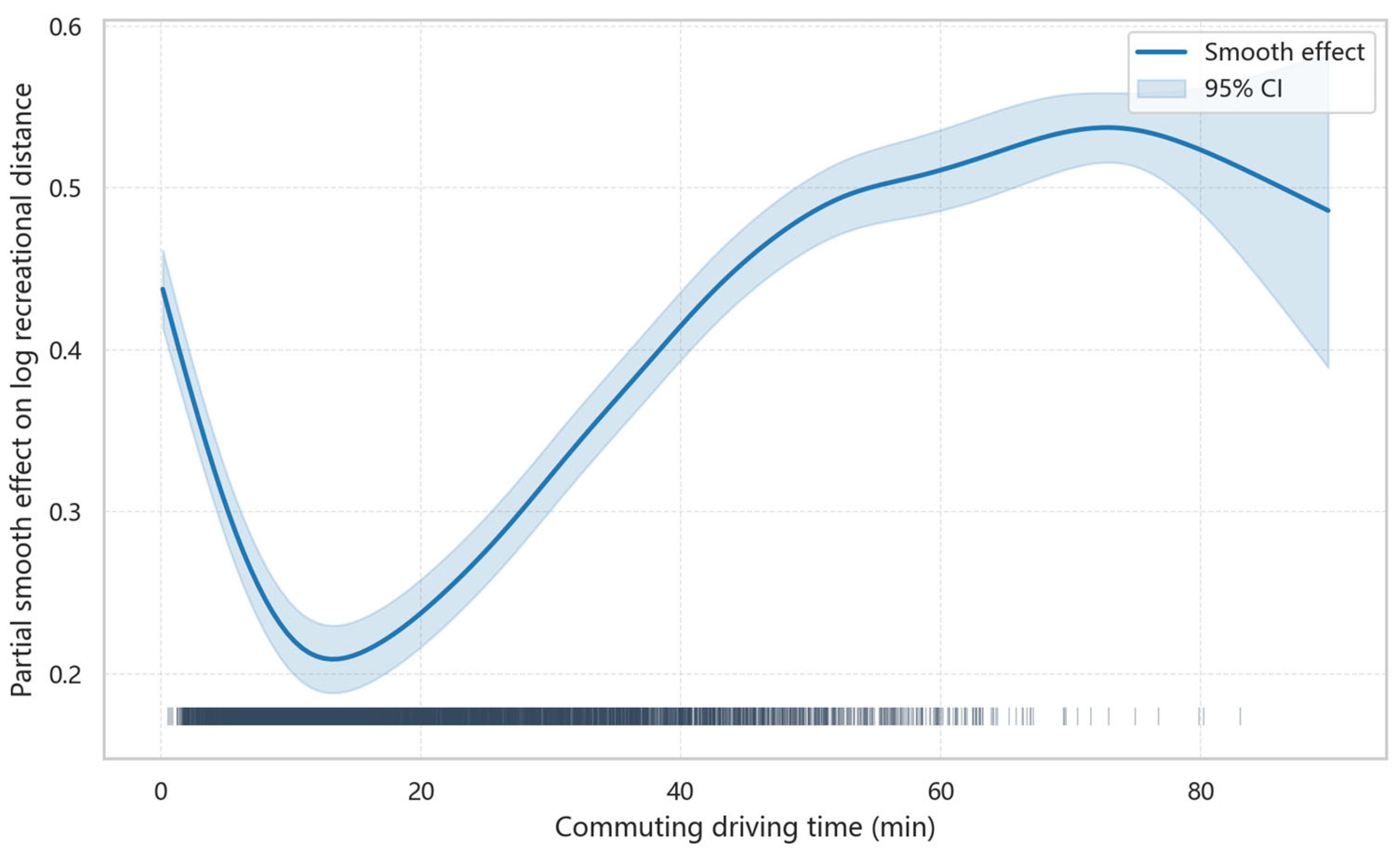
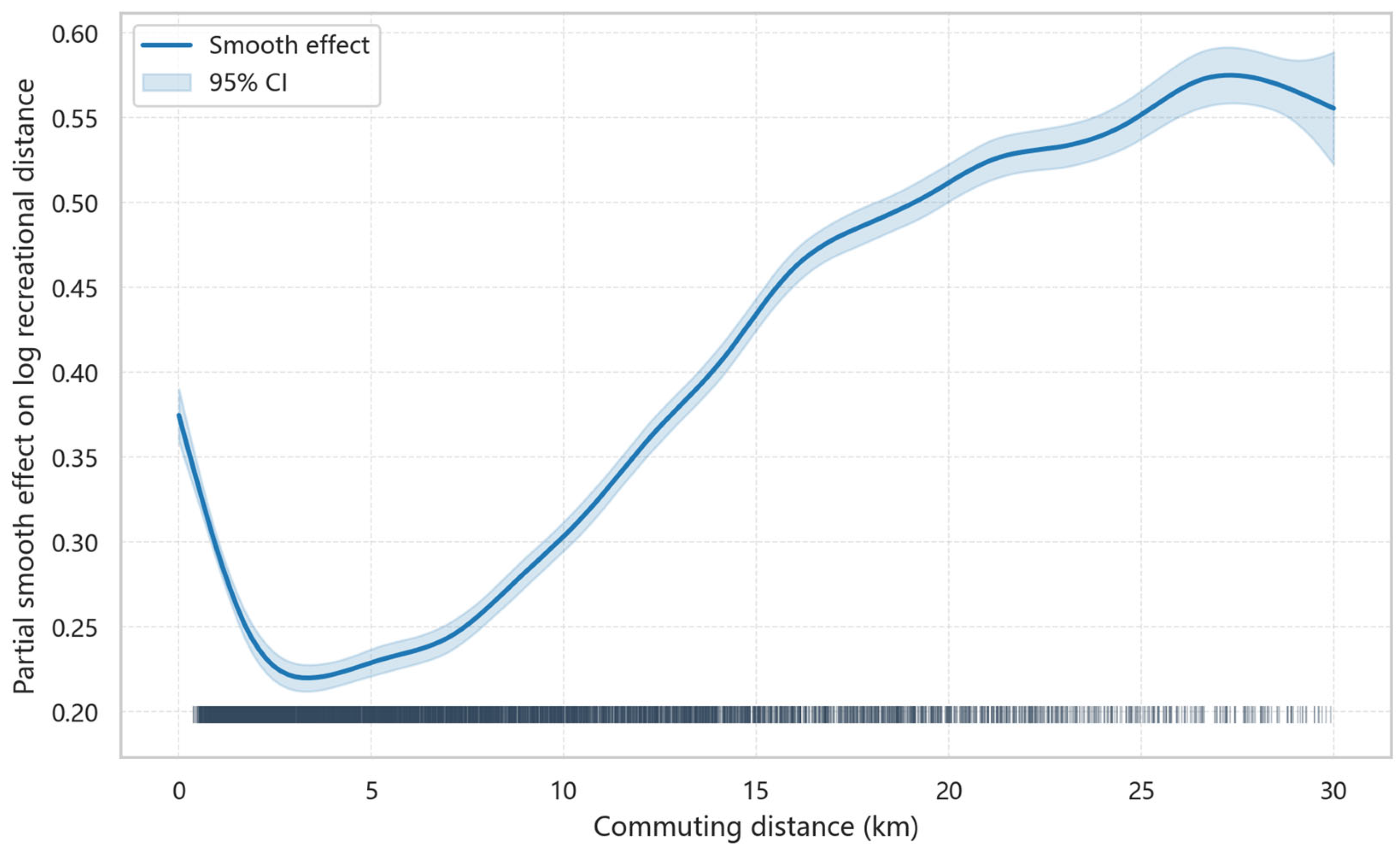
The direct empirical results show that the commuting–recreation relationship is nonlinear and range-dependent, but the U-shaped form is not equally supported across all specifications. The distance- and driving-time specifications provide the main evidence for an early-decline-then-rise relationship. In the two primary driving-time-based models, weekend recreational distance and weekend recreational driving time first decrease and then increase as commuting driving time rises. The supplementary distance-based specification broadly reproduces this form when commuting cost is measured by route distance, indicating that the pattern is not merely an artifact of the driving-time measure. Together, these results support a U-shaped relationship under distance- and driving-time-based operationalizations.
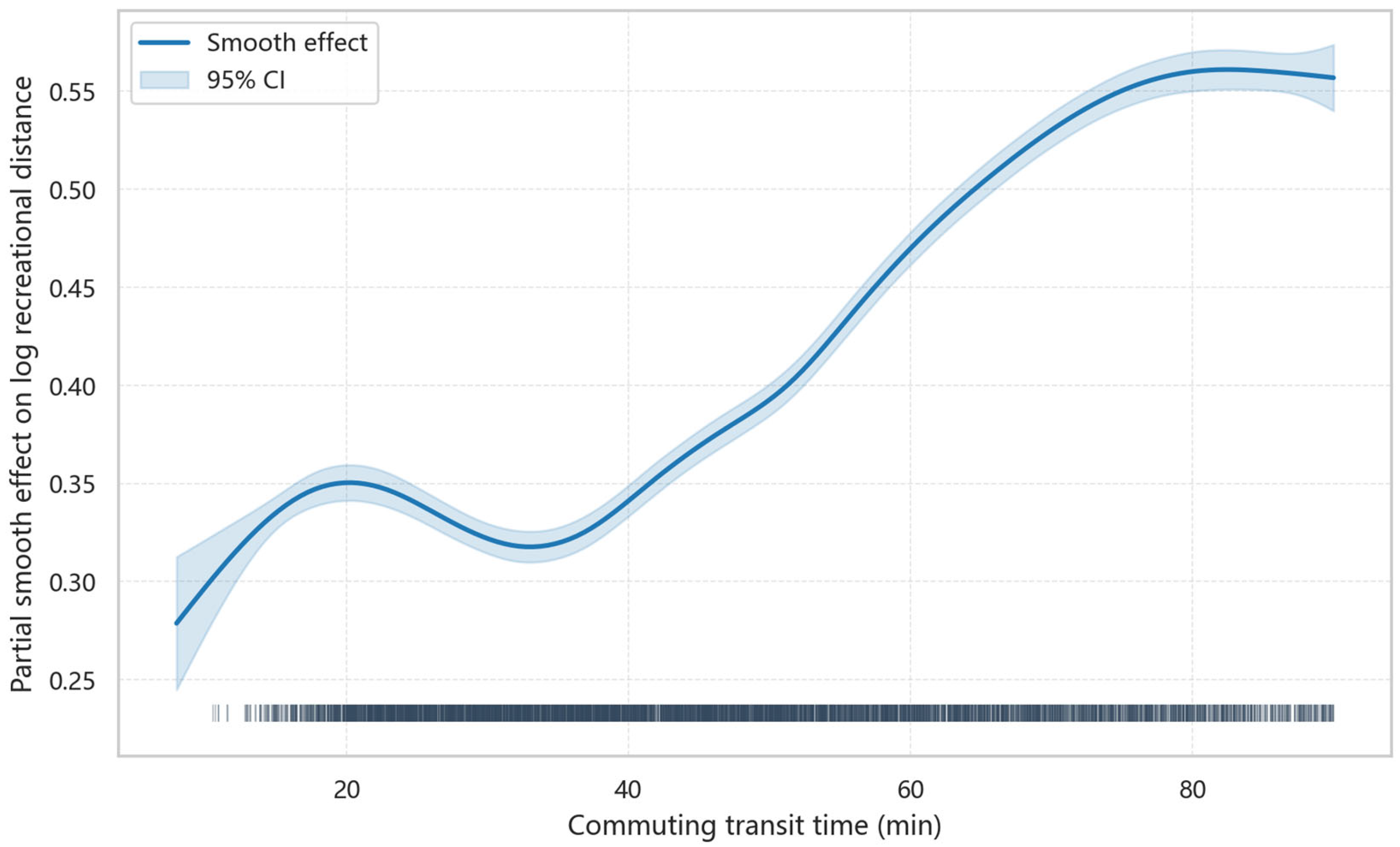
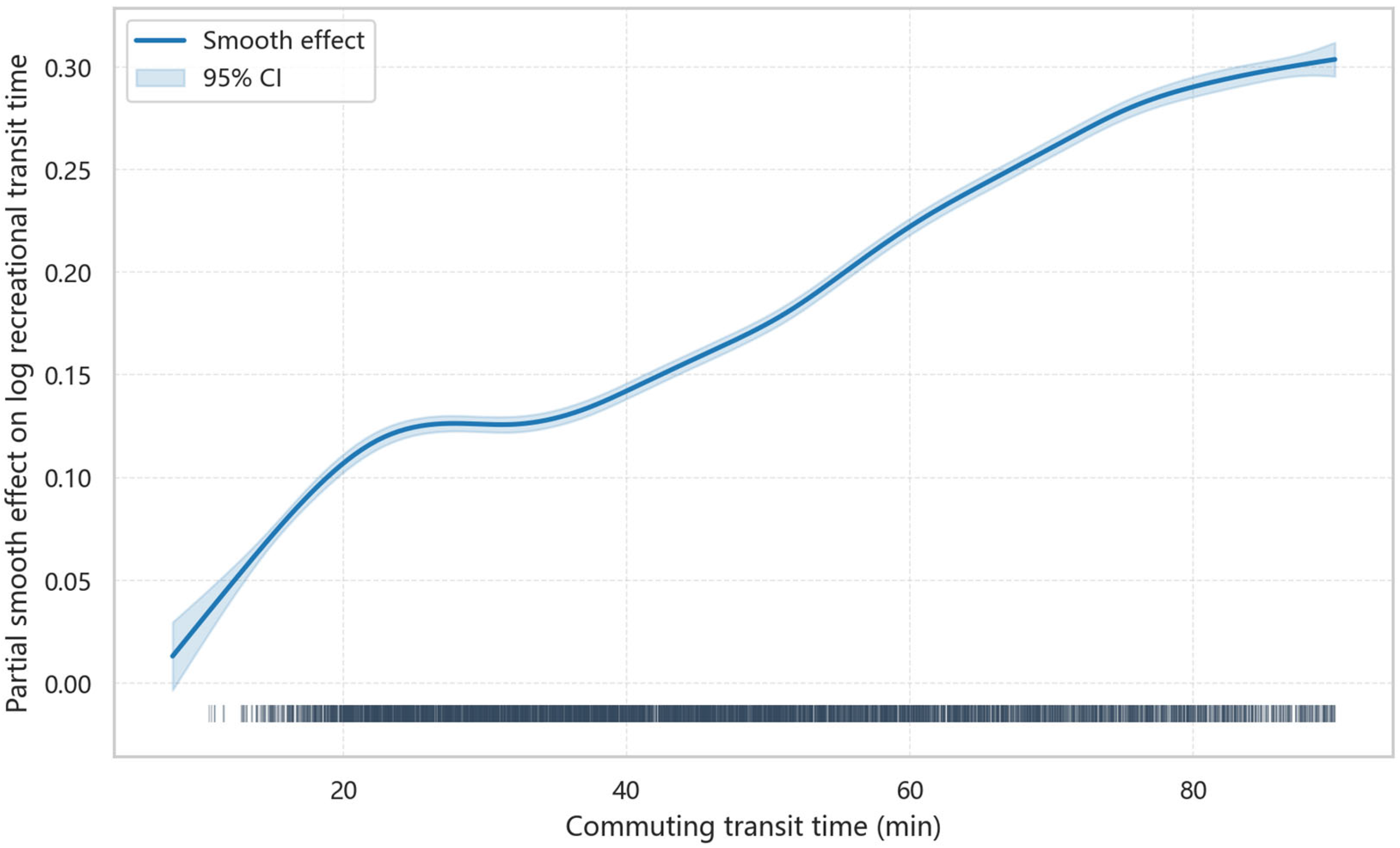
The transit-based specifications produce different curve forms. When commuting transit time is used as the commuting-cost variable while weekend recreational mobility is still measured by driving time, the estimated curve departs from the primary driving-time-based form, especially in the lower commuting range. When transit time is used on both the commuting and recreational sides, the estimated curve becomes closer to a broadly increasing relationship rather than an early-decline-then-rise form. The transit-based results therefore do not clearly reproduce the U-shaped pattern observed in the distance- and driving-time specifications.
4.1.2. Inferring the Realised Commuting–Recreation Relationship
As actual travel mode is not observed in the LBS data, the five specifications should not be treated as equivalent evidence of the same realised citywide commuting–recreation relationship. As discussed in
Section 2.5.2, the distance- and driving-time-based specifications are more closely aligned with realised spatial separation and feasible road-network impedance, whereas the transit-based specifications represent public-transport impedance rather than observed transit use or realised travel time.
The transit-based specifications are therefore less reliable for inferring realised commuting–recreation behaviour. From a behavioural perspective, transit time may overstate realised mobility cost for short trips because residents may walk, cycle, drive, or use other modes instead of public transport; for long trips, high transit time may also induce mode substitution, destination adjustment, or trip suppression rather than represent realised travel time [
37,
38]. The model results reinforce this limitation. The transit-time variables have weak coverage of the very low-cost range, and the transit-based curves therefore do not provide a directly comparable test of the initial declining segment observed in the distance- and driving-time specifications.
Taken together, the transit-based results clarify the sensitivity of the estimated curve to public-transport impedance measures, but they should not be interpreted as overturning the distance- and driving-based evidence. The realised citywide commuting–recreation relationship is therefore more plausibly inferred from the specifications based on distance and driving time, which support a U-shaped, early-decline-then-rise pattern.
4.2. Spatial Interpretation from a Jobs–Housing–Recreation Perspective
4.2.1. Spatial Configuration Behind the U-Shaped Commuting–Recreation Relationship
The nonlinear relationship can be interpreted from the perspective of the jobs–housing–recreation configuration of urban space. This interpretation requires caution because commuting and recreational mobility behaviours reflect not only spatial constraints, but also multiple interacting mechanisms. The estimated curves should therefore be understood as average relationships formed within broader spatial constraints, rather than as precise representations of behavioural mechanisms.
The analysis also does not directly identify the spatial structure of jobs, housing, and recreational opportunities. The following interpretation is therefore a spatially grounded reading of the estimated curve form, not definitive evidence that a particular spatial configuration is solely responsible for the observed relationship. Other non-spatial mechanisms not captured here may also contribute. With this boundary in mind, different empirical relationships between weekday commuting costs and weekend recreational mobility conditions may correspond to different spatial-organization scenarios.
A broadly positive relationship would be consistent with a spatial structure in which employment and recreational advantages are concentrated in the same locations or strongly overlap across major centres. Residential locations close to these shared advantages would tend to experience both lower commuting costs and lower recreational mobility costs, while locations farther away would tend to face deterioration in both. By contrast, a negative relationship would be consistent with a more direct trade-off between employment and recreational advantages, especially where employment opportunities and recreational resources are spatially separated and residential locations are distributed between them.
The observed U-shaped pattern suggests uneven combinations of employment access and recreational access across residential locations: some locations may have strong employment access but weaker recreational accessibility, while others may combine acceptable commuting conditions with more favourable weekend recreational access. The latter combination indicates that commuting and recreational mobility costs are not structurally locked into opposition.
This spatial reading is important because it links the nonlinear curve to the possibility of integrated spatial diagnosis. If employment access and recreational access fully overlapped, commuting-centred evaluation would already capture much of the relevant spatial-performance variation. If they were strictly opposed, the two domains would form a simple trade-off. The observed nonlinear pattern instead suggests that employment and recreational advantages are unevenly but not oppositely distributed across residential space. More favourable combined commuting–recreation outcomes may therefore be possible under the current jobs–housing–recreation structure, depending on how employment distribution, residential development, recreational opportunity provision, and transport connectivity are configured together.
4.2.2. Self-Selection, Destination-Choice Heterogeneity, and Interpretive Boundaries
Residential self-selection is an important interpretive qualification, but it is not the spatial mechanism from which the U-shaped pattern is derived in this study. In built-environment and travel-behaviour studies, self-selection is commonly treated as a confounding mechanism: households may choose residential locations according to preferences, resources, or constraints that also shape travel behaviour [
39]. This issue is relevant here because households may sort into different residential positions within the jobs–housing–recreation configuration, thereby affecting the observed composition of residents and the relative weight of different segments of the curve.
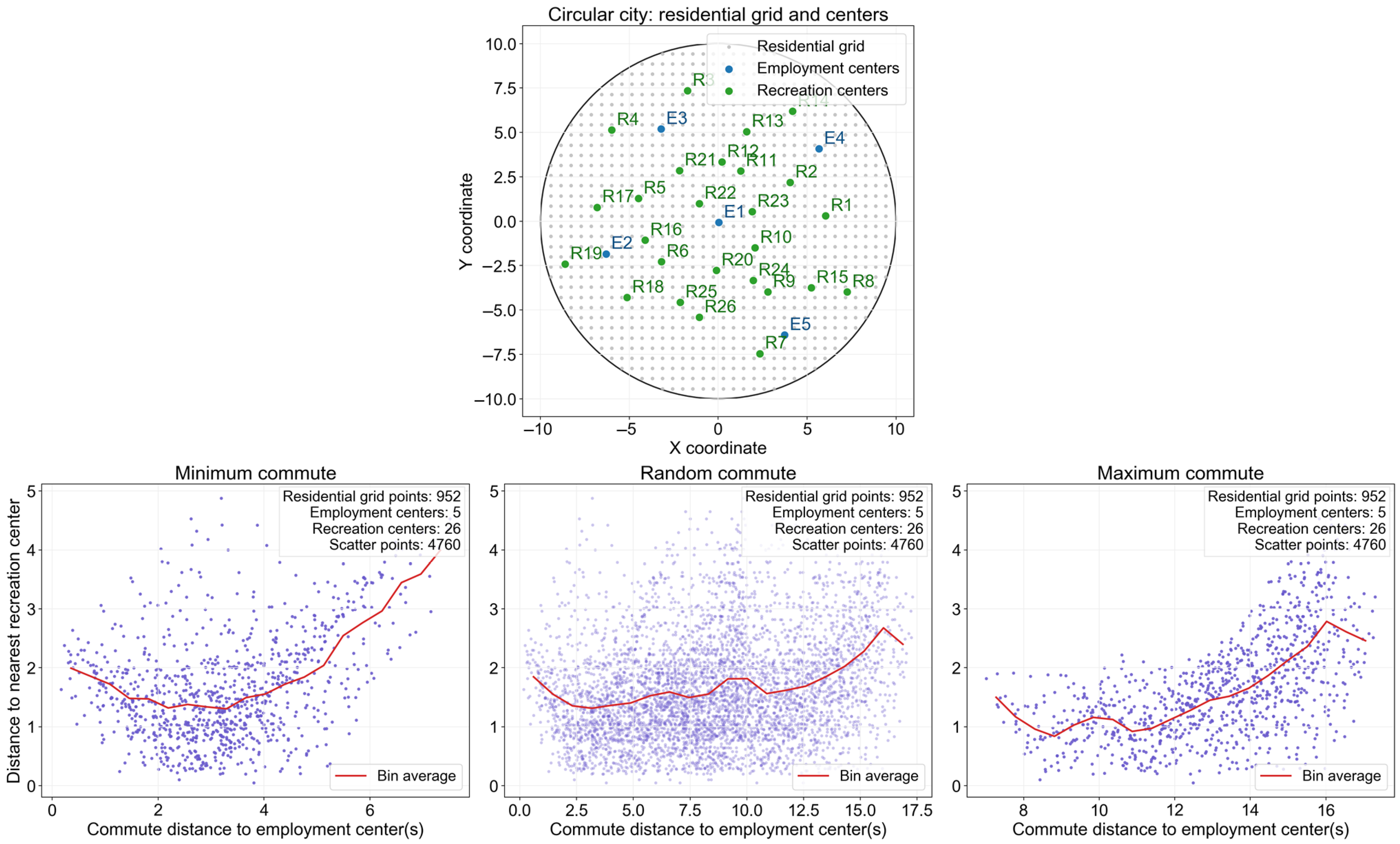
However, this study does not estimate the isolated causal effect of residential location on recreational travel. It examines the realised association between two residence-anchored mobility-cost dimensions within a given jobs–housing–recreation configuration. The conceptual simulation in
Figure 7 supports this spatial-structural interpretation. When employment and recreational centres are unevenly arranged, an early-decline-then-rise relationship can emerge under minimum-commute, random-commute, and maximum-commute scenarios. Although these scenarios alter the depth, width, and local shape of the curve, they do not remove the overall U-shaped form. This suggests that the nonlinear relationship can be generated by the spatial configuration itself. Residential self-selection may shape how this relationship is observed in the empirical sample, but it does not replace or negate the spatial mechanism demonstrated by the simulation.
Weekend recreational destination choice introduces heterogeneity into the observed commuting–recreation relationship. Residents may choose more distant destinations because of destination quality, activity type, novelty, social arrangements, or household needs. These choices may affect the dispersion and local shape of the estimated curve, but they do not make mobility cost irrelevant. Because weekend recreation is discretionary, distance and travel time still constrain participation frequency and destination selection. Long-distance trips may provide high utility in particular cases, but they are less able to support frequent routine recreational participation than more accessible destinations. Thus, destination-choice heterogeneity may modify the observed relationship, while spatially structured recreational mobility costs remain central to interpreting the U-shaped pattern.
4.2.3. Chongqing’s Spatial Configuration and Broader Relevance
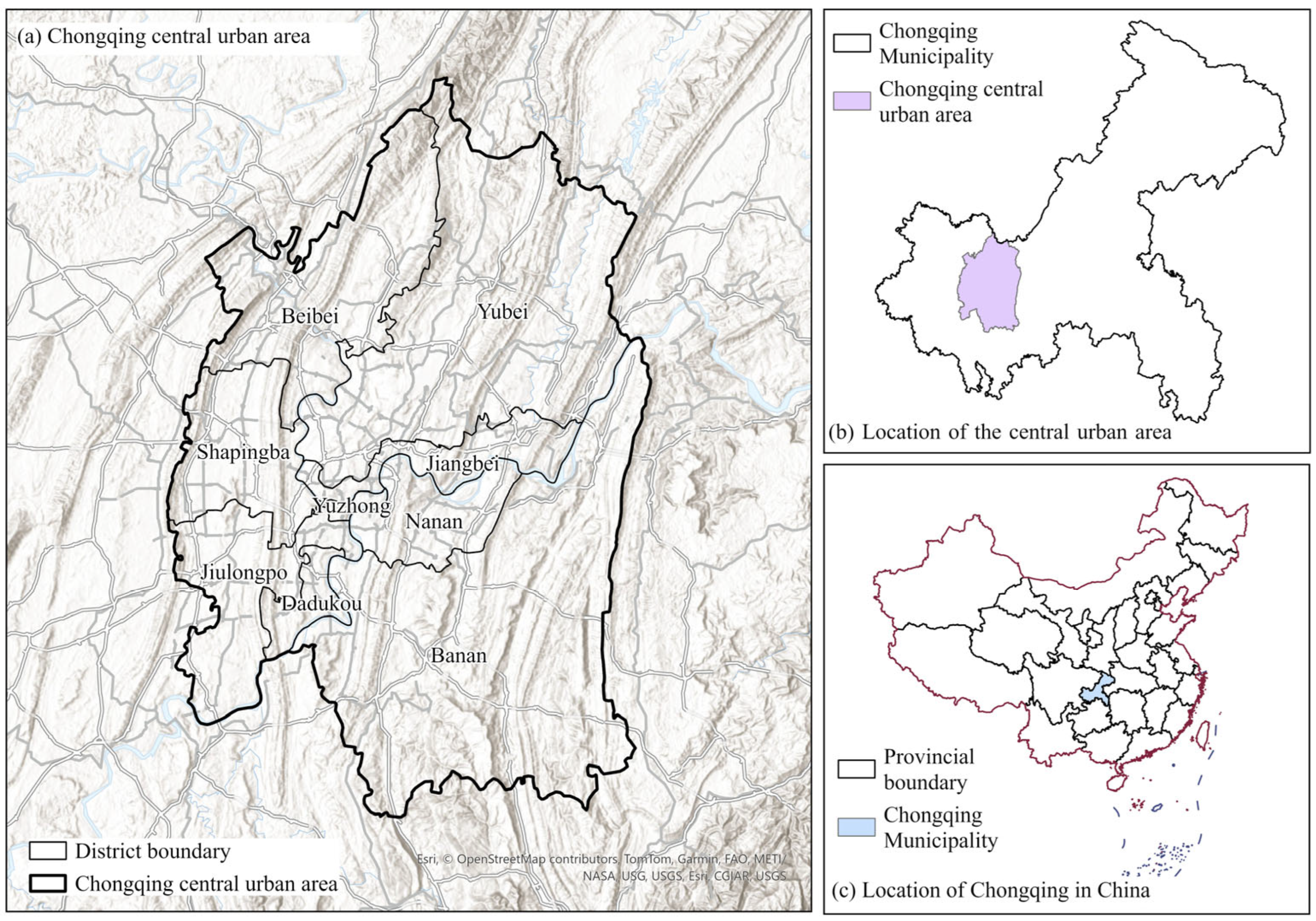
Chongqing provides a particularly relevant case because its mountainous terrain and river-valley constraints have shaped a polycentric, terrain-separated urban structure. Its central urban area consists of multiple clusters, with employment centres, recreational centres, and smaller dispersed recreational destinations distributed across the urban landscape. These conditions produce a partially overlapping yet spatially constrained jobs–housing–recreation configuration. Route-based commuting and recreational mobility costs therefore reflect the uneven joint arrangement of employment and recreational opportunities across residential locations. The same terrain-constrained context may also amplify distortions in transit-based travel time: short physical distances may involve stairs, steep slopes, or incomplete transit coverage, making transit time a less stable proxy for experienced accessibility than in flatter cities with more continuous transit networks.
The broader relevance of this finding does not lie in claiming that the same curve must appear in all cities. Chongqing’s terrain-constrained polycentricity may make the jobs–housing–recreation configuration especially pronounced, but many large Chinese cities also contain multiple employment and recreational centres, heterogeneous residential districts, and differentiated transport networks. The finding therefore suggests a testable spatial hypothesis: where employment and recreational opportunities are unevenly combined across residential locations, commuting and weekend recreational mobility costs may form nonlinear relationships rather than a simple trade-off or synergy. An early-decline-then-rise pattern may emerge when some locations combine relatively low costs in both dimensions, whereas others secure only one advantage or face high costs in both. In cities with more continuous metro and bus networks, transit-based models may reveal a similar nonlinear relationship more clearly.
4.2.4. From Trade-Off Mechanisms to a Spatially Conditioned U-Shaped Relationship
Existing studies most closely related to this topic have generally interpreted the relationship between commuting, residential location, and non-work activities through trade-off, compensation, or constraint mechanisms. These include studies on commuting–leisure compensation [
9], commuting and health-related activities [
12], and residential-location trade-offs involving open space, leisure facilities, and social contacts [
7,
30,
31]. These interpretations are important because they show that commuting burden and non-work or recreational opportunities are not independent. However, they tend to frame the relationship as a monotonic or average effect. The present study partly supports this view: in the declining segment of the U-shaped curve, higher commuting costs are associated with lower recreational mobility costs, suggesting an apparent compensatory pattern between commuting burden and recreational accessibility. Its key contribution, however, is to show that this relationship is not a monotonic trade-off. Beyond a certain commuting-cost range, the curve turns upward, indicating that higher commuting costs can again coincide with higher recreational mobility costs. This nonlinear reversal—from apparent compensation to dual mobility disadvantage—is the key empirical pattern that previous trade-off-oriented interpretations have not captured.
This difference is partly related to data scope, measurement design, and functional-form assumptions. Many previous studies have relied on survey samples, specific non-work outcomes, or pre-specified functional forms. By contrast, this study uses large-scale individual-level LBS data, covers a broader set of weekend recreational activities, and applies GAM to estimate the relationship flexibly across the commuting-cost range. These features make it possible to identify a U-shaped empirical regularity that may otherwise be compressed into an average trade-off, compensation, or constraint effect. Mechanistically, this does not mean that individual trade-offs disappear. Rather, it suggests that they are spatially conditioned. Individual choices operate within a jobs–housing–recreation configuration in which employment access and recreational access are unevenly combined across residential locations. Different segments of the curve may therefore correspond to different opportunity combinations: some locations exhibit apparent compensation between commuting burden and recreational accessibility, whereas others face high costs in both dimensions. The commuting–recreation relationship is therefore not simply a one-dimensional trade-off, but structured by the spatial configuration in which mobility choices are made.
4.3. Planning Implications for Integrated Commuting–Recreation Performance Evaluation
4.3.1. Diagnostic Implications of the U-Shaped Relationship
The planning significance of the identified U-shaped relationship lies primarily in its diagnostic value. The pattern indicates that commuting and recreational mobility conditions are not distributed independently across residential space. Some residential locations may combine relatively low commuting costs with relatively low recreational mobility costs, whereas others may secure only one advantage or face high costs in both dimensions. The finding does not by itself identify which intervention would causally improve both outcomes. However, it shows that commuting performance and weekend recreational mobility conditions should be evaluated jointly when assessing urban spatial-structure performance.
This diagnostic perspective is especially relevant in large Chinese cities, where daily life is increasingly shaped by both weekday commuting and weekend recreational mobility. An evaluation focused only on commuting efficiency may overlook residential locations with poor recreational access, while an evaluation focused only on recreational accessibility may ignore the commuting burden associated with those same locations. A more useful evaluative question is therefore whether residential locations with relatively favourable conditions in both dimensions are sufficiently available and equitably distributed across the urban structure.
4.3.2. Combined Accessibility and Spatial Matching
From this perspective, the relevant planning concern is not proximity to any single type of opportunity, but the spatial matching among residential demand, employment supply, recreational supply, and transport connectivity. This perspective extends beyond the commuting-centred logic of jobs–housing balance [
1,
16,
19,
20] and the treatment of amenities as isolated residential-choice attributes [
6,
7,
31]. For integrated spatial performance, the key issue is not only whether acceptable employment access and favourable recreational access coexist, but whether this coexistence is produced by effective spatial matching among residential distribution, employment locations, recreational opportunity hierarchies, and transport networks.
This matching perspective is important because employment, housing, and recreation are socially differentiated. Different population groups are associated with different workplace locations, residential preferences and constraints, mobility resources, and recreational demands. High-skilled workers, service workers, families with children, older adults, and lower-income households, for example, may face different feasible combinations of jobs, housing, and recreational destinations. Recreational resources should therefore not be evaluated only by their presence or proximity, but by how they are matched with the residential groups and employment opportunities that structure everyday mobility. The relevant issue is whether the jobs–housing–recreation configuration expands favourable combined accessibility conditions for different population groups. This should be understood as an evaluative and diagnostic principle, rather than a direct project-level planning prescription.
4.4. Toward a Framework for Integrated Commuting–Recreation Spatial Performance Analysis
A key requirement for integrated spatial performance analysis is to develop a rigorous framework for evaluating recreation-oriented spatial-structure performance. Such performance should not be equated with observed recreational travel outcomes alone. It should refer more specifically to the extent to which observed recreational mobility reflects the organizing effect of urban structure [
1,
40]. In commuting research, concepts such as excess commuting already move in this direction by evaluating structural inefficiency rather than travel distance or time alone [
1]. By contrast, although existing studies have generated substantial knowledge on recreational accessibility, use, vitality, and equity [
24,
26], a comparable framework for evaluating the structural performance of recreation-oriented spatial organization remains underdeveloped.
Developing such a framework requires a clearer understanding of how recreational mobility is formed. Compared with commuting, recreation is less compulsory, less routine, and more heterogeneous. Realised recreational mobility may be shaped by recreational demand, facility hierarchy, destination quality, destination choice, mode choice, household constraints, and the spatial distribution of opportunities [
28]. Without clarifying these mechanisms, it is difficult to construct performance measures that distinguish the contribution of spatial structure from observed travel outcomes.
Once a recreation-oriented framework is developed, a further task is to integrate it with commuting-oriented spatial-structure evaluation. Only then can cities be assessed in terms of how their spatial structure jointly shapes work-related and weekend recreational mobility. The longer-term agenda is therefore to move from identifying an empirical commuting–recreation relationship to evaluating alternative jobs–housing–recreation configurations, and eventually to informing planning interventions through better matching among residential demand, employment opportunities, recreational resources, and transport networks.
4.5. Limitations
Several limitations should be noted. First, the five model specifications do not have identical evidential status. The distance- and driving-time specifications provide the primary evidence for the commuting–recreation relationship, whereas the transit-time specifications represent public-transport impedance rather than observed public-transport use. The conclusions should therefore be interpreted mainly as evidence on distance- and driving-time-based mobility-cost relationships, not as a full account of actual multimodal travel behaviour.
Second, the spatial-structural interpretation of the curve requires further validation. Although the U-shaped relationship is consistent with the uneven joint configuration of employment access, residential locations, and recreational opportunities within the jobs–housing–recreation structure, the individual-level GAM results alone cannot rule out alternative explanations. Further spatial analyses are needed to examine how the curve relates to residential locations, employment access, recreational opportunity distributions, and transport networks.
Third, the temporal scope of the data is limited. The November observation window captures only one period of recreational behaviour in Chongqing and does not represent full seasonal variation. The estimated relationship should therefore not be interpreted as a year-round pattern without seasonal validation.
Fourth, the study is based on a single-city case. Chongqing provides a useful case for developing a testable spatial hypothesis, but the identified nonlinear relationship should not be directly generalized to other cities without multi-city empirical verification.
Fifth, recreational distance and travel time measure mobility cost and spatial accessibility, not the full utility of recreation. Longer trips may reflect higher destination quality, novelty, or household needs, while shorter trips do not always imply greater utility. Future research should incorporate destination quality, activity type, satisfaction, and visit frequency to assess recreational utility more fully.
Sixth, multi-AOI recreational activity and activity-chain reconstruction remain unresolved issues in interpreting recreational mobility costs and utility. This limitation is closely related to the preceding point, because recreational distance and travel time cannot be directly translated into recreational utility without considering how multiple destinations are combined within a weekend activity chain. For same-direction or sequential multi-AOI activities, AOI-based average distance or travel time may be close to chain-based travel burden. However, for multi-directional or reverse-direction activities, averaging cannot distinguish whether longer movement reflects additional recreational value, additional travel burden, or both. Future research should therefore use activity-sequence or trip-chain methods to examine multi-AOI recreational mobility more directly.
Taken together, these limitations define the directions in which the U-shaped relationship identified in this study should be further examined. Future research should therefore combine multi-city empirical analysis, more detailed spatial-configuration analysis, and conceptual simulations of alternative jobs–housing–recreation layouts to develop a more systematic understanding of when and how such nonlinear relationships emerge.
5. Conclusions
This study examined the relationship between weekday commuting costs and weekend recreational mobility costs as an empirical entry point for integrated spatial-performance research within a jobs–housing–recreation framework. By situating both mobility dimensions within the jobs–housing–recreation structure, the analysis moves beyond separate assessments of commuting efficiency or recreational accessibility and focuses on how the two are jointly configured across residential space.
Empirically, the central finding is a nonlinear and range-dependent relationship between weekday commuting costs and residence-anchored weekend recreational mobility costs in Chongqing. The distance- and driving-time specifications consistently reveal an early-decline-then-rise pattern: as weekday commuting costs increase, weekend recreational mobility costs first decrease and then increase. The transit-time specifications mainly indicate operationalization sensitivity under public-transport impedance, rather than realised public-transport use. Overall, the citywide commuting–recreation relationship is best characterized by the U-shaped pattern identified in the distance- and driving-time results.
Substantively, the U-shaped relationship moves beyond trade-off-oriented interpretations by linking commuting–recreation trade-offs to the uneven spatial combination of employment and recreational access. Individual trade-offs do not disappear, but they operate within a jobs–housing–recreation configuration in which residential locations are unevenly positioned in relation to employment access and recreational access. The declining segment is consistent with apparent compensation, whereas the upward segment reveals that higher commuting costs can again coincide with higher recreational mobility costs. The commuting–recreation relationship is therefore better understood as a spatially conditioned U-shaped relationship than as a one-dimensional trade-off.
The broader contribution of the study is to establish a diagnostic basis for integrated commuting–recreation spatial performance evaluation. The findings suggest that employment distribution, residential development, transport connectivity, and recreational opportunity provision should be assessed in terms of how they jointly shape combined mobility conditions. For planning, the jobs–housing–recreation framework should be used as a diagnostic lens for evaluating combined commuting and recreational mobility conditions before specific interventions are proposed.
These conclusions should be read within both evidential and contextual boundaries. The analysis identifies an empirical relationship and offers a spatial-structural interpretation, but it does not by itself establish a direct causal mechanism. The Chongqing finding should also be treated not as a universal rule, but as a testable spatial hypothesis. In cities where employment, housing, transport, and recreational opportunities are unevenly distributed and only partially overlapping, commuting and recreational mobility costs may also form nonlinear rather than simply positive or negative relationships. Future multi-city, cross-seasonal, and spatially explicit studies are needed to examine the external validity, seasonal stability, and spatial mechanisms of this relationship.