1. Introduction
Urban renewal is not a new topic of academic research. As early as the mid-to-late 20th century, Western countries had already launched large-scale urban renewal initiatives addressing issues such as the decline of old urban areas, industrial transformation, and community revitalization, gradually developing a theoretical framework encompassing spatial governance, property rights coordination, and the balancing of interests [
1,
2,
3]. While Western nations entered the phase of existing stock renewal relatively early, China’s urbanization is currently transitioning from a phase of incremental expansion to one of optimizing the existing stock, with the focus of urban development shifting from “building cities” to “renewing cities.” As a vital tool for optimizing urban spatial structures and achieving high-quality urban development, urban renewal has become a key issue in China’s current urban governance. On 20 January 2026, the Ministry of Natural Resources and the Ministry of Housing and Urban-Rural Development jointly issued the “Notice on Several Measures to Further Support Urban Renewal Initiatives” to implement the relevant requirements of the “Opinions of the Central Committee of the Communist Party of China and the State Council on Promoting High-Quality Urban Development.” In particular, regarding historically formed construction land lacking legal land use procedures, the notice explicitly states that “historical legacy issues should be properly addressed in accordance with the principles of acting in accordance with laws and regulations, respecting history, ensuring fairness and justice, and exercising inclusiveness and prudence,” thereby providing a policy framework for addressing complex property rights issues in urban renewal. Currently, the academic community generally agrees that the core contradictions facing China’s urban renewal are no longer merely issues of design, planning, or construction technology, but rather manifest as institutional challenges such as complex land ownership relationships, imbalances in value creation, and imperfect mechanisms for the distribution of benefits [
4].
As a product of a specific historical period, small-property-right housing presents a governance challenge in urban renewal that is both complex and critical due to the intricacy of its property rights. In July 2023, the “Guiding Opinions on Actively and Steadily Advancing the Renovation of Urban Villages in Megacities and Large Cities,” reviewed and approved by the State Council’s executive meeting, explicitly stated that implementing urban village renovation is “an important measure to improve people’s livelihoods, expand domestic demand, and promote high-quality urban development.” Small-property-right housing is predominantly concentrated in urban villages and urban–rural fringe areas; the effectiveness of its governance is closely tied to social stability, making it a critically important category in urban renewal.
The disposal of existing small-property-right housing is essentially a multi-party negotiation process regarding the distribution of land appreciation gains, requiring consideration of the interests of all parties involved [
5,
6]. Therefore, this paper analyzes the formation mechanisms and source composition of land appreciation gains from the perspective of their distribution, clarifies the legal basis and reasonable boundaries for the participation of the government, village collectives, and stakeholders in the distribution of these gains, and constructs a fair and sustainable framework for the distribution of land appreciation gains that both safeguards the legitimate rights and interests of all parties and effectively curbs unreasonable demands. The aim is to build social consensus, resolve land ownership disputes and funding balance challenges in urban renewal, and provide theoretical support and practical guidance for high-quality urban renewal.
2. The Nature of “Small-Property-Right” Housing and the Challenges of Its Regulation
2.1. The Nature and Development Logic of Small-Property-Rights Housing
“Small-property-right housing” refers to housing constructed on collectively owned rural land (including residential land and collectively owned construction land) that has not paid the required land transfer fees and related taxes in accordance with the law, and has not obtained a state-recognized property ownership certificate. Unlike commercial housing, the land ownership belongs to the rural collective, and the housing is typically built by villagers themselves for the purpose of renting, selling, or conducting business activities related to residential services [
7].
The small-property-right housing system primarily involves three categories of stakeholders. The first category consists of original villagers (members of rural collectives), who are both the land rights holders and the builders and operators of the housing; they generate income by constructing, renting, or selling housing. The second category comprises tenants, primarily migrant workers and other low-income groups, who secure urban living space at low rents and provide labor support for urban industrial development. The third category consists of local governments, which are responsible for providing public infrastructure and services such as roads, water supply, electricity, education, and healthcare, while also undertaking duties related to urban planning and land management. Additionally, when renovating small-property-right housing, village collectives and local governments may hire professional housing construction and leasing companies to centrally manage these properties.
Since the launch of reform and opening-up, rapid industrialization and urbanization have led to a large-scale migration of rural residents to cities in search of employment, creating a massive demand for affordable housing. However, under China’s dual urban–rural land system, rural collective construction land has long been unable to enter the real estate market directly, unlike state-owned land [
8]. Developers building commercial housing on state-owned land must pay land transfer fees and other costs, whereas villagers constructing housing on collective land do not bear the same costs; consequently, rents and sale prices for “small-property-right” housing are significantly lower than those of surrounding commercial housing. As a result, some villagers have begun to build and rent out housing on their own land, providing living space to migrant workers at prices far below those of commercial housing.
As a result, large numbers of migrant workers and low-income groups have congregated in urban villages and urban–rural fringe areas. Urban villages refer to unique spatial units that, while surrounded by urban development land during the process of urban expansion, remain under rural collective land ownership, retain village self-governance organizations, and preserve certain rural socioeconomic characteristics [
9]. Driven by both growing housing demand and expectations of land appreciation, the number of small-property-right housing units has expanded rapidly, gradually forming large-scale clusters of low-cost housing, typified by urban villages. In some areas, the phenomenon of “handshake buildings”—where the distance between structures is so narrow that residents can shake hands through their windows—has even emerged, reflecting widespread issues in the construction of small-property-right housing, such as high-intensity development, excessive density, and disorderly spatial expansion.
It should be noted that small-property-right housing is constructed on collectively owned rural land without having completed the legally required land transfer procedures, paid the land transfer fees and related taxes, or obtained state-recognized property ownership certificates; therefore, it does not possess the full property rights attributes of commercial housing. Under China’s current land management and real estate regulatory systems, small-property-right housing is not incorporated into the formal real estate market system, and its construction, leasing, sale, and transfer lack adequate legal safeguards [
10]. This institutional status—where such housing “exists in practice but lacks formal property rights recognition”—has long placed it in a state of tension between legality and practical demand, and has become a major root cause of numerous issues arising in subsequent governance and urban renewal processes.
Since the 1990s, with the acceleration of industrialization in regions such as the Pearl River Delta and the Yangtze River Delta, as well as the large-scale emergence of urban villages, small-property-right housing began to spread rapidly. In the 21st century, against a backdrop of continuously rising housing prices, insufficient supply of affordable housing, and a persistent migrant population, small-property-right housing expanded further and gradually became an important component of the low-cost housing supply system in megacities and super-large cities, thereby supporting urban industrial development and the labor supply to a certain extent.
2.2. Research on Informal Housing and Its Differences from China’s “Small Property Rights” Housing
Informal housing generally refers to residential spaces constructed without following statutory planning, land management, and construction approval procedures, or without full confirmation of property rights; their ownership status, construction process, or usage patterns partially fall outside the formal institutional framework. As a common phenomenon in the context of rapid global urbanization, informal housing is widespread in developing countries such as those in Latin America, Africa, and Asia, primarily taking the form of slums, informal settlements, self-built housing, and unauthorized constructions [
11,
12,
13,
14]. UN-Habitat notes that informal housing has become an integral part of the global urban housing supply system, and its emergence reflects the structural contradiction between growing housing demand and insufficient formal housing supply in the context of rapid urbanization.
Research on informal housing abroad has evolved from “problem identification” to “governance optimization” [
15]. Early studies primarily viewed informal housing as a product of urban poverty, overcrowding, and housing shortages, emphasizing its negative impacts on urban order, public health, and social governance. Since the 1970s, as urbanization in developing countries has accelerated, researchers have gradually recognized that informal housing is not merely an urban problem, but rather an adaptive housing solution that has emerged because the formal housing market fails to meet the housing needs of low-income groups. Relevant studies indicate that informal housing actually fulfills a function of urban housing security and serves as an important supplement to the formal housing market; its existence possesses a certain degree of economic rationality and social necessity [
16].
From a theoretical perspective, informal housing is typically closely linked to the imbalance between employment and housing that arises during the rapid urbanization process in developing countries. When large numbers of rural residents migrate to cities, they often struggle to secure stable formal employment and cannot afford the costs of housing in the formal market. Consequently, they must rely on the informal economy for income and turn to informal housing—such as slums and illegal settlements—to meet their basic housing needs [
17]. Thus, informal employment and informal housing are often two sides of the same socioeconomic phenomenon, jointly reflecting the developmental dilemma where population growth outpaces the capacity for job creation and housing supply.
Since the beginning of the 21st century, the focus of international research has gradually shifted to issues such as property rights formalization, the protection of housing rights, the provision of public services, and social integration. Some studies argue that property rights registration and confirmation can enhance the security of residents’ assets, increase their willingness to invest in housing, and facilitate the integration of housing assets into the formal market system [
18]. Other studies, however, point out that the mere legalization of property rights cannot fundamentally resolve issues of poverty and social exclusion; in some regions, legalization has even led to rising housing prices and the forced displacement of original residents [
19]. Consequently, an increasing number of studies have begun to focus on mechanisms for coordinating interests in the governance of informal housing, emphasizing that, in addition to property rights legalization, objectives such as housing security, equitable development, and social inclusion must also be comprehensively considered [
20].
At the same time, as urban renewal and land governance practices continue to advance, the capture of land value gains has gradually become a major topic in international research. Relevant studies generally agree that increases in land value do not stem entirely from landowners’ own investments, but are closely linked to government-provided infrastructure, public services, and planning regulations [
21,
22]. Therefore, land value gains generated by public investment should be partially returned to the public sector to support infrastructure development, the provision of affordable housing, and improvements in urban public services. In recent years, countries such as the United States, the United Kingdom, and Brazil have achieved a balance of interests between public investment and land value appreciation through institutional arrangements such as development fees, land value recapture, and transferable development rights [
23,
24]. These studies offer a new theoretical perspective on the governance of informal housing, suggesting that governance objectives extend beyond property rights formalization to include the equitable distribution of land value appreciation and the coordination of interests among diverse stakeholders.
Currently, some domestic studies also frequently discuss small-property-right housing within the framework of informal housing. However, there are significant differences between small-property-right housing in China and what is generally understood as informal housing abroad (
Table 1).
Overall, informal housing abroad primarily reflects subsistence housing issues stemming from a mismatch between employment and housing supply, with governance efforts focused on formalizing property rights, improving infrastructure, and promoting social integration. In contrast, China’s “small-property-right housing” is rooted in the urban–rural dual land system; its emergence is not only linked to housing demand but is also closely tied to land system arrangements and the distribution of land appreciation gains. As large numbers of migrant workers moved into cities, commercial housing prices remained high. In contrast, small-property-right housing built on rural collective land did not require the payment of land transfer fees, allowing it to enter the rental market at prices far below those of commercial housing. Consequently, it has gradually become a major source of housing for low-income urban groups.
With the development of urban infrastructure, the expansion of rail transit networks, and improvements in public services, land values in urban villages and urban–rural fringe areas have continued to rise, leading to a steady accumulation of land appreciation gains in the areas where small-property-right housing is located. Since no land transfer fees were paid during the construction and operation of small-property-right housing, these properties benefit from the land appreciation resulting from public investment while simultaneously raising issues regarding the ownership and distribution of such gains. Therefore, the core of China’s small-property-right housing governance lies not only in legalizing property rights but also in the equitable distribution of land appreciation gains among the government, original villagers, and residents. Against this backdrop, this paper explores the theoretical logic and practical pathways for small-property-right housing governance from the perspective of land appreciation gain distribution.
2.3. The Challenges of Regulating Small-Property-Rights Housing
Small-property-right housing has long served as a source of low-cost housing in cities, providing affordable living spaces for large numbers of migrant workers and low-income groups, and to some extent compensating for the shortage of public housing [
25,
26,
27]. However, small-property-right housing inherently suffers from defects in property rights legitimacy, and as urban development continues to advance, issues regarding its spatial environment and construction quality have become increasingly prominent. Due to the lack of unified planning approvals and construction oversight, many small-property-right housing units suffer from issues such as excessive floor area ratios, excessive building density, unauthorized construction, inadequate fire safety facilities, and structural safety hazards. In some areas, poor environmental and sanitary conditions create a stark contrast with the surrounding urban quality, making it difficult to meet the requirements of high-quality urban development. Consequently, local governments have gradually begun to address the management of small-property-right housing through urban renewal, land acquisition, and renovation initiatives.
It should be noted that the term “expropriation” as used in this article refers to the process by which the government, in accordance with the law, converts collectively owned land into state-owned land through compensation, demolishes existing structures, and proceeds with redevelopment. Expropriation is currently a key method used by many cities to address the issue of “small-property-right housing,” but in practice, it faces complex challenges in balancing competing interests.
The first major contradiction manifests as a conflict of interests between the government and the original villagers. With urban development and continued increases in public investment, land values in areas where small-property-right housing is located have risen significantly. Since villagers are both the land rights holders and the property operators, they often demand higher compensation based on surrounding market prices. Meanwhile, during the expropriation process, the government must cover multiple costs, including land compensation, housing compensation, and resettlement expenses. In some areas, the phenomenon of “hundred-million-yuan demolition households” has even emerged. Specifically, certain villagers who have long engaged in the construction and rental of high-density small-property-right housing receive one-time compensation payments exceeding 100 million yuan during the expropriation process due to the vast scale of the land to be compensated. Some of these structures even involve issues such as exceeding permitted floor area ratios, leading to a rapid rise in expropriation costs that exceed the financial capacity of local governments. At the same time, spurred by expectations of high compensation, illegal construction activities such as a rush to build and unauthorized additions have appeared in some areas, further complicating governance efforts.
The second contradiction manifests as a conflict of interests between the government and low-income residents. If the government fails to implement regulatory measures, the fire and structural safety risks associated with small-property-right housing will continue to threaten the lives and property of residents; however, if large-scale expropriation and renovation are carried out, the original low-income residents will struggle to afford the cost of living in the renovated commercial housing and will be forced to relocate to new low-cost housing areas—which may turn out to be other small-property-right housing units that have not yet been renovated. In other words, governance can improve housing safety but may reduce the supply of low-cost housing in the city; failing to govern can maintain housing affordability but makes it difficult to ensure basic housing safety [
28]. This dilemma means that the governance of small-property-right housing is constantly faced with the challenge of balancing fairness and efficiency, as well as development and social security.
As can be seen, the regulation of small-property-right housing in China differs from the issue of formalizing property rights for informal housing abroad; its core contradiction lies in the ownership and distribution of land appreciation gains within the context of the urban–rural dual land system. On the one hand, the builders and operators of small-property-right housing (i.e., villagers) derive profits from their investments in land and housing; on the other hand, small-property-right housing relies heavily on public service systems—such as roads, education, healthcare, water supply, and electricity—built with government investment, yet fails to pay the corresponding land transfer fees and related charges. This has created an interest structure characterized by “private profits—public investment bearing the costs.” Therefore, the key to resolving the governance dilemma of small-property-right housing lies in clarifying the composition of land appreciation gains and the ownership of rights, and establishing a revenue distribution mechanism that balances fairness and efficiency. Based on this, this paper will construct an analytical framework for the distribution of land appreciation gains from the perspectives of ground rent theory and land development rights, and further explore governance pathways for small-property-right housing.
3. Constructing a Theoretical Framework for the Distribution of Land Appreciation Gains
3.1. The Origin of Land Appreciation Gains: An Analysis Based on the Theory of Rent
Adam Smith was one of the first scholars to systematically study the issue of rent. He argued that rent is the manifestation of the price of land resources and the remuneration received by landowners when they lease their land [
29]. Building upon a critical acceptance of the labor theory of value in classical economics, as represented by Adam Smith, Marx pointed out that “regardless of the unique form that ground rent may take, all its types share a common characteristic: ground rent is the economic realization of land ownership” [
30]. He identified two types of rent: absolute rent and differential rent. He argued that the concept of rent is rich and multifaceted, encompassing both the returns landowners derive from their exclusive control over the natural attributes of the land and the additional profits generated by land with superior operating conditions.
Through observations of China’s urban land market over the past four decades, many scholars have reached a consensus: land transfer fees are essentially the sum of rent for a certain number of years paid in a lump sum by land users to the landowner in exchange for land use rights over a specific period [
31,
32,
33]. At the same time, the essence of socialist rent is the economic realization of public ownership of land [
34]. In China, urban land is owned by the state, while rural and suburban land, except where legally designated as state-owned, is collectively owned. Therefore, based on the principle of public ownership of land, land revenues should be derived from the people and used for the benefit of the people; this constitutes the institutional foundation for the collection and utilization of land transfer fees.
Based on the above theoretical and institutional understanding, the rent structure for the paid transfer of urban and rural construction land should consist of two components: absolute rent and differential rent. Absolute rent is the revenue obtained by the landowner through ownership; all land users must pay this basic land price for the land they use. Differential rent, on the other hand, stems from the differentiation of returns resulting from variations in land endowments and investment levels, and can be further subdivided into Differential Rent I and Differential Rent II. Differential Rent I arises from differences in regional location conditions caused by natural land conditions and basic public investments, while Differential Rent II stems from improvements in production efficiency and increased benefits resulting from continuous additional investments in the same plot of land.
This analytical framework for rent structure provides a unified theoretical foundation for understanding the generation of urban and rural land appreciation gains. In the next section, this paper will discuss the distribution of rent—particularly differential rent—which is closely linked to another key right: land development rights.
3.2. Distribution of Land Appreciation Gains: A Discussion on the Benefits of Land Development Rights
While rent theory clarifies the sources of these gains, determining how they should be distributed necessitates a discussion of land development rights. Differential rent, particularly Differential Rent I, is closely linked to the right to develop land.
The concept of land development rights was first proposed to the British government by the British scholar Uthwatt in the Uthwatt Report, marking the initial conception of the nationalization of this right. Its primary purpose was to resolve the conflict between land expropriation and compensation during the post-war reconstruction process. In Western countries, two distinct models have emerged: public ownership and private ownership of land development rights [
35,
36,
37,
38]. Scholars from various disciplines in China have also put forward different perspectives on the concept of land development rights based on their respective research viewpoints: In the field of land management, some scholars define land development rights as the “qualification for land development” or “right to change land use” derived from state land use controls and planning restrictions—that is, the right of landowners or users to enjoy appreciation gains when converting land from low-value uses (such as agriculture) to high-value uses (such as residential or commercial purposes) [
39]. In the legal community, some scholars view land development rights as the right to obtain greater development gains by altering land use or increasing the intensity of land utilization, noting that this right constitutes an independent right formed under state regulation of land development [
40]. In the field of urban and rural planning, some scholars argue that land development rights originate from spatial regulation, which serves as the spatial allocation mechanism for these rights [
41]; Other scholars propose that in national territorial spatial planning, land development rights should be established as a policy tool, as this would facilitate the optimization of land resource allocation and the balancing of public interests with private rights [
42]. Synthesizing the above perspectives, this paper argues that land development rights are powers—based on spatial land use control—to alter land use and increase land development intensity. Within China’s national territorial spatial planning system, the authority for spatial land use control resides with the government.
The issue of interest distribution arising from the allocation of land development rights has long been a focal point of academic attention. Academic discussions on this topic have primarily centered on three perspectives: “capital gains to private owners” [
43], “capital gains to the public” [
31,
44,
45,
46], and “a balance between public and private interests” [
47,
48,
49]. The “capital gains to private owners” perspective argues that property rights inherently possess value, and based on the right to income derived from property rights, land appreciation gains should belong to the landowner—especially under market economy conditions, where land appreciation represents the opportunity cost of the landowner relinquishing their right of use. In a market economy, the property value of land is reflected in market prices and should adhere to the principle of equivalent exchange. The “public appropriation of appreciation” perspective argues that since China’s Constitution explicitly stipulates that urban land belongs to the state, the right to benefits attached to urban land ownership should rightfully be acquired by the government [
31]. Land appreciation primarily stems from government public investment and overall socio-economic development rather than individual contributions [
46]; its appreciation gains should be shared by the entire population to promote fairness and maximize social welfare. Conversely, the “balancing public and private interests” perspective argues that the gains from land development rights involved in the expropriation of farmland should be shared between the state and farmers [
49].
In recent discussions regarding the distribution of land appreciation gains from the entry of collectively owned operational construction land into the market, most scholars have leaned toward adopting the “public–private balance” perspective. Based on land ownership and land development rights, they argue that the distribution of appreciation gains from rural construction land should be achieved through reasonable institutional design, ensuring that the government, rural collectives, and farmers all benefit [
50,
51]. Current pilot practices across various regions also demonstrate that the pilot programs for the entry of collectively owned commercial construction land into the market adopt a model that balances public and private interests [
52].
In summary, the allocation of land development rights and the corresponding benefits (primarily manifested as Differential Rent I) is the key factor determining the distribution pattern of land appreciation gains. As the holder of development rights and the provider of public services, the government is entitled to a share of the resulting Differential Rent I; meanwhile, Differential Rent II—generated through users’ investment and management—should also be recognized and safeguarded. This lays the theoretical foundation for establishing a distribution framework that balances public and private interests.
3.3. A Fair and Sustainable Framework for the Distribution of Land Appreciation Gains
Based on the theoretical analysis of the composition and sources of land rent presented earlier, as well as the discussion on the nature of land development rights and the attribution of gains, this paper further proposes a more equitable and sustainable framework for the distribution of land appreciation gains. The core of this framework lies in clearly defining the rights of various stakeholders in the distribution of appreciation gains according to the intrinsic logic of how those gains are generated, thereby realizing the distribution principle of “balancing public and private interests and promoting multi-stakeholder sharing”.
First, as the direct economic manifestation of land ownership, absolute rent should be entirely attributed to the landowner. Under China’s public ownership system, ownership of urban state-owned land belongs to the state, while ownership of rural collective land belongs to the farmers’ collectives; all land users must pay this basic land price for the land they use.
Second, the distribution of differential rent must be differentiated based on its various sources. In state-owned construction land, Differential Rent I directly reflects the land’s locational value and government-provided public services. The government enhances the locational value of land parcels by investing in infrastructure and public services through the exercise of spatial land use control. The corresponding rent (taxes and fees) is essentially compensation for public services and should rightfully be collected by the government. In rural land, Differential Rent I stems from the fertility of arable land, the convenience of cultivation (proximity to water sources), and the ease of accessing urban public services. Rural public services (such as garbage collection) are provided by village collectives, which function similarly to urban governments, while contracted households are analogous to urban land users. Therefore, Differential Rent I for rural collective-operated construction land should be reasonably allocated between the farmers’ collectives responsible for rural infrastructure construction and maintenance and the government investing in regional public services.
Differential Rent II, on the other hand, arises from the increased production efficiency resulting from continuous additional investment and management of a specific plot of land. Whether in urban or rural areas, this portion of the appreciation should be enjoyed by the users who actually make the investments and conduct operations, because operators have purchased the right to use urban and rural construction land, and the operating profits derived from the land factor should belong to the operators. At the same time, the optimal use of land is often discovered and realized by users during the actual utilization process; therefore, operational activities make a significant contribution to maximizing land value.
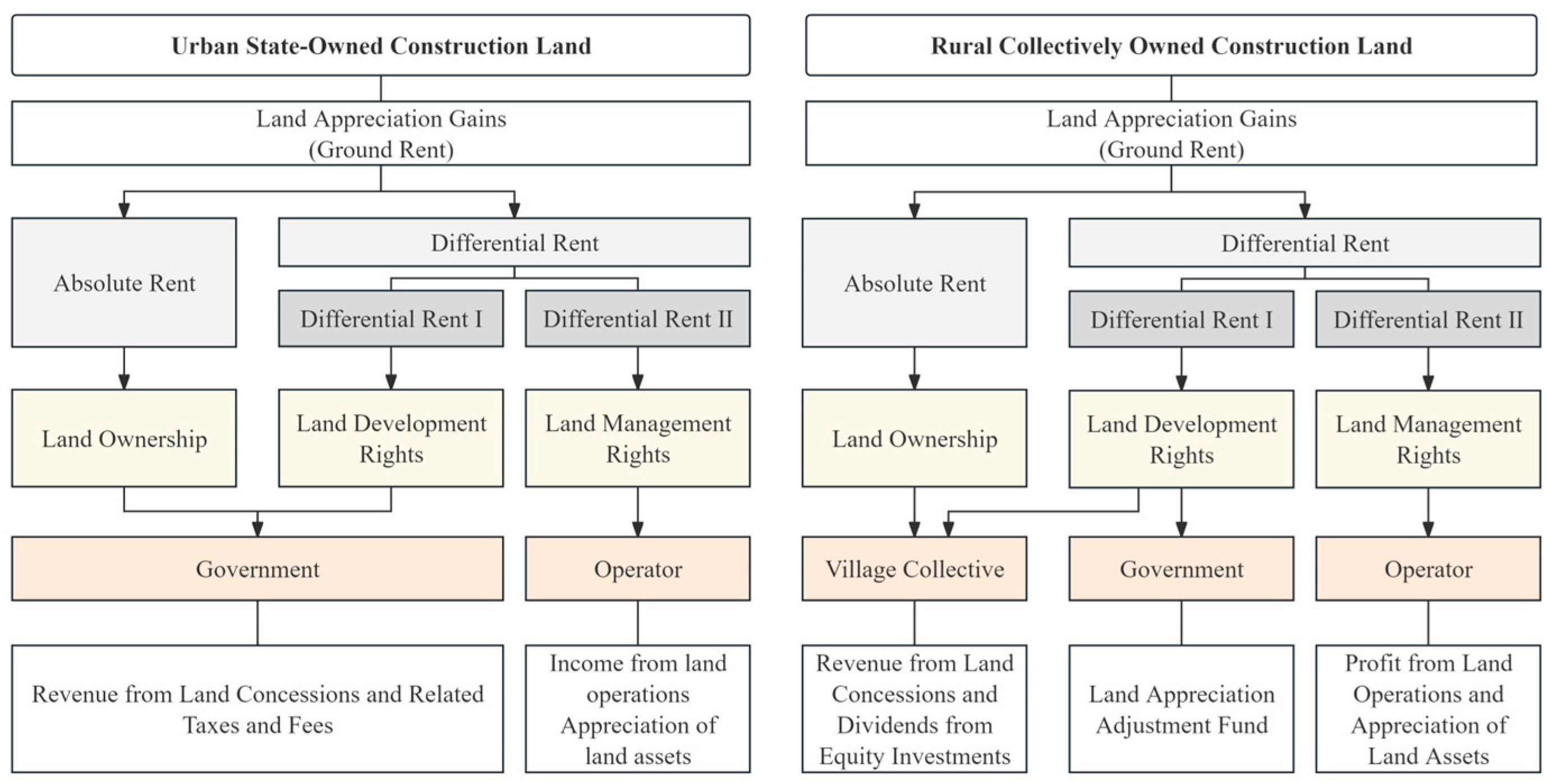
Based on this, this paper constructs a fair and sustainable framework for the distribution of land appreciation gains (as shown in
Figure 1). According to the logic of this framework, the governance of small-property-right housing requires a clear demarcation of land ownership, development rights, and operational rights. At the same time, taking into account the distinct sources of absolute rent, Differential Rent I, and Differential Rent II, a reasonable profit-sharing mechanism should be established among multiple stakeholders, including the government, village collectives, and users. Specifically, village collectives obtain absolute rent based on land ownership. The government and village collectives jointly enjoy Differential Rent I, with the government participating in its distribution by providing urban infrastructure and public services, and the village collectives by providing services such as the maintenance and management of properties in urban villages. Owners of small-property-right housing, meanwhile, receive Differential Rent II based on the appreciation rights derived from their investment in construction and operation.
4. Approaches to Governing Small-Property-Right Housing from the Perspective of Land Appreciation Gains Distribution
The regulation of small-property-right housing is not merely a matter of legalizing property rights; at its core, it is a question of how to fairly distribute land appreciation gains among the government, village collectives (villagers), and residents within the context of the urban–rural dual land system. For a long time, while small-property-right housing has met the housing needs of migrant workers and low-income groups, it has also continued to occupy public infrastructure and public service resources built with government investment without paying land transfer fees, resulting in an imbalance in the distribution of land appreciation gains.
In recent years, with the advancement of reforms allowing rural collective-owned commercial construction land to enter the market, collective land has gained institutional access to the construction land market. Consequently, the governance of small-property-right housing is no longer confined to traditional expropriation and demolition models; instead, a variety of governance options have emerged, including property rights retention, property rights conversion, and conversion into affordable housing. Therefore, based on the framework for the distribution of land appreciation gains established earlier, this paper categorizes the governance of small-property-right housing into two pathways—retaining collective property rights and converting to state-owned property rights—according to the core criterion of “whether collective land property rights are retained,” and further identifies five specific governance models.
4.1. Criteria for Classification and Management
Given the significant differences among small-property-right housing units across regions in terms of construction quality, property rights status, compliance with planning regulations, and the interests of stakeholders, it is difficult to adopt a uniform approach to governance. For small-property-right housing units that are in good structural condition, comply with spatial planning requirements, have relatively clear property rights, and possess the conditions for sustainable operation, priority should be given to retaining collective ownership and incorporating them into the affordable rental housing system. Conversely, for areas with serious safety hazards, prominent planning conflicts, complex property disputes, or high redevelopment value, it is more appropriate to achieve property rights conversion through government expropriation.
Based on this, this paper constructs a classification matrix for governance decisions (
Table 2) based on five dimensions—building quality and safety, compliance with planning requirements, land ownership status, the preferences of villagers and residents, and government fiscal capacity—to provide a basis for selecting subsequent governance pathways.
4.2. General Approach
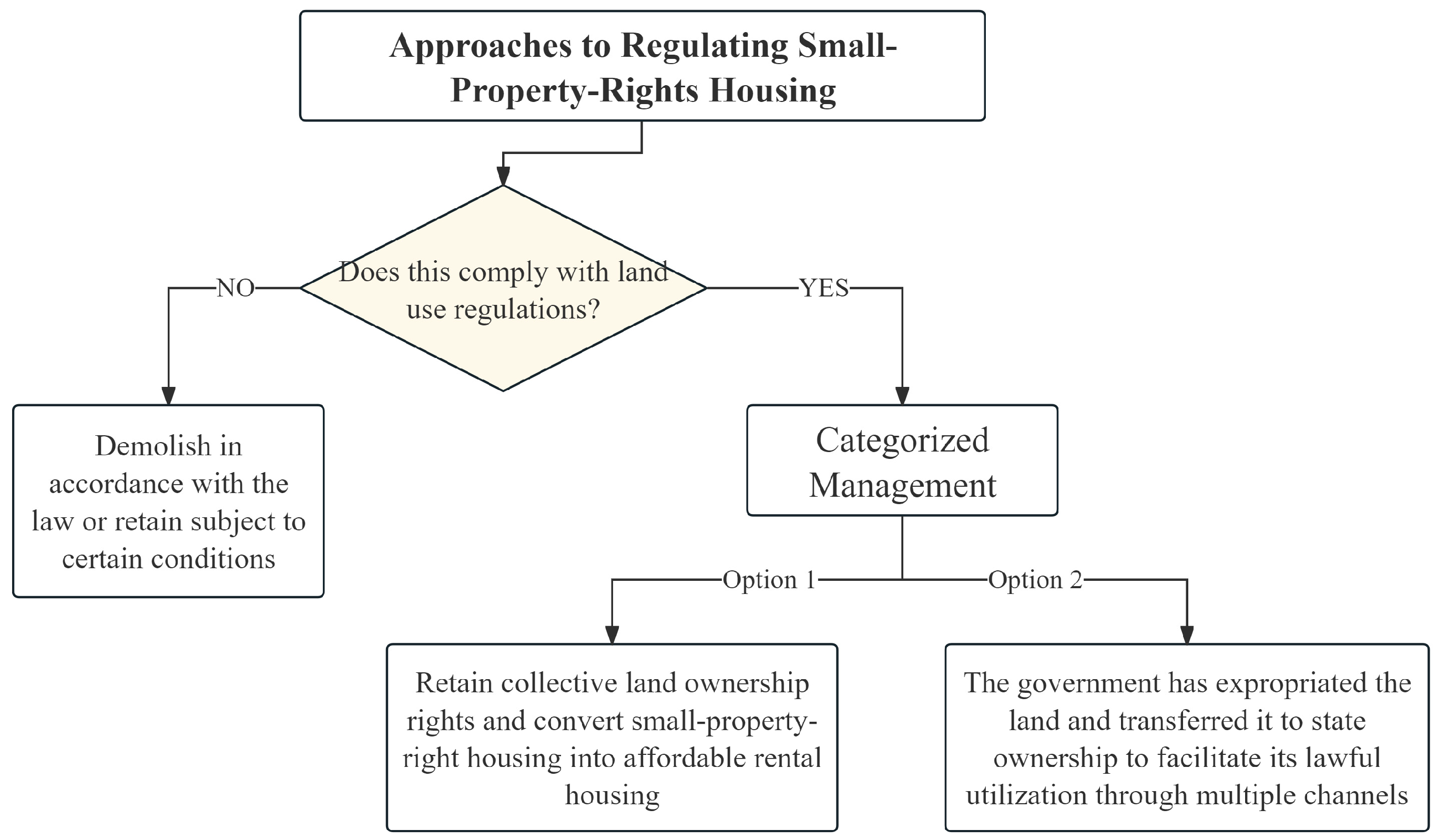
This paper considers two approaches to the management of “small-property-right” housing (as shown in
Figure 2): one involves retaining collective property rights and converting the housing into affordable rental housing; the other involves converting collective property rights into state-owned property rights through expropriation, thereby enabling legal utilization through multiple channels. It should be noted that “small-property-right” housing not only involves the interests of landowners and property operators but also serves as a vital source of housing security for a large number of migrant workers, new urban residents, and low-income groups. Therefore, during the implementation of renovation or expropriation measures, the principle of “prioritizing the protection of residential rights” must be upheld to prevent the forced displacement of existing residents due to indiscriminate demolition. During the renovation period, local governments can leverage resources from affordable rental housing, public rental housing, and market-based rental housing to provide transitional housing arrangements for affected residents. For long-term residents who meet the eligibility criteria, their right to continued residence can be safeguarded through the allocation of affordable rental housing units, priority for return to their original homes, or rental subsidies. Upon completion of the renovation, the role of the social housing system should be fully leveraged to maintain overall affordable rent levels, achieving a harmonious balance between improved living environments and stable housing costs. This approach will prevent the displacement of residents and the loss of social welfare benefits caused by urban renewal, thereby ensuring the coordinated advancement of the objectives of small-property-right housing governance, urban renewal, and housing security.
4.3. Option 1: Retain Collective Land Ownership Rights and Convert Small-Property-Right Housing into Affordable Rental Housing
Currently, the supply of urban affordable rental housing remains insufficient, while the existing stock of small-property-right housing is vast and concentrated, objectively providing a low-cost housing solution for migrant workers and low-income urban groups. As long as access to the commercial real estate market is restricted and the focus remains on housing security, small-property-right housing can align with the positioning of affordable rental housing. In accordance with policy requirements, once collectively owned commercial construction land enters the market, its use must comply with national spatial planning and relevant industrial policies. Current practices across various regions permit uses such as industrial, warehousing, commercial and service sectors, as well as public facilities like affordable rental housing, elderly care, and education; ordinary commercial housing is not included in the permitted scope. This provides a framework for the governance of small-property-right housing: leveraging the policy on the entry of collectively owned commercial construction land into the market, if the land on which small-property-right housing is situated is residential land, it should first be converted into collectively owned commercial construction land [
53], and then incorporated into the affordable housing system to achieve the legal transformation and operation of small-property-right housing. There are two specific implementation approaches:
4.3.1. A Village-Led, Self-Managed Operation Model: The Renovation of Jiaxing’s “Blue-Collar Apartments”
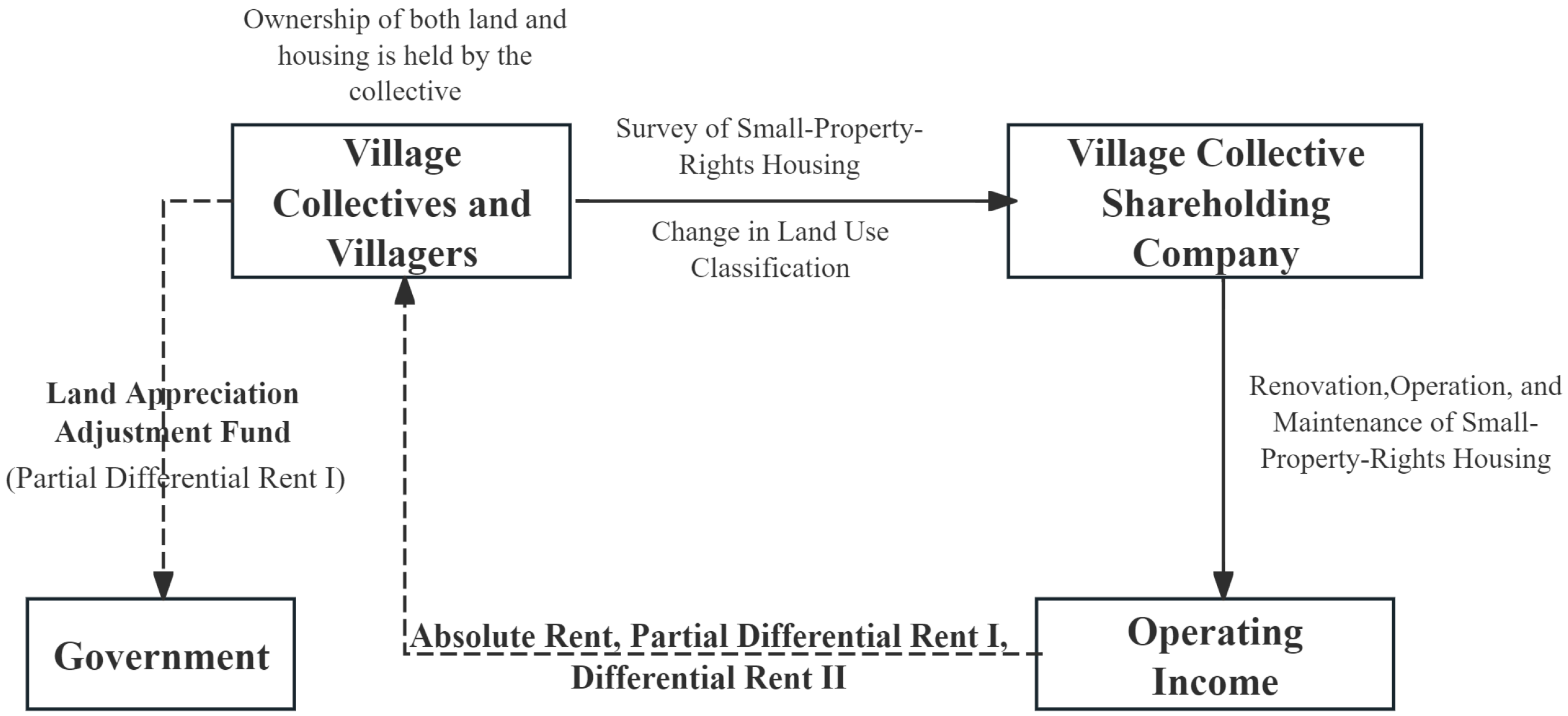
Under this model, both land and housing ownership remain with the village collective and villagers (as shown in
Figure 3). With the village collective serving as the primary responsible entity, it takes the lead throughout the entire process of adaptive governance and renovation, leasing operations, and revenue distribution for small-property-right housing. The village collective must first collaborate with relevant departments to conduct a comprehensive survey of small-property-right housing ownership, establish complete ownership records, and convert the homestead land on which these properties stand into collective commercial construction land. It must then establish a dedicated asset management and operation company (or entrust the village collective economic organization to lead the effort) to coordinate the standardized renovation of the small-property-right housing. After renovation, the village collective or its designated operating entity is responsible for rent collection and daily maintenance and operations. The distribution of rent and operating revenues is divided into three parts: First, absolute ground rent, based on the village collective’s ownership of the land, belongs entirely to the village collective and may be distributed to villagers or used for collective public expenditures in accordance with the bylaws; Second, differential ground rent I, corresponding to land appreciation resulting from government investments in urban infrastructure and public services. The village collective must, in accordance with policy regulations, extract a certain proportion of the land appreciation gains and pay them to the government in the form of a “land appreciation adjustment fund” as cost compensation for public service investments; third, Differential Rent II, which stems from the appreciation resulting from the village collective’s operational management and building renovations and upgrades. This is returned to the village collective in the form of rental surpluses, property management fees, and ancillary operational income (such as revenue from community convenience services). After deducting operational costs and maintenance funds, the remaining portion is shared between the village collective and the villagers. As the landowner, the village collective inherently possesses the institutional advantage of integrating internal resources and coordinating the interests of its members.
In the management of small-property-right housing, if village collectives can consolidate scattered properties with ambiguous ownership into assets that can be uniformly managed through internal governance, they can avoid the high transaction costs associated with external capital intervention and the high administrative costs of direct government intervention, thereby achieving endogenous governance characterized by “low costs and high acceptance.” Practices in revitalizing idle farmhouses carried out in many parts of Zhejiang in recent years demonstrate that this autonomous governance model, with the village collective as the primary actor, is not only feasible but also capable of generating significant socioeconomic benefits. For example, Xinyi Village in Xiuzhou District, Jiaxing, achieved remarkable results by having the village collective lease back idle houses from villagers, renovating them into “blue-collar apartments,” and then renting them out collectively. This initiative generated over 600,000 yuan in additional annual revenue for the village collective and increased annual household income for villagers by 20,000 to 30,000 yuan on average. The Jiaxing case demonstrates that even without converting collective land into state-owned land through government expropriation, village collectives can still achieve low-cost housing supply through a unified operational mechanism. In this process, housing resources originally scattered among individual villagers are centralized under the village collective’s management platform, forming an operational system characterized by unified renovation, unified leasing, and unified maintenance.
From the perspective of land appreciation revenue distribution, the revenue structure established in the Jiaxing case aligns closely with the distribution framework proposed in this paper. Land ownership remains with the village collective; the land rent and related revenues it receives essentially constitute absolute rent, which is redistributed to villagers through the village collective economic organization. Second, the stable rental demand for “blue-collar apartments” is closely linked to improvements in surrounding transportation, municipal infrastructure, and public services. The land appreciation gains resulting from these external public investments can be regarded as Differential Rent I. In accordance with the governance approach outlined in this paper, the village collective should pay the government a corresponding consideration—such as through a land appreciation revenue adjustment fund—to compensate for the government’s public service investment costs. Finally, the rental premium generated by the village collective’s unified renovation, operation, and management of idle housing constitutes Differential Rent II. This premium stems from the operating entity’s capital investment and enhanced management capabilities and is primarily shared by the village collective and the villagers participating in the renovation.
Judging by the results of the ground rent distribution, this model has implemented a basic distribution logic whereby absolute ground rent is allocated to the village collective, differential ground rent I is shared between the government and the village collective, and differential ground rent II is allocated to the operating entity and the investing entity. This is consistent with the framework for the distribution of land appreciation gains proposed in this paper, which emphasizes “balancing public and private interests and promoting multi-stakeholder sharing.”
4.3.2. A Collaborative Governance Model Involving the Government, Businesses, and Village Collectives: The Case of Shuiwei Village in Shenzhen
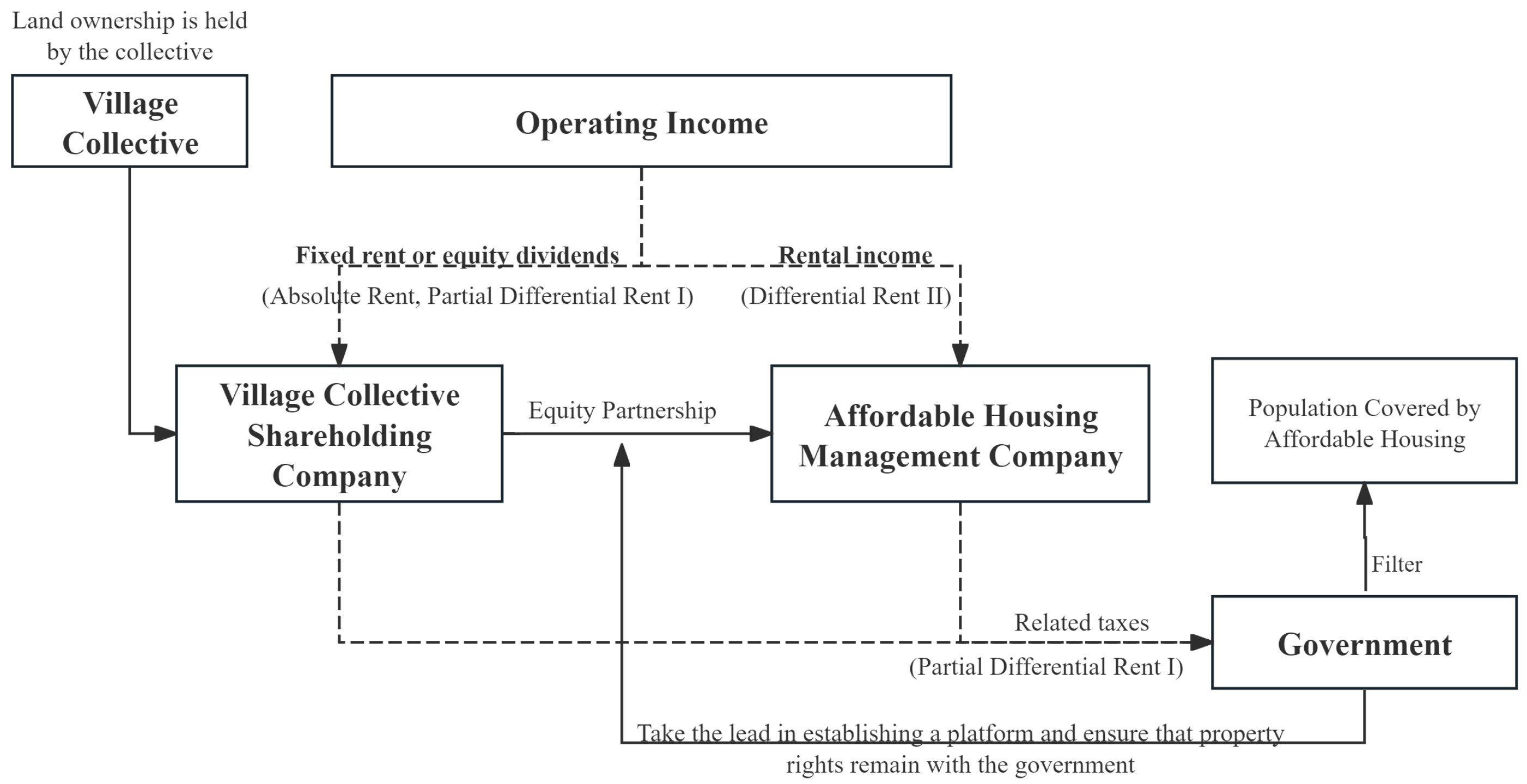
Under this model, the land remains in the hands of the village collective, while the property rights of the houses are transferred to the government through a buyout (as shown in
Figure 4). The government takes the lead in establishing a cooperative platform, bringing in professional enterprises with experience in affordable housing operations to sign long-term cooperation agreements with the village collective. After the small-property-right houses are uniformly acquired and standardized, they are leased on a “rent-only, no-sale” basis to eligible groups such as low-income individuals and migrant workers. Here, the village collective can participate in the cooperative operation as a collective shareholding company, jointly managing the project. The distribution of land appreciation gains also involves three parties: the village collective receives absolute rent based on land ownership and participates in the distribution of a portion of Differential Rent I, which takes the form of fixed land rent or equity dividends; the government obtains Differential Rent I by collecting relevant taxes paid by the operating enterprise and the village collective shareholding company; and the enterprise receives Differential Rent II based on its operating profits. Through this approach, the village collective legalizes small-property-right housing by converting it into affordable rental housing; the government retains the function of small-property-right housing in providing housing for low-income groups and maintaining social stability; and the enterprise can also generate a certain level of operating profit.
Currently, many regions have adopted this approach and successfully managed small-property-right housing, such as Shuiwei Village in Shenzhen [
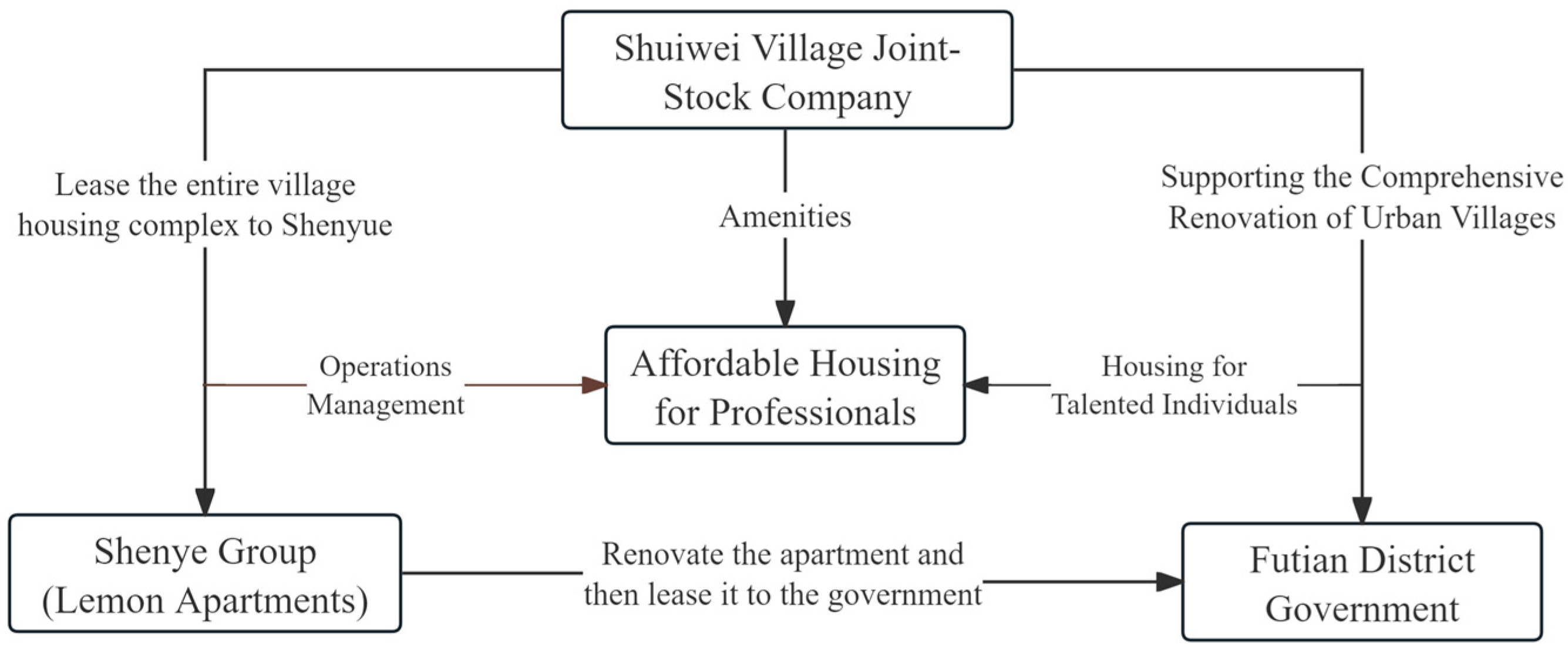
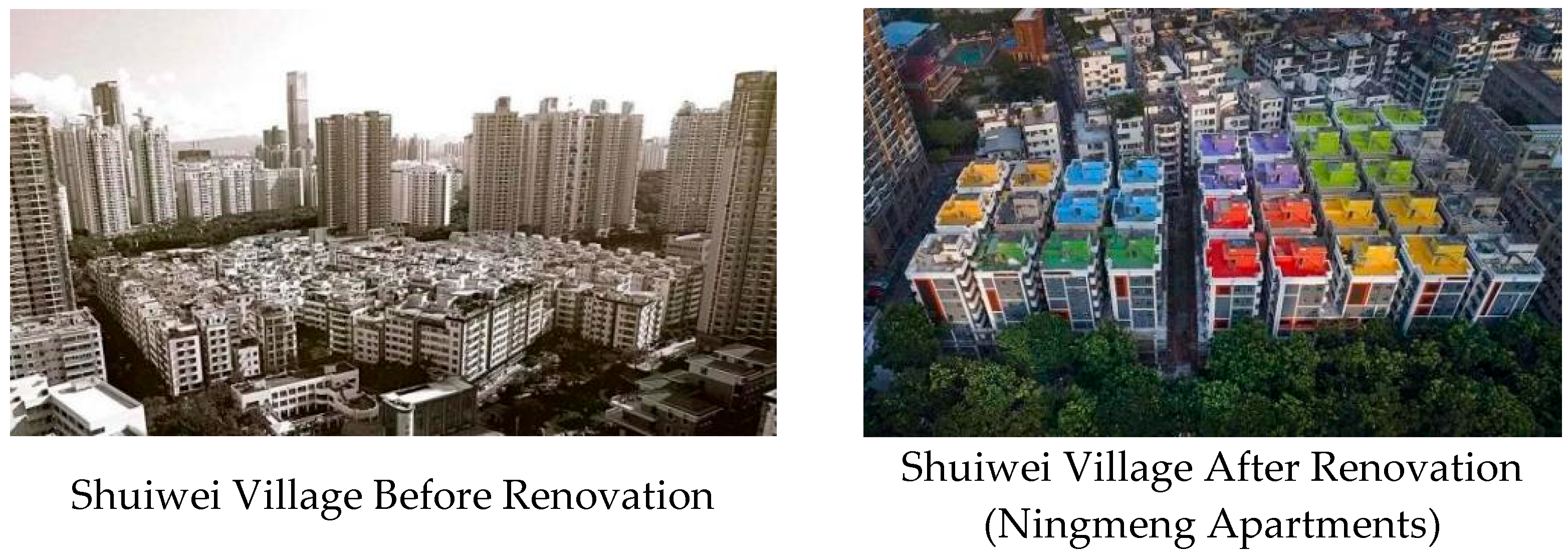
54]. Shuiwei Village in Futian District, Shenzhen, has long been home to a large number of small-property-right housing units primarily used for rental purposes. With the rise in urban renewal and housing security needs, the local government did not opt for wholesale demolition but instead explored a collaborative operation model involving the “government–enterprise–village collective.” Specifically, the government is responsible for formulating policies for affordable rental housing and providing institutional support; the village collective integrates property resources through a shareholding cooperative; and specialized enterprises handle housing renovation, operational management, and leasing services. To address institutional obstacles such as the informal nature of small-property-right housing titles, significant fire hazards, and the lack of renovation standards, the government employs flexible measures—such as issuing letters in lieu of certificates and providing on-site guidance—to enhance awareness of property rights security on rural collective land and create conditions for project implementation. The successful transformation of the Ningmeng Apartments project in Shuiwei Village, Shenzhen—from “village dwellings within the city” to “affordable rental housing for talent”—owes much to the establishment of a “government + enterprise + village collective” multi-center collaborative platform. In this arrangement, Shuiwei Village Collective Joint-Stock Company consolidated villagers’ housing resources and coordinated interests; the state-owned enterprise Shenzhen Industry Group undertook renovation and operations; and the Futian District Government of Shenzhen provided institutional innovation and policy support (
Figure 5). Ultimately, this initiative delivered 504 units of talent apartments to Futian District. Following the renovation, 29 buildings of traditional peasant housing were upgraded from “hand-shaking buildings” into modern affordable talent apartments. Seven new elevators and steel-structured walkways connected the buildings into a three-dimensional community, while the rooftops of the 29 buildings were transformed into vibrant rooftop spaces featuring laundry rooms, vegetable gardens, and recreational gardens (
Figure 6).
From the perspective of land appreciation profit distribution, the case of Shuiwei Village in Shenzhen exemplifies a governance model that achieves both housing security and the sharing of land appreciation profits while retaining collective property rights. Throughout the project’s implementation, land ownership remained with the Shuiwei Village Shareholding Cooperative, ensuring that the absolute ground rent derived from land ownership remained within the village collective. Specifically, the Shuiwei Village Shareholding Cooperative Company consolidates housing units from villagers at an annual cost of approximately 5 million yuan. It then leases 29 buildings totaling 15,472 square meters to Shenzhen Industry Group at a rate of 73 yuan per square meter per month, generating approximately 13.55 million yuan in annual rental income and establishing a stable source of collective economic revenue.
In terms of operations, Shenye Group invested approximately 40 million yuan to comprehensively renovate 29 buildings originally used as farmers’ housing and assumed responsibility for subsequent operational management. Upon completion of the renovation, the Futian District Government leased back all 504 units of talent housing for housing security purposes at a rate of 150 yuan per square meter per month, paying Shenye Group approximately 27.85 million yuan in rent annually. After deducting operating costs, Shenye Group expects to recoup its investment in approximately six years, with an average return on investment of about 5.8% over the 10-year operating period. The revenue generated from capital investment, housing renovation, and professional management can be regarded as differential rent II, which belongs to Shenye Group.
Compared to traditional commercial housing development models, the most significant feature of the Shuiwei Village case is that the collective land was not expropriated and converted into state-owned land; therefore, no land transfer fees were required. Under the logic of traditional land expropriation and development, land transfer fees typically include compensation for the absolute rent required for the government to expropriate collective land, as well as the recovery of Differential Rent I generated by investments in public infrastructure and public services. In the Shuiwei Village project, however, because the village collective retained ownership of the land and provided 504 units of talent housing to the city under a “rent-only, no-sale” arrangement—thereby assuming certain housing security functions—it was not required to make retroactive land transfer fee payments as would be required under the commercial housing development model.
Essentially, the Shuiwei Village case does not involve the direct recovery of Differential Rent I through fiscal means, but rather converts the land appreciation gains—which might otherwise have been recovered through land transfer fees—into the provision of affordable housing, a public good. Although the government did not directly receive land transfer revenue, it added 504 new units of talent housing at a relatively low fiscal cost, thereby achieving housing security objectives; the village collective retained the absolute rent revenue; the operating enterprise obtained differential rent II; and a large number of talented individuals and new urban residents gained access to affordable housing. This has formed a benefit-sharing mechanism of “retaining collective property rights—providing affordable housing—sharing land appreciation gains,” embodying an innovative path that shifts the recovery of differential rent I from fiscal channels to social utilization.
4.4. Option Two: Government Expropriation and Conversion to State-Owned Land to Facilitate Legal Utilization Through Multiple Channels
After the government expropriates the collective land on which small-property-right housing is located through statutory procedures and converts it to state-owned land, it may adopt one of three approaches in accordance with planning requirements and social welfare objectives:
4.4.1. Conversion to a Commercial Housing Model Through Retroactive Payment: The Renovation of Nanjing Qicai Xingcheng
Once owners of small-property-right housing have paid the required land transfer fees and related taxes and fees in accordance with regulations, their properties can be converted into commercial housing with full property rights and included in the formal market. The land transfer fees to be paid correspond to Differential Rent Category I—that is, the land appreciation gains resulting from the government’s long-term investment in infrastructure and public services. The amount to be paid is reasonably calculated using the market price of commercial housing on state-owned land in the same area following its transfer as a reference benchmark. Furthermore, to encourage owners of small-property-right housing to make these payments, the government may collaborate with financial institutions to offer specialized loan support, allowing for installment payments to alleviate the financial burden of a lump-sum payment.
The Qicai Xingcheng project, located in Wangjia Village, Youfangqiao, Yuhuatai District, Nanjing, was once a typical example of “small-property-right housing” in Nanjing. According to Nanjing’s 2003 policy on the rectification and disposal of real estate projects on collectively owned land, projects that began construction before August 2003, met housing quality standards, and passed planning reviews were permitted to retroactively complete construction and land approval procedures in accordance with the law. After review, the Seven-Color Star City project was found to meet the above conditions. It completed land expropriation procedures in August 2007 and, following approval by the municipal government in November 2010, initiated the land transfer process. After the developer paid over 70 million yuan in land transfer fees as required, it legally obtained state-owned land use rights. Subsequently, for the first through eleventh buildings developed in the project’s initial phase (now known as the “Xingfuli” complex), involving approximately 2100 homeowners, the original small-property-right housing purchase agreements were successively replaced with formal commercial housing sales contracts. Ultimately, these homeowners obtained state-owned land use rights certificates and property ownership certificates, achieving a legal transition from non-standard property rights to full commercial housing property rights. However, the “Guoxuefu” cluster within the project failed to meet planning approval requirements and was therefore excluded from the regularization process. To this day, it retains the status of small-property-right housing, resulting in significant disparities between the two clusters in terms of public facility provision and living environment.
From the perspective of the distribution of land appreciation gains, the Qicai Xingcheng case illustrates a governance logic in which property rights are legalized through the retroactive payment of land transfer fees. In this project, the original collectively owned land was first expropriated in accordance with the law and converted into state-owned land, with the village collective and the original land rights holders receiving corresponding compensation through the expropriation process. From the perspective of rent theory, this portion of the proceeds primarily corresponds to compensation for absolute rent generated during the transfer of land ownership.
A key prerequisite for the project to achieve formal property rights is the payment of over 70 million yuan in back-payable land transfer fees. This sum is not, in essence, a single-purpose fee, but rather comprises multiple components related to the redistribution of land appreciation gains. Part of this sum is used to compensate for the absolute rent arising from the expropriation of the original collective land ownership; another portion corresponds to the land appreciation gains generated by the government’s long-term investments in infrastructure, public services, and urban development, and can be regarded as a manifestation of differential rent I. Although the land transfer fees are paid uniformly by the developer, they are ultimately converted, through the process of regularizing property rights, into the costs that homeowners must bear to obtain full ownership of commercial housing.
At the same time, the funds invested by the developer in the early stages of construction, development costs, and the capital gains generated during project operations fall under the category of differential rent II. These gains stem from the development, construction, and operational activities themselves; they are not included in the subsequent supplementary land transfer payments but are already reflected in the property sales prices and development and operational profits.
The Qicai Xingcheng case demonstrates that the essence of converting properties from a “small-property-right” model to a commercial housing model through the retroactive payment of land transfer fees is not merely a change in property ownership certificates, but rather a redefinition of the allocation of absolute rent, differential rent I, and differential rent II. The core significance lies in the fact that owners of small-property-right housing—who previously bore none of the costs of urban public services and infrastructure—now begin to pay for public services in accordance with the rules of the commercial housing system. In other words, the most fundamental distinction between small-property-right housing and commercial housing does not lie in the physical differences of the housing units themselves, but rather in whether the corresponding costs of land development rights and urban public services have been borne. The process of owners making retroactive payments for land transfer fees essentially compensates for Differential Rent I generated by the government’s long-term public investments, thereby completing the transition from “enjoying public services without payment” to “legally purchasing land development rights and public service entitlements.” This case also demonstrates that by reallocating land appreciation gains, property rights can be legalized without demolishing existing housing, thereby facilitating the integration of informal housing into the formal housing market system.
4.4.2. Exemption from Land Transfer Fees for Affordable Rental Housing: Shenzhen’s “2012 Annual Implementation Plan for the Housing Construction Program” Takes Effect
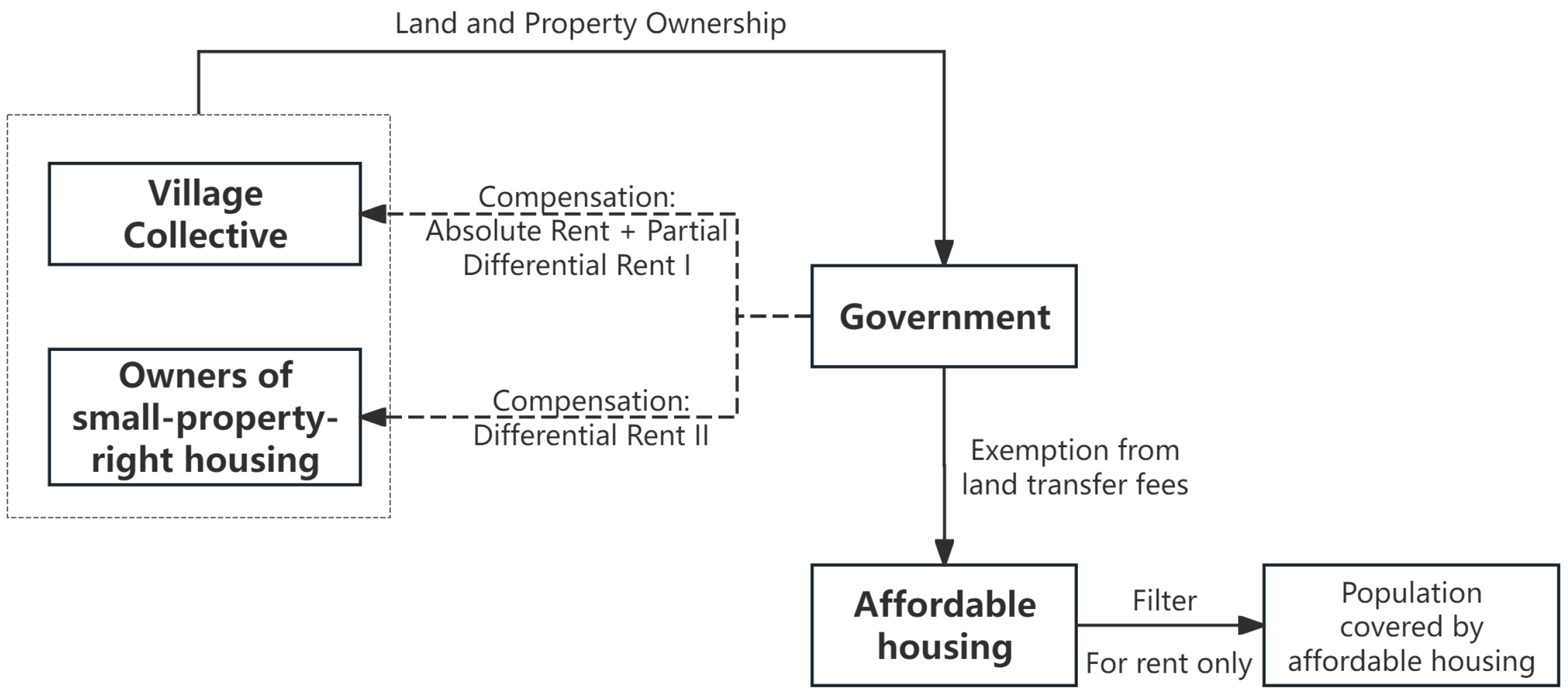
During the government expropriation process, the government makes a one-time purchase of the land ownership and property rights to structures such as houses from the village collective. The full ownership of the “small-property-right” housing is simultaneously transferred to the government, and the land status is changed to state-allocated land (for the construction of affordable housing). Since public services and infrastructure are originally funded by the government, no land transfer fees are required. In the compensation phase, the village collective, as the original landowner, receives compensation for absolute ground rent and a portion of differential ground rent I (corresponding to property management services provided by the village collective); owners of small-property-right housing receive compensation for differential ground rent II (corresponding to housing construction costs and investment and operational returns). In the subsequent operational phase, such housing strictly adheres to the “rent-only, no sale” policy, and tenants are not granted independent property rights. If tenants subsequently apply to share ownership with the government or purchase full ownership, they must pay the full amount of land transfer fees and make up for the value of public services (as shown in
Figure 7).
In 2012, Shenzhen explicitly proposed in its “2012 Annual Implementation Plan for the Housing Construction Program” to “pilot the inclusion of housing originally funded by rural collective economic organizations and self-built homes in urban villages into the effective supply channels for affordable housing through bulk leasing.” The Shenzhen case demonstrates that incorporating existing informal housing into the affordable rental housing system can effectively balance the goals of housing security and property rights standardization. Within the governance framework established in this paper, this model constitutes a specific type of expropriation-conversion model. The government uses public funds to make a one-time purchase of land and property rights, thereby converting them into state-owned assets and integrating them into the affordable housing system for unified management. In this scenario, absolute ground rent remains the property of the original village collective; differential rent II, corresponding to the costs of construction and operation, should be compensated to the original property owners; while differential rent I is retained by the government to offset the long-term costs of public services and infrastructure investments.
Compared with traditional commercial housing development models, the most distinctive feature of this model is that property rights are held by the government and housing is available for rent only, not for sale. Although low-income groups no longer hold property rights, they can continue to access affordable housing through rental agreements, thereby ensuring their right to housing. At the same time, by nationalizing property rights, the government completely resolves issues such as ambiguous ownership and difficulties in safety oversight.
4.4.3. Model for Re-Leasing Existing Properties After Renovation
Based on national spatial planning and urban development needs, the government will demolish and rebuild or renovate small-property-right housing after expropriation. After adjusting the land use and development intensity, the government will re-grant state-owned land use rights to market entities through methods such as public bidding, auction, and listing. During the compensation phase, the government must calculate compensation amounts in accordance with the framework for distributing land appreciation gains. This involves paying absolute ground rent and a portion of differential rent I to the village collective and villagers, and paying differential rent II to the builders and operators of small-property-right housing, thereby ensuring that the original rights and interests of all parties are safeguarded. At this stage, the collective land ownership is converted to state ownership following the expropriation. The process then moves to the redevelopment phase, where the government generates revenue by collecting land transfer fees. This revenue encompasses the absolute rent from state land ownership, as well as the additional differential rent I generated by adjusting land use and increasing development intensity. The funds raised can be used for public expenditures such as urban infrastructure upgrades and the construction of affordable housing.
China’s urban expansion and urban renewal practices over the past few decades have, in fact, widely adopted this governance model. In this process, the government first converts collectively owned land into state-owned land through land expropriation, then introduces market entities to undertake development and construction through land concessions, and uses the gains from land appreciation to support infrastructure development and urban renewal activities. In terms of practical outcomes, this model has effectively driven the restructuring of urban spaces and the realization of land value, becoming one of the most representative land development models in China’s urbanization process. Therefore, this paper treats it as the traditional and benchmark model within the governance pathways for small-property-right housing, using it to compare with the aforementioned innovative governance pathway that preserves collective property rights.
4.5. A Comparison of Five Models
The key difference among the five governance models lies in whether collective land ownership is retained and how gains from land appreciation are realized. Overall, Path 1 is more suitable for regions facing significant fiscal pressures but with strong demand for housing security; Path 2 is more suitable for key renewal areas with high renewal value and a strong need for property rights consolidation.
Option 1 retains collective land ownership and includes: (1) a model of autonomous operation by the village collective; and (2) a collaborative operation model involving the government, enterprises, and the village collective. A common feature of both models is that they do not require the government to bear high land acquisition costs; the land remains under the ownership of the village collective, and revenue is distributed through the operation of affordable rental housing. The former is suitable for village collectives with strong organizational capabilities, while the latter is suitable for large-scale renewal projects that require the participation of professional operators.
Option 2 involves converting collective land into state-owned land through government expropriation, which includes the following three models: (1) converting the land into commercial housing upon payment of back fees; (2) converting it into affordable rental housing; and (3) re-conveying the land after the renewal of existing properties. A common feature of these models is the complete standardization of property rights, but they require the government to bear significant expropriation costs.
It should be noted that the three models under Pathway Two have different target groups and social impacts. (1) The model of converting to commercial housing through retroactive payment of fees is primarily aimed at the original rights holders of small-property-right housing; it legalizes property rights by requiring the retroactive payment of land transfer fees, and its beneficiaries are mainly limited to the original property owners. When owners belong to low-income groups, the model of converting to affordable rental housing may be adopted. (2) The conversion to affordable rental housing model balances the goals of property rights standardization and housing security, enhancing housing safety while preserving housing opportunities for low-income groups. If widely implemented, this model could transform a large volume of existing small-property-right housing into standardized affordable housing, providing affordable housing for more migrant workers and low-income groups; therefore, it should be prioritized as a governance approach whenever conditions permit. (3) The model of re-conveying land after stock renewal places greater emphasis on unlocking land value and restructuring urban space; however, since the target recipients of housing supply are no longer limited to the original residents, this may lead to risks such as the displacement of low-income groups and the re-segregation of living spaces.
5. Discussion
Existing international research on informal housing primarily focuses on issues such as property rights formalization, housing security, slum upgrading, and social integration. A significant body of research suggests that confirming and registering property rights can enhance residents’ sense of housing security and willingness to invest, thereby facilitating the entry of housing assets into the formal market system. However, much of this research is based on a single land ownership system and primarily focuses on the legalization of property rights itself, while paying relatively less attention to the mechanisms underlying land value appreciation and the distribution of such gains.
Compared to international issues of informal housing, China’s “small-property-right housing” exhibits distinct institutional peculiarities. Its origins do not stem solely from a housing shortage but rather from long-standing institutional disparities between collectively owned land and state-owned land within the context of a dual urban–rural land system. Because collectively owned land has long been unable to enter the urban construction land market directly, land appreciation gains have created complex benefits relationships among the state, village collectives, developers, and residents. Consequently, the governance of small-property-right housing is not merely a matter of legalizing property rights, but also a matter of redistributing land appreciation gains.
The theoretical contributions of this paper are primarily reflected in three aspects. First, it breaks away from the existing analytical paradigm in which research on the governance of small-property-right housing has primarily focused on property legalization and formalization [
7]. Existing studies have largely concentrated on property rights confirmation, property value, and their impact on the housing market, while paying relatively little attention to the mechanisms governing the distribution of land appreciation gains among the government, village collectives, and housing rights holders. This paper incorporates the distribution of land appreciation gains into its analytical framework, elucidating the formation logic, conflicts of interest, and governance pathway choices regarding small-property-right housing from a perspective of interest distribution, thereby enriching the theoretical analytical framework of research on the governance of small-property-right housing.
Second, against the backdrop of China’s urban–rural dual land system, this study introduces absolute rent, differential rent I, and differential rent II into the research on the governance of small-property-right housing. It constructs a framework for the distribution of land appreciation gains, revealing the mechanisms of interest formation and the logic of distribution among the state, village collectives, and small-property-right housing holders. This provides new theoretical tools for explaining the complex property rights relationships and interest coordination issues under the urban–rural dual land system. Furthermore, this paper argues that the essence of the small-property-right housing issue lies not only in the legitimacy of property rights but also in the distribution of land appreciation gains under the urban–rural dual land system, thereby expanding existing research on governance mechanisms for informal housing.
Additionally, based on typical cases such as Shuiwei Village in Shenzhen and Qicaixingcheng in Nanjing, five differentiated governance models are proposed. The research indicates that informal housing need not remain in an informal state indefinitely but can gradually transition toward formalization through institutional reform, interest coordination, and property rights adjustments. China’s governance practices regarding small-property-right housing demonstrate that, within the context of the urban–rural dual land system, the transformation of informal housing into formal housing is not only practically feasible but also an essential issue that must be addressed as urban renewal advances and the land system continues to improve. This finding further enriches the global discourse on pathways to property rights formalization in the study of informal housing. It demonstrates that, within an institutional environment characterized by complex property rights structures and diverse stakeholders, informal housing is not an intractable legacy problem but can be gradually integrated into the formal institutional system through incremental reforms. This provides valuable theoretical insights for other developing countries facing challenges related to land system transformation and the governance of informal housing.
At the same time, this study indicates that while international experiences in governing informal housing offer valuable insights, they are difficult to directly apply to the Chinese context. The governance of small-property-right housing in China must fully take into account the urban–rural dual land system, the structure of collective property rights, and the distribution of land appreciation gains. It must safeguard the public interest while balancing the legitimate rights and interests of village collectives, original property owners (i.e., villagers), and low-income groups. Therefore, establishing a mechanism for the distribution of land appreciation gains that balances efficiency and equity is a crucial prerequisite for achieving the sustainable governance of small-property-right housing.
Of course, this paper still has certain limitations. Although the study incorporates typical case studies such as Shuiwei Village in Shenzhen and Qicaixingcheng in Nanjing for validation, it remains primarily a structural analysis and has not yet conducted large-scale field surveys, interviews, or quantitative assessments. In particular, there is still a lack of concrete empirical data to support the determination of land appreciation benefit distribution ratios among different stakeholders, the comparison of economic benefits across different governance models, and the evaluation of long-term governance performance. Future research could further integrate field surveys, questionnaire interviews, and multi-case comparative studies to conduct quantitative analyses of land appreciation benefit distribution mechanisms, thereby enhancing the scientific rigor and policy applicability of the research conclusions.
6. Conclusions
After systematically examining the governance challenges surrounding small-property-right housing, this paper analyzes the theoretical basis for the generation and distribution of land appreciation gains and, based on this, constructs a fair framework for the distribution of such gains. Drawing on this framework, the paper proposes a governance approach for small-property-right housing to address the financial difficulties and challenges in profit distribution currently encountered during the renewal of such housing. The main conclusions are as follows:
Generation and Distribution of Land Appreciation Gains: Land appreciation gains consist of two components: absolute rent and differential rent (I and II). Absolute rent arises from land ownership and represents the intrinsic value of the land itself; Differential Rent I stems from land development rights and is generated by external factors such as government or village collective investments in infrastructure and public services; Differential Rent II stems from land management rights (for residential small-property-right housing, this manifests as investments in construction and operation) and is generated by the user’s active investments and operational activities.
This paper proposes a land appreciation gains distribution mechanism based on the principle of “balancing public and private interests and promoting multi-stakeholder sharing.” Based on the core logic of rent generation, this paper clarifies the ownership and distribution methods for each type of rent: absolute rent belongs to the landowner, i.e., the village collective, and may be distributed to villagers or used for collective public expenditures in accordance with the village collective’s bylaws; Differential Rent I is shared by the government and the village collective, representing compensation for investments in public services and infrastructure; Differential Rent II belongs to the owners of small-property-right housing, corresponding to their investments in construction and operation.
Preserving collective property rights is a key focus in the regulation of small-property-right housing. Against the backdrop of the entry of rural collective commercial construction land into the market, legalization can be achieved through two models: first, the village collective autonomous operation model, in which the village collective uniformly consolidates, renovates, and operates small-property-right housing; second, the government–enterprise–village collective collaborative operation model, in which professional enterprises are responsible for renovation and operation, while the government assumes regulatory responsibilities. Both models can achieve improvements in building safety, housing security, and revenue sharing without expropriating property rights.
Governance approaches for converting to state-owned property rights. In some cases, property rights can be converted through government expropriation, giving rise to three governance models: first, converting the property into commercial housing after paying the outstanding land transfer fees to legalize the property rights; second, converting it into affordable rental housing to continue providing housing security for low-income groups; and third, demolishing and rebuilding the property before re-transferring the land rights for urban renewal and land value redevelopment. These three models correspond to the varying development needs and fiscal conditions of different regions.
The regulation of small-property-right housing is not merely a process of property rights adjustment, but also a process of rebalancing the interests of multiple stakeholders. For village collectives and villagers, reasonable compensation should be provided for their land contributions, housing construction, and operational investments; for the government, the costs of public services and infrastructure investments should be recovered through differential ground rent; and for migrant workers and low-income groups, their basic right to housing should be safeguarded through affordable rental housing, public rental housing, and rental subsidies. Only by achieving a balance among building safety, housing security, public interest, and private interests can the long-term sustainable development of small-property-right housing governance be realized.