Article

From Park Morphology to Estimated Performance: Stormwater Management and Service Provision in Shanghai’s Sponge City Parks

1
The School of Art and Design, Shanghai University of Engineering Science, Shanghai 201620, China
2
Shanghai Institute of Design and Innovation, Tongji University, Shanghai 200092, China
3
The Sam Fox School of Design & Visual Arts, Washington University in St. Louis, St. Louis, MO 63130, USA
4
College of Architecture and Landscape Architecture, Peking University, No. 5 Yiheyuan Road, Beijing 100871, China
*
Author to whom correspondence should be addressed.
Land 2026, 15(6), 1048; https://doi.org/10.3390/land15061048 (registering DOI)
Submission received: 9 May 2026 / Revised: 10 June 2026 / Accepted: 12 June 2026 / Published: 13 June 2026

Abstract

Due to climate change and rapid urbanization, cities worldwide face the dual challenge of improving flood resilience and providing accessible green space within limited land resources. Sponge City parks offer a landscape-based approach for integrating stormwater management with park services. However, how park morphology structures this combined performance remains insufficiently understood. This study examines 26 Sponge City parks in Shanghai and evaluates how node-, line-, and patch-type morphologies are linked to stormwater storage and service provision. Using geospatial analysis, DEM-derived catchment delineation, land-cover interpretation, and statistical analysis, this study compares estimated stormwater storage, storage efficiency, local park availability, and land-cover composition across different park morphologies. The results show that estimated performance of stormwater management and park service provision vary across morphological types, but these differences do not follow a simple node–line–patch hierarchy. Rather, the observed patterns are jointly shaped by park morphology, catchment setting, land-cover allocation, and surrounding urban context. These findings suggest that Sponge City parks should not only be evaluated by total stormwater storage. Their contribution depends on morphology, scale, catchment setting, land-cover allocation, and urban context. The study provides a morphology–performance perspective to support more differentiated planning of multifunctional green infrastructure.

1. Introduction

Cities today confront the dual challenge of adapting to climate change and managing rapid urban growth. In this context, stormwater management and urban greening are increasingly understood as interconnected rather than separate strategies, with each contributing to broader goals of urban sustainability [1,2,3]. As intense rainfall events become more frequent and urban flooding risks increase, conventional drainage systems that focus mainly on conveyance have become increasingly insufficient, calling for more sustainable approaches centered on source retention and infiltration [4,5,6]. At the same time, accessible public parks are essential for social well-being, public health, and ecological quality, while their provision is often limited by competing land uses in dense urban areas [7,8,9,10].
These pressures have shifted attention from single-function drainage infrastructure toward multifunctional green infrastructure that can retain runoff, support ecological processes, and serve everyday public needs [11]. This shift is reflected in concepts such as low-impact development (LID) and sustainable urban drainage systems (SUDS). It has also informed policy frameworks such as Sponge City (SPC) in China, which promotes the co-development of urban resilience, stormwater regulation, and urban greening [1,12]. Within this context, SPC parks have become infrastructures that support stormwater management while delivering essential public services [13,14,15].
Despite strong policy support and theoretical advocacy, a gap remains between the integrative vision of SPC parks and the empirical evidence needed to guide their planning and design. Existing studies mainly follow two predominant but often disconnected directions [11,16,17]. The first direction evaluates the hydro-environmental performance of green infrastructure techniques, such as bio-retention or permeable pavements, with a primary focus on runoff reduction and water quality improvement [18,19,20,21,22]. For instance, many design resources emphasize technique-level examples under local physical and regulatory conditions, while offering limited guidance on how to coordinate stormwater functions with park service provision at the site scale [18,19,20,21,22]. Although a few manuals evaluate drainage devices alongside green space provision and potential synergies, more site-scale evidence is still needed on how stormwater functions and park service provision are coordinated across different park forms [23]. The second direction examines the spatial patterns, accessibility, and ecosystem services of urban green space, often at broader scales [9,24,25,26]. For example, the source–sink landscape theory has been frequently used to interpret ecological processes and hydrological relationships [27,28]. However, these two bodies of work seldom explain how park form, land-cover configuration, and urban context jointly shape both stormwater performance and park service provision at the site scale. Previous case-based research has shown that SPC parks can combine stormwater functions with public services [29]. However, many studies still evaluate these projects either as individual cases or as general multifunctional green infrastructure. Less attention has been paid to how park morphology, scale, land-cover configuration, catchment context, and urban setting together structure differences in stormwater and service performance across implemented SPC parks [28,29,30,31]. This leaves a gap in the cross-case interpretation of how different SPC park forms contribute to multifunctional performance.
This disconnect points to park morphology as a critical but underexamined dimension. In this study, morphology refers to the form, structure, and spatial configuration of parks, including their geometric type, scale, and urban context. In this study, morphology is used as an interpretive framework to understand the potential relationships among geometric type, spatial scale, catchment setting, land-cover allocation, and urban context. These attributes can help structure both hydrological performance and the amount, accessibility, and composition of park service provision [9,24,25,26]. Existing studies of SPC and green infrastructure have provided useful classifications and evidence at the project level, but many of them remain limited to descriptive typologies, individual project assessments, or hydrological source–sink interpretation. Some categorize parks by simple geometry without linking form to measured functional indicators [27], while others apply hydrological source–sink models that center on catchment processes but may overlook the provision of on-site park services [28]. They therefore provide limited evidence on how park morphology shapes the combined outcomes of stormwater management and park service provision. A more integrated morphology–performance framework is needed to interpret SPC parks as multifunctional landscape systems rather than as separate hydrological or recreational facilities [27,32,33].
Rather than treating stormwater management and park services as separate outcomes, this study understands SPC parks as multifunctional landscapes whose performance is structured by morphology, land-cover configuration, and urban context [10,25]. These factors can produce different storage–service relationships, ranging from potential synergies to tensions. This study, therefore, asks the following: how do different park morphologies structure the combined performance of stormwater management and park service provision in SPC parks? To answer this question, this study focuses on Shanghai, which provides an appropriate setting for a morphology-based performance analysis because it is one of China’s leading Sponge City pilot cities and contains a diverse network of implemented SPC parks across central city, new town, and suburban contexts [34]. By examining 26 SPC parks in Shanghai, this study aims to address the three sub-questions: (1) How can SPC parks be classified into morphological types using geospatial analysis? (2) How do stormwater storage performance, including estimated capacity and storage efficiency per unit area, and park service provision, including availability within a 1 km service area and land-cover-based service composition, vary across the selected parks? (3) How can the relationships between morphology and the combined performance be interpreted?
By linking park morphology with stormwater and spatial service indicators, this study shifts the discussion from the general integration of stormwater functions and park services to the differentiated roles of node-, line-, and patch-type SPC parks. Its contribution lies in extending project-level assessments of SPC parks toward a morphology–performance interpretation, clarifying how different park forms may serve different hydrological and public service roles within the urban green infrastructure network. This perspective can support more targeted planning decisions under different hydrological management, land-use constraints, and urban density conditions.
The paper proceeds as follows. Section 2 describes the methodology, covering the study area, case selection, data sources, and analytical procedures. Section 3 presents the results of a morphology-based comparison of stormwater and service-related indicators. Section 4 discusses the morphology–performance relationships and their planning implications. Section 5 summarizes the main findings, limitations, and future research directions.

2. Materials and Methods

2.1. Research Framework

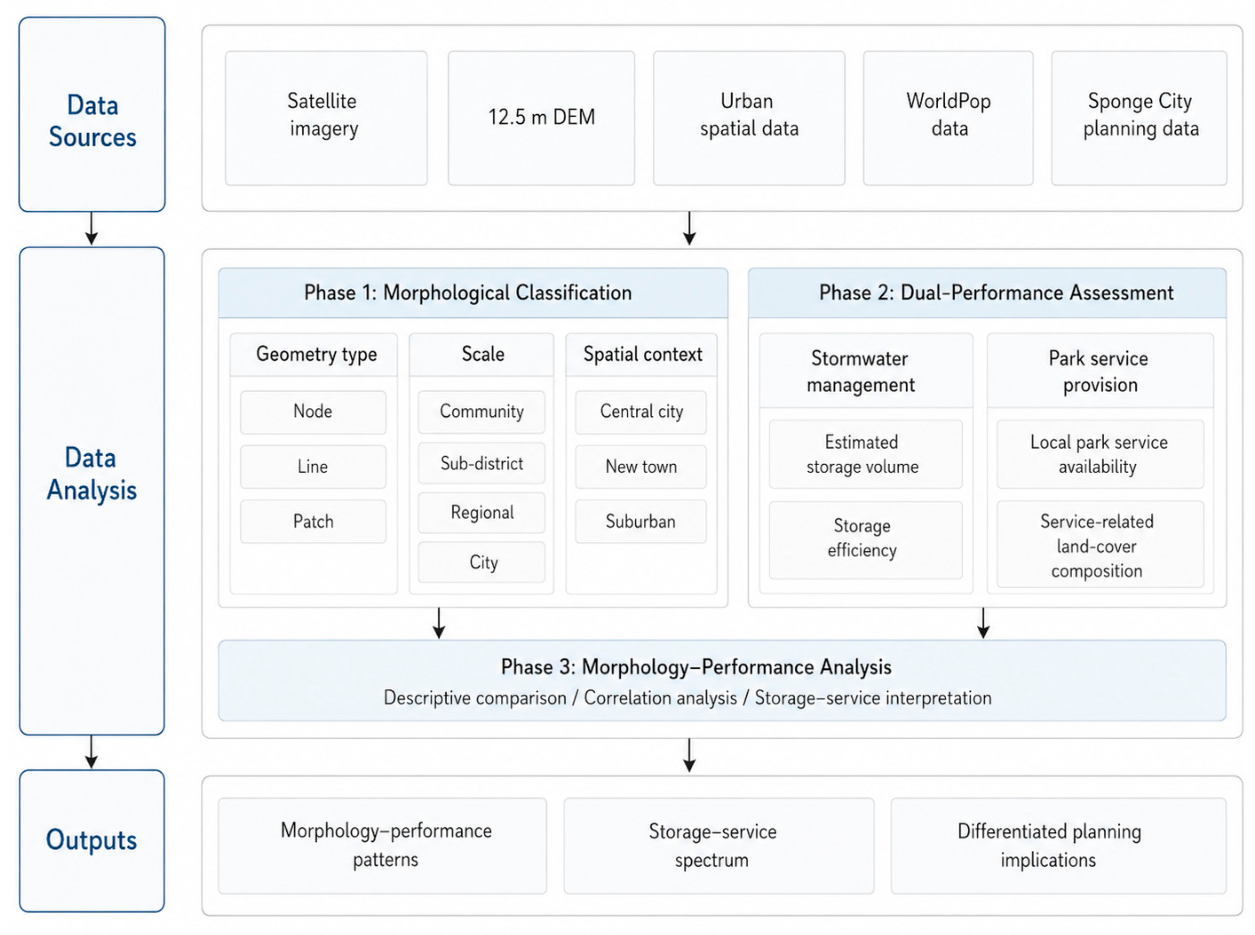
This study empirically examines how different morphological types of SPC parks relate to their performance in stormwater management and park service provision. To achieve this, a GIS-based assessment approach was adopted by combining geospatial analysis, catchment delineation, land-cover interpretation, storage estimation, and morphology–performance analysis. As shown in Figure 1, the research framework consists of three sequential phases: (1) morphological classification of SPC parks, (2) quantitative assessment of stormwater management and service provision, and (3) analysis of the relationship between morphology and performance. The framework moves from descriptive typology to morphology–performance analysis, thereby structuring the comparison across cases and providing a basis for planning interpretation.

2.2. Study Area: Shanghai as a Pioneering Sponge City

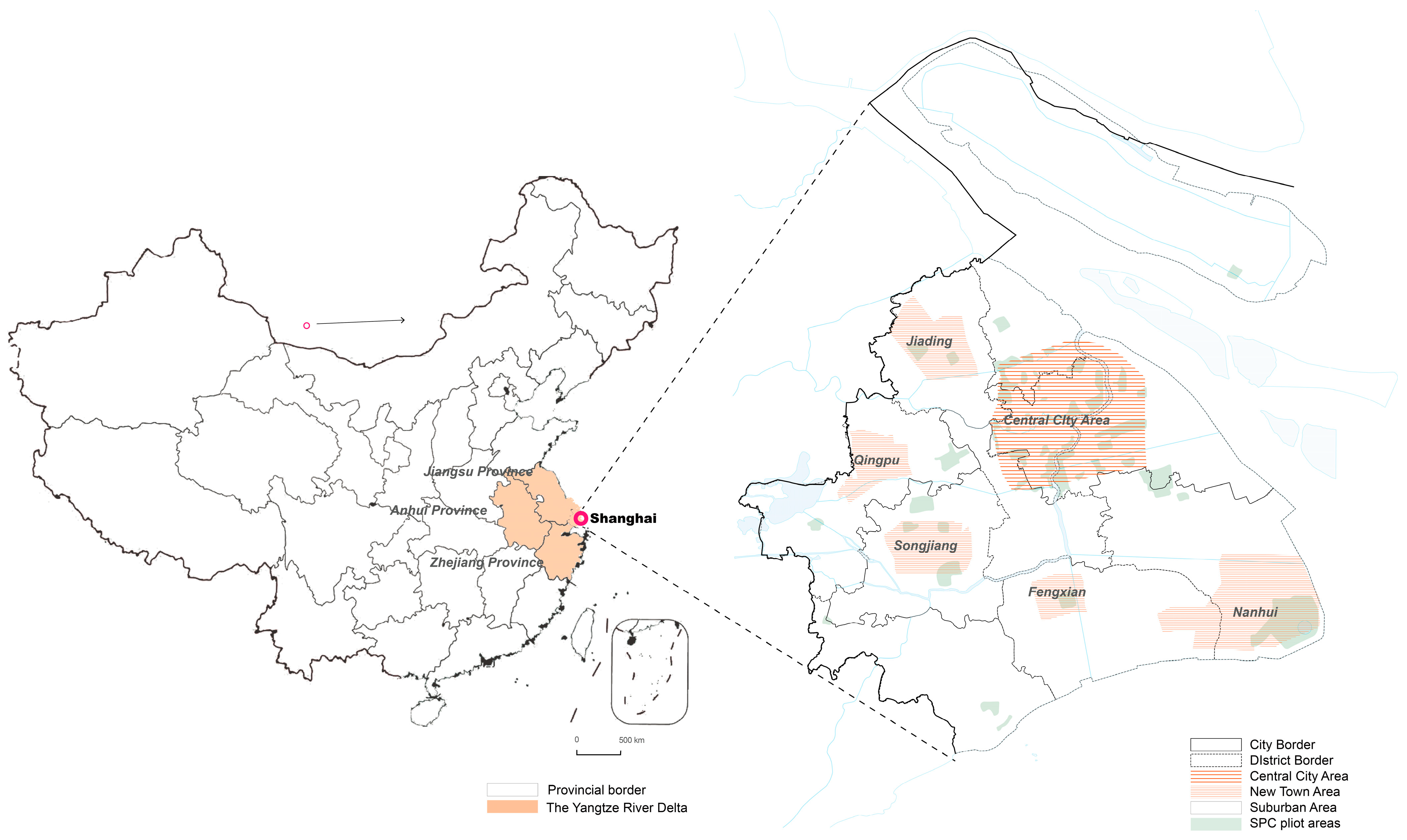
Shanghai was selected as the study area because of its important role as one of China’s first and most comprehensive pilot cities under the Sponge City Program. Located in the Yangtze River Delta, the city covers an area of approximately 6340 km2 (Figure 2). Shanghai has a subtropical monsoon climate, with temperatures typically ranging from 25° to 35 °C [35]. The city receives an average annual precipitation of 1158.1 mm, more than 60% of which occurs between May and September. During this wet season, rainfall events are more frequent and often concentrated, which increases short-term runoff pressure and flood risk in both urban and rural areas [36,37]. Combined with rapid urban growth, these climatic conditions created persistent challenges for stormwater management [38,39]. Together, these factors underscore the need for effective stormwater control, flood mitigation, and rainwater reuse strategies across Shanghai.
With an estimated population of 24.99 million, Shanghai ranks among the world’s most densely urbanized areas. Since the 1980s, intensive urbanization in the city has placed growing pressure on park space and related services. According to the 2023 Shanghai Municipal Statistical Yearbook, Shanghai has 180,000 hectares of green space, accounting for 19.5% of the urban landscape, but this amounts to only 9.5 square meters of green area per person [40]. The Shanghai municipal government has announced the goal of increasing the per capita park area to 13 square meters by 2035 through the development of an integrated urban–rural park framework, which includes the construction of an additional 600 public parks and 1000 km of greenways [41]. In addition, the local administration has initiated the Shanghai Sponge City Special Plan aimed at increasing green space and optimizing stormwater management [34]. As illustrated in Figure 2, 64 pilot projects have been established across all 16 districts in Shanghai. As a leading Sponge City pilot, Shanghai offers a valuable setting to examine practical approaches that integrate stormwater management with park services, particularly in parks, streets, and buildings.
Based on the above, the selection of Shanghai as a pilot city for the SPC program underscores its importance in testing sustainable solutions that integrate green infrastructure into urban centers, new towns, and suburban areas. As shown in Figure 2, the central city areas have the highest population density of 23,740 per square kilometer, and new town areas and suburban areas have a relatively lower population density of 3410 and 2877 per square kilometer [41]. Specifically, new town areas are newly developed zones expected to experience higher population density in the following decades. In the meantime, central city and suburban areas have a proportion of green areas at 24%, while new town areas have a proportion of green areas at 12% [40]. Thus, the city provides a broad range of samples to generate practical insights for China’s other cities but also contributes globally to the discourse on sustainable urbanization.

2.3. Case Selection

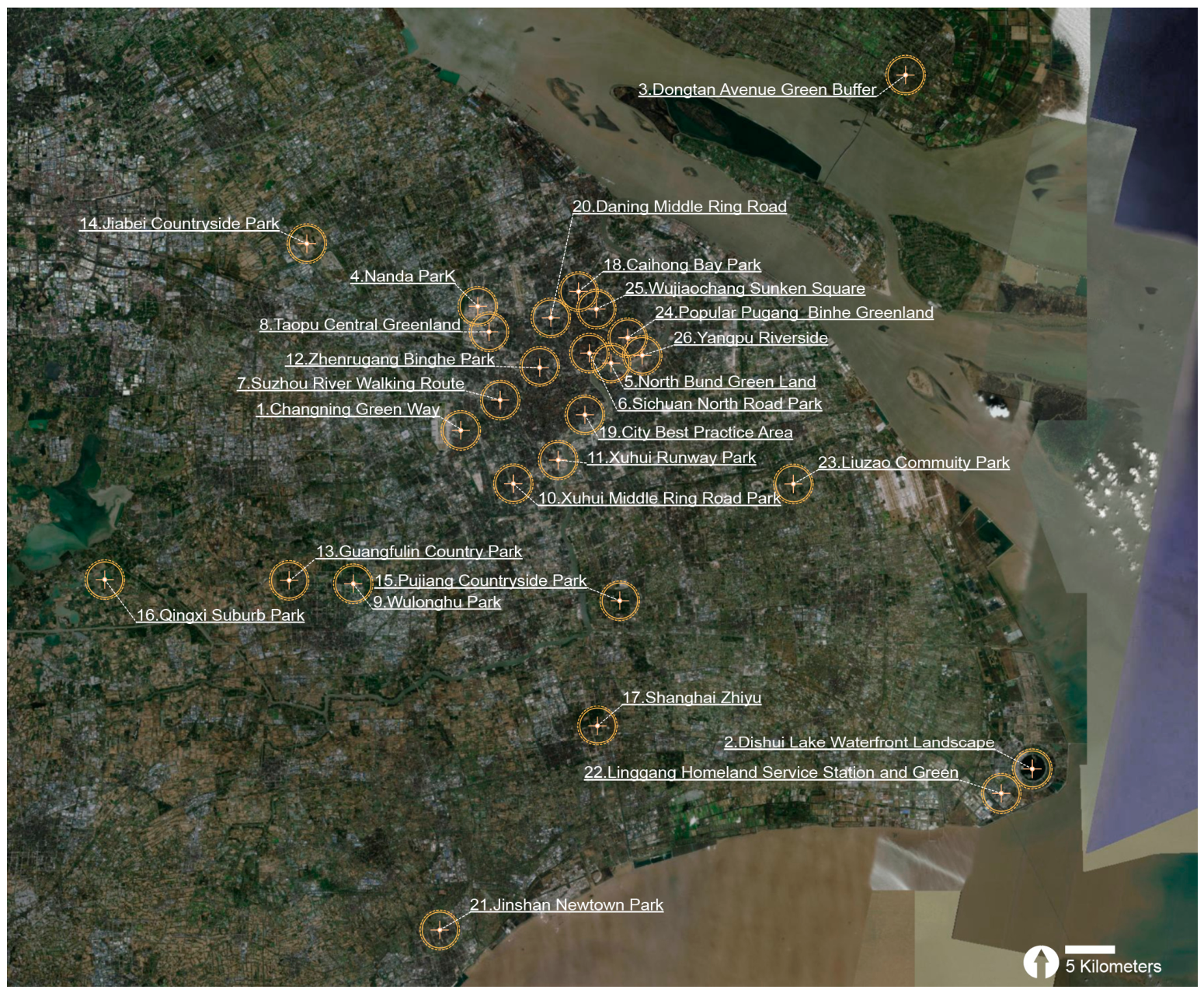
To support a comparable morphology–performance analysis, 26 publicly accessible and constructed park-type SPC projects were selected from the 64 Sponge City pilot areas across Shanghai (Figure 3), covering a wide spectrum of urban contexts: the high-density central city, developing new towns, and suburban areas [42,43]. The selected projects had been implemented by 2025 and were chosen because the analysis requires identifiable park boundaries, public service areas, land-cover composition, and stormwater catchment information. The sample covers a wide range of park sizes, from 0.52 hectares at Wujiaochang Sunken Square to 731.9 hectares at Jiabei Countryside Park. This variation was intentional, as it allows the examination of how scale interacts with morphology and urban context. Although the parks differ in size and location, the selected projects share a common regulatory target, with designed annual stormwater control rates between 70% and 80% [34]. This provides a consistent baseline for comparing their relative performance. Together, these cases provide a suitable basis for comparing SPC parks across morphology, scale, and urban context.

2.4. Research Procedure

The methodology consists of three key steps. First, GIS-based mapping methods were used to examine the morphological features of the SPC parks. Second, the study quantified park service provision and estimated stormwater management performance. Last, based on the assessment results of the selected projects, the potential relationships between morphology and performance were examined to interpret storage–service patterns across park types.

2.4.1. Phase 1: Morphological Classification

A park’s morphology was defined by three dimensions: geometric type, spatial scale, and spatial context. Guided by landscape ecology principles, each park was classified into three geometric types based on its geometric form: node, line, and patch [22,43]. Node-type parks refer to compact and discrete park units, line-type parks refer to elongated, corridor-like spaces, and patch-type parks refer to large, contiguous, and often irregular park areas. These geometric types were identified based on park boundaries, satellite imagery, and available site plans [44]. Second, each site was categorized into four spatial scales based on park area: community (0.5–2 ha), sub-district (2–20 ha), regional (20–100 ha), and city scale (>100 ha) [26,45]. Last, the selected parks’ spatial context was classified into suburban, new town, and central city areas based on the Shanghai municipal planning maps [46]. This three-dimensional classification (type, scale, and context) forms the core morphological typology for subsequent analysis.

2.4.2. Phase 2: Dual-Performance Assessment

To assess dual performance, stormwater management and park services were evaluated. First, park services were assessed based on local service availability and service composition. Availability refers to park area per capita within the park service area, as a spatial indicator of local park availability. Specifically, a 1 km buffer zone from the edge of each park was set as the service scope because it is a convenient distance to visit by walking [47]. This buffer was used as a consistent spatial unit for comparison. Park area per capita is therefore interpreted as park availability within the 1 km buffer rather than actual accessibility. The population within this area was estimated using the WorldPop dataset, which provides population data at a grid scale of approximately 100 m [48]. Population was calculated by summing gridded population values within the 1 km service buffer after raster clipping, and park area per capita was calculated by dividing park area by the estimated buffer population. The service composition of a park is determined by the area of eight common types of land cover (used here as proxies for service-related spatial composition), including pathways, paved open spaces, sports areas (e.g., sports courts or outdoor fitness stations), playgrounds, lawn areas, water areas (e.g., lakes, ponds, and wetlands), other natural areas with no spatial accessibility (e.g., forest), and buildings [49]. The satellite imagery of the selected SPC parks was processed to identify and measure different land cover using the GIS tools of ‘Image Classification’ and ‘Project’ tools [50]. Before classification, representative training samples were manually selected from the high-resolution imagery for the eight land-cover classes. For each land-cover category present in a park, at least three training areas were selected from visually identifiable locations. The procedure consists of five steps:
  • A high-resolution satellite image of each site was obtained through OSM-based map resources.
  • The selected training areas were used to train a support vector machine model to identify different types of land cover.
  • The entire raster was processed under supervised classification, and each pixel was assigned to one of the land-cover classes based on the trained model.
  • The ‘Raster to Polygon’ analysis tool was used to convert the raster file. The output shapefile was then projected in the coordinate system of WGS_1984_UTM_Zone_51N, and the area of each class feature was calculated.
  • The area of each land cover was calculated using the “Summary Statistics” tool. The classified outputs were visually checked against the original high-resolution imagery and available field photographs where possible.
After classification, the outputs were visually checked against the high-resolution imagery and field photographs. The checking focused on category boundaries and possible confusion between visually similar classes.
Second, stormwater storage volume was used as the core attribute of estimated stormwater management performance [51]. It refers to the amount of stormwater that can be collected from the delineated surrounding catchment area. According to the technical guide for Sponge City Construction, low-impact development stormwater system construction, the estimated stormwater storage volume was calculated as follows:
V = 10 × H × Ψ 0 × F
where V is the estimated stormwater storage volume (m3), H refers to the designed rainfall amount (mm), which is calculated based on the designed rainfall depth and the volume capture ratio of annual rainfall in Shanghai for the corresponding Sponge City control zone [52], Ψ0 refers to the synthetic rainfall-runoff coefficient, and F refers to the catchment area (ha). In this study, the calculated value is used as an estimated stormwater storage volume for comparison. For example, Jiabei Countryside Park was assigned a designed rainfall amount of 18.7 mm, a synthetic runoff coefficient of 0.3065, and a catchment area of 2319.25 ha. The estimated stormwater storage volume was calculated as V = 10 × 18.7 × 0.3065 × 2319.25 = 132,915.24 m3. With a park area of 7,224,841.05 m2, the storage volume per unit area was 0.0184 m3/m2. The same procedure was applied to the other parks.
Based on the Special Planning of Shanghai Sponge City, the designed rainfall depth and the volume capture ratio of the annual rainfall of the selected projects are presented in Table 1 [34]. For each park, the designed rainfall depth and the volume capture ratio were assigned according to the corresponding Sponge City planning zone and its annual runoff volume capture target. The stormwater catchment area was delineated from DEM-derived flow direction and flow accumulation layers using the GIS “basin” tool, and was treated as a surface-flow approximation [34]. To calculate the synthetic runoff coefficient, the area of five typical underlying surface types was used, such as green space (S1), bare ground (S2), water body (S3), gravel pavement (S4), and impervious area (S5) (e.g., roof, road, or concrete). These surface types were derived by regrouping the land-cover classes used for service composition analysis. Table 2 presents the runoff coefficient of different underlying surface types [52]. For consistency across cases, the midpoint of each coefficient range in Table 2 was used in the calculation, except for water bodies, which were assigned a coefficient of 1. Then the synthetic runoff coefficient (Ψ0) can be calculated:
Ψ 0 = Ψ 1 S 1 S 0 + Ψ 2 S 2 S 0 + + Ψ 3 S 3 S 0
Ψ 1 refers to the runoff coefficient of green space, Ψ2 refers to the runoff coefficient of the pavement area, Ψ3 refers to the runoff coefficient of the water body, S0 is the area of park space, S1 is the area of green space, S2 is the area of pavement space, and S3 is the area of a water body.

2.4.3. Phase 3: Analysis of Morphology–Performance Relationships

The classified geometric types (node, line, patch) served as the main grouping categories for comparative interpretation. Spatial scale and spatial context were used to interpret differences within and across these park types. The calculated performance metrics (estimated stormwater storage volume, storage per unit area, park area per capita, and land-cover compositions) were compared across these groups using descriptive statistics and correlation analysis. Given the sample size and distribution of cases across morphological types, differences among node-, line-, and patch-type parks were interpreted primarily through descriptive statistics. Pearson correlation analysis was used to explore associations between key continuous variables rather than to establish causal relationships. Statistical significance was evaluated at p < 0.05 for correlation analysis. This phase addresses the core research question by connecting morphological classification with quantitative performance indicators.
To interpret the relationship between form and performance, the analysis adopts trade-offs as a broad planning perspective. In this study, trade-offs are understood as a spectrum: in some settings, stormwater functions and park services may develop in synergy, while they come into tension because of limited space, land-cover allocation, or other reasons. This framing helps guide the interpretation of both group comparisons and correlation results.

2.5. Statistical Analysis and Tools

GIS-based spatial analysis was conducted in ArcMap 10.8.1. This study utilized a combination of spatial analysis system tools, catchment delineation tools, image classification techniques, and statistical software to evaluate the performance of Sponge City parks in stormwater management and park services. Table 3 presents the involved data, including high-resolution satellite imagery accessed through OSM-based map resources, a 12.5 m digital elevation model obtained from https://www.nasa.gov (accessed on 31 May 2023), population datasets from WorldPop, and urban infrastructure information obtained from OSM. During the data collection process, ArcGIS tools of Hydrology and Spatial Analysis were used for project feature extraction, catchment delineation, land-cover classification, and stormwater catchment area delineation. These processes enabled the assessment of SPC parks’ morphological characteristics and performance in stormwater management and park services.
Statistical analysis, including descriptive statistics and correlation analysis, was undertaken to summarize key metrics (estimated stormwater storage volume and park area per capita) and assess correlations between variables. To assess the associations between form and performance, Pearson coefficients were used. Differences across park typologies were interpreted primarily through descriptive statistics. Statistical significance was determined using a threshold of p < 0.05 for correlation analysis.
By combining multiple forms of data, this study developed a morphology–performance framework for evaluating the multifunctionality of Sponge City parks and for understanding how stormwater management can be integrated with park services.

3. Results

3.1. Morphological Typology of SPC Parks

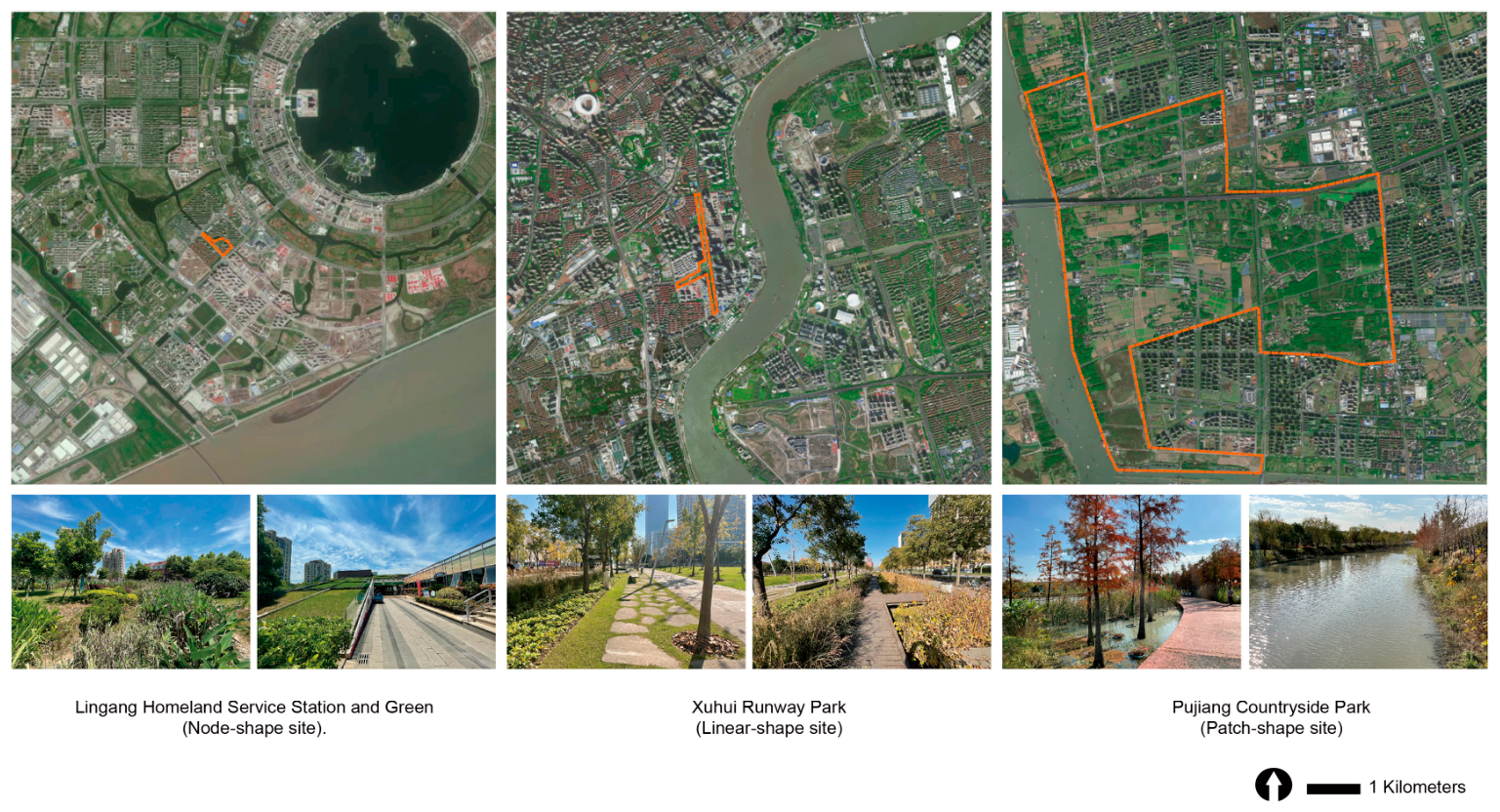
Using the GIS-based classification framework, the 26 SPC parks were categorized according to geometric form, spatial scale, and spatial context (Table 4). Based on satellite imagery and site plans, three distinct morphological types were identified: node (n = 9), characterized by compact, often centralized forms; line (n = 10), featuring elongated, corridor-like shapes; and patch (n = 7), defined by large, contiguous, and irregular perimeters (representative samples are shown in Figure 4). A clear relationship was observed between morphological type and spatial scale. Node-type parks were mainly at the community or sub-district scale, line-type parks ranged from sub-district to regional scale, and patch-type parks were primarily at the city or regional scale. This typology provides the foundational classification for subsequent performance analysis.

3.2. Stormwater Management Performance

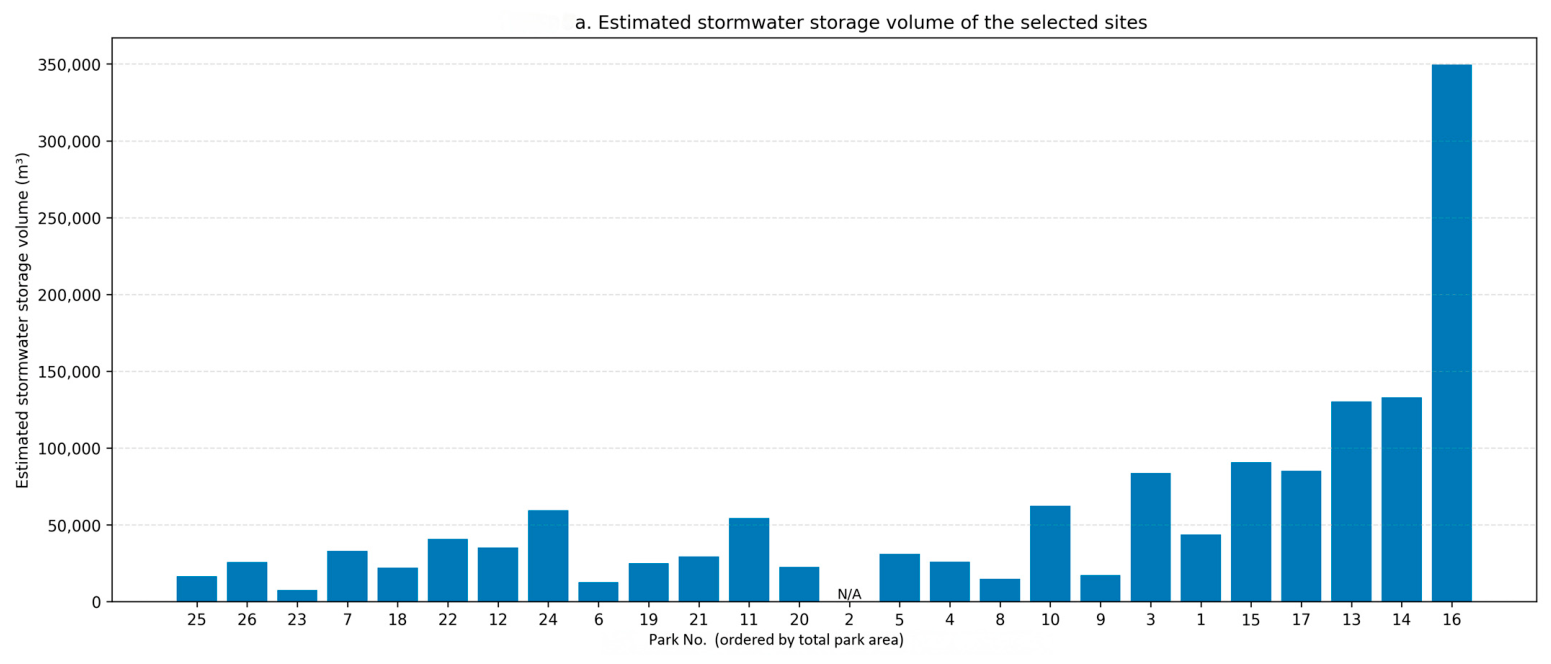
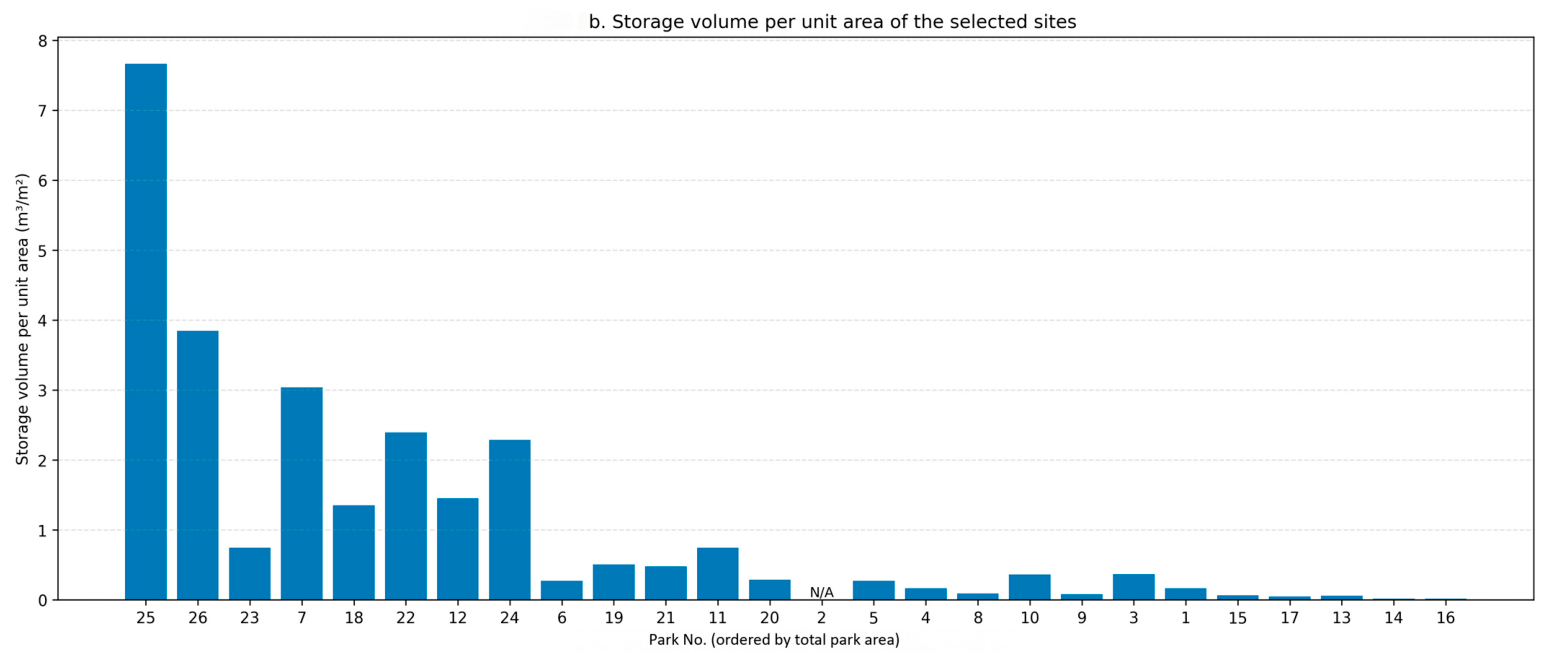
The estimated stormwater storage volume (V) varied substantially across the selected sites, ranging from 7625.1 m3 to 349,596.3 m3, as shown in Figure 5. As expected, the total storage volume was positively associated with park size. However, a different pattern emerged when storage efficiency was considered. When normalized by park area, smaller parks, particularly many node-type and line-type sites, showed an inverse relationship with park size. When grouped by morphological type, patch-type parks showed the highest mean estimated storage volume, followed by line-type and node-type parks. This pattern reflects the larger site areas of many patch-type parks, but variation within each morphological type remained visible, indicating that estimated storage volume should also be interpreted together with catchment area and site-specific drainage context.

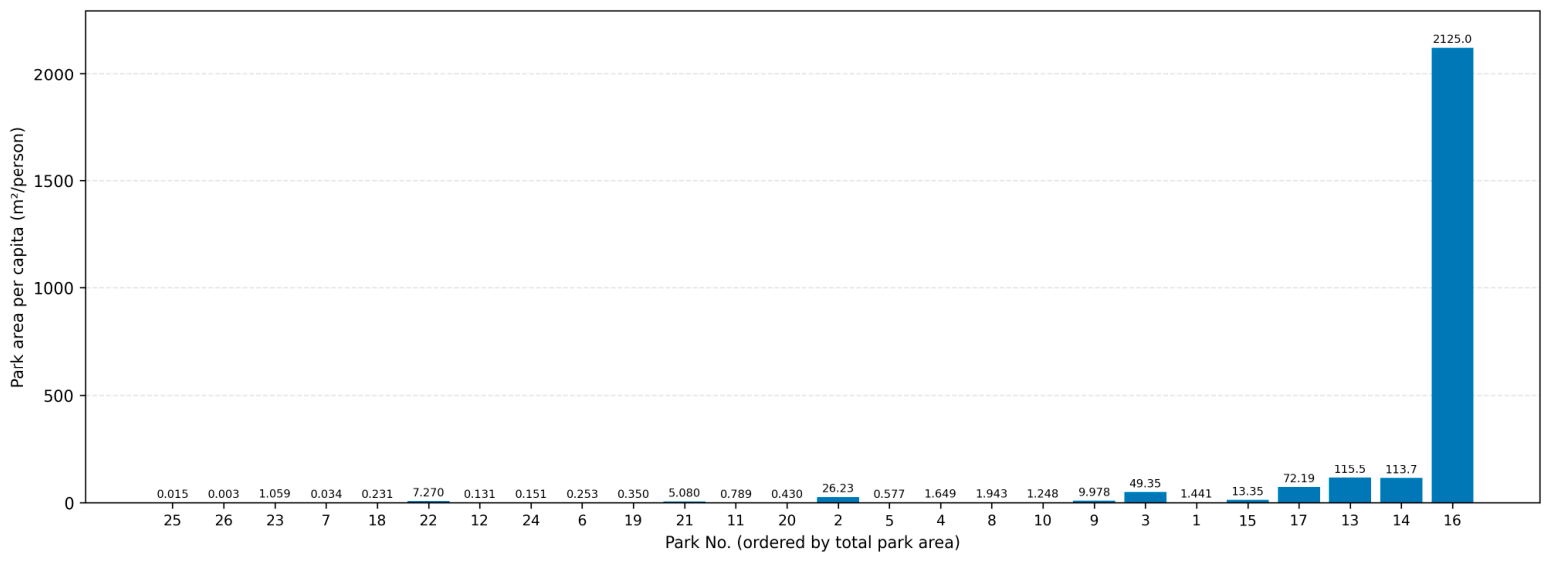
3.3. Park Service Provision Performance

The assessment of park services revealed differences between local park availability and land-cover composition. In terms of service availability, measured as park area per capita within a 1 km radius, the results varied substantially, as shown in Figure 6. Values ranged from 0.0027 to 2124.9825 m2/person, with an overall mean of 97.9978 m2/person and a median of 1.3445 m2/person. The large difference between the mean and median indicates a strongly skewed distribution, mainly because several large city-scale or suburban parks have relatively low surrounding population within the 1 km buffer, whereas some linear parks pass through high-density urban areas. Because this indicator is calculated within a local 1 km buffer, it should be interpreted as local park availability rather than citywide green space provision or actual accessibility.
Analysis of land-cover composition revealed clear differences in service-related spatial composition across the sample. Collectively, lawn areas (mean 24.3%) and other natural areas (mean 35.2%) accounted for most of the park space, which is consistent with greening goals. Pathways (15.2%) and paved open spaces (8.2%) supported circulation and flexible activity use. By contrast, areas dedicated to more intensive functions, such as sports facilities (0.1%) and playgrounds (0.2%), remained limited. Water bodies occupied an average of 9.7% of total space and served both aesthetic and hydrological functions.

3.4. Synthesis: Morphology–Performance Relationships

Integrating the typology with performance metrics suggests that the relationship between stormwater storage and park services can be interpreted as a storage–service spectrum by comparing storage indicators, local park availability, and land-cover composition. At one end, storage capacity and service availability appear to improve together (synergy). At the other end, gains in hydrological performance may be accompanied by constraints on certain service spaces due to limited land and land-cover allocation (tension).
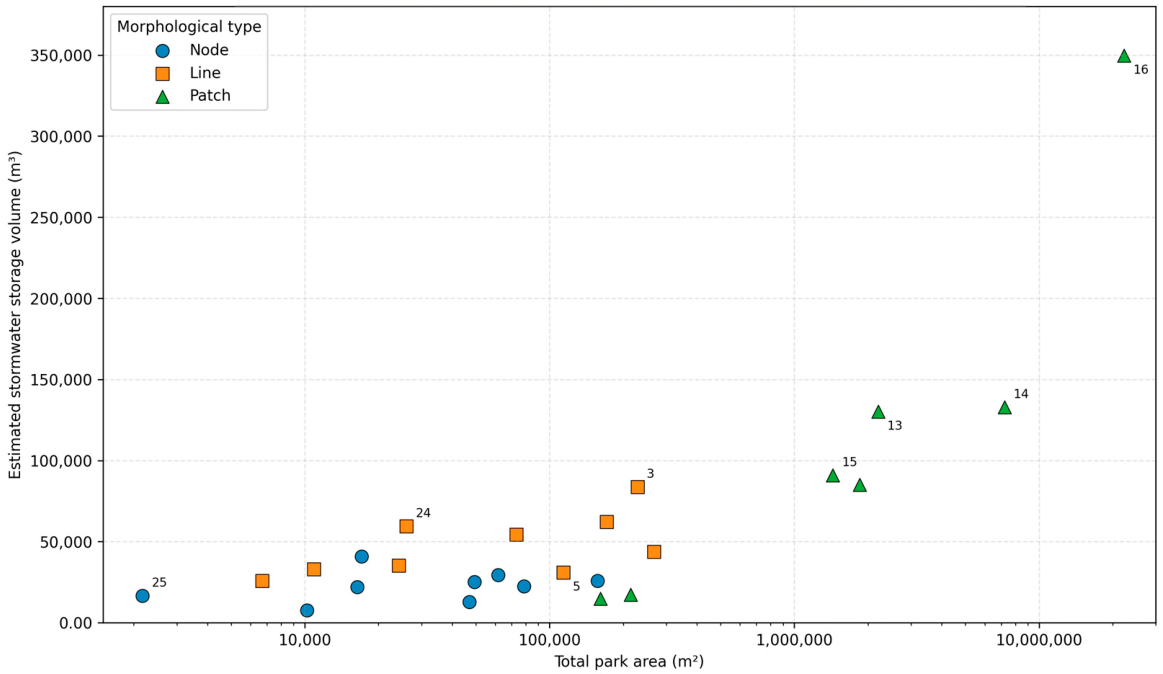
For stormwater management, there is a clear trend that the size of the selected sites is associated with total stormwater storage capacity (Figure 7). When grouped by morphological type, patch-type parks showed the highest mean estimated storage volume, followed by line-type and node-type parks. Although some sites categorized as the line-type occupy a relatively large park area, they still store relatively small amounts of stormwater runoff. For instance, North Bund Green Land, categorized as a line-type, has a relatively large park area of 113,800 m2. Because less stormwater runoff has been captured on-site and more of it is directed to the Huangpu River or the sewer systems, the estimated stormwater storage is relatively low at 31,117.84 m3. This underscores a clear trade-off between total volumetric performance and spatial efficiency.
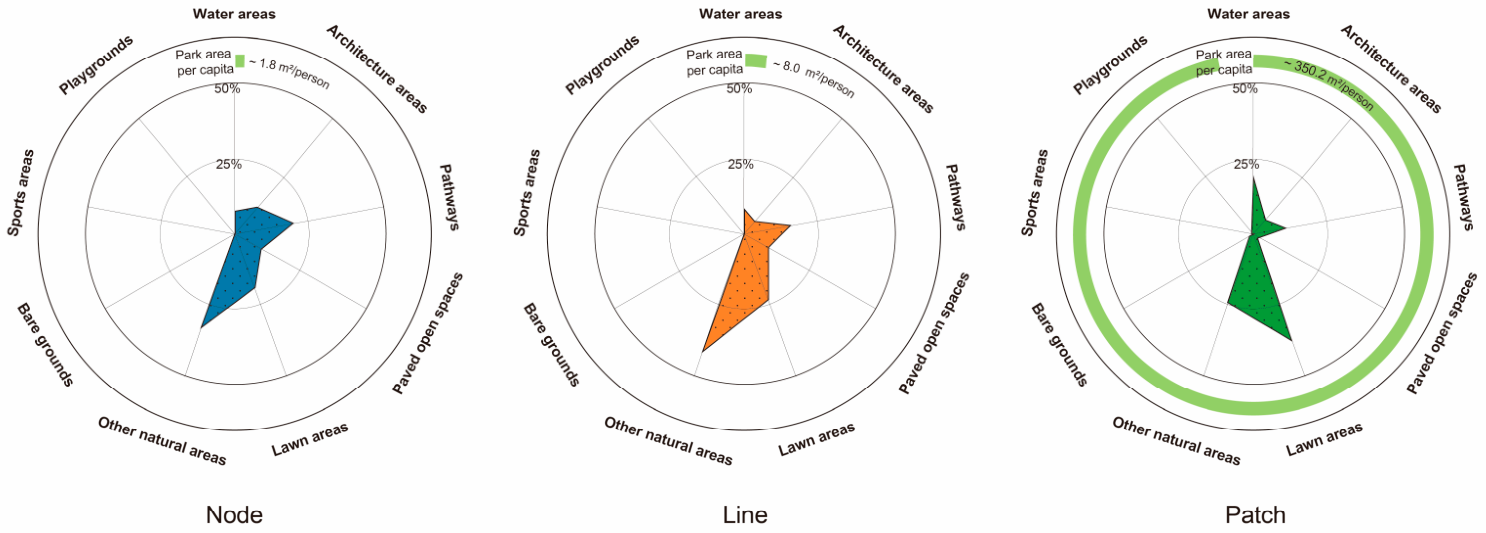
For park services, the mean local park availability showed descriptive differences across morphological types. In the current sample, patch-type parks showed the highest mean park area per capita (350.2361 m2/person), followed by line-type (7.9954 m2/person) and node-type parks (1.8152 m2/person). Land-cover composition also varied by type (Figure 8). Patch-type parks showed the highest mean proportions of water area and lawn area. Line-type parks showed the highest mean proportions of other natural areas and pathways, while node-type parks showed relatively higher proportions of building areas and paved open spaces. Park area per capita only reflects the provision of park space for the surrounding communities and does not account for visitors from distant communities, network accessibility, or actual use intensity.
Building on these differences in service bundles and service availability (Figure 8), SPC parks show different storage–service patterns across morphological types. Patch-type parks in this sample are characterized by larger park area, higher local park availability, and stronger water- and lawn-related composition. Line-type parks show stronger variation, with some large-area cases contributing high estimated storage volume and local availability. Node-type parks remain important for compact and locally distributed service provision, although their total storage depends strongly on site size and catchment conditions.
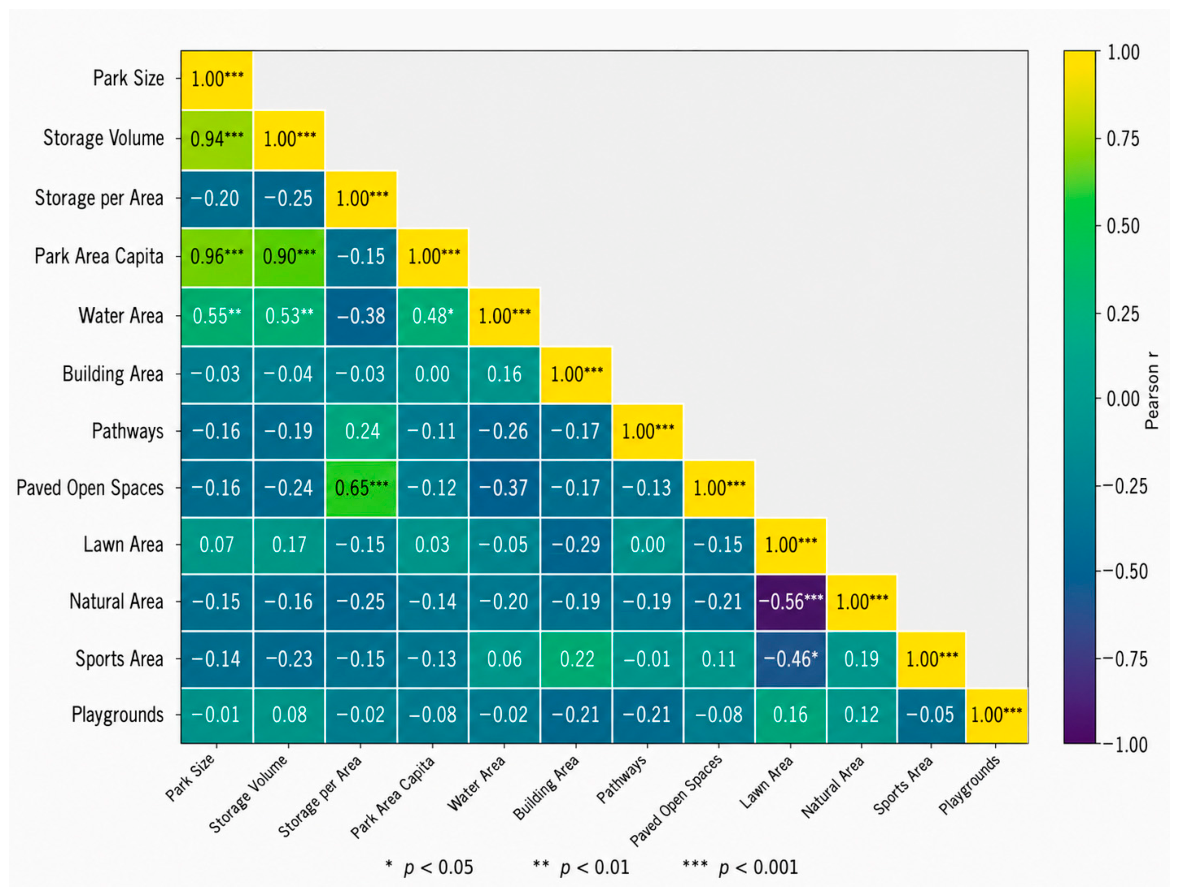
Finally, correlation analysis quantified key associations between performance metrics (Figure 9). A strong positive correlation was found between the total stormwater storage volume and park area per capita (r = 0.901, p < 0.001), suggesting an association between larger storage volume and higher local park availability. Park size was also strongly correlated with park area per capita (r = 0.963, p < 0.001), indicating that park size is an important factor in this relationship. Stormwater storage was positively correlated with the proportion of water area (r = 0.527, p = 0.0068). In addition, a negative correlation was identified between the proportion of lawn and other natural areas (r = -0.562, p = 0.0028), suggesting a potential design or management trade-off between these two types of green spaces. Because multiple correlations were examined in a small sample, the correlation matrix was used for exploratory interpretation. The strong correlations involving park size suggest that several type-based differences are partly scale-related. The higher mean storage volume and park availability of patch-type parks are therefore interpreted mainly in relation to their larger areas, while node- and line-type parks are compared more through storage efficiency, land-cover composition, and contextual roles.

4. Discussion

4.1. Interpreting Morphology–Performance Relationships

The results suggest that park morphology should not be treated as a simple descriptive label. Node-, line-, and patch-type parks differ not only in shape, but also in park size, land availability, surrounding density, and hydrological setting. These differences help interpret why some SPC parks provide greater total storage, while others perform better through spatial efficiency or local service availability. Previous studies have classified Sponge City projects and nature-based solutions, and case-based work has also examined the combined value of SPC parks [27,29,32]. Building on this work, the present study connects park form more directly with estimated stormwater indicators and spatial service indicators. Therefore, morphology offers a useful way to interpret SPC parks as different parts of an urban green infrastructure network, rather than as comparable projects with the same performance expectations.
The typology identified in this study also serves as a useful interpretive tool for planners, policymakers, and other stakeholders. With the identification of source–sink landscape patterns [28,33], it helps clarify how different geometric types may support different roles within the urban hydrological and service network. This performance-oriented interpretation is essential for reading park morphology in ways that support urban resilience, as discussed by Pezzagno [25]. By clarifying the performance implications of each type, the framework allows designers to anticipate possible trade-offs from the early planning stage, such as the contrast between the high total capacity of patch-type parks and the high spatial efficiency of node-type parks.

4.2. Stormwater Management

The results show that park size is closely associated with estimated stormwater storage volume. SPC parks with larger areas and favorable catchment conditions generally showed greater estimated storage values, but this pattern did not correspond to a simple morphology hierarchy. However, this indicator does not fully describe hydrological performance, especially because catchment conditions are represented by a surface-flow approximation rather than observed drainage routing. Smaller node- and line-type parks may contribute less in absolute volume but can still be important when storage is considered per unit area. This differs from assessments that emphasize project scale alone because it shows that smaller SPC parks may still matter when efficiency and spatial distribution are considered [27]. This distinction is particularly important for dense urban areas, where large retention sites are difficult to secure. In such settings, a network of smaller but efficient SPC parks may complement larger regional parks and help distribute source-control functions across the urban fabric.
This emphasis on efficiency calls for a system-level perspective in green infrastructure planning. Research on hydro-environmental adaptation has highlighted the value of classifying interventions according to their functional roles within the stormwater management cycle [53]. The morphology–performance analysis contributes to this by suggesting possible hydrological roles for different park types. Patch-type parks may support retention functions where sufficient land and water areas are available, line-type parks may contribute to corridor-based conveyance or treatment when catchment alignment allows, and node-type parks may provide compact source-control functions in dense settings. This can support the design of an integrated, multi-scale blue–green network while shifting attention from isolated projects to a more systemic sponge effect.

4.3. Park Services

The assessment results also reveal uneven local park availability across Shanghai. In dense urban cores, low park area per capita points to limited park service within the 1 km service buffer. This is consistent with studies showing that the presence of green infrastructure does not necessarily translate into evenly distributed spatial availability [54,55]. The SPC program can expand green infrastructure, but it cannot fully solve shortages in land availability or uneven service distribution on its own. These issues still require broader land-use policy and park network planning.
Morphology also helps structure what kinds of services parks can provide. Patch-type parks in this sample showed higher mean proportions of water area and lawn area, indicating stronger open-space and water-related service composition. Line-type parks showed higher mean proportions of other natural areas and pathways, while node-type parks showed relatively higher proportions of building areas and paved open spaces. This pattern agrees with ecosystem service studies showing that different forms of green space tend to provide different service compositions [30]. For SPC planning, this means that node-, line-, and patch-type parks should not be judged by a single availability or land-cover standard. They need to be understood as complementary parts of a wider park system with different forms of spatial availability and land-cover-based service potential.

4.4. Storage–Service Relationships and Context-Sensitive Design

Stormwater storage and park services do not always move in the same direction. In some parks, the two functions appear to reinforce each other. This is more likely when the site is large enough to accommodate water bodies, lawns, natural habitats, circulation space, and activity areas without strong internal competition. In other parks, especially smaller sites in dense urban areas, improving storage efficiency may compete with the space available for intensive public use. The relationship is therefore better read as a spectrum from synergy to tension.
This provides one way to interpret the different patterns observed across the three morphological types. Patch-type parks tend to have more room for natural-area composition and broader landscape functions when sufficient land and water areas are available. This pattern is consistent with studies on multifunctional landscapes, as well as case-based evidence that SPC parks can support both stormwater and service functions [29,56]. Line-type parks are more conditional. Their service value often comes from movement, connectivity, and corridor functions, but their stormwater performance depends on whether surrounding runoff can be intercepted and retained along the corridor. Node-type parks face stronger land constraints. Their value is less in total storage volume and more in spatial efficiency, local source control, and the careful use of limited public space.
These differences suggest that multifunctionality should not be assumed simply because stormwater facilities are placed inside parks. It depends on the fit between park form, land-cover allocation, catchment setting, and local urban conditions. Patch-type parks may be better suited to natural-area and retention-oriented functions where land is sufficient, line-type parks to connectivity and corridor-based treatment where catchment alignment allows, and node-type parks to compact source-control functions in high-density areas. To make these relationships clearer, Table 5 summarizes the interpreted performance patterns discussed above. The synthesis shows that morphology is not a single causal factor, but an interpretive framework for understanding type-specific contributions. Therefore, the key to SPC park planning is not to apply a single standard to all parks, but to clarify what each type can reasonably contribute under specific site conditions.

4.5. Planning Implications: Morphology-Aware SPC Park Planning

Urban parks are increasingly expected to do more with limited land. They need to support flood adaptation, ecological quality, and everyday public use at the same time, even as urban green space is under pressure from continued development and climate change [54,57]. The results suggest that SPC parks should not be planned or evaluated as if all forms can perform the same role under different site conditions. Patch-type parks may be better suited to larger-scale retention and landscape service functions when sufficient land and water areas are available. Line-type parks can support movement, connectivity, and corridor-based runoff treatment, but their stormwater value depends on whether runoff can be intercepted and retained along the corridor. Node-type parks usually have a limited total capacity, yet they can still provide compact source-control functions and local services in dense urban areas.
This supports the broader argument that green and gray infrastructure need to be integrated to respond to urban water problems and wider public needs [58]. At the same time, this study adds a more specific point: integration does not work in the same way across all park forms. The same stormwater target may lead to different outcomes depending on park size, shape, land cover, catchment setting, and surrounding density. In this respect, the findings contribute to resilience and blue–green infrastructure studies by showing that the role of each park type matters within the larger network [6,10].
For planning, this means that the park type needs to be matched with the site conditions. A small node park in a dense neighborhood should not be judged by the same criteria as a large patch park in a suburban or regional setting. Similarly, a line-type park should not only be assessed by storage volume but also by its corridor function and connection to surrounding catchments. The value of SPC parks, therefore, lies not only in the performance of individual projects but also in how different types may work together across the urban green infrastructure network.

4.6. Limitations

This study has several limitations. First, the analysis is based on Shanghai. The city provides a useful case because it has a large number of implemented SPC parks, but the findings may not transfer directly to cities with different topography, climate, drainage systems, development density, or park networks [10,59]. The analysis also did not use development year, reconstruction intensity, or detailed design objectives as formal control variables because these data were not consistently documented across all cases. Future studies could test whether the node-, line-, and patch-type patterns found here also appear in other urban contexts.
Second, the results depend on the resolution and accuracy of the available spatial data. Morphological classification and land-cover interpretation are influenced by satellite image quality, available field photographs, and classification procedures. Future studies should include independent validation samples and class-level accuracy assessment to improve the robustness of land-cover-based indicators. The stormwater assessment also focuses on storage estimation and DEM-derived catchment delineation, rather than detailed hydrological or hydraulic simulation. Because detailed pipe-network, pump-station, outfall, and river-gate data were not included, the delineated catchments should be interpreted as DEM-derived surface-flow approximations rather than calibrated urban drainage catchments. Further work could include sewer network data, rainfall-runoff modeling, and the interaction between neighboring SPC parks and gray infrastructure.
Lastly, the study focuses on stormwater storage and park service provision. Park area per capita within the 1 km buffer captures local spatial availability, but it does not measure network accessibility, actual visitation, perceived service quality, or socio-economic differences in demand. Similarly, land-cover composition describes the spatial composition of park services, but it does not directly measure user activity or service quality. It does not fully examine user perception, maintenance conditions, long-term ecological performance, or socio-economic differences in service demand. These factors are important for understanding whether multifunctional park design continues to work after implementation [60].

5. Conclusions

The estimated performance patterns of SPC parks are associated with park morphology, scale, catchment setting, land-cover composition, and urban context. Based on 26 cases in Shanghai, the results show that stormwater storage and park service provision do not follow a simple hierarchy among node-, line-, and patch-type parks. Different types contribute through diverse combinations of estimated storage volume, spatial efficiency, local park availability, and land-cover composition. The relationship between stormwater management and park service provision is therefore not simply a matter of two separate indicators. It is better read as a spectrum from synergy to tension. The variation in park area per capita suggests that SPC parks alone cannot fully address local differences in park availability. Planning and design still need to respond to local hydrological conditions, land availability, and public service needs.
The main value of this study is to show that the integration of stormwater management and park services can be interpreted through park form, scale, catchment setting, land-cover allocation, and urban context. Node-, line-, and patch-type SPC parks do not simply differ in shape, but also differ in how they may support storage, connectivity, efficiency, and park service availability. This provides a clearer basis for interpreting different roles of SPC parks within an urban green infrastructure network. Patch-type parks can support natural-area and retention-oriented functions. Line-type parks can strengthen corridor connectivity and runoff treatment when catchment conditions allow. Node-type parks can provide compact and efficient source control in dense areas where land constraints are stronger.
Further research should examine SPC parks as connected parts of a landscape system, rather than as isolated projects. Future work should also include ecological processes, user perception, maintenance conditions, network accessibility, detailed drainage data, and possible secondary risks such as water quality fluctuations. Longitudinal monitoring and comparisons across cities would help test whether the morphology–performance relationships identified in Shanghai also apply elsewhere.

Author Contributions

Conceptualization, P.T.; methodology, P.T.; software, P.T.; validation, P.T.; formal analysis, P.T.; investigation, P.T.; data curation, P.T.; writing—original draft preparation, P.T.; writing—review and editing, H.Y., Z.W., and I.T.; visualization, P.T. and I.T.; supervision, Z.W.; project administration, H.Y. All authors have read and agreed to the published version of the manuscript.

Funding

This research received no external funding.

Data Availability Statement

The original contributions presented in this study are included in the article. Further inquiries can be directed to the corresponding author.

Acknowledgments

The authors would like to thank the editor and anonymous reviewers for their constructive comments and suggestions that helped improve this article.

Conflicts of Interest

The authors declare no conflicts of interest.

References

  1. Fletcher, T.D.; Shuster, W.; Hunt, W.F.; Ashley, R.; Butler, D.; Arthur, S.; Trowsdale, S.; Barraud, S.; Semadeni-Davies, A.; Bertrand-Krajewski, J.-L.; et al. SUDS, LID, BMPs, WSUD and More—The Evolution and Application of Terminology Surrounding Urban Drainage. Urban Water J. 2015, 12, 525–542. [Google Scholar] [CrossRef]
  2. Fletcher, T.D.; Andrieu, H.; Hamel, P. Understanding, Management and Modelling of Urban Hydrology and Its Consequences for Receiving Waters: A State of the Art. Adv. Water Resour. 2013, 51, 261–279. [Google Scholar] [CrossRef]
  3. Larsen, T.A.; Hoffmann, S.; Luthi, C.; Truffer, B.; Maurer, M. Emerging Solutions to the Water Challenges of an Urbanizing World. Science 2016, 352, 928–933. [Google Scholar] [CrossRef]
  4. Radcliffe, J.C. Chapter 1—History of Water Sensitive Urban Design/Low Impact Development Adoption in Australia and Internationally. In Approaches to Water Sensitive Urban Design; Sharma, A.K., Gardner, T., Begbie, D., Eds.; Woodhead Publishing: Sawston, Cambridge, 2019; pp. 1–24. [Google Scholar]
  5. Tong, P. Characteristics, Dimensions and Methods of Current Assessment for Urban Resilience to Climate-Related Disasters: A Systematic Review of the Literature. Int. J. Disaster Risk Reduct. 2021, 60, 102276. [Google Scholar] [CrossRef]
  6. Dong, W.; Zhou, Y.; Guo, D.; Chen, Z.; Wang, J. Evaluation of Urban Infrastructure Resilience Based on Risk-Resilience Coupling: A Case Study of Zhengzhou City. Land 2025, 14, 530. [Google Scholar] [CrossRef]
  7. Bolund, P.; Hunhammar, S. Ecosystem Services in Urban Areas. Ecol. Econ. 1999, 29, 293–301. [Google Scholar] [CrossRef]
  8. Chiesura, A. The Role of Urban Parks for the Sustainable City. Landsc. Urban Plan. 2004, 68, 129–138. [Google Scholar] [CrossRef]
  9. Cranz, G.; Boland, M. Defining the Sustainable Park: A Fifth Model for Urban Parks. Landsc. J. 2004, 23, 102–120. [Google Scholar] [CrossRef]
  10. Liu, Y.; Chen, H.; Wu, J.; Wang, Y.; Ni, Z.; Chen, S. Impact of Urban Spatial Dynamics and Blue-Green Infrastructure on Urban Heat Islands: A Case Study of Guangzhou Using Local Climate Zones and Predictive Modeling. Sust. Cities Soc. 2024, 115, 105819. [Google Scholar] [CrossRef]
  11. Huq, M.E.; López-Carr, D.; Mohd Isa, N.K.; Mahat, H.; Ibrahim, M.H.; Nayan, N.; Muhamad Ismail, M.I.; Jumadi, J.; Hossain, M.K.; Sarker, M.N.I.; et al. Emerging Insights into Low Impact Development (LID) Strategy for Urban Flood Resilience under Climate Change. Environ. Dev. 2026, 58, 101430. [Google Scholar] [CrossRef]
  12. Ferrans, P.; Torres, M.N.; Temprano, J.; Rodríguez Sánchez, J.P. Sustainable Urban Drainage System (SUDS) Modeling Supporting Decision-Making: A Systematic Quantitative Review. Sci. Total Environ. 2022, 806, 150447. [Google Scholar] [CrossRef]
  13. Dudzic-Gyurkovich, K. Urban Development and Population Pressure: The Case of Mlynowka Krolewska Park in Krakow, Poland. Sustainability 2021, 13, 1116. [Google Scholar] [CrossRef]
  14. Hersperger, A.M.; Gradinaru, S.R.; Pierri Daunt, A.B.; Imhof, C.S.; Fan, P. Landscape Ecological Concepts in Planning: Review of Recent Developments. Landsc. Ecol. 2021, 36, 2329–2345. [Google Scholar] [CrossRef]
  15. Otte, A.; Simmering, D.; Wolters, V. Biodiversity at the Landscape Level: Recent Concepts and Perspectives for Multifunctional Land Use. Landsc. Ecol. 2007, 22, 639–642. [Google Scholar] [CrossRef]
  16. Spahr, K.M.; Bell, C.D.; McCray, J.E.; Hogue, T.S. Greening up Stormwater Infrastructure: Measuring Vegetation to Establish Context and Promote Cobenefits in a Diverse Set of US Cities. Urban For. Urban Green. 2020, 48, 126548. [Google Scholar] [CrossRef]
  17. Marzio, S.; Tosi, J.; Poggi, F.; Amado, M. Nature-Based Solutions for Urban Waterfront Regeneration: A Systematic Review of Frameworks, Strategies and Applications. City Environ. Interact. 2026, 29, 100281. [Google Scholar] [CrossRef]
  18. MacAdam, J.; Syracuse, T.; DeRoussel, J.; Roach, K. Green Infrastructure for Southwestern Neighborhoods; The University of Arizona: Tucson, Arizona, 2012; Volume 50. [Google Scholar]
  19. Maryland Department of the Environment Water Management Administration. 2000 Maryland Stormwater Design Manual Volumes I&II 2000; Maryland Department of the Environment Water Management Administration: Baltimore, MD, USA, 2000. [Google Scholar]
  20. Minnesota Pollution Control Agency Minnesota Stormwater Manual. Available online: https://stormwater.pca.state.mn.us/index.php/Main_Page (accessed on 13 October 2021).
  21. San Antonio River Authority. San Antonio River Basin Low Impact Development Technical Design Guidance Manual, 2nd ed.; San Antonio River Authority: San Antonio, TX, USA, 2019. [Google Scholar]
  22. US EPA Urban Runoff: Low Impact Development. Available online: https://www.epa.gov/nps/urban-runoff-low-impact-development (accessed on 30 August 2021).
  23. NYS Department of Environmental Conservation New York State Stormwater Management Design Manual. Available online: https://www.dec.ny.gov/chemical/29072.html (accessed on 13 October 2021).
  24. Kowe, P.; Mutanga, O.; Odindi, J.; Dube, T. Effect of Landscape Pattern and Spatial Configuration of Vegetation Patches on Urban Warming and Cooling in Harare Metropolitan City, Zimbabwe. GIScience Remote Sens. 2021, 58, 261–280. [Google Scholar] [CrossRef]
  25. Pezzagno, M.; Frigione, B.M.; Ferreira, C.S.S. Reading Urban Green Morphology to Enhance Urban Resilience: A Case Study of Six Southern European Cities. Sustainability 2021, 13, 9163. [Google Scholar] [CrossRef]
  26. Tian, Y.; Jim, C.Y.; Wang, H. Assessing the Landscape and Ecological Quality of Urban Green Spaces in a Compact City. Landsc. Urban Plan. 2014, 121, 97–108. [Google Scholar] [CrossRef]
  27. Feng, S.; Yamamoto, T. Preliminary Research on Sponge City Concept for Urban Flood Reduction: A Case Study on Ten Sponge City Pilot Projects in Shanghai, China. Disaster Prev. Manag. 2020, 29, 961–985. [Google Scholar] [CrossRef]
  28. Wang, Z.; Cheng, K. Spatial and Temporal Changes of ‘Source-Sink’ Landscapes during Stromwater Processes in the North Canal Basin, China. Acta Ecol. Sin. 2019, 39, 5922–5931. [Google Scholar] [CrossRef]
  29. Tong, P.; Yin, H.; Wang, Z.; Trivers, I. Combining Stormwater Management and Park Services to Mitigate Climate Change and Improve Human Well-Being: A Case Study of Sponge City Parks in Shanghai. Land 2022, 11, 1589. [Google Scholar] [CrossRef]
  30. Yusuf, D.A.; Zhu, J.; Khaing, C.T.; Adamu, S.; Bala, H.S. Regulating Urban Metabolism in Semi-Arid Regions: Classification and Valuation of Urban Open Spaces Ecosystem Services in Metropolitan Kano. Environ. Dev. 2025, 54, 101165. [Google Scholar] [CrossRef]
  31. Wang, J.; Qiu, C.; Qin, S.; Yao, S.; Chen, J.; Lei, S.; Tan, S.; Zhou, B. Effects of “Source-Sink” Landscape on Spatiotemporal Differentiation of Phosphorus Output in Multiple Watersheds in Mountainous Areas Based on the Modified Location-Weighted Landscape Index. Ecol. Indic. 2024, 158, 111397. [Google Scholar] [CrossRef]
  32. Anderson, V.; Gough, W.A.; Anderson, V.; Gough, W.A. A Typology of Nature-Based Solutions for Sustainable Development: An Analysis of Form, Function, Nomenclature, and Associated Applications. Land 2022, 11, 1072. [Google Scholar] [CrossRef]
  33. Zhang, L.; Jiao, S.; Lu, J. The Effectiveness Analysis of Traditional and New Landscape Indexes in Indicating Flood Risk of Watersheds from the Perspective of Source-Sink Landscapes: A Case Study of Changsha, China. Ecol. Indic. 2025, 170, 113109. [Google Scholar] [CrossRef]
  34. Shanghai Municipal Planning. Special Planning of Shanghai Sponge City; Land and Resources Administration: Beijing, China, 2016. [Google Scholar]
  35. Subtropical Monsoon Climate. In Dictionary of Geotourism; Chen, A., Ng, Y., Zhang, E., Tian, M., Eds.; Springer: Singapore, 2020; p. 593. [Google Scholar]
  36. Shi, J.; Cui, L. Spatial Pattern and Temporal Change of Climate in Shanghai. J. Geo-Inf. Sci. 2015, 17, 1348–1354. [Google Scholar]
  37. Aladin Shanghai Weather. Available online: https://www.weather-atlas.com/en/china/shanghai-climate (accessed on 13 December 2022).
  38. Zhou, Z.; Liu, S.; Zhong, G.; Cai, Y. Flood Disaster and Flood Control Measurements in Shanghai. Nat. Hazards Rev. 2016, 18, B5016001. [Google Scholar] [CrossRef]
  39. Xu, H.; Tian, Z.; Sun, L.; Ye, Q.; Ragno, E.; Bricker, J.; Mao, G.; Tan, J.; Wang, J.; Ke, Q.; et al. Compound Flood Impact of Water Level and Rainfall during Tropical Cyclone Periods in a Coastal City: The Case of Shanghai. Nat. Hazards Earth Syst. Sci. 2022, 22, 2347–2358. [Google Scholar] [CrossRef]
  40. Shanghai Municipal Statistics Bureau Survey Office of the National Bureau of Statistics. Shanghai Shanghai Statistical Yearbook 2020; Shanghai Municipal Statistics Bureau Survey Office of the National Bureau of Statistics: Shanghai, China, 2020. [Google Scholar]
  41. Shanghai Urban Planning and Land Resource Administration Bureau. The Shanghai Master Plan 2017–2035; Shanghai Urban Planning and Land Resource Administration Bureau: Shanghai, China, 2018. [Google Scholar]
  42. Sohu.com Case Study on the Reconstruction of 15 Sponge City Projects in Shanghai. Available online: https://www.sohu.com/a/www.sohu.com/a/247021442_649223 (accessed on 10 June 2022).
  43. Beijing Sponge City Engineering Research Institute The 14th Five-Year Plan of Shanghai Sponge City Construction. Available online: http://www.spongect.com/NewsDetailed.aspx?id=730 (accessed on 16 August 2022).
  44. Arsanjani, J.J.; Zipf, A.; Mooney, P.; Helbich, M. (Eds.) An Introduction to OpenStreetMap in Geographic Information Science: Experiences, Research, and Applications. In OpenStreetMap in GIScience. Lecture Notes in Geoinformation and Cartography; Springer: Cham, Switzerland, 2015. [Google Scholar] [CrossRef]
  45. Cheng, Y.; Zhang, J.; Wei, W.; Zhao, B. Effects of Urban Parks on Residents’ Expressed Happiness before and during the COVID-19 Pandemic. Landsc. Urban Plan. 2021, 212, 104118. [Google Scholar] [CrossRef]
  46. Zhang, L.; Wang, Z.; DA, L. Spatial Characteristics of Urban Green Space: A Case Study of Shanghai, China. Appl. Ecol. Environ. Res. 2019, 17, 1799–1815. [Google Scholar] [CrossRef]
  47. Giles-Corti, B.; Broomhall, M.H.; Knuiman, M.; Collins, C.; Douglas, K.; Ng, K.; Lange, A.; Donovan, R.J. Increasing Walking: How Important Is Distance to, Attractiveness, and Size of Public Open Space? Am. J. Prev. Med. 2005, 28, 169–176. [Google Scholar] [CrossRef]
  48. Bondarenko, M.; Kerr, D.; Sorichetta, A.; Tatem, A.J. Census/Projection-Disaggregated Gridded Population Datasets for 189 Countries in 2020 Using Built-Settlement Growth Model (BSGM) Outputs. In WorldPop; University of Southampton: Southampton, UK, 2020. [Google Scholar] [CrossRef]
  49. Zhai, Y.; Li, D.; Wu, C.; Wu, H. Urban Park Facility Use and Intensity of Seniors’ Physical Activity—An Examination Combining Accelerometer and GPS Tracking. Landsc. Urban Plan. 2021, 205, 103950. [Google Scholar] [CrossRef]
  50. ESRI Image Classification and Segmentation. Available online: https://developers.arcgis.com/python/guide/image-classfication-and-segmentation/ (accessed on 14 October 2022).
  51. Wang, W.; Zhang, L.; Li, J. Assessment Standard for Sponge City Effects; IWA: London, UK, 2020. [Google Scholar] [CrossRef]
  52. Shanghai Municipal Commission of Housing and Urban-Rural Development Management. Shanghai Sponge City Construction Technical Guidelines (Trial); Shanghai Municipal Commission of Housing and Urban-Rural Development Management: Shanghai, China, 2015. (In Chinese) [Google Scholar]
  53. Stamou, A.I.; Mitsopoulos, G.; Sfetsos, A.; Stamou, A.T.; Varotsos, K.V.; Giannakopoulos, C.; Koutroulis, A. Typologizing the Hydro-Environmental Research on Climate Change Adaptation of Water Infrastructure in the Mediterranean Region. Atmosphere 2024, 15, 1526. [Google Scholar] [CrossRef]
  54. Diaz, S.; Settele, J.; Brondizio, E.S.; Ngo, H.T.; Agard, J.; Arneth, A.; Balvanera, P.; Brauman, K.A.; Butchart, S.H.M.; Chan, K.M.A.; et al. Pervasive Human-Driven Decline of Life on Earth Points to the Need for Transformative Change. Science 2019, 366, 1327. [Google Scholar] [CrossRef]
  55. Azadgar, A.; Luciani, G.; Nyka, L. Spatial Allocation of Nature-Based Solutions in the Form of Public Green Infrastructure in Relation to the Socio-Economic District Profile–a GIS-Based Comparative Study of Gdańsk and Rome. Land Use Policy 2025, 150, 107454. [Google Scholar] [CrossRef]
  56. Schindler, S.; Sebesvari, Z.; Damm, C.; Euller, K.; Mauerhofer, V.; Schneidergruber, A.; Biró, M.; Essl, F.; Kanka, R.; Lauwaars, S.; et al. Multifunctionality of Floodplain Landscapes: Relating Management Options to Ecosystem Services. Landsc. Ecol. 2014, 29, 229–244. [Google Scholar] [CrossRef]
  57. Wolch, J.R.; Byrne, J.; Newell, J.P. Urban Green Space, Public Health, and Environmental Justice: The Challenge of Making Cities ‘Just Green Enough. Landsc. Urban Plan. 2014, 125, 234–244. [Google Scholar] [CrossRef]
  58. Browder, G.; Ozment, S.; Rehberger Bescos, I.; Gartner, T.; Lange, G.-M. Integrating Green and Gray; World Bank and World Resources Institute: Washington, DC, USA, 2019. [Google Scholar]
  59. Sattar, T.; Mirza, N.F.; Javed, M.A.; Nasar-u-Minallah, M.; Malik, S. Changing Pattern of Urban Landscape and Its Impact on Thermal Environment of Lahore; Implications for Climate Change and Sustainable Development. Environ. Monit. Assess. 2025, 197, 151. [Google Scholar] [CrossRef] [PubMed]
  60. Kumar, P.; Choudhary, M.P.; Mathur, A.K. Exploring Spatial Dynamics of Urbanization and Solid Waste Generation in Kota City Using the Google Earth Engine. Environ. Monit. Assess. 2025, 197, 212. [Google Scholar] [CrossRef]
Figure 1. Research framework of the study.
Land 15 01048 g001
Figure 2. The location of Shanghai City.
Land 15 01048 g002
Figure 3. Locations of the selected SPC parks across Shanghai.
Land 15 01048 g003
Figure 4. Sampled sites across different morphological types.
Land 15 01048 g004
Figure 5. Estimated stormwater storage volume (a) and storage volume per unit area (b).
Land 15 01048 g005aLand 15 01048 g005b
Figure 6. Park area per capita within the 1 km service buffer.
Land 15 01048 g006
Figure 7. Estimated stormwater storage volume by park area and morphological type.
Land 15 01048 g007
Figure 8. Mean land-cover composition by morphological type.
Land 15 01048 g008
Figure 9. Correlation matrix of key performance metrics.
Land 15 01048 g009
Table 1. Volume capture ratio of annual rainfall and the design rainfall depth in Shanghai.
Volume Capture Ratio of Annual Rainfall (%)Design Rainfall Depth (mm)
6013.4
7018.7
7522.2
8026.7
8533.0
Table 2. Runoff coefficient of different underlying surface types.
Type of Underlying SurfaceRunoff Coefficient Ψ
Green space0.10~0.20
Rooftop, concrete, and asphalt pavement0.85~0.95
Gravel pavement0.35~0.40
Water body1
Bare/unpaved ground0.25–0.35
Table 3. Data collection.
CategoryTypeContent
Normalized dataGeographical imageryOSM-based imagery, 12.5 m DEM; accessed through corresponding online map and DEM sources during GIS processing
Urban infrastructureOSM vector data and municipal map references, including roads, buildings, railways, green space, and waterways.
Climate and planning dataPrecipitation, annual runoff volume capture target, and design rainfall depth from Shanghai Sponge City planning documents
DemographicWorldPop gridded population data, approximately 100 m grid
OtherPoints of interest, administrative division data, and land cover data
Calculated indicatorssite-level performance metricsStormwater storage volume, storage efficiency, park area per capita, and land-cover proportions
Table 4. Overview of the selected SPC parks.
NoGeometry TypesScalesSpace ContextServing Population
Within 1 km Service Buffer
1LineRegionalCentral City185,599
2LineSub-districtCentral City3506
3LineRegionalSuburban4631
4NodeSub-districtNew Town95,336
5LineSub-districtSuburban197,152
6NodeSub-districtCentral City186,084
7LineRegionalCentral City316,066
8PatchRegionalNew Town83,135
9PatchRegionalCentral City21,530
10LineRegionalCentral City137,290
11LineSub-districtSuburban92,784
12LineSub-districtCentral City184,594
13PatchCityCentral City19,045
14PatchCityNew Town63,535
15PatchCityCentral City107,708
16PatchCitySuburban10,481
17PatchCitySuburban25,585
18NodeCommunityCentral City71,003
19NodeSub-districtCentral City141,120
20NodeSub-districtNew Town182,589
21NodeSub-districtNew Town12,143
22NodeCommunityNew Town2346
23NodeCommunityCentral City9647
24LineSub-districtCentral City172,670
25NodeCommunityNew Town146,919
26LineSub-districtNew Town2,500,148
Table 5. Synthesis of morphology–performance relationships and planning implications.
Morphological TypeInterpreted Performance PatternMain Supporting EvidencePlanning Implication
Node-type parksCompact parks with limited total estimated storage but potential spatial efficiency and local source-control value.
  • Generally smaller total estimated storage;
  • Lowest mean local park availability in this sample;
  • Relatively higher proportions of buildings and paved open spaces.
  • Prioritize compact source-control functions, especially infiltration and detention, where land is limited;
  • Evaluate performance by storage efficiency and neighborhood service potential, not only by total storage volume;
  • Balance paved/open spaces with small-scale stormwater functions.
Line-type parksCorridor-like parks with conditional stormwater and service performance, depending on catchment alignment and spatial continuity.
  • Intermediate but variable estimated storage;
  • Higher proportions of pathways and other natural areas;
  • Service value is often linked to corridor continuity and connectivity.
  • Arrange infiltration, detention, purification, and discharge functions according to catchment alignment;
  • Maintain corridor continuity while supporting stormwater conveyance and detention;
  • Coordinate line-type parks with surrounding blue–green infrastructure.
Patch-type parksLarge contiguous parks with stronger total storage and broader open-space or landscape service potential.
  • Highest mean estimated storage volume and highest mean local park availability;
  • Higher proportions of water areas and lawns.
  • Prioritize larger-scale retention where land and water space are sufficient;
  • Support purification and utilization through water areas, lawns, and natural areas;
  • Use patch-type parks as larger multifunctional anchors for storage, open-space provision, and ecological functions.
Disclaimer/Publisher’s Note: The statements, opinions and data contained in all publications are solely those of the individual author(s) and contributor(s) and not of MDPI and/or the editor(s). MDPI and/or the editor(s) disclaim responsibility for any injury to people or property resulting from any ideas, methods, instructions or products referred to in the content.