Article

Nonlinear Day–Night Thermal Responses to Grey–Green Spatial Patterns and Building Morphology: A Land–Climate Interaction Assessment in Xi’an, China

School of Architecture, Chang’an University, Xi’an 710061, China
*
Author to whom correspondence should be addressed.
These authors contributed equally to this work.
Land 2026, 15(6), 1047; https://doi.org/10.3390/land15061047 (registering DOI)
Submission received: 9 May 2026 / Revised: 31 May 2026 / Accepted: 4 June 2026 / Published: 13 June 2026

Abstract

Rapid urbanization reshapes urban land systems and intensifies surface thermal heterogeneity, yet nonlinear day–night land surface temperature (LST) responses to grey–green spatial organization and building morphology remain insufficiently understood, particularly in thermally stressed areas across the urban–rural gradient. Using Xi’an, China, as a case study, this study develops a priority-area-based land–climate interaction framework. Priority areas were defined as grid cells where elevated LST coincided with relatively strong local explanatory relationships between LST and land-cover or morphological variables. Multiscale geographically weighted regression (MGWR), gradient boosting decision trees (GBDTs), SHAP-based interpretation, and threshold sensitivity analysis were combined to identify dominant drivers, nonlinear response patterns, and interaction structures of daytime and nighttime LST. The results show pronounced day–night differentiation: daytime hotspots were concentrated in the built-up core, whereas nighttime hotspots extended toward the urban–rural fringe. Daytime LST was mainly associated with building coverage and grey-space organization, while nighttime LST was more strongly related to mean building height and the cooling contribution of green-space coverage. The analysis further identified localized empirical response ranges for built-up intensity, grey-space connectivity, building height, and green-space coverage within the priority areas. These findings clarify how land-cover configuration and building morphology jointly shape day–night surface thermal responses and provide context-specific evidence for land-use planning and targeted urban heat mitigation.

1. Introduction

Rapid urbanization and climate change have intensified the urban heat island effect, increased the frequency of extreme heat conditions, and made land–climate interactions an increasingly important issue in urban land-system research [1,2]. Of particular concern are compound daytime and nighttime heat conditions in summer, which disrupt the conventional thermal rhythm of hot days and cool nights and intensify the persistence of urban heat [2]. In rapidly urbanizing land systems, grey space, green space, and building morphology jointly mediate surface heat absorption, storage, and release. Understanding how land-cover configuration and grey–green spatial patterns shape these day–night thermal dynamics is therefore essential for explaining urban thermal heterogeneity and supporting targeted heat mitigation.
Land surface temperature (LST) is widely used to characterize the spatial variability of urban thermal environments because it reflects differences in surface energy balance and heat storage–release processes [3,4,5]. Built form, impervious surfaces, and green space all play important roles in regulating solar radiation absorption, heat storage, and nighttime cooling [6,7]. Building coverage ratio and impervious surface intensity are widely recognized as major drivers of elevated LST [8], whereas green space can provide cooling through shading, evapotranspiration, and modification of surface thermal properties [9]. At the same time, building geometry, such as mean building height, can influence sky exposure, near-surface airflow, and nighttime heat release [6,10]. These effects are particularly important in rapidly urbanizing cities, where the spatial arrangement of buildings, hard surfaces, and vegetation strongly influences local microclimatic conditions [6,7].
Previous studies have shown that urban heat is shaped by multiple aspects of urban form rather than by any single factor in isolation [11,12]. Thermal responses differ substantially between daytime and nighttime conditions and also vary across the urban–rural gradient [6,10]. These findings have improved understanding of morphology–temperature relationships and, in some cases, have revealed threshold-like responses relevant to thermal regulation [13]. However, systematic knowledge of nonlinear day–night thermal responses to two-dimensional grey–green spatial patterns and three-dimensional building morphology remains limited. In particular, the combined effects of building form, grey-space structure, and green-space configuration across different urban zones have not yet been sufficiently clarified [7,14,15].
The nonlinear and spatially heterogeneous nature of morphology–temperature relationships also creates methodological challenges. Traditional linear regression models often fail to capture threshold behavior, varying marginal effects, and multi-factor interactions. Recent advances in machine learning have improved the ability to model these complexities, while explainable approaches help identify the relative importance, direction, and interaction structure of different drivers [16,17,18]. Nevertheless, many existing studies emphasize predictive accuracy more than interpretable nonlinear response patterns, especially those associated with day–night thermal variation under different urban morphological contexts [16,17,18].
Xi’an provides a representative case for addressing these issues. As the core city of the Guanzhong Plain Urban Agglomeration, Xi’an experiences a pronounced urban heat island effect shaped by rapid urbanization, complex underlying-surface conditions, and distinctive topographic constraints [19]. Its built-up core, urban–rural fringe, and outer suburban areas also exhibit strong contrasts in building form, land-cover structure, and thermal-environment characteristics [20]. Although previous studies have examined heat exposure and urban form in Xi’an, nonlinear day–night thermal responses to grey–green spatial patterns and building morphology have not yet been systematically quantified under thermally stressed urban conditions [19,20].
Compared with existing urban thermal environment studies, the main contribution of this study is not the use of explainable machine learning alone. Instead, the study contributes a priority-area-based land–climate interaction framework that links land-cover configuration, two-dimensional grey–green spatial organization, three-dimensional building morphology, and day–night LST differentiation. This framework allows nonlinear response ranges to be interpreted within thermally stressed locations where land-use and morphological intervention is most relevant, rather than treating thresholds as general citywide planning standards.
In this study, priority areas refer to grid cells that simultaneously show elevated LST and relatively strong local explanatory relationships between LST and land-cover or morphological variables. This definition is used to focus the nonlinear analysis on locations where thermal stress is high and where spatial configuration is sufficiently related to LST to support targeted interpretation.
Specifically, this study addresses three research questions: (1) How do daytime and nighttime LST patterns differ across the urban–rural gradient in Xi’an? (2) Which grey-space, green-space, and building-morphology factors dominate these day–night thermal responses within the identified priority areas? (3) What localized empirical response ranges and interaction structures can support land-use planning and targeted urban heat mitigation?
To answer these questions, this study develops an integrated analytical framework combining multiscale geographically weighted regression (MGWR), gradient boosting decision trees (GBDTs), SHAP-based interpretation, and threshold sensitivity analysis. Using Xi’an as a case study, the study first identifies daytime and nighttime priority areas, and then examines the dominant drivers, nonlinear response patterns, and interaction structures of LST within these areas. The aim is to improve understanding of how land-cover configuration, grey–green spatial organization, and building morphology jointly shape day–night thermal responses across an urban–rural gradient, and to provide context-specific empirical evidence for land-use planning and heat mitigation in thermally stressed urban areas.

2. Materials and Methods

2.1. Study Area

This study covers the administrative jurisdiction of Xi’an (107°40′–109°49′ E, 33°42′–34°45′ N), with a total area of approximately 10,108 km2. Located in the central Guanzhong Plain, the region has a warm temperate semi-humid continental monsoon climate. Under the combined effects of valley topography, underlying-surface modification, and anthropogenic heat emissions associated with rapid urbanization, Xi’an exhibits a pronounced urban heat island effect and frequent summer daytime and nighttime heat accumulation [21,22].
To ensure that the analysis remained focused on areas substantially affected by human activities, the administrative boundary of Xi’an was used as the baseline spatial extent, while the main body of the southern Qinling Mountains was excluded. The exclusion criterion was based on the land-system scope of the study: areas located within the contiguous southern Qinling mountainous ecological barrier, which are dominated by non-urban ecological land covers and lack built-up land-cover classes in the 2024 land-cover layer, were removed during study-area delineation. This step prevented mountainous ecological areas with minimal construction activity from dominating the city-scale land–climate interaction analysis. The final study area covers 3953.40 km2 and fully encompasses the built-up core, the urban–rural fringe, and the outer suburban zone, thereby enabling a systematic analysis of thermal-environment differentiation along the urban–rural gradient (Figure 1).

2.2. Data Sources and Preprocessing

The core datasets used in this study include land surface temperature (LST), three-dimensional building information, and land-cover data. To ensure the consistency and reliability of the analysis, all datasets were the latest available products for 2024. Detailed information on dataset specifications, sources, and preprocessing is presented in Table 1.
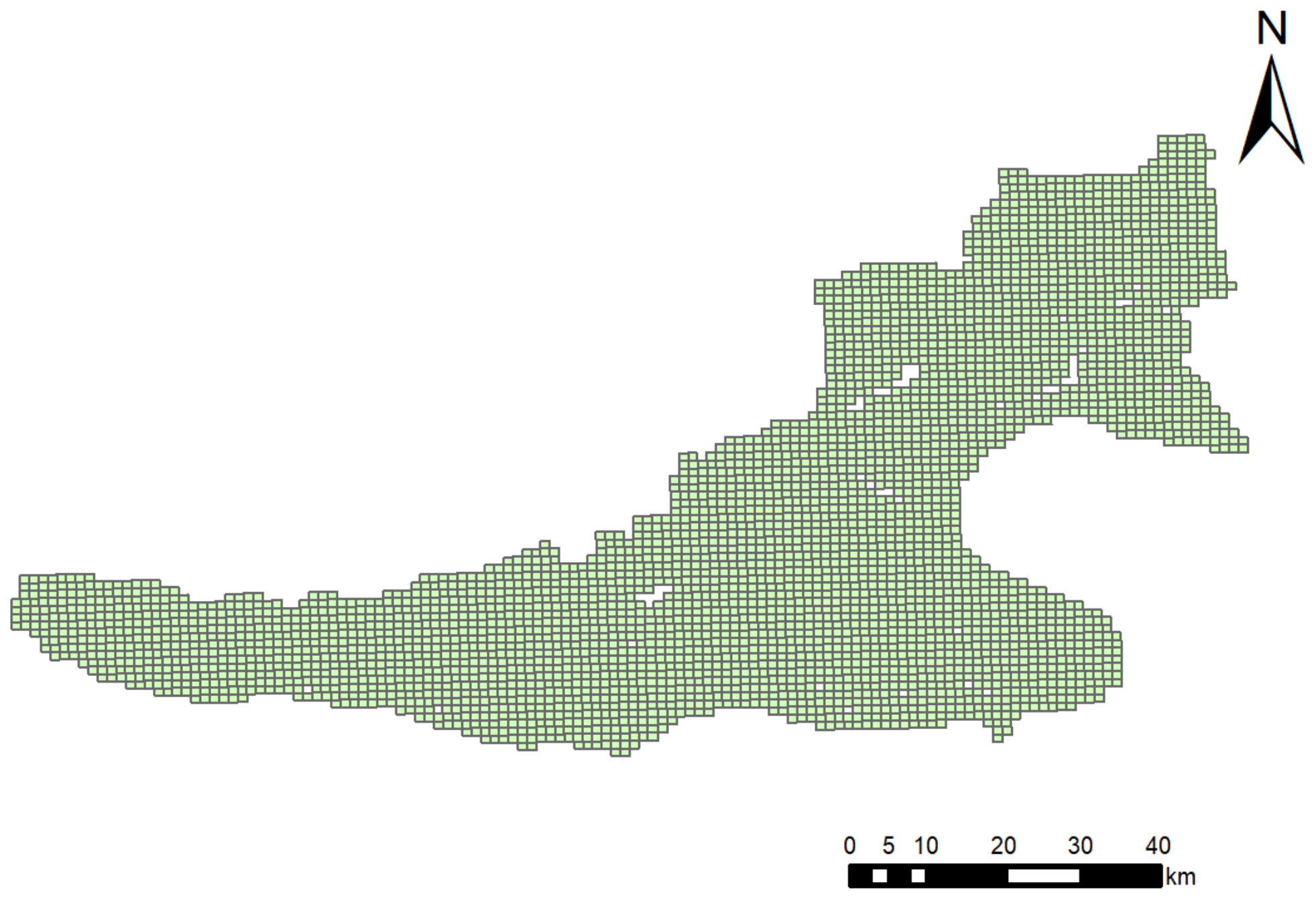
Based on these raw datasets, a standardized preprocessing workflow was used to construct the analytical dataset. To ensure a consistent analytical scale, a regular 1 km × 1 km fishnet grid was generated across the study area, yielding 3828 analysis units (Figure 2). The 1 km grid was selected for three reasons. First, it allows 70 m ECOSTRESS LST pixels and 10 m land-cover cells to be aggregated into stable spatial units, reducing pixel-level noise while retaining intra-urban spatial differentiation. Second, it provides a common unit for integrating raster LST, categorical land cover, building-vector information, and landscape metrics without creating false precision from datasets with different spatial resolutions. Third, it is suitable for city-scale land–climate interaction assessment and planning-oriented comparison across the built-up core, urban–rural fringe, and suburban areas. The possible smoothing effect of this grid scale is further discussed in Section 5.4.
Using the 3D-GloBFP dataset, zonal statistics were performed in ArcGIS 10.8 to derive mean building height (MBH) and building coverage ratio (BCR) for each grid cell. For grid cells without building footprints, both BCR and MBH were assigned values of 0, indicating the absence of building coverage and vertical built structure rather than missing data. Based on the ESRI land-cover dataset, forest land, grassland, and cropland were reclassified as green space, whereas built-up areas and bare land were reclassified as grey space; water bodies, ice, and snow were excluded. Cropland was included in the green-space category because, during the summer study period, it represents vegetated and permeable land with evapotranspiration potential and surface thermal behavior that differs from impervious or bare grey space. However, cropland is not equivalent to urban forest or designed parkland in canopy structure, management intensity, or cooling mechanism, and this classification may influence GCR and connectivity-related results. This issue is explicitly considered in Section 5.4. The reclassified layers were then used for subsequent Morphological Spatial Pattern Analysis (MSPA), and the corresponding landscape metrics were calculated in FRAGSTATS 4.2. To refine the indicator system, Pearson correlation analysis was applied to the initial landscape metrics, and indicators with |r| > 0.8 were removed. The retained metrics were subsequently standardized using Z-score normalization to eliminate differences in scale. Finally, the CRITIC objective weighting method was used to synthesize the selected metrics into composite indices for grey and green spaces. These composite indices are described in Section 3.2.
Because no citywide three-dimensional vegetation-structure dataset was available, the green-space variables used in this study describe two-dimensional coverage and spatial patterns rather than three-dimensional canopy structures. Accordingly, the three-dimensional information considered here is represented by building-related variables, whereas grey-space and green-space pattern variables are derived from two-dimensional land-cover or building-footprint data.

2.3. Indicator System

The indicator system comprises dependent variables and two categories of explanatory variables: two-dimensional (2D) spatial pattern and composition indicators and a three-dimensional (3D) building-morphology indicator. All indicators were calculated at the 1 km × 1 km grid-cell level, and their definitions and calculation methods are presented in Table 2.
For interpretation, GreySPI_conn describes the contiguity and aggregation of grey space; higher values indicate that built-up or bare grey-space patches are more spatially connected, whereas lower values indicate a more fragmented grey-space pattern. GSPI_scale represents the overall scale of green-space coverage, GSPI_shape reflects green-patch fragmentation and shape complexity, and GSPI_conn describes the aggregation and connectivity of green space. These indices are therefore used not only as technical landscape metrics, but also as land-cover configuration descriptors that may influence heat storage, evapotranspiration continuity, surface roughness, and cooling-source connectivity.

2.4. Analytical Framework

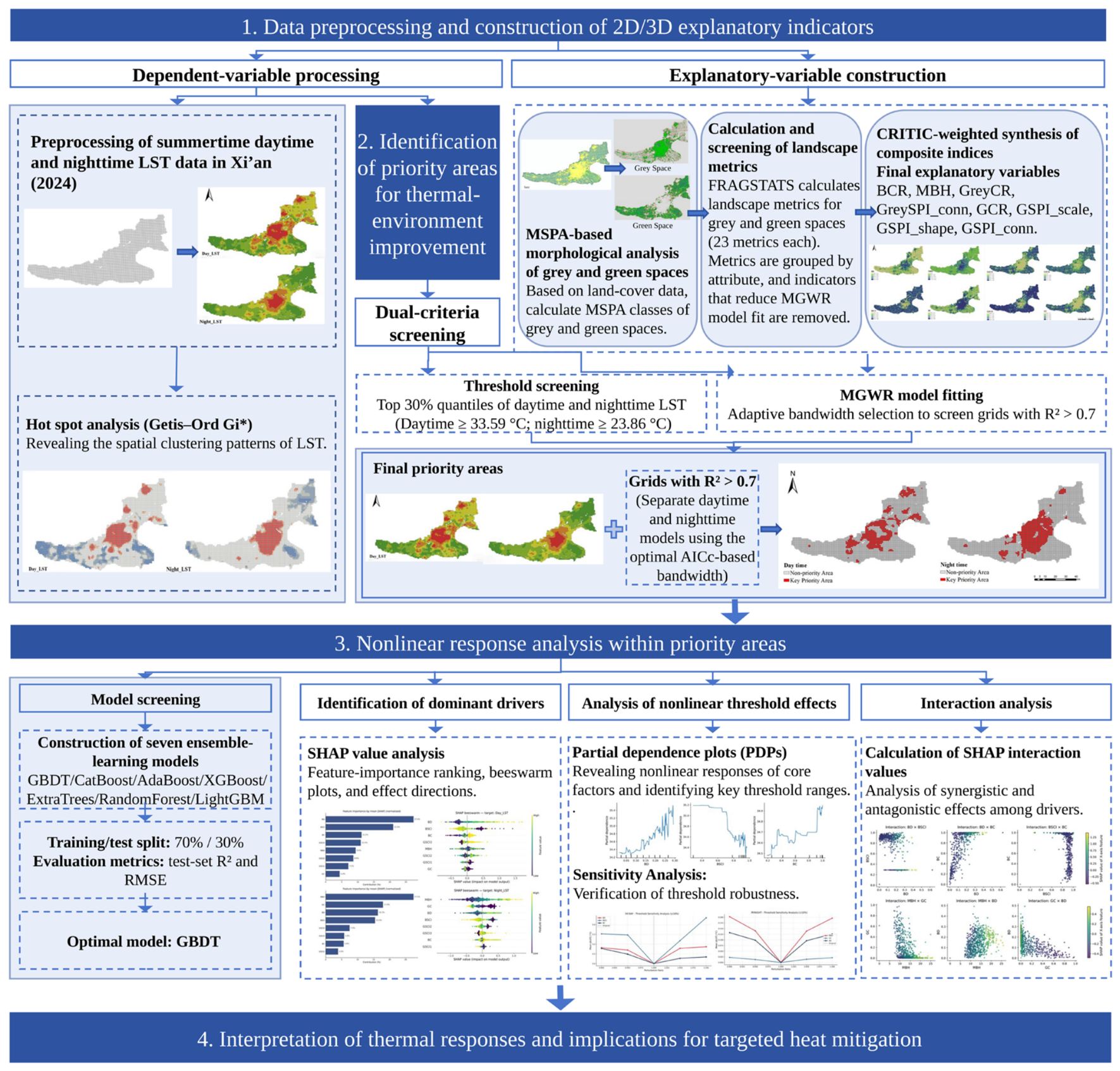
The analytical framework of this study is illustrated in Figure 3 and comprises four sequential stages: (1) data preprocessing and indicator-system construction; (2) identification of priority areas for thermal-environment improvement through spatial overlay of high-LST zones and multiscale geographically weighted regression (MGWR) results; (3) selection of the optimal ensemble-learning model, followed by SHAP-based interpretation of driver importance, nonlinear thresholds, and interaction effects, together with threshold sensitivity analysis to examine the stability of empirical threshold responses; and (4) interpretation of thermal responses to grey–green spatial patterns and building morphology in order to derive implications for land-use planning and targeted urban heat mitigation.

3. Methodology

This study developed a workflow to identify priority areas for thermal-environment improvement, examine nonlinear day–night thermal responses, quantify threshold behavior and interaction patterns, and derive empirical implications for land–climate interaction assessment and targeted urban heat mitigation.

3.1. Morphological Spatial Pattern Analysis (MSPA)

Based on the principles of mathematical morphology, Morphological Spatial Pattern Analysis (MSPA) segments foreground pixels in binary images to identify seven mutually exclusive morphological classes: core, edge, bridge, loop, branch, islet, and perforation [27]. In this study, the reclassified grey-space and green-space layers were used as foreground inputs for MSPA, and the resulting morphological classes served as the basis for subsequent landscape-metric calculation and spatial pattern analysis.

3.2. Landscape Metrics and Composite Indices

Landscape metrics were used to characterize the two-dimensional structural features of grey and green spaces. Using FRAGSTATS 4.2, this study calculated candidate landscape metrics for grey and green spaces at the class level, covering three major groups: area-density, edge-shape, and aggregation metrics [28,29,30,31].
To avoid indicator redundancy and multicollinearity, a two-step procedure was employed to construct the final indicator system.
Indicator screening: Pearson bivariate correlation analysis [32] was applied to pre-screen the candidate landscape metrics, using |r| > 0.8 as the threshold for identifying strongly correlated and potentially redundant indicators. This threshold was used to reduce multicollinearity and avoid over-representing similar landscape-pattern information in the subsequent composite-index construction. Representative core metrics were retained based on their ecological significance and explanatory power for LST. The correlation analysis results for the candidate grey-space and green-space metrics are presented in Table 3 and Table 4, respectively.
Construction of composite indices: All original metrics were standardized using Z-score normalization. Subsequently, the CRITIC (Criteria Importance Through Intercriteria Correlation) objective weighting method [33,34] was used to calculate the weights of the screened metrics. This method determines indicator weights based on both contrast intensity (standard deviation) and conflict (indicator correlations), thereby reducing subjective bias in weighting. The weight of indicator j was calculated as follows:
w j = σ j · k   = 1 m ( 1     r jk ) l   = 1 m σ l · k   = 1 m ( 1 r lk )
In Equation (1), w j denotes the weight of indicator j , σ j denotes the standard deviation of indicator j , r jk denotes the correlation coefficient between indicators j and k , and m denotes the total number of indicators.
The screened landscape metrics within the same category were then aggregated using their CRITIC weights to derive the corresponding composite indices. Because the candidate grey-space composition index (derived from CA) and grey-space shape index (derived from NP, TE, SHAPE_MN, and CIRCLE_MN) reduced the goodness of fit ( R 2 ) of the multiscale geographically weighted regression (MGWR) model, they were excluded from the final composite-index construction. The final composite indices included in the modeling, along with their constituent metrics, are presented in Table 5.
In practical terms, a higher GreySPI_conn indicates that grey-space surfaces are more continuous and aggregated, such as large built-up blocks, industrial areas, or extensive impervious surfaces, whereas a lower value indicates a more fragmented grey-space pattern interspersed with other land covers. For green space, GSPI_scale represents the overall amount and coverage scale of vegetated land, GSPI_shape reflects the fragmentation and boundary complexity of green patches, and GSPI_conn represents the continuity and aggregation of green-space patches. These indices therefore describe not only abstract landscape patterns, but also physically meaningful land-cover configurations that may affect surface heat storage, evapotranspiration continuity, surface roughness, and the spatial continuity of cooling sources.

3.3. Priority-Area Identification Using MGWR

Multiscale geographically weighted regression (MGWR) is an enhanced extension of traditional geographically weighted regression (GWR) [35,36]. This model allows different explanatory variables to have their own optimal bandwidths, thereby better capturing the spatial heterogeneity and scale differences in the effects of different factors on LST. The MGWR model is formulated as follows:
y i   =   β 0 u i , v i + j   = 1 p β j u i , v i x ij   +   ϵ i
In Equation (2), y i denotes the LST of grid cell i ; u i , v i denotes the coordinates of the grid-cell centroid; β 0 u i , v i denotes the location-specific intercept; β j u i , v i denotes the local regression coefficient of explanatory variable j ; x ij denotes the observed value of explanatory variable j in grid cell i ; and ϵ i denotes the random error term.
In this study, MGWR was used to identify priority areas for thermal-environment improvement. Specifically, high-LST areas were first identified using the 70th percentile as the threshold for daytime and nighttime LST, thereby selecting the top 30% of grid cells with elevated thermal intensity. This percentile-based criterion was used as an operational threshold that balances thermal severity and sample size: it excludes low- and moderate-temperature areas while avoiding an overly small sample dominated by extreme outliers. Grid cells with an MGWR goodness of fit of R 2 > 0.7 were then retained, indicating that the selected land-cover and morphological indicators could explain a relatively large share of local LST variation within these units. The two criteria were combined so that subsequent nonlinear analysis focused on locations where thermal stress was high and where LST was sufficiently related to spatial configuration variables. These criteria were used for priority-area identification rather than as universal statistical standards. Grid cells that met both criteria were designated as daytime and nighttime priority areas.
These priority areas were used to focus the subsequent nonlinear analysis on thermally stressed locations with relatively strong local explanatory relationships. Accordingly, the thresholds and interaction patterns derived from the machine-learning analysis should be interpreted as localized empirical relationships identified within these priority areas rather than as universal citywide thresholds or general planning standards.

3.4. Ensemble-Learning Model Selection

To identify the model with the best fitting performance, this study constructed and compared seven mainstream ensemble-learning models using Python 3.9 and the Scikit-learn 1.2.2 library [37]. These models included gradient boosting decision tree (GBDT), extreme gradient boosting (XGBoost), Light Gradient Boosting Machine (LightGBM), categorical boosting (CatBoost), adaptive boosting (AdaBoost), random forest (RF), and Extremely Randomized Trees (ExtraTrees).
The hyperparameters of each model were optimized using grid search combined with five-fold cross-validation. The dataset was randomly split into a training set and a test set at a ratio of 7:3, and model performance was evaluated on the test set. The model performance for daytime and nighttime LST is compared in Table 6.
The results indicated that the GBDT model achieved the best overall fitting performance for both daytime and nighttime LST. The daytime test R 2 of the optimal model was 0.335, whereas the nighttime test R 2 reached 0.658, indicating that nighttime LST was more consistently explained by the selected land-cover and morphological variables. The moderate daytime R 2 should be interpreted carefully. Daytime LST is affected by highly transient processes, including shortwave radiation intensity, microscale shading, surface material heterogeneity, facade reflection, and short-term atmospheric conditions that cannot be fully captured by 1 km land-cover and morphology indicators. Therefore, the daytime model is used primarily to interpret relative driver importance and nonlinear response tendencies within priority areas rather than to provide high-precision prediction. Accordingly, the daytime empirical thresholds are interpreted cautiously as localized response ranges. The Python-implemented GBDT model was used in all subsequent SHAP and threshold analyses because it provided the best combined performance across daytime and nighttime conditions.

3.5. SHAP Interpretation

To address the black-box nature of ensemble-learning models, this study used SHAP (Shapley Additive exPlanations) to interpret the optimal model [38]. Based on the Shapley value concept from game theory, SHAP quantifies the marginal contribution of each feature to the model prediction. The SHAP value for feature i is calculated as follows:
ϕ i   = S N \ i | S | ! · | N | | S | 1 ! | N | ! · f S i f S
In Equation (3), N denotes the set of all features, S denotes a subset of features that excludes feature i , and f ( · ) denotes the model prediction function. Based on SHAP, this study analyzed feature importance, the direction of factor effects, nonlinear threshold behavior, and interactions among multiple factors.

3.6. Threshold Sensitivity Analysis Procedure

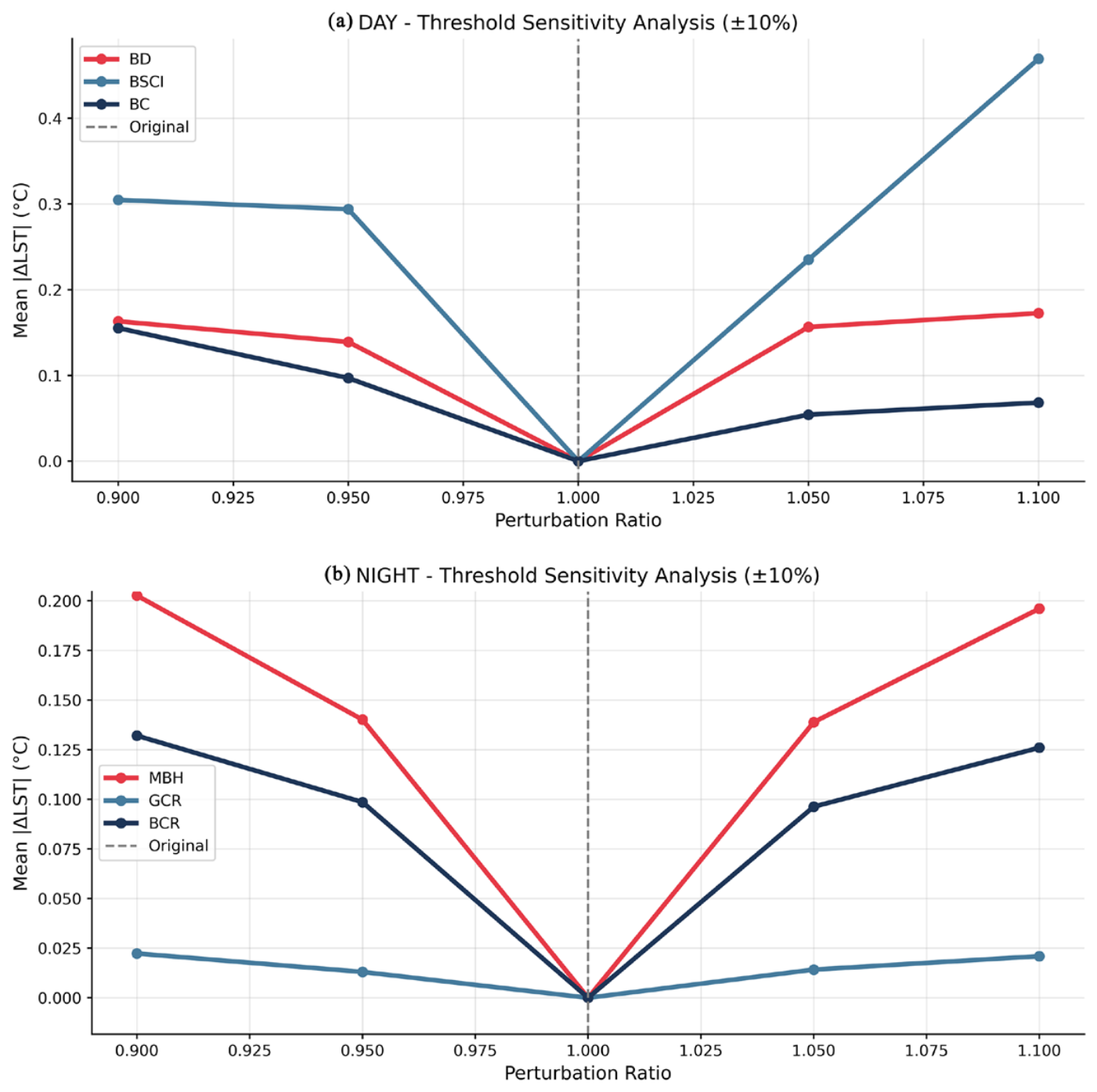
To examine the stability of the identified empirical thresholds, this study conducted threshold sensitivity analysis for the core driving factors with reference to mainstream approaches in related fields [39,40]. Specifically, while holding all other variables and the trained optimal GBDT model constant, proportional perturbations of ±10% were applied to the target factor, namely 0.90, 0.95, 1.05, and 1.10 times the original value, and LST was re-predicted using the perturbed data. Taking the prediction results based on the original data as the baseline, the mean absolute change in predicted LST (Mean |ΔLST|) at each perturbation level was calculated to characterize the sensitivity of the model output to factor fluctuations near the identified thresholds. The nominal temperature-retrieval accuracy of the ECOSTRESS sensor (±0.5 °C) was used only as a contextual reference scale for interpreting the magnitude of perturbation-induced changes, not as a direct validation measure for the threshold estimates.

4. Results

4.1. Day–Night LST Differentiation

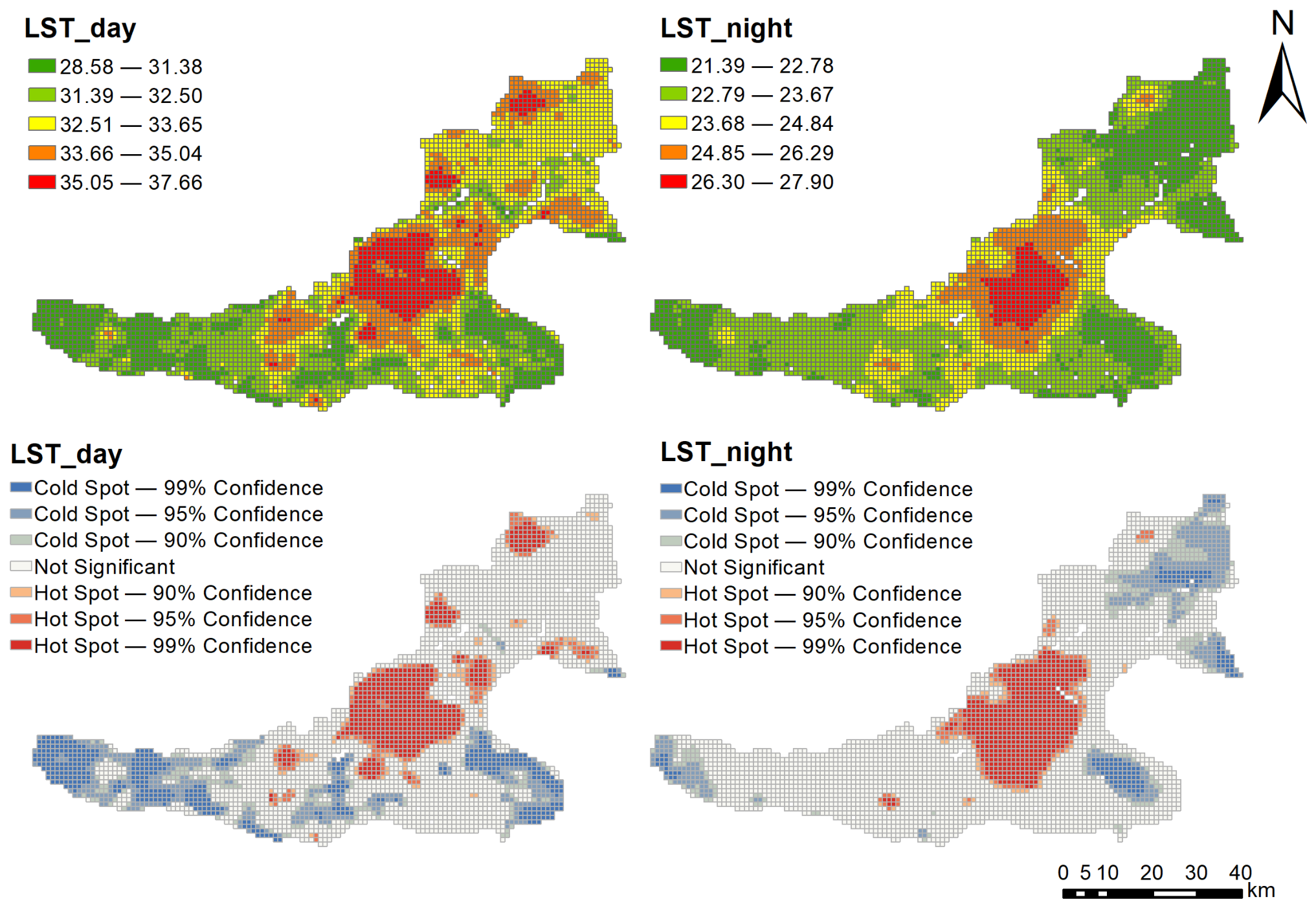
The spatial distribution patterns of daytime and nighttime LST in Xi’an during the summer of 2024 are shown in Figure 4. Daytime LST in the study area ranged from 28.03 °C to 37.66 °C, exhibiting pronounced spatial heterogeneity. Low daytime LST values were concentrated in contiguous cropland in the outer suburban areas, with a mean of approximately 30.5 °C, whereas daytime LST in the built-up core generally exceeded 35 °C, and the urban–rural temperature difference exceeded 7 °C. In contrast, high nighttime LST values (maximum 27.90 °C) were not concentrated in the built-up core, but instead expanded outward in patches toward the urban–rural fringe, while the temperature difference relative to the suburban minimum narrowed to approximately 3 °C.
Hotspot analysis (Getis-Ord Gi*) further quantified the spatial clustering characteristics. During the daytime, extremely significant hotspots (99% confidence level) accounted for 12.65% of all grids in the study area and were highly concentrated in the built-up core within the Second Ring Road. At night, the proportion of extremely significant hotspots increased to 13.56%, and their distribution expanded markedly toward the urban–rural fringe between the Second Ring Road and the Ring Expressway. This spatiotemporal differentiation, characterized by high-heat clustering in the urban core during the daytime and in the urban–rural fringe at night, indicates a pronounced day–night shift in the spatial distribution of thermal stress.

4.2. Grey–Green Spatial Patterns and Building Morphology

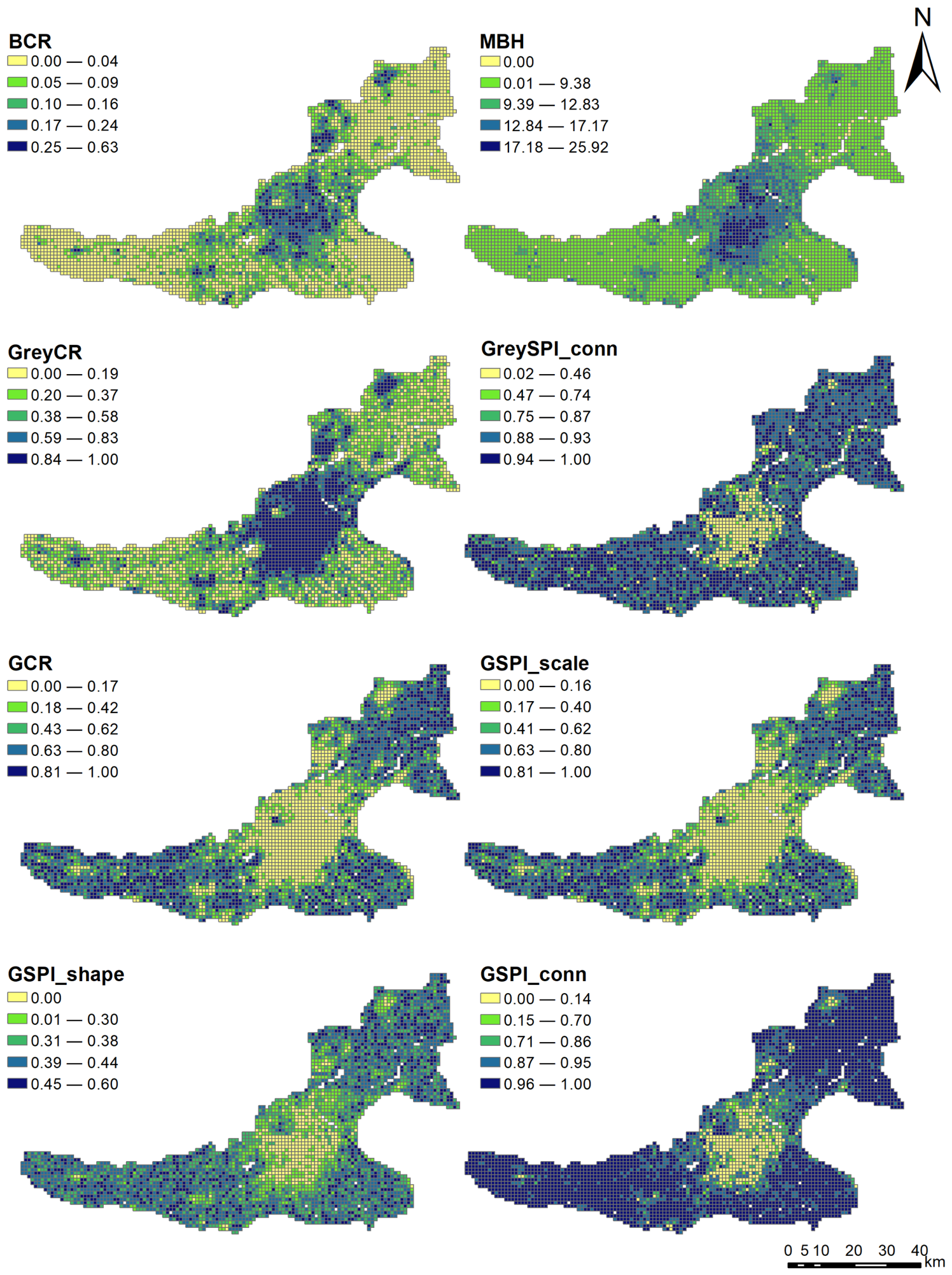
The spatial distribution characteristics of grey–green spatial patterns and building morphology in Xi’an are shown in Figure 5, revealing an overall urban–rural gradient. In terms of building morphology, high values of both BCR and MBH were highly concentrated in the built-up core, with a citywide mean MBH of 9.69 m. For grey space, the citywide mean GreyCR was 0.45 and decreased gradually from the built-up area toward the suburbs. GreySPI_conn values in the urban–rural fringe were mainly concentrated between 0.88 and 0.93, indicating strong contiguity of grey space in this zone. For green space, the citywide mean GCR was 0.53 and was significantly negatively correlated with grey space. The mean GSPI_scale was 0.53, indicating a considerable scale of green coverage. The mean GSPI_shape was 0.35, suggesting marked spatial differences in the degree of green-space fragmentation. The mean GSPI_conn was 0.87, indicating that green space in the outer suburban areas had strong contiguity and connectivity and served as the main regional cooling source.

4.3. Priority Areas for Thermal-Environment Improvement

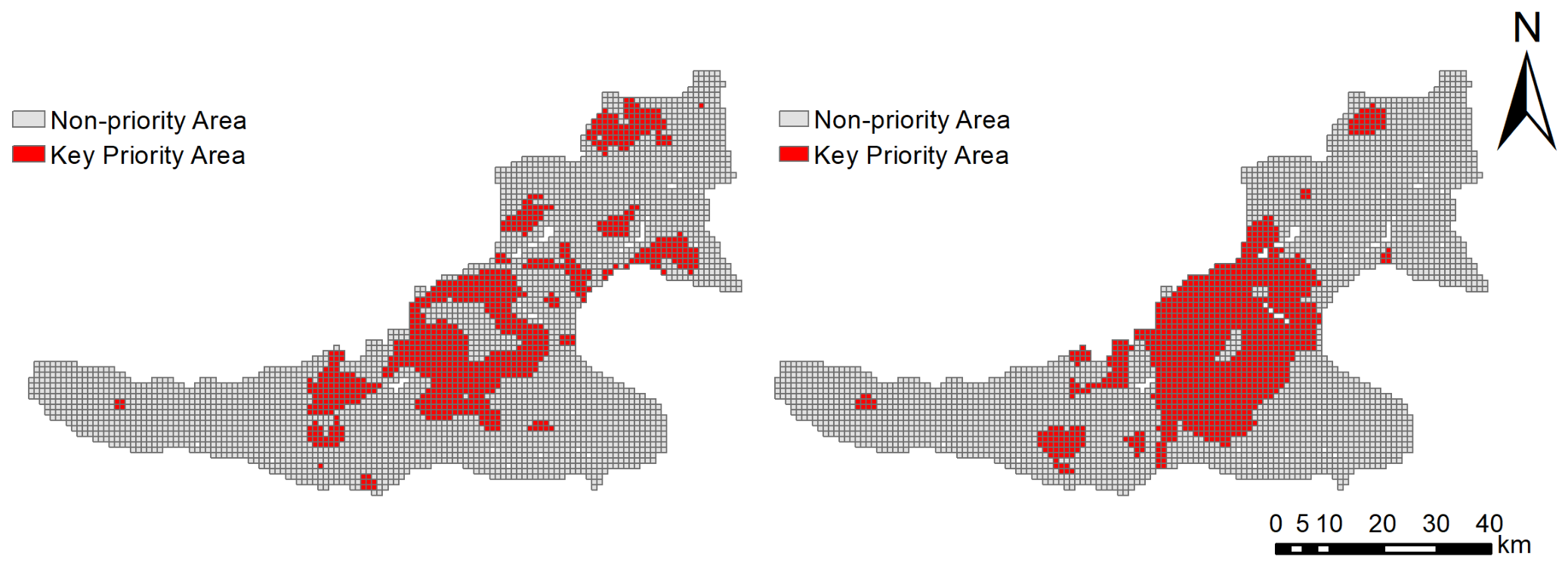
This study used two operational criteria to identify priority areas for improving the daytime and nighttime thermal environment in Xi’an during summer: the 70th percentile thresholds for high LST values (LST_day ≥ 33.59 °C; LST_night ≥ 23.86 °C) and MGWR model goodness of fit ( R 2 > 0.7). These criteria were applied to locate grid cells with both elevated thermal intensity and relatively strong local explanatory relationships between LST and land-cover or morphological variables. The identification results are shown in Table 7 and Figure 6.
Among the 3828 grids in the study area, 861 grids (22.5%) were identified as daytime priority areas, whereas 1013 grids (26.5%) were identified as nighttime priority areas. In terms of spatial distribution, daytime priority areas were highly concentrated in the built-up core and exhibited a belt-like pattern. By contrast, nighttime priority areas extended toward the urban–rural fringe, with clear boundaries and a clustered pattern. The spatial mismatch between these two types of priority areas provides the spatial basis for the subsequent nonlinear analysis and for targeted heat-mitigation interpretation in thermally stressed locations.

4.4. SHAP Feature Importance

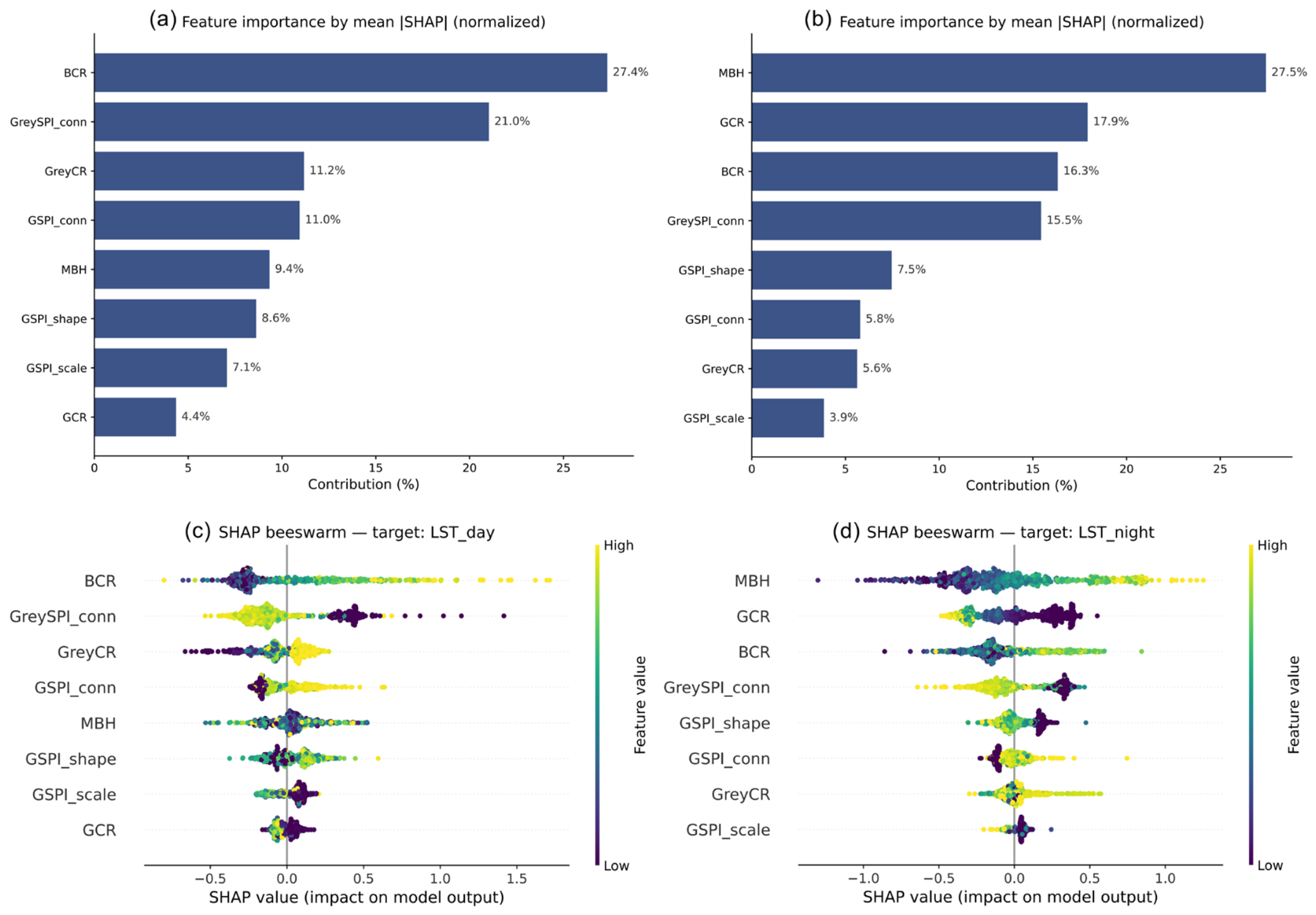
Based on SHAP feature importance analysis of the optimal GBDT model, the contribution rankings and effect directions of individual factors on LST within Xi’an’s daytime and nighttime priority areas for thermal-environment improvement were identified, as shown in Figure 7.
According to the feature importance rankings in Figure 7a,b, the dominant drivers of daytime and nighttime LST exhibited a clear shift. For daytime LST, the factors ranked by contribution were BCR (27.40%) > GreySPI_conn (21.00%) > GreyCR (11.20%) > GSPI_conn (11.00%) > MBH (9.40%). These results indicate that daytime thermal conditions within the analyzed priority areas were mainly shaped by built-up intensity and grey-space spatial patterns, with BCR acting as the primary driver of daytime warming.
The ranking of nighttime LST drivers changed markedly: MBH (27.50%) > GCR (17.90%) > BCR (16.30%) > GreySPI_conn (15.50%). This indicates that the dominant driver within nighttime priority areas shifted from BCR to MBH, while the cooling role of green space strengthened substantially. In terms of factor stability, BCR was the only factor ranked among the top three contributors during both daytime and nighttime, indicating that it was the most stable core indicator affecting thermal conditions across the two periods. By contrast, GCR showed the largest day–night difference in contribution, increasing by 4.07-fold at night relative to the daytime.
The SHAP beeswarm plots in Figure 7c,d further clarified the directions of factor effects. During the daytime, the SHAP values of BCR and GreyCR were significantly positively correlated with factor values, indicating warming effects, whereas the SHAP values of GreySPI_conn and green-space indicators were negatively correlated with factor values, indicating cooling effects. At night, the SHAP values of MBH and BCR were significantly positively correlated with factor values, indicating warming effects, whereas the SHAP values of GCR and green-space connectivity indicators were significantly negatively correlated with factor values, indicating cooling effects.

4.5. Nonlinear Threshold Effects

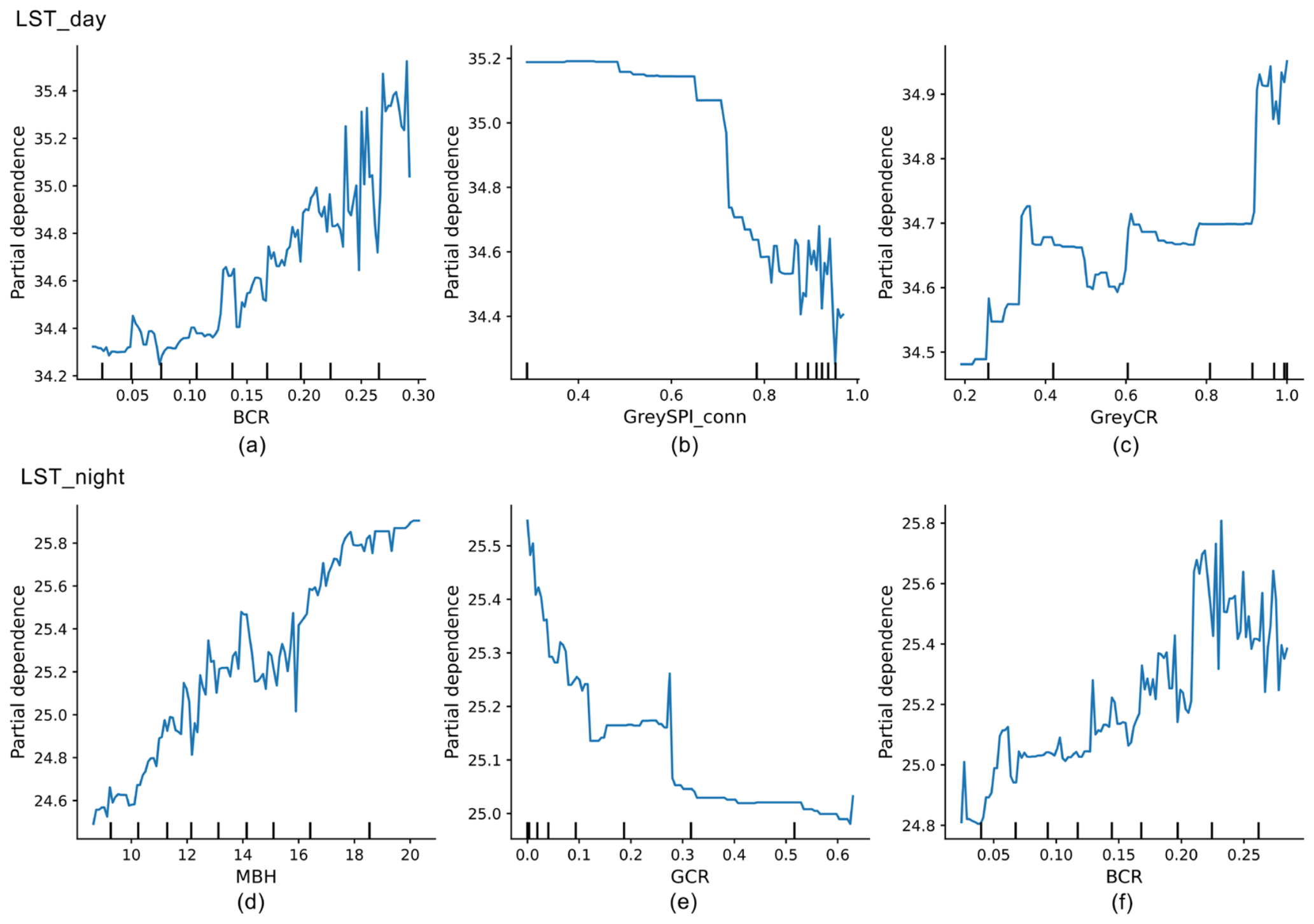
Based on SHAP partial dependence plots (PDPs), this study characterized the nonlinear relationships between core daytime and nighttime drivers and LST and identified empirical threshold behaviors within the analyzed priority areas. The results are shown in Figure 8.

4.5.1. Daytime Driver Thresholds

As shown in Figure 8a–c, BCR exhibited a significant positive correlation with daytime LST, and its warming effect increased continuously with increasing BCR. When BCR exceeded 0.20, the warming rate was approximately 2.4 times that observed when BCR was below 0.20. Within the analyzed daytime priority areas, this result indicates that BCR ≤ 0.20 represents an empirical inflection point associated with lower daytime thermal intensity.
GreySPI_conn showed a nonlinear negative correlation with daytime LST. When GreySPI_conn was below 0.75, its marginal effect on LST was not significant. Once GreySPI_conn reached or exceeded 0.75, daytime LST declined rapidly with increasing GreySPI_conn, and the cooling effect became pronounced. Within the analyzed daytime priority areas, this suggests that GreySPI_conn ≥ 0.75 represents an effective empirical threshold for daytime cooling through improved grey-space configuration. GreyCR was positively correlated with daytime LST and exhibited an approximately linear warming trend overall.

4.5.2. Nighttime Driver Thresholds

As shown in Figure 8d–f, MBH was significantly positively correlated with nighttime LST and was the primary driver of nighttime warming. When MBH exceeded 14 m, the warming rate accelerated further. Within the analyzed nighttime priority areas, this indicates that MBH ≤ 14 m represents an empirical threshold associated with reduced nighttime thermal intensity.
GCR exhibited a significant nonlinear negative correlation with nighttime LST. As GCR increased from 0.05 to 0.25, the cumulative cooling effect reached 1.00 °C, indicating a pronounced effect. Although the marginal cooling effect slowed somewhat once GCR reached 0.15, it remained stable thereafter. Within the analyzed nighttime priority areas, this indicates that GCR ≥ 0.15 represents an effective empirical threshold associated with nighttime cooling. BCR was positively correlated with nighttime LST. Consistent with the daytime pattern, the warming effect increased significantly when BCR exceeded 0.20, suggesting that BCR ≤ 0.20 is also associated with lower nighttime thermal intensity within the analyzed priority areas.

4.6. Interaction Patterns

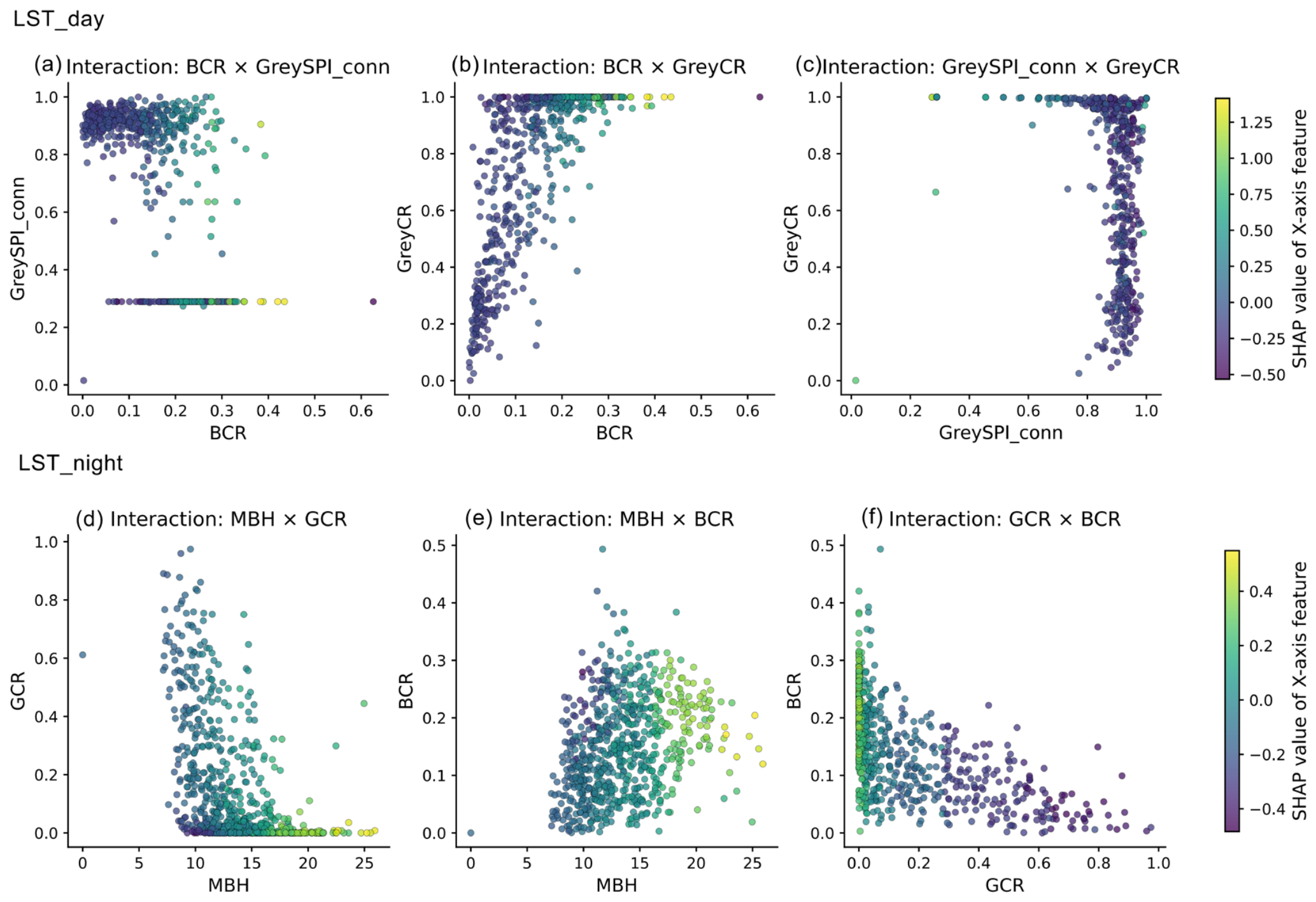
Based on SHAP interaction value analysis, this study revealed the interactions among the core drivers of daytime and nighttime thermal environments within the identified priority areas. The results are shown in Figure 9.

4.6.1. Daytime Interaction Patterns

As shown in Figure 9a–c, the core interactions in the daytime thermal environment were concentrated in combinations of building density and internal grey-space indicators (BCR × GreySPI_conn, BCR × GreyCR, and GreySPI_conn × GreyCR), showing pronounced synergistic warming and cooling effects. When BCR > 0.4 and GreySPI_conn < 0.4, an extremely strong synergistic warming effect was observed, representing the core combination pattern associated with deterioration of daytime thermal conditions within the priority areas. When BCR remained at a relatively low level and GreySPI_conn ≥ 0.75, a significant synergistic cooling effect emerged. Overall, daytime thermal conditions within the analyzed priority areas were dominated by synergistic effects within grey space, with BCR acting as the core driver of these interactions.

4.6.2. Nighttime Interaction Patterns

As shown in Figure 9d–f, the core interactions in the nighttime thermal environment were dominated by building and green-space factors (MBH × GCR, MBH × BCR, and GCR × BCR), exhibiting cross-type synergistic regulation. When MBH > 15 m and GCR < 0.15, an extremely strong synergistic warming effect was observed, representing the core combination pattern associated with deterioration of nighttime thermal conditions within the priority areas. When MBH ≤ 14 m and GCR ≥ 0.15, a significant synergistic cooling effect emerged, representing an effective empirical combination associated with improved nighttime thermal conditions. The interaction between GCR and BCR showed an antagonistic effect, with high GCR significantly mitigating nighttime warming caused by high BCR.

4.7. Threshold Sensitivity

The results of the threshold sensitivity analysis are shown in Figure 10. Under small perturbations of ±10% around the identified thresholds of all core drivers, the mean |ΔLST| in all perturbation scenarios remained below 0.5 °C. This result indicates that the modeled responses around the identified threshold ranges were relatively stable under small input perturbations. The comparison with the nominal ECOSTRESS temperature-retrieval accuracy is used only as a contextual benchmark for the magnitude of the perturbation response, because model sensitivity and sensor retrieval uncertainty represent different types of uncertainty. Among the tested factors, GreySPI_conn was the most sensitive factor in daytime thermal-environment regulation. By contrast, the nighttime cooling effect of GCR showed relatively low sensitivity to threshold perturbation, indicating comparatively stable nighttime response behavior around the identified GCR range.

5. Discussion

5.1. Day–Night Thermal Drivers and Land–Climate Interactions

The marked spatial mismatch between daytime and nighttime priority areas indicates that thermally stressed locations in Xi’an are governed by fundamentally different processes across the diurnal cycle. This result suggests that heat-mitigation strategies should not rely on a uniform spatial logic, but should instead respond to the distinct mechanisms that dominate during the day and at night. Previous studies have likewise shown that the effects of two-dimensional spatial patterns and three-dimensional building form vary substantially between daytime and nighttime conditions, highlighting the importance of separating these responses in urban thermal-environment analysis [6,10,24].
The SHAP results reveal a clear shift in dominant drivers between daytime and nighttime conditions within the identified priority areas. During the daytime, BCR is the primary driver of LST, indicating that solar radiation absorption and daytime heat accumulation are strongly controlled by development intensity and the extent of impervious surfaces. The combined contribution of 3D building morphology and 2D grey space reaches 68.90%, whereas that of green space is only 31.10%, with GCR alone accounting for 4.4%. This pattern suggests that daytime thermal conditions in Xi’an’s thermally stressed areas are primarily shaped by built-environment intensity rather than by the cooling contribution of fragmented green space. Previous studies have similarly identified building density and impervious surface intensity as major drivers of elevated LST, while the cooling effect of green space depends strongly on spatial configuration and scale [8,9].
At night, the dominant thermal process shifts from heat absorption to heat release and dissipation. Heat stored in buildings and impervious surfaces during the day continues to be released after sunset, making MBH the key factor influencing nighttime thermal retention. Greater building mass and more complex vertical form can reduce sky exposure, limit longwave radiation loss, and weaken near-surface ventilation, thereby delaying nighttime heat dissipation [10,18,24]. At the same time, the cooling role of green space becomes more pronounced because its heat-storage capacity is lower than that of buildings and impervious surfaces, and because vegetated surfaces can support evaporative cooling and local heat exchange. This mechanism helps explain why nighttime hotspots extend toward the urban–rural fringe, where recently developed areas often combine relatively tall buildings with insufficient green-space provision.
These statistical results are consistent with basic urban climate mechanisms. During the daytime, high BCR and GreyCR increase the proportion of impervious and built surfaces, enhancing shortwave radiation absorption and sensible heat storage while reducing evaporative cooling. The spatial organization of grey space may further affect local roughness, shading geometry, and heat accumulation patterns. At night, the influence of vertical building form becomes more evident because building mass and street-canyon geometry affect thermal inertia, sky-view conditions, longwave radiation release, and airflow. The stronger nighttime contribution of GCR indicates that continuous vegetated surfaces may help buffer nocturnal heat retention by providing lower heat-storage surfaces and a more connected cooling source.
Taken together, these findings indicate that targeted heat mitigation in Xi’an should account for the day–night shift in dominant drivers. Daytime mitigation in thermally stressed locations is more closely associated with controlling horizontal development intensity and grey-space organization, whereas nighttime mitigation depends more strongly on the combined influence of vertical building form and green-space provision. From a land–climate interaction perspective, these results show that urban heat mitigation should be linked not only to the amount of green space but also to the spatial organization of grey, green, and built land-system components.

5.2. Interaction Structures and Grey–Green Land-Cover Organization

A notable finding of this study is that thermal responses in the analyzed priority areas depend not only on the quantity of grey and green space, but also on their spatial organization. During the daytime, the dominant interactions are concentrated within grey space, especially in combinations involving BCR, GreySPI_conn, and GreyCR. This indicates that daytime thermal stress in Xi’an’s hottest areas is intensified not simply by the presence of impervious surfaces, but by the way these surfaces are configured. For land-use and landscape planning, the configuration of grey and green land-cover components therefore represents a key pathway through which urban land systems influence surface thermal conditions.
The negative relationship between GreySPI_conn and daytime LST highlights a more nuanced role for grey-space organization than is often assumed. Grey space is commonly associated with warming, yet the SHAP results suggest that, after accounting for development intensity through BCR and GreyCR, the configuration of grey space still exerts an independent influence on daytime thermal behavior. In physical terms, very fragmented grey-space layouts may increase irregular surface boundaries, heterogeneous heat-storage patches, and disrupted land-cover organization, whereas more contiguous and orderly grey-space configurations may reflect more coherent land-use structures within the priority areas. This does not imply that grey space itself provides a cooling service; rather, it indicates that the thermal effect of grey space depends on both its amount and its spatial arrangement.
At night, the interaction structure changes fundamentally. The dominant interactions are cross-type, particularly between MBH, GCR, and BCR. This suggests that nighttime thermal conditions in the priority areas are governed less by within-grey-space synergy and more by the combined organization of vertical building form and green-space provision. In particular, the combination of higher MBH and lower GCR is associated with strong nocturnal warming, whereas lower MBH combined with higher GCR is associated with a clear cooling response. These findings reinforce the view that nighttime heat mitigation in thermally stressed urban areas requires attention to both building form and landscape composition rather than to either factor in isolation.

5.3. Empirical Thresholds for Land-Use and Heat-Mitigation Planning

The nonlinear analysis identified several empirical threshold behaviors that are relevant to heat mitigation in the analyzed priority areas. Because these thresholds were derived from locations characterized by both high thermal intensity and relatively strong local explanatory relationships, they should not be interpreted as universal design rules for the entirety of Xi’an. Rather, they represent empirical response points associated with thermally stressed locations and are most appropriately understood as evidence for targeted intervention in urban heat hotspots.
Within the daytime priority areas, BCR ≤ 0.20 was associated with lower thermal intensity, while GreySPI_conn ≥ 0.75 was associated with a more stable daytime cooling response. These findings suggest that daytime mitigation in thermally stressed zones should pay particular attention to limiting excessive built-up intensity and improving grey-space organization. In practical terms, this may be especially relevant to high-density built-up districts where fragmented and tightly interwoven grey-space patterns intensify daytime heating.
Within the nighttime priority areas, MBH ≤ 14 m and GCR ≥ 0.15 were associated with improved nocturnal thermal conditions. These results indicate that nighttime mitigation in heat-trapped areas depends more strongly on the combination of vertical form control and green-space provision. In newly developed or rapidly densifying parts of the urban–rural fringe, this implies that reducing excessive building height and increasing contiguous green-space provision may be more effective than relying on a single-factor intervention.
The threshold combinations identified here are therefore best interpreted as localized empirical ranges for targeted microclimate intervention rather than as prescriptive standards for all urban contexts. Their practical value lies in helping identify where daytime and nighttime heat-mitigation efforts may be most effective within thermally stressed urban environments and in translating land-cover and morphology information into spatially explicit planning guidance.

5.4. Limitations

This study has several limitations. First, although the machine-learning framework captured nonlinear response behavior within the identified priority areas, the best-performing daytime GBDT model yielded a moderate test R 2 of 0.335. This reflects the complexity of daytime urban thermal processes, which are influenced by transient radiation conditions, microscale shading, surface-material differences, facade effects, traffic activity, and short-term atmospheric variability that cannot be fully resolved by the selected 1 km land-cover and morphology indicators. Therefore, the daytime results should be interpreted as relative response tendencies within priority areas rather than as high-precision predictions.
Second, the 1 km × 1 km grid provides a common spatial unit for integrating ECOSTRESS LST, land-cover data, building information, and landscape metrics, but it may smooth fine-scale microclimatic variation. Street-canyon shading, block-level ventilation, small water bodies, and patch-scale vegetation effects may not be fully captured at this scale. Future studies should test the stability of the results using finer grids or block-based units where data resolution permits.
Third, the land-cover classification may introduce uncertainty. In this study, cropland, forest, and grassland were grouped as green space because they are vegetated and permeable summer land-cover types with evapotranspiration potential. However, cropland differs from urban forest and designed parkland in canopy height, vegetation volume, management intensity, and seasonal phenology. This classification may affect the interpretation of GCR and green-space connectivity, especially in suburban and urban–rural fringe areas where cropland occupies a large share of vegetated land.
Fourth, the LST data were derived from ECOSTRESS observations at specific satellite overpass times and therefore cannot represent continuous diurnal thermal dynamics. Although the selected daytime and nighttime time windows help distinguish broad day–night patterns, the temporal sampling does not capture all short-term weather conditions or hourly heat accumulation and dissipation processes.
Finally, the study primarily relies on statistical and interpretable machine-learning approaches and does not directly simulate physical processes such as radiation exchange, turbulent heat flux, ventilation, or anthropogenic heat emissions. In addition, the green-space indicators are two-dimensional and do not include canopy height, vegetation volume, or leaf area index. Future work should combine remote sensing, in situ observations, three-dimensional vegetation data, and process-based urban climate models to further validate the empirical response ranges identified here.

6. Conclusions

6.1. Main Conclusions

Using Xi’an as a case study, this study integrated MGWR, GBDT, and SHAP-based interpretation to examine nonlinear day–night thermal responses to grey–green spatial patterns and building morphology from a land–climate interaction perspective. By focusing on priority areas where elevated LST coincided with relatively strong local explanatory relationships, the study provides context-specific empirical evidence for targeted heat mitigation in thermally stressed urban locations.
The results show a pronounced day–night shift in the spatial distribution of thermal priority areas. Daytime thermal stress is concentrated mainly in the dense built-up core, whereas nighttime hotspots extend outward toward the urban–rural fringe. This spatial mismatch suggests that daytime and nighttime thermal stress are governed by different dominant processes and should be addressed through temporally differentiated mitigation strategies.
The dominant thermal drivers also change substantially across the diurnal cycle. Within the identified priority areas, daytime LST is mainly associated with built-up intensity and grey-space organization, with BCR acting as the dominant warming factor. At night, thermal retention is more strongly associated with MBH, while the relative cooling contribution of GCR increases. These findings indicate that land-use planning should consider both horizontal land-cover composition and vertical building form when interpreting day–night thermal conditions.
The analysis further identified several localized empirical response ranges within the priority areas. During the daytime, lower thermal intensity was associated with BCR ≤ 0.20 and GreySPI_conn ≥ 0.75. At night, reduced thermal intensity was associated with MBH ≤ 14 m and GCR ≥ 0.15. These values should be understood as empirical relationships observed under the data, season, grid scale, and priority-area definition used in this study, rather than as universal planning standards.
Finally, the interaction structures shaping daytime and nighttime thermal conditions differ fundamentally. Daytime thermal stress is dominated by interactions within grey space, particularly when high built-up intensity is combined with fragmented grey-space organization. By contrast, nighttime thermal conditions are more strongly shaped by cross-type interactions between building form and green space, with green-space provision partly buffering nocturnal warming associated with building morphology. These findings support a more differentiated approach to land-use and grey–green configuration planning in thermally stressed areas.

6.2. Outlook

Future research should test whether the localized empirical response ranges identified in this study remain stable under broader urban conditions, different seasons, and different climatic contexts. In particular, integrating true three-dimensional vegetation data, such as canopy height and leaf area index, would improve representation of shading and evapotranspiration effects. Incorporating high-frequency meteorological observations, anthropogenic heat emissions, and process-based physical modeling, including coupled radiation, airflow, and surface-energy simulations, would further strengthen the physical validation of the statistical relationships identified here.

Author Contributions

X.M. and J.C. contributed equally to this work. X.M.: Writing—original draft, Visualization, Validation, Software, Methodology, Investigation, Data curation, Conceptualization. J.C.: Writing—original draft, Writing—review and editing, Validation, Investigation, Formal analysis, Conceptualization, Project administration. H.D.: Writing—review and editing, Supervision, Resources, Funding acquisition. All authors have read and agreed to the published version of the manuscript.

Funding

This work was supported by the Social Sciences Planning Fund of Xi’an, China (grant number 25QL43), and the Revision of the Master Plan for the Shaanxi Guanzhong Impression Tourism Resort Project (project number 211841250167).

Data Availability Statement

The publicly available datasets used in this study are described in Table 1. Processed datasets generated and analyzed during the current study are available from the corresponding author upon reasonable request.

Acknowledgments

The authors thank the data providers and software developers whose publicly available datasets and tools supported this research.

Conflicts of Interest

The authors declare no conflicts of interest.

References

  1. Luber, G.; McGeehin, M. Climate Change and Extreme Heat Events. Am. J. Prev. Med. 2008, 35, 429–435. [Google Scholar] [CrossRef] [PubMed]
  2. He, Y.-L.; Deng, S.-Z.; Ho, H.C.; Wang, H.-B.; Chen, Y.; Hajat, S.; Ren, C.; Zhou, B.-Q.; Cheng, J.; Hu, W.; et al. The half-degree matters for heat-related health impacts under the 1.5 °C and 2 °C warming scenarios: Evidence from ambulance data in Shenzhen, China. Adv. Clim. Change Res. 2021, 12, 628–637. [Google Scholar] [CrossRef]
  3. Liang, Z.; Li, Z.; Fan, Z. Seasonal impacts of built environment and its interactions on urban park cooling effects in Nanjing, China. Build. Environ. 2023, 242, 110580. [Google Scholar] [CrossRef]
  4. Weng, Q. Thermal infrared remote sensing for urban climate and environmental studies: Methods, applications, and trends. ISPRS J. Photogramm. Remote Sens. 2009, 64, 335–344. [Google Scholar] [CrossRef]
  5. Kumar Gavsker, K. Urban growth, changing relationship between biophysical factors and surface thermal characteristics: A geospatial analysis of Agra city, India. Sustain. Cities Soc. 2023, 94, 104542. [Google Scholar] [CrossRef]
  6. Cao, S.; Weng, Q.; Lu, L. Distinctive roles of two- and three-dimensional urban structures in surface urban heat islands over the conterminous United States. Urban Clim. 2022, 44, 101230. [Google Scholar] [CrossRef]
  7. Huang, X.; Wang, Y. Investigating the effects of 3D urban morphology on the surface urban heat island effect in urban functional zones by using high-resolution remote sensing data: A case study of Wuhan, Central China. ISPRS J. Photogramm. Remote Sens. 2019, 152, 119–131. [Google Scholar] [CrossRef]
  8. Li, Y.; Schubert, S.; Kropp, J.P.; Rybski, D. On the influence of density and morphology on the Urban Heat Island intensity. Nat. Commun. 2020, 11, 2647–2649. [Google Scholar] [CrossRef] [PubMed]
  9. Das, M.; Das, A.; Momin, S. Quantifying the cooling effect of urban green space: A case from urban parks in a tropical mega metropolitan area (India). Sustain. Cities Soc. 2022, 87, 104062. [Google Scholar] [CrossRef]
  10. Wu, X.; Zhang, X.; Liao, W.; Chen, G.; Luo, M.; Liu, X. Contrasting 2D/3D urban morphology drivers of surface and canopy temperatures under different spatial scales. Build. Environ. 2025, 283, 113389. [Google Scholar] [CrossRef]
  11. Xiong, S.; Yang, F.; Fan, H. Source–flow–sink processes driving surface thermal environments in lake-rim regions under differentiated land-use patterns: Nonlinear interactions, threshold mechanisms and spatial heterogeneity. Build. Environ. 2025, 290, 114117. [Google Scholar] [CrossRef]
  12. Cheng, H.; Cai, Y.; Zhang, D.; Luo, S.; Li, M.; Hu, Y.; Ma, S. Neighboring matters: Quantifying internal morphology and external spatial interactions on land surface temperature among urban functional zones. Sustain. Cities Soc. 2025, 131, 106689. [Google Scholar] [CrossRef]
  13. Chang, Y.; Xiao, J.; Li, X.; Zhou, D.; Wu, Y. Combining GOES-R and ECOSTRESS land surface temperature data to investigate diurnal variations of surface urban heat island. Sci. Total Environ. 2022, 823, 153652. [Google Scholar] [CrossRef]
  14. Wu, Z.; Wang, Y.; Ren, Y. Optimizing green space-building landscape characteristics of key urban functional zones for comprehensive thermal environment mitigation. Landsc. Urban Plan. 2025, 257, 105314. [Google Scholar] [CrossRef]
  15. Yang, J.; Ren, J.; Sun, D.; Xiao, X.; Xia, J.C.; Jin, C.; Li, X. Understanding land surface temperature impact factors based on local climate zones. Sustain. Cities Soc. 2021, 69, 102818. [Google Scholar] [CrossRef]
  16. Bansal, P.; Quan, S.J. Examining temporally varying nonlinear effects of urban form on urban heat island using explainable machine learning: A case of Seoul. Build. Environ. 2023, 247, 110957. [Google Scholar] [CrossRef]
  17. Ming, Y.; Liu, Y.; Li, Y.; Song, Y. Unraveling nonlinear and spatial non-stationary effects of urban form on surface urban heat islands using explainable spatial machine learning. Comput. Environ. Urban Syst. 2024, 114, 102200. [Google Scholar] [CrossRef]
  18. Erdem Okumus, D.; Akay, M. Quantitative assessment of non-stationary relationship between multi-scale urban morphology and urban heat. Build. Environ. 2025, 272, 112669. [Google Scholar] [CrossRef]
  19. Li, Z.; Wang, X.; Zhao, H.; Xu, X. Spatiotemporal Patterns of the Evolution of the Urban Heat Island Effect and Population Heat Exposure Risks in Xi’an, One of China’s Megacities, from 2003 to 2023. Land 2025, 14, 2021. [Google Scholar] [CrossRef]
  20. Huang, X.; Li, L.; Yan, X.; Ji, W.; Zhao, K.; Zhao, X. Assessment of heat exposure risk for urban populations and spatio-temporal patterns: A perspective of urban functional zones in Xi’an, China. Urban Clim. 2024, 55, 101992. [Google Scholar] [CrossRef]
  21. Ge, J.; Wang, Y.; Guo, Y.; Wang, J.; Zhou, D.; Gu, Z. Multiple-scale urban form renewal strategies for improving diffusion of building heat emission—A case in Xi’an, China. Energy Build. 2024, 328, 115160. [Google Scholar] [CrossRef]
  22. Liu, Q.; Zhang, H.; Peng, J.; Li, Q.; Liu, T.; Hu, F.; Huang, H.; Shen, Y.; Ye, B.; Guo, Y.; et al. Mitigation strategies for regional heat island effects: Integrated network construction of cold and heat islands. Ecol. Indic. 2025, 176, 113703. [Google Scholar] [CrossRef]
  23. Chang, Y.; Xiao, J.; Li, X.; Weng, Q. Monitoring diurnal dynamics of surface urban heat island for urban agglomerations using ECOSTRESS land surface temperature observations. Sustain. Cities Soc. 2023, 98, 104833. [Google Scholar] [CrossRef]
  24. Wang, Z.; Zhou, R.; Yu, Y. The impact of urban morphology on land surface temperature under seasonal and diurnal variations: Marginal and interaction effects. Build. Environ. 2025, 272, 112673. [Google Scholar] [CrossRef]
  25. Che, Y.; Li, X.; Liu, X.; Wang, Y.; Liao, W.; Zheng, X.; Zhang, X.; Xu, X.; Shi, Q.; Zhu, J.; et al. 3D-GloBFP: The first global three-dimensional building footprint dataset. Earth Syst. Sci. Data 2024, 16, 5357–5374. [Google Scholar] [CrossRef]
  26. Karra, K.; Kontgis, C.; Statman-Weil, Z.; Mazzariello, J.C.; Mathis, M.; Brumby, S.P. Global land use/land cover with Sentinel 2 and deep learning. In Proceedings of the 2021 IEEE International Geoscience and Remote Sensing Symposium IGARSS, Brussels, Belgium, 11–16 July 2021; IEEE: Piscataway, NJ, USA, 2021; pp. 4704–4707. [Google Scholar] [CrossRef]
  27. Vogt, P.; Riitters, K.H.; Estreguil, C.; Kozak, J.; Wade, T.G.; Wickham, J.D. Mapping Spatial Patterns with Morphological Image Processing. Landsc. Ecol. 2007, 22, 171–177. [Google Scholar] [CrossRef]
  28. Zhang, D.; Wang, J.; Wang, Y.; Xu, L.; Zheng, L.; Zhang, B.; Bi, Y.; Yang, H. Is There a Spatial Relationship between Urban Landscape Pattern and Habitat Quality? Implication for Landscape Planning of the Yellow River Basin. Int. J. Environ. Res. Public Health 2022, 19, 11974. [Google Scholar] [CrossRef] [PubMed]
  29. Liu, X.; Yang, G.; Que, Q.; Wang, Q.; Zhang, Z.; Huang, L. How Do Landscape Heterogeneity, Community Structure, and Topographical Factors Contribute to the Plant Diversity of Urban Remnant Vegetation at Different Scales? Int. J. Environ. Res. Public Health 2022, 19, 14302. [Google Scholar] [CrossRef]
  30. Dutta, I.; Das, A. Quantifying the Impact of Urban Green Space Pattern to Land Surface Temperature: Evidence from an Urban Agglomeration of Eastern India. In Advancements in Urban Environmental Studies: Application of Geospatial Technology and Artificial Intelligence in Urban Studies; Rahman, A., Sen Roy, S., Talukdar, S., Shahfahad, Eds.; Springer International Publishing: Cham, Switzerland, 2023; pp. 161–177. [Google Scholar] [CrossRef]
  31. Shafie, B.; Javid, A.H.; Irani Behbahani, H.; Darabi, H.; Hosseinzadeh Lotfi, F. An analysis of the landscape structure changes as an ecological approach to achieve sustainable regional planning (Case Study: Latian Dam Watershed). J. Environ. Eng. Landsc. Manag. 2023, 31, 9–22. [Google Scholar] [CrossRef]
  32. Schober, P.; Boer, C.; Schwarte, L.A. Correlation Coefficients: Appropriate Use and Interpretation. Anesth. Analg. 2018, 126, 1763–1768. [Google Scholar] [CrossRef]
  33. Diakoulaki, D.; Mavrotas, G.; Papayannakis, L. Determining objective weights in multiple criteria problems: The critic method. Comput. Oper. Res. 1995, 22, 763–770. [Google Scholar] [CrossRef]
  34. Yin, H.; Xiang, Y.; Chen, Z.; Zhang, W.; Ao, Y. Heat vulnerability assessment and analysis of driving mechanisms in a megacity based on local climate zones: A street-level case study of Chengdu. Sustain. Cities Soc. 2025, 134, 106965. [Google Scholar] [CrossRef]
  35. Fotheringham, A.S.; Yang, W.; Kang, W. Multiscale Geographically Weighted Regression (MGWR). Ann. Am. Assoc. Geogr. 2017, 107, 1247–1265. [Google Scholar] [CrossRef]
  36. Yang, L.; Jiang, S.; Li, Z.; Cao, J.; Ma, Y.; Nan, K.; Lu, R. Spatiotemporal heterogeneity of urban thermal environments: Linking urban form and vitality. Case Stud. Therm. Eng. 2025, 76, 107409. [Google Scholar] [CrossRef]
  37. Pedregosa, F.; Varoquaux, G.; Gramfort, A.; Michel, V.; Thirion, B.; Grisel, O.; Blondel, M.; Prettenhofer, O.; Weiss, R.; Dubourg, V.; et al. Scikit-learn: Machine Learning in Python. J. Mach. Learn. Res. 2011, 12, 2825–2830. [Google Scholar]
  38. Lundberg, S.M.; Lee, S.-I. A Unified Approach to Interpreting Model Predictions. In Advances in Neural Information Processing Systems 30; Guyon, I., Von Luxburg, U., Bengio, S., Wallach, H., Fergus, R., Vishwanathan, S., Garnett, R., Eds.; Curran Associates, Inc.: Red Hook, NY, USA, 2017; pp. 4765–4774. Available online: https://proceedings.neurips.cc/paper_files/paper/2017/hash/8a20a8621978632d76c43dfd28b67767-Abstract.html (accessed on 3 June 2026).
  39. Morris, M.D. Factorial Sampling Plans for Preliminary Computational Experiments. Technometrics 1991, 33, 161–174. [Google Scholar] [CrossRef]
  40. Dellino, G.; Meloni, C. Uncertainty Management in Simulation-Optimization of Complex Systems: Algorithms and Applications; Springer: New York, NY, USA, 2015. [Google Scholar]
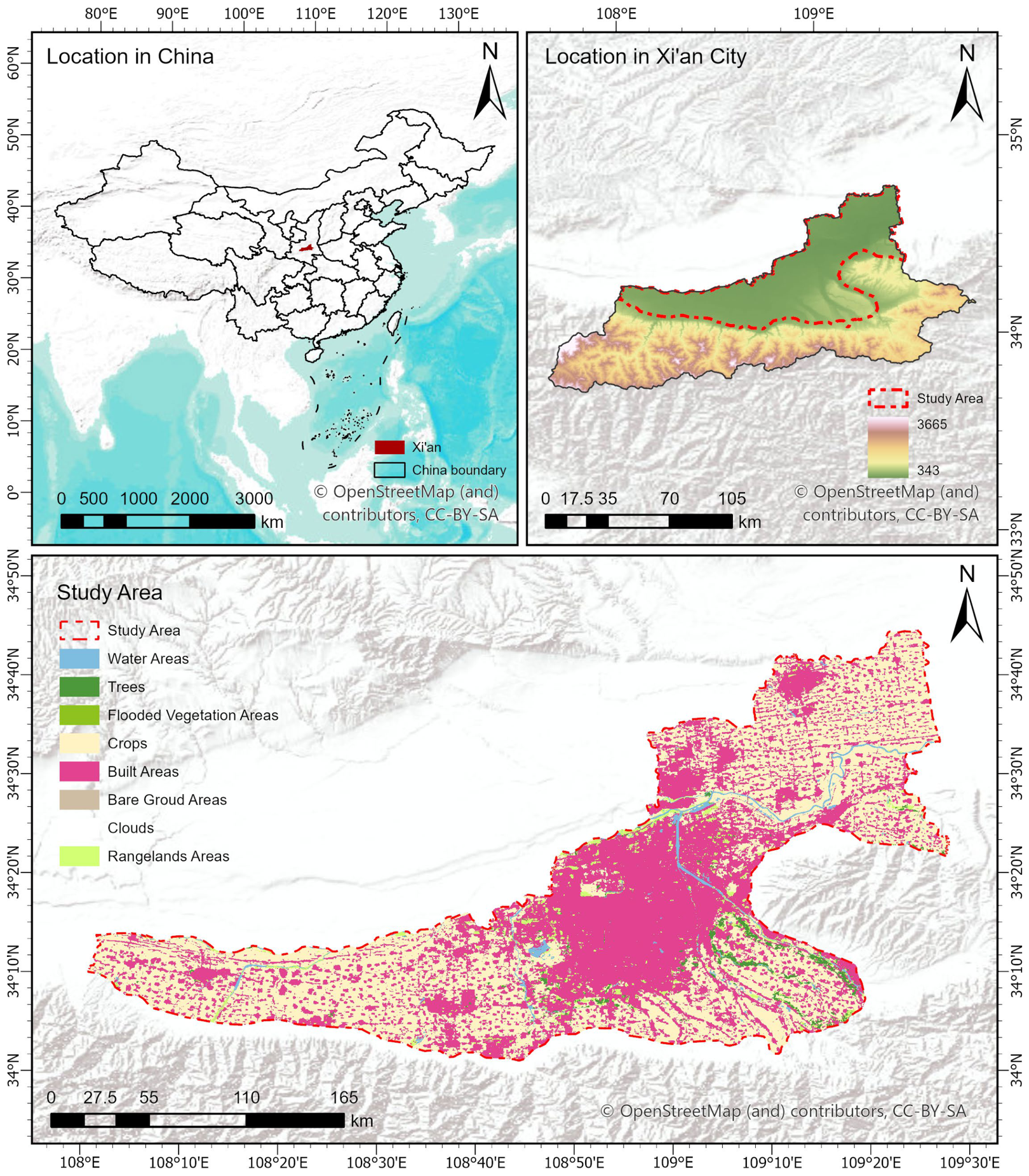
Figure 1. Geographic location and spatial extent of the study area in Xi’an.
Land 15 01047 g001
Figure 2. The 1 km × 1 km analytical fishnet grid for the study area in Xi’an.
Land 15 01047 g002
Figure 3. Analytical framework of the study. Different colors are used to visually distinguish the main components of the analytical workflow.
Land 15 01047 g003
Figure 4. Spatial distribution of summer daytime and nighttime LST in Xi’an.
Land 15 01047 g004
Figure 5. Spatial characteristics of grey–green spatial patterns and building morphology in Xi’an.
Land 15 01047 g005
Figure 6. Spatial distribution of priority areas for daytime and nighttime thermal-environment improvement in Xi’an during summer.
Land 15 01047 g006
Figure 7. SHAP feature importance analysis of the drivers of daytime and nighttime LST.
Land 15 01047 g007
Figure 8. Partial dependence plots of core drivers of daytime and nighttime LST: (a) BCR and daytime LST; (b) GreySPI_conn and daytime LST; (c) GreyCR and daytime LST; (d) MBH and nighttime LST; (e) GCR and nighttime LST; (f) BCR and nighttime LST.
Land 15 01047 g008
Figure 9. SHAP interaction plots of core drivers of daytime and nighttime LST.
Land 15 01047 g009
Figure 10. Threshold sensitivity analysis of core morphological parameters: (a) daytime threshold sensitivity analysis; (b) nighttime threshold sensitivity analysis.
Land 15 01047 g010
Table 1. Primary datasets and sources.
Data TypeProduct/VersionProviderSpatial ResolutionTemporal CoverageSource PlatformReferences
Land surface temperature (LST)ECOSTRESS Level 2 Land Surface Temperature and Emissivity (ECO2LSTE)USGS LP DAAC70 m × 70 mJune–August 2024EarthExplorer; LP DAAC[23,24]
3D building information3D-GloBFP Global 3D Building Footprint Dataset (v1.0)Zenodo/Tsinghua UniversityVector (1–3 m accuracy)2024Zenodo[25]
2D land-cover dataESRI Living Atlas Global Land Cover 2024 (10 m)ESRI10 m × 10 m2024ESRI Living Atlas[26]
Note: LST data were acquired by the ECOSTRESS sensor aboard the International Space Station (ISS). The 3D-GloBFP dataset was generated from multi-source imagery using a deep-learning framework. The ESRI 2024 land-cover product was developed using a U-Net model and achieved an overall classification accuracy of 85.6% [26]. In this study, three-dimensional information is represented by building-related variables, whereas grey-space and green-space variables are derived from two-dimensional land-cover or building-footprint data.
Table 2. Indicator system and calculation methods.
Variable NameAbbreviationDescriptionUnitCalculation Method and Formula
Dependent variablesDaytime land surface temperatureLST_dayMean LST during the summer daytime (10:00–14:00)°CCalculated as the mean daytime LST within each grid cell using the ArcGIS Zonal Statistics tool, based on ECOSTRESS Level 2 LST products.
Nighttime land surface temperatureLST_nightMean LST during the summer nighttime (22:00–02:00)°CCalculated as the mean nighttime LST within each grid cell using the ArcGIS Zonal Statistics tool, based on ECOSTRESS Level 2 LST products.
2D built-up composition indicatorBuilding-coverage ratioBCRProportion of building footprint area within the grid cell% BCR   =   i = 1 n B S i A grid
where B S i is the footprint area of the i -th building ( m 2 ), A grid is the total grid area ( 10 6   m 2 ), and n is the number of buildings.
3D building morphologyMean building heightMBHMean building height within the grid cellm MBH   =   i = 1 n B H i n
where B H i is the height of the i -th building (m) and n is the number of buildings.
2D grey-space pattern indicatorsGrey-space coverage ratioGreyCRProportion of grey-space area (built-up land + bare land) relative to the total grid area% GreyCR   =   A grey A grid
where A grey is the sum of the areas of the seven MSPA morphological classes of grey space ( m 2 ).
Grey-space pattern index of connectivityGreySPI_connComposite landscape pattern index of grey space integrating connectivity and aggregation based on CRITIC weighting/(1) Screening of core landscape metrics (CLUMPY, PLADJ). ( 2 )   Calculation   of   CRITIC   weights :   W j   =   σ j k = 1 m 1 r jk l = 1 m σ l k = 1 m 1 r lk ,
where   σ j is the standard deviation of indicator j ,   and   r jk is the correlation coefficient between indicators j   and   k .
( 3 )   Weighted   synthesis :   GreySPI conn = j = 1 m W j   ×   X ij ,
where   X ij is the standardized value of the j -th landscape metric in the i - th   grid   cell ,   and   m is the number of retained metrics.
2D green-space pattern indicatorsGreen-space coverage ratioGCRProportion of green-space area (forest land, grassland, and cropland) relative to the total grid area% GCR   =   A green A grid
where A green is the sum of the areas of the seven MSPA morphological classes of green space ( m 2 ).
Green-space pattern index of scaleGSPI_scaleComposite landscape pattern index of green space characterizing the coverage scale of green space based on CRITIC weighting/Weighted synthesis of metrics such as total class area (CA).
Green-space pattern index of shapeGSPI_shapeComposite landscape pattern index of green space characterizing shape complexity and fragmentation based on CRITIC weighting/Weighted synthesis of metrics including NP, TE, GYRATE_MN, PARA_MN, and CIRCLE_MN.
Green-space pattern index of connectivityGSPI_connComposite landscape pattern index of green space integrating connectivity and aggregation based on CRITIC weighting/Weighted synthesis of metrics including PLADJ and AI.
Note: All landscape metrics were calculated at the class level in FRAGSTATS 4.2 using binary grey-space and green-space distribution maps as input. All original metrics were standardized using Z-score normalization before CRITIC weighting. In this study, MBH represents the three-dimensional building-morphology dimension, whereas BCR, GreyCR, GreySPI_conn, GCR, GSPI_scale, GSPI_shape, and GSPI_conn are derived from two-dimensional land-cover or building-footprint pattern information. Grey space refers to built-up land and bare land within the grey–green analytical framework.
Table 3. Correlation matrix of candidate landscape metrics for grey space.
CANPTESHAPE_MNPARA_MNCIRCLE_MNCLUMPYPLADJ
CA1−0.535 **−0.283 **−0.124 **−0.507 **−0.516 **−0.259 **0.696 **
NP−0.535 **10.491 **−0.122 **0.638 **0.177 **−0.035 *−0.451 **
TE−0.283 **0.491 **10.600 **0.305 **0.406 **0.141 **−0.073 **
SHAPE_MN−0.124 **−0.122 **0.600 **1−0.078 **0.544 **0.037 *−0.051 **
PARA_MN−0.507 **0.638 **0.305 **−0.078 **1−0.0020.027−0.518 **
CIRCLE_MN−0.516 **0.177 **0.406 **0.544 **−0.00210.178 **−0.304 **
CLUMPY−0.259 **−0.035 *0.141 **0.037 *0.0270.178 **10.201 **
PLADJ0.696 **−0.451 **−0.073 **−0.051 **−0.518 **−0.304 **0.201 **1
Note: ** Correlation is significant at the 0.01 level (two-tailed). * Correlation is significant at the 0.05 level (two-tailed).
Table 4. Correlation matrix of candidate landscape metrics for green space.
CANPTEGYRATE_MNSHAPE_MNPARA_MNCIRCLE_MNPLADJAI
CA1−0.432 **0.112 **0.793 **0.218 **−0.539 **−0.296 **0.708 **0.638 **
NP−0.432 **10.437 **−0.686 **−0.289 **0.550 **0.136 **−0.179 **−0.373 **
TE0.112 **0.437 **1−0.067 **0.519 **0.0130.284 **0.283 **0.054 **
GYRATE_MN0.793 **−0.686 **−0.067 **10.476 **−0.778 **−0.193 **0.562 **0.528 **
SHAPE_MN0.218 **−0.289 **0.519 **0.476 **1−0.372 **0.322 **0.222 **0.094 **
PARA_MN−0.539 **0.550 **0.013−0.778 **−0.372 **1−0.152 **−0.552 **−0.501 **
CIRCLE_MN−0.296 **0.136 **0.284 **−0.193 **0.322 **−0.152 **1−0.139 **−0.171 **
PLADJ0.708 **−0.179 **0.283 **0.562 **0.222 **−0.552 **−0.139 **10.784 **
AI0.638 **−0.373 **0.054 **0.528 **0.094 **−0.501 **−0.171 **0.784 **1
Note: ** Correlation is significant at the 0.01 level (two-tailed).
Table 5. Composition and properties of the composite indices.
Composite IndexConstituent FRAGSTATS MetricsBrief Description of Constituent MetricsComposite Interpretation
GreySPI_connCLUMPY, PLADJClumpiness index; proportion of like adjacenciesHigher values indicate that grey space is more contiguous and better connected.
GSPI_scaleCATotal area of green spaceHigher values indicate a larger coverage scale of green space.
GSPI_shapeNP, TE, GYRATE_MN, PARA_MN, CIRCLE_MNNumber of patches; total edge length; radius of gyration; perimeter–area ratio; closeness to a circleHigher values indicate a greater number of patches, smaller patch sizes, longer boundaries, and more complex shapes, corresponding to a higher degree of fragmentation.
GSPI_connPLADJ, AIProportion of like adjacencies; aggregation indexHigher values indicate that green space is more contiguous and better connected.
Table 6. Comparison of the fitting performance of different models for daytime and nighttime LST.
ModelDaytime LST Test R 2 Daytime LST Test RMSE (°C)Nighttime LST Test R 2 Nighttime LST Test RMSE (°C)
GBDT0.3350.6860.6580.645
CatBoost0.3270.690.650.653
AdaBoost0.3210.6930.6150.685
XGBoost0.3150.6960.6530.65
ExtraTrees0.3050.7010.650.653
RandomForest0.2980.7040.6480.655
LightGBM0.2960.7050.6340.667
Table 7. Identification results and characteristic statistics of daytime and nighttime priority areas.
IndicatorDaytime Priority AreasNighttime Priority AreasEntire Study Area
Number of grid cells86110133828
Proportion of total grid cells (%)22.526.5100
Mean LST (°C)34.7325.3132.85/23.59
LST range (°C)33.59–37.6623.86–27.9028.03–37.66/22.78–27.90
Mean   MGWR   model   R 2 0.8220.8580.659/0.735
Disclaimer/Publisher’s Note: The statements, opinions and data contained in all publications are solely those of the individual author(s) and contributor(s) and not of MDPI and/or the editor(s). MDPI and/or the editor(s) disclaim responsibility for any injury to people or property resulting from any ideas, methods, instructions or products referred to in the content.