Article

Trade-Offs and Synergies of Ecosystem Services in Oases Along Water–Heat Gradients in Arid Northwestern China

1
College of Forestry, Henan Agricultural University, Zhengzhou 450046, China
2
Key Research Institute of Yellow River Civilization and Sustainable Development, Henan University, Zhengzhou 450046, China
*
Authors to whom correspondence should be addressed.
Land 2026, 15(6), 1049; https://doi.org/10.3390/land15061049 (registering DOI)
Submission received: 9 May 2026 / Revised: 10 June 2026 / Accepted: 11 June 2026 / Published: 13 June 2026

Abstract

Understanding trade-offs and synergies among ecosystem services (ESs) along environmental gradients is crucial for sustainable oasis management. This study investigated four key ESs—carbon storage (CS), habitat quality (HQ), water yield (WY), and soil conservation (SC)—in three typical oases along water–heat gradients in arid northwestern China. The InVEST model was used to quantify ESs in 1990, 2005, and 2022, and Pearson correlation, geographically weighted regression, K-means clustering, and random forest models were applied to analyze service relationships, ecosystem service bundles (ESBs), and driving factors. The results showed that CS and HQ maintained strong synergies, while the WY–SC relationship shifted from weak trade-offs under drier conditions to stronger synergies under more favorable water–heat conditions. Geographically weighted regression revealed spatial heterogeneity and directional asymmetry in ES relationships. Four ESB types were identified: ecologically fragile zones, ecological transition or buffer zones, agricultural production zones, and core ecological source zones. Driving-factor analysis indicated that vegetation-related services were mainly associated with land-cover structure and vegetation growth, whereas hydrological and erosion-related services were more closely linked to precipitation, potential evapotranspiration, temperature, and topography. These findings support differentiated oasis management through ecological restoration, development regulation, water-saving agriculture, and strict ecological protection.

1. Introduction

Oases are the primary centers of human production and livelihoods in arid regions, occupying only about 4% of global arid land while supporting over 95% of the population living in these environments [1,2]. Oases provide critical ecosystem services (ESs), including water conservation, climate regulation, desertification mitigation, and biodiversity maintenance, playing an essential role in maintaining ecological stability in arid regions [3,4]. However, oasis ecosystems are highly fragile and strongly dependent on water resources. When human activities exceed ecological carrying capacity, degradation and desertification may occur [5,6,7]. Nevertheless, existing studies have largely examined ES trade-offs and synergies within single oasis systems or under generalized environmental settings, while limited attention has been paid to how water–heat gradients systematically regulate ES interactions, multifunctional spatial organization, and driving factors across oasis socio-ecological systems [8,9,10]. Water–heat gradients regulate vegetation structure, hydrological processes, soil erosion dynamics, and biogeochemical cycling, which collectively shape ecosystem service interactions in oasis socio-ecological systems [11,12]. Therefore, examining ecosystem service interactions along water–heat gradients can provide a scientific basis for differentiated oasis management [13].
Ecosystem services are the diverse benefits that humans derive from natural systems and represent a critical linkage between ecosystem functioning and human well-being [14]. Ecosystem service trade-offs and synergies describe antagonistic or synergistic relationships among ESs [15,16]. Existing approaches for analyzing ES trade-offs and synergies differ in their analytical focus and applicability [10]. Correlation analysis is frequently employed to evaluate the overall direction and strength of pairwise ES relationships [15]. Production possibility frontiers are useful for examining efficiency boundaries and optimization trade-offs, whereas Bayesian networks can characterize complex probabilistic dependencies among ESs; however, both are less suited to revealing spatially explicit variations in ES relationships [16,17]. Given the strong environmental heterogeneity of oasis systems, methods capable of capturing spatial non-stationarity are particularly necessary. Geographically weighted regression (GWR) provides such an approach by allowing local estimation of ES relationships and revealing spatial heterogeneity and directional asymmetry across water–heat gradients [18]. However, GWR-based analyses may yield markedly different ES interaction patterns depending on the specification of dependent and independent variables, and most existing studies have paid insufficient attention to this directional asymmetry, resulting in limited insight into how ES interactions are spatially organized [15,19].
Although correlation analysis and GWR can identify overall and spatially heterogeneous pairwise ES relationships, they remain limited in explaining how multiple ESs co-occur and form integrated functional units across heterogeneous oasis landscapes [20]. This limitation is particularly important for oasis ecological governance, where management decisions require not only understanding pairwise ES interactions but also identifying spatial zones with distinct multifunctional characteristics [3]. Ecosystem service bundles (ESBs), which represent repeated co-occurrence patterns among ESs, provide a complementary framework for characterizing spatial co-occurrence, functional coupling, and multifunctional organization [21]. By identifying dominant service combinations and their spatiotemporal variation patterns, ESB analysis links ES interactions to ecological functional zoning and supports differentiated oasis management. Previous studies have used principal component method [22], K-means algorithm [23], and self-organizing maps [17] to identify ESBs, and the approach has become increasingly robust and widely applied across multiple spatial scales [24]. Therefore, integrating correlation analysis, GWR, and ESB analysis enables a progressive analytical framework: from identifying overall pairwise ES relationships, to revealing spatial heterogeneity and directional asymmetry, and finally to characterizing multifunctional spatial structures and functional zones in oasis systems.
The Tarim River upper-mainstream oasis (TRU oasis), Heihe River midstream oasis (HRM oasis), and Shiyang River middle–lower reach oasis (SRLM oasis) represent three typical oases in arid northwestern China and exhibit clear differences in water–heat conditions [10]. In recent decades, intensified land-use pressure, human disturbance, and climate change have caused landscape fragmentation and ecological degradation in these oases, potentially intensifying ecosystem service trade-offs and weakening coordinated ecosystem functioning [25]. However, the variation in ES interactions among these oases remains unclear. Moreover, existing large-scale management strategies are insufficient for the fine-scale governance of fragmented oasis ecosystems, highlighting the need for differentiated management based on ecological functional zoning [26].
In this context, this study investigated how water–heat gradients regulate ecosystem service interactions, multifunctional spatial organization, and ecological functional differentiation in three representative oases of arid northwestern China. The InVEST model was used to quantify four ESs—carbon storage (CS), habitat quality (HQ), water yield (WY), and soil conservation (SC)—in 1990, 2005, and 2022. Pearson correlation analysis captured overall ES relationships, whereas geographically weighted regression revealed spatial heterogeneity and directional asymmetry. The K-means algorithm was applied to classify ESBs, and a random forest model was used to explore dominant driving factors. By integrating pairwise ES relationships, local spatial patterns, multifunctional zones, and dominant drivers, this study provides insights into how water–heat gradients shape oasis ecosystem functioning and support differentiated ecological governance in arid regions.

2. Study Area and Data Sources

2.1. Overview of the Study Area

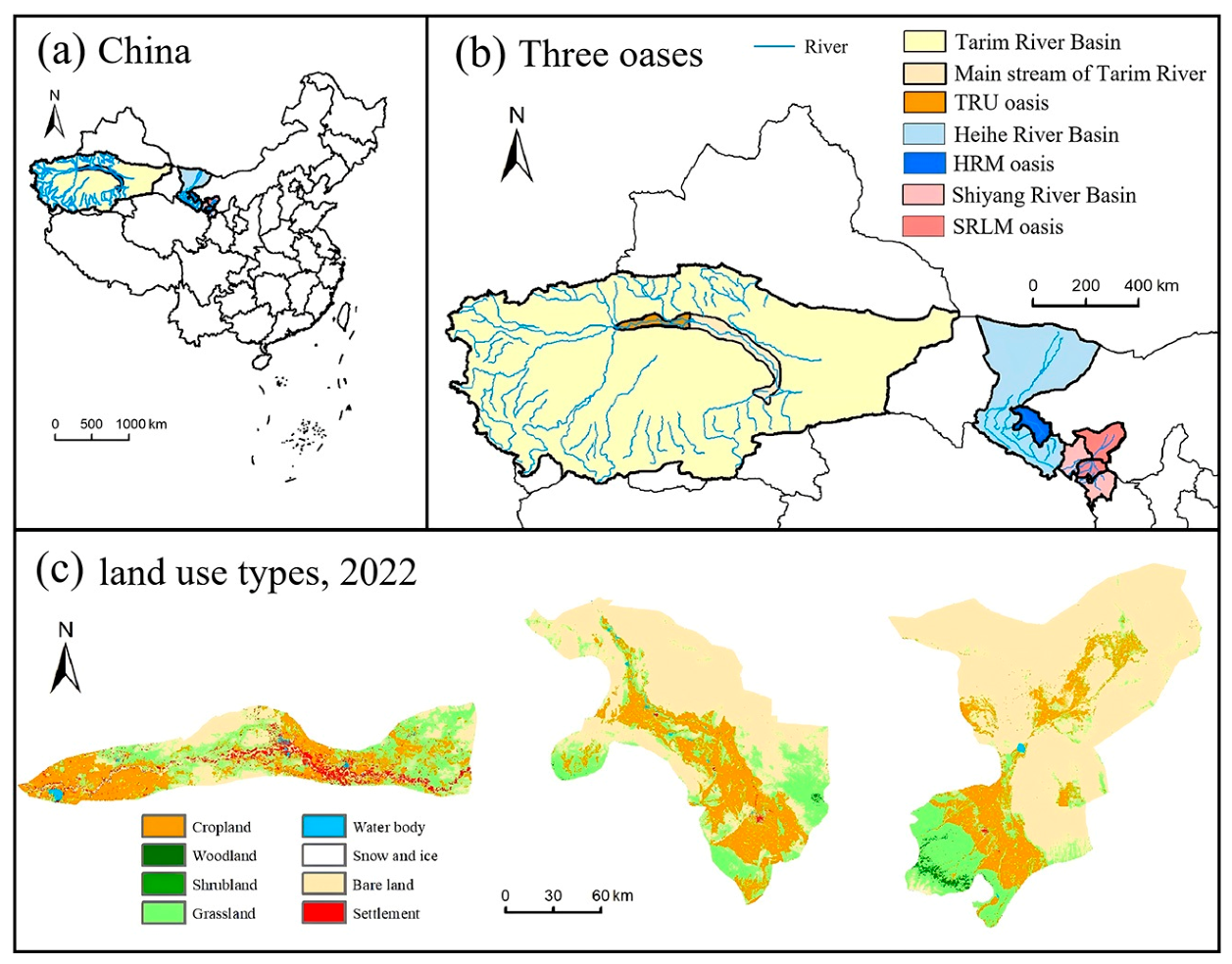
Three representative oases from arid inland river catchments in northwestern China were selected for analysis (Figure 1). Based on previous studies [27] and quantitative water–heat indicators, the gradient from relatively favorable to more arid conditions follows the order: SRLM oasis > HRM oasis > TRU oasis. The TRU oasis is located in western Xinjiang, mainly covering Alar City and parts of Shaya County, with an area of approximately 9300 km2. The HRM and SRLM oases occur in the middle and eastern Hexi Corridor, Gansu Province, spanning about 10,600 km2 and 20,400 km2, respectively. All three oases have a temperate continental climate, with limited and seasonally concentrated rainfall, strong evaporative demand, abundant solar radiation, frequent winds, and active aeolian processes. Vegetation structure is relatively simple, but these oases still provide important habitats and play a key role in maintaining biodiversity in arid regions.
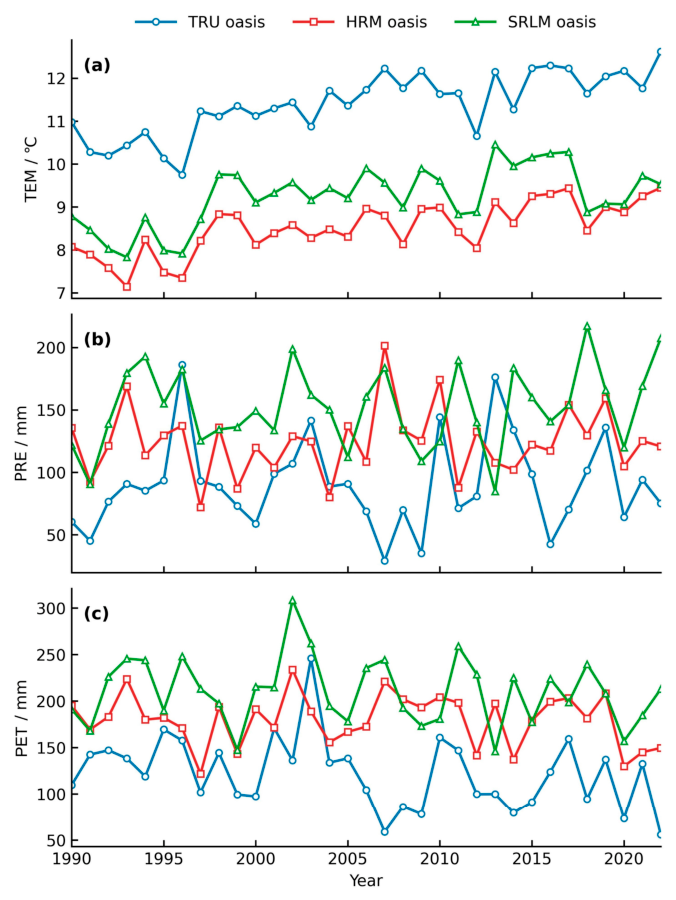
In this study, water–heat conditions were defined as an integrated constraint on oasis ecosystem processes, with precipitation representing water availability and temperature and potential evapotranspiration reflecting heat-related evaporative demand. To support the water–heat gradient classification, mean annual temperature (TEM), precipitation (PRE), and potential evapotranspiration (PET) were calculated for 1990–2022 (Figure 2, Table 1). The TRU oasis had the highest temperature but the lowest precipitation and potential evapotranspiration, indicating severe water limitation. The HRM oasis showed intermediate conditions, whereas the SRLM oasis had substantially higher precipitation and potential evapotranspiration. Given the dominant role of water availability in arid oasis ecosystems, these indicators support the gradient order of SRLM oasis > HRM oasis > TRU oasis.

2.2. Data Source

The 30 m land use and land cover (LULC) data were obtained for 1990, 2005, and 2022 to represent major long-term ecological transition stages in the study area, including early oasis development, rapid land-use transformation, and the recent period influenced by ecological restoration, climate change, and intensified human activities. The detailed land-use types are presented in Figure 1c.
In addition, natural environmental variables, including temperature (T), PRE, PET, digital elevation model (DEM), and normalized difference vegetation index (NDVI), were collected to characterize the biophysical conditions of oasis ecosystems. Socioeconomic variables, including population density (PopDens), per capita GDP (GDPpc), and urbanization rate (UrbanRate), were obtained from county-level statistical yearbooks for the corresponding study years. County-level socioeconomic data were spatialized through interpolation and converted into raster layers consistent with the ecosystem service datasets in extent and resolution. Table 2 provides the sources and characteristics of the datasets used in this study.

2.3. Research Methods

2.3.1. Research Framework

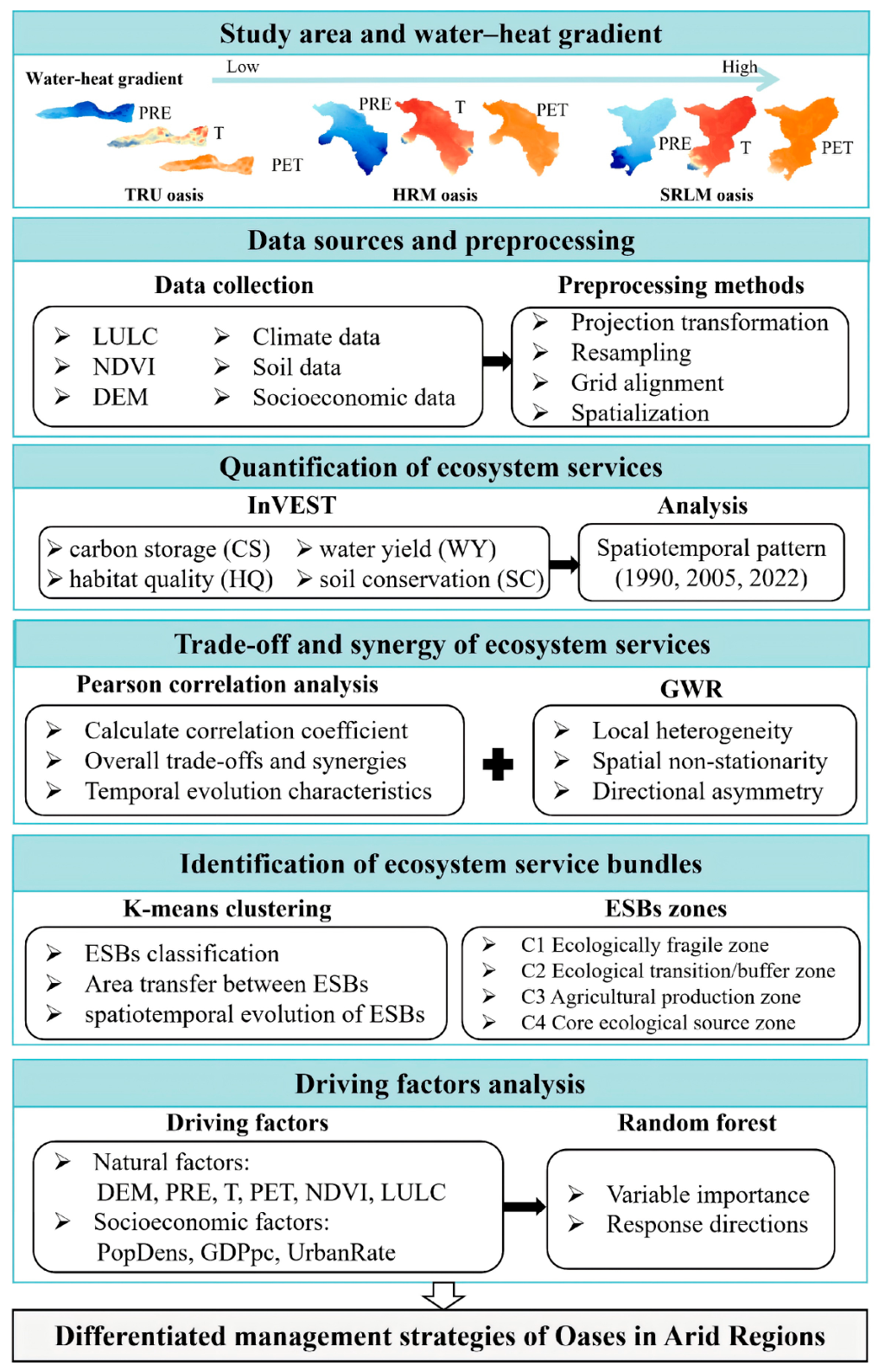
To comprehensively assess ESs in oases, the research framework was designed to link ES assessment, trade-off and synergy analysis, ESB identification, driving-factor analysis, and differentiated management strategies. The overall workflow is shown in Figure 3.

2.3.2. Quantification of Ess

Following previous studies [28], CS, HQ, WY, and SC were selected to represent the key ecological functions of arid oases [7,25,29,30]. InVEST-based modeling was applied to estimate the four indicators, following procedures reported in previous studies [10]. The InVEST parameters were determined based on related literature [31,32], regional ecological characteristics, and the InVEST user guide for version 3.14.2. Carbon density values for four carbon pools were assigned to each land use and land cover class, with details and sources provided in Table S1. Parameters for the other three ES modules were set according to previous studies and adjusted for the three oasis systems [31,33].

2.3.3. Analysis of Es Trade-Offs and Synergies

Pearson correlation analysis was used to identify overall trade-off and synergy relationships among ecosystem services. Before analysis, all ecosystem service layers were harmonized to a common grid with consistent spatial resolution and extent. Correlation coefficients were calculated using valid grid-cell values within each oasis and year after excluding No Data values; thus, the sample size corresponded to the number of valid grid cells. Positive and negative coefficients indicate synergies and trade-offs, respectively [23]. Because ecosystem service values are spatially structured, Pearson correlation analysis was mainly used to characterize the overall direction and relative strength of relationships, while local spatial heterogeneity was further examined using GWR. Annual correlation analyses were conducted using the SciPy package (version 1.10.1) in Python (version 3.9).
We used geographically weighted regression to examine local variation and non-stationary patterns in ES relationships. Compared with local association methods such as bivariate LISA, which mainly identify spatial co-occurrence or clustering patterns, GWR estimates local coefficients and significance levels, thereby quantifying the direction and strength of local relationships under heterogeneous environmental conditions. Positive and negative local coefficients were interpreted as spatial synergies and trade-offs, respectively [23]. Each ES was alternately specified as the dependent variable and regressed against the remaining services, generating two directional maps for each service pair and allowing directional asymmetry to be examined.
All ES indicators were standardized using Z-score normalization before GWR modeling to improve coefficient comparability among different ES pairs. All GWR models were fitted using an adaptive bi-square kernel, and the optimal bandwidth was selected according to the AICc criterion. To improve model transparency and reliability assessment, the selected bandwidth, AICc, R2, and adjusted R2 of the GWR models are reported in Table 3. GWR analyses were implemented using the mgwr package (version 2.1.2) in Python (version 3.9).

2.3.4. Identification of Esbs

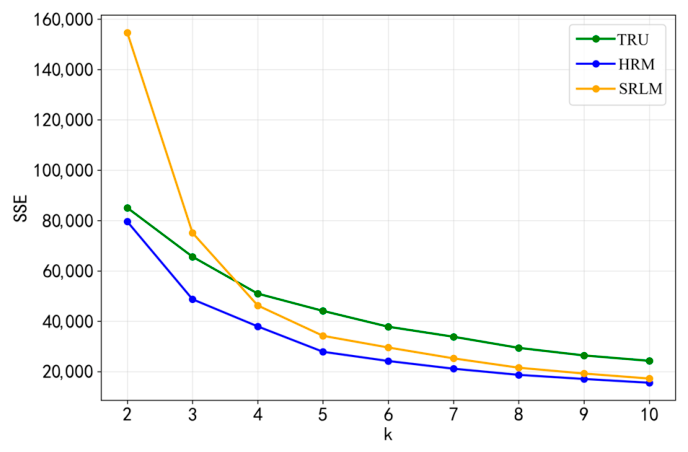
The K-means clustering algorithm classified oasis ESs into ESBs and identified spatially differentiated multifunctional patterns [28]. All ecosystem service indicators were standardized using Z-score normalization before clustering. The bundle classification scheme was selected by integrating the SSE elbow criterion, cluster compactness assessment, and ecological interpretability. Stepwise clustering was performed for K = 2–10. The SSE curve declined markedly from K = 2 to K = 4 and then decreased more gradually, indicating an elbow point around K = 4. Although K = 4 did not always yield the highest silhouette coefficient, it provided a better balance between statistical performance, ecological interpretability, and cross-oasis comparability than K = 3 or K = 5. Therefore, four ecosystem service bundles were identified. To reduce the influence of initial centroid selection, K-means clustering was performed with multiple random initializations and a fixed random seed. Bundle characteristics were interpreted using standardized profiles of CS, HQ, WY, and SC. Because interannual SSE patterns were similar, only the 2022 SSE curve is presented in Figure 4 to illustrate the selection of K = 4.

2.3.5. Driving Factors

Based on previous studies [34] and the characteristics of arid oasis ecosystems, nine variables were selected to examine the main socio-ecological controls on spatiotemporal variations in ecosystem services. These variables included natural environmental factors—T, PRE, PET, DEM, NDVI, and LULC—and socioeconomic factors—PopDens, GDPpc, and UrbanRate. These variables represent water–heat conditions, topography, vegetation growth, land-cover change, human activity intensity, and socioeconomic development. A random forest model was used to assess driver importance, and partial dependence analysis further evaluated marginal response directions between key drivers and ES variations [35].

3. Results

3.1. Spatiotemporal Variation in Ess in Oases Across Different Water–Heat Gradients

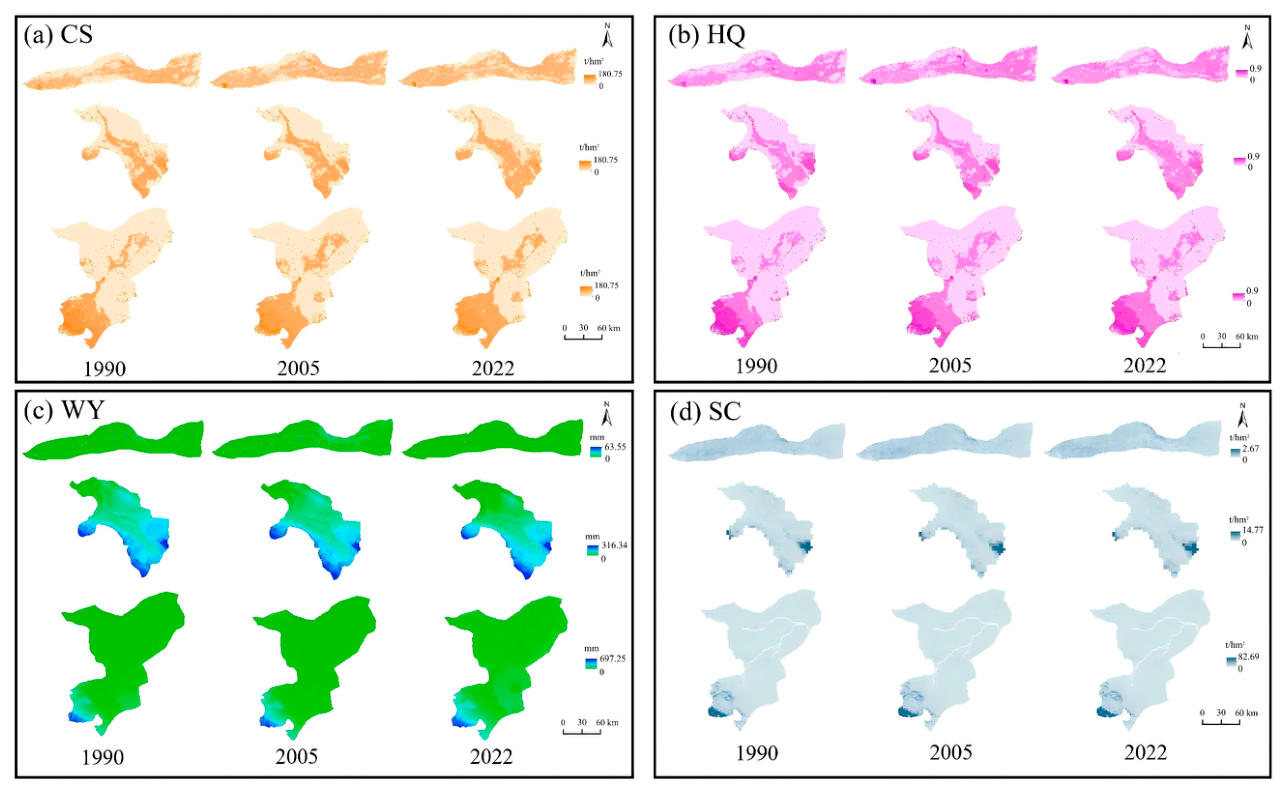
Across oases along different water–heat gradients, CS and HQ exhibit largely consistent spatial patterns with pronounced spatial heterogeneity (Figure 5a,b). High values are mainly concentrated in forests, grasslands, and riparian wetlands, whereas low values occur in built-up and desert areas. Spatially, both services are highest in the TRU oasis, decline from southeast to northwest in the HRM oasis, and decrease from southwest to northeast in the SRLM oasis. Overall, CS and HQ show increasing trends across all oases. Temporally, elevated-value areas across the TRU oasis expanded during 1990–2005 and slightly contracted during 2005–2022, indicating a modest reduction in carbon sink quality in the later period. In the HRM oasis, high-value areas decreased during the early period but increased substantially thereafter, reflecting the effects of large-scale ecological restoration. In the SRLM oasis, high-value areas increased during the early period and remained relatively stable in the later period, as carbon losses from urban expansion were largely offset by gains from ecological restoration.
WY and SC display similar spatial patterns across the oases (Figure 5c,d), showing higher values in elevated terrain and lower values across flatter areas. Following the water–heat gradient, the maximum values of both services increase progressively. Over the past three decades, their spatial patterns remained relatively stable, although total amounts varied among oases. Specifically, total WY in the TRU oasis and HRM oasis first increased and then declined, decreasing by 76.12% and 16.83%, respectively, whereas WY in the SRLM oasis increased markedly by 1.11 × 10⁹ m3 (181.95%) from 2005 to 2022. SC increased slightly (6.18%) in the TRU oasis and remained relatively stable in the other two oases.

3.2. Trade-Offs and Synergies Among Ess

3.2.1. Correlation Analysis

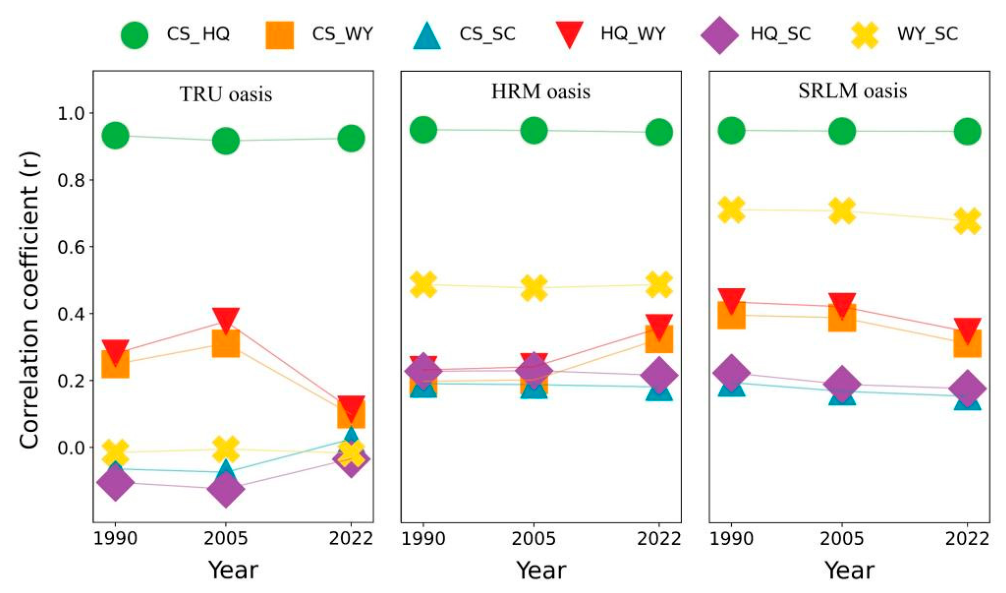
The correlation analysis results (Figure 6) indicate that WY, CS, and HQ exhibit significant synergistic relationships across pairwise combinations in oases of the arid region of northwestern China (p < 0.05). Among these, the CS–HQ synergy was the strongest, and correlation values remained above 0.94, and their relationships remain relatively stable across all oases during the study period. The CS–WY and HQ–WY synergies were comparable and followed similar temporal trends; their correlation values varied from 0.243 to 0.425. In the TRU oasis, the degree of synergy for both pairs increased from 1990 to 2005 by 0.062 and 0.096, respectively, but declined markedly from 2005 to 2022 by 0.212 and 0.262. In the HRM oasis, these relationships remained relatively stable during 1990–2005 and increased substantially during 2005–2022, by 0.114 and 0.109, respectively. In contrast, both relationships in the SRLM oasis showed declining trends over the study period, with decreases of 0.086 and 0.090.
Across all oases, the CS–SC and HQ–SC relationships display similar magnitudes and temporal trends. In the TRU oasis, both pairs exhibited weak trade-offs during 1990–2005 but improved during 2005–2022; the CS-SC association shifted toward synergy. For the HRM and SRLM oases, both pairs consistently showed synergistic relationships of comparable strength and remained relatively stable throughout the study period. Over the entire study period, the WY–SC association showed a weak trade-off in the TRU oasis, whereas it exhibited moderate synergy in the HRM oasis and strong synergy in the SRLM oasis. This pattern indicates a pronounced gradient effect along the water–heat gradient, whereby improved water–heat conditions are associated with stronger synergies between WY and SC.

3.2.2. Spatial Variation in Trade-Offs and Synergies

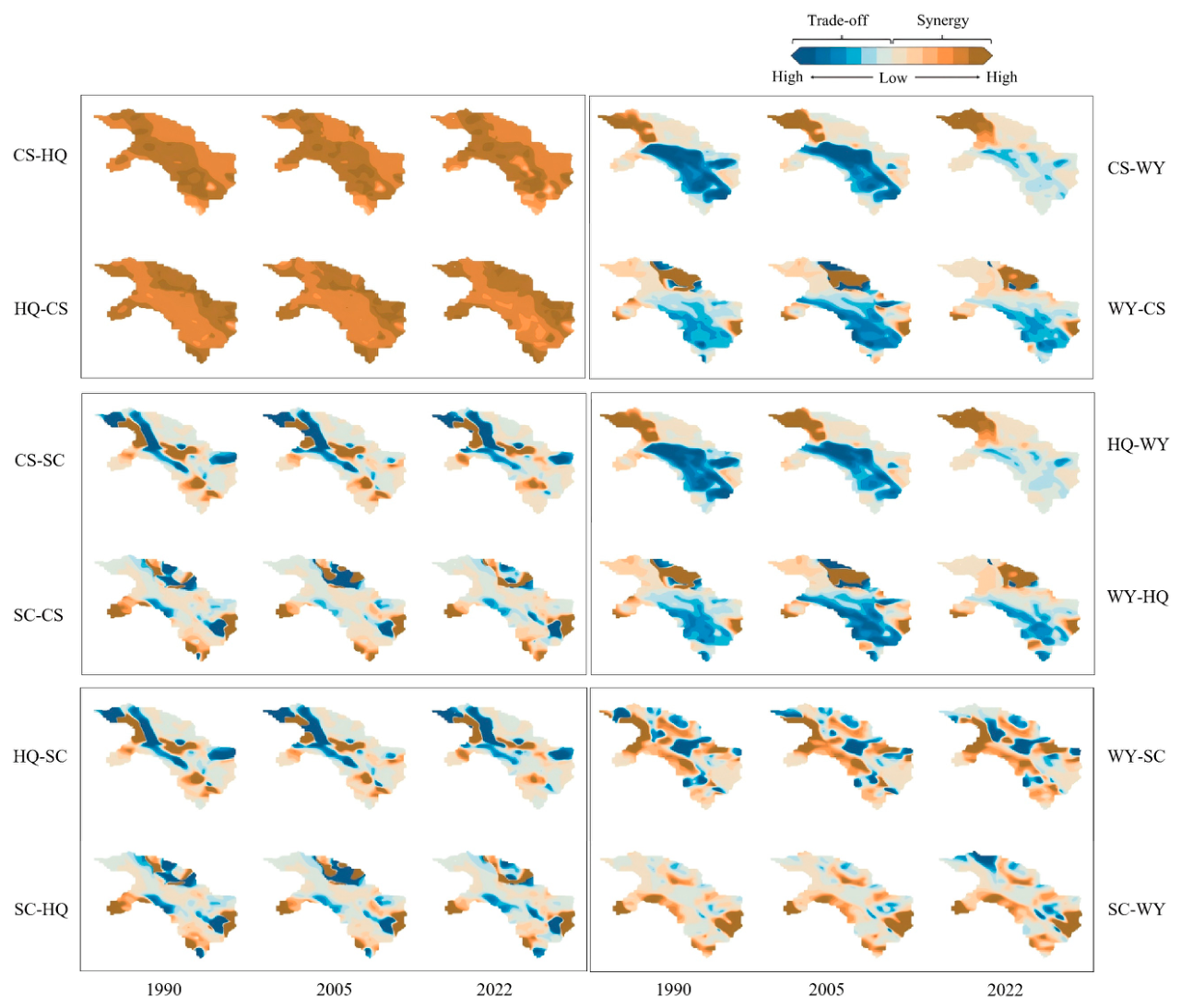
To avoid relying solely on qualitative interpretation of GWR coefficient maps, we further quantified the spatial proportions of significant synergy, significant trade-off, and non-significant relationships. Local coefficients greater than zero with |t| > 1.96 were classified as significant synergies, whereas coefficients less than zero with |t| > 1.96 were classified as significant trade-offs. Grid cells with |t| ≤ 1.96 were classified as non-significant relationships. The resulting proportions are summarized in Table 4 and were used to support the interpretation of dominant local ES relationships.
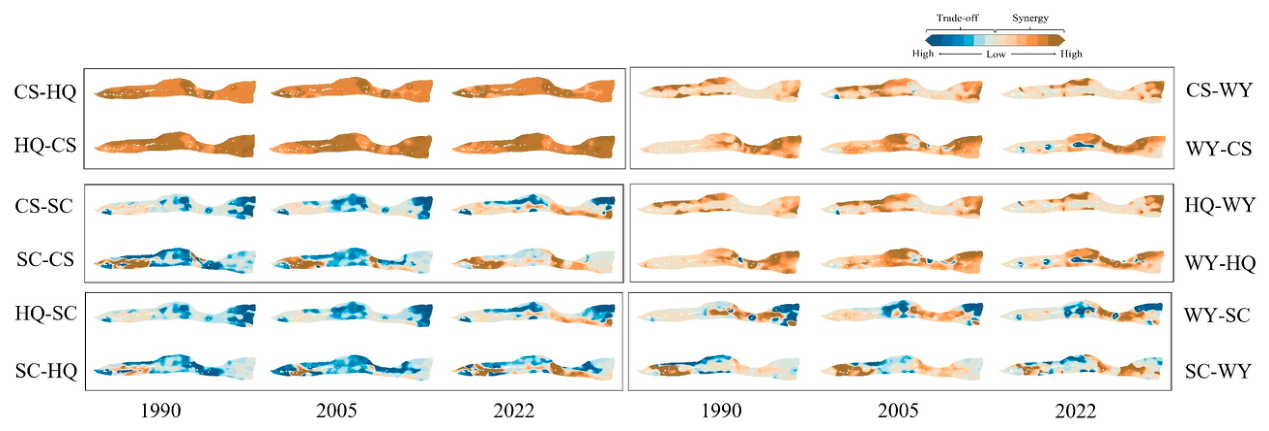
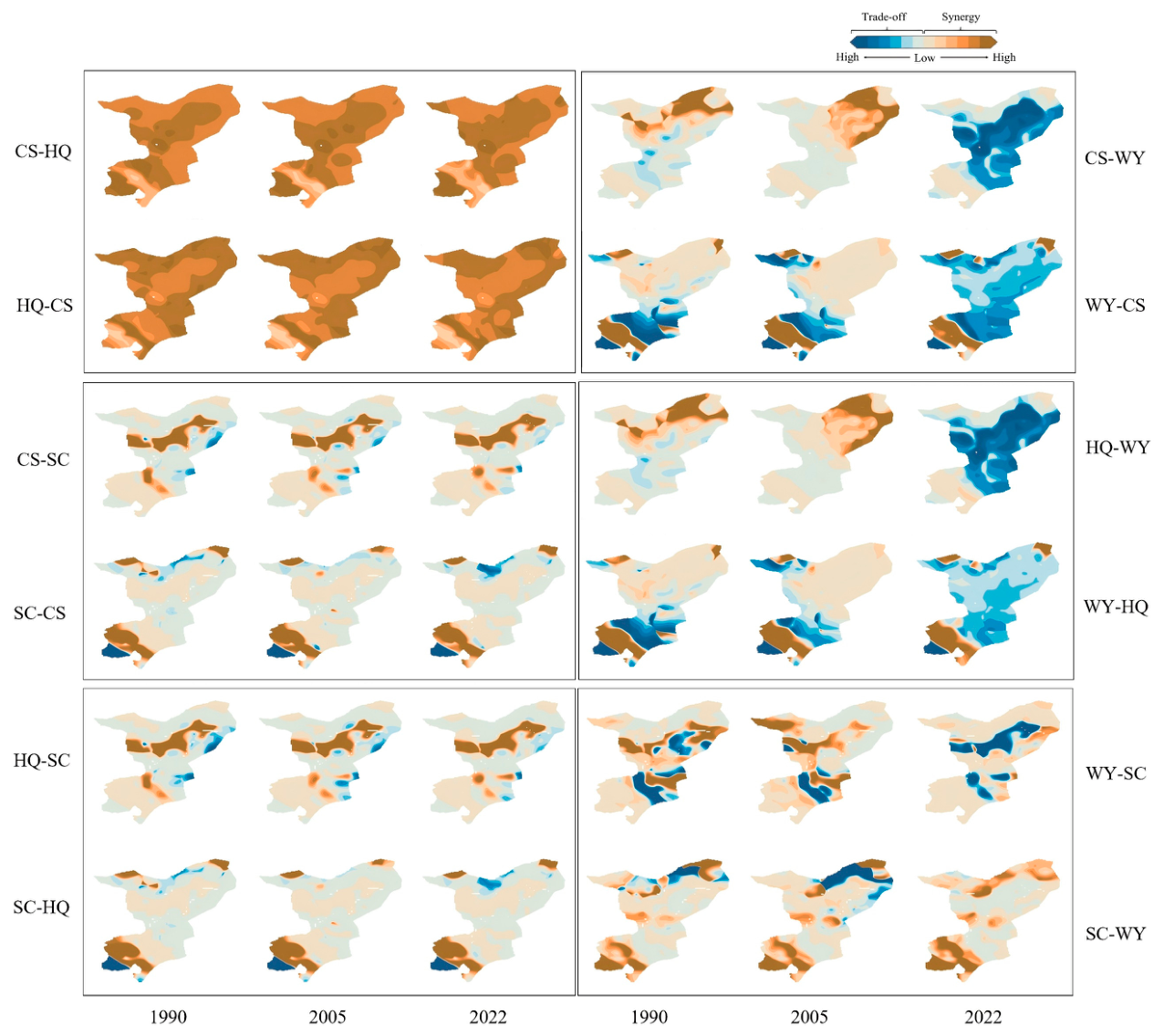
GWR results showed that the CS–HQ relationship was consistently dominated by significant synergies across the three oasis systems and study years (Figure 7, Figure 8 and Figure 9; Table 4). The proportion of significant synergy was generally high for both directional specifications, indicating a stable positive spatial association for the CS–HQ pair. However, this relationship showed spatially varying strength depending on the dependent-variable specification. When CS was treated as the dependent variable, stronger synergies were mainly observed near rivers, wetlands, and vegetated areas, whereas the HQ-dependent specification highlighted areas where habitat quality was more sensitive to spatial variation in carbon storage. This directional difference suggests that the CS–HQ relationship is spatially asymmetric rather than spatially homogeneous.
For the CS–WY and HQ–WY relationships, the proportions of significant synergy, significant trade-off, and non-significant areas varied substantially among oases and years (Table 4). In the TRU oasis, significant synergies were more widely distributed than significant trade-offs for most years, although the spatial extent and intensity of synergy changed over time. In the HRM oasis, trade-off patterns were primarily distributed across cropland and riparian areas, whereas synergistic areas occurred more frequently outside these intensively managed zones. In the SRLM oasis, the relative proportions of synergy and trade-off changed more strongly across years, indicating greater temporal instability in hydrological–ecological coupling.
The CS–SC and HQ–SC relationships also displayed clear spatial heterogeneity. In the TRU oasis, significant trade-off areas occupied a relatively larger proportion for several directional specifications, suggesting that increases in soil conservation were not always accompanied by simultaneous increases in CS or HQ. In contrast, both HRM and SRLM oases showed a higher proportion of significant synergies for these relationships, although non-significant areas remained widespread in some years. Soil conservation–vegetation service interactions are therefore strongly shaped by local water–heat and land-use contexts.
The WY–SC relationship exhibited the most pronounced spatial heterogeneity among the analyzed ES pairs. The proportions of significant synergy and trade-off varied markedly across the three oases and between reversed model specifications (Table 4). This indicates that WY–SC interactions cannot be adequately represented by a single global relationship. Instead, the relationship depends on local vegetation cover, runoff generation, erosion processes, and topographic conditions. The contrast between WY–SC and SC–WY further suggests directional asymmetry in the hydrological–erosion coupling process.

3.2.3. Identification and Evolution of Esbs

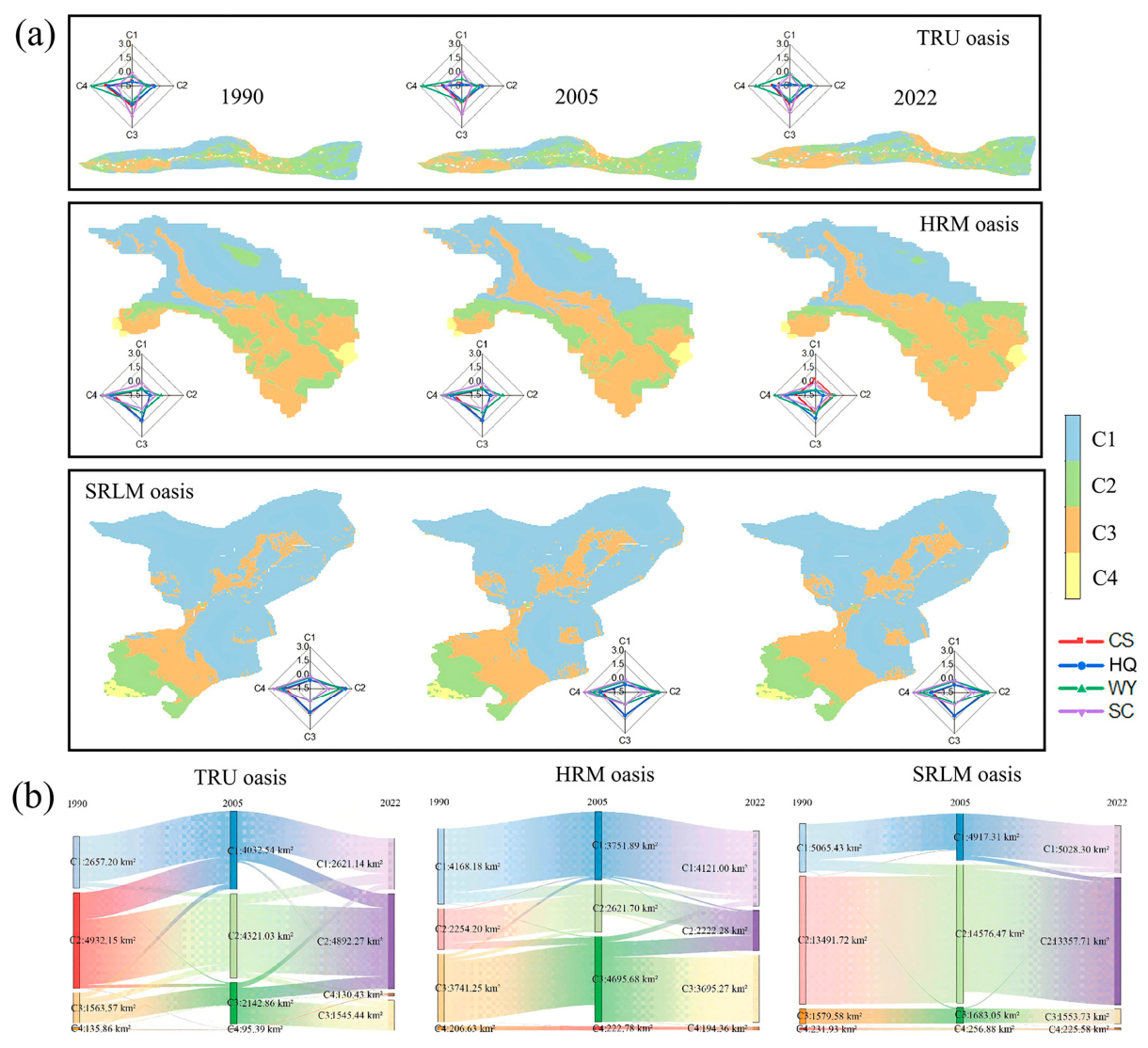
Based on K-means clustering analysis, four ESBs were identified in each oasis (Figure 10a). The ecological labels of these bundles were assigned based on the combined interpretation of standardized ES profiles, dominant land-cover composition, and spatial pattern features. Radar charts show the standardized values of CS, HQ, WY, and SC for each bundle, providing a visual basis for interpreting their multifunctional characteristics (Figure 10a). Specifically, C1 was identified as an ecologically fragile zone, characterized by persistently low levels of all services; C2 was defined as an ecological transition/buffer zone, with relatively high CS, HQ, and WY but low SC; C3 was interpreted as an agricultural production zone because it was mainly distributed in cultivated oasis landscapes and exhibited service profiles typical of human-managed agricultural systems, including relatively high service supply but vulnerable declines in SC and WY; and C4 was classified as a core ecological source zone, featuring high overall ecosystem functioning, particularly in WY and SC. While the functional composition of these ESBs remained broadly consistent across the study years, their spatial distributions and spatiotemporal changes differed markedly among oases.
In the TRU oasis, ESBs exhibit pronounced functional differentiation and dynamic instability, characterized by continuous expansion of C2 at the expense of C1 and C3, together with marked degradation of C4, indicating simultaneous weakening of core ecological and agricultural functions (Figure 10a,b). In the HRM oasis, ESB dynamics reflect strong human influence, with dominant bundles shifting from agricultural–fragile coexistence to fragile expansion and subsequently back to agricultural dominance, highlighting dynamic competition of agricultural expansion with ecological conservation. In contrast, SRLM oasis exhibited a highly stable ESB structure dominated by C1, with limited transitions mainly between C1 and C3, while high-function bundles (C2 and C4) remain stable under rigid desert constraints.
Overall, despite sharing a common “fragile–transition–core–agricultural” differentiation pattern across the water–heat gradient, the three oases differ substantially in system stability and driving mechanisms. With deteriorating water–heat conditions, oasis systems in northwestern China tend to shift from naturally constrained rigid systems to highly elastic human–environment interaction systems, and ultimately toward degraded and vulnerable systems.

3.3. Driving Factors of Ess

The random forest models included nine driving factors: T, PRE, PET, DEM, NDVI, LULC, PopDens, GDPpc, and UrbanRate. The models showed good predictive performance, with mean test R2 values of 0.906, 0.900, 0.825, and 0.796 for CS, HQ, WY, and SC, respectively (Table 5).
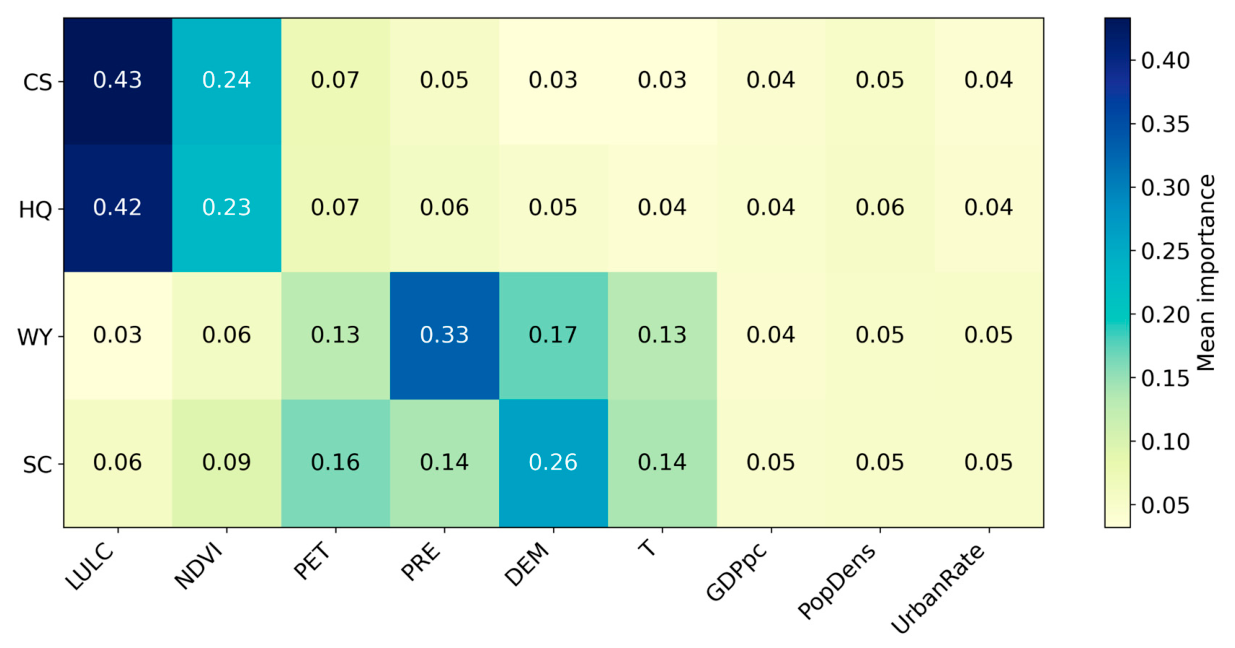
The variable-importance results showed clear differences among ES types (Figure 11). CS and HQ were primarily associated with LULC, NDVI, and PET, indicating that land-use structure, vegetation greenness, and atmospheric evaporative demand were key factors regulating vegetation-related services. PDP-derived results further showed that NDVI had positive effects on both CS and HQ, with positive responses in 9/9 and 7/9 oasis-year cases, respectively (Table 5). This suggests that increased vegetation greenness generally promoted carbon storage and habitat quality.
WY was mainly influenced by PRE, DEM, and T (Figure 11). PRE showed a consistently positive PDP response, with positive effects in 9/9 oasis-year cases and a mean PDP Spearman’s ρ of 0.976 (Table 5), indicating that water input was the dominant control on WY. In contrast, T showed a negative response in 9/9 cases, suggesting that stronger thermal conditions may reduce WY by increasing water loss.
SC was mainly driven by DEM, PET, and PRE (Figure 11). DEM and PRE showed positive PDP responses, whereas PET showed a negative response in most cases (Table 5). These results indicate that SC was jointly shaped by topographic conditions, water availability, and atmospheric evaporative demand.
Overall, vegetation-related services were mainly associated with LULC and NDVI, whereas hydrological and erosion-related services were more strongly affected by PRE, PET, DEM, and T. By combining variable importance with PDP-derived response directions, the results provide a more interpretable explanation of ES driving mechanisms.

4. Discussion

4.1. Spatiotemporal Variations and Potential Driving Mechanisms of ESs Along Water–Heat Gradients

Spatiotemporal variations in ecosystem services reflect the combined influence of climate, land-use transformation, vegetation conditions, topography, and human disturbance in arid oasis socio-ecological systems [36]. The random forest analysis indicated that vegetation-related ESs (CS, HQ) were mainly associated with LULC, NDVI, as well as PET. In contrast, hydrological and erosion-related ESs (WY, SC) displayed strong associations with precipitation, potential evapotranspiration, temperature, and topographic conditions. These results indicate that ecosystem service dynamics along water–heat gradients are jointly shaped by land-cover structure, vegetation growth, water availability, atmospheric evaporative demand, and terrain constraints.
Carbon storage and habitat quality showed similar spatial patterns, mainly concentrated in forests, grasslands, and riparian wetlands. This is consistent with previous studies showing that vegetation structure and land-use composition are key controls on vegetation-related ecosystem services [10,37]. Mechanistically, LULC shapes vegetation habitat patterns, while vegetation greenness reflects growth status and biomass accumulation [38]. The positive response of carbon storage and habitat quality to normalized difference vegetation index further suggests that increased vegetation cover generally enhances carbon sequestration potential and habitat suitability. Their marked increase in the TRU and SRLM oases during the early period may be partly associated with the conversion of bare or sparsely vegetated land into irrigated cropland and the consequent increase in vegetation cover and biomass under oasis conditions [39].
Unlike humid-region ecosystems, cropland expansion in arid oases may partly occur through the reclamation of bare or sparsely vegetated land rather than the replacement of high-quality natural habitats [40,41]. Under irrigation and shelterbelt construction, such transitions may increase modeled vegetation-related services relative to desert backgrounds [42]. However, these increases do not necessarily indicate improved ecological integrity, because cropland expansion may also intensify water consumption, habitat fragmentation, and ecological pressure [43]. Therefore, increases in modeled service supply should be distinguished from long-term ecological improvement.
Water yield and soil conservation displayed similar spatial patterns across the oases, suggesting spatial coupling between hydrological regulation and erosion control shaped jointly by precipitation and topography. WY was mainly influenced by precipitation, digital elevation model, and temperature, indicating the combined effects of water input, terrain redistribution, and thermal constraints. The positive response of water yield to precipitation confirms that water input is the fundamental control of hydrological service supply in arid and semi-arid regions [19,37]. Topography further regulates runoff generation, water accumulation, and snowmelt-related supply, especially in mountain–oasis systems [44]. In contrast, the negative response of water yield to temperature suggests that stronger thermal conditions may increase evaporative water loss and reduce available water yield.
Soil conservation was mainly associated with digital elevation model, potential evapotranspiration, and precipitation, consistent with the understanding that erosion-related services are jointly influenced by topography, rainfall processes, vegetation cover, and surface water–energy conditions [45]. Topography affects slope gradients, runoff pathways, and erosion potential [46]. Precipitation can enhance vegetation growth and soil retention capacity, although it may also increase rainfall erosivity under certain conditions [47]. The positive response of soil conservation to precipitation highlights the potential role of water-input-driven vegetation growth in arid oases, whereas the negative response to potential evapotranspiration indicates that stronger atmospheric evaporative demand may intensify water stress and weaken soil retention capacity.
Overall, ecosystem services along water–heat gradients are governed by differentiated but interconnected mechanisms. Carbon storage and habitat quality are mainly linked to land-cover structure and vegetation growth; water yield is associated with precipitation, topographic redistribution, and thermal constraints; and soil conservation depends on terrain conditions, water availability, and atmospheric evaporative demand. These findings suggest that oasis ecosystem services cannot be explained by a single climatic or land-use factor, but reflect the coupled effects of water–heat constraints, vegetation dynamics, land-use transformation, and topographic heterogeneity [48]. Because random forest analysis identifies statistical associations rather than strict causal effects, interpretations related to ecological restoration, agricultural expansion, and water-management policies should be regarded as plausible explanations rather than formal causal attribution. Future studies should combine ecosystem service modeling with counterfactual scenarios, process-based models, or long-term observations to better quantify management effects.

4.2. Trade-Offs and Synergies Among Ess in Oases Across Water–Heat Gradients

Clarifying trade-offs and synergies among ESs across water–heat gradients is crucial for promoting oasis ecological stability and sustainable management [49]. Our results show that synergies generally prevailed among ESs in northwestern China’s oases, consistent with previous studies [50,51,52], but their strength and temporal changes differed among services and oases. CS and HQ showed a strong and stable synergy, reflecting their shared dependence on vegetation structure and habitat conditions [53]. Conversely, WY–CS and WY–HQ synergies were weaker and more dynamic, indicating more complex interactions between hydrological and ecological processes [43].
Differences among oases further highlight the influence of human–water–ecosystem interactions. In the TRU oasis, the decline in synergies after 2005 may be associated with agricultural expansion and intensive water use, which can alter runoff processes and reduce natural vegetation, carbon storage, and habitat quality [54]. In the HRM oasis, strengthened synergies in the later period may be related to ecological water allocation and restoration efforts, suggesting that improved water management can support multiple ecosystem services [55]. In the SRLM oasis, the persistent decline in synergies may reflect ecosystem degradation under intensive human disturbance [56].
WY–SC interactions exhibited distinct gradient-dependent variation across water–heat conditions, shifting from weak trade-offs in the TRU oasis to stronger synergies in the HRM and SRLM oases. This transition reflects the role of vegetation in regulating hydrological and erosion processes. Under extremely arid conditions, sparse vegetation reduces canopy interception, root stabilization, and surface roughness, making runoff generation more closely associated with soil loss. As water–heat conditions improve, denser vegetation enhances infiltration, slows runoff, strengthens root reinforcement, and reduces erosion, thereby promoting synergy between water regulation and soil conservation [57]. Topography may further affect this relationship by influencing runoff accumulation, slope-related erosion, and sediment transport [58]. Therefore, the transition from trade-offs to synergies arises from interactions among water–heat gradients, vegetation dynamics, runoff generation, and erosion processes in arid oasis systems.
GWR further reveals pronounced spatial heterogeneity and directional asymmetry in ES relationships. Directional asymmetry was identified by comparing reversed GWR specifications for the same ES pair, such as CS–HQ versus HQ–CS and WY–SC versus SC–WY. The results show that the spatial extent of significant synergy and trade-off can differ substantially when the dependent and explanatory variables are reversed. This finding suggests that pairwise ES relationships are not necessarily symmetric, even when the same two services are involved.
The CS–HQ relationship provides a clear example of this asymmetric structure. Although CS and HQ were generally synergistic, the spatial intensity and sensitive areas differed between the two directional specifications. When CS was treated as the dependent variable, stronger synergies tended to occur near water-rich and vegetated areas, suggesting that habitat conditions can enhance carbon storage in relatively productive oasis patches. Conversely, when HQ was treated as the dependent variable, sensitive areas shifted toward natural or less intensively managed ecosystems, indicating that habitat quality may respond more strongly to carbon-related vegetation structure in these areas.
Directional asymmetry was also evident in the WY–SC relationship. The reversed specifications WY–SC and SC–WY showed different proportions of significant synergy and trade-off areas, indicating that water yield and soil conservation respond differently to local hydrological and erosion processes. This asymmetry may imply that some ESs act more as responsive services, while others exert stronger structuring effects on local ES interactions. In arid oases, such asymmetry is likely shaped by the combined effects of vegetation cover, runoff generation, soil erosion, topographic gradients, and human water management [23].
Overall, ES relationships in arid oases are jointly regulated by natural water–heat constraints and human intervention pathways, resulting in strong spatial heterogeneity and directional asymmetry. While water–heat conditions define the fundamental limits and spatial differentiation of ES interactions, differentiated human activities—particularly land-use practices and water management strategies—reshape the realized strength and evolution of ES synergies in practice.

4.3. Management Implications for Sustainable Oasis Development Along Water–Heat Gradients

Based on the ecosystem service bundle patterns, differentiated governance strategies should be adopted for different functional zones. For the ecologically fragile zone (C1), priority should be given to ecological restoration, vegetation recovery, desertification control, and cropland retirement in marginal or ecologically unsuitable areas. In the ecological transition/buffer zone (C2), management should focus on maintaining ecological buffering functions, controlling excessive land development, and improving landscape connectivity to prevent further degradation. For the agricultural production zone (C3), water-saving agriculture, irrigation efficiency improvement, and farmland ecological management should be prioritized, because this zone supports important production functions but is vulnerable to water-resource constraints and declines in soil conservation and water yield. In the core ecological source zone (C4), strict ecological protection and development restrictions should be implemented to sustain high multifunctional ES supply [28].
Regionally, TRU oasis should prioritize ecological restoration, marginal cropland retirement, and strict agricultural water-use control due to its severe water limitation and fragile ecosystem conditions. HRM oasis should consolidate ecological restoration gains and strengthen integrated water governance to sustain ES recovery. SRLM oasis should emphasize the coordination of agricultural production, urban expansion control, and ecological restoration, especially by promoting water-saving agriculture in agricultural production zones and limiting development in ecologically sensitive areas.

4.4. Limitations and Future Perspectives

Although this study systematically examines ES interactions and spatial organization across oasis systems under different water–heat gradients, several limitations remain [59]. First, although selected years represent major ecological transition stages, the limited temporal resolution may constrain the ability to capture short-term fluctuations and continuous ecosystem service dynamics. Second, while the K-means clustering approach reduces subjectivity compared with expert-based zoning, ecosystem service bundle classification still contains methodological uncertainty related to cluster-number selection and algorithm choice. Third, ecosystem service interactions may exhibit scale dependence, whereas the analysis relied on a single spatial scale. Finally, although key environmental and socioeconomic drivers were incorporated, certain potentially important variables, such as groundwater dynamics, irrigation intensity, and additional policy-related factors, were not explicitly included due to data availability constraints. Future studies should integrate higher-temporal-resolution datasets, multi-scale analytical frameworks, and multi-method robustness comparisons to improve understanding of oasis ecosystem dynamics.

5. Conclusions

This study examined ecosystem service trade-offs and synergies in three representative oases along water–heat gradients in arid northwestern China. The results showed that water–heat conditions influenced the spatial organization and interactions of ESs. Carbon storage and habitat quality generally exhibited strong synergies, while water-yield–soil-conservation interactions shifted from weak trade-offs under drier conditions to stronger synergies under relatively favorable water–heat conditions.
Geographically weighted regression revealed clear spatial heterogeneity and directional asymmetry in ecosystem service relationships, indicating that trade-offs and synergies varied across oasis landscapes. Ecosystem service bundle analysis identified four functional zones: ecologically fragile zones, ecological transition or buffer zones, agricultural production zones, and core ecological source zones.
The driving-factor analysis showed that vegetation-related services were mainly associated with land-cover structure and vegetation growth, whereas hydrological and erosion-related services were more closely linked to precipitation, potential evapotranspiration, temperature, and topography. These findings suggest that oasis ecosystem services are jointly shaped by water–heat constraints, vegetation dynamics, land-use transformation, topographic heterogeneity, and human disturbance.
Overall, this study provides a spatial basis for differentiated oasis management. Future strategies should emphasize ecological restoration in fragile zones, development regulation in transition zones, water-saving agriculture in agricultural production zones, and strict protection in core ecological source zones.

Supplementary Materials

The following supporting information can be downloaded at: https://www.mdpi.com/article/10.3390/land15061049/s1.

Author Contributions

Y.M.: Conceptualization, Methodology, Data curation, Formal analysis, Visualization, Writing—original draft. J.H.: Methodology, Data curation. X.Z.: Validation, Resources. Y.G.: Funding acquisition, Methodology, Data curation. K.C.: Validation, Resources. X.L.: Supervision, Validation, Methodology. All authors have read and agreed to the published version of the manuscript.

Funding

This work was supported by the National Natural Science Foundation of China (42301309) and Gansu Youth Science and Technology Fund (23JRRA1187).

Data Availability Statement

Data will be made available on request.

Acknowledgments

We would like to thank the anonymous reviewers and the editors for their helpful comments that improved the manuscript substantially.

Conflicts of Interest

The authors declare no conflicts of interest.

References

  1. Gaur, M.K.; Squires, V.R. Geographic Extent and Characteristics of the World’s Arid Zones and Their Peoples. In Climate Variability Impacts on Land Use and Livelihoods in Drylands; Gaur, M.K., Squires, V.R., Eds.; Springer International Publishing: Cham, Switzerland, 2018; pp. 3–20. [Google Scholar]
  2. Tilman, D.; Cassman, K.G.; Matson, P.A.; Naylor, R.; Polasky, S. Agricultural Sustainability and Intensive Production Practices. Nature 2002, 418, 671–677. [Google Scholar] [CrossRef] [PubMed]
  3. Bernardino, P.N.; De Keersmaecker, W.; Horion, S.; Oehmcke, S.; Gieseke, F.; Fensholt, R.; Van De Kerchove, R.; Lhermitte, S.; Abel, C.; Van Meerbeek, K.; et al. Predictability of Abrupt Shifts in Dryland Ecosystem Functioning. Nat. Clim. Change 2025, 15, 86–91. [Google Scholar] [CrossRef]
  4. Liu, Y.; Fu, B.; Wang, S.; Rhodes, J.R.; Li, Y.; Zhao, W.; Li, C.; Zhou, S.; Wang, C. Global Assessment of Nature’s Contributions to People. Sci. Bull. 2023, 68, 424–435. [Google Scholar] [CrossRef]
  5. Easterling, D.R. Climate Extremes: Observations, Modeling, and Impacts. Science 2000, 289, 2068–2074. [Google Scholar] [CrossRef]
  6. Li, C.; Fu, B.; Wang, S.; Stringer, L.C.; Wang, Y.; Li, Z.; Liu, Y.; Zhou, W. Drivers and Impacts of Changes in China’s Drylands. Nat. Rev. Earth Environ. 2021, 2, 858–873. [Google Scholar] [CrossRef]
  7. Liu, B.; Zhao, Y.; Malekian, A.; Wang, X.; Zhao, W.; Manesh, M.B.; Wang, B.; Yang, C.; Sun, W.; Li, W.; et al. Interactions and Feedback Mechanisms in Oasis Wetland Hydrology–Soil–Vegetation Systems, Northwestern China. CATENA 2025, 258, 109220. [Google Scholar] [CrossRef]
  8. Cui, L.; Zheng, S.; Jin, Y.; Shen, Z.; Dong, X.; Xu, M. Understanding the Nonlinear Trade-off Relationship to Optimize Urban-Rural Ecosystem Services: A Case Study in Arid and Semi-Arid Region, China. Habitat Int. 2025, 166, 103567. [Google Scholar] [CrossRef]
  9. Wu, X.; Fu, B.; Wang, S.; Song, S.; Li, Y.; Xu, Z.; Wei, Y.; Liu, J. Decoupling of SDGs Followed by Re-Coupling as Sustainable Development Progresses. Nat. Sustain. 2022, 5, 452–459. [Google Scholar] [CrossRef]
  10. Zhang, J.; Zhang, Z.; Liu, L.; Cao, Y.; Zhang, M.; Yuan, Z.; Ma, R.; Liu, X.; Liu, Y. Scaling Effects of Ecosystem Service Trade-off and Synergy in Arid Inland River Basins: A Case Study of the Manas River Basin of Xinjiang, China. Ecol. Indic. 2025, 173, 113358. [Google Scholar] [CrossRef]
  11. Cui, J.; Chen, A.; Huntingford, C.; Piao, S. Integrating Ecosystem Water Demands into Drought Monitoring and Assessment under Climate Change. Nat. Water 2024, 2, 215–218. [Google Scholar] [CrossRef]
  12. Neyret, M.; Peter, S.; Le Provost, G.; Boch, S.; Boesing, A.L.; Bullock, J.M.; Hölzel, N.; Klaus, V.H.; Kleinebecker, T.; Krauss, J.; et al. Landscape Management Strategies for Multifunctionality and Social Equity. Nat. Sustain. 2023, 6, 391–403. [Google Scholar] [CrossRef]
  13. Pellowe, K.E.; Meacham, M.; Peterson, G.D.; Lade, S.J. Global Analysis of Reef Ecosystem Services Reveals Synergies, Trade-Offs and Bundles. Ecosyst. Serv. 2023, 63, 101545. [Google Scholar] [CrossRef]
  14. Bai, X.; Ren, S.; Ji, S.; Ren, Y.; Fang, L.; Chen, J.; Wang, Q. Spatiotemporal Dynamics and Future Predictions of Ecosystem Service Synergies and Trade-Offs in China. Environ. Res. 2026, 297, 124194. [Google Scholar] [CrossRef]
  15. Wang, M.; Wang, X.; Shi, W. Exploring the Response of Trade-Offs and Synergies among Ecosystem Services to Future Land Use Changes in the Hilly Red Soil Region of Southern China. J. Environ. Manag. 2024, 372, 123283. [Google Scholar] [CrossRef] [PubMed]
  16. Feng, Q.; Zhao, W.; Duan, B.; Hu, X.; Cherubini, F. Coupling Trade-Offs and Supply-Demand of Ecosystem Services (ES): A New Opportunity for ES Management. Geogr. Sustain. 2021, 2, 275–280. [Google Scholar] [CrossRef]
  17. Dade, M.C.; Mitchell, M.G.E.; McAlpine, C.A.; Rhodes, J.R. Assessing Ecosystem Service Trade-Offs and Synergies: The Need for a More Mechanistic Approach. Ambio 2019, 48, 1116–1128. [Google Scholar] [CrossRef]
  18. Chen, D.; Li, X.; Li, T.; Cao, J.; Yang, C.; Zhang, B. Exploring Spatio-Temporal Heterogeneity of Ecosystem Service Interactions in Rapidly Urbanizing Areas: Trade-Offs/Synergistic Changes and Their Driving Mechanisms. Ecol. Indic. 2025, 181, 114400. [Google Scholar] [CrossRef]
  19. Wei, H.; Ji, W.; Li, L.; Yang, Y. Integrating Regional and Telecoupled Flows into the Assessment of Ecosystem Service Supply–Demand Risks: A Case Study of Carbon Sequestration Services. Ecol. Indic. 2026, 185, 114785. [Google Scholar] [CrossRef]
  20. Yuan, F.; Qiu, L.; Zhang, F.; Liu, G. Water-Food-Ecology Interactions in an Arid Irrigation Region: Trade-Offs, Synergies, and Drivers from an Ecosystem Service Bundle Perspective. J. Environ. Manag. 2025, 396, 128120. [Google Scholar] [CrossRef]
  21. Gou, M.; Li, L.; Ouyang, S.; Wang, N.; La, L.; Liu, C.; Xiao, W. Identifying and Analyzing Ecosystem Service Bundles and Their Socioecological Drivers in the Three Gorges Reservoir Area. J. Clean. Prod. 2021, 307, 127208. [Google Scholar] [CrossRef]
  22. Karimi, J.D.; Corstanje, R.; Harris, J.A. Understanding the Importance of Landscape Configuration on Ecosystem Service Bundles at a High Resolution in Urban Landscapes in the UK. Landsc. Ecol. 2021, 36, 2007–2024. [Google Scholar] [CrossRef]
  23. Weng, A.; Li, B.; Lin, Y.; Wen, L.; Zhou, Y.; Cai, G.; Zhang, S.; Nizamani, M.M.; Wang, H. Dynamics and Trade-off/Synergy of Ecosystem Services in China’s First Batch National Parks: Evidence from Recent Decades and Future Land Use and Cover Changes. J. Environ. Manag. 2026, 398, 128481. [Google Scholar] [CrossRef] [PubMed]
  24. Arango-Carvajal, L.I.; Villegas, J.C.; León-Peláez, J.D.; Sánchez-Londoño, J. Not All Trade-Offs and Synergies between Ecosystem Services Are Created Equal: Assessing Their Spatio-Temporal Variation in Response to Land Cover Change in the Colombian Andes. Reg. Environ. Chang. 2025, 25, 46. [Google Scholar] [CrossRef]
  25. Chen, Y.; Feng, X.; Tian, H.; Wu, X.; Gao, Z.; Feng, Y.; Piao, S.; Lv, N.; Pan, N.; Fu, B. Accelerated Increase in Vegetation Carbon Sequestration in China after 2010: A Turning Point Resulting from Climate and Human Interaction. Glob. Change Biol. 2021, 27, 5848–5864. [Google Scholar] [CrossRef]
  26. Li, C.; Fu, B.; Wang, S.; Stringer, L.C.; Zhou, W.; Ren, Z.; Hu, M.; Zhang, Y.; Rodriguez-Caballero, E.; Weber, B.; et al. Climate-Driven Ecological Thresholds in China’s Drylands Modulated by Grazing. Nat. Sustain. 2023, 6, 1363–1372. [Google Scholar] [CrossRef]
  27. Meng, Y.; He, Z.; Liu, B.; Chen, L.; Liu, B. Changes of spatial distribution and ecosystem service value of oasis wetlands in arid areas: Taking three typical inland river basins as examples. Resour. Sci. 2020, 42, 2022–2034. [Google Scholar] [CrossRef]
  28. Luo, K.; Wang, H.; Yan, X.; Ma, C.; Zheng, X.; Wu, J.; Wu, C. Study on Trade-Offs and Synergies of Rural Ecosystem Services in the Tacheng-Emin Basin, Xinjiang, China: Implications for Zoning Management of Rural Ecological Functions. J. Environ. Manag. 2024, 363, 121411. [Google Scholar] [CrossRef]
  29. Li, J.; Chen, X.; Kurban, A.; Van de Voorde, T.; De Maeyer, P.; Zhang, C. Coupled SSPs-RCPs Scenarios to Project the Future Dynamic Variations of Water-Soil-Carbon-Biodiversity Services in Central Asia. Ecol. Indic. 2021, 129, 107936. [Google Scholar] [CrossRef]
  30. Shen, J.; Zhao, M.; Tan, Z.; Zhu, L.; Guo, Y.; Li, Y.; Wu, C. Ecosystem Service Trade-Offs and Synergies Relationships and Their Driving Factor Analysis Based on the Bayesian Belief Network: A Case Study of the Yellow River Basin. Ecol. Indic. 2024, 163, 112070. [Google Scholar] [CrossRef]
  31. Chen, W.; Wang, R.; Liu, X.; Lin, T.; Hao, Z.; Zhang, Y.; Zheng, Y. The Interrelationships and Driving Factors of Ecosystem Service Functions in the Tianshan Mountains. Forests 2024, 15, 1678. [Google Scholar] [CrossRef]
  32. Wang, J.; Zhai, T.; Lin, Y.; Kong, X.; He, T. Spatial Imbalance and Changes in Supply and Demand of Ecosystem Services in China. Sci. Total Environ. 2019, 657, 781–791. [Google Scholar] [CrossRef]
  33. Ding, Q.; Wang, L.; Fu, M. Spatial Characteristics and Trade-Offs of Ecosystem Services in Arid Central Asia. Ecol. Indic. 2024, 161, 111935. [Google Scholar] [CrossRef]
  34. Li, J.; Zhang, C.; Chen, X. Exploring the Relative Importance of Socio-Ecological Factors to Ecosystem Services Clusters: A Support to Spatially Targeted Management. Environ. Res. Lett. 2021, 16, 084053. [Google Scholar] [CrossRef]
  35. Song, N.; Kasimu, A.; Tang, L.; Chen, J.; Zhang, Y.; An, X.; Zhang, X. A Network Perspective on Ecosystem Service Trade-Offs and Synergies Relationships and Their Spatial Pattern Optimization in Arid Regions. Environ. Technol. Innov. 2025, 40, 104584. [Google Scholar] [CrossRef]
  36. Yang, J.; Xie, B.; Zhang, D.; Tao, W. Climate and Land Use Change Impacts on Water Yield Ecosystem Service in the Yellow River Basin, China. Environ. Earth Sci. 2021, 80, 72. [Google Scholar] [CrossRef]
  37. Ouyang, Z.; Zheng, H.; Xiao, Y.; Polasky, S.; Liu, J.; Xu, W.; Wang, Q.; Zhang, L.; Xiao, Y.; Rao, E.; et al. Improvements in Ecosystem Services from Investments in Natural Capital. Science 2016, 352, 1455–1459. [Google Scholar] [CrossRef]
  38. Shimamoto, C.Y.; Zwiener, V.P.; Balvanera, P.; Marques, M.C.M. Trade-off and Synergies among Ecosystem Services of the Atlantic Forest Biome. Perspect. Ecol. Conserv. 2026, 24, 40–47. [Google Scholar] [CrossRef]
  39. Xu, A.; Hu, M.; Shi, J.; Bai, Q.; Li, X. Construction and Optimization of Ecological Network in Inland River Basin Based on Circuit Theory, Complex Network and Ecological Sensitivity: A Case Study of Gansu Section of Heihe River Basin. Ecol. Model. 2024, 488, 110578. [Google Scholar] [CrossRef]
  40. Boesing, A.L.; Prist, P.R.; Barreto, J.; Hohlenwerger, C.; Maron, M.; Rhodes, J.R.; Romanini, E.; Tambosi, L.R.; Vidal, M.; Metzger, J.P. Ecosystem Services at Risk: Integrating Spatiotemporal Dynamics of Supply and Demand to Promote Long-Term Provision. One Earth 2020, 3, 704–713. [Google Scholar] [CrossRef]
  41. Chen, Y.; Zhai, Y.; Gao, J. Spatial Patterns in Ecosystem Services Supply and Demand in the Jing-Jin-Ji Region, China. J. Clean. Prod. 2022, 361, 132177. [Google Scholar] [CrossRef]
  42. Yin, D.; Yu, H.; Shi, Y.; Zhao, M.; Zhang, J.; Li, X. Matching Supply and Demand for Ecosystem Services in the Yellow River Basin, China: A Perspective of the Water-Energy-Food Nexus. J. Clean. Prod. 2023, 384, 135469. [Google Scholar] [CrossRef]
  43. Turkelboom, F.; Leone, M.; Jacobs, S.; Kelemen, E.; García-Llorente, M.; Baró, F.; Termansen, M.; Barton, D.N.; Berry, P.; Stange, E.; et al. When We Cannot Have It All: Ecosystem Services Trade-Offs in the Context of Spatial Planning. Ecosyst. Serv. 2018, 29, 566–578. [Google Scholar] [CrossRef]
  44. Feurer, M.; Rueff, H.; Celio, E.; Heinimann, A.; Blaser, J.; Htun, A.M.; Zaehringer, J.G. Regional Scale Mapping of Ecosystem Services Supply, Demand, Flow and Mismatches in Southern Myanmar. Ecosyst. Serv. 2021, 52, 101363. [Google Scholar] [CrossRef]
  45. Liu, J.; Wang, J.; Tan, Y. Spatiotemporal Pattern and Influencing Mechanism of the Flood-Regulating Ecosystem Service Capacity and Demand in China’s Yellow River Basin, 2000–2020. J. Hydrol. Reg. Stud. 2023, 45, 101312. [Google Scholar] [CrossRef]
  46. Huang, F.; Zuo, L.; Gao, J.; Jiang, Y.; Du, F.; Zhang, Y. Exploring the Driving Factors of Trade-Offs and Synergies among Ecological Functional Zones Based on Ecosystem Service Bundles. Ecol. Indic. 2023, 146, 109827. [Google Scholar] [CrossRef]
  47. Li, L.; Feng, R.; Hou, G.; Xi, J. Trade-Offs, Synergies and Driving Pathways between Tourism Cultural Ecosystem Service and Multiple Ecosystem Services in Ecological Functional Zone. Habitat Int. 2025, 165, 103558. [Google Scholar] [CrossRef]
  48. Huang, M.; Xiao, Y.; Xu, J.; Liu, J.; Wang, Y.; Gan, S.; Xie, G.; Lyu, S. A Review on the Supply-Demand Relationship and Spatial Flows of Ecosystem Services. J. Resour. Ecol. 2022, 13, 925–935. [Google Scholar] [CrossRef]
  49. Landuyt, D.; Broekx, S.; Goethals, P.L.M. Bayesian Belief Networks to Analyse Trade-Offs among Ecosystem Services at the Regional Scale. Ecol. Indic. 2016, 71, 327–335. [Google Scholar] [CrossRef]
  50. Gao, J.; Zuo, L.; Liu, W. Environmental Determinants Impacting the Spatial Heterogeneity of Karst Ecosystem Services in Southwest China. Land Degrad. Dev. 2021, 32, 1718–1731. [Google Scholar] [CrossRef]
  51. Li, W.; Kang, J.; Wang, Y. Identifying the Impacts of Landscape Structure on Ecosystem Services Trade-Offs among Ecosystem Services Bundles in the Mountains of Southwest China. Ecol. Eng. 2024, 209, 107419. [Google Scholar] [CrossRef]
  52. Liu, S.; Wang, Z.; Wu, W.; Yu, L. Effects of Landscape Pattern Change on Ecosystem Services and Its Interactions in Karst Cities: A Case Study of Guiyang City in China. Ecol. Indic. 2022, 145, 109646. [Google Scholar] [CrossRef]
  53. Sun, W.; Li, D.; Wang, X.; Li, R.; Li, K.; Xie, Y. Exploring the Scale Effects, Trade-Offs and Driving Forces of the Mismatch of Ecosystem Services. Ecol. Indic. 2019, 103, 617–629. [Google Scholar] [CrossRef]
  54. Yang, R.; Mu, Z.; Li, Z.; Qiu, X.; Liu, J. A Health-Service-Risk Framework for Evaluating Ecological Carrying Capacity in Arid Inland River Basins: A Case Study of the Tarim River Basin. Ecol. Indic. 2025, 173, 113427. [Google Scholar] [CrossRef]
  55. Lei, Y.; Jiang, X.; Fan, S.; Nie, T. Ecohydrological Responses of Vegetation Changes to Artificial Water Allocation Schemes in the Heihe River Basin over the Past 40 Years. Environ. Monit. Assess. 2025, 197, 1338. [Google Scholar] [CrossRef]
  56. Wang, Y.; Pan, J. Landscape-Based Ecological Resilience and Impact Evaluation in Arid Inland River Basin: A Case Study of Shiyang River Basin. Appl. Geogr. 2024, 167, 103299. [Google Scholar] [CrossRef]
  57. Deng, X.; Li, Z.; Gibson, J. A Review on Trade-off Analysis of Ecosystem Services for Sustainable Land-Use Management. J. Geogr. Sci. 2016, 26, 953–968. [Google Scholar] [CrossRef]
  58. Shi, Y.; Shi, D.; Zhou, L.; Fang, R. Identification of Ecosystem Services Supply and Demand Areas and Simulation of Ecosystem Service Flows in Shanghai. Ecol. Indic. 2020, 115, 106418. [Google Scholar] [CrossRef]
  59. Li, Q.; Bao, Y.; Wang, Z.; Chen, X.; Lin, X. Trade-Offs and Synergies of Ecosystem Services in Karst Multi-Mountainous Cities. Ecol. Indic. 2024, 159, 111637. [Google Scholar] [CrossRef]
Figure 1. Study area. Note: The colors in (a) follow the same category legend as that shown in (b).
Land 15 01049 g001
Figure 2. Annual variations in water–heat indicators across the three oases from 1990 to 2022: (a) TEM, (b) PRE, and (c) PET.
Land 15 01049 g002
Figure 3. Analytical workflow of the study. Note: In the PRE and PET maps, darker colors indicate higher values. In the T map, values increase gradually from blue to red.
Land 15 01049 g003
Figure 4. SSE for different numbers of bundles in the three oases.
Land 15 01049 g004
Figure 5. Changes in ESs across oases from 1990 to 2022.
Land 15 01049 g005
Figure 6. Changes in correlation coefficients among ESs in oases.
Land 15 01049 g006
Figure 7. Spatial distribution of local GWR coefficients among ES pairs in the TRU oasis. Positive and negative coefficients denote synergies and trade-offs, respectively. Quantitative proportions of significant synergy, significant trade-off, and non-significant areas are reported in Table 4.
Land 15 01049 g007
Figure 8. Spatial distribution of local GWR coefficients among ES pairs in the HRM oasis. The interpretation of coefficients is the same as in Figure 7.
Land 15 01049 g008
Figure 9. Local patterns of GWR-based coefficients among ES pairs across the SRLM oasis. The interpretation of coefficients is the same as in Figure 7.
Land 15 01049 g009
Figure 10. (a) Spatial distribution and standardized ecosystem service profiles of ESBs across the three oases. Radar charts indicate the standardized values of CS, HQ, WY, and SC for each bundle and provide the basis for ecological interpretation and bundle naming; (b) transitions among different ESBs across oases from 1990 to 2022.
Land 15 01049 g010
Figure 11. Relative importance of the nine driving factors for ecosystem services based on random forest models.
Land 15 01049 g011
Table 1. Long-term mean annual temperature, precipitation, and potential evapotranspiration of the three oases during 1990–2022.
VariableOasisLong-Term MeanSD
TEM (°C)TRU11.4010.724
HRM8.5080.603
SRLM9.2360.700
PRE (mm)TRU89.96736.568
HRM124.05527.289
SRLM151.76832.492
PET (mm)TRU122.15738.763
HRM179.78927.702
SRLM210.06736.066
Note: SD represents standard deviation.
Table 2. Details on research data.
Data TypeTemporal CoverageSpatial ResolutionData Source
LULC1990, 2005, 202230 mhttps://zenodo.org/records/12779975 (accessed on 9 March 2026)
T (°C)1990–20221 kmChina Meteorological Data Service Center (http://data.cma.cn/ (accessed on 9 March 2026))
PRE (mm)1990–20221 km
PET (mm)1990–20221 km
DEM1990, 2005, 202230 mGeospatial Data Cloud site, Computer Network Information Center, Chinese Academy of Sciences (https://www.gscloud.cn (accessed on 9 March 2026)).
NDVI1990, 2005, 20221 kmResource and Environment Science and Data Centre of Chinese Academy of Sciences (http://www.resdc.cn/ (accessed on 10 March 2026))
Soil data1990, 2005, 20221 kmNational Qinghai Tibet Plateau Science Data Center (http://data.tpdc.ac.cn/zh-hans/ (accessed on 10 March 2026))
PopDens1990, 2005, 2022/Xinjiang Statistical Yearbook and Gansu Statistical Yearbook
GDPpc1990, 2005, 2022/
UrbanRate1990, 2005, 2022/
Table 3. Diagnostic summary of GWR models for directional ES-pair relationships across oasis systems.
OasisNo. of GWR ModelsSample Size RangeBandwidth RangeAICc RangeR2 RangeMean R2Adjusted R2 RangeKernel and Bandwidth
TRU oasis3611,491–11,504345–346−14,965.12–30,391.670.203–0.9850.6110.191–0.984adaptive bi-square, AICc-selected
HRM oasis3612,836–12,879386–387−21,365.84–19,762.760.733–0.9890.8760.730–0.989adaptive bi-square, AICc-selected
SRLM oasis3625,195–25,229756–760−48,319.64–45,302.190.652–0.9910.8700.649–0.991adaptive bi-square, AICc-selected
Table 4. Proportions of significant synergy, significant trade-off, and non-significant areas derived from GWR models.
OasisES PairSynergy 1990
(%)
Trade-Off 1990
(%)
Non-Significant 1990
(%)
Synergy 2005
(%)
Trade-Off 2005
(%)
Non-Significant 2005
(%)
Synergy 2022
(%)
Trade-Off 2022
(%)
Non-Significant 2022
(%)
TRU oasisCS–HQ100.00.00.0100.00.00.0100.00.00.0
CS–WY76.70.023.384.04.811.251.34.344.4
HQ–WY73.90.425.777.84.817.446.23.750.1
CS–SC14.543.142.417.852.030.239.026.134.9
HQ–SC7.357.435.35.470.224.525.441.832.8
SC–WY22.514.563.038.425.236.418.610.770.7
HRM oasisCS–HQ97.30.02.789.90.010.197.30.02.7
CS–WY29.550.420.128.347.124.636.144.919.0
HQ–WY30.949.919.230.046.523.438.242.119.7
CS–SC25.418.655.924.918.756.421.720.857.5
HQ–SC24.520.455.123.219.857.020.621.957.5
SC–WY42.013.744.341.213.745.140.015.244.8
SRLM oasisCS–HQ97.60.02.499.50.00.597.60.02.4
CS–WY27.930.841.234.628.636.911.273.815.0
HQ–WY29.129.741.335.627.137.313.371.715.0
CS–SC21.512.466.222.113.764.323.011.665.5
HQ–SC21.613.365.222.614.962.522.613.364.1
SC–WY23.84.471.823.73.373.031.110.758.2
Table 5. RF model performance and PDP-based response directions of the top three drivers for each ES.
ESMean Test R2Key DriverMean ImportancePositive/Negative CasesMean Spearman’s ρDirection
CS0.906LULC0.4330/9−0.605Land-use categorical effect
NDVI0.2399/00.935+
PET0.0740/8−0.863
HQ0.900LULC0.4160/8−0.449Land-use categorical effect
NDVI0.2267/00.678+
PET0.0700/8−0.793
WY0.825PRE0.3319/00.976+
DEM0.1726/30.388+
T0.1330/9−0.944
SC0.796DEM0.2619/00.959+
PET0.1612/7−0.529
PRE0.1397/00.614+
Note: “+” and “−” denote positive and negative GWR coefficients, respectively.
Disclaimer/Publisher’s Note: The statements, opinions and data contained in all publications are solely those of the individual author(s) and contributor(s) and not of MDPI and/or the editor(s). MDPI and/or the editor(s) disclaim responsibility for any injury to people or property resulting from any ideas, methods, instructions or products referred to in the content.