Article

Spatial Dynamics of Land Green Utilization Efficiency in Chinese Urban Agglomerations

Department of East-Asia Studies, Graduate School, Pai Chai University, Daejeon 35337, Republic of Korea
*
Author to whom correspondence should be addressed.
Land 2026, 15(6), 1046; https://doi.org/10.3390/land15061046 (registering DOI)
Submission received: 24 April 2026 / Revised: 27 May 2026 / Accepted: 10 June 2026 / Published: 12 June 2026
(This article belongs to the Section Land Use, Impact Assessment and Sustainability)

Abstract

Improving land green utilization efficiency (LGUE) is essential for achieving sustainable development in China. This study investigates the spatiotemporal evolution and localized driving mechanisms of land green utilization efficiency across 127 cities in six major Chinese urban agglomerations from 2011 to 2023. Previous research frequently overlooks the spatial non-stationarity and structural interactions within regional land governance. To address this theoretical gap, a comprehensive multiscale framework is employed. This framework integrates the Super-SBM model, Dagum Gini decomposition, Spatial Markov chains, and Multiscale Geographically Weighted Regression. The empirical results reveal an overall upward efficiency trajectory alongside persistent spatial inequalities. A pronounced scale-efficiency inversion is observed between developed eastern coastal and developing central-western inland regions. Furthermore, spatial interaction analysis identifies a significant backwash effect. This mechanism constrains the upward mobility of peripheral cities adjacent to high-efficiency core nodes. The multiscale regression demonstrates substantial spatial heterogeneity in the effects of key driving factors. Elements such as industrial structure and financial development exhibit highly localized associations dependent on regional institutional contexts. These findings bridge macroeconomic growth models with micro-environmental governance. The study provides critical empirical evidence for shifting from uniform administrative management to spatially targeted regional policy frameworks.

1. Introduction

As global climate change and resource constraints intensify, the traditional urbanization model characterized by extensive land expansion and high carbon emissions is becoming increasingly unsustainable. This development pattern often leads to excessive land consumption and environmental degradation, particularly in contexts where local fiscal systems are closely linked to land-based revenues [1]. Consistent with the Environmental Kuznets Curve (EKC) hypothesis, economic growth and environmental quality may initially exhibit conflicting dynamics before reaching a turning point [2]. As the world’s largest developing country, China is undergoing a critical transition toward high-quality development while pursuing its “dual-carbon” goals. This transition is accompanied by increasing environmental pressures and resource constraints [3]. Urban agglomerations, as key spatial units of economic activity, accommodate a large share of the population and industrial production. Consequently, they face growing challenges related to ecological sustainability, including carbon balance and environmental carrying capacity [4]. In this context, improving the LGUE has become an important pathway toward achieving sustainable regional development [5].
From a theoretical perspective, regional development is often associated with spatial inequality [6]. In China, substantial regional disparities exist in terms of resource endowments, stages of development, and environmental governance across different urban agglomerations. Recent national strategies have emphasized coordinated regional development to reduce such disparities. However, with the increasing integration of interregional trade and factor mobility, spatial interactions have become more complex [7]. A key question arises as to whether core cities generate positive spillover effects (“trickle-down effects”) for surrounding areas or whether they instead produce “backwash effects” that concentrate resources and exacerbate regional disparities. Empirical observations suggest that core cities tend to attract labor, capital, and other high-quality factors from neighboring regions [8]. In the absence of effective institutional mechanisms, this process may lead to resource misallocation and persistent low-efficiency outcomes in peripheral areas [9,10]. Such dynamics are particularly evident in regions experiencing population decline and economic stagnation [11,12]. Moreover, the impacts of macro-level policies may vary significantly across regions, while their effects in less developed inland areas may differ due to variations in industrial structure and environmental capacity [13]. Existing evidence also indicates substantial regional differences in ecological risks and land use conflicts across urban agglomerations [14,15]. Despite these complexities, existing studies have largely focused on static measurements at the city or provincial level. Many rely on global regression models that assume spatial homogeneity, potentially overlooking nonlinear dynamics and localized effects in efficiency evolution [16]. As a result, policy implications derived from such studies may lack spatial specificity.
To address these limitations, this study constructs a comprehensive analytical framework using panel data from 127 cities across six representative Chinese urban agglomerations. The main contributions of this study are as follows:
(1)
Deepening the micro-empirical validation of the core–periphery theory by challenging the traditional “trickle-down” assumption in environmental economics. Unlike conventional wisdom that assumes developed core cities inevitably generate positive green spillovers for their surroundings, this study utilizes Spatial Markov chains to provide robust quantitative evidence of the “backwash effect” in LGUE. It reveals how core cities, while concentrating high-quality capital and technology, may simultaneously exacerbate an “inefficiency lock-in” in peripheral areas through resource siphoning and pollution displacement. This mechanism substantially enriches the theoretical explanations of regional environmental inequality.
(2)
Expanding the spatial heterogeneity perspective of the Environmental Kuznets Curve (EKC) by identifying a counterintuitive “scale-efficiency inversion.” Breaking away from the linear assumption that larger economic aggregates inherently yield higher green efficiency, this study empirically demonstrates that less-developed central and western inland agglomerations often outperform economically advanced eastern coastal regions in relative static efficiency. This finding highlights the theoretical significance of “congestion effects” and historical path dependence in developed areas, alongside the profound “latecomer advantages” in clean technology adoption enjoyed by inland regions.
(3)
Constructing a cohesive “State–Dynamic–Interaction–Mechanism” analytical closed-loop to comprehensively decipher spatial non-equilibrium. Moving beyond the simple aggregation of multiple models, this study systematically integrates methods to address sequential research questions: employing the Super-SBM model for static baseline measurement, the GML index for dynamic productivity decomposition, the Dagum Gini and Spatial Markov chains to capture asymmetric spatial overlapping and interactions, and finally, the MGWR model to reveal the multiscale spatial heterogeneity of micro-level drivers.

2. Literature Review and Theoretical Framework

2.1. Literature Review

With the increasing integration of urbanization and ecological sustainability, LGUE has become an important topic in recent research. Existing studies can be broadly classified into three main areas.

2.1.1. Efficiency Measurement and Temporal Evolution

Traditional efficiency measurement approaches often fail to account for environmental externalities. To address this limitation, the non-radial slack-based measure (SBM) model with undesirable outputs has been widely adopted, as it effectively incorporates environmental constraints and resolves slack variables. This framework has been applied to evaluate cultivated land use efficiency [17], construction land allocation efficiency [18], and urban land use efficiency within generalized data envelopment analysis frameworks [19]. For dynamic analysis, the GML index is commonly used to measure total factor productivity changes over time [20]. Recent studies have applied these methods to examine the spatiotemporal evolution of land use efficiency across Chinese cities [21,22], sometimes incorporating objective weighting methods [23] or structural equation modeling approaches [24]. However, relatively few studies have integrated static efficiency measures with dynamic productivity analysis within a unified framework.

2.1.2. Spatial Spillovers and Regional Disparities

A substantial body of literature has examined spatial dependence and regional disparities in land use efficiency. Methods such as Local Indicators of Spatial Association (LISA) [25] and the Dagum Gini coefficient [26] have been widely used to identify spatial clustering and decompose inequality. Empirical studies have investigated various regions, including the Yangtze River Economic Belt [27,28], the Yangtze River Delta [29,30], and the Yellow River Basin [31], as well as nationwide analyses covering a large number of cities [32]. These studies generally confirm the importance of spatial interactions and agglomeration effects in shaping land use efficiency [33]. However, quantitative evidence on asymmetric spatial interaction—particularly the differential effects of neighboring regions across efficiency levels—remains limited.
Recent scholarship increasingly focuses on the complex mechanisms driving land green utilization efficiency within rapidly urbanizing contexts. Emerging studies demonstrate that urbanization and technological innovation exert nonlinear and synergistic effects on green land use in major urban agglomerations [34]. Scholars also emphasize the critical role of macroeconomic pressures and spatial expansion policies in reshaping regional land use patterns and ecological outcomes [35,36]. These international perspectives highlight the necessity of employing multiscale approaches to capture the spatial heterogeneity of land utilization.

2.1.3. Driving Mechanisms and Spatial Heterogeneity

Existing research has explored the influence of macroeconomic and policy-related factors on land use efficiency. Studies have identified the positive roles of smart city development zones [37,38], development zones [39], land market reforms [40,41], and innovation-driven growth [42] in improving efficiency. Environmental policies and green development strategies have also been recognized as important determinants [43,44]. Nevertheless, most studies rely on global regression models that estimate average effects across regions. Such approaches may obscure spatial heterogeneity and limit the ability to identify localized drivers of efficiency variation.
The existing literature provides a foundation for understanding land green utilization efficiency. Several research gaps remain. Previous studies primarily focus on independent static evaluations or average spatial effects. Researchers rarely integrate static measurements with dynamic trajectory tracking. Quantitative evidence regarding asymmetric spatial spillovers is also insufficient. Furthermore, the reliance on global regression models restricts the identification of spatially heterogeneous driving mechanisms. This study addresses these gaps through an integrated analytical framework. The research combines the Super-SBM model and the GML index to evaluate static and dynamic efficiency. Spatial Markov chains are introduced to quantify asymmetric spatial interactions. The Multiscale Geographically Weighted Regression model is applied to uncover localized driving factors. This approach offers a comprehensive perspective on regional development disparities and informs spatially targeted policy design.

2.2. Theoretical Framework and Mechanistic Analysis

The spatial evolution of LGUE within urban agglomerations reflects the allocation and interaction of production factors across interconnected regional systems.

2.2.1. Spatial Interactions: Trickle-Down and Backwash Effects

According to the core–periphery framework proposed by Krugman [45], spatial development is shaped by the interaction between centripetal and centrifugal forces. Core cities may generate positive spillovers by diffusing technology and facilitating industrial upgrading in surrounding areas. In addition, strong agglomeration effects may attract high-quality resources from peripheral regions, leading to uneven development and potential efficiency disparities. These contrasting mechanisms are commonly described as “trickle-down effects” and “backwash effects.” The relative dominance of these effects depends on regional conditions, institutional arrangements, and the degree of market integration.

2.2.2. Spatial Heterogeneity and Localized Responses

The Porter Hypothesis suggests that well-designed environmental regulations can stimulate innovation and enhance competitiveness [46]. However, the effectiveness of such mechanisms may vary across regions. For example, industrial upgrading may improve environmental performance in developed areas but may have limited or even adverse effects in regions with weaker industrial bases [47,48]. Similarly, the impact of capital allocation is context-dependent. While financial development can support technological innovation and green transformation, excessive concentration of capital in nonproductive sectors, such as real estate, may reduce overall efficiency. In addition, rapid urban expansion may increase congestion and environmental pressure, thereby offsetting potential efficiency gains. These considerations highlight the importance of accounting for spatial heterogeneity when analyzing the determinants of LGUE.
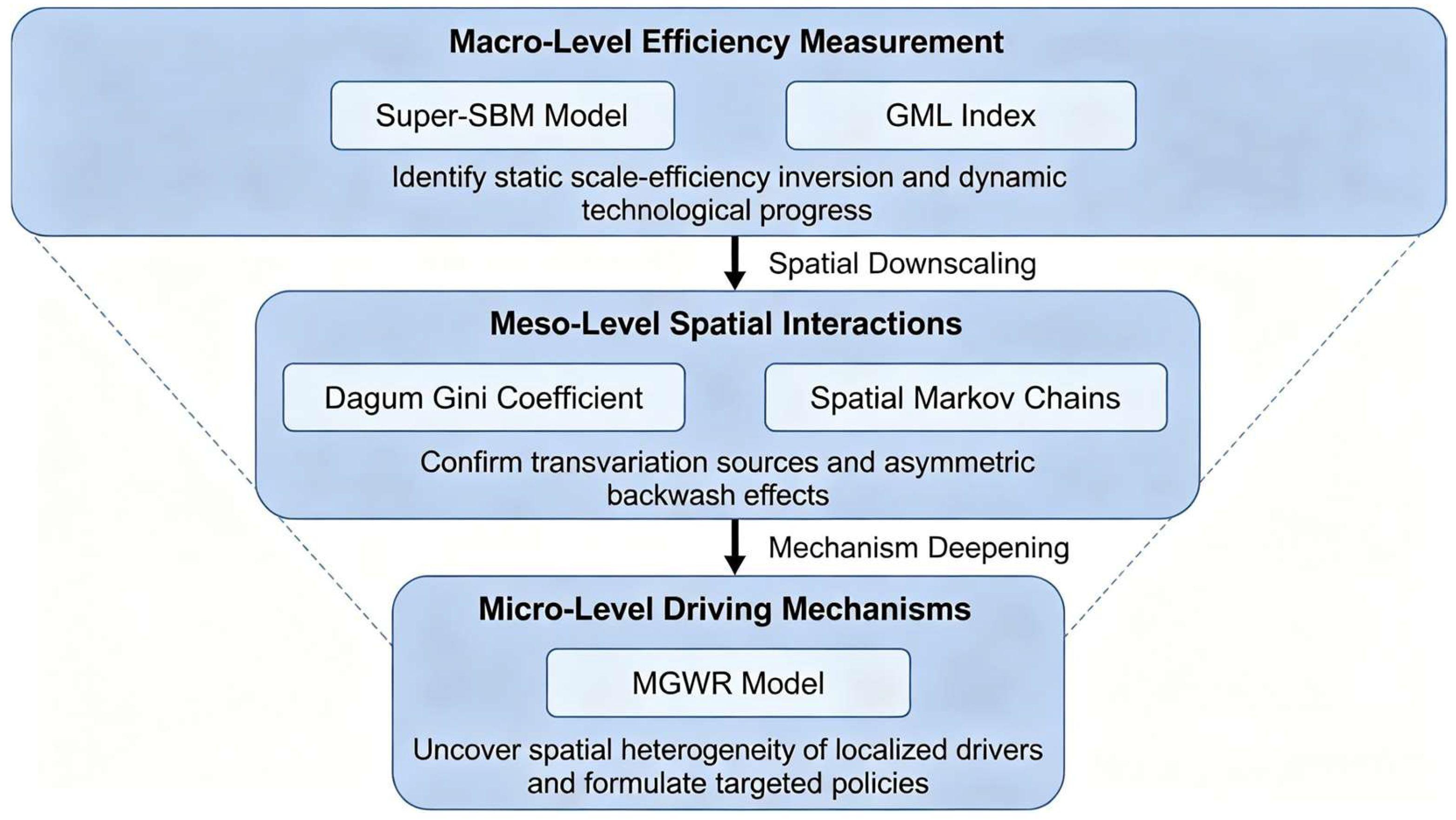
This study develops a structured analytical framework to systematically evaluate the spatial evolution and driving mechanisms of land green utilization efficiency. The research process consists of four sequential steps. The first step utilizes the Super-SBM model to measure static efficiency baselines. The second step applies the Global Malmquist–Luenberger index to decompose dynamic productivity growth into technical efficiency and technological progress. The third step employs the Dagum Gini coefficient and spatial Markov chains to identify regional disparities and spatial interaction patterns. The final step implements the Multiscale Geographically Weighted Regression model to explore the spatial heterogeneity of specific driving factors. Figure 1 illustrates the interconnections among these research components.

3. Methodology and Data

3.1. Delineation of the Study Area

Based on regional economic development levels, spatial patterns of urbanization, and the framework outlined for China, this study focuses on six representative urban agglomerations: the Yangtze River Delta (YRD), Pearl River Delta (PRD), Chengdu–Chongqing (CC), Middle Reaches of the Yangtze River (MYR), Central Plains (CPUA), and Shandong Peninsula (SPUA). These agglomerations can be categorized into three hierarchical tiers: world-class (YRD, PRD), national-level (CC, MYR), and regional-level (CPUA, SPUA). They are also geographically balanced, with three located in eastern China and three in central and western regions. Due to data availability, the final sample includes 127 prefecture-level cities and municipalities within these urban agglomerations, as shown in Table 1.
The spatial boundaries of the selected urban agglomerations are defined by the official development plans from the National Development and Reform Commission. The hierarchical classification into world-class, national-level, and regional-level categories follows the guidelines in the Opinions on Promoting High-Quality Urban Development. Core cities are identified by their administrative status as provincial capitals or municipalities. The Beijing–Tianjin–Hebei region is excluded from this study. Several peripheral cities in that region lack continuous historical environmental data prior to 2015. The current sample prioritizes regions with reliable data to maintain panel stability.

3.2. Indicator System Construction

LGUE integrates economic growth, environmental constraints, and territorial sustainability. Traditional land use models primarily prioritize economic output. The green efficiency concept shifts this analytical focus. It evaluates the ability of a regional system to maximize economic and social benefits while minimizing resource consumption and ecological degradation. Economic efficiency serves as the developmental foundation. Environmental performance acts as the ecological boundary. Territorial sustainability represents the long-term spatial coordination goal. Combining these three dimensions provides a comprehensive metric for assessing high-quality urban development.
With the transformation of development paradigms toward sustainability, the concept of LGUE has expanded beyond economic performance to incorporate ecological and social dimensions. LGUE reflects the ability to maximize economic, social, and environmental outputs while minimizing resource inputs under technological conditions.
Based on input–output theory and ecological economics, and drawing on previous studies [27,32], this study constructs a comprehensive evaluation system. In addition to the conventional inputs of land, capital, and labor, energy consumption and technological innovation are incorporated to better capture the resource intensity and innovation capacity associated with urban development. Outputs are categorized into desirable and undesirable components, reflecting both positive outcomes and environmental costs.
The indicator system incorporates recent advancements in urban density and carbon performance research. We referenced the framework proposed by Li et al. [44] to ensure data consistency. This system captures the resource intensity of Chinese urban agglomerations. Technology expenditure is included as an input variable. It reflects the financial commitment to innovation. Innovation inputs provide resources to develop cleaner production methods. These methods help reduce environmental pollutants. The observed scale-efficiency inversion represents an empirical finding rather than a conceptual innovation. It emerges from applying this multidimensional indicator system to the regional datasets.

3.2.1. Input Indicators

Land: Measured by the built-up area of municipal districts, which more accurately reflects the extent of urban development compared to administrative areas.
Capital: estimated using the Perpetual Inventory Method (PIM), expressed as K i , t = I i , t + ( 1 δ ) K i , t 1 , where I i , t represents fixed asset investment (base year 2011), and the depreciation rate δ is set at 9.6%.
Labor: measured by the number of non-agricultural employees, including employment in the secondary and tertiary sectors.
Energy: Represented by total energy consumption, converted into standard coal equivalents. Energy is a key factor in both economic production and environmental impact.
Technology: Measured by the proportion of science and technology expenditure in local public budgets, reflecting the level of technological investment and innovation capacity.
It should be noted that technology expenditure represents a critical input for green development. The indicator is measured by the proportion of science and technology expenditure in local public budgets. This choice reflects the financial commitment of local governments to innovation. Innovation inputs are essential to optimize land use structures. They provide the necessary resources to develop cleaner production methods. These methods help reduce environmental pollutants and carbon emissions. Including this variable as an input factor conforms to green growth theory. It ensures that the calculated efficiency accounts for the innovation costs of environmental management.

3.2.2. Output Indicators

Desirable Outputs: Include economic, fiscal, and ecological dimensions. Economic output is measured by GDP (deflated to constant 2011 prices). Fiscal capacity is proxied by local public budget revenue. Ecological outcomes are represented by the green coverage rate in built-up areas.
Undesirable Outputs: Include environmental pollutants and carbon emissions. Specifically, industrial wastewater, sulfur dioxide (SO2), and industrial solid waste are used to capture local pollution, while total carbon dioxide (CO2) emissions represent broader climate impacts. To improve data accuracy, CO2 emissions are derived from high-resolution datasets provided by the China Emission Accounts and Datasets (CEADs) and ODIAC. These data are spatially aggregated to the city level using GIS-based zonal statistics.

3.2.3. Explanatory Variables

To analyze the determinants of LGUE, five core explanatory variables are selected:
Economic Level: Measured by the natural logarithm of per capita GDP.
Population Density: Measured by the natural logarithm of population per unit area.
Industrial Structure: Represented by the share of the tertiary sector in GDP.
Foreign Direct Investment: Measured as the ratio of utilized FDI to GDP.
Financial Development: Measured by the ratio of total loans and deposits of financial institutions to GDP.

3.2.4. Data Sources and Processing

Data are obtained from the China Statistical Yearbook, China City Statistical Yearbook, and provincial/municipal statistical yearbooks. Environmental data are supplemented by the China Environment Statistical Yearbook and the CEADs database. All monetary variables are deflated to constant 2011 prices to ensure comparability. Missing values are addressed using linear interpolation and moving average methods. The final dataset is a balanced panel covering 127 cities from 2011 to 2023. The dataset for the year 2023 is extracted from the 2024 editions of the respective statistical yearbooks. These editions provide the finalized annual statistics.
The dataset for 2023 primarily relies on the annual statistical communiques of local economic and social development published by municipal governments. These communiques are officially released early in the subsequent year. Missing values for specific environmental indicators in 2023 are supplemented using linear interpolation based on historical trends. This approach maintains panel continuity while utilizing the most recent preliminary official statistics.
To ensure the reliability of regression results, multicollinearity tests are conducted. The Variance Inflation Factor (VIF) values for all explanatory variables are below the threshold of 10, indicating no significant multicollinearity. Descriptive statistics are detailed in Table 2.

3.3. Methodology and Model Specification

This study employs a sequential multi-method analytical framework. Each method serves a distinct analytical purpose without functional overlap. The Super-SBM model evaluates static baseline efficiency. The GML index tracks dynamic temporal changes. The Dagum Gini coefficient and Spatial Markov chains assess spatial interactions and distributional disparities. The MGWR model identifies localized driving mechanisms. The measurement outputs from the static and dynamic models serve as foundational data for the subsequent spatial and regression analyses. This sequential design prevents analytical redundancy and ensures structural coherence between theory and methodology.

3.3.1. Super-SBM Model with Undesirable Outputs

Traditional Data Envelopment Analysis (DEA) models are subject to limitations, including the presence of slack variables and the inability to distinguish efficiently among decision-making units (DMUs) located on the production frontier (i.e., efficiency score equal to 1). To address these issues, this study employs the Super-SBM model with undesirable outputs, which allows for efficiency scores greater than unity and incorporates environmental externalities such as carbon emissions and industrial pollutants [20,21]. Assuming a system consisting of n DMUs, each utilizing m inputs (x) to produce s 1 desirable outputs ( y d ) and s 2 undesirable outputs ( y u ) , the model is formulated as follows in Equation (1).
ρ * = min 1 m i = 1 m ( x ¯ / x i k ) 1 s 1 + s 2 r = 1 s 1 y ¯ g y r k g + t = 1 s 2 y ¯ b y t k b s . t . x ¯ j = 1 , j k n x i j λ j ; y ¯ g j = 1 , j k n y r j g λ j ; y ¯ b j = 1 , j k n y t j b λ j x ¯ x k , y ¯ g y k g , y ¯ b y k b , λ j 0
where ρ * denotes the super-efficiency score of the target DMU, and λ j represents the weight vector; and x ¯ , y ¯ g , y ¯ b denote the slack variables for inputs, desirable outputs, and undesirable outputs, respectively. An efficiency score of ρ * 1 indicates that DMU is relatively efficient. It should be noted that the Super-SBM model evaluates relative efficiency rather than absolute production scale. Therefore, efficiency scores reflect the effectiveness of input–output conversion under given conditions, rather than the magnitude of economic output. Observed regional differences in efficiency may thus be associated with variations in factor allocation, technological conditions, and environmental constraints, rather than scale effects per se.

3.3.2. Global Malmquist–Luenberger (GML) Index

While the Super-SBM model provides a static measure of efficiency, it does not capture intertemporal changes. To address this limitation, the GML index is employed to measure dynamic changes in total factor productivity [20]. Compared with the traditional Malmquist–Luenberger index, the GML index is based on a global production frontier, ensuring transitivity and avoiding infeasibility issues in linear programming. This index is further decomposed into Efficiency Change (EC) and Technological Change (TC), as shown below in Equations (2)–(4).
G M L t t + 1 = 1 + D G ( x t , y t , b t ; g t ) 1 + D G ( x t + 1 , y t + 1 , b t + 1 ; g t + 1 ) = E C t t + 1 × T C t t + 1
E C t t + 1 = 1 + D t ( x t , y t , b t ; g t ) 1 + D t + 1 ( x t + 1 , y t + 1 , b t + 1 ; g t + 1 )
T C t t + 1 = ( 1 + D G ( x t , y t , b t ; g t ) ) / ( 1 + D t ( x t , y t , b t ; g t ) ) ( 1 + D G ( x t + 1 , y t + 1 , b t + 1 ; g t + 1 ) ) / ( 1 + D t + 1 ( x t + 1 , y t + 1 , b t + 1 ; g t + 1 ) )
where D G and D t represent the global and contemporaneous directional distance functions, respectively. A GML value > 1 indicates an improvement in green productivity. EC reflects improvements in relative efficiency (catch-up effect). Conversely, TC reflects shifts in the production frontier (innovation effect).

3.3.3. Kernel Density Estimation

Kernel density estimation (KDE) is used to analyze the distributional characteristics and temporal evolution of LGUE. As a non-parametric method, KDE does not impose assumptions on the underlying distribution and provides a flexible approach to describing distributional changes. The density function is defined as Equation (5).
f ( x ) = 1 N h i = 1 N K X i x h
where N denotes the number of observations, X i represents the observed value, K ( ) is the kernel function, and h is the bandwidth parameter. In this study, a Gaussian Kernel is adopted, and the optimal bandwidth is determined using Silverman’s empirical rule.

3.3.4. Global Spatial Autocorrelation and Spatial Markov Chains

To examine spatial dependence, the global Moran’s I statistic is employed. A significantly positive Moran’s I indicates the presence of spatial clustering. To further investigate spatial dynamics, a Spatial Markov chain model is constructed by incorporating a spatial weight matrix based on inverse distance. This approach allows transition probabilities to depend not only on a city’s current state but also on the states of its neighboring cities. The conditional transition probability is defined as follows in Equations (6) and (7) [49,50]:
P i j ( W ) = P X t + 1 = j X t = i , L a g t = k
L a g t = h m W h m X h t
where P i j ( W ) represents the probability of transitioning from state i to state j, conditional on the spatial lag k. Efficiency levels and their spatial lags are discretized into four categories (low, medium-low, medium-high, and high) to facilitate analysis. This framework enables the examination of path dependence and spatial interaction patterns across different efficiency regimes.

3.3.5. Dagum Gini Coefficient and Decomposition

To measure spatial inequality, the Dagum Gini coefficient is employed, as it allows for decomposition into multiple components and accounts for overlapping distributions [31]. The overall Gini coefficient G is defined as Equation (8).
G = j = 1 k h = 1 k i = 1 n j r = 1 n h | y j i y h r | 2 n 2 μ
where k denotes the number of urban agglomerations (k = 6); n j ( n h ) represents the number of cities within agglomeration, μ is the overall mean. The total inequality is decomposed as in Equation (9).
G = G w + G n b + G t
where G w signifies the intra-group disparity contribution (measuring inequality strictly within a single agglomeration); G n b stands for the net inter-group disparity contribution (measuring the baseline gap between distinct groups such as mature and developing clusters). Most critically, G t dictates the transvariation (super-variable density) contribution. It captures the exact degree of cross-overlapping data between different agglomerations. An increase in G t proves that the “frontrunners” in lagging clusters have outperformed the “stragglers” in developed ones, indicating a distributional overlap that transcends traditional geographic boundaries. Transvariation identifies the relative overlap between different sub-samples. It measures the spatial inequality arising from a specific condition. This condition occurs when individuals in a lower-average regional group outperform individuals in a higher-average regional group. This mathematical component isolates the structural impact of cross-distributional sharing. It distinguishes the Dagum methodology from traditional inequality decomposition techniques.

3.3.6. Multiscale Geographically Weighted Regression (MGWR)

The traditional ordinary least squares (OLS) model assumes spatial homogeneity of parameters, which may not hold in practice. Although Geographically Weighted Regression (GWR) allows for spatially varying coefficients, it assumes a single bandwidth for all variables, which may not accurately reflect differing spatial scales. To address this limitation, the MGWR model is employed [51]. MGWR allows each explanatory variable to have its own optimal bandwidth, thereby capturing multiscale spatial heterogeneity. The model is specified as shown in Equation (10).
y i = β i 0 ( u i , v i ) + k = 1 p β i k ( u i , v i ) x i k + ε i
where y i is the efficiency of the target city i ; ( u i , v i ) denotes the spatial coordinates of city I; β i k ( u i , v i ) represents the localized regression coefficient for the k-th driving variable specific to that city’s bandwidth. The model employs an adaptive kernel function to determine the spatial weight W i j , as shown in Equation (11).
W i j = 1 ( d i j / b i ( k ) ) 2 2 , d i j b i ( k ) 0 , d i j > b i ( k )
where d i j is the geographic distance between cities i and j; and b i ( k ) is the optimal bandwidth determined using Cross-Validation (CV) or the AICc criterion. By mapping the distribution of β i k across different cities, we can explicitly identify the congestion or threshold effects triggered by financial, demographic, and industrial policy tools across urban agglomerations in varying life cycles.
The study utilizes panel data from 2011 to 2023. The MGWR model is primarily designed for cross-sectional analysis. To address this mismatch, the data are averaged over the entire study period. This mean-pooling method collapses the panel into a stable cross-section. The approach effectively removes short-term macroeconomic fluctuations. It allows the model to capture long-term spatial non-stationarity. Spatial panel models often assume a single spatial scale for all independent variables. In contrast, MGWR calculates a specific bandwidth for each variable. This flexible bandwidth selection helps identify scale-dependent relationships accurately. Therefore, MGWR is preferred to examine localized driving mechanisms across varying spatial scales.

3.3.7. Model Implementation Details

The computational implementation relies on standardized software packages to ensure reproducibility. The Super-SBM model and GML index calculations use MATLAB R2023a. The Spatial Markov chain transitions are processed using Python 3.9. The spatial weight matrix applies an inverse geographic distance calculation. Efficiency states are classified into four discrete categories using quartile thresholds. The MGWR 2.2 software executes the spatial regression analysis. The optimal bandwidth for the MGWR model is determined by the corrected Akaike Information Criterion. Robustness checks involve alternative economic–geographic nested matrices to verify result stability.

4. Empirical Results

4.1. Static Evolution of LGUE: Evidence of Scale-Efficiency Divergence

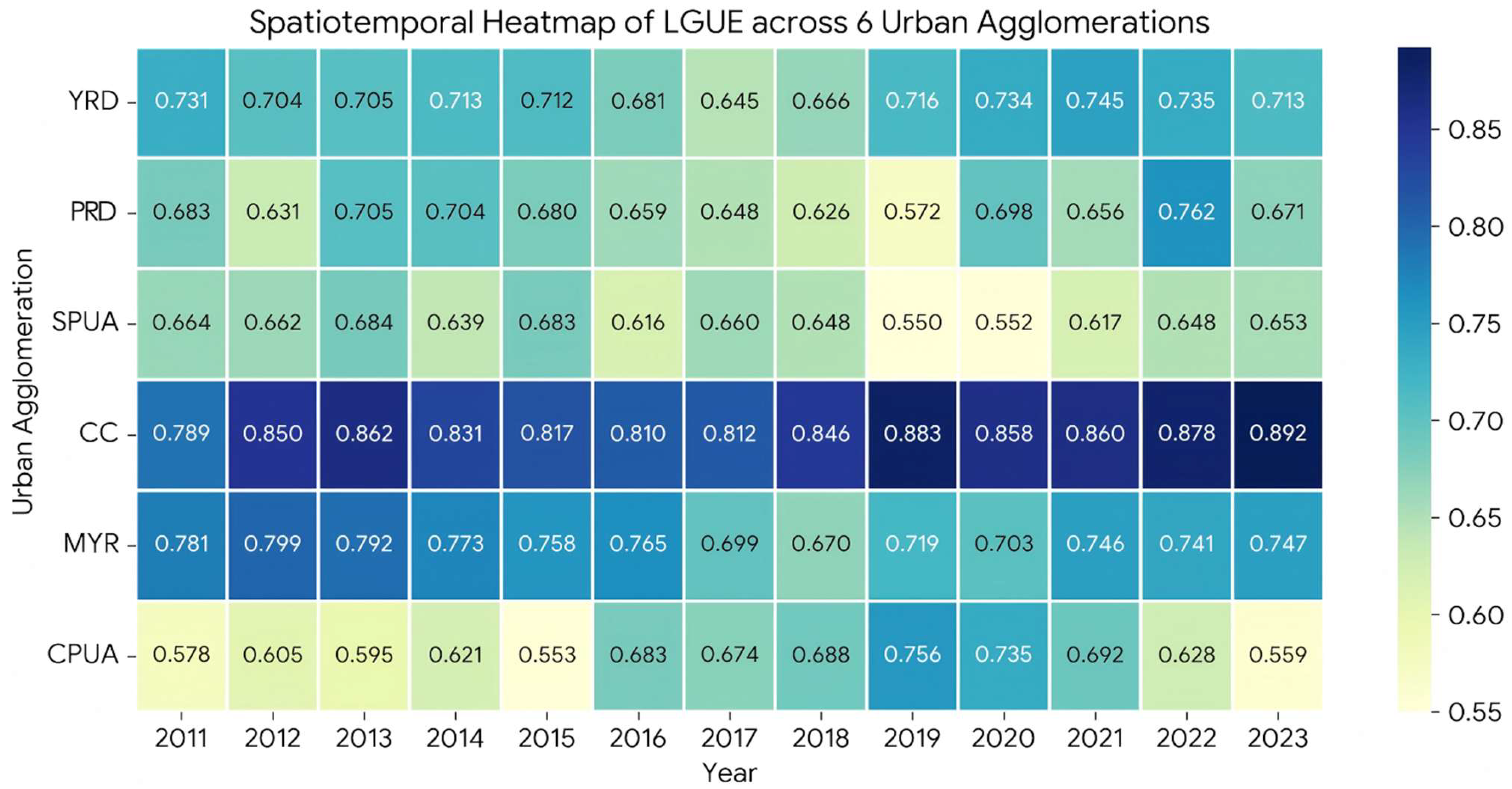
To examine the baseline characteristics of LGUE across different urban agglomerations, this study applies the Super-SBM model with undesirable outputs to six representative clusters (Figure 2).
  • Static Analysis of Allocative Efficiency
From 2011 to 2023, LGUE across the six urban agglomerations exhibits a notable spatial pattern that does not fully correspond to differences in economic scale. In particular, several central and western inland agglomerations (e.g., CC and MYR) demonstrate relatively higher efficiency levels compared to some eastern coastal agglomerations. This pattern may be attributed to differences in development stages, industrial structures, and environmental constraints. Inland regions benefit from later adoption of cleaner technologies due to their relatively lower levels of historical industrialization. This developmental transition is supported by national initiatives such as the Western Development Strategy and the organized relocation of industries from eastern provinces. Furthermore, this observed advantage might partly reflect an inherent characteristic of the Super-SBM model. Inland cities often possess lower absolute economic outputs but simultaneously exhibit significantly lower resource inputs and pollutant emissions. This input–output structure can mathematically yield higher relative efficiency scores compared to heavily industrialized coastal cities. In contrast, economically advanced coastal regions such as the Yangtze River Delta and Pearl River Delta face greater adjustment pressures due to legacy pollution and high-intensity land use. Regional-level agglomerations (e.g., CPUA, and SPUA) tend to exhibit relatively lower efficiency levels, potentially reflecting structural constraints associated with traditional industrial composition and slower technological upgrading.
2.
Temporal Evolution and Regional Heterogeneity
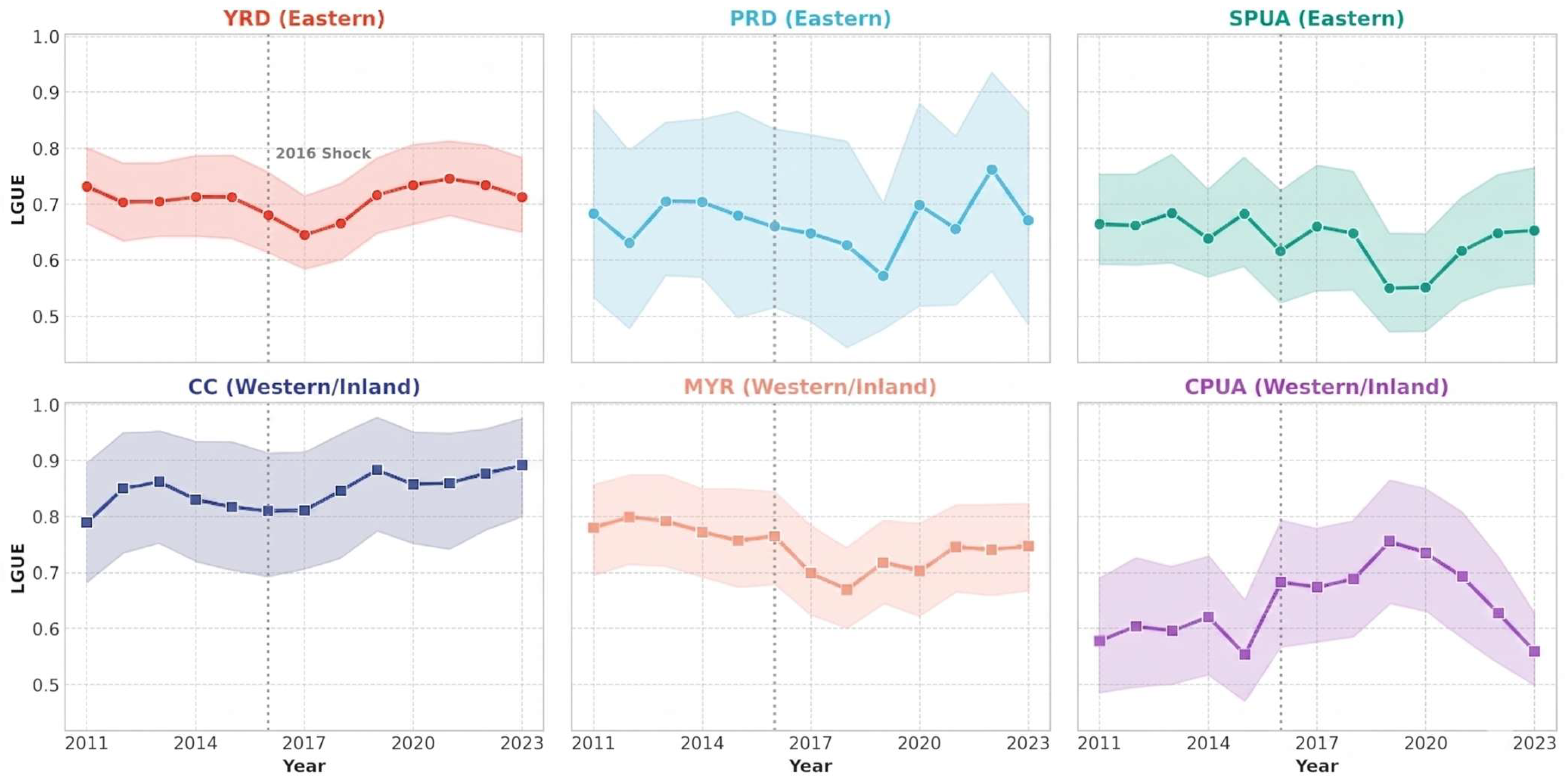
As illustrated in Figure 3, the temporal evolution of LGUE differs across regions. Around 2016, a period associated with strengthened environmental regulations, several eastern agglomerations exhibit short-term fluctuations in efficiency. This may reflect adjustment costs related to stricter environmental standards and industrial restructuring. In contrast, some inland agglomerations maintain relatively stable upward trends during the same period, suggesting differences in policy sensitivity and adaptive capacity. In addition, the width of confidence intervals indicates varying degrees of intra-regional disparity. For example, certain agglomerations display relatively narrow dispersion, implying synchronized development across cities, whereas others exhibit wider variation, suggesting increasing internal heterogeneity. Overall, the results highlight substantial regional differences in both the level and evolution of LGUE. The eastern coastal and central-western inland regions exhibited distinctly different evolutionary trajectories and internal convergence patterns over the study period.

4.2. Spatiotemporal Distribution and Sources of Inequality

To further analyze the evolution of LGUE distribution and identify sources of spatial inequality, this study employs 3D-KDE and the Dagum Gini coefficient decomposition.

4.2.1. Distributional Evolution of LGUE

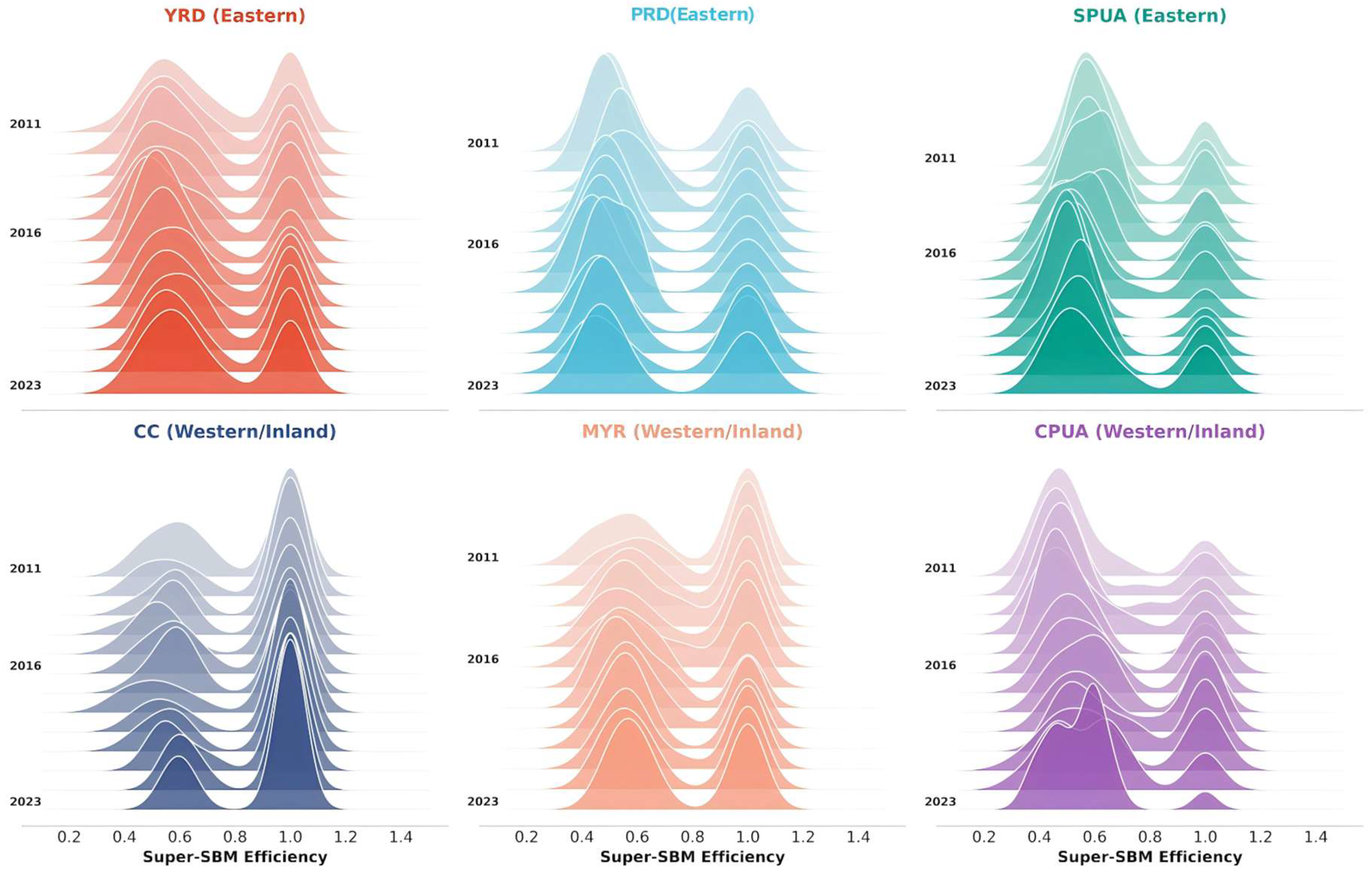
To more intuitively capture the internal evolutionary dynamics of each urban agglomeration, this study employs the 3D-KDE ridgeline plots (Figure 4).
From the perspective of spatiotemporal distributional changes, the level of LGUE across China’s six major urban agglomerations exhibits an overall upward trend, while simultaneously revealing pronounced structural disparities in intra-regional coordination. At the aggregate level, between 2011 and 2023, the primary peaks of kernel density functions for all agglomerations shift rightward to varying extents, indicating a steady increase in Super-SBM efficiency scores, and confirming the continuous improvement trajectory of LGUE. This pattern not only reflects the sustained effectiveness of green development policies, but also suggests notable progress in resource allocation efficiency and environmental governance at the local level.
Among the eastern coastal agglomerations, the YRD and PRD display particularly distinctive evolutionary patterns. Following the significant tightening of environmental regulations around 2016, the height of their main density peaks declines, while the distribution becomes more dispersed, gradually exhibiting long-tailed characteristics and multi-modal structures. This transformation reflects the transitional dynamics of traditionally industrialized regions undergoing capacity reduction and green restructuring. Core cities, endowed with superior capital, technological capabilities, and policy support, achieve rapid improvements in green efficiency, with efficiency values increasingly concentrated in the higher range (above 1.0). In contrast, peripheral cities, constrained by weaker industrial foundations and slower structural adjustment, experience temporary stagnation, contributing to the emergence of distributional tails and polarization. A similar pattern is observed in the SPUA, where the post-2016 evolution toward a more pronounced bimodal distribution indicates intensifying internal disparities.
In contrast, the CC and MYR urban agglomerations in western and central China follow a markedly different evolutionary trajectory. Their kernel density curves display a consistent upward shift accompanied by increasing concentration. The CC agglomeration, in particular, exhibits a sharply defined and increasingly concentrated peak near the efficiency frontier (approximately 1.0), indicating a high degree of convergence. Although the MYR agglomeration retains a bimodal structure, its main peak gradually shifts from the 0.6–0.8 interval to the 0.8–1.0 interval, alongside a narrowing of the overall distribution. These patterns suggest that, during the process of industrial transfer absorption and new-type urbanization, both regions maintain relatively strong internal coordination, resulting in more balanced and synergistic improvements in green efficiency.
Although the CPUA also demonstrates an upward trend, its pronounced bimodal structure and extended tail indicate comparatively weaker intra-regional coordination. Overall, the evolution of LGUE across China’s major urban agglomerations reflects both a general trend of improvement and a clear structural divergence characterized by “eastern polarization” and “western coordination.” This divergence is rooted in differences in initial development conditions and transformation pathways, and provides important empirical evidence for the formulation of more targeted and differentiated green development policies.

4.2.2. Decomposition of Spatial Inequality

Given that the 3D-KDE analysis primarily reflects the independent distributional evolution within each urban agglomeration, this study further employs the Dagum Gini coefficient to systematically decompose the sources of spatial inequality and to identify the underlying structural drivers of disparities in LGUE across regions.
  • Temporal Evolution of Overall Inequality and Its Core Drivers
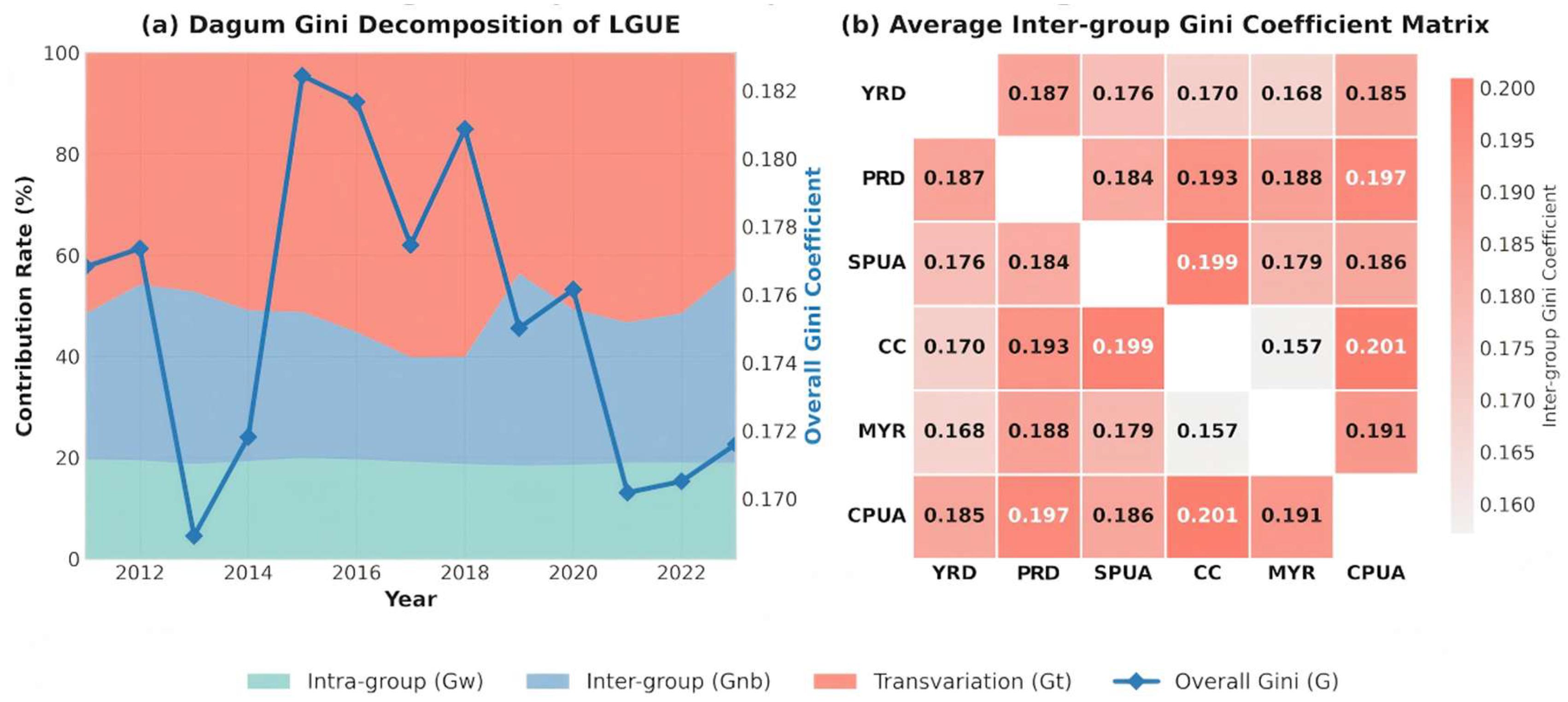
As shown in Table 3 and Figure 5a, the overall spatial Gini coefficient across the six urban agglomerations averages approximately 0.1747 over the sample period. Although the overall trend remains relatively stable, a noticeable increase is observed during 2016–2018, suggesting that major policy adjustments may induce short-term disturbances in spatial equilibrium. At the intra-regional level, the PRD and YRD consistently exhibit relatively high Gini coefficients, indicating pronounced core–periphery disparities within these economically advanced regions. In contrast, the CC urban agglomeration demonstrates a marked decline in its internal Gini coefficient—from 0.1493 in 2011 to 0.0901 in 2023—implying a significant trend toward internal convergence and enhanced regional coordination.
More importantly, the Dagum Gini decomposition reveals that the transvariation component, which captures the degree of distributional overlap across regions [3], contributes an average of 51.04% to total inequality, thereby constituting the dominant source of spatial disparity. This finding indicates that inter-regional differences are not strictly hierarchical, but rather characterized by substantial overlap. In other words, high-efficiency cities are increasingly observed in relatively less-developed regions, while pockets of low efficiency persist within traditionally advanced regions, resulting in a complex and interwoven spatial structure.
2.
Matrix Analysis of Cross-Regional Disparities
The matrix analysis presented in Figure 5b further illustrates the magnitude and pattern of inter-agglomeration disparities. Two representative patterns emerge. First, a “high–low disparity” pattern is evident, particularly between the CC agglomeration and the CPUA as well as the SPUA. This gap may be attributed to differences in development trajectories. The CC region, benefiting from relatively favorable ecological endowments and latecomer advantages in clean technology adoption during industrial relocation, has achieved rapid improvements in green efficiency. In contrast, the CPUA and SPUA remain more constrained by path dependence on traditional agriculture and heavy industries, where higher levels of undesirable outputs hinder the pace of green transformation. Second, a “cross-regional coordination” pattern is observed, most notably between the YRD and the MYR urban agglomeration, where disparities remain relatively small. This suggests the emergence of inter-regional linkages that transcend administrative boundaries, likely facilitated by coordinated development strategies such as those associated with the Yangtze River Economic Belt [29].

4.3. Dynamic Decomposition of LGUE Growth Drivers

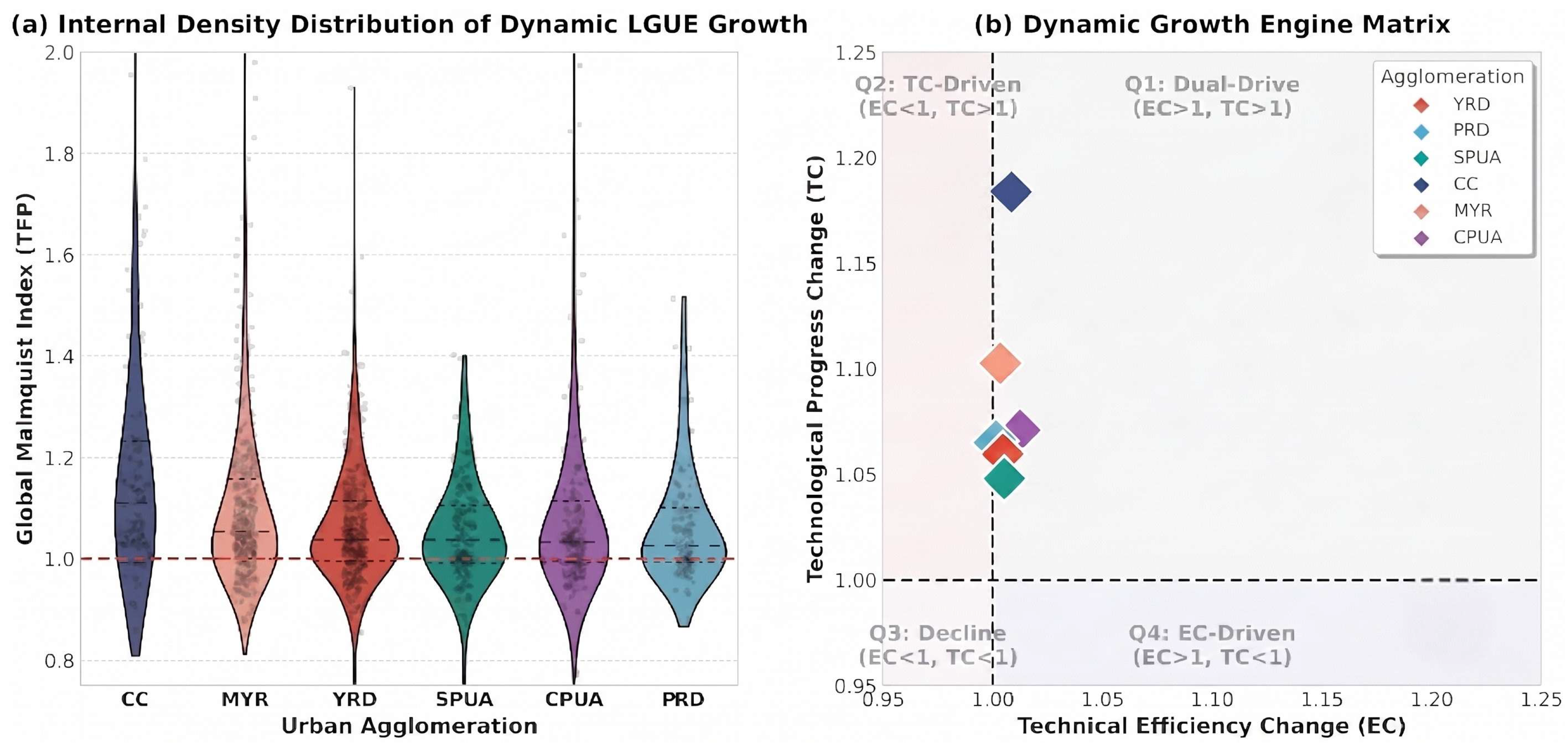
To address the limitations of static analysis, this study adopts the GML productivity index incorporating undesirable outputs. This approach decomposes the dynamic evolution of LGUE total factor productivity (TFP) into TC and EC, thereby providing insights into the underlying growth mechanisms. The results are illustrated in Figure 6.

4.3.1. Dynamic Convergence and Internal Differentiation

Figure 6a presents the distribution of TFP across urban agglomerations using violin–scatter plots. At the aggregate level, the core density of TFP for all regions lies above the unity threshold, indicating that LGUE experienced positive dynamic growth throughout the study period. From a comparative perspective, a convergence pattern is observed, with central and western regions exhibiting higher median TFP growth rates than their eastern counterparts. This finding is consistent with the “catch-up effect,” whereby less-developed regions achieve relatively faster growth through the adoption of existing technologies.
However, substantial heterogeneity persists within regions. The CC agglomeration displays a right-skewed distribution with a pronounced upper tail, suggesting that high growth is driven by a limited number of leading cities. In contrast, the YRD and PRD exhibit relatively concentrated distributions, reflecting stronger internal coordination. Meanwhile, the lower tails of the CPUA and SPUA distributions extend below the unity threshold, indicating that a subset of cities within these regions continues to experience declines in green productivity.

4.3.2. Decomposition of Growth Momentum

Figure 6b plots the average values of EC and TC within a quadrant framework. While all agglomerations fall within the region characterized by simultaneous improvements in TC and EC, a clear asymmetry is observed. The variation in TC is substantial, whereas EC values remain clustered around unity, indicating limited improvements in technical efficiency.
This suggests that the growth of LGUE is predominantly attributed to technological progress—such as the adoption of cleaner production technologies, energy substitution, and digitalization—while the statistical contribution from improvements in resource allocation efficiency or institutional performance remains limited. Consequently, the current growth pattern may be characterized as being largely technology-driven, with relatively limited contributions from efficiency gains.

4.4. Spatial Interaction Mechanisms of LGUE Evolution

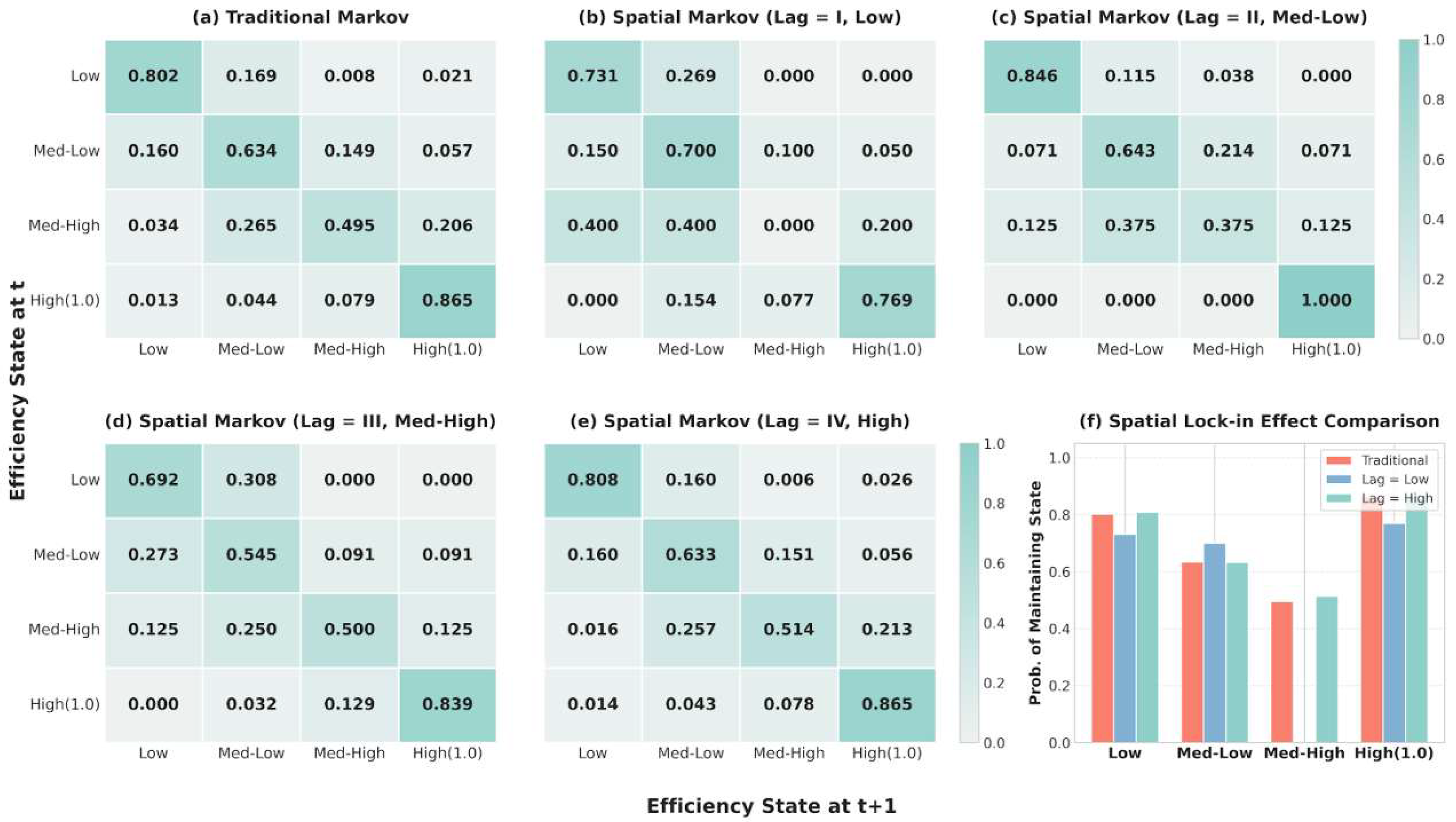
To further investigate spatial dependence and neighborhood effects, this study constructs an inverse-distance spatial weight matrix and applies a Spatial Markov Chain approach. Given the clustering of observations at the efficiency frontier under the Super-SBM framework, LGUE levels are classified into four categories: Low, Medium-Low, Medium-High, and High (frontier). Transition probability matrices are reported in Figure 7.

4.4.1. Path Dependence and Club Convergence

The traditional Markov transition matrix (Figure 7a), which abstracts from spatial interaction effects, indicates that transition probabilities are highly concentrated along the main diagonal, signifying strong persistence in efficiency levels over time. In particular, cities tend to remain within their initial efficiency states, with both low-efficiency groups and those at the “absolute frontier” exhibiting especially high stability. This pattern provides robust empirical support for the existence of “club convergence,” whereby cities with similar initial conditions—supported by early advantages in green capital, technological capabilities, and institutional frameworks—converge toward distinct steady-state equilibria. At the same time, a considerable number of less-developed cities remain constrained by an “inefficiency lock-in” [9]. Furthermore, the limited presence of off-diagonal transition probabilities, which are largely confined to adjacent states, suggests that changes in urban green efficiency follow a gradual and incremental process, with transitions across non-adjacent tiers occurring infrequently.

4.4.2. Spatial Interaction Effects

When spatial dependence is incorporated, the transition dynamics change significantly. The Spatial Markov results (Figure 7b–f) demonstrate that the efficiency levels of neighboring regions exhibit a meaningful statistical association with local evolution. This pattern reflects asymmetric spatial interactions. The transition matrix does not provide direct causal proof of core-driven polarization. The observed statistical pattern demonstrates a strong spatial association and neighborhood dependence. The development trajectories of peripheral cities are statistically linked to the efficiency status of their neighbors.
The polarization or backwash effect constrains the upward mobility of lagging regions. Conventional perspectives often posit that developed areas generate positive spillovers for neighboring regions through a “trickle-down” mechanism. However, the evidence presented in Figure 7f challenges this assumption. When a low-efficiency city is surrounded by high-efficiency neighbors, its probability of remaining in the low-efficiency state does not decline; rather, it increases markedly to 80.8%. This empirical result substantiates the presence of a backwash effect in spatial economics [42]. The intensive growth of core cities is frequently associated with the concentration of high-quality factors—such as capital and skilled labor—drawn from surrounding regions, while pollution-intensive activities may be displaced outward. As a consequence, peripheral cities face increasing difficulty in achieving green transformation.
At the same time, agglomeration economies reinforce clustering dynamics among developed regions. For cities already positioned at the high-efficiency frontier, spatial clustering is associated with positive synergistic outcomes. As shown in Figure 7f, when a high-efficiency city is adjacent to low-efficiency neighbors, the probability of maintaining its status is 76.9%; this probability increases to 86.5% when neighboring cities are also highly efficient. This pattern is consistent with the notion of spatial agglomeration benefits emphasized in New Economic Geography. Prominent urban clusters, such as the YRD and the PRD, have strengthened their positions through intercity networks of green technology, harmonization of environmental standards, and the sharing of advanced production factors, thereby reinforcing cumulative advantage dynamics.
Overall, the spatial evolution of LGUE in China’s urban agglomerations is shaped by a complex interaction of path dependence, regional heterogeneity, and spatial spillover effects. The coexistence of convergence and divergence highlights the necessity of differentiated policy approaches, particularly those aimed at reducing institutional barriers, enhancing inter-regional coordination, and improving efficiency-oriented governance mechanisms.

5. Spatial Heterogeneity of Driving Mechanisms

Traditional global regression models estimate a single average coefficient, which may obscure spatial variations in the effects of explanatory variables. To address this limitation, this study employs the MGWR model. By applying mean-pooling to panel data from six major urban agglomerations over the period 2011–2023, short-term fluctuations are smoothed, enabling a more robust examination of spatial heterogeneity in the determinants of LGUE.

5.1. MGWR Model Applicability Diagnostics

Table 4 presents a comparison of model performance across OLS, GWR, and MGWR specifications. The global OLS model exhibits relatively low explanatory power (R2 = 0.041) and a high residual sum of squares (RSS = 121.737), indicating limited ability to capture spatially varying relationships. In contrast, the MGWR model significantly improves model fit, with R2 increasing to 0.376 and the Akaike Information Criterion (AICc) decreasing to 356.021. Compared with both OLS and GWR, the MGWR model demonstrates superior performance in terms of goodness-of-fit and model parsimony. These results suggest that accounting for multiscale spatial heterogeneity is essential for accurately identifying the determinants of LGUE. Overall, the diagnostic results support the suitability of the MGWR model for analyzing spatially heterogeneous relationships in this study.

5.2. Spatiotemporal Heterogeneity of Driving Mechanisms

The MGWR model yields local parameter estimates that vary across space, allowing for a detailed examination of the heterogeneous effects of key driving factors. The average local R2 of approximately 0.56 further indicates that the model provides a satisfactory explanation of spatial variation in LGUE.
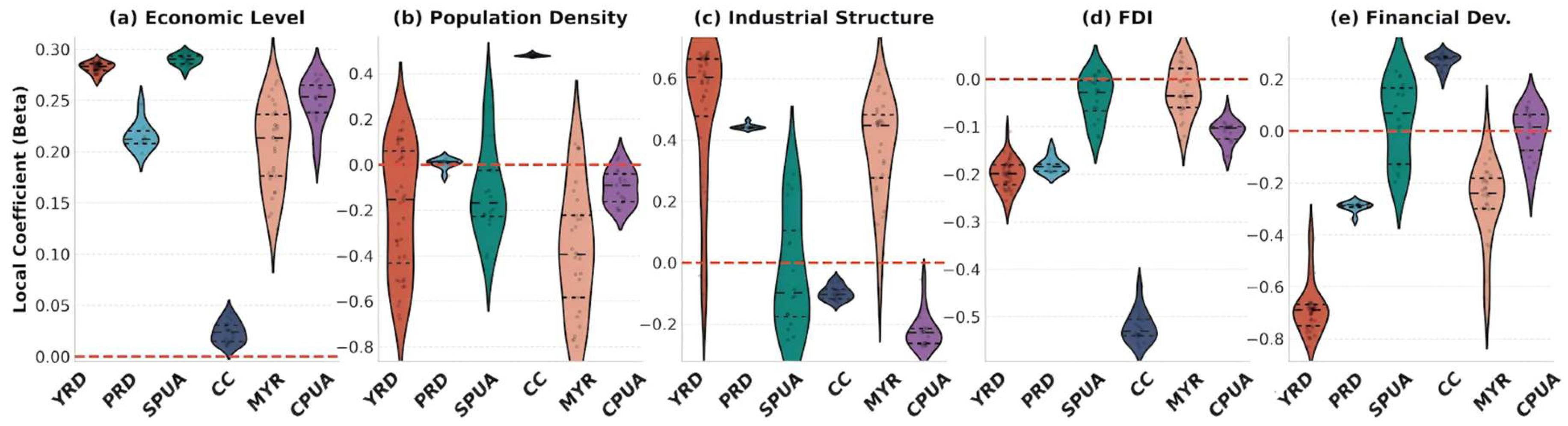
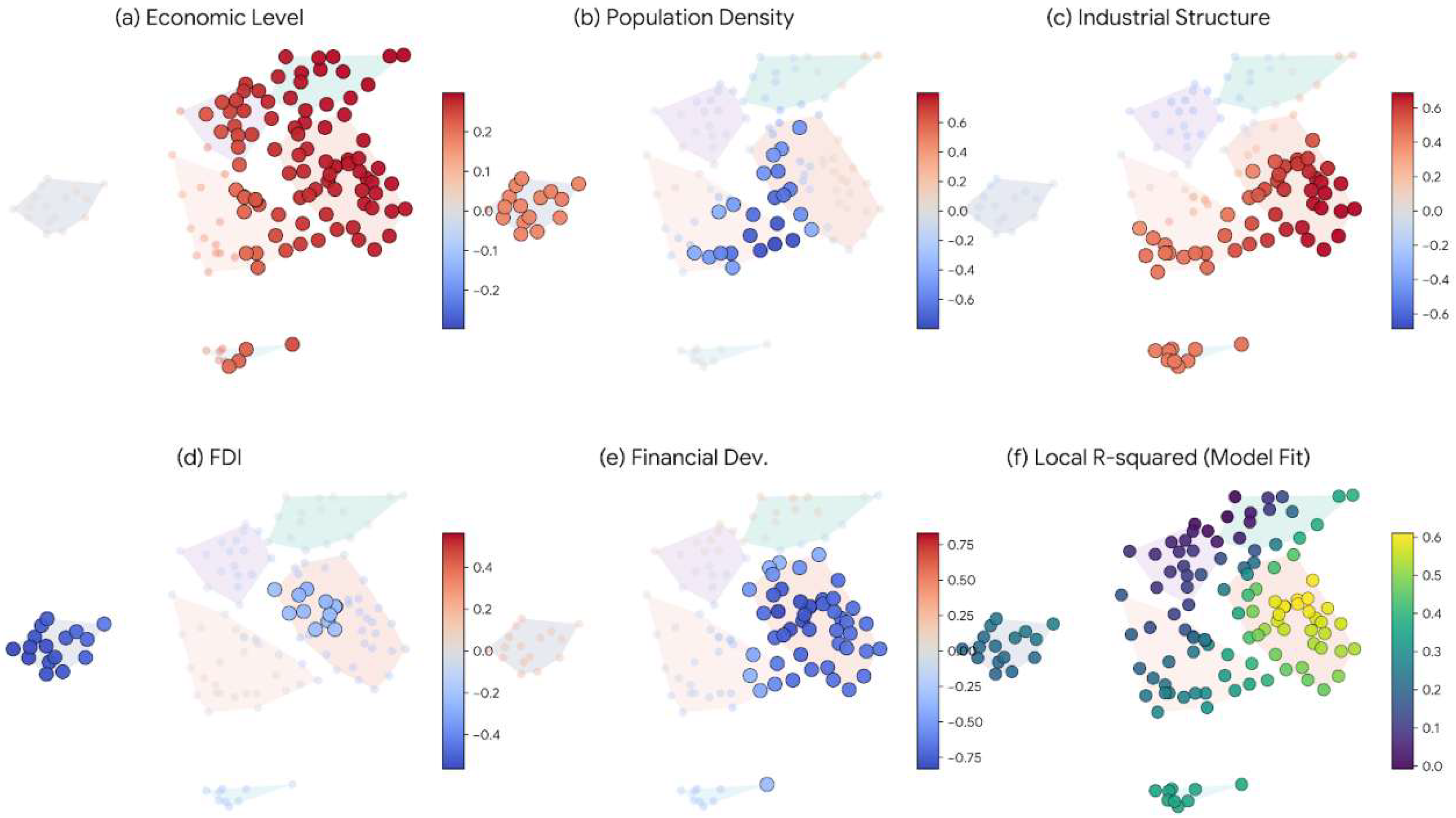
Combining the coefficient distributions (Figure 8) and spatial patterns (Figure 9), the effects of the main explanatory variables are summarized as follows.

5.2.1. Economic Development Level

Economic development exhibits a consistently positive association with LGUE across most regions (Figure 9a). This finding aligns with the EKC hypothesis, suggesting that once a certain income threshold is reached, increased fiscal capacity and capital accumulation facilitate investments in environmental infrastructure and green technologies, thereby enhancing land use efficiency.

5.2.2. Population Density

The effect of population density is predominantly negative in many core urban areas (Figure 9b). This indicates that, beyond a certain threshold, congestion effects may outweigh the benefits of agglomeration economies. Excessive population concentration imposes severe ecological overload. The marginal costs of urban infrastructure maintenance begin to exceed the economic returns. This spatial dynamic limits further improvements in land green utilization efficiency. As a result, excessive population concentration may impose pressures on land resources and environmental capacity, thereby constraining improvements in LGUE [12,16].

5.2.3. Industrial Structure

The impact of industrial structure exhibits pronounced regional heterogeneity (Figure 9c). In eastern coastal regions, industrial upgrading demonstrates a significant positive correlation with LGUE. By contrast, in central and western regions, including the CPUA and CC, the effect is either weak or negative [13]. This suggests that premature or imbalanced industrial transformation, without adequate support from the real economy, may hinder productivity improvements and reduce overall efficiency.

5.2.4. Foreign Direct Investment (FDI)

The spatial effects of FDI provide empirical support for the Pollution Haven Hypothesis. As shown in Figure 9d, FDI exhibits negative associations with LGUE in many central and western regions [7], where environmentally intensive industries may relocate. This pattern indicates that the environmental costs associated with industrial transfer may outweigh the potential technological spillovers in these areas.

5.2.5. Financial Level

The spatial heterogeneity of financial development highlights the dual effects of capital allocation. As illustrated in Figure 9e, within the capital-abundant core of the YRD, financial deepening exerts a pronounced inhibitory effect. This finding indicates that the more developed eastern regions are experiencing a trend of capital diversion from the real economy. This phenomenon is closely associated with the rapid growth of speculative finance and the overheating of regional real estate markets [52]. These financial activities generate a substantial credit crowding-out effect [53]. This reallocation of capital away from productive sectors constrains green innovation in industrial enterprises [8]. In contrast, in western peripheral regions such as the CC, the relatively nascent stage of financial deepening continues to exert a modest positive influence by alleviating green credit constraints faced by local firms.

5.3. Robustness Check

To assess the robustness of the empirical results, alternative spatial weight matrices were employed, including an economic–geographic nested matrix. The results remain largely consistent in terms of coefficient signs and spatial patterns, indicating that the main findings are robust to different model specifications.

6. Discussion and Limitations

6.1. Discussion of Main Findings

By integrating static efficiency measurement, dynamic productivity decomposition, spatial Markov chain analysis, and MGWR modeling, this study provides a comprehensive framework for analyzing the spatiotemporal dynamics of LGUE.
Compared to existing literature that predominantly employs global econometric models or single-scale spatial regressions, our findings underscore the paramount importance of spatial non-stationarity and scale dependence. Previous studies often treat urban agglomerations as homogenous entities. Our multiscale approach reveals that land green utilization efficiency is fundamentally shaped by asymmetric neighborhood interactions and highly localized institutional contexts. This perspective bridges the theoretical gap between macroeconomic growth models and micro-level environmental governance. It highlights the risk of adopting uniform policy frameworks in highly heterogeneous spatial environments.

6.1.1. Mechanisms of the Backwash Effect

The Spatial Markov results reveal the coexistence of polarization and backwash effects. High-efficiency cities tend to form spatial clusters, while low-efficiency regions may remain trapped in persistent underperformance, particularly when adjacent to more developed areas [8,45]. This result also provides entirely new micro-level evidence for understanding how regional imbalances in China become entrenched. The observed backwash pattern relates closely to asymmetric factor mobility and industrial relocation within urban agglomerations. Developed core cities often concentrate high-quality resources like financial capital and skilled labor. This concentration process can reduce the developmental capacity of peripheral areas. Concurrently, core regions implement strict environmental standards. This regulatory asymmetry can encourage the relocation of carbon-intensive or high-pollution industries to neighboring lagging cities. These combined factor flows and industrial adjustments shape the persistent efficiency disparities across regions.
Furthermore, the backwash effect stems deeply from institutional and political mechanisms. Local governments engage in fierce territorial competition under growth-oriented evaluation systems. Core cities often leverage their higher administrative hierarchies to secure preferential policies and major infrastructure investments. This institutional asymmetry exacerbates territorial inequalities. Consequently, peripheral cities face marginalized urban governance and constrained public resource allocation. This institutional dynamic deepens social inequalities alongside economic disparities.

6.1.2. Spatial Heterogeneity of Driving Factors

The MGWR results highlight substantial spatial heterogeneity in the effects of key driving factors. This variation reflects the differing adaptive capacities and development stages of urban agglomerations. In economically advanced eastern coastal regions, the positive correlation of industrial upgrading with green efficiency relates to mature technological infrastructures and stringent environmental enforcement. These developed clusters successfully leverage digital economies to optimize land use configurations [51]. Conversely, the weaker or negative associations observed in central and western inland regions suggest structural challenges. Rapid industrial shifts toward services without a strong manufacturing base can lead to premature deindustrialization [13]. This structural imbalance restricts the continuous improvement of regional land use efficiency. Furthermore, the localized impacts of foreign direct investment and financial development confirm that capital allocation mechanisms depend heavily on regional institutional contexts.

6.2. Limitations and Future Research

Several limitations remain in this study. The research focuses primarily on intra-agglomeration dynamics. It does not fully account for inter-agglomeration interactions. Future research could incorporate social network analysis or spatial difference-in-differences models to evaluate cross-regional spillover effects and policy impacts. Furthermore, the cross-sectional nature of the MGWR model restricts causal inference. The observed spatial patterns represent statistical associations rather than definitive mechanisms. Potential endogeneity issues remain. Unobservable localized factors and reverse causality between economic growth and environmental performance might bias the spatial coefficients. Future studies should integrate spatial instrumental variables or quasi-natural experiments to address these analytical constraints. Finally, the reliance on prefecture-level administrative boundaries presents a spatial aggregation limitation. This approach treats each city as a homogenous unit. It may obscure intra-city heterogeneity between developed urban cores and transitioning suburban areas. Subsequent research could utilize county-level statistics or high-resolution remote sensing grids to evaluate finer spatial mechanisms.

7. Conclusions

This study systematically investigates the spatiotemporal evolution and localized driving mechanisms of land green utilization efficiency across six major Chinese urban agglomerations from 2011 to 2023.
The empirical results reveal an overall upward trajectory in green efficiency during the study period. However, this growth is accompanied by a persistent spatial disparity characterized by an unexpected scale-efficiency inversion between eastern coastal and western inland regions. The decomposition analysis indicates that interregional distribution overlap constitutes the primary source of overall spatial inequality. Dynamic productivity tracking further demonstrates that technological progress serves as the predominant driving momentum for efficiency growth, whereas technical efficiency improvements remain relatively marginal.
Furthermore, spatial interaction analysis confirms the dominance of path dependence and club convergence. The presence of a significant backwash effect tends to constrain the upward mobility of low-efficiency peripheral cities when adjacent to high-efficiency core nodes. Finally, the multiscale regression analysis uncovers pronounced spatial non-stationarity in driving mechanisms. Factors such as economic development, population density, industrial structure, foreign direct investment, and financial deepening exhibit highly localized and scale-dependent associations with land green utilization efficiency.
These empirical findings emphasize that regional land governance requires a transition from uniform management strategies to spatially targeted and well-coordinated institutional frameworks. For developed eastern coastal agglomerations, policies must focus on curbing speculative financialization. Governments should guide capital back toward real green technological innovations and break down administrative barriers to foster joint environmental enforcement. Conversely, central and western inland regions must avoid premature deindustrialization. These developing areas should establish strict environmental thresholds when accommodating industrial transfers from the east. Furthermore, institutional frameworks must be developed to facilitate ecological compensation from core cities to peripheral lagging regions. This financial transfer is necessary to mitigate adverse backwash effects and promote inclusive regional sustainability.

8. Policy Implications

Based on the empirical findings, this study proposes a set of differentiated and precisely targeted policy measures aimed at overcoming regional efficiency barriers and guiding China’s urban agglomerations toward a comprehensive green and low-carbon transition.
First, it is necessary to strengthen cross-regional coordination mechanisms and ecological compensation systems to mitigate spatial disparities and reduce negative spillover effects. This requires dismantling administrative barriers that reinforce backwash effects and constructing robust, institutionalized frameworks for interregional ecological compensation. Core agglomeration areas should facilitate the substantive diffusion of high-end production factors toward less-developed western regions through mechanisms such as enclave economies and compensatory transfer payments. Furthermore, establishing cross-jurisdictional mutual recognition of environmental standards is critical to preventing the relocation and concentration of pollution-intensive activities across regions. Second, differentiated industrial policies should be implemented according to regional conditions. In particular, central and western regions should balance industrial upgrading with the preservation of a solid manufacturing base.
Third, foreign direct investment (FDI) policies should incorporate more stringent environmental standards to prevent the relocation of pollution-intensive industries. At the same time, policymakers should remain vigilant against the risk of industrial hollowing-out and adopt differentiated, region-specific FDI governance frameworks. In eastern regions, efforts should focus on deepening integration with the digital economy. By contrast, central and western regions should guard against premature deindustrialization by maintaining a robust manufacturing base while promoting its green transformation. In addition, western regions should raise environmental entry thresholds for FDI through the implementation of rigorous “negative list” regimes informed by the Porter Hypothesis [51]. Moreover, financial resources should be more effectively redirected toward the real economy, alongside measures to optimize the spatial distribution of population in line with regional carrying capacities.
Fourth, financial resources should be more effectively allocated to support the real economy, especially green technologies and sustainable industries. Authorities should restrain the idle circulation of credit resources within the real estate sector in eastern regions and redirect capital toward core green technologies. Concurrently, inclusive green finance should be expanded in western regions to strengthen the foundations for sustainable development. Moreover, optimizing urban spatial structures—particularly through the accelerated development of sub-centers within metropolitan areas—can facilitate the redistribution of population away from overconcentrated multi-centric cores, thereby alleviating excessive agglomeration and restoring the efficiency gains associated with optimal agglomeration economies.

Author Contributions

Conceptualization, M.C., L.L., and H.X.; methodology, M.C. and H.L.; validation, M.C., H.L., and H.X.; formal analysis, M.C.; investigation, M.C.; data curation, H.X. and L.L.; writing—original draft preparation, M.C. and L.L.; writing—review and editing, H.L. and L.L.; project administration, M.C. All authors have read and agreed to the published version of the manuscript.

Funding

This work was supported by the research grant of Pai Chai University in 2025 (2025A0128).

Data Availability Statement

The data that support the findings of this study are available in National Bureau of Statistics of China at https://www.stats.gov.cn/english/.

Conflicts of Interest

The authors declare no conflicts of interest.

References

  1. Getzner, M.; Bröthaler, J.; Neuhuber, T.; Dillinger, T.; Grinzinger, E.; Kanonier, A. Socio-economic, political and fiscal drivers of unsustainable local land use decisions. Land Use Policy 2025, 153, 107537. [Google Scholar] [CrossRef]
  2. Grossman, G.M.; Krueger, A.B. Economic growth and the environment. Q. J. Econ. 1995, 110, 353–377. [Google Scholar] [CrossRef]
  3. Lu, X.; Kuang, B.; Li, J. Regional difference decomposition and policy implications of China’s urban land use efficiency under the environmental restriction. Habitat Int. 2018, 77, 32–39. [Google Scholar] [CrossRef]
  4. Zhang, Z.; Lyu, Y.; Liu, X.; Song, X. Optimization of land use structure in Wuhan-Ezhou-Huanggang-Huangshi metropolitan area: A multi-scenario simulation under the perspective of carbon-oxygen balance. Resour. Environ. Yangtze Basin 2025, 34, 2753–2766. [Google Scholar]
  5. Zeng, P.; Jiang, X.; Chen, Y. Spatiotemporal evolution and climbing curve simulation of land green use efficiency in urban agglomerations of China. Resour. Sci. 2024, 46, 187–204. [Google Scholar] [CrossRef]
  6. Williamson, J.G. Regional inequality and the process of national development: A description of the patterns. Econ. Dev. Cult. Change 1965, 13, 1–84. [Google Scholar] [CrossRef]
  7. Song, Y.; Huang, X.; Li, Q.; Qi, X.; Sun, R.; Wang, M. Unpacking China’s land use and trade-driven land transfers through telecoupling. Land Use Policy 2025, 158, 107709. [Google Scholar] [CrossRef]
  8. Fan, Y.; Gao, M.; Bi, L.; Lee, C.L.; Yin, G. Land rights, resource allocation and urban settlement choices of migrant workers in Yunnan, Western China. Land Use Policy 2025, 148, 107411. [Google Scholar] [CrossRef]
  9. Koroso, N.H. Urban land policy and urban land use efficiency: An analysis based on remote sensing and institutional credibility thesis. Land Use Policy 2023, 132, 106827. [Google Scholar] [CrossRef]
  10. Koroso, N.H.; Zevenbergen, J.A.; Lengoiboni, M. Urban land use efficiency in Ethiopia: An assessment of urban land use sustainability in Addis Ababa. Land Use Policy 2020, 99, 105081. [Google Scholar] [CrossRef]
  11. Kang, H.; Fu, M.; Kang, H.; Li, L.; Dong, X.; Li, S. The impacts of urban population growth and shrinkage on the urban land use efficiency: A case study of the northeastern region of China. Land 2024, 13, 1532. [Google Scholar] [CrossRef]
  12. Csomós, G.; Szalai, Á.; Farkas, J.Z. A sacrifice for the greater good? On the main drivers of excessive land take and land use change in Hungary. Land Use Policy 2024, 147, 107352. [Google Scholar] [CrossRef]
  13. Adzigbli, W.K.; Duku, E.; Atampugre, G.; Fürst, C.; Nyarko, B.K. Agricultural land use policies and landscape dynamics: Evidence from rainforest agroecological zone. Land Use Policy 2024, 142, 107184. [Google Scholar] [CrossRef]
  14. Ye, Y.; Chen, Y.; Deng, X.; Zhu, L.; Zhang, W. Identification of landscape ecological risks and analysis of influencing factors: A comparison based on three major urban agglomerations. Environ. Sci. 2025, 47, 3853–3865. [Google Scholar] [CrossRef]
  15. Wang, D.; Wang, M.; Zheng, W.; Song, Y.; Huang, X. A multi-level spatial assessment framework for identifying land use conflict zones. Land Use Policy 2025, 148, 107382. [Google Scholar] [CrossRef]
  16. Gianoli, A. Unlocking patterns in urban land use efficiency: A global analysis using XGBoost and Bayesian networks. Land Use Policy 2026, 160, 107838. [Google Scholar] [CrossRef]
  17. Kuang, B.; Lu, X.; Zhou, M.; Chen, D. Provincial cultivated land use efficiency in China: Empirical analysis based on the SBM-DEA model with carbon emissions considered. Technol. Forecast. Soc. Change 2020, 151, 119874. [Google Scholar] [CrossRef]
  18. Liu, Y.; Zhang, Z.; Zhou, Y. Efficiency of construction land allocation in China: An econometric analysis of panel data. Land Use Policy 2018, 74, 261–272. [Google Scholar] [CrossRef]
  19. Chen, Y.; Chen, Z.; Xu, G.; Tian, Z. Built-up land efficiency in urban China: Insights from the General Land Use Plan (2006–2020). Habitat Int. 2016, 51, 31–38. [Google Scholar] [CrossRef]
  20. Oh, D.H. A global Malmquist-Luenberger productivity index. J. Product. Anal. 2010, 34, 183–197. [Google Scholar] [CrossRef]
  21. Hu, H.; Pan, L.; Jing, X.; Li, G.; Zhuo, Y.; Xu, Z.; Chen, Y.; Wang, X. The Spatiotemporal Non-Stationary Effect of Industrial Agglomeration on Urban Land Use Efficiency: A Case Study of Yangtze River Delta, China. Land 2022, 11, 755. [Google Scholar] [CrossRef]
  22. Song, Y.; Yeung, G.; Zhu, D.; Xu, Y.; Zhang, L. Efficiency of urban land use in China’s resource-based cities, 2000–2018. Land Use Policy 2022, 115, 106009. [Google Scholar] [CrossRef]
  23. Wang, J.; Sun, K.; Ni, J.; Xie, D. Evaluation and Factor Analysis of the Intensive Use of Urban Land Based on Technical Efficiency Measurement—A Case Study of 38 Districts and Counties in Chongqing, China. Sustainability 2020, 12, 8623. [Google Scholar] [CrossRef]
  24. Zhu, X.; Zhang, P.; Wei, Y.; Li, Y.; Zhao, H. Measuring the efficiency and driving factors of urban land use based on the DEA method and the PLS-SEM model—A case study of 35 large and medium-sized cities in China. Sustain. Cities Soc. 2019, 50, 101646. [Google Scholar] [CrossRef]
  25. Anselin, L. Local indicators of spatial association—LISA. Geogr. Anal. 1995, 27, 93–115. [Google Scholar] [CrossRef]
  26. Dagum, C. A new approach to the decomposition of the Gini income inequality ratio. Empir. Econ. 1997, 22, 515–531. [Google Scholar] [CrossRef]
  27. Ge, K.; Zou, S.; Ke, S.; Chen, D. Does urban agglomeration promote urban land green use efficiency take the Yangtze River Economic Belt of China as an example. Sustainability 2021, 13, 10527. [Google Scholar] [CrossRef]
  28. Han, D.; Cao, Z. Evaluation and Influential Factors of Urban Land Use Efficiency in Yangtze River Economic Belt. Land 2024, 13, 671. [Google Scholar] [CrossRef]
  29. Wu, C.; Wei, Y.D.; Huang, X.; Chen, B. Economic transition, spatial development and urban land use efficiency in the Yangtze River Delta, China. Habitat Int. 2017, 63, 67–78. [Google Scholar] [CrossRef]
  30. Ding, T.; Chen, J.; Fang, Z.; Chen, J. Assessment of coordinative relationship between comprehensive ecosystem service and urbanization: A case study of Yangtze River Delta urban agglomerations, China. Ecol. Indic. 2021, 133, 108454. [Google Scholar] [CrossRef]
  31. Xue, D.; Yue, L.; Ahmad, F.; Draz, M.U.; Chandio, A.A. Empirical investigation of urban land use efficiency and influencing factors of the Yellow River basin Chinese cities. Land Use Policy 2022, 117, 106117. [Google Scholar] [CrossRef]
  32. Zhou, Y.; Lu, Y. Spatiotemporal evolution and determinants of urban land use efficiency under green development orientation: Insights from 284 cities and eight economic zones in China, 2005–2019. Appl. Geogr. 2023, 161, 103117. [Google Scholar] [CrossRef]
  33. Yu, J.; Zhou, K.; Yang, S. Land use efficiency and influencing factors of urban agglomerations in China. Land Use Policy 2019, 88, 104143. [Google Scholar] [CrossRef]
  34. Yang, C.; Huang, J.; Jiao, M.; Yang, Q. The Effects of Urbanization on Urban Land Green Use Efficiency of Yangtze River Delta Urban Agglomeration: Mechanism from the Technological Innovation. Sustainability 2024, 16, 2812. [Google Scholar] [CrossRef]
  35. Wang, X.; Yan, K.; Shi, Y.; Hu, H.; Mao, S. The Nonlinear Impact of Economic Growth Pressure on Urban Land Green Utilization Efficiency—Empirical Research from China. Land 2025, 14, 739. [Google Scholar] [CrossRef]
  36. Zhang, L.; Zhang, C.; Gao, C.; Wang, C. Exploring the impact of urban expansion on urban green land use efficiency: A case study of Chengdu-Chongqing urban agglomeration. Front. Public Health 2025, 13, 1596250. [Google Scholar] [CrossRef]
  37. Moore, L.; van de Laar, M.; Wong, P.H.; O’Donoghue, C. Integrating human-centered AI for land use policy: Insights from agricultural interventions in international development. Land Use Policy 2025, 158, 107716. [Google Scholar] [CrossRef]
  38. Wang, A.; Lin, W.; Liu, B.; Wang, H.; Xu, H. Does smart city construction improve the green utilization efficiency of urban land? Land 2021, 10, 657. [Google Scholar] [CrossRef]
  39. Sun, Y.; Ma, A.; Su, H.; Su, S.; Chen, F.; Wang, W.; Weng, M. Does the establishment of development zones really improve industrial land use efficiency? Implications for China’s high-quality development. Land Use Policy 2020, 90, 104265. [Google Scholar] [CrossRef]
  40. Chen, W.; Shen, Y.; Wang, Y.; Wu, Q. How do industrial land price variations affect industrial diffusion? Evidence from a spatial analysis of China. Land Use Policy 2018, 71, 384–394. [Google Scholar] [CrossRef]
  41. Jiang, X.; Lu, X.; Liu, Q.; Chang, C.; Qu, L. The effects of land transfer marketization on the urban land use efficiency: An empirical study based on 285 cities in China. Ecol. Indic. 2021, 132, 108296. [Google Scholar] [CrossRef]
  42. Meng, Y.; Wang, K.; Lin, Y. The role of land use transition on industrial pollution reduction in the context of innovation-driven development: The Case of 30 Provinces in China. Land 2021, 10, 353. [Google Scholar] [CrossRef]
  43. Hu, B.; Li, J.; Kuang, B. Evolution characteristics and influencing factors of urban land use efficiency difference under the concept of green development. Econ. Geogr. 2018, 38, 183–189. [Google Scholar] [CrossRef]
  44. Li, Y.; Wei, L.; Zeng, E. Research on the Associations and Indicative Thresholds of Urban Density on Carbon Performance: A Case Study of Chengdu-Chongqing Urban Agglomeration. Urban Build. Sci. 2026, 2, 6. [Google Scholar] [CrossRef]
  45. Krugman, P. Increasing returns and economic geography. J. Polit. Econ. 1991, 99, 483–499. [Google Scholar] [CrossRef] [PubMed]
  46. Porter, M.E.; Van der Linde, C. Toward a new conception of the environment-competitiveness relationship. J. Econ. Perspect. 1995, 9, 97–118. [Google Scholar] [CrossRef]
  47. Zhang, X.; Dong, X.; Liu, H.; Wang, X. Spatiotemporal effects of urban sprawl on habitat quality in the Pearl River Delta from 1990 to 2018. Sci. Rep. 2021, 11, 13981. [Google Scholar] [CrossRef] [PubMed]
  48. Schaub, S.; El Benni, N.; Jan, P.; Huguenin-Elie, O.; Richter, F.; Klaus, V.H. Optimizing land-use strategies to improve grassland multifunctionality. Land Use Policy 2025, 153, 107548. [Google Scholar] [CrossRef]
  49. Rey, S.J. Spatial empirics for economic growth and convergence. Geogr. Anal. 2001, 33, 195–214. [Google Scholar] [CrossRef]
  50. Duan, X.; Haseeb, M.; Tahir, Z.; Mahmood, S.A.; Tariq, A. Analyzing and predicting land use and land cover dynamics using multispectral high-resolution imagery and hybrid CA-Markov modeling. Land Use Policy 2025, 157, 107655. [Google Scholar] [CrossRef]
  51. Fotheringham, A.S.; Yang, W.; Kang, W. Multiscale geographically weighted regression (MGWR). Ann. Am. Assoc. Geogr. 2017, 107, 1247–1265. [Google Scholar] [CrossRef]
  52. Xu, X.; Zhao, T. Towards Green Development: Exploring the Impact of Housing Price Bubbles on Regional Green Innovation Efficiency Based on Chinese Provincial Panel Data Analysis. Sustainability 2024, 16, 10275. [Google Scholar] [CrossRef]
  53. Zhong, Z.; Li, K. “Crowding Out” or “Reservoir Effect”? Unraveling the Impact of Financialization on Green Innovation in Heavy Polluting Enterprises: Evidence from China’s Listed Companies. Sustainability 2024, 16, 7192. [Google Scholar] [CrossRef]
Figure 1. Integrated analytical framework for evaluating the spatial evolution and driving mechanisms of LGUE.
Land 15 01046 g001
Figure 2. Spatiotemporal Heatmap of LGUE across 6 Urban Agglomerations.
Land 15 01046 g002
Figure 3. Internal Variation and Evolutionary Trend of LGUE (6 Urban Agglomerations).
Land 15 01046 g003
Figure 4. Temporal Evolution of LGUE Distribution.
Land 15 01046 g004
Figure 5. Spatial Non-equilibrium Tracking of LGUE.
Land 15 01046 g005
Figure 6. Dynamic Decomposition and Internal Heterogeneity of LGUE.
Land 15 01046 g006
Figure 7. Spatial Markov Chain Transition Matrices of Static LGUE.
Land 15 01046 g007
Figure 8. Spatial Heterogeneity of Driving Mechanisms (MGWR Local Coefficients).
Land 15 01046 g008
Figure 9. Spatial Distribution of Core Driving Mechanisms (Averaged MGWR).
Land 15 01046 g009
Table 1. Six highly representative urban agglomerations.
Urban AgglomerationTierRegionNo. of CitiesCore CitiesPopulation
(10,000 Persons)
GDP
(100 Million Yuan)
Per Capita GDP (10,000 Yuan/Person)
Yangtze River Delta (YRD) WorldEastern40Shanghai, Nanjing, Hangzhou, Hefei23,756.09324,723.8213.67
Pearl River Delta (PRD) WorldEastern9Guangzhou, Shenzhen7915.82119,893.4215.15
Middle Reaches of the Yangtze River (MYR) NationalCentral29Wuhan, Changsha, Nanchang12,426.00129,045.0010.39
Chengdu–Chongqing (CC) NationalWestern16Chengdu, Chongqing9700.7788,848.099.16
Shandong Peninsula (SPUA) RegionalEastern16Jinan, Qingdao10,070.2198,668.509.80
Central Plains (CPUA) RegionalCentral17Zhengzhou9530.7362,958.026.61
Table 2. Descriptive Statistics of Main Variables.
VariablesObsMeanStd. Dev.MinMaxVIF
Dependent Variable
Super-SBM Efficiency (LGUE)16510.7850.2450.1581.234-
Input Indicators
Urban construction land area1651203.393257.83121.0001701.61-
Capital stock1651125.462122.29111.3721058.91-
Non-agricultural employment165182.857117.4737.740951.85-
Total energy consumption1651371.956529.0599.2504365.32-
Technology expenditure ratio165125.18820.6341.827178.571-
Desirable Outputs
Regional GDP1651400.324545.78229.3264605.84-
Local fiscal revenue1651408.191798.28817.0718312.50-
Green coverage rate165142.1023.90614.76458.110-
Undesirable Outputs
CO2 emissions1651433.212407.84018.6903074.20-
Industrial wastewater16517.4927.6730.21471.307-
SO2 emissions1651310.190455.1512.1205313.40-
Industrial solid waste165124.32469.2420.0971859.87-
Explanatory Variables
Economic level165166.08437.55710.090206.2782.14
Population density1651624.958357.66095.0003005.001.52
Industrial structure165143.3609.81418.08084.6051.87
Foreign direct investment165119.31616.1840.08593.1721.36
Financial development level16512.5481.0580.7647.9761.79
Table 3. Dagum Gini Coefficient and Its Decomposition for LGUE (Selected Years).
YearG Gw Gb Gt CCCPUAMYRPRDSPUAYRD
20110.17680.03470.05100.09110.14930.18330.16100.18360.13350.1698
20140.17180.03310.05130.08740.13350.19680.15080.16730.12020.1733
20170.17750.03400.03670.10670.13770.17880.16680.19780.18690.1668
20200.17610.03270.05410.08930.11830.16470.16760.20170.14900.1621
20230.17160.03250.06600.07310.09010.12710.15390.19780.17580.1650
Mean0.17540.03360.05220.08970.12300.17510.15970.18430.15600.1687
Note: The ‘Mean’ row at the bottom represents the 13-year average from 2011 to 2023.
Table 4. Diagnostic Comparison between Global Regression and MGWR Models.
Model DiagnosticsOLSGWRMGWR
Residual Sum of Squares (RSS)121.737106.66679.256
Akaike Information Criterion (AICc)367.735366.562356.021
R - squared   ( R 2 ) 0.0410.1600.376
Adjusted R-squared−0.0070.0640.247
Disclaimer/Publisher’s Note: The statements, opinions and data contained in all publications are solely those of the individual author(s) and contributor(s) and not of MDPI and/or the editor(s). MDPI and/or the editor(s) disclaim responsibility for any injury to people or property resulting from any ideas, methods, instructions or products referred to in the content.