This is an early access version, the complete PDF, HTML, and XML versions will be available soon.
Open AccessArticle
Assessment of Solar Energy Capacity Across Europe: Comparative Analysis of Production and Consumption Data
by
Hassan Gholami
 Hassan Gholami
1
Adjunct Associate Professor at the City and Regional Planning Group, Department of Safety, Economics and Planning, University of Stavanger, 4036 Stavanger, Norway
2
Senior Consultant in Solar, BESS and Smart Grid, Multiconsult AS, 0276 Oslo, Norway
Land 2026, 15(6), 1044; https://doi.org/10.3390/land15061044 (registering DOI)
Submission received: 24 April 2026
/
Revised: 9 June 2026
/
Accepted: 9 June 2026
/
Published: 12 June 2026
Abstract
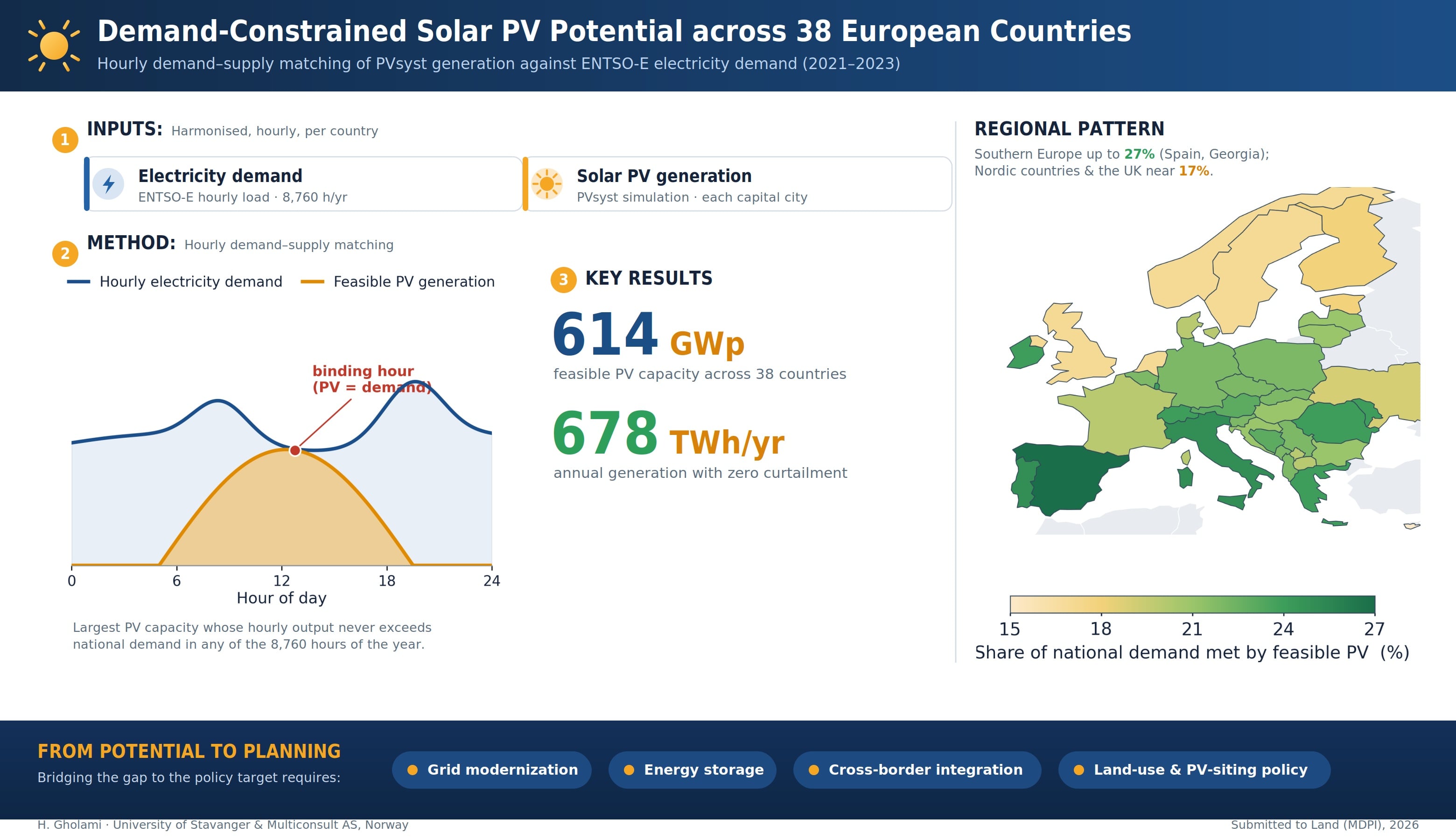
Europe’s solar photovoltaic (PV) capacity is expanding rapidly, raising a key question: how much PV can each national electricity system actually absorb? Most existing assessments rely on annual or seasonal averages, which overlook the hour-by-hour match between PV generation and demand that ultimately limits feasible deployment. This study quantifies the demand-constrained PV potential of 38 European countries and how it varies across regions. Hourly PV generation is simulated in PVsyst and matched against national hourly demand from ENTSO-E. Feasible capacity is defined as the largest installation whose output never exceeds demand in any hour of the year. This system-level, time-resolved method yields operationally constrained estimates rather than purely physical potential. The 38 countries could feasibly deploy about 614 GWp of PV, generating around 678 TWh per year without exceeding hourly demand. Regional differences are pronounced: southern Europe benefits from superior solar resources, while northern and eastern regions face seasonal and infrastructural challenges. These findings underline the importance of grid modernization, energy storage, and cross-border integration. The estimates form a conservative baseline; they exclude drivers such as electric-vehicle (EV) deployment, demand-side flexibility, battery energy storage, latent demand growth, power export, and building-integrated photovoltaics (BIPV), whose inclusion would expand the feasible potential. This study offers a transparent comparative framework to guide policy, investment, and system planning for Europe’s carbon-neutral energy transition.
Share and Cite
MDPI and ACS Style
Gholami, H.
Assessment of Solar Energy Capacity Across Europe: Comparative Analysis of Production and Consumption Data. Land 2026, 15, 1044.
https://doi.org/10.3390/land15061044
AMA Style
Gholami H.
Assessment of Solar Energy Capacity Across Europe: Comparative Analysis of Production and Consumption Data. Land. 2026; 15(6):1044.
https://doi.org/10.3390/land15061044
Chicago/Turabian Style
Gholami, Hassan.
2026. "Assessment of Solar Energy Capacity Across Europe: Comparative Analysis of Production and Consumption Data" Land 15, no. 6: 1044.
https://doi.org/10.3390/land15061044
APA Style
Gholami, H.
(2026). Assessment of Solar Energy Capacity Across Europe: Comparative Analysis of Production and Consumption Data. Land, 15(6), 1044.
https://doi.org/10.3390/land15061044
Note that from the first issue of 2016, this journal uses article numbers instead of page numbers. See further details
here.
Article Metrics
Article Access Statistics
For more information on the journal statistics, click
here.
Multiple requests from the same IP address are counted as one view.