Article

Whose National Park? The Dilemma of Institutional Construction in Shangri-La Potatso National Park from a Spatial Justice Perspective

1
School of Management, Minzu University of China, Beijing 100081, China
2
School of Economics and Management, Pu’er University, Pu’er 665000, China
*
Author to whom correspondence should be addressed.
Land 2026, 15(6), 1036; https://doi.org/10.3390/land15061036
Submission received: 6 April 2026 / Revised: 22 May 2026 / Accepted: 9 June 2026 / Published: 11 June 2026
(This article belongs to the Special Issue National Parks and Natural Protected Area Systems)

Abstract

This study integrates spatial justice theory with the Institutional Analysis and Development (IAD) framework to construct a new analytical model: “Institutional Rules–Spatial Justice Issues–Spatial Injustice Perception–Institutional Feedback.” Using Shangri-La Potatso National Park as a case study, our deductive–inductive approach reveals the practical dilemmas and institutional challenges in the development of China’s national park system. The findings indicate that (1) national park reforms have not restructured entrenched power relations, leading to ineffective governance and deficiencies across multiple institutional rules; (2) these rule deficiencies shape an action arena where multiple actors interact within nested power networks, generating four interrelated spatial justice issues—power deviance, resource deprivation, cultural erosion, and conflict reproduction; (3) actors’ perceptions of spatial injustice, assessed through procedural, distributive, recognitional, and restorative justice lenses, produce institutional feedback that often perpetuates rather than resolves systemic inequities. Theoretically, this study reveals that while spatial justice issues manifest differently in ecological conservation versus urban development contexts, both are driven by institutional exclusion constructed through a “capital–power–technology” alliance. In practical terms, an inclusive governance system centered on collaborative decision-making, equitable resource allocation, cultural recognition, and integrated conflict resolution is proposed to advance spatial justice.

1. Introduction

The national park system, a cornerstone of China’s ecological civilization strategy, was established as a key reform following the Third Plenary Session of the 18th CPC Central Committee. It aims to achieve state-led, publicly accessible, and intergenerationally equitable conservation through integrated ecosystem management, operating under the core principle of prioritizing ecological protection with the strictest land-use controls. The development of China’s national park system has yielded a series of replicable and scalable achievements in areas such as protected area integration, national park legislation, institutional setup, and community development mechanisms [1]. However, the first batch of pilot zones has also revealed typical challenges, including fragmented management with overlapping mandates, conflicts between conservation and development, the marginalization of indigenous rights, lagging legal safeguards, and persistent funding gaps [2]. These issues expose the complex dynamics inherent in deepening institutional reforms.
Such challenges are not unique to China but are prevalent throughout the global history of national parks. For instance, early management practices in Yellowstone National Park in the United States sparked prolonged controversies due to the neglect of indigenous rights [3]; Australia’s Kakadu National Park has struggled to balance conservation with community development [4]; and South Africa’s Kruger National Park faces similar challenges regarding financial sustainability and community co-management [5]. Additionally, the management of recreational use in the Lake District National Park in the United Kingdom illustrates the persistent tension between providing public access and preserving ecological integrity, further highlighting the complex interplay of visitor expectations, conservation mandates, and managerial capacity [6]. These international cases demonstrate that national parks, as complex spaces where nature conservation intersects with human activity, are perpetually sites of negotiation and adjustment among diverse rights and interests.
These enduring challenges stem from entrenched structural issues involving institutions, power, and interests. First, cross-sectoral and multi-level coordination is impeded by a long-standing, fragmented governance framework. The framework reinforces institutional path dependence, leading to ambiguous accountability and disjointed policy implementation [7]. Second, local and indigenous voices are often marginalized in spatial planning and management. The marginalization stems from significant power asymmetries in decision-making processes, characterized by unequal access to knowledge, information, and resources. Third, protected areas may become arenas of conflict instead of collaboration due to competing stakeholder interests. These encompass ecological security, economic development, commercial profit, livelihood needs, and cultural preservation. Effective mediation is essential to prevent this outcome [8].
The persistence of these issues not only impedes the realization of national parks’ ecological civilization mandate [2] but also risks exacerbating tensions between conservation objectives and human well-being [9]. Within this context, spatial justice offers a robust analytical framework for systematically diagnosing and addressing these structural challenges [8]. By emphasizing equitable spatial resource allocation, democratic processes in spatial production, and balanced spatial power relations [10], spatial justice theory illuminates the contradictions inherent in national park governance, where multiple spatial claims converge. This approach helps to bridge a critical gap in existing research, which has predominantly emphasized instrumental rationality while undertheorizing the dimension of value rationality in protected area governance. Specifically, this framework operates through three key mechanisms. First, it interrogates “whose interests are represented and whose voices are heard in space,” directly confronting power asymmetries and interest conflicts. This reveals systematically excluded groups and how spatial policies shape their rights [11]. Second, by prioritizing democratic participation and equal rights protection, it offers both a normative compass and actionable principles for overcoming institutional inertia and fostering inclusive governance [12]. Third, it reframes ecological conservation as a spatial practice, critically assessing whether the burdens and benefits under conservation-first policies are justly distributed—thereby advancing more equitable and sustainable human–environment relations [13]. However, current discussions on spatial justice in protected areas suffer from a lack of theoretical focus in their transplantation. Existing studies often directly apply analytical frameworks developed for urban spatial justice, overlooking how the scientific discourse of “conservation priority” in national parks reshapes the very connotation of justice. This makes it difficult to address the core question: “Why do natural protected areas become arenas of power conflict?” This leads to the central research questions of this study: When the context shifts from urban development to ecological conservation, what spatial justice issues arise from the construction of the national park system? What are their specific manifestations? What are their formation mechanisms?
This study employs a combined deductive–inductive analytical approach to conduct exploratory research on spatial justice issues within the institutional development of the Shangri-La Potatso National Park (Shangri-La City, Diqing Tibetan Autonomous Prefecture, Yunnan Province, China, hereinafter “Potatso National Park”). It aims to reveal the particularities of spatial justice issues within the context of ecological conservation, with the goal of providing a theoretical reference and decision-making support for the construction of the national park system.

2. Literature and Theory

2.1. The Issue of Spatial Justice in National Park Research

National parks are not pristine wildernesses but complex socio-ecological systems that integrate ecological conservation [14], recreational services [15], community development [16], and cultural heritage [17]. Within these systems, the allocation and use of spatial resources often involve profound issues of justice [18]. Previous research has identified two core problems in protected area governance: imbalances in spatial rights and conflicts in benefit distribution.
At the level of spatial rights, strict ecological conservation policies often lead to the institutional exclusion of local communities. Studies indicate that the establishment and management of protected areas are frequently accompanied by the compression of traditional livelihood spaces and restrictions on resource use rights for local communities [19,20]. Simultaneously, Indigenous peoples and local knowledge are often marginalized in management decision-making, with their cultural spaces and spiritual territories inadequately recognized or safeguarded [8,21].
Regarding benefit distribution, significant inequity exists in the allocation of benefits and costs arising from tourism development and ecological conservation. Research has shown that tourism development tends to exacerbate spatial perception conflicts and interest games between communities, tourists, and enterprises [22,23]. Moreover, communities often occupy a disadvantaged position in the distribution of tourism revenues, with ineffective participation mechanisms observed in cases worldwide [24]. Additionally, gaps remain in the design, implementation effectiveness, and community perception of benefits under ecological compensation policies [25,26], making it difficult to genuinely alleviate the tension between conservation and development.
Existing research has advanced in specific areas, including ecological monitoring [27], carrying capacity assessment [28], and legal-institutional design [29]. However, its focus has been predominantly on technical aspects or macro-level institutional descriptions. Consequently, there has been insufficient attention to the interactive mechanisms between micro-level actor behaviors and macro-level institutions. In particular, there is a lack of systematic examination—from the perspective of spatial justice theory—of the structural inequalities among different actors across dimensions such as spatial occupation, use, control, and meaning-making. Therefore, constructing a spatial analytical framework capable of revealing power relations, integrating pluralistic values, and guiding equitable governance has become a critical issue for advancing national park research.

2.2. Empirical Research on Spatial Justice Theory in the Context of Ecological Conservation

The theory of Spatial Justice critically examines the interaction between geographical space and social equity. It reveals that space is not a value-neutral physical domain but rather a concrete manifestation of power dynamics and social construction [30]. Spatial justice is defined as “social justice in the production of space and the allocation of spatial resources” [31]. The specific connotations of spatial justice encompass several key principles: advocating for the equitable distribution of resources and opportunities; reducing spatial deprivation and the marginalization of vulnerable groups; safeguarding the rights of citizens and communities to participation and cultural respect; opposing systemic violence; and ensuring environmental justice [32]. Applied research on spatial justice has predominantly focused on urbanization and industrialization contexts, addressing topics such as gentrification in urban renewal [33], spatial segregation in social housing [34], and accessibility to public service facilities [35]. These studies have established a multidimensional analytical framework centered on distributive justice, procedural justice, and recognitional justice. Distributive justice ensures that subjects of spatial production fairly enjoy spatial resources in terms of opportunities, rights, and outcomes [11,33]. Procedural justice emphasizes the fairness of rules and the adequacy of decision-making processes [34]. Recognitional justice focuses on acknowledging and respecting the identities, cultural rights, and needs of citizens and groups [36,37]. Shi et al. (2020) explored the remedial function of corrective justice for historical spatial injustices from the perspective of ecological justice [38].
The delineation of spatial boundaries, functional zoning, facility layout, and resource allocation within natural protected area systems—primarily national parks—essentially represents the spatial projection of political power [39]. However, when the lens of spatial justice is turned toward ecological conservation, theoretical frameworks derived from urban and rural development contexts may face limitations in their direct applicability to nature conservation. For instance, the equity performance evaluation framework for urban parks proposed by Yang et al. (2020) is difficult to directly adapt to the complex functions and multi-scale governance realities of national parks [40]. Similarly, while Zhang et al. (2017) proposed enhancing institutional justice in national park management through “good governance” from an institutional logic perspective, their work lacks empirical research to substantiate its implementation effectiveness [41]. Furthermore, existing studies lack micro-level analysis of the spatial justice perceptions of key stakeholders within national parks. This gap hinders an effective understanding of rights conflicts among key stakeholders. These conflicts concern spatial access, resource utilization, and cultural expression within parks. Consequently, it impedes the coordination of such conflicts and obscures how they shape stakeholder behaviors, ultimately undermining conservation goals.

2.3. Application of the IAD Framework in Protected Area Research

Developed by Elinor Ostrom, the Institutional Analysis and Development (IAD) framework is the primary analytical tool in this study. This framework facilitates a systematic examination of how institutional structures shape both individual behaviors and collective decision-making processes. At its core, the IAD framework maps a holistic cycle. This cycle begins with external variables—such as biophysical conditions, community attributes, and existing rules. These variables shape the action arena, which comprises specific situations and interacting actors. This leads to patterns of interaction and outcomes which are then evaluated, ultimately feeding back to influence and modify the initial institutional rules [42]. The IAD framework has been applied to analyze governance in protected areas. It examines how institutional structures shape actor behaviors and outcomes through a sequence of action situations, interactions, and evaluations. The framework elucidates interactions within multi-level governance, showing how formal and informal rules—from national laws to local norms—influence resource management and community participation [43,44]. The IAD framework helps to analyze cross-scale coordination and stakeholder dynamics. For example, it has been used to examine institutional designs such as China’s “unified authority with hierarchical management,” revealing challenges in authority division, fiscal alignment, and implementation incentives [45]. Additionally, the framework clarifies interactions between tourism and compensation policies, linking institutional arrangements to behavioral and governance outcomes [46]. However, the IAD framework has limitations in addressing power asymmetries, value conflicts, and historical path dependence. It offers limited insight into spatial justice issues or varied community participation outcomes under similar rules. Future research should integrate the IAD framework with perspectives such as political ecology and spatial justice to better address equity and sustainability in protected area governance.

2.4. Theoretical Framework

This study posits that the construction of a national park system is a dynamic process, continuously shaped, negotiated, and evolved through sustained interactions between multiple actors based on their spatial justice goals. Consequently, this research integrates Spatial Justice Theory with the IAD framework to propose a new theoretical framework: “Institutional Rules–Spatial Justice Issues–Spatial Justice Perception–Institutional Feedback” (Figure 1).
Specifically, within the exogenous variables component, the study focuses on the rules influencing the action arena. The IAD framework defines “institutional rules” as the core governance structures shaping protected area management. These rules encompass both formal and informal elements. Formal rules include laws, regulations, management plans, and property rights systems established during national park system construction. Informal rules consist of historically formed local norms and community customary practices. These rules constitute fundamental constraints on spatial production and reproduction within national parks, directly establishing the basic norms for resource allocation, rights definition, and decision-making participation. Regarding the action arena, the study argues that the implementation of rules—both formal and informal—for national park construction inevitably engages with pre-existing rules and social relations. This engagement reshapes regional spatial patterns, resource control, and socio-economic networks. In this action situation, the evolving patterns of interaction among diverse actors lead to specific outcomes, which are conceptualized as spatial justice issues in this study. When actors perceive these issues, a spatial injustice perception emerges. This perception serves as an evaluation criterion for the national park construction process and generates pressure for institutional feedback, prompting efforts to amend, adjust, or reconstruct the initial institutional rules.
This study examines spatial justice issues in ecological conservation, using Potatso National Park as a case study. It analyzes how these issues manifest specifically in Potatso’s development. The research also identifies the underlying causes of the challenges faced in the park’s system development. Ultimately, it aims to provide theoretical insights for building more equitable, sustainable, and resilient national park governance models.

3. Methodology

3.1. Study Area

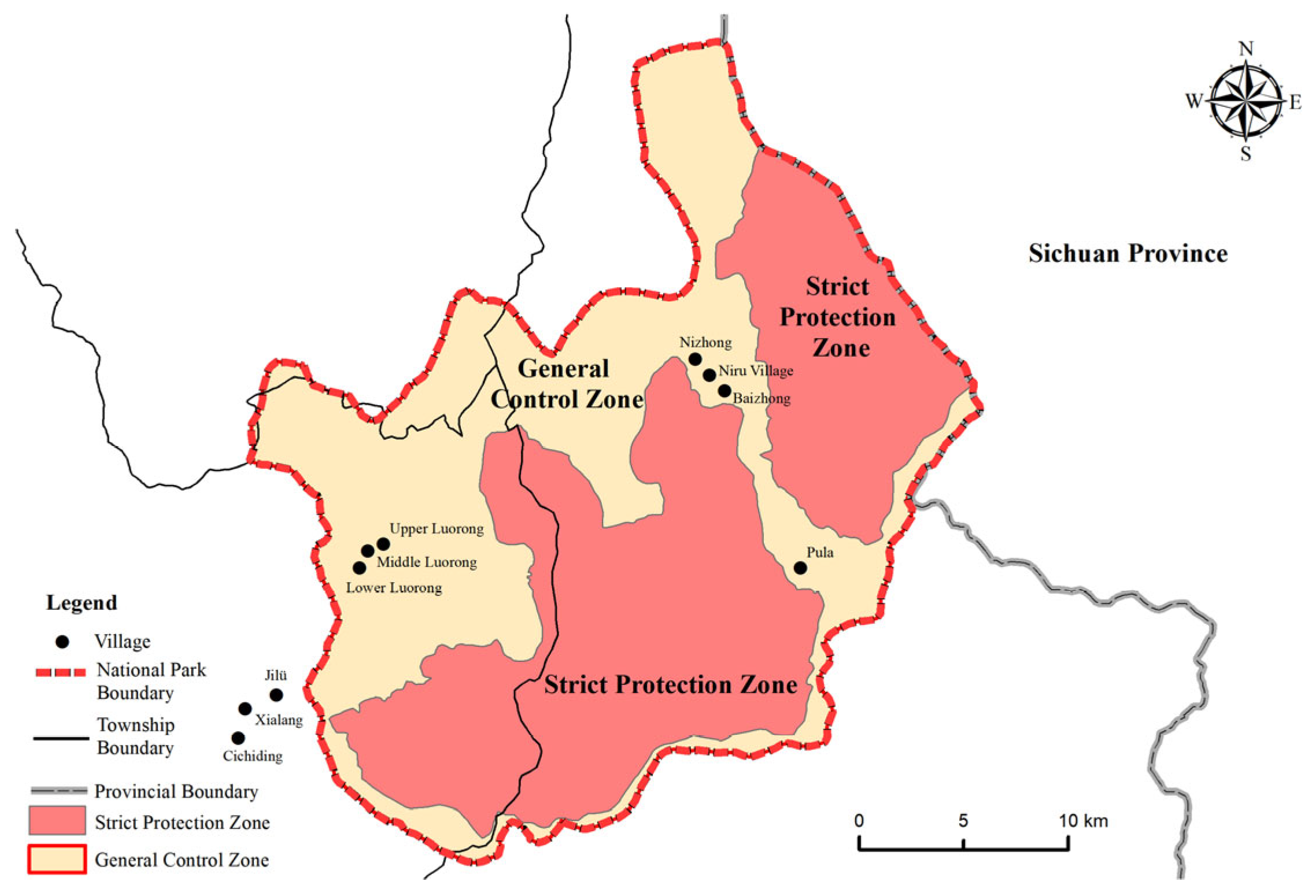
Potatso National Park is located in Shangri-La City, Diqing Tibetan Autonomous Prefecture, Yunnan Province, China. It lies at the heart of the “Three Parallel Rivers” World Natural Heritage Site in northwestern Yunnan. The park covers 60,210.99 hectares, with the core protection zone and general control zone accounting for 53.32% and 46.68% of the total area, respectively (Figure 2). The park encompasses relatively pristine and intact ecosystems, including forest–shrublands, alpine meadows, wetlands and lakes, geological relics, and river–canyon ecosystems. The park’s boundaries encompass three townships in Shangri-La City, Diqing Prefecture: Jiantang Town, Luoji Township, and Gezan Township. These include 6 village committees and 39 natural villages, predominantly Tibetan settlements. The primary sources of productive economic income for local residents are agriculture, animal husbandry, and gathering.
As a pioneering pilot zone for China’s national park system reform, the development of Potatso National Park has encompassed the entire process from local-level exploration to the establishment of a national institutional framework. In 1996, the Yunnan Provincial Forestry Department initiated explorations of the national park model; in 2007, the provincial government approved the establishment of the Potatso National Park; in 2008, it received pilot approval from the National Forestry and Grassland Administration; between 2010 and 2014, relevant plans and management regulations were successively introduced; and, in 2015, it was included among the first batch of national park system pilot zones nationwide. However, despite serving as a pilot site, Potatso was not included in the first cohort of national parks. Its power structure reforms failed to achieve the objectives outlined in the Overall Plan for Establishing the National Park System, and key institutional transformations remained incomplete. Subsequently, Potatso National Park was integrated into the larger Shangri-La National Park and was listed among the 49 candidate national park zones under the National Park Spatial Layout Plan in 2022. This inclusion marks a critical phase in the development of the national park system. The case of Potatso exemplifies the tension between top-down policy design and on-the-ground implementation, offering a representative lens through which the translation of national park concepts into institutional practice may be examined.

3.2. Data Collection

To enhance data quality, this study employs a triangulation approach, integrating multiple data sources to strengthen the validity and reliability of the findings. Data were collected primarily through semi-structured in-depth interviews, complemented by participant observation and secondary sources. The fieldwork was conducted over four phases between 2023 and 2026—16–21 July 2023; 22 August–9 September 2024; 13–21 January 2025; and 29 January–7 February 2026—amounting to 44 days in the field. The study focused on interviewing staff from the Shangri-La Potatso National Park Administration (hereinafter the Potatso National Park Administration), village committee officials, staff from the Potatso Tourism Branch Company (Shangri-La City, Diqing Tibetan Autonomous Prefecture, Yunnan Province, China, hereinafter the Tourism Branch), community residents, and visitors. The interviews focused on the park’s development achievements, existing issues, current difficulties and challenges, and suggestions and expectations for future development. By examining the perceptual differences and interactive dynamics between policymakers, policy implementers, business operators, local residents, and visitors, this study seeks to elucidate the manifestations and underlying causes of spatial justice issues in the context of the institutional development of Potatso National Park.
The study began by interviewing a long-time resident of the community who held four distinct roles: a Category I community resident (In accordance with the spirit of the document “Reply of the Shangri-La Potatso National Park Administration on the Request for Coordination and Reduction of Community Subsidy Funds” (Di Pu Guan Fu [2008] No. 7), since 18 June 2008, the Potatso Tourism Branch Company has implemented a regionally tiered subsidy scheme for communities within the jurisdiction of Potatso National Park. The communities are classified into three tiers—Category I, Category II, and Category III—based on the degree to which their production and livelihoods are affected, ranging from high to low. The subsidy standards vary accordingly (including per capita direct subsidies, per-household direct subsidies, compensation for unresolved infrastructure issues, land compensation, compensation for business withdrawal and environmental remediation, and subsidies for issues arising from the second-phase development, among others), homestay owner, national park guide, and village committee staff member (She previously served as a clerk at the Village Committee of Hongpo Village, Jiantang Town). This initial interview provided a general overview of the impacts of park development and the perceptions and interactions among various actors. Subsequently, using purposive and random sampling, three rounds of interviews and data collection were conducted. During the interviews, questions were tailored based on information provided by respondents, and necessary verification was conducted to ensure data accuracy and comprehensiveness. With the respondents’ permission, the entire process was audio-recorded. Following the principle of sampling saturation, the interview sampling was terminated when new samples no longer yielded significant new insights. The final analytical corpus (Table 1) comprised 97 interview transcripts (>300,000 Chinese characters), 44 field observation records, 168 official documents, 25 media reports, and 30 samples of visitor-generated content. To ensure construct validity, the study employed methodological triangulation, cross-verifying insights from these interviews, documentary sources, news media, and online platforms.

3.3. Data Analysis

This study employs a combined deductive–inductive analytical approach to investigate the institutional development of Potatso National Park. This research is guided by the theoretical framework of “Institutional Rules–Spatial Justice Issues–Spatial Injustice Perception–Institutional Feedback,” which provides an initial deductive structure for inquiry. This framework informed the data collection and the preliminary stages of analysis.
Data analysis proceeded through a systematic, multi-stage coding process conducted using MAXQDA 2022. The process began with an initial conceptualization phase, where raw textual data from interviews, observations, documents, media reports, and user-generated content were examined. Irrelevant or ambiguous statements were excluded, and coding was performed at both the sentence and paragraph levels to preserve contextual integrity. Through iterative comparison and integration, this phase generated 67 distinct concepts (see Table 2 for coding examples).
Subsequently, these concepts were synthesized and grouped based on their interrelationships during the categorization phase. This inductive process of merging and refining led to the identification of 24 initial categories. Further analysis through cluster analysis—akin to axial coding—consolidated these into 10 coherent sub-categories. These sub-categories were then inductively grouped under four core analytical categories: power deviance, resource deprivation, cultural dissolution, and conflict reproduction (Table 3).
The final stage—selective coding—involved abstract induction to integrate these categories into a coherent theoretical model. Through bottom-up, step-by-step theoretical integration, the analysis culminated in a model that delineates the spatial justice issues and impacts stemming from the institutional development of Potatso National Park (Figure 3).
Prior to the full analysis, a theoretical saturation test was conducted on a randomly selected subset of data (e.g., interview transcripts C3, V7, V12, V27, R6, R24, R32, R35; observation records O5, O17; official documents D100, D164; media reports M6, M14; user-generated content U4, U10, U21). Following the complete coding of the remaining 347 data items, the same subset was re-analyzed. No new concepts or categories emerged, and the relationships among categories remained stable, confirming that theoretical saturation was achieved.

4. Findings

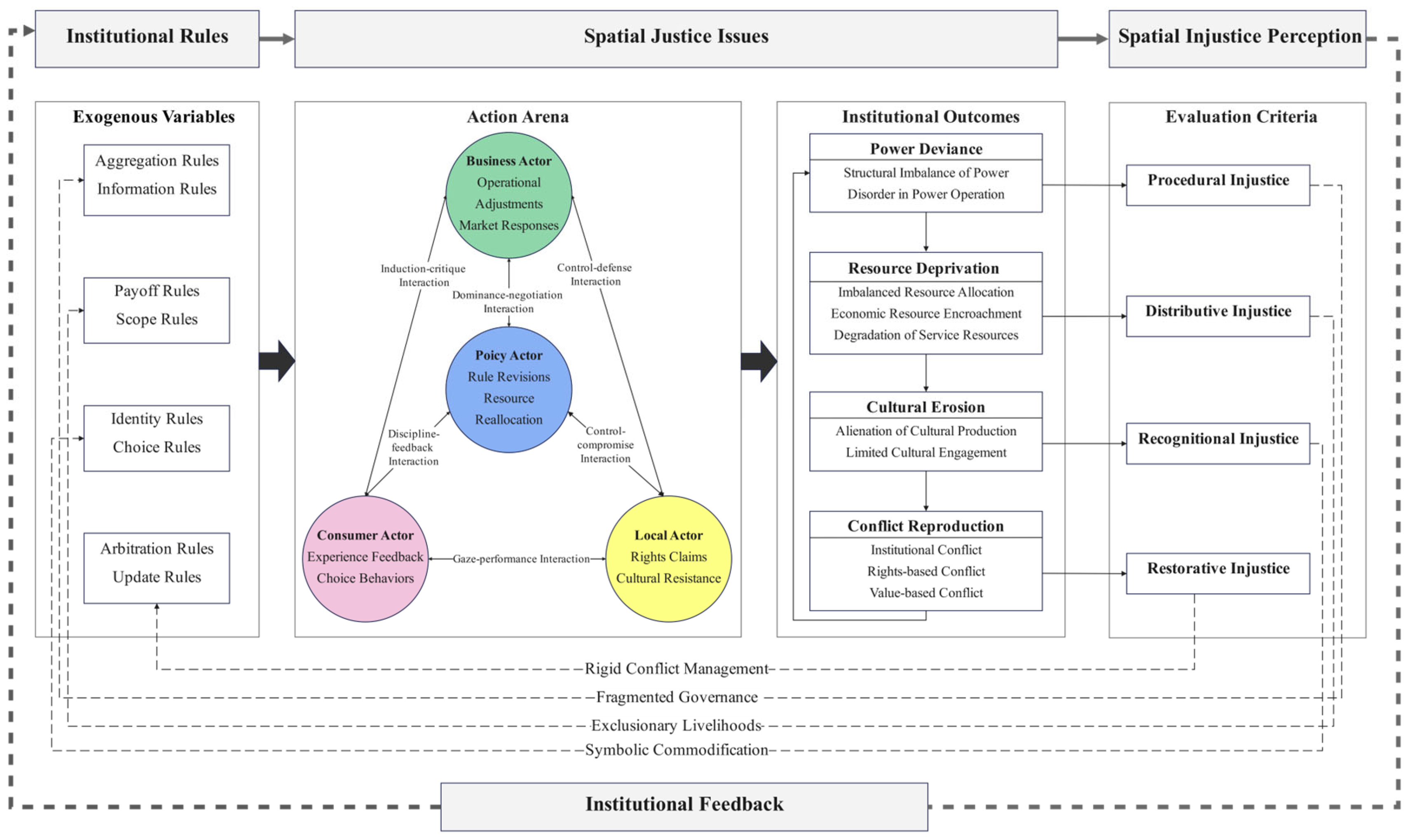
4.1. From Aggregation and Information Rule Deviations to Fragmented Governance: A Procedural Injustice Perspective

In Potatso National Park, deficiencies in the aggregation rules (which determine control) and information rules (which regulate information flow) [42] shape an action arena wherein four core actor groups—policy, business, local and consumer—interact in patterned ways shaped by their respective positions and interests. These rule-shaped interactions crystallize into persistent relational dynamics: policy–business relations are characterized by dominance–negotiation; policy–local interactions by control–compromise; policy–consumer relations by discipline–feedback; business–local engagements often take the form of control–defense; business–consumer interactions follow an induction–critique pattern; and local–consumer engagements manifest as gaze–performance. Such dynamics generate power deviance, reflected in structural imbalances and operational disorder, leading the actors to collectively perceive procedural injustice in decision-making and practice [12,34]. This shared perception of spatial injustice entrenches a fragmented governance regime. The resulting governance fragmentation acts not merely as an outcome but as a critical institutional feedback loop that reinforces the initial rule deficiencies, thereby perpetuating a cycle of power deviance and procedural injustice.
The core manifestation of power structural imbalance lies in chaotic management structures and disordered power allocation. In terms of management structure, government departments dominate resource allocation and policy direction. They leverage institutional capital, such as planning and approval authority. In contrast, tourism enterprises participate primarily in specific development and operational processes. Their involvement is driven by economic capital investment. The chaotic management structure creates an inherent tension. This tension exists between local development impulses, driven by economic and fiscal needs, and national conservation priorities, which emphasize ecological protection. For example, the 2009 park plan revision substantially reduced the controlled area from 1313 km2 to 602.1 km2. Officially justified as resolving conflicts with mining and power generation (D132) (D132: Annual Work Summary of the Shangri-La Potatso National Park Administration for 2010 and Work Priorities for 2011 (Di Pu Guan Bao [2010] No. 21)), this boundary change essentially represents a political compromise between conservation goals and local economic development needs. The disorder in power allocation has impeded a key process: the effective translation of residents’ cultural and social capital into institutional voice. This capital includes traditional ecological wisdom, local knowledge, and social networks. Consequently, this exclusion diminishes residents’ standing as key actors within the national park governance system. For example, the Implementation Plan for Tourism-Driven Community Development proposed folk tourism projects in villages like Luorong and Xialang. However, execution was dominated by an external corporate model (D95) (D95: Official Reply of the People’s Government of Diqing Prefecture on the Tourism Subsidy Funding Scheme for Communities within Potatso National Park (Di Zheng Ban Fu [2008] No. 51)), which restricted community autonomy and led to the plan’s stagnation, remaining unimplemented as of 2025. Furthermore, in the process of advancing ecological conservation, locally accumulated knowledge—such as seasonal rotational grazing practices on grasslands and natural fluctuations in lakeside water quality—has often been overlooked due to its misalignment with standardized scientific paradigms. Areas designated as sacred mountains and lakes, such as Shudu Lake, Bita Lake, and Militang Alpine Pasture, are classified as strict protection zones, yet they face particularly severe challenges in ecological protection and cultural heritage preservation. The displacement of local knowledge by institutional and economic capital not only undermines the scientific rigor and adaptability of conservation policies but also intensifies the tension between conservation objectives and the livelihood needs of local communities.
At the operational level of power, the inherent fragmentation of the bureaucratic system leads to persistent challenges in administrative coordination, functional inefficiencies, and deficits in power supervision. Although a dedicated park administration has been formally established, its actual authority remains significantly constrained. The original authorities—including those responsible for forestry, environmental protection, land resources, water conservancy, tourism, and local governance—have neither been fully devolved nor effectively integrated into the new administrative framework. Consequently, Potatso National Park Administration operates with limited authority and responsibility in key areas such as conservation, planning, and enforcement, remaining reliant on interdepartmental coordination and vulnerable to local development priorities. This inefficiency arises from incomplete central delegation, insufficient institutional constraints on sub-national discretion, and a misalignment between fiscal responsibility and administrative mandate. Although local governments bear primary conservation duties, disputes over tourism revenue allocation undermine the park’s national character and core policy objectives. Moreover, insufficient transparency, accessibility, and participatory governance rules weaken power supervision, marginalizing local communities from active co-governance to passive recipients and undermining the legitimacy and effectiveness of the national park system. Limited access to information and low capacity to engage with technical-administrative processes restrict meaningful community participation, hindering the integration of local knowledge into decision-making. Concurrently, local governments and tourism authorities reinforce institutional control through information asymmetries, further obstructing inclusive governance. As one resident remarked, “At that time, few people truly understood the implications; only a handful of relatively educated villagers signed the land transfer agreement on our behalf (R14).” Another resident similarly observed, “When the scenic area company posted recruitment notices...... we had no awareness of it at all (R11).”

4.2. From Payoff and Scope Rule Disorder to Exclusionary Livelihoods: A Distributive Injustice Perspective

Deficiencies in payoff rules (which govern the distribution of gains and losses) and scope rules (which define the boundaries of permissible action) [42] shape an action arena characterized by resource deprivation among key actors. The deprivation fosters a shared perception of distributive injustice in resource access and benefit sharing [11,33]. This shared perception of spatial inequity entrenches a regime of exclusionary livelihoods. These outcomes then form an institutional feedback loop that reinforces the initial rule deficiencies, perpetuating the cycle of resource deprivation and distributive injustice.
Imbalances in resource allocation manifest as disruptions in supply, uneven conversion, and inadequate protection of rights and interests. Inequities arise from an asymmetrical power structure that concentrates resources within dominant groups, marginalizing local communities’ development rights. The park administration’s weakened authority limits its ability to address key community demands—such as higher ecological compensation and more ranger jobs—which are crucial for conservation and well-being. Institutional flaws favor rigid controls over adaptive governance, exemplified by the simplistic closure of park areas, revealing an inability to balance conservation and development. Meanwhile, tourism revenue is largely diverted externally or toward corporate expansion rather than local reinvestment, excluding residents from economic benefits. Financially constrained and reliant on the Tourism Branch, the park administration lacks control over revenue and struggles to fulfill community commitments. Without mechanisms to improve livelihoods or foster participation, conservation efforts lack sustained local support. For instance, in matters such as driver recruitment, the Tourism Branch failed to honor the state government’s commitment to “give priority to the local community” (D166) (D166: Notice from the Shangri-La Potatso National Park Administration on Thoroughly Implementing the Labor Employment Policy for Park Communities as Directed by the Prefectural People’s Government (Di Pu Guan Fa [2010] No.17)) and did not report this deviation to the park administration. This omission directly contributed to community dissatisfaction and generated pressures related to maintaining social stability.
Economic resource encroachment is manifested in market mechanism dysfunction, challenges to the park’s brand, and increased livelihood hardships. The fundamental issue stems from a corporate-led management model that has deviated into a tool for local and corporate profit-seeking, rather than serving conservation goals. This distorted form of “half-planned, half-market” has placed the Tourism Branch in a conflicted role, oscillating between acting as a “predator” and being constrained as a “captive.” On the one hand, it is compelled to undertake government-mandated political or administrative projects—such as those related to the low-altitude economy and winter sports—which are often “costs cannot be recouped”(C3). On the other hand, it is forced to bear costs for community support and ecological conservation, responsibilities that should fall to public finance or park management authorities. Faced with additional challenges—including the protection zoning trap, supply–demand mismatches, a brand crisis due to the exclusion from the first cohort of national parks, and competition from nearby attractions—the Tourism Branch has resorted to suppressing community benefits and restricting the collective economy to maintain operations. Consequently, conservation costs are shifted to the enterprise and community, creating a bottleneck in green development. Under pressure from group-level management and profit targets, the Branch’s economic activities not only undermine community rights but also reflect passive adaptation to an flawed institutional environment.
The degradation of service resources manifests in infrastructure deficits, service quality shortfalls, and inadequate experiential quality. Tourist complaints signal clear deficiencies in the park’s infrastructure and services. This indicates that the problems stem from systemic governance and commercial practices, which restrict equitable access to public environmental goods. These shortcomings—such as inadequate maintenance, deliberate under-provision of basic services, and the arbitrary closure of sensitive zones—reflect insufficient public investment, corporate cost-minimization, and regulatory capture driven by short-term incentives. Collectively, they undermine visitor rights, satisfaction, and the park’s educational and ecological mandates. By transforming shared heritage into a landscape of exclusion and reducing the public to passive recipients of substandard offerings, these practices erode the democratic legitimacy of national parks as institutions of public trust. When core public goods—quality ecological experiences and rigorous environmental education—become scarce or inaccessible, the park’s claim to national representativeness and its transformative educational role becomes fundamentally untenable.

4.3. From Identity and Choice Rule Imbalance to Symbolic Commodification: A Recognitional Injustice Perspective

Deficiencies in identity rules (which define roles and responsibilities) and choice rules (which establish behavioral norms) [42] shape an action arena characterized by cultural erosion among key actors. This erosion fosters a shared perception of recognitional injustice, centering on the devaluation of cultural identities and demands [36,37]. This shared perception reinforces a tourism system dominated by symbolic commodification. This institutional outcome feeds back by further entrenching the initial rule deficiencies, thereby perpetuating the cycle of cultural erosion and recognitional injustice.
The alienation of cultural production is manifested specifically through the devaluation of cultural capital and the superficial presentation of culture. This phenomenon stems from the power–capital driven reconstruction of culture, which strips local culture of autonomy and reduces it to a consumable symbol. Despite regulatory emphasis on local characteristics, the model of “government leadership, corporate participation, and market-driven operations” (D150) (D150: Draft Regulation on the Management of Potatso National Park in Diqing Prefecture) and centralized planning (D2) (D2: Revised Draft Regulation on the Protection and Management of Shangri-La Potatso National Park in the Diqing Tibetan Autonomous Prefecture of Yunnan Province) standardize cultural expression. As a result, distinctiveness is forced to fit administratively predefined forms. This devalues cultural capital: deep cultural structures—such as sacred mountain taboos or community narratives—are marginalized for resisting commodification, while superficial, easily marketable ethnic symbols are selectively circulated. Consequently, culture becomes detached from its original contexts and meanings, repackaged into consumable experiences—as seen in projects like jungle zip-lining, eco-art festivals and cultural IPs such as “Squirrel Zhaxi” (D167) (D167: Annual Work Summary of the Potatso Tourism Branch Company for 2025 and Work Plan for 2026)—ultimately forming a symbolic landscape designed for external consumption.
Limited cultural engagement, manifested in monotonous experiences and impoverished connotations, reduces cultural heritage to superficial consumption. This commodification marginalizes authentic narratives, severs the culture–nature connection, and excludes the public from meaningful participation. Visitor feedback illustrates this disengagement: “Even an elderly woman was so bored she was scrolling through TikTok while walking” (V39) and “The scenery isn’t scenic, and there’s no fun to be had” (V32). In practice, experiences are streamlined into a fast-food-style chain of costume rental, photography, performances, and souvenir shopping. Authentic settings give way to symbolic collages, as noted: “they just used the gimmick of Xie Na’s (Xie Na is a Chinese celebrity) wedding venue” (V35). Consequently, cultural dissemination prioritizes “form over substance” (U9). An ecological interpretation system with a nature-centric, culture-marginalizing bias further severs the culture–nature link, transforming cultural landscapes into mere decorative elements. This limited engagement undermines the park’s capacity to fulfill its cultural-educational role in building a strong sense of the Chinese national community. It thereby reduces the principle of “public welfare for all” to a mere formality.

4.4. From Arbitration and Update Rule Failure to Rigid Conflict Management: A Restorative Injustice Perspective

Deficiencies in arbitration rules (for resolving disputes) and update rules (for amending charters) [42] shape an action arena characterized by conflict reproduction among key actors. The reproduction fosters a shared perception of restorative injustice, reflecting a systemic failure to redress historical grievances and resolve emerging disputes [38,47]. Such a shared perception, in turn, reinforces rigid approaches to conflict management. Consequently, the initial rule deficiencies are perpetuated, solidifying a cycle of conflict reproduction and restorative injustice.
The persistent reproduction of institutional conflicts reflects a systemic lack of resilience, rooted in ineffective institutional supply and operational contradictions. Despite longstanding policy recognition of community relations and benefit distribution as core issues since the park administration’s establishment in 2005, implementation remains inadequate. Compensation and revenue-sharing mechanisms lack dynamic adjustment and financial safeguards, while participatory channels show gaps in job creation and skills training. Community development projects—such as folk culture villages—often stall due to poor coordination and unstable policy support. This impasse stems not from a lack of design but from rules that lag behind community needs and inflexible interest coordination. The resulting institutional rigidity fails to balance conservation and development, forcing the Tourism Branch into a conflicted position and causing persistent friction with local communities—leaving it “struggling to advance while reacting passively” (C1). Ultimately, the framework reinforces a binary opposition between conservation and development, as well as corporate and community interests, rather than fostering adaptive, inclusive coordination.
Rights-based conflicts primarily stem from dual pressures on residents’ survival and development rights. At the community level, survival-related conflicts arise from issues such as resource encroachment, chaotic compensation, excessive protective responsibilities, and the shifting of development costs. Meanwhile, development-related conflicts emerge from the transfer or circumvention of development rights and developmental segregation. Although the government has attempted remedies, such as reinvesting tourism revenues, flawed compensation mechanisms and unscientific standards persist. These issues, compounded by weak risk-bearing capacity and absent community participation, have prevented the “public welfare for all” principle from translating into tangible livelihood improvements. As resident R7 remarked, “The villages nearby have had their access roads, streetlights, and fences repaired; new houses have been built, and homestays and restaurants have opened up—but our village has nothing.” While tourism authorities promote service standards and ecological conservation, they lack supporting measures for community capacity-building and localized development, intensifying residents’ sense of rights deprivation. This is echoed by resident R22: “We’re not allowed to build a gravel pit in our village. I have to haul the gravel for my homestay from elsewhere, which costs two to three times more—or even more. Who’s going to cover that price difference?”
Value-based conflicts, manifested in consumption imbalance and low service efficiency, constitute a spatial justice issue that prioritizes commercial extraction over equitable public benefit. This model reduces public access to meaningful educational programs while embedding manipulative consumption practices into the visitor experience, thereby stratifying a public good into a transactional space. For instance, park visits are limited to a linear shuttle-bus tour connecting “Yoyo Trail (Ice and Snow World)–Shudu Lake–Bita Lake,” while culturally significant programs such as traditional village visits or educational study tours remain inaccessible due to operational restrictions. Within the scenic area, “practices designed to induce consumption” (V36) are prevalent, including misleading guide promotions, low-quality product pushes disguised as complimentary services, and mandatory shopping corridors. Although such strategies may raise short-term secondary spending, they undermine experiential dignity and erode managerial trust, reducing the non-transactional national park experience to a calculated commercial exchange. This approach contradicts public-welfare principles and weakens the park’s core educational function. Meanwhile, ecological and cultural exhibitions exhibit trends of low quality and fragmentation. Interpretation systems are often reduced to product promotion vehicles—such as the marketing of “Highland Vitality” sunscreen—rather than substantively explaining local ecology or ethnic culture. Cultural facilities like the ecological library and King Gesar performance hall remain underutilized, and potential experiences such as visits to Luorong Village are unrealized due to rigid operations. Service design appears oriented toward maximizing commercial flow rather than fostering understanding and respect. Consequently, inadequate ecological education leaves visitor perceptions superficial, often expressed as “just an ordinary lake” or “nothing special” (V7).

5. Discussion

5.1. Theoretical Implications

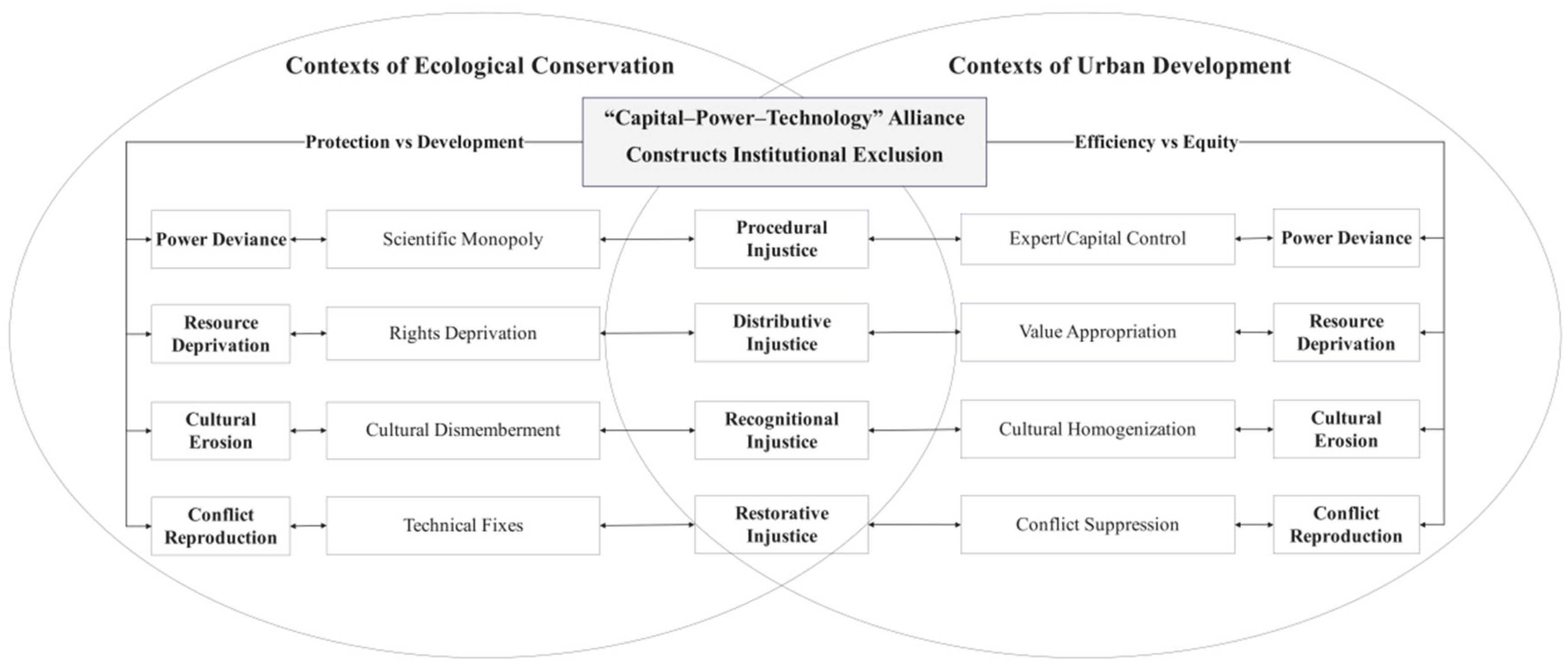
In the institutional development of Potatso National Park, four types of spatial justice issues arise: power deviance, resource deprivation, cultural erosion, and conflict reproduction. This paper deconstructs spatial injustice through the lens of the “capital–power–technology” alliance, contrasting its manifestations in ecological conservation with those in urban development. As illustrated in Figure 4, the alliance operates through four dimensions of injustice—procedural, distributive, recognitional, and restorative—each assuming a distinct form shaped by its specific socio-spatial context.
In ecological conservation, procedural injustice often manifests as a scientific monopoly, where expert knowledge and ecological redlines render decision-making a technical black box [13], marginalizing local voices [8]. This leads to distributive injustice through the institutional deprivation of community resource rights, frequently framed as necessary for protection [48]. Such processes foster recognitional injustice via the cultural dismemberment of traditional livelihoods and local ecological knowledge [49], which are stigmatized as incompatible with scientific management [50]. Consequently, restorative measures are often limited to technical fixes [51,52], such as limited compensation or resettlement. These measures address only the symptoms of conflict while avoiding necessary structural reforms in land tenure or participatory governance. This approach ultimately perpetuates the conflict it seeks to resolve.
In urban development, procedural injustice is characterized by expert and capital control, where planning decisions are dominated by growth coalitions under the guise of economic efficiency or technical necessity [33]. Distributive injustice follows as a form of value appropriation. In this process, the surplus value generated from land is systematically captured by developers and the state. This displacement of residents exacerbates existing inequalities [11,32]. Recognitional injustice appears as cultural homogenization [53], wherein place-based identities and collective memories are erased or commodified in standardized urban redevelopment [11,54]. In response, restorative approaches often prioritize immediate conflict suppression and concessions rather than rights-based negotiations. Thus, they reinforce underlying tensions instead of resolving them [55,56].
In conservation areas, the core contradiction is “protection versus development.” In urban spaces, it is “efficiency versus equity.” Despite these contextual differences, both pathways converge into a closed loop of institutional exclusion. The alliance operates through a series of interconnected strategies. First, it leverages technocratic governance to depoliticize spatial conflicts. Second, it redirects material and symbolic value to powerful actors. Third, it marginalizes alternative knowledges and ways of life. Finally, it employs short-term managerial solutions that circumvent the need for greater institutional change. It demonstrates how spatial injustice is reproduced not as a policy failure but as a systemic outcome of aligned capital, power, and technical rationality operating across varied geographical and political contexts.

5.2. Practical Implications

Moving forward, Potatso National Park’s governance should be reconfigured by dismantling entrenched interests and establishing an ecology-centered paradigm. This requires a multi-pronged institutional approach. First, a collaborative decision-making and oversight mechanism should be developed. By refining aggregation and information rules, power deviance can be corrected, and spatial governance challenges from procedural inequities can be progressively resolved. Second, an equitable and sustainable resource allocation framework should be established. Optimizing payoff and scope rules can be expected to strengthen institutional safeguards against resource deprivation, advance distributive justice, and support the synergy between conservation and community development. Third, a cultural recognition system based on respect and innovation should be cultivated. Enhancing identity and choice rules can mitigate cultural dissolution, safeguard diversity, and promote the symbiotic flourishing of ecological and cultural values. Finally, an integrated conflict governance framework is needed, combining prevention and resolution. Strengthening the synergy between arbitration and update rules will curb conflict reproduction, address restorative injustice, and enhance the system’s overall resilience and adaptive capacity.

6. Conclusions

This study integrates Spatial Justice Theory with the Institutional Analysis and Development (IAD) framework to construct an analytical model structured around “Institutional Rules–Spatial Justice Issues–Spatial Injustice Perception–Institutional Feedback.” Taking Shangri-La Potatso National Park as a case study, a combined deductive–inductive analytical approach was applied to examine the practical dilemmas and institutional causes in the construction of China’s national park system. The findings reveal that (1) while Potatso National Park’s reforms formally align with the national park system’s overall plan, they have failed to restructure entrenched power relations. Constrained by local and sectoral interests, a conservation-centered governance framework has not been established. This institutional fragmentation has resulted in deficiencies across multiple rule types—including aggregation, information, payoff, scope, identity, choice, arbitration, and update rules—thus undermining coherent governance. (2) These institutional deficiencies shape an action arena where multiple actors—policy, business, local, and consumer—engage in adaptive interactions within nested power networks. This dynamic generates four interrelated spatial justice issues: power deviance, resource deprivation, cultural erosion, and conflict reproduction. Power deviance manifests as structural imbalance and operational disorder and triggers resource deprivation, which in turn leads to cultural erosion and, ultimately, reinforces conflict reproduction. The continuous reproduction of conflict consequently gives rise to new problems of power deviance. (3) Actors’ perceptions of these justice issues—evaluated through procedural, distributive, recognitional, and restorative justice lenses—generate institutional feedback in the form of fragmented governance, exclusionary livelihoods, symbolic commodification, and rigid conflict management. These feedback mechanisms exert pressure for policy adjustment, yet often perpetuate rather than resolve systemic injustice. Finally, the study discusses both theoretical and practical implications. In terms of theoretical implications, while spatial justice issues manifest through distinct pathways in ecological conservation and urban development contexts, both reveal institutional exclusion constructed by the “capital–power–technology” alliance. In terms of practical implications, this study proposes the establishment of an inclusive governance system, structured around four key components: a collaborative decision-making and oversight governance system (ensuring procedural justice); an equitable and sustainable resource allocation and security system (addressing distributive justice); a cultural recognition system based on respect and innovation (upholding recognitional justice); and an integrated conflict governance system for prevention and resolution (fostering restorative justice).
This study has limitations. The small number of administrator interviewees may constrain the power structure analysis, despite supplementation with documentary analysis. Additionally, the IAD framework focuses primarily on rules, with less attention to physical conditions and community attributes. Future research should address these areas through broader empirical investigation.

Supplementary Materials

The following supporting information can be downloaded at: https://www.mdpi.com/article/10.3390/land15061036/s1. Table S1. Basic Information of Respondents.

Author Contributions

J.P.: Topic selection, research design, model construction, content enhancement guidance, and funding support. Y.Y. (Corresponding Author): Research design, research data collection, data analysis, model construction, initial draft writing, and revision. X.T.: Research data collection and data analysis. All authors have read and agreed to the published version of the manuscript.

Funding

Minzu University of China (grant number 2024JCYJ14) as part of the “Interdisciplinary” Research Special Project.

Data Availability Statement

Data from this research will be made available from the corresponding author upon reasonable request. The primary data for this study were derived from a two-year field investigation conducted by the research team. The secondary data were provided by the Shangri-La Potatso National Park Administration; the Potatso Tourism Branch Company; the Village Committee of Hongpo Village in Jiantang Town, Shangri-La City, Diqing Tibetan Autonomous Prefecture; and the Village Committee of Niru Village in Luoji Township, with permission granted for use in scientific research.

Conflicts of Interest

The authors declare no conflicts of interest.

References

  1. Tinglu, D.; Na, L.; Zhipang, H.; Tingpeng, L.; Yuan, M.; Wen, X. Progress of China’s national park construction and development prospects. Acta Ecol. Sin. 2024, 44, 4964–4972. [Google Scholar] [CrossRef]
  2. Baorong, H. Improve governance system of national parks, build the world’s largest national park system with high quality. Bull. Chin. Acad. Sci. 2024, 39, 219–229. [Google Scholar] [CrossRef]
  3. Yochim, M.J.; Lowry, W.R. Creating Conditions for Policy Change in National Parks: Contrasting Cases in Yellowstone and Yosemite. Environ. Manag. 2016, 57, 1041–1053. [Google Scholar] [CrossRef] [PubMed]
  4. Haynes, C. Seeking Control: Disentangling the Difficult Sociality of Kakadu National Park’s Joint Management. J. Sociol. 2013, 49, 194–209. [Google Scholar] [CrossRef]
  5. Anthony, B. The Dual Nature of Parks: Attitudes of Neighbouring Communities towards Kruger National Park, South Africa. Environ. Conserv. 2007, 34, 236–245. [Google Scholar] [CrossRef]
  6. Collins, M. The Politics of the Environment, and Noisy Sports: Two Totally Different Outcomes in the Lake District National Park for Powerboating and off-Road Motoring. Leis. Stud. 2011, 30, 423–452. [Google Scholar] [CrossRef]
  7. Xiaomei, C.; Yang, S. From conflict to mutualism: The institutional logic of National Parks in the construction of ecological civilization. J. Manag. World 2022, 38, 131–154. [Google Scholar] [CrossRef]
  8. Jian, P.; Yao, Y.; Xueling, T. Paradise and Homeland: The Differences in Spatial Justice Perception and Behavior Formation Mechanisms between Tourists and Local Residents in Potatso National Park. Trop. Geogr. 2026, 46, 884–899. [Google Scholar] [CrossRef]
  9. Siyuan, H. The role of communities in the governance of China’s national parks and the consolidation and development of their role. J. Nat. Resour. 2024, 39, 2310–2334. [Google Scholar]
  10. Soja, E.W. Seeking Spatial Justice; Social Sciences Academic Press: Beijing, China, 2016; p. 436. [Google Scholar]
  11. Uwayezu, E.; de Vries, W.T. Expropriation of Real Property in Kigali City: Scoping the Patterns of Spatial Justice. Land 2019, 8, 23. [Google Scholar] [CrossRef]
  12. Bavnbæk, K.F.; Thuesen, A.A. Navigating Spatial Justice: Exploring Municipal Planners’ Logics in Differentiated Village Planning. J. Rural Stud. 2025, 114, 103496. [Google Scholar] [CrossRef]
  13. Junfeng, W.; Qingzhong, M. Social nature: The lineage and prospects of research on the social construction of nature. Hum. Geogr. 2025, 40, 18–25. [Google Scholar] [CrossRef]
  14. Li, L.; Tang, H.; Lei, J.; Song, X. Spatial Autocorrelation in Land Use Type and Ecosystem Service Value in Hainan Tropical Rain Forest National Park. Ecol. Indic. 2022, 137, 108727. [Google Scholar] [CrossRef]
  15. Kang, N.; Wang, E.; Yu, Y.; Duan, Z. Valuing Recreational Services of the National Forest Parks Using a Tourist Satisfaction Method. Forests 2021, 12, 1688. [Google Scholar] [CrossRef]
  16. Ma, Y.; Li, Y.; Ma, Y.; Liu, Y.; Li, X.; Zhong, F. Resident Empowerment and National Park Governance: A Case Study of Three-River-Source National Park, China. Land 2025, 14, 1413. [Google Scholar] [CrossRef]
  17. Wessels, J.-A.; Douglas, A. Exploring Creative Tourism Potential in Protected Areas: The Kruger National Park Case. J. Hosp. Tour. Res. 2022, 46, 1482–1499. [Google Scholar] [CrossRef]
  18. Bonatti, M.; Bayer, S.; Pope, K.; Eufemia, L.; Turetta, A.P.D.; Tremblay, C.; Sieber, S. Assessing the Effectiveness and Justice of Protected Areas Governance: Issues and Situated Pathways to Environmental Policies in Río Negro National Park, Paraguay. Soc. Sci. 2023, 12, 71. [Google Scholar] [CrossRef]
  19. He, S.; Wang, B. Traditional Livelihood Risks and Adaptation within a Conservation Context: Insights from Two National Parks in China. Conserv. Sci. Pract. 2025, 7, e70134. [Google Scholar] [CrossRef]
  20. Mani Rai, I.; Kumar Dhakal, R. Politics of Knowledge in Conservation: (De)valued Traditional Ecological Knowledge of Bote in Chitwan National Park, Nepal. Ethnobiol. Conserv. 2024, 13, 1–13. [Google Scholar] [CrossRef]
  21. Gong, J.; Xiang, C.; Knight, D.W. Spatial Variations in Tourism Sustainability Perceptions: A Multi-Group SEM Analysis of Gateway Communities in New National Parks. Tour. Recreat. Res. 2026, 51, 568–585. [Google Scholar] [CrossRef]
  22. Wengel, Y.; Ma, L.; Ramanayake, U.; Apollo, M.; Liu, Y.; Jung, J. Balancing People-Park Conflict, Conservation and Tourism in Hainan Tropical Rainforest National Park. J. Policy Res. Tour. Leis. Events 2026, 18, 306–328. [Google Scholar] [CrossRef]
  23. Job, H.; Bittlingmaier, S.; Mayer, M.; von Ruschkowski, E.; Woltering, M. Park–People Relationships: The Socioeconomic Monitoring of National Parks in Bavaria, Germany. Sustainability 2021, 13, 8984. [Google Scholar] [CrossRef]
  24. Akayezu, P.; Ndagijimana, I.; Dushimumukiza, M.C.; Bernhard, K.P.; Groen, T.A. Community livelihoods and forest dependency: Tourism contribution in Nyungwe National Park, Rwanda. Front. Conserv. Sci. 2022, 3, 1034144. [Google Scholar] [CrossRef]
  25. Yu, Y.; Wang, Z.; Wang, E. Estimating Tourism Entrepreneurs’ Willingness to Pay for Ecological Compensation of the National Forest Parks. J. For. Res. 2025, 30, 283–294. [Google Scholar] [CrossRef]
  26. Pan, C.; Huang, H.; Sun, X.; Su, S. Impact of Forest Ecological Compensation Policy on Farmers’ Livelihood: A Case Study of Wuyi Mountain National Park. Forests 2025, 17, 53. [Google Scholar] [CrossRef]
  27. Anderson, N.E.; Bessell, P.R.; Mubanga, J.; Thomas, R.; Eisler, M.C.; Fèvre, E.M.; Welburn, S.C. Ecological Monitoring and Health Research in Luambe National Park, Zambia: Generation of Baseline Data Layers. EcoHealth 2016, 13, 511–524. [Google Scholar] [CrossRef]
  28. Wang, H.; Zhang, Y.; Wang, Q.; Yu, J.; Yuan, C. Spatial Assessment of Ecotourism Development Suitability Incorporating Carrying Capacity in the Yellow River Estuary National Park. Sustainability 2025, 17, 8449. [Google Scholar] [CrossRef]
  29. Li, Y.; Yang, X. Spatial Dimension of Biodiversity Conservation and Its Legislative Expression. Jiang-Huai Trib. 2025, 2, 73–83. [Google Scholar] [CrossRef]
  30. Dikeç, M. Justice and the Spatial Imagination. Environ. Plan. A Econ. Space 2001, 33, 1785–1805. [Google Scholar] [CrossRef]
  31. Dadashpoor, H.; Dehghan, R. Defining Spatial Justice: A Review. Habitat Int. 2025, 160, 103387. [Google Scholar] [CrossRef]
  32. Wang, K.; Lu, J.; Liu, H.; Ye, F.; Dong, F.; Zhu, X. Spatial Justice and Residents’ Policy Acceptance: Evidence from Construction Land Reduction in Shanghai, China. Land 2023, 12, 300. [Google Scholar] [CrossRef]
  33. Moroni, S. The Just City. Three Background Issues: Institutional Justice and Spatial Justice, Social Justice and Distributive Justice, Concept of Justice and Conceptions of Justice. Plan. Theory 2020, 19, 251–267. [Google Scholar] [CrossRef]
  34. Uwayezu, E.; de Vries, W.T. Can In-Kind Compensation for Expropriated Real Property Promote Spatial Justice? A Case Study Analysis of Resettlement in Kigali City, Rwanda. Sustainability 2020, 12, 3753. [Google Scholar] [CrossRef]
  35. Nazari Adli, S.; Chowdhury, S.; Shiftan, Y. Evaluating Spatial Justice in Rail Transit: Access to Terminals by Foot. J. Transp. Eng. Part A Syst. 2020, 146, 04020101. [Google Scholar] [CrossRef]
  36. Uwayezu, E.; de Vries, W.T. Exploring the Connection between Spatial Justice and Land Tenure Security: Insights from Inclusive Urban (Re)Development Schemes in Recife, Brazil. GeoJournal 2022, 87, 3365–3386. [Google Scholar] [CrossRef]
  37. Lee, H.; Shon, H. Spatial and Temporal Patterns of Energy Aid and Poverty in Four African Countries: Focusing on Distributive and Recognition Justice. Renew. Sustain. Energy Rev. 2024, 192, 114261. [Google Scholar] [CrossRef]
  38. Runzhe, S.; Changjian, L. The Study of Benefit Coordination Mechanism of Water Resource Ecological Compensation in Yangtze River Economic Belt—From the Perspective of Spatial Justice. Jiangxi Soc. Sci. 2020, 40, 49–59+254–255. [Google Scholar]
  39. Tongtong, L. The Institutional Response and Perfection of National Park Construction from the Perspective of Space. Mod. Law. Sci. 2023, 45, 63–74. [Google Scholar]
  40. Lijuan, Y.; Peifeng, Y. Urban Parks from the Perspective of Spatial Justice: Reflection, Revision and Research Framework. Urban Dev. Stud. 2020, 27, 38–45. [Google Scholar]
  41. Haixia, Z.; Lisheng, Z. Institutional Logic and Model Selection in the Construction of National Parks Administration. Resour. Sci. 2017, 39, 11–19. [Google Scholar]
  42. Ostrom, E. Challenges and Growth: The Development of the Interdisciplinary Field of Institutional Analysis. J. Inst. Econ. 2007, 3, 239–264. [Google Scholar] [CrossRef]
  43. Badola, R.; Hussain, S.A.; Dobriyal, P.; Manral, U.; Barthwal, S.; Rastogi, A.; Gill, A.K. Institutional Arrangements for Managing Tourism in the Indian Himalayan Protected Areas. Tour. Manag. 2018, 66, 1–12. [Google Scholar] [CrossRef]
  44. Orihuela, J.C.; Mendieta, A. One and Three Forests: Understanding Institutional Diversity in Amazonian Protected Areas. For. Policy Econ. 2021, 133, 102620. [Google Scholar] [CrossRef]
  45. Yin, Z.; Ying, L.; Quanfeng, S.; Shengzhi, L. A performance comparison of different governance types of protected areas in China: From the perspective of local communities. J. Nat. Resour. 2024, 39, 2364–2382. [Google Scholar] [CrossRef]
  46. Chenming, S.; Xialu, X.; Bo, Z.; Jiaqi, W.; Yi, X. Adaptive Governance Model for Human-Wildlife Conflicts Based on the IAD-SES Framework: A Case Study of Yushu Tibetan Autonomous Prefecture, Qinghai, China. World For. Res. 2025, 38, 126–134. [Google Scholar] [CrossRef]
  47. Mayer, A.; Lopez, M.C.; Moran, E.F. Uncompensated Losses and Damaged Livelihoods: Restorative and Distributional Injustices in Brazilian Hydropower. Energy Policy 2022, 167, 113048. [Google Scholar] [CrossRef]
  48. Benetti, S.; Langemeyer, J. Ecosystem Services and Justice of Protected Areas: The Case of Circeo National Park, Italy. Ecosyst. People 2021, 17, 411–431. [Google Scholar] [CrossRef]
  49. Barnes, P.A.; Aninta, S.G.; Ariyanto, T.; Holle, M.J.M.; Ikhawan, M.K.; Jayanto, H. The Gap between Policy and Practice for Human Rights in Conservation: A Case Study in Papua Province, Indonesia. Oryx 2023, 57, 360–369. [Google Scholar] [CrossRef]
  50. Martin, A.; Myers, R.; Dawson, N.M. The Park Is Ruining Our Livelihoods. We Support the Park! Unravelling the Paradox of Attitudes to Protected Areas. Hum. Ecol. 2018, 46, 93–105. [Google Scholar] [CrossRef]
  51. Houphouët, A.D.L.; Sangne, Y.C.; Diarrassouba, A.; Adou Yao, Y.C.; Betbeder, J.; Hérault, B. Forest Structure Recovery around West Africa’s Last Great Rainforest: Modelling Complex Dynamics in Taï National Park. Trees For. People 2025, 22, 101005. [Google Scholar] [CrossRef]
  52. Xue, S.; Fang, Z.; Bai, Y.; Alatalo, J.M.; Yang, Y.; Zhang, F. The next Step for China’s National Park Management: Integrating Ecosystem Services into Space Boundary Delimitation. J. Environ. Manag. 2023, 329, 117086. [Google Scholar] [CrossRef]
  53. Hewidy, H.; Harsia, E. Let Them Speak: Insurgent Planning and Urban Justice. Cities 2025, 162, 105918. [Google Scholar] [CrossRef]
  54. Uwayezu, E.; De Vries, W.T. Indicators for Measuring Spatial Justice and Land Tenure Security for Poor and Low Income Urban Dwellers. Land 2018, 7, 84. [Google Scholar] [CrossRef]
  55. Banerjee, A.; Schuitema, G. Spatial Justice as a Prerequisite for a Just Transition in Rural Areas? The Case Study from the Irish Peatlands. Environ. Plan. C Politics Space 2023, 41, 1096–1112. [Google Scholar] [CrossRef]
  56. Romero-Seseña, P. Applicability and Uses of the Online Environment in Restorative Mediation: Towards a Digital Restorative Justice? Curr. Issues Crim. Justice 2025, 37, 75–93. [Google Scholar] [CrossRef]
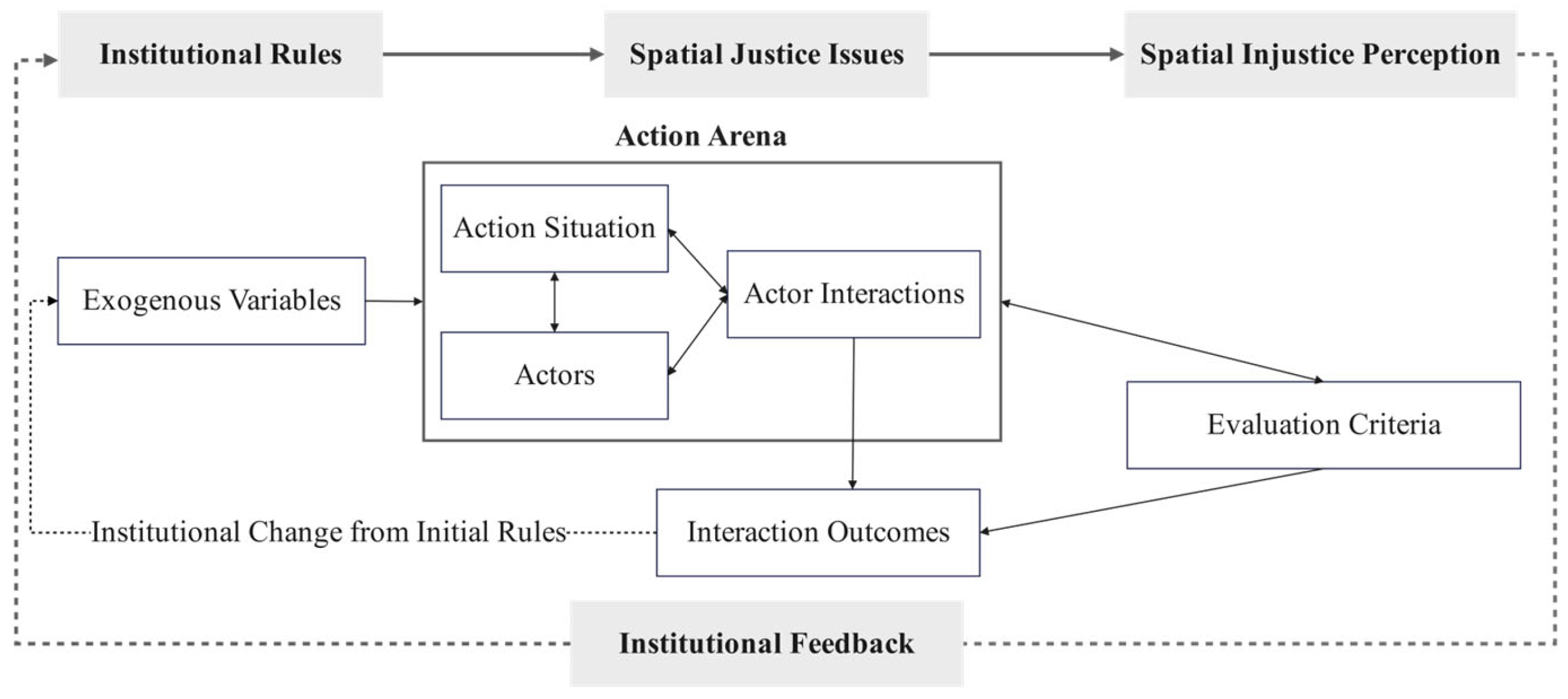
Figure 1. Theoretical framework of “Institutional Rules–Spatial Justice Issues–Spatial Injustice Perception–Institutional Feedback.”.
Land 15 01036 g001
Figure 2. Zoning map of Potatso National Park.
Land 15 01036 g002
Figure 3. A model of institutional–spatial justice impact in Potatso National Park.
Land 15 01036 g003
Figure 4. Differences and connections in spatial justice issues between ecological conservation and urban development contexts.
Land 15 01036 g004
Table 1. Data collection methods and participant information.
Data SourceParticipant/Document CodeSelection Criteria/DescriptionPrimary Focus of Inquiry/Content
Semi-structured InterviewsR1–R40Residents: Purposively sampled from communities categorized as Type I, II, and III tourism benefit-sharing recipients within Potatso National Park.Perceptions of current development and management; reasons for satisfaction or dissatisfaction; expectations and suggestions for future development.
V1–V39Visitors: Randomly approached at key park sites to ensure a diverse sample.Visitor experience, motivations, and perceptions of park management and conservation.
N1–N2Park Administration Staff: Key informants from the National Park Administration.Institutional roles, key operational challenges, implemented management measures, and recommendations.
G1–G7Community Committee Staff: Key informants from the Hongpo and Niru Village Committees.Community-level governance roles, benefit-sharing mechanisms, and community–park interactions.
C1–C9Tourism Company Staff: Key informants from the Potatso Tourism Branch Company.Corporate responsibilities, operational challenges, contributions to park management, and strategic recommendations.
Participant ObservationO1–O44Field notes recorded by researchers during multiple site visits between 2023 and 2026 at various park locations and community settings.Direct evidence of on-ground practices, visitor behaviors, community activities, and physical site conditions to anchor and triangulate interview findings.
Secondary Document AnalysisD1–D168Official Documents: Collected from park administration, local archives, and village committees (e.g., meeting minutes, management reports, policy plans, agreements).Documentary basis for analyzing governance frameworks, policy implementation, community engagement, and accountability mechanisms.
M1–M25News Media: Articles from mainstream Chinese news outlets (e.g., The Paper, Guangming Online).Public discourse and media narrative trends regarding national park system development.
U1–U30User-Generated Content (UGC): Publicly available posts from major social media and travel platforms (e.g., Xiaohongshu, Ctrip).Unofficial visitor perceptions, experiences, and behaviors shared on digital platforms.
Notes: (1) Participant Totals: Interviews, 97 individuals (see Supplementary Materials, Table S1); observational records, 44 logs; secondary documents, 223 items. (2) Interview Procedure: All interviews were semi-structured. They were primarily conducted in Mandarin, with the flexibility to use local dialects when necessary to facilitate clearer communication and build rapport. All sessions were audio-recorded with prior consent and later transcribed verbatim for thematic analysis. (3) Ethical Considerations: Informed consent was obtained from all interview participants. Anonymity and confidentiality are maintained through the use of assigned codes.
Table 2. Example of initial coding.
Interview ExcerptInitial Concept (Code)
V7: The smell inside the restroom was really strong.Poor restroom sanitation
V22: I said I wanted to visit the Ice and Snow World last, but they said it wasn’t allowed.Spontaneous exploration restricted
V4: The shuttle bus system is beyond criticism, incredibly inefficient.Inefficient shuttle bus scheduling
V15: The pushy sales of prayer plaques are quite off-putting.Overt commercialization
V26: The guided tour commentary was very basic……there wasn’t much other informative or valuable content.Superficial and rigid interpretation
R8: The development of recreational projects inside the park encroaches on our community-owned forest land.Resource encroachment
R7: Our village is within the redline (restricted zone), so we miss out on many beneficial development projects.Restricted development opportunities
R8: The tour boats on Shudu Lake also damage the ecosystem.Destructive resource use
R3: Having this kind of thing (wishing plaques) inside a national park, and it doesn’t fit at all—there isn’t even a temple.Performative elements alien to the native setting
R18: Fire prevention is the most critical issue. If a fire breaks out, Potatso is finished.High pressure on forest fire prevention
…………
Table 3. Results of the multi-stage coding process.
Main CategorySubcategoryInitial CategoryConcept
Power devianceImbalance in the power structureChaotic management structureInconsistent goals, poor coordination, insufficient participation, slow construction
Disorder in power allocationAbuse of power, delayed execution, chaotic operation, internal exclusion, lack of discourse power, unfulfilled promises, management blind spot
Disorder in power operationAdministrative coordination difficultiesVertical coordination disjointed, horizontal coordination barrier
Administrative dysfunctionInconsistent authority and responsibility, insufficient capabilities
Power supervision deficitsWeak information comprehension ability, information asymmetry, information isolation
Resource deprivationImbalanced resource allocationDisruptions in resource supplyInsufficient manpower, uneven distribution, weak funding guarantee mechanism
Uneven resource conversionEconomic path dependence, operational pressure, spatial contradiction
Inadequate
rights protection
Difficulty in finding employment locally, large number of temporary workers, cheap labor force
Economic resource encroachmentMarket mechanism dysfunctionBusiness model imbalance, protection zoning trap, supply–demand mismatch
Park Brand ChallengesBrand crisis, peripheral competitive pressure
Livelihood Hardships Disruption of traditional livelihood, deprivation of alternative livelihoods
Degradation of service resourcesInfrastructure deficienciesInsufficient infrastructure maintenance, inadequate sanitation maintenance
Service quality shortfalls Poor basic services, rough recreational services, inefficient transportation services
Insufficient experiential qualityThe core area closure affected the experience, obvious commercialization, scheduling rigid
Cultural erosionCultural production alienationCultural capital devaluationAbuse of cultural symbols, freezing of cultural resources, neglect of cultural characteristics
Superficial presentation of cultureLow-quality ethnic cultural programs, lack of national cultural characteristics
Limited cultural engagementMonotonous cultural experiencesFew cultural experiences, insufficient cultural interaction
Impoverished cultural connotationsThe fast-foodization of culture, lack of intellectual depth
Conflict reproductionInstitutional conflictIneffective institutional supplyArbitrary decision-making, policy stagnation
Operational mechanism conflictsDevelopment—protection conflict, conflict of standardization of operations, conflict of functional transformation
Rights-
based conflict
Rights to survival conflictsResource encroachment, chaotic compensation, excessive protective responsibilities, shifting of development costs
Rights to development conflictsTransfer of development rights, circumvention of development rights, development segregation
Value-based conflictConsumption value imbalanceLow consumption value, unmet personalized needs
Low service efficiencyLow-quality display of ecological culture, weak ecological education function
Disclaimer/Publisher’s Note: The statements, opinions and data contained in all publications are solely those of the individual author(s) and contributor(s) and not of MDPI and/or the editor(s). MDPI and/or the editor(s) disclaim responsibility for any injury to people or property resulting from any ideas, methods, instructions or products referred to in the content.