1. Introduction
Cropland is the fundamental support for human survival and development. Its functional connotation keeps enriching and deepening with social and economic development. In traditional agricultural society, the core function of the cropland focuses on grain supply and livelihood maintenance. With the accelerated process of industrialization and urbanization, residents’ demand structure in urban and rural areas upgrades continuously. Cropland multifunctionality becomes increasingly prominent. It undertakes the core task of grain production, and also has multiple functions such as living bearing, ecological regulation and cultural inheritance [
1,
2]. The coordinated development of cropland multifunctionality serves as a crucial foundation for safeguarding national grain security, promoting high-quality agricultural development, and consolidating ecological civilization construction. At present, the rapid progress of urbanization and industrialization profoundly reshapes urban-rural spatial structure, industrial structure and population structure. Problems such as rural hollowing, population aging, extensive use, and non-agricultural conversion of cropland have become increasingly severe [
3,
4]. These changes lead to the unbalanced development of production, living, ecological and cultural functions of the cropland. Except for the production function, the living bearing function, ecological regulation function and cultural inheritance function continue to weaken and even to disappear. This trend restricts the improvement of comprehensive utilization efficiency of cropland. It also poses a serious threat to the sustainable utilization of cropland and the stability of national grain security. In this context, clarifying the spatiotemporal evolution of cropland’s four major functions and identifying the key factors driving this evolution is an urgent research priority.
Henan Province is a key grain production area and a major agricultural province in China. Its grain output has always ranked among the top nationwide. It undertakes an important mission to guarantee national grain security. As a province with a large agricultural population and as a key region for new urbanization construction, Henan stays in a period of profound economic and social transformation. Its cropland multifunctionality undergoes obvious restructuring. The grain production function keeps strengthening with the advancement of national high-standard farmland construction. The rural labor outflow, the expansion of the urban and rural construction land, and the intensive agricultural management profoundly change the cropland’s capacity to support farmers’ livelihoods, regulate the ecological environment, and maintain the space for traditional farming cultural inheritance. Therefore, it is vital to systematically examine the spatial-temporal evolution of cropland multifunctionality in Henan Province. It acts as an important entry point to understand the changes in the human–land relationship in major grain-producing areas. Accordingly, a systematic examination of the spatial-temporal evolution of cropland multifunctionality in Henan Province provides a vital perspective for interpreting the evolution of human–land relations in major grain-producing regions.
From the perspective of domestic and foreign research, abundant research has been conducted on cropland multifunctionality. Existing studies mainly focus on its connotation definition, function classification, evaluation methods, and trade-off and synergy relationships. Scholars have constructed diverse evaluation models to explore the evolution characteristics and influencing factors of cropland multifunctionality in different regions. These studies provide theoretical support and practical reference for the optimal allocation of cropland resources [
5,
6,
7]. Additional research at provincial and river basin scales has focused on the spatial-temporal evolution, trade-offs and synergies, and driving factors of cropland multifunctionality, generating region-specific conclusions. Yin et al. took the mountainous areas of western Hubei as a case. Under the background of rural revitalization, they quantified the spatial-temporal evolution and trade-off relationship of production, living and ecological functions of cropland. They also establish a differentiated ecological compensation mechanism. The results offer a scientific basis for the coordination and sustainable utilization of cropland multifunctionality in mountainous areas [
8]. Luo et al. took the suburban cropland in Nanchang from 2012 to 2022 as the research object [
9]. They built an evaluation index system from the dimensions of production, ecology and landscape. They further analyzed the spatial-temporal evolution law and nonlinear response mechanism. Their research enriched the theoretical framework of cropland multifunctionality evolution and urbanization response in suburban areas. Xiang and Wu selected the Xianju County in eastern China and Shidian County in western China as comparative cases. They revealed the heterogeneous transformation paths and four-dimensional driving mechanisms of production, living and ecological functions of cropland in eastern and western China from 2000 to 2020. The research provides differentiated and replicable policy tools and practical paths for cropland protection, rural revitalization and ecological compensation in regions at different development stages of China [
10]. Other scholars discussed the correlations between cropland multifunctionality and farmland productivity, farmland loss as well as urbanization [
11,
12,
13].
Although existing studies have laid a certain research foundation, there are still significant deficiencies. First, most current studies on cropland multifunctionality focus on the production, living and ecological functions. The existing studies largely neglect the cultural dimension, lacking a clear definition, systematic evaluation, and spatial-temporal analysis of the cropland’s cultural function. Only a few studies involved cultural function. They failed to clearly define its connotation and they also failed to systematically analyze its spatial-temporal evolution characteristics. Second, existing studies cannot fully identify the driving factors behind the spatial-temporal evolution of the four cropland functions. Existing studies mainly focus on the spatial-temporal evolution of cropland multifunctionality and the coupling coordination among its subsystems. However, they pay limited attention to the influencing factors. Moreover, relevant studies mostly analyze a single driving factor. They rarely discuss the interactive mechanism of natural, social, economic and policy factors. It is difficult to reveal the core driving force and internal logic behind the evolution of the four cropland functions.
Against this backdrop, this study takes Henan Province, a major grain-producing region, as the research area and establishes a four-dimensional evaluation system for cropland multifunctionality. Using multi-source spatiotemporal data, it explores the temporal evolution and spatial differentiation of each function and identifies driving mechanisms behind shifts in cropland functions. The findings offer theoretical foundations and practical references for differentiated cropland management, coordinated improvement of multiple farmland functions and national food security governance. Compared with existing literature, this paper delivers improvements from both research perspective and analytical approach. Theoretically, it optimizes the evaluation framework of cropland multifunctionality, defines the connotation and quantitative criteria of cultural function, and expands relevant theoretical research on functional transition of cropland. In exploring the driving factors, this study incorporates nighttime light intensity and road network density as proxies for human activities alongside natural and socioeconomic indicators to quantify the magnitude and direction of influence of relevant drivers.
2. Concept Connotation and Analytical Framework of Cropland Multifunctionality
2.1. Concept Connotation of Cropland Multifunctionality
Cropland multifunctionality refers to the comprehensive attributes of cropland systems. The system performs multiple functions simultaneously in the process of human utilization and management, so as to meet diverse social demands. This chapter constructs an analytical framework that encompasses the four functions of farmland (production, living, ecological, and cultural functions). It clarifies the core connotations and assessment directions of each function. It also provides clear research ideas and theoretical support for the subsequent analysis of spatial-temporal evolution characteristics and the identification of driving factors.
2.1.1. Production Function
The production function is the primary function of cropland. It refers to the capacity of cropland as the carrier of agricultural production. It supplies grain, oil crops, vegetables and other agricultural products to meet human demands for food and farm goods. As the core output of cropland utilization, the production function serves as the foundational component within the cropland multifunctionality system. In major grain-producing areas such as Henan Province, the strength of the production function depends not only on natural endowments of cropland, but it also relies on factor input and infrastructure matching level of cropland. Effective irrigation conditions determine production stability in dry seasons. They act as a key indicator to measure the degree of cropland independent of rainfall. Agricultural machinery input reflects technical equipment level and labor productivity of cropland. It serves as an important source of modern agricultural production efficiency. Multiple cropping index reflects the degree of intensive utilization of cropland. In plain agricultural areas with sufficient light and heat conditions, a higher multiple cropping index means stronger annual output capacity per unit cropland area.
Drawing on the above conceptual analysis, this study evaluates the cropland production function in terms of output level and supporting conditions. At the output level, grain yield per unit area reflects the core capacity of food supply. The proportion of agricultural gross product reflects the contribution status of cropland in regional economic structure. At the supporting condition level, multiple cropping index represents cropland use intensity and intensification level. Effective irrigation rate reflects the guaranteed level of farmland infrastructure. Total agricultural machinery power per unit cropland indicates agricultural technical equipment level and labor productivity.
2.1.2. Living Function
The living function refers to the role of cropland in sustaining rural residents’ livelihoods, providing employment opportunities, social security support and maintaining rural social stability. It fully embodies the socio-economic attributes of cropland. Henan Province has a large agricultural population. Thus the living function of cropland always plays a vital role locally. In rural areas, cropland is not merely a means of agricultural production. It also serves as the basic guarantee for farmers’ daily lives. Cropland undertakes social security functions including employment absorption, income acquisition and elderly security. For rural migrants during urbanization, cropland can also ease social risks caused by economic fluctuations. The performance of the living function is affected by cropland endowment, rural labor structure and non-agricultural employment opportunities.
The living function can be divided into three specific connotations. The first is the resource carrying function. Cropland is the basic resource for rural residents to survive. Its per capita possession sets the bottom line of material guarantee for people’s basic lives. Per capita grain possession of rural residents directly shows the capacity of cropland to guarantee household grain supply, which is the most basic material form of the living function. Per capita cropland area reflects the abundance of land resources and lays the spatial foundation for the exertion of living function. The second is the employment absorption function. Cropland provides jobs and labor opportunities for the rural workforce through agricultural production activities. In traditional agricultural regions with limited non-agricultural jobs, the primary industry becomes the main way to employ local laborers. The employment scale of the primary industry directly reflects the employment carrying capacity of cropland. Per capita agricultural gross output value measures the agricultural economic scale corresponding to each rural resident. The third is the income support function. Cropland brings steady economic income to rural residents through operational gains or land transfer rents. Per capita disposable income of rural residents includes the income derived from cropland in household business earnings, and also reveals the economic status of cropland within the whole rural livelihood system.
Based on the above-mentioned connotation analysis, this study evaluates the living function of cropland from three dimensions, namely resource bearing, employment absorption and income support. In terms of resource bearing, per capita grain availability of rural residents indicates the grain security guarantee capacity of cropland. Per capita cropland area of rural areas reflects the degree of abundance of cropland resources. In terms of employment absorption, employment in the primary industry represent the actual labor carrying scale of cropland. Per capita agricultural gross output value of rural areas measures the agricultural output scale corresponding to each rural resident. In terms of income support, per capita disposable income of rural residents serves as a comprehensive indicator. It reflects the economic contribution of cropland management to the overall income sources of farmers.
2.1.3. Ecological Function
The ecological function refers to the benefits of cropland in maintaining regional ecological balance and providing environmental services and ecological products. As a semi-natural ecosystem, cropland has both production and ecological attributes. Its ecological function includes climate regulation, carbon sequestration, water conservation, soil conservation, biodiversity maintenance, and agricultural waste absorption. In the system of cropland multifunctionality, the ecological function provides the environmental foundation for the sustainable exertion of production function. It also acts as the natural prerequisite for the survival of the living function and the cultural function.
The connotation of the ecological function can be interpreted from positive and negative orientations. The positive orientation refers to the function of the ecological service supply. Cropland fixes carbon dioxide and releases oxygen through crop photosynthesis, and it constitutes an important part of the terrestrial carbon sinks. The accumulation of organic soil matter in farmland continuously produces carbon sequestration effects. The supply level of such ecological services depends on the utilization mode and management intensity of cropland. The negative orientation refers to the function of environmental load bearing. Cropland also acts as the receptor and absorption carrier of chemical inputs in agricultural production. The application of modern agricultural materials such as chemical fertilizers, pesticides, and plastic mulch raises grain output and, at the same time, imposes external environmental pressure on the cropland system. Excessive and improper use will lead to soil compaction, non-point source pollution, farmland biodiversity decline, microplastic residues, and other eco-environmental problems, turning cropland from an ecological service supplier into a pollution source. The ecological function of cropland is concealed and external. Most ecological benefits generated by cropland do not enter market transactions and cannot be directly converted into economic returns. It bears the attributes of public goods and it is systematically underestimated in individual decision-making. When land use decisions are driven merely by short-term economic returns, the ecological function is highly likely to be sacrificed.
Based on the above-mentioned connotation analysis and evolutionary trend, this study measures the ecological function of cropland multifunctionality from the positive orientation of ecological supply and the negative orientation of the environmental load. From the perspective of ecological supply, this study adopts the carbon sequestration capacity of cropland to characterize its carbon sink contribution and climate regulation function. From the perspective of environmental load, three indicators including fertilizer use intensity, pesticide use intensity, and plastic mulch use intensity are selected.
2.1.4. Cultural Function
The cultural function of cropland refers to functions such as cultural heritage related to farming practices, vernacular cultural landscapes, and recreational experiences shaped by long-term agricultural production. These functions are gradually formed in long-term agricultural production practices. These functions serve as a vital carrier of traditional Chinese culture and a key node linking urban and rural cultural ties [
14]. Specifically, the cultural function of cropland covers three progressive dimensions. The first is the physical carrier dimension, consisting of agricultural heritage such as ancient terraces and historic ponds, as well as local landscape elements including field ridges and old-growth trees. The second refers to intangible inheritance, encompassing region-adapted farming wisdom, folk festivals, and rural cultural identity. The third is modern social service, which delivers aesthetic enlightenment, leisure recreation, and psychological comfort for urban and rural residents [
15,
16]. As the birthplace and core region of Central Plains farming civilization, Henan boasts thousands of years of cultivation history and stands as a typical representative of China’s traditional agricultural modes. Its cropland landscapes serve not only as grain production bases but also bear irreplaceable cultural heritage value especially when driven by rapid urbanization and agricultural modernization.
From the perspective of landscape ecology, the cultural function of cropland is not an abstract concept but is physically manifested through the spatial form and landscape configuration of farmland. Restricted by natural conditions, traditional smallholder agriculture adopted localized and intensive cultivation, generating diversified, scattered farmland mosaics with irregular boundaries; such heterogeneous landscapes constitute the tangible spatial embodiment of indigenous farming culture. In contrast, intensive and large-scale modern agricultural production improves farm productivity but reduces the heterogeneity of farmland landscapes, triggering substantial losses of traditional farming cultural carriers. Accordingly, the diversity, evenness, and morphological complexity of landscape patterns can reflect the preservation level and abundance of traditional farming landscapes [
17,
18]. Specifically, the Shannon’s Diversity Index (SHDI) quantifies the richness of cropland patch categories; richer patch compositions generally retain more traces of traditional cropping systems such as intercropping and crop rotation, alongside diversified farming cultural features. The Shannon’s Evenness Index (SHEI) evaluates the balanced distribution of various landscape types, with higher values indicating better continuity of indigenous cultural landscapes. The Landscape Shape Index (LSI) quantifies boundary irregularity of cropland patches. Fields with contorted boundaries generally derive from traditional smallholder farming and preserve abundant ridge culture and farming customs. Since aesthetic and recreational services, another core component of cultural function, cannot be fully captured by landscape structural metrics, per capita aesthetic value of cropland is incorporated as an auxiliary indicator in this study.
Therefore, this study evaluates the cultural function of cropland multifunctionality from two dimensions: landscape pattern and aesthetic value. Four indicators are selected: Shannon diversity index, Shannon evenness index, landscape shape index, and per capita aesthetic landscape value of cropland.
2.2. Construction of the Analytical Framework for Cropland Multifunctionality
The four major functions of cropland, namely production, living, ecological and cultural functions, do not exist independently. They are four functional dimensions embedded within the same cropland system and present complex interactions with one another. In terms of functional correlation, the production function lays the foundation and provides material guarantee for the living function. The living function serves as the interface of direct social connection between cropland and human society. The ecological function plays a role of environmental constraint and support. It constitutes the ecological basis for the sustainable operation of production function. The cultural function is a symbolic and value form accumulated and sublimated by production and living practices over a long historical period. It has the strongest spatial and temporal scalability while being the most vulnerable.
Understanding the systematic relationship among various functions is the epistemological premise for revealing the spatial-temporal evolution law of cropland multifunctionality. Based on the connotation of cropland multifunctionality mentioned above and relevant academic research, this study establishes an evaluation index system for cropland multifunctionality (
Table 1) [
19,
20].
3. Research Methods and Design
3.1. Overview of the Study Area
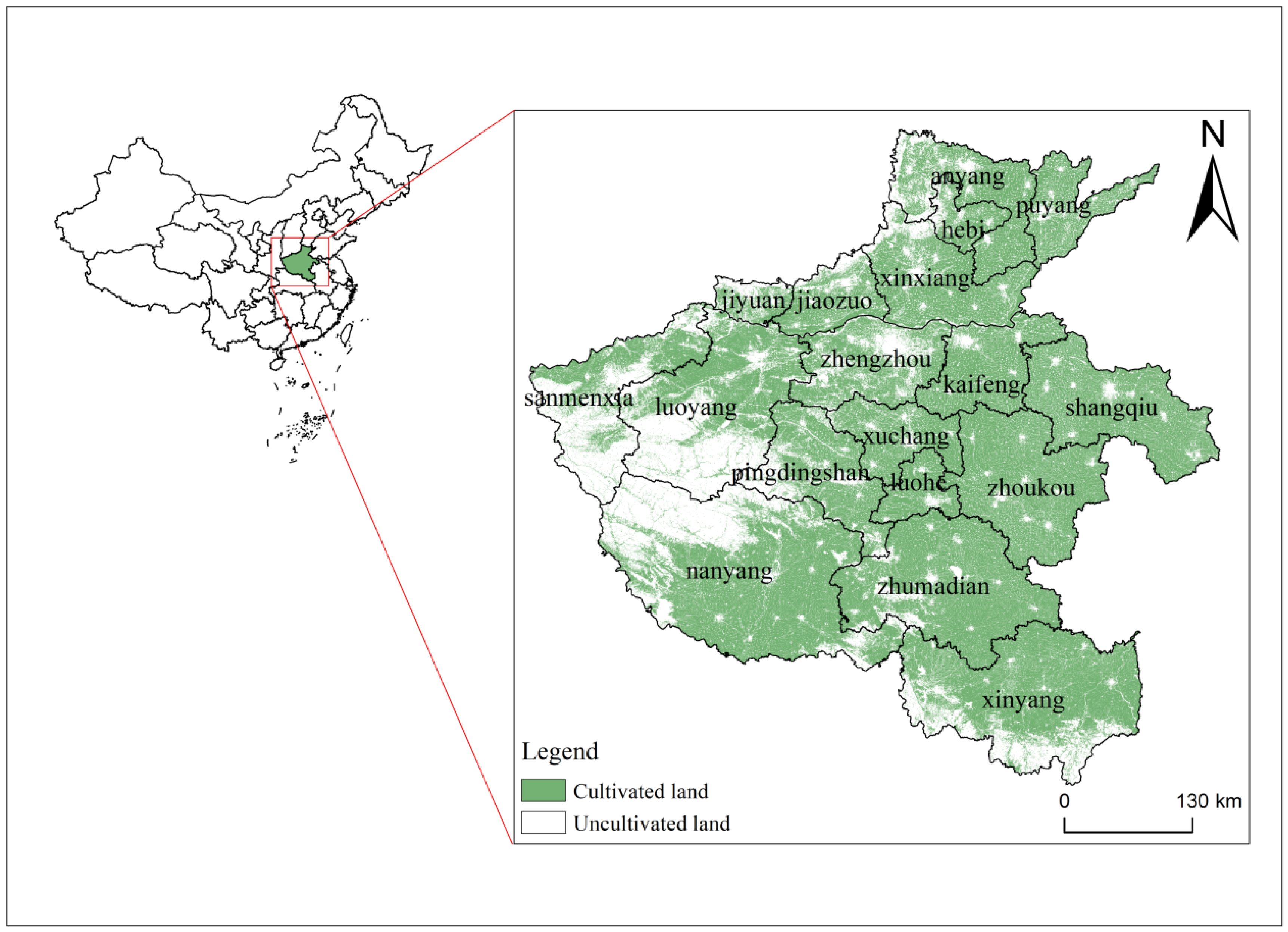
Henan Province is located in central China, along the middle and lower reaches of the Yellow River. Its geographic coordinates range from 31°23′ N to 36°22′ N and from 110°21′ E to 116°39′ E. Henan Province spans the four major river basins of the Haihe, Yellow, Huaihe, and Yangtze rivers. It has a total land area of about 167,000 km
2. Henan is a key national core region for grain production and a major agricultural product area. It is also a typical region for the performance of cropland multifunctionality (
Figure 1). Plains and hills dominate the terrain. Plains and basins account for about 55.7% of the total area. This provides an excellent topographic foundation for the concentrated and contiguous distribution of cropland. Henan is a major agricultural province and one of China’s key grain-producing regions. According to official data, the cropland area of Henan exceeded 7.5 million hectares in 2024. The permanent basic cropland area totals 6.61 million hectares, and Henan bears an important grain supply responsibility within China’s national food production layout (Data source:
https://dnr.henan.gov.cn/2025/06-26/3174311.html, accessed on 6 March 2026). The annual average temperature is 12–16 °C, and annual precipitation is 600–1200 mm. Rainfall and heat occur in the same period. This climate is suitable for growing major crops such as wheat and maize. The hydrothermal conditions of cropland are well matched. Cropland mainly consists of irrigated land and dry land. Agricultural mechanization and improved variety coverage rank among the top in China. Henan is an important national production base for wheat and maize. Its total grain output has remained stable at more than 65 million tons for many years. It has made important contributions to national food security (Data source:
https://www.henan.gov.cn/2022/12-13/2656184.html, accessed on 6 March 2026).
In recent years, Henan has adopted multiple measures to strictly protect the cropland red line. It has achieved continuous growth in both the quantity and quality of cropland. However, cropland use in the region still presents a prominent tendency of prioritizing production over living functions, and emphasizing intensive utilization while neglecting ecological, and cultural values. The spatial-temporal evolution characteristics of the four functions of cropland—production, living, ecological, and cultural—have become increasingly significant. The evolution laws and driving mechanisms of each function have not been systematically clarified.
3.2. Research Methods
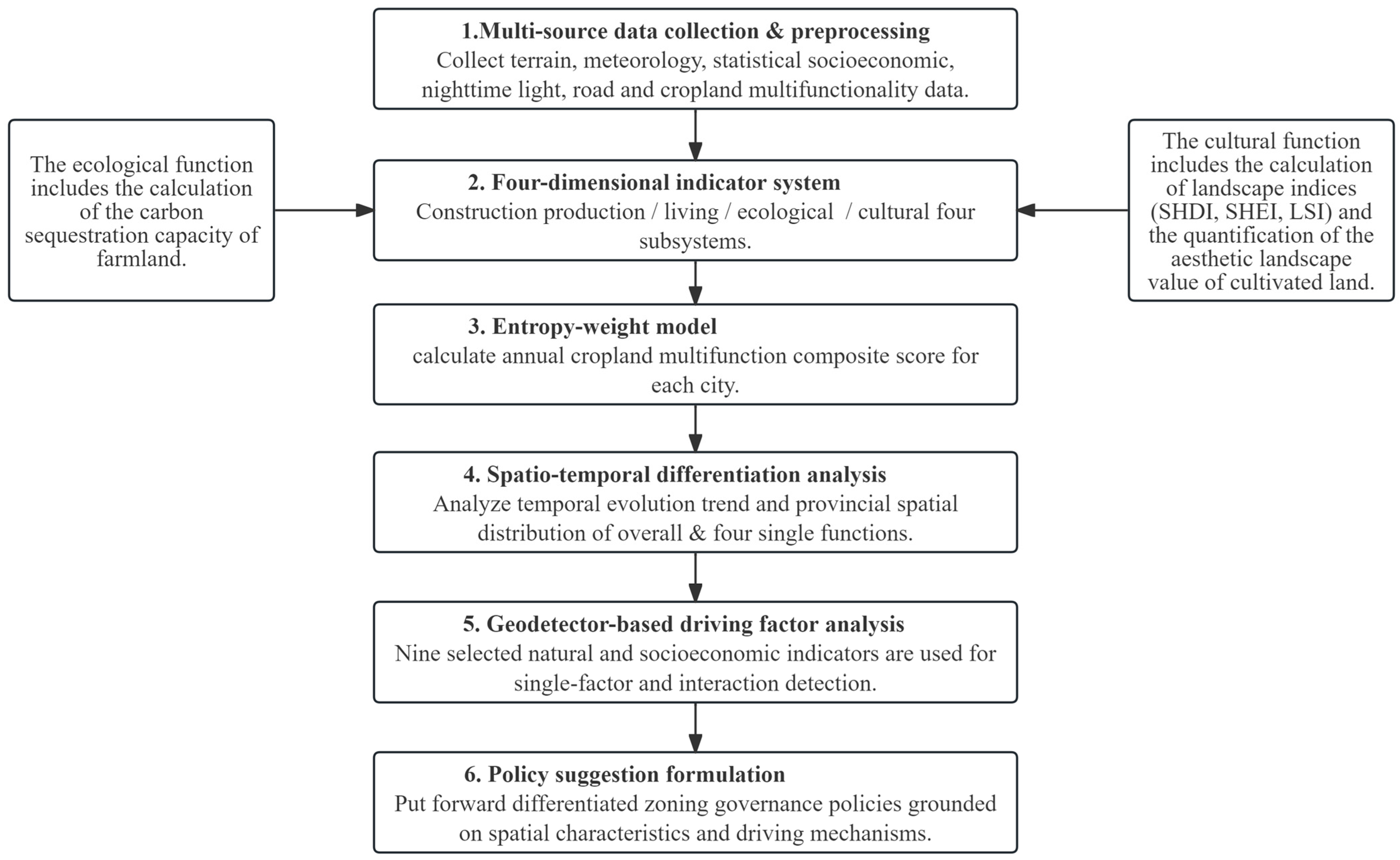
To quantitatively assess the four-dimensional cropland multifunctionality in Henan Province covering production, living, ecological, and cultural services, this study conducts quantitative measurement and empirical analysis via the entropy weight method, cultivated land carbon sequestration estimation, landscape pattern index calculation, equivalent factor-based aesthetic value evaluation of cultivated land, and geographic detector-based driving factor identification. The overall data processing and research flowchart are presented in
Figure 2.
3.2.1. Entropy Weight Method
The entropy weight method is a widely adopted approach for determining the weight of evaluation indicators and measuring comprehensive development levels. It has been extensively applied in existing studies. Due to limited article length, this paper does not elaborate on its basic principles. This study employs the entropy weight method to calculate the weight of each evaluation indicator of cropland multifunctionality. On this basis, it further computes the comprehensive development level of cropland multifunctionality in Henan Province and its prefecture-level cities. To enable the entropy weight method to compare cropland multifunctionality levels across different years and regions, this study incorporates time variables into the indicator system by referring to existing academic research [
21].
Step 1 Standardization of Raw Indicator Data:
The min-max normalization is separately conducted for positive and negative indicators: The dataset covers r years, n prefecture-level cities (districts) and m evaluation indicators. Let xtij denote the original raw value of the j-th indicator for the i-th city in year t, and Xtij denote the standardized value correspondingly. The min-max normalization is separately conducted for positive and negative indicators:
For negative indicators:
where
max(
xtij) and
min(x
tij) refer to the maximum and minimum values of the
j-th indicator across all cities and all research periods. To prevent zero values after normalization, which would cause invalid logarithmic operation in subsequent entropy calculation, a tiny constant is added for data translation:
Xtij’ =
Xtij + 0.0001.
Step 2 Calculation of indicator proportion:
Step 3 Information entropy calculation for the
j-th indicator:
Step 4 Calculation of information redundancy of the
j-th indicator:
Step 5 Weight determination of the
j-th evaluation indicator:
Step 6 Measurement of cropland multifunctionality for cities in Henan Province across years:
where
Sti represents the composite score of cropland multifunctionality of the
i-th city in year
t. A higher composite score indicates a superior level of cropland multifunctionality.
3.2.2. Carbon Sequestration Capacity of Cropland
Crop carbon sequestration constitutes a key component of carbon fixation in farmland ecosystems. Its core mechanism is that crops convert atmospheric CO
2 into organic matter through photosynthesis, thereby realizing the biological fixation of carbon elements. This study follows the estimation framework proposed by Li et al. It constructs a regional-scale measurement model for crop carbon absorption based on the economic yield, economic coefficient, and carbon absorption rate of different crops [
22]. The model quantitatively evaluates the carbon sequestration of major crops in the study area during the growth period. The estimation formula for crop carbon absorption is shown as follows:
In the formula,
k represents the
k-th crop, and
denotes the total number of major crop types in the study area.
Ck refers to the carbon absorption rate of the
k-th crop. It refers to the carbon uptake required for crops to synthesize per unit of dry organic matter, and reflects the carbon fixation efficiency of crop photosynthesis.
Dk is the total biological carbon amount of the
k-th crop, with the unit of ton.
Yk stands for the economic yield of the
k-th crop. It adopts annual yield data released in statistical yearbooks, measured in ton.
Hk represents the economic coefficient of the
k-th crop. Referring to existing research results, the economic coefficients and carbon absorption rates of major crops are shown in
Table 2 [
23].
3.2.3. Landscape Pattern Index
This study selects three core landscape indices, namely the Shannon Diversity Index (
SHDI), Shannon Evenness Index (
SHEI), and Landscape Shape Index (
LSI). These indices aim to quantify the diversity, evenness, and shape complexity of landscape patterns in the study area. All indices are calculated using the landscape analysis software Fragstats 4.2 [
24].
The
SHDI reflects the richness of landscape patch types and the distribution differences among various patch types. Its calculation formula is as follows:
The
SHEI measures the area distribution evenness of each patch type in the landscape. It is the ratio of the Shannon Diversity Index to the maximum landscape diversity index. Its calculation formula is as follows:
The
LSI characterizes the overall shape complexity of a landscape. It reflects the tortuosity of patch boundaries and the degree of landscape fragmentation. Its calculation formula is as follows:
In the formula, m represents the total number of patch types in the landscape. Pi is the proportion of the area of the i-th patch type to the total landscape area, ranging from 0 to 1. E denotes the total length of all patch boundaries in the landscape, and A refers to the total landscape area. A higher SHDI value indicates richer landscape types in the study area. It also means more obvious distribution differences among various patch types and a higher level of landscape diversity. The value of SHEI ranges from 0 to 1. A SHEI value closer to 1 implies a more uniform area distribution of each patch type. A larger value suggests a more complex overall landscape shape and more tortuous patch boundaries. It also corresponds to a higher degree of landscape fragmentation.
3.2.4. Aesthetic Landscape Value of Cropland
The aesthetic landscape value of cropland is an important part of the cultural service value of cropland ecosystems. This study adopts the equivalent factor method, which is widely used in domestic academic circles. It calculates the per capita aesthetic landscape value of cropland through step-by-step conversion.
The first step is to calculate the value of one standard ecological service equivalent (
D). The standard ecological service equivalent value is benchmarked to the grain provisioning service value of the study area. According to the classification system proposed by Xie et al., the value of one standard ecological service equivalent equals one-seventh of the annual average grain output value in the study area [
25]. The calculation formula is as follows:
In the formula, refers to the average price of major grain crops in the study area (yuan/kg). represents the average grain yield of cropland in the study area (kg/hm2).
The second step is to calculate the aesthetic landscape value per unit area of cropland (
Vaes). According to the ecological service attributes of cropland aesthetic landscape, the corresponding equivalent factor is selected (
Eaes). The standard ecological service equivalent value is further converted into the aesthetic landscape value per unit area of cropland. The calculation formula is shown below:
The third step is to calculate the per capita aesthetic landscape value of cropland (
Vper). This study adopts the total cropland area and rural permanent population of the study area. It converts the aesthetic landscape value per unit area into the per capita level. This index directly reflects the per capita aesthetic landscape value of cropland enjoyed by rural residents in the study area. The calculation formula is as follows:
In the formula, S is the total cropland area of the study area (hm2). N stands for the rural permanent population. Vper denotes the per capita aesthetic landscape value of cropland (yuan/person). It serves as one of the core measurement indicators in this paper.
3.2.5. Geographical Detector
The GeoDetector model is a spatial statistical method. It is used to analyze the spatial differentiation and driving mechanism of geographical phenomena. This method does not need to satisfy the linear hypothesis. It can effectively identify the leading factors affecting the spatial distribution of geographical elements. It further quantifies the explanatory power of both individual factors and their interaction effects in driving the spatial differentiation of the study area. The GeoDetector is widely applied and well-established in spatial research fields such as land use, ecological environment, and resource evaluation [
26].
There are obvious spatial differences in cropland multifunctionality among prefecture-level cities in Henan Province. Its spatial-temporal evolution characteristics are jointly affected by natural, social, economic, and other multidimensional factors. The interaction among these factors presents complex features. Therefore, this study adopts the GeoDetector model. It aims to systematically identify the main driving factors of spatial differentiation of cropland multifunctionality in Henan Province. It clarifies the explanatory degree of each driving factor for the spatial distribution differences in cropland multifunctionality. It also reveals the interaction characteristics among different driving factors. This research provides a scientific basis for further analyzing the driving mechanism of spatial-temporal evolution of cropland multifunctionality and formulating targeted regulation strategies in Henan Province.
Based on the evaluation results of data availability, nine key influencing factors are selected (
Table 3). The GeoDetector factor detection and interaction detection models are adopted to systematically explore the driving mechanism of the spatial-temporal evolution of cropland multifunctionality in Henan Province. Natural attributes lay inherent constraints on cropland resource stock and land suitability, hence four physical geography indicators are introduced [
27,
28]. Average altitude (x1) and slope (x2) limit the layout of large-scale contiguous farmland and the feasibility of mechanical cultivation, as topographical conditions directly affect agricultural land consolidation and operational efficiency. Annual average temperature (x3) and precipitation (x4) determine crop planting structure and the ecological service capacity of cropland, since thermal and moisture regimes are primary drivers of agricultural productivity and ecosystem functioning. Socioeconomic factors dominate human-induced functional restructuring and quantify anthropogenic disturbance. Per capita GDP (x5) reflects regional financial capacity for high-standard farmland construction and agricultural industrial upgrading, which is widely recognized as a key enabler of investment in agricultural infrastructure and technology. Nighttime light intensity (x6) and road network density (x7) are widely adopted refined spatial proxies for depicting fine-grained human activity intensity and regional accessibility, compensating for deficiencies of traditional statistical data. Urbanization rate (x8) and population density (x9) characterize rural labor transfer and construction land encroachment pressure on cropland [
29,
30].
3.3. Research Data
This study uses five types of data: socioeconomic data, agricultural data, grain price data, land cover data, and administrative boundary data. Socioeconomic data and agricultural data are obtained from the official website of the Henan Provincial Bureau of Statistics (
https://tjj.henan.gov.cn/, accessed on 15 March 2026). These data cover annual economic performance and agricultural production in Henan Province with high authority and reliability. A few missing values are filled by linear interpolation to meet analysis requirements. Grain price data are collected from the National Compilation of Agricultural Product Costs and Benefits. Land cover data are derived from the China 30 m Annual Land Cover Dataset (CLCD) developed by Wuhan University (
http://doi.org/10.5281/zenodo.4417809). These data are used to calculate three core landscape indices: SHDI, SHEI, and LSI. The CLCD is built on Landsat images with a spatial resolution of 30 m. It includes nine land cover types and has an overall accuracy of 79.31%. It is suitable for long-term landscape pattern analysis. Administrative boundary data are derived from the Resource and Environment Science and Data Center, Chinese Academy of Sciences (
https://www.resdc.cn/DOI/DOI.aspx?DOIID=121, accessed on 15 March 2026). No modifications were made to the base map.
In the analysis of influencing factors, this study employs Visible Infrared Imaging Radiometer Suite (VIIRS) nighttime light data to characterize regional human activity intensity. The data are derived from the annual composite products released by the Earth Observation Group (EOG) (
https://eogdata.mines.edu/products/vnl/, accessed on 15 March 2026). VIIRS is a new-generation nighttime light remote sensing product that replaces the traditional DMSP-OLS data. It has a spatial resolution of approximately 500 m. It has the advantages of on-orbit radiometric calibration and no light saturation effect. It can precisely capture artificial night light sources such as urban areas, residential sites, and traffic road networks. Compared with traditional nighttime light data, VIIRS has higher radiometric accuracy and better detail description ability. It objectively reflects regional population agglomeration, economic activities, and human development intensity. It is widely used in quantifying human activity intensity, urban expansion and cropland ecological impact research. Road network density is a key indicator of urban transportation systems. It reflects the development scale and supply capacity of urban road networks. It provides important guidance for urban transportation planning and construction. Road network density data are obtained from the official OpenStreetMap (OSM) website (
http://www.openstreetmap.org, accessed on 15 March 2026). These data are processed in ArcGIS 10.8. The processing steps include projection transformation, clipping to the study area and screening. Finally, road network density for each prefecture-level city is obtained.
4. Research Results
4.1. Evolution Characteristics of Cropland Multifunctionality in Henan Province
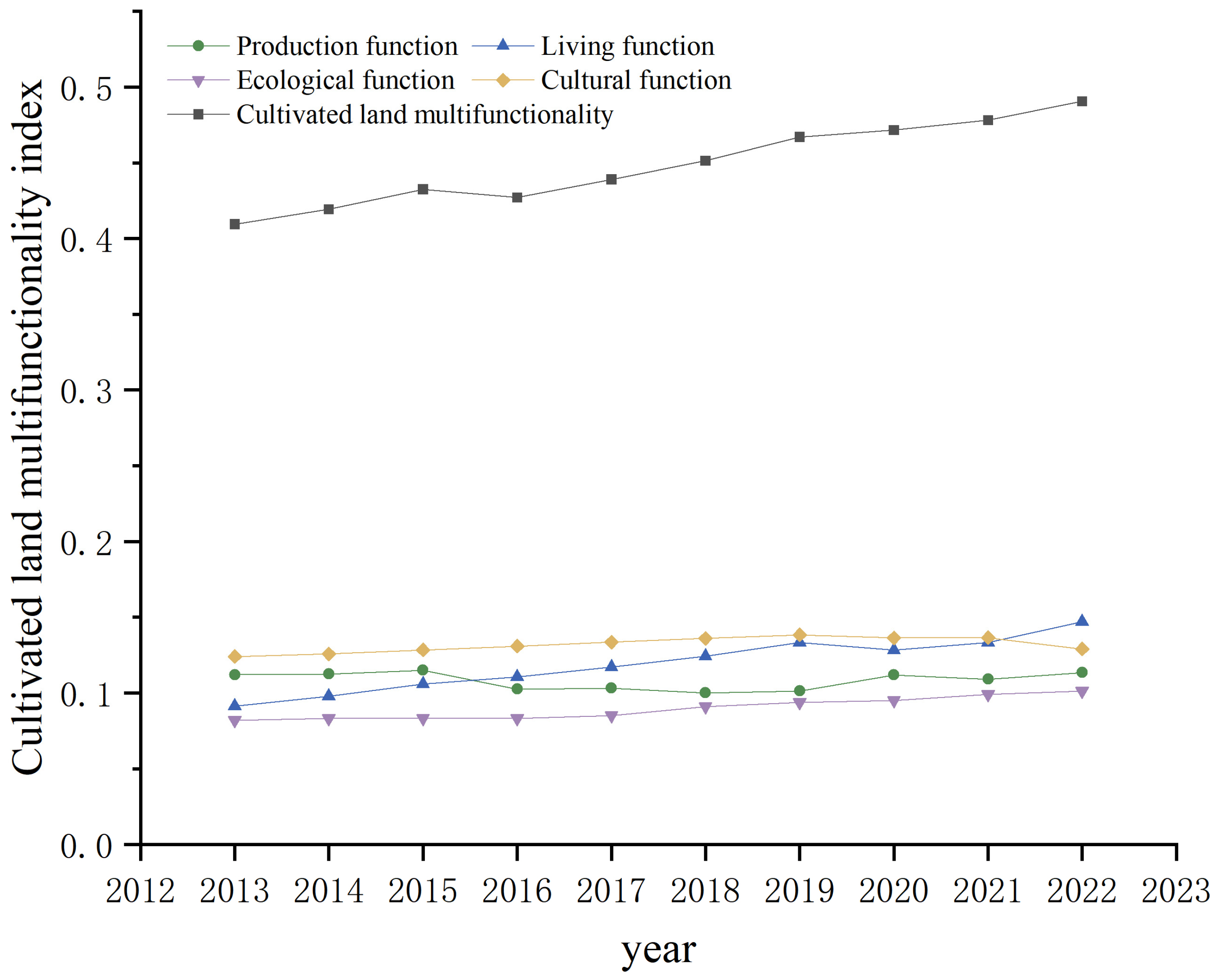
From 2013 to 2022, the index of cropland multifunctionality in Henan Province shows a continuous upward trend. The value rises from 0.409 in 2013 to 0.491 in 2022, with an average annual growth rate of approximately 2.0% (
Figure 3). This indicates that the comprehensive service capacity of cropland steadily improves during the study period. Each sub-function presents obvious structural differences in its changing trend. The production function index remains at a high level between 0.10 and 0.11. It declines slightly after 2015 but maintains a small overall fluctuation range. It continuously provides fundamental support for the entire system of cropland multifunctionality. The living function index increases from 0.091 to 0.147, with a growth rate of over 60%. It acts as the leading factor driving the rise in the comprehensive multifunctionality index. It reflects that the carrying capacity of cropland in employment absorption, income guarantee and rural social stability improves significantly during the study period. The ecological function index rises slowly from 0.082 to 0.101. Its growth range is relatively limited, while the improving trend remains steady. It implies that the ecosystem service capacity of cropland achieves gradual promotion. The cultural function index increases from 0.124 to 0.138 during 2013 to 2019, and drops slightly to 0.129 after 2020. It is the only function with an obvious fluctuating trend. This result suggests that the later adjustment of land use structure weakens the cultural landscape and leisure service functions of cropland to a certain extent. Overall, the improvement of cropland multifunctionality in this period is mainly driven by the rapid growth of living function. The stable supply of production function and the steady improvement of ecological function jointly lay a dual supporting foundation. The fluctuation of cultural function also reveals that greater attention should be paid to cropland landscape protection and farming culture inheritance.
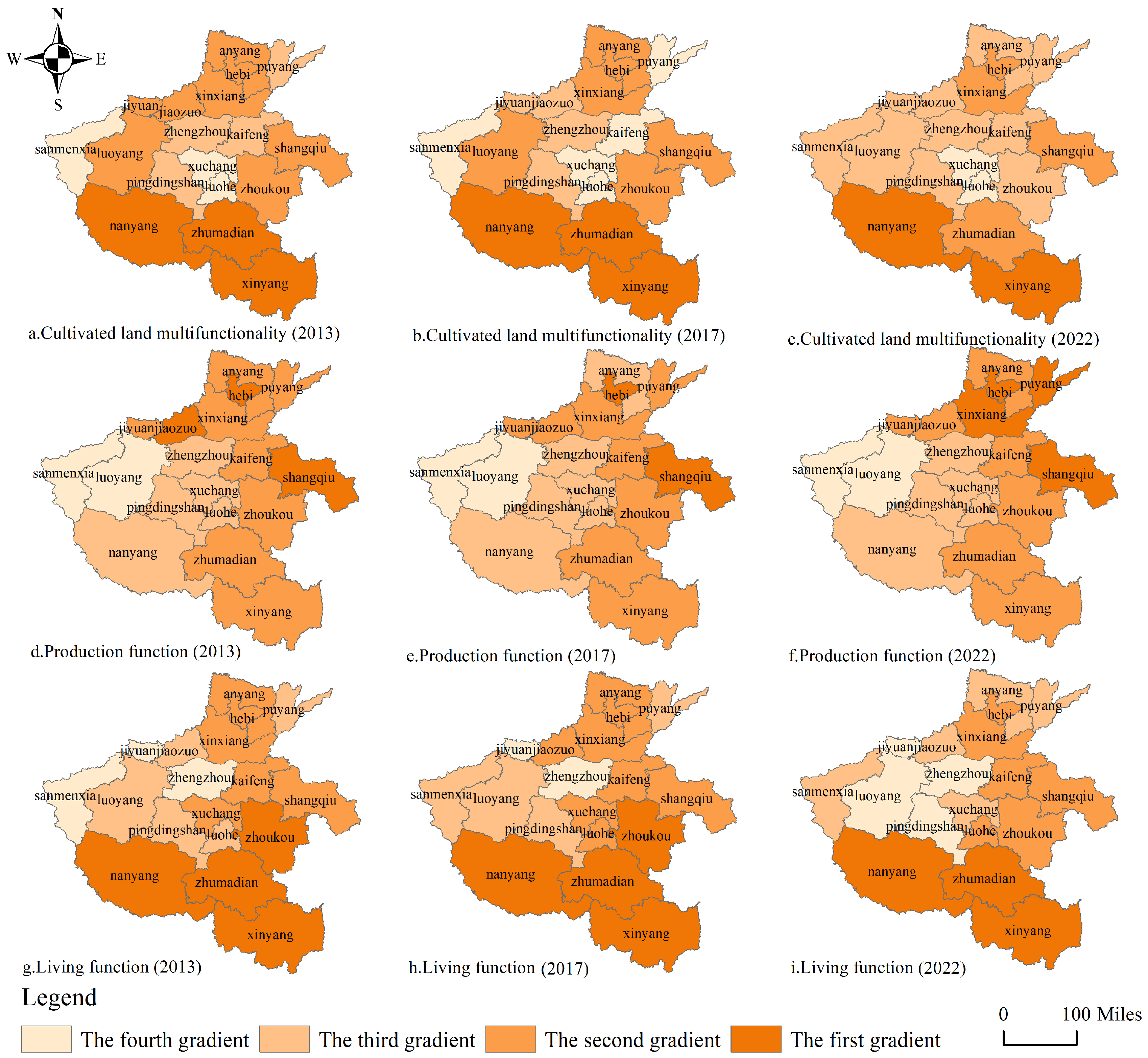
To clearly reveal the spatial-temporal evolution characteristics of cropland multifunctionality in Henan Province, this study conducts spatial visualization analysis for the period 2013–2022 based on ArcGIS 10.8. The results are shown in
Figure 4.
Figure 4a–c shows the spatial distribution pattern and evolution characteristics of cropland multifunctionality levels in Henan Province in 2013, 2017 and 2022, respectively. Spatially, across the study period, regional gaps gradually narrowed alongside rising overall multifunctionality. Between 2013 and 2017, southern high-value agglomerations remained unchanged, yet several northern cities such as Jiyuan, Jiaozuo, Kaifeng, and Puyang slid down functional grades. From 2017 to 2022, low-value zones shrank continuously and mid-high areas expanded. Despite the shrinking disparity, obvious north–south gradients still persist, constrained by natural conditions, economic-status and land-use modes, leaving ample room for coordinated functional promotion province-wide.
Although the overall cropland multifunctionality level of the whole province rises steadily, the gradient difference still exists between high-level areas in southern Henan and medium and low-level areas in northern and central Henan. There is still great potential for the coordinated improvement of cropland multifunctionality across different regions. Southern Henan outperforms other regions in comprehensive cropland performance, anchored by Nanyang and Xinyang as perennial high-value zones, whereas central, northern and eastern regions are dominated by medium and low functional grades. This spatial disparity might stem from different natural endowments: southern Henan boasts superior hydrothermal conditions and abundant forest-cropland composite resources, forming a solid foundation for multi-dimensional cropland development, while plain-dominated northern and eastern areas focus intensively on grain cultivation and neglect ecological and cultural value tapping.
4.1.1. Evolutionary Characteristics of Cropland Production Function
The spatial pattern of the cropland production function is characterized by higher values in eastern Henan and lower values in western Henan, with evident local agglomeration. This pattern remains highly stable throughout the study period (
Figure 4d–f). In terms of temporal evolution, the scope of high-gradient zones for cropland production function expanded gradually from 2013 to 2022 with continuously consolidated agglomeration advantages, and no obvious spatial shift occurred in core agglomeration areas. High-level areas concentrate in the eastern Henan Plain and parts of northern Henan. Cities including Shangqiu, Xinxiang, and Hebi always rank in the first gradient. These regions have flat terrain, contiguous high-quality cropland resources and large-scale agricultural production modes. They form the core grain production areas of Henan Province. Restricted by fragmented terrain and other factors, the western Henan mountainous areas and the surrounding zones of some central Henan cities remain in the fourth gradient of production function. Their low-level status showed no fundamental change.
From 2013 to 2017, the first-gradient zones of cropland production function were mainly concentrated in Hebi and Shangqiu. The overall spatial pattern of provincial high-value agglomerations remained stable. From 2017 to 2022, the production function grades of Anyang, Xinxiang and Puyang improved remarkably, leading to a northward expansion of core agglomeration scope. By contrast, cities around Zhengzhou and Xuchang in central Henan saw mild fluctuations in functional grades but maintained steady hierarchical levels on the whole. The above evolution process indicates that the spatial pattern of cropland production function in Henan Province has strong path dependence. The core production areas occupy a prominent position. Peripheral regions realize functional optimization under policy guidance.
4.1.2. Evolutionary Characteristics of Cropland Living Function
Differently from production function’s east-biased distribution, cropland living function concentrates predominantly in southern Henan (
Figure 4g–i). The high-value areas in southern Henan remained stable throughout the research period, yet the overall gradient differentiation between the southern and northern regions intensified. From 2013 to 2017, southern Henan (Nanyang, Xinyang, Zhumadian, and Zhoukou) consistently retained high-value living function with little spatial variation. During 2017–2022, low-value areas expanded significantly across Zhengzhou, Xuchang, and Pingdingshan, with many medium-value units further degraded to low-value levels. In northern Henan, the second-gradient areas in Anyang and Xinxiang moderately shrank and transitioned to the third gradient, while the high-value zones in southern Henan remained stable. Driven by the expansion of central low-value zones, the north–south gradient divergence of provincial living function was further enlarged.
Benefiting from abundant farmland resources and sound urban-rural integration, southern Nanyang, Xinyang, and Zhumadian permanently lead in living function. By comparison, most central, northern and western areas rank low due to rural population outflow and weakened farmland social security amid rapid urbanization. Though improved rural infrastructure has lifted living function in some mid-low regions, blocked interregional resource transfer prevents the spread of southern development advantages, leaving the persistent north–south functional divide largely unchanged. During the study period, some medium and low gradient areas in central and northern Henan evolve into the third gradient. This phenomenon indicates that the social and living carrying capacity of cropland gradually improves in these regions. Nevertheless, the prominent gradient gap always exists between high-level areas in southern Henan and low-level areas in northern Henan.
4.1.3. Evolutionary Characteristics of Cropland Ecological Function
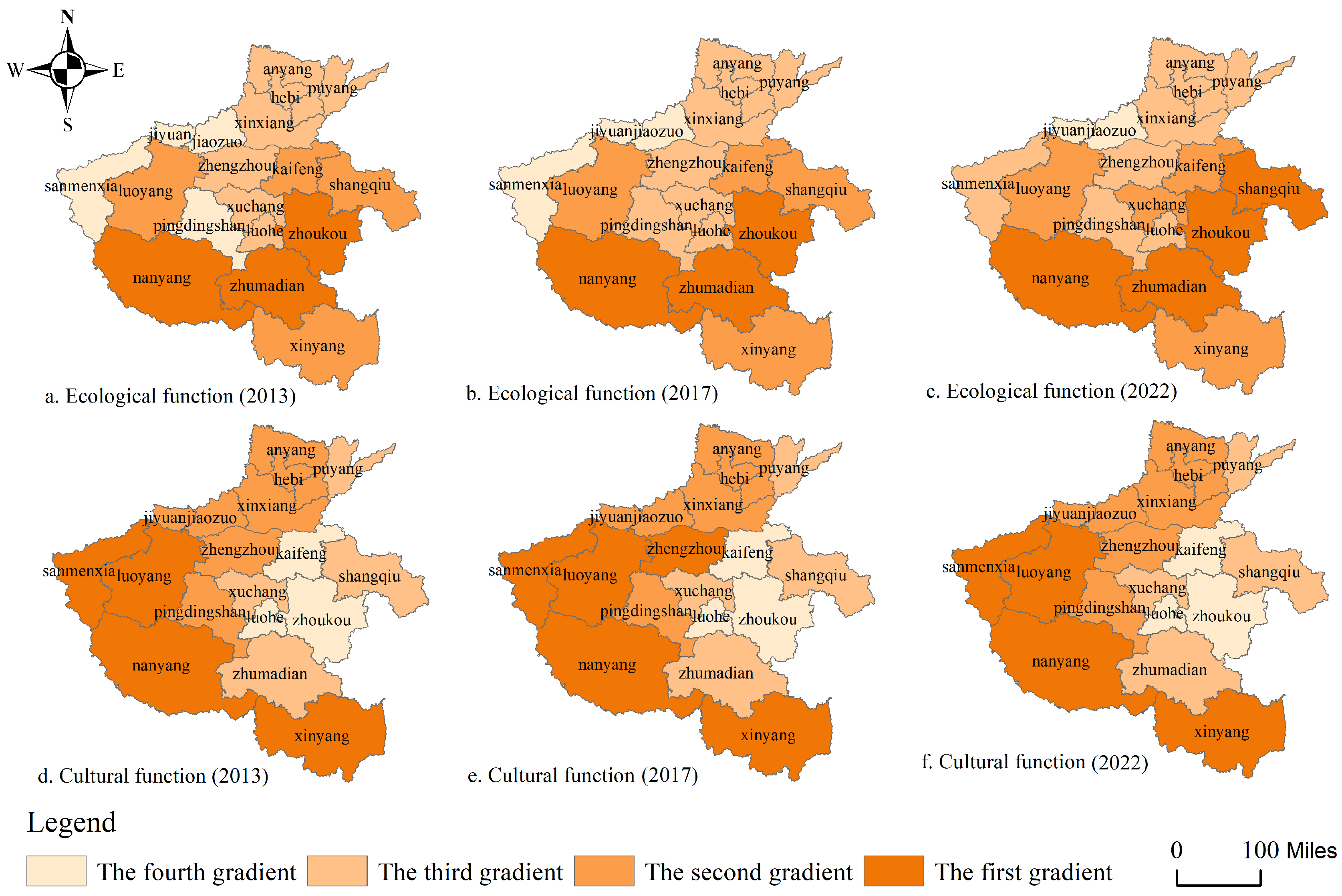
Figure 5a–c illustrates the spatial pattern and spatial-temporal evolution of cropland ecological function levels in Henan Province from 2013 to 2022. Overall, the cropland ecological function in Henan Province presents a spatial differentiation pattern. It is high in the south and low in the north, with obvious agglomeration in southern Henan. High-level areas are concentrated in southern Henan, while parts of western and northern Henan belong to low-level areas. The spatial gradient difference is prominent, and the overall pattern remains stable. Ecological functionality forms a south-concentrated high-value agglomeration pattern, determined by distinct vegetation and hydrological conditions across the province. Cities in southern Henan such as Nanyang, Zhumadian, and Xinyang always stay in the first gradient of ecological function. They possess superior hydrothermal conditions, abundant forest and wetland resources, and high vegetation coverage. These regions form the core supply area of cropland ecosystem services in Henan Province. Affected by fragmented terrain and intense human activities, Sanmenxia and Luoyang in western Henan, as well as Jiaozuo in northern Henan, remain in the third and fourth gradients of cropland ecological function. During the study period, the core status of high-level areas in southern Henan is further consolidated. Their inherent ecological advantages remain prominent. Meanwhile, some medium and low gradient areas in central and eastern Henan gradually upgrade to higher gradients. This change reflects the continuous improvement of regional cropland ecological environment. The supply capacity of ecological services increases steadily.
4.1.4. Evolutionary Characteristics of Cropland Cultural Function
Figure 5d–f shows the spatial pattern and spatial-temporal evolution of cropland economic and cultural function levels in Henan Province from 2013 to 2022. Distinct from the above-mentioned three functions, cropland cultural-economic value features west-high and east-low spatial differentiation. High-level areas concentrate in western and southern Henan, while parts of central and eastern Henan belong to low-level areas. The spatial gradient difference is significant, and the overall pattern remains stable. From 2013 to 2017, Sanmenxia, Luoyang, Nanyang, and Xinyang in western and southern Henan remained consistently within the first gradient, and the spatial coverage of high-value agglomerations was basically stable. During 2017–2022, western high-value clusters maintained their size, Zhengzhou saw mild grade improvement, and most northern cities had no notable tier changes, leading to a rigid overall spatial structure.
Spatially, Sanmenxia, Luoyang, Nanyang, and Xinyang consistently occupy the top tier in economic and cultural functionality of cropland. The western cities boast profound agrarian heritage and mature rural tourism systems, while southern regions excel at diversified agricultural industrialization, jointly turning local farmland into important carriers for farming culture inheritance and agritourism development. In contrast, fast urban expansion in central Zhengzhou, Kaifeng, and eastern Zhoukou has occupied traditional agricultural land, narrowing cultural development space and resulting in monotonous cropland functions. Thanks to rural revitalization and cultural preservation policies, underdeveloped northern and eastern regions have started developing characteristic agriculture and leisure tourism, delivering continuous improvements in cropland’s cultural and economic gains. In general, the spatial pattern of cropland cultural function in Henan Province has strong path dependence. High-level areas remain stable for a long time, while medium and low-level areas show obvious improvement.
4.2. Analysis of Influencing Factors on the Evolutionary of Cropland Multifunctionality in Henan Province
4.2.1. Analysis of Major Influencing Factors
The GeoDetector model requires independent variables to be categorical variables and dependent variables to be continuous numerical variables. This study first adopts the Jenks Natural Breaks method to discretize the continuous data of nine driving factors into categorical data, specifically dividing continuous variables into five categories. It then uses the GeoDetector model to measure the explanatory power (q value) of each factor on the spatial differentiation of cropland multifunctionality in Henan Province. The results are shown in
Table 4.
The factor detection results show that average slope (x2), population density (x9), and average annual temperature (x3) are the leading driving factors. Their explanatory power values are 0.297, 0.263, and 0.238, respectively. These results indicate that terrain constraints and population pressure act as the core forces shaping the pattern of cropland multifunctionality. Average annual precipitation (x4) and average altitude (x1) serve as important influencing factors, with explanatory power of 0.161 and 0.138, respectively. Per capita GDP (x5), night light intensity (x6), road network density (x7), and urbanization rate (x8) belong to weak influencing factors. All their explanatory power values are lower than 0.1. This indicates that urban development exerts an insignificant direct driving effect on the spatial differentiation of cropland multifunctionality at the prefecture city scale. Overall, the influence intensity of physical geographical factors is generally higher than that of socio-economic factors. Background conditions such as terrain and climate lay the foundation for determining the spatial pattern of cropland multifunctionality.
4.2.2. Interactive Factor Detection Analysis
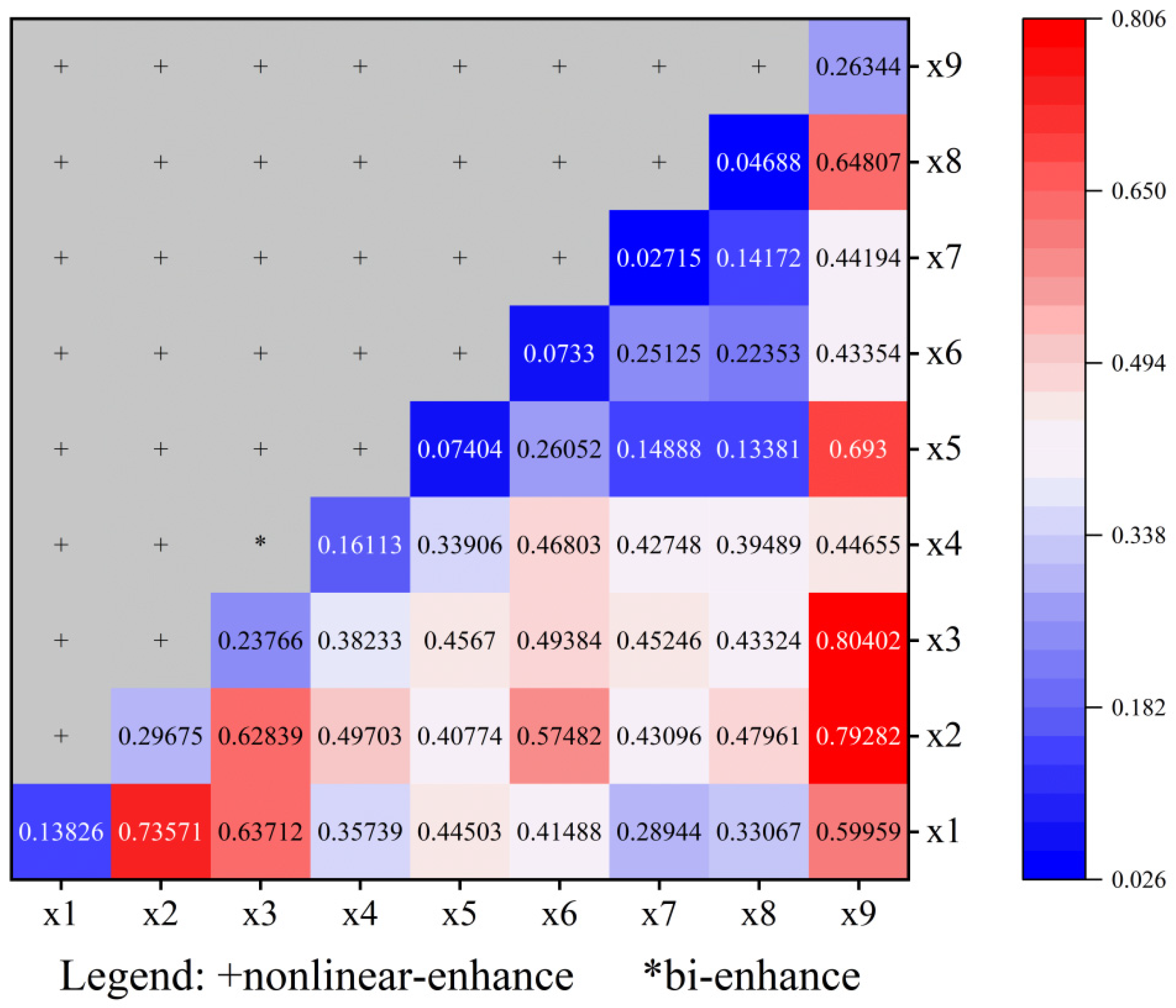
The interactive detection module of the GeoDetector model is adopted to analyze the interaction among influencing factors of cropland multifunctionality evolution in Henan Province (
Figure 6). The interactive detection results show that all driving factors present a mutual enhancement effect. No nonlinear weakening or independent interaction types exist. This reveals that the spatial differentiation of cropland multifunctionality is not driven by a single factor in a linear manner. It results from the coupling effect of natural conditions and socio-economic factors.
From the perspective of interaction intensity, different factor combinations show significant differences in their explanatory power for cropland multifunctionality. The interaction between average annual temperature and population density is the strongest, with a q value of 0.804 and a nonlinear enhancement type. This indicates that the synergistic effect of climatic conditions and population pressure forms the core mechanism shaping the spatial pattern of cropland multifunctionality. The interaction between average slope and population density (q = 0.793), as well as that between average altitude and average slope (q = 0.736), also remains at a high level and presents nonlinear enhancement. This shows that the coupling of terrain constraints and human activities acts as a key factor determining the spatial differences in cropland functions.
From the perspective of interaction intensity, the interactions among natural factors generally show a significant enhancement effect. The interaction between average annual temperature and average annual precipitation belongs to the two-factor enhancement type, with a q value of 0.468. This reflects that the synergistic effect of hydrothermal conditions jointly restricts the production potential and ecological function of cropland. The interaction effects between average altitude and average annual temperature, as well as average annual precipitation, are significantly higher than the explanatory power of single factors. This means that terrain affects regional climatic conditions and indirectly amplifies its influence on the pattern of cropland multifunctionality. The coupling effect between socio-economic factors and natural factors also presents obvious nonlinear enhancement characteristics. The interactive explanatory power of per capita GDP and population density (q = 0.693), as well as night light intensity and average annual temperature (q = 0.494), is remarkably higher than their individual explanatory power. This indicates that economic development and urbanization do not work independently. They rely on natural conditions and affect the spatial pattern of cropland multifunctionality indirectly by changing the mode and intensity of cropland use.
It is noteworthy that certain socio-economic factors—such as road network density and urbanization rate—exhibit relatively low explanatory power at the single-factor level. However, their explanatory power increases substantially once interaction effects with natural factors are taken into account. This suggests that these factors do not drive cropland multifunctionality through direct linear effects; rather, they exert influence indirectly through coupling with natural baseline conditions such as terrain and climate. Overall, interaction effects among natural factors tend to be stronger than those involving socio-economic factors. The coupling between natural and socio-economic factors emerges as the dominant mechanism underlying the spatial differentiation of cropland multifunctionality, whereas the linear driving effect of any single factor remains relatively limited.
4.2.3. Influencing Mechanism of Cropland Multifunctionality Evolution
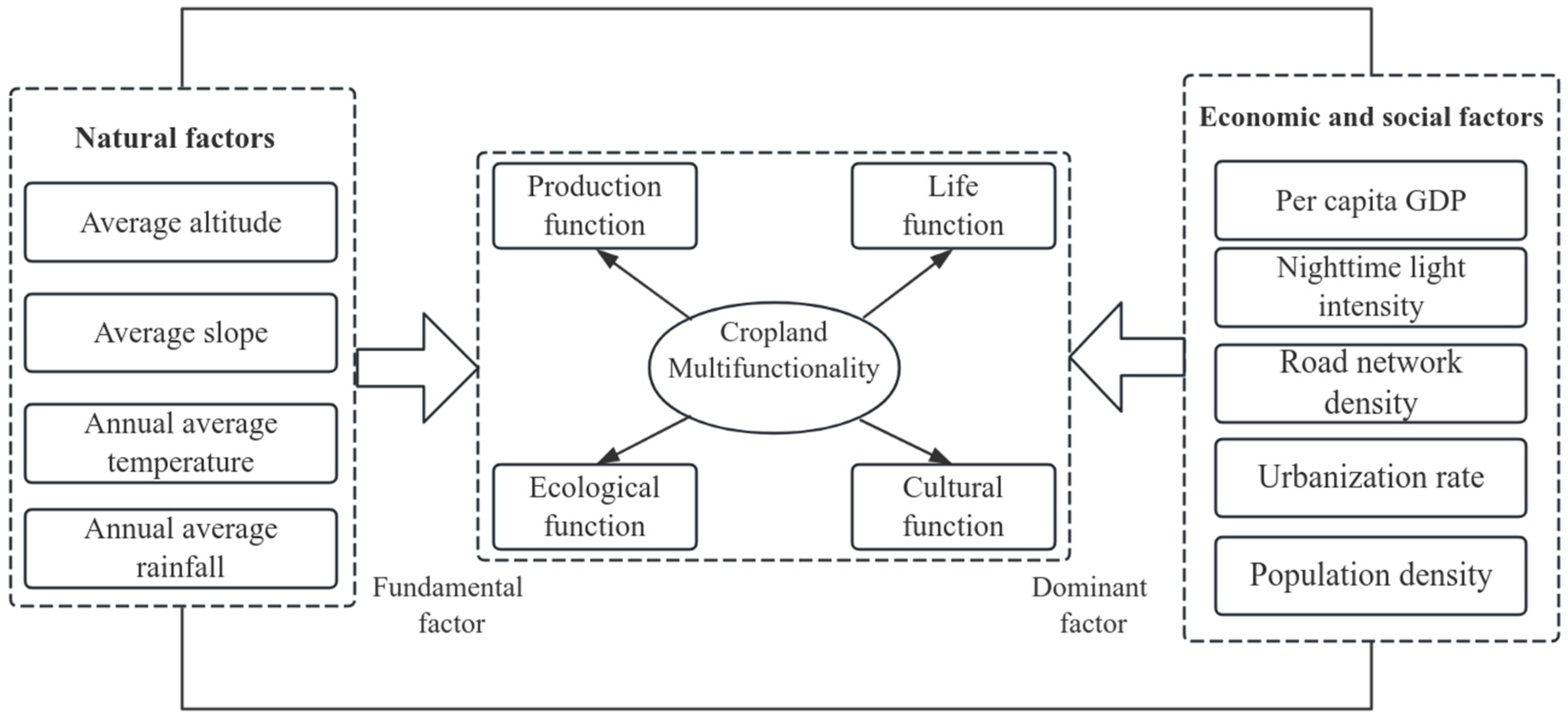
Based on the above results of factor detection and interactive detection from the GeoDetector model, this study combines the actual characteristics of cropland use and regional development in Henan Province. The driving factors affecting the spatial-temporal evolution of cropland multifunctionality can be classified into three categories: natural condition constraint, socio-economic driving, and human-land coupling regulation. These three types jointly form a multi-level influencing mechanism for the evolution of cropland multifunctionality in Henan Province (
Figure 7).
Natural geographical conditions lay the foundation for the formation and spatial-temporal evolution of cropland multifunctionality. They directly determine the production potential, ecological stability, and utilization mode of cropland, and act as the core controlling factor of its spatial differentiation in Henan Province. Average slope and average altitude are the key restrictive factors of cropland multifunctionality pattern. The hilly and mountainous areas in western and northern Henan have large terrain gradients. Their cropland has poor tillage suitability and limited production function, but presents prominent functions such as ecological conservation and soil and water conservation. The plain areas in eastern and central Henan feature flat terrain and concentrated high-quality cropland, where the production function occupies a dominant position. Both the single-factor explanatory power and interaction effect of terrain factors remain at a high level. This indicates that terrain difference is the fundamental cause driving the spatial differentiation of cropland multifunctionality across the province.
Annual average temperature and precipitation affect cropping system, water condition, and ecological process of cropland. They jointly shape the overall pattern of cropland multifunctionality. The eastern and southern plain areas of Henan have favorable hydrothermal conditions, and show strong coordination between the production function and ecological function of cropland. By contrast, western Henan has large precipitation fluctuations. Its cropland suffers reduced production stability and rising ecological risks. Interaction detection results show that the coupling effect of hydrothermal conditions significantly strengthens the influence intensity of single factors. This reflects the synergistic driving mechanism of climatic factors.
Socioeconomic development greatly affects the spatial-temporal evolutionary of cropland multifunctionality. It changes cropland use intensity, use patterns, and functional demands, and its impact noticeably varies across different regions.
Population density is a key driving factor second only to natural factors, with an explanatory value of q = 0.263. Population concentration increases food demand. It promotes intensive cropland use in the eastern Henan plain and strengthens the production function of cropland. The population outflow in the hilly areas of western Henan reduces cropland use intensity and gradually restores its ecological function. The interaction effect between population density and natural factors generally shows nonlinear enhancement. This indicates that population pressure relies on natural conditions to exert its driving role. Factors such as per capita GDP and road network density have weak direct impacts on cropland multifunctionality. Their explanatory power rises significantly after interacting with natural factors. Economic development promotes the adjustment of agricultural industrial structure and increases the planting proportion of high-value cash crops. The rise in urbanization rate and road network density accelerates urban-rural factor flow and promotes the differentiation of cropland use patterns.
The interaction detection results reveal the strengthening human-land coupling driving mechanism of cropland multifunctionality spatial-temporal evolution in Henan Province. All factors present mutual enhancement effects without any weakening or independent action. Nonlinear enhancement plays a dominant role, followed by two-factor enhancement. The coupling among natural factors, as well as between natural and socioeconomic factors, significantly magnifies the influence intensity of single factors. The synergistic effect of terrain, climate, and population density is the most prominent. It is clear that the spatial differentiation of cropland multifunctionality is not driven by a single independent factor. It results from the combined effects dominated by natural condition, regulated by socioeconomic conditions, and strengthened by human-land coupling.
5. Discussion
This study systematically evaluates cropland multifunctionality in Henan Province from four dimensions, namely production, living, ecology and culture. It also reveals its spatial-temporal evolution and driving mechanism. The findings provide new evidence for understanding the functional differentiation of cropland in major grain-producing areas.
First, cropland multifunctionality shows a stable pattern with high values in the south and low values in the north. Each functional dimension presents obvious spatial differentiation. The spatial gradient presents high-level agglomeration in Nanyang and Xinyang of southern Henan, while northern and central Henan stay at an overall low level. This spatial pattern is essentially shaped by the long-term effect of natural conditions. Terrain and hydrothermal conditions not only limit the suitability and potential of farming, but also indirectly promote the accumulation of regional agricultural culture. In terms of production function, the eastern Henan plain has contiguous cropland and large-scale management. It forms a stable advantageous pattern of high level in the east and low level in the west. This pattern maintains the inherent functional status of the Huanghuaihai Plain as a core grain production area. From the dimensions of living carrying capacity, ecological conservation, and cultural landscape, southern Henan has superior hydrothermal conditions and rich agricultural cultural resources. It therefore shows an overall distribution characteristic of southern high–northern low spatial pattern. Numerous existing studies have verified the prominent spatial disequilibrium of cropland multifunctionality across China, which generally follows a pattern of higher functional levels in plain regions than mountainous areas and in southern regions than northern regions. Natural endowments such as topography and hydrothermal conditions constitute the fundamental basis shaping the macroscopic spatial pattern of cropland functions, and spatial discrepancies in terrain and climate directly lead to heterogeneous distributions of cropland cultivation potential, ecological carrying capacity and farming resource endowments [
6,
31].
Compared with relevant research in Northeast China, Gong et al. found an upward trend in cropland multifunctionality across black-soil areas of Jilin Province, which accords with the growth trend observed in Henan [
32]. However, their study revealed that gains in economic and social functions substantially inhibited ecological improvement. No such obvious trade-off was detected in our Henan research. The discrepancy can be explained by divergent paths of agricultural intensification. Over the past three decades, extensive mechanization and intensive farming in Northeast’s black-soil regions have exerted heavy pressure on farmland ecological services, whereas agricultural transformation in Henan has proceeded more gradually and evenly. The findings of this study are basically consistent with such macroscopic regularities. Different from previous nationwide and cross-regional macro-scale studies, this paper targets the core grain-producing area of the Huang-Huai-Hai Plain, refines the detailed differentiation of cropland functions at the prefectural-city level within a single province, and supplements empirical evidence for studies on cropland multifunctionality in major grain-producing zones.
Second, on the basis of the traditional indicator framework, this study empirically identifies the influences of nighttime light intensity and road network density on the spatial pattern of cropland functions. Average slope, annual temperature, annual precipitation and altitude form the basic constraints on the spatial-temporal evolution of cropland multifunctionality. Factor detection results in this study show that average slope acts as the core driving factor with q value of 0.297. This directly accounts for the spatial differentiation pattern: the production function is constrained and the ecological function stands prominent in the mountainous and hilly areas of western Henan, whereas the production function dominates in the plain regions of eastern and southern Henan. Existing studies generally regard terrain and climate as the fundamental factors shaping cropland use pattern and functional differentiation. With an explanatory power of 0.263, population density ranks as the second-most important driver. Population agglomeration alters cropland use intensity and functional demand structure substantially. These findings align with Northeast China’s black-soil research outcomes, which also confirm that natural conditions outweigh socioeconomic factors. Those Northeast studies take agricultural income, mechanization, and irrigation as major socioeconomic drivers without introducing nighttime light and road density [
6,
32]. Nevertheless, most previous research only adopts conventional indicators such as terrain, hydrothermal conditions, GDP, and population, neglecting refined proxies for human activities like nighttime light and road network density, which limits their capacity to quantify spatially heterogeneous impacts of location and human interference. Compared with prior literature, this paper integrates nighttime light and road network density into the driving framework. The estimated statistic values (q = 0.073 for nighttime light and q = 0.027 for road network density) verify their non-negligible roles in shaping cropland multifunctionality. The newly added indicators help depict spatial disparities of anthropogenic disturbance, supplement existing analytical frameworks, and improve the comprehensiveness and accuracy of driving mechanism interpretation.
Third, interactive detection further reveals a widespread enhancement effect among all driving factors. Nonlinear enhancement dominates the interaction types. The synergy of hydrothermal conditions and the coupling of terrain and population together form the core interactive mechanism. This finding extends the linear interpretation of single factors to the nonlinear interaction of multiple factors. It better reflects the complex coupling characteristics of the human–land system. It also provides an important supplement for understanding the nonlinearity and synergistic amplification effect of the driving mechanism of cropland multifunctionality. In addition, a prominent distinction exists in the selection of evaluation dimensions. A prominent distinction exists in the selection of evaluation dimensions. Most existing relevant studies adopt a three-dimensional framework covering production, social, and ecological functions while ignoring quantitative measurement of cultural function. By contrast, this study introduces landscape indicators and farmland aesthetic value to quantify cropland cultural service, remedying the widespread neglect of cultural value assessment in existing multifunction research [
33,
34]. Different from the traditional three-dimensional evaluation framework that focuses only on production, living, and ecological functions, this study constructs an extended four-dimensional evaluation system. By introducing landscape pattern indices and cropland cultural service value to quantitatively characterize cultural function, this research remedies the prevalent deficiency of existing studies that overemphasize production-living-ecological functions while ignoring cultural value. Accordingly, the improved evaluation dimension and refined quantitative method constitute a significant marginal innovation of this study relative to previous similar studies.
This study has certain limitations. First, the quantification method for the cultural function needs improvement. The landscape pattern index alone fails to fully represent the spiritual connotation and inheritance value of farming culture. Future studies can optimize the evaluation system by combining multi-source data, such as cultural heritage distribution and folk activities. Second, this study conducts empirical analysis based on the prefecture-level city scale. Such a relatively coarse analytical scale may obscure the fine-grained spatial heterogeneity of cropland multifunctionality at the county and township levels and cannot fully reveal the microscopic evolutionary characteristics and driving mechanisms of cropland functions. Therefore, future research can further refine the research scale to carry out multi-scale comparative analysis and deepen the exploration of micro-level spatial differentiation mechanisms. Third, the study does not include policy and institutional factors. Policies such as cropland protection, rural revitalization, and high-standard farmland construction play an important guiding role in the spatial-temporal evolution of cropland multifunctionality. Future studies can incorporate policy variables to build a comprehensive driving mechanism analysis framework. This framework will enhance the systematic and comprehensive nature of the research.
6. Conclusions
This study takes Henan Province as a typical major grain-producing area. It is based on multi-source panel data from 2013 to 2022. The study constructs an evaluation system for cropland multifunctionality from four dimensions: production, living, ecological, and cultural functions. It comprehensively uses the entropy weight method, spatial analysis, and the GeoDetector model. The study systematically identifies the characteristics of spatial-temporal evolution and analyzes the spatial pattern of cropland multifunctionality. It also quantitatively examines the driving mechanism.
The results show that the comprehensive level of cropland multifunctionality in Henan Province has shown a continuous upward trend from 2013 to 2022. There are obvious regional differences. The spatial pattern is generally high in the south and low in the north, with agglomeration in southern Henan. This pattern shows strong stability. Production function was higher in the east, while the living, ecological and cultural functions all presented prominent north–south divergence. The analysis of the driving mechanism shows that natural conditions are the decisive factors for the spatial differentiation of cropland multifunctionality. Annual slope, annual temperature, annual precipitation, and annual altitude constitute basic constraints. Among them, annual slope has the strongest explanatory power. Population density is a key human driving factor. GDP per capita, nighttime light, urbanization rate and road density exert limited direct impacts. The interaction detection further confirms that all factors show enhancement effects. The effects are mainly nonlinear enhancement and supplemented by bivariate enhancement. The combinations of temperature-population density and terrain-population density exhibited the highest explanatory capacity.
Derived from the above spatial patterns and driving mechanism findings, differentiated farmland governance is put forward for regional coordinated improvement. Southern areas coordinate grain production, ecological protection, and farming culture development, alongside terraced planting and soil conservation subsidies matching local rugged terrain. Eastern grain-focused plains consolidate staple food output, expand large-scale land consolidation, and reduce agrochemical pollution via farmland trusteeship and scaled farming. Western and northern hilly regions carry out land consolidation and infrastructure upgrades, and relevant agricultural entrepreneurship support helps retain rural labor against sparse population constraints. Central urban peripheries enforce rigid cropland boundary management to prevent functional degradation caused by unregulated urban expansion. At the provincial level, zoning rules should be formulated according to terrain, climate, and population distribution. Relevant departments can tailor cropping layouts to local thermal conditions and build a multifunction monitoring system to dynamically adjust land use and ease excessive human pressure on farmland.
Author Contributions
Conceptualization, M.S.; methodology, M.S.; software, Q.W.; validation, S.Q.; investigation, H.Z.; resources, H.Z.; data curation, Q.W.; writing—original draft preparation, M.S.; writing—review and editing, M.S. and S.Q.; visualization, S.Q.; supervision, H.Z.; project administration, H.Z. and S.Q.; funding acquisition, S.Q. All authors have read and agreed to the published version of the manuscript.
Funding
This research was supported by the National Social Science Foundation of China (Grant No: 25XJY012; 24XJY046) and the Science and Technology Plan Project of Xinjiang Production and Construction Corps (Grant No: 2025YD051).
Data Availability Statement
The data used to support the findings of this study are available from the corresponding author upon request.
Conflicts of Interest
The authors declare no conflicts of interest.
References
- Brunstad, R.J.; Gaasland, I.; Vårdal, E. Multifunctionality of agriculture: An inquiry into the complementarity between landscape preservation and food security. Eur. Rev. Agric. Econ. 2005, 32, 469–488. [Google Scholar] [CrossRef]
- Jiang, Y.; Long, H.; Ives, C.D.; Ives, C.D.; Deng, W.; Chen, K.; Zhang, Y. Modes and practices of rural vitalisation promoted by land consolidation in a rapidly urbanising China: A perspective of multifunctionality. Habitat Int. 2022, 121, 102514. [Google Scholar] [CrossRef]
- Deng, X.; Huang, J.; Rozelle, S.; Uchida, E. Growth, population and industrialization, and urban land expansion of China. J. Urban Econ. 2008, 63, 96–115. [Google Scholar] [CrossRef]
- Yang, L.; Ou, C.; Wang, Z.; Du, Z.; Yao, X.; Du, Z. Unveiling patterns and drivers of long-term rural settlement changes from the urban-rural gradient perspective: A case study of the Beijing-Tianjin-Hebei region in China. Habitat Int. 2025, 156, 103300. [Google Scholar] [CrossRef]
- Hölting, L.; Beckmann, M.; Volk, M.; Cord, A.F. Multifunctionality assessments—More than assessing multiple ecosystem functions and services? A quantitative literature review. Ecol. Indic. 2019, 103, 226–235. [Google Scholar] [CrossRef]
- Gao, J.; Zhu, Y.; Zhao, R.; Sui, H. The use of cultivated land for multiple functions in major grain-producing areas in northeast China: Spatial-temporal pattern and driving forces. Land 2022, 11, 1476. [Google Scholar] [CrossRef]
- He, S.; Lin, L.; Xu, Q.; Hu, C.; Zhou, M.; Liu, J.; Li, Y.; Wang, K. Farmland zoning integrating agricultural multi-functional supply, demand and relationships: A case study of the Hangzhou metropolitan area, China. Land 2021, 10, 1014. [Google Scholar] [CrossRef]
- Yin, C.; Nie, Y.; Li, Y.; Zhou, Y.; Yu, L.; Qin, H.; Yu, J. Multifunctional trade-off and compensation mechanism of arable land under the background of rural revitalization: A case study in the West Mountain Regions of Hubei Province. Environ. Sci. Pollut. Res. 2023, 30, 96329–96349. [Google Scholar] [CrossRef]
- Luo, X.; Ye, Y.; Guo, X.; Zhao, X.; Kuang, L. Multifunctional evolution response mechanisms to urbanization processes on peri-urban cultivated land, Nanchang City, China. Land 2025, 14, 259. [Google Scholar] [CrossRef]
- Xiang, J.; Wu, H. Understanding the transition process and dynamic mechanism of farmland use functions: A comparative analysis from Eastern and Western China. J. Rural Stud. 2025, 117, 103642. [Google Scholar] [CrossRef]
- Yu, M.; Yang, Y.; Chen, F.; Zhu, F.; Qu, J.; Zhang, S. Response of agricultural multifunctionality to farmland loss under rapidly urbanizing processes in Yangtze River Delta, China. Sci. Total Environ. 2019, 666, 1–11. [Google Scholar] [CrossRef]
- Shi, W.; Liu, D. Does urbanization reduce the multi-functional value of cultivated land? Evidence from China. Front. Environ. Sci. 2023, 11, 1102300. [Google Scholar] [CrossRef]
- Gao, J.; Zhao, R.; Wang, P. Study on the sensitivity of cultivated land multifunction to the changes of grain productivity capacity. J. Nat. Resour. 2024, 39, 1434–1449. [Google Scholar] [CrossRef]
- He, S.; Min, Q.; Li, H.; Liu, M.; Jiao, W.; Bai, Y. Value typology and evaluation of Important Agricultural Heritage Systems. Chin. J. Eco-Agric. 2020, 28, 1314–1329. [Google Scholar] [CrossRef]
- Mutahar, A.K.; Cahyono, E.D.; Fahriyah, F. Local wisdom and farmer welfare through the Nyadran tradition: A case study in Panjang Village. Habitat 2024, 35, 133–148. [Google Scholar] [CrossRef]
- Tang, H.; Liu, X.; Li, J.; Wang, H. Study on the conservation and renewal of traditional rural tourism spaces: A perspective based on tourists’ revisit intention. J. Clean. Prod. 2025, 499, 145184. [Google Scholar] [CrossRef]
- Pan, Z.; Chen, Y.; Huang, Y.; Zheng, L. The vernacular cultural landscape in traditional villages: Global hotspots, emerging trends, and a case study of China’s Qilu cultural district. Front. Earth Sci. 2024, 12, 1511292. [Google Scholar] [CrossRef]
- Gao, X.; He, Y.; Hu, Y.; Yin, Y.; Zhang, Z.; Shi, X.; Liang, J.; Lan, C.; Liu, W.; Xu, Z.; et al. Response of cultivated land quality to landscape pattern changes at the watershed scale. J. Environ. Manag. 2025, 392, 126818. [Google Scholar] [CrossRef]
- Wang, Z.; Yang, H.; Hu, Y.; Peng, Y.; Liu, L.; Su, S.; Wang, W.; Wu, J. Multifunctional trade-off/synergy relationship of cultivated land in Guangdong: A long time series analysis from 2010 to 2030. Ecol. Indic. 2023, 154, 110700. [Google Scholar] [CrossRef]
- Qin, Y.; Li, Z.; Huang, E.; Lu, D.; Fang, S.; Duan, X.; Gao, L.; Zhao, Y.; Kang, H.; Liu, Z.; et al. Analysis of coupled and coordinated development of cultivated land multifunction and agricultural mechanization in China. Land 2025, 14, 999. [Google Scholar] [CrossRef]
- Wu, Q.; Chang, W.; Song, M.; Zhu, H. Measurement of urban–rural integration development level and diagnosis of obstacle factors: Evidence from the Beijing–Tianjin–Hebei urban agglomeration, China. Land 2025, 14, 261. [Google Scholar] [CrossRef]
- Li, M.; Li, H.; Zhou, Z.; Chen, Y.; Wang, Y.; Li, T.; Fu, Q. Spatial simulation and optimization of cropping structure under climate and land use change conditions considering synergistic economic benefits and carbon reduction in crop growth processes. Earth’s Future 2024, 12, e2024EF004684. [Google Scholar] [CrossRef]
- Chen, L.Y.; Xue, L.; Xue, Y. Spatial-temporal characteristics of China’s agricultural net carbon sink. J. Nat. Resour. 2016, 31, 596–607. [Google Scholar] [CrossRef]
- Dai, E.; Lu, R.; Yin, J. Identifying the effects of landscape pattern on soil conservation services on the Qinghai-Tibet Plateau. Glob. Ecol. Conserv. 2024, 50, e02850. [Google Scholar] [CrossRef]
- Xie, G.D.; Zhang, C.X.; Zhang, L.M.; Chen, W.H.; Li, S.M. Improvement of the evaluation method for ecosystem service value based on per unit area. J. Nat. Resour. 2015, 30, 1243–1254. [Google Scholar] [CrossRef]
- Wang, J.F.; Xu, C.D. Geodetector: Principle and prospective. Acta Geogr. Sin. 2017, 72, 116–134. [Google Scholar] [CrossRef]
- Liu, W.; Xue, Y.; Shang, C. Spatial distribution analysis and driving factors of traditional villages in Henan province: A comprehensive approach via geospatial techniques and statistical models. Herit. Sci. 2023, 11, 1–21. [Google Scholar] [CrossRef]
- Li, X.; Zhang, X.; Jin, X. Spatio-temporal characteristics and driving factors of cultivated land change in various agricultural regions of China: A detailed analysis based on county-level data. Ecol. Indic. 2024, 166, 112485. [Google Scholar] [CrossRef]
- Guo, X.; Lin, T.; Zheng, Y.; Ng, M.; Zhang, J.; Geng, H.; Jia, Z.; Lin, J.; Chen, Y.; Han, H.; et al. Scale effects of the spatiotemporal relationship between nighttime light and population activity intensity: A case study in Shanghai, China. GISci. Remote Sens. 2025, 62, 2600717. [Google Scholar] [CrossRef]
- Yan, Z.; Yu, Y. From Spatial Patterns to Sustainability Pathways: A Culture-Ecology-Economy Framework for Characteristic Village Development in Southwest China’s Ecologically Sensitive Ethnic Regions. Sustainability 2026, 18, 3480. [Google Scholar] [CrossRef]
- Bao, J.; Mao, L.; Liu, Y.; Fan, S. Investigation of spatiotemporal changes and impact factors of trade-off intensity in cultivated land multifunctionality in the Min River basin. Agriculture 2024, 14, 1666. [Google Scholar] [CrossRef]
- Gong, H.; Zhao, Z.; Chang, L.; Li, G.; Li, Y.; Li, Y. Spatiotemporal patterns in and key influences on cultivated-land multi-functionality in Northeast China’s black-soil region. Land 2022, 11, 1101. [Google Scholar] [CrossRef]
- Lian, H.; Zhang, Y.; Xiong, X.; Han, W. Functional assessment of rural counties under the production–living–ecological framework: Evidence from Guangdong, China. Land 2025, 14, 995. [Google Scholar] [CrossRef]
- Ji, Z.; Liu, C.; Xu, Y.; Sun, M.; Wei, H.; Sun, D.; Li, Y.; Zhang, P.; Sun, Q. Quantitative identification and the evolution characteristics of production–living–ecological space in the mountainous area: From the perspective of multifunctional land. J. Geogr. Sci. 2023, 33, 779–800. [Google Scholar] [CrossRef]
| Disclaimer/Publisher’s Note: The statements, opinions and data contained in all publications are solely those of the individual author(s) and contributor(s) and not of MDPI and/or the editor(s). MDPI and/or the editor(s) disclaim responsibility for any injury to people or property resulting from any ideas, methods, instructions or products referred to in the content. |