Article

Quantifying Urban Travel Resilience Under Multi-Source External Stimuli: Linking Social Perception, Green Exposure, and Low-Carbon Mobility

1
School of Architecture, Tianjin University, Tianjin 300072, China
2
The International Joint Institute of Tianjin University, Fuzhou, Tianjin University, Tianjin 300072, China
3
Dipartimento di Architettura e Design (DAD), Politecnico di Torino, 10129 Torino, Italy
*
Author to whom correspondence should be addressed.
Land 2026, 15(6), 1019; https://doi.org/10.3390/land15061019 (registering DOI)
Submission received: 6 May 2026 / Revised: 3 June 2026 / Accepted: 6 June 2026 / Published: 9 June 2026

Abstract

Demand-side management is increasingly important for low-carbon transport governance. However, many studies assume relatively stable travel preferences and pay limited attention to behavioural changes under sudden external shocks. This study proposes an Event–Behaviour–Resilience framework and applies Natural Language Processing to Sina Weibo data to examine travel responses to extreme heat and refined oil price adjustments. The results show asymmetric response patterns. Oil price increases were associated with cost-based low-carbon substitution, with new-energy vehicle intentions accounting for 64.4% of the share. In contrast, extreme heat was associated with both trip reduction and motorised travel. Travel reduction reached 52.4%, while ride-hailing or taxi responses accounted for 24.6%. A quadratic fitting analysis identified 38.0–39.0 °C as an observed transition interval, within which high-carbon motorised willingness began to exceed low-carbon slow mobility willingness. Group-level analysis showed unequal behavioural flexibility. While 80.0% of the general population reduced travel under extreme heat, the forced mobility group showed limited travel reduction and maintained a high level of low-carbon willingness at 86.87%. XGBoost-SHAP results indicated that temperature, emotional valence, and behavioural constraints contributed to low-carbon mobility intention. These findings suggest that behavioural responses can help identify spatial interventions for low-carbon transport, especially in relation to heat exposure, mobility flexibility, and access to adaptive travel options.

1. Introduction

Urban transport is a critical sector for mitigating carbon emissions amid global climate change, acting as a vital nexus connecting land use, daily activities, public space, and energy consumption. Consequently, the low-carbon transition of urban mobility extends beyond mere technological substitution; it is fundamentally a planning and governance challenge concerning spatial organisation and behaviour guidance. Globally, residential activities, including daily living and travel, account for nearly one-quarter of direct carbon dioxide emissions from fuel combustion, highlighting the importance of demand-side interventions [1]. Consequently, existing studies have shown that transport decarbonisation should move beyond technological substitution and place more emphasis on demand-side management [2,3]. This shift is particularly important for cities seeking sustainable, resilient, and inclusive development.
However, urban transport systems do not operate in a stable and closed environment. Residents’ travel behaviour is shaped by regular commuting patterns, land-use arrangements, and the quality of public space. For instance, in contexts of severe job-housing imbalance, the promotion of active commuting is heavily contingent upon the quality of the neighbourhood environment and the provision of adequate slow-mobility infrastructure [4]. It is also affected by sudden external disruptions, such as extreme weather events and energy price fluctuations [5]. For example, the frequency of extreme heat events has increased, which can substantially alter travel conditions and reduce walking, cycling, and public transport use due to heat stress [6]. In addition, sharp fluctuations in fuel prices, such as those experienced globally in 2022, impose significant economic constraints on daily commuting [7]. These multi-source shocks can abruptly shift residents’ travel willingness in the short term, thereby exposing underlying weaknesses in urban spatial planning, public transit provision, and climate-adaptive street design. Therefore, understanding travel behaviour under external shocks is important for both low-carbon transport governance and urban resilience planning [8].
Global health emergencies, such as the COVID-19 pandemic, have further highlighted the need to examine travel behaviour under external shocks. Recent studies have used smart card data with XGBoost and SHAP to analyse nonlinear changes in public transport use and to interpret the role of external risk perception in travel choices [9]. Other studies have shown that COVID-19-related disruptions affected interdependent sectors, including agriculture and transport, and created broader social and livelihood risks [10]. These findings suggest that static models may have limited capacity to capture travel responses during sudden events. Building on this literature, this study uses nonlinear analysis and social perception data to examine behavioural adaptation under environmental and economic shocks.
Most existing studies have examined the impact of extreme weather or other disruptive events through physical and objective indicators. For example, studies on heatwaves, heavy rainfall, and other extreme events often use fixed monitoring data, traffic flow data, or vehicle trajectory data. These studies usually focus on changes in traffic volume, travel speed, road congestion, and carbon emission factors [11,12]. This evidence is useful for evaluating system performance. However, it often treats travel demand as relatively fixed. It pays less attention to residents’ perception, willingness, and adaptive responses under external shocks. External events not only change physical travel conditions. They also change how residents perceive risk, cost, comfort, and travel necessity. These perceived changes can further reshape travel mode choice and low-carbon travel willingness [13].
This limitation is also evident in studies on travel mode choice. Many studies use stated-preference surveys or questionnaire data to examine the psychological factors behind travel behaviour [14]. These methods have helped explain attitudes, norms, and perceived control in travel decisions. However, they usually describe behaviour under relatively stable conditions [15]. They also have limitations in capturing real-time responses during sudden events. Respondents may recall their choices after the event has passed. They may also express stronger low-carbon preferences because such answers are socially desirable [16]. As a result, static surveys may not fully reflect the immediate and non-linear changes in travel willingness caused by risk perception, emotional stress, or travel cost pressure [14].
Social perception data provides a complementary way to understand these changes. Social media texts record public discussion, emotional responses, and behavioural intention during external events. With the support of natural language processing, these data can be used to capture near-real-time changes in public perception and travel willingness [17]. Social media data also has limitations. It may include selection bias because platform users cannot represent all urban residents [18]. It cannot replace observed traffic flow data. Nevertheless, it can reveal perception-based behavioural signals that are difficult to obtain from traditional surveys or traffic monitoring data. This is especially useful for analysing sudden events, when residents’ emotions and travel intentions change quickly [19].
Current transport studies using social perception data still have two main gaps. First, many studies focus on sentiment polarity under a single event. They pay more attention to whether public emotions are positive or negative [20]. They pay less attention to how these emotions relate to specific travel intentions, such as reducing travel, changing travel modes, or shifting to private cars [14]. Second, existing studies rarely compare different types of external stimuli. Environmental stimuli and economic stimuli may lead to different behavioural mechanisms [21]. Extreme heat may reduce outdoor comfort and weaken the willingness to walk or cycle. Rising fuel prices may increase cost sensitivity and encourage some residents to shift away from private cars [22]. Without a comparative framework, it is difficult to identify the asymmetric effects of different stimuli on low-carbon travel behaviour.
From the perspective of urban planning, these behavioural responses also reflect the adaptive capacity of urban space and transport systems. Under environmental stimuli, such as extreme heat, walking and cycling systems face direct exposure risks. This problem is closely related to street shading, green space coverage, land-use mix, and climate-adaptive public space design [23]. Furthermore, the effective use of these climate-adaptive spaces heavily depends on residents’ subjective perceptions, as perceived safety and comfort often mediate the relationship between green space availability and its actual utilisation [24]. When streets lack thermal comfort and green buffers, residents may reduce outdoor travel or avoid low-carbon travel modes [8]. Under economic stimuli, such as rising fuel prices, residents’ responses depend on the availability, affordability, and accessibility of public transport and alternative travel networks [25]. These two types of stimuli, therefore, reveal different weaknesses in urban space and mobility systems. They also show why low-carbon transport governance needs to consider both behavioural perception and spatial resilience [21].
To address these gaps, this study introduces the concept of low-carbon behavioural elasticity and develops an Event–Behaviour–Resilience (EBR) analytical framework. The framework links external events, public perception, travel willingness, and resilience responses. This study focuses on two representative events in Beijing: the extreme heat event in July 2023 and the refined oil price increase in November 2025. The former represents an environmental stimulus, while the latter represents an economic stimulus. Using social media text mining and natural language processing, this study measures social perception sensitivity, macro-level travel willingness resilience, and micro-level change intensity of travel tendency.
This study aims to answer three research questions. First, how do environmental and economic stimuli affect residents’ willingness to travel? Second, do different stimuli lead to different patterns of low-carbon travel elasticity? Third, what do these behavioural responses reveal about the vulnerability and adaptive capacity of urban transport systems? By answering these questions, this study contributes to the literature on low-carbon transport, social perception, and urban resilience planning. It also provides evidence for developing more dynamic and differentiated carbon reduction strategies in urban transport governance.
The remainder of this paper is organised as follows. Section 2 introduces the data sources, the construction of the multidimensional semantic dictionary, and the Event–Behaviour–Resilience (EBR) analytical framework. Section 3 reports the quantitative results and compares changes in travel intentions under economic and environmental stimuli. Section 4 discusses the asymmetric mechanisms of resilience responses and the structural vulnerabilities revealed in the urban transport system. Section 5 concludes the study and proposes policy implications for adaptive and low-carbon transport governance.

2. Materials and Methods

To capture the complex nonlinear interactions between multi-source external stimuli and urban travel behaviour, this study develops an Event–Behaviour–Resilience analytical framework. The methodology is structured into three main phases: Natural Language Processing-based data pre-processing, semantic feature quantification and socioeconomic profiling, and algorithmic modelling.

2.1. Data Sources and Pre-Processing

This study used the mobile platform of Sina Weibo as the main source of social perception data. Sina Weibo contains public posts on urban events, including discussions, emotional responses, and behavioural intentions. These posts were used to identify residents’ perceptions of external stimuli and possible changes in travel willingness. Public posts were collected with a Python 3.11.3-based web crawler. The crawler extracted posts with specific temporal and spatial tags. The collected fields included Weibo ID, user ID, publication time, text content, and geotagged city. These fields supported the identification of the time, location, and semantic content of public responses. External events were selected according to three criteria. First, the event occurred at a national or regional scale and had a clear outbreak or implementation time. Second, it was related to daily mobility or travel costs. Third, no major policy change, pandemic-related lockdown, or overlapping extreme weather event occurred during the event window. Based on these criteria, two types of external stimuli were selected, and a one-week observation window centred around each event was established. The environmental stimulus was the extreme heatwave event in Beijing around 10 July 2023, and the economic stimulus was the refined oil price increase in Beijing around 10 November 2025.
This event was used to examine changes in outdoor comfort, public space use, and low-carbon mobility. The economic stimulus was the adjustment of domestic refined oil retail prices. These price changes were used to examine changes in mode choice and low-carbon travel willingness. The initial dataset included 3532 Weibo posts for the extreme heat event and 2685 posts for the oil price event. Posts were first filtered using event-specific keywords and a fixed time window. Only posts tagged to the relevant regions were retained. Posts without text were removed, and exact duplicates were deleted. A noise dictionary was used to remove posts unrelated to the events, including those about the stock market, entertainment, livestreaming, or lotteries. Posts expressing behavioural intent were retained using regular expressions, which excluded action words preceded by negation terms. Behavioural modes were categorised for each event, and sentiment indicators were applied to capture positive and negative opinions. After these steps, the final dataset included 1264 posts for extreme heat and 1153 posts for oil price events (Table 1).

2.2. Keyword System and Social Perception Quantification Model

Building on the cleaned dataset, the next step focused on feature extraction. Targeted NLP algorithms and semantic dictionaries were used to convert unstructured text into measurable psychological and behavioural variables.

2.2.1. Construction Rules of the Multi-Dimensional Semantic Dictionary

The semantic dictionary included three core dimensions. The first dimension was event identification. It was used to define the context of the corpus. The second dimension was micro-level travel behaviour. It was used to capture changes in mobility intentions, including source reduction, low-carbon substitution, and high-carbon rebound. The third dimension was perception sensitivity. It was used to measure psychological responses and examine their moderating role.
For the behavioural dimension, micro-level travel intentions were classified into three binary variables. These were Source Reduction or No-travel Intent, Low-carbon Mobility Intent, and High-carbon Motorised Intent. They are denoted as C no _ travel , C low and C high respectively. Let K     { no _ travel ,   low ,   high } denote the intent category. Let B K denote the predefined keyword dictionary for each category. The dictionary is detailed in Table 2.
C K = max w B K I   RegexMatch   NegativeLookbehind   ( negation _ tokens ) + escape   ( w ) ,   T
where I ( ) is an indicator function returning 1 if the regular expression matches successfully, and 0 otherwise. This ensures that phrases expressing negated behaviours yield a value of 0, accurately capturing true behavioural adjustments.

2.2.2. Scoring Mechanism

Psychological response was quantified using a continuous Emotional Valence Score ( V [ 1.0 , 1.0 ] ) . L e t ( S = ( p 1 , ω 1 ) , , ( p m , ω m ) ) denote the sentiment dictionary, where ( p j ) represents a regular-expression emotional pattern and ( ω j ) is its corresponding numerical weight. For a given text ( T ), the raw valence score was calculated by accumulating the weights of all matched sentiment patterns. The score was then constrained within the psychological saturation range ( [ 1.0 ,   1.0 ] ):
V = max 1.0 , min 1.0 , j = 1 m ω j I j ( T )
where ( I j ( T )   =   1 ) if the text ( T ) matches the emotional pattern ( p j ), and ( I j ( T )   =   0 ) otherwise.

2.2.3. Perception Sensitivity

Corresponding to the third dimension of the dictionary, a discrete Social Perception Sensitivity Index W     { 1 ,   0 ,   1 } was formulated to isolate individual socioeconomic vulnerability. It is defined as a piecewise function of the valence score V and contextual constraint indicators:
P rigid   =   { mustcommute ,   gotowork ,   essentialworker }
W = 1 ,   i f   V   0.4   a n d     p     P rigid   s u c h   t h a t   R e g e x   M a t c h   ( p , T ) = 1 1 ,   e l i f   | V |   >   0.3 0 ,   o t h e r w i s e
This study then combined the continuous valence score with rigid constraint keywords. Based on this combined judgement, social perception sensitivity was classified into three levels.
High-sensitivity elastic type ( W   =   1 ): When |Valence| > 0.3, the post indicated a strong emotional response to the external stimulus. It also suggested that the individual had some flexibility in adjusting travel behaviour.
Neutral observation type ( W   =   0 ) : When |Valence| ≤ 0.3, the post mainly described the event as an objective fact. The emotional response was weak or neutral.
Forced rigid type ( W   =   1 ): When Valence < 0 and the post contained keywords related to livelihood or occupational constraints, the post was classified as a forced rigid type. This type indicated that the individual had limited travel choice under external shocks due to work, livelihood, or other necessary activities.
Through this systematic mapping process, unstructured online expressions were transformed into a structured data matrix. The matrix included both psychological valence and travel willingness indicators. It provided the basis for measuring social perception sensitivity, behavioural elasticity, and travel resilience under different external stimuli. The unified dictionary rules, numerical weights, and concrete semantic parsing examples are systematically compiled in Table 3.

2.2.4. Socioeconomic Proxy Profiling

Weibo data usually do not provide direct demographic information because of platform anonymity and privacy protections. Therefore, it is difficult to obtain individual attributes such as income level, age, or exact occupation. To address this limitation, this study used a semantic-based proxy method based on behavioural constraints. This method did not directly identify demographic groups. Instead, it classified posts according to the constraints reflected in travel-related expressions. The analysis focused on the forced mobility group, denoted as W   =   1 , which refers to users who showed limited flexibility in their travel choices under external shocks. Four proxy subgroups were identified: cost-constrained travellers, work-constrained commuters, public transport-dependent travellers, and mobility-constrained travellers. These subgroups were identified through expressions related to travel cost pressure, income loss, attendance rules, unavoidable work trips, reliance on public transport, physical discomfort, and mobility limitations. This method links behavioural vulnerability with the constraints expressed in Weibo texts. It shows how cost pressures, work requirements, transport dependence, and mobility limitations may restrict travel choices under external shocks. It also helps identify groups with lower behavioural flexibility without relying on direct demographic information (Table 4).

2.3. Theoretical Framework and Methods

2.3.1. Research Logic and Analytical Framework

In urban transport research, elasticity is often used to describe how travel demand responds to changes in cost, travel time, or other external conditions. However, many traditional elasticity models focus on relatively stable travel environments. They may not fully explain short-term changes in travel willingness during sudden external events. In such situations, residents’ travel choices are also affected by perceived risk, emotional response, and behavioural constraints.
To address this issue, this study develops an Event–Behaviour–Resilience framework, referred to as EBR. The core logic of this framework follows the pathway of external event—social perception—behavioural elasticity. External events provide the stimulus context. Social perception reflects how residents understand and respond to these events. Behavioural elasticity describes how travel willingness changes under perceived pressure. This logic links external shocks with travel intentions and resilience-related outcomes.
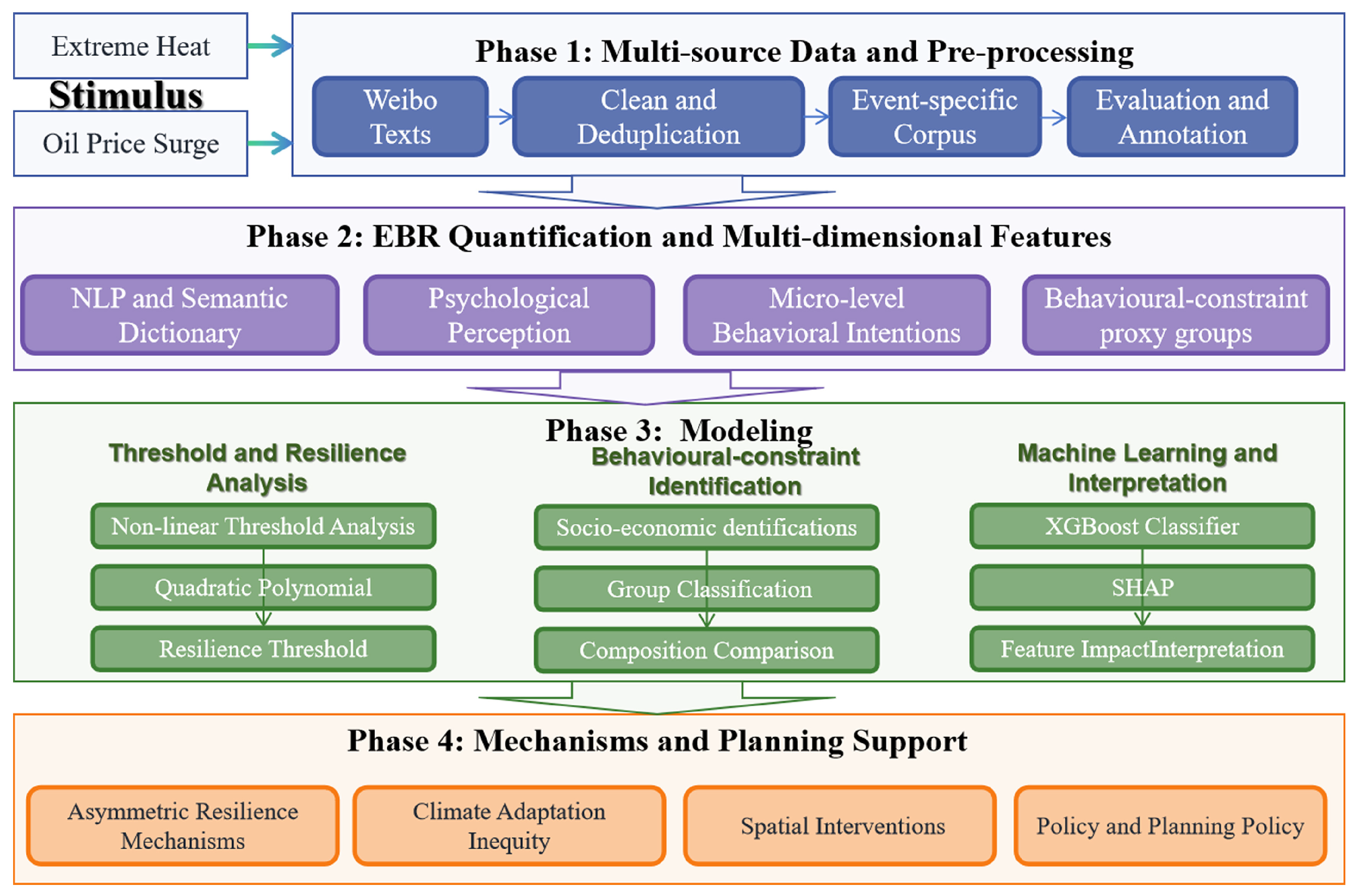
As shown in Figure 1, the framework is implemented through four phases. The first phase is data collection and pre-processing. Weibo texts related to extreme heat and refined oil price adjustments were collected, cleaned, deduplicated, and organised into event-specific corpora. The second phase features construction. NLP methods and semantic dictionaries were used to extract psychological perception, micro-level travel intentions, and behavioural-constraint proxy groups from the text data. The third phase is modelling. Nonlinear threshold analysis was used to examine temperature-related changes in low- and high-carbon travel willingness. Group classification and composition comparison were used to compare behavioural responses across proxy groups. XGBoost-SHAP analysis was used to assess the relative contribution of temperature, emotional valence, and behavioural constraints to low-carbon mobility intention. The fourth phase is mechanism interpretation and planning support. The modelling results were used to discuss asymmetric response mechanisms, differences in adaptation capacity, and possible spatial intervention directions.
Through this framework, the study builds a quantitative pathway from external events to social perception and then to behavioural elasticity. It helps explain how different external stimuli affect low-carbon travel willingness. It also supports the identification of situations in which low-carbon travel becomes difficult, risky, or constrained, thereby providing evidence for spatial planning measures under external shocks.

2.3.2. Data Analysis Methods

(1)
Measurement of External Stimulus Intensity ( S )
Drawing on common approaches to event quantification, this study defines external stimulus intensity as the relative change in event-specific indicators. For the economic stimulus, namely the oil price adjustment, the stimulus intensity was measured by the rate of change in fuel price.
S oil = P t P t 1 P t 1
where P t is the oil price on the event day, and P t 1 is the oil price in the baseline period.
For the environmental stimulus, namely extreme heat, the stimulus intensity was measured by the deviation of daily temperature from the regional thermal comfort threshold. A larger deviation indicates a stronger heat-related stimulus to residents’ outdoor travel perception and behaviour.
S heat   = T t T threshold T threshold
where T t is the daily maximum temperature, and T threshold is the regional thermal comfort threshold that may trigger changes in travel willingness.
(2)
Measurement of Micro-level Behavioural Change Intensity ( V m )
This study introduces an indicator of micro-level behavioural change intensity, defined as the behavioural volatility proportion. For a specific external stimulus, all valid texts containing travel behavioural intentions were extracted. The relative proportion of a specific travel mode was then calculated as follows.
V m = C m j = 1 k C j   ×   100 %
where C m is the total word-frequency score of travel mode m in the valid corpus, such as slow mobility or ride-hailing. k is the total number of micro-level travel mode categories.
The value of V m reflects how actively a specific travel mode is mentioned by the public as a response strategy under a given external stimulus. A sharp increase in V m indicates that this travel mode has become a key response channel. It can therefore be regarded as a priority area for transport resilience management.
(3)
Measurement of Internal Structure Transfer Rate ( ER )
To further measure the macro-level direction of carbon-related travel structure change, this study proposes the internal structure transfer rate.
ER = C low C high   + 1
where C low is the total willingness score for low-carbon and slow mobility modes, and C high   +   1 is the total willingness score for high-carbon motorised modes. The constant 1 was added to the denominator to avoid division by zero.
This indicator reflects the tendency of the travel structure to shift from high-carbon modes to low-carbon modes. When ER > 1.0, the external stimulus has a positive, low-carbon guiding effect. When ER < 1.0, the transport system shows a passive high-carbon rebound. This indicates a failure of low-carbon travel resilience.
(4)
Evolution Trend and Non-linear Threshold Fitting ( T C )
Daily social perception data from social media may contain random volatility. To reduce random noise and identify the overall trend of travel willingness under extreme heat, this study used quadratic polynomial regression to smooth the observed values. The model was specified as follows.
P m ( T ) = β 0 + β 1 T + β 2 T 2 + ϵ
where P m   ( T ) is the relative proportion of travel willingness for the mode m , such as low-carbon slow mobility or high-carbon travel, under the regional maximum temperature T . β 0 , β 1 , and   β 2 are regression coefficients, and ϵ is the error term.
This study fitted trend curves for low- and high-carbon travel willingness separately. The critical temperature T c was then identified by solving the intersection point of the two fitted curves. This point indicates the transition in public travel choice from low-carbon dominance to high-carbon dominance. In this study, T c is defined as the low-carbon resilience failure threshold of the transport system.
(5)
Group-level Vulnerability Quantification and Resilience Gap Analysis
Building on the behavioural-constraint proxy classification in Section 2.2, this study examined differences in travel responses across mobility groups. The dataset was grouped by stimulus type S     { heat ,   oil } and mobility group G     { general ,   forced }. For each subgroup, the average response share of travel mode m     { no   travel ,   low ,   high } was calculated as follows:
Share m G , S   =   1 N G , S i = 1 N G , S C m , i C no   travel , i   +   C low , i   +   C high , i   ×   100 %
where N G , S denotes the number of valid samples in the mobility group G under stimulus type S . This measure describes the average proportion of each travel response type within a subgroup.
The response shares were then compared across stimulus types and mobility groups. This comparison was used to examine whether oil price changes were associated with low-carbon substitution. It was also used to examine whether extreme heat was associated with high-carbon motorised responses or weaker travel-reduction capacity among the forced mobility group. This analysis provides a quantitative description of differences in behavioural flexibility under external shocks.
(6)
Driving Mechanism Analysis Using XGBoost and SHAP
To examine the factors associated with low-carbon mobility intention, this study used an XGBoost classification model and SHAP interpretation. The target variable was defined as y i     0 , 1 , where   y i   =   1 indicates that post i expressed an intention to adopt low-carbon mobility. The input features included extracted text-based variables, such as emotional valence and perception sensitivity, as well as event-related variables, such as temperature and stimulus type. XGBoost was used because it can model nonlinear relationships and interactions among input features. The model predicts the outcome by combining multiple classification and regression trees:
y ^ i   =   k = 1 K f k ( x i ) , f k     F
where x i denotes the feature vector of the sample i , and $ F denotes the space of regression trees. The model was trained by minimising a regularised objective function:
L   =   i = 1 N l ( y i ,   y ^ i )   +   k = 1 K Ω ( f k )
where l ( y i ,   y ^ i ) is the loss function, and Ω ( f k ) is the regularisation term used to control tree complexity.
To interpret the model results, SHAP values were calculated for each feature. SHAP estimates the contribution of each feature to the model output. The SHAP value of the feature j is defined as:
ϕ j   =   S F { j } | S | ! ( | F | | S | 1 ) ! | F | !   f x ( S { j } )     f x ( S )
where F is the full feature set, S is a subset of features that does not include the feature j , and f x ( S ) is the model output conditioned on subset S .
The SHAP results were used to compare the relative contributions of external stimuli, emotional responses, and behavioural constraints. The XGBoost model estimated nonlinear associations between these features and low-carbon mobility intention. SHAP then decomposed the model’s output and quantified the contribution of each feature. This supported mechanism interpretation and attribution analysis rather than only model validation.

3. Results

This study extracted quantitative features from Weibo texts related to refined oil price adjustments and extreme heat events. Section 3 follows a progressive analytical logic. It first examines event-specific patterns of sentiment and travel intention under the two stimuli. It then compares the two events to identify asymmetric behavioural responses and temperature-related changes in travel willingness. Based on this comparison, the analysis further examines how these responses vary across behavioural-constraint groups. Finally, an XGBoost-SHAP model is used to assess the relative contributions of external stimuli, emotional responses, and behavioural constraints to low-carbon mobility intention.

3.1. Behavioural Willingness and Resilience Characteristics Driven by the Oil Price Event

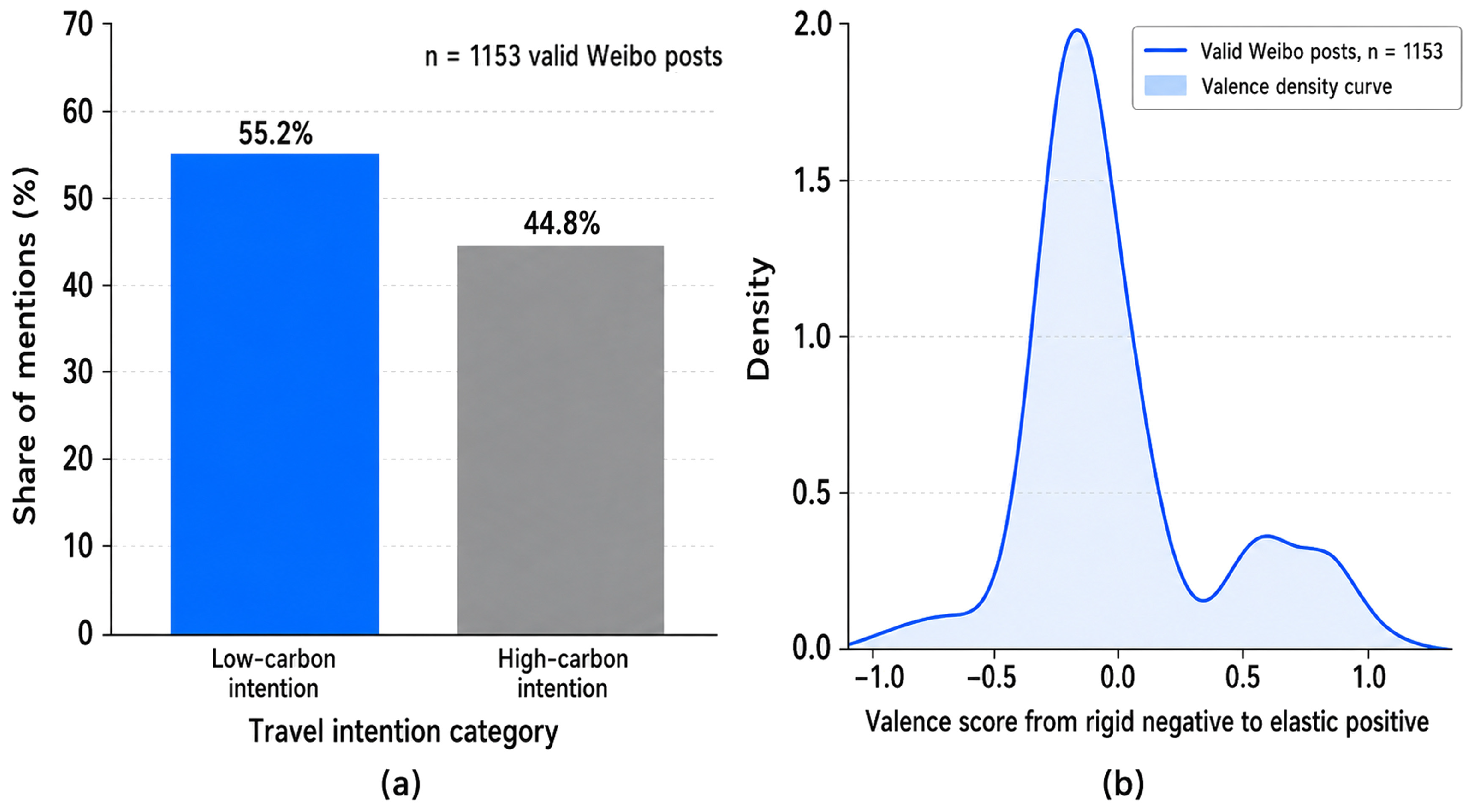
Amid rising oil prices, residents’ responses mainly reflected changes in travel intention, rather than a dominant tendency to reduce travel demand at the source. As shown in Figure 2a, low-carbon intention accounted for 55.2% of valid Weibo posts, which was higher than the share of high-carbon intention at 44.8%. Figure 2b shows that public perception valence was concentrated slightly below zero, with a smaller cluster on the positive side. This suggests that public perception was generally slightly negative, but not uniformly so. The internal structure transfer rate, calculated as the ratio of low-carbon intention to high-carbon intention, was 1.23. This means that low-carbon transfer willingness was higher than high-carbon persistence willingness. Overall, the results suggest that rising oil prices may encourage a modest shift toward lower-carbon travel intentions, reflecting a form of active adaptation among residents.

3.2. Behavioural Willingness and Resilience Characteristics Driven by the Extreme Heat Event

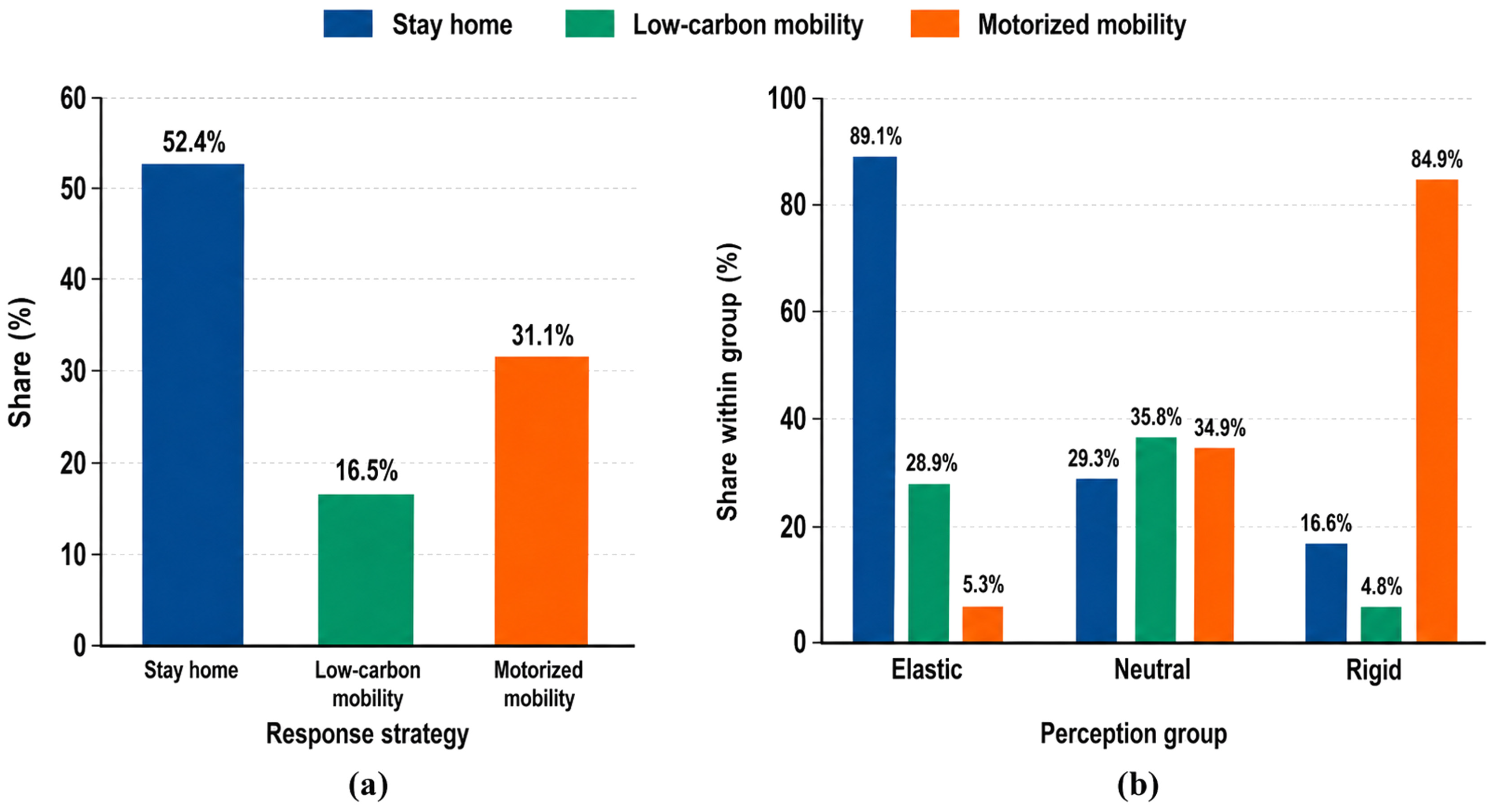
Compared with the internal structural changes caused by oil prices, travel responses under extreme heat showed a different pattern. The results reveal a form of forced adaptation under environmental stress. The environmental stimulus was associated with a dominant source-level trip-reduction response, with stay-home behaviour accounting for 52.4% of all observed strategies (Figure 3a). The cross-analysis by perception-sensitivity group further shows clear behavioural polarisation: the elastic group was dominated by stay-home responses, whereas the rigid group was dominated by motorised mobility (Figure 3b). For the high-sensitivity elastic group ( W   =   1 ), responses were mainly concentrated in source-level trip reduction, such as working from home. This indicates that these residents tended to reduce exposure by avoiding outdoor travel.
In contrast, the forced-rigid group ( W   =   1 ) showed the opposite pattern. The proportion of source-level trip reduction was very low in this group. At the same time, their willingness to use low-carbon slow mobility declined significantly. Their willingness to use high-carbon motorised modes, such as ride-hailing services and air-conditioned private cars, showed a clear rebound. As a result, the internal structure transfer rate of this group was far below 1.0.
These results suggest that extreme heat does not simply reduce travel willingness at the aggregate level. It also produces unequal behavioural responses across groups. Residents with greater behavioural flexibility can reduce trips to avoid heat exposure. However, residents with rigid mobility needs may be forced to shift away from low-carbon modes. This reveals the climate vulnerability of slow mobility systems and the unequal adaptive capacity within urban transport systems.

3.3. Asymmetric Mechanisms of Travel Behaviour Resilience Under Multi-Source Event Stimuli

Building on the event-specific results presented in the previous sections, this section compares travel responses under the oil price and extreme heat stimuli. It further examines whether extreme heat was associated with nonlinear changes in low-carbon and high-carbon travel intentions.
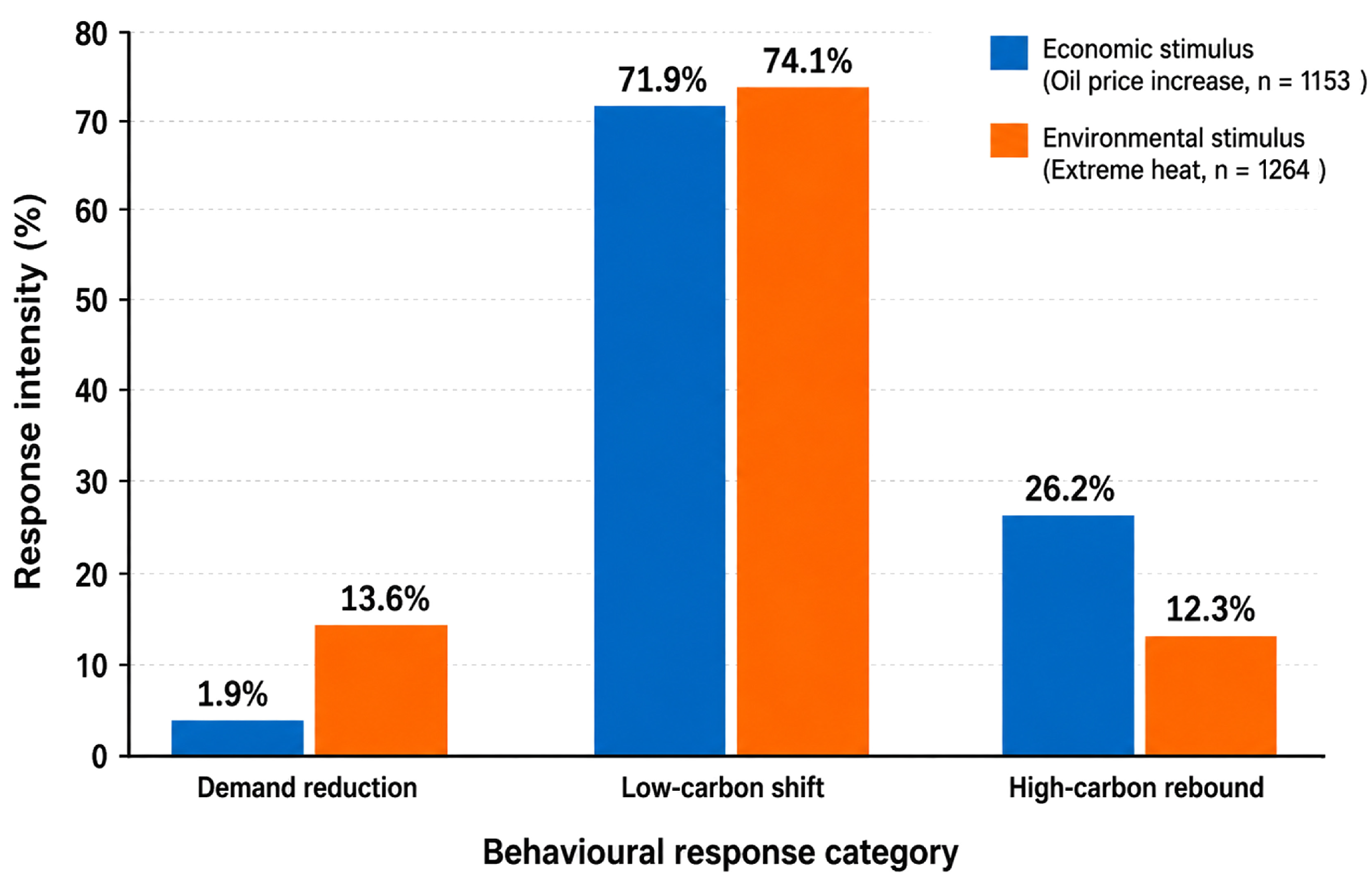
To further compare the two types of stimuli, this study analysed the social perception results within a unified framework, as shown in Figure 4. The comparison shows that travel responses differed between the oil price and extreme heat events. This indicates an asymmetric pattern of travel resilience under different external stimuli.
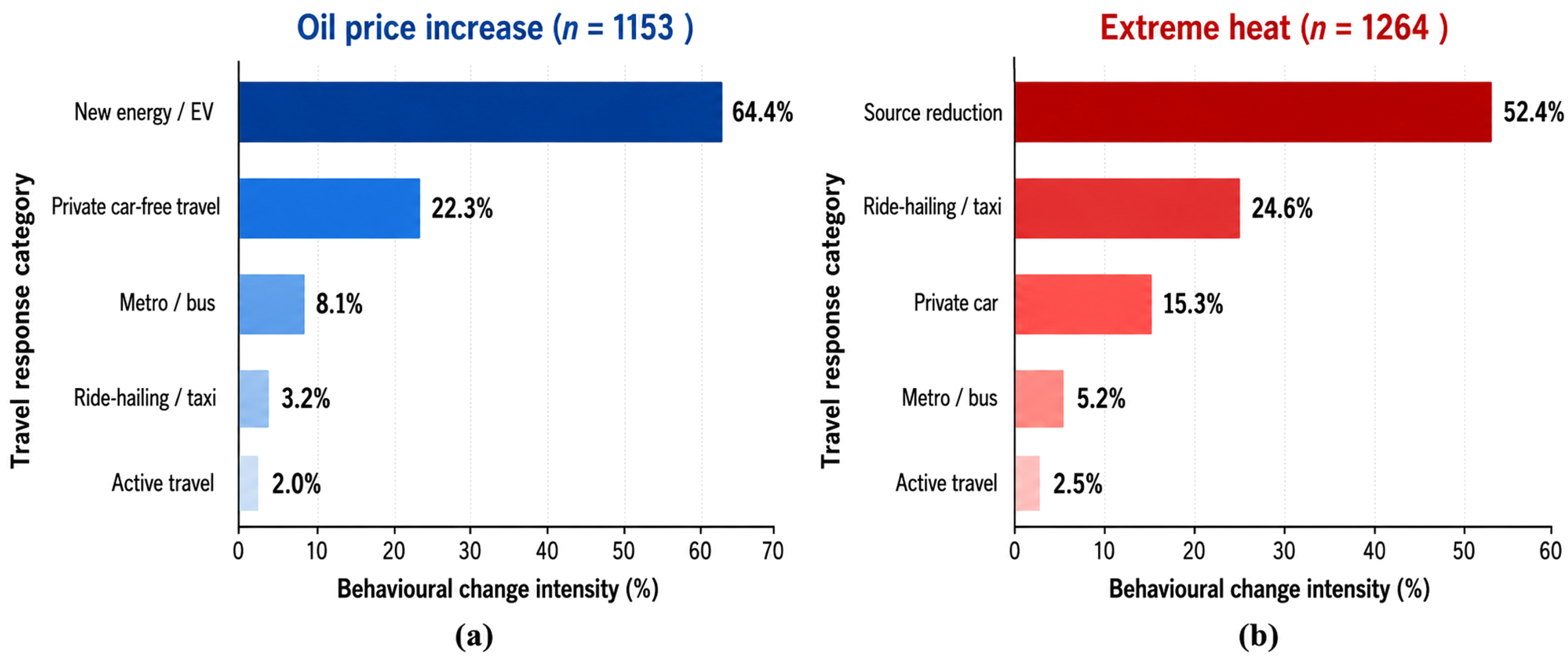
Amid the economic cost stimulus of oil price fluctuations, residents’ travel responses were mainly reflected in mode adjustments. As shown in Figure 5a, responses related to new energy or electric vehicles accounted for the largest share, reaching 64.4%. Private car-free travel accounted for 22.3%, while metro or bus-related responses accounted for 8.1%. Ride-hailing taxi use and active travel accounted for relatively small shares, at 3.2% and 2.0%, respectively. These results suggest that oil price changes were more closely associated with cost-based travel mode adjustment than with source-level trip reduction. Residents may have compared the cost attributes of different travel modes and considered lower-cost or lower-carbon alternatives.
The response pattern under extreme heat was different. As shown in Figure 5b, source-level trip reduction accounted for the largest share, reaching 52.4%. Motorised responses also represented a notable proportion. Ride-hailing or taxi use accounted for 24.6%, and private car use accounted for 15.3%. By contrast, metro or bus use accounted for 5.2%, and active travel accounted for only 2.5%. This pattern indicates that extreme heat was associated with two main types of response. Some residents reduced trips to avoid outdoor exposure. Others shifted to motorised modes, such as taxis and private cars. These responses may reflect the reduced feasibility of active mobility under high-temperature conditions. Overall, extreme heat was associated with both a reduction in trips and a shift toward climate-controlled motorised travel.
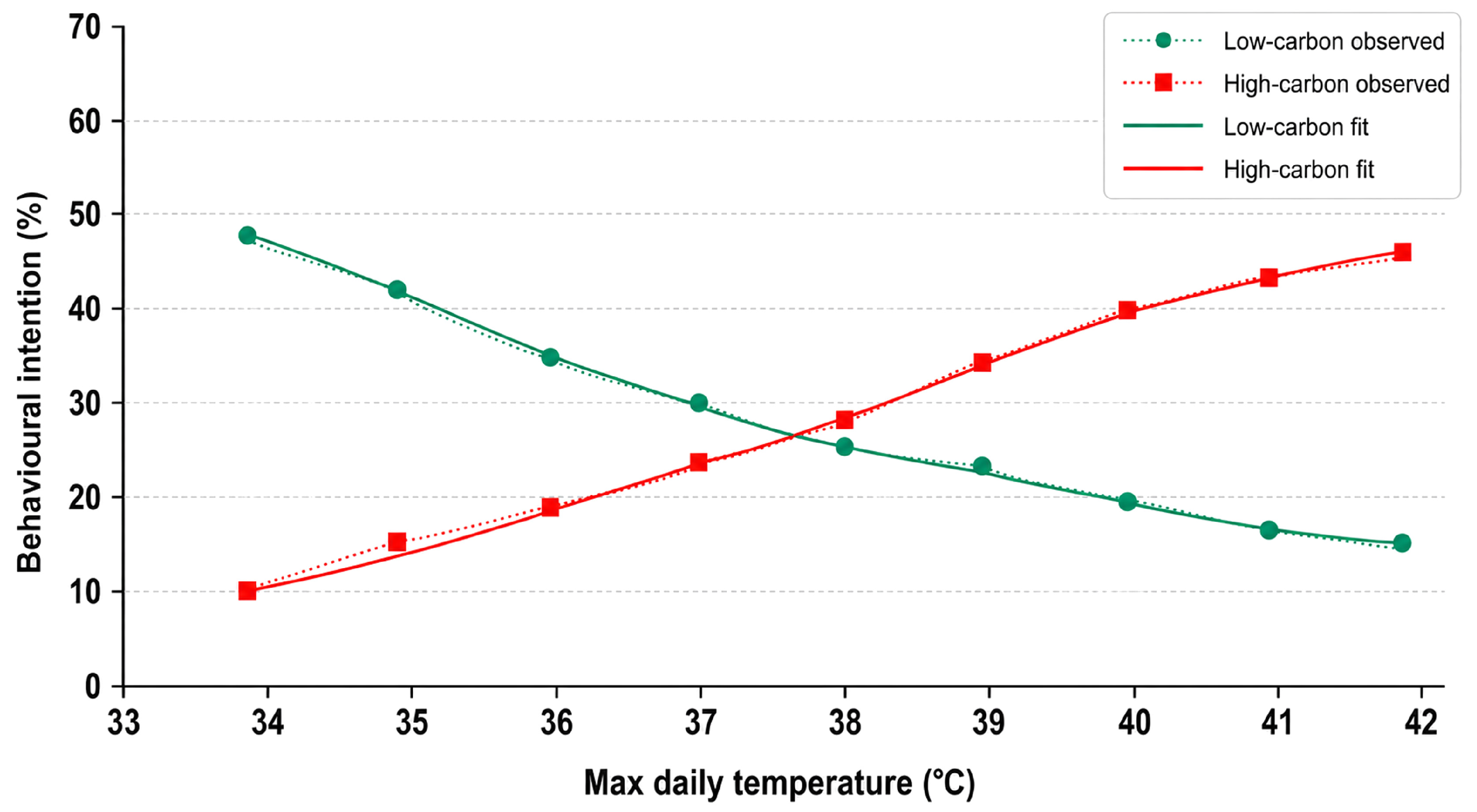
To further examine temperature-related changes in travel willingness, this study matched the extracted environmental perception data with the observed daily maximum temperature series. The daily proportions of different travel intentions were then plotted. A quadratic polynomial fit was used to describe the changing patterns, as shown in Figure 6.
The fitted curves show a clear temperature-related trend. As the daily maximum temperature increased, the share of low-carbon slow mobility willingness gradually decreased. At the same time, the share of high-carbon motorised travel willingness increased. The two fitted curves intersected between 38.0 °C and 39.0 °C. This indicates a transition range in which high-carbon motorised willingness became higher than low-carbon slow mobility willingness. The model evaluation results are presented in Table 5. Both fitted models showed high explanatory power. The adjusted R 2 values were 0.9979 for low-carbon intention and 0.9980 for high-carbon intention. The RMSE values were 0.81% and 0.84%, respectively. These results suggest that the fitted curves captured the observed daily changes with small errors. Therefore, the 38.0 °C to 39.0 °C range can be interpreted as an observed transition interval in the sample, rather than as a fixed universal threshold.
Both models showed a high goodness of fit, with R 2 values above 0.99 and RMSE values below 0.9%. The fitted curves suggest a change in the relative dominance of low-carbon and high-carbon willingness. When the two fitted functions were equated, their intersection fell between 38.0 °C and 39.0 °C. This transition interval was further compared with the daily observed values, as shown in Table 6. Low-carbon willingness decreased from 46.3% at 35.0 °C to 4.1% at 42.0 °C. In contrast, high-carbon willingness increased from 16.1% to 62.3% over the same temperature range. The residuals between the observed and fitted values were within ± 0.8 % . These results suggest that the fitted curves closely reflected the observed daily changes. Therefore, the 38.0-39.0 °C range can be interpreted as the observed transition interval for this sample. Within this range, high-carbon motorised willingness began to exceed low-carbon slow mobility willingness. This system-level pattern also indicates the need to further examine how such response differences vary across behavioural-constraint groups.

3.4. Behavioural Vulnerability Characteristics Under Multi-Source Event Stimuli

Travel responses differed across stimulus types and behavioural-constraint groups. This section further examines whether these differences varied across users with different behavioural constraints. Because Weibo data do not provide reliable demographic information, this study used a behavioural-constraint proxy classification based on travel-related expressions. This classification does not directly identify demographic attributes such as income, age, or occupation.
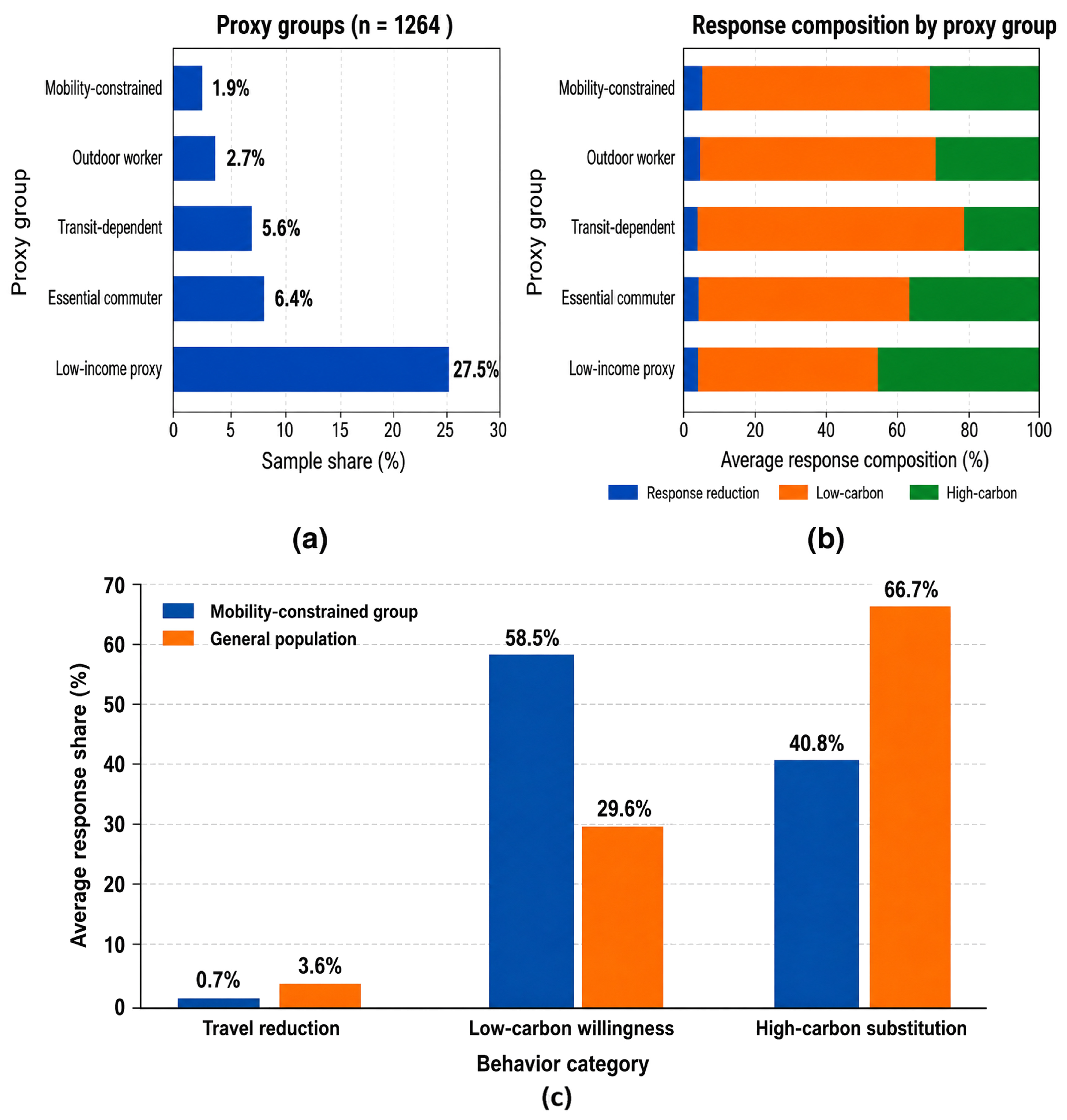
As shown in Table 7 and Figure 7a,b, cost-constrained travellers accounted for the largest share of the sample, at 27.53%. Work-constrained commuters accounted for 6.42%, followed by public transport-dependent travellers at 5.63%, outdoor-exposed travellers at 2.68%, and mobility-constrained travellers at 1.95%. These categories reflect different forms of travel constraints, including cost pressures, work requirements, public transport dependence, outdoor exposure, and mobility limitations.
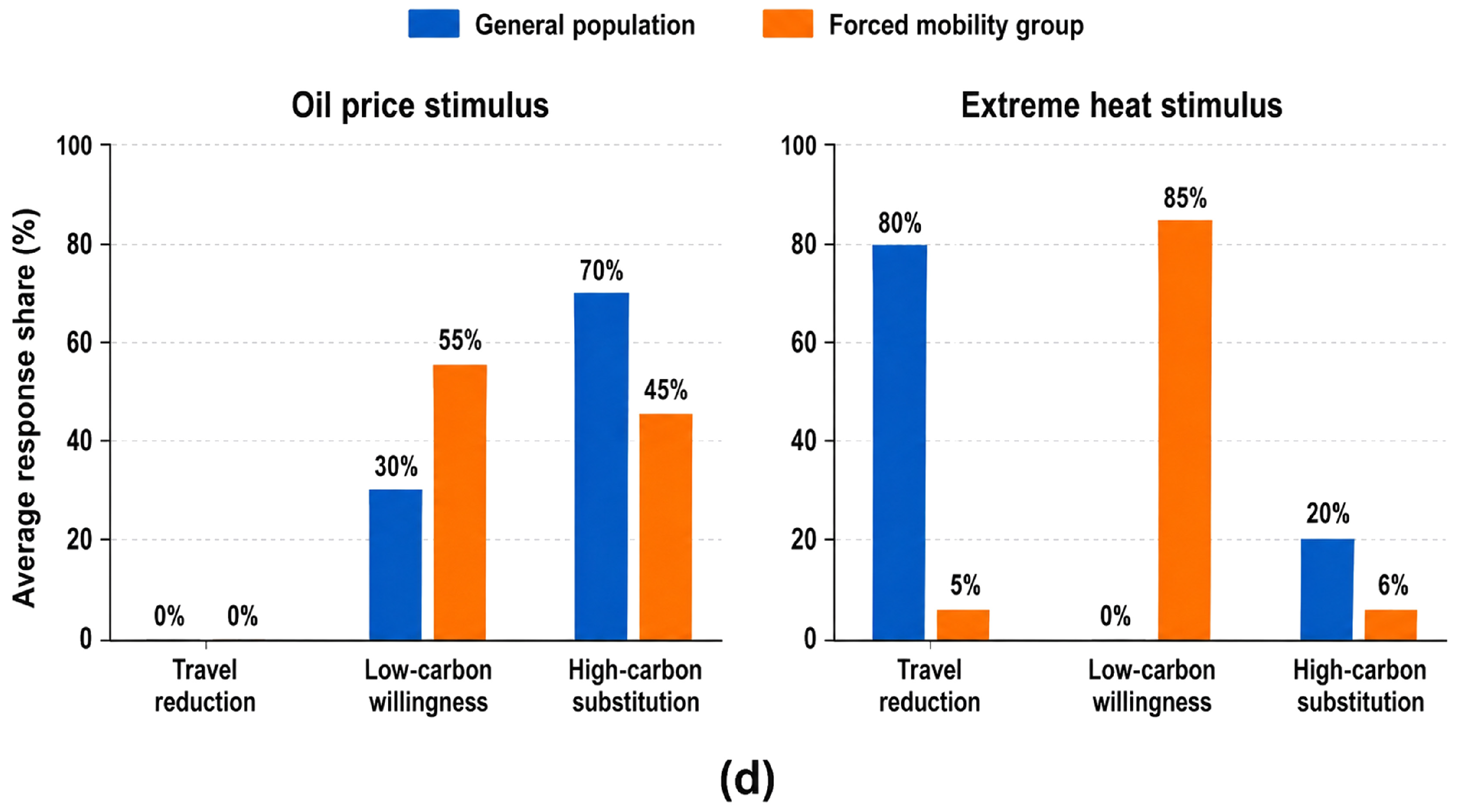
The response composition shows that low-carbon willingness accounted for a large share in most proxy groups. Public transport-dependent travellers had the highest low-carbon willingness, at 79.71%. Outdoor-exposed travellers and mobility-constrained travellers also showed relatively high values, at 69.72% and 66.56%, respectively. However, these values should be interpreted with caution. For constrained users, low-carbon willingness may not always indicate active environmental preference. It may also reflect limited access to private motorised modes or limited flexibility in travel choices. Table 7 and Figure 7c,d further compare the general population and the forced mobility group under the two types of external stimuli. Under the oil price stimulus, the forced mobility group showed a higher share of low-carbon willingness than the general population, at 54.53% compared with 31.05%. The general population showed a higher share of high-carbon substitution, at 68.95%, compared with 45.47% for the forced mobility group.
Under the extreme heat stimulus, the general population showed a travel reduction share of 80.00%, while the forced mobility group showed only 5.56%. (Table 8) At the same time, the forced mobility group showed a low-carbon willingness share of 86.87%, while the general population showed 0.00%. This contrast suggests that the forced mobility group had less capacity to reduce travel under heat stress. Their continued low-carbon willingness may reflect constrained travel options rather than stronger voluntary adaptation. Overall, the comparison indicates different behavioural pathways across mobility groups. The general population was more likely to reduce trips under extreme heat. The forced mobility group was more likely to maintain low-carbon or routine travel modes. This difference reflects behavioural constraints expressed in the texts, rather than direct demographic differences.

3.5. Driving Mechanism Analysis

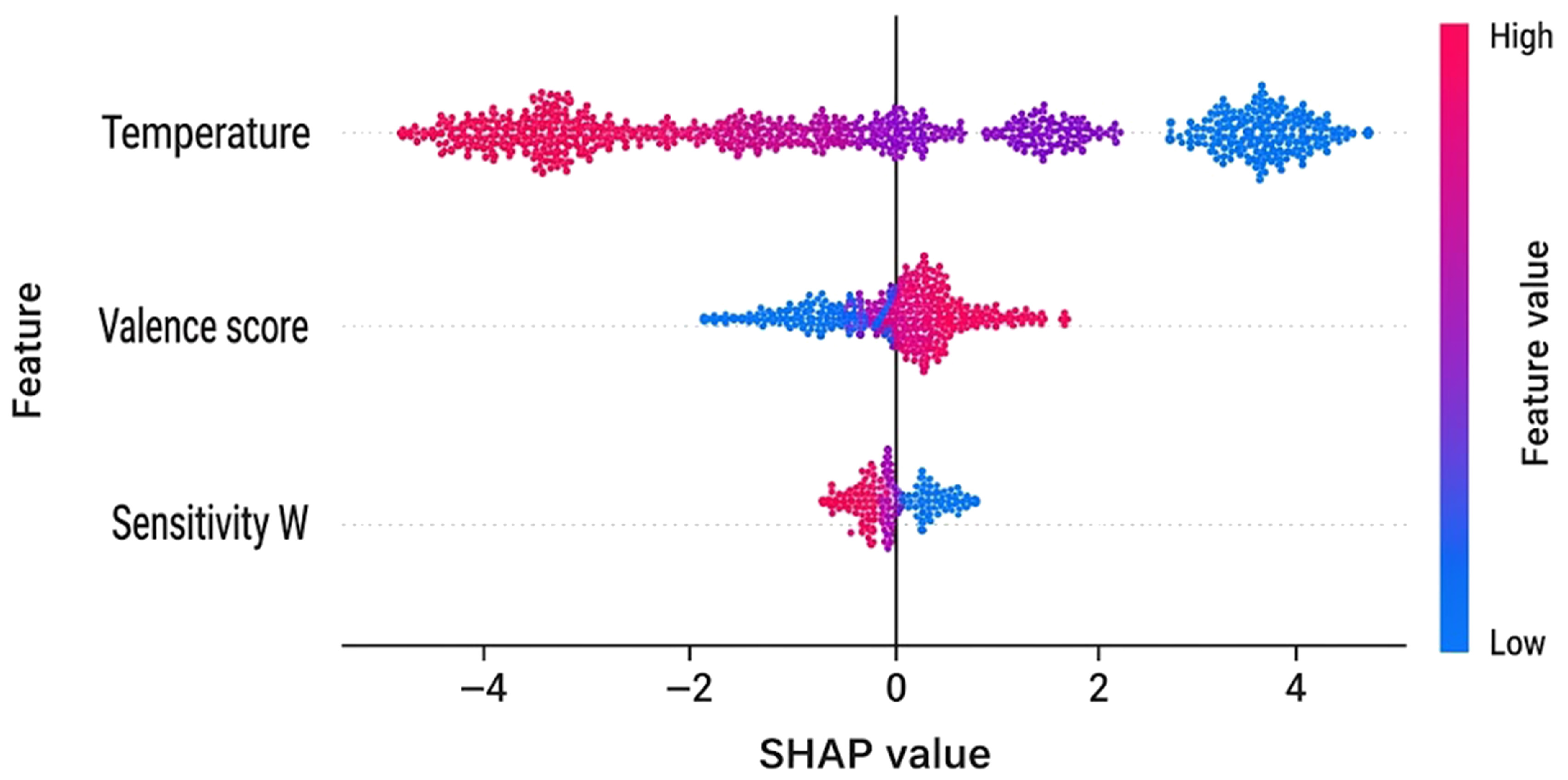
To further examine the factors related to these differences, this study used an XGBoost classification model and SHAP interpretation. The target variable indicated whether a post expressed low-carbon mobility intention. The input features included temperature, valence score, and sensitivity W .
Before applying SHAP interpretation, the XGBoost classification model was evaluated using an 80:20 train–test split. This step was used to assess whether the model could provide a stable basis for subsequent feature interpretation. The model achieved an accuracy of 86.96% and an ROC-AUC value of 0.9500. The macro F1-score was 0.87, suggesting that the model performed reasonably well across different mobility-choice classes. These results indicate that the model captured the main classification patterns in the data and provided an appropriate basis for the subsequent SHAP-based interpretation of feature contributions.
Figure 8 presents the SHAP summary results of the XGBoost model. Among the selected features, temperature showed the widest SHAP value range and made the largest contribution to the model output. Higher temperature values were mainly associated with negative SHAP values, suggesting a lower predicted probability of low-carbon mobility intention. Valence score and sensitivity W   also contributed to the prediction, but their SHAP distributions were more concentrated. Higher valence scores were generally associated with positive SHAP values, while lower values of W were more often located on the positive side of the SHAP axis. This indicates that emotional responses and behavioural constraints also helped explain differences in low-carbon mobility intention. Overall, the SHAP results are consistent with the descriptive findings in Section 3.4. They suggest that low-carbon travel responses were related to external environmental conditions, emotional expressions, and behavioural constraints.

4. Discussion

This study shows that low-carbon travel responses to external shocks are not only determined by transport supply or spatial accessibility. They are also shaped by how residents perceive risks, costs, and constraints during specific events. The results reveal two different behavioural mechanisms. Refined oil price increases were mainly associated with cost-based mode substitution, especially the shift toward new energy vehicles. In contrast, extreme heat reduced the willingness for active mobility and increased both travel reduction and motorised substitution. The group-level results further show that low-carbon behaviour may have different meanings across users. For the general population, travel reduction under extreme heat may reflect greater behavioural flexibility. For the forced mobility group, continued low-carbon travel may reflect limited alternatives rather than voluntary adaptation. These findings suggest that low-carbon spatial optimisation should start from behavioural mechanisms. It should identify where and why low-carbon travel becomes difficult, risky, or involuntary, and then guide targeted interventions such as shaded walking and cycling routes, heat-adaptive public transport spaces, and travel support for groups with limited flexibility.

4.1. Social Perception as a Behavioural Lens for Understanding Low-Carbon Travel Responses

Research on low-carbon travel behaviour has often relied on built environment indicators, such as density, diversity, design, distance to transit, and destination accessibility [26]. These indicators are important for explaining routine travel behaviour and estimating transport-related carbon emissions. However, they mainly describe stable spatial conditions. They are less able to explain short-term changes in travel willingness under sudden external shocks.
This study shows that low-carbon travel responses are shaped not only by spatial supply and transport infrastructure, but also by residents’ perceptions of risk, cost, and behavioural constraints. Under refined oil price increases, residents showed a stronger willingness to shift toward lower-cost or lower-carbon alternatives. Under extreme heat, active mobility willingness decreased, while travel reduction and motorised substitution increased. These results suggest that external stimuli may change the behavioural pathway through which travel choices affect potential carbon emissions.
Previous transport studies using social media data have provided useful evidence on public sentiment [20]. However, many studies still focus mainly on general sentiment polarity. They give less attention to how emotions are linked to specific travel intentions and mode shifts [14]. This study addresses this gap by using the Event–Behaviour–Resilience framework to transform Weibo texts into indicators of emotional valence, travel intention, and behavioural constraints. Compared with stated-preference surveys, this approach can better capture short-term behavioural expressions during event periods, although it cannot replace survey-based demographic information [14,27].
The XGBoost-SHAP results further show that temperature, emotional valence, and sensitivity indicators contributed to low-carbon mobility intention. This supports the use of social perception as a behavioural lens for interpreting low-carbon travel responses to external shocks. It also complements static built environment analysis by showing when low-carbon travel may become difficult, risky, or less feasible. Therefore, social perception can help identify spatial optimisation needs, such as shaded walking and cycling routes, heat-adaptive public transport spaces, and travel support for users with limited behavioural flexibility [28].

4.2. Asymmetric Resilience Pathways Under Economic and Environmental Stimuli

A key finding of this study is that different external stimuli were associated with different travel response pathways [8,22]. Rather than reducing travel demand in the same way, oil price increases and extreme heat changed travel willingness through different behavioural mechanisms. This distinction helps identify the spatial support needed for low-carbon travel under different conditions.
Under refined oil price increases, travel responses were mainly related to cost-based mode adjustment. The behavioural change intensity for new energy vehicle substitution reached 64.4%. This suggests that rising fuel costs may encourage some residents to consider lower-cost or lower-carbon alternatives. It is also consistent with studies showing that cost-related interventions can influence green commuting choices [22]. However, such effects depend on the availability of alternative travel modes. Public transport coverage, transfer convenience, and access to new energy vehicle infrastructure may affect whether short-term cost responses can become more stable, low-carbon choices [29].
Extreme heat followed a different pathway. Active travel is often seen as an important part of low-carbon transport transitions [30,31], but high temperatures can reduce the feasibility of walking and cycling [32]. In this study, active mobility willingness decreased under extreme heat, while travel reduction and motorised substitution increased. The fitted curves showed that low-carbon slow mobility willingness declined as daily maximum temperature increased, while high-carbon motorised willingness increased. The two curves intersected between 38.0 °C and 39.0 °C. This range represents an observed transition interval in this sample, rather than a universal threshold. These results suggest that low-carbon transport responses are sensitive to environmental conditions. When heat exposure increases, residents may reduce trips or shift to motorised modes for thermal comfort. Therefore, climate-adaptive spatial design should be included in low-carbon transport planning. Relevant measures include shaded pedestrian routes, protected cycling corridors, cooling facilities, and heat-adaptive transit stops [33,34].

4.3. Behavioural Differences and Unequal Adaptation Capacity in Urban Transport Responses

The results show that travel responses under external shocks varied across behavioural-constraint groups. This finding extends the analysis from aggregate travel demand to micro-level behavioural differences. It is also consistent with resilience studies suggesting that infrastructure and service systems may reproduce vulnerability when they do not meet the needs of constrained users [13,35].
Under extreme heat, the general population mainly responded by reducing travel, with a travel reduction share of 80.0%. This suggests that many users had the flexibility to avoid exposure by cancelling or reducing trips. In contrast, the forced mobility group showed a much lower travel reduction share of 5.56%. This indicates a limited capacity to adjust travel plans, possibly due to work requirements, cost pressures, or reliance on routine modes of transport.
The forced mobility group also maintained a high low-carbon willingness under extreme heat, reaching 86.87%. This should not be interpreted simply as voluntary low-carbon adaptation. It may also reflect constrained travel choices and limited access to more comfortable alternatives. The SHAP results support this interpretation. Sensitivity W contributed to low-carbon mobility intention, although its effect range was smaller than that of temperature. Lower values of W were more often associated with positive SHAP values, suggesting a link between behavioural constraints and continued low-carbon travel intention.
These findings indicate that low-carbon travel should not be assessed only by emission outcomes. It should also be considered in terms of safety, feasibility, and behavioural flexibility. For users with limited adaptation capacity, planning interventions should improve the comfort and accessibility of low-carbon travel. Relevant measures include shaded walking routes, heat-adaptive transit stops, better last-mile services, and targeted travel support during heat events.

4.4. Spatial Optimisation Directions Based on Behavioural Response Mechanisms

Low-carbon spatial optimisation should respond to the behavioural problems revealed by external shocks. The results show that low-carbon travel may become difficult, less attractive, or constrained under different conditions. Economic stimuli create opportunities for low-carbon substitution, but these opportunities depend on accessible public transport, convenient transfers, and supporting facilities for new energy vehicles. Extreme heat reduces the feasibility of active mobility and may shift some residents toward travel reduction or motorised alternatives. The results also show unequal adaptation capacity. Users with stronger behavioural constraints may continue routine low-carbon travel despite higher heat-related discomfort. Therefore, spatial planning should not only promote low-carbon travel but also improve its safety, comfort, affordability, and accessibility under external shocks (Table 9).

5. Conclusions

This study examined how urban residents’ travel intentions changed under refined oil price adjustments and extreme heat events. It developed an Event–Behaviour–Resilience framework and used Weibo text data to identify social perception, travel intention, and behavioural constraints. The study helps explain how external shocks may influence low-carbon travel choices and related carbon emission changes.
The findings show that different external shocks were linked to different travel responses. Refined oil price increases were mainly related to cost-based changes in travel mode. In contrast, extreme heat affected low-carbon travel by reducing the comfort and feasibility of walking, cycling, and other outdoor modes of travel. These results suggest that low-carbon travel is not shaped only by transport supply or spatial accessibility. It is also influenced by residents’ perceptions, constraints, and ability to adjust their travel choices during specific events.
The study also shows that low-carbon behaviour should be interpreted carefully. For some users, low-carbon travel may reflect environmental preference or cost-saving choices. For users with limited travel flexibility, it may also reflect a lack of safer or more comfortable alternatives. Therefore, low-carbon travel should not be assessed only by emission outcomes. It should also be understood in relation to safety, comfort, affordability, and accessibility.
These findings provide implications for low-carbon spatial optimisation. During fuel price increases, public transport discounts, better transfer services, and improved access to new energy vehicle services may help guide low-carbon travel. During extreme heat, shaded walking and cycling routes, cooling facilities, and comfortable public transport waiting spaces are needed. Planning strategies should also support users with limited travel flexibility through better last-mile services, shaded access routes, and commuting support during heat events.
This study has limitations. Due to privacy protection and platform restrictions, Weibo posts only provide coarse geographic tags. They do not include precise residential locations, workplace locations, or complete travel routes. This limits the ability to match behavioural expressions with detailed spatial conditions. Key spatial features, such as street-level shade, local heat conditions, walking and cycling environments, transit waiting conditions, and 500-metre accessibility, could not be directly extracted for each post. Future research could combine social media data with mobile phone signalling data, built environment data, street-view images, and fine-scale climate data. This would help further examine how spatial conditions affect low-carbon travel responses under external shocks.

Author Contributions

Conceptualization, Y.L., T.C., R.W. and S.M.; Methodology, Y.L., T.C. and R.W.; Software, Y.L. and S.M.; Validation, Y.G. and S.M.; Investigation, Y.L. and Y.G.; Resources, Y.G.; Data curation, S.M.; Writing—original draft, Y.L. and Y.G.; Writing—review & editing, R.W. and H.Z.; Visualization, Y.L.; Supervision, R.W. and H.Z.; Project administration, H.Z.; Funding acquisition, H.Z. All authors have read and agreed to the published version of the manuscript.

Funding

This research was funded by the National Key Research and Development Program of China (Grant No. 2023YFC3807701). The APC was funded by the National Key Research and Development Program of China.

Data Availability Statement

The original contributions presented in this study are included in the article. Further inquiries can be directed to the corresponding author.

Conflicts of Interest

The authors declare no conflict of interest.

References

  1. Lamb, W.F.; Wiedmann, T.; Pongratz, J.; Andrew, R.; Crippa, M.; Olivier, J.G.J.; Wiedenhofer, D.; Mattioli, G.; Al Khourdajie, A.; House, J.; et al. A review of trends and drivers of greenhouse gas emissions by sector from 1990 to 2018. Environ. Res. Lett. 2021, 16, 073005. [Google Scholar] [CrossRef]
  2. Creutzig, F.; Jochem, P.; Edelenbosch, O.Y.; Mattauch, L.; van Vuuren, D.P.; McCollum, D.; Minx, J. Transport: A roadblock to climate change mitigation? Science 2015, 350, 911–912. [Google Scholar] [CrossRef]
  3. Lucatello, S.; Sánchez, R. Climate Change in North America: Risks, Impacts, and Adaptation. A Reflection Based on the IPCC Report AR6—2022. Rev. Mex. Econ. Finanz. 2022, 17, e794. [Google Scholar] [CrossRef]
  4. Qiu, N.; Li, W.; Han, X.; Jiang, Y.; Zhang, Z.; Du, M. Active commuting: An alternative source of health-promoting physical activity in job–housing imbalance contexts. Humanit. Soc. Sci. Commun. 2025, 12, 1990. [Google Scholar] [CrossRef]
  5. De Vos, J. The effect of COVID-19 and subsequent social distancing on travel behavior. Transp. Res. Interdiscip. Perspect. 2020, 5, 100121. [Google Scholar] [CrossRef] [PubMed]
  6. Borg, M.A.; Xiang, J.; Anikeeva, O.; Pisaniello, D.; Hansen, A.; Zander, K.; Dear, K.; Sim, M.R.; Bi, P. Occupational heat stress and economic burden: A review of global evidence. Environ. Res. 2021, 195, 110781. [Google Scholar] [CrossRef]
  7. Baffes, J.; Nagle, P. (Eds.) Commodity Markets: Evolution, Challenges and Policies; World Bank: Washington, DC, USA, 2022. [Google Scholar] [CrossRef]
  8. Batur, I.; Alhassan, V.O.; Chester, M.V.; Polzin, S.E.; Chen, C.; Bhat, C.R.; Pendyala, R.M. Understanding how extreme heat impacts human activity-mobility and time use patterns. Transp. Res. Part D Transp. Environ. 2024, 136, 104431. [Google Scholar] [CrossRef]
  9. Kim, J.; Lee, H. Exploring Transit Use during COVID-19 Based on XGB and SHAP Using Smart Card Data. J. Adv. Transp. 2022, 2022, 6458371. [Google Scholar] [CrossRef]
  10. Gray, R.S. Agriculture, transportation, and the COVID-19 crisis. Can. J. Agric. Econ. 2020, 68, 239–243. [Google Scholar] [CrossRef]
  11. Böcker, L.; Dijst, M.; Prillwitz, J. Impact of Everyday Weather on Individual Daily Travel Behaviours in Perspective: A Literature Review. Transp. Rev. 2013, 33, 71–91. [Google Scholar] [CrossRef]
  12. Tsapakis, I.; Cheng, T.; Bolbol, A. Impact of weather conditions on macroscopic urban travel times. J. Transp. Geogr. 2013, 28, 204–211. [Google Scholar] [CrossRef]
  13. Gu, X.; Chen, P.; Fan, C. Socio-demographic inequalities in the impacts of extreme temperatures on population mobility. J. Transp. Geogr. 2024, 114, 103755. [Google Scholar] [CrossRef]
  14. Zha, W.; Ye, Q.; Li, J.; Ozbay, K. A social media data-driven analysis for transport policy response to the COVID-19 pandemic outbreak in Wuhan, China. Transp. Res. Part A Policy Pract. 2023, 172, 103669. [Google Scholar] [CrossRef]
  15. Yabe, T.; Rao, P.S.C.; Ukkusuri, S.V. Modeling the Influence of Online Social Media Information on Post-Disaster Mobility Decisions. Sustainability 2021, 13, 5254. [Google Scholar] [CrossRef]
  16. Vesely, S.; Klöckner, C.A. Social Desirability in Environmental Psychology Research: Three Meta-Analyses. Front. Psychol. 2020, 11, 1395. [Google Scholar] [CrossRef] [PubMed]
  17. Liu, Y.; Liu, X.; Gao, S.; Gong, L.; Kang, C.; Zhi, Y.; Chi, G.; Shi, L. Social Sensing: A New Approach to Understanding Our Socioeconomic Environments. Ann. Am. Assoc. Geogr. 2015, 105, 512–530. [Google Scholar] [CrossRef]
  18. Blank, G.; Lutz, C. Representativeness of Social Media in Great Britain: Investigating Facebook, LinkedIn, Twitter, Pinterest, Google+, and Instagram. Am. Behav. Sci. 2017, 61, 741–756. [Google Scholar] [CrossRef]
  19. Han, X.; Wang, J.; Zhang, X.; Wang, L.; Xu, D. Mining public behavior patterns from social media data during emergencies: A multidimensional analytical framework considering spatial–temporal–semantic features. Trans. GIS 2024, 28, 58–82. [Google Scholar] [CrossRef]
  20. Torres, E.C.M.; de Picado-Santos, L.G. Sentiment Analysis and Topic Modeling in Transportation: A Literature Review. Appl. Sci. 2025, 15, 6576. [Google Scholar] [CrossRef]
  21. Chevance, G.; Andrieu, B.; Koch, N.; Tonne, C.; Nieuwenhuijsen, M.; Bernard, P. How gasoline prices influence the effectiveness of interventions targeting sustainable transport modes? npj Sustain. Mobil. Transp. 2024, 1, 17. [Google Scholar] [CrossRef]
  22. Belloc, I.; Gimenez-Nadal, J.I.; Molina, J.A. The gasoline price and the commuting behavior of US commuters: Exploring changes to green travel mode choices. J. Transp. Geogr. 2024, 121, 104006. [Google Scholar] [CrossRef]
  23. Lanza, K.; Stone, B., Jr. Climate adaptation in cities: What trees are suitable for urban heat management? Landsc. Urban Plan. 2016, 153, 74–82. [Google Scholar] [CrossRef]
  24. Wang, R.; Jiang, Y.; Liu, D.; Peng, H.; Cao, M.; Yao, Y. Is perceived safety a prerequisite for the relationship between green space availability, and the use and perceived comfort of green space? Wellbeing Space Soc. 2025, 8, 100247. [Google Scholar] [CrossRef]
  25. Brons, M.; Nijkamp, P.; Pels, E.; Rietveld, P. A meta-analysis of the price elasticity of gasoline demand. A SUR approach. Energy Econ. 2008, 30, 2105–2122. [Google Scholar] [CrossRef]
  26. Maharjan, S.; Tsurusaki, N.; Divigalpitiya, P. Influencing Mechanism Analysis of Urban Form on Travel Energy Consumption—Evidence from Fukuoka City, Japan. Urban Sci. 2018, 2, 15. [Google Scholar] [CrossRef]
  27. Chen, X.; Wang, Z.; Di, X. Sentiment Analysis on Multimodal Transportation during the COVID-19 Using Social Media Data. Information 2023, 14, 113. [Google Scholar] [CrossRef]
  28. Han, X.; Ma, R.; Zhang, H.M. Energy-aware trajectory optimization of CAV platoons through a signalized intersection. Transp. Res. Part C Emerg. Technol. 2020, 118, 102652. [Google Scholar] [CrossRef]
  29. Jing, Q.-L.; Liu, H.-Z.; Yu, W.-Q.; He, X. The Impact of Public Transportation on Carbon Emissions—From the Perspective of Energy Consumption. Sustainability 2022, 14, 6248. [Google Scholar] [CrossRef]
  30. Allen, H.; Nolmark, H. Active Transportation, the Ultimate Low Carbon Way to Travel—A Review of International Research and Education. Front. Sustain. Cities 2022, 4, 824909. [Google Scholar] [CrossRef]
  31. Brand, C.; Dons, E.; Anaya-Boig, E.; Avila-Palencia, I.; Clark, A.; de Nazelle, A.; Gascon, M.; Gaupp-Berghausen, M.; Gerike, R.; Götschi, T.; et al. The climate change mitigation effects of daily active travel in cities. Transp. Res. Part. D Transp. Environ. 2021, 93, 102764. [Google Scholar] [CrossRef]
  32. Falah, N.; Falah, N.; Solis-Guzman, J. Weather-Driven Cycling: Developing a Predictive Model for Urban Bicycle Usage Based on Five Key Weather Factors. Urban Sci. 2025, 9, 41. [Google Scholar] [CrossRef]
  33. Hatchett, B.J.; Benmarhnia, T.; Guirguis, K.; VanderMolen, K.; Gershunov, A.; Kerwin, H.; Khlystov, A.; Lambrecht, K.M.; Samburova, V. Mobility data to aid assessment of human responses to extreme environmental conditions. Lancet Planet. Health 2021, 5, e665–e667. [Google Scholar] [CrossRef]
  34. Ly, A.; Davenport, F.V.; Diffenbaugh, N.S. Exploring the Influence of Summer Temperature on Human Mobility During the COVID-19 Pandemic in the San Francisco Bay Area. GeoHealth 2023, 7, e2022GH000772. [Google Scholar] [CrossRef]
  35. Stechemesser, A.; Wenz, L. Inequality in behavioural heat adaptation: An empirical study with mobility data from the transport system in New York City, NY, USA. Lancet Planet. Health 2023, 7, e798–e808. [Google Scholar] [CrossRef]
Figure 1. Quantitative analytical framework of event–behaviour–resilience.
Land 15 01019 g001
Figure 2. Travel intention structure and psychological perception under oil price increases. (a) Distribution of low-carbon and high-carbon travel intentions; (b) Distribution of continuous perception valence.
Land 15 01019 g002
Figure 3. Travel response strategies and behavioural polarisation under extreme heat events. (a) Overall distribution of travel response strategies under extreme heat; (b) Strategy composition across perception-sensitivity groups under extreme heat.
Land 15 01019 g003
Figure 4. Behavioural response intensity under economic and environmental stimuli.
Land 15 01019 g004
Figure 5. Structural shift in micro-level travel behaviours under external stimuli: (a) Under oil price increase; (b) Under extreme heat events.
Land 15 01019 g005
Figure 6. Dynamic evolution curves of travel willingness in the slow mobility system.
Land 15 01019 g006
Figure 7. Behavioural response composition across behavioural-constraint proxy groups: (a) Behavioural-constraint proxy groups identified from Weibo texts; (b) behavioural response composition across behavioural-constraint proxy groups; (c) behavioural-constraint proxy groups identified from Weibo texts; (d) behavioural response.
Land 15 01019 g007aLand 15 01019 g007b
Figure 8. XGB_ SHAP: Feature Impact on Low-carbon Mobility.
Land 15 01019 g008
Table 1. Methods for data collection and cleaning of Weibo data.
StageDescription
Raw Data CollectionEvent keywords for extreme heat include heatwave, heatstroke, 40 °C, and outdoor heat. Event keywords for oil price include oil price, price increase, fill up, and fuel cost. Posts were collected 7 days before and 7 days after each event. Posts were filtered by geographic tags to match the relevant region.
Missing Data and DeduplicationPosts without textual content were removed. Exact duplicate posts were eliminated to remove repeated reposts, spam, and machine-generated content.
Noise ExclusionPosts containing trending but irrelevant topics such as stock market discussions, entertainment, livestreaming, and lottery promotions were removed using a custom noise dictionary.
Valid Behavioural Intent FilteringOnly posts expressing valid behavioural intent were retained. Action words preceded by negation terms such as not, did not, or never were excluded. Behavioural modes were categorised for extreme heat as stay-home, transit, active travel, shelter car, and taxi, and for oil price as electric vehicle, transit, active travel, car, and taxi. Sentiment indicators were applied with positive and negative weights.
Table 2. Semantic dictionary and extraction rules for event perception and travel intention variables.
Semantic DimensionSub-CategoryIndicator Definition/Extraction WeightTypical Keywords
Event identifiersClimatic and environmental eventsTexts containing extreme heat-related featuresHeatwave, high temperature, outdoor heat
Policy and economic eventsTexts containing oil price adjustment-related featuresOil price, price increase, fuel cost
Behavioural Sub-modesSource trip reduction/zero-carbon travelAbsolute frequency of this behaviour category ( C no _ travel )Working from home, not going out, staying at home
Low-carbon travel/slow and public mobilityAbsolute frequency of this behaviour category ( C low )Metro, bus, cycling, walking, shared e-bike, electric vehicle, carpooling, public transport route
High-carbon travel Absolute frequency of this behaviour category ( C high )Filling up at night, fuel rush, self-driving travel, car air conditioning, long-distance
Psychological SensitivityContinuous perception valenceContinuous weights assigned to emotional words and mapped to the interval [−1, 0, 1]Too hot positive, saving money positive, too expensive negative, extremely hot negative
Rigid constraintsOccupational or livelihood-related attributes that may cause low-carbon elasticity failureMust go to work, migrant worker, still have to go, no choice, should work anyway
Table 3. Standard and methods for quantitative processing of data.
Variable NamePredefined Keywords/ConceptsWeights
( ω )/Criteria
Illustrative Translated Example from Corpus & Computational TraceFinal Values
Travel Intentions
C no _ travel , C low , C high
B no _ travel [‘stay home’, ‘air-conditioned room’]
B low [‘subway’, ‘bus’, ‘cycling’]
B high [‘taxi’, ‘private car’, ‘drive’]
Binary Indicator ( 0 ,   1 ) via Regex LookbehindExample: “It’s 40 degrees outside, taking a taxi directly to the office, melting.”
Trace:
1. Match Event: “40 degrees”   Valid.
2. Lookbehind check on taxi: No negation   C high   =   1 .
C no _ travel = 0
C low = 0
C high = 1
Emotional Valence
V [ 1 ,   1 ]
[‘melting’, ‘deadly heat’, ‘suffering’]
[‘must work’, ‘essential worker’]
[‘cool’, ‘shelter’]
ω = −0.9
ω = −0.5
ω = 0.3
Example: “Still must go to work at 40 degrees, essential workers suffer, melting in the heat.”
Trace:
1. Match melting: V V   +   ( 0.7 )   =   0.7
2. Match essential worker: V V   +   ( 0.5 )   =   1.2
3. Clamp: max ( 1.0 ,   1.2 )   =   1.0
V = 1.000
Perception Sensitivity
W { 1 ,   0 ,   1 }
Piecewise Conditions Based on V and Constraint Indicators      W   =   1   if
      V     0.4
and rigid keywords.
      W   =   1   if
      | V |   >   0.3
W   =   0 else.
Trace:
1. For Heatwave Example above: V   =   1.0     0.4
2. Contains rigid constraint token: “essential worker”.
3. Trigger Condition 1   W   =   1 (Forced Rigid).
Heat Ex:
W   = 1
Table 4. Group classification method based on social media texts.
Proxy GroupBehavioural Constraint RepresentedIdentification RuleTypical ExpressionsAnalytical Use
Cost-constrained travellersTravel choices affected by cost pressure, income loss, or affordability concerns.Posts containing expressions related to travel cost, fuel cost, wage loss, or difficulty affording trips.fuel cost; too expensive; cannot afford; wage deduction; salary; living cost; commuting costIndicates cost-related limits on travel choices under external shocks.
Work-constrained commutersTravel choices constrained by attendance rules, work schedules, or unavoidable commuting needs.Posts containing expressions related to clocking in, attendance, lateness, shift work, or the need to travel for work.clock in; full attendance; being late; must go to work; cannot take leave; rush hour; work shiftIndicates work-related limits on travel flexibility.
Public transport-dependent travellersTravel choices shaped by reliance on public transport services and transfer conditions.Posts containing expressions related to metro, bus, transfer, waiting, crowding, stations, or service disruption.metro; bus; transfer; waiting; crowded; queue; bus stop; metro station; last trainIndicates dependence on public transport when external conditions worsen.
Outdoor-exposure-related travellersTravel choices constrained by outdoor work or mobility-intensive tasks.Posts containing expressions related to delivery, courier work, construction sites, outdoor work, or high-temperature exposure during work.delivery; courier; rider; construction site; sanitation work; outdoor work; food deliveryIndicates exposure-related limits on avoiding travel or outdoor activity.
Mobility-constrained travellersTravel choices constrained by physical discomfort, limited mobility, or difficulty walking.Posts containing expressions related to physical discomfort, mobility inconvenience, walking difficulty, or reduced ability to move.limited mobility; mobility inconvenience; leg pain; difficulty walking; physical discomfort; hard to walkIndicates physical limits on adaptive travel choices.
Table 5. Polynomial regression model evaluation parameters.
Behavioural ModelR2Adjusted R2RMSEF-Statisticp-Value
Low-carbon intention0.99840.99790.81%2172.75<0.001
High-carbon intention0.99850.99800.84%2282.08<0.001
Table 6. Cross-validation of daily empirical observations and fitted trajectories.
Daily Max TemperatureObserved Low-Carbon RatioFitted Low-Carbon RatioResidualObserved High-Carbon RatioFitted High-Carbon RatioResidualDominant Mode Shift
35.0 °C46.3%46.0%+0.316.1%16.4%−0.3Low-carbon dominance
36.0 °C41.9%42.5%−0.619.5%19.9%−0.4Low-carbon dominance
37.0 °C38.4%38.0%+0.425.2%24.5%+0.7Low-carbon dominance
38.0 °C32.1%32.4%−0.330.1%30.5%−0.4Low-carbon dominance
39.0 °C26.2%25.7%+0.538.3%37.6%+0.7High-carbon dominance
40.0 °C17.5%18.1%−0.645.5%46.0%−0.5High-carbon dominance
41.0 °C9.8%9.4%+0.454.8%55.6%−0.8High-carbon dominance
42.0 °C4.1%3.5%+0.662.3%61.8%+0.5High-carbon dominance
Table 7. Behavioural-constraint proxy groups and average response shares.
Behavioural-Constraint Proxy GroupSample ShareTravel ReductionLow-Carbon WillingnessHigh-Carbon Substitution
Cost-constrained travellers27.53%0.00%56.46%43.54%
Work-constrained commuters6.42%1.35%61.16%37.49%
Public transport-dependent travellers5.63%0.98%79.71%19.31%
Outdoor-exposed travellers2.68%1.11%69.72%29.17%
Mobility-constrained travellers1.95%0.00%66.56%33.44%
Table 8. Asymmetric behavioural responses across groups under dual external stimuli.
Stimulus TypeMobility GroupTravel ReductionLow-Carbon WillingnessHigh-Carbon Substitution
Oil price stimulusGeneral population0.00%31.05%68.95%
Oil price stimulusForced mobility group0.00%54.53%45.47%
Extreme heat stimulusGeneral population80.00%0.00%20.00%
Extreme heat stimulusForced mobility group5.56%86.87%7.58%
Table 9. Spatial optimisation objective based on behaviour.
Key Behavioural FindingSpatial Optimisation Direction
Fuel price increases were associated with stronger low-carbon substitution, especially new energy vehicle intention at 64.4%Improve the accessibility of low-carbon alternatives through public transport discounts, transfer convenience, and charging facility support
Extreme heat reduced active mobility willingness and increased travel reduction or motorised substitutionImprove the climate adaptability of active travel spaces through shaded walking routes, protected cycling corridors, and cooling facilities
The fitted curves intersected between 38.0 °C and 39.0 °CUse this observed transition interval to guide heat-responsive transport measures, such as higher public transport frequency and air-conditioned waiting spaces
The forced mobility group showed limited travel reduction at 5.56% and high low-carbon willingness at 86.87%Improve the safety, comfort, and affordability of routine low-carbon travel for users with limited behavioural flexibility
Disclaimer/Publisher’s Note: The statements, opinions and data contained in all publications are solely those of the individual author(s) and contributor(s) and not of MDPI and/or the editor(s). MDPI and/or the editor(s) disclaim responsibility for any injury to people or property resulting from any ideas, methods, instructions or products referred to in the content.