1. Introduction
The urban–rural income gap is one of the central issues in the income distribution of developing countries and an urgent practical problem in the process of modernization [
1]. As the largest developing country, China has long faced pronounced urban–rural income inequality during its rapid industrialization and urbanization, shaped by multiple factors including the level of economic development, the urban–rural dual system, and government development strategies [
2,
3]. In the context of China’s economic transition, the relationship between economic growth and income distribution has become increasingly important. Rapid growth has created the material foundation for improving residents’ income, but it has also been accompanied by uneven resource allocation between urban and rural areas. Although this gap has been narrowed in recent years under the influence of policies such as targeted poverty alleviation, rural revitalization, and new-type urbanization [
4], the urban–rural per capita disposable income ratio remained at 2.31 in 2025, indicating that the underlying imbalance has not been fundamentally reversed. The urban–rural income gap not only restricts the expansion of rural household consumption but also constrains the advancement of urban–rural integration and the realization of common prosperity [
5]. Therefore, examining the determinants and formation mechanisms of the urban–rural income gap in China can help deepen the understanding of the relationship between economic growth and income distribution in developing countries. In this study, the term “city” refers to the prefecture-level administrative unit used in China’s statistical system. Accordingly, “urban” and “rural” refer to the urban and rural spaces within the overall administrative area of each prefecture-level city. However, this study focuses primarily on the income disparity between urban and rural residents, and the empirical meaning of these categories is reflected in the official statistical indicators of urban and rural residents’ income.
Existing studies have examined the urban–rural income gap from different perspectives. One line of research focuses on how to measure the gap, using indicators such as the urban–rural income ratio [
6], the Theil index and related decomposition indicators [
4,
7]. Another line of research examines its evolutionary trend across different stages of economic development. Based on an examination of income distribution in developed countries, Kuznets argued that income inequality follows an “inverted U-shaped” pattern as economic development proceeds [
8]. Drawing on China’s development experience, Chen and Lin found that under a heavy-industry-oriented development strategy, China’s urban–rural income gap did not follow the classical “inverted U-shaped” trajectory during economic development, but instead exhibited a “U-shaped” trend [
9]. A third line of research focuses on the determinants of the gap, which can generally be divided into macro-structural and micro-individual approaches. The former focuses on how factors such as the level of economic development [
8], industrial structure [
10], urbanization [
7], openness to foreign trade [
11], patterns of urban expansion [
6], and government macroeconomic policies [
12] shape urban–rural income distribution. The latter emphasizes individual-level factors, such as urban–rural educational disparities [
2], rural entrepreneurship [
13], and Internet use [
14], analyzing how differences in individual capability and access to information affect urban–rural income disparities. Overall, the existing literature has provided relatively comprehensive insights into the formation mechanisms and evolutionary processes of urban–rural income inequality, offering an important foundation for further research. However, most studies focus on general economic, structural, policy, or individual factors. The role of local economic growth management, especially economic growth target pressure, has received less systematic attention.
For developing countries, problems arising in the process of economic growth need to be addressed through continued development. Income growth driven by economic development, especially the increase in rural residents’ income, has been identified as a practical foundation and key driving force for narrowing the urban–rural income gap [
15,
16]. Reducing this gap through growth therefore places higher demands on government economic management in developing countries [
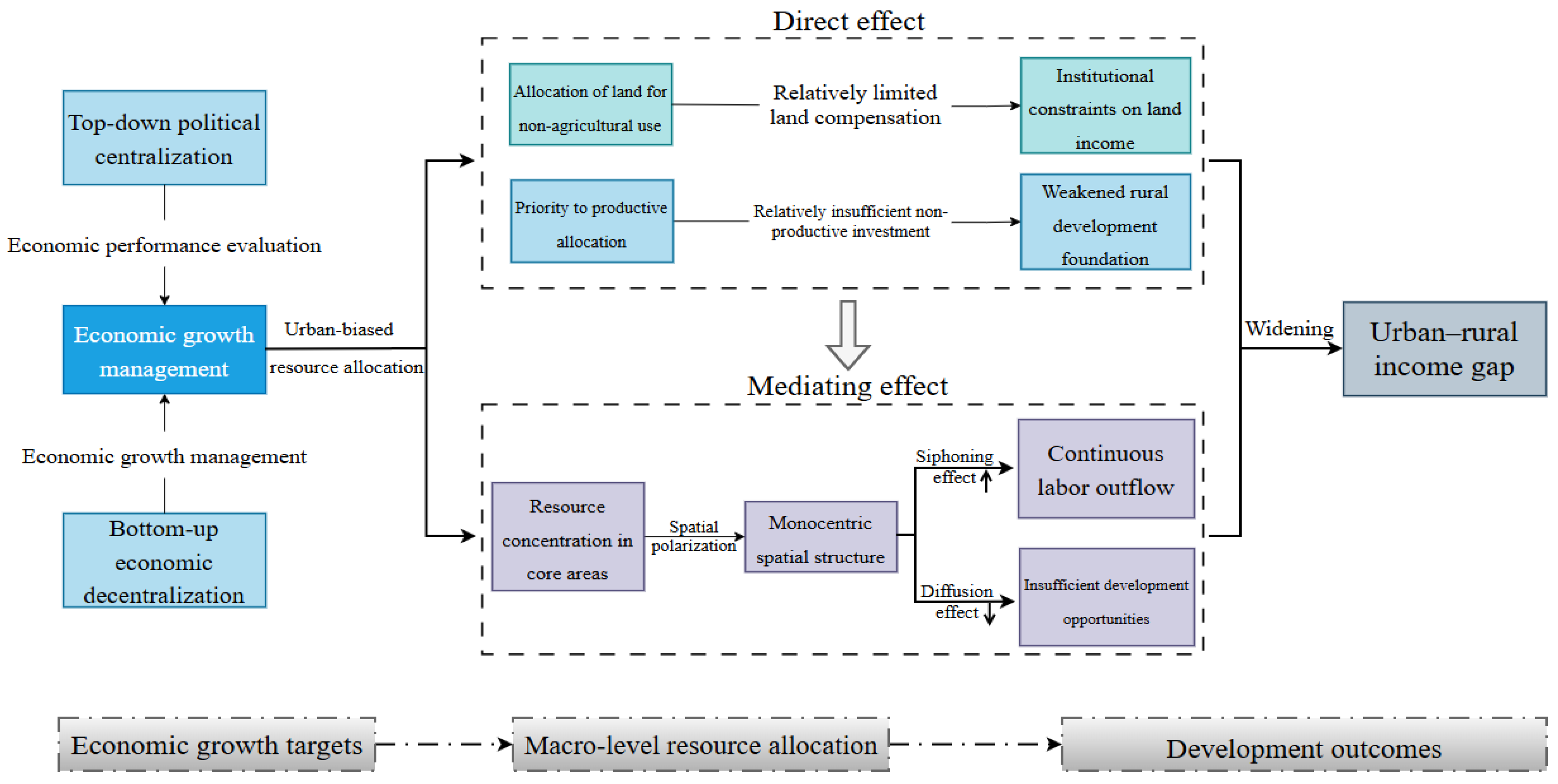
17]. In China, economic growth target management has become an important policy instrument through which local governments promote economic development [
18,
19]. However, under the pressure of economic growth targets, local governments may prioritize resources allocation, such as land and fiscal funds, toward urban non-agricultural sectors in pursuit of faster and more visible economic growth outcomes. Although this process may improve economic performance, it can also generate an urban-biased pattern of resource allocation, thereby widening the urban–rural income gap [
20,
21]. Existing studies have examined the relationship between economic growth targets and the urban–rural income gap from the perspective of urban bias [
21]. This paper differs from these studies in two ways. First, it focuses on economic growth target pressure rather than economic growth targets themselves. Economic growth target pressure captures the extent to which local governments set growth targets above their potential growth capacity, and therefore better reflects additional growth pressure. Second, existing research mainly explains this relationship from the perspective of factor allocation, whereas this paper introduces urban spatial structure and examines how the spatial allocation of development factors reshapes urban monocentricity and affects the urban–rural income gap. Mechanistically, macro-level resource allocation by the government constitutes a key channel of economic growth management; through the spatial allocation of resources, it shapes the evolution of urban spatial structure [
12,
22]. Existing studies have shown that urban spatial structure can affect the urban–rural income gap by shaping factor mobility, industrial agglomeration, and the distribution of development opportunities [
23,
24]. Accordingly, economic growth management may reshape urban spatial structure through macro-level resource allocation and, in turn, influence the urban–rural income gap. However, the transmission chain of “economic growth management–urban spatial structure–urban–rural income gap” has not been systematically examined. Against this background, this paper introduces urban spatial structure into the analytical framework and examines how economic growth target pressure reshapes urban spatial structure and subsequently affects the urban–rural income gap, providing a new analytical perspective for understanding the spatial effects and distributional consequences of government economic management.
The evolution of the urban–rural income gap is profoundly shaped by policy interventions [
4]. For developing countries undergoing transition, macroeconomic management is not only concerned with aggregate growth, but also reshapes urban spatial structure through the allocation of development resources [
17,
19]. Since resource allocation is often expressed spatially, economic growth management may further reshape urban spatial structure and generate distributional consequences. Understanding this spatial mechanism has therefore become an important practical and theoretical issue. Based on this, the study proposes the following research hypothesis: under economic growth target pressure, local governments promote the evolution of urban spatial structure toward monocentricity, thereby widening the urban–rural income gap. Compared with existing studies, the marginal contributions of this paper are mainly reflected in three aspects. First, both economic growth management and the urban–rural income gap are important practical issues facing developing countries, but insufficient attention has been paid to the interaction between them [
21]. Starting from economic growth target pressure, this paper attempts to identify its effect on the urban–rural income gap. Second, by introducing spatial structure as an analytical dimension, this study examines the internal relationships among economic growth target pressure, urban spatial structure, and the urban–rural income gap, thereby providing a new explanatory perspective for understanding the spatial effects of economic growth management. Third, this paper further reveals the spatiotemporal heterogeneity of the mechanism through which economic growth target pressure affects the urban–rural income gap via urban spatial structure, showing that this mechanism varies across development stages and city population scales. This extends the understanding of the heterogeneous distributional effects of economic growth management.
3. Model Construction, Variable Measurement, and Data Description
3.1. Econometric Models
To examine the impact of economic growth target pressure on the urban–rural income gap, this paper constructs the following baseline econometric model:
In Model (1), the subscripts i and t denote city and year, respectively. Theil is the explained variable and measures the urban–rural income gap within each prefecture-level city. Target is the core explanatory variable, representing local economic growth target pressure. The coefficient β1 captures the effect of economic growth target pressure on the urban–rural income gap after controlling for other factors. X denotes a set of city-level control variables, including economic development, industrial structure, openness, fiscal expenditure, technological innovation, and infrastructure conditions. These variables are included to reduce potential omitted-variable bias. μi represents city fixed effects, which control for time-invariant city characteristics, while λt represents year fixed effects, which control for common shocks across years. εit is the random disturbance term.
Kuznets argued that economic development and income inequality may display an inverted U-shaped relationship [
8], while economic growth management serves as an important driving force for economic growth. Accordingly, this study adds the squared term of the core explanatory variable to the model to test whether a nonlinear relationship exists between the explanatory variable and the explained variable. The model is specified as follows:
In Model (2), Target2it is included to test whether the effect of economic growth target pressure on the urban–rural income gap is nonlinear. If β2 is statistically significant, it suggests that the marginal effect of target pressure changes as the level of target pressure increases.
Based on the preceding theoretical analysis, monocentric urban spatial structure may serve as an important transmission mechanism through which economic growth target pressure affects the urban–rural income gap. Therefore, this study uses mediation models for the empirical tests. The models are specified as follows:
Models (3) to (5) jointly constitute the mediation testing framework. Models (3) to (5) jointly constitute the mediation testing framework. Model (3) estimates the total effect of economic growth target pressure on the urban–rural income gap. Model (4) examines whether economic growth target pressure affects the mediating variable M, namely the urban monocentricity index. Model (5) further includes both Target and M to examine whether urban monocentricity remains significant after controlling for target pressure. In addition, this study uses the bootstrap method to estimate the indirect effect and the proportion of the mediating effect, thereby further testing the robustness of the mediation mechanism.
3.2. Variable Definitions
(1) Explained variable: urban–rural income gap (
Theil). The Theil index is adopted to measure the income gap between urban and rural residents. This index effectively captures income distribution inequality and has been widely used in studies of urban–rural income disparities [
4]. The calculation formula is as follows:
Here, Theilit denotes the Theil index of city i in year t. The subscript j = 1, 2 represent the urban and rural resident groups within city i, respectively; y denotes per capita disposable income; and p denotes population.
(2) Core explanatory variable: economic growth target pressure (
Target). Economic growth target pressure is defined as the degree to which the economic growth target set by a local government deviates from its actual economic growth rate. Higher pressure suggests a stronger growth orientation among local governments and a greater tendency to adopt urban-biased resource allocation strategies [
41]. Drawing on existing studies, the average actual economic growth rate over the previous three years is used to represent potential economic growth [
42]. The difference between the annual GDP growth target announced in each city’s Government Work Report and its potential economic growth rate is defined as the “self-imposed additional target level,” which is used to measure local governments’ economic growth target pressure [
21]. Compared with the annual GDP growth target itself, economic growth target pressure better reflects the proactive growth orientation of local governments.
(3) Control variables (X). The control variables include: (a) trade dependence (Trade), measured by the ratio of total regional imports and exports to regional GDP, to capture the level of urban openness; (b) road density (Road), used to measure transportation infrastructure; (c) patent grants per 10,000 people (Patent), representing regional innovation capacity; (d) per capita fiscal expenditure (Fiscal), measured as the ratio of general public budget expenditure to permanent resident population, which captures the government’s capacity for public service provision and redistribution; and (e) the share of the tertiary industry (Service), measured as the proportion of tertiary-industry value added in regional GDP, which reflects the development level of the service sector. These control variables may affect the urban–rural income gap through industrial structure, factor mobility, employment opportunities, and public service provision.
(4) Mediating variable: urban monocentricity index (
M). This study uses the primacy index to measure the degree of monocentricity in urban spatial structure. The urban primacy index reflects the scale advantage of a city’s main center relative to its secondary centers. A higher primacy index indicates a greater concentration of economic activities and population in the main center and a stronger tendency toward a monocentric urban spatial structure [
43].
3.3. Data Sources
The sample consists of 41 cities in the Yangtze River Delta region. A city-level panel dataset is constructed for the period 2007–2023, with administrative divisions standardized according to the 2023 boundaries. As a region with a relatively high level of economic development, a complex urban system, and distinct spatial structural characteristics, the Yangtze River Delta is well suited for examining the relationship among economic growth management, urban spatial structure, and the urban–rural income gap. In addition, prefecture-level cities are the core administrative level connecting provincial strategic deployment with county-level implementation. They also serve as important units through which economic growth targets are transmitted downward. Therefore, this study uses city-level data for empirical analysis.
The data are mainly obtained from the China City Statistical Yearbook, provincial and municipal statistical yearbooks, and statistical bulletins. Specifically, data on economic growth targets are manually collected from the Government Work Reports of prefecture-level cities. Data for measuring spatial structure are derived from nighttime light data. For this variable, this study uses DMSP/OLS stable nighttime light data for 2007–2011, with a spatial resolution of approximately 1 km, and NPP-VIIRS nighttime light data for 2012–2023, with a spatial resolution of approximately 500–750 m. Both datasets are obtained from the Earth Observation Group of the National Centers for Environmental Information, National Oceanic and Atmospheric Administration (
https://ngdc.noaa.gov/eog/download.html, accessed on 6 June 2026). Following existing studies, the nighttime light data are preprocessed through projection transformation, clipping according to prefecture-level cities and their subordinate county-level units, background noise and outlier removal, and resampling. To improve the comparability between DMSP/OLS and NPP-VIIRS data, the two datasets are further harmonized through cross-sensor fitting based on the overlapping period between the two data sources [
44,
45]. On this basis, the urban monocentricity index is measured by the share of the brightest county-level unit in the total nighttime light intensity of the prefecture-level city. Specifically, this study first calculates the total nighttime light intensity of each county-level unit within a prefecture-level city. The county-level unit with the highest value is then identified as the primacy unit. The index equals the primacy unit’s share of the prefecture-level city’s total nighttime light intensity. A higher value indicates that nighttime light intensity is more concentrated in one leading county-level unit, suggesting a stronger monocentric tendency in the urban spatial structure. The descriptive statistics of the main variables are reported in
Table 1.
4. Empirical Results and Analysis
4.1. Baseline Regression Results
The baseline regression results are reported in
Table 2. Models (1) and (2) show that the estimated coefficients of the core explanatory variable are both positive. Model (2), which includes control variables, provides the main baseline evidence. The coefficient of the core explanatory variable is significantly positive at the 5% level, indicating that economic growth target pressure significantly widens the urban–rural income gap. Specifically, the coefficient of Target in Model (2) is 0.0013. Since Target is measured in percentage points, this means that a 1 percentage point increase in economic growth target pressure is associated with a 0.0013 increase in the Theil index. This finding suggests that, under growth target pressure, local governments may allocate limited resources in an urban-biased manner, thereby reinforcing urban–rural income inequality. Hypothesis 1 is therefore supported.
To further examine whether a nonlinear relationship exists between the two variables, Model (3) introduces the squared term without control variables, while Model (4) includes both the squared term and control variables. The results show that the coefficient of the squared term is statistically insignificant regardless of whether control variables are included. This suggests that the effect of economic growth target pressure on the urban–rural income gap does not exhibit significant nonlinearity, further supporting the appropriateness of the baseline model specification.
4.2. Robustness Tests
To test the robustness of the baseline regression results, this study conducts robustness checks from four aspects: replacement of the core explanatory variable, adjustment of the sample, adjustment of the sample period and inclusion of province-year fixed effects. The results are reported in
Table 3.
First, replacing the core explanatory variable. The original variable is replaced by the difference between the city-level economic growth target and the corresponding provincial growth target, which is used to measure the extent to which prefecture-level city governments set growth targets above those of higher-level governments [
46]. For Shanghai, a municipality directly under the central government, the GDP growth target announced by the central government is used as the higher-level growth target. The results of Model (1) show that the estimated coefficient of the alternative explanatory variable remains significantly positive, indicating that municipal governments’ target setting above provincial targets significantly widens the urban–rural income gap, thereby confirming the robustness of the baseline regression results.
Second, adjusting the sample. On the one hand, considering that municipalities directly under the central government and provincial capitals have distinctive characteristics in terms of administrative status, policy authority, and resource allocation capacity, Model (2) excludes Nanjing, Hangzhou, Hefei, and Shanghai, retaining only 37 ordinary prefecture-level cities for regression analysis. The results show that the coefficient of the core explanatory variable remains significantly positive, indicating that the baseline results are not driven by a small number of cities with higher administrative rank. This again confirms the robustness of the baseline results. On the other hand, considering that national new-type urbanization pilot areas may display different development characteristics due to institutional reforms and policy experimentation, Model (3) further controls for the possible influence of the national new-type urbanization pilot policy. Specifically, this study constructs a pilot dummy variable based on the official lists of national new-type urbanization pilot areas. If a city is included in the pilot list, the dummy variable is assigned a value of 1 from the year in which the city was included and for all subsequent years; otherwise, it is assigned a value of 0. By adding this policy dummy variable, the model controls for the potential effect of new-type urbanization pilot policies while retaining the full city–year sample. The results show that the coefficient of the core explanatory variable remains significantly positive, indicating that the baseline conclusion is robust after controlling for the new-type urbanization pilot policy.
Third, adjusting the sample period. Considering that the 2008 global financial crisis may have produced a temporary shock to local economic performance and income distribution, Model (4) adjusts the sample period to 2009–2023 and re-estimates the baseline model. The results show that the coefficient of the core explanatory variable remains significantly positive, further confirming the robustness of the baseline model.
Fourth, including province-year fixed effects. To further control for province-level time-varying factors, such as changes in provincial policies and economic conditions. Model (5) includes province-year fixed effects in the baseline model. The results show that the coefficient of the core explanatory variable remains significantly positive, indicating that the baseline conclusion is still robust after controlling for province-level differences that vary over time.
4.3. Heterogeneity Tests
Changes in the stage of economic development, adjustments in central governance priorities, and differences in regional development foundations may all affect local governments’ resource allocation behavior and the urban–rural income gap. Therefore, the effect of economic growth target pressure on the urban–rural income gap may exhibit significant heterogeneity. On this basis, heterogeneity is examined from both temporal and regional dimensions.
4.3.1. Temporal Heterogeneity
In the temporal heterogeneity test, this study uses 2012 as the dividing point and splits the sample into two periods: 2007–2011 and 2012–2023. This division is based on the following considerations. On the one hand, after 2012, China’s economic growth rate gradually declined to below 8%, and the economy began to transition toward high-quality development [
47]. On the other hand, central governance priorities underwent notable adjustment after 2012. Policies such as targeted poverty alleviation and rural revitalization were successively promoted, and urban–rural integration development became increasingly important in macro-level policy agendas. These changes may have affected local governments’ economic growth target setting and resource allocation patterns, thereby altering the intensity of the effect of economic growth target pressure on the urban–rural income gap.
Models (1) and (2) in
Table 4 report the regression results for the two periods, respectively. The coefficients of the explanatory variable are significantly positive in both periods, indicating that economic growth target pressure widens the urban–rural income gap across different stages. However, compared with 2007–2011, the estimated coefficient of the core explanatory variable declines markedly in 2012–2023, suggesting that the widening effect of economic growth target pressure on the urban–rural income gap has weakened. Possible explanations are as follows. First, since the 18th National Congress of the Communist Party of China, the performance evaluation system for local officials, which previously emphasized economic growth as a key indicator, has been adjusted. Indicators related to livelihood development have since received greater weight in evaluation [
48]. This helps mitigate urban-biased resource allocation and restrain the widening of the urban–rural income gap. Second, coordinated urban–rural development has gradually become a shared governance priority among central and local governments. Macro-level policies such as poverty alleviation and rural revitalization since the 18th National Congress have effectively mitigated urban–rural development inequality and narrowed the urban–rural income gap. Overall, the effect of economic growth target pressure on the urban–rural income gap remains positive, but its magnitude has declined in the later period.
4.3.2. Regional Heterogeneity
In the regional heterogeneity test, this study divides the sample by province. This division is mainly based on the fact that provinces in the Yangtze River Delta differ substantially in economic development level, urban–rural industrial structure, labor mobility, and public service provision. These differences may affect local governments’ resource allocation patterns, leading to regional heterogeneity in the effect of economic growth target pressure on the urban–rural income gap. Compared with Jiangsu and Zhejiang, Anhui has a relatively lower level of economic development, weaker rural industrial foundations, and more limited labor transfer capacity. As a result, its urban–rural income gap may be more vulnerable to urban-biased resource allocation.
The results of the regional heterogeneity analysis are reported in Models (3), (4), and (5) of
Table 3. Given Shanghai’s small sample size, its regression results are not reported separately. The coefficients of the core explanatory variable show clear differences across Anhui, Zhejiang, and Jiangsu. Specifically, in column (3), the estimated coefficient for Anhui is significantly positive and relatively large, indicating that the widening effect of target pressure on the urban–rural income gap is more pronounced in Anhui. In column (4), the estimated coefficient for Zhejiang is negative but insignificant. In column (5), the estimated coefficient for Jiangsu is significantly negative. These results suggest that the impact of economic growth target pressure on the urban–rural income gap exhibits clear regional differences. One possible explanation is that Anhui has a relatively weak rural industrial foundation, limited non-agricultural employment absorption capacity, and insufficient capacity for rural labor transfer to urban areas. As a result, the gains from economic expansion accrue mainly to urban sectors, while rural areas are less able to benefit from them, resulting in a larger urban–rural income gap. The negative but insignificant coefficient for Zhejiang suggests that growth target pressure may have a weaker widening effect in regions with more developed private economies and stronger urban–rural linkages, but the evidence is not statistically robust. The significantly negative coefficient for Jiangsu requires further explanation. In Jiangsu, growth target pressure may not necessarily lead to a purely urban-biased allocation of resources. Due to its stronger county-level economy and developed township industries, local governments may rely more on county-level industrial platforms and township enterprises to achieve growth targets. This process can expand non-agricultural employment and income opportunities for rural residents, allowing rural areas to share more of the gains from local economic growth. Therefore, growth target pressure in Jiangsu may narrow the urban–rural income gap. However, this explanation remains tentative and requires further examination in future research.
4.4. Mechanism Tests
4.4.1. Mediation Effect Test
The preceding theoretical analysis suggests that economic growth target management may affect the urban–rural income gap by reshaping urban spatial structure. In
Table 5, the coefficient of the explanatory variable in Model (1) is significantly positive, indicating that economic growth target pressure has a significant total effect on the urban–rural income gap. Model (2) examines the effect of the core explanatory variable on the mediating variable. The result shows that economic growth target pressure has a significantly positive effect on the primacy index, suggesting that it increases urban primacy and reinforces the trend toward monocentric development. When both economic growth target pressure and the primacy index are included in Model (3), the regression coefficient of the core explanatory variable decreases but remains significant, while the coefficient of the primacy index is significantly positive. This indicates that monocentric urban spatial structure plays a partial mediating role in the effect of economic growth target pressure on the urban–rural income gap.
The regression results are consistent with the theoretical hypotheses, showing that under economic growth target pressure, local governments tend to allocate fiscal expenditure, infrastructure, and other development resources toward core urban areas. This helps strengthen their capacity to maintain stable economic growth, while also promoting the evolution of urban spatial structure toward a monocentric pattern. An increase in the primacy index indicates that population, industrial activity, and public resources are increasingly concentrated in the core area. However, when urban–rural benefit-sharing mechanisms remain underdeveloped, rural areas have difficulty fully sharing the agglomeration benefits generated by central urban areas, leading to a larger urban–rural income gap. Existing studies show that spatial structure significantly affects urban–rural income distribution, and that polycentric development generally helps narrow the urban–rural income gap [
49]. Accordingly, when factors are excessively concentrated in core urban areas and diffusion mechanisms remain insufficient, a centralized spatial pattern may further enlarge the urban–rural income gap [
24]. Therefore, economic growth target pressure not only directly widens the urban–rural income gap, but also reinforces this effect by promoting the evolution of urban spatial structure toward monocentricity. Thus, Hypothesis 2 is supported.
To further examine the mediating effect, this study conducts a bootstrap test. The estimated indirect effect through urban monocentricity accounts for approximately 23.077% of the total effect. The bootstrap test further confirms the robustness of the mediating effect. This finding indicates that urban spatial structure, represented by the primacy index, constitutes an important transmission channel through which economic growth target pressure affects the urban–rural income gap, highlighting the importance of optimizing urban spatial structure for promoting urban–rural integration during the transition period.
4.4.2. City Size Heterogeneity in the Spatial Structure Transmission Mechanism
The effect of urban spatial structure on the urban–rural income gap is not fixed; rather, it may be closely related to differences in city size and other urban characteristics [
50]. To further identify the heterogeneous characteristics of the mechanism through which economic growth target management affects the urban–rural income gap via the urban spatial structure, cities are classified according to the Notice of the State Council on Adjusting the Standards for City Size Classification issued in 2014. Following this official classification, this study uses 5 million permanent residents as the threshold and divides the sample into two groups: cities with fewer than 5 million permanent residents, including small, medium-sized, and large cities; and cities with 5 million or more permanent residents, including megacities and super-megacities. Mediation effect tests are then conducted separately for the two groups, and the regression results are reported in
Table 6. The results show that the spatial structure transmission mechanism is mainly observed in cities below the megacity threshold, while it is not significant in megacities and super-megacities. Specifically, in the megacity and super-megacity sample, the effects of economic growth target pressure on both the urban–rural income gap and the primacy index fail to pass the significance test, indicating that urban spatial structure does not produce a significant mediating effect in this group. By contrast, in the sample of cities with fewer than 5 million residents, economic growth target pressure not only significantly widens the urban–rural income gap, but also significantly increases the primacy index. After the mediating variable is included, the coefficient of the primacy index is significantly positive, indicating that monocentric spatial structure plays a partial mediating role. This difference may arise from disparities in resource endowments and spatial development across cities of different sizes. On the one hand, cities below the megacity threshold have relatively limited fiscal and industrial resources. Under economic growth target pressure, local governments have stronger incentives to concentrate resources in core urban areas, reinforcing urban monocentricity and enlarging the urban–rural income gap [
19]. On the other hand, secondary centers in these cities are relatively underdeveloped, and their industrial division of labor, transport linkages, and factor mobility networks remain relatively weak. As a result, the agglomeration benefits of central urban areas are less likely to diffuse to surrounding rural areas, further enlarging the urban–rural income gap [
24].
5. Discussion
The urban–rural income gap is a persistent issue in economic and social development. It is closely related to urban–rural integration development and overall social stability [
6]. Based on a sample of cities in China’s Yangtze River Delta, this study examines the mechanism through which economic growth target pressure affects the urban–rural income gap via urban spatial structure. The empirical results show that excessive economic growth target pressure may widen the urban–rural income gap, and that monocentric urban spatial structure plays a partial mediating role in this process. The findings provide useful implications for developing countries seeking to promote economic growth and advance urban–rural coordination.
First, economic management measures should be applied rationally to balance growth guidance with urban–rural coordinated development. From a global perspective, especially in developing countries, setting economic growth targets to promote economic growth is a common governance practice [
17]. Economic growth provides an important foundation for increasing the income of both urban and rural residents. Therefore, developing countries should not simply reject necessary government guidance over economic development. However, economic management should not continue to follow an urban-biased path that merely pursues short-term growth performance [
51]. Governments should base policy design on local development stages and resource endowments, coordinate urban–rural public service provision and industrial layout, provide greater support for rural education and related fields, and strengthen the bridging role of small and medium-sized towns in connecting cities and rural areas. In this way, economic growth and urban–rural integration development can be better aligned.
Second, urban spatial structure should be optimized according to local conditions so as to balance the dual objectives of economic growth and coordinated urban–rural development. Existing research indicates that, under certain conditions, a monocentric spatial structure can strengthen agglomeration externalities, promote the concentrated allocation of factors, and improve economic growth performance [
22,
31]. However, when the concentration of development resources in central urban areas exceeds an optimal threshold, it may constrain the development space of rural and peripheral areas and thus widen the urban–rural income gap. Notably, this effect varies across city types. The findings of this study also show that the transmission mechanism whereby economic growth target pressure strengthens monocentric spatial structure and further widens the urban–rural income gap is more pronounced in small and medium-sized cities. Therefore, the selection and adjustment of urban spatial organization should fully consider city size and the stage of economic development, avoid an indiscriminate pursuit of a single spatial model detached from local realities, and achieve coordination between growth efficiency and distributive equity.
Third, the performance evaluation system for local governments should be improved, shifting from a priority on development speed toward greater emphasis on coordination and sharing. In the current governance system, growth-oriented performance evaluation remains a strong constraint, and economic growth continues to serve as an important reference for local officials’ incentives and promotion assessment [
18]. In this context, an excessive emphasis on GDP and growth rates may reinforce short-term, observable performance-oriented behavior, driving urban-biased resource allocation and exacerbating urban–rural development imbalance [
25]. Therefore, the performance evaluation mechanism should be enhanced through a more scientific design of indicators. The weight of aggregate economic and growth rate indicators should be moderately reduced, while greater importance should be attached to indicators such as employment quality, social security, ecological civilization construction, public service provision, and urban–rural integration development. Such reforms can guide local governments to shift their development focus toward long-term development capacity and livelihood improvement, thereby mitigating, at the institutional level, the widening effect of economic growth target pressure on the urban–rural income gap.
This study empirically examines the mechanism through which economic growth target pressure affects the urban–rural income gap and offers implications for optimizing economic management practices. Nevertheless, due to data limitations and other constraints, several issues warrant further investigation. First, growth pressure is measured as the difference between economic growth targets and potential growth levels. This measurement focuses on the effect of growth pressure on the urban–rural income gap, but it does not fully capture government orientations toward multidimensional governance objectives, such as social development, ecological protection, and public service provision. In addition, due to the difficulty of obtaining consistent city-level data on land-related fiscal revenue, land finance is not included as a control variable in the empirical model. Future research may further address this issue when more complete data become available. Second, this study mainly focuses on the role of urban spatial structure, while devoting limited analysis to inter-city factor flows and spatial spillover effects. Future research could employ spatial econometric methods to examine the regional linkage effects of economic growth target pressure. Finally, the empirical analysis mainly relies on city-level statistical data. As a result, the specific operational process of the transmission mechanism linking economic growth target pressure, monocentric spatial structure, and the urban–rural income gap still lacks support from contextual empirical materials. Future research could incorporate typical case studies to further investigate the concrete mechanisms among economic growth target setting, spatial structure adjustment, and urban–rural income differentiation across different city types.
6. Conclusions
How to scientifically narrow the urban–rural income gap and promote coordinated urban–rural development has become a common issue faced by developing countries. Based on city-level panel data from the Yangtze River Delta region for the period 2007–2023, this study systematically examines the effect of economic growth target pressure on the urban–rural income gap and the mediating role of urban spatial structure. The main findings are as follows. First, based on the baseline model, empirical results indicate that economic growth target pressure significantly widens the urban–rural income gap, confirming that excessive growth pressure can exacerbate income disparities. Second, based on the heterogeneity analysis, this effect exhibits notable temporal and regional heterogeneity: it diminishes over time and is weaker in more-developed regions, while remaining pronounced in less-developed regions. Third, based on the mediation effect analysis, urban spatial structure, particularly the degree of monocentricity, partially mediates the effect of growth target pressure. This mechanism also exhibits heterogeneity across city population sizes: it is more pronounced in smaller cities and not significant in larger cities, highlighting how local urban configuration influences the distributional impact of growth-oriented policies. These findings suggest that economic growth management not only serves as an important tool for promoting economic development, but also affects the income distribution pattern. For developing countries, balancing economic growth with coordinated urban–rural development and social equity remains a key challenge in achieving long-term, stable development.