1. Introduction
Cities rely on key workers during periods of crisis. Yet, the housing market often makes it difficult for these workers to live close to the places where their services are needed. The COVID-19 pandemic made this tension especially clear. Health workers, teachers, carers, police, firefighters, delivery workers and other essential service workers helped keep urban life functioning, but many continue to face high housing costs and long commutes. This concern has also been recognised in the key worker housing literature, which shows that essential service workers often face affordability constraints in high-cost urban housing markets [
1,
2,
3].
Auckland, New Zealand, provides a useful setting for examining this issue. As the country’s largest metropolitan area, Auckland faces persistent housing affordability pressures, a clear urban rent gradient, and a concentration of employment and essential services around major urban centres. These conditions make the trade-off between accessibility and housing costs especially visible. In bid rent theory, households are expected to balance housing costs against accessibility to central locations and employment opportunities [
4]. For key workers in health, education, care, policing, and emergency services, this trade-off is particularly important because many of their jobs are tied to fixed work locations. Unlike workers whose employment locations may change more easily, key workers often need to serve specific hospitals, schools, care facilities or public service sites. However, areas close to these employment centres are often expensive rental areas. The question is therefore not simply whether key workers can afford housing but whether the urban land market allows them to live in locations that optimally match the spatial demands of their work.
This issue becomes more complex when households have more than one worker. A single job or commute rarely determines residential location. In dual-earner and multi-worker households, the choice of where to live must balance several practical constraints, including different workplaces, working hours, transport options, household income, and rental costs. Earlier studies of two-worker households show that residential location decisions can be shaped by the joint location of workplaces, commuting costs, and work hour constraints [
5,
6]. A household may choose a location that reduces one worker’s commuting burden while increasing another’s. It may also accept a longer commute in exchange for lower rent, larger housing or better access to family and community support. These trade-offs are central to understanding how key workers position themselves within the urban rental market.
This study draws on bid rent theory and Crane’s [
7] model of job location uncertainty to examine how employment stability, commuting burden and time pressure are associated with residential location outcomes in Auckland’s rental market. The conceptual framing recognises that residential location decisions often reflect trade-offs across multiple workers within the same household. Using distance to the Auckland CBD as the main spatial reference point, the analysis examines whether key worker status, working hours, commuting mode and household employment structure are associated with different rent distance gradients. The empirical analysis is therefore best understood as a reduced form analysis of observable rental location patterns, rather than a full structural model of household optimisation. In this way, the paper connects bid rent theory and job location uncertainty with worker level evidence on residential positioning within Auckland’s private rental market.
Using microdata from New Zealand’s Integrated Data Infrastructure (IDI), the study examines how working households are distributed across Auckland’s private rental market. The analysis first examines whether workers with greater job location certainty, proxied by key worker status, exhibit different rent distance gradients. It then investigates whether commuting uncertainty, reflected through work hour pressure and transport mode, is associated with residential location outcomes. Finally, the study examines whether household employment structure, measured by the number of employed workers within a household, is associated with differences in rent levels and rent distance gradients. This design allows the paper to examine how employment characteristics, commuting conditions and household structure are associated with residential positioning within Auckland’s urban rent gradient.
The study contributes to the literature in three main ways. First, it extends the bid rent literature by incorporating key worker job location uncertainty and time pressure into residential location analysis. Second, it shifts attention from the abstract household to the practical realities of multiple-worker households, where residential decisions must balance multiple commutes and work schedules. Third, it provides empirical evidence from Auckland, a high-cost city where housing affordability pressures and essential service provision are closely connected. The findings suggest that workers with more stable job locations, proxied by key worker status, are associated with a flatter rent distance gradient, indicating a lower observed rental premium for CBD proximity. By contrast, workers under greater time pressure, especially those working longer hours, show a steeper rent-distance gradient. This pattern remains evident among private vehicle commuters, suggesting that time pressure, rather than transport mode alone, is relevant to residential location outcomes. In addition, workers residing in two-worker and three-worker households pay higher rents than those residing in single-worker households, while two-worker households exhibit a flatter rent-distance gradient. Together, these findings suggest that both worker-level employment characteristics and household employment structure are associated with residential positioning within Auckland’s rental market.
The paper proceeds as follows.
Section 2 reviews the literature on bid rent theory, job location uncertainty and residential location choice.
Section 3 develops the conceptual framework and hypotheses.
Section 4 describes the data and empirical strategy.
Section 5 presents and discusses the empirical results.
Section 6 concludes by considering the implications for housing policy, land-use governance and the spatial accessibility of key workers in high-cost cities.
2. Literature Review
The origins of residential location modelling can be traced to von Thünen’s [
8] “isolated state” model, which showed how transportation costs shape land use and production locations in an agricultural economy. Central to this model is the bid rent concept, whereby land is allocated to the user willing to pay the highest rent at a given location. Alonso [
4] later extended this idea to urban residential location decisions by modelling how individuals and households choose where to live within a monocentric city. In this framework, households balance expenditure on housing, non-housing consumption, land consumption and distance from the city centre. Subsequent work, especially after the development of discrete choice models by McFadden [
9], sought to estimate how residential location decisions are influenced by household characteristics and place-based attributes, including the built environment, socioeconomic conditions, points of interest, and accessibility [
10,
11,
12,
13,
14].
However, residential location choice is rarely made with complete certainty. As Train [
15] notes, it is difficult to model all the attributes decision-makers face, and important factors are often omitted. Housing decisions are shaped by uncertainty over future price expectations, household circumstances and wider economic and social conditions [
16]. Maclennan [
17] proposed a behavioural framework that identifies several sources of housing market uncertainty, including imperfect information, uncertain search behaviour and changing demand. Yet their framework provides limited guidance on how to measure such uncertainty in empirical models of residential location choice [
18]. Yiu [
19] responded to this challenge by classifying housing-related uncertainty into four measurable dimensions: income, housing user costs, transportation costs, and neighbourhood externalities.
Amongst various uncertainties, job-related uncertainty is particularly relevant for workers deciding where to live. Kan [
20] shows that households with different levels of risk aversion have different propensities to move. More directly, workers face uncertainty about future employment and job locations when making residential decisions [
21]. Earlier studies have examined the role of job location uncertainty in residential mobility and commuting behaviour. Andrulis [
22] incorporated job location uncertainty into a model of household moving probability, while Crane [
7] directly examined how future job location uncertainty influences commuting behaviour. Hatamzadeh et al. [
23] further examined how workers with flexible and fixed schedules differ in their commuting behaviour, particularly with respect to walking as a mode of transport. These studies show that employment uncertainty can shape residential and commuting decisions, but they do not fully explain how workers with more spatially fixed jobs respond to urban rent gradients.
Recent research has shown that residential location choice is shaped by accessibility, affordability and urban structure. He and Zhang [
24], in their study of Beijing, show how residential movement between the city centre and suburbs reflects broader processes of suburbanisation and urban redevelopment. Their findings suggest that individuals with higher economic and cultural capital are more likely to remain in, or move to, central locations. Marwal and Silva [
25] use an agent-based model to examine how city affordability affects residential location choice and highlight the importance of urban form, land use, and accessibility in shaping sustainable residential outcomes. These studies reinforce the view that residential choice is not simply a private housing decision. It is also structured by the spatial organisation of cities and the affordability of accessible locations.
A related body of work examines how commuting costs and transport accessibility affect residential location choice. In household utility models, commuting costs are often incorporated under different assumptions about transport costs, accessibility and travel behaviour [
26,
27,
28,
29]. Other studies have examined uncertainty in commuting expenses across different transport modes, including private cars and public transport [
30]. Car ownership also matters because households without cars respond differently to transport infrastructure and accessibility conditions [
31,
32]. Glaeser et al. [
33] show that public transport accessibility can influence low-income workers’ decisions to live in the inner city. Bürgle [
34] similarly suggests that households without cars tend to prefer locations with high population accessibility. However, much of the literature does not distinguish key-worker households, nor does it fully consider how employment conditions interact with commuting constraints.
Residential location choice models also commonly include individual and household attributes such as income, social class, ethnicity and preferences [
35,
36]. Zhang et al. [
37] show that traffic congestion can influence where people live as individuals may choose locations that reduce commute times, even if this involves other residential trade-offs. Wang and Ozbilen [
38] examine teleworking, residential location choice and travel time allocation, showing that telework can reduce travel time, although only up to certain thresholds. Yet work hours remain under-examined in the residential location literature. Some studies include work hours as a constraint within household utility functions [
5,
39], but fewer studies estimate directly how working hours shape residential location outcomes. Madden [
6], in a study of two-worker households, found that uncertainty about work hours affects residential location decisions and that the location of the husband’s job plays a strong role in determining household location. This points to the importance of time pressure in household residential decisions.
Building on the literature, the present study examines how job location certainty, commuting burden and work hours are associated with residential location outcomes in Auckland’s rental market. The conceptual framing is household-based, since residential location decisions are likely to reflect trade-offs across multiple workers. However, given the limits of the available data, the empirical analysis is best understood as a reduced-form analysis of observable rent-distance patterns. The study does not directly observe the full household decision-making process, nor does it reconstruct the complete workplace geography of all household members. Instead, it uses worker-level observations within rental households to examine whether key worker status, commuting mode and working hours are associated with different rent-distance gradients relative to the Auckland CBD. This framing connects bid rent theory and job location uncertainty to observed residential outcomes while remaining cautious about the limits of the available data.
3. Development of Hypotheses
The residential location of working households reflects practical trade-offs among housing costs, workplace access, transport constraints and household needs. In standard residential location theory, workers and households balance the value of accessibility against the cost of housing. In practice, this decision is made with uncertainty. Workers may face uncertainty about future income, housing costs, transport costs, workplace locations and neighbourhood conditions [
40,
41,
42,
43]. Existing studies have examined several forms of uncertainty in residential location choice [
32,
44,
45], often distinguishing between economic and non-economic determinants [
46,
47]. Kim et al. [
27], using Oxfordshire, United Kingdom, as a case study, show that uncertainty about housing status and local amenities, including school quality, can affect residential decision-making. More recent studies have extended this line of research to specific population groups, including older residents, migrants, retirees and occupants of subsidised housing [
48,
49,
50,
51,
52]. Frenkel et al. [
53], in their study of knowledge workers in Tel Aviv, further show that commuting time and housing price uncertainty can shape preferences for metropolitan centre and inner ring locations.
Job location uncertainty is especially relevant to workers deciding where to live. Crane [
7] developed a household utility model in which uncertainty over future workplace location affects commuting behaviour and residential location choice. In this model, workers consider not only their current commute but also the possibility that their workplace may change in the future. Building on this approach, Parenti and Tealdi [
54] incorporated job change probability and commuting costs into the analysis of interregional commuting. This study draws on the same logic to consider how employment stability, commuting burden and time pressure may be reflected in workers’ observed residential locations within Auckland’s rental market.
The empirical analysis is framed as a reduced-form worker-level analysis rather than a full structural household location choice model. The study does not reconstruct the complete workplace geography, employer structure or occupational composition of all household members. Instead, it examines whether workers identified as key workers within rental households display different residential positions relative to the Auckland CBD, after controlling for observed worker, dwelling and neighbourhood characteristics. The estimated key worker effect should therefore be interpreted as a composite association that may reflect job location stability, employer geography, transport accessibility and household coordination.
This framing is particularly relevant for key workers. Key workers are often employed in sectors such as health, education, care, policing and emergency services, where jobs may be more spatially fixed than those of other workers. In this study, key worker status is used as a proxy for higher job location certainty. Workers with more certain job locations may have less need to locate close to the CBD as a hedge against future workplace changes. By contrast, workers with less certain job locations may place greater value on central or accessible locations because such places provide broader access to potential employment opportunities. Therefore, in a single centre Auckland setting, key workers are expected to display a weaker rental premium for CBD proximity than comparable non-key workers. Thus, we hypothesise the following:
H1. Ceteris paribus, workers with greater certainty about their job location, proxied by key worker status, are associated with a flatter rent-distance gradient from the Auckland CBD, indicating a lower observed willingness to pay a rental premium for central proximity.
Furthermore, the study examines how commuting burden and time pressure are associated with workers’ observed residential locations within Auckland’s rental market. Commuting mode has been widely examined in the transportation studies literature regarding how transport access, travel costs, and mode choice affect residential location outcomes [
55,
56,
57,
58]. Workers who rely on public transport may face higher effective commuting costs when services are limited, indirect or unavailable outside standard operating hours. Private vehicle commuters may have greater flexibility, but they may still face substantial time costs, congestion, parking costs and fatigue from long journeys.
Working hours add another important dimension to this decision. Previous studies have shown that work time and commuting time are closely related to residential location choice and travel behaviour [
59,
60,
61]. Workers with longer hours have less discretionary time and may therefore place greater value on reducing commuting burdens. This is particularly relevant in Auckland, where distance from the CBD can lead to longer, less predictable travel times. In a reduced-form empirical setting, longer working hours can therefore be interpreted as a proxy for stronger time pressure. Workers under greater time pressure are expected to place greater value on central or accessible locations as living closer to the CBD may reduce the time and uncertainty associated with commuting. Thus, we hypothesise the following:
H2. Ceteris paribus, households facing higher commuting uncertainties (i.e., indicated by key workers with long work hours who may be unable to use public transport at night) are more inclined to pay a rental premium to live closer to the Auckland city centre.
In addition to worker-level employment characteristics, residential location choices may also be influenced by household employment structure. Residential decisions are frequently made jointly by household members rather than by individual workers alone. As the number of employed workers within a household increases, residential location decisions may need to accommodate multiple workplace locations, commuting requirements and scheduling constraints simultaneously.
Households with more employed workers may also possess greater effective earning capacity, which can influence housing expenditure and residential choice. Previous studies have shown that income is positively associated with housing consumption and residential accessibility because higher-income households are generally able to compete for more desirable locations and higher-quality housing [
4,
9]. At the same time, multiple-worker households may face greater coordination requirements because residential locations must balance the accessibility needs of several workers rather than a single commuter [
6,
62]. Consequently, household employment structure may influence both the level of rent paid and the shape of the rent distance gradient. Households with different employment structures may therefore exhibit different residential positioning patterns within Auckland’s rental market. Thus, we hypothesise the following:
H3. Ceteris paribus, households with a greater number of employed workers are associated with higher rents and different rent-distance gradients than single-worker households.
4. Research Design
4.1. Data
The data for this study are drawn from the Integrated Data Infrastructure (IDI), a large research database managed by Statistics New Zealand (Stats NZ). Integrated Data Infrastructure is a large research database. It holds microdata about people and households. The data is about life events, such as education, income, benefits, migration, justice, and health. It comes from government agencies, Stats NZ surveys, and non-government organisations (NGOs). The data is linked together, or integrated, to form the IDI. There are tight broad categories of data, namely, health, education and training, benefits and social services, justice, people and communities, population, income and work, and housing in the IDI [
63]. The IDI links deidentified information on individuals and households in New Zealand from government agencies, Stats NZ surveys, and non-governmental organisations [
64]. Further details on the IDI data structure and processing procedures are provided in
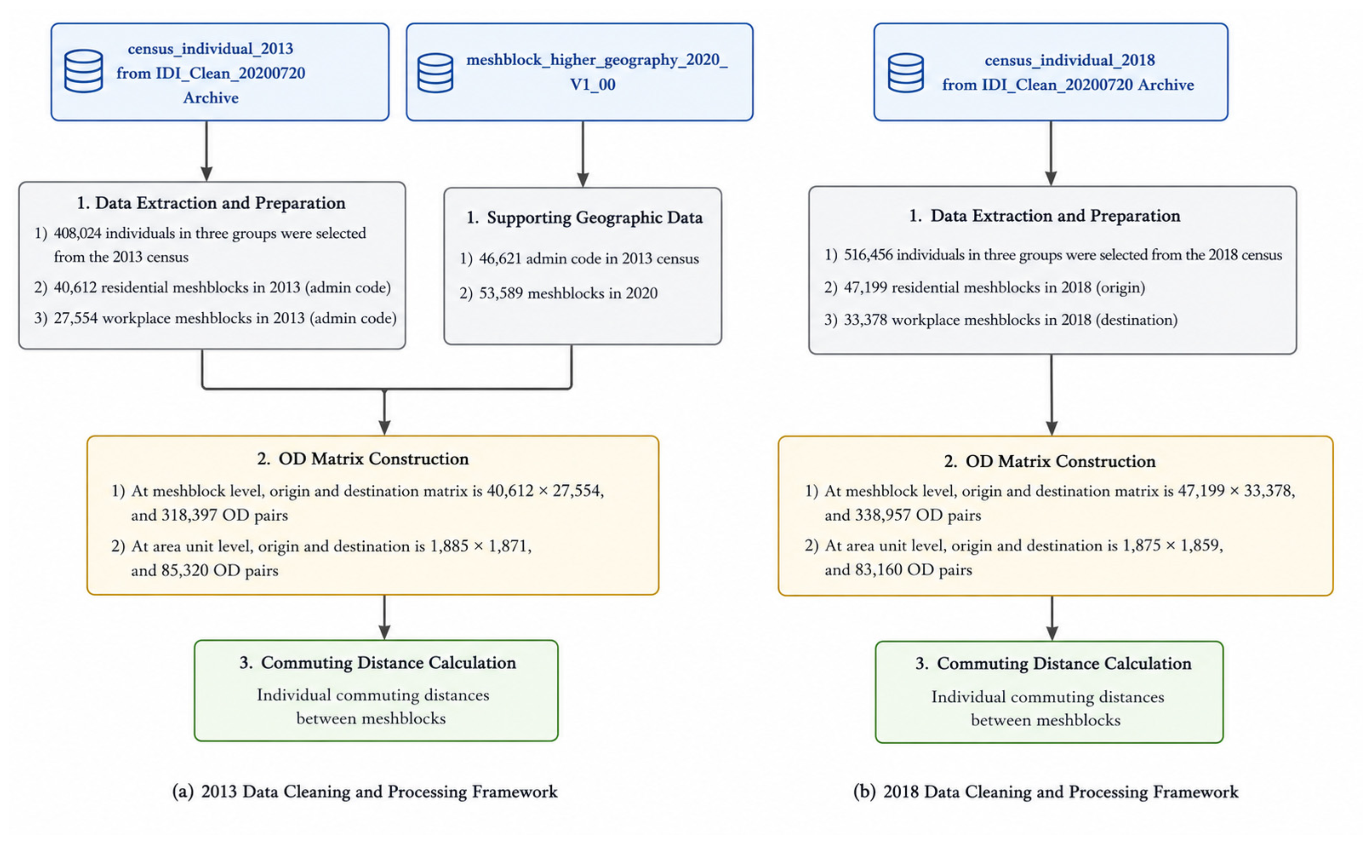
Appendix A. This study uses individual-level microdata from the 2013 and 2018 population censuses, combined with meshblock-level geographic information available through the IDI.
These data provide detailed information on workers’ residential location, occupation, income, household characteristics and relevant dwelling and neighbourhood attributes. Although some workplace geography information is available for descriptive purposes, the approved analytical extract does not permit precise workplace or employer addresses to be linked to household rental records at the level required to estimate individual home to work commuting distance. Accordingly, the empirical design focuses on workers’ residential positioning within Auckland’s urban rent gradient, rather than on realised commuting distance. The main rent gradient models therefore use residential distance from the worker’s dwelling meshblock to the Auckland CBD as a measure of central accessibility and metropolitan land rent positioning. This measure should be interpreted as a proxy for exposure to the Auckland CBD rent gradient, not as a direct measure of each worker’s commute.
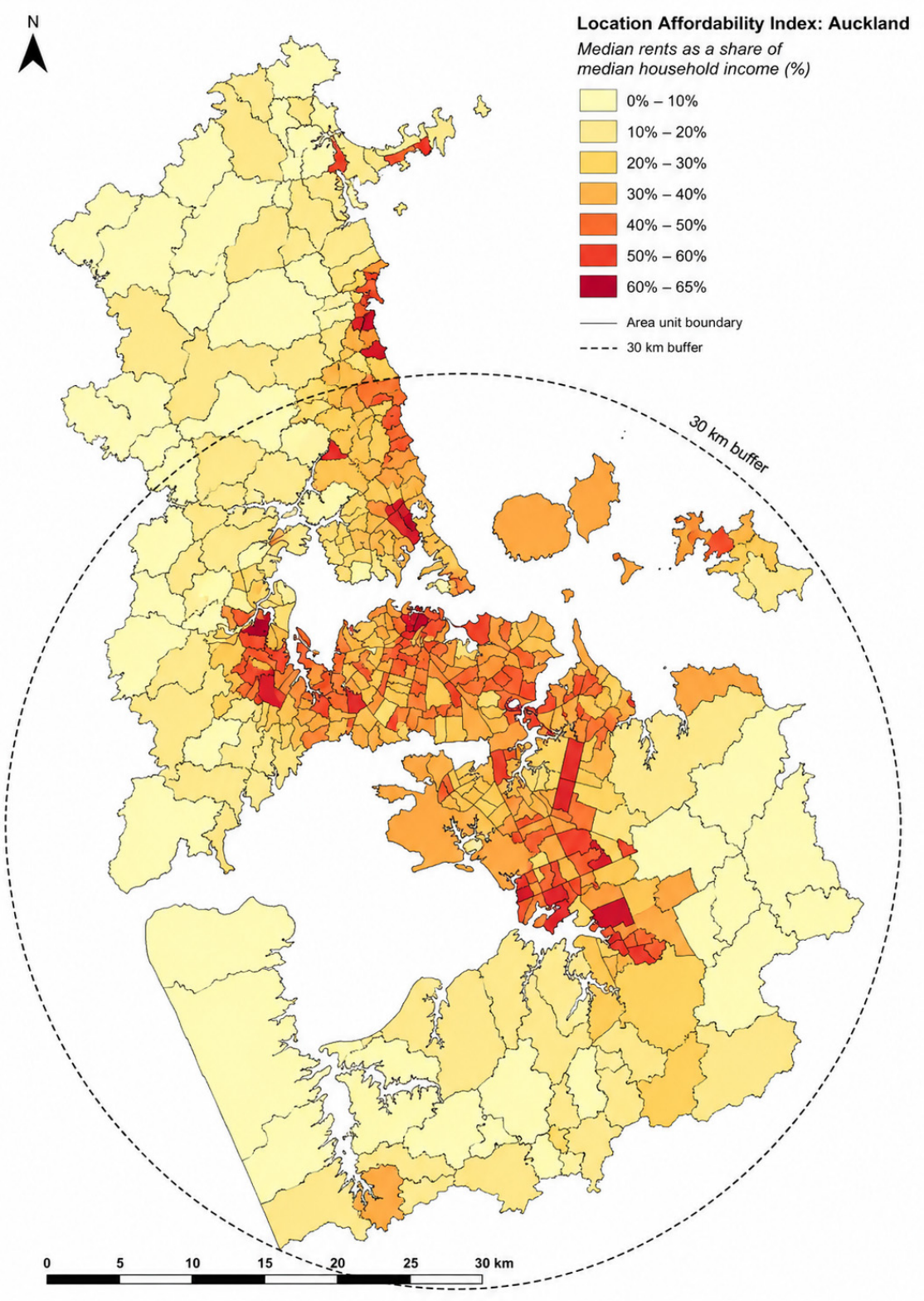
Figure 1 presents the Auckland study area and the defined buffer around the Auckland city centre used for the empirical analysis.
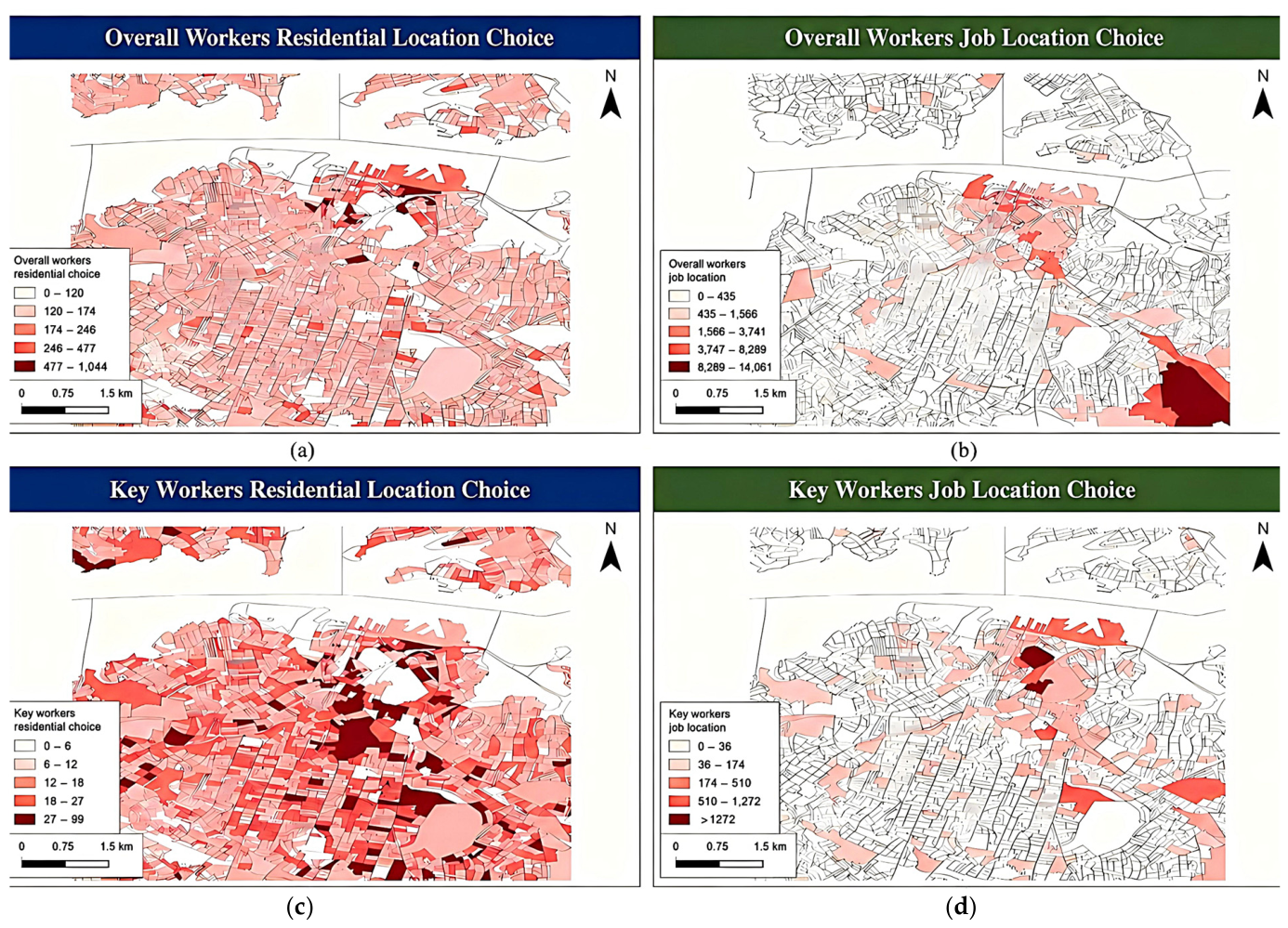
The IDI provides a major advantage for this study because it links micro-level information on individuals, households, employment, income, and location. This allows examination of how multiple factors combine to shape residential outcomes, rather than treating workers or households as isolated observations. The linked structure of the data also allows the analysis to capture variation across population groups and census years. The geographical distributions of the residential and job locations of key workers are presented in
Appendix B, which provides additional spatial context for interpreting the commuting patterns and location-based differences examined in the analysis.
To align the empirical sample with the study’s theoretical focus, the dataset is restricted to workers living in households with no more than 3 employed members. The analysis is further limited to workers renting privately owned dwellings in the Auckland region. These restrictions ensure that the empirical sample is relevant to the study’s focus on rental affordability, worker location choices, and household employment structure.
Table 1 reports the descriptive statistics for the variables used in the analysis. The final analytical sample contains 175,810 observations.
All monetary variables are measured in nominal New Zealand dollars. As the analysis pools observations from the 2013 and 2018 census years, the empirical models include a census year dummy to account for time specific changes in nominal rent levels, including inflation and broader Auckland rental market conditions. The year dummy should therefore be interpreted as capturing average differences between census years, rather than inflation alone.
The average weekly rent in the analytical sample is NZD 513.54. Weekly rents above NZD 3000 are excluded from the analysis as outliers. The mean residential distance from the Auckland CBD is 7.52 km, with a standard deviation of 5.83 km, indicating considerable variation in residential location across workers. A distance value of 0 indicates that the worker’s residential meshblock is located at, or coincides with, the defined city centre meshblock. Observations located more than 100 km from the Auckland CBD are excluded from the study.
The IDI census data report income in 14 income bands rather than as exact income values. Following standard practice, this study uses the midpoint of each income band as a proxy for annual income, as shown in
Table 2. The income variable refers to the annual income associated with the observed worker-level record linked to the rental household within the IDI. It therefore does not represent pooled household income, the income of the highest earner, or total household purchasing power. Instead, the variable should be interpreted as an individual worker-level earnings indicator within a rental household context. The average annual income is NZD 52,920, with a standard deviation of NZD 37,542, suggesting substantial income variation across workers.
The average number of bedrooms is about three, while the average number of heating devices per dwelling is slightly above 1. The census-year dummy equals 1 for observations from the 2018 census and 0 for those from the 2013 census. Key workers are identified using occupation codes from the Australian and New Zealand Standard Classification of Occupations (ANZSCO). The key worker group includes teachers, nurses, firefighters, health workers, child carers, personal carers, and police officers. The key worker dummy equals 1 when a worker’s occupation falls within one of these groups, and 0 otherwise. In the analytical sample, key workers account for approximately 10% of observations.
The New Zealand Index of Deprivation (NZDep) is included to control for neighbourhood socioeconomic conditions. NZDep is an area-based measure of deprivation constructed from nine census variables and reported in deciles, where decile 1 represents the least deprived areas and decile 10 the most deprived [
64]. Residents in more deprived areas may face greater exposure to environmental risks, lower housing quality, and fewer resources to manage household costs. Heating is also included as a dwelling-level control because heating provision is closely related to housing quality, utility costs, and residential decision-making [
65,
66]. Ethnicity controls include European, Asian, Māori, Middle Eastern, Pacific, and other ethnic groups. The average weekly work hours are 37.72, while the maximum is 152, indicating that some workers report very long hours.
Table 3 presents descriptive comparisons across the analytical groups used in the empirical analysis. The average residential distance to the Auckland CBD varies within a relatively narrow range across most groups, from approximately 7.33 km to 8.06 km. This suggests that the regression results are unlikely to be driven solely by large baseline differences in residential distance across the main household and worker groups.
4.2. Empirical Model
The empirical analysis is conducted in three parts. First, the study estimates Alonso’s [
4] bid rent curve for Auckland and examines whether workers with greater job location certainty, proxied by key worker status, exhibit different rent-distance gradients. Second, the analysis focuses on multiple-worker rental households and examines whether commuting uncertainty, reflected through work hour pressure and transportation mode, is associated with residential location outcomes. Third, the study examines whether household employment structure, measured by the number of employed workers within a household, is associated with differences in rent levels and rent-distance gradients. In the first stage, the baseline model is specified as follows:
where
is the natural logarithm of weekly rent for worker observation
.
denotes the natural logarithm of residential distance from the worker’s dwelling location to the Auckland city centre.
is a vector of control variables, including the number of bedrooms, the number of heating devices, vehicle ownership, individual income, ethnicity, and neighbourhood socioeconomic deprivation, measured by the New Zealand Index of Deprivation. The year dummy controls for census year differences, and
is the error term. This baseline specification is used to test whether Auckland exhibits a downward-sloping bid rent curve. Consistent with Alonso’s bid rent theory, the coefficient on distance,
, is expected to be negative.
To test H1, the following reduced-form interaction model is estimated using the multiple-worker rental household sample:
where
equals 1 if the worker’s occupation belongs to the defined key worker group, and 0 otherwise. Key worker status is used as a proxy for higher job location certainty because key workers are more likely to be employed in occupations with relatively fixed workplace locations. The interaction term
tests whether the rent distance gradient differs between key workers and non-key workers. If H1 is supported,
is expected to be positive. This would indicate that key workers have a flatter rent-distance gradient than non-key workers, consistent with the interpretation that they are less inclined, or less able, to pay a rental premium to live closer to the Auckland city centre.
To test H2, the following reduced-form interaction model is estimated:
where
denotes weekly work hours. Work hours are used as a continuous measure of work hour pressure. Workers with longer hours may face higher commuting costs, less flexible daily schedules, and greater demand for residential convenience. City centre locations generally offer greater proximity to employment, services, amenities, and public transport [
67,
68]. The interaction term
tests whether workers with longer work hours exhibit a steeper rent distance gradient. If H2 is supported,
is expected to be negative. This would suggest that workers with longer weekly work hours are more willing to pay a rental premium for proximity to the Auckland city centre. Again, it is worth noting that although Equations (2) and (3) are motivated by the theoretical framework, they should be interpreted as reduced-form empirical tests of observable rent distance gradients rather than as estimates of a full structural household location choice model.
To test H3, we estimate a household employment structure model using the full analytical sample. The model compares single-worker, two-worker, and three-worker households, with single-worker households as the reference group:
where
denotes household employment structure, distinguishing between single-worker, two-worker, and three-worker households. Household employment structure is used as an observable indicator of differences in earning capacity and commuting coordination requirements. Multiple-worker households may have a greater effective earning capacity but must also balance the accessibility needs of several workers. The interaction terms
test whether the rent-distance gradient differs across household employment structures. If H3 is supported, the
are expected to be positive. This would indicate a flatter rent-distance gradient relative to single-worker households, suggesting that residential location decisions are less strongly associated with proximity to the Auckland CBD.
5. Empirical Results and Discussion
Table 4 reports the estimated rent distance gradients for Auckland. Column (0) presents the baseline bid rent specification using the full analytical sample. The coefficient on residential distance to the Auckland CBD,
, is negative and statistically significant. The coefficient of approximately −0.06 indicates that a 1% increase in residential distance from the Auckland CBD is associated with a 0.06% decrease in weekly rent, holding the included controls constant. This finding is consistent with a downward sloping urban rent gradient in Auckland.
The subsequent columns focus on workers in multiple worker rental households. Columns (1) and (2) test H1 by examining whether the rent distance gradient differs between key workers and non-key workers. Column (1) shows that the coefficient on the key worker dummy is negative and statistically significant. This indicates that, conditional on the included controls, key worker observations are associated with lower weekly rents than non-key worker observations. Column (2) introduces the interaction between key worker status and residential distance to the Auckland CBD. The coefficient on is positive and statistically significant, indicating that key workers have a flatter rent distance gradient than non-key workers. This pattern is consistent with H1, which suggests that workers with higher job location certainty, proxied by key worker status, have a lower observed rental premium for central proximity.
Columns (3) and (4) test H2 by examining whether work hour pressure is associated with a different rent distance gradient. The coefficient on is negative and statistically significant in Column (4). This suggests that workers with longer weekly work hours exhibit a steeper rent distance gradient, consistent with a stronger observed rental premium for proximity to the Auckland CBD. This finding supports H2, which proposes that workers facing greater work hour pressure may place greater value on central accessibility, potentially because longer hours increase the opportunity cost of commuting and reduce schedule flexibility.
Columns (5) and (6) provide a subsample analysis for workers who commute by private vehicle. The interaction between and remains negative and statistically significant, suggesting that the association between longer work hours and a steeper rent distance gradient is not driven solely by public transport reliance. This result is consistent with the interpretation that time pressure and commuting burden remain relevant even among private vehicle commuters. However, these estimates should still be interpreted as reduced form associations rather than causal estimates of residential location choice.
The control variables generally show the expected associations. Individual income is positively associated with weekly rent, suggesting that higher income workers tend to occupy higher rent dwellings. The number of bedrooms is also positively associated with rent, as expected. The vehicle ownership variable is positive, which may reflect broader household resources, dwelling size or suburban housing characteristics. The census year dummy is positive across the models, indicating that rents were higher in 2018 than in 2013, after controlling for the included characteristics. The heating variable is less stable across specifications and should be interpreted cautiously as the number of heating devices may capture several overlapping dwelling attributes, including size, age, condition and amenity level.
Table 5 reports the H3 results on household employment structure and the Auckland rent distance gradient. Column (0) reproduces the baseline specification from
Table 4 to provide a common reference point for comparison. Column (1) adds household employment structure indicators and shows that workers residing in two worker and three-worker households are associated with higher weekly rents than workers residing in single-worker households. The estimated coefficients for two worker and three-worker households are 0.0459 and 0.0806, respectively, implying rental premiums of approximately 4.7% and 8.4%. These findings suggest that household employment structure is associated with differences in observed rent levels.
Column (2) introduces interaction terms between household employment structure and residential distance from the Auckland CBD. The interaction term for two-worker households is positive and statistically significant, indicating a flatter rent distance gradient relative to single-worker households. This suggests that residential location decisions in two-worker households are less strongly associated with proximity to the Auckland CBD, which is consistent with the need to balance the commuting requirements of multiple workers. By contrast, the interaction term for three-worker households is not statistically significant, suggesting that any difference in the rent distance gradient between three worker and single-worker households is not systematically observed in the data. One possible explanation is that three-worker households may face more heterogeneous residential constraints, resulting in less consistent residential location patterns.
6. Conclusions and Limitations
Household residential location choice is often analysed through models that assume a single income earner, stable job locations, and standard working hours. These assumptions may understate the complexity of contemporary rental household decision-making, particularly when more than one household member is employed. Motivated by Crane’s treatment of uncertain job locations and commuting costs, this study examines how employment certainty, work hour pressure, and urban land rent are associated with residential location outcomes in Auckland.
Rather than estimating a full structural household location model, the empirical analysis uses a reduced-form, single-centre Auckland rent gradient approach. Distance to the Auckland CBD is used as the spatial reference point to capture central accessibility and the urban rent gradient. This framing is appropriate for the present study because the objective is to examine whether worker-level employment characteristics and household employment structure are associated with different positions along Auckland’s rental gradient.
Using individual-level microdata from Statistics New Zealand’s Integrated Data Infrastructure (IDI), the study examines workers living in privately rented dwellings in Auckland. The results show a clear downward-sloping rent distance gradient, with rents decreasing as residential distance from the Auckland CBD increases. Workers residing in two-worker and three-worker households are associated with higher rents than workers residing in single-worker households, while two-worker households exhibit a flatter rent-distance gradient. These findings suggest that household employment structure is associated with both housing expenditure and residential positioning within Auckland’s rental market. In multiple-worker rental households, workers identified as key workers are associated with a flatter rent-distance gradient than non-key worker observations. This pattern is consistent with the hypothesis that workers with higher job location certainty, proxied by key worker status, are less inclined, or less able, to pay a rental premium for proximity to the Auckland city centre. The results also show that workers with longer weekly work hours have a steeper rent-distance gradient, suggesting that work hour pressure may increase the value placed on central accessibility.
The study makes three contributions. Theoretically, it extends residential location research by linking employment certainty, work hour pressure, and multiple-worker household contexts within a bid rent framework. Empirically, it provides population-scale evidence on how key worker status and work hour pressure and household employment structure are associated with positions along Auckland’s rent gradient. Methodologically, it demonstrates the value of IDI microdata for examining residential sorting in relation to employment characteristics, household structure, rental housing, and urban land markets.
6.1. Implications
The findings have implications for land-use governance and housing policy in cities facing affordability pressures. Auckland’s rent gradient suggests that central, accessible locations command higher rents. However, access to these locations is not evenly distributed across workers. The results indicate that key workers in the private rental market are less willing or able to pay the premium required for central proximity. This suggests that the residential location of essential labour is shaped not only by household preferences but also by how urban land markets allocate access to high-value locations.
From a land governance perspective, this raises a spatial mismatch concern. If well-located urban land is allocated mainly through market bidding, some key workers may be positioned further from central, accessible areas, even where their services remain essential to the city’s functioning and resilience. This does not imply that the present results identify a direct causal effect of key worker status on residential displacement. Rather, the findings point to a systematic association between key worker status and residential position along the rent gradient, which deserves policy attention.
Possible policy responses include affordable rental housing near major employment centres, inclusionary housing requirements in accessible areas, land-use incentives for mixed-income rental supply, and the strategic use of public or institutional land for key-worker accommodation. These interventions should be understood not only as housing affordability measures but also as land governance tools that may improve the spatial alignment between housing, labour, infrastructure, and essential services. Such measures may be particularly relevant where workers face both housing affordability pressures and substantial commuting constraints.
Because the present study focuses on privately rented dwellings, these implications relate primarily to the private rental market and should not be read as a direct evaluation of social housing eligibility or outcomes. This distinction is important because social housing and key worker housing are not the same policy instrument. In New Zealand, public housing eligibility is targeted towards households with high housing need and relatively low income and assets. Many full-time key workers, especially in dual-earner households, may therefore sit outside public housing eligibility while still facing affordability pressures in Auckland’s private rental market. The policy implication of this study is therefore not that social housing eligibility should be treated as equivalent to key worker housing. Rather, the results suggest that key workers’ access to well-located private rental housing warrants closer attention in land-use and housing policy debates.
The findings also suggest that planning frameworks should pay closer attention to household employment structure. Multiple-worker households face trade-offs across more than one worker’s job location, work schedule, income, commuting burden, and rental affordability. Planning approaches that assume a simple relationship between workplace access and residential choice may therefore overlook important constraints faced by working households.
6.2. Scope and Future Research
Several issues define the scope of this study and point to useful directions for future research.
First, the empirical analysis is intentionally framed as an associative rent gradient model. It does not seek to estimate a full structural household location choice model. This design allows the study to leverage the strengths of IDI microdata to examine population-scale associations between observed worker characteristics and residential position in Auckland’s private rental market. The results should therefore be interpreted as conditional associations with the Auckland rent gradient, rather than as definitive causal estimates of the full household decision-making process.
Second, the current approved IDI extract does not allow the precise workplace or company address of each worker to be linked to the household rental record. Home-to-workplace distance would provide a more direct test of commuting burden, but this level of linkage could not be used because of confidentiality and privacy requirements. The study therefore uses distance to the Auckland CBD as a second-best measure of relative metropolitan accessibility and position within Auckland’s urban rent gradient. This is informative in Auckland because the CBD and nearby central areas contain major employment, health, education, and service facilities. Future research using approved workplace-linked data could test the commuting mechanism more directly.
Third, key worker status may capture a combination of related mechanisms. These include job location stability, employer geography, public transport accessibility, shift work, and household coordination. In Auckland, some key workers may work for large public or quasi-public employers near major transport corridors, while others may work in schools, care facilities, emergency services, or health facilities distributed across the wider region. Employer concentration, therefore, does not necessarily mean that public transport is viable for all key workers or that commuting costs are reduced. Future research combining workplace locations, employer identifiers, public transport accessibility measures, and work schedule information would help more directly separate these mechanisms.
Fourth, the present analysis does not fully model dwelling size, family formation, adult children remaining in the parental home, or within-household sharing of vehicles and commuting costs. The regression model includes the number of bedrooms, which partly accounts for dwelling size, but richer property and household composition data would be needed to examine household life cycle and intra-household coordination more fully. Such linkage was not available in the approved IDI extract because combining detailed property characteristics, household composition, occupation, rent, and location can increase identification risks. Future research with approved household and property-linked data could examine these mechanisms in greater detail.
Finally, a fuller household-level design distinguishing single-worker and multiple-worker households by key worker composition would be valuable. Such an analysis could identify whether dwellings contain no key workers, one key worker, or multiple key workers, and whether residential location patterns differ across these household types. The present study instead provides a broader reduced form estimate of the association between observed key worker status and the Auckland rent gradient. This provides a useful first step in understanding the spatial distribution of key workers in Auckland’s private rental market, while also setting a clear agenda for future household- and workplace-linked research.





_Cheung.jpeg)