

Article

Historical Scarcity Within Rural Land Systems: How Early-Life Famine Exposure Impacts Compensatory Food Consumption Among Rural Chinese Residents
School of Agricultural Economics and Rural Development, Renmin University of China, Beijing 100872, China
*
Author to whom correspondence should be addressed.
Land 2026, 15(3), 491; https://doi.org/10.3390/land15030491
Submission received: 15 February 2026 / Revised: 13 March 2026 / Accepted: 15 March 2026 / Published: 18 March 2026

Abstract

Understanding the long-term impact of historical land system failures on rural elderly dietary habits is essential for enhancing rural well-being. Existing studies focus on physiological effects but often neglect the deep-seated psychological mechanisms and resource boundaries driving irrational late-life consumption. By integrating the Stimulus-Organism-Response (S-O-R) model and compensatory consumption theory, this study uses balanced panel data from the CLHLS and a Cohort-Difference-in-Differences framework to identify causal effects. The results show that: (1) Early-life famine exposure creates a rigid life-cycle consumption imprint. Adolescent exposure leads to significantly higher levels of compensatory food consumption in later life despite current improvements in material conditions. (2) Learned helplessness drives historical trauma into compensation. Mechanism analysis shows that individuals attempt to restore a sense of order and security by controlling micro-level food intake. (3) The behavioral impact of this trauma depends on resource boundary conditions. The compensatory drive is stronger in resource-scarce regions but weakens with individual economic self-reliance. Additionally, professional community counseling shows a reversal effect, surpassing informal family support which suffers from a “compliance paradox”. These results are robust after a series of validation tests. Our study supports shifting rural revitalization policies from material aid to professional psychological intervention.

1. Introduction

Rural China is undergoing a profound paradigm shift. Beyond spatial transformation, urbanization is reshaping rural dietary patterns, shifting the focus from basic caloric intake toward superior nutritional quality. Empirical evidence indicates that urbanization enhances dietary standards by optimizing nutritional structures, as measured by metrics like the Healthy Eating Index (HEI), and recalibrating household health preferences [1]. However, this transition is not governed solely by external environmental factors. In less-developed rural regions, socio-psychological factors, notably perceived needs and ingrained dietary habits, serve as critical determinants of high-quality protein consumption, including meat, eggs, and dairy [2]. Consequently, rural dietary upgrading emerges as a synergistic outcome of macro-level urbanization and micro-level cognitive evolution.
Extensive studies have examined rural food consumption. Existing literature generally identifies income growth, digital technology adoption, and nutritional interventions as the primary drivers behind dietary transitions in rural areas [3,4]. Nevertheless, current theoretical frameworks encounter significant limitations when explaining the behaviors of the rural elderly in China. Preliminary field observations indicate that although absolute poverty has been eradicated, rural elderly populations do not strictly follow Engel’s Law. Even after achieving financial security, they often maintain habits such as excessive hoarding, a preference for high-salt and high-oil foods, and compulsive frugality, which leads to the inadequate intake of certain food groups [2]. This “well-fed but poorly nourished” behavioral pattern persists despite economic improvements, reflecting a consumption paradox marked by defensive inertia [5].
This consumption paradox reveals the limitations of the traditional “rational actor” model. Existing models often assume that consumption depends exclusively on current income and prices, thereby overlooking how historical shocks profoundly shape individual preferences. In fact, this behavioral lag is closely tied to the structural failure of the early land system. In the early 1960s, land in rural China was collectively managed and distributed. Due to institutional deviations and environmental pressures, the land system’s output suffered a severe collapse, leading to chronic food shortages [6,7]. For the adolescents of that era, the experience involved not only physical hunger but also a fundamental loss of autonomy over survival resources. This lack of control over land output constituted a profound external shock, which eventually transformed into an enduring psychological imprint.
This sense of insecurity persists across time and space, internalizing early-life survival anxiety into a hoarding instinct in later years. From the perspective of compensatory consumption, such irrational behavior is fundamentally an attempt by individuals to restore a sense of self-control through material acquisition after experiencing a deficit in power or resources [8,9]. Because the loss of control over land output represents a foundational early-life memory, compensatory actions in later life serve as a micro-level mechanism to repair this historical trauma. To address this puzzle, this study develops an analytical framework of shock, internalization, and compensation, connecting observations of typical rural consumption habits with large-scale empirical evidence.
This study seeks to answer a central question: how did land system output shocks from half a century ago shape current food consumption behaviors among the rural elderly through psychological pathways? To address this question, we employ empirical analysis to establish the causal facts of historical imprints. Furthermore, we deconstruct the mediating effect of learned helplessness within this relationship.
This paper makes several primary contributions. First, we redefine famine as a structural failure of the land governance system. This approach corrects the limitations of relying solely on income to explain behavior, and it reveals how institutional shocks act as long-term psychological constraints with distinct economic attributes [10]. Second, we propose a new category called survival-type compensation. This extends compensatory consumption theory to the field of survival resources in rural settings. Third, by introducing and verifying the variable of learned helplessness, we demonstrate how survival pressure transforms from institutional loss of control into the internalization of control at the individual level. Fourth, in contrast to traditional material supply theories, we find that precise psychological intervention is essential to blocking trauma transmission and repairing irrational behavior.
The remainder of this paper is organized as follows. Section 2 develops the theoretical framework and presents the research hypotheses. Section 3 explains the data sources and research methods. Section 4 presents the empirical results. Finally, Section 5 concludes the study and proposes targeted policy recommendations.

2. Theoretical Analysis and Research Hypotheses

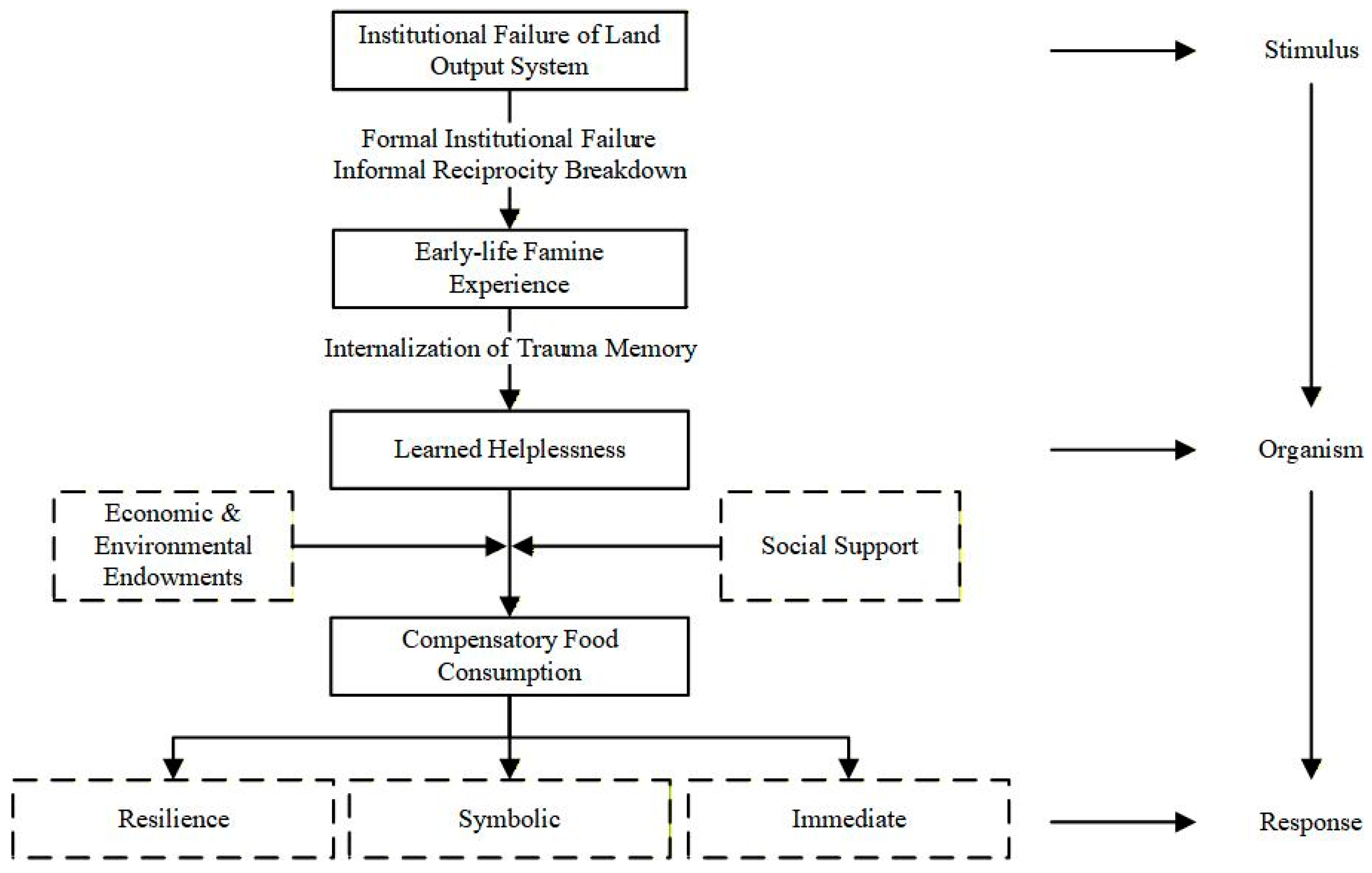
This study employs the Stimulus-Organism-Response (S-O-R) framework to systematically explain the long-term impact of land system failure on the behavior of rural residents [11]. Within this framework, the famine shocks triggered by early-life land output failure serve as the external stimulus (S). These shocks are internalized through psychological mechanisms into the individual’s organism state (O), such as learned helplessness. Ultimately, these internal states determine the compensatory food consumption response (R) in later life.

2.1. Institutional Failure of the Land System and Famine Shocks During the Collectivization Period

In the late 1950s, rural China experienced a significant structural shift in its production and distribution paradigms, leading to a transition in farmers’ operational autonomy over survival resources [6]. Under a centrally planned framework aimed at rapid industrialization, land management was swiftly moved from individual households to collective organizations. Between 1958 and 1959, influenced by ambitious development targets, local administrative measures such as “close planting,” “deep plowing,” and the centralized management of private production tools were implemented [12]. These institutional arrangements occasionally struggled to adapt to local farming conditions, resulting in temporary grain output fluctuations and the historical period of scarcity [13]. From an international perspective, similar institutional challenges appeared in other command-based economies. For example, the agricultural transitions in the Soviet Union during the early 20th century, characterized by mandatory procurement quotas, led to documented food security challenges [14]. Similar patterns of supply-side rigidity were observed in other regions with highly centralized distribution systems. The potential loss of production incentives within a strictly planned framework is a recognized characteristic in institutional economics [15]. At the rural level, these factors can trigger a structural mismatch in land output.
In practice, the systemic failure of land output represents a process of entitlement deprivation. In essence, individuals lose their “residual claims” and “control rights” over vital survival resources, despite acting as agricultural producers [6,16]. When top-down policy mandates distort the natural laws of land output, the institutional safety valves originally intended to guarantee survival inevitably collapse. This shock, rooted in a perceived lack of institutional control, carries significant cumulative effects [17]. It manifests not only in the traumatic memories of extreme physical hunger, specifically the experience of surviving on rice bran and tree bark, but also in the simultaneous failure of both formal and informal institutions.
Drawing on in-depth interviews with survivors, the collapse of the output system triggered by land institutional mismatch was internalized into profound collective trauma. This trauma involves three intertwined dimensions. First, at the level of physiological trauma, external shocks led to direct threats to survival. Material scarcity emerged in the form of extreme caloric deficits, stripping individuals of their basic sense of security. Frequent interview accounts of edema, the consumption of rice bran and tree bark, and indelible memories of death together formed the physical foundation of this trauma. Second, at the institutional level, the failure of the land output system led to the structural collapse of rural society [6,13]. In terms of formal institutions, this failure was reflected in the loss of public canteen functions and the disorder of grain procurement [12]. These disruptions caused individuals to lose basic institutional protections and buffering mechanisms when facing extreme environments. Finally, at the informal institutional level, the shock of extreme resource scarcity caused traditional kinship and neighborhood informal institutions to collapse [13]. The originally stable network of generalized reciprocity in rural society loosened due to anomic behaviors, such as “food snatching” and “food guarding” [18]. The resulting decline in social cohesion left a long-term sense of insecurity at the individual psychological level.
According to life course theory, trauma triggered by institutional loss of control does not naturally dissipate when the event ends. Instead, it is transformed into a “historical imprint” or “scar” internalized within an individual’s traits, which can be awakened by food [19]. Such deep psychological imprints significantly reshape the risk preferences of survivors. Consequently, even in subsequent environments of material abundance, rural residents still maintain a strong defensive psychology and compensatory impulses [20].
Because of compensatory impulses, existing food consumption classifications are insufficient to explain behaviors shaped by the long-term effects of famine. This study introduces compensatory consumption theory, which suggests that consumption is essentially a tool for mitigating psychological deficits [21]. When individuals feel helpless or lose a sense of control, they often engage in consumption to repair psychological gaps [22]. This behavior can be categorized into proactive compensation and reactive compensation [8]. This framework explains why famine survivors simultaneously exhibit characteristics of both extreme frugality and overconsumption.
In summary, external institutional shocks project directly onto current behavioral patterns through historical trajectories. Based on these arguments, we propose the following hypothesis:
Hypothesis 1 (H1). 
Early-life institutional collapse and hunger experiences, resulting from land output system failure, have a significant positive impact on the compensatory food consumption behavior of rural residents.

2.2. Learned Helplessness: From Land Output System Failure to Psychological Internalization

Learned helplessness describes a stable cognitive state where individuals perceive their actions as unrelated to outcomes [23], a concept this study extends to the collective level to explain the pervasive passivity triggered by land output failure [24]. In the S-O-R framework, this internal state of the organism (O) acts as the central nexus connecting institutional shocks to behavioral responses. The survival crisis triggered by the institutional failure of the land output system in early life went beyond mere physical resource scarcity, as it profoundly reshaped individuals’ psychological structures. According to Life Course Theory, institutional upheavals experienced during formative years exert profound and long-lasting impacts on individuals [20,25,26].
First, the mandatory distortion of land output patterns triggered “metabolic scars” at both physiological and objective capability levels. Between 1959 and 1961, top-down policy mandates violated the natural laws of land productivity, leading to an institutional collapse that directly deprived individuals of their basic sense of security [6,13]. Global empirical evidence confirms that such systemic food insecurity has long-term biological and economic consequences [27]. In Ethiopia, extreme malnutrition (GAM 50.3%) caused severe stunting, while studies in the Soviet Union confirm lasting stature loss and metabolic alterations [15,28]. These impairments create a “metabolic memory” that imposes objective constraints on consumption capacity and reinforces persistent anxiety about future shortages. Through physiological instincts, this memory continuously reinforces an individual’s persistent anxiety about future food shortages. Even after material conditions improve, this psychological shadow from early deprivation still drives a compensatory craving for high-energy foods [20].
The structural deprivation of land distribution and decision-making rights caused a state of learned helplessness [23]. This trauma differs from war-induced trauma, which usually comes from external conflict. Instead, the trauma discussed here results from the systemic failure of institutional protections within a command-based framework [15]. In the collective era, material rewards were completely detached from labor input. This shift fundamentally broke stable expectations about the link between effort and reward [6]. People realized that their hard work did not change distribution outcomes. This lack of control at the institutional level then turned into a defensive scarcity mindset [29].
Eventually, the trauma of losing control over survival resources turned into a lasting logic of psychological compensation. Scarcity theory suggests that long-term poverty captures an individual’s attention [30]. This changes decision-making logic from utility maximization to minimizing survival risks. Unlike the destruction of war, the loss of autonomy caused by institutional mismatch is internalized as long-term insecurity [18,31,32]. Compensatory consumption theory suggests that when people feel the macro-environment is out of control, they try to restore an internal sense of order. They achieve this through excessive possession and hoarding in micro-level areas like food consumption [22,32]. International studies in drought-prone regions like Ethiopia further confirm this. Pervasive anxiety about future security drives deep compensatory impulses [31]. In this process, food is more than just physical sustenance. It serves as a psychological tool to regain the sense of control lost during the earlier failure of land output systems [20,33]. Based on this logic, we propose:
Hypothesis 2 (H2). 
Learned helplessness exerts a significant mediating effect between early-life land output system failure and later-life compensatory food consumption behavior.

2.3. Resource Heterogeneity and the Transmission of Historical Trauma

The impact of early trauma on behavior is context-dependent. Under the S-O-R framework, individual and macro-level resource endowments (O) shape the link between historical shocks (S) and behavioral responses (R) [11]. In the Chinese context, the role of these resources is pre-determined by the Hukou (household registration) system. Established in 1955 and formally promulgated in 1958, the Hukou system is a mandatory institution that categorizes every individual into either agricultural (rural) or non-agricultural (urban) status [34,35].
This system functioned as an “institutional cage” that strictly bound individuals to their place of birth for decades. Much like the Propiska system in the Soviet Union, Hukou restricted population mobility and deprived farmers of an exit mechanism [17,34]. Because this system blocked relocation as a way to escape hardship, individuals became entirely dependent on their localized resource base to survive shocks. According to Conservation of Resources (COR) theory, this resource base determines a person’s vulnerability to trauma [36]. While sufficient resources can ease the anxiety of learned helplessness, a lack of resources reinforces insecurity, driving compensatory food consumption. This response heterogeneity mainly appears in the following areas:
  • Individual Economic Endowments: The Logic of Economic Self-Reliance
Individual economic endowment is the primary resource for the organism (O) to cope with uncertainty. Beyond material wealth, it reflects the recovery of the survival agency lost during the land system failure. The historical failure of land output was essentially a deprivation of individual autonomy. In this study, individuals with high economic self-reliance use their internal resources to regain a sense of control. This generates an immune effect that acts as a psychological firewall. This firewall prevents early-life trauma from translating into irrational consumption. In contrast, those with low self-reliance lack the means to rebuild this agency. They remain trapped in the scarcity-driven panic left by the original institutional failure. To compensate for their limited economic control, they resort to the most basic form of security, which is excessive food consumption. Based on this, we propose:
Hypothesis 3a (H3a). 
The driving effect of early-life disaster shocks on compensatory food consumption (CFC) is more significant among the low economic self-reliance group.
2.
Environmental Endowments: The Substitution Logic of Regional Resource Supply
The macro-environment provides the external context for compensatory behavior. Based on Belk, the available options for compensatory consumption depend on the richness of resources in the environment [21]. In the resource-poor Central and Western regions, channels for psychological comfort are limited, so food often becomes the only outlet for compensation. In contrast, the diverse consumption options in developed Eastern regions create a “dilution effect.” Based on this logic, we propose:
Hypothesis 3b (H3b). 
The driving effect of early-life disaster shocks on compensatory food consumption (CFC) is more significant in economically underdeveloped regions (Central and Western China).
3.
The Mitigating and Corrective Effects of the Social Support
Social endowments represent inflows of external resources. At their core, these are informal institutions built on trust and reciprocity [32,37]. For example, cash transfers from family members can directly ease an individual’s panic over scarcity. However, it is important to note that emotional interactions without professional guidance might backfire. Such “compliant support” can actually reinforce hoarding habits among the elderly. In comparison, formal institutions offer more standardization. Pensions provide a baseline for income expectations. Meanwhile, professional community counseling can directly change behavioral logic through cognitive reconstruction [3]. This progression from material aid to professional intervention creates a tiered barrier for rural residents facing historical trauma. Based on this, we propose:
Hypothesis 4 (H4). 
Social support has significant group differences in its effect on trauma, and professional community psychological support shows the strongest corrective impact on behavior.

2.4. Theoretical Dimensions and Manifestations of Compensatory Food Consumption

Compensatory consumption originates from the psychological mechanisms individuals use to cope with self-threats [38]. It refers to a strategic behavior where individuals use consumption to fill psychological gaps and restore internal balance when their sense of control, belonging, or self-worth is threatened [22]. A core feature of this behavior is the shift in motivation. The driver of consumption moves away from the functional utility of a product and toward its symbolic value and emotional repair functions [21]. This perspective bridges the gap between the rational actor assumption in traditional economics and research in motivational psychology. It has become a key theoretical foundation in behavioral economics for explaining irrational consumption phenomena.
Although existing literature has made significant contributions to compensatory consumption theory, a clear contextual mismatch occurs when explaining the behavior of rural Chinese residents. Most studies in consumption sociology focus on status-based or hedonic compensation among the urban middle class, emphasizing symbols, prestige, and identity. The marginal contribution of this study lies in adapting this theory from urban symbolic levels to a rural survival context, thereby proposing a new category: subsistence-based compensation. This transition shifts the focus of compensation from abstract self-esteem toward fundamental security and survival. Within this framework, individuals use food acquisition to mend psychological gaps caused by early-life land system shocks.
To deconstruct the complex effects of land system failure on consumption, this study adopts and builds upon the framework of Kim and Rucker [8]. We categorize these behaviors into three distinct dimensions: immediate, proactive, and symbolic. This integrated approach provides a unified explanation for the seemingly contradictory consumption patterns of rural residents:
The first dimension involves symbolic value reconstruction through the Symbolic Consumption model. In this context, food serves as a symbolic vehicle for maintaining identity continuity and rebuilding social ties. Loveland et al. found that consumers who experienced exclusion or deprivation often prefer nostalgic products to reconnect with their past and significant others [39]. This logic explains why some rural elderly individuals remain attached to famine-era foods, such as sweet potatoes and wild herbs, or cling to specific historical dietary patterns. Furthermore, extravagant consumption during festivals uses the symbol of “abundance” to validate current social mobility. Such behavior compensates for the low social status once caused by institutional scarcity [21].
The second dimension is immediate compensation. This dimension follows the logic of Mandel and Smeesters [40], where compensation occurs after a threat or negative emotion has already surfaced. It represents a post-hoc coping strategy used to alleviate current distress. Because early-life land output often failed to meet the survival baseline, this memory of physiological deficits transforms into a powerful “revenge” preference in adulthood once material conditions improve. Individuals may consume heavily seasoned foods indiscriminately. They use immediate sensory stimulation to shift attention away from anxiety. Consequently, food serves as a direct tool for mitigating negative psychological states [40].
The third dimension involves proactive risk defense, categorized as Proactive compensation. This study operationalizes the active compensation concept from Kim & Rucker as a resilient defense mechanism [8]. This mode occurs before a threat emerges and serves as a proactive buffer against future self-threats. Driven by a subconscious fear of losing resource autonomy again, rural residents develop two psychological buffers. The first involves extreme frugality and hoarding, where storing extra grain rebuilds a micro-level security barrier [20]. The second involves irrational health investment, where individuals use supplements to build survival capital against future disasters. These actions reflect a drive to regain absolute control over survival resources. Ultimately, this behavior addresses a deep-seated lack of perceived control [33,41].
Altogether, compensatory food consumption (CFC) represents a “motivational shift” from functional utility toward psychological repair [21,22]. This transition is consistent with international research on trauma-induced and irrational consumption patterns [29,42]. We deconstruct this complex response into three theoretical dimensions: immediate, proactive, and symbolic. This framework explains the paradox where famine survivors show both extreme frugality and over-consumption. To ensure empirical transparency, we apply the entropy weight method to transform these dimensions into a standardized composite score [43]. This method moves beyond simple measurements of calorie intake. Instead, it quantifies the long-term health consequences of early-life shocks, highlighting the practical relevance of our results for public health [44].
Building upon the aforementioned hypotheses, we established an integrated S-O-R framework to systematically delineate how early-life land system shocks are internalized into compensatory food consumption patterns among the rural elderly (Figure 1).

3. Materials and Methods

3.1. Data Source

Empirical data for this study are derived from the Chinese Longitudinal Healthy Longevity Survey (CLHLS) conducted by Peking University. This survey covers 23 provinces, accounting for approximately 85% of the national population to provide robust representation. We selected this database for three primary reasons. First, participants were born primarily in the 1940s or earlier. This facilitates the identification of the long-term impacts of famine-related institutional shocks occurring between 1959 and 1961. Second, detailed non-monetary food frequency records provide a micro-level foundation for constructing the Compensatory Food Consumption Index. Third, extensive psychological health scales and social support modules align with the theoretical framework of shock, internalization, and compensation.
We implemented the following cleaning procedures. First, we limited the sample to respondents whose birthplace and current residence are both in rural areas. This isolates perceptions of the land system from confounding urbanization factors. Second, we used four waves of data from 2008, 2011, 2014, and 2018 to construct a balanced panel. Finally, we removed individuals with missing or logically inconsistent data for the core independent, dependent, or control variables. The final balanced panel comprises 2440 rural residents and 9760 total valid observations. All statistical analyses were performed using Stata 16.0 (Stata Corp, College Station, TX, USA).

3.2. Variable Selection

3.2.1. Dependent Variables: Compensatory Food Consumption Index (CFC)

This study constructs the Compensatory Food Consumption (CFC) Index using the entropy weight method to ensure an objective and comprehensive measurement of rural residents’ behavior [45]. Compared to subjective weighting methods, the entropy weight method determines weights by calculating the information entropy and the degree of variation for each indicator. This approach effectively avoids potential biases caused by manual weight assignment [45]. Based on compensatory consumption theory, we categorize food consumption into the following three dimensions: Symbolic, Immediate, and Proactive Compensation. As shown in Table 1, we selected specific food items from the CLHLS database to represent these dimensions.
Symbolic Compensation includes preserved vegetables and animal fats. Preserved vegetables sustain traditional taste memories and alleviate early-life anxiety caused by a historical loss of control. Animal fats evoke a sense of psychological security and serve as path-dependent markers for identity recognition [46]. These foods carry the sensory and postmemory legacy of the collective economy era [39]. They function as symbolic vessels for individuals to maintain their identity and internal balance.
Immediate compensation focuses on staples, sugars, and meat. These foods provide intense pleasure to counter historical energy scarcity [42]. For example, staples and sugars trigger rapid dopamine release. Memories of early-life survival threats increase an individual’s preference for sweetness as a compensatory buffer against psychological distress [40]. High meat consumption reflects a biological over-correction for past deprivation. Famine exposure creates a permanent metabolic craving for high-fat and energy-dense foods [20]. These items characterize immediate compensation because they represent a form of revenge hedonism. They fill the physiological and psychological gaps left by historical institutional scarcity [47].
Proactive compensation reflects a shift toward strategic health investment to regain life control. We categorize these indicators into two functional groups. First, health supplements and vitamins (including traditional herbs) act as psychological buffers. They transform health anxiety into tangible resilience actions to mitigate feelings of vulnerability [48]. Second, high-quality proteins such as dairy, aquatic products, beans, and eggs represent a defensive consumption upgrade. These items function as instruments to counter early-life health deficits and enhance physiological resilience against future shocks [42,46]. It demonstrates an attempt by individuals to reconstruct a sense of control over their lives [8].
We selected data from respondents aged approximately 60 to isolate long-term consumption habits from confounding effects like tooth loss or medical dietary restrictions [49]. As specified in Table 1, we processed the raw frequency data through reverse-coding (except for staples) and min-max normalization. These procedures ensure that higher index values consistently represent more frequent consumption and that all indicators are comparable before the EWM calculation.
The construction of the CFC Index follows four mathematical steps. Standardizing the indicators ensures comparability across different food categories. Since all indicators in this study are positive (where higher values represent greater compensatory intensity), we utilized the positive min-max normalization formula:
x i j = x i j min ( x j ) max ( x j ) min ( x j )
The next step involves calculating the proportion p i j of the i - t h respondent’s value for the j - t h indicator relative to the total sum:
p i j = x i j i = 1 n x i j
Information entropy e j is then determined for each indicator, where n represents the sample size:
e j = 1 ln n i = 1 n p i j ln p i j
Finally, the weight w j is derived from the information utility value d j = 1 e j :
w j = d j j = 1 m d j
The resulting weights in Table 1 reflect the objective contribution of each food item to the overall compensatory tendency.
The indicator weights derived from the EWM are summarized in Table 1. The analysis reveals that Proactive Compensation is the dominant dimension, with traditional herbs (0.2889) and vitamins (0.2446) collectively accounting for over 53% of the total weight. This concentration confirms that for famine survivors, compensatory tendencies have shifted from basic calorie seeking toward a strategic defense against health risks. In contrast, the minimal weights of staples (0.0314) and animal fats (0.0241) suggest that subsistence-level intake has become homogenized across the sample and no longer serves as a primary differentiator of compensatory behavior.
While the weight of dairy products (0.1122) reflects a beneficial dietary upgrade, the heavy concentration in non-essential supplements indicates a reliance on psychological buffers to mitigate feelings of vulnerability [48,50]. This objective measurement framework effectively quantifies the physiological and psychological legacy of historical institutional shocks, providing a tool to identify how early-life deprivation translates into modern consumption logic.

3.2.2. Core Independent Variable: Early-Life Famine Exposure

Following the quasi-natural experiment framework of Chen & Zhou [51], this study identifies the long-term impacts of land system shocks by exploiting the interaction between spatial severity and temporal exposure.
  • Spatial Dimension: Famine Severity (EDR)
This study adopts the Excess Death Rate (EDR) in the respondent’s birth province as the primary measure of shock intensity. The Hukou system is a mandatory household registration institution that categorizes individuals into rural or urban status and restricts geographic mobility (see Section 2.3 for a detailed explanation) [35]. This institution created a natural barrier to regional migration [34]. It effectively prevented individuals from relocating to escape the famine. This institutional “lock-in” ensures that the famine shock remains truly exogenous and effectively mitigates self-selection bias [52]. Regarding data reliability, we utilize the abnormal death statistics reconstructed by Cao [53,54] from nearly 1000 county annals. This dataset corrects for historical administrative reporting bias and remains a standard source in classic famine literature. The EDR is calculated as follows:
E D R p = 1 3 t = 1959 1961 ( D R p t D R p , n o r m )
D R p , n o r m represents the baseline, defined as the average death rate for each province between 1954 and 1958.
2.
Temporal Dimension: Exposure Cohorts ( T r e a t i )
Adolescence represents a primary window for the development of cognitive schemas and psychological scars [24]. During this stage, the institutional collapse caused by land governance failure leads to a loss of survival control and produces lasting defensive traits [18]. Conversely, psychological frameworks and behavioral habits are already stable by adulthood. Since adults undergo minimal cognitive reshaping, they provide a reliable control group for heterogeneity analysis [20,33].
Treatment Group (Treat = 1): This group includes individuals born between 1941 and 1947. These people were in their adolescence (aged 12–18) when the famine broke out. Therefore, they experienced the deepest psychological impact regarding resource scarcity and the loss of institutional control.
Control Group (Treat = 0): This group consists of individuals born between 1920 and 1940. These individuals were already adults during the disaster. Since their psychological structures and behavioral habits were already stable, the shock caused less cognitive reshaping for them. The detailed operationalization and grouping rationale are summarized in Table 2.
The study constructs the final interaction term to capture the net impact of the specific institutional shock, which involves spending adolescence in a severely affected province, on late-life consumption behavior. A significantly positive coefficient confirms that early-life “psychological scars” drive compensatory food consumption during old age.

3.2.3. Definitions of Mechanism and Heterogeneity Variables

  • Mechanism Variable: Learned Helplessness (LH) Index
This study introduces learned helplessness as a mediating variable. We construct this index using six specific items from the CLHLS questionnaire. These six items cover the dimensions of motivation, cognition, and emotion [24,55]. The survey asks respondents if they often feel fearful or anxious. It also asks if they feel as happy as they did in their youth. We include a question about whether they can always see the positive side of things. Another item checks if they have the power to make their own decisions. The questionnaire also evaluates if they feel useless as they age and if they maintain a clean environment. We apply exploratory factor analysis to synthesize these items into a composite index. The Kaiser-Meyer-Olkin (KMO) statistic is 0.71. This value confirms the suitability of our data structure for factor analysis [48]. The results show that anxiety and a lack of decision-making power carry the highest factor loadings. These specific elements constitute the core cognitive framework of helplessness in our sample.
2.
Grouping Dimensions for Heterogeneity Analysis
Economic Endowments: This study defines Economic Endowments using a Comprehensive Economic Self-sufficiency Index. We apply the entropy weight method to synthesize seven survey indicators into this index. These metrics include personal and household income, primary income source, medical and elderly care payment capacity, self-care ability, and independent living preference. Together, these elements capture an individual’s exchange entitlements and survival capacity [26,29]. We divide the sample at the median to test the Security Substitution Hypothesis.
Environmental Endowments: Following official standards, the sample is categorized into Eastern (developed) and Central-Western (less developed) regions. This aims to examine the substitution effect of regional market maturity on compensation channels [21,56].
Social Support: To evaluate the efficacy of social interventions, four variables are compared across two dimensions: “formal vs. Informal” and “material vs. psychological” [57]. These specifically include: cash support, emotional sharing, pension coverage, and community psychological counseling. The specific definitions and measurement methods for these mechanism and heterogeneity variables are summarized in Table 3.

3.2.4. Control Variables

Individual Demographics: These variables include gender, ethnicity, actual age at the time of the survey, years of schooling, marital status, and whether the respondent currently resides in their birthplace [58]. We also account for birthplace residency to control for dietary inertia—the long-term persistence of regional food preferences [59].
Family Background and Intergenerational Traits: We include the parents’ years of education, the father’s occupation during the respondent’s childhood, the number of living children, and current living arrangements. These indicators capture the joint influence of natal family resource endowments and current intergenerational support [51].
Socioeconomic Status: This dimension covers the logarithm of per capita household income, self-reported economic status, and pension coverage. These variables are used to control for individual budget constraints and financial security [60].
Health Status and Lifestyle: We select self-rated health, activities of daily living, the number of chronic conditions, and history of long-term physical labor. Including these factors helps exclude passive dietary restrictions caused by physiological decline or metabolic variations [61]. The detailed definitions and operationalization of all main, heterogeneity, and control variables are summarized in Table 4.

3.3. Empirical Strategy: Cohort-DID Model

This study employs a Cohort Difference-in-Differences (Cohort-DID) model to identify the causal impact of early-life institutional shocks on the compensatory consumption of rural residents [62]. Our approach utilizes temporal variation across birth cohorts and spatial variation in disaster severity across provinces. This design effectively isolates interference from age effects, regional fixed characteristics, and macro-environmental shocks [63]. The baseline regression model is specified as follows:
Y i p c t = α 0 + β 1 ( S e v e r i t y p × T r e a t c ) + γ X i p c t + μ p + δ c + λ t + ϵ i p c t
The variables are defined as follows:
1. Y i p c t represents the Compensatory Food Consumption (CFC) Index for individual i from birth cohort c in province p, surveyed at time t.
2. S e v e r i t y p × T r e a t c serves as the core interaction term. In this setup, S e v e r i t y p denotes the province-level Excess Death Rate (EDR), and T r e a t c is a dummy variable identifying famine-exposed cohorts. The coefficient β 1 identifies the net impact of early-life famine on consumption patterns in later life.
3. X i p c t is a vector of control variables. These factors account for individual demographics, family background, socioeconomic status, and health-related lifestyle behaviors.
4. μ p and δ c   represent province and birth-cohort fixed effects, respectively. These terms absorb regional non-time-varying characteristics and common historical shocks shared by specific cohorts.
5. λ t represents survey-year fixed effects. This component accounts for macroeconomic fluctuations or policy changes across different survey waves.
6. ϵ i p c t is the random error term. Standard errors are clustered at the province level to account for regional correlation.
We replace the dependent variable in the baseline model with a series of mechanism variables M to investigate the transmission channels of psychological internalization and social reconstruction. This approach follows the identification strategy described above.
M i p c t = α 0 + β 1 S e v e r i t y p × T r e a t c + γ X i p c t + μ p + δ c + λ t + ϵ i p c t
In this model, M represents the psychological or social state of the individual. By analyzing the direction and significance of the coefficients, we aim to verify whether early-life famine influences long-term behavioral decisions by inducing learned helplessness.

4. Results

4.1. Descriptive Statistics

The results from Table 5 indicate that the mean Compensatory Food Consumption (CFC) index for the treatment group (0.213) is significantly higher than that of the control group (0.190), with the difference significant at the 1% level. This provides preliminary evidence for the psychological scar hypothesis, suggesting that famine shocks during critical developmental windows lead to stronger defensive consumption patterns in later life [20].
Mean difference tests reveal significant disparities in demographic and socioeconomic traits between the two cohorts. Specifically, the treatment group attained higher education and exercised more frequently, yet had significantly fewer living children than the control group. These differences align with the broader trajectory of intergenerational change in China [26,29]. Paradoxically, despite their superior human capital, the treatment group earns lower per capita income and suffers from greater impairment in activities of daily living. This confirms that famine exposure during the sensitive adolescent period creates long-term scars [64]. Consequently, this cohort faces a unique struggle in their senior years, characterized by more complex health challenges and tighter resource constraints.
The widespread imbalance in covariates across cohorts indicates that simple mean comparisons are heavily confounded by intergenerational shifts. Consequently, to isolate the net effect of early-life famine and address these confounding factors, we employ a Cohort Difference-in-Differences (Cohort-DID) model.

4.2. Baseline Regression: Testing the Consumption Imprint of Early-Life Institutional Shocks

Table 6 presents the baseline regression results. The analysis reveals that early-life famine exposure exerts a significant positive impact on the Compensatory Food Consumption (CFC) index. In the most restrictive specification (Column 6), the coefficient estimate is 0.004, which is significant at the 1% level. This finding verifies Hypothesis 1 and confirms that the consumption imprint of early-life shocks persists into old age. Across all specifications, the core coefficient remains highly stable. The adjusted R2 increases from 0.414 to 0.553, demonstrating the model’s strong explanatory power.
The estimated effect size carries substantial practical relevance for public health and land economics. According to FAO (2024) [65], hidden health costs resulting from dietary patterns in China reach approximately 1.5 trillion USD annually. The famine-induced increase in the CFC index reflects a misallocation of household resources. Survivors in rural China often prioritize expensive yet low-nutrition supplements, such as “medicinal wine,” over optimal nutritional intake. This behavioral shift correlates with a nearly doubled risk of chronic diseases in adulthood, illustrating how historical shocks translate into long-term public health expenditures and agricultural resource pressure [66,67].
Estimates for control variables reveal the material and psychological constraints of compensatory consumption. The consistently positive coefficient for self-rated economic status (0.016 **), suggesting that purchasing power enables the translation of psychological motives into actual behavior. Similarly, the positive impact of exercise reflects a trend toward proactive health investment [68]. Conversely, the significant negative effect of quality of life (−0.009 **) highlights a substitution effect where subjective well-being reduces the demand for material compensation [69]. Notably, the core coefficient remains stable across all specifications, effectively ruling out interference from life-cycle effects or absolute poverty.

4.3. Robustness Checks

4.3.1. Parallel Trend Test: Event Study Approach

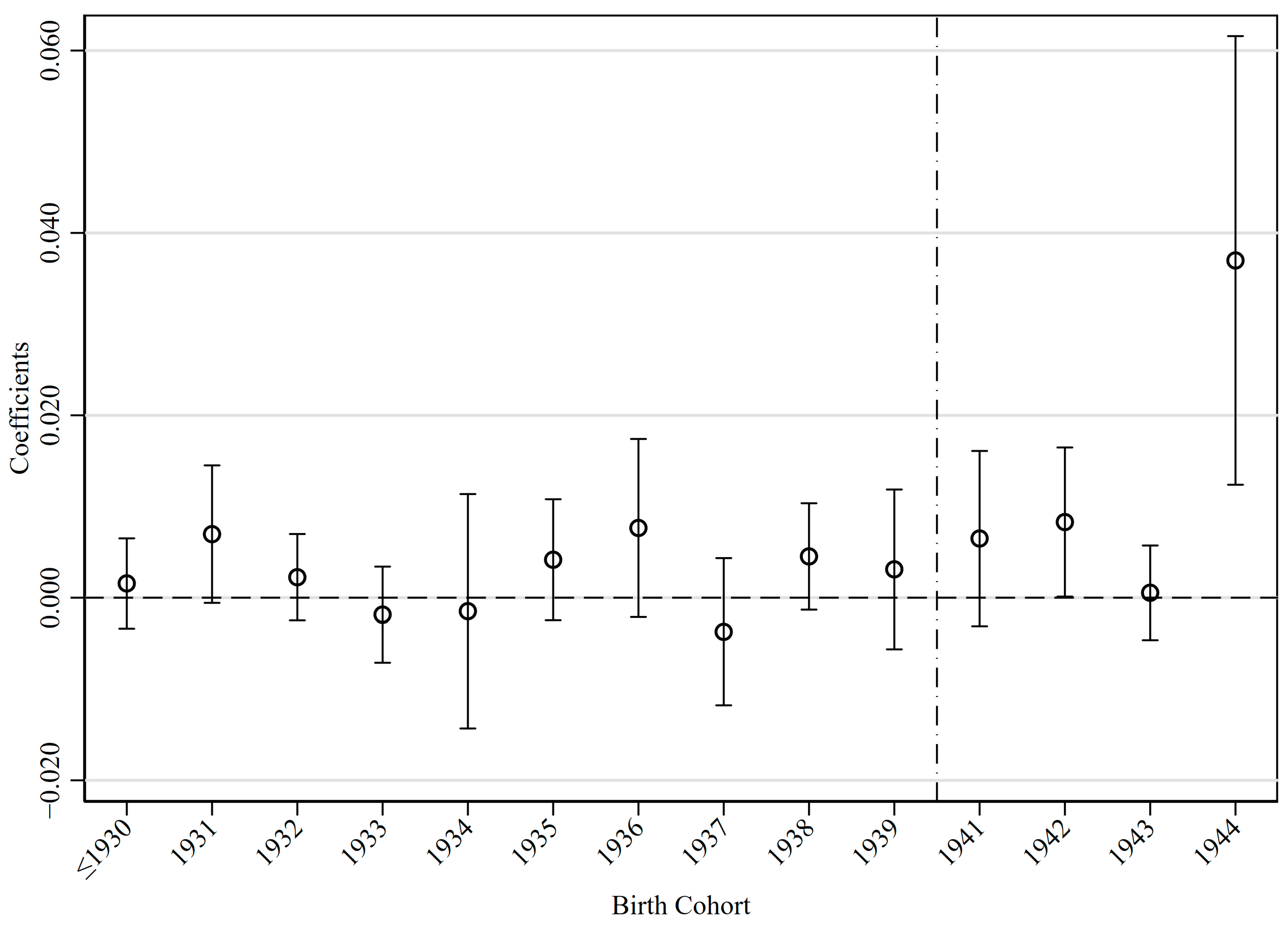
The validity of the Cohort-DID model depends on the parallel trend assumption. To test this assumption, we use the event study approach developed by Jacobson et al. and Chen et al. [62,70]. We modify the baseline model (3) by replacing the single interaction term with a series of cohort-specific interactions. The dynamic regression model is specified as follows:
Y ipct = α + k = 1925 , k 1940 1944 β k ( Severity p × I { BirthYear i = k } ) + γ X ipct + μ p + δ c + λ t + ϵ ipct  
We designate the 1940 birth cohort as the reference group. Because these individuals had already reached adulthood when the famine occurred, they serve as a critical anchor to distinguish between different exposure states. The sample spans birth cohorts from 1925 to 1944. This specific range ensures a sufficient number of observations for each year and allows the study to fully capture the critical adolescent window for famine exposure.
The event study results (Figure 2) confirm that the parallel trend assumption is satisfied. Specifically, all interaction coefficients for the pre-famine cohorts (1930–1939) are statistically insignificant and fluctuate near the zero line. The joint F-test (p = 0.517) further ensures the absence of systematic pre-existing trends. While the treatment effect is relatively latent for the 1941–1943 cohorts, a significant and sharp increase occurs in the 1944 cohort. This pattern validates the “developmental sensitivity” hypothesis, indicating that the compensatory imprint is specifically triggered by shocks during the critical adolescent window rather than a general life-cycle trend.

4.3.2. Excluding Direct-Controlled Municipalities

The results from Table 7 indicate that the core findings remain robust after excluding samples from the four direct-controlled municipalities-Beijing, Tianjin, Shanghai, and Chongqing. We follow Cheng et al. in this approach to mitigate potential bias stemming from the unique resource endowments and policy protections in these regions [71]. Historically, during the planned economy period, these municipalities often enjoyed more stable food rationing and more mature market environments than other provinces.
As shown in Table 7, the coefficients for the core interaction term remain statistically significant across all specifications, with values stabilizing between 0.003 and 0.004. This stability confirms that the baseline findings are not driven by specific policy dividends or the economic advantages of major urban centers. Instead, the results demonstrate cross-regional generalizability. Even after removing cities with higher social security levels, the positive impact of early-life famine on late-life compensatory consumption persists, further validating the reliability of our research conclusions.

4.3.3. Robustness Check: Alternative Dependent Variable

To address potential memory bias associated with retrospective data (dietary frequency at age 60), we replace the dependent variable with the “current” Compensatory Food Consumption (CFC) index measured at the time of the survey [18]. This test evaluates the persistence of consumption preferences across the life cycle and examines whether the psychological scar resists the passive dietary constraints caused by aging.
The results from Table 8 indicate that the core interaction term remains significantly positive across all specifications after replacing the dependent variable. Specifically, in the full model (Column 6), the estimated coefficient is 0.004 (p < 0.01), which is highly consistent with the baseline results. This confirms that famine trauma exerts an irreversible anchoring effect on individual consumption patterns. Regardless of the life stage, individuals exposed to severe shocks exhibit stronger compensatory tendencies. This finding rules out temporary behavioral adaptation and confirms that early-life experiences exert lifelong influence on dietary decisions through deep psychological reshaping.

4.3.4. Robustness Test Using Grain Yield Reduction Rate

To mitigate potential measurement error or statistical bias associated with demographic indicators, we replace excess mortality with the provincial grain yield reduction rate as the proxy for famine intensity, following Chen & Zhou [51]. This indicator directly captures the physical shortage of resource availability, thereby characterizing the behavioral reshaping of individuals from the dimension of material supply shocks.
The results from Table 9 indicate that the coefficients for the interaction between grain yield reduction and the treatment cohort remain significantly positive across all specifications. In the full model (Column 6), the estimated coefficient is 0.083 (p < 0.01). Specifically, a one-standard-deviation increase in the regional grain yield reduction rate is associated with an average 3.2% increase in the CFC index among exposed individuals. This marginal effect is highly comparable to the results obtained using demographic indicators in the baseline regression. These findings confirm that the positive causal impact of early-life famine remains robust across different measures of shock intensity.

4.4. Mechanism Testing: Learned Helplessness as a Mediating Path

4.4.1. Impact of Early-Life Famine on the LH Index

The results from Table 10 examine the psychological transmission path between early-life famine exposure and food consumption among rural residents. Columns (1) to (6) show that the Early-life Famine Exposure remains significantly positive across all specifications. As control variables for individual, family, economic, and health dimensions are progressively included, the coefficient increases from 0.007 to 0.014, with the significance level strengthening from 10% to 1%. The robustness of these increasing coefficients suggests that psychological trauma does not dissipate over time. Instead, it internalizes as a persistent “psychological scar” in the form of learned helplessness [44], thereby supporting Hypothesis 2.
These empirical results confirm that uncontrollable food shortages lead individuals to form a cognitive schema of uncontrollable resources. According to Compensatory Control Theory, when individuals experience a loss of internal control, they instinctively seek to restore a sense of order through compensatory consumption [37]. Under this logic, late-life compensatory food consumption serves as a psychological defense strategy to fill gaps in perceived security.

4.4.2. Mechanism Robustness: Placebo Tests and Cognitive Controls

We performed temporal placebo tests and controlled for cognitive function to strengthen the reliability of the mechanism analysis.
First, we used a counterfactual framework to rule out the interference of natural generational trends. Specifically, we assigned the 1954–1956 birth cohorts as a fictitious treatment group [51]. Column (1) in Table 11 shows that the fictitious interaction coefficient is negative and statistically insignificant (−0.008). This result confirms that the learned helplessness effect stems from a specific historical shock rather than a natural age-related trend.
Next, we addressed cognitive decline as a competing explanation. Older adults’ mental states can be influenced by cognitive deterioration. To account for this, we added Mini-Mental State Examination (MMSE) scores to the baseline model [26]. Column (2) demonstrates that the core coefficient remains significantly positive (0.012 ***) after controlling for cognitive differences. This suggests that the psychological impact of early-life famine is independent of physiological aging. These findings verify the psychological scar as an autonomous transmission pathway, rather than a byproduct of late-life physiological decline [72].

4.5. Heterogeneity Analysis

4.5.1. Economic Endowment: The Role of Economic Self-Reliance

Subgroup regression results (Table 12) reveal that the impact of early-life shocks varies significantly across different levels of economic self-sufficiency.
Low Self-reliance Group (Significant Positive Effect): The core interaction coefficient is 0.004 ** (p < 0.05). For seniors lacking endogenous security, early-life psychological scars are difficult to offset with limited current resources. Lacking macroeconomic control, these individuals compensate by asserting control over micro-level food intake.
High Self-reliance Group (Insignificant Effect): Conversely, the coefficient for this group drops to 0.002 and is statistically insignificant. This confirms an immunity effect. Robust personal resources act as a psychological firewall, effectively blocking the transmission of early-life trauma into late-life irrational consumption.
This disparity suggests that compensatory food consumption is essentially a defensive behavior. As economic self-sufficiency improves, the compensatory motivation rooted in insecurity diminishes accordingly. Therefore, Hypothesis 3a is supported.

4.5.2. Environmental Endowment: Substitution Effects of Regional Resource Supply

The results in Table 13 reveal how the macro environment influences the impact of early-life shocks.
Underdeveloped Regions (Central and West): The interaction coefficient is 0.003 (p < 0.01). These areas have fewer social or market resources. People choose food because it is a low-barrier way to reduce anxiety. Environmental scarcity increases the psychological weight of food in an individual’s internal account. Developed Regions (East): The coefficient is −0.001 and is not significant. Diverse market supplies and social outlets replace the demand for material compensation. As the environment provides more satisfaction, the need for food compensation decreases. These findings show that environmental resources can replace individual compensation. Hypothesis 3b is supported.

4.5.3. Social Endowment: The Mitigating Role of Social Support Systems

Table 14 shows how social support changes the impact of early-life shocks.
  • Family Support
In the group with low cash support, early-life shocks lead to more compensatory consumption (0.005 ***). For the group with high support, this effect is not significant. This shows that cash acts as a security substitute. It reduces the psychological need to seek safety from food. Surprisingly, the effect remains significant (0.004 **) for those with emotional support. This suggests a pattern of acquiescent support within the family. To express filial piety, children may indulge or cater to their parents’ specific dietary preferences [29], which unintentionally reinforces and stabilizes irrational consumption habits rooted in early-life trauma.
2.
Public Institutional Support
Pension coverage acts as a safety valve. The effect is smaller for those with pensions (0.003 **) than for those without (0.005). Pensions reduce survival anxiety but cannot remove all psychological imprints [24]. Community counseling shows a strong reversal effect. In areas without counseling, the shock has a strong effect (0.005 ***). In areas with counseling, the effect becomes negative (−0.013 **). This means professional help helps people build a more rational consumption model [70,73]. Professional help is very important for healing collective trauma. Hypothesis 4 is supported.

5. Conclusions and Discussions

5.1. Main Findings and Research Conclusions

This study analyzes the long-term effects of early-life famine exposure on food consumption patterns among the rural elderly using CLHLS panel data and a Cohort-DID framework. The core findings are as follows:
Early-life land system failure left a permanent mark on consumption patterns. This institutional collapse led to extreme famine and long-term compensatory food consumption (CFC) among rural residents. Our results adapt the model of Luo & Chen to the rural context [37], proving that past output interruptions triggered enduring food obsessions [20]. These consumption patterns validate the lasting repercussions seen in other systemic crises, such as the persistent coping strategies in rural Ethiopia and the human capital imprints in Bangladesh [28,74]. While compensation and learned helplessness originated in war-trauma research, these concepts effectively explain the scars left by institutional failure [72]. Systemic shocks, like the welfare crises in the Soviet Union, produce psychological impacts as profound as those caused by conflict [15]. Similar interruptions fix dietary preferences for life, mirroring the preference shifts seen after the Dutch famine [75]. Ultimately, the mental habits formed during these shocks trigger robust compensatory behaviors that persist even after economic conditions improve.
Learned helplessness serves as the primary driver of this behavior. This state represents more than a negative emotion; it reflects a profound cognitive shift resulting from the loss of control over land output [6,13]. Extreme unpredictability led survivors to internalize a persistent sense of powerlessness [76], specifically the belief that survival resources were inherently uncontrollable. Learned helplessness exerts long-term effects on individual cognition, affect, and behavior [44]. This study finds that cognitive habits formed during youth are remarkably resistant to change. Consequently, even when resources are plentiful, older survivors still subconsciously rely on material possessions, such as expensive health products, as a tool to regain a sense of psychological control, echoing Lin & Zhou’s logic regarding how early-life misfortune shapes later mental health [77].
The success of social support hinges on its precise targeting of trauma. Heterogeneity analysis indicates that direct cash aid primarily functions by relaxing budget constraints and releasing suppressed desires. However, professional mental health services are more effective than informal family support in decoupling trauma-driven anxiety from current dietary choices. This finding fills a critical gap identified by Sun et al. (2022), who noted that in rural China, informal intergenerational support often remains the sole resource for assistance due to an underdeveloped formal social support system [78]. Within this context, we define “formal health interventions” as institutionalized, community-based psychological support and health literacy programs. This approach extends the advocacy of Lei & Bai (2020), who proposed promoting healthy lifestyles and community interventions specifically for the oldest-old [26]. Furthermore, as noted by Han et al. (2022), a formal health intervention mechanism is essential for reshaping health-related mindsets and improving nutritional literacy [79]. Consequently, this study provides an empirical foundation for implementing targeted interventions aimed at mitigating the long-term psychological impacts of early-life deprivation.

5.2. Policy Recommendations

Our findings show that early-life land system failure created deep psychological scars. To reduce irrational consumption caused by learned helplessness, government policies must move beyond material aid. We propose the following strategies, which provide a scalable framework for other societies recovering from historical resource shocks.
First, grassroots organizations, like village committees, should implement targeted health literacy programs to help survivors reshape their cognitive frameworks [79]. While this study highlights the localized misconception that “medicinal wine” can repair early-life deficits, the broader principle applies to any post-scarcity society where survivors overvalue pseudo-scientific health products. Redefining nutrition as a scientific balance, rather than a defensive investment, can reduce the psychological drive for compensatory consumption globally, providing a low-cost intervention for regions where formal therapy is scarce.
Second, rural medical stations should function as integrated hubs for both physiological and mental healing. This model provides a concrete implementation path for healthy interventions targeting vulnerable elderly populations [26]. Traditionally, Chinese village doctors served a dual role as medical providers and informal counselors. However, these stations have become increasingly “institutionalized” and emotionally detached over time. Many developing nations face a similar reality: grassroots practitioners possess deep community trust but lack formal mental health training. Policies should bridge this gap by offering mental health certification to local staff, enabling them to better support survivors through community counseling and social interaction.
Third, while increasing rural pensions is a priority, simply distributing cash subsidies may inadvertently fuel the compensatory consumption of low-value items. The key to mitigating this phenomenon lies in breaking the mechanism of learned helplessness. We propose a new “pension-participation” model that links financial aid to community social activities. For example, organizing Respect-the-Elderly events and actively soliciting seniors’ opinions at village assembly meetings can help them regain a sense of control and security. Additionally, grassroots organizations can issue nutrition vouchers or fresh produce subsidies to improve the accessibility of high-quality protein.
Finally, strengthening the resilience of land systems is fundamental to long-term psychological stability. For communities that have experienced historical food crises, adaptive land management and stable agricultural output provide a clear signal that the era of scarcity has ended. By alleviating survival anxiety, these institutional safeguards prevent the formation of compensatory food consumption habits, offering a vital strategy to promote healthy aging and reduce chronic health burdens worldwide.
This study has several limitations that suggest directions for future inquiry. While our quantitative model identifies broad patterns, preliminary field research in rural areas reveals complex emotional links between famine memories and food choices that numerical data alone cannot fully capture. Future research should prioritize longitudinal perspectives and qualitative case studies to explore these nuanced behaviors, such as specific food avoidance or ritualistic eating habits. By integrating large-scale datasets with in-depth field observations, researchers can build a more empathetic and effective evidence base. Such efforts are essential for developing policies that not only address the long-term impacts of land system failure but also safeguard the dignity and well-being of the aging rural population.

Author Contributions

X.L.: Conceptualization, Writing—original draft, Writing—review & editing, Visualization, Methodology, Formal analysis, Validation, Investigation, Data curation. Z.L.: Conceptualization, Formal analysis, Methodology, Visualization, Writing—review & editing, Investigation, Validation, Writing—original draft. L.Z.: Conceptualization, Formal analysis, Funding acquisition, Investigation, Project administration, Resources, Supervision, Writing—review & editing. All authors have read and agreed to the published version of the manuscript.

Funding

This research was supported by the National Natural Science Foundation of China (NSFC) under the Special Project on High-Quality Agricultural Development: “Long-term Mechanisms and Policy Evaluation for Preventing Returning to Poverty and Promoting Common Prosperity” (Grant No. 72442020).

Institutional Review Board Statement

Ethical review and approval were waived for this study due to the use of anonymous secondary data from the Chinese Longitudinal Healthy Longevity Survey (CLHLS). The original CLHLS project was approved by the Biomedical Ethics Committee of Peking University. The data are publicly available and do not contain any personally identifiable information. The preliminary field observations mentioned in the text were informal and served only for conceptual classification without involving the collection of personal sensitive data.

Data Availability Statement

The data presented in this study are available in the Peking University Open Research Data Platform at https://doi.org/10.18170/DVN/WBO7LK. These data were derived from the Chinese Longitudinal Healthy Longevity Survey (CLHLS) managed by the Center for Healthy Aging and Development Studies, Peking University.

Acknowledgments

During the preparation of this manuscript, the authors used for the purposes of language polishing. The authors have reviewed and edited the output and take full responsibility for the content of this publication. The authors would like to express their gratitude to the anonymous reviewers for their insightful comments and constructive suggestions, which have significantly improved the quality of this manuscript. We also thank the editorial staff for their professional support throughout the publication process. Additionally, during the preparation of this work, the authors utilized Gemini 3 Flash (Google) for language polishing. The authors have carefully reviewed and edited the generated output and take full responsibility for the content of this publication.

Conflicts of Interest

The authors declare no conflicts of interest.

References

  1. Ren, Y.; Castro Campos, B.; Peng, Y.; Glauben, T. Nutrition transition with accelerating urbanization? Empirical evidence from rural China. Nutrients 2021, 13, 921. [Google Scholar] [CrossRef]
  2. Huang, J.; Antonides, G.; Nie, F. Social-psychological factors in food consumption of rural residents: The role of perceived need and habit within the theory of planned behavior. Nutrients 2020, 12, 1203. [Google Scholar] [CrossRef]
  3. Hou, M.; Min, S.; Qing, P.; Tian, X. Can a knowledge calendar improve dietary knowledge? Evidence from a field experiment in rural China. World Dev. 2024, 174, 106447. [Google Scholar] [CrossRef]
  4. Yang, Q.; Zhu, Y. The emerging short-form video platforms improve household dietary diversity of rural residents: Evidence from China. Food Policy 2025, 131, 102797. [Google Scholar] [CrossRef]
  5. Wen, J.; Zhu, W.; Han, X.; Wang, X. Impacts of habit formation effect on food consumption and nutrient intake in rural China. Nutrients 2024, 16, 505. [Google Scholar] [CrossRef] [PubMed]
  6. Lin, J.Y. Collectivization and China’s agricultural crisis in 1959–1961. J. Political Econ. 1990, 98, 1228–1252. [Google Scholar] [CrossRef]
  7. Zhang, K.; Luo, Y.; Han, Y. The long-term impact of famine experience on harvest losses. Agriculture 2023, 13, 1128. [Google Scholar] [CrossRef]
  8. Kim, S.; Rucker, D.D. Bracing for the psychological storm: Proactive versus reactive compensatory consumption. J. Consum. Res. 2012, 39, 815–830. [Google Scholar] [CrossRef]
  9. Lisjak, M.; Bonezzi, A.; Kim, S.; Rucker, D.D. Perils of compensatory consumption: Within-domain compensation undermines subsequent self-regulation. J. Consum. Res. 2015, 41, 1186–1203. [Google Scholar] [CrossRef]
  10. Deng, X.; Xu, D.; Zeng, M.; Qi, Y. Does early-life famine experience impact rural land transfer? Evidence from China. Land Use Policy 2019, 81, 58–67. [Google Scholar] [CrossRef]
  11. Mehrabian, A.; Russell, J.A. An Approach to Environmental Psychology; MIT Press: Cambridge, MA, USA, 1974. [Google Scholar]
  12. Wen, G.; Liu, Y. Revisit the effect of free exit from communal dining halls on the Great Leap Famine. China Econ. Q. 2010, 9, 1163–1176. [Google Scholar]
  13. Kung, J.K. Transaction costs and peasants’ choice of institutions: Did the right to exit really solve the free rider problem in Chinese collective agriculture? J. Comp. Econ. 1993, 17, 485–503. [Google Scholar] [CrossRef]
  14. Tauger, M.B. Arguing from errors: On certain issues in Robert Davies’ and Stephen Wheatcroft’s analysis of the 1932 Soviet grain harvest and the Great Soviet Famine of 1931–1933. Eur.-Asia Stud. 2006, 58, 973–984. [Google Scholar] [CrossRef]
  15. Wheatcroft, S.G. The first 35 years of Soviet living standards: Secular growth and conjunctural crises in a time of famines. Explor. Econ. Hist. 2009, 46, 24–52. [Google Scholar] [CrossRef]
  16. Sen, A. Poverty and Famines: An Essay on Entitlement and Deprivation; Oxford University Press: Oxford, UK, 1981. [Google Scholar]
  17. Shi, Z.; Wu, Z. Early-life misfortune and its long-term impact on health inequality: Life course and double cumulative disadvantage. Sociol. Stud. 2018, 33, 166–192, 245–246. [Google Scholar]
  18. Kung, J.K. A review of the causes of China’s great famine in 1958–1961. Twenty-First Century 1998, 48, 147–156. [Google Scholar]
  19. Holtzman, J.D. Food and memory. Annu. Rev. Anthropol. 2006, 35, 361–378. [Google Scholar] [CrossRef]
  20. Peterman, J.N.; Wilde, P.E.; Liang, S.; Bermudez, O.I.; Silka, L.; Rogers, B.L. Relationship between past food deprivation and current dietary practices and weight status among Cambodian refugee women in Lowell, MA. Am. J. Public Health 2010, 100, 1930–1937. [Google Scholar] [CrossRef]
  21. Belk, R.W. Possessions and the extended self. J. Consum. Res. 1988, 15, 139–168. [Google Scholar] [CrossRef]
  22. Rucker, D.D.; Galinsky, A.D. Desire to acquire: Powerlessness and compensatory consumption. J. Consum. Res. 2008, 35, 257–267. [Google Scholar] [CrossRef]
  23. Seligman, M.E.P. Learned helplessness. Annu. Rev. Med. 1972, 23, 407–412. [Google Scholar] [CrossRef]
  24. Uzbay, T.; Erdoğan, B. Collective learned helplessness: A conceptional framework. Theory Soc. 2025, 54, 879–890. [Google Scholar] [CrossRef]
  25. Elder, G.H. Children of the Great Depression: Social Change in Life Experience; Westview Press: Boulder, CO, USA, 1999. [Google Scholar]
  26. Lei, X.; Bai, C. Cognitive function and mental health of elderly people in China: Findings from 2018 CLHLS survey. China Popul. Dev. Stud. 2020, 3, 343–351. [Google Scholar] [CrossRef]
  27. Barker, D.J. The fetal and infant origins of adult disease. Br. Med. J. 1990, 301, 1111–1117. [Google Scholar]
  28. Gebre, B.; Ayenew, H.Y.; Biadgilign, S. Drought, hunger and coping mechanisms among rural household in Southeast Ethiopia. Heliyon 2021, 7, e06355. [Google Scholar] [CrossRef]
  29. Krieg, A. The experience of collective trauma in Australian indigenous communities. Australas. Psychiatry 2009, 17, S28–S32. [Google Scholar] [CrossRef] [PubMed]
  30. Mullainathan, S.; Shafir, E. Scarcity: Why Having Too Little Means So Much; Macmillan: New York, NY, USA, 2013. [Google Scholar]
  31. Scott, J.C. The Moral Economy of the Peasant: Rebellion and Subsistence in Southeast Asia; Cheng, L.; Liu, J., Translators. Original Work Published 1976; Yilin Press: Nanjing, China, 2001. [Google Scholar]
  32. Cao, J.; Xu, Y.; Zhang, C. Clans and calamity: How social capital saved lives during China’s Great Famine. J. Dev. Econ. 2022, 157, 102865. [Google Scholar]
  33. Ranjitha, G.P.; Anandakuttan, B.U.; Russell, W.B. Consumption to compensate for the feeling of ‘loss of ownership of self’: Women’s experiences in the transition to marriage. Int. J. Consum. Stud. 2021, 45, 669–682. [Google Scholar]
  34. Cheng, T.; Selden, M. The origins and social consequences of China’s hukou system. China Q. 1994, 139, 644–668. [Google Scholar]
  35. Song, Q.; Smith, J.P. Hukou system, mechanisms, and health stratification across the life course in rural and urban China. Health Place 2019, 58, 102150. [Google Scholar]
  36. Hobfoll, S.E. Conservation of resources: A new attempt at conceptualizing stress. Am. Psychol. 1989, 44, 513–524. [Google Scholar] [CrossRef] [PubMed]
  37. Luo, Z.; Chen, S. The influence of social support on compensatory consumption: The role of perceived power and psychological capital. Soft Sci. 2018, 32, 114–117. [Google Scholar]
  38. Gronmo, S. Compensatory consumer behavior: Theoretical perspectives and research directions. In The Frontiers of Consumer Behavior; Maynes, E.S., Ed.; North-Holland: Amsterdam, The Netherlands, 1982; pp. 245–259. [Google Scholar]
  39. Loveland, K.E.; Smeesters, D.; Mandel, N. Still sexy after all these years: The role of social exclusion in the propensity to consume nostalgic products. J. Consum. Res. 2010, 37, 393–409. [Google Scholar]
  40. Mandel, N.; Smeesters, D. The sweet escape: Effects of mortality salience on consumption quantities for high- and low-self-esteem consumers. J. Consum. Res. 2008, 35, 309–323. [Google Scholar]
  41. Cao, T.; Prentice, C.; Wang, Q.; Nguyen, H.S. Compensatory Consumption: A Review and Research Agenda Using the Theory-Context-Characteristics-Methodology Framework. Int. J. Consum. Stud. 2025, 49, e70112. [Google Scholar] [CrossRef]
  42. Wiss, D.A.; LaFata, E.M. Structural equation modeling of adverse childhood experiences, ultra-processed food intake, and symptoms of post-traumatic stress disorder, ultra-processed food addiction, and eating disorder among adults seeking nutrition counseling in Los Angeles, CA. Appetite 2025, 208, 107938. [Google Scholar]
  43. Zou, T.; Guo, P.; Wu, Q. Applying an entropy-weighted TOPSIS method to evaluate energy green consumption revolution progressing of China. Environ. Sci. Pollut. Res. 2023, 30, 42267–42281. [Google Scholar] [CrossRef]
  44. McKean, K.J. Using multiple risk factors to assess the behavioral, cognitive, and affective effects of learned helplessness. J. Psychol. 1994, 128, 177–183. [Google Scholar] [CrossRef]
  45. Shannon, C.E. A mathematical theory of communication. Bell Syst. Tech. J. 1948, 27, 379–423. [Google Scholar] [CrossRef]
  46. Strand, M. Food and trauma: Anthropologies of memory and postmemory. Cult. Med. Psychiatry 2023, 47, 466–494. [Google Scholar]
  47. Laran, J.; Salerno, A. Life-history strategy, food choice, and caloric consumption. Psychol. Sci. 2013, 24, 167–173. [Google Scholar] [CrossRef] [PubMed]
  48. Chen, Y.; Li, L.; Tan, Z.; Ma, C.; Wang, B.; Guo, Q.; Li, L. Effects of social support and loneliness on the irrational consumption tendencies of healthcare products among the elderly: A structural equation model. Int. J. Environ. Res. Public Health 2022, 19, 14404. [Google Scholar] [CrossRef] [PubMed]
  49. Nowjack-Raymer, R.E.; Sheiham, A. Association of edentulism and diet and nutrition in US adults. J. Dent. Res. 2003, 82, 123–126. [Google Scholar] [CrossRef] [PubMed]
  50. Zhai, T. National food supply and the evolution of residents’ dietary quality: Theoretical logic and cross-country evidence. China Rural. Econ. 2025, 9, 24–43. (In Chinese) [Google Scholar]
  51. Chen, Y.; Zhou, L.A. The long-term health and economic consequences of the 1959–1961 famine in China. J. Health Econ. 2007, 26, 659–681. [Google Scholar] [CrossRef]
  52. Kaiser, H.F. An index of factorial simplicity. Psychometrika 1974, 39, 31–36. [Google Scholar] [CrossRef]
  53. Meng, X.; Qian, N.; Yared, P. The institutional causes of China’s Great Famine, 1959–1961. Rev. Econ. Stud. 2015, 82, 1568–1611. [Google Scholar] [CrossRef]
  54. Cao, S. The Deaths of China’s Population and Its Root Cause during 1959–1961. Chin. J. Popul. Sci. 2005, 1, 16–30. (In Chinese) [Google Scholar]
  55. Wang, X.; Hu, X.; Chen, F.; Yu, Q.; Wang, Y.; Qiu, X.; Yang, F.; Wang, C.; Wang, W. Association between childhood hunger and depression or anxiety in later life: Insights from two case-control studies. Psychiatry Res. 2025, 348, 116475. [Google Scholar] [CrossRef] [PubMed]
  56. Min, S.; Liu, W.; Yang, M.; Pan, C. The impact of township farmers’ markets on the dietary balance of rural residents. China Rural Surv. 2025, 6, 62–80. (In Chinese) [Google Scholar]
  57. McIntosh, W.A.; Shifflett, P.A.; Picou, J.S. Social support, stressful events, strain, dietary intake, and the elderly. Med. Care 1989, 27, 140–153. [Google Scholar] [CrossRef] [PubMed]
  58. Zeng, Y.; Feng, Q.; Hesketh, T.; Christensen, K.; Vaupel, J.W. Survival, disabilities in activities of daily living, and physical and cognitive functioning among the oldest-old in China: A cohort study. Lancet 2017, 389, 1619–1629. [Google Scholar] [CrossRef]
  59. Atkin, D. The caloric costs of culture: Evidence from Indian migrants. Am. Econ. Rev. 2016, 106, 1144–1181. [Google Scholar] [CrossRef]
  60. Cheng, L.; Liu, H.; Zhang, Y.; Zhao, Z. The health implications of social pensions: Evidence from China’s new rural pension scheme. J. Comp. Econ. 2018, 46, 53–77. [Google Scholar] [CrossRef]
  61. Jia, X.; Su, C.; Du, W.; Zhang, X.; Wang, L.; Huang, F.; Bai, J.; Wei, Y.; Wang, Z.; Zhang, B.; et al. Association of dietary quality with cognitive function in Chinese adults aged 55 years and above: A longitudinal study. J. Nutr. Health Aging 2023, 27, 514–523. [Google Scholar] [CrossRef] [PubMed]
  62. Duflo, E. Schooling and labor market consequences of school construction in Indonesia: Evidence from an unusual policy experiment. Am. Econ. Rev. 2001, 91, 795–813. [Google Scholar] [CrossRef]
  63. Zhang, Z.; Jiang, J. Does famine during the fetal period increase the degree of disability of the elderly?—An empirical study based on data from China. BMC Public Health 2025, 25, 85. [Google Scholar] [CrossRef]
  64. Dong, H.; Du, C.; Wu, B.; Wu, Q. Multi-state analysis of the impact of childhood starvation on the healthy life expectancy of the elderly in China. Front. Public Health 2021, 9, 690645. [Google Scholar] [CrossRef]
  65. Food and Agriculture Organization of the United Nations (FAO). The State of Food and Agriculture 2024: Value-Driven Transformation of Agrifood Systems (In Brief); Food and Agriculture Organization of the United Nations (FAO): Rome, Italy, 2024. [Google Scholar]
  66. Zhou, J.; Sheng, J.; Fan, Y.; Zhu, X.; Tao, Q.; Liu, K.; Hu, C.; Ruan, L.; Yang, L.; Tao, F.; et al. The effect of Chinese famine exposure in early life on dietary patterns and chronic diseases of adults. Public Health Nutr. 2019, 22, 603–613. [Google Scholar] [CrossRef]
  67. Cui, H.; Smith, J.P.; Zhao, Y. Early-life deprivation and health outcomes in adulthood: Evidence from childhood hunger episodes of middle-aged and elderly Chinese. J. Dev. Econ. 2020, 143, 102417. [Google Scholar] [CrossRef]
  68. Zhang, Y.; Liu, Q.; Duan, B. Effects of earthquake shocks on risk preference: Evidence from urban household in China. J. World Econ. 2022, 45, 213–236. [Google Scholar]
  69. Wang, Y.F.; Wang, K.H. Will Public Health Emergencies Affect Compensatory Consumption Behavior? Evidence from Emotional Eating Perspective. Foods 2024, 13, 3571. [Google Scholar] [CrossRef]
  70. Chen, Y.; Yang, D.; Zhang, J. The long-term effects of rural-to-urban migration on children’s education. Am. Econ. Rev. 2020, 110, 3567–3604. [Google Scholar]
  71. Cheng, Z.; Smyth, R.; Zhang, L. Does childhood adversity affect household portfolio decisions? Evidence from the Chinese Great Famine. China Econ. Rev. 2024, 87, 102227. [Google Scholar] [CrossRef]
  72. Sindler, A.J.; Wellman, N.S.; Stier, O.B. Holocaust survivors report long-term effects on attitudes toward food. J. Am. Diet. Assoc. 2004, 104, 1011–1013. [Google Scholar] [CrossRef]
  73. Jacobson, L.S.; LaLonde, R.J.; Sullivan, D.G. Earnings losses of displaced workers. Am. Econ. Rev. 1993, 83, 685–709. [Google Scholar]
  74. Shabnam, N.; Ulubaşoğlu, M.A.; Guven, C. Food affordability and double catastrophe in early life: Lessons from the 1974–75 Bangladesh famine. Econ. Rec. 2022, 98, 24–51. [Google Scholar] [CrossRef]
  75. Lussana, F.; Painter, R.C.; Ocke, M.C.; Buller, H.R.; Bossuyt, P.M.; Roseboom, T.J. Prenatal exposure to the Dutch famine is associated with a preference for fatty foods and a more atherogenic lipid profile. Am. J. Clin. Nutr. 2008, 88, 1648–1654. [Google Scholar] [CrossRef] [PubMed]
  76. Miller, I.W.; Norman, W.H. Learned helplessness in humans: A review and attribution-theory model. Psychol. Bull. 1979, 86, 93–118. [Google Scholar] [CrossRef]
  77. Lin, S.; Zhou, Y. Famine, personality formation and mental health. Stud. Labor Econ. 2019, 7, 37–63. [Google Scholar]
  78. Sun, Q.; Wang, Y.; Lu, N.; Lyu, S. Intergenerational support and depressive symptoms among older adults in rural China: The moderating roles of age, living alone, and chronic diseases. BMC Geriatr. 2022, 22, 83. [Google Scholar] [CrossRef] [PubMed]
  79. Han, Y.; Zhang, L.; Fang, Y. Multidimensional disability evaluation and confirmatory analysis of older adults in a home-based community in China. Front. Public. Health 2022, 10, 899303. [Google Scholar] [CrossRef] [PubMed]
Figure 1. Theoretical framework.
Land 15 00491 g001
Figure 2. Parallel Trend Test using the Event Study Approach.
Land 15 00491 g002
Table 1. Variable Selection and Theoretical Correspondence.
DimensionIndicatorQuestionnaire ItemWeight
SymbolicPreserved VegetablesFrequency of eating pickles (at age 60)?
(Reverse-coded: 5 = Always, 1 = Never)
0.085
Animal FatsWhat cooking oil has been used primarily over the long term?
(1 = Animal fat/Lard, 0 = Other)
0.0241
ImmediateStaples (Rice/Flour)How many liang (50 g) of staples are consumed daily?
(Min-Max normalization)
0.0901
Sugar/SweetsFrequency of eating sugar/sweets (at age 60)?
(Reverse-coded: 5 = Always, 1 = Never)
0.0314
MeatFrequency of eating meat (at age 60)?
(As above)
0.0211
ProactiveTraditional Herbs/TonicsFrequency of eating tonics (at age 60)?
(As above)
0.2889
Vitamins/Health SupplementsFrequency of eating vitamins (at age 60)?
(As above)
0.2446
Dairy ProductsFrequency of drinking milk (at age 60)?
(As above)
0.1122
Aquatic ProductsFrequency of eating fish/aquatic products (at age 60)?
(As above)
0.0442
Bean ProductsFrequency of eating bean products (at age 60)?
(As above)
0.0328
EggsFrequency of eating eggs (at age 60)?
(As above)
0.0255
Total----1
Table 2. Grouping Criteria and Rationale for Treatment and Control Cohorts.
GroupBirth CohortAge in 1959Rationale
Treatment Group (Treat = 1)1941–194712–18 (Adolescence)High cognitive plasticity; critical window for schema formation.
Control Group (Treat = 0)1920–194019–39 (Adulthood)Stable psychological structure; minimal cognitive reshaping.
Note: To isolate psychological mechanisms and minimize survivorship bias, respondents born after 1948 (fetal/infant stage) or before 1920 (extreme longevity) are excluded.
Table 3. Definition and Measurement of Mechanism and Heterogeneity Variables.
VariableDescriptionMethodKey Indicators/Result
Panel A: Mediator
Learned Helplessness (LH)Cognitive, motivational, and emotional dimensionsExploratory Factor Analysis Anxiety (0.760); Lack of decision-making power (0.719); Feeling useless (0.700)
Panel B: Group Dimension
Economic Endowments (ESR)Individual resource base (7 items) Entropy Weight MethodComposite Score
Environmental Endowments (ENV)External market supply substitutionGeographic Regional DivisionRegional Dummy Variables
Social Support (SS)Formal vs. informal institutional systemsKey Variable GroupingFamily cash, Pension; Emotional sharing, Community counseling
Table 4. Definition and Operationalization of Research Variables.
VariableDescription and Measurement
Panel A: Main Variables
CFC Index (Y)Continuous index (0–1) across Symbolic, Immediate, and Proactive dimensions via Entropy Weight Method.
Famine ExposureSeverity × Treat (Interaction between provincial excess death rate and birth cohort dummy).
Learned Helplessness (LH)Standardized factor score of 6 psychological items via Exploratory Factor Analysis.
Panel B: Heterogeneity Variables
Economic Self-sufficiency1 = High (above median composite index), 0 = Low.
Environmental Endowment1 = Eastern region (developed), 0 = Central-Western (less developed).
Social Support1 = Receives cash, emotional sharing, pension, or counseling; 0 = Otherwise.
Panel C: Control Variables
Gender1 = Female, 0 = Male.
Ethnicity1 = Han, 0 = Others.
AgeActual age in years.
Birthplace1 = Urban, 0 = Rural.
EducationYears of schooling completed.
Co-residence1 = Lives with children, 0 = Otherwise.
Father’s Occupation1 = White-collar, 0 = Others. (See Note 1)
IncomeLog-transformed household income per capita.
Economic StatusSelf-rated relative status (1 = Very poor to 5 = Very wealthy).
Self-rated HealthCategorical scale (1 = Very good to 5 = Very poor).
ADLTotal count of impaired activities of daily living (0–6).
Note 1: White-collar occupations include “Professional/Technical” and “Government/Managerial” roles. Others include commercial workers, self-employed, agricultural workers, domestic workers, military personnel, and those who never worked.
Table 5. Descriptive Statistics of Main Variables by Group.
Variable NameAdolescent-Exposed (Treatment)Adult-Exposed (Control)Difference
Panel A: Main Variables
Compensatory Food Consumption0.2130.1900.023 ***
Early-life Famine Exposure4.2544.687−0.432 ***
Learned Helplessness −0.0150.060−0.075 **
Panel B: Demographics
Gender0.5250.4530.072 ***
Ethnicity0.9310.936−0.006
Actual Age70.07881.941−11.863 ***
Birthplace0.1080.0770.032 ***
Panel C: Family Background
Mother’s Years of Schooling0.1780.0860.092 ***
Father’s Years of Schooling1.3360.8870.449 ***
Number of Living Children3.3764.430−1.054 ***
Father’s Occupation0.2840.1150.169 ***
Co-residence with Children1.1301.232−0.102 ***
Panel D: Economic Status
Per Capita Household Income (Yuan)29396.1431307.85−1911.71 *
Family Economic Status0.1720.173−0.001
Pension Coverage0.2840.2220.062 ***
Retirement Status1.6211.715−0.094 *
Panel E: Health & Lifestyle
ADL Impairment1.1140.8380.276 *
Exercise History0.2500.1720.078 ***
Physical Labor History0.0410.115−0.074 ***
Self-rated Life Quality1.1130.8270.286
Self-rated Health Status2.5002.4600.040
Notes: 1. *** p < 0.01, ** p < 0.05, * p < 0.1. 2. Group difference = Treatment group mean − Control group mean.
Table 6. Baseline regression results of early-life famine exposure on the CFC index.
Variable(1)(2)(3)(4)(5)(6)
Early-life Famine Exposure0.002 **0.002 *0.0020.003 **0.004 **0.004 ***
(0.001)(0.001)(0.001)(0.001)(0.001)(0.001)
Individual ControlsNoYesYesYesYesYes
Family and Economic ControlsNoNoYesYesYesYes
Health and Lifestyle ControlsNoNoNoYesYesYes
Psychological ControlsNoNoNoNoYesYes
Province Fixed EffectsYesYesYesYesYesYes
Cohort Fixed EffectsYesYesYesYesYesYes
Survey-year Fixed EffectsYesYesYesYesYesYes
Province-specific Linear TrendsYesYesYesYesYesYes
Observations975297447130193518981883
Adjusted R20.4140.4250.5290.5440.5500.553
Notes: *, **, and *** denote significance at the 10%, 5%, and 1% levels, respectively. Robust standard errors, clustered at the province level to account for regional correlation, are reported in parentheses.
Table 7. Regression Results after Excluding Samples from Direct-Controlled Municipalities.
Variable(1)(2)(3)(4)(5)(6)
Early-life Famine Exposure0.003 **0.003 **0.003 **0.003 *0.003 **0.004 **
(0.001)(0.001)(0.001)(0.002)(0.001)(0.001)
Control VariablesNoYesYesYesYesYes
Province Fixed EffectsYesYesYesYesYesYes
Cohort Fixed EffectsYesYesYesYesYesYes
Survey-year Fixed EffectsYesYesYesYesYesYes
Province-specific Linear TrendsYesYesYesYesYesYes
Observations911691086622174517111700
Adjusted R20.4110.4220.5280.5370.5430.546
Notes: * and ** denote significance at the 10% and 5% levels, respectively. Robust standard errors, clustered at the province level to account for regional correlation, are reported in parentheses.
Table 8. Alternative Dependent Variable.
Variable(1)(2)(3)(4)(5)(6)
Early-life Famine Exposure0.003 **0.003 **0.003 *0.004 **0.004 **0.004 ***
(0.001)(0.001)(0.002)(0.002)(0.002)(0.001)
Control VariablesNoYesYesYesYesYes
Province Fixed EffectsYesYesYesYesYesYes
Cohort Fixed EffectsYesYesYesYesYesYes
Survey-year Fixed EffectsYesYesYesYesYesYes
Province-specific Linear TrendsYesYesYesYesYesYes
Observations975297447130193518981883
Adjusted R20.4250.4350.5420.5640.5710.574
Notes: *, **, and *** denote significance at the 10%, 5%, and 1% levels, respectively. Robust standard errors, clustered at the province level to account for regional correlation, are reported in parentheses.
Table 9. Alternative Proxy for Famine Intensity (Grain Yield Reduction Rate).
Variable(1)(2)(3)(4)(5)(6)
Grain Yield Reduction × Treatment Cohort0.058 ***0.061 ***0.067 **0.077 **0.084 ***0.083 ***
(0.018)(0.019)(0.024)(0.030)(0.029)(0.027)
Control VariablesNoYesYesYesYesYes
Province Fixed EffectsYesYesYesYesYesYes
Cohort Fixed EffectsYesYesYesYesYesYes
Survey-year Fixed EffectsYesYesYesYesYesYes
Province-specific Linear TrendsYesYesYesYesYesYes
Observations911591076736183618001787
Adjusted R20.4170.4280.5370.5540.5600.563
Notes: ** and *** denote significance at the 5% and 1% levels, respectively. Robust standard errors, clustered at the province level to account for regional correlation, are reported in parentheses.
Table 10. Impact of Early-life Famine Exposure on the Learned Helplessness (LH) Index.
Variable(1)(2)(3)(4)(5)(6)
Early-life Famine Exposure0.007 *0.0070.008 *0.013 **0.015 ***0.014 ***
(0.004)(0.004)(0.004)(0.005)(0.005)(0.005)
Control VariablesNoYesYesYesYesYes
Province Fixed EffectsYesYesYesYesYesYes
Cohort Fixed EffectsYesYesYesYesYesYes
Survey-year Fixed EffectsYesYesYesYesYesYes
Province-specific Linear TrendsYesYesYesYesYesYes
Observations878187736661183618001799
Adjusted R20.4850.4910.3630.4610.4510.489
Notes: *, **, and *** denote significance at the 10%, 5%, and 1% levels, respectively. Robust standard errors, clustered at the province level to account for regional correlation, are reported in parentheses.
Table 11. Robustness of Mechanism: Placebo Test and Control for Cognitive Ability.
Variable(1)(2)
Early-life Famine Exposure−0.0080.012 ***
(0.006)(0.004)
MMSE Score −0.021 ***
(0.003)
Control VariablesYesYes
Province Fixed EffectsYesYes
Cohort Fixed EffectsYesYes
Survey-year Fixed EffectsYesYes
Province-specific Linear TrendsYesYes
Observations17991799
Adjusted R20.4860.498
Notes: *** denote significance at the 1% levels. Robust standard errors clustered at the province level are reported in parentheses. Column (1) presents the results of a temporal placebo test using the 1954–1956 cohorts as a fictitious treatment group. Column (2) includes the Mini-Mental State Examination (MMSE) score to account for potential cognitive bias.
Table 12. Heterogeneity Analysis: Subgroup Regression Based on Economic Self-sufficiency.
Variable(1) Low Self-Sufficiency Group(2) High Self-Sufficiency Group
Early-life Famine Exposure0.004 **0.002
(0.001)(0.002)
Control VariablesYesYes
Province Fixed EffectsYesYes
Cohort Fixed EffectsYesYes
Survey-year Fixed EffectsYesYes
Province-specific Linear TrendsYesYes
Observations32803850
Adjusted R20.5220.536
Notes: ** denote significance at the 5% levels. Robust standard errors clustered at the province level are in parentheses. The self-sufficiency index is a composite measure of financial and physical autonomy.
Table 13. Heterogeneity Analysis: Subgroup Regression Based on Regional Economic Development.
Variable(1) Underdeveloped Regions (Central and West)(2) Developed Regions (East)
Early-life Famine Exposure0.003 ***−0.001
(0.001)(0.001)
Control VariablesYesYes
Province Fixed EffectsYesYes
Cohort Fixed EffectsYesYes
Survey-year Fixed EffectsYesYes
Province-specific Linear TrendsYesYes
Observations82921460
Adjusted R20.4040.479
Notes: *** denote significance at the 1% levels. Robust standard errors clustered at the province level are in parentheses. Regions are categorized by economic development levels.
Table 14. Moderating Effects of Social Support: A Multi-dimensional Analysis.
Support SourceSupport TypeVariable(1) Low Support(2) High SupportKey Finding
InformalMaterialChild Cash Gifts0.005 ***0.004Economic security substitutes for compensatory demand.
(Family) (0.001)(0.003)
EmotionalNo. of Confidants0.0020.004 **Family interaction fails to block compensatory behavior.
(0.002)(0.002)
FormalMaterialPension Coverage0.0050.003 **Effect intensity weakens but remains significant.
(State) (0.004)(0.001)
EmotionalCommunity Counseling0.005 ***−0.013 **Significant negative moderation; promotes rationalization.
(0.001)(0.005)
Controls & Fixed Effects: Yes
Notes: ** and *** denote significance at the 5% and 1% levels. All models include Province, Cohort, and Survey-year Fixed Effects, as well as Province-specific Linear Trends. Robust standard errors clustered at the province level are in parentheses. Grouping is determined by the availability or median level of each support factor.
Disclaimer/Publisher’s Note: The statements, opinions and data contained in all publications are solely those of the individual author(s) and contributor(s) and not of MDPI and/or the editor(s). MDPI and/or the editor(s) disclaim responsibility for any injury to people or property resulting from any ideas, methods, instructions or products referred to in the content.