Article

Light in the Crater: Leveraging Public Solar Hubs to Fund Mountain Resilience in the Italian Central Apennines


1
Dipartimento di Scienze Teoriche e Applicate (DiSTA), Università degli Studi eCampus, 22060 Novedrate, Italy
2
Dipartimento di Ingegneria Industriale e Scienze Matematiche (DIISM), Università Politecnica Delle Marche, 60131 Ancona, Italy
3
Struttura Commissariale Sisma 2016, 00187 Roma, Italy
*
Author to whom correspondence should be addressed.
Land 2026, 15(6), 1004; https://doi.org/10.3390/land15061004
Submission received: 7 April 2026 / Revised: 26 May 2026 / Accepted: 31 May 2026 / Published: 7 June 2026

Abstract

The management of European mountain landscapes is increasingly threatened by rural abandonment and escalating environmental risks. This study investigates an innovative Stewardship–Renewable Energy Communities model for the Central Apennines, exploring how post-seismic public reconstruction can serve as a financial engine for territorial maintenance. Utilizing Open Data Sisma administrative records and Photovoltaic Geographical Information System irradiation metrics, this research assesses the solar potential of 18 municipalities within the Sibillini seismic crater. To ensure a reliable baseline, a Building Suitability Coefficient was introduced as a conservative proxy for the public reconstruction sector. Results indicate that the implementation of a distributed network of 6.5 MWp across 325 public nodes, with a specific yield of 1390 kWh/kWp on the entire area, could generate 9 GWh/year. This translates to approximately EUR 1.08 million in annual revenue from energy incentives and sharing. This economic surplus provides a Stewardship Capacity sufficient to fund the active maintenance of 789.77 hectares per year through Nature-Based Solutions, based on a regional rate of 1200 EUR/ha. The novelty of this study lies in bridging post-disaster energy policy with landscape resilience, demonstrating that distributed rooftop solar portfolios represent a non-invasive, self-funding mechanism. By leveraging the reconstructed public stock, mountain territories can transition from passive neglect to active, energy-backed stewardship, offering a reproducible template for high-value cultural landscapes.

1. Introduction

1.1. European Context

The resilience of the European socio-economic fabric is inextricably linked to the vitality of its Inner Areas, territories characterized by profound geographic and cultural identity yet increasingly marginalized by urban-centric development models [1].
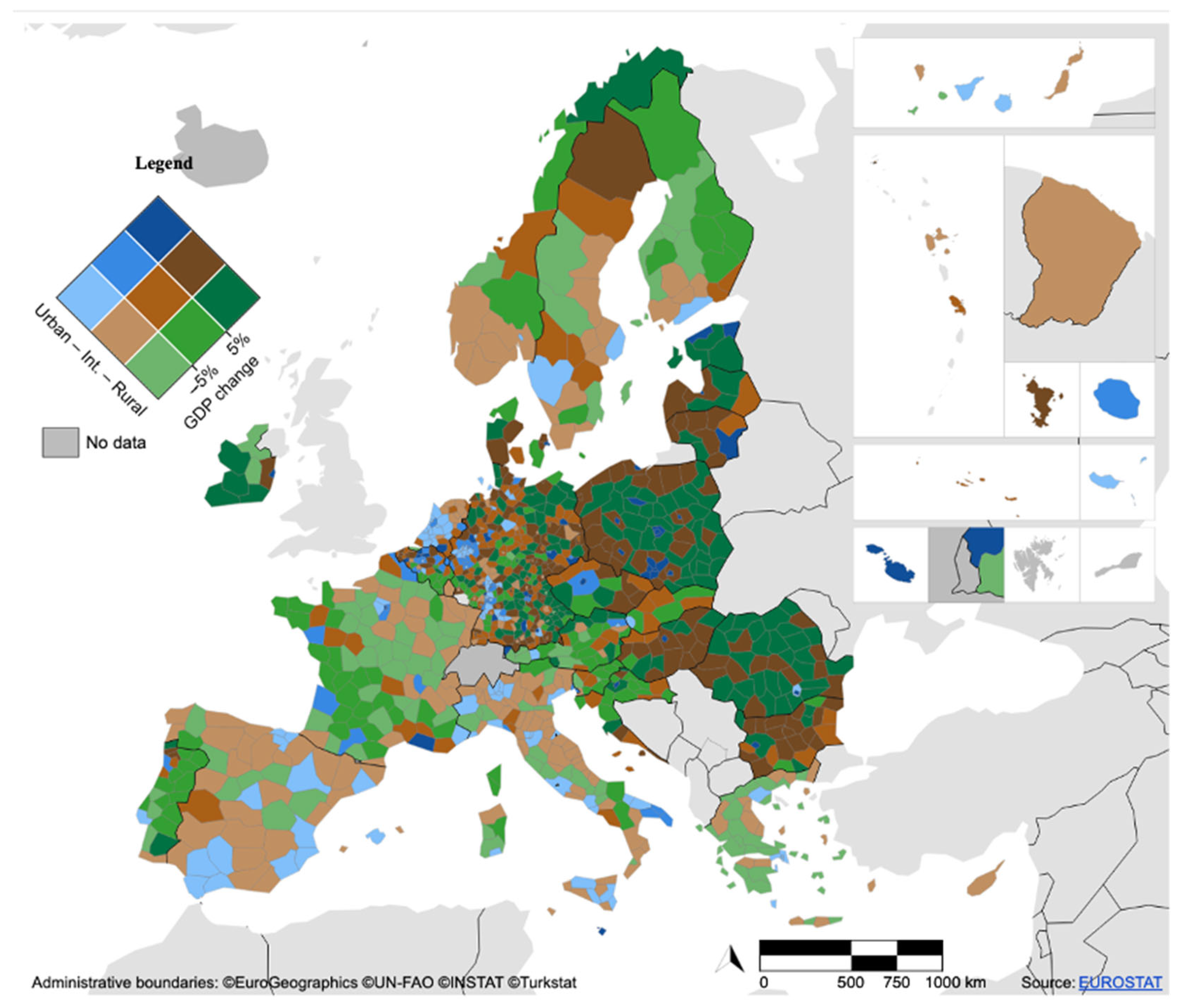
These landscapes share a distinct set of structural constraints that define their permanent natural complexity. The European classification of urbanization identifies nearly 80% of these municipalities as rural, often located at significant distances from essential service hubs (hospitals, schools, and transit nodes), which exacerbates the risk of demographic shrinkage and economic stagnation (Figure 1) [2].
This peripherality is compounded by climatic restrictions that, while historically shaping unique agropastoral mosaics, now leave these regions highly exposed to the escalating impacts of climate change [3].

1.2. Literature Review

1.2.1. Dynamic Evolution of the Apennine Socio-Ecological Systems

In Italy, the Inner Areas represent geographically a strategic pillar of the national landscape, encompassing approximately 177,000 km2 (roughly 59% of the national surface) and hosting over 13 million residents [4]. Characterized by high average elevations, with 42.4% of municipalities situated in hilly regions and complex topographies, they face systemic challenges in infrastructure and accessibility [5]. Despite their peripheral status relative to service provision centers, these territories are not merely empty spaces; they contribute significantly to the national economy through the cultural and creative sectors, which account for 6.1% of Italy’s national added value [6].
The National Strategy for Inner Areas (SNAI), approved with the European Commission Implementing Decision C (2022) 4787, constitutes the relative territorial policy for the 2020–2027 programming period, identifying marginalized municipalities based on specific accessibility parameters: health, education, and collective mobility, enclosing therefore 1904 municipalities with more than 4.5 million residents, over a surface of 94,000 km2 [7,8].
A foundational body of research has established a framework for assessing the environmental health of these fragile systems, identifying five critical pillars of landscape functionality: carbon sequestration, water availability, biodiversity, fire risk, and soil degradation [9]. While these parameters were originally synthesized to diagnose the impacts of land use modification in the Central Apennines, recent empirical evidence from the 2020–2026 period demands a refined understanding of their current trajectories.
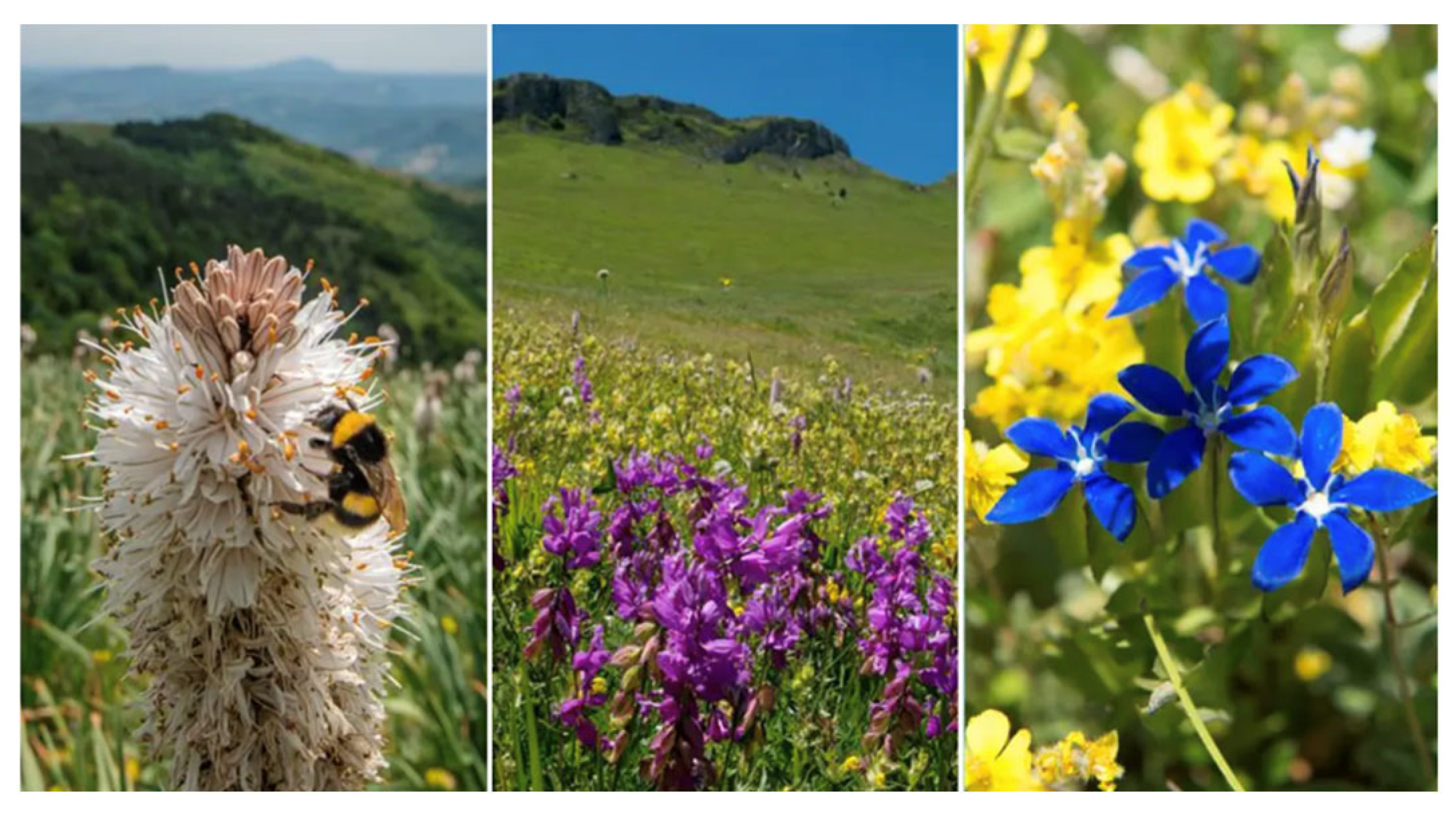
The most recent data indicates an alarming acceleration in the “management neglect paradox”. In terms of water availability, longitudinal studies in Central Italy document a significant reduction in the river runoff across all seasons between 1927 and 2020, alongside a decreasing trend in the runoff coefficient driven by thermal anomalies and shifting precipitation patterns [10]. Recent hydro-climatic analyses conducted in the Central Apennine Hydrographic District highlight a significant intensification of water stress, characterized by a paradoxical increase in the frequency and severity of meteorological drought periods, despite annual precipitation volumes remaining essentially stationary between 1965 and 2020. This trend is particularly marked on the Tyrrhenian coast, where the percentage of months experiencing severe drought has quadrupled over the last twenty years, from 5% to 24%, due to multidecadal oscillations that are placing increasing pressure on the resilience of regional aquifers [11]. This hydrological stress is mirrored in biodiversity dynamics (Figure 2); the abandonment of traditionally managed wooded grasslands has reached a tipping point where shrub encroachment reduces light availability even beyond the canopy edge, displacing rare heliophilous specialists in favor of shade-tolerant pre-forest species [12].
Simultaneously, the unmanaged forest expansion, which has increased forest surface by 20% over the last 30 years, has transitioned from a carbon-positive asset to a liability [13,14]. In the temperate regions of Central Italy, the escalation of wildfire risk is increasingly driven by prolonged drought periods that interact with specific landscape vulnerabilities, particularly in mountainous and hilly terrains where the forest matrix predominates [15]. Mapping these risks reveals that geomorphological factors (specifically southern exposures and slopes exceeding 15%) create zones of high susceptibility that demand targeted spatial planning. Within these areas, successional land covers such as shrublands and wastelands have emerged as highly fire-sensitive ecological units, underscoring the necessity of differentiating between vegetation types that exacerbate fuel hazards and those that could potentially be managed as natural mitigation agents [14]. Beyond the physical susceptibility of the terrain, the Italian wildfire crisis is exacerbated by a governance framework that prioritizes reactive emergency suppression over proactive prevention, a gap that is increasingly difficult to bridge as rural abandonment drives unprecedented fuel accumulation across the Apennine ridge [16]. Finally, soil degradation maintains a dominant negative trend; multi-temporal assessments using the Environmentally Sensitive Area Index (ESAI) in Latium (1960–2020) reveal a widening divergence in soil health between coastal and inland mountain districts, as millenary drainage and terrace systems collapse under neglect [17].
Ultimately, the pursuit of Sustainable Development Goal 7 in remote territories increasingly relies on energy-based rural development. Recent literature has demonstrated the significant potential of utilizing agro-biomass and agricultural residues to reinforce regional energy security in rural Europe [18]. Similarly, the deployment of Renewable Energy Communities (RECs) is emerging as a critical tool for rural resilience, transforming passive consumers into active stakeholders in the energy transition [19,20]. Building upon these place-based approaches, the present study shifts the focus from agricultural/biomass feedstocks to the built environment, investigating the integration of photovoltaic portfolios within post-seismic reconstruction.

1.2.2. Active and Passive Rewilding: Pros & Cons

The depopulation of territories and the progressive abandonment of the cultivated soil have prompted a debate about the management of these areas [21,22]. In particular, the discourse on passive rewilding in the Mediterranean mountains, and the Central Apennine ridge specifically, presents a multifaceted socio-ecological trajectory. On one hand, recent longitudinal evidence suggests that non-intervention can facilitate the restoration of carbon-rich, old-growth characteristics in Mediterranean mountain forests, potentially rebuilding mixed beech–silver fir (Fagus sylvatica, Abies alba) systems that are more resilient to climatic shifts [23]. This successional process, in an experimental study in Mediterranean basin mountains, is accompanied by measurable gains in soil organic carbon stocks and microbial quality, which progressively improve as croplands transition into old-forest structures [24]. Furthermore, the successful dispersal of reintroduced wild ungulates, such as red deer, highlights the capacity of rewilding to support wildlife recovery, though their preference for forest edges suggests that a cultural mosaic rather than total canopy closure remains optimal for habitat functionality [25].
Conversely, the management neglect inherent in strict passive strategies triggers a critical conflict in these human-shaped landscapes. In areas such as the Abruzzo, Lazio, and Molise National Parks, an intense debate has emerged regarding the preservation of high-nature-value grasslands against the systemic expansion of unmanaged forests [26].
Theoretical perspectives argue that approaches aiming for strict non-intervention are conceptually inconsistent when applied to cultural ecosystems co-evolved with human agency over millennia. In this context, total land abandonment is increasingly viewed as suboptimal; it erodes landscape heterogeneity, displaces open-habitat specialists, and exacerbates wildfire hazards by allowing continuous fuel loads to accumulate [27].
Therefore, while passive rewilding offers distinct regulating benefits, its implementation in the Apennines must be balanced against the loss of the biodiversity-rich agricultural mosaics that define the region’s socio-ecological identity.

1.2.3. Socio-Economic Stewardship and the Anthropo-Systemic Value of the Apennines

The preservation of the Central Apennine cultural landscape is fundamentally dependent on the maintenance of its anthropo-systemic value, the unique territorial capital, both tangible and intangible, that persists only through the continuous presence and active agency of local communities. Research within the 2016–2017 seismic crater area suggests that the withdrawal of human presence constitutes a net loss for the public budget, as the resulting destruction of territorial capital outweighs any immediate savings in service provision [28]. This valuation underscores the necessity of the SNAI, which seeks to counteract the marginalization of these zones by fostering integrated development models that address their structural distance from essential services. Several concrete economic pathways emerge from the literature and they involve tourism, agriculture and services sectors [29].
Agritourism and nature-based tourism are the most frequently cited opportunities. Agrotourism in European mountain areas can diversify farm income while preserving extensive agricultural landscapes [30]. The Rewilding Apennines initiative, recently selected for a five-year program under the Endangered Landscapes & Seascapes Program starting April 2026, explicitly aims to “support new economic opportunities linked to a healthier, more dynamic natural environment” alongside ecological restoration in the central Apennines [31].
Traditional and quality food products are another pillar. A University of Parma partnership in the Apennines worked to strengthen short supply chains for mountain farmers, showing that community–university collaboration can help overcome the isolation that makes these supply chains fragile [32]. From this was born the idea of a proximity economy model where minor food supply chains from fragile areas become drivers of local revitalization based on cooperation, reciprocity, and shared value creation [33].
Payments for ecosystem services represent a less developed but potentially transformative mechanism. A recent work (2022) identified specific agricultural practices that deliver bundles of ecosystem services across policy scenarios, particularly grazing-related practices: extending the grazing period, grazing in semi-natural and abandoned areas, adapting stocking rates, and seasonal transhumance [34]. These findings suggest that properly compensating farmers for landscape management could close the income gap that drives abandonment.
Community-based cooperatives have emerged as an institutional innovation in Italian inner areas. An article reports that these enterprises, which pursue general interest and create local partnerships, can address the specific needs of depopulating communities and potentially reverse demographic decline by enhancing social, natural, and artificial capital [35].

1.2.4. Feasibility of Photovoltaic Energy Development in Mountain Regions

Current literature on renewable energy transitions in mountain regions highlights a significant spatial and multi-criteria trade-offs [36]. Studies conducted in the high-altitude environment of the Andean region consistently rank ground-mounted PV arrays lower than forest biomass or hydropower due to their substantial land-use footprint and negative impact on landscape heritage [37]. GIS-based studies in Polish mountains have shown that only about one-fifth of total incoming radiation can be converted to electricity in protected mountain areas, with annual solar potential ranging widely from 113 to 1314 kWh/m2 [38]. Throughout the year, photovoltaic systems in highland regions in Europe and Lebanon demonstrated superior efficiency, with performance ratios spanning 73.73% to 88.64%. This trend suggests that lower ambient temperatures in these altitudes contribute to enhanced system output; consequently, the mean annual yield for the two locations in the Italian Alps ranges from 101.57 to 108.27 kWh/kWp [39].
Central Italy (roughly Lazio, Tuscany, Umbria, Marche, and not for specifically mountain areas; latitudes ~41–43°N) generally receives annual global horizontal irradiation (GHI) in the range of about 1400–1700 kWh/m2/year, depending on altitude, coastal proximity, and local climate. For a well-oriented fixed PV system (typically about 30° tilt, south-facing), the in-plane irradiation is higher, and expected annual energy yields are roughly 1200–1500 kWh/kWp [40].

1.3. Research Gap, Objectives, and Contributions

This study hypothesizes that utilizing the newly reconstructed public building stock as a distributed photovoltaic infrastructure enables mountain municipalities to generate an economic surplus specifically allocated for active landscape maintenance. However, notable gaps remain in feasibility studies regarding PV development in the Central Apennines, particularly concerning how non-invasive solar portfolios can be integrated into post-disaster recovery frameworks. Furthermore, there is a lack of quantitative literature exploring how renewable energy revenues can be systematically redirected to counter land abandonment and fund landscape stewardship in socio-economically fragile, earthquake-stricken areas.
To address these gaps, the primary aim of this study is to quantify the untapped solar potential of the public reconstruction sector within the Sibillini Mountains cluster and to propose a self-funding Stewardship-REC model. Secondary objectives include the evaluation of the potential economic revenue generated by energy sharing and the quantification of the resulting landscape Stewardship Capacity.
To achieve these objectives, the research is guided by the following questions:
  • RQ1: How is the solar potential spatially distributed across the seismic crater, and which municipalities can act as regional energy hubs?
  • RQ2: Can the economic incentives derived from these public solar hubs provide sufficient financial coverage to support active landscape stewardship and Nature-Based Solutions (NbSs), particularly in high-risk landscape?
  • RQ3: What is the realistic solar potential of the public reconstruction sector when filtered through a building-suitability proxy?
The original contribution of this research lies in designing a model tailored for post-seismic areas, transforming structural repair into an engine for energy independence. This approach provides a novel, self-sustaining financial lever for the socio-economic and environmental recovery of territories at high risk of depopulation, offering a reproducible framework for policymakers, urban planners, and technicians operating in post-disaster contexts.

2. Materials and Methods

This study selects the Sibillini Mountains (about 70,000 ha spanning the Marche and Umbria regions) as the pilot area for scientifically strategic reasons. This region serves as a living lab for the management neglect paradox, having been severely impacted by the 2016–2017 seismic sequence and being a focal point for the SNAI.
The methodology adopts an integrated, multi-criteria approach to evaluate the feasibility of a REC as a financial engine for landscape stewardship in the Sibillini Mountains.
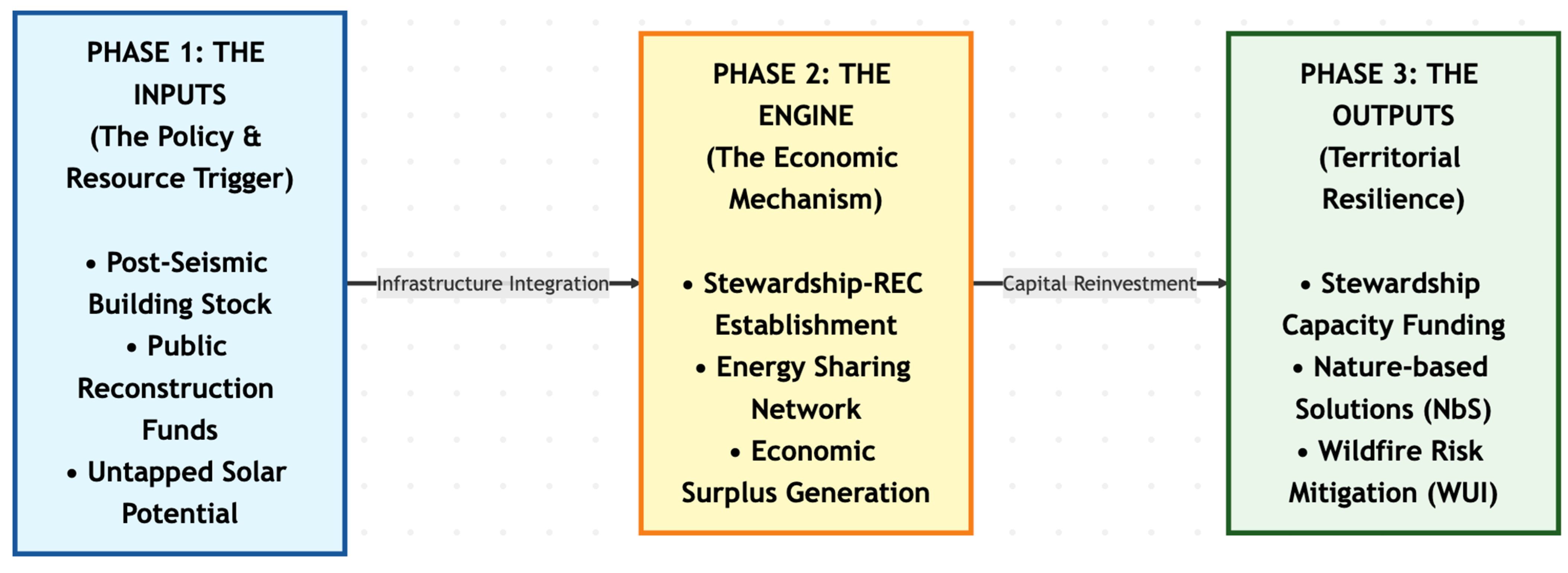
To clarify the logical architecture of this study, Figure 3 illustrates the Stewardship-REC conceptual framework, divided into three sequential phases. The process initiates with Inputs, where post-seismic reconstruction funds act as a catalyst to unlock the untapped photovoltaic potential of damaged public buildings. This capitalizes on existing structural repair to install solar capacity without consuming new land. The core mechanism, or Engine, is driven by the establishment of a REC; here, the energy generated by the public nodes is shared, legally and economically generating a financial surplus through national incentive schemes (e.g., GSE tariffs). Finally, the Outputs translate this economic surplus into a Stewardship Capacity. These funds are ring-fenced for NbSs, specifically targeting the active maintenance of the Wildland–Urban Interface to mitigate wildfire risks and bolster the socio-economic resilience of territories threatened by depopulation.

2.1. Study Area: The Sibillini Mountains

The pilot area encompasses the Monti Sibillini National Park and the surrounding municipalities within the 2016 seismic crater (Table 1).
This area (Figure 4) is characterized by the following:
  • Geomorphological Vulnerability: high wildfire susceptibility in southern-exposed slopes (>15%) and successional shrublands [14].
  • Hydrological Stress: a documented increase in severe drought frequency, rising from 5% to 24% in recent decades [11].
  • Socio-Demographic Fragility: significant rural abandonment and anthropo-systemic capital loss following the 2016 earthquake [28].
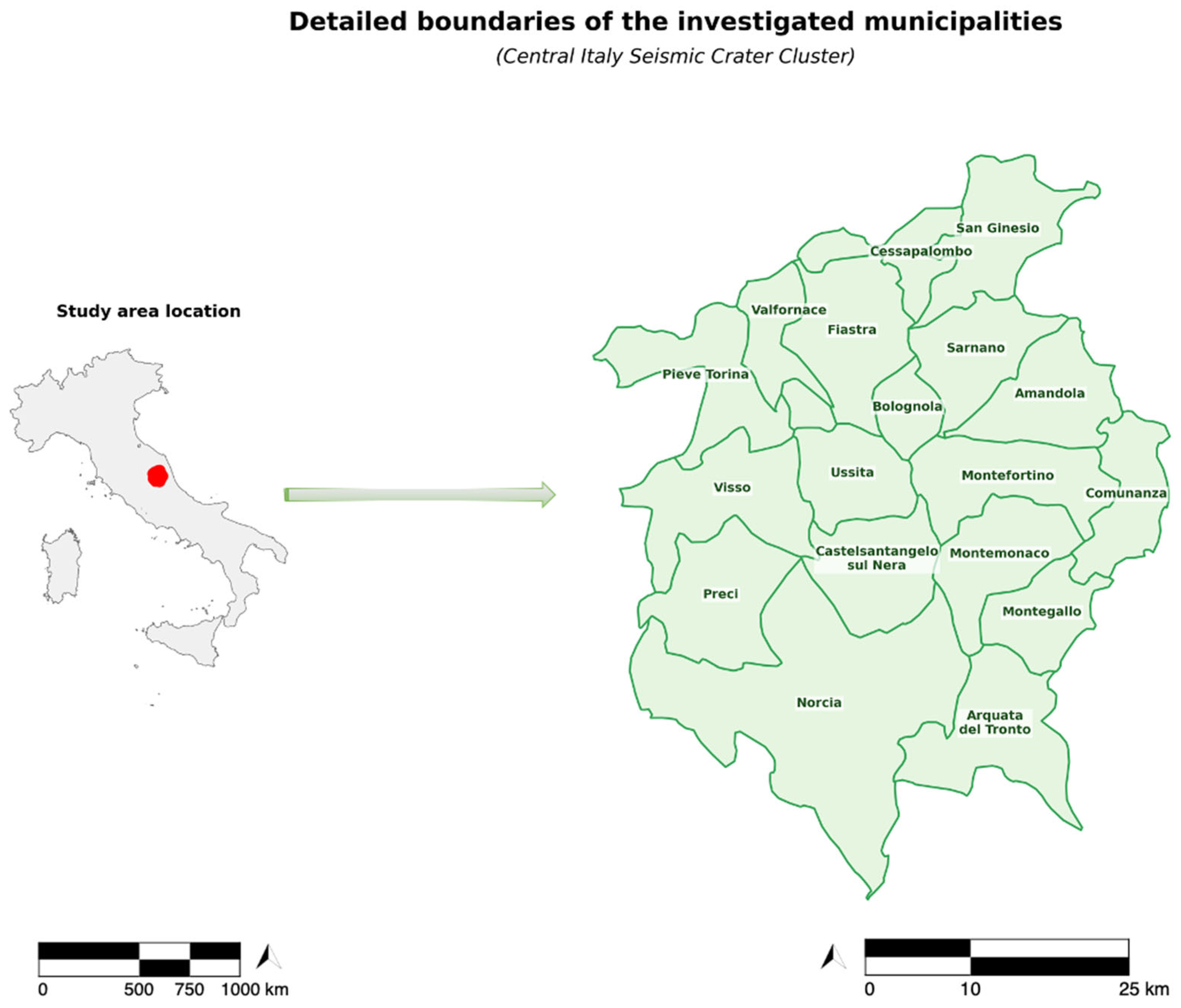
Figure 4. Geographical map of the Sibillini Mountains area. Panel A provides the national context, where the red dot indicates the location of the study area within Italy, while Panel B details the boundaries of the investigated municipalities.
Land 15 01004 g004

2.2. Module I: Spatial Identification of Energy Assets (GIS Analysis) and Rooftop Availability

High-resolution remote sensing and cadastral data are utilized to identify two main energy features:
  • PV Solar Radiation for the above-mentioned municipalities, considered under global irradiation optimum angle and calculated horizon for terrain shadow, using PVGIS-SARAH13 (EU joint Research Centre) for the period 2020–2023 (latest data available) [40];
  • PV Surfaces, mapping anthropo-systemic opportunities, including the rooftops of public seismic-damaged buildings and degraded/marginal surfaces identified for reconstruction. Seismic-damaged infrastructures are identified via Open Data Sisma 2016, specifically by mapping building rooftops within the 2016 seismic crater slated for public reconstruction or temporary stabilization [41]. These surfaces represent immediate opportunities for decentralized energy generation without further land consumption [42].
To operationalize the spatial potential into actionable energy metrics, the model assumes a standardized baseline installation of 20 kWp per public building. This specific threshold was strategically selected as it satisfies both spatial and regulatory imperatives. Architecturally, utilizing high-efficiency monocrystalline modules, a 20 kWp system requires approximately 100 to 120 m2 of net unshaded area [43], which reflects the standard architectural typologies of Apennine public infrastructure (e.g., municipal halls, primary schools, and gyms) [44]. Administratively, under the Italian legislative framework, systems up to 20 kWp represent a critical bureaucratic cut-off: they are exempt from being registered as an Officina Elettrica (Electrical Workshop) with the Agenzia delle Dogane (Customs Agency), thereby avoiding fiscal metering obligations and annual fees [45]. Additionally, plants of this size benefit from highly simplified grid-connection procedures (Modello Unico) on standard low-voltage networks, making them the most frictionless and rapidly deployable asset class for understaffed municipal administrations.

2.3. Module II: The Energy-Stewardship Economic Loop

This module models the financial mechanism through which the revenue generated by the REC is redirected to fund the operational costs of landscape maintenance, effectively decoupling territorial stewardship from volatile agricultural markets.

2.3.1. Revenue Modeling: The REC Financial Engine

The economic output of the energy-sharing model is calculated based on the combined production from the PV and biomass assets identified in Module I. The revenue stream is defined by the current Italian regulatory framework of the Ministry of the Environment and Energy Security (MASE) [46] and the strategic priorities of the National Strategic Plan for Inner Areas (PSNAI) 2025 [8], focusing on two primary components:
  • Incentivized Energy Sharing: revenue is derived from the sharing incentive for electricity produced and consumed within the community boundaries. For the Sibillini pilot area, a weighted average Incentive Rate has been applied, based on the latest ministerial decrees, accounting for the mountain correction factor intended to offset higher installation and maintenance costs in inner areas.
  • System Charge Savings: the model incorporates the reduction in regional system charges and the valorization of energy injected into the grid. This creates a surplus fund specifically earmarked for the community’s general interest—in this case, the maintenance of the anthropo-systemic capital.

2.3.2. Operational Cost Modeling: Nature-Based Solutions

The costs of active stewardship are quantified by evaluating the requirements of specific NbSs necessary to restore the High Nature Value cultural mosaic. Two primary interventions are prioritized:
Rotational Grazing and Transhumance: costs include the management of livestock (shepherding labor, mobile fencing, and water supply) required to maintain open grasslands and prevent woody encroachment. Following the valuation models (Bernués et al. (2014); Zabala et al. (2021)), the estimation of the economic value of these agroecosystem services amounts to approximately EUR 120 per hectare/year, with a significant portion of the willingness to pay attributed to wildfire prevention and biodiversity conservation [47,48].
Mechanical Mowing and Scrub Clearing: in areas where grazing is insufficient or labor is scarce, mechanical mowing is modeled to ensure the persistence of heliophilous plant species and forest-edge habitats. These costs are adjusted for the steep topography of the Sibillini ridge (slopes > 15%), which necessitates specialized equipment and higher labor intensity.
To determine the financial requirements for territorial stewardship, the model adopts a conservative cost baseline for active landscape maintenance. The selected baseline of 1200 EUR/ha for Stewardship Capacity is grounded in current regional pricing standards in Central Italy. Specifically, the Official Price List of the Marche Region for Public Works (2024) cites a rate of 1227.11 EUR/ha (Item 12.03.012) for specialized mechanical mowing and pruning on embankments and verges, tasks technically comparable to the maintenance of firebreaks and steep mountain slopes [49]. This active service cost is significantly higher than agricultural subsidies, such as the 130 EUR/ha annual payment provided by the Marche Rural Development Complement 2023–2027 (Intervention SRA08) for the management of permanent pastures [50]. By anchoring the model to the higher public work tariff rather than the lower agricultural subsidy, the study suggests that the REC surplus is sufficient to commission professional-grade landscape maintenance, effectively filling the gap left by rural abandonment.

2.3.3. The Stewardship Capacity

The Energy-Stewardship Loop is closed by calculating the Stewardship Capacity (Astew):
A s t e w = R R E C C O p C N b S _ u n i t
where RREC (REC Revenue) is the gross revenue from energy production, COp (Operative Cost) represents the technical operation and maintenance costs of the energy plants, and CNbS_unit (Nature-Based Solutions unit Cost) is the total cost of landscape maintenance.
This metric (Astew) identifies the specific portion of high-value or high-risk landscape (e.g., strategic firebreaks, peri-urban slopes, or bio-corridors) that can be adopted and managed through the solar energy surplus.

2.4. Data Acquisition and Solar Resource Assessment

The solar resource assessment was conducted using the PVGIS-SARAH3 database (European Union, 2001–2026). For each identified municipality, irradiation data on the optimally inclined plane (H(i)opt) was extracted for a four-year period (2020–2023). Preprocessing involved calibrating the tilt angle for each specific coordinate; this localized approach ensures that the specific energy yield calculations reflect the unique geographic conditions of each node in the Sibillini cluster. Following PVGIS technical standards, the total system loss is calculated as follows:
TS L   =   ( 100 · ( 1     ( 1     α L ) · ( 1     I L ) · ( 1     S L ) ) )
  • TSL = total system loss
  • αL = angle-of-incidence loss
  • IL = temperature/irradiance loss
  • SL = standard system loss
For example, a compound of angle-of-incidence loss of 3.7%, a temperature/irradiance loss of 7.2%, and a standard system loss of 14%, results in a comprehensive total loss of 23.1%. This conservative approach ensures that the projected specific yield of 1390 kWh/kWp is realistic for the high-altitude conditions of the Central Apennines.
The calculation of the final energy yield Yf was performed using a custom Python 3.10 script. This script processes the monthly irradiation data to derive annual performance metrics, while the subsequent economic modeling for the Stewardship-REC surplus was conducted in MS Excel. To support the reproducibility of our findings, the Python code, including the parameters for H(i)opt calculations, is archived and publicly accessible via the Zenodo repository [at https://zenodo.org/records/19356503] (accessed on 25 May 2026).
Validation through on-site measurements was not feasible during this study, as the public building stock is currently within the active post-seismic reconstruction phase. Consequently, the study utilizes the SARAH3 radiation database as the primary high-fidelity reference, supported by a validation step against the Global Solar Atlas (see Discussion, Section 4.2).

3. Results

3.1. Anthropo-Systemic PV Potential

The geospatial analysis of the anthropo-systemic photovoltaic potential across 1365 km2 of the Sibillini crater reveals a highly viable, yet topographically constrained, solar resource. By weighting the high-resolution satellite data (PVGIS-SARAH3, 2020–2023) against municipal surface areas, the region demonstrates a weighted average specific yield (Yf) of 1390.52 kWh/kWp, assuming a conservative system performance ratio (PR) of 0.8 [51,52].
Crucially, the data quantifies the geomorphological vulnerability inherent to the Apennine ridge. The application of calculated horizon shading exposes significant intra-regional variance: optimally situated municipalities such as Castelsantangelo sul Nera achieve peak yields of 1567.36 kWh/kWp, whereas the highest regional settlement of Bolognola experiences seasonal solar radiation penalties, dropping to 1218.66 kWh/kWp (Table 2). This variance dictates that regional energy planning cannot rely on generic provincial averages, but must be hyper-localized to the topographic realities of the seismic crater.
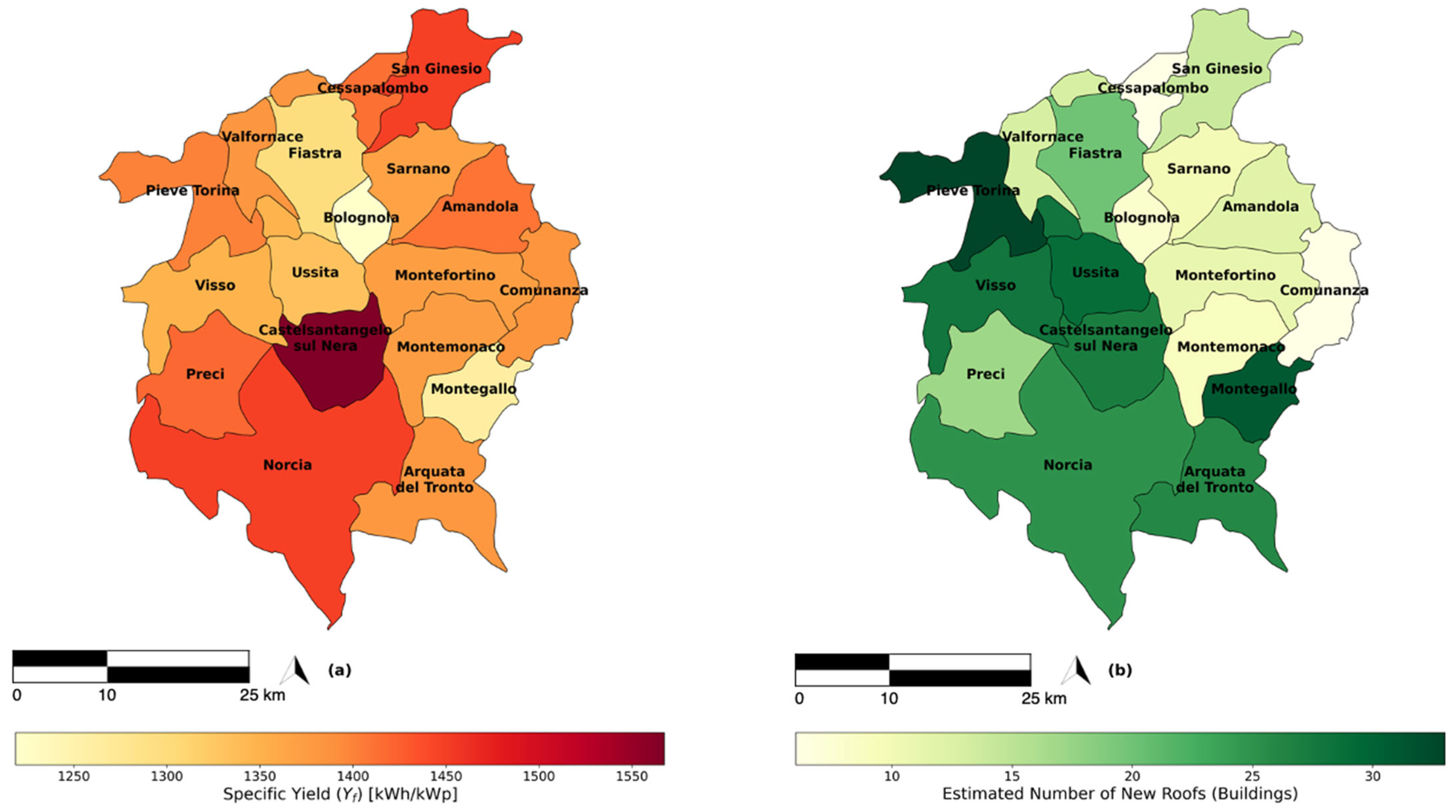
These data are graphically represented with a high-resolution spatial distribution of anthropo-systemic solar potential (Yf) across the Sibillini crater study area (Figure 5a). The map highlights the topographic constraints on energy yield, identifying high-production plateau hubs and low-production valley systems. Boundaries are based on 2026 ISTAT administrative coordinates that match with the municipality’s denomination of PVGIS-SARAH13 of Table 3.

3.2. Quantification of the Public Solar Rooftop Availability

This study focused exclusively on the public reconstruction sector within the 2016 seismic crater, as public buildings (e.g., schools, town halls, gyms) possess the ideal structural, administrative, and load-profile characteristics to act as the primary energy hubs for a REC. Data regarding the number of funded public reconstruction projects were extracted from the official administrative databases (Open Data Sisma 2016). However, preliminary analysis revealed a significant semantic limitation in the administrative datasets: the term “public interventions” aggregates actual structural buildings (suitable for PV integration) with non-building infrastructure. To resolve this and prevent an overestimation of available roof surfaces, the evaluation of a Building Suitability Coefficient (Ce) was conducted across both affected regions (Umbria and Marche) using the latest available reconstruction datasets. A granular verification was conducted by cross-referencing detailed project descriptions in Umbria and with a manual check performed via the Marche Region’s Sismapp database. To standardize this verification, strict inclusion and exclusion criteria were defined:
  • Inclusion criteria comprised actual buildings with exploitable roof structures funded by ordinary public funds, emergency special orders, or donations: schools, public housing, barracks, accommodation facilities (camper areas, mountain shelters, tourist facilities), institutional properties (municipal buildings), sports facilities (gyms, ski plants), production facilities (municipal warehouses, power plants), and community service facilities (e.g., hospitals and nursing homes, civil protection buildings).
  • Exclusion criteria filtered out non-building infrastructure and architecturally restricted assets: places of worship (for ethical and architectural reasons), cemeteries, water and sewerage systems, retaining walls, road networks, and parks.
The localized empirical verification across the selected multi-regional nodes confirmed a cumulative suitability rate of 40.8%, based on the identification of 92 viable rooftop structures out of 225 total evaluated public interventions (see Appendix C for the complete granular dataset). Backed by these expanded field metrics, the conservative baseline value for Ce was established at 0.40 (40%), and it was applied also to the remaining municipalities in the Sibillini cluster.
The analysis of the public reconstruction datasets, filtered through Ce, identifies a total of 325 potential energy hubs across the Sibillini cluster (Figure 5).
These represent reconstructed public buildings capable of acting as the primary nodes for a REC. Assuming a standardized conservative installation of 20 kWp per public building (typical for small-to-midscale public facilities) [43], the total installed capacity for the public sector of the cluster is estimated at 6.50 MWp. Given the specific local irradiation (Table 2), this infrastructure would generate approximately 9 GWh per year, calculated as follows:
E = P · P R · H ( i ) o p t
where E is the energy produced annually [kWh], P is the peak power [kWp], PR is the performance ratio (0.8), and H(i)opt is the average annual irradiation [kWh/m2/year]; therefore, on average in the Sibillini mountain area:
E = ( 20   kWp / plant   ·   325   plants )   ·   0.8   ·   1738.15   =   9.038   kWh   9   GWh
The results, analyzed instead at the level of individual municipalities, reveal a hierarchy of Resilience Nodes (Table 3). Pieve Torina, with 33 potential hubs, emerges as the cluster leader. Other strategic nodes, such as Montegallo and Ussita, demonstrate that even sparsely populated mountain municipalities can become net energy exporters and significant land-care providers. The verified nodes of Norcia and Preci provide 24 and 20 hubs, respectively, confirming that the urban-to-mountain funding loop is viable even in the most historically significant and sensitive areas of the crater.

3.3. Hypothesized kWh Economic Value and Stewardship Surplus Calculation

To define the Astew values, it is fundamental to evaluate the related revenues (RREC) and associate costs (COp and CNbS_unit).
About RREC has been considered the current Italian Regulatory Framework for RECs, specifically the MASE Decree (Ministry of Environment and Energy Security) active in 2024–2026.
The consequent hypothesized economic value of 0.12 EUR/kWh is a conservative rate calculated as follows:
Incentive for Shared Energy: approximately 0.11 EUR/kWh (Variable based on the market price, but capped/indexed for plants under 1 MW).
ARERA Valuation (Reimbursement of Network Charges): about 0.01 EUR/kWh (the benefit of consuming energy where it is produced).
Total Revenue: this 0.12 EUR/kWh represents the net benefit that the REC earns for every kilowatt-hour shared among its members in the Sibillini municipalities, providing a stable 20-year revenue stream for localized landscape maintenance [53].
As shown in Table 4, the total cluster RREC is estimated at EUR 1,077,721 per year.
In reference to COp, to ensure the long-term viability of the solar infrastructure, the model accounts for annual operation and maintenance costs. Following international benchmarks for distributed rooftop PV in Europe [54], a conservative maintenance cost of 20 EUR/kWp/year was applied. For a standard 20 kWp installation, this results in an annual expenditure of EUR 400, which is deducted from the gross shared energy incentives to determine the final surplus available for landscape maintenance.
The costs per hectare relative to the Nature-Based Solutions (CNbS_unit) in the Sibillini Mountains are not passive (leaving nature alone). Instead, they involve active interventions designed to restore the socio-ecological equilibrium of the wooded grasslands, with these key activities:
  • Targeted Pastoralism (shepherding): Paying shepherds to bring flocks to specific “high-risk” areas. The goal is “mosaic grazing,” which keeps the grass short and prevents the accumulation of dry biomass (fuel) that leads to intense wildfires.
  • Strategic Mowing: mechanical clearance of scrub and tall grass in areas where grazing is not possible, particularly around the Wildland–Urban Interface (the border between the town and the forest).
  • Scrub Thinning: elective removal of invasive shrubs (like Juniperus or Cytisus) that act as “ladder fuels,” allowing ground fires to climb into the tree canopy.
Despite the “surprising paucity of rewilding literature truly focusing on economics and/or providing detailed quantification” [55], an estimate has been obtained based on the following considerations. In the Rural Development Programs (PSR) for the Marche region (e.g., Measure 10: Agri-environment-climate payments), the compensatory payments for organic farming or mountain pasture maintenance often range from 800 to 900 EUR/ha [56]. However, these are passive subsidies. Literature on active stewardship (where the farmer must provide a specific service like firebreak maintenance) adds the cost of specialized labor, bringing the total to the EUR 1000–EUR 1500 range. Based on the 1200 EUR/ha stewardship cost defined in the methodology, a single 20 kWp REC can provide full financial coverage for the stewardship of approximately 2.7 hectares of critical buffer zones.
Applying the stewardship cost benchmark of EUR 1200/ha/year for active maintenance (e.g., fire risk reduction, fuel load control, and mosaic grazing), the solar energy produced by these public roofs could fund the active protection of 789.77 hectares of high-risk mountain slopes annually.

4. Discussion

4.1. Interpretation of Results

The application of the model to the regional reconstruction data allowed for the geographic visualization of the post-seismic solar potential (Figure 6). The resulting spatial distribution highlights specific municipalities that possess a critical mass of reconstructed public buildings. These nodes are strategically positioned to act as the foundational pillars for the local Renewable Energy Communities, transforming the burden of public reconstruction into an active network of distributed renewable power generation.
The Stewardship-REC model proposes a scalable solution for Italy’s Inner Areas, which cover 59% of the national territory (177,000 km2) and face severe land abandonment risks, with over 2 million hectares of national agricultural area currently lacking economic viability [57,58]. A prudent extrapolation suggests that scaling the Sibillini cluster’s metrics to just 10% of these vulnerable regions would generate approximately 114 GWh of clean energy annually. Based on 2024 ISPRA emission factors [59], this network would avoid 24,500 tons of CO2 per year while injecting a self-sustaining ecosystem fund of over EUR 13.6 million annually into rural economies. By structurally linking energy decentralization with landscape maintenance, this framework addresses systemic vulnerabilities, such as wildfire risk and land abandonment, by providing a financial mechanism for territorial management.

4.2. Literature Benchmarking and Contextual Analysis

To contextualize these results, it is pertinent to analyze the scientific significance of the cluster’s average yield, which stands at 1390.52 ± 76.22 kWh/kWp. This relatively low variability indicates a substantial homogeneity in solar potential across the Sibillini area, notwithstanding the morphological differences between the municipalities. However, the Pearson correlation analysis between municipal altitude and specific yield returned a value of r = −0.428. This result indicates a moderate negative correlation, suggesting that altitude alone does not necessarily guarantee higher energy efficiency. On the contrary, the decrease in yield at higher elevations suggests an alternative explanation in the complex morphology of the Apennines: municipalities located at higher altitudes within the cluster (such as Bolognola) are frequently situated in narrow valleys subject to significant orographic shading (horizon blocking), which restricts direct sunlight hours compared to more open, lower-elevation municipalities.
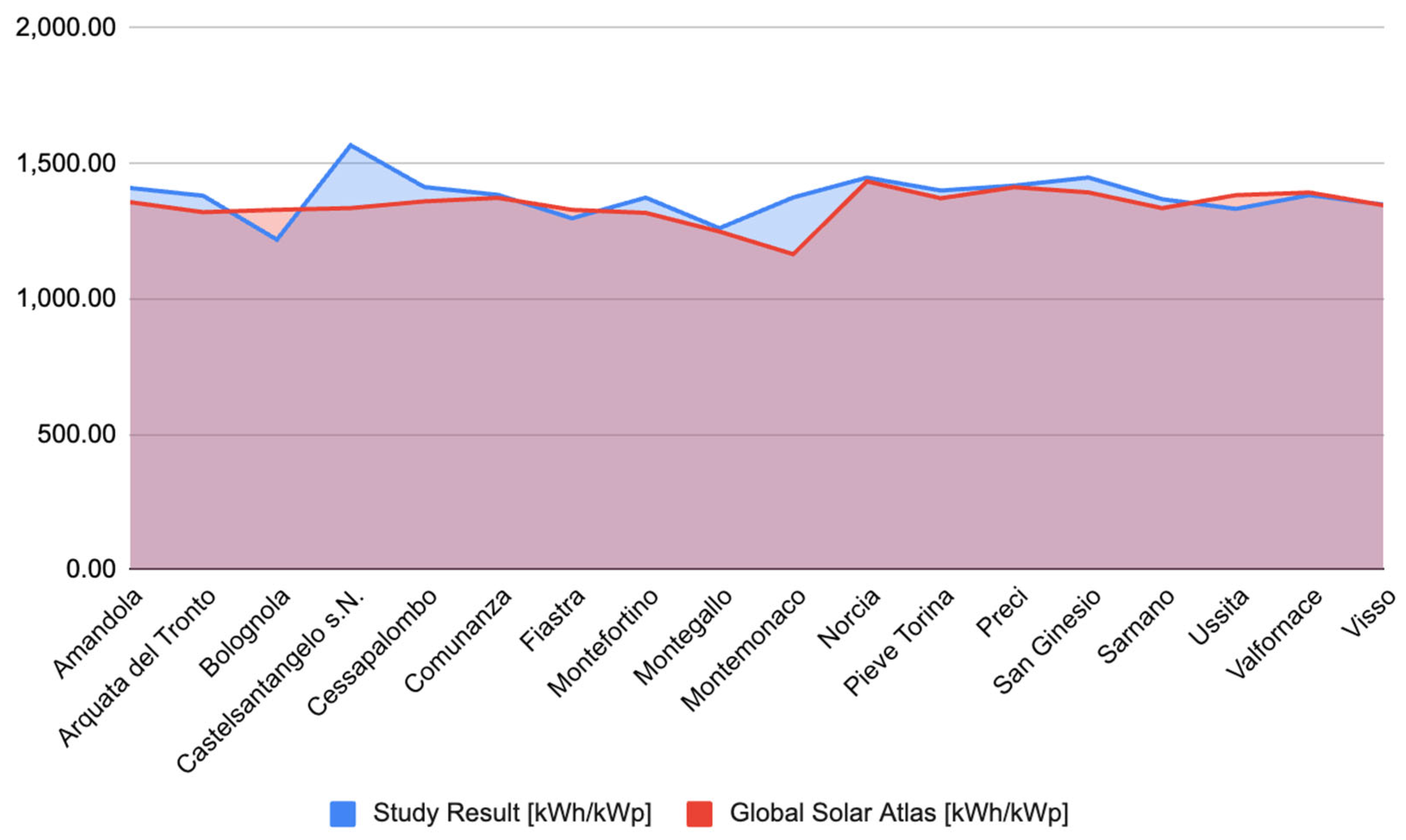
To ensure the reliability and accuracy of the simulated energy outputs, the results were cross-validated against independent international benchmark (Global Solar Atlas). Specifically, a comparison table (Appendix B) and a validation graphic (Figure 7) illustrate the consistency between the datasets. To statistically validate this alignment, a paired t-test was conducted comparing the study’s yield projections with the benchmark across the 18 target municipalities. The analysis yielded a p-value of 0.084 (p > 0.05), indicating no statistically significant difference between the two datasets.
The specific yield of the Sibillini cluster outperforms the Italian national average of 1066 kWh/kWp by approximately 30% [60]. This efficiency indicates that high-altitude atmospheric clarity and optimized rooftop inclinations may offset the complex topographic constraints of the central Apennines. Furthermore, this potential is projected to remain highly stable under future climate change scenarios. While severe models (RCP 8.5) predict a 2% national decrease in PV capacity by 2100 exacerbated by an 8% drop in Alpine regions due to diminishing snow cover, the Apennine ridge demonstrates unique resilience. Here, a projected 1–2% production increase is expected, as rising surface radiation offsets temperature-induced efficiency losses (−0.52%/°C) [61]. To exploit this stable resource, standard PV remains the optimal technological choice over alternatives like Concentrating Solar Power (CSP). PV achieves more than twice the specific energy density (up to 172 kWh/(m2·year)) of CSP (81.5 kWh/(m2·year)) and effectively utilizes diffuse irradiance. This modularity avoids the extensive flat land requirements (exceeding 50,000 m2 per MW) that render CSP infeasible in mountainous topographies [62]. Finally, deploying these PV systems exclusively on reconstructed public rooftops provides a critical strategic advantage in land preservation. Recent geospatial analyses indeed reveal that only 26% of the Italian territory remains legally available for utility-scale solar due to stringent landscape and environmental protections [63].

4.3. Policy and Practical Implications

The practical implementation of the Stewardship-REC model relies on the regulatory flexibility provided by the recent MASE Decree No. 414/2023 (CACER Decree) [46]. Under the current Italian framework, RECs are established as non-profit legal entities whose primary purpose is to provide environmental, economic, or social community benefits. Crucially, the Italian Gestore Servizi Energetici (Energy service manager) does not impose rigid constraints on how the incentive is redistributed, provided it aligns with the REC’s statutory social goals [53]. To overcome bureaucratic rigidity, the model can utilize Article 55 of the Third Sector Code (Italian Legislative Decree 117/2017), which enables Shared Administration procedures. This allows municipalities and RECs to co-design land-stewardship interventions and directly contract local workers or agricultural cooperatives for landscape maintenance. By defining Active Territorial Stewardship as a core social objective in the REC’s bylaws, the energy-sharing surplus is transformed into a legitimate, cross-sectoral funding stream for environmental resilience, facilitating the integration of decentralized energy initiatives with land management objectives.
Finally, practical deployment faces critical technical constraints regarding electrical infrastructure. This study quantifies the theoretical generation potential based on macro-scale satellite datasets and structural suitability; however, it omits an analysis of the localized low- and medium-voltage grid hosting capacity. Detailed topological and real-time load data of the distribution network are currently proprietary to the Distribution System Operator and unavailable for open-data spatial modeling. While the Italian National Recovery and Resilience Plan is actively investing EUR 3.6 billion to increase the structural hosting capacity of the national grid by over 5.6 GW to accommodate Renewable Energy Communities (Italian Legislative Decree 146/2022), the localized physical implementation of the Stewardship-REC model will necessarily require executive, Distribution System Operator-level grid-flow simulations to identify specific infrastructure bottlenecks.
Having outlined this legal and administrative framework, the physical implementation of the model relies on the spatial configurations provided by the reconstruction process.

4.4. Sensitivity Analysis

The economic robustness of the proposed framework was evaluated through a sensitivity analysis utilizing a 3x3 contingency matrix (Table 5). This procedure assesses the stability of the annual Stewardship Capacity (Astew), quantified as the total fundable land area (ha) per annum, against a ±20% variation in two primary stochastic parameters:
  • System Yield (performance ratio, PR): reflecting technical variances, environmental uncertainties, and localized shading effects (Baseline PR = 0.80).
  • Incentive Rates: representing the inherent volatility of energy markets and potential shifts in the national regulatory framework (Baseline 0.12 EUR/kWh).

Table 5. Sensitivity analysis of the total annual Stewardship Capacity (Astew) [ha/year] in response to ±20% fluctuations in System Yield (PR) and Incentive Rates.
Astew [ha/Year]Yield −20%
(PR = 0.64)
Baseline Yield (PR = 0.80)Yield +20%
(PR = 0.96)
Incentive −20%
(0.096 EUR/kWh)
468 ha611 ha754 ha
Baseline Incentive (0.120 EUR/kWh)611 ha790 ha969 ha
Incentive +20%
(0.144 EUR/kWh)
754 ha969 ha1184 ha
The sensitivity matrix reveals that even in the most pessimistic scenario (bottom-left/top-left cells), the model maintains a positive, although significantly reduced, impact. Specifically, even with a simultaneous 20% drop in both technical performance and energy incentives, the Sibillini cluster can still fund over 460 hectares of active landscape maintenance annually. Conversely, under optimistic conditions, this capacity expands to nearly 1200 hectares, demonstrating the high scalability and economic stability of the Stewardship-REC framework as a primary tool for territorial resilience.

5. Conclusions

This research provides a mixed-method framework that integrates spatial energy modeling with economic feasibility to address the compounded vulnerabilities of Italy’s mountain territories. The specific contribution of this study is its application to a vulnerable territorial context characterized by historical rural depopulation (Inner Areas) and post-seismic structural damage. By integrating decentralized energy generation into post-disaster reconstruction frameworks, this research provides a methodological link between energy transition modeling and community-level land management policies. In precise terms, the key takeaways of this research structurally answer the core research questions (RQs):
  • Geographic Heterogeneity and Energy Hubs (RQ1): While the cluster achieves an exceptional average yield of 1390 kWh/kWp (outperforming the national average by 30%), spatial analysis reveals a hyper-localized energy landscape dictated by mountain geomorphology. Production ranges significantly from 1218 kWh/kWp in valley bottoms (e.g., Bolognola) to 1567 kWh/kWp in high-irradiation plateaus (e.g., Castelsantangelo sul Nera). This heterogeneity proves that regional planning cannot rely on generic provincial averages, requiring the strategic selection of micro-climatic Energy Hubs.
  • The Economic Stewardship Mechanism (RQ2): The proposed REC framework is economically self-sustaining, capable of generating approximately EUR 1.08 million in annual revenue. This surplus shifts conservation from passive subsidies to an active stewardship model capable of funding the maintenance of 790 hectares annually. Specifically, interventions should be focused on the Wildland–Urban Interface, the critical transition zone where residential structures meet flammable forest fuels [64]. In the Apennine context, post-seismic abandonment has accelerated the biomass encroachment around villages, creating a continuous fuel load that facilitates high-intensity wildfire spread [28]. This approach transforms the REC from a mere energy producer into a strategic planner for civil protection, ensuring that the financial surplus is invested where the risk to human life and infrastructure is highest.
  • Asset Recovery and Land Preservation (RQ3): Through the conservative application of the Ce conversion proxy, the spatial model identifies 325 viable energy nodes within the public reconstruction portfolio. By prioritizing these distributed rooftops, the framework circumvents severe national constraints, protecting pristine mountain landscapes from soil consumption, and redefines post-disaster rebuilding not as a cost center, but as a productive infrastructural asset for long-term territorial resilience.
Nevertheless, the proposed Stewardship-REC model presents three primary limitations. First, the spatial analysis relies on the administrative Open Data Sisma repository, which lacks precise architectural volumetric data. This necessitated the application of a 40% conversion proxy (Ce) derived from specific municipal datasets. While this introduces spatial uncertainty, the resulting baseline remains reliable, as validated by its statistical alignment with Global Solar Atlas benchmarks. Second, the economic feasibility of the EUR 1200/ha landscape maintenance fund is strictly contingent upon national tariff stability. Because the Stewardship-REC is a pioneering framework and the physical energy nodes are currently pre-construction, the economic assumptions regarding RREC, COp, and CNbs_unit remain scenario-based rather than empirically validated. Rather than providing a definitive financial audit, it establishes the critical break-even thresholds necessary for administrative planning. Indeed, sensitivity analyses indicate the model is sustainable only if the national GSE incentive exceeds 0.08 EUR/kWh; a reduction below this threshold would decrease Stewardship Capacity by approximately 15%, requiring a proportional recalibration of environmental targets. Finally, practical deployment faces critical technical and institutional constraints. The study quantifies theoretical generation but omits localized grid hosting capacity, necessitating future grid-flow simulations to assess infrastructure bottlenecks. Furthermore, municipalities in Italy’s Inner Areas often lack the administrative personnel required to navigate the bureaucratic complexities of the CACER framework, suggesting that future execution will rely heavily on targeted capacity-building or the intervention of third-party energy aggregators.
Therefore, future studies must address specific methodological limitations to fully operationalize this framework. First, to overcome the spatial uncertainties inherent in administrative post-disaster databases, future research must utilize updated cadastral systems and GIS-based architectural surveys to identify the exact net surface and geometry of available rooftops at the definitive conclusion of the reconstruction process. Currently, high-resolution 3D cadastral datasets detailing specific roof azimuths and slopes are unavailable for these rural mountain municipalities. Moreover, an ex-post empirical validation is physically precluded at the current stage of the post-seismic process: according to the latest institutional data [44], 35% of the public interventions are still in the ongoing design phase and 2.4% have not yet commenced. Consequently, future research will need to incorporate definitive ”as-built” architectural surveys and high-resolution cadastral mapping to refine the theoretical generation profiles once the physical reconstruction process is fully finalized. Second, technical simulations of local low- and medium-voltage grid hosting capacities are required to assess potential infrastructure bottlenecks. Finally, future studies should introduce a highly quantitative, longitudinal evaluation of the proposed socio-economic loop. Research must track the exact conversion rates of local energy availability into stewardship income, and subsequently measure how this income generates local occupational opportunities to successfully contrast rural depopulation. Conducting comparative analyses of these targeted policy results across other European marginalized or disaster-affected regions will be essential to validate the international scalability of the Stewardship-REC paradigm.

Author Contributions

Conceptualization, B.M., F.C., G.C. and A.C.; methodology, B.M.; software, A.C.; validation, F.C. and G.C.; formal analysis, B.M. and F.C.; data curation, F.C. and A.C.; writing—original draft preparation, G.C. and A.C.; writing—review and editing, F.C. and G.C.; supervision, B.M. and A.C. All authors have read and agreed to the published version of the manuscript.

Funding

This research received no external funding.

Data Availability Statement

The raw solar radiation, PV performance datasets, and all useful data finalized to determinate Astew were obtained from the European Commission’s Joint Research Centre Photovoltaic Geographical Information System (PVGIS-SARAH3), available at https://re.jrc.ec.europa.eu/pvg_tools/en/ (accessed on 25 May 2026), and Open Data Sisma 2016, available at https://sisma2016data.it (accessed on 25 May 2026). The custom Python-based analytical framework developed for the area-weighted cluster analysis and the extraction of topographic shading impacts is available in a public repository at https://zenodo.org/records/19356503 (accessed on 25 May 2026), DOI: 10.5281/zenodo.19356503. All other derived data supporting the findings of this study are included within the article.

Conflicts of Interest

The authors declare no conflicts of interest.

Abbreviations

The following abbreviations are used in this manuscript:
AstewStewardship Capacity
CeBuilding Suitability Coefficient
CNbS_unitNature-Based Solutions Unit Cost
COpOperative Cost
H(i)optAverage Annual Irradiation
MASEMinistry of Environment and Energy Security
NbSNature-Based Solutions
SNAINational Strategy for Inner Areas
PRPerformance Ratio
PVPhotovoltaic
PSNAINational Strategic Plan for Internal Areas
RECRenewable Energy Community
RRECRenewable Energy Community Revenue
YfAverage Specific Yield

Appendix A. Comparative Summary of Solar Yield, Estimated REC Revenues, and the Resulting Annual Stewardship Capacity for the Investigated Municipalities

MunicipalityArea (km2)H(i)opt [kWh/(m2·Year)]Yf [kWh/kWp]Available Public RoofsEnergy (MWh/Year)RREC (EUR)COp (EUR)Astew (ha)
Amandola691762.461409.9712333.456€40,015€4800.0029.35
Arquata del Tronto921726.141380.9126722.488€86,699€10,400.0063.58
Bolognola261523.331218.668222.304€26,676€3200.0019.56
Castelsantangelo s.N.711959.21567.3627750.276€90,033€10,800.0066.03
Cessapalombo281766.181412.946166.728€20,007€2400.0014.67
Comunanza541730.11384.086166.728€20,007€2400.0014.67
Fiastra841622.031297.6220555.76€66,691€8000.0048.91
Montefortino781717.371373.9011305.668€36,680€4400.0026.9
Montegallo481576.241260.9931861.428€103,371€12,400.0075.81
Montemonaco681718.361374.699250.092€30,011€3600.0022.01
Norcia2761810.011448.0125694.7€83,364€10,000.0061.14
Pieve Torina741750.141400.1133917.004€110,040€13,200.0080.7
Preci821773.161418.5317472.396€56,688€6800.0041.57
San Ginesio781810.361448.2914389.032€46,684€5600.0034.24
Sarnano631710.361368.2910277.88€33,346€4000.0024.45
Ussita551665.421332.3429805.852€96,702€11,600.0070.92
Valfornace491729.081383.2613361.244€43,349€5200.0031.79
Visso1001685.31348.2428778.064€93,368€11,200.0068.47
Sibillini Cluster13951738.151390.523259031.1€1,083,732€130,000.00794.78

Appendix B. Comparison of Specific Photovoltaic Power Output Between the Present Study and the Global Solar Atlas

MunicipalityStudy Result [kWh/kWp]Global Solar Atlas [kWh/kWp]Deviation
Amandola1409.971357.703.71%
Arquata del Tronto1380.911320.204.40%
Bolognola1218.661329.00−9.05%
Castelsantangelo s.N.1567.361335.2014.81%
Cessapalombo1412.941360.203.73%
Comunanza1384.081373.100.79%
Fiastra1297.621328.90−2.41%
Montefortino1373.901317.704.09%
Montegallo1260.991248.700.97%
Montemonaco1374.691165.0015.25%
Norcia1448.011433.900.97%
Pieve Torina1400.111371.602.04%
Preci1418.531412.400.43%
San Ginesio1448.291393.303.80%
Sarnano1368.291335.102.43%
Ussita1332.341383.10−3.81%
Valfornace1383.261392.70−0.68%
Visso1348.241345.700.19%
Sibillini Cluster1390.521358.452.31%

Appendix C. Granular Distribution of Public Interventions and Structural Rooftop Eligibility Across the Sample Nodes

MunicipalityRegionData SourceNo. of Interventions (Total)No. of Eligible
Interventions
% Eligible Over Total Interventions
NorciaUmbriaUmbria Report Ricostruzione 2016–2025 [65]632438.1%
PreciUmbriaUmbria Report Ricostruzione 2016–2025 [65]442045.5%
Pieve TorinaMarcheSismapp regione Marche [66]611524.6%
UssitaMarcheSismapp Regione Marche [66]573357.9%
Total 2259240.8%

References

  1. Ottomano Palmisano, G.; Sardaro, R.; La Sala, P. Recovery and Resilience of the Inner Areas: Identifying Collective Policy Actions through PROMETHEE II. Land 2022, 11, 1181. [Google Scholar] [CrossRef]
  2. Eurostat. Urban-Rural Europe—Introduction. 2024. Available online: https://ec.europa.eu/eurostat/statistics-explained/index.php?title=Urban-rural_Europe_-_introduction#Area_and_population (accessed on 25 May 2026).
  3. Hincks, S.; Carter, J.; Connelly, A. A new typology of climate change risk for European cities and regions: Principles and applications. Glob. Environ. Change 2023, 83, 102767. [Google Scholar] [CrossRef]
  4. Basile, G.; Cavallo, A. Rural Identity, Authenticity, and Sustainability in Italian Inner Areas. Sustainability 2020, 12, 1272. [Google Scholar] [CrossRef]
  5. ISTAT. The Geography of Inner Areas in 2020. Territories Between Potential and Weaknesses; ISTAT: Rome, Italy, 2022. Available online: https://www.istat.it/wp-content/uploads/2024/11/20220720_FOCUS_Inner_Areas_en.pdf (accessed on 31 March 2026).
  6. European Commission. Digitalisation, Innovation, Competitiveness and Culture—Tourism and Culture 4.0; European Commission: Brussels, Belgium, 2021. [Google Scholar]
  7. European Commission. Commission Implementing Decision of 15 July 2022 Approving the Partnership Agreement with the Italian Republic; European Commission: Brussels, Belgium, 2022. [Google Scholar]
  8. Department for Cohesion Policies and the South. National Strategic Plan for Internal Areas (PSNAI) 2021–2027; Presidency of the Council of Ministers: Rome, Italy, 2025. [Google Scholar]
  9. Marchetti, B.; Castelli, G.; Corvaro, F. Evaluation of Environmental Impacts Related to Land Use Modification in the Central Apennines of Italy. Highlights Sustain. 2025, 4, 240–255. [Google Scholar] [CrossRef]
  10. Rahi, A.; Rahmati, M.; Dari, J.; Saltalippi, C.; Brogi, C.; Morbidelli, R. Unraveling hydroclimatic forces controlling the runoff coefficient trends in central Italy’s Upper Tiber Basin. J. Hydrol. Reg. Stud. 2023, 50, 101579. [Google Scholar] [CrossRef]
  11. Romano, E.; Petrangeli, A.B.; Salerno, F.; Guyennon, N. Do recent meteorological drought events in central Italy result from long-term trend or increasing variability? Int. J. Climatol. 2022, 42, 4111–4128. [Google Scholar] [CrossRef]
  12. Allegrezza, M.; Tesei, G.; Francioni, M.; Giovagnoli, D.; Bianchini, M.; D’ottavio, P. The Effects of Different Management Intensities on Biodiversity Conservation in the Wooded Grasslands of the Central Apennines. Forests 2025, 16, 1034. [Google Scholar] [CrossRef]
  13. Bugalho, M.N.; Pérez-Barbería, F.J.; Pereira, J.M.C.; Gordon, I.J. Does re-wilding contribute to biodiversity conservation in Mediterranean cultural landscapes? Ambio 2026, 55, 546–557. [Google Scholar] [CrossRef]
  14. Gentilucci, M.; Barbieri, M.; Younes, H.; Rihab, H.; Pambianchi, G. Analysis of Wildfire Susceptibility by Weight of Evidence, Using Geomorphological and Environmental Factors in the Marche Region, Central Italy. Geosciences 2024, 14, 112. [Google Scholar] [CrossRef]
  15. Trucchia, A.; Meschi, G.; Fiorucci, P.; Gollini, A.; Negro, D. Defining Wildfire Susceptibility Maps in Italy for Understanding Seasonal Wildfire Regimes at the National Level. Fire 2022, 5, 30. [Google Scholar] [CrossRef]
  16. Kirschner, J.A.; Ascoli, D.; Moore, P.; Clark, J.; Calvani, S.; Boustras, G. Governance drivers hinder and support a paradigm shift in wildfire risk management in Italy. Reg. Environ. Change 2024, 24, 13. [Google Scholar] [CrossRef]
  17. Maialetti, M.; Salvati, L.; Chelli, F.M. Sustainable Development, Territorial Disparities in Land Resources, and Soil Degradation: A Multi-Temporal Approach. Resources 2024, 13, 125. [Google Scholar] [CrossRef]
  18. Sebestyén, T.T.; Benedek, J. Evaluating agro-biomass feedstock for energy transition and rural sustainability. Next Energy 2026, 11, 100502. [Google Scholar] [CrossRef]
  19. Shi, Z.; Liang, F.; Pezzuolo, A. Renewable energy communities in rural areas: A comprehensive overview of current development, challenges, and emerging trends. J. Clean. Prod. 2024, 484, 144336. [Google Scholar] [CrossRef]
  20. Perpiña Castillo, C.; Hormigos Feliu, C.; Dorati, C.; Kakoulaki, G.; Peeters, L.; Quaranta, E.; Taylor, N.; Uihlein, A.; Auteri, D.; Dijkstra, L. Renewable Energy Production and Potential in EU Rural Areas; No. JRC135612; Joint Research Centre: Luxembourg, 2024. [Google Scholar]
  21. Hart, E.E.; Haigh, A.; Ciuti, S. A scoping review of the scientific evidence base for rewilding in Europe. Biol. Conserv. 2023, 285, 110243. [Google Scholar] [CrossRef]
  22. Fayet, C.M.J.; Verburg, P.H. Modelling opportunities of potential European abandoned farmland to contribute to environmental policy targets. CATENA 2023, 232, 107460. [Google Scholar] [CrossRef]
  23. Palli, J.; Mensing, S.A.; Schoolman, E.M.; Solano, F.; Piovesan, G. Historical ecology identifies long-term rewilding strategy for conserving Mediterranean mountain forests in south Italy. Ecol. Appl. 2023, 33, e2758. [Google Scholar] [CrossRef] [PubMed]
  24. Cortijos-López, M.; Sánchez-Navarrete, P.; Lasanta, T.; Nadal-Romero, E. How do acid or alkaline soil environments affect soil organic carbon stocks in a post-abandonment secondary succession process in Mediterranean mountain areas? Catena 2023, 232, 107384. [Google Scholar] [CrossRef]
  25. Rivieccio, E.; Troiano, C.; Petrelli, S.; Maselli, V.; de Filippo, G.; Fulgione, D.; Buglione, M. Population development and landscape preference of reintroduced wild ungulates: Successful rewilding in Southern Italy. Peerj 2022, 10, e14492. [Google Scholar] [CrossRef]
  26. Pallotta, E.; Boccia, L.; Rossi, C.M.; Ripa, M.N. Forest Dynamic in the Italian Apennines. Appl. Sci. 2022, 12, 2474. [Google Scholar] [CrossRef]
  27. García-Ruiz, J.M.; Lasanta, T.; Nadal-Romero, E.; Lana-Renault, N.; Álvarez-Farizo, B. Rewilding and restoring cultural landscapes in Mediterranean mountains: Opportunities and challenges. Land Use Policy 2020, 99, 104850. [Google Scholar] [CrossRef]
  28. Morettini, G.; Compagnucci, F. What futures for the Apennines? The anthropo-systemic value of mountainous inner areas. Futures 2025, 166, 103536. [Google Scholar] [CrossRef]
  29. Bianchino, A.; Fusco, D.; Giordano, P.; Liguori, M.A.; Summa, D. Tourism as a means to counteract inner areas (ias) depopulation: The case study of Campania region. SIEDS 2024, 78, 247–258. [Google Scholar] [CrossRef]
  30. Alhitmi, H.K.; Rahman, E.Z.; Bayram, G.E. Regenerative Tourism—The Concept of Moving beyond Responsible and Sustainable Tourism. In The Role of Artificial Intelligence in Regenerative Tourism and Green Destinations; Emerald Publishing Limited: Leeds, UK, 2024. [Google Scholar] [CrossRef]
  31. Rewilding Apennines. Restoring the wild hearth of Italy; Rewilding Apennines: Gioia dei Marsi, Italy, 2026; Available online: https://rewilding-apennines.com/news/restoring-the-wild-heart-of-italy/ (accessed on 10 May 2026).
  32. Mancini, M.C.; Arfini, F.; Guareschi, M. Lessons Learned from a Community–University Partnership. Soc. Sci. 2022, 11, 338. [Google Scholar] [CrossRef]
  33. Marotta, G.; Nazzaro, C. Proximity economy and local food chains for the regeneration of inner areas. Ital. Rev. Agric. Econ. 2023, 78, 3–15. [Google Scholar] [CrossRef]
  34. Bernués, A.; Tenza-Peral, A.; Gómez-Baggethun, E.; Clemetsen, M.; Eik, L.; Martín-Collado, D. Targeting best agricultural practices to enhance ecosystem services in European mountains. J. Environ. Manag. 2022, 316, 115255. [Google Scholar] [CrossRef]
  35. Mastronardi, L.; Romagnoli, L. Community-based cooperatives: A new business model for the development of Italian inner areas. Sustainability 2020, 12, 2082. [Google Scholar] [CrossRef]
  36. Ortega Romero, I.; Serrano-Guerrero, X.; Ochoa Malhaber, C.; Barragán-Escandón, A. Spatial Analysis of Rooftop Solar Energy Potential for Distributed Generation in an Andean City. Energies 2026, 19, 344. [Google Scholar] [CrossRef]
  37. Cely Quesada, F.Y.; Arias, J.M.P.; González, F.A.; Llamas, A.d.J.R.; Velandia, E.E.N.; Celis, I.J.M. A review of renewable technologies for power generation in the high mountain ecosystem. Sustain. Eng. Innov. 2025, 7, 559–574. [Google Scholar] [CrossRef]
  38. Stachura, T.; Halecki, W.; Bedla, D.; Chmielowski, K. Spatial Solar Energy Potential of Photovoltaic Panels Surrounded by Protected Mountain Ranges. Civ. Environ. Eng. Rep. 2022, 32, 73–95. [Google Scholar] [CrossRef]
  39. Faraj, N.; Daher, D.H.; Brunetti, F.; Lushnikova, A.; Baricco, M.; Ménézo, C.; Barbero, N. Solar power at new heights: Comparing photovoltaic performance across altitudes. Sol. Energy 2026, 305, 114256. [Google Scholar] [CrossRef]
  40. JRC. Photovoltaic Geographical Information System (PVGIS). Available online: https://joint-research-centre.ec.europa.eu/photovoltaic-geographical-information-system-pvgis_en (accessed on 10 May 2026).
  41. Commissario Straordinario Ricostruzione Sisma. Open Data Ricostruzione Sisma 2016. Available online: https://sisma2016data.it/ (accessed on 25 May 2026).
  42. Kakoulaki, G.; Taylor, N.; Szabo, S.; Kenny, R.; Chatzipanagi, A.; Jäger-Waldau, A. Communication on the potential of applied PV in the European Union: Rooftops, reservoirs, roads (R3). EPJ Photovolt. 2024, 15, 2. [Google Scholar] [CrossRef] [PubMed]
  43. D’Adamo, I.; Falcone, P.M.; Gastaldi, M.; Morone, P. The economic viability of photovoltaic systems in public buildings: Evidence from Italy. Energy 2020, 207, 118316. [Google Scholar] [CrossRef]
  44. Commissario Straordinario Ricostruzione Sisma 2016; Presidenza del Consiglio dei Ministri. Dal Cratere un Modello: Il Laboratorio Appennino Centrale. Rapporto Sulla Ricostruzione Sisma 2016; Presidenza del Consiglio dei Ministri: Rome, Italy, 2025. Available online: https://sisma2016.gov.it/wp-content/uploads/2025/07/Rapporto2025_def_merged.pdf (accessed on 25 May 2026).
  45. Italian Republic. Legislative Decree No. 504 of 26 October 1995, Article 52, Comma 2, Letter A (Testo Unico Accise). Available online: https://www.normattiva.it/uri-res/N2Ls?urn:nir:stato:decreto.legislativo:1995-10-26;504 (accessed on 25 May 2026).
  46. Ministry of the Environment and Energy Security (MASE). Ministerial Decree No. 414 of 7 December 2023: Incentives for the Spread of Renewable Energy Self-Consumption Forms (Incentivi per la Diffusione Delle Forme di Autoconsumo di Energia da Fonti Rinnovabili); Official Gazette of the Italian Republic: Rome, Italy, 2023. Available online: https://www.mase.gov.it/portale/documents/d/guest/decreto-cer-pdf (accessed on 25 May 2026).
  47. Bernués, A.; Rodríguez-Ortega, T.; Ripoll-Bosch, R.; Alfnes, F. Socio-Cultural and Economic Valuation of Ecosystem Services Provided by Mediterranean Mountain Agroecosystems. PLoS ONE 2014, 9, e102479. [Google Scholar] [CrossRef]
  48. Zabala, J.A.; Martínez-Paz, J.M.; Alcon, F.A. Comprehensive approach for agroecosystem services and disservices valuation. Sci. Total Environ. 2021, 768, 144859. [Google Scholar] [CrossRef]
  49. Regione Marche. Prezzario Ufficiale Della Regione Marche in Materia di Lavori Pubblici e di Sicurezza e Salute Nei Cantieri Temporanei e Mobili; Regione Marche: Ancona, Italy, 2025; p. 709. Available online: https://static.regione.marche.it/Portals/0/ITE/Prezzario/2024/File%203.pdf (accessed on 25 May 2026).
  50. Regione Marche. Complemento Regionale per lo Sviluppo Rurale 2023–2027; Intervento SRA08-ACA 1; Regione Marche: Ancona, Italy, 2024; p. 10. Available online: https://bandi.regione.marche.it/Allegati/8716/DDD_ASR_2024_0913_A.pdf (accessed on 25 May 2026).
  51. Dani Ali, N.; Bahri, S.; Siregar, Y.I.; Suwondo, S.; Anhar, A.; Marpaung, N.L.; Muhammad, J.; Rosma, I.H. Optimizing tilt angle of the roof for the best performance ratio of rooftop photovoltaic. Bulletin EEI 2025, 14, 4949–4961. [Google Scholar] [CrossRef]
  52. Solano, J.C.; Arciniega, J.J. The Performance Ratio of a Grid-Connected Photovoltaic System: An Experimental and Calculative Analysis. In Congress on Research, Development and Innovation in Renewable Energies; Espinoza-Andaluz, M., Santana-Villamar, J., Ordóñez-Saca, B., Vallejo-Cervantes, C., Rodríguez-Álava, L., Eds.; Springer Nature: Cham, Switzerland, 2025; pp. 25–37. [Google Scholar]
  53. Gestore Servizi Energetici. Decreto Cacer e Tiad—Regole Operative per L’accesso al Servizio per L’autoconsumo Diffuso e al Contributo PNRR; Gestore Servizi Energetici: Rome, Italy, 2025; Available online: https://www.gse.it/servizi-per-te/autoconsumo/gruppi-di-autoconsumatori-e-comunita-di-energia-rinnovabile (accessed on 25 May 2026).
  54. International Renewable Energy Agency. Solar PV Supply Chain Cost Tool: Methodology, Results and Analysis; International Renewable Energy Agency: Abu Dhabi, United Arab Emirates, 2026. [Google Scholar]
  55. Faure, E.; Levrel, H.; Quétier, F. Economics of rewilding. Ambio 2024, 53, 1367–1382. [Google Scholar] [CrossRef]
  56. Regione Marche; The European Agricultural Fund for Rural Development. Italy—Rural Development Programme (Regional)—Marche; Regione Marche: Ancona, Italy, 2025. [Google Scholar]
  57. Fantechi, T.; Contini, C.; Casini, L. From productivity to abandonment: Sub-national evidence from the Italian farm sector in the context of EU agricultural policy. J. Rural. Stud. 2026, 121, 103949. [Google Scholar] [CrossRef]
  58. Castillo, C.P.; Jacobs-Crisioni, C.; Diogo, V.; Lavalle, C. Modelling agricultural land abandonment in a fine spatial resolution multi-level land-use model: An application for the EU. Environ. Model. Softw. 2021, 136, 104946. [Google Scholar] [CrossRef]
  59. Caputo, A. Efficiency and Decarbonization Indicators in Italy and in the Biggest European Countries; Technical Report; ISPRA: Rome, Italy, 2024.
  60. IEA-PVPS. National Survey Report of PV Power Applications in Italy; International Energy Agency Photovoltaic Power Systems Programme: Paris, France, 2024. [Google Scholar]
  61. Bonanno, R.; Collino, E. Assessing the impact of climate change on solar energy production in Italy. Reg. Environ. Change 2025, 25, 78. [Google Scholar] [CrossRef]
  62. Caputo, G.; Balog, I.; Canneto, G. Solar Power in Italy: Evaluating the potential of concentrated solar power and photovoltaic technologies. Energies 2026, 19, 1446. [Google Scholar] [CrossRef]
  63. Ranjgar, B.; Niccolai, A.; Leva, S. Where Can Solar Go? Assessing land availability for PV in Italy under regulatory constraints. Solar 2025, 5, 40. [Google Scholar] [CrossRef]
  64. Bacciu, V.; Salis, M.; Arca, B.; Pellizzaro, G.; Ascoli, D.; Delogu, G.; Eftychidis, G.; Chuvieco, E.; Gitas, I.; Viegas, D. Shifting to a holistic approach in national wildfire management policies: The Italian case. iForest 2025, 18, 163–175. [Google Scholar] [CrossRef]
  65. Ufficio Speciale Ricostruzione Umbria; Vice Commissario Straordinario Sisma 2016. Umbria Report Ricostruzione 2016–2025 Il Lavoro Fatto Insieme; Ufficio Speciale Ricostruzione Umbria: Perugia, Italy, 2025; Available online: https://www.sismaumbria2016.it/sites/default/files/amministrazione_trasparente/ok_report_2025_compressed.pdf (accessed on 25 May 2026).
  66. Regione Marche. Sismapp: Piattaforma Cartografica Informativa Della Ricostruzione Sisma 2016. Available online: https://sismapp.regione.marche.it (accessed on 25 May 2026). (accessible to authorized personnel).
Figure 1. EU data crossing between area typology (urban, intermediate, and rural) and GDP development (2008–2021). Source: Eurostat, 2024.
Land 15 01004 g001
Figure 2. The complex agro-sylvo-pastoral landscape of the Sibillini Mountains. This delicate socio-ecological balance represents the specific cultural landscape targeted for preservation by the proposed Stewardship-REC financial mechanism.
Land 15 01004 g002
Figure 3. Logical flow of the Stewardship-REC model: linking post-seismic public reconstruction (Inputs) to economic surplus generation (Engine) and active territorial resilience (Outputs).
Land 15 01004 g003
Figure 5. Maps of the Sibillini Mountains area with: (a) distribution solar potential (Yf) and (b) estimated new roofs on public building.
Land 15 01004 g005
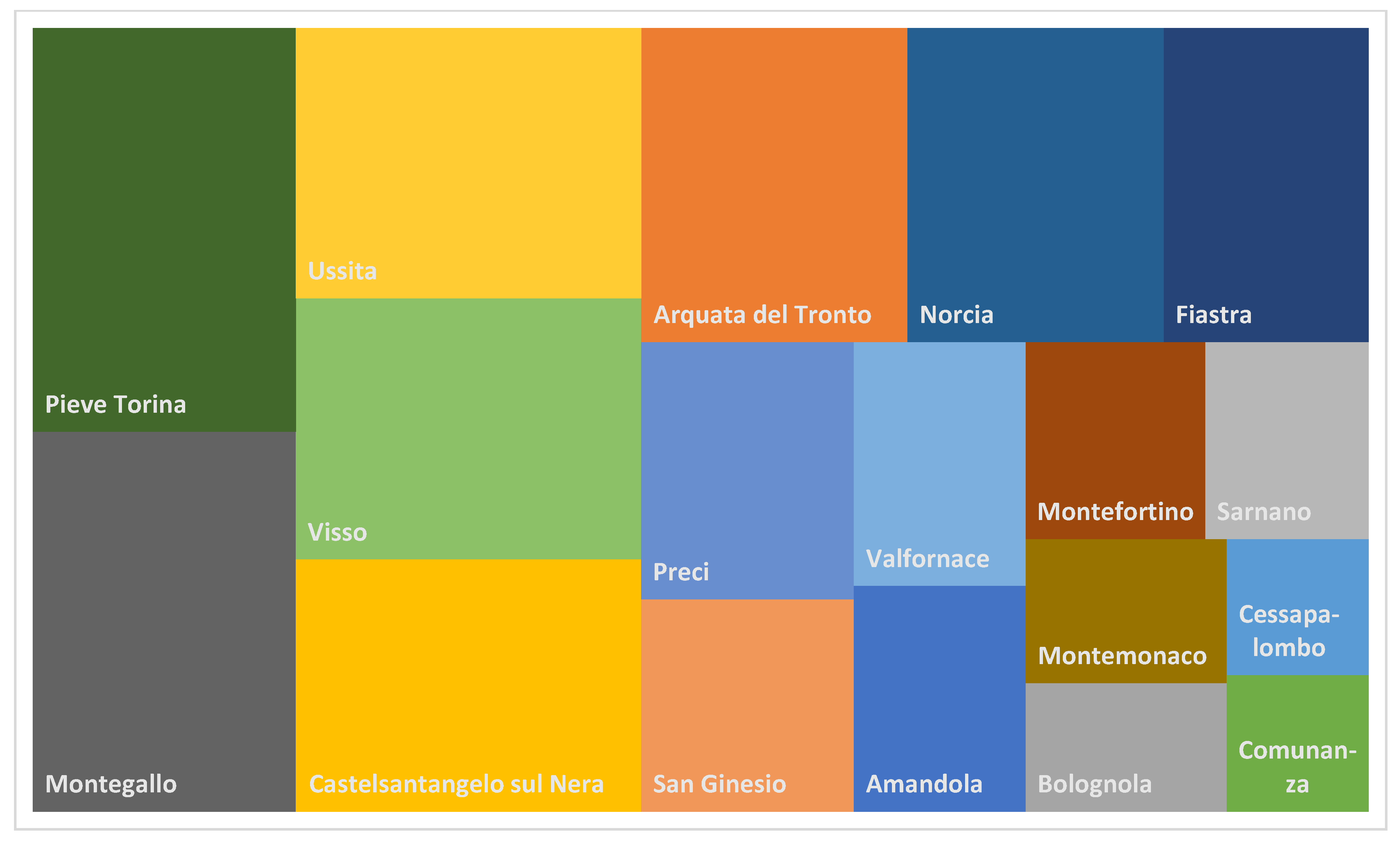
Figure 6. Annual Stewardship Capacity by municipality. The area of each polygon is proportional to the hectares of active landscape maintenance fundable by the solar REC surplus.
Land 15 01004 g006
Figure 7. Comparison of specific yield results against Global Solar Atlas benchmark.
Land 15 01004 g007
Table 1. Municipalities of the Sibillini Mountains area under study.
MunicipalityProvinceRegionArea (km2)
Arquata del TrontoAscoli Piceno Marche92
Comunanza54
Montegallo48
Montemonaco68
AmandolaFermo Marche69
Montefortino78
BolognolaMacerataMarche26
Castelsantangelo sul Nera71
Cessapalombo28
Fiastra 84
Pieve Torina74
San Ginesio78
Sarnano63
Ussita55
Visso100
Valfornace49
NorciaPerugiaUmbria276
Preci82
Sibillini Cluster 1395
Table 2. PV potential of the municipalities of Sibillini Mountains area (2020–2023).
MunicipalitySurface Area (km2)Avg. Annual Irradiation (H(i)opt)
[kWh/m2/Year]
Specific Yield (Yf)
(PR = 0.8) [kWh/kWp]
Amandola691762.461409.97
Arquata del Tronto921725.741380.60
Bolognola261523.331218.66
Castelsantangelo sul Nera711959.201567.36
Cessapalombo281765.781412.63
Comunanza541730.101384.08
Fiastra841622.031297.63
Montefortino781717.371373.89
Montegallo481576.241260.99
Montemonaco681717.961374.37
Norcia2761809.611447.69
Pieve Torina741750.141400.11
Preci821773.161418.53
San Ginesio781810.361448.29
Sarnano631710.361368.29
Ussita551665.421332.34
Valfornace491728.681382.94
Visso1001685.301348.24
Sibillini Cluster (±Std. Dev.)13951738.15 ± 95.241390.52 ± 76.22
Table 3. Public solar potential and Stewardship Capacity by municipality under the estimate of Ce = 0.4 and 20 kWp installation per building.
MunicipalityNumber of
New Roofs
Annual Energy (MWh/Year)
Amandola12338.39
Arquata del Tronto26718.07
Bolognola8194.99
Castelsantangelo sul Nera27846.37
Cessapalombo6169.55
Comunanza6166.09
Fiastra20519.05
Montefortino11302.26
Montegallo31781.82
Montemonaco9247.44
Norcia25724.00
Pieve Torina33924.07
Preci17482.30
San Ginesio14405.52
Sarnano10273.66
Ussita29772.75
Valfornace13359.65
Visso28755.01
Sibillini Cluster3258981.01
Table 4. Revenues and costs from PV plants in Sibillini Mountains area.
MunicipalityRREC (EUR)COp (EUR)Astew (ha)
AmandolaEUR 40,607EUR 480029.84
Arquata del TrontoEUR 86,169EUR 10,40063.14
BolognolaEUR 23,398EUR 320016.83
Castelsantangelo sul NeraEUR 101,565EUR 10,80075.64
CessapalomboEUR 20,346EUR 240014.96
ComunanzaEUR 19,931EUR 240014.61
FiastraEUR 62,286EUR 800045.24
MontefortinoEUR 36,271EUR 440026.56
MontegalloEUR 93,818EUR 12,40067.85
MontemonacoEUR 29,693EUR 360021.74
NorciaEUR 86,880EUR 10,00064.07
Pieve TorinaEUR 110,889EUR 13,20081.41
PreciEUR 57,876EUR 680042.56
San GinesioEUR 48,662EUR 560035.89
SarnanoEUR 32,839EUR 400024.03
UssitaEUR 92,731EUR 11,60067.61
ValfornaceEUR 43,158EUR 520031.63
VissoEUR 90,602EUR 11,20066.17
Sibillini Cluster EUR 1,077,721EUR 130,000789.77
Disclaimer/Publisher’s Note: The statements, opinions and data contained in all publications are solely those of the individual author(s) and contributor(s) and not of MDPI and/or the editor(s). MDPI and/or the editor(s) disclaim responsibility for any injury to people or property resulting from any ideas, methods, instructions or products referred to in the content.