Article

Faunal Restoration and Shellfish Farming: An Ecological–Economic Win-Win Framework for Sporobolus alterniflorus Control in Mangrove Habitats

1
Fujian Provincial Key Laboratory for Coastal Ecology and Environmental Studies, College of the Environment and Ecology, Xiamen University, Xiamen 361102, China
2
Zhangjiang Estuary Mangrove Wetland Ecosystem Station, National Observation and Research Station for the Taiwan Strait Marine Ecosystem, Xiamen University, Zhangzhou 363000, China
*
Author to whom correspondence should be addressed.
Land 2026, 15(5), 882; https://doi.org/10.3390/land15050882
Submission received: 4 March 2026 / Revised: 30 April 2026 / Accepted: 13 May 2026 / Published: 19 May 2026
(This article belongs to the Section Land, Biodiversity, and Human Wellbeing)

Abstract

In Luoyuan Bay, China, Sporobolus alterniflorus invasion has hindered mangrove restoration and disrupted faunal communities within mangrove habitats. This study investigated its impact on mollusk, crab, and fish assemblages across mangrove, mudflat, and invaded habitats from 2019 to 2020. Results showed that species diversity of three assemblages did not differ significantly between invaded and non-invaded mangrove habitats; however, assemblage structure was altered and functional traits declined markedly in invaded areas. Compared with non-invaded mangroves, invaded habitats showed decreases of 81.6% in mollusk density, 50.7% in mollusk biomass, 66.6% in crab density and 84.2% in crab biomass. Dominant fish species (Acanthogobius ommaturus, Liza carinata, Stolephorus chinensis) also exhibited lower body size, total size and biomass in invaded habitats. Given the close dependence of coastal residents on these faunal resources, a socioeconomic analysis of livelihood strategies was conducted, revealing Sinonovacula constricta aquaculture achieved the highest net income-to-investment ratio, 122.7% higher than nearshore fishery and 308.3% higher than shallow-sea oyster cultivation, while professional shellfish farming yielded the highest net income per hectare, 23.6% higher than oyster cultivation. Thus, both forms of shellfish aquaculture provide greater economic returns than other livelihood options. Based on these findings and niche theory, we propose a management framework: after removing S. alterniflorus, plant native mangroves (Kandelia obovata) in mid-to-high intertidal zones and lease lower flats for shellfish farming. This framework has the potential to integrate ecological restoration with local livelihoods and may inform similar efforts in other regions facing biological invasions and restoration challenges.

1. Introduction

With socioeconomic development, human activities such as aquaculture, agriculture, tourism, and urbanization have increasingly encroached on large areas of mangrove forests [1,2]. Today, mangroves are facing severe threats from both anthropogenic disturbances and global climate change [3]. Among these threats, Sporobolus alterniflorus (Loisel.) P.M.Peterson & Saarela (=Spartina alterniflora Loisel.) (Poaceae), a species native to the eastern coast of North America and the Gulf of Mexico, has emerged as a major concern [4,5,6].
During the early phase of introduction, S. alterniflorus contributes to sediment accretion, and its complex root system may lead to a short-term rise in biodiversity, especially among macrobenthos [7,8]. However, over time it becomes invasive, colonizing gaps within mangrove forests and altering sediment conditions, hydrological regimes, food web structures, and ecosystem functions in mangrove habitats. These changes ultimately cause significant ecological and economic damage to coastal wetlands worldwide [9,10,11]. Numerous control strategies have been developed to manage S. alterniflorus invasions, including physical removal, chemical control using herbicides, biological replacement, natural enemy control, and integrated management that combines two or more of these approaches. Such efforts have been documented in Louisiana and Washington (USA), Spain and South Africa, and most coastal provinces of China [12,13,14,15,16,17,18,19]. However, owing to its high adaptability and reproductive capacity, S. alterniflorus often cannot be completely eradicated. Consequently, it continues to degrade the ecological functions and services of surrounding ecosystems, including mangroves [20,21,22,23,24,25,26].
In parallel, large-scale mangrove restoration has been launched to reverse degradation [27,28,29]. Two main approaches are commonly applied. The first is intertidal afforestation, which involves planting mangrove seedlings directly on bare mudflats. This method is cost-effective in the short term but often suffers from low survival rates due to unsuitable elevation or biofouling [30,31]. The second is pond-to-mangrove restoration, which restores tidal hydrology by breaching dikes to reestablish hydrological connectivity. This allows natural tidal exchange, sediment transport, and seedling recruitment [32,33,34,35]. Critically, both restoration approaches compete for intertidal space that local communities have long used for shellfish farming, nearshore fishery, and oyster cultivation [36,37]. Even if mangroves are successfully re-established and thrive in the early stages, their long-term survival still depends on improving local livelihoods, involving residents in restoration planning and implementation, and ensuring equitable benefit-sharing [30,38,39,40]. Restoration strategies that overlook local livelihood concerns often fail to gain community support, thereby making them unsustainable [37].
Luoyuan Bay, located in Fujian Province, China, historically supported extensive mangrove forests. However, the aggressive S. alterniflorus was intentionally introduced in 1979 to defend against storm surges [41,42]. Since then, it has expanded rapidly, and by 2018 its coverage had reached 777 hectares [9]. With a broader ecological niche than native mangroves (K. obovata), Sporobolus alterniflorus can distribute from the mid-to-high intertidal zones, which are suitable for mangroves, down to the lower intertidal flats [11,43,44,45]. As a result, natural mangroves in Luoyuan Bay have largely disappeared. Although some studies have examined the competitive effects of S. alterniflorus on mangrove vegetation, its ecological impacts on faunal communities in this region remain to be quantified. Furthermore, control projects for this species often require substantial investment while suffering ongoing economic losses due to frequent reinvasions [1,46,47,48]. There is an urgent need to identify a sustainable management approach that effectively controls S. alterniflorus while accommodating community livelihoods, thereby protecting restoration outcomes and enabling long-term natural succession.
To address the above issues, this study first quantified the ecological impacts of S. alterniflorus invasion by comparing the diversity and community structure of mollusk, crab, and fish assemblages across mangrove, mudflat, and invaded habitats. These taxa are environmentally sensitive and strongly support coastal livelihoods. We then evaluated the economic performance of different local livelihood strategies to explore the links between habitat conditions and livelihood choices. Drawing on previous research, we hypothesized that during the early stage of S. alterniflorus invasion in Luoyuan Bay, species diversity of mollusk, crab and fish assemblages may not be significantly affected, but abundance, biomass, and other functional indicators would decline significantly. Assemblage composition would also vary markedly across habitats. Combined with livelihood surveys, these findings would enable us to propose a management framework that reconciles ecological and economic benefits for Luoyuan Bay’s planted mangrove habitats.

2. Materials and Methods

2.1. Study Area

Luoyuan Bay is a semi-enclosed bay along the northeastern coast of Fujian Province, China. It features an irregular bedrock coastline, regular semi-diurnal tides, and extensive gently sloping tidal flats composed predominantly of silty clay. Following the long-term invasion of S. alterniflorus, almost no natural mangroves remained in the bay until restoration efforts began. Owing to the lack of propagule sources, the potential for natural mangrove regeneration was very limited. Therefore, early-stage ecological restoration had to rely on afforestation on tidal flats, using human intervention to create suitable conditions, with the aim of gradually promoting natural recovery after mangroves become established.
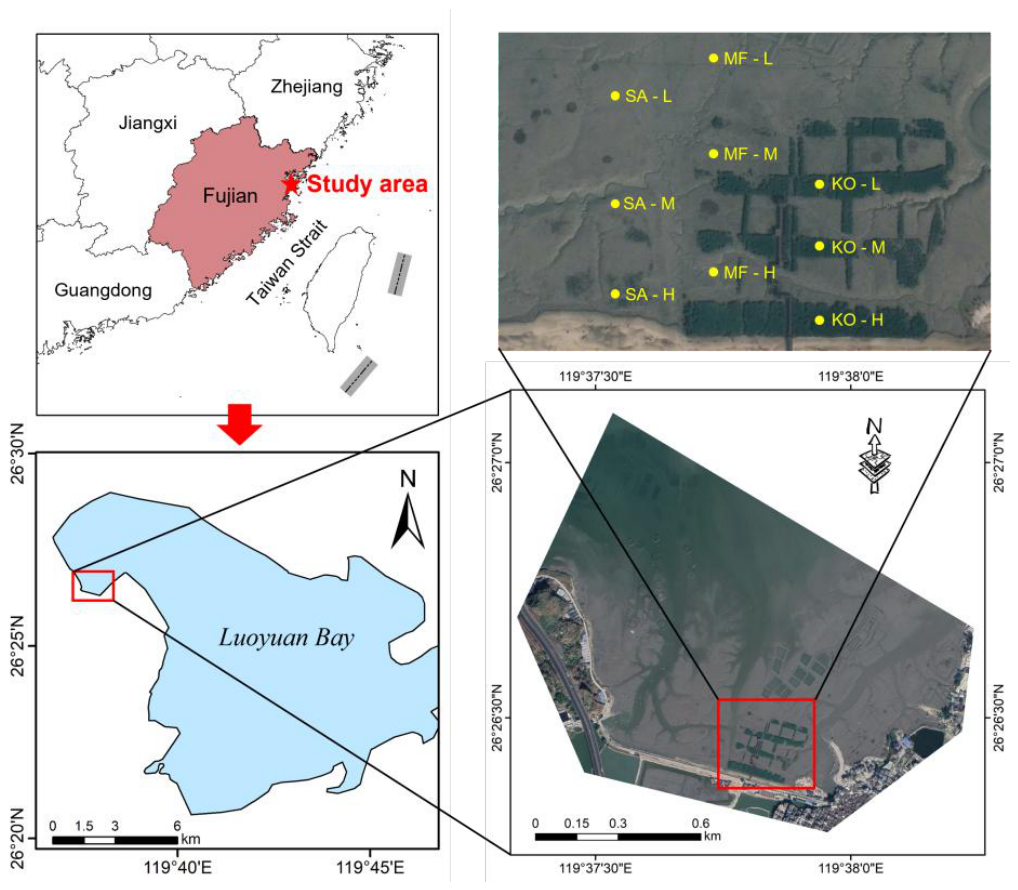
The study area lies within the Luoyuan Bay Mangrove Coastal Park, where mangroves are distributed as artificially planted strips, with mudflats interspersed among them, and S. alterniflorus occurs in randomly aggregated patches either on the mudflats or at the low-tide margins of the mangroves. The specific sampling sites are illustrated in Figure 1.

2.2. Multi-Taxa Surveys

The multi-taxa surveys were designed to assess the ecological impacts of S. alterniflorus invasion on mollusk, crab, and fish assemblages across mangrove, mudflat, and invaded habitats.
Macrobenthos, including mollusk and crab assemblages in this study, were sampled in December 2019 and June 2020. Three sampling sites were established per habitat (≥50 m apart). At each site, five replicate quadrats (25 cm × 25 cm × 30 cm) were randomly placed at the same tidal level (≥10 m apart), resulting in 15 quadrats per habitat type. After sampling, each sediment sample was washed through a 1 mm mesh sieve to collect living molluscs and crabs, which then should be sorted, counted and weighed. All of them were identified to the species level.
Fish were sampled using centipede nets. Each net was 10 m long with an 8.5 mm mesh, consisting of 23 rectangular iron frames (35 cm × 25 cm) placed every 40 cm. Each frame had two funnel-shaped openings acting as fish traps [49,50]. To minimize the influence of tidal variation on data comparability, all fish sampling was conducted during spring tides in December 2019 and June 2020, with three consecutive sampling days per sampling event. Sampling was carried out during daytime high tides that inundated the intertidal flats. Nets were deployed simultaneously approximately one hour before tidal flooding of the sampling area and retrieved simultaneously approximately one hour after ebb tide when the flats were re-exposed. Five nets were deployed per habitat per day over three consecutive days, totaling 15 nets per habitat. Captured fish were sorted, measured, weighed, and identified to species level where possible.

2.3. Livelihood Survey

Based on the multi-taxa surveys that assessed the potential ecological impacts of S. alterniflorus invasion on local fishery resources, we conducted a livelihood survey to evaluate the economic performance of different local livelihood strategies.
The livelihood survey consisted of two phases: a preliminary survey in August 2019 and a formal survey in October 2020. The preliminary phase involved collecting basic information and designing the questionnaire. The formal phase included interviews with 23 respondents, all of whom were engaged in mudflat shellfish cultivation, nearshore fishery, and shallow-sea oyster hanging cultivation. Given that approximately 30–50 households in Beishan Village rely on fishery-related livelihoods, the sample size represents 50–70% of the target households and can be considered representative for analysis.
Nearshore fishers use privately owned motorized boats to depart from Moon Bay Wharf in Beishan Village and travel about 25 km to the Kemenkou waters of Luoyuan Bay, where they drag nets in open waters. The catch is typically sold to local aquatic product distributors or cooperative traders from other regions. The sales channels for the other three livelihood types are similar and are not detailed here.
Shallow-sea oyster hanging cultivation has been completely banned in Luoyuan Bay since 2017. Some practitioners have relocated about 60 km south to Lianjiang waters, where they lease aquaculture plots and procure or assemble foam rafts and cultivation substrates. Some produce their own oyster seedlings; others send substrates to Fuqing waters for paid seedling cultivation. Oysters are filter-feeders that absorb nutrients directly from seawater, requiring no additional feed or pesticides. Practitioners only need to regularly check and manage the rafts.
Mudflat shellfish cultivation includes two main approaches. One is Sinonovacula constricta aquaculture (razor clams) on open tidal flats outside mangrove zones. Seedlings, either naturally recruited or manually sown, are grown until harvest, which involves overturning the sediment surface. This approach requires no embankments and has low initial capital investment. Cultivation starts in January, with maintenance and harvesting around June. The removal of S. alterniflorus has made this practice viable again. The other approach, professional shellfish farming, also occurs on open flats outside mangroves but involves constructing high-quality embankments with heavy machinery. These embankments precisely control surface water levels, providing stable hydrodynamic conditions. During heavy rainfall, they protect shellfish from osmotic stress caused by freshwater intrusion and minimize extreme-weather losses. Bivalves such as razor clams and blood clams benefit from longer feeding times and stable conditions, which promote growth and meat quality. Both forms of shellfish farming rely on natural seawater nutrients and use no artificial feed or chemical fertilizers.

2.4. Data Analysis

2.4.1. Assemblage Diversity and Functional Metrics

Abundance data of different times and quadrats (or nets) were combined to analyze α-diversity and functional attributes of mollusk, crab and fish assemblages across different habitats. Due to the highly heterogeneous mosaic pattern of different habitat types, the diversity comparisons in this study focus on α-diversity at the plot scale. Key metrics included species richness (S), Shannon-Wiener diversity index (H’), Pielou’s evenness index (J), and Margalef richness index (D), as well as assemblage density and biomass per unit area. These analyses were performed using the vegan R package. Species richness (S) and the Shannon-Wiener index (H’) were calculated using the functions specnumber and diversity, respectively. Evenness (J) and richness (D) were derived from known or previously computed data. Normality was tested using the Shapiro–Wilk test, and homogeneity of variances was assessed using Levene’s test. Due to heteroscedasticity, all parameters were analyzed using the Kruskal–Wallis test. When significant differences were detected, pairwise comparisons were conducted using the Mann–Whitney U test.

2.4.2. Assemblage Difference Analysis

Bray–Curtis dissimilarity matrices were generated from species abundance data for mollusk, crabs, and fish assemblages across the three habitat types: mangrove, mudflat, and S. alterniflorus areas. These matrices were used for non-metric multidimensional scaling (NMDS) to visualize differences in assemblage structure and biomass, which is more robust to non-linear relationships, large numbers of zero values, noise, and outliers commonly encountered in ecological data. PERMONOVA was then applied to test for significant compositional differences among habitats, which can effectively detect group differences even when within group variation is large. Similarity Percentage (SIMPER) analysis was performed to identify the contribution of individual species to assemblage dissimilarities across habitats. This allowed for the identification of key species driving structural and functional differences. Only the top five species contributing most to the dissimilarities were reported.
NMDS, PERMANOVA, and SIMPER analyses were performed using the vegan package in R (version 4.4.3). NMDS was conducted and visualized with the metaMDS and ggplot function. PERMANOVA was performed with the adonis2 function, and SIMPER with the simper function.

2.4.3. Dominant Species Analysis

To identify dominant species within the fish assemblage, this study used the Index of Relative Importance (IRI) proposed by Pianka [51]. This index was originally developed for diet studies, but now been widely applied in the analysis of fish community [52,53,54,55]. The formula is as follows:
I R I = N % + W % × F % × 10 4
where N is the percentage of a species’ abundance in the total number of individuals, W is the percentage of a species’ biomass in the total biomass, and F is the frequency of the occurrence of the species during the survey.
The IRI combines information on individual abundance, biomass, and frequency of occurrence to better reflect species dominance. Higher IRI values reflect greater ecological prominence. Calculations were performed using Microsoft Excel.

3. Results

3.1. Biodiversity Across Habitat Types

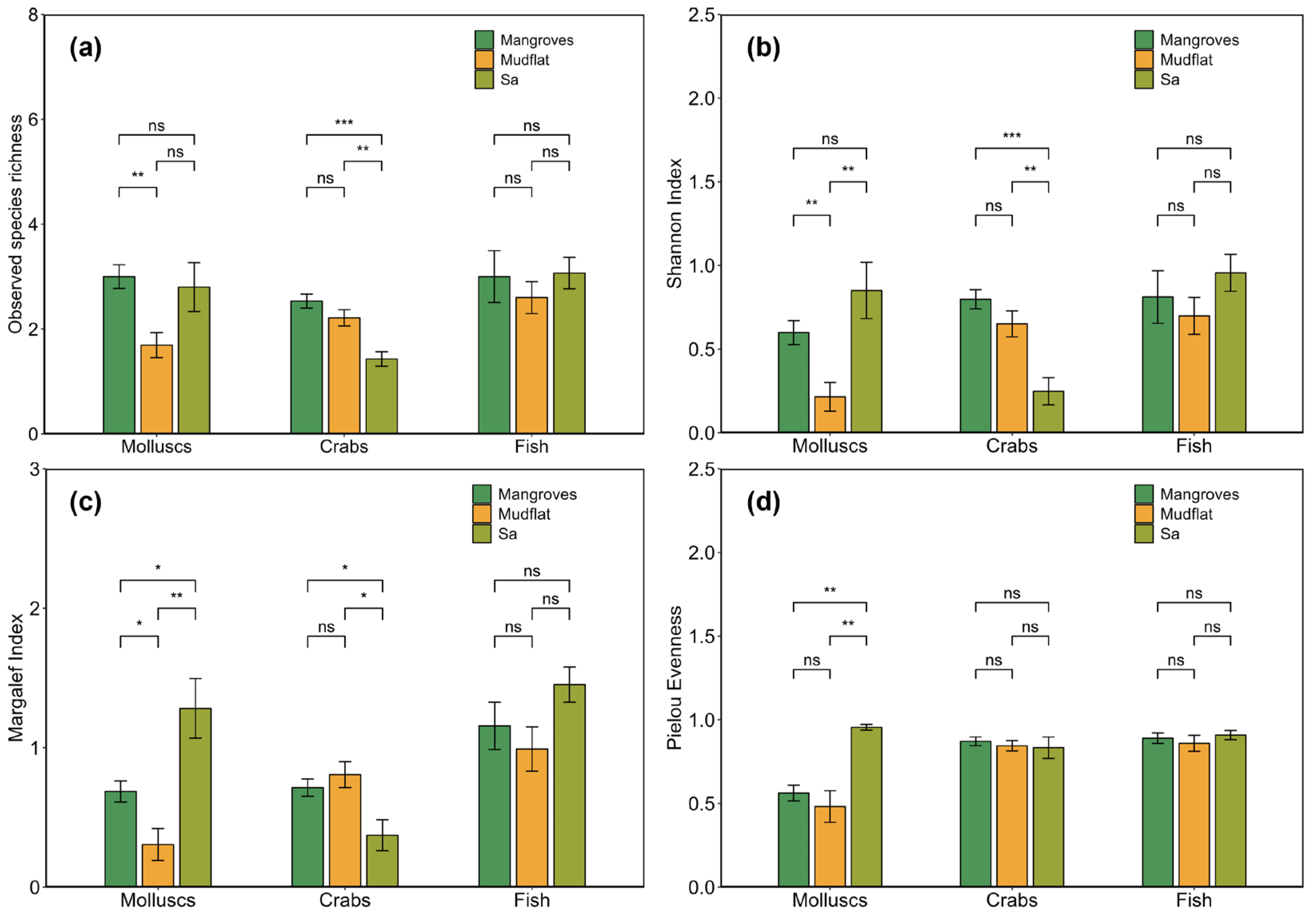
For mollusk assemblage, no significant difference in average species number per quadrat was observed between mangrove and S. alterniflorus habitats. However, the S. alterniflorus site exhibited significantly higher values for Pielou’s evenness index and Margalef richness index compared to mangrove and mudflat sites. The Shannon diversity index did not differ significantly between the S. alterniflorus and mangrove habitats. In contrast, crab assemblage showed greater species richness, Shannon diversity, and Margalef richness in mangrove habitats than in S. alterniflorus areas, although Pielou’s evenness did not significantly differ. For fish assemblage, species diversity indices showed no significant variation across the three habitat types. The biodiversity results are shown in Figure 2.

3.2. Variation in Structure and Biomass Differences of Three Assemblages

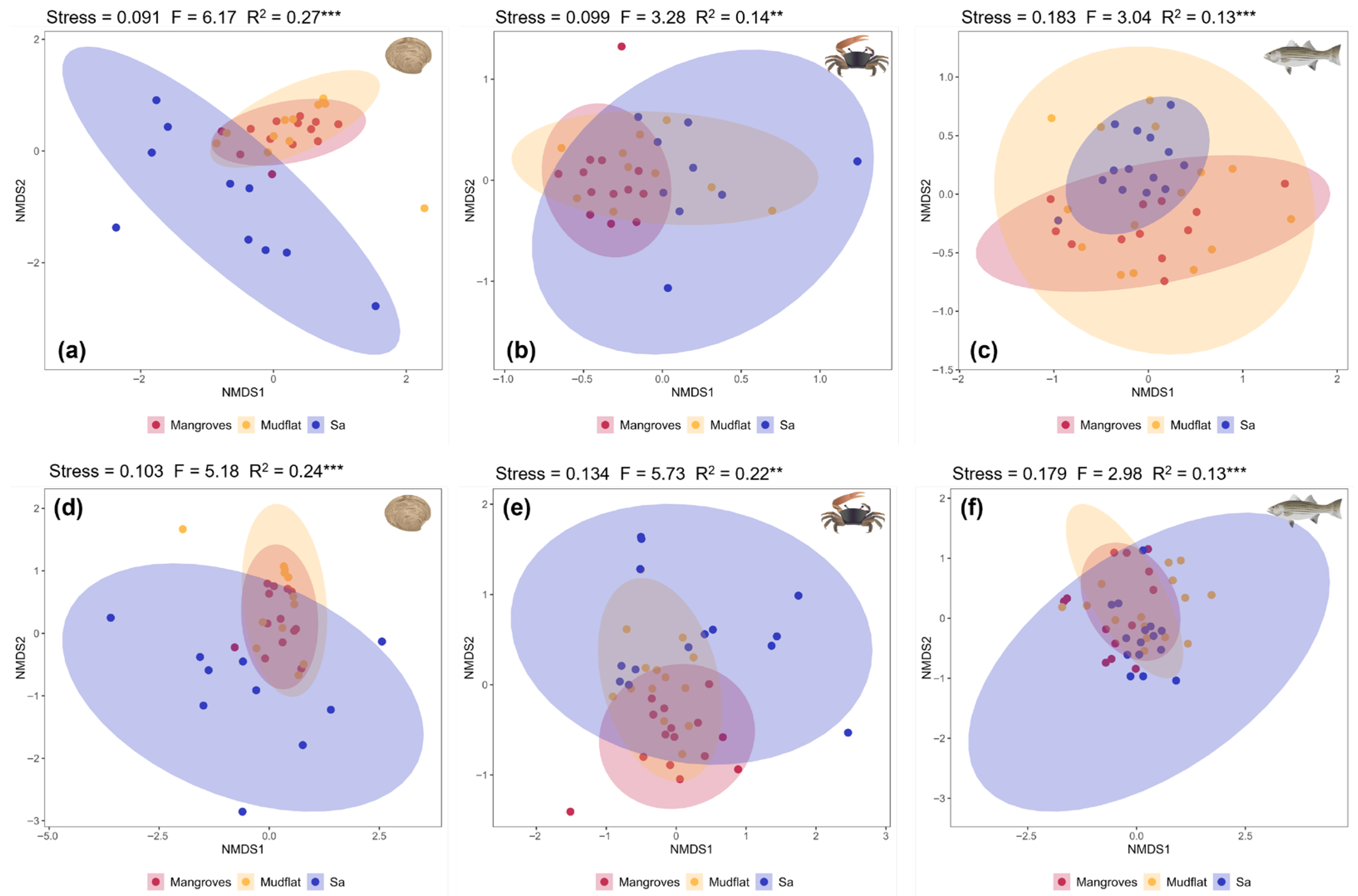
NMDS and ANOSIM results based on Bray–Curtis distances indicated significant differences in structure and biomass of mollusk, crab, and fish assemblages across habitat types. The animal assemblages in S. alterniflorus habitats were more dispersed, with lower overlap and aggregation than those in mangrove and mudflat areas. These findings suggest that habitat type significantly influences both the structure and biomass characteristics of multiple animal groups. The results of NMDS analysis are shown in Figure 3.
SIMPER analysis further demonstrated that habitat-related dissimilarities were driven by different key species. For mollusk assemblage (Table 1), Glauconome primeana, Assiminea brevicula and Estellarca olivacea contributed most to structural variation across all habitat comparisons. In terms of biomass differences, G. primeana, E. olivacea, and Laternula anatina were primary contributors between S. alterniflorus, mangrove, and mudflat habitats. Overall, these results suggest that bivalves play a key role in driving the structural and biomass differences in mollusk assemblage across different habitat types.

3.3. Macrobenthos Density and Biomass

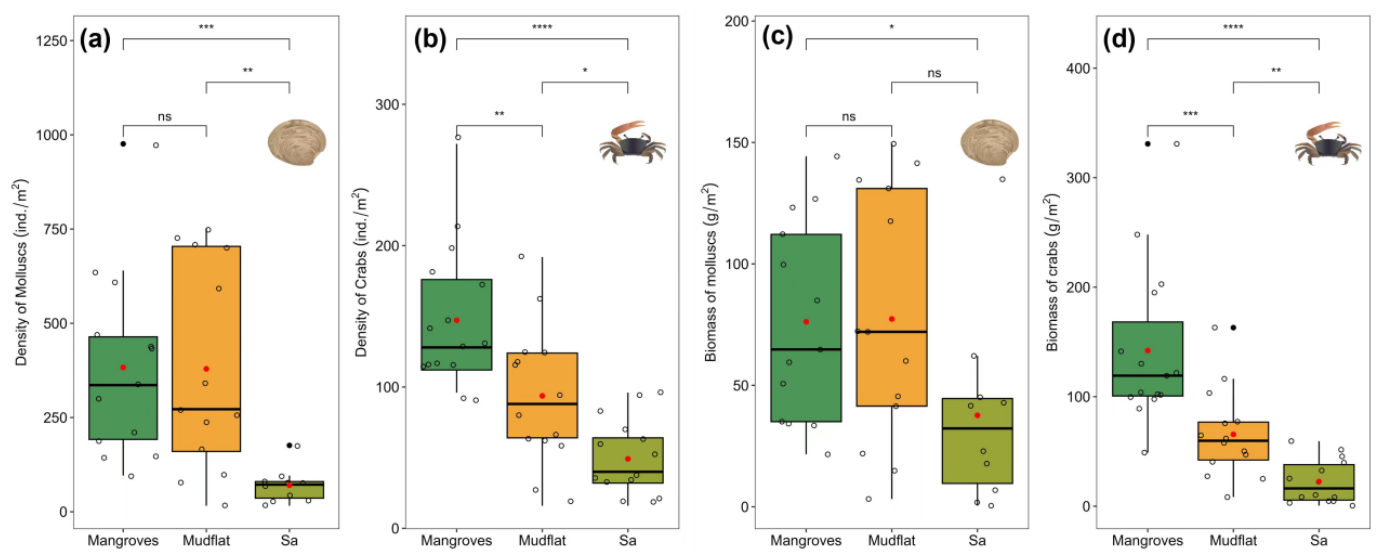
Results of the density (Figure 4a,b) and biomass (Figure 4c,d) per unit area across different habitats showed that, mollusk density in the S. alterniflorus habitat (70.4 ind.·m−2) was significantly lower than that in mangrove (382.8 ind.·m−2) and mudflat (379.1 ind.·m−2) habitats, with no significant difference between the latter two. Similarly, mollusk biomass was significantly lower in S. alterniflorus areas (37.6 g·m−2) compared to mangroves (76.2 g·m−2). For crab assemblage, both density (49.1 ind.·m−2) and biomass (22.5 g·m−2) in S. alterniflorus habitats were substantially lower than in mangrove and mudflat habitats. The mangrove habitat exhibited the highest crab density (147.2 ind.·m−2) and biomass (142.2 g·m−2), suggesting a substantial reduction in benthic abundance and biomass due to S. alterniflorus invasion.

3.4. Dominant Fish Species and Their Habitat Preferences

Based on the pooled sampling data, three dominant fish species were identified using the IRI: Acanthogobius ommaturus, Liza carinata, and Stolephorus chinensis. For L. carinata, 17 individuals were collected in the mangrove habitats, 30 in the mudflats, and 11 in the S. alterniflorus habitats. A. ommaturus was most abundant in S. alterniflorus habitats (31 individuals), followed by mangroves (21) and mudflats (10). S. chinensis was most prevalent in mudflats (33 individuals).
The relative proportions of each species also varied by habitat. A. ommaturus accounted for 19.8%, 9.9%, and 44.3% of the total fish in mangrove, mudflat, and S. alterniflorus habitats, respectively. For L. carinata, the respective proportions were 16.0%, 29.7%, and 15.7%. S. chinensis made up 19.8%, 32.7%, and 8.6% of the total catch in each habitat type. The IRI data of fish species is provided in Table 2.
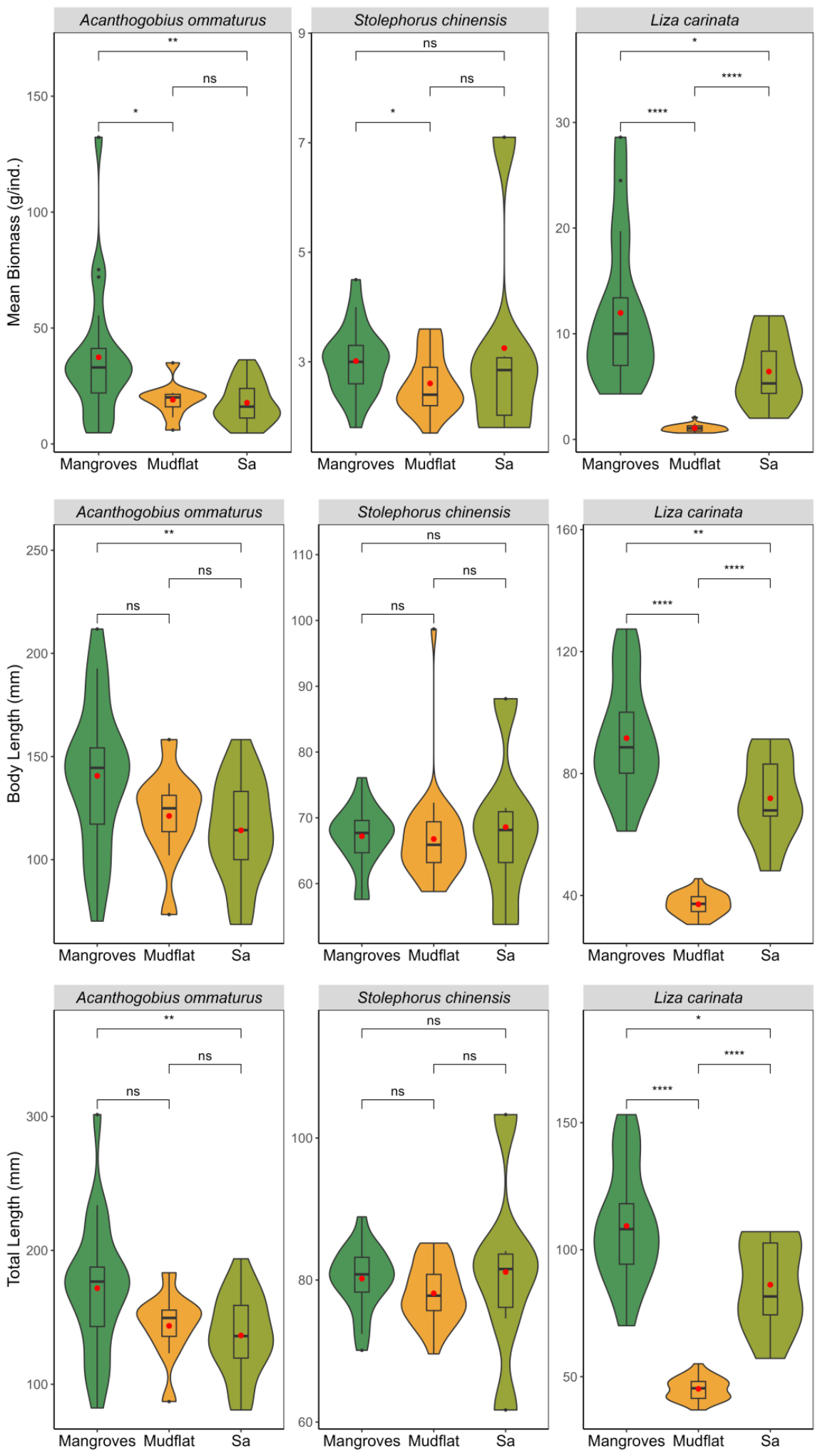
Functional indicators such as mean biomass, body length, and total length for these dominant species were generally highest in mangrove habitats. Except for S. chinensis, both A. ommaturus and L. carinata exhibited significantly greater values in mangroves than in S. alterniflorus habitats (Figure 5), suggesting that mangroves offer more favorable conditions for fish growth.

3.5. Socioeconomic Analysis of Different Means of Livelihood

In Beishan Village, Luoyuan Bay, four primary livelihood strategies were identified: nearshore fishery, shallow-sea oyster cultivation, S. constricta aquaculture and professional shellfish farming. Each involved several dozen practitioners. This section evaluated and compared these livelihood types using three indicators: per capita annual total cost, net income-to-investment ratio, and average net income per hectare. The objective was to assess their economic efficiency, labor requirements, and technical demands to identify the most viable options for local livelihoods.
Different livelihood strategies involved varying levels of capital and operational costs. As shown in Table 3, nearshore fishery and shallow-sea oyster cultivation required both initial fixed costs (e.g., vessel purchases) and substantial ongoing costs (e.g., fuel, materials, seedling inputs). In contrast, S. constricta aquaculture and professional shellfish farming might only require substantial ongoing costs. Notably, shallow-sea oyster cultivation had the highest overall cost burden among the four livelihoods. While professional shellfish farming and nearshore fishery had comparable operational costs, the former required lower initial investment. Sinonovacula constricta aquaculture remained the most cost-effective, with both the lowest fixed and variable costs.
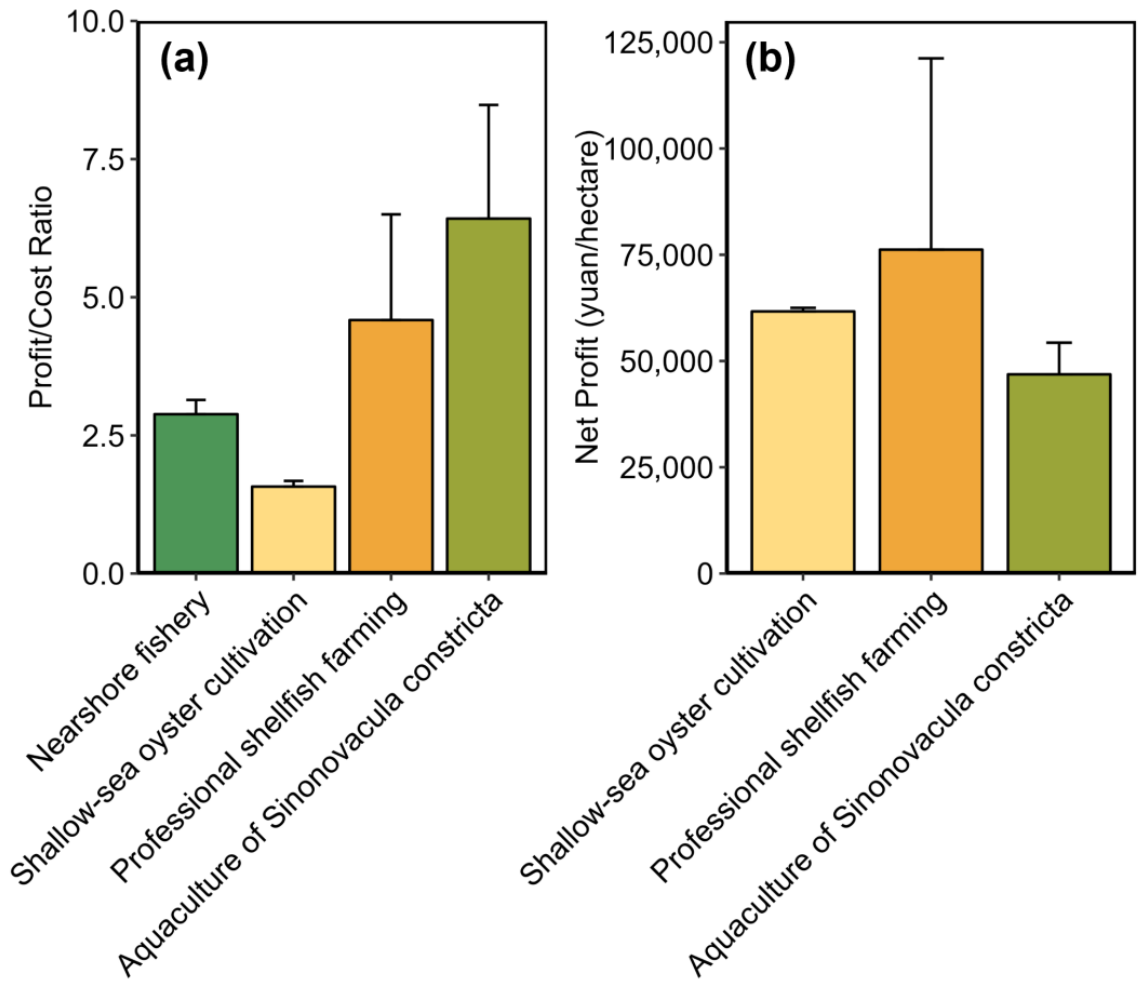
The net income-to-investment ratio was defined as the total net profit per production cycle divided by the total input costs, including seedling, materials, labor, and fuel. This metric reflects the profitability of each unit of capital investment: the higher the ratio, the greater the return per unit of capital. Among the four livelihood types, S. constricta aquaculture achieved the highest net income-to-investment ratio (6.4 ± 2.1), 40.0% higher than that of professional shellfish farming, 122.7% higher than that of nearshore fishery, and 308.3% higher than that of shallow-sea oyster cultivation on average. Professional shellfish farming exhibited a relatively high net income-to-investment ratio, ranking second. These results suggest that both forms of shellfish aquaculture on mudflats provide more favorable returns under comparable input levels (Figure 6a).
Net income per hectare reflects land-use efficiency and was particularly important in coastal areas where intertidal zones are limited. Since nearshore fishery does not rely on land-based units, it was excluded from this analysis. Among the remaining livelihood strategies, professional shellfish farming yielded the highest average net income per hectare (¥76,200/hm2), 23.6% higher than that of shallow-sea oyster cultivation and 62.6% higher than that of S. constricta aquaculture (Figure 6b). These results suggest that professional shellfish farming not only is the most land-productive livelihood strategy for residents of Beishan Village, but also represents a highly productive use of tidal flats from a coastal resource management perspective.
In summary, shellfish aquaculture on mudflats has the significant potential to benefit local incomes and community engagement. Integrating these livelihood strategies with mangrove restoration efforts may support the coordinated development of ecological conservation and socioeconomic sustainability in the Luoyuan Bay region.

4. Discussion

4.1. Effects of Habitat Types and Mangrove Restoration Age on Macrobenthic Diversity

The results indicated that in S. alterniflorus habitats, the overall biodiversity of the macrobenthic community (including mollusk and crab assemblages) showed no significant difference from that in non-invaded mangrove habitats; however, their abun-dance and biomass were already significantly lower due to the potential effects of the invasion. This pattern aligns with findings from Shao, et al. [56] and can be attributed to several ecological mechanisms.
Macrobenthos are sensitive to spatial heterogeneity across habitats [57,58,59]. On the one hand, unlike mangroves, S. alterniflorus possesses both sexual and asexual reproduction. It can rapidly expand through its rhizome system to form dense monospecific stands, thereby outcompeting native plant species in interspecific competition. During the invasion process, shifts in food sources for animals and rapid root system development are primary drivers of changes in faunal diversity. These factors also give rise to a time-dependent pattern in the ecological effects of S. alterniflorus [8,60,61,62,63]. In the early invasion stage (1–2 years), habitat alterations and high primary productivity provide abundant new food resources for macrobenthos, leading to a rapid increase in faunal diversity [64]. However, by the mid-invasion stage (3–4 years) and the complete invasion stage (beyond 5 years), increased vegetation density and root network densification reduce water flow, cause organic accumulation and oxygen depletion, and compress living space (especially for burrowing crabs). This leads to a long-term decline in macrobenthic diversity [7,65,66,67,68]. Consequently, species composition and community structure undergo substantial changes, with Chironomidae becoming the dominant taxa [69]. Furthermore, the fast growth of S. alterniflorus requires large amounts of PO43− [70]. The lower PO43− content in this zone may limit phytoplankton growth, thereby affecting the abundance of some filter-feeding animals, such as certain bivalves [71,72].
On the other hand, changes in macrobenthic diversity during mangrove restoration are closely linked to shifts in forest structure, understory conditions, and successional stage [58,73]. Young mangroves tend to have more open canopies, allowing greater light penetration and microhabitat heterogeneity, which support a wider variety of food sources for macrobenthic organisms. As tree height and canopy width increase, light penetration into the understory decreases, limiting the growth of microphytobenthos—an important food source for macrobenthos. Simultaneously, the root system becomes denser, which may inhibit the movement and habitation of macrobenthos within the sediment [74,75,76]. Therefore, macrobenthic diversity throughout mangrove restoration may follow a unimodal trend, peaking at a certain stage. Different taxa may reach their diversity peaks at different times. For example, Bosire et al. reported that crab density increased rapidly during the early stages of mangrove restoration in Kenya, while mollusk diversity remained low, indicating different sensitivities to habitat conditions [77]. Similarly, Wang et al. found that on Ximen Island, China, crustacean diversity peaked around eight years after mangrove restoration, whereas mollusks (mainly gastropods and bivalves) reached their highest diversity at approximately eleven years [76]. The mangrove sites investigated in this study had been restored for about eight years, aligning with the expected peak in crab diversity but preceding the peak for mollusks. This temporal difference may explain why crab diversity was higher in mangrove habitats than in S. alterniflorus zones, while mollusk diversity was slightly lower.

4.2. Ecological Indicators of Dominant Fish Species

While mangroves are typically recognized for enhancing fish diversity and abundance due to their structural complexity and provision of shelter [78], this study observed no significant differences in species richness or diversity among the three habitat types. This finding aligns with the results of Marley, et al. [79], and may be attributed to the ecological functions of alternative habitats [80]. Both mangroves and S. alterniflorus stands offer structural refuge, while the high turbidity of estuarine mudflats may obscure predator visibility, providing comparable protective effects [79,81]. These results highlight that bare mudflats can be just as important as structurally complex habitats.
Dominant species play a key role in shaping fish community structure and function [82,83]. Our results showed that functional traits of dominant fish species, such as body size, biomass, and length, were generally higher in mangrove habitats. This may be due to the complex root systems of mangroves, which provide shelter from predators, as well as the abundance of food resources such as epiphytic algae and mollusks. These factors likely support better growth conditions for species such as A. ommaturus and L. carinata, which are carnivorous or detritivorous [78,84]. In contrast, L. carinata exhibited the lowest values for various functional indicators in bare mudflat habitats. This may be because the species’ pale body coloration makes adult individuals more visible and vulnerable to predation in exposed environments. As a result, juveniles are more commonly found in this habitat, leading to reduced average biomass and body size [85].

4.3. Comparison of Four Types of Livelihoods

Nearshore fishery and shallow-sea oyster cultivation are both offshore activities that require fishing vessels, leading to high initial investment and operational costs. Although shallow-sea oyster cultivation generates higher gross income due to larger farming areas, its profit advantage diminishes when investment costs are held constant. In contrast, professional shellfish farming and S. constricta aquaculture are conducted on more stable nearshore mudflats with greater human control, resulting in more consistent and predictable yields [86,87].
Fisheries remain a primary livelihood for coastal communities but are subject to seasonal income fluctuations and risks of overfishing [87]. Integrating alternative income sources such as shellfish aquaculture offers a more sustainable path. Both low-cost S. constricta aquaculture and capital-intensive professional shellfish farming rely on natural seawater nutrients, require no artificial feed or chemicals, and are environmentally friendly [88].
Our findings show that bivalves drive differences in mollusk community structure and function across habitats, with higher density and biomass in mangroves and mudflats than in S. alterniflorus-invaded areas. Notably, shellfish aquaculture yields higher economic returns under comparable investment or area, incentivizing community participation and creating a positive feedback loop between ecological restoration and socioeconomic development.

4.4. Proposal of a Management Framework for Eco-Economic Coordination

Community-Based Mangrove Management (CBMM) refers to the decentralization of authority and responsibility to grassroots communities in the management of mangrove ecosystems [89]. Fundamentally, CBMM emphasizes the role of local participation in implementing sustainable management practices [90]. Since the 1980s, countries such as Indonesia and Thailand have successfully conserved mangroves through CBMM with voluntary community support [91]. Over the past three decades, CBMM approaches have been adopted in more than ten countries, including Indonesia, the Philippines, Bangladesh, Cambodia, and Sri Lanka [90,91,92,93,94]. However, studies on CBMM in China remain limited. The specific model to be adopted in a given region must be carefully discussed based on the local socio-ecological context.
Sporobolus alterniflorus exhibits strong adaptability and a broad ecological niche, allowing it to occupy open tidal flats ranging from the low to the upper intertidal zones [11]. As its invasion has been shown to reduce the abundance and biomass of macrobenthos as well as the individual functional traits of dominant fish species, periodic removal of S. alterniflorus and effective management of mangrove habitats and adjacent mudflats are essential for conserving ecological resources and guaranteeing economic returns. After complete removal of S. alterniflorus, a critical prerequisite for successful restoration is the systematic restoration of tidal connectivity. This includes clearing or dredging historical tidal creeks blocked by S. alterniflorus, temporarily excavating water diversion channels in key areas, and performing micro-topographic adjustments, in order to ensure that tidal water evenly covers the restoration site and creates suitable conditions for mangrove colonization [27,33,40].
Mangrove afforestation on mudflats requires suitable elevation to ensure survival. Excessive inundation duration and high inundation frequency can negatively affect mangrove growth [95,96,97,98,99]. Different mangrove species have different inundation tolerance thresholds, and consequently their suitable planting elevations vary. For K. obovata, previous studies on growth and physiological responses across different intertidal elevation gradients have indicated that its suitable planting elevation is in the mid-to-high intertidal zone [100]. Meanwhile, bivalve growth is also influenced by inundation duration. As filter feeders, most cultured bivalves are highly sensitive to tidal elevation. Studies have shown that individuals located in lower intertidal zones have longer feeding durations and higher filtration rates, which promote faster growth and higher meat yield. Therefore, bivalve aquaculture is more suitable for lower intertidal areas [101,102,103].
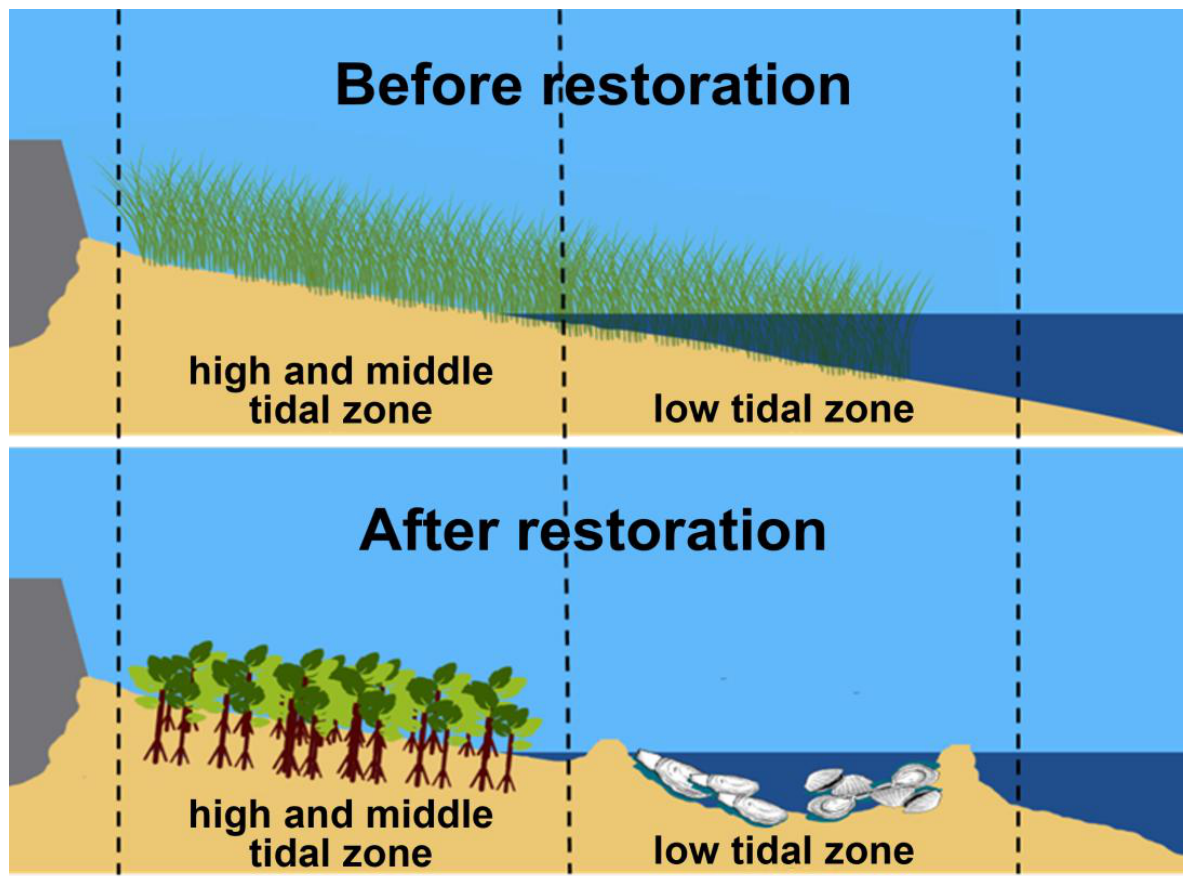
By integrating community participation, we propose a management framework tailored to the specific conditions of Luoyuan Bay that balances ecological protection and economic development. The niche of K. obovata and bivalves along the tidal elevation gradient is the foundation of our framework design. After completely removing S. alterniflorus from the area, K. obovata should be planted in the middle to upper intertidal zone, while the lower intertidal mudflats can be contracted to nearby aquaculture households for bivalve farming. During this process, the contracted farmers would be encouraged to be responsible for removing remaining S. alterniflorus from the mudflats, forming the foundation for a community-based mangrove management (CBMM) system. Compared to current control methods for S. alterniflorus, which are often ecologically detrimental (particularly those using herbicides), time-consuming, expensive, and uncertain in their success [104], our proposed management framework causes less habitat disturbance and establishes a long-term, stable land-use pattern by applying niche theory to mudflat management. The management framework is particularly illustrated in Figure 7.
Although CBMM has achieved some successes, its effectiveness depends heavily on local social, institutional, and governance conditions. Common challenges include superficial community participation, inequitable benefit distribution, and insufficient long-term funding and enforcement capacity [39,90]. In response to these limitations, the framework proposed in this study attempts to link tidal flat leasing to residents’ responsibility for S. alterniflorus removal, using economic incentives to encourage participation and partially mitigating issues of benefit distribution and enforcement.
Therefore, our framework exhibits potential innovations in both S. alterniflorus control and the ecological management of mangrove habitats. Nevertheless, its long-term success still depends on transparent governance and sustained capacity building. Long-term monitoring of hydrological conditions and propagule dispersal will also be essential to fully evaluate the effectiveness of our framework in promoting natural mangrove regeneration.

5. Conclusions

This study demonstrates that although S. alterniflorus invasion in mangrove areas may not significantly reduce faunal diversity, it does substantially alter assemblage structure and diminish functional traits such as abundance and biomass, particularly among macrobenthic organisms. Additionally, our analysis of local livelihood strategies in Beishan Village, Luoyuan Bay, reveals that bivalve aquaculture offers a more cost-effective and ecologically compatible means of resource utilization compared to traditional nearshore fishery and shallow-sea oyster farming.
Based on these findings and niche theory, we propose a sustainable management framework that integrates ecological restoration with socioeconomic development. Specifically, after removing S. alterniflorus from the entire intertidal zone, native mangroves (K. obovata) could be planted in the mid-to-high intertidal zone, while lower tidal flats could be leased to local residents for shellfish farming. Participating households would also be encouraged to take responsibility for monitoring and managing potential reinvasion of S. alterniflorus. This framework is proposed based on the Luoyuan Bay case study and may preliminarily inform similar efforts in other regions facing the dual challenges of biological invasion and mangrove restoration. However, future application to other regions should be preceded by further validation and adaptation based on local environmental and socioeconomic conditions.

Author Contributions

Conceptualization, D.L., W.W. and M.W.; methodology, P.G. and Y.L.; software, D.L. and H.C.; validation, D.L., P.G. and H.C.; formal analysis, Y.L.; investigation, D.L., P.G., Y.L., H.C. and K.Z.; resources, W.W. and M.W.; data curation, D.L.; writing—original draft preparation, D.L. and K.Z.; writing—review and editing, D.L., P.G. and Y.L.; visualization, D.L.; supervision, W.W. and M.W.; project administration, W.W. and M.W.; funding acquisition, W.W. and M.W. All authors have read and agreed to the published version of the manuscript.

Funding

This research was funded by the National Forestry and Grassland Administration Emergency Leading the Charge with Open Competition Project (No. K20B4001) and the National Key Research and Development Program of China (No. K2516004).

Data Availability Statement

Data will be made available on request.

Acknowledgments

During the preparation of this manuscript, we extend our gratitude to all those who contributed to the demanding fieldwork. Special thanks are extended to Lin Zhang for his constructive suggestions on paper’s framework.

Conflicts of Interest

The authors declare that they have no known competing financial interest or personal relationships that could have appeared to influence the work reported in this paper.

Abbreviations

The following abbreviations are used in this manuscript:
CBMMCommunity-Based Mangrove Management

References

  1. Alongi, D.M. Present state and future of the world’s mangrove forests. Environ. Conserv. 2002, 29, 331–349. [Google Scholar] [CrossRef]
  2. Giri, C.; Muhlhausen, J. Mangrove forest distributions and dynamics in Madagascar (1975–2005). Sensors 2008, 8, 2104–2117. [Google Scholar] [CrossRef] [PubMed]
  3. Lovelock, C.E.; Cahoon, D.R.; Friess, D.A.; Guntenspergen, G.R.; Krauss, K.W.; Reef, R.; Rogers, K.; Saunders, M.L.; Sidik, F.; Swales, A.; et al. The vulnerability of Indo-Pacific mangrove forests to sea-level rise. Nature 2015, 526, 559–563. [Google Scholar] [CrossRef] [PubMed]
  4. Early, R.; Bradley, B.; Dukes, J.; Lawler, J.; Olden, J.; Blumenthal, D.; Gonzalez, P.; Grosholz, E.; Ibañez, I.; Miller, L.; et al. Global threats from invasive alien species in the twenty-first century and national response capacities. Nat. Commun. 2016, 7, 12485. [Google Scholar] [CrossRef]
  5. Paini, D.; Sheppard, A.; Cook, D.; De Barro, P.; Worner, S.; Thomas, M. Global threat to agriculture from invasive species. Proc. Natl. Acad. Sci. USA 2016, 113, 7575–7579. [Google Scholar] [CrossRef]
  6. Wails, C.; Baker, K.; Blackburn, R.; Del Vallé, A.; Heise, J.; Herakovich, H.; Holthuijzen, W.; Nissenbaum, M.; Rankin, L.; Savage, K.; et al. Assessing changes to ecosystem structure and function following invasion by Spartina alterniflora and Phragmites australis: A meta-analysis. Biol. Invasions 2021, 23, 2695–2709. [Google Scholar] [CrossRef]
  7. Ge, B.; Bao, Y.; Cheng, H.; Zhang, D.; Hu, Z. Influence of Spartina alterniflora invasion stages on macrobenthic communities on a tidal flat in Wenzhou Bay, China. Braz. J. Oceanogr. 2012, 60, 441–448. [Google Scholar] [CrossRef]
  8. Meng, W.; Feagin, R.; Innocenti, R.; Hu, B.; He, M.; Li, H. Invasion and ecological effects of exotic smooth cordgrass Spartina alterniflora in China. Ecol. Eng. 2020, 143, 105670. [Google Scholar] [CrossRef]
  9. Strong, D.R.; Ayres, D.R. Ecological and Evolutionary Misadventures of Spartina. Annu. Rev. Ecol. Evol. Syst. 2013, 44, 389–410. [Google Scholar] [CrossRef]
  10. Zhang, D.; Hu, Y.; Liu, M.; Chang, Y.; Yan, X.; Bu, R.; Zhao, D.; Li, Z. Introduction and Spread of an Exotic Plant, Spartina alterniflora, Along Coastal Marshes of China. Wetlands 2017, 37, 1181–1193. [Google Scholar] [CrossRef]
  11. Zhang, Y.H.; Huang, G.M.; Wang, W.Q.; Chen, L.Z.; Lin, G.H. Interactions between mangroves and exotic in an anthropogenically disturbed estuary in southern China. Ecology 2012, 93, 588–597. [Google Scholar] [CrossRef]
  12. Fisher, A.; DiTomaso, J.; Gordon, T. Intraspecific groups of Claviceps purpurea associated with grass species in Willapa Bay, Washington, and the prospects for biological control of invasive Spartina alterniflora. Biol. Control 2005, 34, 170–179. [Google Scholar] [CrossRef]
  13. Grevstad, F.; Strong, D.; Garcia-Rossi, D.; Switzer, R.; Wecker, M. Biological control of Spartina alterniflora in Willapa Bay, Washington using the planthopper Prokelisia marginata: Agent specificity and early results. Biol. Control 2003, 27, 32–42. [Google Scholar] [CrossRef]
  14. Knott, C.; Webster, E.; Nabukalu, P. Control of smooth cordgrass (Spartina alterniflora) seedlings with four herbicides. J. Aquat. Plant Manag. 2013, 51, 132–135. [Google Scholar]
  15. Mateos-Naranjo, E.; Cambrollé, J.; De Lomas, J.; Parra, R.; Redondo-Gómez, S. Mechanical and chemical control of the invasive cordgrass Spartina densiflora and native plant community responses in an estuarine salt marsh. J. Aquat. Plant Manag. 2012, 50, 106–111. [Google Scholar]
  16. Patten, K. Persistence and non-target impact of imazapyr associated with smooth cordgrass control in an estuary. J. Aquat. Plant Manag. 2003, 41, 1–6. [Google Scholar]
  17. Riddin, T.; van Wyk, E.; Adams, J. The rise and fall of an invasive estuarine grass. S. Afr. J. Bot. 2016, 107, 74–79. [Google Scholar] [CrossRef]
  18. Yuan, L.; Zhang, L.; Xiao, D.; Huang, H. The application of cutting plus waterlogging to control Spartina alterniflora on saltmarshes in the Yangtze Estuary, China. Estuar. Coast. Shelf Sci. 2011, 92, 103–110. [Google Scholar] [CrossRef]
  19. Zhou, T.; Liu, S.; Feng, Z.; Liu, G.; Gan, Q.; Peng, S. Use of exotic plants to control Spartina alterniflora invasion and promote mangrove restoration. Sci. Rep. 2015, 5, 12980. [Google Scholar] [CrossRef]
  20. Ayres, D.; Smith, D.; Zaremba, K.; Klohr, S.; Strong, D. Spread of exotic cordgrasses and hybrids (Spartina sp.) in the tidal marshes of San Francisco Bay, California, USA. Biol. Invasions 2004, 6, 221–231. [Google Scholar] [CrossRef]
  21. Huang, X.F.; Feng, J.X.; Dong, J.D.; Zhang, J.; Yang, Q.S.; Yu, C.X.; Wu, M.L.; Zhang, W.Q.; Ling, J. Spartina alterniflora invasion and mangrove restoration alter diversity and composition of sediment diazotrophic community. Appl. Soil Ecol. 2022, 177, 104519. [Google Scholar] [CrossRef]
  22. Jackson, M.V.; Fuller, R.A.; Gan, X.J.; Li, J.; Mao, D.H.; Melville, D.S.; Murray, N.J.; Wang, Z.M.; Choi, C.Y. Dual threat of tidal flat loss and invasive Spartina alterniflora endanger important shorebird habitat in coastal mainland China. J. Environ. Manag. 2021, 278, 111549. [Google Scholar] [CrossRef]
  23. Jarvis, J.; Moore, K. Influence of environmental factors on Vallisneria americana seed germination. Aquat. Bot. 2008, 88, 283–294. [Google Scholar] [CrossRef]
  24. Liu, M.Y.; Mao, D.H.; Wang, Z.M.; Li, L.; Man, W.D.; Jia, M.M.; Ren, C.Y.; Zhang, Y.Z. Rapid Invasion of in the Coastal Zone of Mainland China: New Observations from Landsat OLI Images. Remote Sens. 2018, 10, 1933. [Google Scholar] [CrossRef]
  25. Lu, C.; Li, L.; Wang, Z.; Su, Y.; Su, Y.; Huang, Y.; Jia, M.; Mao, D. The national nature reserves in China: Are they effective in conserving mangroves? Ecol. Indic. 2022, 142, 109265. [Google Scholar] [CrossRef]
  26. Mao, D.H.; Liu, M.Y.; Wang, Z.M.; Li, L.; Man, W.D.; Jia, M.M.; Zhang, Y.Z. Rapid Invasion of Spartina Alterniflora in the Coastal Zone of Mainland China: Spatiotemporal Patterns and Human Prevention. Sensors 2019, 19, 2308. [Google Scholar] [CrossRef] [PubMed]
  27. Ellison, A.M.; Felson, A.J.; Friess, D.A. Mangrove Rehabilitation and Restoration as Experimental Adaptive Management. Front. Mar. Sci. 2020, 7, 327. [Google Scholar] [CrossRef]
  28. Lee, S.Y.; Hamilton, S.; Barbier, E.B.; Primavera, J.; Lewis, R.R. Better restoration policies are needed to conserve mangrove ecosystems. Nat. Ecol. Evol. 2019, 3, 870–872. [Google Scholar] [CrossRef] [PubMed]
  29. Su, J.; Friess, D.A.; Gasparatos, A. A meta-analysis of the ecological and economic outcomes of mangrove restoration. Nat. Commun. 2021, 12, 5050. [Google Scholar] [CrossRef]
  30. Samson, M.S.; Rollon, R.N. Growth performance of planted mangroves in the Philippines: Revisiting forest management strategies. Ambio 2008, 37, 234–240. [Google Scholar] [CrossRef]
  31. Wodehouse, D.; Rayment, M. Mangrove area and propagule number planting targets produce sub-optimal rehabilitation and afforestation outcomes. Estuar. Coast. Shelf Sci. 2019, 222, 91–102. [Google Scholar] [CrossRef]
  32. Friess, D.; Rogers, K.; Lovelock, C.; Krauss, K.; Hamilton, S.; Lee, S.; Lucas, R.; Primavera, J.; Rajkaran, A.; Shi, S. The State of the World’s Mangrove Forests: Past, Present, and Future. Annu. Rev. Environ. Resour. 2019, 44, 89–115. [Google Scholar] [CrossRef]
  33. Lewis, R.I. Ecological engineering for successful management and restoration of mangrove forests. Ecol. Eng. 2005, 24, 403–418. [Google Scholar] [CrossRef]
  34. Primavera, J.; Yap, W.; Savaris, J.; Loma, R.; Moscoso, A.; Coching, J.; Montilijao, C.; Poingan, R.; Tayo, I. Manual on Mangrove Reversion of Abandoned and Illegal Brackishwater Fishponds—Mangrove Manual Series No. 2; Zoological Society of London: London, UK, 2013. [Google Scholar]
  35. Primavera, J.H.; Rollon, R.; Samson, M.S. The pressing challenges of mangrove rehabilitation: Pond reversion and coastal protection. Biologica 2011, 50, 232. [Google Scholar]
  36. Duncan, C.; Primavera, J.; Pettorelli, N.; Thompson, J.; Loma, R.; Koldewey, H. Rehabilitating mangrove ecosystem services: A case study on the relative benefits of abandoned pond reversion from Panay Island, Philippines. Mar. Pollut. Bull. 2016, 109, 772–782. [Google Scholar] [CrossRef]
  37. Dale, P.E.R.; Knight, J.M.; Dwyer, P.G. Mangrove rehabilitation: A review focusing on ecological and institutional issues. Wetl. Ecol. Manag. 2014, 22, 587–604. [Google Scholar] [CrossRef]
  38. Katon, B.M.; Pomeroy, R.S.; Garces, L.R.; Ring, M.W. Rehabilitating the mangrove resources of Cogtong Bay, Philippines: A comanagement perspective. Coast. Manag. 2000, 28, 29–37. [Google Scholar] [CrossRef]
  39. Martínez-Espinosa, C.; Wolfs, P.; Vande Velde, K.; Satyanarayana, B.; Dahdouh-Guebas, F.; Hugé, J. Call for a collaborative management at Matang Mangrove Forest Reserve, Malaysia: An assessment from local stakeholders’ view point. For. Ecol. Manag. 2020, 458, 117741. [Google Scholar] [CrossRef]
  40. Primavera, J.H.; Esteban, J.M.A. A review of mangrove rehabilitation in the Philippines: Successes, failures and future prospects. Wetl. Ecol. Manag. 2008, 16, 345–358. [Google Scholar] [CrossRef]
  41. Chung, C.-H. Thirty years of ecological engineering with Spartina plantations in China. Ecol. Eng. 1993, 2, 261–289. [Google Scholar] [CrossRef]
  42. An, S.Q.; Gu, B.H.; Zhou, C.F.; Wang, Z.S.; Deng, Z.F.; Zhi, Y.B.; Li, H.L.; Chen, L.; Yu, D.H.; Liu, Y.H. Spartina invasion in China: Implications for invasive species management and future research. Weed Res. 2007, 47, 183–191. [Google Scholar] [CrossRef]
  43. Cui, L.; Qiu, J.; Berger, U.; Cao, M.; Li, W.; Jiang, J. Comparing and quantifying the ecological niches of the saltmarsh grass Spartina alterniflora and major mangrove species in China. Sci. Rep. 2025, 15, 23604. [Google Scholar] [CrossRef]
  44. Kim, S.; Yu, C.; Ruesink, J.; Hong, J. Vertical distribution of the salt marsh invader Spartina alterniflora and native halophytes on the west coast of Korea in relation to tidal regimes. Aquat. Invasions 2023, 18, 331–349. [Google Scholar] [CrossRef]
  45. Peng, D.; Chen, L.; Pennings, S.; Zhang, Y. Using a marsh organ to predict future plant communities in a Chinese estuary invaded by an exotic grass and mangrove. Limnol. Oceanogr. 2018, 63, 2595–2605. [Google Scholar] [CrossRef]
  46. Hartman, J.M. Recolonization of small disturbance patches in a new-england salt-marsh. Am. J. Bot. 1988, 75, 1625–1631. [Google Scholar] [CrossRef]
  47. Jia, P.; Qu, G.; Jia, J.; Li, D.; Sun, Y.; Liu, L. Long-term Spartina alterniflora invasion simplified soil seed bank and regenerated community in a coastal marsh wetland. Ecol. Appl. 2024, 34, e2754. [Google Scholar] [CrossRef] [PubMed]
  48. Xie, B.; Han, G.; Qiao, P.; Mei, B.; Wang, Q.; Zhou, Y.; Zhang, A.; Song, W.; Guan, B. Effects of mechanical and chemical control on invasive Spartina alterniflora in the Yellow River Delta, China. Peerj 2019, 7, e7655. [Google Scholar] [CrossRef] [PubMed]
  49. Wang, M.; Huang, Z.; Shi, F.; Wang, W. Are vegetated areas of man groves attractive to juvenile and small fish? The case of Dongzhaigang Bay, Hainan Island, China. Estuar. Coast. Shelf Sci. 2009, 85, 208–216. [Google Scholar] [CrossRef]
  50. Zhang, Y.M.; Ding, Y.P.; Wang, W.Q.; Li, Y.X.; Wang, M. Distribution of fish among Avicennia and Sonneratia and microhabitats in a tropical mangrove ecosystem in South China. Ecosphere 2019, 10, e02759. [Google Scholar] [CrossRef]
  51. Pianka, E.R. Ecology of the Agamid Lizard Amphibolurus isolepis in Western Australia. Copeia 1971, 1971, 527–536. [Google Scholar] [CrossRef]
  52. Alebachew, S.; Tesfahun, A.; Kebtieneh, N. Abundance, distribution, and diversity of fishes in Ribb Reservoir, Lake Tana basin, Ethiopia. Cogent Food Agric. 2022, 8, 2105934. [Google Scholar] [CrossRef]
  53. Jutagat, T.; Krudpan, C.; Ngamsnae, P.; Lamkom, T.; Payooha, K. Changes in the fish catches during a trial opening of sluice gates on a run-of-the river reservoir in Thailand. Fish. Manag. Ecol. 2005, 12, 57–62. [Google Scholar] [CrossRef]
  54. Liu, J.; Xiong, S.; Li, P.; Liu, Y.; Wang, Y.; Liu, K.; Wang, J. Fish community structure and diversity in the Ningxia section of the main stream of the Yellow River in China. Peerj 2025, 13, e20228. [Google Scholar] [CrossRef]
  55. Pinto, S.; Monteiro-Neto, C.; Barbarino, E.; Tubino, R.; da Costa, M. The structure of shallow water fish assemblages in sandy beaches of a tropical bay in the southwestern Atlantic. Ichthyol. Res. 2022, 69, 236–247. [Google Scholar] [CrossRef]
  56. Shao, O.W.; Li, Y.J.; Gu, W.F.; Zhang, R.L.; Tang, Y.B.; Xu, H.T.; Shou, L.; Zeng, J.N.; Liao, Y.B. Assessment of macrobenthos in evaluating the restoration effects of artificial mangrove planting on tidal flats in Zhejiang, China. Mar. Environ. Res. 2025, 204, 106930. [Google Scholar] [CrossRef]
  57. Cannicci, S.; Lee, S.; Bravo, H.; Cantera-Kintz, J.; Dahdouh-Guebas, F.; Fratini, S.; Fusi, M.; Jimenez, P.; Nordhaus, I.; Porri, F.; et al. A functional analysis reveals extremely low redundancy in global mangrove invertebrate fauna. Proc. Natl. Acad. Sci. USA 2021, 118, e2016913118. [Google Scholar] [CrossRef]
  58. Ram, M.; Sheaves, M.; Waltham, N. Mangrove restoration reinstates similar macrobenthos communities to natural mangroves in Guyana, South America. ICES J. Mar. Sci. 2024, 82, fsae172. [Google Scholar] [CrossRef]
  59. Rao, Y.; Cai, L.; Zhou, X.; Fu, S.; Peng, W.; Chen, X.; Zheng, B. Changes of Community Structure and Functional Feeding Groups of Benthic Macrofauna After Mangrove Afforestation in a Subtropical Intertidal Zone, China. Wetlands 2021, 41, 114. [Google Scholar] [CrossRef]
  60. Jiang, S.; Zhang, C.; Chen, L.; Liu, C.; Yan, L.; Li, B. Effects of Smooth Cordgrass Spartina alterniflora Invasion on Macrobenthic Fauna in the Yellow River Delta. Wetlands 2022, 42, 13. [Google Scholar] [CrossRef]
  61. Neira, C.; Levin, L.; Grosholz, E.; Mendoza, G. Influence of invasive Spartina growth stages on associated macrofaunal communities. Biol. Invasions 2007, 9, 975–993. [Google Scholar] [CrossRef]
  62. Zhang, W.; Zeng, C.; Tong, C.; Zhang, Z.; Huang, J. Analysis of the Expanding Process of the Spartina Alterniflora Salt Marsh in Shanyutan Wetland, Minjiang River Estuary by Remote Sensing. In Proceedings of the 3rd International Conference on Environmental Science and Information Application Technology (ESIAT), Wuhan, China, 20–21 August 2011; pp. 2472–2477. [Google Scholar]
  63. Sun, Q.Y.; Ma, K.M. Context dependence masks the long-term harm of Spartina alterniflora invasion on macrobenthos in China. J. Environ. Manag. 2025, 380, 124884. [Google Scholar] [CrossRef]
  64. Wang, J.; Zhang, X.; Nie, M.; Fu, C.; Chen, J.; Li, B. Exotic Spartina alterniflora provides compatible habitats for native estuarine crab Sesarma dehaani in the Yangtze River estuary. Ecol. Eng. 2008, 34, 57–64. [Google Scholar] [CrossRef]
  65. Feng, J.; Zhou, J.; Wang, L.; Cui, X.; Ning, C.; Wu, H.; Zhu, X.; Lin, G. Effects of short-term invasion of Spartina alterniflora and the subsequent restoration of native mangroves on the soil organic carbon, nitrogen and phosphorus stock. Chemosphere 2017, 184, 774–783. [Google Scholar] [CrossRef]
  66. Ge, B.; Jiang, S.; Yang, L.; Zhang, H.; Tang, B. Succession of macrofaunal communities and environmental properties along a gradient of smooth cordgrass Spartina alterniflora invasion stages. Mar. Environ. Res. 2020, 156, 104862. [Google Scholar] [CrossRef]
  67. Ghasemi, A.; Taheri, M.; Foshtomi, M.; Noranian, M.; Mira, S.; Jam, A. Gorgan Bay: A microcosm for study on macrobenthos species-environment relationships in the southeastern Caspian Sea. Acta Oceanol. Sin. 2016, 35, 82–88. [Google Scholar] [CrossRef]
  68. Hou, S.; Yu, X.; Lu, C. Effect of Spartina alterniflora invasion on the macrobenthic community in the Sheyang estuary. Trans. Oceanol. Limnol. 2012, 1, 137–146. [Google Scholar]
  69. Shu, F.; Kong, L.; Wang, S.; Zi, F. Chironomid Larva Community and Indication to Eutrophication Progress in Lake Nansi, Shandong, China. Chin. J. Appl. Environ. Biol. 2013, 19, 141–146. [Google Scholar]
  70. Li, J.; Lai, Y.; Xie, R.; Ding, X.; Wu, C. Sediment phosphorus speciation and retention process affected by invasion time of Spartina alterniflora in a subtropical coastal wetland of China. Environ. Sci. Pollut. Res. 2018, 25, 35365–35375. [Google Scholar] [CrossRef]
  71. Peng, S.-Y.; Lai, Z.-N.; Jiang, W.-X.; Gao, Y.; Pang, S.-X.; Yang, W.-L. Study on community structure of macrozoobenthos and impact factors in pearl river estuary. Acta Hydrobiol. Sin. 2010, 36, 1179–1189. [Google Scholar] [CrossRef]
  72. Quan, W.; Zhang, H.; Wu, Z.; Jin, S.; Tang, F.; Dong, J. Does invasion of Spartina alterniflora alter microhabitats and benthic communities of salt marshes in Yangtze River estuary? Ecol. Eng. 2016, 88, 153–164. [Google Scholar] [CrossRef]
  73. Azman, M.S.; Sharma, S.; Shaharudin, M.A.M.; Hamzah, M.L.; Adibah, S.N.; Zakaria, R.M.; MacKenzie, R.A. Stand structure, biomass and dynamics of naturally regenerated and restored mangroves in Malaysia. For. Ecol. Manag. 2021, 482, 118852. [Google Scholar] [CrossRef]
  74. Chen, Q.; Li, J.; Zhang, L.M.; Lu, H.F.; Ren, H.; Jian, S.G. Changes in the Macrobenthic Faunal Community during Succession of a Mangrove Forest at Zhanjiang, South China. J. Coast. Res. 2015, 31, 315–325. [Google Scholar] [CrossRef]
  75. Freitas, R.F.; Brauko, K.M.; Pagliosa, P.R. Relationships between mangrove root system and benthic macrofauna distribution. Hydrobiologia 2021, 848, 1391–1407. [Google Scholar] [CrossRef]
  76. Wang, Q.X.; Song, L.; Agusti, S.; Duarte, C.; Christakos, G.; Wu, J.P. Changes of the Macrobenthos Community with Non-native Mangrove Rehabilitation and Salt Marsh Invasion in Ximen Island, Zhejiang, China. Ocean Sci. J. 2021, 56, 395–405. [Google Scholar] [CrossRef]
  77. Bosire, J.O.; Dahdouh-Guebas, F.; Kairo, J.G.; Cannicci, S.; Koedam, N. Spatial variations in macrobenthic fauna recolonisation in a tropical mangrove bay. Biodivers. Conserv. 2004, 13, 1059–1074. [Google Scholar] [CrossRef]
  78. Laegdsgaard, P.; Johnson, C. Why do juvenile fish utilise mangrove habitats? J. Exp. Mar. Bio. Ecol. 2001, 257, 229–253. [Google Scholar] [CrossRef]
  79. Marley, G.S.A.; Deacon, A.E.; Phillip, D.A.T.; Lawrence, A.J. Mangrove or mudflat: Prioritising fish habitat for conservation in a turbid tropical estuary. Estuar. Coast. Shelf Sci. 2020, 240, 106788. [Google Scholar] [CrossRef]
  80. Carrasquilla-Henao, M.; Rueda, M.; Juanes, F. Fish habitat use in a Caribbean mangrove lagoon system. Estuar. Coast. Shelf Sci. 2022, 278, 108090. [Google Scholar] [CrossRef]
  81. Blaber, S.J.M. Fishes and fisheries in tropical estuaries: The last 10 years. Estuar. Coast. Shelf Sci. 2013, 135, 57–65. [Google Scholar] [CrossRef]
  82. Eger, A.M.; Best, R.J.; Baum, J.K. Dominance determines fish community biomass in a temperate seagrass ecosystem. Ecol. Evol. 2021, 11, 10489–10501. [Google Scholar] [CrossRef]
  83. Wohlgemuth, D.; Solan, M.; Godbold, J.A. Specific arrangements of species dominance can be more influential than evenness in maintaining ecosystem process and function. Sci. Rep. 2016, 6, 39325. [Google Scholar] [CrossRef]
  84. Verweij, M.C.; Nagelkerken, I.; de Graaff, D.; Peeters, M.; Bakker, E.J.; van der Velde, G. Structure, food and shade attract juvenile coral reef fish to mangrove and seagrass habitats: A field experiment. Mar. Ecol. Prog. Ser. 2006, 306, 257–268. [Google Scholar] [CrossRef]
  85. Krause, J.; Loader, S.P.; McDermott, J.; Ruxton, G.D. Refuge use by fish as a function of body length-related metabolic expenditure and predation risks. Proc. R. Soc. B-Biol. Sci. 1998, 265, 2373–2379. [Google Scholar] [CrossRef]
  86. Pollnac, R.; Beitl, C.M.; Vina, M.A.; Gaibor, N. Perceptions of El Niño-Southern Oscillation (ENSO) and La Niña Shape Fishers’ Adaptive Capacity and Resilience. Soc. Sci. 2024, 13, 356. [Google Scholar] [CrossRef]
  87. Sanon, V.P.; Ouedraogo, R.; Toé, P.; El Bilali, H.; Lautsch, E.; Vogel, S.; Melcher, A.H. Socio-Economic Perspectives of Transition in Inland Fisheries and Fish Farming in a Least Developed Country. Sustainability 2021, 13, 2985. [Google Scholar] [CrossRef]
  88. Martin, S.M.; Lorenzen, K.; Bunnefeld, N. Fishing Farmers: Fishing, Livelihood Diversification and Poverty in Rural Laos. Hum. Ecol. 2013, 41, 737–747. [Google Scholar] [CrossRef]
  89. Alcorn, J.; Kajuni, A.; Winterbottom, B. Assessment of CBNRM Best Practices in Tanzania. 2002. Available online: https://www.cbnrm.net/pdf/usaid_007_tanzania_assessment2002.pdf (accessed on 20 March 2025).
  90. Datta, D.; Chattopadhyay, R.N.; Guha, P. Community based mangrove management: A review on status and sustainability. J. Environ. Manag. 2012, 107, 84–95. [Google Scholar] [CrossRef]
  91. Sidik, A.S. The Changes of Mangrove Ecosystem in the Mahakam Delta, Indonesia: A Complex Social-Environmental Pattern of Linkages in Resource Utilization. 2008. Available online: https://www.academia.edu/49293591/The_Changes_of_Mangrove_Ecosystem_in_Mahakam_Delta_Indonesia_A_Complex_Social_Environmental_Pattern_of_Linkages_in_Resources_UTILIZATION1 (accessed on 25 March 2025).
  92. Islam, M.S.; Wahab, M.A. A review on the present status and management of mangrove wetland habitat resources in Bangladesh with emphasis on mangrove fisheries and aquaculture. Hydrobiologia 2005, 542, 165–190. [Google Scholar] [CrossRef]
  93. Melana, D.M.; Melana, E.E.; Mapalo, A.M. Mangrove Management and Development in the Philippines. In Proceedings of the Meeting on Mangrove and Aquaculture Management, Bangkok, Thailand, 14–16 February 2000; pp. 39–47. [Google Scholar]
  94. Wattage, P.; Mardle, S. Total economic value of wetland conservation in Sri Lanka identifying use and non-use values. Wetl. Ecol. Manag. 2008, 16, 359–369. [Google Scholar] [CrossRef]
  95. Asaeda, T.; Barnuevo, A.; Sanjaya, K.; Fortes, M.; Kanesaka, Y.; Wolanski, E. Mangrove plantation over a limestone reef—Good for the ecology? Estuar. Coast. Shelf Sci. 2016, 173, 57–64. [Google Scholar] [CrossRef]
  96. Hooper, D.; Adair, E.; Cardinale, B.; Byrnes, J.; Hungate, B.; Matulich, K.; Gonzalez, A.; Duffy, J.; Gamfeldt, L.; O’Connor, M. A global synthesis reveals biodiversity loss as a major driver of ecosystem change. Nature 2012, 486, 105–108. [Google Scholar] [CrossRef]
  97. Jacotot, A.; Marchand, C.; Gensous, S.; Allenbach, M. Effects of elevated atmospheric CO2 and increased tidal flooding on leaf gas-exchange parameters of two common mangrove species: Avicennia marina and Rhizophora stylosa. Photosynth. Res. 2018, 138, 249–260. [Google Scholar] [CrossRef]
  98. Kodikara, K.; Pathmasiri, R.; Irfan, A.; Pullukuttige, J.; Madarasinghe, S.; Farid, D.; Nico, K. Oxidative stress, leaf photosynthetic capacity and dry matter content in young mangrove plant Rhizophora mucronata Lam. under prolonged submergence and soil water stress. Physiol. Mol. Biol. Plants 2020, 26, 1609–1622. [Google Scholar] [CrossRef]
  99. Piro, A.; Mazzuca, S.; Phandee, S.; Jenke, M.; Buapet, P. Physiology and proteomics analyses reveal the response mechanisms of Rhizophora mucronata seedlings to prolonged complete submergence. Plant Biol. 2023, 25, 420–432. [Google Scholar] [CrossRef] [PubMed]
  100. Chen, Y.; Ye, Y. Growth and physiological responses of saplings of two mangrove species to intertidal elevation. Mar. Ecol. Prog. Ser. 2013, 482, 107–118. [Google Scholar] [CrossRef]
  101. Garner, Y.L.; Litvaitis, M.K. Effects of wave exposure, temperature and epibiont fouling on byssal thread production and growth in the blue mussel, Mytilus edulis, in the Gulf of Maine. J. Exp. Mar. Bio. Ecol. 2013, 446, 52–56. [Google Scholar] [CrossRef]
  102. McQuaid, C.D.; Lindsay, J.R. Interacting effects of wave exposure, tidal height and substratum on spatial variation in densities of mussel Perna perna plantigrades. Mar. Ecol. Prog. Ser. 2005, 301, 173–184. [Google Scholar] [CrossRef]
  103. Pérez-Cebrecos, M.; Berrojalbiz, X.; Izagirre, U.; Ibarrola, I. Metabolic scaling variation as a constitutive adaptation to tide level in Mytilus galloprovincialis. Front. Mar. Sci. 2023, 10, 1289443. [Google Scholar] [CrossRef]
  104. Daehler, C.; Strong, D. Status, prediction and prevention of introduced cordgrass Spartina spp invasions in Pacific estuaries, USA. Biol. Conserv. 1996, 78, 51–58. [Google Scholar] [CrossRef]
Figure 1. Location of Study area and Sampling Sites. SA represents the Sporobolus alterniflorus areas, MF represents the mudflats, and KO represents the mangrove areas. H, M, and L correspond to the relative high, middle, and low tidal zones of each habitat, respectively.
Land 15 00882 g001
Figure 2. Observed species richness per quadrat (a) and alpha diversity results (mean ± SE) (bd) for the mollusk, crab and fish assemblages at the mangrove site (Mangroves), mudflat site (Mudflat) and S. alterniflorus site (Sa) in Luoyuan Bay. Significance levels: * p < 0.05; ** p < 0.01; *** p < 0.001; ns: not significant.
Land 15 00882 g002
Figure 3. NMDS analysis of structure (ac) and biomass (df) of mollusk, crab and fish assemblages based on Bray–Curtis distance. Density metrics were used for assemblage structure analysis, while biomass metrics were used for assemblage biomass analysis. Significance levels: ** p < 0.01; *** p < 0.001.
Land 15 00882 g003
Figure 4. Density of molluscs, crabs (a,b) and biomass of them (c,d) at the mangrove site (Mangroves), mudflat site (Mudflat) and S. alterniflorus site (Sa) in Luoyuan Bay Mangrove Coastal Park (2019–2020). Red dots in the figure represent the mean values. Significance levels: * p < 0.05; ** p < 0.01; *** p < 0.001; **** p < 0.0001; ns: not significant.
Land 15 00882 g004
Figure 5. Mean biomass, body length and total length of dominant fish species among three habitats in Luoyuan Bay Mangrove Coastal Park (2019–2020). Red dots in the figure represent the mean values. Significance levels: * p < 0.05; ** p < 0.01; **** p < 0.0001; ns: not significant.
Land 15 00882 g005
Figure 6. Profit/Cost ratio (a) and net profit (yuan/hectare) (b) of four means of livelihood in Beishan Village, Luoyuan County (2019–2020).
Land 15 00882 g006
Figure 7. Comparison figure using new ecological and economical win-win framework, in which the mudflat was overgrown with S. alterniflorus before restoration, and K. obovata was planted on the high and middle tidal zone with shellfish aquaculture on the low tidal zone after restoration.
Land 15 00882 g007
Table 1. Divergence species and average dissimilarity contribution rate among mollusk assemblage between different habitats (top 5).
Mollusk Assemblage SpeciesAverage Contribution (%)
Mangroves vs. SAStructureGlauconome primeana59.29
Assiminea brevicula8.91
Estellarca olivacea6.36
Littoraria melanostoma1.81
Laternula anatina1.61
BiomassGlauconome primeana50.61
Estellarca olivacea17.42
Laternula anatina6.13
Sinonovacula constricta2.73
Littoraria melanostoma2.66
Mudflat vs. SAStructureGlauconome primeana67.03
Estellarca olivacea6.15
Assiminea brevicula3.84
Cassidula sowerbyana2.53
Littoraria melanostoma2.32
BiomassGlauconome primeana56.47
Estellarca olivacea15.6
Laternula anatina5.1
Littoraria melanostoma3.14
Sinonovacula constricta2.77
Mangroves vs. MudflatStructureGlauconome primeana38.14
Assiminea brevicula5.69
Estellarca olivacea3.54
Cassidula sowerbyana0.96
Laternula anatina0.59
BiomassGlauconome primeana36.97
Estellarca olivacea9.13
Assiminea brevicula1.67
Laternula anatina1.31
Cassidula sowerbyana0.94
Table 2. The index of relative importance (IRI) of fish species in Luoyuan Bay Mangrove Coastal Park (2019–2020).
SpeciesIRI
Acanthogobius ommaturus4536.06
Liza carinata1626.93
Stolephorus chinensis1188.04
Bostrychus sinensis421.34
Amoya chusanensis152.03
Lateolabrax japonicus219.21
Valamugil cunnesius147.59
Acentrogobius viridipunctatus46.66
Thryssa vitrirostris25.17
Johnius belangerii16.86
Nuchequula nuchalis13.01
Konosirus punctatus6.74
Cryptocentrus yatsui14.16
Acanthogobius stigmothonus1.14
Periophthalmus cantonensis1.21
Amoya chlorostigmatoides1.09
Thryssa kammalensis0.98
Table 3. Initial fixed costs (yuan/person) and ongoing operational costs (yuan/person) of four means of livelihood in Beishan Village, Luoyuan County.
Means of LivelihoodInitial Fixed CostsOngoing Operational Costs
Nearshore fishery10,60016,415
Shallow-sea oyster cultivation12,33384,667
Aquaculture of Sinonovacula constricta013,975
Professional shellfish farming230016,700
Disclaimer/Publisher’s Note: The statements, opinions and data contained in all publications are solely those of the individual author(s) and contributor(s) and not of MDPI and/or the editor(s). MDPI and/or the editor(s) disclaim responsibility for any injury to people or property resulting from any ideas, methods, instructions or products referred to in the content.