New Botanical and Avian Insights from the Holocene of Murrah Cave in the Trans-Pecos of Texas, USA


Abstract
1. Introduction
2. Murrah Cave
3. Materials and Methods
4. Results
5. Discussion
6. Conclusions
Author Contributions
Funding
Data Availability Statement
Acknowledgments
Conflicts of Interest
References
- Fenneman, N.M. Physiography of Western United States; McGraw-Hill: New York, NY, USA, 1931. [Google Scholar]
- Hunt, C.B. Physiography of the United States; W.H. Freeman: San Francisco, CA, USA, 1967. [Google Scholar]
- Powell, A.M.; Worthington, R.D. Flowering Plants of Trans-Pecos Texas and Adjacent Areas; BRIT Press: Fort Worth, TX, USA, 2018. [Google Scholar]
- Gehlback, F.R. Mountain Islands and Desert Seas: A Natural History of the U.S.-Mexican Borderlands; Texas A&M University Press: College Station, TX, USA, 1981. [Google Scholar]
- Powell, A.M. Trees and Shrubs of the Trans-Pecos and Adjacent Areas; University of Texas Press: Austin, TX, USA, 1998. [Google Scholar]
- Yancey, F.D.I.; Schmidly, D.J.; Manning, R.W.; Kasper, S. The Mammals of Trans-Pecos Texas; Texas A&M University Press: College Station, TX, USA, 2023. [Google Scholar]
- Shafer, H.J. Painters in Prehistory. Archaeology and Art of the Lower Pecos Canyonlands; Trinity University Press: San Antonio, TX, USA, 2013. [Google Scholar]
- Black, S.L.; Kilby, J.D.; Castañeda, A.M. The archaeology of Eagle Nest Canyon, Texas: Papers in honor of Jack and Wilmuth Skiles. J. Tex. Archeol. Hist. 2024, 6, 1–500. [Google Scholar]
- Boyd, C.E. Rock Art of the Lower Pecos; Texas A&M University Press: College Station, TX, USA, 2003. [Google Scholar]
- Dibble, D.S.; Lorrain, D. Bonfire Shelter: A Stratified Bison Kill Site, Val Verde County, Texas; Miscellaneous Papers No. 1; The University of Texas at Austin, Texas Memorial Museum: Austin, TX, USA, 1968; Volume 4, pp. 1–138. [Google Scholar]
- Epstein, J.F. Centipede and Damp Caves: Excavations in Val Verde County, Texas, 1958. Bull. Tex. Archeol. Soc. 1963, 33, 1–129. [Google Scholar]
- Turpin, S.A. Papers on Lower Pecos Prehistory; Studies in Archeology 8; University of Texas at Austin, Texas Archeological Research Laboratory: Austin, TX, USA, 1991; pp. 149–173. [Google Scholar]
- Turpin, S.A. The Lower Pecos River region of Texas and Northern Mexico. In The Prehistory of Texas; Perttula, T.K., Ed.; Texas A&M University Press: College Station, TX, USA, 2004; pp. 266–280. [Google Scholar]
- Lord, K.J. The Zooarchaeology of Hinds Cave Val Verde County, Texas; Department of Anthropology, Texas A&M University: College Station, TX, USA, 1984. [Google Scholar]
- Jurgens, C.J. Zooarchaeology and Bone Technology from Arenosa Shelter (41VV99), Lower Pecos Region, Texas. Doctoral Dissertation, University of Texas at Austin, Austin, TX, USA, 2005. [Google Scholar]
- Jurgens, C.J. Zooarchaeological research in the western Lower Pecos Canyonlands. J. Tex. Archeol. Hist. 2024, 6, 457–468. [Google Scholar]
- Dering, J.P. Pollen and Plant Macrofossil Vegetation Record Recovered from Hinds Cave, Val Verde County, Texas. Master’s Thesis, Texas A&M University, College Station, TX, USA, 1979. [Google Scholar]
- Hester, T.R. Late Paleo-indian occupations at Baker Cave, southwestern Texas. Bull. Tex. Archeol. Soc. 1982, 53, 101–119. [Google Scholar]
- Hanselka, J.K.; Bush, L.L.; Dering, J.P.; Farfedet, C.J.M. Shaded canyons and mesquite fires: 13,000 years of ethnobotany in Eagle Nest Canyon. J. Tex. Archeol. Hist. 2024, 6, 325–348. [Google Scholar]
- Chadderon, M.F. Baker Cave, Val Verde County, Texas: The 1976 Excavations; Special Report 13; University of Texas at San Antonio, Center for Archaeological Research: San Antonio, TX, USA, 1983; pp. 1–114. [Google Scholar]
- Word, J.H.; Douglas, C.L. Excavations at Baker Cave, Val Verde County, Texas. Bull. Tex. Meml. Mus. 1970, 16, 1–151. [Google Scholar]
- Martin, G.C. Archeological Exploration of the Shumla Caves; Big Bend Basket Maker Papers 3; Witte Memorial Museum: San Antonio, TX, USA, 1933; pp. 1–94. [Google Scholar]
- Pearce, J.E.; Jackson, A.T. A prehistoric rock shelter in Val Verde County, Texas. Univ. Tex. Bull. 1933, 3327, 1–143. [Google Scholar]
- Holden, W.C. Excavation of Murrah Cave. Bull. Tex. Archeol. Paleontol. Soc. 1937, 9, 48–73. [Google Scholar]
- Davenport, J.W. Archaeological Exploration of Eagle Cave, Langtry, Texas; Big Bend Basket Maker Papers 4; Witte Memorial Museum: San Antonio, TX, USA, 1938; pp. 1–32. [Google Scholar]
- Lundelius, E.L.J. A history of paleontological investigations of Quaternary cave deposits on Edwards Plateau, central Texas. In Ice Age Cave Faunas of North America; Schubert, B.W., Mead, J.I., Graham, R.W., Eds.; Indiana University Press: Bloomington, MN, USA, 2003; pp. 201–214. [Google Scholar]
- Lundelius, E.L., Jr.; Graham, R.W.; Anderson, E.; Guilday, J.; Holman, J.A.; Steadman, D.W.; Webb, S.D. Terrestrial vertebrate faunas. In Late Quaternary Environments of the United States, Volume 1, The Late Pleistocene; Wright, H.E., Ed.; University of Minnesota Press: Minneapolis, MN, USA, 1983; pp. 311–353. [Google Scholar]
- Moretti, J.A.; Bell, C.J. Early and Middle Pleistocene of North America. In Encyclopedia of Quaternary Science, 3rd ed.; Elias, S.A., Ed.; Elsevier: New York, NY, USA, 2025; pp. 297–319. [Google Scholar]
- Moretti, J.A. The Vertebrate Fauna of Macy Locality 100: Exploring Late Pleistocene Community Composition in Non-Analog North America. Master’s Thesis, Texas Tech University, Lubbock, TX, USA, 2018. [Google Scholar]
- Moretti, J.A.; Johnson, E. Small rails from the late Quaternary of the Southern High Plains and their palaeoenvironmental context. IBIS 2023, 165, 1280–1295. [Google Scholar] [CrossRef]
- Johnson, E. Lubbock Lake. Late Quaternary Studies on the Southern High Plains; Texas A&M University Press: College Station, TX, USA, 1987. [Google Scholar]
- Salisbury, K.; Jane, F. Charcoals from Maiden Castle and their significance in relation to the vegetation and climatic conditions in prehistoric times. J. Ecol. 1940, 28, 310–325. [Google Scholar] [CrossRef]
- Godwin, H.; Tansley, A. Prehistoric charcoals as evidence of former vegetation, soil and climate. J. Ecol. 1941, 29, 117–126. [Google Scholar] [CrossRef]
- Howard, E.B. The occurrence of flints and extinct animals in pluvial deposits near Clovis, New Mexico. Part I: Introduction. Proc. Acad. Nat. Sci. Phila. 1935, 87, 299–303. [Google Scholar]
- Bryant, V.M.J. Prehistoric diet in southwest Texas: The coprolite evidence. Am. Antiq. 1974, 39, 407–420. [Google Scholar] [CrossRef]
- Shafer, H.J.; Bryant, V.M., Jr. Archeological and Botanical Studies at Hinds Cave Val Verde County, Texas; Special Series 1; Texas A&M University Anthropology Laboratory: College Station, TX, USA, 1977; pp. 1–137. [Google Scholar]
- Williams-Dean, G.J. Ethnobotany and Cultural Ecology of Prehistoric Man in Southwest Texas. Doctoral Dissertation, Texas A&M University, College Station, TX, USA, 1978. [Google Scholar]
- Sobolik, K.D. Diet change in the Lower Pecos: Analysis of Baker Cave coprolites. Bull. Tex. Archeol. Soc. 1988, 59, 111–128. [Google Scholar]
- Sobolik, K.D. The Prehistoric Diet and Subsistence of the Lower Pecos Region, as Reflected in Coprolites from Baker Cave, Val Verde County, Texas; Studies in Archeology; University of Texas at Austin, Texas Archeological Research Laboratory: Austin, TX, USA, 1991; Volume 7, pp. 1–152. [Google Scholar]
- Howard, H. The avifauna of Emeryville Shellmound. Univ. Calif. Publ. Zool. 1929, 32, 301–394. [Google Scholar]
- Stuiver, M.; Reimer, P.J. Extended 14C data base and revised Calib 3.0 14C age calibration program. Radiocarbon 1993, 35, 215–230. [Google Scholar] [CrossRef]
- Reimer, P.J.; Austin, W.E.N.; Bard, E.; Bayliss, A.; Blackwell, P.G.; Ramsey, C.B.; Butzin, M.; Cheng, H.; Edwards, R.L.; Friedrich, M. The IntCal20 northern hemisphere radiocarbon age calibration curve (0–55 cal kbp). Radiocarbon 2020, 65, 725–757. [Google Scholar] [CrossRef]
- Ksepka, D.T.; Balanoff, A.M.; Bell, M.A.; Houseman, M.D. Fossil grebes from the Truckee Formation (Miocene) of Nevada and a new phylogenetic analysis of Podicipediformes (Aves). Palaeontology 2013, 56, 1149–1169. [Google Scholar] [CrossRef]
- Mayr, G. The coracoscapular joint of neornithine birds—Extensive homoplasy in a widely neglected articular surface of the avian pectoral girdle and its possible functional correlates. Zoomorphology 2021, 140, 217–228. [Google Scholar] [CrossRef]
- Bochenski, Z.M. The comparative osteology of grebes (Aves: Podicipediformes) and its systematic implications. Acta Zool. Cracoviensia 1994, 37, 191–346. [Google Scholar]
- Storer, R.W. The Pleistocene pied-billed grebes (Aves: Podicipedidae). Smithson. Contrib. Paleobiol. 1976, 27, 147–153. [Google Scholar]
- Storer, R.W. Intraspecific Variation and the Identification of Pliocene and Pleistocene Grebes; Science Series; Natural History Museum of Los Angeles County: Los Angeles, CA, USA, 1992; Volume 36, pp. 419–422. [Google Scholar]
- Simpson, B.; Karges, P.; Carpenter, J. Quercus polymorpha (Fagaceae) new to Texas and the United States. SIDA 1992, 15, 153. [Google Scholar]
- Nixon, K.C.; Muller, C.H. 5c. Quercus Linnaeus sect. Quercus. White oaks. In Flora of North America; Committee FoNAE, Ed.; Oxford University Press: New York, NY, USA, 1997; Volume 3, pp. 471–506. [Google Scholar]
- Hess, W.J.; Robbins, R.L. 4. Yucca Linnaeus. In Flora of North America; Committee FoNAE, Ed.; Oxford University Press: New York, NY, USA, 2002; Volume 26, pp. 423–439. [Google Scholar]
- Muller, M.J.; Storer, R.W. Pied-billed grebe (Podilymbus podiceps). In Birds of the World, Version 1.0; Poole, A.F., Gill, F.B., Eds.; Cornell Lab of Ornithology: Ithaca, NY, USA, 2020. [Google Scholar]
- Johnsgard, P.A. Diving Birds of North America; University of Nebraska Press: Lincoln, NE, USA, 1987. [Google Scholar]
- Lockwood, M.W.; Freeman, B. The Texas Ornithological Society Handbook of Texas Birds; Texas A&M University Press: College Station, TX, USA, 2004. [Google Scholar]
- Oberholser, H.C. The Bird Life of Texas; University of Texas Press: Austin, TX, USA, 1974; Volume 1. [Google Scholar]
- Peterson, J.; Zimmer, B.R. Birds of the Trans-Pecos; University of Texas Press: Austin, TX, USA, 1998. [Google Scholar]
- Bent, A.C. Life Histories of North American Diving Birds; Dover Publications Inc.: New York, NY, USA, 1986. [Google Scholar]
- Fjeldså, J. The Grebes; Oxford University Press, Inc.: New York, NY, USA, 2004. [Google Scholar]
- Feduccia, A. Fossil Birds from the Late Pleistocene Ingleside Fauna, San Patricio County, Texas. Condor 1973, 75, 243–244. [Google Scholar] [CrossRef][Green Version]
- Brodkorb, P. Catalogue of Fossil Birds: Part 1 (Archaeopterygiformes through Ardeiformes). Bull. Fla. State Mus. 1963, 7, 179–293. [Google Scholar] [CrossRef]
- Lord, K.J. Numerical Analysis of Faunal Remains of the Little Bethlehem (41AU38) and Leonard K (41AU37) Sites. Plains Anthropol. 1977, 22, 291–298. [Google Scholar] [CrossRef]
- Lord, K.J. Identification of Faunal Remains. In Allens Creek: A Study in the Cultural Prehistory of the Lower Brazos River Valley, Texas; Hall, G.D., Ed.; Texas Archeological Survey, Research Report; The University of Texas at Austin: Austin, TX, USA, 1981; Volume 61, pp. 421–432. [Google Scholar]
- Perttula, T.K.; Crane, C.J.; Bruseth, J.E. A Consideration of Caddoan Subsistence. Southeast. Archaeol. 1982, 1, 89–102. [Google Scholar]
- Sutcliffe, A.J. A Section of an Imaginary Bone Cave. Stud. Speleol. 1970, 2, 79–80. [Google Scholar]
- Archer, M. Apparent Association of Bone and Charcoal of Different Origin and Age in Cave Deposits. Mem. Qld. Mus. 1974, 17, 37–48. [Google Scholar]
- Jass, C.N. Caves, Arvicoline Rodents, and Chronologic Resolution. Palaeontol. Electron. 2011, 14, 40A. [Google Scholar]
- Heisinger, B.E. Skiles Shelter investigations: Age and formation processes. J. Tex. Archeol. Hist. 2024, 6, 349–370. [Google Scholar]
- Nielsen, C. A Microstratigraphic Approach to Evaluating Site Formation Processes at Eagle Cave (41VV167). J. Tex. Archeol. Hist. 2024, 6, 89–106. [Google Scholar]
- Bement, L. Excavation of the Late Pleistocene Deposits of Bonfire Shelter, Val Verde County, Texas; Archeology Series; Texas Archeological Survey: Austin, TX, USA, 1986; Volume 1, pp. 1–69. [Google Scholar]
- Johnson, E. Human modified bone from early Southern Plains sites. In Bone Modification; Bonnichsen, R., Sorg, M., Eds.; Center for the Study of the First Americans: Orono, ME, USA, 1989; pp. 431–471. [Google Scholar]
- Koenig, C.W.; Black, S.L.; Frederick, C.D.; Panagiotakopulu, E. Low impact, high resolution: Unraveling and learning from 13,000 years of indigenous use of Eagle Cave. J. Tex. Archeol. Hist. 2024, 6, 51–88. [Google Scholar]
- Schuetz, M.K. An analysis of Val Verde County cave material. Bull. Tex. Archeol. Soc. 1956, 27, 129–160. [Google Scholar]
- Stock, J.A. The Prehistoric Diet of Hinds Cave (41VV456), Val Verde County, Texas: The Caprolite Evidence. Master’s Thesis, Texas A&M University, College Station, TX, USA, 1983. [Google Scholar]
- Poinar, H.N.; Kuch, M.; Sobolik, D.D.; Barnes, I.; Stankiewicz, A.B.; Kuder, T.; Spaulding, W.G.; Bryant, V.M.; Pääbo, A.C. A molecular analysis of dietary diversity for three archaic Native Americans. Proc. Natl. Acad. Sci. USA 2001, 98, 4317–4322. [Google Scholar] [CrossRef]
- Heisinger, B.E. The Archaeology of Skiles Shelter (41VV165): A Long-Term Plant Rockshelter Baking Facility in the Lower Pecos Canyonlands of Texas. Master’s Thesis, Texas State University, San Marcos, TX, USA, 2019. [Google Scholar]
- Bicchieri, M.G. Hunters and Gatherers Today; Holt, Rhinehart, and Winston: New York, NY, USA, 1972. [Google Scholar]
- Lee, R.B.; DeVore, I. Man the Hunter; Aldine: Chicago, IL, USA, 1968. [Google Scholar]
- Wells, P.V. Post-glacial origin of the present Chihuahuan desert less than 11,500 years ago. In Transactions of the Symposium on the Biological Resources of the Chihuahuan Desert Region United States and Mexico; Wauer, R.H., Riskind, D.H., Eds.; Sul Ross State University: Alpine, TX, USA, 1974; pp. 67–83. [Google Scholar]
- Van Devender, T.R. Holocene woodlands in the southwestern deserts. Science 1977, 198, 189–192. [Google Scholar] [CrossRef] [PubMed]
- Van Devender, T.R.; Freeman, C.E.; Worthington, R.D. Full-glacial and recent vegetation of Livingston Hills, Presidio County, Texas. Southwest. Nat. 1978, 23, 289–301. [Google Scholar] [CrossRef]
- Mead, J.I.; Schroeder, B.A.; Yost, C.L. Late Pleistocene Shasta ground sloth (Xenarthra) dung, diet, and environment from the Sierra Vieja, Presidio County, Texas. Tex. J. Sci. 2021, 73, 3. [Google Scholar] [CrossRef]
- Hibbard, C.W. Techniques of collecting microvertebrate fossils. Contrib. Mus. Paleontol. Univ. Mich. 1949, 8, 7–19. [Google Scholar]
- Shaffer, B.S. Quarter-inch screening: Understanding biases in recovery of vertebrate faunal remains. Am. Antiq. 1992, 57, 129–136. [Google Scholar] [CrossRef]
- Mead, J.I. Late Pleistocene of North America. In Encyclopedia of Quaternary Science; Elias, S.A., Ed.; Elsevier Ltd.: Amsterdam, The Netherland, 2013; Volume 4, pp. 3150–3158. [Google Scholar]
- Raun, G.G.; Eck, L.J. Vertebrate remains from four archeological sites in the Amistad Reservoir area, Val Verde County, Texas. Tex. J. Sci. 1967, 19, 138–150. [Google Scholar]
- Rodriguez, D.P. Patterns in the use of the rockshelters of Eagle Nest Canyon, Langtry, Texas. Master’s Thesis, Texas State University, San Marcos, TX, USA, 2015. [Google Scholar]




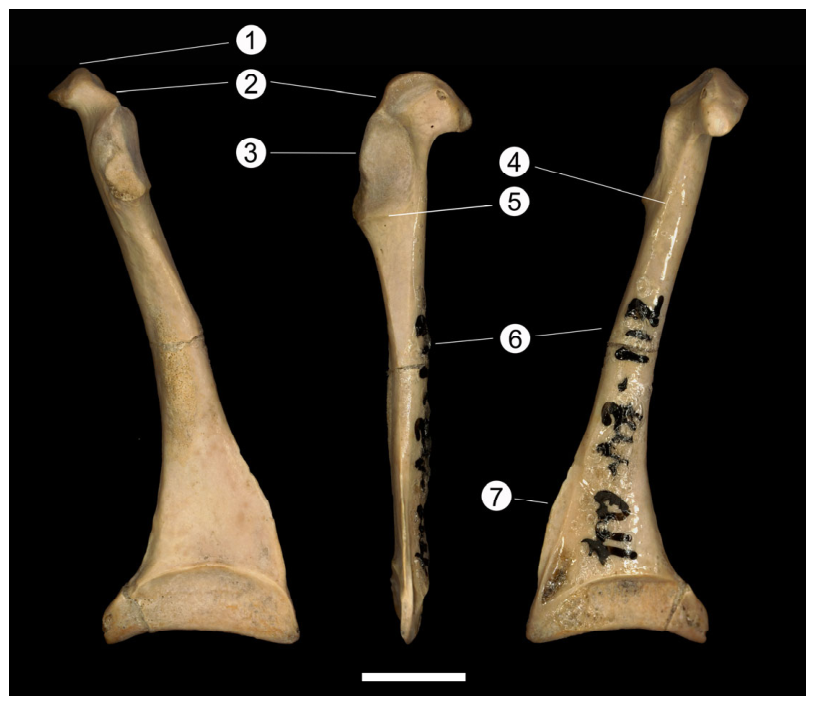
| Taxon | Total Length | Width of Sternal Facet | ||
|---|---|---|---|---|
| TTU-A3-112 | 27.7 | 9.4 | ||
| Podilymbus podiceps | Female | Male | Female | Male |
| Mean | 29.1 | 31.7 | 10.3 | 11.6 |
| Number of specimens | 9 | 10 | 9 | 10 |
| Observed range | 27.7–31.3 | 30.1–33.6 | 9.1–11.0 | 10.9–12.4 |
| Podiceps nigricollis | ||||
| Mean | 26.8 | 27.9 | 10.1 | 10.6 |
| Number of specimens | 5 | 5 | 13 | 13 |
| Observed range | 26.6–26.9 | 26.5–29.0 | 9.6–10.7 | 9.8–11.0 |
| Podiceps auritus | ||||
| Mean | 28.4 | 29.8 | 11.1 | 11.8 |
| Number of specimens | 10 | 10 | 9 | 9 |
| Observed range | 27.0–30.1 | 28.0–31.2 | 10.5–12.0 | 11.1–12.4 |
| Podilymbus podiceps | Podiceps auritus and Podiceps nigricollis | |
|---|---|---|
| 1 | Coraco-humeral surface is relatively narrow and located internally | Coraco-humeral surface is relatively wide and is located proximally |
| 2 | Transition from glenoid facet to the head is constricted | Transition from the glenoid facet is relatively broad |
| 3 | Glenoid facet relatively narrow | Glenoid facet relatively broad |
| 4 | Diaphysis distal to the scapular facet is rounded ventrally | Diaphysis distal to the scapular facet is flattened ventrally |
| 5 | Distal border of the glenoid facet slopes distally toward the distal border of the scapular facet | Distal border of the glenoid facet is level with or extends distal to the distal border of the scapular facet |
| 6 | Diaphysis is relatively slender | Diaphysis is relatively broad |
| 7 | Sterno-coracoidal crest is narrow, with a flat external border | Sterno-coracoidal crest is wide and sub-triangular |
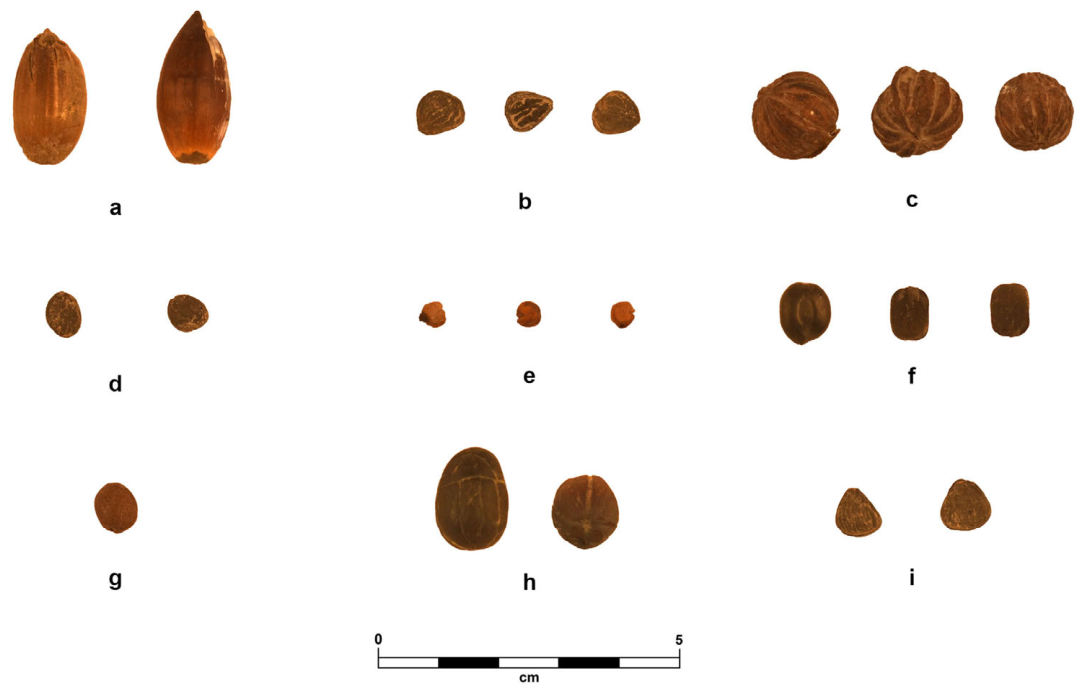
| Seeds | ||||
| Catalog Number | Family | Taxon | Common Name | Counts |
| TTU-A3-465 | Juglandaceae (Walnut Family) | Juglans microcarpa | Texas walnut | 11 |
| TTU-A3-461 | Fagaceae (Oak Family) | Quercus cf. fusiformis | Texas live oak | 2 |
| TTU-A3-584 | Cactaceae (Catus Family) | Opuntia spp. | prickly pear | 26 |
| TTU-A3-593 | Ebenaceae (Ebony Family) | Diospyros texana | Texas persimmon | 1 |
| TTU-A3-592 | Fabaceae (Legume Family) | Senegalia berlandieri | guajillo | 1158 |
| TTU-A3-462 | Prosopis glandulosa | honey mesquite | 64 | |
| TTU-A3-596 | Dermatophyllum secundiflora | Texas mountain laurel | 2 | |
| TTU-A3-597 | cf. Rhamnaceae (Buckthorn Family) | buckthorns | 22 | |
| Asparagaceae (Asparagus Family) | ||||
| TTU-A3-581 | Agavoideae | agave | 2 | |
| TTU-A3-464 | Yucca cf. treculeana | Torrey’s yucca | 90 | |
| Charcoal | ||||
| TTU-A3-585 TTU-A3-682 | Fagaceae (Oak Family) | Quercus-Leucobalanus | white oak group | 6 |
| TTU-A3-679 | Ebenaceae (Ebony Family) | Diospyros texana | Texas persimmon | 5 |
| TTU-A3-579 TTU-A3-675 TTU-A3-680 | Fabaceae (Legume Family) | Prosopis glandulosa | honey mesquite | 21 |
| TTU-A3-681 TTU-A3-678 | Dermatophyllum secundiflora | Texas mountain laurel | 21 | |
| TTU-A3-594 | Zygophyllaceae (Creosote-bush or Caltrop Family) | cf. Guaiacum angustifolium | Texas lignum-vitae | 4 |
| TTU-A3-683 | Oleaceae (Olive Family) | Fraxinus cf. greggii | Gregg’s ash | 2 |
| TTU-A3-684 | Scrophulariaceae (Figwort Family) | Leucophyllum frutescens | cenizo | 2 |
| Family | Taxon | Common Name | Form | * Habitat | Tolerances |
|---|---|---|---|---|---|
| Juglandaceae (Walnut Family) | Juglans microcarpa | Texas walnut | Tree | Canyons, along or near watercourses | Heat, cold, drought |
| Fagaceae (Oak Family) | Quercus cf. fusiformis | Texas live oak | Shrub to tree | Limestone mesas, canyon, and flats near watercourses | Heat, cold, high drought |
| Quercus-Leucobalanus (white oak group) | White oak | Tree | ** Q. polymorpha-watercourse; Q. vaseyana-limestone canyons, watercourses, and high mountains; Q. fusiformis-limestone mesas, canyons, and flats near watercourses; | Heat, cold, high drought | |
| Cactaceae (Catus Family) | Opuntia | Prickly pear cactus | Shrub | Limestone hills, mesas, and canyons; desert to semi-desert, grassland to woodland; | Heat, drought |
| Ebenaceae (Ebony Family) | Diospyros texana | Texas persimmon | Shrub to small tree | Limestone desert to semi-desert, along intermittent water courses and on slopes | Heat, high drought |
| Fabaceae (Legume Family) | Senegalia berlandieri | Guajillo | Shrub | Rocky limestone substrates along and near the Rio Grande | Heat, high drought |
| Prosopis glandulosa | Honey mesquite | Shrub to small tree | Desert, grassland, mesic mountain | Heat, high drought | |
| Dermatophyllum secundiflora | Texas mountain laurel | Shrub | Limestone watercourses | Heat, cold, drought | |
| cf. Rhamnaceae (Buckthorn Family) | Shrub to small tree | Desert, grassland, brushy flats and arroyos | |||
| Zygophyllaceae (Creosote-bush or Caltrop Family) | cf. Guaiacum angustifolium | Texas lignum-vitae | Shrub | Intermittent watercourses and brushlands | Heat, cold |
| Oleaceae (Olive Family) | Fraxinus cf. greggii | Gregg’s ash | Shrub to tree | Limestone hills, mesas, and canyons and near the Rio Grande | Heat, cold |
| Scrophulariaceae (Figwort Family) | Leucophyllum frutescens | Cenizo | Shrub | Desert hillsides, arroyos, scrublands | Heat, cold, drought |
| Asparagaceae (Asparagus Family) agave subfamily) | Agavoideae | Agave subfamily | Shrub-forb | Desert | |
| Yucca cf. treculeana | Torrey’s yucca | Shrub | Hills, mesas, slopes, desert scrub and grasslands | Heat, cold, drought |
| Arizona Lab Number | Catalog Number | Material | Radiocarbon Date | AD/BC | Calendar Calibration (cal AD/BC) | Calendar Calibration (cal BP) | ||
|---|---|---|---|---|---|---|---|---|
| Median Probability | 95.4% cal Age Range | Median Probability | 95.4% cal Age Range | |||||
| AA116297 | TTU-A3-573 | Textile–segment | 633 ± 30 | 1317 AD | 1350 cal AD | 1290–1396 cal AD | 600 cal BP | 555–660 cal BP |
| AA116298 | TTU-A3-574 | Textile–mat segment | 705 ± 30 | 1245 AD | 1290 cal AD | 1266–1392 cal AD | 660 cal BP | 560–680 cal BP |
| AA116299 | TTU-A3-575 | Textile–mat segment | 666 ± 30 | 1284 AD | 1320 cal AD | 1279–1392 cal AD | 630 cal BP | 560–670 cal BP |
| AA116300 | TTU-A3-670 | Textile–basket segment | 995 ± 30 | 955 AD | 1050 cal AD | 994–1154 cal AD | 900 cal BP | 800–960 cal BP |
| AA116301 | TTU-A3-672 | Textile–loin cloth fringe segment | 638 ± 30 | 1312 AD | 1350 cal AD | 1287–1396 cal AD | 600 cal BP | 550–660 cal BP |
| AA116302 | TTU-A3-671 | Textile–fiber twine segment | 627 ± 30 | 1323 AD | 1350 cal AD | 1295–1397 cal AD | 600 cal BP | 550–650 cal BP |
| AA117334 | TTU-A3-579 | Charcoal–Prosopis cf. glandulosa | 4785 ± 19 | 2835 BC | 3575 cal BC | 3625–3528 cal BC | 5520 cal BP | 5480–5580 cal BP |
| AA117337 | TTU-A3-594 | Charcoal–cf. Guaiacum angustifolium | 2620 ± 16 | 670 BC | 800 cal BC | 809–788 cal BC | 2750 cal BP | 2740–2750 cal BP |
| AA117332 | TTU-A3-679 | Charcoal–Diospyros texana | 2529 ± 16 | 579 BC | 675 cal BC | 786–565 cal BC | 2620 cal BP | 2510–2730 cal BP |
| AA117336 | TTU-A3-681 | Charcoal–Dermatophyllum secundiflora | 2612 ± 16 | 662 BC | 800 cal BC | 807–780 cal BC | 2750 cal BP | 2730–2760 cal BP |
| AA117333 | TTU-A3-682 | Charcoal–Quercus-Leucobalanus group | 2573 ± 16 | 623 BC | 785 cal BC | 799–770 cal BC | 2730 cal BP | 2720–2750 cal BP |
| AA117338 | TTU-A3-683 | Charcoal–Fraxinus cf. greggii | 2630 ± 16 | 680 BC | 805 cal BC | 811–791 cal BC | 2750 cal BP | 2740–2760 cal BP |
| AA117335 | TTU-A3-684 | Charcoal–Leucophyllum frutescens | 2539 ± 16 | 589 BC | 755 cal BC | 790–570 cal BC | 2700 cal BP | 2520–2740 cal BP |
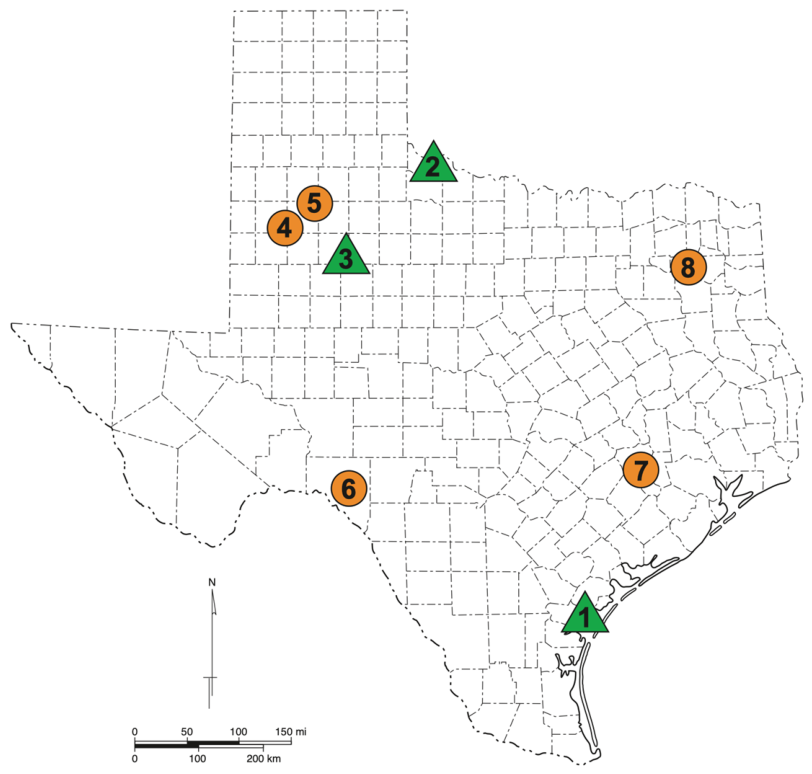
| Taxon | Locality | Age (14C yr) | Reference | |
|---|---|---|---|---|
| 1 | Podilymbus podiceps | Ingleside, San Patricio County | Late Pleistocene | [58] |
| 2 | Podilymbus podiceps | Howard Ranch l.f., Hardeman County | Late Pleistocene (16,775 BP) | [59] |
| 3 | Podilymbus podiceps | Macy Fork l.f., Garza County | Late Pleistocene (11,550–11,000 BP) | [29] |
| 4 | Podilymbus podiceps | Lubbock Lake (41LU1; Plainview l.f.), Lubbock County | Early Holocene (10,000 BP) | [31] |
| 5 | Podiceps cf. nigricollis | Lubbock Lake (41LU1; Plainview l.f.), Lubbock County | Early Holocene (10,000 BP) | [31] |
| 6 | Podilymbus podiceps | Murrah Cave (41VV351), Val Verde County | Late Holocene | This paper |
| 7 | Podilymbus podiceps | Leonard K site (41AU37), Austin County | Late Holocene (2470–1590 BP) | [60,61] |
| 8 | Podilymbus podiceps | Taddlock site (X41WD39), Wood County | Late Holocene (1010–950 BP) | [62] |
| Family | Taxon | Common Name | Form | * Habitat | Tolerances |
|---|---|---|---|---|---|
| Ephedraceae (Mormon tea or Joint-fir Family) | Ephedra spp. | Mormon tea | Shrub | Desert shrub grassland | Heat, cold, drought |
| Juglandaceae (Walnut Family) | Juglans microcarpa | Texas walnut | Tree | Canyons, along or near watercourses | Heat, cold, drought |
| Fagaceae (Oak Family) | Quercus | Oak | Shrub to tree | Limestone mesas, canyon, and flats near watercourses | Heat, cold, high drought |
| Cactaceae (Catus Family) | Opuntia | Prickly pear cactus | Shrub | Limestone hills, mesas, and canyons; desert to semi-desert, grassland to woodland | Heat, drought |
| Fabaceae (Legume Family) | Senegalia berlandieri | Guajillo | Shrub | Rocky limestone substrates along and near the Rio Grande | Heat, high drought |
| Prosopis glandulosa | Honey mesquite | Shrub to small tree | Desert, grassland, mesic mountain | Heat, high drought | |
| Dermatophyllum secundiflora | Texas mountain laurel | Shrub | Limestone watercourses | Heat, cold, drought | |
| Bignoniaceae (Bignonia Family) | Chilopsis linearis | Desert willow | Tree | Streams, riverbanks | Heat, cold, high drought |
| Poaceae (Grass Family) | Aristida spp. | Needle grass | Grass | Hillsides, grasslands | Drought |
| Asparagaceae (Asparagus Family, agave subfamily) | Yucca cf. treculeana | Torrey’s yucca | shrub | Hills, mesas, slopes, desert scrub, and grasslands | Heat, cold, drought |
| Agave lechuguilla | Lechuguilla | Shrub-forb | Desert shrub grassland | Heat, cold, drought | |
| Asparagaceae (Asparagus Family, nolinoid subfamily) | Dasylirion texanum | Sotol | Grass-like | Desert flats, grasslands, shrub grassland | Heat, cold |
| Nolina texana | Texas bear grass | Grass-like | Hillsides, grasslands, shrublands | Heat, cold, drought | |
| Amaryllidaceae (Amaryllis family) | Allium spp. | Wild onion | Herb | Hills, grasslands, desert, desert mountains | Cold, drought |
| Family | Taxon | Common Name |
|---|---|---|
| Ephedraceae (Mormon tea or Joint-fir Family) | Ephedra spp. | Mormon tea |
| Juglandaceae (Walnut Family) | Juglans microcarpa | Texas walnut |
| Fagaceae (Oak Family) | Quercus | Oak |
| Quercus cf. fusiformis | Texas live oak | |
| Quercus-Leucobalanus | White oak group | |
| Cactaceae (Catus Family) | Opuntia | Prickly pear cactus |
| Ebenaceae (Ebony Family) | Diospyros texana | Texas persimmon |
| Fabaceae (Legume Family) | Senegalia berlandieri | Guajillo |
| Prosopis glandulosa | Honey mesquite | |
| Dermatophyllum secundiflora | Texas mountain laurel | |
| cf. Rhamnaceae (Buckhorn Family) | Buckhorn | |
| Zygophyllaceae (Creosote-bush or Caltrop Family) | cf. Guaiacum angustifolium | Texas lignum-vitae |
| Oleaceae (Olive Family) | Fraxinus cf. greggii | Gregg’s ash |
| Scrophulariaceae (Figwort Family) | Leucophyllum frutescens | Cenizo |
| Bignoniaceae (Bignonia Family) | Chilopsis linearis | Desert willow |
| Poaceae (Grass Family) | Aristida spp. | Needle grass |
| Asparagaceae (Asparagus Family, agave subfamily) | Yucca cf. treculeana | Torrey’s yucca |
| Agave lechuguilla | Lechuguilla | |
| Asparagaceae (Asparagus Family, nolinoid subfamily) | Dasylirion texanum | Sotol |
| Nolina texana | Texas bear grass | |
| Amaryllidaceae (Amaryllis Family) | Allium spp. | Wild onion |
Disclaimer/Publisher’s Note: The statements, opinions and data contained in all publications are solely those of the individual author(s) and contributor(s) and not of MDPI and/or the editor(s). MDPI and/or the editor(s) disclaim responsibility for any injury to people or property resulting from any ideas, methods, instructions or products referred to in the content. |
© 2026 by the authors. Licensee MDPI, Basel, Switzerland. This article is an open access article distributed under the terms and conditions of the Creative Commons Attribution (CC BY) license.
Share and Cite
Johnson, E.; Moretti, J.A. New Botanical and Avian Insights from the Holocene of Murrah Cave in the Trans-Pecos of Texas, USA. Land 2026, 15, 883. https://doi.org/10.3390/land15050883
Johnson E, Moretti JA. New Botanical and Avian Insights from the Holocene of Murrah Cave in the Trans-Pecos of Texas, USA. Land. 2026; 15(5):883. https://doi.org/10.3390/land15050883
Chicago/Turabian StyleJohnson, Eileen, and John A. Moretti. 2026. "New Botanical and Avian Insights from the Holocene of Murrah Cave in the Trans-Pecos of Texas, USA" Land 15, no. 5: 883. https://doi.org/10.3390/land15050883
APA StyleJohnson, E., & Moretti, J. A. (2026). New Botanical and Avian Insights from the Holocene of Murrah Cave in the Trans-Pecos of Texas, USA. Land, 15(5), 883. https://doi.org/10.3390/land15050883