Article

Quantifying the Impacts of Land Use/Cover and Climate Change on Water Conservation in the Source Region of the Yellow River

1
School of Civil and Hydraulic Engineering, Xichang University, Xichang 615013, China
2
School of Civil Engineering and Water Resources, Qinghai University, Xining 810016, China
3
State Key Laboratory of Plateau Ecology and Agriculture, Qinghai University, Xining 810016, China
4
School of Geological Engineering, Qinghai University, Xining 810016, China
*
Author to whom correspondence should be addressed.
Land 2026, 15(5), 876; https://doi.org/10.3390/land15050876 (registering DOI)
Submission received: 6 April 2026 / Revised: 9 May 2026 / Accepted: 16 May 2026 / Published: 19 May 2026

Abstract

The Source Region of the Yellow River (YRSR) is a key ecological barrier and a major water supply area, where water conservation is highly sensitive to ongoing climate change (CC) and land use/cover change (LUCC). However, the relative roles of CC and LUCC in regulating water conservation remain insufficiently quantified. In this study, we applied the Soil and Water Assessment Tool (SWAT) to simulate the spatiotemporal dynamics of water conservation in the YRSR and to disentangle the respective contributions of CC and LUCC using a fixing–changing approach, in which one driver is fixed and the other is varied across paired scenarios, followed by projections driven by CMIP6 forcing under SSP2–4.5 and SSP5–8.5. Water conservation showed a pronounced southeast–northwest contrast and increased over 2000–2019 (+4.56 mm/year). Attribution analysis revealed that CC dominated changes in water conservation, whereas LUCC exerted a weak net negative influence. Most increasing regions were precipitation-driven, whereas declining regions were concentrated where evapotranspiration and surface runoff increased concurrently. Under SSP2–4.5, water conservation is projected to continue increasing (+1.16 mm/year). In contrast, under SSP5–8.5, water conservation is projected to slightly decline (−0.26 mm/year). These findings highlight the primary role of climate in regulating water conservation in the YRSR and provide scientific support for adaptive watershed management under a changing climate.

1. Introduction

Water resources are fundamental to both the functioning of the Earth’s ecosystems and the survival and development of human societies. As a critical hydrological service, water conservation is an ecosystem function that ensures stable water supply and regulates hydrological processes [1,2]. It sustains ecosystem stability, generates ecological benefits, and underpins a variety of regulatory and provisioning services [3,4]. Given its direct link to water resource availability and ecological stability, water conservation has become a focal point in hydrological and ecological research, particularly in the context of accelerating climate change. The Qinghai-Tibet Plateau (QTP), known as the “Asian Water Tower”, is characterized by extensive alpine ecosystems, widespread frozen ground, and fragile hydrological regimes [5]. The YRSR is situated in the northeastern QTP. As a vital water source and ecological safeguard, it underpins the Yellow River Basin’s environmental security and long-term development [6,7]. Dominated by alpine grasslands, wetlands, and permafrost, the YRSR exhibits strong sensitivity to environmental disturbances, making its water conservation both vital and vulnerable.
Over recent decades, CC has profoundly altered the global hydrological cycle, particularly through its effects on the cryosphere. In the YRSR, the depth of seasonally frozen ground decreased by 1.2 cm/year, while the extent of regional permafrost has shown a persistent shrinking trend, with a marked reduction over the past several decades [8]. Warming has intensified precipitation and water exchange, accelerating the hydrological cycle across the QTP [9,10,11]. These cryospheric and climatic changes can affect water conservation by altering evapotranspiration and surface runoff generation, which are key components of the water balance framework used in this study [12,13,14]. From 1990 to 2015, LUCC on the QTP ranged from 0% to 2% annually, with major transformations concentrated along the eastern periphery and the Three-Rivers Source Region [15]. In the Three-Rivers Source Region, where grasslands predominate, the grassland area was reduced by approximately 2.17 million hm2 over the past two decades, and the total water body area has exhibited an expansion trend at an average rate of 9% per decade [16]. Water conservation is governed by interactions between climatic and land use/cover factors, showing marked sensitivity to fluctuations in precipitation, evapotranspiration, and surface runoff [17,18,19]. LUCC and CC are widely recognized as the dominant drivers of hydrological change. The compounding effects of LUCC and CC may induce regime shifts in hydrological processes [20,21,22,23], thereby leading to significant changes in regional water conservation. Therefore, it is necessary to re-evaluate the recent evolution of water conservation in the YRSR and to clarify its driving mechanisms. In the meantime, to support long-term water resources planning, future trajectories of water conservation were projected under CMIP6 scenario forcing.
Existing evidence shows that the relative roles of LUCC and CC in shaping hydrological responses vary markedly among basins. For instance, SWAT based analyses revealed that CC dominated hydrological changes in the Heihe River Basin [24] as well as the Sabarmati River region [25]. In contrast, LUCC exerted greater influence in the source region of the Lancang River [26], the Luan River Basin [27], and other catchments where LUCC perturbations dominate water balance shifts [28]. These studies indicate that attribution outcomes can be strongly shaped by spatial heterogeneity and the specific characteristics of each basin. However, the relative contributions of LUCC and CC to water conservation in the YRSR remain insufficiently quantified within a consistent attribution framework. Moreover, the spatial heterogeneity of water conservation changes and their dominant hydrological drivers are still unclear. Future changes in water conservation under different climate scenarios also remain uncertain for the YRSR.
To quantify the contributions of LUCC and CC and identify the associated hydrological drivers, an appropriate model is needed to represent water balance components and scenario responses. Hydrological and ecosystem service models are widely employed to evaluate water conservation. The InVEST model has been applied across the QTP to assess water conservation [29,30]. Within the InVEST framework, water conservation is commonly estimated by first calculating water yield and then adjusting it using terrain and soil factors [31,32]. This approach focuses on the final ecosystem service quantity and its spatial visualization at the landscape scale, and is generally implemented at an annual scale [4,33,34]. Compared with InVEST, SWAT places greater emphasis on process based hydrological simulation and the identification of hydrological drivers of water conservation. SWAT can directly simulate key hydrological components at a daily time step, including evapotranspiration and surface runoff [35,36,37]. It has also been widely used to simulate hydrological components related to water conservation and to assess the effects of LUCC and CC on these components [38,39]. Therefore, SWAT (version 2012) was adopted in this study to assess water conservation dynamics under historical and future conditions.
Different from previous SWAT based studies that mainly focused on hydrological responses or assessed the effects of CC and LUCC separately, this study explicitly centers on water conservation and integrates historical change detection, attribution of LUCC and CC contributions, identification of dominant hydrological driver combinations, and CMIP6 based future projection within a unified framework. Accordingly, this study focuses on the YRSR and aims to (1) characterize the spatiotemporal dynamics of water conservation over the past two decades; (2) quantify the respective contributions of LUCC and CC based on SWAT simulations within a fixing–changing approach; and (3) project future trajectories of water conservation under CMIP6 climate scenarios. The proposed framework is transferable to alpine headwater basins globally and supports climate adaptive strategies for sustainable water governance.

2. Data and Methods

2.1. Study Area

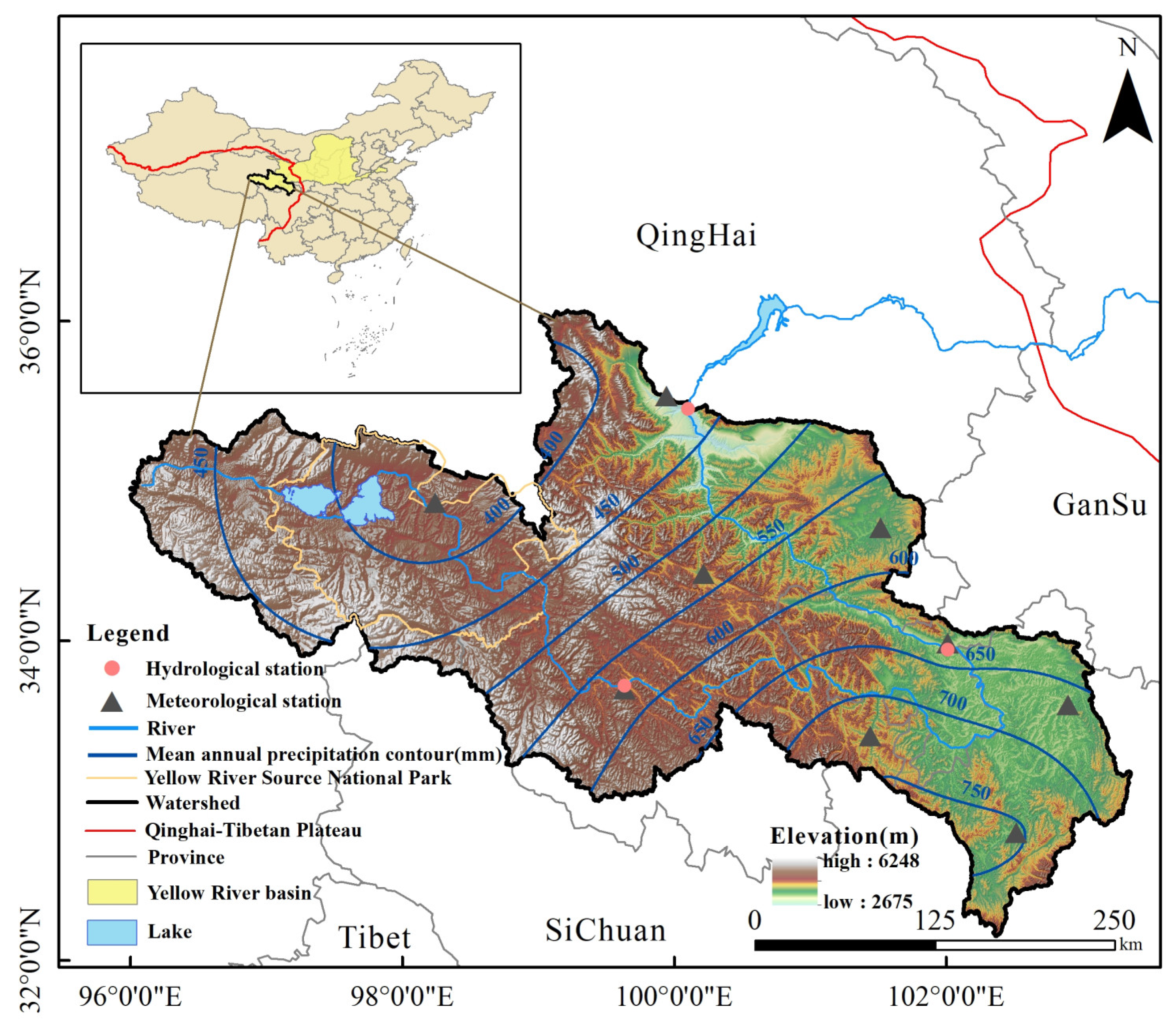
The YRSR (32°20′ N–36°10′ N, 95°50′ E–103°30′ E) is situated in the northeastern QTP (Figure 1), covering 123,000 km2 upstream of the Tangnaihai hydrological station. Elevations range from 2675 to 6286 m, with terrain generally higher in the west and lower in the east. Land use/cover (LUC) is dominated by grasslands, followed by forests and bare soils. The region has a continental plateau climate with strong temperature seasonality and heterogeneous precipitation. Mean annual precipitation (2000–2019) was 539 mm, increasing from 400 mm in the northwest to 750 mm in the southeast. Despite high ecohydrological sensitivity, the YRSR functions as a key water tower, regulating runoff and sustaining water supply for downstream basins.

2.2. Data

Observed monthly runoff at the Tangnaihai, Maqu, and Jimai stations was obtained from the Hydrological Yearbook of the Yellow River. LUC maps at 30 m resolution were sourced from the Resource and Environmental Science and Data Center of China (https://www.resdc.cn/ (accessed on 10 April 2025)) and were used to construct land use inputs for the SWAT model and to analyze LUCC. Soil properties at 1 km resolution were taken from the National Cryosphere Desert Data Center (https://www.ncdc.ac.cn/ (accessed on 15 April 2025)). A 90 m digital elevation model (DEM) was obtained from the Geospatial Data Cloud (https://www.gscloud.cn/ (accessed on 12 December 2024)). Daily meteorological data for 2000–2019 were sourced from the China National Meteorological Data Center (https://data.cma.cn/ (accessed on 8 February 2022)). Future precipitation and temperature were taken from the CMIP6-based China downscaled precipitation, temperature, wind dataset (1979–2100) archived at the National Tibetan Plateau Data Center (https://www.tpdc.ac.cn/ (accessed on 12 October 2025)). The SSP2–4.5 and SSP5–8.5 subsets were extracted and converted into station-scale daily series to drive the SWAT simulations. Before model input preparation, all spatial datasets were unified to the same coordinate system, clipped to the study area, and converted according to the input requirements of the SWAT model. The meteorological and future climate data were checked and formatted as daily series to ensure consistency between historical and future simulations. These datasets were selected because they meet the spatial and temporal requirements for assessing water conservation using SWAT in the YRSR and have been widely used in previous hydrological and ecological studies in this region [26,32,40,41].

2.3. SWAT Model

The SWAT model is widely used to simulate hydrological processes in large watersheds, combining physical mechanisms with a semi-distributed structure and operating at a daily time step [42,43,44]. In SWAT, the landscape is discretized into Hydrological Response Units (HRU), which are defined based on unique combinations of LUC, soil type, and topographic slope classes, according to user-defined threshold values [45]. Owing to its ability to capture spatial heterogeneity and simulate the interactions among climate, land surface, and hydrological processes, SWAT has been extensively applied in watershed hydrological studies worldwide. Here, water conservation in the YRSR was quantified using SWAT simulations. The simulations follow a water balance formulation:
s w t = s w 0 + i = 1 n ( R d a y Q s u r f W S E E P Q g w E a )
where s w t is the final soil moisture (mm), s w 0 is the initial soil moisture (mm), R d a y is the precipitation (mm), Q s u r f is the surface runoff (mm), W S E E P is the downward percolation leaving the soil profile (mm) and Q g w is groundwater recharge and outflow (mm), E a is the evapotranspiration (mm).
In SWAT, water yield refers to the total amount of water entering the main channel from each HRU within a time step [41]. Previous studies have commonly used regional water balance equations to quantify water conservation, which is also referred to as water retention in some studies [46,47]. Based on this water balance concept, this study uses the term water conservation to represent the portion of precipitation retained within the watershed after evapotranspiration and surface runoff losses [39,48]. Water conservation at the HRU scale is defined as:
W = R d a y Q s u r f E a
where W is the water conservation (mm), R d a y is the precipitation (mm), Q s u r f is the surface runoff (mm), E a is the evapotranspiration (mm).
To identify the hydrological drivers of water conservation change, changes in water conservation between two periods were decomposed according to the same water balance relationship:
Δ W = Δ R d a y Δ Q s u r f Δ E a
where Δ W represents the change in water conservation, and Δ R d a y , Δ Q s u r f , and Δ E a represent the changes in precipitation, surface runoff, and evapotranspiration, respectively. Based on the signs of Δ R d a y , Δ Q s u r f , Δ E a , and Δ W , each spatial unit was classified into different hydrological driver combinations. For each driver combination, the change in water conservation, its contribution rate relative to the total basin scale change, and the corresponding area fraction were calculated to identify the dominant hydrological mechanisms controlling water conservation changes across the YRSR.

2.4. Evaluation of the SWAT Model

SWAT parameters were calibrated with SUFI-2 implemented in SWAT-CUP (version 5.1.6) [49,50]. The 20 calibrated parameters were selected based on previous SWAT applications in the YRSR and other alpine basins, together with their known sensitivity and hydrological relevance to runoff related processes [41,51,52]. These parameters represent key hydrological processes in the SWAT model. Model calibration was performed using runoff data from 2000 to 2009, followed by validation with data from 2010 to 2019. The final optimized values of the parameters are presented in Table S1.
The SWAT model typically utilizes the Nash–Sutcliffe Efficiency coefficient (NSE) as the primary objective function for model calibration and validation [53]. NSE theoretically spans from −∞ to 1, with higher values indicating better agreement between simulations and observations. Additionally, the coefficient of determination (R2) and percent bias (PBIAS) are frequently employed as complementary statistical indicators to assess model performance [54]. R2 varies between 0 and 1. Values closer to 1 indicate better agreement between simulated and observed results. PBIAS quantifies the directional bias between simulated and observed values: positive values indicate model underestimation (observed > simulated), while negative values reflect model overestimation (observed < simulated). Optimal model performance is achieved when PBIAS approaches zero. NSE, R2, and PBIAS were computed using the following equations:
NSE = 1 i = 1 n Q o b s , i Q s i m , i 2 i = 1 n Q o b s , i Q ¯ o b s 2
R 2 = i = 1 n Q o b s , i Q ¯ o b s Q s i m , i Q ¯ s i m i = 1 n Q o b s , i Q ¯ o b s 2 i = 1 n Q s i m , i Q ¯ s i m 2 2
PBIAS = i = 1 n Q o b s , i Q s i m , i i = 1 n Q o b s , i × 100 %
where o b s is observed discharge, s i m is simulated discharge, Q is runoff; Q ¯ is mean runoff.

2.5. Fixing–Changing Approach

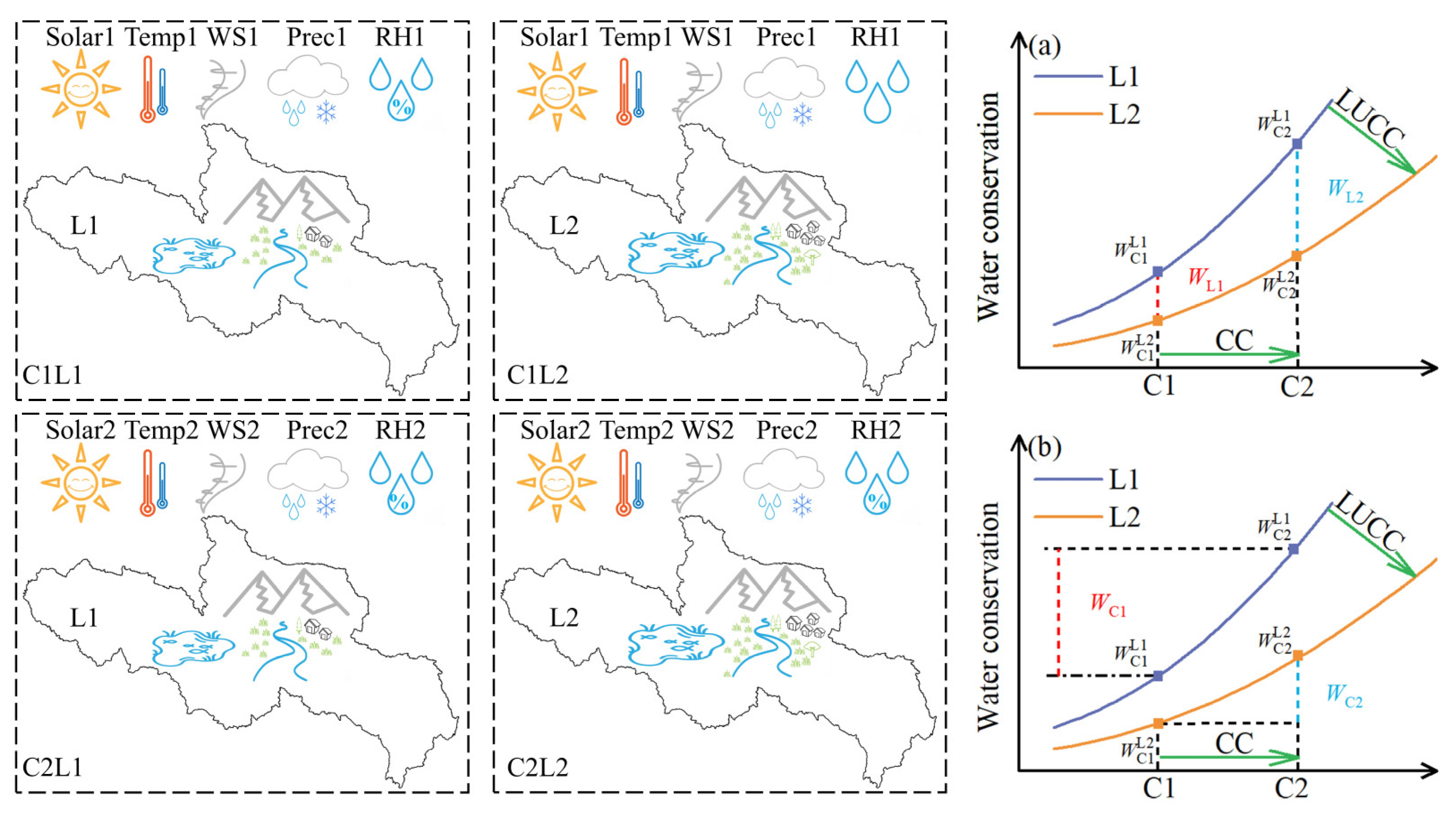
To separate the effects of LUCC and CC on water conservation, a fixing–changing approach was implemented in this study. This approach quantifies the response of hydrological variables by alternately holding climate or land use conditions constant while allowing the other factor to vary. It has been widely adopted in watershed scale attribution analyses [24,25,55]. Meteorological data covering 2000–2019 were assembled and organized into two contrasting periods, 2000–2009 and 2010–2019, denoted as C1 and C2, respectively. LUC conditions corresponding to these periods were defined as L1 and L2. By combining the two climate periods with the two LUC settings, four simulation scenarios (C1L1, C1L2, C2L1, and C2L2) were generated and implemented in the SWAT model. Specifically, C1L1 is defined as the reference baseline, representing the climate and LUC conditions of the first period. C1L2 represents the LUCC scenario, in which LUC changes from L1 to L2 while climate remains fixed at C1. C2L1 represents the CC scenario, in which climate changes from C1 to C2 while LUC remains fixed at L1. C2L2 represents the combined change scenario, in which both climate and LUC correspond to the second period. Therefore, the difference between paired simulations can be attributed to the factor that changes between the two scenarios. Figure 2 summarizes the scenario setting and illustrates the decomposition of water conservation changes into components attributable to LUCC and CC. For each phase, model runs were performed using the LUC maps corresponding to the start and end years of that phase. Because the LUC dataset is available at five year intervals and LUC changes generally occur gradually, the 2020 LUC map was used to represent the LUC conditions in 2019. The results of the two simulations were then averaged to represent the mean LUC conditions of each phase [26,56].
The LUCC effect was quantified by comparing paired simulations with different LUC conditions under the same climate, while the CC effect was quantified by comparing paired simulations with different climate conditions under the same LUC. The water conservation responses to LUCC ( Δ W L ) under climatic conditions C1 and C2 are denoted as Δ W L 1 and Δ W L 2 (Figure 2a). The water conservation responses to CC ( Δ W C ) under LUC conditions L1 and L2 are denoted as Δ W C 1 and Δ W C 2 (Figure 2b). The following equations are applied:
Δ W L = 1 2 Δ W L 1 + Δ W L 2 = 1 2 W L 2 C 1 W L 1 C 1 + W L 2 C 2 W L 1 C 2
Δ W C = 1 2 Δ W C 1 + Δ W C 2 = 1 2 W L 1 C 2 W L 1 C 1 + W L 2 C 2 W L 2 C 1
Δ W = Δ W L + Δ W C = W L 2 C 2 W L 1 C 1
C L = Δ W L Δ W
C C = Δ W C Δ W
where Δ W L , Δ W C and Δ W denote the water conservation responses attributable to LUCC, CC, and their interaction effect, respectively. C L and C C denote the relative contributions of LUCC and CC, respectively. W L 1 C 1 is the simulation under C1 and L1, and other combinations ( W L 2 C 1 , W L 1 C 2 , W L 2 C 2 ) follow the same notation.

3. Results

3.1. Model Evaluation Results

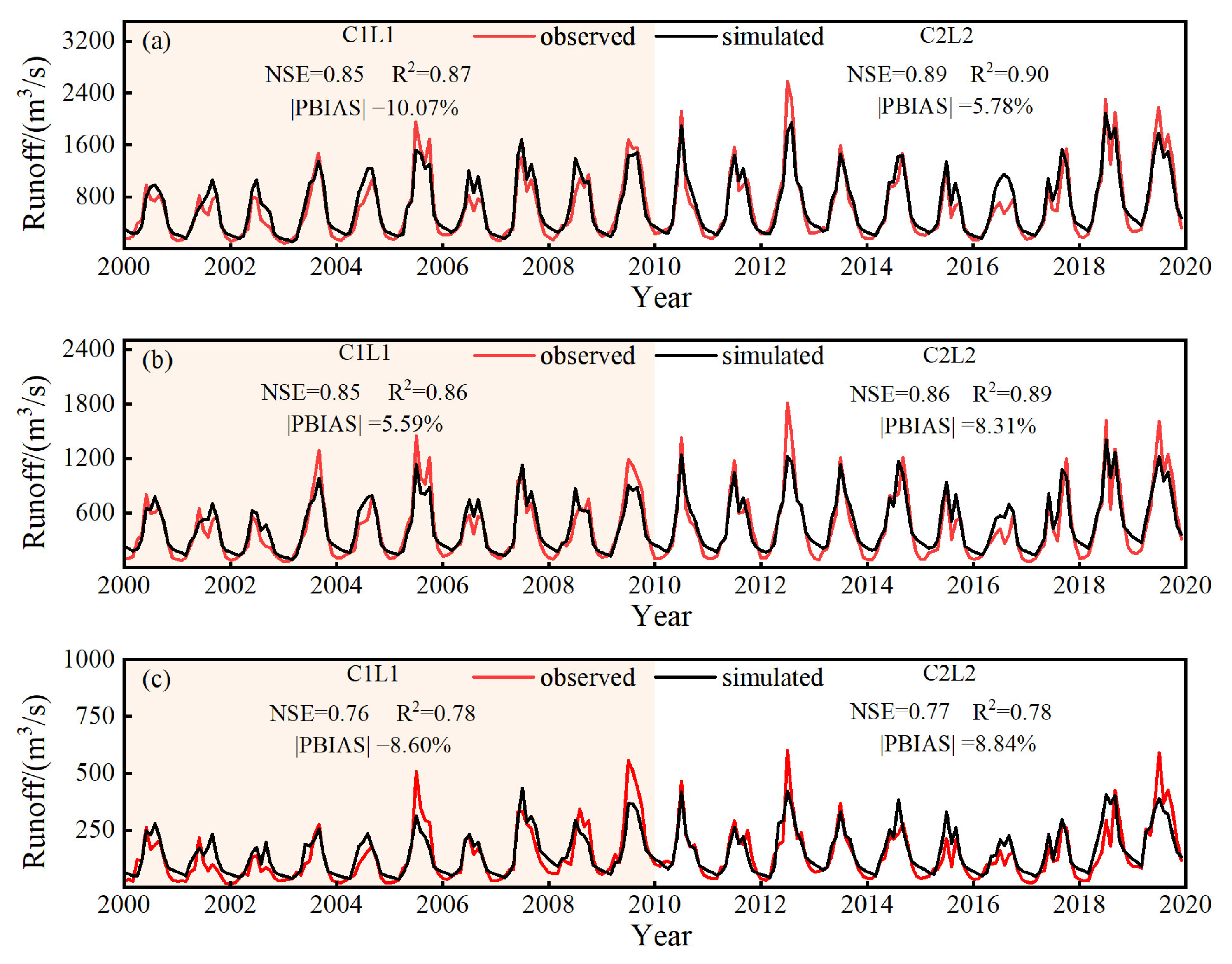
Runoff observations from three stations were used to calibrate (2000–2009) and validate (2010–2019) the SWAT simulations (Figure 3). Model performance was evaluated using R2, NSE, and PBIAS to measure agreement between simulations and observations and to assess model applicability.
The performance evaluation indicates consistently strong fits at all three stations, with R2 > 0.75 and NSE > 0.75 for both calibration and validation. In the validation period, the absolute PBIAS values were consistently less than 10%. These statistics indicate that the calibrated SWAT model provides a reliable representation of runoff dynamics in the YRSR and is suitable for subsequent hydrological simulations and scenario analyses.

3.2. Spatial and Temporal Variations in Water Conservation

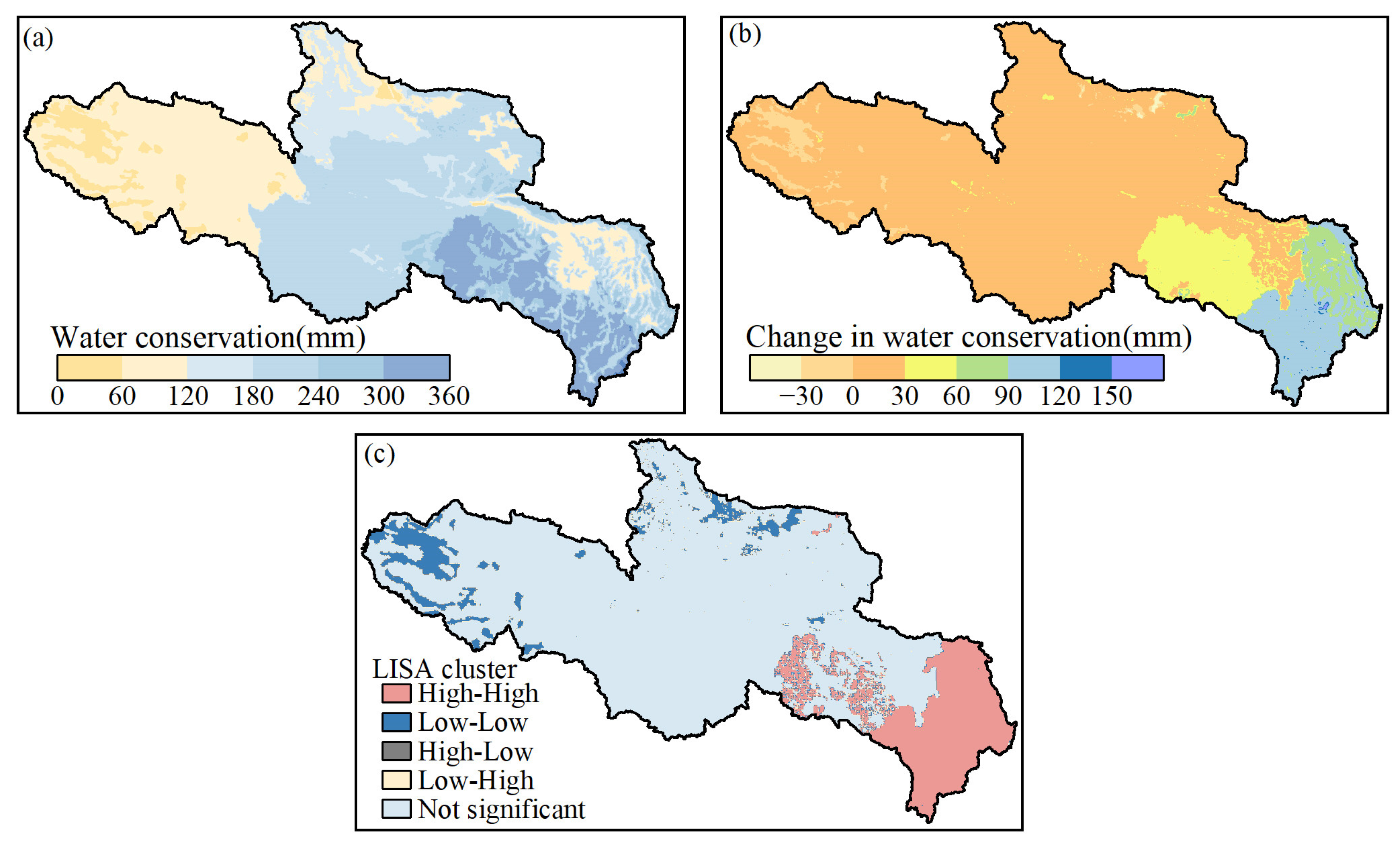
The spatial distribution of water conservation in the YRSR from 2000 to 2019 (Figure 4a) exhibited a distinct increasing gradient from west to east and north to south. High-value zones (>240 mm) were concentrated in the southeastern regions, while low-value zones (<60 mm) predominated in the northwestern basin. As shown in Figure 4b, increases occurred across the basin but were markedly stronger in the southeast than elsewhere. In the western, central, and northern regions, the average increase in water conservation ranged from 0 to 30 mm, while the southeastern areas generally exhibited larger increments ranging from 30 to 120 mm. Conversely, partial declines in water conservation occurred in specific western and northern areas, with reductions predominantly ranging from −30 to 0 mm.
Spatial autocorrelation analysis was further conducted to provide statistical support for the spatial pattern of water conservation change. The change in water conservation was calculated as the difference between the mean annual water conservation during 2010–2019 and that during 2000–2009. Global Moran’s I and Local Moran’s I were then used to evaluate the overall spatial autocorrelation and identify local spatial clusters, respectively. Detailed descriptions of these spatial autocorrelation methods can be found in previous studies [57,58]. The results showed that water conservation change exhibited significant positive spatial autocorrelation across the YRSR (Global Moran’s I > 0, p < 0.05), indicating that the spatial pattern was clustered. The Local Moran’s I cluster map showed that High-High clusters were mainly distributed in the southeastern YRSR, corresponding to areas with relatively large increases in water conservation (Figure 4c). Low-Low clusters were mainly found in parts of the western and northern regions, indicating areas with weak increases or local decreases. High-Low and Low-High outliers were rare, suggesting that the spatial pattern was generally continuous.
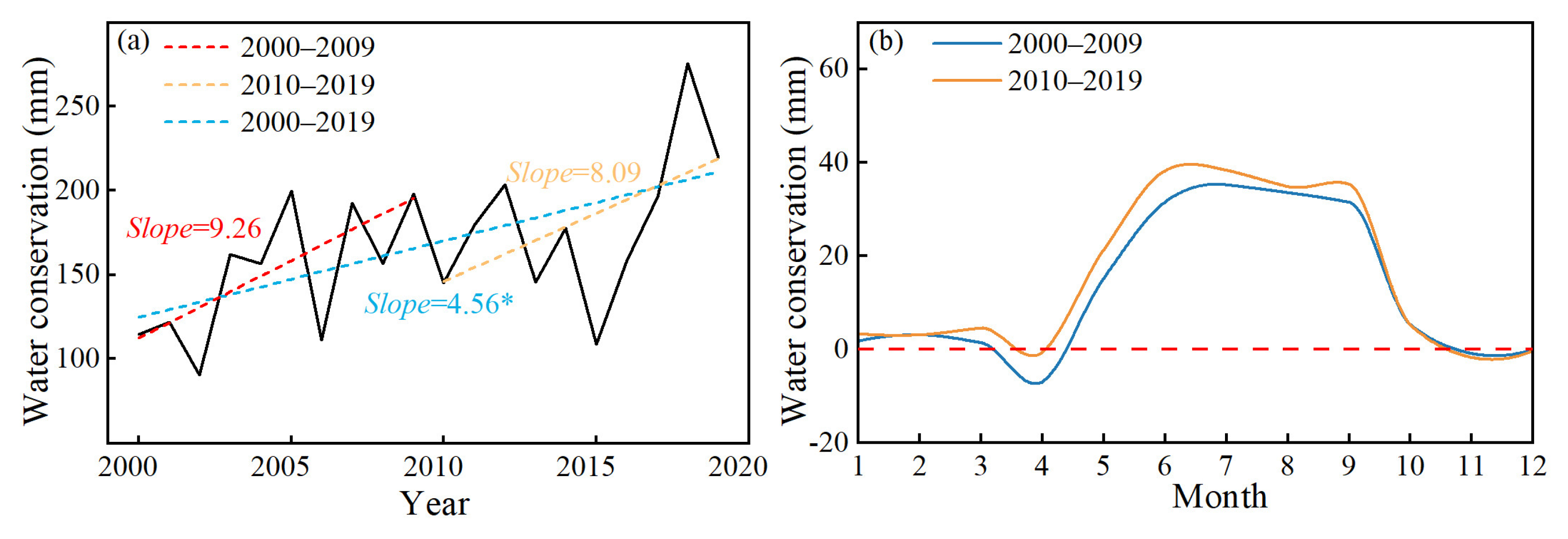
The interannual variation in water conservation in the YRSR from 2000 to 2019 (Figure 5a) showed a clear increasing trend. Temporal trends were assessed using the Mann– Kendall test and Sen’s slope estimator, following previous studies [59,60,61]. The results indicated a statistically significant upward trend, with a Sen’s slope of +4.56 mm/year (p < 0.05). At the decadal scale, water conservation increased at rates of 9.26 mm/year in 2000–2009 and 8.09 mm/year in 2010–2019. The mean annual water conservation was 150.28 mm in 2000–2009 and was 20.5% higher in 2010–2019 than in the preceding decade.
Seasonal comparisons (Figure 5b) highlighted distinct monthly patterns: summer (June–August) exhibited peak water conservation values in both study periods, while April showed marked declines. This pattern underscores the pronounced influence of seasonal precipitation distribution on the basin scale water conservation.

3.3. Attribution of Water Conservation Changes to LUCC and CC

The YRSR is dominated by grassland ecosystems, which covered approximately 80% of the basin in 2010, followed by forest (7%) and wetland (5%) (Figure S1). Among grassland categories, low-coverage (GRS_L), medium-coverage (GRS_M), and high-coverage (GRS_H) grasslands accounted for 29%, 33%, and 18% of the total area, respectively.
LUCC from 2000 to 2020 exhibited distinct temporal variations (Figure S2). Between 2000 and 2010, LUCC intensity was high and was dominated by the conversion of unused land (UNUS) to GRS_L, accompanied by bidirectional transitions among grassland types and moderate increases in forest and wetland areas. During 2010–2020, LUCC intensity decreased notably, and spatial patterns became relatively stable, indicating that the basin entered a stage of land use equilibrium.
The YRSR experienced a consistent warming and wetting trend during 2000–2019 (Figure S3). The Mann–Kendall test and Sen’s slope estimator indicated a significant precipitation increase (+7.49 mm/year, p < 0.05) and a significant increase in mean temperature (+0.05 °C/year, p < 0.01). Spatially, precipitation increased more strongly in the southeastern areas (8–12 mm/year), while the temperature rise was more pronounced in the central and southeastern areas (0.07–0.09 °C/year).
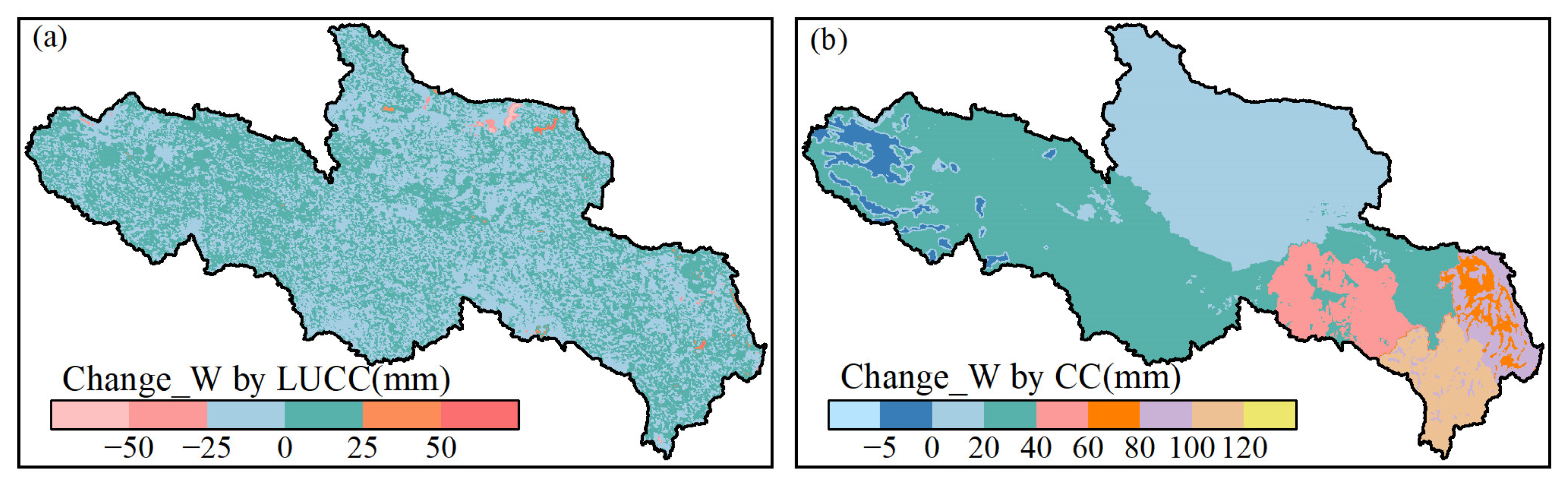
Figure 6 summarizes the attribution of water conservation changes in the YRSR to LUCC and CC. LUCC contributed to increases in water conservation across 50.17% of the basin area (predominantly within 0–25 mm) and decreases in 49.83% of the area (generally −25 to 0 mm). In contrast, CC drove increases in water conservation over 97.11% of the basin area, with substantial enhancements of 20–120 mm in the southeastern regions. The limited decrease zones (2.89% of the basin) under CC were concentrated in the northwestern regions, exhibiting minor reductions of −5 to 0 mm.
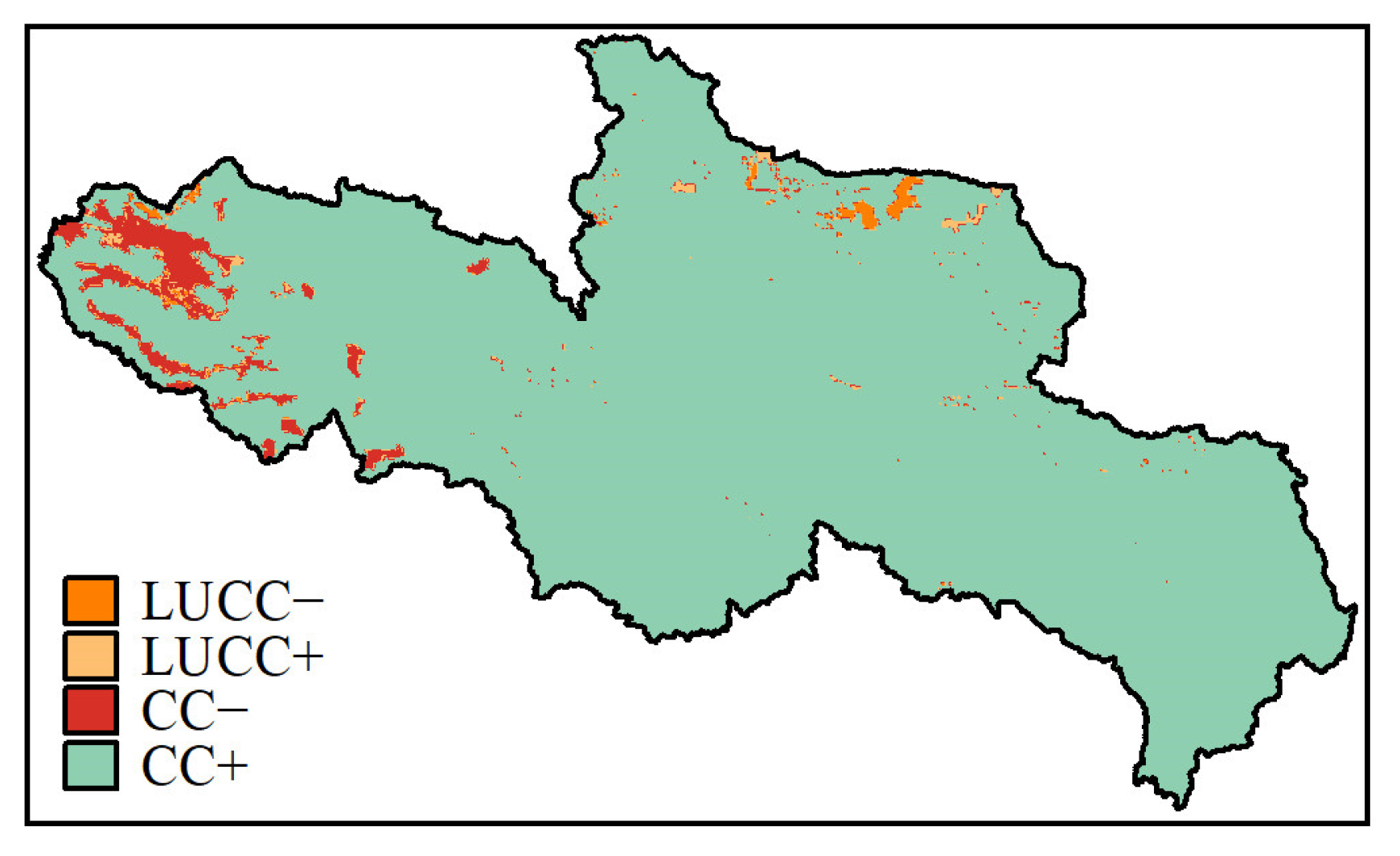
Analysis of the spatial dominance of driving factors (Figure 7; Table 1) shows that climate change is the main driver over 98.28% of the YRSR, with 95.78% of the basin showing increases in water conservation attributed to climate change and 2.50% showing decreases. LUCC leads in 1.72% of the basin, largely confined to the west and north. Within the areas where LUCC exerts dominant control, 0.89% of the basin shows an increase in water conservation caused by LUCC, whereas 0.83% shows a decrease.
In the YRSR, the variation in water conservation was predominantly governed by CC, which enhanced water conservation with a contribution rate of +100.39%. In contrast, LUCC exerted a negative influence by reducing water conservation, with a contribution rate of −0.39%. The climate and LUC conditions of the first period were used as the reference baseline for calculating the contribution rates. The contribution rates were calculated relative to the total simulated change in water conservation, which was +30.87 mm. When the magnitude of a positive driver effect is larger than the total net change, its contribution rate can exceed 100%. In this study, the net CC effect was +30.99 mm, which was slightly larger than the total net change of +30.87 mm because the positive CC effect was partly offset by the negative LUCC effect. Quantitatively, LUCC induced an increase of +0.91 mm and a decrease of −1.03 mm in water conservation, yielding a net reduction of −0.12 mm. Conversely, CC drove a substantial increase of +31.06 mm alongside a negligible decrease of −0.07 mm, resulting in a net gain of +30.99 mm. These results indicate that CC was the dominant factor promoting the increase in water conservation, while LUCC slightly offset this increase.
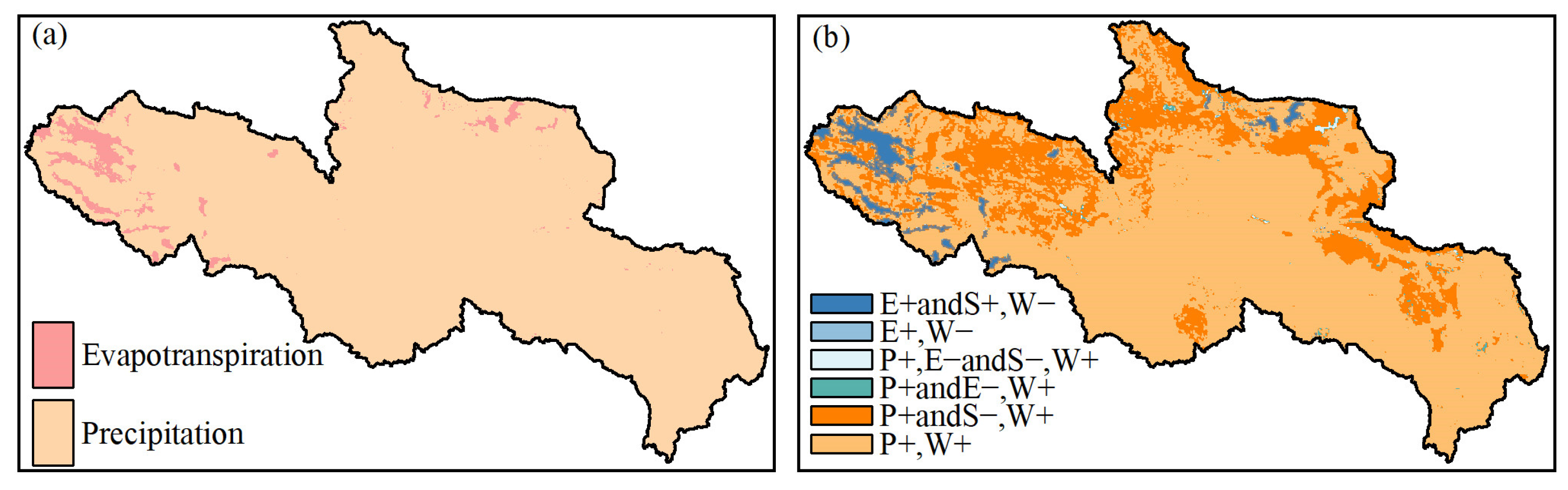
Integrating Figure 8 with Table 2 indicates that precipitation dominates the basin-scale signal, accounting for 96.68% of the YRSR. In contrast, evapotranspiration-related patterns cover only 3.32% and are mainly confined to the western and northern sectors.
Further decomposition of precipitation (P), evapotranspiration (E), and surface runoff (S) impacts revealed the following:
(1)
Precipitation increase (P+) alone dominated water conservation enhancement (W+) across 69.39% of the YRSR.
(2)
Combined precipitation increase (P+) and surface runoff decrease (S−) jointly drove water conservation increases (W+) in 26.72% of the YRSR.
(3)
Evapotranspiration increase (E+) coupled with surface runoff increase (S+) predominantly reduced water conservation (W−) in 3.24% of the YRSR.
In the YRSR, precipitation increase contributed to a +25.13 mm enhancement in water conservation, accounting for 81.41% of the total variation. Water conservation increased by 5.55 mm where precipitation rose while surface runoff declined, representing 17.97% of the total contribution. Conversely, increased evapotranspiration coupled with increased surface runoff reduced water conservation by −0.18 mm, yielding a negative contribution rate of −0.57%.

3.4. Future Changes in Water Conservation

Climate forcing was derived from four CMIP6 GCMs (CanESM5, FGOALS-g3, IPSL-CM6A-LR, and MPI-ESM1-2-HR) and their multi-model ensemble (MME) mean. Model performance was assessed using Taylor diagrams (Figure S4) by comparing the annual means of precipitation, daily maximum temperature (Tmax), and daily minimum temperature (Tmin) with historical observations in the YRSR. The MME showed the most consistent agreement with observations among all candidates; therefore, it was selected to drive the future climate scenarios.
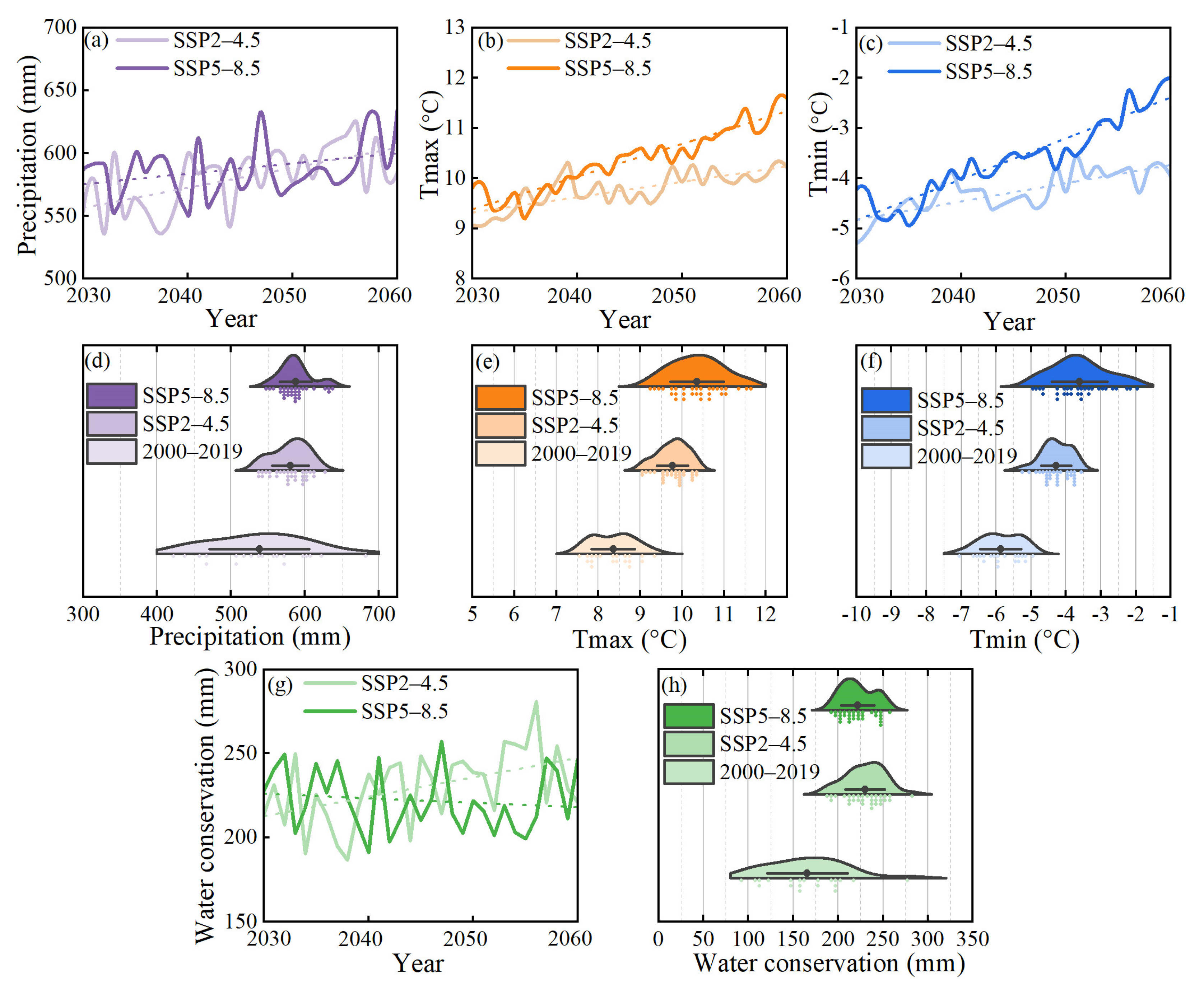
Climate projections from the MME were bias corrected using the delta method prior to hydrological modeling. Monthly correction factors were derived by comparing historical climate simulations with observed climate data and were then applied to future climate projections to reduce systematic bias while preserving the projected climate change signal [62,63]. For the future simulations, LUC conditions were kept constant using the 2020 LUC map, and only climate forcing was varied under SSP2–4.5 and SSP5–8.5. These bias corrected projections were used to generate station scale future precipitation and temperature series for analyzing future changes in climate and water conservation. Temporal trends of precipitation and temperature under SSP2–4.5 and SSP5–8.5 scenarios are presented in Figure 9a–f, with these datasets driving SWAT modeled simulations of 2030–2060 water conservation changes (Figure 9g,h). Projections indicate increasing precipitation and temperature across the YRSR during 2030–2060, where temperature exhibits a more pronounced upward trend accelerating under higher emissions. Relative to the 2000–2019 baseline, mean precipitation increased by 7.73% (SSP2–4.5) and 9.09% (SSP5–8.5), while mean water conservation rose to 229.93 mm and 221.97 mm, respectively. Growth rates during 2030–2060 showed precipitation increasing at +1.59 mm/year (SSP2–4.5) and +0.82 mm/year (SSP5–8.5), Tmax rising +0.03 °C/year and +0.07 °C/year, and Tmin increasing +0.04 °C/year and +0.08 °C/year. However, water conservation responses differed between scenarios: it showed an increasing trend (+1.16 mm/year) under SSP2–4.5, but a decreasing trend (−0.26 mm/year) under SSP5–8.5.

4. Discussion

4.1. Spatiotemporal Characteristics and Future Trends of Water Conservation

Water conservation refers to the process and capacity of an ecosystem, within a specific spatiotemporal scale, to retain, infiltrate, and store water through the interception by canopy layers, litter layer, soils, as well as the retention in lakes and reservoirs [4]. This function reflects the ecosystem’s ability to regulate hydrological processes and maintain water availability. Accurate assessment of water conservation is crucial for quantifying hydrological ecosystem services and supporting sustainable watershed management. This study evaluated changes in water conservation in the YRSR from 2000 to 2019. Our results show that water conservation in the YRSR exhibited a significant increasing trend, with an average annual increase rate of +4.56 mm/year (p < 0.05). This trend is consistent with Li et al. [26], who reported a similar increase of 4.08 mm/year from 2001 to 2020 (p < 0.05). Additionally, Chen et al. [18] found that the spatial pattern of water conservation in the YRSR was higher in the southeast and lower in the northwest, which aligns with our findings. High water conservation tends to coincide with higher precipitation, dense grassland cover, and a larger forest fraction [32]. High coverage grasslands and forested areas in the southeastern YRSR play a critical role in enhancing infiltration and reducing surface runoff, thereby allowing a larger fraction of precipitation to be retained and stored as water conservation.
Looking toward the future, Xue et al. projected that water conservation in the YRSR may decline in some areas during 2021 to 2100 under SSP5–8.5 [64]. Furthermore, Xu et al. projected that runoff in the YRSR would continue increasing under long term CMIP6 projections from 2025 to 2098 [65]. Gao et al. emphasized that the YRSR may face a substantial risk of water resource reduction under high emission scenarios [66]. In this study, we utilized CMIP6 data to assess the future water conservation of the YRSR. Under SSP2–4.5, water conservation is projected to continue increasing, primarily driven by moderate yet sustained increases in precipitation. In contrast, under SSP5–8.5, water conservation shows a declining trend despite an overall increase in precipitation. This pattern is supported by the projected climate and water conservation trends shown in Figure 9. Under SSP5–8.5, precipitation does not decrease, but Tmax and Tmin increase more rapidly than under SSP2–4.5, indicating stronger warming. Such warming may enhance atmospheric evaporative demand and evapotranspiration, thereby increasing evaporative water loss [67]. Previous studies have also reported increasing runoff in the YRSR under future climate scenarios [65,68]. According to the water balance framework used in this study, the projected decline in water conservation under SSP5–8.5 can be explained by the offsetting effects of enhanced evaporative water loss and increased runoff on the positive contribution of increased precipitation. These results highlight the need to prioritize moderate emission pathways and to integrate climate change information into basin scale water resources planning to sustain the YRSR’s water conservation.

4.2. Attribution Analysis: Dominance of CC over LUCC

CC is a slow and long-term process. The climate of the YRSR exhibited a trend towards warmer and wetter conditions during 2000–2019, consistent with changes observed across the QTP [69,70]. LUCC primarily alters regional water conservation by modifying underlying surface conditions, which affect key hydrological processes such as evapotranspiration, infiltration, and runoff generation [71]. Attribution analysis reveals that CC exerted a dominant influence on water conservation. Hydrological driver assessment further indicates that increased precipitation was the primary factor driving enhanced water conservation over the two-decade period, which is consistent with observations reported in other studies [17,18,26]. Consistent with our findings, Ye et al. [72] estimated YRSR water conservation with InVEST and reported an upward trend over 2000–2020, largely attributable to increased precipitation, with LUCC acting as a negative influence. In our results, CC contributed +100.39% to the increase in water conservation, whereas LUCC exerted a negative forcing (−0.39%). The limited LUCC contribution is attributed to two factors. First, the magnitude of LUCC change during 2010–2020 was small. Second, LUCC impacts exhibited counteracting effects (Table 1): positive influences (+2.95%) were largely offset by negative conversions (−3.34%). This dual-directional response reduces the net impact of LUCC. Furthermore, CC directly alters precipitation, evapotranspiration and surface runoff, thereby exerting a dominant influence on water conservation.

4.3. Limitations, Uncertainties, and Future Directions

Several uncertainties and limitations should be acknowledged. The reported attribution values were calculated from paired SWAT scenario simulations, including the differences and averages among scenario combinations. Therefore, these values should be interpreted as estimates based on specific scenario settings rather than uncertainty free absolute quantities. They may be affected by uncertainties in input datasets, including meteorological forcing, LUC maps, and soil data [49,73]. Although the calibrated SWAT model showed acceptable performance, parameter uncertainty may still influence the simulated evapotranspiration, surface runoff, and water conservation. In addition, the representation of snowmelt, frozen soil, and permafrost related processes in SWAT remains simplified, which may affect the simulated evapotranspiration and surface runoff, and consequently influence water conservation estimates derived from the water balance framework. Future studies could further evaluate the effects of model parameters and cold region process representation on projected water conservation changes and attribution results.
Future projections were driven by a bias corrected MME of CMIP6 GCMs. Although this approach is preferable to using a single climate model, uncertainty across models and scenarios remains [74]. Differences among CMIP6 models in representing regional precipitation, temperature, circulation patterns, and extreme events may affect future water conservation projections. In addition, the delta bias correction method assumes that the bias relationship estimated from the historical period remains applicable to future periods. This assumption may be limited under nonstationary climate conditions, especially for extreme precipitation and changes in climate variability.
Future LUCC was assumed to remain constant in this study. Although our attribution results indicate that climate change was the dominant driver of water conservation changes over the past two decades, future LUCC may still change under ecological conservation policies, grazing management, vegetation restoration, and human activities. Policy measures such as grazing bans, ecological restoration, and ecological engineering may alter vegetation cover, evapotranspiration, and runoff generation, thereby affecting water conservation responses. The assumption of constant future LUCC helps isolate the effect of future climate change, but it may overlook the additional influence of future land use transitions and policy driven land management. Future work should incorporate dynamic LUCC scenarios and policy-related land management scenarios to better evaluate the robustness of water conservation simulations in the YRSR.

5. Conclusions

This study clarifies the recent evolution and dominant drivers of water conservation in the YRSR over the past two decades and explores its future trajectories under changing climate conditions. The main conclusions are as follows:
(1)
Significant LUCC occurred primarily during 2000–2010, marked by a sharp decline in UNUS (from 10.67% to 5.48%) and expansion of GRS_L (from 23.35% to 28.78%). In contrast, LUCC became relatively stable during 2010–2020. The climate of the YRSR became increasingly warm and wet during 2000–2019, with a significant warming trend (+0.05 °C/year, p < 0.01) and a concurrent increase in precipitation (+7.49 mm/year, p < 0.05).
(2)
Water conservation across the YRSR rose during 2000–2019(+4.56 mm/year, p < 0.05). Spatially, a clear southeast–northwest gradient was observed, with higher values in the southeastern part of the region and lower values toward the northwest. Mean annual water conservation was 150.28 mm in 2000–2009 and was 20.5% higher in 2010–2019 than in the previous decade.
(3)
CC was identified as the dominant driver of increased water conservation in the YRSR. Attribution analysis revealed that 98.28% of the study area was dominated by CC impacts, compared to 1.72% influenced by LUCC. Correspondingly, CC contributed +100.39% to the water conservation increase, while LUCC exerted a negative forcing (−0.39%). Spatially, most increasing regions are precipitation-driven, whereas declining patches are concentrated where evapotranspiration and surface runoff rise concurrently.
(4)
For 2030–2060, projections indicate wetter and warmer conditions in the YRSR under both SSP2–4.5 and SSP5–8.5, water conservation shows divergent responses: an increasing trend (+1.16 mm/year) under SSP2–4.5 versus a decreasing trend (−0.26 mm/year) under SSP5–8.5.

Supplementary Materials

The following supporting information can be downloaded at: https://www.mdpi.com/article/10.3390/land15050876/s1, Figure S1: LUC in YRSR (2010); Figure S2: LUCC in the YRSR (2000–2020): (a) Normalized area trajectories of major LUC; (b) LUCC in the YRSR from 2000 to 2020; Figure S3: Variability of precipitation and temperature in YRSR from 2000 to 2019: (a) Precipitation interannual variability; (b)Temperature interannual variability; (c) Precipitation Sen’s slope; (d) Temperature Sen’s slope. Note: * p < 0.05, ** p < 0.01; Figure S4: Taylor diagrams for the monthly values of three climatic factors: (a) precipitation; (b) Tmax; (c) Tmin. Note: The red dot–dash line is the root mean square error; Table S1: SWAT parameters included in calibration and their final fitted values.

Author Contributions

Y.S. conceptualized the study, designed the methodology, conducted the analysis, and wrote the manuscript. G.C. assisted with model implementation, data processing, and result interpretation. H.P. and Y.L. contributed to the literature review and manuscript drafting. Q.L. supervised the study, contributed to the conceptual framework and interpretation of results, and revised the manuscript. All authors have read and agreed to the published version of the manuscript.

Funding

This work was financially supported by the PhD Scientific Research Start-up Project of Xichang University (No. YBZ2025009).

Data Availability Statement

All data and models that support the findings of this study are available from the corresponding author upon reasonable request.

Conflicts of Interest

The authors declare no conflicts of interest.

Abbreviations

The following abbreviations are used in this manuscript:
YRSRSource Region of the Yellow River
SWATSoil and Water Assessment Tool
LUCCLand use/cover change
LUCLand use/cover
CCClimate change
TmaxMaximum temperature
TminMinimum temperature
GRS_LLow-coverage grassland
GRS_MMedium-coverage grassland
GRS_HHigh-coverage grassland
CULTCultivated Land
FRSTForest Land
WATRWater Land
BLTBuilt-up Land
PGLAPermanent Glacier/Snow
FLPLFloodplains
WetlandWETL
UNUSUnused land
MMEMulti-model ensemble
NSENash–Sutcliffe Efficiency coefficient
R2Coefficient of determination
PBIASPercent bias

References

  1. Costanza, R.; d’Arge, R.; de Groot, R.; Farber, S.; Grasso, M.; Hannon, B.; Limburg, K.; Naeem, S.; O’Neill, R.V.; Paruelo, J.; et al. The Value of the World’s Ecosystem Services and Natural Capital. Nature 1997, 387, 253–260. [Google Scholar] [CrossRef]
  2. Šatalová, B.; Kenderessy, P. Assessment of Water Retention Function as Tool to Improve Integrated Watershed Management (Case Study of Poprad River Basin, Slovakia). Sci. Total Environ. 2017, 599–600, 1082–1089. [Google Scholar] [CrossRef] [PubMed]
  3. Lv, Y.; Hu, J.; Sun, F.; Zhang, L. Water Retention and Hydrological Regulation: Harmony but Not the Same in Terrestrial Hydrological Ecosystem Services. Acta Ecol. Sin. 2015, 35, 5191–5196. (In Chinese) [Google Scholar] [CrossRef]
  4. Wang, Y.; Ye, A.; Qiao, F.; Li, Z.; Miao, C.; Di, Z.; Gong, W. Review on Connotation and Estimation Method of Water Conservation. South-North Water Transf. Water Sci. Technol. 2021, 19, 1041–1071. (In Chinese) [Google Scholar] [CrossRef]
  5. Zhang, G.; Nan, Z.; Hu, N.; Yin, Z.; Zhao, L.; Cheng, G.; Mu, C. Qinghai-Tibet Plateau Permafrost at Risk in the Late 21st Century. Earth’s Future 2022, 10, e2022EF002652. [Google Scholar] [CrossRef]
  6. Liu, J.; Qin, K.; Xie, G.; Xiao, Y.; Huang, M.; Gan, S. Is the ‘Water Tower’ Reassuring? Viewing Water Security of Qinghai-Tibet Plateau from the Perspective of Ecosystem Services ‘Supply-Flow-Demand’. Environ. Res. Lett. 2022, 17, 094043. [Google Scholar] [CrossRef]
  7. Shao, Y.; Liu, Y.; Li, Y.; Yuan, X. Regional Ecosystem Services Relationships and Their Potential Driving Factors in the Yellow River Basin, China. J. Geogr. Sci. 2023, 33, 863–884. [Google Scholar] [CrossRef]
  8. Qin, Y.; Yang, D.; Gao, B.; Wang, T.; Chen, J.; Chen, Y.; Wang, Y.; Zheng, G. Impacts of Climate Warming on the Frozen Ground and Eco-Hydrology in the Yellow River Source Region, China. Sci. Total Environ. 2017, 605–606, 830–841. [Google Scholar] [CrossRef]
  9. Hu, Y.; Maskey, S.; Uhlenbrook, S. Trends in Temperature and Rainfall Extremes in the Yellow River Source Region, China. Clim. Change 2012, 110, 403–429. [Google Scholar] [CrossRef]
  10. Ji, P.; Yuan, X.; Ma, F.; Pan, M. Accelerated Hydrological Cycle over the Sanjiangyuan Region Induces More Streamflow Extremes at Different Global Warming Levels. Hydrol. Earth Syst. Sci. 2020, 24, 5439–5451. [Google Scholar] [CrossRef]
  11. Wang, Y.; Xie, X.; Shi, J.; Zhu, B.; Jiang, F.; Chen, Y.; Liu, Y. Accelerated Hydrological Cycle on the Tibetan Plateau Evidenced by Ensemble Modeling of Long-Term Water Budgets. J. Hydrol. 2022, 615, 128710. [Google Scholar] [CrossRef]
  12. Ahmed, N.; Lu, H.; Yu, Z.; Adeyeri, O.E.; Iqbal, M.S.; Su, J. A Distributed Modeling Approach to Water Balance Implications from Changing Land Cover Dynamics in Permafrost Environments. Geogr. Sustain. 2024, 5, 561–576. [Google Scholar] [CrossRef]
  13. Yang, J.; Wang, T.; Yang, D.; Yang, Y. Insights into Runoff Changes in the Source Region of Yellow River under Frozen Ground Degradation. J. Hydrol. 2023, 617, 128892. [Google Scholar] [CrossRef]
  14. Ma, Q.; Jin, H.-J.; Bense, V.F.; Luo, D.-L.; Marchenko, S.S.; Harris, S.A.; Lan, Y.-C. Impacts of Degrading Permafrost on Streamflow in the Source Area of Yellow River on the Qinghai-Tibet Plateau, China. Adv. Clim. Change Res. 2019, 10, 225–239. [Google Scholar] [CrossRef]
  15. Zhang, L.; Zhang, H.; Xu, E. Information Entropy and Elasticity Analysis of the Land Use Structure Change Influencing Eco-Environmental Quality in Qinghai-Tibet Plateau from 1990 to 2015. Environ. Sci. Pollut. Res. 2022, 29, 18348–18364. [Google Scholar] [CrossRef]
  16. Duan, X.; Chen, Y.; Wang, L.; Zheng, G.; Liang, T. The Impact of Land Use and Land Cover Changes on the Landscape Pattern and Ecosystem Service Value in Sanjiangyuan Region of the Qinghai-Tibet Plateau. J. Environ. Manag. 2023, 325, 116539. [Google Scholar] [CrossRef]
  17. Jia, G.; Hu, W.; Zhang, B.; Li, G.; Shen, S.; Gao, Z.; Li, Y. Assessing Impacts of the Ecological Retreat Project on Water Conservation in the Yellow River Basin. Sci. Total Environ. 2022, 828, 154483. [Google Scholar] [CrossRef]
  18. Chen, G.; Zuo, D.; Xu, Z.; Wang, G.; Han, Y.; Peng, D.; Pang, B.; Abbaspour, K.C.; Yang, H. Changes in Water Conservation and Possible Causes in the Yellow River Basin of China during the Recent Four Decades. J. Hydrol. 2024, 637, 131314. [Google Scholar] [CrossRef]
  19. Xu, M.; Xu, G.; Liu, S.; Li, J.; Li, Z.; Cheng, Y.; Zhuang, J.; Dang, Y.; Wang, B.; Gu, F. Changes in Water Conservation and a New Estimation for Its Future Potential. CATENA 2025, 250, 108761. [Google Scholar] [CrossRef]
  20. Kundzewicz, Z.W. Climate Change Impacts on the Hydrological Cycle. Ecohydrol. Hydrobiol. 2008, 8, 195–203. [Google Scholar] [CrossRef]
  21. Chandu, N.; Eldho, T.I.; Mondal, A. Hydrological Impacts of Climate and Land-Use Change in Western Ghats, India. Reg. Environ. Change 2022, 22, 32. [Google Scholar] [CrossRef]
  22. Guédé, K.G.; Yu, Z.; Simonovic, S.P.; Gu, H.; Emani, G.F.; Badji, O.; Chen, X.; Sika, B.; Adiaffi, B. Combined Effect of Landuse/Landcover and Climate Change Projection on the Spatiotemporal Streamflow Response in Cryosphere Catchment in the Tibetan Plateau. J. Environ. Manag. 2025, 376, 124353. [Google Scholar] [CrossRef]
  23. Liu, Y.; Liu, F.; Chen, C.; Chen, Q.; Zhang, J.; Mo, K.; Jiang, Q.; Yao, S. A Holistic Approach to Projecting Streamflow and Analyzing Changes in Ecologically Relevant Hydrological Indicators under Climate and Land Use/Cover Change. J. Hydrol. 2024, 632, 130863. [Google Scholar] [CrossRef]
  24. Yang, L.; Feng, Q.; Yin, Z.; Wen, X.; Si, J.; Li, C.; Deo, R.C. Identifying Separate Impacts of Climate and Land Use/Cover Change on Hydrological Processes in Upper Stream of Heihe River, Northwest China. Hydrol. Process. 2017, 31, 1100–1112. [Google Scholar] [CrossRef]
  25. Sharma, A.; Patel, P.L.; Sharma, P.J. Influence of Climate and Land-Use Changes on the Sensitivity of SWAT Model Parameters and Water Availability in a Semi-Arid River Basin. CATENA 2022, 215, 106298. [Google Scholar] [CrossRef]
  26. Li, M.; Di, Z.; Yao, Y.; Ma, Q. Variations in Water Conservation Function and Attributions in the Three-River Source Region of the Qinghai-Tibet Plateau Based on the SWAT Model. Agr. For. Meteorol. 2024, 349, 109956. [Google Scholar] [CrossRef]
  27. Ding, B.; Yu, X.; Jia, G. Exploring the Controlling Factors of Watershed Streamflow Variability Using Hydrological and Machine Learning Models. Water Resour. Res. 2025, 61, e2024WR039734. [Google Scholar] [CrossRef]
  28. Marhaento, H.; Booij, M.J.; Rientjes, T.H.M.; Hoekstra, A.Y. Attribution of Changes in the Water Balance of a Tropical Catchment to Land Use Change Using the SWAT Model. Hydrol. Process. 2017, 31, 2029–2040. [Google Scholar] [CrossRef]
  29. Wang, Y.; Ye, A.; Peng, D.; Miao, C.; Di, Z.; Gong, W. Spatiotemporal Variations in Water Conservation Function of the Tibetan Plateau under Climate Change Based on InVEST Model. J. Hydrol. Reg. Stud. 2022, 41, 101064. [Google Scholar] [CrossRef]
  30. Wen, X.; Shao, H.; Wang, Y.; Lv, L.; Xian, W.; Shao, Q.; Shu, Y.; Yin, Z.; Liu, S.; Qi, J. Assessment of the Spatiotemporal Impact of Water Conservation on the Qinghai-Tibet Plateau. Remote Sens. 2023, 15, 3175. [Google Scholar] [CrossRef]
  31. Che, X.; Jiao, L.; Zhu, X.; Wu, J.; Li, Q. Spatial-Temporal Dynamics of Water Conservation in Gannan in the Upper Yellow River Basin of China. Land 2023, 12, 1394. [Google Scholar] [CrossRef]
  32. Xie, X.; Peng, M.; Zhang, L.; Chen, M.; Li, J.; Tuo, Y. Assessing the Impacts of Climate and Land Use Change on Water Conservation in the Three-River Headstreams Region of China Based on the Integration of the InVEST Model and Machine Learning. Land 2024, 13, 352. [Google Scholar] [CrossRef]
  33. Cong, W.; Sun, X.; Guo, H.; Shan, R. Comparison of the SWAT and InVEST Models to Determine Hydrological Ecosystem Service Spatial Patterns, Priorities and Trade-Offs in a Complex Basin. Ecol. Indic. 2020, 112, 106089. [Google Scholar] [CrossRef]
  34. Vigerstol, K.L.; Aukema, J.E. A Comparison of Tools for Modeling Freshwater Ecosystem Services. J. Environ. Manag. 2011, 92, 2403–2409. [Google Scholar] [CrossRef]
  35. Odusanya, A.E.; Mehdi, B.; Schürz, C.; Oke, A.O.; Awokola, O.S.; Awomeso, J.A.; Adejuwon, J.O.; Schulz, K. Multi-Site Calibration and Validation of SWAT with Satellite-Based Evapotranspiration in a Data-Sparse Catchment in Southwestern Nigeria. Hydrol. Earth Syst. Sci. 2019, 23, 1113–1144. [Google Scholar] [CrossRef]
  36. Meaurio, M.; Zabaleta, A.; Uriarte, J.A.; Srinivasan, R.; Antigüedad, I. Evaluation of SWAT Models Performance to Simulate Streamflow Spatial Origin. The Case of a Small Forested Watershed. J. Hydrol. 2015, 525, 326–334. [Google Scholar] [CrossRef]
  37. Parajuli, P.B.; Jayakody, P.; Ouyang, Y. Evaluation of Using Remote Sensing Evapotranspiration Data in SWAT. Water Resour. Manag. 2018, 32, 985–996. [Google Scholar] [CrossRef]
  38. Gashaw, T.; Tulu, T.; Argaw, M.; Worqlul, A.W. Modeling the Hydrological Impacts of Land Use/Land Cover Changes in the Andassa Watershed, Blue Nile Basin, Ethiopia. Sci. Total Environ. 2018, 619–620, 1394–1408. [Google Scholar] [CrossRef] [PubMed]
  39. Zuo, D.; Chen, G.; Wang, G.; Xu, Z.; Han, Y.; Peng, D.; Pang, B.; Abbaspour, K.C.; Yang, H. Assessment of Changes in Water Conservation Capacity under Land Degradation Neutrality Effects in a Typical Watershed of Yellow River Basin, China. Ecol. Indic. 2023, 148, 110145. [Google Scholar] [CrossRef]
  40. Zhan, H.; Yu, D.; Wang, L.; Zhang, J.; Xu, M.; Fang, X.; Xue, K.; Yan, Y.; Ren, L.; Wang, Y.; et al. Stronger Influences of Grassland Growth than Grassland Area on Hydrological Processes in the Source Region of the Yellow River. J. Hydrol. 2024, 642, 131886. [Google Scholar] [CrossRef]
  41. Xu, R.; Qiu, D.; Gao, P.; Mu, X. Water and Sediment Yield in the Source Region of the Yellow River, Northeastern Tibetan Plateau: Historical Pattern, Future Evolution, and Attribution Analysis. CATENA 2025, 258, 109280. [Google Scholar] [CrossRef]
  42. Arnold, J.G.; Srinivasan, R.; Muttiah, R.S.; Williams, J.R. Large Area Hydrologic Modeling and Assessment Part I: Model Development. J. Am. Water Resour. 1998, 34, 73–89. [Google Scholar] [CrossRef]
  43. Arnold, J.G.; Fohrer, N. SWAT2000: Current Capabilities and Research Opportunities in Applied Watershed Modelling. Hydrol. Process. 2005, 19, 563–572. [Google Scholar] [CrossRef]
  44. Gassman, P.W.; Reyes, M.R.; Green, C.H.; Arnold, J.G. The Soil and Water Assessment Tool: Historical Development, Applications, and Future Research Directions. Trans. ASABE 2007, 50, 1211–1250. [Google Scholar] [CrossRef]
  45. Pignotti, G.; Rathjens, H.; Cibin, R.; Chaubey, I.; Crawford, M. Comparative Analysis of HRU and Grid-Based SWAT Models. Water 2017, 9, 272. [Google Scholar] [CrossRef]
  46. Zhai, R.; Tao, F.; Xu, Z. Spatial–Temporal Changes in Runoff and Terrestrial Ecosystem Water Retention under 1.5 and 2 °C Warming Scenarios across China. Earth Syst. Dyn. 2018, 9, 717–738. [Google Scholar] [CrossRef]
  47. Zhang, G.; Wu, Y.; Li, H.; Zhao, W.; Wang, F.; Chen, J.; Sivakumar, B.; Liu, S.; Qiu, L.; Wang, W. Assessment of Water Retention Variation and Risk Warning under Climate Change in an Inner Headwater Basin in the 21st Century. J. Hydrol. 2022, 615, 128717. [Google Scholar] [CrossRef]
  48. Lin, F.; Chen, X.; Yao, H.; Lin, F. SWAT Model-Based Quantification of the Impact of Land-Use Change on Forest-Regulated Water Flow. CATENA 2022, 211, 105975. [Google Scholar] [CrossRef]
  49. Wu, H.; Chen, B. Evaluating Uncertainty Estimates in Distributed Hydrological Modeling for the Wenjing River Watershed in China by GLUE, SUFI-2, and ParaSol Methods. Ecol. Eng. 2015, 76, 110–121. [Google Scholar] [CrossRef]
  50. Shivhare, N.; Dikshit, P.K.S.; Dwivedi, S.B. A Comparison of SWAT Model Calibration Techniques for Hydrological Modeling in the Ganga River Watershed. Engineering 2018, 4, 643–652. [Google Scholar] [CrossRef]
  51. Zhang, Y.; Su, F.; Hao, Z.; Xu, C.; Yu, Z.; Wang, L.; Tong, K. Impact of Projected Climate Change on the Hydrology in the Headwaters of the Yellow River Basin. Hydrol. Process. 2015, 29, 4379–4397. [Google Scholar] [CrossRef]
  52. Li, X.; Jia, H.; Chen, Y.; Wen, J. Runoff Simulation and Projection in the Source Area of the Yellow River Using the SWAT Model and SSPs Scenarios. Front. Environ. Sci. 2022, 10, 1012838. [Google Scholar] [CrossRef]
  53. Nash, J.E.; Sutcliffe, J.V. River Flow Forecasting through Conceptual Models Part I—A Discussion of Principles. J. Hydrol. 1970, 10, 282–290. [Google Scholar] [CrossRef]
  54. Moriasi, D.N.; Arnold, J.G.; Van Liew, M.W.; Bingner, R.L.; Harmel, R.D.; Veith, T.L. Model Evaluation Guidelines for Systematic Quantification of Accuracy in Watershed Simulations. Trans. ASABE 2007, 50, 885–900. [Google Scholar] [CrossRef]
  55. Zhang, X.; Zhang, L.; Zhao, J.; Rustomji, P.; Hairsine, P. Responses of Streamflow to Changes in Climate and Land Use/Cover in the Loess Plateau, China. Water Resour. Res. 2008, 44, W00A07. [Google Scholar] [CrossRef]
  56. Zhang, L.; Nan, Z.; Yu, W.; Zhao, Y.; Xu, Y. Comparison of Baseline Period Choices for Separating Climate and Land Use/Land Cover Change Impacts on Watershed Hydrology Using Distributed Hydrological Models. Sci. Total Environ. 2018, 622–623, 1016–1028. [Google Scholar] [CrossRef]
  57. Moran, P.A.P. Notes on Continuous Stochastic Phenomena. Biometrika 1950, 37, 17–23. [Google Scholar] [CrossRef]
  58. Anselin, L. Local Indicators of Spatial Association—LISA. Geogr. Anal. 1995, 27, 93–115. [Google Scholar] [CrossRef]
  59. Mann, H.B. Nonparametric Tests Against Trend. Econometrica 1945, 13, 245. [Google Scholar] [CrossRef]
  60. Sen, P.K. Estimates of the Regression Coefficient Based on Kendall’s Tau. J. Am. Stat. Assoc. 1968, 63, 1379–1389. [Google Scholar] [CrossRef]
  61. Hirsch, R.M.; Slack, J.R. A Nonparametric Trend Test for Seasonal Data with Serial Dependence. Water Resour. Res. 1984, 20, 727–732. [Google Scholar] [CrossRef]
  62. Beyer, R.; Krapp, M.; Manica, A. An Empirical Evaluation of Bias Correction Methods for Palaeoclimate Simulations. Clim. Past 2020, 16, 1493–1508. [Google Scholar] [CrossRef]
  63. Su, F.; Zhang, L.; Ou, T.; Chen, D.; Yao, T.; Tong, K.; Qi, Y. Hydrological Response to Future Climate Changes for the Major Upstream River Basins in the Tibetan Plateau. Glob. Planet. Change 2016, 136, 82–95. [Google Scholar] [CrossRef]
  64. Xue, J.; Li, Z.; Feng, Q.; Gui, J.; Zhang, B. Spatiotemporal Variations of Water Conservation and Its Influencing Factors in Ecological Barrier Region, Qinghai-Tibet Plateau. J. Hydrol. Reg. Stud. 2022, 42, 101164. [Google Scholar] [CrossRef]
  65. Xu, S.; Qin, T.; Lv, X.; Lu, J.; Feng, J.; Gao, H.; Liu, H.; Yang, Y. Analysis of Runoff and Sediment Evolution and Attribution in the Source Regions of the Yangtze and Yellow Rivers. J. Hydrol. Reg. Stud. 2025, 57, 102110. [Google Scholar] [CrossRef]
  66. Gao, Y.; Zhou, M.; Yu, Z.; Ju, Q.; Jin, J.; Zhang, D. Climate Change Impacts on Seasonal Runoff in the Source Region of the Yellow River: Insights from CORDEX Experiments with Uncertainty Analysis. J. Hydrol. 2024, 645, 132132. [Google Scholar] [CrossRef]
  67. Yuan, L.; Chen, X.; Ma, Y.; Han, C.; Wang, B.; Ma, W. Long-Term Monthly 0.05° Terrestrial Evapotranspiration Dataset (1982–2018) for the Tibetan Plateau. Earth Syst. Sci. Data 2024, 16, 775–801. [Google Scholar] [CrossRef]
  68. Jian, S.; Pei, Y.; Zhu, T.; Yu, X. Spatiotemporal Change and Attribution Analysis of Future Runoff on the Yellow River Basin of China. J. Hydrol. Reg. Stud. 2023, 49, 101494. [Google Scholar] [CrossRef]
  69. Wei, Y.; Lu, H.; Wang, J.; Wang, X.; Sun, J. Dual Influence of Climate Change and Anthropogenic Activities on the Spatiotemporal Vegetation Dynamics Over the Qinghai-Tibetan Plateau From 1981 to 2015. Earth’s Future 2022, 10, e2021EF002566. [Google Scholar] [CrossRef]
  70. Guo, L.; Wang, G.; Song, C.; Sun, S.; Li, J.; Li, K.; Huang, P.; Ma, J. Hydrological Changes Caused by Integrated Warming, Wetting, and Greening in Permafrost Regions of the Qinghai-Tibetan Plateau. Water Resour. Res. 2025, 61, e2024WR038465. [Google Scholar] [CrossRef]
  71. Palamuleni, L.G.; Ndomba, P.M.; Annegarn, H.J. Evaluating Land Cover Change and Its Impact on Hydrological Regime in Upper Shire River Catchment, Malawi. Reg. Environ. Change 2011, 11, 845–855. [Google Scholar] [CrossRef]
  72. Ye, L.; Liu, C.; Wang, G.; Zhao, T.; Jia, Y.; Ruan, Y. Modeling and Analysis of Water Conservation Capacity in the Source Region of the Yellow River from 2000 to 2020. Hydro-Sci. Eng. 2023, 6, 46–56. (In Chinese) [Google Scholar] [CrossRef]
  73. Kmoch, A.; Moges, D.M.; Sepehrar, M.; Narasimhan, B.; Uuemaa, E. The Effect of Spatial Input Data Quality on the Performance of the SWAT Model. Water 2022, 14, 1988. [Google Scholar] [CrossRef]
  74. Buytaert, W.; Célleri, R.; Timbe, L. Predicting Climate Change Impacts on Water Resources in the Tropical Andes: Effects of GCM Uncertainty. Geophys. Res. Lett. 2009, 36, L07406. [Google Scholar] [CrossRef]
Figure 1. Location of the YRSR. Note: From upstream to downstream, these are Jimai, Maqu and Tangnaihai hydrological stations.
Land 15 00876 g001
Figure 2. Schematic of the scenario setting and quantitative analysis processes: (a) LUCC; (b) CC.
Land 15 00876 g002
Figure 3. Monthly runoff calibration and validation at three stations in the YRSR: (a) Tangnaihai hydrological station; (b) Maqu hydrological station; (c) Jimai hydrological station.
Land 15 00876 g003
Figure 4. Spatial patterns and spatial autocorrelation of water conservation in the YRSR: (a) Average water conservation for 2000–2019; (b) Differences in average water conservation between 2010–2019 and 2000–2009; (c) Local Moran’s I cluster map of the change in mean annual water conservation between 2010–2019 and 2000–2009.
Land 15 00876 g004
Figure 5. Water conservation in the YRSR (2000–2019): (a) Annual series (2000–2019), (b) Monthly means for 2000–2009 and 2010–2019. Note: * p < 0.05.
Land 15 00876 g005
Figure 6. Attribution of water conservation change in the YRSR: (a) LUCC; (b) CC.
Land 15 00876 g006
Figure 7. Spatial distribution of dominant driving factors. Note: “LUCC+” indicates areas where LUCC is the main driver and increases water conservation, “LUCC−” indicates areas where LUCC is the main driver and decreases water conservation, “CC+” indicates areas where climate change is the main driver and increases water conservation, and “CC−” indicates areas where climate change is the main driver and decreases water conservation.
Land 15 00876 g007
Figure 8. Hydrological drivers of water conservation variations: (a) Dominant control; (b) Spatial P, E and S driver on water conservation variations.
Land 15 00876 g008
Figure 9. Future trends of precipitation, temperature, and water conservation and their half violin plots in the YRSR during 2030–2060: (a) Future trends of precipitation; (b) Future trends of Tmax; (c) Future trends of Tmin; (d) Half violin plot of precipitation; (e) Half violin plot of Tmax; (f) Half violin plot of Tmin; (g) Future trends of water conservation; (h) Half violin plot of water conservation. Note: The dashed lines in panels (ac,g) indicate the trend lines.
Land 15 00876 g009
Table 1. Attribution summary of water conservation change under the fixing–changing approach.
Component W (mm) Contribution Rate (%)Area Fraction (%)
LUCC+0.912.950.89
LUCC−−1.03−3.340.83
LUCC−0.12−0.391.72
CC+31.06100.6295.78
CC−−0.07−0.232.50
CC30.99100.3998.28
Table 2. Classification of water conservation change by hydrological driver combinations.
Driver Pattern∆W (mm)Contribution Rate (%)Area Fraction (%)
E+ and S+, W−−0.18 −0.573.24
E+, W−−0.005 −0.010.08
P+, E− and S−, W+0.16 0.520.31
P+ and E−, W+0.21 0.690.26
P+ and S−, W+5.55 17.9726.72
P+, W+25.13 81.4169.39
Disclaimer/Publisher’s Note: The statements, opinions and data contained in all publications are solely those of the individual author(s) and contributor(s) and not of MDPI and/or the editor(s). MDPI and/or the editor(s) disclaim responsibility for any injury to people or property resulting from any ideas, methods, instructions or products referred to in the content.