Article

Comprehensive Land Consolidation and Its Impact on Rural Resilience: The Study of Huzhou, China

1
College of Economics and Management, Xinjiang Agricultural University, Urumqi 830052, China
2
School of Humanities and Law, Northeastern University, Shenyang 110169, China
*
Author to whom correspondence should be addressed.
Land 2026, 15(5), 870; https://doi.org/10.3390/land15050870 (registering DOI)
Submission received: 15 April 2026 / Revised: 7 May 2026 / Accepted: 15 May 2026 / Published: 19 May 2026
(This article belongs to the Special Issue Advances in Land Consolidation and Land Ecology (Second Edition))

Abstract

Comprehensive land consolidation (CLC) is a systematic initiative aimed at optimizing spatial patterns of land use and revitalizing idle rural land resources. It is a pivotal policy instrument for enhancing rural resilience and possesses significant practical implications. Grounded in resilience theory, this study establishes an evaluation system for rural resilience, assesses resilience levels in Huzhou from 2003 to 2023, and investigates its spatiotemporal characteristics employing the entropy-weighted TOPSIS method and geodetector model. Furthermore, this research identifies the driving factors and dynamic mechanisms through which comprehensive land consolidation impacts rural resilience. The study area is categorized into four zones based on land use types to elucidate regional heterogeneity. The findings indicate that comprehensive land consolidation markedly enhances rural resilience, which progresses from slow initial growth to accelerated improvement, ultimately culminating in leapfrog development. Spatially, rural resilience exhibits a “central-high, marginal-low” distribution, characterized by core-periphery agglomeration. Notably, the key driving factors vary significantly across different regions. Mechanistically, comprehensive land consolidation bolsters rural resilience through a sequential pathway that begins with consolidation intervention, which activates critical factors. This activation leads to structural reorganization within the rural framework, followed by the optimization of functions that enhance overall resilience. In terms of policy implications, it is essential to adopt differentiated consolidation strategies tailored to regional resource endowments, emphasizing the optimization of production-living-ecological spaces to foster integrated and sustainable rural development.

1. Introduction

In the context of rapid urbanization and industrialization, rural decline resulting from population loss has become a pervasive global trend [1,2]. Currently, certain rural areas in China confront multifaceted challenges, including labor shortages, an aging and diminishing social fabric, inefficient industries, resource over-exploitation, and land degradation [3]. These deep-rooted development issues not only undermine the endogenous driving forces within rural communities but also underscore the urgent necessity for systematic strategic measures to rejuvenate rural development. The implementation of the rural revitalization strategy emerges as a critical pathway to reverse rural decline, characterized by a clear, problem-oriented focus that aligns with the pressing demands of the times. To implement rural revitalization, it is necessary to break down urban-rural factor barriers, stimulate rural endogenous dynamics through institutional innovation, and prevent risks such as population loss and climate disasters. Strengthening rural resilience and consolidating the foundation for development is of great significance for consolidating poverty alleviation achievements and promoting urban-rural integration.
Land has long been recognized as the primary spatial carrier and core element of rural development, yet it currently represents a critical bottleneck hindering rural progress. Consequently, efficient land utilization has emerged as a vital entry point for addressing rural development dilemmas and facilitating revitalization [4]. Current challenges include the inefficient market-oriented allocation of land resources, difficulty in realizing land values, restricted urban-rural factor mobility, fragmentation of cultivated land, widespread idle homesteads, and disorganized spatial arrangements characterized by chaotic housing, industrial, and infrastructural layouts. The interplay of these issues—manifesting as inefficient land use, imbalanced spatial order, and diminished ecological functions—has severely constrained sustainable rural development [5].
In response, China has implemented land consolidation projects intended to optimize territorial development, revitalize available land resources, and promote a collaborative approach to ecological conservation and industrial development, thereby strengthening the human-land relationship in rural areas [6]. Land consolidation, which originated in 14th-century Europe, serves as a fundamental instrument of land management. In the late 1980s, China began incorporating international best practices through Sino-German cooperation [7]. Over nearly four decades of policy evolution, China’s land consolidation model has undergone iterative upgrades, which can be categorized into three distinct stages: the initial exploration phase (1978–1998), the systematic promotion phase (1999–2011), and the current stage of overall coordination (2012–present) [8]. The focal point of these initiatives has gradually shifted from mitigating agricultural land fragmentation to enhancing land quality and optimizing construction land efficiency, ultimately evolving toward comprehensive ecological restoration and territorial space consolidation.
Given the diverse demands for high-quality regional development in the contemporary era, coupled with increasingly stringent resource and environmental constraints, traditional land consolidation exhibits certain limitations and incompatibilities in terms of its objectives, mechanisms, and models [9]. In 2003, Zhejiang Province pioneered the “Thousand Villages Demonstration, Ten Thousand Villages Renovation” project (Green Rural Revival Program), underpinned by comprehensive land consolidation. Comprehensive land consolidation not only extends and enhances traditional land consolidation but also constitutes a systematic initiative integrating agricultural land consolidation, construction land consolidation, and ecosystem protection and restoration. Its primary objective is to facilitate equitable exchange and bidirectional flows of urban–rural factors, and it is recognized as a hallmark practice in the implementation of China’s rural revitalization strategy [10].
Since 2019, China has actively promoted pilot projects and expanded the coverage of comprehensive land consolidation. By the end of 2023, a total of 1304 national pilot projects had completed the consolidation of 252,000 hectares of land, generating replicable and scalable practices. In 2024, the Ministry of Natural Resources issued guidance emphasizing the role of land consolidation as a core platform to facilitate urban–rural factor mobility, optimize territorial spatial layout, and promote the integration of three industries as well as coordinated urban–rural development. Comprehensive land consolidation is increasingly becoming a crucial instrument for enhancing rural resilience and underpinning sustainable development. Therefore, a systematic investigation into its impact on the evolution of rural resilience holds profound practical significance.
Resilience is a fundamental attribute of rural systems and plays a critical role in sustaining rural development. Essentially, it refers to the capacity of rural areas—as dynamically open and complex systems—to resist external disturbances, adapt to environmental changes, and achieve transformative innovation [11]. This capacity is realized through the coordinated regulation and dynamic adaptation of interrelated subsystems spanning the economic, social, ecological, and governance dimensions. In the context of growing uncertainty and risk, rural resilience serves as a key mechanism for absorbing shocks and facilitating post-disaster recovery, thereby determining the ability of rural social-ecological systems to withstand disturbances or seize development opportunities [12]. Rural social-ecological systems comprise both tangible and intangible elements, which can be categorized into four types of capital: natural, production, human, and social. These capitals are interwoven and interdependent, forming the material basis of rural resilience and exerting a strong influence on its level. The depletion or weakening of any single type or combination of capitals reduces rural resilience, whereas sufficient and stable capital reserves provide an essential buffer against external shocks [13].
Through integrating agricultural land consolidation, construction land consolidation, and ecological protection and restoration, comprehensive land consolidation reshapes the interactions among rural social-ecological subsystems [14]. This restructuring profoundly affects factor allocation, spatial structure, and system service functions, ultimately driving dynamic changes in rural resilience [15]. Taking Huzhou City—a demonstration zone of the “Green Rural Revival Program”—as the study area, this research investigates the intrinsic relationship between comprehensive land consolidation and rural resilience. The objective is to reveal the mechanisms through which comprehensive land consolidation influences rural resilience, thereby providing a scientific basis for promoting context-appropriate land consolidation, enhancing rural resilience, and advancing rural revitalization.

2. Methods and Data Sources

2.1. Study Area

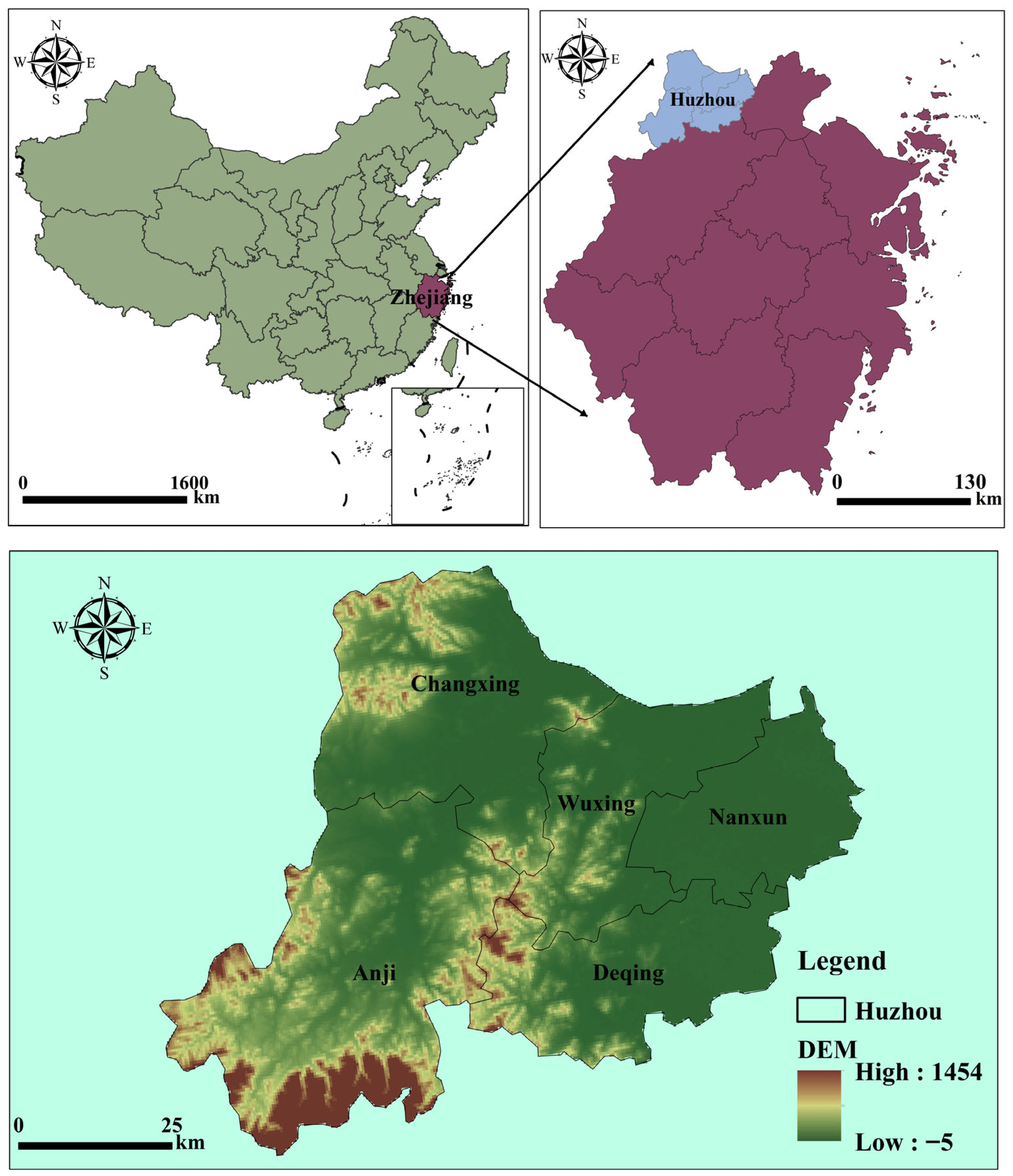
This study selects Huzhou City, Zhejiang Province, as the case area (Figure 1). Located in northern Zhejiang, Huzhou covers 5818 km2 and administers two districts (Wuxing and Nanxun) and three counties (Deqing, Changxing, and Anji). As of 2023, the city had a permanent resident population of 3.439 million and a GDP of 401.509 billion yuan [16].
Huzhou City was selected as the study area for three primary reasons. First, in terms of policy representativeness and practical experience, Huzhou—particularly its subordinate Anji County—is the birthplace of the concept that “lucid waters and lush mountains are invaluable assets” and a pioneer demonstration area of Zhejiang Province’s “Future Rural Construction Action” (Thousand Villages Demonstration Project) [17,18]. Following the principle of “integrated protection and restoration of mountains, rivers, forests, farmlands, lakes, grasslands, and sandlands”, Huzhou has implemented comprehensive land consolidation projects that effectively address prominent challenges such as fragmented cultivated land, poor ecological connectivity, and inefficient use of rural construction land [19]. Characterized by policy innovation, theoretical relevance, demonstrable effectiveness, and replicability, Huzhou represents a typical case for investigating the synergistic relationship between comprehensive land consolidation and rural resilience enhancement.
Second, Huzhou exhibits a composite landscape of mountains, hills, plains, and water networks, along with diverse land use types, making it a typical multifunctional territorial unit in the Yangtze River Delta. This enables the research findings to effectively capture spatial variations across rural typologies in eastern coastal China. Third, Huzhou provides 20 consecutive years of rural governance statistics, supporting long-term time-series analysis. The city also features high urban–rural integration, a solid rural industrial base, extensive comprehensive land consolidation pilots, and mature implementation models, representing a typical rural area in eastern developed China. Consequently, the conclusions drawn from this case have direct reference value for economically developed regions such as the Yangtze River Delta and the Pearl River Delta. For less developed areas in central and western China, local adaptations are necessary before application; future cross-regional comparative studies can further verify and extend the findings.

2.2. Data Sources

This study covers the period 2003–2023. The research data encompass multiple dimensions—industry, talent, organization, culture, and ecology—across districts and counties of Huzhou City. Socioeconomic statistical data were primarily obtained from the Huzhou Statistical Yearbook (2003–2023) (https://tjj.huzhou.gov.cn/col/col1229208257/index.html, accessed on 29 April 2026) and relevant provincial and municipal statistical yearbooks released by local official statistical departments. Basic geographic and administrative division data were obtained from the National Geographic Information Public Service Platform (Tianditu) (https://cloudcenter.tianditu.gov.cn/administrativeDivision/, accessed on 29 April 2026). PM2.5 data supporting this study were derived from the China High-Resolution High-Quality Near-Surface Air Pollutant Dataset provided by the National Tibetan Plateau Data Center (https://data.tpdc.ac.cn/home, accessed on 30 April 2026). Normalized Difference Vegetation Index (NDVI) data were acquired from NASA’s MOD13A3 satellite product (https://lpdaac.usgs.gov/products/mod13a3v061/, accessed on 30 April 2026). Land use data at 30 m spatial resolution were extracted from the Resource and Environment Science and Data Cloud Platform, Chinese Academy of Sciences (https://www.resdc.cn/, accessed on 30 April 2026), including six first-level and 25 s-level land use categories interpreted from remote sensing monitoring.

2.3. Research Methods

2.3.1. Theoretical Framework

Globally, developed economies have developed diverse territorial and rural governance models, with Europe boasting a mature, standardized land consolidation system: Germany prioritizes farmland rearrangement and integrated village renewal to support large-scale agriculture and high-quality rural living; the Netherlands adopts polder renovation and water–soil ecological management to build multifunctional resilient landscapes amid dense population and low-lying terrain; France advances cross-regional territorial restructuring to narrow development gaps while balancing agriculture and ecology [20]. Evolutionally, European land consolidation has shifted from early goals of eliminating cultivated land fragmentation and promoting mechanization to embracing large-scale farming, village renewal, ecological restoration, landscape preservation, and spatial optimization in recent decades, now prioritizing rural sustainability, ecological resilience, and urban–rural coordination to form a globally replicable rural revitalization paradigm [21,22].
These international and European experiences align with China’s comprehensive land consolidation in addressing land fragmentation, inefficient use, and rural systemic imbalances, yet diverge in institutional arrangements, implementation mechanisms, and development priorities due to contextual differences. This global diversity offers valuable comparative references for scholars to identify localized operational mechanisms, adapt analytical frameworks to regional characteristics, and formulate targeted rural resilience strategies—underscoring the need for a clear theoretical foundation to understand rural systems and land consolidation’s role within them [23,24,25].
Rural areas are social-ecological systems comprising natural, economic, and sociocultural subsystems. Their core characteristic lies in the collaborative relationship of “factor–structure–function”, which underpins multifunctional roles including production, ecological regulation, social support, and cultural maintenance [26,27]. Rural resilience is the system’s key ability to cope with internal and external disturbances, encompassing five dimensions: economic, cultural, ecological, safety, and social resilience. It essentially enables buffering, adaptation, and recovery through dynamic adjustments in factor allocation, structure, and function [28].
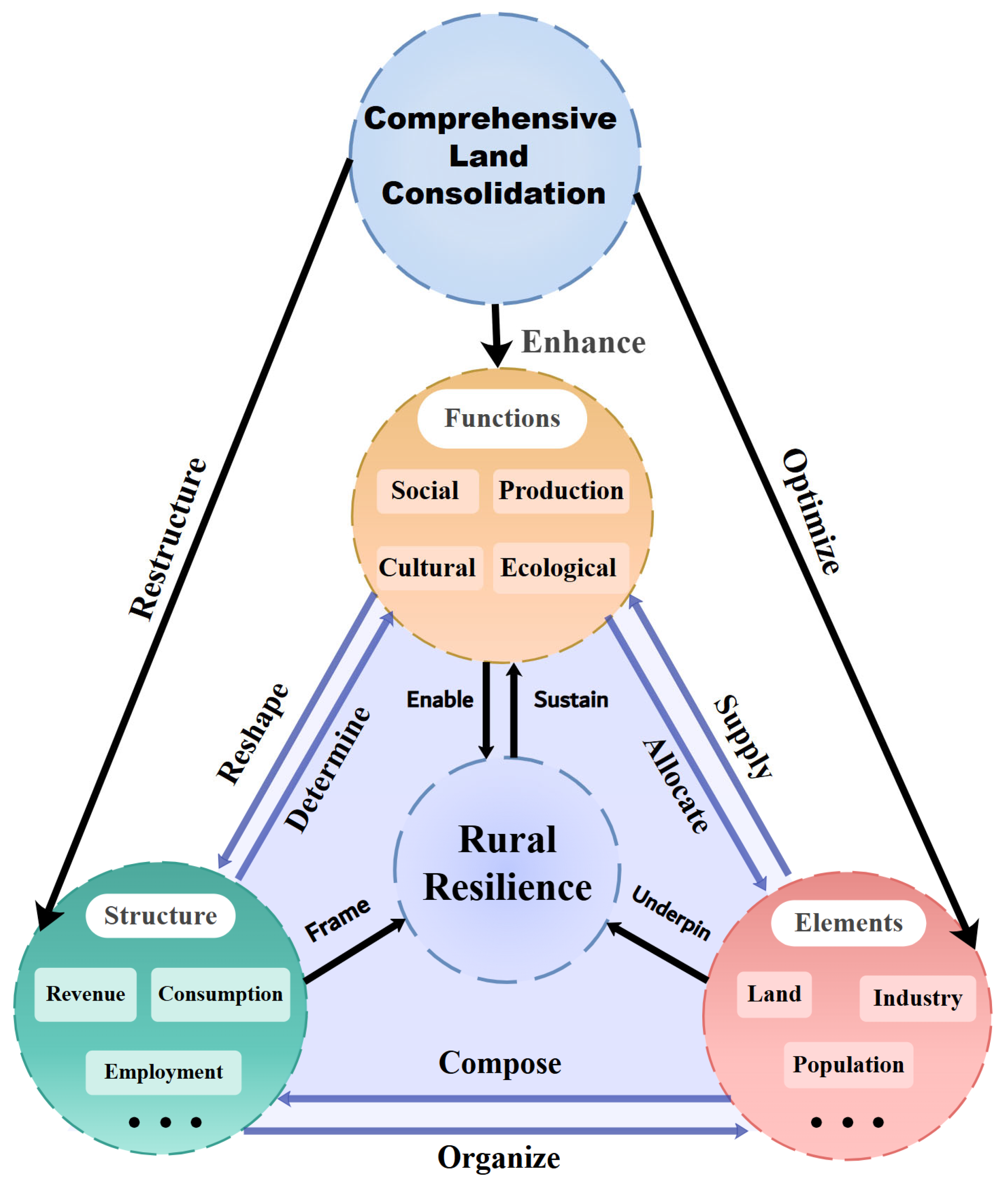
Comprehensive land consolidation is a systematic governance measure addressing rural land fragmentation, inefficient land use, and functional imbalances. It integrates farmland consolidation, construction land consolidation, and ecological restoration, serving as an external intervention to optimize the “element–structure–function” configuration of rural systems [29,30,31]. As illustrated in Figure 2, its shaping rural resilience follows a progressive pathway: through the systematic optimization and reallocation of core elements, it reshapes key socioeconomic structures and enhances multiple composite functions. In this process, elements, structure, and function form multidimensional closed-loop interactions. Elements and structures are bidirectionally shaped: element allocation constitutes the fundamental composition of structure, while a rational structural framework in turn guides the reorganization of elements. A stable structure determines functions, whereas the goal of functional upgrading drives adaptive structural reshaping. Element optimization provides the material foundation for functional enhancement, and functional orientation directs the allocation of elements toward compatible directions [32].
Through synergistic coupling, these three components collectively contribute to the construction of rural resilience. Core elements provide the material foundation support. Diverse structures offer a stable organizational framework and shock resistance. Composite functions directly embody the core capabilities of rural resilience and, by continuously empowering the system’s processes of adaptation, recovery, and transformation, drive rural resilience from basic maintenance to dynamic enhancement. In turn, rural resilience reinforces the stable persistence of the rural system’s core functions, ultimately establishing a pathway for enhancing rural resilience through the coordinated action of elements, structure, and functions driven by comprehensive land consolidation [33,34].

2.3.2. Rural Resilience Evaluation

This study develops a rural resilience evaluation index system based on five structural dimensions—economic, cultural, ecological, organizational, and social resilience—that serve as the carriers of the rural social-ecological system. Three core resilience capabilities (resistance, adaptation, and transformation) are defined as hierarchical functional responses to disturbances, establishing a structure–function mapping between the five subsystems and performance outcomes. Using stock and flow indicators to measure resilience levels across the subsystems, the study systematically analyzes the specific manifestations of the three capabilities. A final set of 21 indicators is selected to form a comprehensive rural resilience evaluation index system.
Specifically, the economic resilience dimension reflects the rural economy’s material foundation, growth vitality, industrial diversity, risk dispersion capacity, and food security, thereby capturing its ability to resist shocks, adapt to market changes, and transform development modes. The cultural resilience dimension encompasses human capital accumulation, demographic vitality, social cohesion, and the endogenous dynamics of cultural heritage and governance innovation. These components collectively underpin rural areas’ long-term adaptive capacity and transformative development capability. In this operational framework, rural elites are measured by the proportion of rural residents with a bachelor’s degree or above. The ecological resilience dimension characterizes the health and stability of the natural ecological base, along with environmental governance intensity and ecological stress, collectively reflecting the ecosystem’s resistance to disturbances and its ability to adapt and recover. The organizational resilience dimension measures the coverage, execution capacity, financial independence, and governance innovation potential of the rural governance system, directly reflecting its capacity for crisis response and resource mobilization. The social resilience dimension reflects the level of basic public services and infrastructure, together with rural population attractiveness and social development sustainability, thereby supporting the system’s ability to maintain social stability and achieve long-term transformation.
This study uses the entropy weight-TOPSIS method for objective weighting and resilience quantification. Weights are endogenously derived from data variation and information entropy: indicators with higher spatiotemporal dispersion receive greater weights, while those with limited variation receive lower weights, ensuring reproducibility and avoiding subjective bias. The results show weights are concentrated in economic and organizational dimensions, with ecological resilience having a comparatively lower weight—an objective statistical outcome from data characteristics rather than a normative judgment on ecological importance. This is justified by two factors: first, as an ecological civilization demonstration area, Huzhou maintained a high and stable ecological environment across districts and counties during 2003–2023, with indicators like vegetation coverage and air quality showing small spatial-temporal fluctuations and low information entropy, leading to reduced weight allocation; second, comprehensive land consolidation directly acts on economic factors and grassroots governance, generating obvious spatial differences in economic and organizational indicators, whereas ecological improvement is a long-term indirect spillover effect with milder divergence. Thus, the lower ecological resilience weight is determined by the study area’s homogeneous ecological background and differentiated policy intervention intensity on economic/organizational dimensions, aligning with the entropy weight method’s inherent logic and Huzhou’s actual development context. Detailed information on the 21 indicators is shown in Table 1.

2.3.3. Entropy-Weighted Topsis Method

The entropy-weighted TOPSIS method is used to determine the weight of each indicator in the rural resilience index system and the resilience level [35]. The essence of the entropy-weighted TOPSIS method is an improvement of the traditional TOPSIS evaluation method. The weight of evaluation indicators is determined by the entropy weight method, and then the ranking of evaluation objects is determined by the TOPSIS method using the technique of approximating the ideal solution [36]. The main calculation steps of the entropy-weighted Topsis method are as follows:
Calculate information entropy.
H j = k i = 1 m p i j ln p i j p i j = x i j i = 1 m x i j ; k = 1 ln m
Define the weight of indicator j.
ω j = 1 H j j = 1 n ( 1 H j ) ω j 0 , 1 ,   a n d   j = 1 n ω j = 1
Calculate the weighted matrix.
R = ( r i j ) m × n , r i j = ω j · x i j ( i = 1,2 , · · · , m ; j = 1,2 , · · · , n )
Determine the optimal and worst solutions.
S j + = m a x ( r 1 j , r 2 j , · · · , r n j ) , S j = m i n ( r 1 j , r 2 j , · · · , r n j )
Calculate the Euclidean distance between each scheme and the optimal and worst solutions.
s e p i + = j = 1 n S j + r i j 2 , s e p i = j = 1 n S j r i j 2
Calculate the comprehensive evaluation index.
C i = s e p i s e p i + + s e p i , C i [ 0 , 1 ]
In the formula, the larger the value, the better the evaluation object.

2.3.4. Geodetector

The geodetector was first proposed by scholars such as Wang Jinfeng [37]. It is a spatial analysis method to explore the spatial heterogeneous distribution of geographical spatial factors and their influencing factors. The influence of different factors on the research object is quantified by the q value, q ∈ [0, 1]. The closer the q is to 1, the stronger the explanatory ability of the factor to the research object, and vice versa. The specific calculation formula is as follows:
q = 1 i = 1 n N i e i 2 N e 2
where N is the number of samples in the entire study area; Ni is the number of samples in the lower-level area; e2 is the variance of the degree centrality square of the entire study area; ei2 is the variance of the degree centrality of the next-level study area.

3. Results

3.1. Spatiotemporal Evolution of Rural Resilience

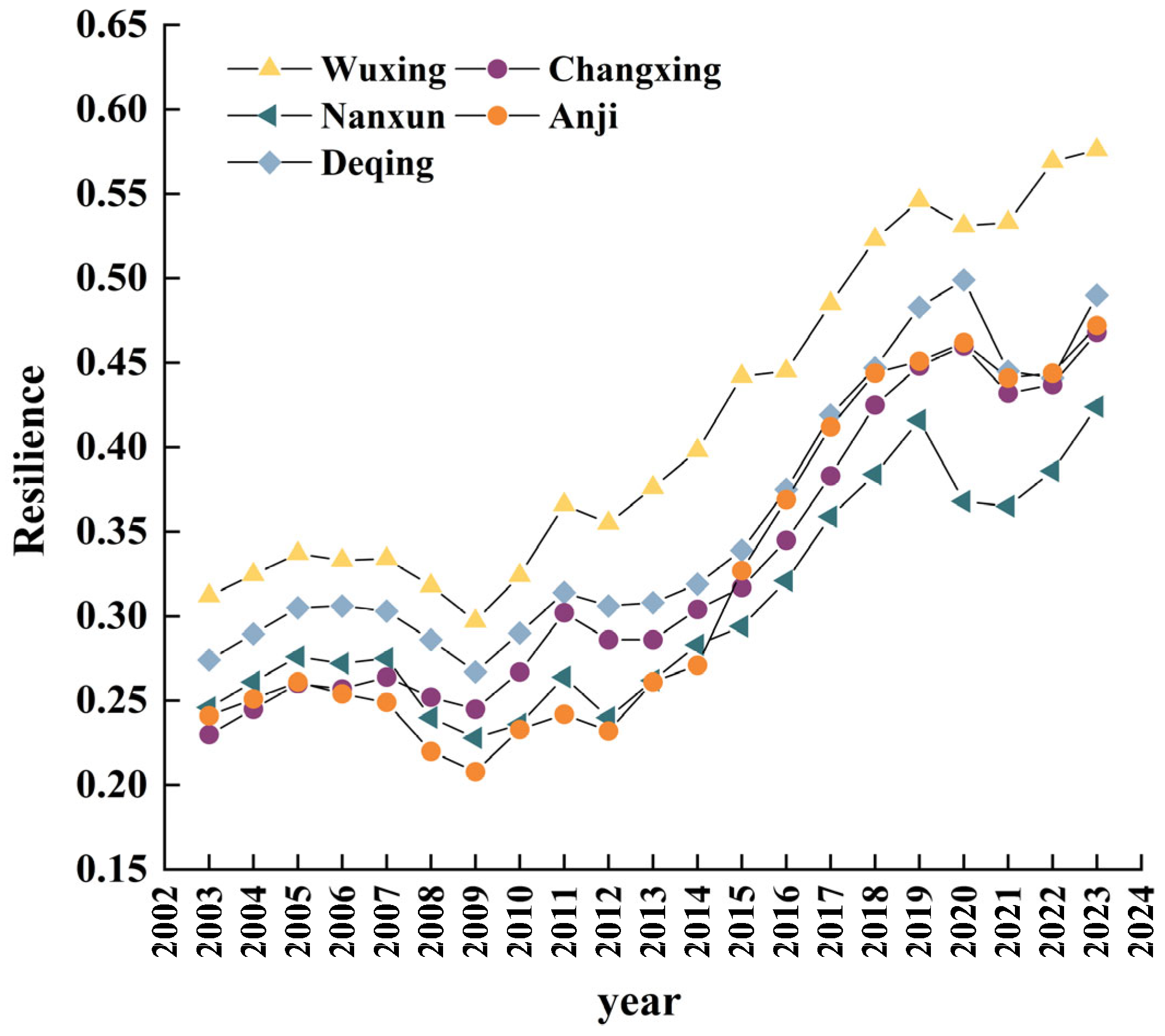
As shown in Figure 3, the overall level and regional differentiation characteristics of rural resilience values in Huzhou City show significant dynamic changes: from 2003 to 2010, the rural resilience level showed a gentle growth trend, gradually increasing from the range of 0.25~0.30 in 2003 to the range of 0.30~0.35 in 2010, with small differences among districts (counties); from 2010 to 2015, rural resilience entered a stage of differentiated improvement, maintaining a steady growth trend as a whole, and regional gaps began to appear; from 2016 to 2023, the content of comprehensive land consolidation was deepened into diversified fields such as ecosystem restoration and industrial transformation, promoting the resilience level to enter a channel of accelerated leap and intensified differentiation. By 2023, the resilience value of Wuxing District had exceeded 0.550, and the average resilience value jumped from 0.260 in 2003 to 0.486 in 2023, an increase of 0.225, showing phased characteristics of “slow growth in the early stage, acceleration in the middle stage, and leap in the later stage”.
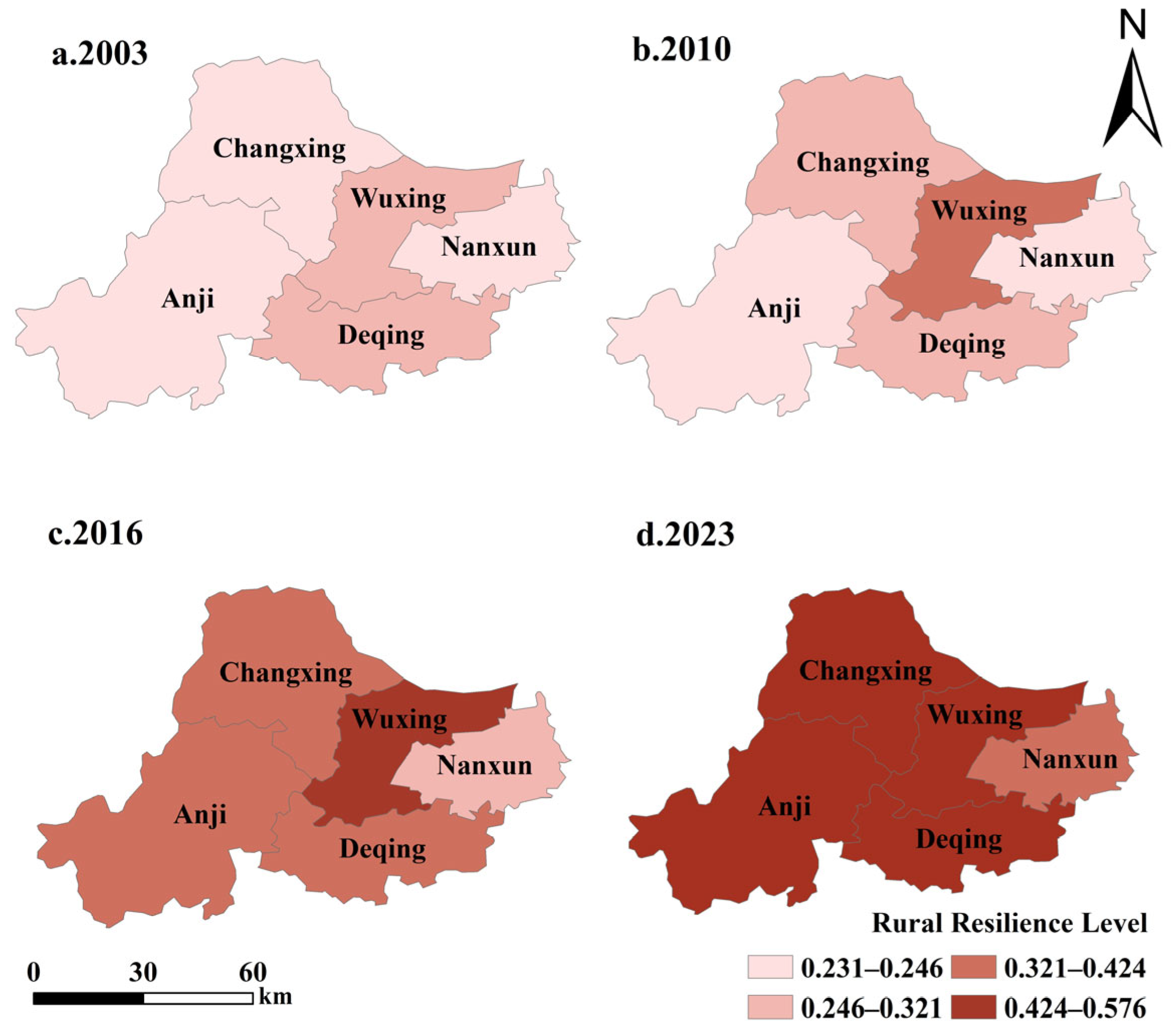
As shown in Figure 4, from the perspective of spatial distribution, the spatial aggregation of rural resilience in Huzhou City presents significant temporal evolution characteristics: in 2003, only Wuxing District and Deqing County were in the high resilience range, with no obvious high-value aggregation; in 2010, Wuxing District became the first high-resilience area, initially forming a spatial pattern of “high in the center and low in the periphery”; in 2016, Changxing County, Anji County and Deqing County entered the sub-high resilience range, forming a contiguous aggregation zone with Wuxing District, and the scope of high-value aggregation expanded significantly; in 2023, all districts/counties except Nanxun District were in the high resilience range, forming a large-scale high-value aggregation area, with the highest spatial continuity and coverage of aggregation. On the whole, the spatial level of rural resilience in Huzhou City presents a “core-periphery” agglomeration and diffusion, always taking Wuxing District as the high-value core, Nanxun District as the long-term peripheral low-aggregation area, and Changxing, Anji and Deqing gradually integrating into the high-value aggregation circle from the periphery, and the spatial connection with the core area changing from scattered to close.

3.2. Identification of Influencing Factors of Rural Resilience

3.2.1. Influencing Factor System

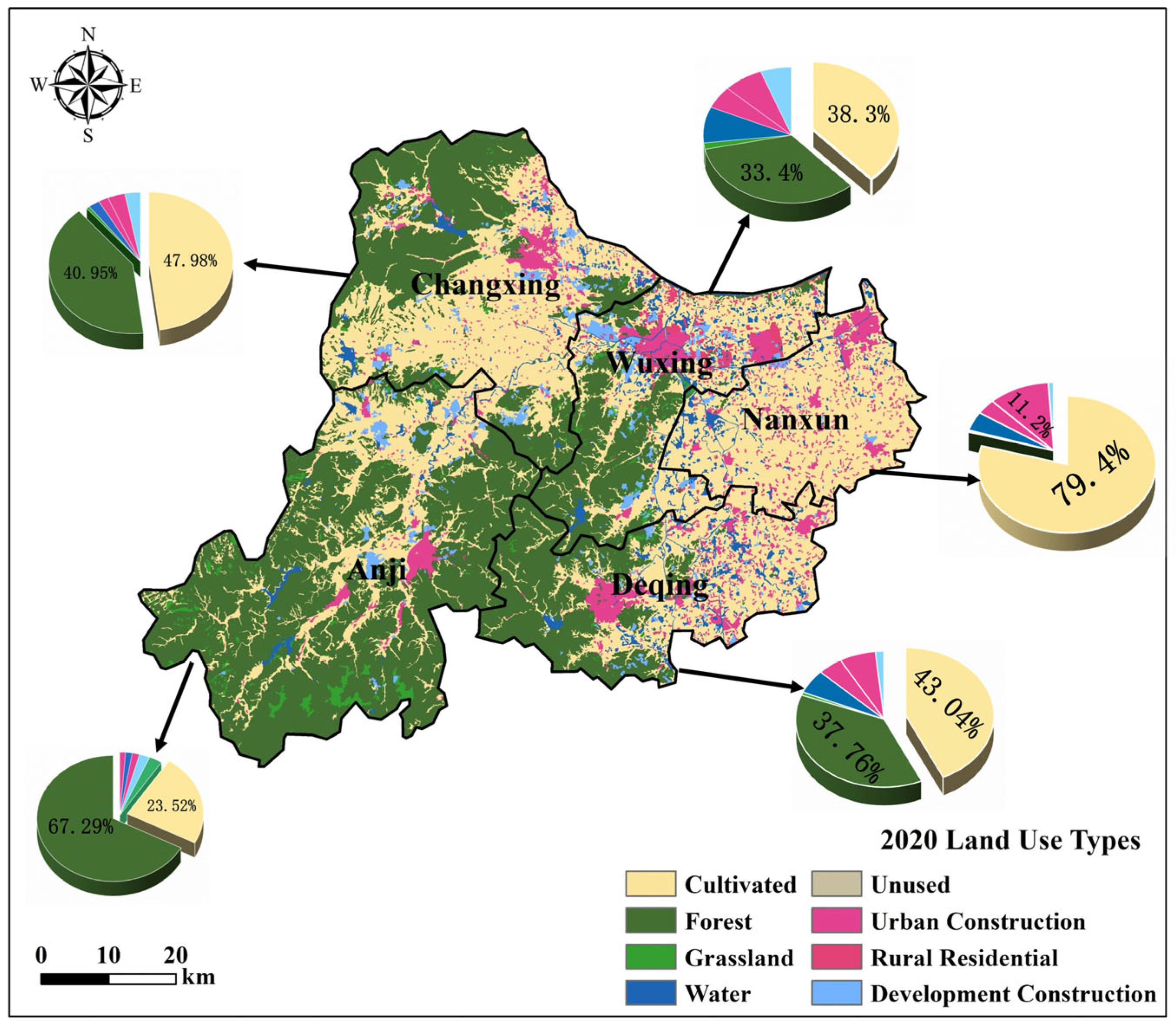
Firstly, based on the land use situation of each district (county) in Huzhou City in 2020, this paper divides the county development types into four types, detailed land use conditions are shown in Figure 5. (1) Urban-rural construction-agricultural integration type (Wuxing), with urban-rural construction land accounting for 18.26% and cultivated land accounting for 38.26% due to its central urban area attribute, having both urban construction and urban agricultural development functions; (2) Ecological leading type (Anji), with forest accounting for 67.29%, the highest in the city, and urban-rural construction land only 2.78%, focusing on ecological protection and green development; (3) Agricultural leading type (Nanxun), with cultivated land accounting for 79.38%, far exceeding other areas, and rural construction land accounting for 11.16%, a typical model of modern agriculture and rural construction; (4) Agricultural-ecological coordination type (Deqing and Changxing), with a relatively balanced proportion of cultivated land and forest, supporting the diversified development of modern agriculture and ecotourism.
Second, this study develops an influencing factor system comprising six specific indicators, focusing on the three core spatial carriers—agricultural land, construction land, and ecological land—engaged in comprehensive land consolidation.
As the dominant land use type in rural areas, agricultural land performs dual production and living functions [38]. Its consolidation targets two key dimensions: enhancing production capacity through improved irrigation conditions and soil quality optimization, and optimizing spatial coordination via the transformation of scattered cultivated land into concentrated contiguous parcels [39,40,41,42]. The selected indicators are the change rate of effective irrigation area and the change rate of cultivated land fragmentation.
Ecological land acts as a fundamental barrier for regional ecological security and a core resource for improving human settlement quality, with dual ecological conservation and social service functions [43]. Its consolidation prioritizes ecological restoration through increased vegetation coverage and expanded forest land, alongside human settlement optimization by elevating waste harmless treatment levels and improving living environment tidiness. Corresponding indicators include the change rate of vegetation coverage (NDVI) and the change rate of per capita harmless waste treatment.
Construction land, the core spatial carrier for rural residential and industrial activities, focuses on optimizing the allocation efficiency of residential and industrial land [44]. Residential land optimization involves reorganizing scattered living spaces into compact and orderly areas, while industrial land upgrading promotes the transition from extensive expansion to intensive and coordinated development. The indicators adopted are the change rate of per capita rural residential land and the change rate of secondary industry output value per unit area. Table 2 presents the six influencing factors.

3.2.2. Detection of Influencing Factors

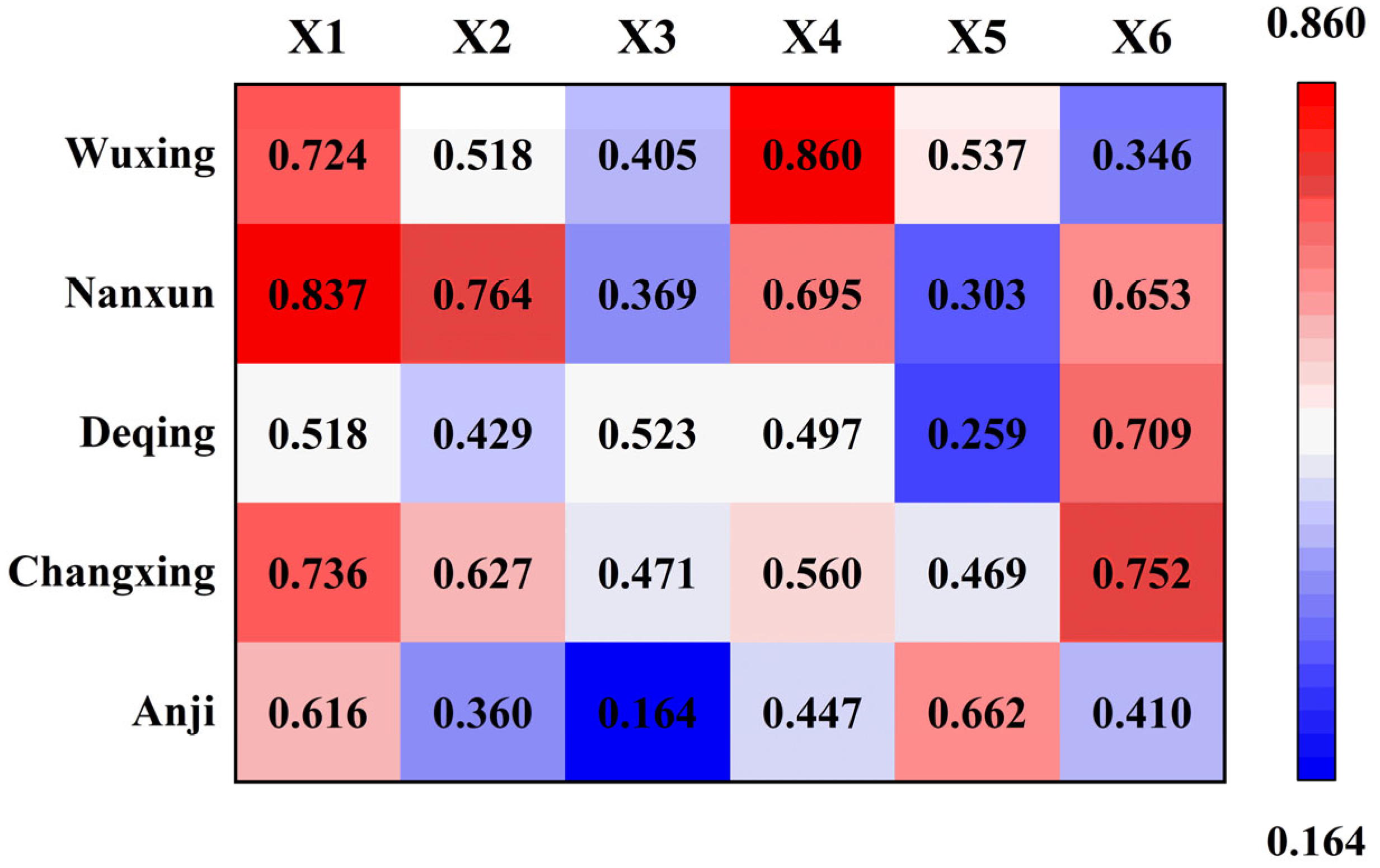
Using factor detection in a geodetector model, the influence intensity of each indicator on rural resilience was quantified, revealing significant regional differentiation, Figure 6 presents the influence of each impact factor: (1) In Wuxing District (urban-rural construction-agricultural integration type), the level of intensive industrial development exerted the strongest influence (q = 0.860), followed by agricultural land production capacity (q = 0.724). This highlights both the economic efficiency of intensive industrial land use in the central urban area and the foundational role of urban agricultural production capacity in regional resilience. (2) In Anji County (ecologically oriented type), ecological restoration intensity showed the strongest influence in the city (q = 0.662), consistent with its ecological priority strategy embodied by the “lucid waters and lush mountains” philosophy. (3) In Nanxun District (agriculturally oriented type), agricultural land production capacity and spatial coordination ranked first in the city. Given that cultivated land accounts for over 79% of its area, agricultural production capacity is a key driver of rural resilience. (4) Deqing County and Changxing County (agricultural–ecological coordination types) exhibit multi-factor driven characteristics: Deqing is mainly influenced by the coupling of rural residential land intensive use and living environment improvement, while Changxing is driven primarily by agricultural land production level and living environment improvement.
The interaction detection results of the geodetector model reveal significant regional heterogeneity in two-factor interaction types and core influencing factors. The four study regions have formed two dominant interaction combinations, with specific characteristics as follows: (1) Wuxing District (urban–rural–agricultural integration type): The interaction between agricultural land production capacity and the level of living environment improvement is the strongest, indicating a robust synergistic correlation between agricultural land functions and settlement quality. (2) Nanxun District (agricultural-led type): The most prominent interactions occur between the intensity of intensive residential land use and both the level of intensive industrial development and the degree of living environment improvement. (3) Deqing and Changxing County (agricultural–ecological coordination type): These counties share a core set of dominant interaction combinations, including the intensity of intensive residential land use, the degree of agricultural land spatial coordination, and the improvement of the living environment. This clearly underscores the key bridging role of living environment optimization in linking residential land consolidation and agricultural land spatial restructuring. (4) Anji County (ecology-led type): Agricultural land production capacity acts as the dominant interactive factor, forming strong interactions with both the level of intensive industrial development and the intensity of ecological restoration.
Overall, agricultural land production capacity, the intensity of intensive residential land use, and the improvement of human settlement environment are the core active factors with the highest interaction frequency and the widest influence scope. The interaction characteristics of each region are highly consistent with the local dominant land use functions, reflecting the adaptability of comprehensive land consolidation measures to regional development attributes.

3.3. Influence Mechanism of Comprehensive Land Consolidation on Rural Resilience

Based on the above findings, comprehensive land consolidation serves as an integrated policy instrument. Its core components include agricultural land consolidation, construction land readjustment, and ecological restoration. Through systematic governance interventions, it reshapes the endogenous driving forces of rural development, thereby addressing such challenges as factor misallocation, structural imbalance, and functional deficiency [45]. The underlying mechanism follows a chain transmission pathway: integrated intervention activates key factors, guides structural restructuring, optimizes system functions, and ultimately enhances resilience.

3.3.1. Factor Activation: The Logical Starting Point of Resilience Improvement

Factor activation serves as the core nexus through which comprehensive land consolidation enhances rural resilience. Its central logic lies in activating three key elements—population, land, and industry—within the rural system, thereby establishing a solid material foundation and subject support for resilience improvement [46]. (1) Population dimension: Ecological land consolidation optimizes the living environment, while construction land readjustment facilitates the agglomeration of public services. These measures improve rural housing and living conditions, attracting returning migrant workers and stabilizing local employment. In doing so, they address the loss of system vitality caused by population decline and inject human capital and social development momentum into rural areas. (2) Land dimension: Agricultural land consolidation enhances land quality and spatial suitability; construction land readjustment improves land use efficiency; and ecological land restoration strengthens ecological carrying capacity. These actions resolve issues such as land fragmentation and inefficient use, providing spatial security for the stable functioning of the rural system. (3) Industrial dimension: Intensive upgrading of industrial land, coupled with functional linkages between agricultural land and ecological land, consolidates fragmented industrial spaces and builds industrial development platforms, thereby activating endogenous industrial growth drivers. This approach avoids the vulnerability associated with industrial monoculture and lays the groundwork for factor mobility and subsequent rural structural restructuring [47,48].

3.3.2. Structural Reorganization: The Key Bridge of Resilience Transmission

Structural restructuring serves as the core link between factor activation and functional optimization. In essence, activated factors drive the rural system’s spatial, land use, and industrial structures toward adaptability, efficiency, and disturbance resilience through their circulation and reallocation. (1) Spatial structure: Scientifically delineating production, living, and ecological spaces breaks the traditional fragmented pattern with functional conflicts, ensuring spatial layout matches industrial development, population size, and ecological carrying capacity. (2) Land use structure: Through land consolidation and categorized control, the conflicts arising from scattered construction land and fragmented cultivated land are resolved. This enables the dynamic and optimized allocation of land resources between urban and rural areas, thereby establishing a spatial foundation for efficient factor flow and coordinated functional interactions. (3) Industrial structure: Integrating industrial land use and coordinating park planning transforms rural industries from a monocultural agricultural base toward diversified forms, thereby strengthening disturbance resistance of the industrial system and providing robust structural support for economic resilience.

3.3.3. Function Optimization: The Final Goal of Resilience Leap

Functional optimization is the core link through which comprehensive land consolidation enhances rural resilience. Based on spatial restructuring, it promotes the coordinated improvement of the rural system’s four major functions. Production function is enhanced through increased agricultural efficiency and industrial diversification, ensuring stable resource supply and high economic output, thereby underpinning economic resilience. Ecological function is strengthened via targeted restoration and scientific environmental management, improving ecosystem stability and buffering capacity against external disturbances. Social function is optimized through refined public service provision and enhanced community cohesion, fostering adaptive capacity and reinforcing grassroots social stability. Cultural function is consolidated by expanding rural cultural spaces and preserving intangible heritage, injecting endogenous momentum into adaptive rural development. These four functions are not isolated but interact synergistically, forming a closed-loop enabling mechanism that ensures stable rural system operation and enhances resilience under complex, multi-disturbance conditions [49].

4. Discussion

4.1. Comparison with Related Research and Marginal Contributions

Existing studies have yielded fruitful results in comprehensive land consolidation and rural development, covering performance evaluation under urban-rural coordination [50,51] adaptive transformation and model optimization of territorial consolidation [9], the interactive mechanism between consolidation and rural restructuring [52], the effects of consolidation on land transfer, farmland quality, and household livelihoods [53], as well as ecological transformation and multi-functional value enhancement [30]. Most existing studies have focused on regional classification based on geographical location, terrain conditions, or production functions, and have explored consolidation modes, factor allocation, and rural restructuring effects. However, insufficient attention has been paid to directly linking consolidation with rural resilience, and systematic collaborative governance frameworks and full-chain multi-dimensional mechanisms remain lacking.
Relative to the existing literature, this study presents the following innovations and marginal contributions. First, most previous studies have divided research areas based on geographical location, terrain conditions, or production functions, with few directly linking zoning governance to rural resilience. In contrast, this study closely integrates land use types with rural resilience objectives according to regional resource endowments and formulates differentiated consolidation strategies for four typical zones: urban-rural integration zones, ecological priority zones, agricultural priority zones, and agro-ecological coordination zones. Consequently, it establishes a clear, policy-oriented transmission pathway from targeted zoning governance to rural resilience enhancement.
Second, earlier studies have mostly focused on single-dimensional effects such as land transfer, infrastructure improvement, or livelihood transformation, which are insufficient to address systemic dilemmas in rural development. Adopting a systematic resilience perspective, this study constructs a comprehensive evaluation framework that concurrently addresses population outflow, inefficient land use, industrial monotony, and governance fragmentation. It further identifies the synergistic mechanisms through which spatial support, talent return, and industrial dynamics jointly improve rural resilience. Third, this study moves beyond the traditional single-factor analysis paradigm by adopting a multi-factor interaction and synergy perspective. While most existing studies treat land, population, industry, governance, and ecology as independent variables, this study systematically investigates the coupling, coordination and interactive driving effects among these factors. Accordingly, it extends and refines the theoretical framework and analytical perspective of research on land consolidation and rural resilience.

4.2. Policy Implications

(1) Given the differentiated impacts of comprehensive land consolidation on rural resilience, targeted consolidation strategies should be formulated according to regional resource endowments [54]. For urban–rural–agricultural integration zones, priority should be accorded to intensive industrial development and efficient spatial allocation, so as to promote the in-depth integration of modern industries with urban agriculture. Key implementation pathways include: (i) establishing cross-sectoral land use coordination platforms to streamline administrative approval processes and facilitate the development of mixed-function zones; (ii) designing targeted fiscal incentive mechanisms—such as tax breaks, infrastructure subsidies, or low-interest loans—to attract agri-tech enterprises, rural service industries, and start-ups; and (iii) popularizing land leasing, shareholding cooperation, and land trusteeship models to consolidate land resources, thereby strengthening the synergistic resilience of the industrial economy and agricultural foundation.
In ecology-led zones, ecological restoration and strict adherence to ecological redlines remain paramount. Recommended action pathways include: (i) improving the ecological performance-based compensation mechanism; (ii) constructing ecological corridors and fostering distinctive eco-brands to translate ecological advantages into sustainable economic benefits; and (iii) establishing a long-term monitoring and evaluation system for ecological assets, incorporating remote sensing technology and ground surveys to support adaptive management and performance-linked subsidy allocation.
In agriculture-led zones, efforts should focus on enhancing agricultural production capacity, optimizing spatial layout, and ensuring food security. Core implementation measures include: (i) promoting contiguous farmland consolidation through land swap, reallocation, and land consolidation projects, supplemented by the upgrading of supporting infrastructure; (ii) strictly regulating cultivated land use via zoning management, land use permits, and annual compliance reviews to prevent non-agricultural conversion and ensure cultivated land quality; and (iii) facilitating large-scale and intensive agricultural operations by encouraging orderly land transfer to family farms, farmer cooperatives, and leading agribusinesses, coupled with the provision of technical extension services for precision agriculture, water-saving irrigation, and green farming practices.
In agricultural–ecological coordination zones, priority should be given to improving the rural living environment while balancing agricultural production and ecological protection. Key pathways include: (i) guiding concentrated and intensive residential settlement through scientific village planning, coupled with relocation incentives such as housing subsidies for centralized communities and improved public service access; (ii) promoting the rehabilitation of idle and inefficient construction land into cultivated land or ecological land through demolition and land reclamation projects, with compensation standards tied to land restoration quality and long-term maintenance commitments; and (iii) integrating ecological landscape restoration into land consolidation plans, developing agroforestry systems, and rehabilitating small-scale wetlands to enhance ecological connectivity and improve the rural living environment.
(2) To address insufficient activation of key factors—population outflow, inefficient land use, and industrial monoculture—systemic policies should follow the logic of coordinated governance linking land consolidation, population agglomeration, and diversified industrial cultivation. First, agricultural land consolidation should convert scattered plots into contiguous high-standard farmland to improve productivity. Construction land should be optimized by centralizing dispersed residential areas and enhancing public services. Ecological land integration through environmental restoration projects can improve living conditions and quality of life. Second, policies such as local employment and social insurance subsidies should be introduced to attract returning labor and stabilize employment, thereby alleviating rural population outflow. Third, special funds should be established to support niche industries and micro enterprise startups. Financial capital should be guided to rural areas, and tailored financial products should be developed to resolve rural financing difficulties.
(3) Given the systematic and cross-domain nature of comprehensive land consolidation, a multi-dimensional collaborative mechanism should be established. First, set up a cross-departmental leading group headed by key government officials, integrating the functions of natural resources, agriculture and rural affairs, ecological environment, finance, and housing construction departments. Clear division of responsibilities is established: natural resources departments oversee land use planning and spatial layout; agricultural departments provide technical support; ecological departments set restoration standards; and housing departments address rural construction needs. This ensures seamless coordination across land consolidation, industrial support, and other links, forming a full-chain governance framework. Second, leverage satellite remote sensing and big data technologies, and a cross-sectoral digital sharing and monitoring platform is built to enable real-time data sharing and dynamic whole-process supervision. Third, establish a whole-process public participation mechanism and a land tenure dispute mediation system. Key information is disclosed through online and offline platforms, while channels for public opinion solicitation are constructed to guide public engagement in consolidation-related procedures. Additionally, the benefit-sharing and feedback mechanisms are improved to foster a governance pattern featuring co-construction, co-governance, and shared benefits.

4.3. Limitations and Prospects

Although this paper systematically measures the rural resilience level of Huzhou City from 2003 to 2023 and explores the impact mechanism of comprehensive land consolidation on rural resilience based on the entropy-weighted TOPSIS method and geographical detector model, certain limitations persist due to constraints such as research scale, data availability, analytical dimensions, and methodological frameworks. These limitations call for further refinement and expansion in subsequent studies. First, this study only examines the overall effect of comprehensive land consolidation without isolating the interference and superposition effects of other rural revitalization policies. Since rural resilience results from multi-policy synergy, the independent contribution of land consolidation cannot be precisely determined, potentially leading to overestimation and interpretive bias. Specifically, q values are systematically inflated because the joint contribution of land consolidation and other policies is fully attributed to land consolidation-related factors. Overlap in influence dimensions between concurrent policies and consolidation factors may raise the q values of some factors while suppressing those of the truly core, unaffected factors.
Second, the mechanism analysis is largely based on qualitative interpretation and logical deduction, lacking quantitative validation of transmission pathways. The interactions, time lag effects, and contribution rates among factor activation, structural restructuring, and functional optimization have not been quantitatively measured. Third, while existing studies have largely been confined to the municipal or county level and have neglected micro-scale variations across townships, villages, and hamlets, the use of aggregated county-level data in this study—although useful for capturing regional trends—may nevertheless obscure village-level inequalities, particularly in terms of income distribution and resource access.
Future research should address the limitation that this study fails to exclude the interference of other rural revitalization policies and lacks rigorous causal identification. Quasi-natural experiments and advanced econometric methods can be introduced to isolate the confounding effects of multiple policies. Specifically, the Difference-in-Differences (DID) and Propensity Score Matching Difference-in-Differences (PSM-DID) approaches can be employed to accurately identify the net effect of comprehensive land consolidation on rural resilience. Regarding the constraint of a single research scale and insufficient regional representativeness, future studies can establish a multi-scale nested analytical framework and conduct cross-regional comparative analyses. Spatially, the research scale can be extended to the town and village levels, and combined with field surveys and village-level panel data, to reveal the key mechanisms and practical pathways through which land consolidation influences rural resilience at the micro scale.

5. Conclusions

Taking Huzhou City, China’s Zhejiang Province—a pioneer demonstration area of the “Green Rural Revival Program”—as the research object, this study systematically measures and conducts an in-depth analysis of rural resilience levels from 2003 to 2023 based on resilience theory and the “factor-structure-function” framework. The key innovative findings are as follows: Firstly, from a temporal perspective, it reveals the long-term, stable, and positive driving effect of comprehensive land consolidation on rural resilience. Over the 20-year period, the average rural resilience value in Huzhou increased from 0.260 to 0.486, clearly demonstrating a three-stage evolutionary pattern of “from slow to accelerated to leapfrog development,” which reflects the cumulative nature and phased leapfrog characteristics of land consolidation policy effects. Secondly, it breaks through the limitations of previous homogeneous analyses, identifies significant differences in the core driving factors of resilience across regions with different land use types, and further refines four types of regional driving models: agricultural integration type, ecological leading type, agricultural dominant type, and agricultural-ecological coordination type. Meanwhile, it discovers the two-factor interaction differentiation characteristics of land consolidation’s impact on rural resilience, confirming that agricultural land production capacity, intensive residential land use, and human settlement improvement are the three key carrier factors, with their interaction laws highly consistent with the dominant land use functions of respective regions.
The comprehensive land consolidation project in Hongxingqiao Town, Changxing County, further provides solid evidence for the above conclusions. Through the “merger of small fragmented fields,” the town has built 10,000 mu of contiguous farmland, introduced social capital to develop the “two-year five-crop” rice-vegetable rotation model, and helped increase the per mu benefit from 2800 yuan to 10,000 yuan [55]. Simultaneously, it has carried out systematic consolidation, including ecological restoration and industrial introduction, and improved public services relying on the co-governance of rural elites, creating a livable and prosperous rural revitalization model. This intuitively verifies the long-term positive driving effect of land consolidation on rural resilience.
The core logic of the “Huzhou Model”—“ecology as the foundation, land consolidation as the thread, and adaptation to local conditions”—boasts strong practical value and promotion applicability. In the domestic context, developed rural areas can directly draw on its “factor-structure-function” coordinated path and phased consolidation timeline; ecologically fragile areas can focus on transplanting Anji County’s “ecology-led” strategy, integrating ecological restoration with agricultural land consolidation to enhance climate resilience; suburban integrated rural areas can prioritize the coupling scheme of intensive residential land use and human settlement improvement adopted by Wuxing District and Deqing County, achieving the dual goals of spatial optimization and resilience co-construction. From a global perspective, the Huzhou Model provides a nature-based, low-cost, and highly adaptable resilience governance paradigm for developing countries along the “Belt and Road” and late-developing agricultural regions. Its method of identifying differentiated driving factors based on local conditions can effectively guide land consolidation planning in areas with diverse resource endowments, while the two-factor interaction regulation logic offers an operable tool for addressing multiple global challenges such as climate change, land degradation, and rural decline.

Author Contributions

Conceptualization, Y.L. and J.W.; methodology, Y.L. and J.W.; validation, Y.L., J.W.; formal analysis, J.W.; resources, Y.L.; data curation, Y.Z. and Z.W.; writing—original draft preparation, J.W.; writing—review and editing, Y.L. and Z.W.; visualization, J.W.; supervision, Y.L.; funding acquisition, Y.L. All authors have read and agreed to the published version of the manuscript.

Funding

This research was funded by the National Natural Science Foundation of China (42471240, 42171208), Liaoning Revitalization Talents Program (XLYC2503076), and the Fundamental Research Funds for the Central Universities of the Ministry of Education of China (N25ZLH001).

Data Availability Statement

The raw data supporting the conclusions of this article will be made available by the authors on request. All figures presented in this paper are original and produced by the authors. No figures are copied or adapted from other published sources.

Acknowledgments

We thank the reviewers and editors for their insightful comments.

Conflicts of Interest

The authors declare no conflicts of interest.

References

  1. Liu, Y.; Li, Y. Revitalize the world’s countryside. Nature 2017, 548, 275–277. [Google Scholar] [CrossRef]
  2. Li, Y.; Westlund, H.; Liu, Y. Why some rural areas decline while some others not: An overview of rural evolution in the world. J. Rural Stud. 2019, 68, 135–143. [Google Scholar] [CrossRef]
  3. Zhang, R.; Du, G.M.; Li, Y.H.; Wang, L.; Stanny, M.; Naumov, A. Measurement of rural hollowing and its remediation path based on human-land relationship: A case study of Baiquan County, Heilongjiang Province. Prog. Geogr. 2024, 43, 488–503. (In Chinese) [Google Scholar]
  4. Fan, Y.T.; Jin, X.B.; Zhang, X.L.; Sun, Y.; Han, B. Mechanism analysis and case study of comprehensive land consolidation from the perspective of rural restructuring. China Land Sci. 2021, 35, 109–118. (In Chinese) [Google Scholar]
  5. Song, X.Q. Theoretical and practical path of comprehensive land consolidation guided by resilient territorial space. Mod. Urban Res. 2021, 3, 11–16. (In Chinese) [Google Scholar]
  6. Long, H.L.; Tu, S.S. Land use transition and rural revitalization. China Land Sci. 2018, 32, 1–6. (In Chinese) [Google Scholar]
  7. Zhou, Y.; Li, Y.; Xu, C. Land consolidation and rural revitalization in China: Mechanisms and paths. Land Use Policy 2020, 91, 104379. [Google Scholar] [CrossRef]
  8. Wang, J.; Zhong, L.N. Literature review and research progress of land consolidation in China. China Land Sci. 2016, 30, 88–97. (In Chinese) [Google Scholar]
  9. Jin, X.B.; Ying, S.C. Adaptive transformation and path optimization of comprehensive land consolidation for regional high-quality development. China Land Sci. 2023, 37, 1–11. (In Chinese) [Google Scholar]
  10. Huang, Z.H.; Fu, L.L. Practical logic and experience enlightenment of promoting comprehensive rural revitalization through the Ten-Million Village Project. Reform 2025, 2, 1–20. (In Chinese) [Google Scholar]
  11. Li, Y. A systematic review of rural resilience. China Agric. Econ. Rev. 2022, 15, 66–77. [Google Scholar] [CrossRef]
  12. Li, Y.H.; Yan, J.Y.; Liu, Y.S. Theoretical cognition and path research of rural revitalization based on rural resilience. Acta Geogr. Sin. 2019, 74, 2001–2010. (In Chinese) [Google Scholar]
  13. Long, H.L.; Liu, Y.S. Rural restructuring in China. J. Rural Stud. 2016, 47, 387–391. [Google Scholar] [CrossRef]
  14. Luo, X.L.; Jin, X.B.; Liu, X.J.; Zhang, S.S.; Ying, S.C.; Zhou, Y.K. Mechanism and model of urban-rural integration driven by comprehensive land consolidation in urban fringe areas from the perspective of symbiosis theory. J. Nat. Resour. 2024, 39, 1053–1067. (In Chinese) [Google Scholar]
  15. Huang, X.; Li, H.; Zhang, X.; Zhang, X. Land use policy as an instrument of rural resilience: The case of rural homestead withdrawal mechanism in China. Ecol. Indic. 2018, 87, 47–55. [Google Scholar] [CrossRef]
  16. 2023 National Economic and Social Development Statistical Bulletin of Huzhou City. Available online: https://www.huzhou.gov.cn/col/col1229213530/art/2024/art_1610323982.html (accessed on 29 April 2026). (In Chinese)
  17. The Two Mountains Concept Changes China and Leads the Era. Available online: https://www.gov.cn/yaowen/liebiao/202508/content_7036465.htm (accessed on 29 April 2026). (In Chinese)
  18. Five-Year Action Plan for High-Quality Implementation of Cross-Township Comprehensive Land Consolidation in Huzhou (2023–2027). Available online: https://www.huzhou.gov.cn/art/2023/12/7/art_1229728392_59065098.html (accessed on 29 April 2026). (In Chinese)
  19. Implementation Plan for Improving County Carrying Capacity and Deepening the Project of Thousands of Villages Demonstration and Ten Thousands of Villages Renovation in Huzhou. Available online: https://huzhou.gov.cn/hzgov/front/s1/xxgk/yshjzl/20240102/i3692997.html (accessed on 2 May 2026). (In Chinese)
  20. Hartvigsen, M. Land reform and land fragmentation in Central and Eastern Europe. Land Use Policy 2014, 36, 330–341. [Google Scholar] [CrossRef]
  21. Stańczuk-Gałwiaczek, M.; Sobolewska-Mikulska, K.; Ritzema, H.; van Loon-Steensma, J.M. Integration of water management and land consolidation in rural areas to adapt to climate change: Experiences from Poland and the Netherlands. Land Use Policy 2018, 77, 498–511. [Google Scholar] [CrossRef]
  22. Janus, J.; Markuszewska, I. Land consolidation: A great need to improve effectiveness. a case study from Poland. Land Use Policy 2017, 65, 143–153. [Google Scholar] [CrossRef]
  23. Liu, Y.S.; Fang, F.; Li, Y.H. Key issues of land use in China and implications for policy making. Land Use Policy 2014, 40, 6–12. [Google Scholar] [CrossRef]
  24. Asiama, K.O.; Bennett, R.M.; Zevenbergen, J.A. Land consolidation on Ghana’s rural customary lands: Drawing from the Dutch, Lithuanian and Rwandan experiences. J. Rural Stud. 2017, 56, 87–99. [Google Scholar] [CrossRef]
  25. Qiao, Q.W.; Xu, Q.F.; Wang, Z.R. Experience and enlightenment of foreign land consolidation management. Shandong Land Resour. 2012, 28, 68–72. (In Chinese) [Google Scholar]
  26. Liu, Y.S.; Zhou, Y.; Li, Y.H. Rural regional system and rural revitalization strategy in China. Acta Geogr. Sin. 2019, 74, 2511–2528. (In Chinese) [Google Scholar]
  27. Yin, Q.; Zhou, S.; Lv, C.; Zhang, Y.; Sui, X.; Wang, X. Comprehensive land consolidation as a tool to promote rural restructuring in China: Theoretical framework and case study. Land 2022, 11, 1932. [Google Scholar] [CrossRef]
  28. Li, X.; Ma, X.D.; Hu, M.L. Research on human-land-industry mutual feedback mechanism of rural regional system. Geogr. Res. 2022, 41, 1981–1994. (In Chinese) [Google Scholar]
  29. Ying, S.C.; Jin, X.B.; Luo, X.L.; Qi, Z.; Liang, K.Y.; Zhou, Y.K. Mechanism of comprehensive land consolidation in governing rural hollowing from the perspective of rural function evolution. China Land Sci. 2023, 37, 84–94. (In Chinese) [Google Scholar]
  30. Liu, Y.Q.; Dai, L.; Long, H.L.; Feng, X.L. Land consolidation model and ecological-oriented transformation under rural revitalization: A case study of Zhejiang Province. China Land Sci. 2021, 35, 71–79. (In Chinese) [Google Scholar]
  31. Li, J.; Ding, Y.; Jing, M.; Dong, X.; Zheng, J.; Gu, L. Quantitative change or qualitative change: The impact of whole-region comprehensive land consolidation on cultivated land security based on township panel data in Zhejiang Province. Land 2024, 13, 2158. [Google Scholar] [CrossRef]
  32. Sun, J.W.; Lu, Y.Q. Mechanism and optimization path of comprehensive land consolidation for urban-rural integration. J. Nat. Resour. 2023, 38, 2201–2216. (In Chinese) [Google Scholar] [CrossRef]
  33. Liu, Y.; Geng, W.L.; Shao, J.W.; Zhou, Z.M.; Zhang, P.Y. Response of land use change to ecosystem service value from the perspective of production-living-ecological space: A case study of the lower Yellow River. Areal Res. Dev. 2021, 40, 129–135. (In Chinese) [Google Scholar]
  34. Kong, D.Y.; Chen, H.G.; Wu, K.S. Evolution characteristics, ecological effects and influencing factors of production-living-ecological space in China. J. Nat. Resour. 2021, 36, 1116–1135. (In Chinese) [Google Scholar]
  35. Ma, X.F.; Zhang, R.; Ruan, Y.F. How to evaluate the level of green development based on entropy weight TOPSIS: Evidence from China. Int. J. Environ. Res. Public Health 2023, 20, 1707. [Google Scholar] [CrossRef] [PubMed]
  36. Zhang, J.; Liu, C.; Zhou, C. The waterlogging resilience assessment of metro stations with the entropy weight–TOPSIS method: A case study in Changsha, China. Appl. Sci. 2026, 16, 3881. [Google Scholar] [CrossRef]
  37. Wang, J.F.; Xu, C.D. Geodetector: Principle and prospect. Acta Geogr. Sin. 2017, 72, 116–134. (In Chinese) [Google Scholar]
  38. Ge, X.; Zhu, F.; Yang, Y.; Liu, G.; Chen, F. Probing influence factors of implementation patterns for sustainable land consolidation: Insights from seventeen years of practice in Jiangsu Province, China. Sustainability 2020, 12, 3576. [Google Scholar] [CrossRef]
  39. Zhou, J.; Li, C.; Chu, X.; Luo, C. Is cultivated land increased by land consolidation sustainably used in mountainous areas? Land 2022, 11, 2236. [Google Scholar] [CrossRef]
  40. Ma, Z.; Tang, H.; Xu, D.; Ran, R. Does land consolidation reduce farmland abandonment? plot-level evidence from hilly China. Land 2026, 15, 347. [Google Scholar] [CrossRef]
  41. Qiao, L. Resource reallocation: The mechanism and pathway of comprehensive land consolidation to promote agricultural scale operation. J. Nat. Resour. 2025, 40, 2269–2282. (In Chinese) [Google Scholar] [CrossRef]
  42. Lu, H.; Shi, H.; Li, B.; Xu, D. The impact of whole region comprehensive land consolidation on ecological vulnerability: Evidence from township panel data in Zhejiang Province. Land 2025, 14, 2291. [Google Scholar] [CrossRef]
  43. Lu, Y.; Yu, F.; Li, R. Synergizing urban smartness and resilience: An evaluation framework for coupling coordination and influencing factors. npj Urban Sustain. 2026. [Google Scholar] [CrossRef]
  44. Jiang, Y.; Long, H.L.; Tang, Y.T.; Deng, W.; Chen, K.Q.; Zheng, Y. The impact of land consolidation on rural vitalization at village level: A case study of a Chinese village. J. Rural Stud. 2021, 86, 485–496. [Google Scholar] [CrossRef]
  45. Kong, X.S.; Wang, J.; Jin, Z.F.; Er, L.L. Transformation and innovative thinking of rural land consolidation for rural revitalization. China Land Sci. 2019, 33, 95–102. (In Chinese) [Google Scholar]
  46. Zhu, C.M.; Wang, K.; Zhang, J.; Gan, M.Y.; Yuan, S.F. Connotation and realization path of territorial space governance: Based on the perspective of element-structure-function-value. China Land Sci. 2022, 36, 10–18. (In Chinese) [Google Scholar]
  47. Zhu, J.; Ma, S.; Zhou, Q. Industrial revitalization of rural villages via comprehensive land consolidation: Case studies in Gansu, China. Land 2022, 11, 1307. [Google Scholar] [CrossRef]
  48. Pfeifer, C.; Jongeneel, R.A.; Sonneveld, M.P.W.; Stoorvogel, J.J. Landscape properties as drivers for farm diversification: A Dutch case study. Land Use Policy 2009, 26, 1106–1115. [Google Scholar] [CrossRef]
  49. Teng, M.; Ni, L.; Li, H.; Chen, W. Comprehensive benefit evaluation of saline–alkali land consolidation based on optimal land use value: Evidence from Jilin Province, China. Land 2025, 14, 1687. [Google Scholar] [CrossRef]
  50. Liang, C.; Zhou, Y. Evaluating the impacts of whole-region comprehensive land consolidation on the optimization of rural production-living-ecological spaces in China. Habitat Int. 2025, 162, 103438. [Google Scholar] [CrossRef]
  51. Li, Y.H.; Wu, W.; Liu, Y.S. Land consolidation for rural sustainability in China: Practical reflections and policy implications. Land Use Policy 2018, 74, 137–141. [Google Scholar] [CrossRef]
  52. Chen, K.Q.; Long, H.L. Land consolidation and rural development transformation: Mutual feedback mechanism and regional regulation. China Land Sci. 2020, 34, 1–9. (In Chinese) [Google Scholar]
  53. Do, M.H.; Nguyen, T.T.; Grote, U. Land consolidation, rice production, and agricultural transformation: Evidence from household panel data for Vietnam. Econ. Anal. Policy 2023, 77, 157–173. [Google Scholar] [CrossRef]
  54. Zhou, X.; Lv, Y.; Zou, J.; Gu, X. Theoretical logic and implementation path of comprehensive land consolidation for promoting common prosperity: A case study of Ningbo City. Land 2024, 13, 253. [Google Scholar] [CrossRef]
  55. Four Land Consolidation Projects Rated as Provincial Excellent. Available online: https://www.huzhou.gov.cn/col/col1229213482/art/2026/art_37c5f26b1f894599892ff5e439710dbc.html (accessed on 2 May 2026). (In Chinese)
Figure 1. Geographical location of Huzhou City.
Land 15 00870 g001
Figure 2. Comprehensive Land Consolidation and Rural Resilience.
Land 15 00870 g002
Figure 3. Rural Resilience Evolution Chart.
Land 15 00870 g003
Figure 4. Spatial distribution of rural resilience.
Land 15 00870 g004
Figure 5. Development patterns of Huzhou City. Note: Based on the standard map with approval number GS (2024) No. 0650 from the National Standard Map Service. No modification to the base map. The same below.
Land 15 00870 g005
Figure 6. Results of Single-Factor Detection.
Land 15 00870 g006
Table 1. Evaluation index system.
Primary IndicatorSecondary IndicatorUnitWeight
Economic
Resilience
(0.266)
Balance of Residents’ SavingsYuan0.048
Growth Rate of Per Capita Disposable Income of Residents%0.085
Per Capita Tourism IncomeYuan0.070
Herfindahl-Hirschman Index (HHI)-0.100
Grain Yield per Mu of Cultivated Landkg/mu0.017
Cultural
Resilience
(0.199)
Proportion of Fiscal Expenditure on Education, Culture and Sports%0.040
Average Years of SchoolingYear0.020
Proportion of Primary and Secondary School Students%0.039
Number of Rural ElitesPerson0.085
Ecological
Resilience
(0.113)
Per Capita Park Green Space Areakm2/person0.030
Normalized Difference Vegetation Index (NDVI)-0.026
Comprehensive Utilization Rate of Industrial Solid Waste%0.048
PM2.5 Concentrationmg/m30.039
Organizational
Resilience
(0.228)
Distribution Density of Grassroots OrganizationsPiece/km20.054
Number of Grassroots Organization Staff per 1000 PeoplePerson0.073
Fiscal Self-sufficiency Rate%0.009
Proportion of Funds for Grassroots Organization Construction%0.038
Social Resilience
(0.194)
Number of Medical and Health Beds per 1000 PeoplePiece0.041
Road Densitykm/km20.094
Growth of Rural Labor ForcePerson0.003
Number of Internet Broadband Access UsersHousehold0.043
Table 2. Indicator System of Influencing Factors.
Criterion LayerCodeIndicator LayerIndicator Explanation
Agricultural Land ConsolidationX1Agricultural Land Production CapacityChange Rate of Effective Irrigation Area (%)
X2Spatial Coordination Degree of Agricultural LandChange Rate of Cultivated Land Fragmentation (%)
Construction Land ConsolidationX3Intensity of Residential Land UseChange Rate of Per Capita Rural Residential Land (%)
X4Level of Intensive Industrial DevelopmentChange Rate of Output Value per Unit Area of Secondary Industry (%)
Ecological Land ConsolidationX5Ecological Restoration IntensityChange Rate of Vegetation Coverage (NDVI) (%)
X6Improvement Degree of Human Settlement EnvironmentChange Rate of Per Capita Harmless Waste Treatment Volume (%)
Disclaimer/Publisher’s Note: The statements, opinions and data contained in all publications are solely those of the individual author(s) and contributor(s) and not of MDPI and/or the editor(s). MDPI and/or the editor(s) disclaim responsibility for any injury to people or property resulting from any ideas, methods, instructions or products referred to in the content.