Comprehensive Land Consolidation and Its Impact on Rural Resilience: The Study of Huzhou, China
Abstract
1. Introduction
2. Methods and Data Sources
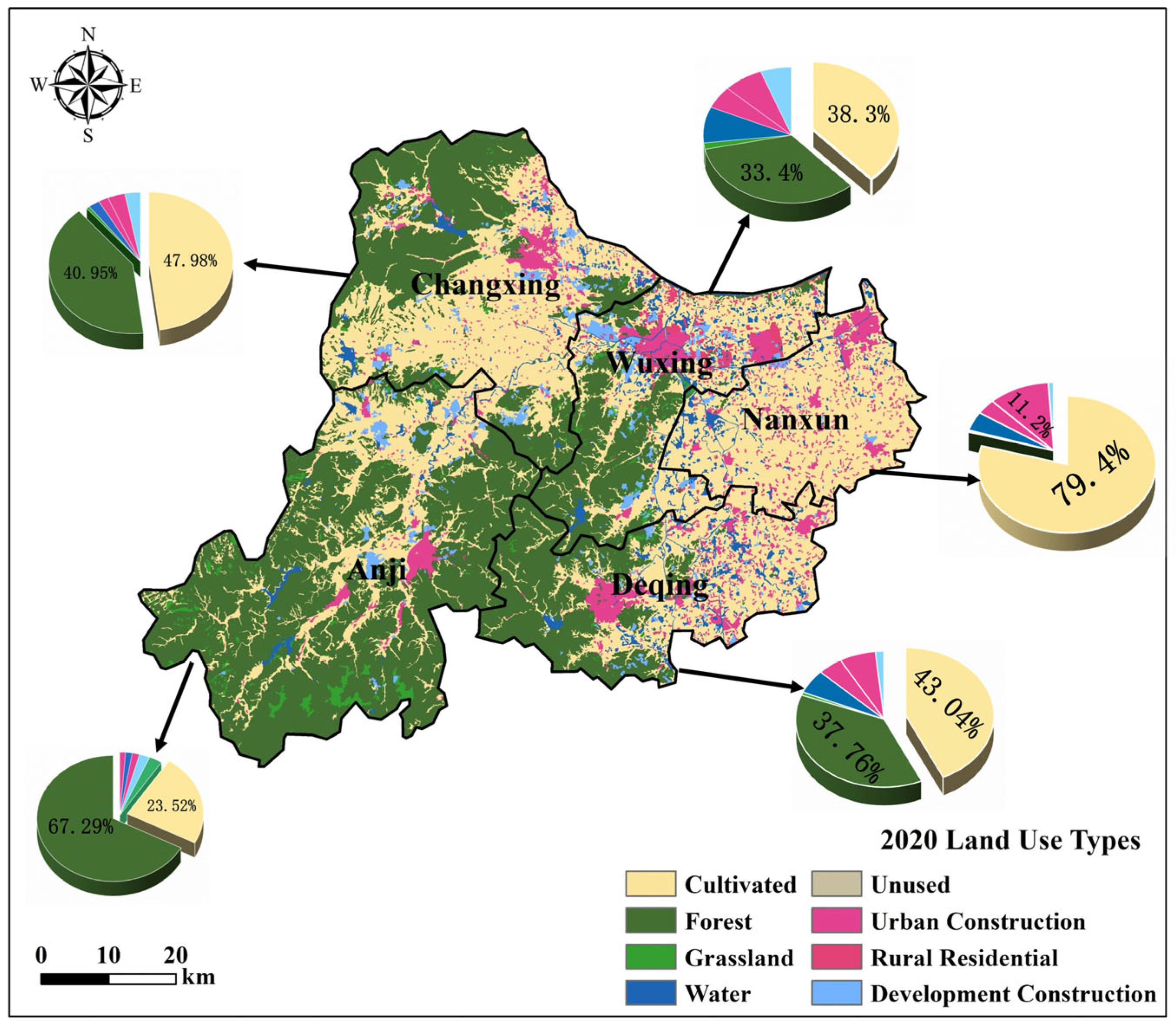
2.1. Study Area
2.2. Data Sources
2.3. Research Methods
2.3.1. Theoretical Framework
2.3.2. Rural Resilience Evaluation
2.3.3. Entropy-Weighted Topsis Method
2.3.4. Geodetector
3. Results
3.1. Spatiotemporal Evolution of Rural Resilience
3.2. Identification of Influencing Factors of Rural Resilience
3.2.1. Influencing Factor System
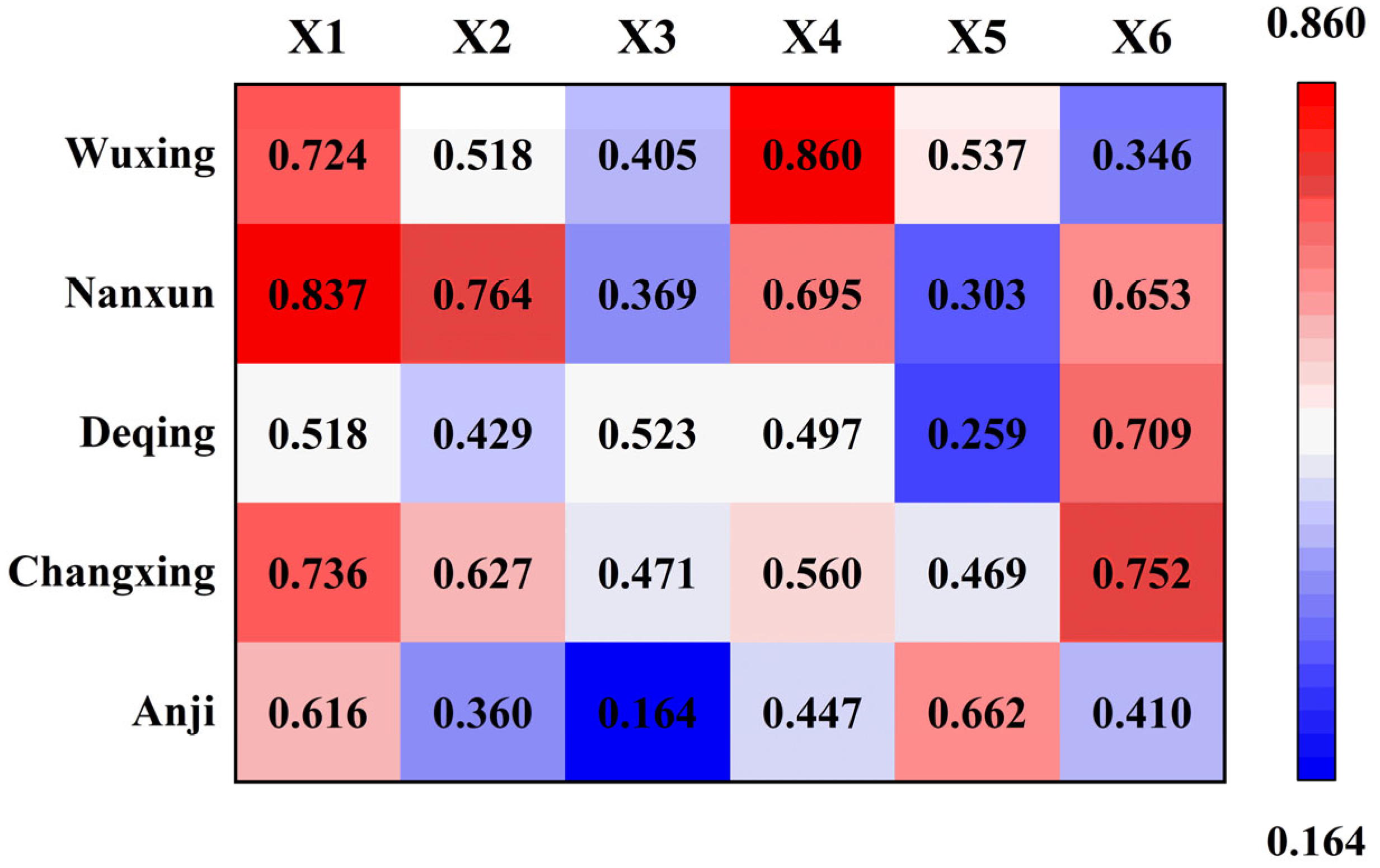
3.2.2. Detection of Influencing Factors
3.3. Influence Mechanism of Comprehensive Land Consolidation on Rural Resilience
3.3.1. Factor Activation: The Logical Starting Point of Resilience Improvement
3.3.2. Structural Reorganization: The Key Bridge of Resilience Transmission
3.3.3. Function Optimization: The Final Goal of Resilience Leap
4. Discussion
4.1. Comparison with Related Research and Marginal Contributions
4.2. Policy Implications
4.3. Limitations and Prospects
5. Conclusions
Author Contributions
Funding
Data Availability Statement
Acknowledgments
Conflicts of Interest
References
- Liu, Y.; Li, Y. Revitalize the world’s countryside. Nature 2017, 548, 275–277. [Google Scholar] [CrossRef]
- Li, Y.; Westlund, H.; Liu, Y. Why some rural areas decline while some others not: An overview of rural evolution in the world. J. Rural Stud. 2019, 68, 135–143. [Google Scholar] [CrossRef]
- Zhang, R.; Du, G.M.; Li, Y.H.; Wang, L.; Stanny, M.; Naumov, A. Measurement of rural hollowing and its remediation path based on human-land relationship: A case study of Baiquan County, Heilongjiang Province. Prog. Geogr. 2024, 43, 488–503. (In Chinese) [Google Scholar]
- Fan, Y.T.; Jin, X.B.; Zhang, X.L.; Sun, Y.; Han, B. Mechanism analysis and case study of comprehensive land consolidation from the perspective of rural restructuring. China Land Sci. 2021, 35, 109–118. (In Chinese) [Google Scholar]
- Song, X.Q. Theoretical and practical path of comprehensive land consolidation guided by resilient territorial space. Mod. Urban Res. 2021, 3, 11–16. (In Chinese) [Google Scholar]
- Long, H.L.; Tu, S.S. Land use transition and rural revitalization. China Land Sci. 2018, 32, 1–6. (In Chinese) [Google Scholar]
- Zhou, Y.; Li, Y.; Xu, C. Land consolidation and rural revitalization in China: Mechanisms and paths. Land Use Policy 2020, 91, 104379. [Google Scholar] [CrossRef]
- Wang, J.; Zhong, L.N. Literature review and research progress of land consolidation in China. China Land Sci. 2016, 30, 88–97. (In Chinese) [Google Scholar]
- Jin, X.B.; Ying, S.C. Adaptive transformation and path optimization of comprehensive land consolidation for regional high-quality development. China Land Sci. 2023, 37, 1–11. (In Chinese) [Google Scholar]
- Huang, Z.H.; Fu, L.L. Practical logic and experience enlightenment of promoting comprehensive rural revitalization through the Ten-Million Village Project. Reform 2025, 2, 1–20. (In Chinese) [Google Scholar]
- Li, Y. A systematic review of rural resilience. China Agric. Econ. Rev. 2022, 15, 66–77. [Google Scholar] [CrossRef]
- Li, Y.H.; Yan, J.Y.; Liu, Y.S. Theoretical cognition and path research of rural revitalization based on rural resilience. Acta Geogr. Sin. 2019, 74, 2001–2010. (In Chinese) [Google Scholar]
- Long, H.L.; Liu, Y.S. Rural restructuring in China. J. Rural Stud. 2016, 47, 387–391. [Google Scholar] [CrossRef]
- Luo, X.L.; Jin, X.B.; Liu, X.J.; Zhang, S.S.; Ying, S.C.; Zhou, Y.K. Mechanism and model of urban-rural integration driven by comprehensive land consolidation in urban fringe areas from the perspective of symbiosis theory. J. Nat. Resour. 2024, 39, 1053–1067. (In Chinese) [Google Scholar]
- Huang, X.; Li, H.; Zhang, X.; Zhang, X. Land use policy as an instrument of rural resilience: The case of rural homestead withdrawal mechanism in China. Ecol. Indic. 2018, 87, 47–55. [Google Scholar] [CrossRef]
- 2023 National Economic and Social Development Statistical Bulletin of Huzhou City. Available online: https://www.huzhou.gov.cn/col/col1229213530/art/2024/art_1610323982.html (accessed on 29 April 2026). (In Chinese)
- The Two Mountains Concept Changes China and Leads the Era. Available online: https://www.gov.cn/yaowen/liebiao/202508/content_7036465.htm (accessed on 29 April 2026). (In Chinese)
- Five-Year Action Plan for High-Quality Implementation of Cross-Township Comprehensive Land Consolidation in Huzhou (2023–2027). Available online: https://www.huzhou.gov.cn/art/2023/12/7/art_1229728392_59065098.html (accessed on 29 April 2026). (In Chinese)
- Implementation Plan for Improving County Carrying Capacity and Deepening the Project of Thousands of Villages Demonstration and Ten Thousands of Villages Renovation in Huzhou. Available online: https://huzhou.gov.cn/hzgov/front/s1/xxgk/yshjzl/20240102/i3692997.html (accessed on 2 May 2026). (In Chinese)
- Hartvigsen, M. Land reform and land fragmentation in Central and Eastern Europe. Land Use Policy 2014, 36, 330–341. [Google Scholar] [CrossRef]
- Stańczuk-Gałwiaczek, M.; Sobolewska-Mikulska, K.; Ritzema, H.; van Loon-Steensma, J.M. Integration of water management and land consolidation in rural areas to adapt to climate change: Experiences from Poland and the Netherlands. Land Use Policy 2018, 77, 498–511. [Google Scholar] [CrossRef]
- Janus, J.; Markuszewska, I. Land consolidation: A great need to improve effectiveness. a case study from Poland. Land Use Policy 2017, 65, 143–153. [Google Scholar] [CrossRef]
- Liu, Y.S.; Fang, F.; Li, Y.H. Key issues of land use in China and implications for policy making. Land Use Policy 2014, 40, 6–12. [Google Scholar] [CrossRef]
- Asiama, K.O.; Bennett, R.M.; Zevenbergen, J.A. Land consolidation on Ghana’s rural customary lands: Drawing from the Dutch, Lithuanian and Rwandan experiences. J. Rural Stud. 2017, 56, 87–99. [Google Scholar] [CrossRef]
- Qiao, Q.W.; Xu, Q.F.; Wang, Z.R. Experience and enlightenment of foreign land consolidation management. Shandong Land Resour. 2012, 28, 68–72. (In Chinese) [Google Scholar]
- Liu, Y.S.; Zhou, Y.; Li, Y.H. Rural regional system and rural revitalization strategy in China. Acta Geogr. Sin. 2019, 74, 2511–2528. (In Chinese) [Google Scholar]
- Yin, Q.; Zhou, S.; Lv, C.; Zhang, Y.; Sui, X.; Wang, X. Comprehensive land consolidation as a tool to promote rural restructuring in China: Theoretical framework and case study. Land 2022, 11, 1932. [Google Scholar] [CrossRef]
- Li, X.; Ma, X.D.; Hu, M.L. Research on human-land-industry mutual feedback mechanism of rural regional system. Geogr. Res. 2022, 41, 1981–1994. (In Chinese) [Google Scholar]
- Ying, S.C.; Jin, X.B.; Luo, X.L.; Qi, Z.; Liang, K.Y.; Zhou, Y.K. Mechanism of comprehensive land consolidation in governing rural hollowing from the perspective of rural function evolution. China Land Sci. 2023, 37, 84–94. (In Chinese) [Google Scholar]
- Liu, Y.Q.; Dai, L.; Long, H.L.; Feng, X.L. Land consolidation model and ecological-oriented transformation under rural revitalization: A case study of Zhejiang Province. China Land Sci. 2021, 35, 71–79. (In Chinese) [Google Scholar]
- Li, J.; Ding, Y.; Jing, M.; Dong, X.; Zheng, J.; Gu, L. Quantitative change or qualitative change: The impact of whole-region comprehensive land consolidation on cultivated land security based on township panel data in Zhejiang Province. Land 2024, 13, 2158. [Google Scholar] [CrossRef]
- Sun, J.W.; Lu, Y.Q. Mechanism and optimization path of comprehensive land consolidation for urban-rural integration. J. Nat. Resour. 2023, 38, 2201–2216. (In Chinese) [Google Scholar] [CrossRef]
- Liu, Y.; Geng, W.L.; Shao, J.W.; Zhou, Z.M.; Zhang, P.Y. Response of land use change to ecosystem service value from the perspective of production-living-ecological space: A case study of the lower Yellow River. Areal Res. Dev. 2021, 40, 129–135. (In Chinese) [Google Scholar]
- Kong, D.Y.; Chen, H.G.; Wu, K.S. Evolution characteristics, ecological effects and influencing factors of production-living-ecological space in China. J. Nat. Resour. 2021, 36, 1116–1135. (In Chinese) [Google Scholar]
- Ma, X.F.; Zhang, R.; Ruan, Y.F. How to evaluate the level of green development based on entropy weight TOPSIS: Evidence from China. Int. J. Environ. Res. Public Health 2023, 20, 1707. [Google Scholar] [CrossRef] [PubMed]
- Zhang, J.; Liu, C.; Zhou, C. The waterlogging resilience assessment of metro stations with the entropy weight–TOPSIS method: A case study in Changsha, China. Appl. Sci. 2026, 16, 3881. [Google Scholar] [CrossRef]
- Wang, J.F.; Xu, C.D. Geodetector: Principle and prospect. Acta Geogr. Sin. 2017, 72, 116–134. (In Chinese) [Google Scholar]
- Ge, X.; Zhu, F.; Yang, Y.; Liu, G.; Chen, F. Probing influence factors of implementation patterns for sustainable land consolidation: Insights from seventeen years of practice in Jiangsu Province, China. Sustainability 2020, 12, 3576. [Google Scholar] [CrossRef]
- Zhou, J.; Li, C.; Chu, X.; Luo, C. Is cultivated land increased by land consolidation sustainably used in mountainous areas? Land 2022, 11, 2236. [Google Scholar] [CrossRef]
- Ma, Z.; Tang, H.; Xu, D.; Ran, R. Does land consolidation reduce farmland abandonment? plot-level evidence from hilly China. Land 2026, 15, 347. [Google Scholar] [CrossRef]
- Qiao, L. Resource reallocation: The mechanism and pathway of comprehensive land consolidation to promote agricultural scale operation. J. Nat. Resour. 2025, 40, 2269–2282. (In Chinese) [Google Scholar] [CrossRef]
- Lu, H.; Shi, H.; Li, B.; Xu, D. The impact of whole region comprehensive land consolidation on ecological vulnerability: Evidence from township panel data in Zhejiang Province. Land 2025, 14, 2291. [Google Scholar] [CrossRef]
- Lu, Y.; Yu, F.; Li, R. Synergizing urban smartness and resilience: An evaluation framework for coupling coordination and influencing factors. npj Urban Sustain. 2026. [Google Scholar] [CrossRef]
- Jiang, Y.; Long, H.L.; Tang, Y.T.; Deng, W.; Chen, K.Q.; Zheng, Y. The impact of land consolidation on rural vitalization at village level: A case study of a Chinese village. J. Rural Stud. 2021, 86, 485–496. [Google Scholar] [CrossRef]
- Kong, X.S.; Wang, J.; Jin, Z.F.; Er, L.L. Transformation and innovative thinking of rural land consolidation for rural revitalization. China Land Sci. 2019, 33, 95–102. (In Chinese) [Google Scholar]
- Zhu, C.M.; Wang, K.; Zhang, J.; Gan, M.Y.; Yuan, S.F. Connotation and realization path of territorial space governance: Based on the perspective of element-structure-function-value. China Land Sci. 2022, 36, 10–18. (In Chinese) [Google Scholar]
- Zhu, J.; Ma, S.; Zhou, Q. Industrial revitalization of rural villages via comprehensive land consolidation: Case studies in Gansu, China. Land 2022, 11, 1307. [Google Scholar] [CrossRef]
- Pfeifer, C.; Jongeneel, R.A.; Sonneveld, M.P.W.; Stoorvogel, J.J. Landscape properties as drivers for farm diversification: A Dutch case study. Land Use Policy 2009, 26, 1106–1115. [Google Scholar] [CrossRef]
- Teng, M.; Ni, L.; Li, H.; Chen, W. Comprehensive benefit evaluation of saline–alkali land consolidation based on optimal land use value: Evidence from Jilin Province, China. Land 2025, 14, 1687. [Google Scholar] [CrossRef]
- Liang, C.; Zhou, Y. Evaluating the impacts of whole-region comprehensive land consolidation on the optimization of rural production-living-ecological spaces in China. Habitat Int. 2025, 162, 103438. [Google Scholar] [CrossRef]
- Li, Y.H.; Wu, W.; Liu, Y.S. Land consolidation for rural sustainability in China: Practical reflections and policy implications. Land Use Policy 2018, 74, 137–141. [Google Scholar] [CrossRef]
- Chen, K.Q.; Long, H.L. Land consolidation and rural development transformation: Mutual feedback mechanism and regional regulation. China Land Sci. 2020, 34, 1–9. (In Chinese) [Google Scholar]
- Do, M.H.; Nguyen, T.T.; Grote, U. Land consolidation, rice production, and agricultural transformation: Evidence from household panel data for Vietnam. Econ. Anal. Policy 2023, 77, 157–173. [Google Scholar] [CrossRef]
- Zhou, X.; Lv, Y.; Zou, J.; Gu, X. Theoretical logic and implementation path of comprehensive land consolidation for promoting common prosperity: A case study of Ningbo City. Land 2024, 13, 253. [Google Scholar] [CrossRef]
- Four Land Consolidation Projects Rated as Provincial Excellent. Available online: https://www.huzhou.gov.cn/col/col1229213482/art/2026/art_37c5f26b1f894599892ff5e439710dbc.html (accessed on 2 May 2026). (In Chinese)



| Primary Indicator | Secondary Indicator | Unit | Weight |
|---|---|---|---|
| Economic Resilience (0.266) | Balance of Residents’ Savings | Yuan | 0.048 |
| Growth Rate of Per Capita Disposable Income of Residents | % | 0.085 | |
| Per Capita Tourism Income | Yuan | 0.070 | |
| Herfindahl-Hirschman Index (HHI) | - | 0.100 | |
| Grain Yield per Mu of Cultivated Land | kg/mu | 0.017 | |
| Cultural Resilience (0.199) | Proportion of Fiscal Expenditure on Education, Culture and Sports | % | 0.040 |
| Average Years of Schooling | Year | 0.020 | |
| Proportion of Primary and Secondary School Students | % | 0.039 | |
| Number of Rural Elites | Person | 0.085 | |
| Ecological Resilience (0.113) | Per Capita Park Green Space Area | km2/person | 0.030 |
| Normalized Difference Vegetation Index (NDVI) | - | 0.026 | |
| Comprehensive Utilization Rate of Industrial Solid Waste | % | 0.048 | |
| PM2.5 Concentration | mg/m3 | 0.039 | |
| Organizational Resilience (0.228) | Distribution Density of Grassroots Organizations | Piece/km2 | 0.054 |
| Number of Grassroots Organization Staff per 1000 People | Person | 0.073 | |
| Fiscal Self-sufficiency Rate | % | 0.009 | |
| Proportion of Funds for Grassroots Organization Construction | % | 0.038 | |
| Social Resilience (0.194) | Number of Medical and Health Beds per 1000 People | Piece | 0.041 |
| Road Density | km/km2 | 0.094 | |
| Growth of Rural Labor Force | Person | 0.003 | |
| Number of Internet Broadband Access Users | Household | 0.043 |
| Criterion Layer | Code | Indicator Layer | Indicator Explanation |
|---|---|---|---|
| Agricultural Land Consolidation | X1 | Agricultural Land Production Capacity | Change Rate of Effective Irrigation Area (%) |
| X2 | Spatial Coordination Degree of Agricultural Land | Change Rate of Cultivated Land Fragmentation (%) | |
| Construction Land Consolidation | X3 | Intensity of Residential Land Use | Change Rate of Per Capita Rural Residential Land (%) |
| X4 | Level of Intensive Industrial Development | Change Rate of Output Value per Unit Area of Secondary Industry (%) | |
| Ecological Land Consolidation | X5 | Ecological Restoration Intensity | Change Rate of Vegetation Coverage (NDVI) (%) |
| X6 | Improvement Degree of Human Settlement Environment | Change Rate of Per Capita Harmless Waste Treatment Volume (%) |
Disclaimer/Publisher’s Note: The statements, opinions and data contained in all publications are solely those of the individual author(s) and contributor(s) and not of MDPI and/or the editor(s). MDPI and/or the editor(s) disclaim responsibility for any injury to people or property resulting from any ideas, methods, instructions or products referred to in the content. |
© 2026 by the authors. Licensee MDPI, Basel, Switzerland. This article is an open access article distributed under the terms and conditions of the Creative Commons Attribution (CC BY) license.
Share and Cite
Wen, J.; Li, Y.; Zhang, Y.; Wu, Z. Comprehensive Land Consolidation and Its Impact on Rural Resilience: The Study of Huzhou, China. Land 2026, 15, 870. https://doi.org/10.3390/land15050870
Wen J, Li Y, Zhang Y, Wu Z. Comprehensive Land Consolidation and Its Impact on Rural Resilience: The Study of Huzhou, China. Land. 2026; 15(5):870. https://doi.org/10.3390/land15050870
Chicago/Turabian StyleWen, Jiuyao, Yuheng Li, Yun Zhang, and Zijing Wu. 2026. "Comprehensive Land Consolidation and Its Impact on Rural Resilience: The Study of Huzhou, China" Land 15, no. 5: 870. https://doi.org/10.3390/land15050870
APA StyleWen, J., Li, Y., Zhang, Y., & Wu, Z. (2026). Comprehensive Land Consolidation and Its Impact on Rural Resilience: The Study of Huzhou, China. Land, 15(5), 870. https://doi.org/10.3390/land15050870