


Synergistic Effects of Biochar and Algae-Transformed Organic Waste from the Dairy Industry on Soil Organic Matter and Soil Sorption Properties


Abstract
1. Introduction
2. Materials and Methods
2.1. Soil Characteristics
2.2. Characteristics of the Tested Organic Amendments
2.3. Establishment and Management of the Laboratory Experiment
2.4. Soil Sampling and Analysis
2.5. Statistical Analysis
3. Results
3.1. Soil Organic Matter
3.2. Soil Sorption Capacity
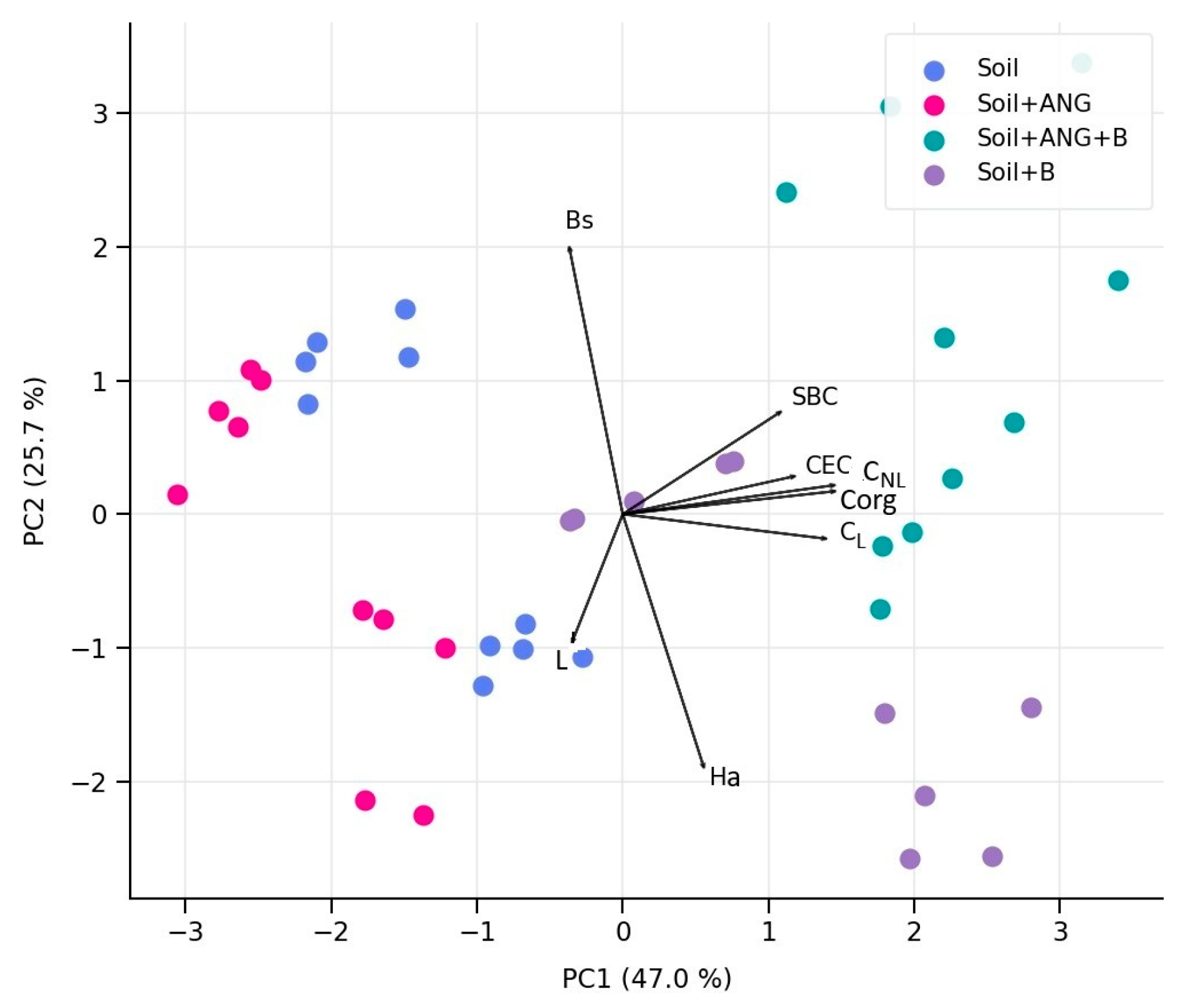
3.3. Relationships Between Soil Organic Matter Parameters and Soil Sorption Properties
4. Discussion
4.1. Effect of Organic Amendments on Changes in Soil Organic Matter
4.2. Effect of Organic Amendments on Changes in Soil Sorption Properties
4.3. Relationships Between Soil Organic Matter and Soil Sorption in Response to Organic Amendments
5. Conclusions
Author Contributions
Funding
Data Availability Statement
Acknowledgments
Conflicts of Interest
References
- Abhilash, P.C.; Singh, A.; Rakshit, A.; Tripathi, V. Soil Amendments for Environmental Sustainability, Policy Recommendations and Future Prospects. In Soil Amendments for Sustainability: Challenges and Perspectives; Rakshit, A., Sarkar, B., Abhilash, P.C., Eds.; CRC Press, Taylor & Francis Group: Boca Raton, FL, USA, 2019; pp. 115–122. [Google Scholar]
- Lehmann, J.; Joseph, S. (Eds.) Biochar for Environmental Management: Science, Technology and Implementation, 2nd ed.; Routledge: London, UK, 2015. [Google Scholar]
- Šimanský, V. Effects of Biochar and Biochar with Nitrogen on Soil Organic Matter and Soil Structure in Haplic Luvisol. Acta Fytotechn. Zootechn. 2016, 19, 129–138. [Google Scholar] [CrossRef] [Scilit]
- Singh, H.; Northup, B.K.; Rice, C.W.; Prasad, P.V.V. Biochar Applications Influence Soil Physical and Chemical Properties, Microbial Diversity, and Crop Productivity: A Meta-Analysis. Biochar 2022, 4, 8. [Google Scholar] [CrossRef] [Scilit]
- Šimanský, V.; Horák, J.; Igaz, D.; Balashov, E.; Jonczak, J. Biochar and Biochar with N Fertilizer as a Potential Tool for Improving Soil Sorption of Nutrients. J. Soils Sediments 2018, 18, 1432–1440. [Google Scholar] [CrossRef] [Scilit]
- Tang, K.H.D. Biochar Amendments for Soil Restoration: Impacts on Nutrient Dynamics and Microbial Activity. Environments 2025, 12, 425. [Google Scholar] [CrossRef] [Scilit]
- Igaz, D.; Šimanský, V.; Horák, J.; Kondrlová, E.; Dohanová, J.; Rodný, M.; Buchkina, N.P. Can a Single Dose of Biochar Affect Soil Physical and Chemical Characteristics? J. Hydrol. Hydromech. 2018, 66, 421–428. [Google Scholar] [CrossRef] [Scilit]
- Wojewódzki, P.; Lemanowicz, J.; Dębska, B.; Haddad, S.A. Soil Enzyme Activity Response under Amendment of Different Types of Biochar. Agronomy 2022, 12, 569. [Google Scholar] [CrossRef] [Scilit]
- Shyam, S.; Ahmed, S.; Joshi, S.J.; Sarma, H. Biochar as a Soil Amendment: Implications for Soil Health, Carbon Sequestration, and Climate Resilience. Discov. Soil 2025, 2, 18. [Google Scholar] [CrossRef] [Scilit]
- Pandian, K.; Vijayakumar, S.; Mustaffa, M.R.A.F.; Subramanian, P.; Chitraputhirapillai, S. Biochar—A Sustainable Soil Conditioner for Improving Soil Health, Crop Production and Environment under Changing Climate: A Review. Front. Soil Sci. 2024, 4, 1376159. [Google Scholar] [CrossRef] [Scilit]
- Lahori, A.H.; Guo, Z.Y.; Zhang, Z.Q.; Li, R.H.; Mahar, A.; Awasthi, M.K.; Shen, F.; Sial, T.A.; Kumbhar, F.; Wang, P.; et al. Use of Biochar as an Amendment for Remediation of Heavy Metal Contaminated Soils: Prospects and Challenges. Pedosphere 2017, 27, 991–1014. [Google Scholar] [CrossRef] [Scilit]
- Karer, J.; Wimmer, B.; Zehetner, F.; Kloss, S.; Soja, G. Biochar Application to Temperate Soils: Effects on Nutrient Uptake and Crop Yield under Field Conditions. Agric. Food Sci. 2013, 22, 390–403. [Google Scholar] [CrossRef] [Scilit]
- Horák, J.; Šimanský, V.; Igaz, D.; Juriga, M.; Aydin, E.; Lukáč, M. Biochar: An Important Component Ameliorating the Productivity of Intensively Used Soils. Pol. J. Environ. Stud. 2020, 29, 2995–3001. [Google Scholar] [CrossRef] [Scilit]
- Šrank, D.; Šimanský, V. Differences in Soil Organic Matter and Humus of Sandy Soil after Application of Biochar Substrates and Combination of Biochar Substrates with Mineral Fertilizers. Acta Fytotechn. Zootechn. 2020, 23, 117–124. [Google Scholar] [CrossRef] [Scilit]
- Choudhary, N.; Tripathi, A.; Singh, P.K.; Parikh, H.S.; Tiwari, A. Application of Algae for Enhanced Plant Growth and Food Productivity. Syst. Microbiol. Biomanuf. 2024, 4, 564–574. [Google Scholar] [CrossRef] [Scilit]
- Song, X.; Liu, J.; Feng, Y.; Zhou, C.; Li, X.; Yan, X.; Ruan, R.; Cheng, P. Microalgae-Based Biofertilizers Improve Fertility and Microbial Community Structures in the Soil of Potted Tomato. Front. Plant Sci. 2024, 15, 1461945. [Google Scholar] [CrossRef] [Scilit] [PubMed]
- Xavier James, V.C.; Pushpa Thiraviam, A.G.; Al-Dosary, M.A.; Hatamleh, A.A.; Bukhari, N.A.; Arokiyaraj, S.; Kalaiyarasi, M. Evaluation of Nutrient Composition and Biostimulant Properties of Seaweeds for Improving Soil Microbial Population and Tomato Plant Growth. BioResources 2025, 20, 1431–1451. [Google Scholar] [CrossRef] [Scilit]
- Sariñana-Aldaco, O.; Rivera-Solís, L.L.; Benavides-Mendoza, A.; Robledo-Olivo, A.; Rodríguez-Jasso, R.M.; González-Morales, S. Using Brown Algae in the Plant–Soil System: A Sustainable Approach to Improving the Yield and Quality of Agricultural Crops. Horticulturae 2025, 11, 94. [Google Scholar] [CrossRef] [Scilit]
- Kabato, W.S.; Hailegnaw, N.; Chaffamo, T.E.; Samuel, A.; De Silva, A.G.S.D.; Molnár, Z. Microalgae-Based Strategies for Soil Health and Crop Productivity: Mechanisms, Challenges, and Pathways to Climate-Resilient Agriculture. Agronomy 2025, 15, 2669. [Google Scholar] [CrossRef] [Scilit]
- Phillips, C.L.; Meyer, K.M.; Garcia-Jaramillo, M.; Weidman, C.S.; Stewart, C.E.; Wanzek, T.; Grusak, M.A.; Watts, D.W.; Novak, J.; Trippe, K.M. Towards Predicting Biochar Impacts on Plant-Available Soil Nitrogen Content. Biochar 2022, 4, 9. [Google Scholar] [CrossRef] [Scilit]
- Khan, T.; Nipu, A. Interaction between Biochar and Algae on Problem Soil. J. Mater. Sci. Chem. Eng. 2024, 12, 56–68. [Google Scholar] [CrossRef]
- FAO. World Reference Base for Soil Resources 2014. International Soil Classification System for Naming Soils and Creating Legends for Soil Maps. Update 2015; World Soil Resources Reports No. 106; FAO: Rome, Italy, 2015; Available online: http://www.fao.org/3/i3794en/I3794en.pdf (accessed on 13 June 2024).
- Hrivňáková, K.; Makovníková, J.; Barančíková, G.; Bezák, P.; Bezáková, Z.; Dodok, R.; Grečo, V.; Chlpík, J.; Kobza, J.; Lištjak, M.; et al. Jednotné Metodické Postupy Analyzy Pôdy [Uniform Methods of Soil Analyses]; VÚPOP: Bratislava, Slovakia, 2011. (In Slovak) [Google Scholar]
- Dziadowiec, H.; Gonet, S. Przewodnik Metodyczny do Badań Materii Organicznej Gleb [Methodological Guidebook for the Organic Matter Researches]; PTG: Warszawa, Poland, 1999. (In Polish) [Google Scholar]
- Loginow, W.; Wisniewski, W.; Gonet, S.S.; Ciescinska, B. Fractionation of Organic Carbon Based on Susceptibility to Oxidation. Pol. J. Soil Sci. 1987, 20, 47–52. [Google Scholar]
- Blair, G.J.; Lefroy, R.D.B.; Lisle, L. Soil Carbon Fractions Based on Their Degree of Oxidation, and the Development of a Carbon Management Index for Agricultural Systems. Aust. J. Agric. Res. 1995, 46, 1459–1466. [Google Scholar] [CrossRef] [Scilit]
- Gross, A.; Bromm, T.; Glaser, B. Soil Organic Carbon Sequestration after Biochar Application: A Global Meta-Analysis. Agronomy 2021, 11, 2474. [Google Scholar] [CrossRef] [Scilit]
- Wang, J.; Xiong, Z.; Kuzyakov, Y. Biochar Stability in Soil: Meta-Analysis of Decomposition and Priming Effects. GCB Bioenergy 2016, 8, 512–523. [Google Scholar] [CrossRef] [Scilit]
- Li, S.; Tasnady, D. Biochar for Soil Carbon Sequestration: Current Knowledge, Mechanisms, and Future Perspectives. C 2023, 9, 67. [Google Scholar] [CrossRef] [Scilit]
- Kalu, S.; Seppänen, A.; Mganga, K.Z.; Sietiö, O.-M.; Glaser, B.; Karhu, K. Biochar Reduced the Mineralization of Native and Added Soil Organic Carbon: Evidence of Negative Priming and Enhanced Microbial Carbon Use Efficiency. Biochar 2024, 6, 7. [Google Scholar] [CrossRef] [Scilit]
- Šimanský, V.; Wójcik-Gront, E.; Bordoloi, S.; Horák, J. Biochar and Its Combination with Nitrogen Fertilisation Altered Soil Organic Matter, Humic Substances, and Soil Structure: Short-Term vs Long-Term Changes. Environ. Geochem. Health 2025, 47, 532. [Google Scholar] [CrossRef] [Scilit]
- Li, C.; Li, C.; Chen, M.; Li, C.; Li, C. Effects of Biochar Type and Application Rate on the Labile Organic Carbon Fractions of Soil Aggregates in Tropical Agricultural Fields. Plant Soil 2026, 518, 917–932. [Google Scholar] [CrossRef] [Scilit]
- Qiqin, L.; Huaguang, Z.; Minxiu, S.; Qian, L.; Haijun, F.; Haimin, C.; Rui, Y. Improvement of Soil Structure and Bacterial Composition by Long-Term Application of Seaweed Fertilizer. J. Soil Sci. Plant Nutr. 2023, 23, 5122–5132. [Google Scholar] [CrossRef] [Scilit]
- Hanes, J. Analýza Sorpčných Vlastností Pôd [Analysis of the Sorption Properties of Soils]; SSCRI: Bratislava, Slovakia, 1999; p. 138. (In Slovak) [Google Scholar]
- Sun, Z.H.; Hu, Y.; Shi, L.; Li, G.; Pang, Z.; Liu, S.Q.; Chen, Y.M.; Jia, B.B. Effects of Biochar on Soil Chemical Properties: A Global Meta-Analysis of Agricultural Soil. Plant Soil Environ. 2022, 68, 272–289. [Google Scholar] [CrossRef] [Scilit]
- Hailegnaw, N.S.; Mercl, F.; Pračke, K.; Száková, J.; Tlustoš, P. Mutual Relationships of Biochar and Soil pH, CEC, and Exchangeable Base Cations in a Model Laboratory Experiment. J. Soils Sediments 2019, 19, 2405–2416. [Google Scholar] [CrossRef] [Scilit]
- Domingues, R.R.; Sánchez-Monedero, M.A.; Spokas, K.A.; Melo, L.C.A.; Trugilho, P.F.; Valenciano, M.N.; Silva, C.A. Enhancing Cation Exchange Capacity of Weathered Soils Using Biochar: Feedstock, Pyrolysis Conditions and Addition Rate. Agronomy 2020, 10, 824. [Google Scholar] [CrossRef] [Scilit]
- Adetunji, A.T.; BlancoCanqui, H. Soil Health Response to Biochar Combined with Other Amendments: A Review. Biochar 2026, 8, 23. [Google Scholar] [CrossRef] [Scilit]
- Orlov, D.S. Humus Substances in Soil; Lomonosov University: Moscow, Russia, 1974. [Google Scholar]
- Stevenson, J.F. Humus Chemistry; John Wiley & Sons: New York, NY, USA, 1994. [Google Scholar]
- Oyebiyi, O.O.; Laezza, A.; Hoque, M.M.; Thammavongsa, S.; Li, M.; Tsipas, S.; Tasiopoulos, A.J.; Scopa, A.; Drosos, M. Organic Amendments for Sustainable Agriculture: Effects on Soil Function, Crop Productivity and Carbon Sequestration Under Variable Contexts. C 2026, 12, 7. [Google Scholar] [CrossRef] [Scilit]

| Treatments | Abbreviation |
|---|---|
| Soil (control) | S |
| Soil + biochar | S+B |
| Soil + algae N extract | S+AGN |
| Soil + algae N extract + biochar | S+AGN+B |
| Parameter | Soil | Soil+B | Soil+AGN | Soil+AGN+B | |
|---|---|---|---|---|---|
| Corg (g kg−1) | Sampling 1 | 15.5 ± 0.20 a | 21.8 ± 0.40 b | 15.4 ± 0.46 a | 24.3 ± 1.15 c |
| Sampling 2 | 15.5 ± 0.44 a | 24.3 ± 0.52 c | 15.8 ± 0.14 a | 22.4 ± 0.33 b | |
| Difference: 2-1 | 0.06 | 2.52 | 0.44 | −1.90 | |
| Mean | 15.5 ± 0.36 A | 23.1 ± 1.41 B | 15.6 ± 0.43 A | 23.3 ± 1.34 B | |
| CL (g kg−1) | Sampling 1 | 1.65 ± 0.07 a | 2.51 ± 0.06 b | 1.87 ± 0.06 b | 2.54 ± 0.12 c |
| Sampling 2 | 1.89 ± 0.09 a | 2.80 ± 0.12 b | 1.74 ± 0.09 a | 2.64 ± 0.11 b | |
| Difference: 2-1 | 0.23 | 0.29 | −0.13 | 0.11 | |
| Mean | 1.77 ± 0.15 A | 2.65 ± 0.18 B | 1.80 ± 0.10 A | 2.59 ± 0.13 B | |
| CNL (g kg−1) | Sampling 1 | 13.8 ± 0.24 a | 19.3 ± 0.39 b | 13.5 ± 0.48 a | 21.7 ± 1.08 c |
| Sampling 2 | 13.7 ± 0.39 a | 21.5 ± 0.48 c | 14.1 ± 0.19 a | 19.7 ± 0.38 b | |
| Difference: 2-1 | −0.18 | 2.22 | 0.56 | −2.00 | |
| Mean | 13.8 ± 0.36 A | 20.4 ± 1.26 B | 13.8 ± 0.48 A | 20.7 ± 1.35 B | |
| L | Sampling 1 | 0.120 ± 0.01 ab | 0.130 ± 0.00 bc | 0.138 ± 0.01 c | 0.117 ± 0.00 a |
| Sampling 2 | 0.138 ± 0.01 b | 0.130 ± 0.00 ab | 0.124 ± 0.01 a | 0.130 ± 0.00 ab | |
| Difference: 2-1 | 0.018 | 0.000 | −0.015 | 0.014 | |
| Mean | 0.129 ± 0.01 A | 0.130 ± 0.01 A | 0.131 ± 0.01 A | 0.124 ± 0.01 A |
| Parameter | Soil | Soil+B | Soil+AGN | Soil+AGN+B | |
|---|---|---|---|---|---|
| Ha (mmol(+)kg−1) | Sampling 1 | 7.00 ± 0.00 ab | 8.19 ± 0.12 b | 5.78 ± 0.00 a | 6.58 ± 1.70 ab |
| Sampling 2 | 11.7 ± 0.73 a | 14.1 ± 0.80 b | 11.9 ± 1.09 a | 10.7 ± 0.42 a | |
| Difference: 2-1 | 4.66 | 5.91 | 6.14 | 4.17 | |
| Mean | 9.33 ± 2.51 A | 11.2 ± 3.17 a | 8.85 ± 3.34 a | 8.67 ± 2.56 a | |
| SBC (mmol(+)kg−1) | Sampling 1 | 171 ± 6.05 a | 164 ± 7.09 a | 161 ± 2.68 a | 191 ± 7.25 b |
| Sampling 2 | 180 ± 4.75 bc | 171 ± 3.38 ab | 163 ± 2.71 a | 187 ± 7.55 c | |
| Difference: 2-1 | 9.40 | 6.20 | 2.20 | −4.00 | |
| Mean | 176 ± 7.58 B | 168 ± 6.70 AB | 162 ± 3.08 A | 189 ± 8.08 C | |
| CEC (mmol(+)kg−1) | Sampling 1 | 178 ± 6.05 a | 173 ± 6.70 ab | 167 ± 2.68 a | 197 ± 8.02 b |
| Sampling 2 | 192 ± 4.87 bc | 185 ± 3.42 ab | 175 ± 2.68 a | 198 ± 7.31 c | |
| Difference: 2-1 | 14.1 | 12.1 | 8.34 | 0.17 | |
| Mean | 185 ± 9.40 B | 179 ± 8.66 AB | 171 ± 5.21 A | 198 ± 8.08 C | |
| Bs (%) | Sampling 1 | 96.1 ± 0.14 ab | 95.2 ± 0.21 a | 96.6 ± 0.10 b | 96.7 ± 0.80 b |
| Sampling 2 | 93.9 ± 0.37 bc | 92.4 ± 0.43 a | 93.2 ± 0.52 ab | 94.6 ± 0.36 c | |
| Difference: 2-1 | −2.14 | −2.88 | −3.40 | −2.13 | |
| Mean | 95.0 ± 1.17 AB | 93.8 ± 1.56 A | 94.9 ± 1.85 AB | 95.6 ± 1.30 B |
Disclaimer/Publisher’s Note: The statements, opinions and data contained in all publications are solely those of the individual author(s) and contributor(s) and not of MDPI and/or the editor(s). MDPI and/or the editor(s) disclaim responsibility for any injury to people or property resulting from any ideas, methods, instructions or products referred to in the content. |
© 2026 by the authors. Licensee MDPI, Basel, Switzerland. This article is an open access article distributed under the terms and conditions of the Creative Commons Attribution (CC BY) license.
Share and Cite
Šimanský, V.; Horák, J. Synergistic Effects of Biochar and Algae-Transformed Organic Waste from the Dairy Industry on Soil Organic Matter and Soil Sorption Properties. Land 2026, 15, 857. https://doi.org/10.3390/land15050857
Šimanský V, Horák J. Synergistic Effects of Biochar and Algae-Transformed Organic Waste from the Dairy Industry on Soil Organic Matter and Soil Sorption Properties. Land. 2026; 15(5):857. https://doi.org/10.3390/land15050857
Chicago/Turabian StyleŠimanský, Vladimír, and Ján Horák. 2026. "Synergistic Effects of Biochar and Algae-Transformed Organic Waste from the Dairy Industry on Soil Organic Matter and Soil Sorption Properties" Land 15, no. 5: 857. https://doi.org/10.3390/land15050857
APA StyleŠimanský, V., & Horák, J. (2026). Synergistic Effects of Biochar and Algae-Transformed Organic Waste from the Dairy Industry on Soil Organic Matter and Soil Sorption Properties. Land, 15(5), 857. https://doi.org/10.3390/land15050857

